




Abstract
The sales-related difficulties faced by cooperatives can be solved by expanding their sales channels through e-commerce. However, extant studies have only examined cooperatives’ e-commerce sales behavior from either a technology perception or government support perspective. To fill this gap, based on survey data of 215 farmer cooperatives in Liaoning province, China, this study employs a probit model to analyze the impact of both technology perception and government support on these cooperatives’ e-commerce sales behavior, as well as their marginal and accelerating effects. Both factors were shown to have a significant positive impact. Technology perception has a greater impact on e-commerce sales behavior than government support, while perceived effectiveness has the most significant impact. This study also found that government support has an accelerating effect on the relationship between technology perception and farmer cooperatives’ e-commerce sales behavior. Therefore, governments should improve cooperative members’ technology perception to aid them in expanding sales.
Keywords
Introduction
In line with the modernization strategy, China’s government passed the cooperative law (Law of Professional Farmers’ Cooperatives), effective July 1, 2007. Since then, China has witnessed a boom in agricultural cooperatives (Z. Huang & Liang, 2018). By 2020, 2.203 million farmer cooperatives had been registered. More than a 100 million farmers had become members, accounting to about 50% of the total farmers. The millions of farmer cooperatives form the backbone of the economy of several agrarian societies, including the highly populated countries like China and India. Farmer cooperatives are often considered to be advantageous for their greater economic efficiency, contribution toward economic opportunities, organizing its transportation and sale, reducing poverty, improving food security, controlling quality standards and their role in supporting the rural nonfarm economy (Carla & Liu, 2020; Kabeer, 2017).
Problems related to sales, such as the unsatisfactory sales of agricultural products and single-channel distribution, severely restrict the growth of farmer cooperatives and affect their operating income and market competitiveness, which in turn affects their survival and development (Tian, 2016; J. Zhang et al., 2016). Thankfully, with the development of the internet, agricultural products can be distributed through new channels such as e-commerce. By selling using e-commerce, cooperatives can expand the scope of their market, reduce or remove intermediaries, and decrease transportation costs (Tan & Ludwig, 2016). This helps them expand their business into the service sector, transform the form of value creation, and increase the value-added potential of their agricultural products (Y. F. Zhang, 2016).
However, in reality, e-commerce sales by cooperatives are in their infancy and current adoption rates are not particularly high. In a survey of cooperatives in the Liaoning Province of China, 44.65% of cooperatives reported to have adopted e-commerce sales. However, for 37.89% of these, e-commerce sales accounted for less than 10% of total sales. In recent years, although the cooperative’s use of e-commerce sales has increased, there still exist some problems needed to be further investigated.
Literature Review
Cooperative decision-making behavior is influenced not only by economic factors such as cost and profitability, business scale, etc., but also by noneconomic factors such as individual perceptions and the external environment (Cheng et al., 2021). According to the theory of cognitive behavior, cognition plays a mediating and coordinating role in terms of behavior. People can change their cognition through the correct interpretation of the meaning of external environmental events to influence and modify their behavior (F. H. Zhang et al., 2017). Perception acts as the primary driver of an individual’s or organization’s behavior, and the cognitive level of an individual or organization directly affects the intensity of the adoptive behavior toward new technologies (Hou et al., 2019; T. Huang et al., 2018).
In developing countries, such as China and India, the government plays an important role in cooperative development, including cooperative e-commerce adoption (Zeng & Guo, 2016; S. M. Zhang et al., 2020). In India, the government promotes the development of cooperatives through fiscal policy, financial support, and agricultural insurance mechanisms (Lindahl et al., 2020). Scholars found that the impact of the government on e-commerce sales is mainly reflected at the macrolevel of government support (Prieger, 2013; Yap et al., 2006). They agreed that the government should provide relevant services to improve resource availability and use e-commerce sales information networks based on their convenience. On one hand, the government effectively integrates the infrastructure, information, and administrative resources that display inefficiencies in the market through administrative means; accurately grasps the general direction of social development; and strengthens the training related to e-commerce sales and reduces the worries of the users of e-commerce sales through the development of basic services such as warehousing and logistics required by e-commerce sales. On the other hand, the government should promote policies and provide support in terms of tax revenue and talent introduction to ensure that cooperatives can quickly complete their strategic layout (Yang & Li, 2017).
Previous studies have explored e-commerce sales behavior from the perspective of “technology perception” or “government support.” They found that the perception of a cooperative’s chairperson regarding e-commerce significantly affects the e-commerce sales behavior of that cooperative (L. Q. Tang & Zhou, 2018), while the coexistence of a lack of government support and overstepping (i.e., when a government overreaches an organization’s authority to perform a task) will influence the e-commerce sales behavior of cooperatives by affecting the readiness of their infrastructure (Wang & Ding, 2015). However, studies have only examined the e-commerce sales behavior of cooperatives from a single perspective: either technology perception or government support. They have thus not considered the joint effect of the two, which raises concerns regarding the accuracy and comprehensiveness of their conclusions. In fact, even when a chairperson has the relevant technical knowledge, if there is no strong government support, the adoption of e-commerce sales behavior by a cooperative may not proceed smoothly. Similarly, even if government support is strong, the e-commerce sales behavior of cooperatives may differ significantly due to individual differences in perception.
To fill this gap in the existing research, we used survey data of 215 cooperatives in Liaoning Province of China and employed a probit model to study the e-commerce sales behavior of cooperatives from two perspectives: technology perception and government support. We identified the key factors affecting the e-commerce sales behavior of cooperatives and investigated the synergistic effect of technology perception and government support. The findings are expected to provide reference for cooperatives in promoting the application of e-commerce technology and broadening their sales channels. This study finds that both these factors had a significant positive impact on the e-commerce sales behavior of farmer cooperatives. Technology perception has a greater impact on e-commerce sales behavior than government support, and perceived effectiveness in technology perception has the most significant impact. This study also finds that government support has an accelerating effect on the relationship between technology perception and the e-commerce sales behavior of farmer cooperatives.
Materials and Method
Theoretical Analysis and Research Hypothesis
Referencing the literature (J. K. Huang, 1994), this study assumes that the chairperson of the cooperative is rational, that is, the objective function is maximized under constraints. It also assumes that the factor and product markets the cooperatives face are perfectly competitive, information is complete, and cooperatives are price takers.
The statistical decision function under static conditions is
If the cooperative sells products through traditional channels such as farmer’s markets, the subjective risk function g(K, Z) = 1, at which point the net income
Based on this assumption, whether the cooperative adopts e-commerce sales depends on the relative net profits of traditional sales channels and e-commerce sales. If the expected net income of e-commerce sales is greater than the net income of traditional sales channels, the chairperson of the cooperative will prefer e-commerce sales; conversely, if the expected net income of e-commerce sales is less than the net income of traditional sales channels, adopting e-commerce sales will not be the best decision for the cooperative. Only g(K, Z) is uncertain in Δπ i , so the e-commerce sales behavior of the cooperative mainly depends on g(K, Z); that is, it depends on factors such as technology perception and policy. Thus, we propose the following hypotheses:
Government support refers to the guidance and support measures provided by the government, including the policies, funds, human resources, and technologies that aid the e-commerce sales of cooperatives. If technology perception will influence the e-commerce sales behavior of cooperatives, this influence may be compounded by government support. Stronger government support may improve a chairperson’s perception of e-commerce sales, leading to a better understanding of the technology, convenience, and effectiveness of e-commerce sales. Conversely, weaker government support may hinder the chairperson’s perception and understanding of e-commerce sales, which is not ideal for their implementation. Therefore, we propose the following hypothesis:
Data Source
Liaoning Province is the representative of the general situation of Chinese agriculture. A questionnaire survey conducted in all 14 cities in Liaoning Province from December 2017 to May 2018 is our primary source of data. The respondents were chairperson of planting cooperatives. As the most important manager and decision maker of the cooperative, the chairpersons of the board of directors make decisions that deeply affect the behavior of the cooperative. According to the random sampling method, a total of 260 questionnaires were collected through field research and telephone interviews, 215 were valid for an effective response rate of 82.7%. Chairperson were informed about the purpose of the study and gave consent before being interviewed. The characteristics of the cooperatives and their chairperson are shown in Table 1.
Characteristics of the Cooperatives and Their Chairpersons.
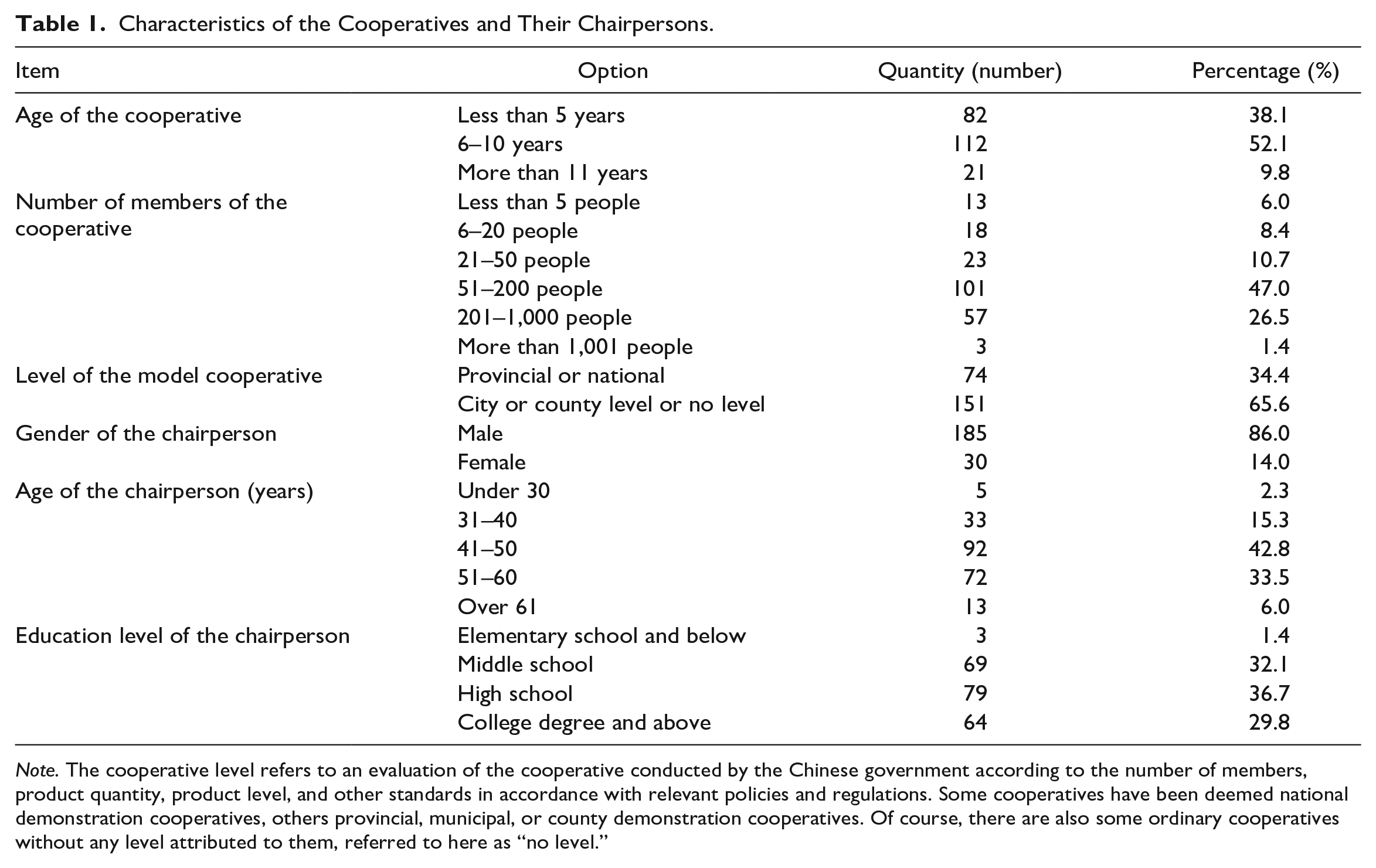
Note. The cooperative level refers to an evaluation of the cooperative conducted by the Chinese government according to the number of members, product quantity, product level, and other standards in accordance with relevant policies and regulations. Some cooperatives have been deemed national demonstration cooperatives, others provincial, municipal, or county demonstration cooperatives. Of course, there are also some ordinary cooperatives without any level attributed to them, referred to here as “no level.”
Variables
E-commerce sales behavior
The e-commerce sales behavior of a cooperative refers to behavior that involves the use of e-commerce technology—such as self-built and third-party platforms—to sell the cooperative’s agricultural products, with the aim of expanding sales. It is measured by “whether the cooperative adopted e-commerce sales behavior?,” and is a dichotomous variable. Cooperatives’ e-commerce sales behavior and the time of the sales are illustrated in Appendix A.
Technology perception
Perception refers to the process of paying attention to something, trying to collect and understand information about it, and becoming familiar with it due to the influence of existing interests (Atanu et al., 1994; J. Tang et al., 2013). “Technology perception” means that subjects with a certain knowledge set acquire further empirical knowledge and skills through experiencing, perceiving, understanding, and summarizing problems, and they assess and select solutions by continuously categorizing their experiences to form effective behaviors. Therefore, in this study, we divide technology perception into three aspects: technical knowledge, perceived convenience, and perceived effectiveness, using a 5-point Likert-type scale (Li et al., 2017). The specific descriptions of the three dimensions of technology perception are given in Appendix B.
Government support
In developing countries such as China, relevant government departments design policies to support, guide, and sustain the development of e-commerce sales of agricultural products. For example, human resources and technical training and instruction, where the government selects and sends technical experts to “go to the countryside” and encourages cooperative members to participate in group training, online sessions, and expert lectures to improve their knowledge and understanding of e-commerce sales. There is also financial support, where the government provides subsidies and loans to support the development of agriculture e-commerce. Therefore, in this study, we use a 5-point Likert-type scale by asking “how strong is the government support for e-commerce?” to measure government support (Lu, 2018). The government support is represented as seen in Appendix C.
Control variables
To avoid multicollinearity problems affecting the estimation results, according previous studies control variables were chosen to be as representative as possible (Li et al., 2017; Zeng et al., 2019). For the individual characteristics of the chairperson, four variables were selected: gender, age, education level, and identity (ordinary farmer or large farmer/rural broker/village cadre/enterprise member). For the organizational characteristics of cooperatives, three variables were selected: number of members, form of establishment, and stage of growth.
Instrumental variable (IV)
Based on the relevant literature (Cui & Liu, 2019; Lei et al., 2012), this study selected “whether the cooperative is involved in community development?” as an instrumental variable for technology perception. The reason is that the community is an important place to disseminate knowledge and skills to the directors, which can improve their technical perception to a certain extent, and it is also an important social place for the chairperson, which can indirectly improve their technical awareness through communication and learning. Meanwhile, “whether the cooperative is involved in community development?” does not directly affect cooperatives’ e-commerce sales behavior.
Method
The decision of cooperatives’ e-commerce sales behavior is represented by two possibilities: “adopted” and “not adopted,” which fit a discrete choice model. The probit model was selected to analyze the factors affecting the e-commerce sales behavior of the cooperatives. According to the definition of the probit model:

The equation for the relationship between of Y and Y* is:

Equation 1 was transformed to obtain the regression equation model:

Y is the explanatory variable indicating whether the cooperative adopted e-commerce sales; p is the probability; and Xi is the explanatory variable—the n factors to be evaluated that affect the cooperatives’ adoption of e-commerce sales.
Results
Probit Estimation and Marginal Effect Analysis
Technical knowledge in technology perception
The technical knowledge of the chairperson has a positive impact on the e-commerce sales behavior of the cooperative. When the chairperson’s technical knowledge of e-commerce increases by 1%, the probability of the cooperative adopting e-commerce sales increases by 6.66%. The finding shows that the chairperson’s technical knowledge of e-commerce has a significant impact on the e-commerce sales behavior of the cooperative. The higher the chairperson’s level of technical knowledge of e-commerce is, the more likely the cooperative is to adopt e-commerce sales behavior. The chairperson who understands e-commerce technology, will adopt it. As cooperative members have a relatively low level of education and limited inclination to learn new technologies, the more technical knowledge they have about the technology itself, the more capable they will be of adopting e-commerce sales behavior.
Perceived convenience in technology perception
The chairperson’s perceived convenience has a positive influence on the cooperative’s e-commerce sales behavior. When the chairperson’s perceived convenience of e-commerce increases by 1%, the probability of cooperatives adopting e-commerce sales increases by 6.48%. The finding shows that the higher the chairperson’s perceived convenience of e-commerce is, the more likely the cooperative is to adopt e-commerce sales. The chairperson’s perceived convenience of e-commerce has a slight influence on the e-commerce sales behavior of the cooperatives. The chairperson believes that e-commerce is easy to learn and use before adopting e-commerce technology.
Perceived effectiveness in technology perception
The chairperson’s perceived effectiveness has a positive impact on the e-commerce sales behavior of the cooperatives. When the chairperson’s perceived effectiveness of e-commerce increases by 1%, the probability of the cooperative adopting e-commerce sales increased by 15.11%. The finding shows that the higher the level of the chairperson’s perceived effectiveness of e-commerce is, the more likely the cooperative will be to adopt the e-commerce sales behavior. The chairperson’s perceived effectiveness of e-commerce has an extremely significant impact on the cooperative’s e-commerce sales behavior. The cooperatives in the development stage pay more attention to the direct economic benefits that e-commerce sales can provide. The higher the economic benefits of e-commerce sales, the more likely they are to engage in e-commerce sales behavior. The chairperson believes that e-commerce sales produce significant economic results for the cooperative, will adopt it.
Government support
Government support has a positive impact on cooperatives’ e-commerce sales behavior. When the level of government support increases by 1%, the probability of a cooperative adopting e-commerce sales increases by 6.33%. This indicates that the stronger the government support, the more likely it is that cooperatives will adopt e-commerce sales behavior. With government support—which covers relevant policies and technical training and instruction—and financial support, the economic and technical difficulties faced by cooperatives are alleviated to some extent, which helps in their adoption of e-commerce sales behavior. E-commerce promotion and training by the government gives cooperative members a deeper understanding of e-commerce technology and reduces the costs of cooperatives, encouraging them to implement e-commerce sales.
Control variables
Stage of growth has a positive impact on cooperatives’ e-commerce sales behavior. When the stage of growth increases by 1%, the probability of a cooperative adopting e-commerce sales increases by 7.86%. The finding shows that the higher stage of growth is, the more likely the cooperative will be to adopt the e-commerce sales behavior. Cooperatives at a higher stage of development have a certain size of membership, sufficient capital, and longer-term ties with government departments, so they are more likely to understand e-commerce sales techniques and adopt them (Table 2).
Estimation Results.
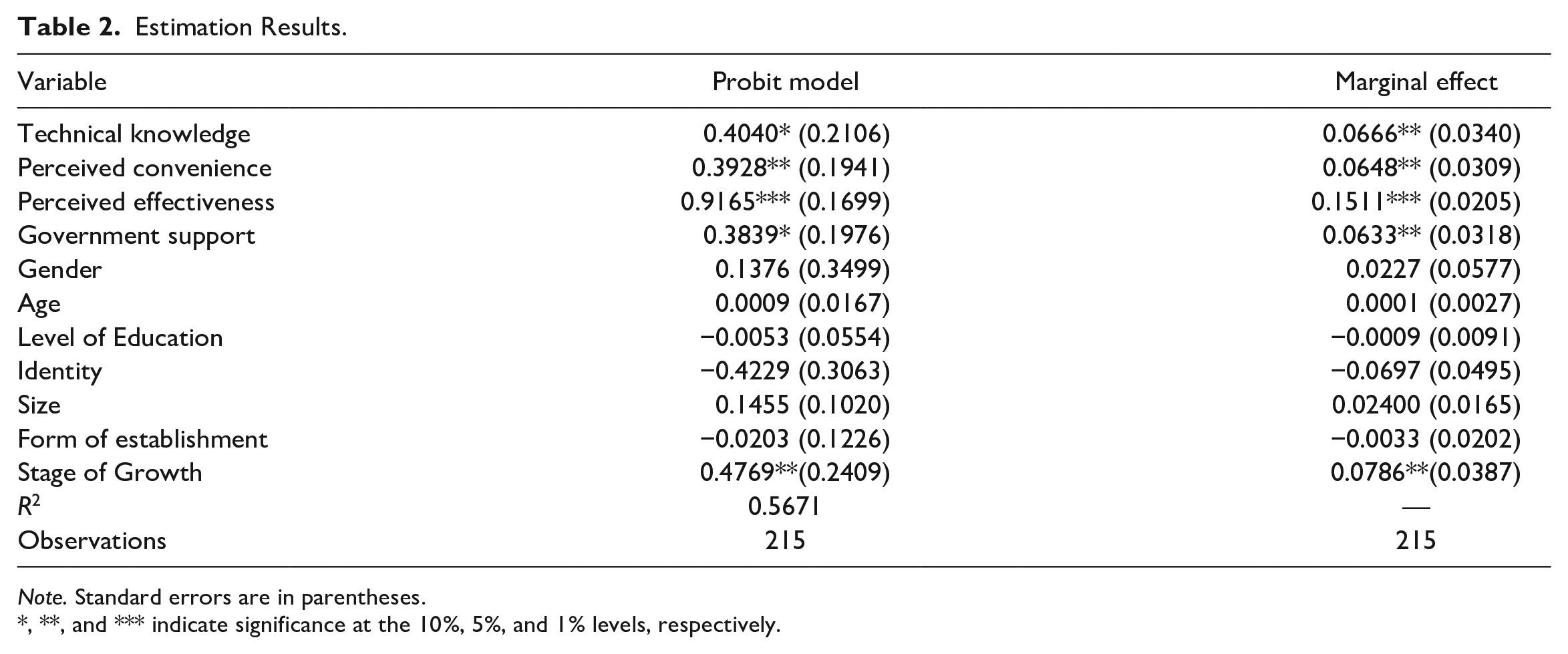
Note. Standard errors are in parentheses.
, **, and *** indicate significance at the 10%, 5%, and 1% levels, respectively.
Robustness Test
To reduce the influence of the multicollinearity problem, this study performs robustness test. This study incorporated technical knowledge, perceived convenience, and perceived effectiveness in the level of technology perception, performed a probit regression, and then added the variables of technology perception and government support to obtain Model 1 and Model 2, respectively. The results of the regression are shown in Table 3 and indicate that the impacts of technology perception and government support on cooperatives’ e-commerce sales behavior are positive and significant at the 1% level, which is consistent with the baseline regression results presented.
Robustness Test Results.

Note. Standard errors are in parentheses.
, **, and *** indicate significance at the 10%, 5%, and 1% levels, respectively.
Endogeneity Test
To solve the endogenous problems that may exist in the baseline regression, this study chooses “whether the cooperative is involved in community development?” as the instrumental variable of the chairperson’s technology perception to test the endogenous problems.
The regression analysis in this study is conducted using the IV-probit model, as shown in Table 4. In the first stage estimation, whether the cooperatives participate in community governance has a significant positive impact on their technology perception, indicating that the instrumental variables are strongly correlated with technology perception. The F-value is 31.12, and its p-value is 0.001, indicating that there is no weak instrumental variable problem. In the second stage estimation, the Wald test rejects the exogenous hypothesis at least at the 1% level, indicating that there is an endogeneity problem in the baseline regression. The results of the IV-Probit model show that the coefficient on technology perceptions is positive and significant at the 1% level. It indicates that the higher the technology perception, the more likely the cooperative adopts e-commerce sales.
Endogenous Processing: Instrumental Variable Method.

Note. Standard errors are in parentheses.
, **, and *** indicate significance at the 10%, 5%, and 1% levels, respectively.
The Accelerating Effect of Government Support
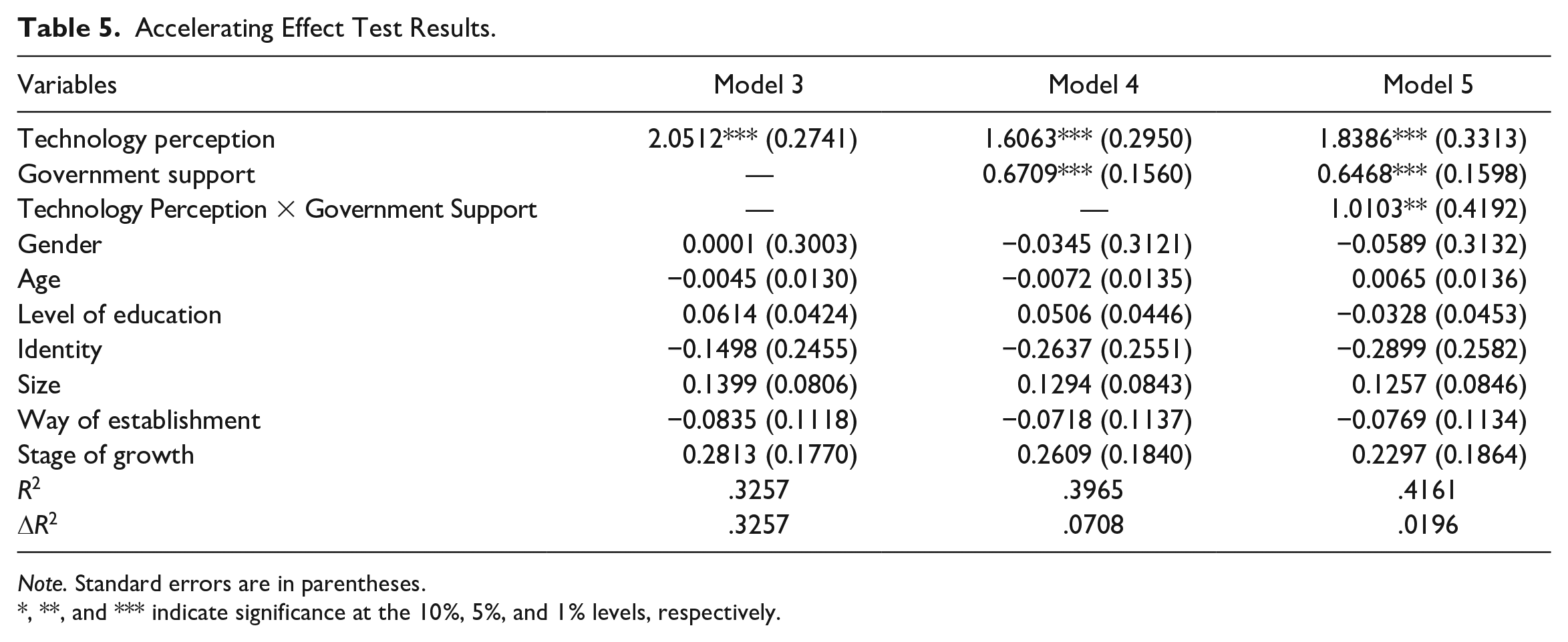
In the measurement of the accelerating effect, this study adopted the steps for testing accelerating variables and the criteria for judging accelerating effects to process and analyze the empirical data. The independent variables and the accelerating variables were zero-centralized before the interaction term was constructed, where each data point of each variable subtracted its mean value, so that the influence of multicollinearity could be as close to eliminated as possible. The results are shown in Table 5.
Accelerating Effect Test Results.
Note. Standard errors are in parentheses.
, **, and *** indicate significance at the 10%, 5%, and 1% levels, respectively.
Model 3 was used to test the relationship between technology perception and the e-commerce sales behavior of the cooperatives, and the test was passed. Furthermore, on the basis of Model 3, Model 4 passed the significance test after adding the accelerating effect of government support with ΔR2 = .0708, indicating that the overall explanatory power of Model 4 increased after the accelerating variable was added. Finally, after adding the interaction between technology perception and government support, the explanatory power of Model 5 increased, with a β of 1.0103, significant at the 5% level. This indicates that government support has a positive accelerating effect on technology perception and cooperatives’ e-commerce sales behavior. Governmental departments actively help solve the difficulties encountered by cooperatives in adopting e-commerce sales behavior; reduce technical barriers, risks, and uncertainties; and improve the members’ level of perception of the convenience of e-commerce, thus encouraging the cooperatives to adopt e-commerce sales behavior.
Discussion
The first research question explored the impact of technology perception on cooperative e-commerce sales behavior. It was found that technology perception has significant positive impacts on a cooperative’s e-commerce sales behavior, where the higher the technology perception is, the more likely the cooperative will be to adopt e-commerce sales behavior. The conclusion is consistent with the broader view in the literature that individual perception has an impact on individual (organizational) behavior (Li et al., 2017). The more clearly the chairperson understands the technology itself, technical convenience, and technical effectiveness, the better the cooperative can make e-commerce behavioral decisions according to the actual state of the cooperative.
With regard to the second research question on whether government support affects cooperative e-commerce sales behavior, it was found that government support has significant positive impacts on a cooperative’s e-commerce sales behavior, where the stronger government support is, the more likely the cooperative will be to adopt e-commerce sales. The conclusion is consistent with the broader view in the literature that government support has an impact on individual (organizational) behavior (Li et al., 2017). By formulating relevant policies and consolidating economic resources, the government supports and guides cooperatives to use e-commerce to help expand sales channels, to a large extent alleviating the worries of cooperatives.
The study also analyzes the marginal effects of technology perception and government support of the e-commerce sales behavior of cooperatives. The results show that, compared with government support, technology perception has a greater effect on cooperatives’ e-commerce sales behavior. This conclusion is inconsistent with the views of several scholars (Li et al., 2017). The technology upon which e-commerce sales rely is different from the production technology—such as water-saving irrigation technology and fertilization technology—so the effect of governmental promotion is not significant. Furthermore, since a cooperative is a mutual-aid economic organization comprised mainly of farmers, its decision-making behavior is primarily characterized by the goal of profit. If the agricultural products sold by e-commerce can generate considerable economic benefits in the short term, the more likely the cooperatives are to use e-commerce for sales.
For the third research question, examining whether government support has an accelerating effect on technology perceptions affecting cooperative e-commerce sales behavior. It was found that government support has a positive accelerating effect on technology perception and cooperatives’ e-commerce sales behavior. In developing countries such as China, government behavior is an important factor influencing individual (organizational) behavior. The government has taken various measures through administrative, legal, or economic means to enhance the degree of influence of technology perceptions on the e-commerce sales behavior of cooperatives.
Conclusion
In this study, we conducted the research using survey data, and analyzed the impact of technology perception and government support on cooperatives’ e-commerce sales behavior. We constructed an initial model by the probit model and applied a marginal effects test, performed a robustness analysis to test the variable stationarity, and built the instrumental variables method for the endogeneity test. The analysis result shows that (a) technology perception and government support have significant positive impacts on cooperatives’ e-commerce sales behavior; (b) compared with government support, technology perception has a greater effect on cooperative’s e-commerce sales behavior. Among them, the ranking of the degree of influence is perceived effectiveness in technology perception, technical knowledge in technology perception, perceived convenience in technology perception, and government support; and (c) government support plays an accelerating role between technology perception and cooperatives’ e-commerce sales behavior.
Our results confirm the existing empirical evidence that technical awareness and government support have significant impacts on cooperatives’ e-commerce sales behavior. This study makes a number of theoretical contributions to the literature on e-commerce sales behavior. First, based on the theory of planned behavior, this study reveals the influence that technology cognition and government support have on e-commerce sales behavior, highlights the differences in their effects, and tests how their interaction affects e-commerce sales behavior. Second, this study tests the regulatory effect of government support on technology cognition and e-commerce sales behavior. In doing so, it extends the previous research on the impact of technology cognition and government support on e-commerce sales behavior. Third, from the research object perspective, this article focuses on the cooperative, a new agricultural operator. Farmers, as the main actors in cooperatives, are facing serious challenges in regard to sales, which consequently restricts their survival and development. The emergence of e-commerce can provide them with new sales channels. Therefore, this study is of great significance to the research on cooperative e-commerce sales behavior.
Although this article has made a few contributions in theory and practice, it is not without limitations. First, the adoption of e-commerce sales by individuals or organizations should be a gradual process, usually in a dynamic form (Abdoulaye & Sanders, 2005). Owing to the difficulty of data collection and other extenuating factors, the cross-section data used for analysis in this article are lacking in terms of the adoption behavior of simulation dynamic technology (F. H. Zhang et al., 2017). To improve the reliability of the results, cooperatives must be tracked and analyzed with panel data in the future. Second, the data in this article are all from the sample survey of cooperatives in Liaoning Province, China, so the generalizability of the results is limited. Therefore, to mitigate this, the survey area should be expanded in the future and sampling surveys must be carried out in several provinces, or even nationwide, to collect adequate data. Finally, the results show that the technical cognition and government support of the president of the cooperative has a positive impact on the cooperative’s e-commerce sales behavior. However, government support has no accelerating effect on effective cognition and cooperative e-commerce sales behavior. Therefore, in the future, government support must be subdivided and the intermediary role of other indicators must be explored.
Footnotes
Appendix A
Appendix B
Variables of the Cooperative Chairperson’s Technology Perception.

| Variables | Very low | Low | Normal | High | Very high | |||||
|---|---|---|---|---|---|---|---|---|---|---|
| Quantity (number) | Percentage (%) | Quantity (number) | Percentage (%) | Quantity (number) | Percentage (%) | Quantity (number) | Percentage (%) | Quantity (number) | Percentage (%) | |
| Technical knowledge | 5 | 2.33 | 58 | 26.98 | 88 | 40.93 | 48 | 22.33 | 16 | 7.44 |
| Perceived convenience | 4 | 1.86 | 48 | 22.33 | 86 | 40.00 | 62 | 28.84 | 15 | 6.98 |
| Perceived effectiveness | 10 | 4.65 | 46 | 21.40 | 60 | 27.91 | 49 | 22.79 | 50 | 23.26 |
Appendix C
Government Support Variables.

| Variable | Very low | Low | Normal | High | Very high | |||||
|---|---|---|---|---|---|---|---|---|---|---|
| Quantity (number) | Percentage (%) | Quantity (number) | Percentage (%) | Quantity (number) | Percentage (%) | Quantity (number) | Percentage (%) | Quantity (number) | Percentage (%) | |
| Government support | 7 | 4.65 | 28 | 21.40 | 104 | 27.91 | 59 | 22.79 | 17 | 23.26 |
Author Contributions
All authors contributed equally to the article.
Declaration of Conflicting Interests
The author(s) declared no potential conflicts of interest with respect to the research, authorship, and/or publication of this article.
Funding
The author(s) disclosed receipt of the following financial support for the research and/or authorship of this article: This work was supported by the National Social Science Fund of China (grant no. 19BJY168), National Natural Science Foundation of China (grant no. 71840010), Project of Liaoning Education Department (grant no. WSNFW201903), and Liaoning Revitalization Talents Program (grant no. XLYC1904014).
