



Abstract
This research delves into the intricate relationship between special education majored students’ perceptions of classroom atmosphere and their learning engagement, while also investigating the mediating influence of professional identity and the moderating effect of future orientation. A survey involving 582 special education majored students was conducted, utilizing the Student Perceived Class Atmosphere Scale, Learning Engagement Scale, College Students Professional Identity Scale, and Future Orientation Questionnaire for data collection. The collected data underwent thorough organization and statistical analysis using SPSS 24 software.
The research results show that: (1) Special education majored students’ perception of class atmosphere has a positive predictive effect on learning engagement; (2) Professional identity plays an important mediating role between perception of class atmosphere and learning engagement; (3) Future orientation significantly moderates the direct path between special education majored students’ perceived class atmosphere and learning engagement, and moderated the second half of mediation models, the relationship between professional identity and special education majored students’ learning engagement. These research results enrich the theory of special education and have practical significance for improving the quality of special education teacher training.
Plain language summary
This study investigates the causal pathways by which special education undergraduate students’ perceptions of classroom atmosphere affect their levels of learning engagement, mediated by professional identity and moderated by future orientation. The research findings indicate that a positive perception of the classroom atmosphere positively influences learning engagement, with professional identity playing a pivotal mediating role. Moreover, future orientation is found to moderate the direct relationship between students’ perceptions of the class atmosphere and learning engagement, as well as the mediating effect of professional identity. The study underscores the significance of cultivating a conducive classroom environment for special education undergraduates, enhancing their professional identity development, and fostering future-oriented thinking to promote active engagement in learning tasks within the special education field.
Keywords
Introduction
The status of teachers directly affects the stability and development of special education in China. To run special education well so that every child can enjoy fair and high-quality education, it is urgent to cultivate a group of special education teachers who are dedicated to their work and have a high level of professionalism (Biggs et al., 2016; Snoek, 2010). As an important factor affecting the academic performance of special education majored students, learning engagement is an important indicator to measure the quality of special education talent training (Anderson et al., 2004; McLeskey et al., 2017). It is a psychological concept related to learning characterized by a constant presence of positive emotions, strong motivation, and evident in three distinct aspects: vitality, dedication, and concentration. The attention of scholars has been drawn towards the intricate process of learning engagement among special education students, which is affected by various factors such as individual characteristics, educational settings, and the environment (Kahu, 2013; Lu et al., 2022; Major, 2012).
Special education is a crucial field within the education sector that focuses on catering to the unique needs of students with diverse learning challenges and disabilities. Special education teachers play a pivotal role in creating inclusive and supportive learning environments that enable students to thrive academically, socially, and emotionally. The classroom atmosphere, as perceived by special education majored students, encompasses a wide range of factors such as teacher-student interactions, peer relationships, classroom management techniques, and overall support structures.
The learning engagement of special education majored students is essential for their academic success and overall well-being. Learning engagement refers to the extent to which students are actively involved, motivated, and invested in their learning experiences. For students studying special education, high levels of learning engagement are not only beneficial for their own educational outcomes but also for their future roles as effective special education teachers.
The ecological system theory holds that individual development is nested in the context in which it is located (Neal & Neal, 2013; Wu & David, 2002), and the interaction between the individual and the environment promotes learning engagement (Bundick et al., 2014; Luo et al., 2022). Class organization and management, teacher-student interaction, and peer relationships together constitute the class social environment, which is an important micro-environment that affects learning (Guenther & Miller, 2011; Neufeld et al., 2006). Class atmosphere refers to the stability and positivity of the class, including peer relationships, teacher-student relationships, and class organization (Fraser & Walberg, 2005; Koenen et al., 2022; Pianta et al., 2012). Previous research on class atmosphere focused on the field of basic education. The class atmosphere perceived by students can significantly predict individual social adaptation, self-efficacy, learning motivation, and academic performance (Jiang et al., 2017; Ucar & Sungur, 2017). Classes are the basic units for educational, teaching, and management activities on university campuses. Class atmosphere also has an important impact on college students’ physical and mental adaptation and academic performance (Chemers et al., 2001; Reyes et al., 2012). A foreign survey on college students’ learning engagement found that effective class management has a significant impact on students’ perception, behavior, and learning engagement (Anjarwati & Sa’adah, 2021; Diemer et al., 2012). Research has also found that factors in the class social ecological environment, such as teacher-student relationship, teacher-student interaction, and student classroom participation, have varying degrees of impact on the learning engagement of college students in different disciplines (Pianta et al., 2012; Varga, 2017). However, previous studies have focused more on the relationship between the two and less on its internal mechanism. Ecological systems theory emphasizes that environmental factors and individual characteristics will affect behavioral outcomes, and environmental factors will also have an effect through individual cognition and experience (D. P. Ryan, 2001).
Exploring the mediating variables and moderator variables between perceived environmental factors and learning engagement will help to understand how and when perceived class atmosphere plays a role. It can further enrich subsequent research on the relationship between the two and help carry out targeted educational practices. Therefore, based on the perspective of individual students, this study examines the impact of special education majored students’ perceived class atmosphere (subjective environment) on learning engagement (behavioral results), and reveals the mediating role of professional identity (psychological process) and future orientation (individual traits) mediate this mediating process.
Professional identity is an individual’s acceptance and recognition of the major he or she has studied, reflecting an individual’s continuous cognitive and behavioral involvement and positive emotional state in the learning process, including cognitive, emotional, behavioral, and social factors (Ivanova & Skara-MincĿne, 2016), is a psychological process in which individuals actively accept professional learning and gradually converge emotionally and behaviorally. According to the “Contest-Process-Outcome Model” (Roeser et al., 1996), professional identity is an internal psychological variable of an individual, which is gradually produced by the individual in contact with family, school, and social environment. It is a dynamic psychological process of recognizing, accepting, and liking the major studied, and being willing to learn and explore with a positive attitude and proactive behavior (Canrinus et al., 2011, 2012). Its formation process is affected by the subjective environment, such as perceived social support, teacher-student interaction and the influence of cooperation with peers (Osterman, 2023; Ruzek et al., 2016). Good class interpersonal relationships, teacher-student interaction and professional learning atmosphere can enhance students’ professional cognition and professional emotions, stimulate happy learning emotions, and promote professional identification (Brekelmans et al., 2002; Osterman, 2023; Price, 2008). A survey of visiting students in American universities found that teacher-student interaction, student interpersonal relationships, and flexible classroom organization forms (such as online classes, MOOCs, micro-classes and flipped classrooms, etc.) are all important factors that affect professional identity (Pianta et al., 2012; Ruzek et al., 2016; Wubbels et al., 2014). Professional identity also affects the learning engagement of special education majored students (Wang et al., 2020; Zhang et al., 2018). According to the “cognition-emotion-behavior” theory, professional identity is based on professional cognition, generates emotional connections, and stimulates continued behavior motivation, thus affecting learning engagement. Students with high professional identity have a positive emotional connection with professional learning, which enables students to have positive learning motivation and initiative, thereby increasing learning engagement. On the contrary, students with low professional identification have a negative emotional connection with professional learning, are prone to learning burnout, reduce learning initiative, and reduce learning engagement.
Existing research has confirmed that professional identity can promote positive academic emotions and positively predict learning engagement (Canrinus et al., 2012; Lei et al., 2018; Yu et al., 2021). Research by Rowe et al. (2023) and Xu et al. (2023) also found that professional identity and school belonging have an impact on college students’ learning engagement. The joint prediction is significant and can jointly explain 48.8% of learning engagement, among which professional identification has the strongest prediction effect. In addition, the mediation model “perceived class atmosphere → professional identity → learning engagement” assumes that, consistent with the basic view of the ecological system operating mechanism of learning engagement, class environmental factors (such as perceived class atmosphere) will affect students’ psychological processes (such as sense of belonging and identity), which in turn affects behavioral outcomes (such as learning engagement). Therefore, this study hypothesizes that professional identity may be a mediating variable between perceived class atmosphere and learning engagement.
There may be certain conditionality in the direct or indirect relationship between perceived environmental factors and academic performance. For example, Hardré and Sullivan (2008) believes that there are individual differences in the impact of students’ perceived environmental factors on academic performance. The research by Mazzetti et al. (2020) further confirmed that future orientation can moderate the relationship between perceived environmental factors and academic performance. College students are in the transition stage of future planning. As their exploration level gradually increases, they will invest more time and energy in planning for future development. Therefore, this study speculates that future orientation may be an important moderator variable of perceived class atmosphere and learning engagement. Future orientation refers to an individual’s tendency to prioritize thoughts and behaviors that are focused on the future. It is also an individual’s thinking and planning for the future, and includes three psychological processes: motivation, planning, and evaluation (Sharp & Coatsworth, 2012).
On the one hand, future orientation promotes individuals to proactively analyze the advantages of environmental resources and plan for the future, rather than passively accepting environmental influences and showing active learning behaviors (Aspinwall, 2005); on the other hand, future orientation promotes individuals to reflect on the future. Professional orientation and attitude can reduce the adverse effects of social prejudice, deepen professional cognition, influence professional orientation and learning attitude, and promote professional identity (Van den Boogaard et al., 2019; Village, 2011). Therefore, future orientation may mediate the impact of perceived class atmosphere on professional identity.
In addition, personal characteristics are regarded as an important mediating device between professional identity and professional learning behavior (Pereira et al., 2015; Yi et al., 2023), and future orientation is considered an important factor in promoting professional identity and low student engagement in learning. According to the “value-control” theory, future orientation has also been confirmed to have an important regulatory role between academic emotions and academic performance (Seginer, 2009). Then the future orientation of special education majored students may play a moderating role in the process of professional identity affecting learning engagement. However, due to the relative lack of relevant empirical research, this study makes assumptions about the moderation model based on the connotation of variables and the relationship between variables: Individuals who possess a strong future orientation tend to prioritize thoughts about future careers, possess the ability to independently explore, and foster a sense of personal identity. As a result, this can potentially diminish the connection between perceived classroom atmosphere and levels of engagement in learning, weaken the perception of the correlation between classroom atmosphere and professional identity, and attenuate the association between professional identity and learning engagement.
In short, this study takes special education majored students as the research object and proposes a moderated mediation model. This study aims to explore: (1) The mediating effect of professional identity on the relationship between special education majored school students’ perception of class atmosphere and learning engagement; (2) The moderating effect of future orientation on the direct/indirect relationship between special education majored school students’ perception of class atmosphere and learning engagement, providing a theoretical basis for the pre-service training of special education majored students.
Considering that previous studies have found that the gender, grade, admission type, etc. of the subjects are significantly related to the professional identity and learning engagement of special education majored students (Casuso-Holgado et al., 2013; Khalid, 2019). Therefore, this study controls these variables (Figure 1).
Based on the above statements, the hypothesis model of this article’s research is proposed:

Moderated mediating effect model.
H1: Special education majored students’ perception of class atmosphere has a positive predictive effect on learning engagement;
H2: Professional identity plays an important mediating role between perception of class atmosphere and learning engagement;
H3: Future orientation significantly moderates the direct path between special education majored students’ perceived class atmosphere and learning engagement;
H4: Future orientation moderated the second half of mediation models, the relationship between professional identity and special education majored students’ learning engagement.
Methods
Research Design
In the research design, a comprehensive methodology was adopted to ensure the reliability and validity of the data. Common method bias was mitigated through the utilization of advanced techniques such as anonymous tests, reverse-scoring questions, and Harman’s single factor test, ultimately indicating the absence of significant bias. Descriptive analysis and correlation coefficients were employed to reveal positive associations among variables including special education students’ perceptions of class atmosphere, professional identity, future orientation, and learning engagement. Hierarchical regression analysis and the implementation of Process Model 59 facilitated an examination of the mediating role of professional identity and the moderating impact of future orientation, demonstrating the moderating role of future orientation on the interrelations among the variables. Moreover, the application of the Johnson-Neyman method allowed for an in-depth exploration of the influence of perceived class atmosphere on learning engagement through professional identity across varying levels of future orientation, thereby enriching the analytical depth of the study.
Participants
By employing the convenience sampling method, a diverse pool of 608 participants was recruited from 7 schools situated in the central region, with a specific focus on special education majors. Among this group, 582 questionnaires were deemed valid, representing students across all academic levels, from freshman to senior. Notably, the sample consisted of 186 male participants and 396 female participants.
Measures
Student Perceived Class Atmosphere Scale
Regarding the “Student Perceived Class Atmosphere Scale” utilized in our study, it was constructed based on Schaps et al.’s class environment theory (1996). The questionnaire comprises 3 essential dimensions: peer relationships, teacher-student relationships, and class organization, totaling 20 items scored on a 5-point scale. The underlying theoretical framework of this scale demonstrates strong applicability within the context of studying college student groups.
Peer relationships within the scale refer to the extent to which classmates in the classroom foster a collaborative environment aimed at enhancing unity and cooperation during the learning process. Higher scores on this dimension reflect improved quality of cooperative interactions among peers. Teacher-student relationships capture the nature of interactions between educators and students, with higher scores indicating closer and more positive interactions. Class organization assesses factors such as management, order, and discipline within the classroom, where a higher score signifies better organization and effective management.
Notably, in our study, the Cronbach’s α coefficients for the three distinct dimensions of peer relationship, teacher-student relationship, and class organization were determined to be .90, .94, and .90, respectively. Moreover, the overall Cronbach’s α coefficient for the entire scale was calculated to be .96, indicating strong internal consistency reliability.
Learning Engagement Scale
It utilizes the UWES-S developed by Schaufeli et al. (2002). Which consists of a total of 17 items across 3 dimensions: vitality, dedication, and concentration. The scale is rated on a 7-point scale based on the frequency of occurrence. Vitality refers to the energy and enthusiasm experienced during the learning process, with a higher score indicating a better level of energy. Dedication represents the positive emotional experiences gained during learning, and a higher score indicates greater positive emotions. Concentration measures the level of focus during the learning process, with a higher score indicating increased positive emotions and enhanced concentration. In this study, the Cronbach’s α coefficients for the 3 dimensions of vitality, dedication, and concentration were .90, .87, and .92, respectively. The Cronbach’s α coefficient for the overall scale was .96.
Professional Identity Questionnaire
The professional identity scale for college students compiled by Qin (2009) was utilized for measurement. The scale comprises four dimensions: cognitive, emotional, behavioral, and appropriateness. A total of 23 items are assessed on a Likert-5 scale. Cognitive dimension reflects the level of understanding of the professional field, with a higher score indicating a greater understanding. Emotional dimension reflects the level of emotional affinity towards the major, and a higher score signifies more positive emotions related to the major. Behavioral dimension assesses the engagement and involvement in major-related activities, and a higher score indicates more positive behavior towards the major. Appropriateness dimension reflects the level of alignment between the major and personal preferences, with a higher score representing a greater matching degree. In this study, the Cronbach’s α coefficients for the cognitive, emotional, behavioral, and appropriateness dimensions were .85, .90, .84, and .80, respectively. The Cronbach’s α coefficient for the entire questionnaire was .93.
Future Orientation Questionnaire
The Future Orientation Questionnaire compiled by Liu et al. (2011) was used to measure individuals’ cognitive preferences and volitional action tendencies towards future time. The questionnaire has a total of 31 items, consisting of 3 dimensions, namely future cognition, future emotion, and future volitional action. Each dimension contains two factors and is scored on a five-point scale. Future cognition includes density and breadth. Density is the frequency of thinking about the future, and breadth is the extension of future time. Thinking is worry and fear about the future, and optimism is positive about the future. Future volitional actions include planning and execution. Planning is the ability to achieve goals, and execution is a positive action taken to achieve the goal. The Cronbach’α coefficients of the three dimensions of future cognition, future emotion and future volitional action are .81, .85, and .79 respectively, and the Cronbach’α coefficient of the total questionnaire is .90.
Procedure
This study was approved by the Ethics Committee in July 2023. Data collection began on July 25, 2023 and completed on October 15, 2023. At the beginning of the experiment, all experimental participants must sign a paper version of informed consent form. Upon securing informed consent from both the school administration and the students themselves, proficient psychology teachers were designated as the primary invigilator, responsible for the organization and administration of the examinations on a class-specific basis. The administration process involved the dissemination of four questionnaires in a specific order to the students. Clear instructions detailing the content and expectations of the assessments were uniformly presented by the examiners. The completion of the examination typically took around 45 min per student. After the completion of the questionnaires, they were promptly collected for further analysis.
Results
Common Method Bias Test
This study used measures such as anonymous tests and reverse-scoring questions to control common method bias. Harman’s single factor test method (Podsakoff et al., 2003) was used to test the data. The unrotated exploratory factor analysis results extracted 15 factors with characteristic roots greater than 1. The first common factor only explained 25.39%, of the variation which less than the critical value of 40% (Greenland et al., 2016). Therefore, the common method bias in the data of this study is not serious.
Descriptive Analysis and Correlation Coefficient
Table 1 presents the descriptive results of each variable and the correlation coefficient between each variable. The results show that there are significant positive correlations among the variables of special education majored students’ perceived class atmosphere, professional identity, future orientation, and learning engagement.
Mean/Standard Deviation and Correlation Coefficient of Each Variable.

p < .05. **p < .01.
The Mediating Role of Professional Identity and the Moderating Role of Future Orientation
Hierarchical regression analysis is a statistical method used to analyze the relationship between a dependent variable and multiple independent variables by entering them into the regression equation in a specific order. The hierarchical regression analysis method proposed by Wen (2012) was employed to conduct regression analysis, examining the relationships between perceived class atmosphere and professional identity, perceived class atmosphere and learning engagement, and perceived class atmosphere, professional identity, and learning engagement. The results were presented in Table 2.
Regression Analysis of Learning Engagement on Perceived Class Climate/Professional Identity.

p < .05. **p < .01.
After controlling for gender, grade, and admission type, perceived class atmosphere significantly influences professional identity (B = 0.201, R2 = .037, t = 4.717, p < .01), as well as learning engagement (B = 0.351, R2 = .105, t = 8.243, p < .01). Moreover, even when considering the mediating variable, the direct impact of perceived class atmosphere on learning engagement remains significant (B = 0.290, t = 7.010, p < .01). Additionally, professional identity significantly contributes to learning engagement (ΔR2 = .082, B = 0.303, t = 7.655, p < .01), indicating its crucial role in the link between special education majored students’ perception of class atmosphere and learning engagement. According to the results, there is evidence of partial mediation in the relationship between perceived class atmosphere and learning engagement. The total effect from perceived class atmosphere to learning engagement is 0.351, with a direct effect of 0.290 (see Table 2). The mediation effect is calculated as 0.303 × 0.201 = 0.061, and the 95% confidence interval for the mediation effect is [0.0284, 0.101]. The proportion of the total effect accounted for by the mediation effect is 0.061/0.351 = 0.174, suggesting that 17.4% of the impact of perceived class atmosphere on learning engagement in special education majored students is mediated by professional identity. As a result, Hypothesis 1 is supported.
In this study, we utilized model 59 (moderated mediation model) of the PROCESS program in SPSS 24.0 software to examine the potential moderating role of future orientation on the relationship between perceived class atmosphere, professional identity, and learning engagement in special education majored students. According to Preacher et al. (2007), if the 95% confidence interval of the indirect effect does not include 0, then the indirect effect is considered significant. Table 3 shows us moderated mediating effect model with future orientation as the moderating variable.
Moderated Mediating Effect Model with Future Orientation as the Moderating Variable.

p < .05. **p < .01.
Upon analyzing the data controlling for gender, grade, and admission type, it was found that perceived class atmosphere significantly and positively predicted professional identity (β = .202, p < .001). However, the interaction between perceived class atmosphere and future orientation had a significant impact on professional identity, while the predictive effect of future orientation on professional identity was not significant (β = −.054, p > .05), with a 95% confidence interval of [−0.142, 0.034]. Consequently, it can be concluded that the first half of the mediating effect of perceived class atmosphere on learning engagement through professional identity was not significantly moderated by future orientation.
Furthermore, the findings indicated that perceived class atmosphere had a significant positive prediction on learning engagement (β = .212, p < .001), and the interaction between perceived class atmosphere and future orientation had a significant predictive effect on learning engagement (β = −.193, p < .05). Therefore, future orientation moderated the direct effect of perceived class atmosphere on learning engagement in special education majored students.
Moreover, professional identity demonstrated a significant predictive effect on learning engagement (β = .312, p < .05), and the interaction between professional identity and future orientation had a significant predictive effect on learning engagement (β = −.251, p < .05). Hence, the second half of the mediating effect of perceived class atmosphere on learning engagement through professional identity was found to be moderated by future orientation.
In summary, Hypothesis 2 is supported as future orientation was found to moderate both the direct and mediating effects of perceived class atmosphere and professional identity on learning engagement in special education majored students.
Model 59 of the PROCESS program was used to test whether the mediating effect size changes with the moderating variable. Testing the mediating effect size changes with a moderating variable using Model 59 in the PROCESS program indicates a sophisticated analysis involving mediation and moderation effects. This model specifically focuses on examining how the strength or direction of a mediating effect may vary based on the levels of a moderating variable.
In the context of the PROCESS program developed by Hayes (2013), Model 59 specifically deals with moderated mediation, where the effect of the independent variable on the dependent variable via the mediator is dependent on the level of the moderator. This type of analysis allows researchers to explore more complex relationships between variables by considering both the mediating and moderating factors simultaneously. Table 4 shows the direct effect of perceived class atmosphere on learning engagement and the mediating effect of professional identity among special education majored students with different future orientation levels.
Perceived Class Atmosphere on Learning Engagement and the Mediating Effect of Professional Identity.
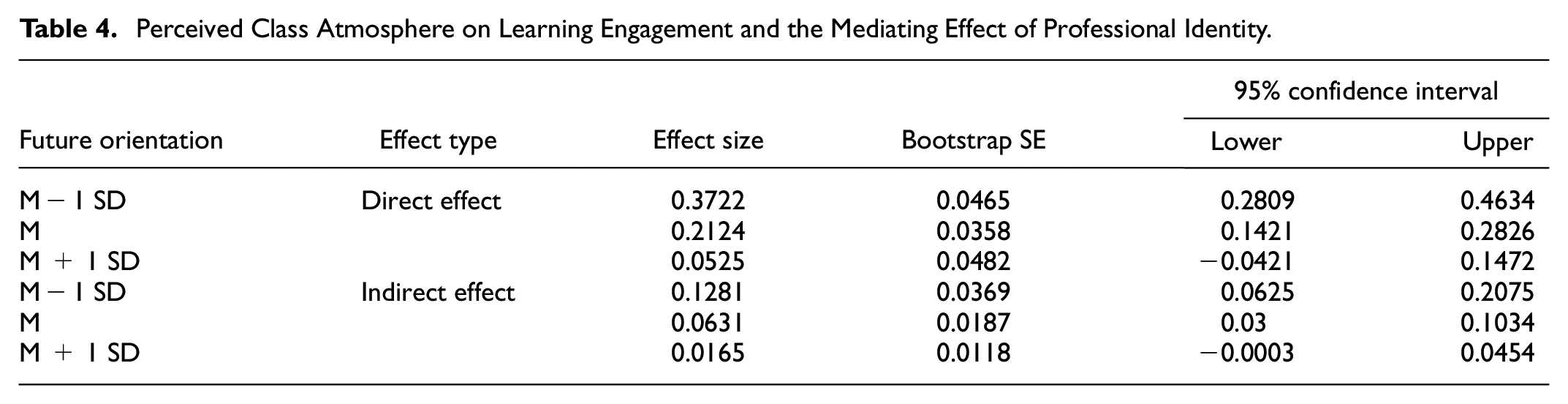
The findings of the study revealed that in the direct path of the relationship between perceived class atmosphere and learning engagement, the influence of future orientation on the impact of perceived class atmosphere on learning engagement was found to be significant at lower levels of future orientation, specifically when future orientation was below one standard deviation and the mean level. However, at levels above one standard deviation, the direct effect of perceived class climate on learning engagement in special education majored students was not significant. This indicates that future orientation has a negative regulating effect on the impact of perceived class climate on learning engagement.
Regarding the second part of the relationship, which involves the mediating variable professional identity, it was observed that when future orientation was lower than one standard deviation and two levels below the mean, the professional identity of special education majored school students significantly influenced their learning engagement. Conversely, when future orientation was higher than one standard deviation, the impact of professional identity on learning engagement was not significant. This suggests that future orientation negatively regulates the influence of professional identity on learning engagement, thereby exerting a negative regulatory effect on the perceived class atmosphere.
To examine the influence of special education majored students’ perceived class atmosphere on learning engagement through professional identification at different levels of future orientation, the Johnson-Neyman method (referred to as the J-N method) was employed. Simple slope tests were conducted, and simple effect diagrams were developed. The approach involved fixing the critical value of the t statistic and determining the threshold at which the simple slope became significant. By considering the entire range of values of the moderating variable, this method overcomes the limitation of testing the significance of the simple slope at only one point at a time (Aguinis, 1995). Figure 2 shows the moderating effect of future orientation.

J-N method on the moderating effect of future orientation.
The abscissa represents the moderator variable of future orientation, while the ordinate denotes the change in the regression coefficient (i.e., slope) in the regression equation. The dependent variable in the equation is majored student learning engagement in special education, the independent variable is perceived class atmosphere, and the moderator variable is future orientation. All variables are standardized. The middle straight line indicates the point estimate, while the upper and lower curves signify the 95% confidence interval values. The dashed straight line corresponds to the point of future orientation. As for the regression coefficient of perceived class climate, it ranges from being statistically significant to insignificant. This figure demonstrates that when the value of future orientation is less than 1.87 standard deviations, perceived class atmosphere positively predicts learning engagement.
The J-N technique’s findings further validated the moderating effect of future orientation. Within the value range of special education majored students’ (standardized) future orientation between −2.097 and 0.651, perceived class atmosphere significantly and positively predicted learning engagement. As future orientation increased, the impact of perceived class atmosphere on learning engagement decreased. This pattern was observed in 77.320% of the sample cases. However, when the level of future orientation surpassed 0.651 standard deviations, the impact of perceived class atmosphere on learning engagement became insignificant.
In the second part of the analysis, with the value range of special education majored students’ (standardized) future orientation between −2.097 and 0.890, professional identification significantly and positively predicted learning engagement. As future orientation increased, the impact of professional identification on learning engagement diminished (Figure 3). This trend was observed in 85.223% of the sample cases. Nevertheless, when the level of future orientation exceeded 0.890 standard deviations, the indirect effect of professional identification on learning engagement was not significant.

J-N method on the moderating effect of future orientation on the relationship between professional identity and learning engagement.
The abscissa represents the moderator variable of future orientation, while the ordinate denotes the change in the regression coefficient (i.e., slope) in the regression equation. The dependent variable in the equation is majored student learning engagement in special education, the independent variable is professional identity, and the moderator variable is future orientation. All variables are standardized. The middle straight line indicates the point estimate, while the upper and lower curves represent the 95% confidence interval values. The dashed straight line corresponds to the point of future orientation. As for the regression coefficient of professional identity, it ranges from being statistically significant to insignificant. This figure demonstrates that when the value of future orientation is less than 0.89 standard deviations, professional identity positively predicts learning engagement.
Discussion
The Relationship Between Perception of Class Atmosphere and Learning Engagement
This study found that special education majored students’ perception of class atmosphere can directly predict learning engagement, which is consistent with previous research results (Koth et al., 2008; Pianta et al., 2012; A. M. Ryan & Patrick, 2001; Solomon et al., 1996), and also confirms the theory of the ecological system operating mechanism of learning engagement. Multiple educational factors such as class organization, curriculum setting and implementation, teaching methods and methods, teacher-student interaction, and peer cooperation jointly constitute the learning situation and affect students’ learning engagement. Teachers and students are key stakeholders within the educational ecosystem, playing pivotal roles in the educational process. Enhancing teachers’ information literacy, upgrading teaching methodologies, and employing diverse approaches such as hybrid teaching models (which integrate traditional face-to-face instruction with online teaching) and virtual simulation experimental teaching, have been identified as effective strategies to stimulate students’ learning initiative and enhance their engagement in the learning process (Lombardi & Oblinger, 2007; Rutten et al., 2012). From the theory of group socialization development, peer interaction affects students’ self-efficacy (Pellas, 2014), and peer participation and support can affect the self-efficacy of surrounding classmates. Learning attitude promotes autonomous learning engagement and good class organization and management help increase support, create a strong learning atmosphere, stimulate strong learning willingness, and increase students’ learning engagement. Therefore, effective ways to improve the learning engagement of special education majored students can be through building harmonious class interpersonal relationships, increasing support, enhancing peer assistance, upgrading teaching methods, deepening teacher-student interaction, and enhancing the learning enthusiasm of special education majored students, thereby promote effective learning engagement.
The Mediating Effect of Professional Identity
Previous research has confirmed the relationship between perceived environmental factors and professional identity (Hilel & Ramírez-García, 2022; Solomon et al., 1996), and the positive predictive effect of perceived environmental factors and professional identity on learning engagement (Liu et al., 2023; Yu et al., 2021; Zhang & Guo, 2023). This study found that professional identity plays a partial mediating effect between special education majored students’ perception of class atmosphere and learning engagement. Professional identity is a dynamic process (Hu et al., 2019; Rich & Schachter, 2012). The perception of class atmosphere by special education majored students affects professional identity, and professional identity directly affects learning engagement. The results of this study support the theory of the ecological operating mechanism of learning engagement. Teacher-student interaction, peer support and class management constitute the micro-environment that affects learning engagement. Professional identity as the cognitive understanding and emotional experience of the special education major, through interaction with the objective environment. The interaction promotes learning engagement.
In the process of perceiving the class environment, special education majored students will gradually assimilate or adapt, recognize and accept the major they learn, and use a positive attitude and proactive behavior to learn and explore (Deemer, 2004). When they perceive the support from the class environment, they will have a strong sense of belonging and identity, and promote learning engagement. This study found that 24.3% of the effect of perceived class atmosphere on learning engagement is through professional identification. Previous research has also found that professional commitment has a mediating effect on special education majored students’ perceived environmental factors and positive academic emotions (Ross & Gray, 2006), which is similar to the results of this study. Forty percentage of the subjects in this study were majored school students who were transferred to the special education major, and their professional identity was obviously lower than that of students with their first choice (Beijaard et al., 2000; White et al., 2011). However, as the policy of free education for majored students continues to advance in local majored colleges, most special education majored students still regard learning as their own responsibilities and obligations and consciously engaged in the learning process.
This may be the reason why the mediating effect size in the mediating effect model of professional identity is not very high. In addition, this study found that after adding the variable of future orientation, when the level of future orientation is higher than 1 standard deviation, the mediating effect of special education majored students’ perceived class atmosphere on learning engagement through professional identity is not significant. It shows that the process of special education majored students’ perception of class atmosphere affects learning engagement through professional identity, and is also moderated by personality traits, which weakens the mediating effect of professional identity on special education majored students’ perception of class atmosphere and its impact on learning engagement. Specifically, in the actual teaching process, creating a good class atmosphere is an effective measure to improve the learning engagement of special education majored students.
The results of this study remind us that to improve the learning engagement of special education majored students, we must pay attention to the process of active construction of individual professional identity and the supporting factors in the formation of professional identity, by deepening teacher-student interaction, enhancing peer mutual assistance, adopting flexible class organization, upgrading teaching methods, deepening professional understanding through professional guidance, enhancing their sense of belonging and identity, let them truly feel the social value and significance of the special education major, and stimulate their lasting and stable intrinsic learning motivation.
Moderating Effect of Future Orientation
This study found that future orientation mediates the relationship between special education majored students’ perceived class atmosphere and learning engagement, and the higher the future orientation, the weaker the impact of perceived class atmosphere on learning engagement. Specifically, when the future orientation level of special education majored students is lower than 0.651 standard deviations, promoting class atmosphere can improve the learning engagement of special education majored students. But when the future orientation level of special education majored students is higher than 0.651 standard deviations, the prediction effect is not significant. In other words, creating a good class atmosphere can effectively promote special education majored students with low future orientation to increase their learning engagement. For special education majored students with low future orientation, special education majored students with high perceived class atmosphere have higher learning engagement than students with low perceived class atmosphere. The essence of future orientation lies in analyzing resource advantages, planning for the future, and implementing proactive and effective coping methods. When promoting learning engagement based on ecological system theory, special education teachers who have high future orientation can maintain a high level of learning autonomy even when the perceived class atmosphere fails to meet their needs. However, the perceived classroom atmosphere has a less significant impact on promoting learning engagement when considering students’ learning needs.
The study further found that future orientation has a moderating effect in the process of special education majored school students’ professional identity affecting learning engagement. This conclusion confirms the theoretical hypothesis: cultivating students’ future orientation is an effective way to promote students with low professional identity and learning engagement (Hunter et al., 2007). Specifically, when the future orientation level of special education majored students is lower than 0.89 standard deviations, improving professional identity can promote the learning engagement of special education majored students. However, when the future orientation level of special education majored students is higher than 0.89 standard deviations, the predictive effect of professional identity on learning engagement is not significant. From the perspective of “value-control” theory, future orientation plays a moderating role in the latter part of the path (professional identity-learning engagement) due to the fact that the professional identity of special education major students stems from their comprehension of the field they are studying. Students with low future orientation are more likely to be affected by the professional status, professional prestige, and professional benefits of special education, resulting in lower learning engagement (Cabras & Mondo, 2018). The higher the level of future orientation of individuals, the more able they are to get rid of the adverse effects of professional bias, and promote special education majored students to think about their own characteristics and environmental resource advantages, and actively plan for the future. At the same time, there are more female students majoring in special education. With the rapid development of special education, more and more women are attracted to invest (Gerber, 2017). When their future orientation level is higher, their learning enthusiasm and initiative increase, and their learning engagement increases, while the impact of professional identity on learning engagement is less obvious. In this study, the moderating effect of future orientation was not significant in the process of special education majored students’ perception of class atmosphere affecting professional identity. Existing research has found that future orientation is a moderating variable between students’ perceived environmental factors and academic emotions (Jin et al., 2019). The moderating effect of future orientation on special education majored students may be reflected in the emotional process of perceived class atmosphere affecting professional identity. However, in this study, the variable of professional identity was examined as a composite total score, which may obscure its role in perceived class atmosphere and professional identity.
Conclusion
This study explores the mediating process through which special education majored students’ perceived class atmosphere affects learning engagement through professional identity, which is moderated by future orientation. The following conclusions were obtained:
(1) Special education majored students’ perception of class atmosphere has a positive predictive effect on learning engagement.
(2) Professional identity plays an important mediating role in the relationship between special education majored students’ perception of class atmosphere and learning engagement.
(3) Future orientation significantly moderates the direct path between special education majored school students’ perceived class atmosphere and learning engagement, and also moderates the second half of the mediating effect, that is, the impact of special education majored school students’ professional identity on their learning engagement.
Implications and Limitations
The findings highlight the significance of creating a positive class atmosphere for special education majored students. Educators and school administrators play a crucial role in cultivating a nurturing and inclusive classroom setting that encourages constructive interactions, fosters mutual respect, and cultivates a strong sense of belonging. An optimistic classroom atmosphere has the potential to significantly impact students’ active participation in learning, ultimately enriching their overall educational journey.
Special education majored students’ professional identity emerged as a crucial factor in mediating the relationship between their perception of the class atmosphere and learning engagement. Educators should focus on interventions and activities that facilitate the development of a strong professional identity among these students. Incorporating career guidance, mentoring programs, and opportunities for practical hands-on experiences can help students connect their classroom learning to real-world applications, thereby increasing their motivation and engagement in the field of special education.
The results indicate that future orientation significantly moderates the relationship between special education majored students’ perceived class atmosphere and their learning engagement. It suggests that students who possess a clear vision of their future goals and aspirations may be more influenced by the class atmosphere in terms of their engagement in learning. Educators should encourage students to set realistic and meaningful goals, provide guidance for career planning, and offer opportunities for students to envision their future in the field of special education. This can enhance the impact of the class atmosphere on their engagement, further motivating them to actively participate and excel in their studies.
By taking these implications into consideration, educational institutions can create an environment that fosters positive perceptions of the class atmosphere, promotes the development of a strong professional identity, and encourages future-oriented thinking among special education majored students. Ultimately, this can lead to increased learning engagement, academic achievement, and career readiness in the field of special education.
While this study sheds light on key aspects of adult education in special education programs, future research should focus on integrating pedagogical intervention strategies and programs to enhance the quality of higher education for adult learners. This could involve the development of tailored interventions to support diverse learning needs within this population.
The findings of this study underscore the importance of incorporating evidence-based practices and pedagogical approaches in higher education settings catering to adult learners in special education. Educators and policymakers can leverage these insights to improve teaching methods and support mechanisms for this unique student demographic.
This research result will help to further enrich the theory of special education pre-service education and provide a basis for improving the special education in majored colleges. Provide practical basis for educating the quality of training of special education majored students. However, this study only examined the group of special education majored students. Due to the particularity and complexity of special education work and the diversity of role awareness, whether the conclusions obtained in this study can be extrapolated to other professional college student groups requires further expanded research. Secondly, this study did not find the moderating role of future orientation in the relationship between special education majored students’ perceived class atmosphere and professional identity. Whether the future orientation of special education majored students plays a moderating role in the process of perceived class atmosphere affecting professional identity needs further study. Third, professional identity is a complex and dynamic process of change, which is a combination of process and state. The future career development prospects of special education majored students are also changing with the changes of the times and changes in corresponding policies. In the future, it can be further verified through follow-up research; finally, this study controlled the gender, grade, and admission type of special education majored students. Future research will divide special education majored students into different subgroups according to school type, admission type, to examine the differences in the relationships between each variable among these groups.
Summary
This study explores the causal mechanisms through which the perceptions of classroom climate by undergraduate students in special education influence their engagement in learning activities, with the mediating role of professional identity and the moderating influence of future orientation. The empirical findings reveal that a favorable perception of the classroom environment significantly enhances learning engagement, with professional identity serving as a critical mediator. Additionally, future orientation is identified as a moderating factor in the direct association between students’ perceptions of classroom climate and their engagement in learning, as well as in the mediating role of professional identity. The study highlights the importance of fostering a conducive classroom environment for undergraduate students in special education, facilitating the development of their professional identity, and encouraging future-oriented thinking to stimulate proactive participation in learning tasks within the field of special education.
Footnotes
Acknowledgements
The author is very grateful to various parties who have helped and were involved in data collection and the implementation of this research, including teachers and students of Huangshan University for participating in this project. Thanks to Liu Jing, a computer professional data processing teacher who help me do the data processing.
Declaration of Conflicting Interests
The author declared the following potential conflicts of interest with respect to the research, authorship, and/or publication of this article: Tan Shaojie as the author of the research paper titled “Exploring the Influence of Perceived Class Atmosphere on Learning Engagement in Special Education Majored Students” declare that there are no conflicts of interest that could influence the outcome or interpretation of this study.
We affirm that we have not received any direct financial support or benefits from any organization or individual that may have a financial or personal interest in the findings of this research. Moreover, we have not received any materials, funding, or other forms of assistance that may have influenced the design, execution, or reporting of the study.
We understand that maintaining scientific integrity is of utmost importance, and we have taken necessary precautions to ensure transparency and objectivity throughout the research process. Any potential conflicts that could arise have been adequately addressed to ensure the validity, accuracy, and impartiality of our findings.
Funding
The author disclosed receipt of the following financial support for the research, authorship, and/or publication of this article: This research was supported by Huangshan University.

Data Availability Statement
The original contributions presented in the study are included in the article/supplementary material, further inquiries can be directed to the corresponding author.