




Abstract
This study aimed to investigate the interrelationship of psychological capital (PsyCap) and mindful learning for English learning engagement and the possible path from PsyCap to English learning engagement with mindful learning as the mediator for university students in Taiwan. Data from 245 Taiwanese university students were used to analyze their PsyCap, mindful learning, and English learning engagement. The results of structural equation modeling indicated that PsyCap predicted mindful learning, mindful learning predicted English learning engagement, and a complete mediation existsed with mindful learning as the mediator between PsyCap and English learning engagement. The findings suggested that training and practicing PsyCap and mindful learning may be effective in facilitating English learning outcomes.
Introduction
In this increasingly competitive global environment, being proficient in English equips Taiwanese university students with the capability of facing challenges ahead. To acquire English successfully, engagement in learning English as one of the core elements of active learning is an effective way to enhance learning outcomes (Prince, 2004). Engagement in the learning process is complex, comprising cognitive, affective, and behavioral components (Fredricks et al., 2004). Engagement in the learning process leading to promising learning outcomes has been evidenced (Wolters & Taylor, 2012). Furthermore, research has indicated that motivated and self-regulated learners are more engaged in the learning process, and self-efficacy is closely related to learning engagement (Reeve, 2012; Schunk & Mullen, 2012), and engaged learners are more resilient (Ellen et al., 2012). Mindful learners who show active involvement and high curiosity, as well as an awareness of different possibilities and perspectives for solving tasks and an attendance to what is happening in the moment, tend to be more interested and involved in the learning activities (Schreiner & Louis, 2006, 2011). Thus, evidence from previous research has indicated that psychological capital (PsyCap) and mindful learning are effective in facilitating and enhancing learning outcomes (Avey et al., 2010; Bakosh et al., 2016; Langer, 2000; B. C. Luthans et al., 2012; Yeganeh & Kolb, 2009). However, empirical evidence for the association of PsyCap and mindful learning on learning outcomes is still limited (Datu & Valdez, 2016; Yeganeh & Kolb, 2009). Therefore, in search of more effective learning paths, this study aims to investigate the interrelationship of PsyCap and mindful learning for English learning engagement in the context of university students in Taiwan.
PsyCap refers to a higher-order psychological state associated with efficacy, hope, optimism, and resilience (F. Luthans et al., 2007). It is an important factor in job performance and satisfaction in the workforce (Avey et al., 2010). Research on the impacts of PsyCap now has been extended to educational settings, and positive correlations between PsyCap and academic performance and success have been found (Datu & Valdez, 2016; Martin & Marsh, 2006; Richardson et al., 2012; Siu et al., 2014; You, 2016). There also is empirical evidence for the influence of specific PsyCap abilities. For example, self-efficacy plays a key role in learning engagement (Reeve, 2012; Schunk & Mullen, 2012), and there is a close association between resilience and learning engagement and learning outcomes (Brooks et al., 2012; Ellen et al., 2012; Skinner & Pitzer, 2012). As there are relatively few studies that have addressed the effects of PsyCap on either English learning as a whole or the learning of English as a Foreign Language (EFL) contexts, which include English learning in Taiwan, this study focuses on PsyCap in such contexts.
Engaging in learning is active and self-driven, and tends to have promising results in academic performance (Finn & Zimmer, 2012; Reschly & Christenson, 2012). It is important to understand the cognitive, affective, and behavioral factors when determining the degree of English learning engagement so as to promote successful acquisition of English in an EFL context (Dincer et al., 2019; Mercer, 2018). As cognitive factors associated with learning engagement are receiving more attention, mindful learning is being discussed as part of the conceptual framework (Schreiner & Louis, 2006).
Mindful learning includes four subscales: novelty seeking (new learning opportunities), engagement (noticing details), novelty producing (gathering new information), and flexibility (open to making changes). When learning mindfully, one notices new things and is aware of variations associated with different contexts and perspectives (Langer, 2000). Mindful learners are consciously aware of their surroundings and actions occurring within on-going events in those environments (Langer, 2016). Through mindful learning, an individual pays attention to the learning process, notices his or her learning habits and behaviors, and seeks alternative solutions whenever possible (Langer & Moldoveanu, 2000). Mindful learning, which allows individuals to focus more on what they are learning, associates with positive learning experiences and leads to better learning outcomes (Langer, 2000). This research thus proposes that mindful learning may be positively associated with learning engagement and also connected to successful English learning.
One distinction to be made concerns the use of the term “engagement” when referring to one of the subscales in mindful learning and the meaning of the same term in the latent variable “English learning engagement.” As mentioned earlier, in mindful learning, “engagement” as a construct refers to learners’ ability to notice more details and interact more with the environment (Langer, 2016). Furthermore, it refers to paying attention to various possibilities and perspectives. In other words, “engagement” here means engaging mindfully and so differs from the meaning of engagement in “English learning engagement.” For the purpose of this research, “English learning engagement” focuses on the engagement in learning at the course level, specifically on skills engagement, emotional engagement, participation/interaction engagement, and performance engagement. These are used to measure the degree of involvement learners put forth in learning English. Hence, “engagement” as one of the subscales in mindful learning is different in definition, meaning, and context from the latent variable “English learning engagement.”
Based on previous findings on PsyCap, mindful learning, and learning engagement, this research aims to find the interrelationships among PsyCap, mindful learning, and English learning engagement. It is assumed that PsyCap and mindful learning are closely associated and that mindful learning is also closely related to English learning engagement. Accordingly, this research explores the possible path from PsyCap to English learning engagement with mindful learning as the mediator for university students in Taiwan.
Theoretical Framework
PsyCap
According to F. Luthans et al. (2007), PsyCap includes four components: self-efficacy, hope, resilience, and optimism. Self-efficacy refers to an individual’s confidence in facing challenges and taking the necessary efforts to successfully meet those challenges. Hope refers to an individual’s perseverance and abilities in choosing pathways to successfully attain goals. Resilience refers to the extent of an individual’s ability to cope with adversity and bounce back from drawbacks. Optimism identifies an individual’s positive attitude toward life and to look on the bright side and believe that there are possible solutions to problems. Although the components of PsyCap include features that seem to associate with permanent or stable components of an individual’s psychology state, PsyCap is not a trait-like construct and therefore not the same as personality. PsyCap is a state-like higher-order construct representing an individual’s positive capacities and is likely to change and develop over time. Efficacy, hope, resilience, and optimism represent state-like constructs and are open to development over time (F. Luthans et al., 2010).
The four components of the PsyCap, thought to be distinct, actually are closely related to one another. These four subscales combine to form a core construct of PsyCap, which is broader and more influential in effect than any one of the components alone (F. Luthans et al., 2007). Self-efficacy has been proven to associate with performance, and efficacious individuals have the confidence to accept challenges and undergo the necessary efforts to attain their goals (Bandura, 1997). If an efficacious individual also is hopeful, then goal attainment is even more promising. Such an individual is optimistic about different routes to success. An efficacious and hopeful individual also may be more resilient when encountering drawbacks and so is likely to recover from states or situations of hopelessness in a shorter period of time (F. Luthans et al., 2007; Snyder, 2000). Similarly, if an individual demonstrates optimism in addition to self-efficacy and hope, he or she will be more confident about pursuing goals and stronger and more resilient in coping with challenges (F. Luthans et al., 2007).
Previous studies have suggested that PsyCap intervention with training guidelines can develop individuals’ PsyCap and lead to an improvement in job performance (F. Luthans et al., 2010). As a result, the positive psychological capacities of individuals can predict their performance (F. Luthans et al., 2007, 2010). Evidence has also shown that developing PsyCap enables engagement in academic settings as well as in workplace environments and has positive performance impacts (Datu & Valdez, 2016; B. C. Luthans et al., 2012; Sweetman & Luthans, 2010). PsyCap has been significantly correlated to self-regulation, intelligence beliefs, and academic performance (Sheikhi & Shahmorady, 2015); motivation (Siu et al., 2014); learning empowerment (You, 2016); and learning engagement (Sheikhi & Shahmorady, 2015; Siu et al., 2014; You, 2016). Overall, PsyCap is an important predictor of academic success.
Mindful Learning
Mindful learning originated from the idea of mindfulness through meditation. However, the socio-cognitive mindfulness by Langer (2000, 2016) is achieved without meditation and defined as a flexible state of mind that enables an individual to focus on the present, be aware of the surrounding environment, and notice new things around him or her. Mindful learning is measured through four subscales, namely, novelty seeking, novelty producing, engagement, and flexibility (Pirson et al., 2012). As learning is an active process which involves acquiring new information and knowledge, successful learning relies on the process of learning the information. If we receive the information as it is presented, without being aware of different avenues to understanding it, then we are taking in the information mindlessly. On the contrary, if we consider the way information is presented by being aware of different ways to interpret the information, then we are undertaking mindful learning.
Mindfulness is a combination of conscious awareness of and attention to the current situation and present reality (Brown & Ryan, 2003; Jha et al., 2007). An individual’s constant focus and sustained consciousness of personal experiences and events happening around him or her are the reflection of mindfulness of his or her surroundings. Unfortunately, most of the time, students learn in a mindlessness state, taking in the information without questioning the truthfulness of the contents. In their research on reaching learning potentials, Yeganeh and Kolb (2009) proposed that the integration of socio-cognitive mindfulness by Langer (2000) with experiential learning facilitates direct learning, fosters deep reflection, engages in thinking, and takes immediate actions. When learning is mindful, learners are sensitive to context, open to new information, aware of novel distinctions, and eventually they can develop multiple perspectives. As learning is a transformation of experience, being attentive to and consciously aware of the learning process, and noticing new details enhance one’s learning and help one reach his or her goals more easily.
Learning is dynamic and so are on-going events and phenomenon. A quasi-experimental study on third graders in the U.S. public elementary schools indicated that student outcomes were significantly improved compared with those of a control group when mindful awareness training was implemented (Bakosh et al., 2016). A large-scale research project on attentiveness and literacy achievement also showed that inattentive behavior in learning has significant negative impacts on reading achievement (Rowe & Rowe, 1999). The findings suggested that being attentive in the classroom is important in facilitating academic engagement and achievement. In other words, an individual with a mindful way of thinking and learning is alert and conscious about things around him or her and open to changes in his or her environment and how to adapt to them. Constant attention is paid to on-going events and to possible alternatives to the way that things are done or the way in which information is received (Langer, 2000). As a result, mindful learning is proven as an effective tool and strategy for enhancing learning outcomes.
English Learning Engagement
Following the work of Astin (1984) on student involvement in learning, an abundance of literature shows that there are positive correlations between student engagement and positive learning outcomes (Bruinsma, 2004; Carini et al., 2006; Hsieh, 2014; Kuh et al., 2008). Various facets of student engagement have been studied extensively in the past decades. Among these, Kuh and associates carried out a collection of research for the National Survey of Student Engagement (NSSE) that was designed to assess how students are engaged in educational practices and what they can gain from their college experience (Carini et al., 2006; Kuh, 2001a, 2001b, 2003; Kuh et al., 2008). Another line of research on learning engagement by Fredricks et al. (2004) insists that learning engagement is more than student involvement because engagement requires action. The researchers further differentiated learner engagement into behavioral engagement, emotional engagement, and cognitive engagement.
For the purpose of investigating university students’ English learning engagement, this research is confined to assessing learning engagement at the course level. Consequently, a measure of college student course engagement with four factors was adapted (Handelsman et al., 2005). The first factor, skills engagement, represents learners’ engagement in activities that involve practice work associated with course-related materials. The second factor, emotional engagement, represents how learners feel about course materials. The third factor, participation/interaction engagement, shows how learners participate and interact with their instructors and peers. Finally, the fourth factor, performance engagement, indicates engagement associated with learners’ performance in the course.
The four factors directly correlate to learners’ English development, affective state, academic achievement, and social interaction in the classroom (Svanum & Bigatti, 2009; Webber et al., 2013; Wilson et al., 2015). Previous research has indicated that students who actively participate in class activities and interact with their peers and instructors in learning are more likely to have positive learning outcomes. Also, it is easier for students who show great interest in and are strongly motivated to learn the course contents to attain the academic performance that they have set for themselves.
The importance of engagement in learning is unquestionable, and the various cognitive, affective, behavioral, and contextual factors influencing engagement have been studied extensively (Finn & Zimmer, 2012). For example, motivation is a variable that is closely related to learning engagement. Cleary and Zimmerman (2012) proposed a cyclical feedback loop for cognitive engagement that includes the forethought phase (task analysis and self-motivation beliefs), performance control phase (self-control and self-observation), and self-reflection phase (self-judgment and self-reaction). The forethought phase highlights the importance of self-efficacy and motivation and aids in facilitating the performance control phase, which involves attention focusing and metacognitive monitoring. Motivation shows the “will” of the learners, and attention can be a “skill” which regulates the level of engagement. (Cleary & Zimmerman, 2012). Knowledge and application of the factors that identify with learning engagement are potentially complemented by understanding of PsyCap and mindful learning. Thus, it is the aim of this research to find the interrelationship and paths among PsyCap, mindful learning, and English learning engagement.
The Present Study
This research is aimed at investigating the interrelationships among PsyCap, mindful learning, and English learning engagement in the context of university students in Taiwan. Based on previous literature, a measurement model is developed to test the mediating effect of mindful learning between PsyCap and English learning engagement (Figure 1). The hypotheses proposed are as follows:
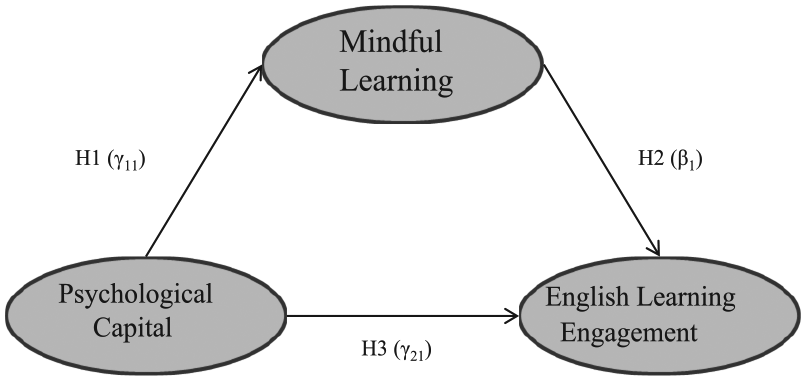
Hypothesized model.
Method
Participants
Participants were students enrolled in general English courses at a private comprehensive university in Northern Taiwan. The questionnaires were distributed and collected in class. The participants gave consent to participate in this research and were assured that their names and other personal information would remain confidential. A total of 253 students voluntarily participated in this study. After disregarding eight incomplete questionnaires, 245 questionnaires were included in the analyses. Among the participants, 117 (47.8%) were males and 128 (52.2%) were females. Their majors varied and included architecture, aerospace, electrical engineering, mechanical engineering, environmental engineering, accounting, Chinese literature, chemistry, information and library science, Japanese, chemical and materials engineering, information management, and educational technology.
Instruments
PsyCap
A total of 24 items, in four subscales, for measuring PsyCap were adapted from Yu et al.’s (2012) Psychological Capital Scale (PCS). Yu et al. developed PCS based on F. Luthans et al.’s (2007) PsyCap Questionnaire, with four subscales: self-efficacy, hope, resilience, and optimism. The questions were developed in Chinese and the response choices were based on a 4-point Likert-type scale (from 1 = strongly disagree to 4 = strongly agree) to test the PsyCap of university students in Taiwan. The PCS has been previously tested in related research and proven to be a reliable and valid scale for measuring the PsyCap of university students in Taiwan.
The four subscales are described as follows:
Self-efficacy (n = 6, α = .89): The subscale of self-efficacy measured learners’ positive beliefs and confidence in their ability to succeed in a given task. Example: I am confident with my abilities in dealing with problems.
Hope (n = 6, α = .91): The subscale of hope measured learners’ perseverance in attaining goals and ability in directing and redirecting paths when pursuing their goals. Example: When facing problems, I can think of different ways to solve the problems.
Resilience (n = 6, α = .87): The subscale of resilience focused on learners’ ability to sustain a positive attitude and bounce back when experiencing setbacks and adversity. Example: I can stay calm when facing difficult challenges in my schoolwork.
Optimism (n = 6, α = .90): The subscale of optimism measured learners’ positive perspectives and attributes regarding current and future potential for success. Example: I am optimistic about the future, even if my future development is filled with uncertainties.
Mindful learning
To measure students’ mindful learning, the Mindful Learning Scale developed by Chen and Yu (2017) based on the Langer Mindfulness Scale (Pirson et al., 2012) was used. The items were first translated into Chinese and revised according to the learning context. The scale includes four subscales: novelty producing, novelty seeking, engagement, and flexibility. It has been previously tested and validated with university students in Taiwan. The response choices are based on a 5-point Likert-type scale, from 1 = seldom to 5 = always. The Mindful Learning Scale has undergone confirmatory factor analysis (CFA), and a fit of the data to the model has been validated (χ2 = 546.66, root mean square error of approximation [RMSEA] = .08, comparative factor index [CFI] = .98, parsimony normed fit index [PNFI] = .83). Therefore, the scale is appropriate for testing the mindful learning of university students in Taiwan.
The four subscales are described as follows:
Novelty producing (n = 4, α = .87): This factor examined to what extent learners are capable of generating new information from on-going events around them. Example: I consider myself to be a creative person.
Novelty seeking (n = 4, α = .79): This factor examined to what extent learners perceive a situation as an opportunity to learn something new. Example: I can adjust easily according to my own observation or experience.
Engagement (n = 6, α = .80): This factor examined to what extent learners are capable of noticing what is occurring around them. Example: I can find one or more key information within a short period of time.
Flexibility (n = 4, α = .84): This factor examined how learners perceive change in life. Example: I am very flexible and able to accept different ways of doing things.
English learning engagement
To measure learners’ engagement in learning English, a questionnaire composed of 17 questions was adapted from the Student Course Engagement Questionnaire (SCEQ; Handelsman et al., 2005). Four factors of engagement were measured: skills engagement, emotional engagement, participation/interaction engagement, and performance engagement. Related questions from SCEQ were selected and translated into Chinese, and the response choices were based on a 5-point Likert-type scale (1 = not at all characteristic of me, 2 = not really characteristic of me, 3 = moderately characteristic of me, 4 = characteristic of me, 5 = very characteristic of me).
The four factors are described as follows:
Skills engagement (n = 5, α = .80): The skills engagement factor is intended to measure how engaged learners are in practicing their English skills. Example: I take good notes in English class.
Emotional engagement (n = 5, α = .79): The emotional engagement factor focused on how emotionally engaged learners are in learning English. Example: I really want to learn English well.
Participation/interaction engagement (n = 5, α = .88): The participation/interaction engagement factor represented how learners are engaged in learning English through participating in class and interacting with their instructors and peers. Example: I always participate actively in classroom discussions.
Performance engagement (n = 2, α = .65): The performance engagement factor focused on how learners are engaged through English class performance. Example: I am confident to say that I learn and do well in English class. The seemingly lower reliability of performance engagement is attributed to the fact that there are only two questions for this factor.
Data Analysis
To test the measurement model, descriptive analysis and structural equation modeling (SEM) were conducted using SPSS 21 and Amos 20.0 software, respectively. The reliability and validity of the measurement model were tested using composite reliability (CR) and average variance extracted (AVE). A CFA (Anderson & Gerbing, 1988) was used to determine whether the measurement model fit the data. The measurement model was tested first, followed by the path model.
After the validation of the measurement model, a path model was used to analyze the interrelationship among the three latent variables using SEM. For both the measurement model and the path model, the same number of participants (N = 245) was adapted for testing the two models. The maximum likelihood estimation method was used for validation (Arbuckle, 2011). The fit of the models was assessed using chi-square statistics and various fit indices such as the goodness of fit index (GFI), CFI, Tucker–Lewis Index (TLI), nonnormed fit index (NFI), RMSEA, and standardized root mean square residual (SRMR). Nonsignificant chi-square statistics, CFI, GFI, TLI, NFI higher than .90, RMSEA less than .08, and SRMR less than .05 were considered a good fit of the data to the model (Byrne, 1994; Hu & Bentler, 1999; Tucker & Lewis, 1973). However, with a large sample size, it is unlikely for the chi-square to be nonsignificant. Thus, other indices are relied on for testing the model fit. The bootstrap method, as opposed to the Sobel (1982) test, was used to test the mediation effects between the variables. A 95% confidence interval, zero excluded, and significance at the .05 level indicated that the mediation effect is significant.
Results
Descriptive Statistics and Correlational Analysis
For the three variables, the means of PsyCap ranged from 2.95 to 3.08 (SD = 0.44–0.48), the means of mindful learning ranged from 3.56 to 3.78 (SD = 0.63–0.70), and the means of English learning engagement ranged from 2.69 to 3.08 (SD = 0.72–0.89). Of the three variables, mindful learning received the highest scores, and the results indicated that the learners do practice mindful learning to a certain degree. The scores of PsyCap indicated that the learners possessed marginal positive psychological capacities. On the contrary, the scores of English learning engagement were not as satisfactory because the learners were on the edge of being moderately engaged in learning English. The absolute values of skewness and kurtosis of items fell under the range (–.31 to .65) to suit the multivariate normality assumption. Thus, a maximum likelihood estimation was used for the goodness of fit of the model (Finney & DiStefano, 2006) (Table 1).
Descriptive Statistics of PsyCap, Mindful Learning, and English Learning Engagement.

Note. PsyCap = Psychological Capital; ELE = English learning engagement.
According to the zero-order correlation matrix (Table 2), all of the variables were positively correlated to each other except for the nonsignificant correlation between performance engagement and optimism. This may infer that having an optimistic attitude does not necessarily lead to high performance engagement in learning English. The correlations also revealed the fact that the association between PsyCap and mindful learning (r = .47–.65) was strongest in the interrelationship among the three variables. The associations between PsyCap and English learning engagement (r = .13–.35), and mindful learning and English learning engagement (r = .15–.43) were both weakly correlated.
Zero-Order Correlational Matrix.

p < .05. **p < .01.
Note. PsyCap = Psychological Capital; ML = mindful learning; ELE = English learning engagement.
Measurement Model
A measurement model was constructed and tested for the interrelationship among PsyCap, mindful learning, and English learning engagement of Taiwanese university students. A CFA of the measurement model was conducted to examine whether the measurement model provided an adequate fit to the data. According to the criteria listed, the measurement model showed a good fit to the data (χ2 = 110.50***, df = 51, GFI = .93, CFI = .97, TLI = .96, NFI = .95, RMSEA = .069, and SRMR = .047). Although chi-square statistics were significant due to the large sample size, other indices suggested that the model fit the data well.
Standardized factor loadings were also examined for the measurement model. According to Table 3, standardized factor loading for all the factors ranged from .77 to .94, all significant at p < .001. The CR values indicated that the three factors were highly reliable and the AVE values ranged from .67 to .73, indicating the validity of the factors. The CR values were greater than .70 and the AVE values were greater than .50, which fit the standard values suggested (Fornell & Larcker, 1981; Hair et al., 2010). Overall, the results showed an adequate fit to the data and the measurement model was valid and reliable.
Standardized Factor Loadings for the Measurement Model.

Note. AVE = average variance extracted; CR = composite reliability; PsyCap = Psychological Capital; ELE = English learning engagement.
Path Model
Following an adequate fit of the measurement model to the data, the path model was then tested using the maximum likelihood estimation method, and chi-square statistics and various fit indices were performed to determine the fit of the model to the data. The results indicated that the data provided an adequate fit to the path model with χ2 = 110.50***, df = 51, GFI = .93, CFI = .97, TLI = .96, NFI = .95, RMSEA = .069, and SRMR = .047 (Table 4). PsyCap was a significant predictor of mindful learning (γ11 = .75), mindful learning was a significant predictor of English learning engagement (β1 = .32), but PsyCap was not a significant predictor of English learning engagement (γ21 = .15). Hence, the model was considered a complete mediation model. As a complete mediation model, mindful learning was a mediator between PsyCap and English learning engagement, and the path model explained 20% of the variance of English learning engagement (Figure 2).
Model Fit Indices.
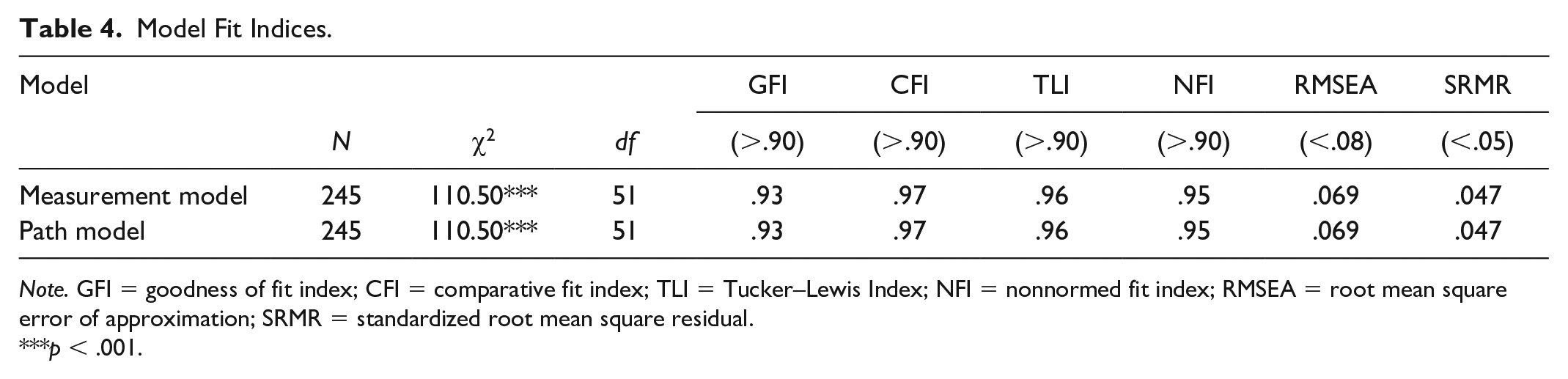
Note. GFI = goodness of fit index; CFI = comparative fit index; TLI = Tucker–Lewis Index; NFI = nonnormed fit index; RMSEA = root mean square error of approximation; SRMR = standardized root mean square residual.
p < .001.

Structural model.
When examining mediation, it is necessary to consider Type I error and statistical power (MacKinnon et al., 2002). The bootstrap method was carried out instead of the Sobel (1982) test to validate the mediation effect because the distribution of the mediation effect was not assumed to be normally distributed (Baron & Kenny, 1986; MacKinnon et al., 1995; Stone & Sobel, 1990). With repeated sampling of replacement to ensure that zero is not in the confidence interval and that the indirect effect is not zero, the bootstrap method is more appropriate for testing the mediation effect (Shrout & Bolger, 2002). The indirect effect of PsyCap on English learning engagement was tested and showed to be positively significant, and the 95% interval did not include zero (.03–.44). The total effect was also significant and did not include zero (.24–.55) in the 95% interval (Table 5).
Bootstrap Analysis of Path Model (N = 245).
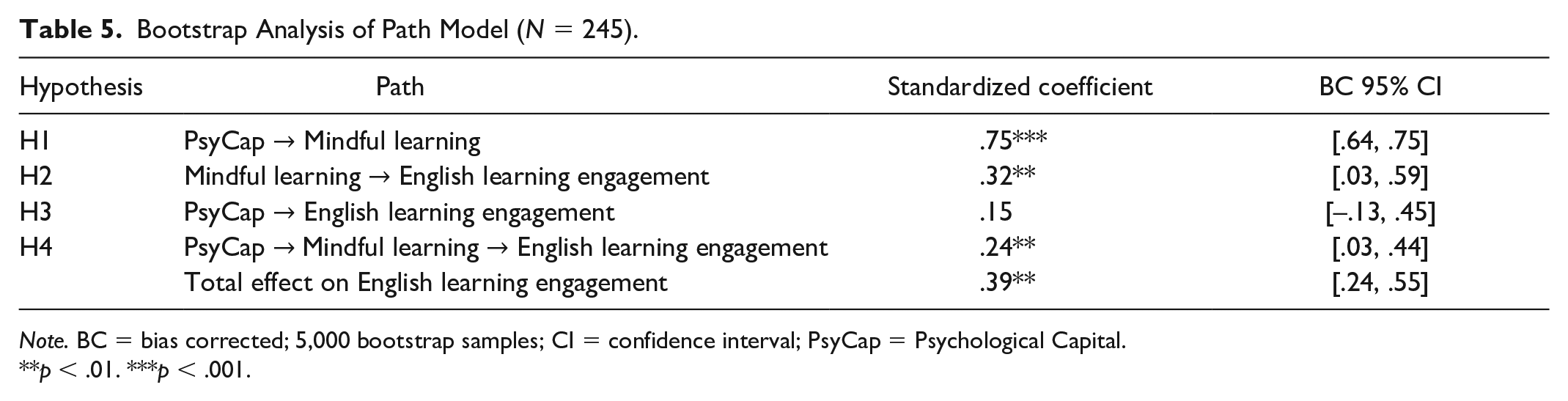
Note. BC = bias corrected; 5,000 bootstrap samples; CI = confidence interval; PsyCap = Psychological Capital.
p < .01. ***p < .001.
Discussion
The results of this research indicated that PsyCap was a significant predictor of mindful learning, mindful learning was a significant predictor of English learning engagement, and mindful learning was a mediator between PsyCap and English learning engagement. Although PsyCap did not directly predict English learning engagement, its indirect effect cannot be underestimated. The findings of this research support the crucial roles of PsyCap and mindful learning in English learning engagement.
Distinct subscales of PsyCap, such as efficacy and resilience, have been widely studied for their impacts on learning outcomes. Self-efficacy in learning is often considered to be an important factor in successful language acquisition. Believing in what one is capable of doing positively impacts one’s motivation and facilitates the learning process (Reeve, 2012; Schunk & Mullen, 2012). Resilience is the extent to which learners cope with obstacles. It also reflects learners’ reactions when facing challenges and overcoming difficulties in the learning process (Skinner & Pitzer, 2012). English learning involves experimenting with the target language. Through trial and error, learners can make mistakes and encounter difficulties and sometimes failure in the process. The results from this research provide a more comprehensive view on the psychological resources represented by PsyCap and their association with English learning engagement. The finding contributes to current literature by providing four psychological factors as a collective variable and so differs from commonly seen single-factor studies of self-efficacy or resilience.
Results revealed that PsyCap significantly predicted mindful learning. They parallel previous research, reflecting that PsyCap is an important factor in learning and individuals with positive psychological resources are more likely to be focused on learning and confident in their potential for success (Datu & Valdez, 2016; F. Luthans et al., 2007; Sheikhi & Shahmorady, 2015; Siu et al., 2014; You, 2016). Therefore, the more efficacious, hopeful, optimistic, and resilient learners are, the more mindful in learning they are.
The four subscales of PsyCap positively associated with the four subscales of mindful learning. When learners are self-efficacious, they tend to believe that they have the ability to learn new knowledge and try new things (novelty seeking). Also, efficacious learners devote themselves to a task and fully engaged in accomplishing a task (engagement). Hopeful and optimistic people know the importance of sustaining a positive attitude when undertaking obstacles, and they believe that success is in their own hands. So, they are positive about generating new information around them and believe that they can make it (novelty producing). As for resilient learners, they do not allow themselves to be defeated for too long and can bounce back from setback. Thus, they are able to notice changes around them and make adjustments when needed (flexibility).
The findings support the claim that PsyCap is beneficial not only in the workplace but also in educational settings. Individuals with higher PsyCap also are more likely to be mindful in learning, which is to be aware and consciously focus on what one is learning, be engaged in a task, constantly seek different methods to facilitate learning, and be flexible in choosing different ways to accomplish a task.
Mindful learning was a significant predictor of English learning engagement, and the findings conformed to previous research that attested to the association of mindful learning, learning performance, and outcomes (Bakosh et al., 2016; Yeganeh & Kolb, 2009). An individual who is mindful in learning is focused on the present, interested in different ways of exploring information and acquiring knowledge, and thus actively engaging in the learning process (Langer, 2016). Mindful learning can be learned. With adequate training, it is possible for learners to practice mindful learning. As English is learned as a foreign language in Taiwan and is not learned in a natural English-speaking environment, it is more difficult for learners to acquire the language naturally and implicitly. Therefore, English language learning requires learners to put forth extra effort, consciously pay more attention to the formal features of the language, and actively participate to successfully acquire English language skills. Mindful learning helps learners become aware of the learning situation and more engaged in learning.
Mindful learning is a teachable skill, and the training of mindful practices generally is easy for and accessible to learners (Bakosh, et al., 2016; Langer, 2000; Yeganeh & Kolb, 2009). In this high-tech era with so many social networking services and instant access to the internet, many distractions are present simultaneously. For many learners, it is difficult to focus and pay attention while learning English. However, with adequate practice in mindful learning, learners are better able to focus on the learning process and achieve desired academic outcomes.
PsyCap was not a significant predictor of learning engagement in this study. The finding is different from existing literature which holds whether there is a direct positive association between PsyCap and learning engagement (B. C. Luthans et al., 2012; Siu et al., 2014; Sweetman & Luthans, 2010) or an indirect positive association between PsyCap and learning engagement (You, 2016). Nonetheless, the results of the research revealed that PsyCap indirectly affects the English learning engagement of university students in Taiwan through mindful learning. That does not diminish the important role that PsyCap plays in overall learning outcomes. However, other factors also significantly contribute to how EFL learners might cultivate and rely on strong psychological resources when encountering difficulties and other obstacles.
There is no direct correlation between learners with high PsyCap and English learning engagement because there is even more to learning than the possession of positive psychological resources. Positive PsyCap provides emotional strength and support in the face of learning challenges and learning drawbacks. As learners with higher PsyCap adopt mindful learning, that is like a catalyst that facilitates learning engagement. Being focused and aware of the environment generates new thoughts, enhances concentration, and cultivates critical thinking abilities. With mindful learning as the mediator linking psychological resources to the action of active engagement in learning English, the indirect effect of mindful learning is important in the transformation from cognitive awareness to behavioral actualization of English learning engagement. In other words, an individual who is efficacious, hopeful, optimistic, and resilient is more likely to enjoy acquiring new knowledge and actively engage in the learning process when he or she is also focused and aware of the learning process. From this research, the results revealed that positive PsyCap is important in learning, and mindful learning as a mediator facilitates English learning engagement.
Conclusion
The results of this research demonstrate that PsyCap and mindful learning are important factors associated with the English learning engagement of university students in Taiwan. PsyCap was a predictor of mindful learning, mindful learning was a predictor of English learning engagement, and mindful learning was a mediator between PsyCap and English learning engagement. Thus, learners who have a strong PsyCap and practice mindful learning are more successful in learning English. Being hopeful, optimistic, confident, and resilient helps individuals to be emotionally healthy, cope with and minimize stress, pay attention, and sustain keen interest in learning. Implementing training and practice of PsyCap and mindful learning helps learners to acquire proficiency in English, achieve academic success, and maintain a high level of mental health.
The findings of the research offer some pedagogical and research implications. Nonetheless, some limitations are recognized. First, the English learning engagement in this research was confined to the university students who were enrolled in general English courses in an EFL context. To understand the learning engagement of English for EFL learners, the extent of learning engagement would be better understood if it were to be extended to include learners’ English learning experiences over a longer time period (extending beyond the time of the general English courses). Another limitation concerns the time of data collection. As PsyCap and mindful learning are not stable and likely to change over time, it would be interesting to see the changes in participants’ PsyCap, mindful learning, and English learning engagement over a longer period of time. Also, no causal relationships were identified in this research. Examining the causal relationships among PsyCap, mindful learning, and English learning engagement may provide even more fruitful findings.
This research identified two important predictors of English learning engagement for EFL learners and added empirical evidence on the still limited literature of PsyCap and mindful learning in academic settings. Future research is suggested to probe further into the impacts of PsyCap and mindful learning across disciplines and in different contexts. Empirical evidence for the influence of the implementation of training and practice of PsyCap and mindful learning is also called for in the future.
Footnotes
Declaration of Conflicting Interests
The author(s) declared no potential conflicts of interest with respect to the research, authorship, and/or publication of this article.
Funding
The author(s) received no financial support for the research, authorship, and/or publication of this article.
