




Abstract
This study examined the relations among future orientation, school bonding, and school bullying perpetration behaviors. Data were collected from 677 seventh- to ninth-grade adolescents in an area in Southwest China. Specifically, students completed the Future-Orientation Questionnaire, the Psychological Sense of School Membership scale, and the Revised Olweus Bully/Victim Questionnaire to assess their future orientation, school bonding, and bullying behaviors, respectively. Results indicated that students’ future orientation (toward education or occupation) was negatively associated with school bullying perpetration. Future orientation was also significantly associated with their feeling of school bonding. School bonding had a significant indirect effect (b = .37) on the relation between future orientation in the educational domain and school bullying behavior, and also played a significant mediating role in the relation between future orientation in the occupational domain and school bullying perpetration (b = .30). This research suggests that school bonding may be one mechanism by which children’s orientation toward future education or future occupation may have an effect on their bullying perpetration behaviors.
Introduction
Bullying in schools has been identified as a serious problem plaguing school students worldwide (Jimerson, Swearer, & Espelage, 2010). Significant research attention has been directed toward identifying risk factors for bullying and victimization, thus we can now sketch a fairly accurate profile of the characteristics of perpetrators and victims of school bullying (Cook, Williams, Guerra, Kim, & Sadek, 2010). However, given that protective and promotive factors also play an important role in the etiology and the developmental course of adolescent problem behavior, scientific attention should be broadened beyond its traditional preoccupation with risk factors to encompass protective and promotive factors as well (Jessor, Van Den Bos, Vanderryn, Costa, & Turbin, 1995), so as to inform school bullying prevention strategies for adolescents to aim to reduce the risks and strengthen the protective factors (Ttofi & Farrington, 2012).
Future orientation, which refers to an individual’s thoughts, plans, motivations, and feelings about his or her future (Nurmi, 1991), has been identified as a protective and promotive factor for adolescents. Nurmi (1991) pointed out that adolescents who are not oriented toward the future may engage in a variety of problem behaviors, such as delinquency, problems in school or drug use. Research has provided evidence of the association between future orientation and a wide range of problem behaviors (Bolland, 2003; Oyserman & Saltz, 1993; Robbins & Bryan, 2004; Stoddard, Zimmerman, & Bauermeister, 2011). However, the link between future orientation and school bullying has not been examined. In addition, no research has tested the mediating effect of school bonding on the relation between future orientation and school bullying behavior. Therefore, in the present study, we aim to examine the relationship between future orientation and school bullying, and to examine the mediating effect of school bonding on the future orientation—school bullying behavior link.
In adolescence, future orientation is an important issue worthy of further research. First, the subjective sense of future time plays an essential role in student or human motivation (Carstensen, 2006; Husman & Lens, 1999). Second, adolescence is a time of identity development, exploration, and commitment (Erikson, 1950). Third, motivational factors are more malleable than individual demographic factors and school context factors. As such, they are capable of being the target of school-based prevention and intervention efforts.
Future Orientation and Bullying Behaviors
Adolescence is a critical “turning point” in the life course, during which adolescents make important choices that will have an impact on their future (Quinton, Pickles, Maughan, & Rutter, 1993). Future orientation is an issue that becomes critical as children approach adolescence, during which time it is rapidly developing, differentiating, and expanding (Greene, 1986). Future plans become increasingly detailed, and adolescents begin to make more realistic evaluations of their ability to reach future goals. Seginer (2009) reviewed previous work on future orientation and summarized the aspects of future orientation that may have motivating effects on behaviors, namely, the perceived value of future events, the expected possibilities of achieving future goals, and the evaluation of one’s control over goal attainment. On the basis of these considerations, individuals direct their development in certain ways and purposefully select a variety of life trajectories (Nurmi, 1993). That is to say that if adolescents consider a positive future that is important, achievable, and controllable, they would be expected to devote themselves to activities that help them reach that vision of their future; whereas a low level of future orientation may influence the decision-making process of engaging in problem behaviors (P. Chen & Vazsonyi, 2011).
There are a number of studies showing that future orientation is inversely related to several kinds of problem behaviors, including theft (Oyserman & Saltz, 1993), general delinquency (Skorikov & Vondracek, 2007), school misconduct (Oyserman, Bybee, & Terry, 2006), and violent behavior (P. Chen & Vazsonyi, 2011; Stoddard et al., 2011). No research, however, has established whether future orientation is negatively associated with school bullying. Accordingly, the first aim of the present study was to examine the relation between future orientation and bullying behavior.
The Mediating Effect of School Bonding
School bonding is argued to be particularly important for adolescents as they rely less on family as part of the individuation process and come to rely more on extrafamilial relationships, such as those found in schools, with friends, and others (Goodenow, 1993). Researchers have not yet reached consensus about the definition of school bonding. In the current study, to define school bonding, we adopted Goodenow’s (1993) definition of psychological school membership, which refers to “the extent to which students feel personally accepted, respected, included, and supported by others in the school social environment” (p. 80). Empirical studies have documented that students’ school bonding is negatively related to a number of conduct problems, aggression, and violent behaviors (Chapman, Buckley, Sheehan, Shochet, & Romaniuk, 2011; Loukas, Ripperger-Suhler, & Horton, 2009; Maddox & Prinz, 2003; Resnick et al., 1997). For instance, Maddox and Prinz (2003) found that school bonding is linked to delinquency and antisocial behavior. However, the relationship between school bonding and school bullying remains unclear. Therefore, in the current study, it is expected that school bonding is negatively associated with bullying behavior. In addition, previous research reported gender differences in bullying behaviors (Atik & Guneri, 2013; L. M. Chen & Cheng, 2013; Zhou et al., 2013), thus the effect of gender on bullying should be tested.
Studies of the antecedents of school bonding have proliferated, but many have either focused on individual characteristics, such as age, gender, physical attractiveness, family structure, and academic performance (Thompson, Iachan, Overpeck, Ross, & Gross, 2006), emotional problems (Waters, Cross, & Shaw, 2010b), and coping styles (Frydenberg, Care, Freeman, & Chan, 2009), or focused on school ecology factors (McNeely, Nonnemaker, & Blum, 2002; Thompson et al., 2006; Waters, Cross, & Shaw, 2010a; Whitlock, 2006; Yuen et al., 2012). There has been a lack of attention to individual motivational factors, such as future orientation.
Multiple studies have shown that being future-oriented is associated with several optimal school outcomes. For instance, future-oriented students have been found to regulate their study behavior (Bilde, Vansteenkiste, & Lens, 2011), to be more strongly engaged in their schoolwork, to spend more time studying (Horstmanshof & Zimitat, 2007), to manage their time more efficiently, to display less procrastination (Harber, Zimbardo, & Boyd, 2003; Jackson, Fritch, Nagasaka, & Pope, 2003), to persevere with their schoolwork, and they also derive a greater sense of satisfaction from studying (Zaleski, 1987). Although there is no direct evidence showing that future orientation is associated with school bonding, much indirect pieces of evidence hint that future orientation may be positively related to school bonding. Based on these findings, in the present study it is anticipated that future orientation be positively associated with school bonding. It is important to note that prior research reported age and gender differences of future orientation (Lamm, Schmidt, & Trommsdorff, 1976; Steinberg et al., 2009), therefore the effects of gender and age (or grade) on future orientation should be tested.
Now the last but most important hypothesis has also emerged. Specifically, in the above section, we hypothesized that future orientation is negatively related to school bullying behaviors; in the current section, we have hypothesized that future orientation is positively associated with school bonding, which is, in turn, negatively related to bullying behaviors. Then, does school bonding have a mediating effect on the relation between future orientation and school bullying behaviors? Thus, in the current study, school bonding is anticipated to have a mediating effect on the relation between future orientation and school bullying.
Theoretical Foundations
A social exchange perspective can be applied to explain bullying behavior by weighing the costs, rewards, and alternatives for its perpetrators. A social exchange framework posits that much of human relationships are formed by the use of a subjective cost–benefit analysis and the comparison of alternatives (Homans, 1958, 1974; Thibaut & Kelley, 1959). Bullying is probably rewarding for perpetrators. For instance, they can obtain power, social dominance, or high-status group affiliation through bullying (Olthof, Goossens, Vermande, Aleva, & Meulen, 2011; Salmivalli, 2010). There are two kinds of standard or criterion to evaluate the acceptability of outcomes in an exchange relationship: comparison level (CL) that determines whether the exchange meets the individual’s expectations, and CL for alternatives (or CLalt) that determines whether the current outcome exceeds the individual’s other alternatives (Thibaut & Kelley, 1959). In adolescence, with the rapid development of future orientation (Greene, 1986), adolescents have more alternatives to meet their needs and achieve their goals, such as through commitment to future education or occupation to gain social status or power. These alternatives may be more cost-effective than bullying in the long run. Therefore, adolescents who develop high-level future orientation may less likely engage in bullying, whereas those who have a low level of future orientation may pursue immediate gratification by engaging in bullying.
Purpose of Study
Using a cross-sectional research design among adolescents in rural China, the current research aimed to examine future orientation as a motivator enhancing students’ sense of school bonding, which, in turn, negatively relates to bullying behavior.
Specifically, four central questions guided this research:
Method
Participants
Participants were 677 students from one rural middle school located in Southwest China. Of this total, 375 (55.4%) were girls, 238 (35.2%) were seventh graders, and 271 (40.0%) and 168 (24.8%) were eighth and ninth graders, respectively. Participants ranged in age from 12 to 17 years, with a mean age of 14.37.
Procedures
Approval for this research was obtained from the University Human Research Ethics Committee prior to data collection. Data were collected in spring 2013 through anonymous self-report questionnaires distributed in the regular classroom by the researcher and teachers. Information about the purpose of the survey and confidentiality of responses was clearly explained. Parent or guardian permission and student assent were obtained. Students completed the questionnaires during class time. The children did not receive compensation for their participation in the study.
Measures
Background variables
Students were asked to provide demographic information, including age, gender, grade, and whether they were left behind or not.
Bullying perpetration
Bullying perpetration was assessed using the Chinese version of the Revised Olweus Bully/Victim Questionnaire (OBVQ-R; W. X. Zhang, Wu, & Jones, 1999). Seven items were presented asking about specific forms of behaviors associated with bullying others. These seven questions referred to the four forms of bullying perpetration: verbal, physical, social, and other forms of bullying others. Example items include “I called mean names, made fun of, or teased others in a hurtful way,” and “I hit, kicked, pushed, shoved around, or locked others indoors.” Participants were asked to respond on a 5-point Likert-type scale ranging from 0 (never) to 4 (several times a week). Total scores were calculated by summing across items. The range of total scores thus ran from 0 to 28. The Cronbach’s alpha coefficient for the seven-item scale was .81 (W. X. Zhang et al., 1999) and .71 in the present study.
Future orientation
The Exploration and Commitment Questionnaire (Nurmi, Seginer, & Poole, 1990) was used to measure the levels of exploration and commitment separately in three domains of future life: education, occupation, and family. Exploration for education, occupation, or family was assessed by asking three questions, respectively, concerning the extent to which the participants had sought information and planned for this domain of their lives (e.g., “How often do you think about your studies and plan your future education?”). The participants respond to the questions on a 5-point Likert-type scale ranging from 1 (never) to 5 (daily). Cronbach’s alpha reliabilities for explorations concerning future education, occupation, and family were .73, .74, and .79, respectively (Nurmi, Poole, & Kalakoski, 1996).
Commitment related to education, occupation, or family was assessed by asking four questions, respectively, concerning the extent to which the participants were committed to their decisions in this domain of their life, and the extent to which they had already realized their plans (e.g., “How determined are you to fulfill your plans about your future education after middle school?”). The participants responded to the questions on a 5-point Likert-type scale ranging from 1 (definitely not) to 5 (definitely yes). Cronbach’s alpha reliabilities for the scores measuring commitment to decisions concerning future education, occupation, and family were .60, .62, and .61, respectively (Nurmi et al., 1996).
The Chinese version of the Exploration and Commitment Questionnaire was revised by L. L. Zhang, Zhang, Ji, and Nurmi (2006). Cronbach’s alpha reliabilities for explorations concerning future education, occupation, and family were .53, .66, and .76, respectively. Cronbach’s alpha reliabilities for the scores measuring commitment to decisions concerning future education, occupation, and family were .59, .56, and .68, respectively.
In the current study, we only chose the subscale of explorations concerning future education and occupation, and commitment to decisions concerning future education and occupation. In this study, Cronbach’s alpha reliabilities for explorations concerning future education and occupation were .55 and .66, respectively; Cronbach’s alpha reliabilities for the scores measuring commitment to decisions concerning future education and occupation were .59 and .58, respectively. Cronbach’s alpha reliability for the whole future orientation scale was .84.
School bonding
It was assessed with the Psychological Sense of School Membership (PSSM) scale (Goodenow, 1993). The Chinese version of the PSSM is an 18-item measure using a 6-point Likert-type scale response format ranging from 1 (not at all true) to 6 (completely true; Cheung & Hui, 2003). This scale assesses the extent to which students feel a sense of belonging (e.g., “I feel like a real part of this school”), respect (e.g., “I am treated with as much respect as other students”), encouragement (e.g., “People here know I can do good work”), and acceptance and inclusion (e.g., “I am included in lots of activities at this school”). Goodenow (1993) reported that in two studies with suburban students, internal reliability was .88. Scores on the PSSM correlated significantly with teacher-rated social standing and with student self-reported motivation, grades, and teacher-rated student effort (Goodenow, 1993). The internal consistency of this measure for the present sample was α = .83.
Results
Analysis Overview
Research questions were addressed with structural equation modeling using Mplus Version 6.1 (Muthén & Muthén, 1998-2010). Missing data were dealt with listwise deletion. Models were estimated separately for the educational and occupational domain of future orientation. That is, we established two models: In Model 1, there were three variables—future educational orientation (independent variable), school bonding (mediator), and bullying behavior (dependent variable); in Model 2, there were three variables—future occupational orientation (independent variable), school bonding (mediator), and bullying behavior (dependent variable). Model fit was evaluated based on the chi-square test statistic, the comparative fit index (CFI), the root mean square error of approximation (RMSEA), and the standardized root mean square residual (SRMR). Guidelines suggest that CFI values greater than .95, RMSEA less than .06, and SRMR less than .08 indicate good model fit (Hu & Bentler, 1999).
Gender Differences in Future Orientation, School Bonding, and School Bullying
Independent-samples t test analyses indicated that there were no significant differences in scores for males and females in school bonding, t(675) = 0.05, p = .96; however, there were significant differences in scores in bullying, t(675) = 6.31, p < .001, in educational future orientation, t(675) = −3.28, p < .01, and in occupational future orientation, t(675) = −2.19, p < .05.
Grade Differences in Future Orientation, School Bonding, and School Bullying
One-way ANOVA analyses showed a statistically significant difference in future occupational orientation scores for three grade groups, F(2, 674) = 4.94, p < .01. However, there were no statistical differences in future educational orientation, F(2, 674) = 0.81, p = .44, school bonding, F(2, 674) = 0.54, p = .59, and bullying scores, F(2, 674) = 0.56, p = .57, for three grade groups. Therefore, gender and grade were controlled in subsequent structural equation modeling analyses.
Descriptive Statistics
Intercorrelations, means, standard deviations, skewness, and kurtosis for the 10 observed variables are presented in Table 1. The kurtosis values of the four variables of the school bullying perpetration scale were greater than 0, indicating that the univariate distributions of variables were not normal which can lead to multivariate abnormality, thus the more robust maximum likelihood mean adjusted (MLM) estimator was used for data analysis in the present study rather than ML which is based on data normality (Byrne, 2012). Correlations, covariances, variances, means, and standard deviations for latent variables are presented in Table 2.
Correlations and Descriptive Statistics for Observed Variables (N = 677).

p < .05. **p < .01. ***p < .001.
Correlations, Covariances, Variances, Means, and Standard Deviations for Latent Variables (N = 677).

Note. Numbers on the diagonal are variances, those below the diagonal are covariances, and those above the diagonal (italicized) are correlations.
p < .05. **p < .01. ***p < .001.
Structural Equation Modeling Analysis
Measurement model
All the measured variables significantly loaded on the latent variables (all p < .001; see Table 3). A test of the measurement model showed a good fit to the data (see Table 3).
Factor Loadings for the Measurement Model.

p < .001.
Structural model
The structural model of total effect of future educational (or occupational) orientation on school bullying perpetration fits the data well (see Table 4). The proposed mediation model with the indirect pathway of future educational (or occupational) orientation on school bullying through school bonding demonstrated a good fit with the data (see Table 4). There was a significant and negative indirect effect (β = −.37, p < .05) in Model 1(see Table 5); to estimate the effect size of the mediation effect in Model 1, the method of Preacher and Kelley (2011) was used: ab·Sx / Sy = (−.37) 0.61 / 2.04 = −.11, indicating that bullying perpetration decreases by 0.11 standard deviations for every 1 SD increase in education future orientation indirectly via school bonding. Similarly, there was a significant and negative indirect effect (β = −.30, p < .05) in Model 2 (see Table 5); the effect size of the mediation effect in Model 2 is ab·Sx / Sy = (−.30) 0.62 / 2.04 = −.09, indicating that bullying perpetration decreases by 0.09 standard deviations for every 1 SD increase in occupation future orientation indirectly via school bonding. It is also important to note that future education orientation accounted for 44% of the variance in school bonding (p < .001); in turn, future education orientation and school bonding explained 26% of the variance in bullying perpetration (p < .01). Similarly, future occupation orientation accounted for 36% of the variance in school bonding (p < .001); in turn, future occupation orientation and school bonding explained 24% of the variance in bullying perpetration (p < .01).
Goodness-of-Fit Indices for Measurement and Structural Models.
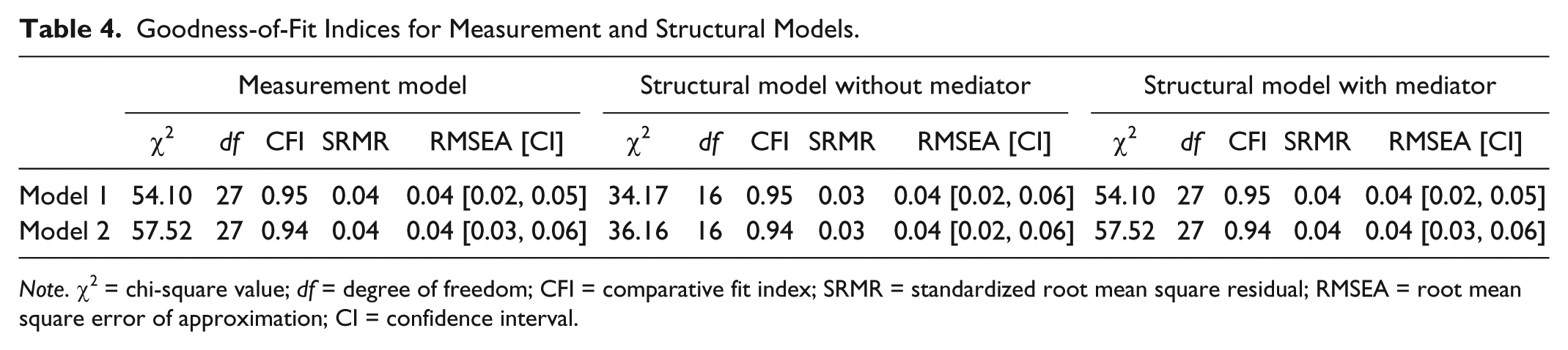
Note. χ2 = chi-square value; df = degree of freedom; CFI = comparative fit index; SRMR = standardized root mean square residual; RMSEA = root mean square error of approximation; CI = confidence interval.
Indirect Effects of Future Orientation on School Bullying Through School Bonding.

Note. Standardized coefficients are reported. CI = confidence interval; IV = independent variable; M = mediator; DV = dependent variable.
p < .05. **p < .01. ***p < .001.
Discussion
This research examined relations among future orientation, school bonding, and school bullying perpetration behaviors among a sample of adolescents in rural China. Four hypotheses were all supported. Specifically, future orientation is negatively associated with school bullying perpetration behaviors; future orientation is positively related to school bonding; school bonding is negatively associated with school bullying perpetration behaviors; and school bonding mediates the relationship between future orientation and school bullying perpetration behaviors.
This study built on prior research in several ways. First, it has demonstrated that adolescents’ future orientation in both the educational and occupational domains is associated with diminished bullying behaviors, suggesting that such motivation may be beneficial for reducing bullying behavior. This finding is in accord with previous related studies, which reported that future orientation is inversely related to school misconduct (Oyserman et al., 2006; Skorikov & Vondracek, 2007). Second, in the current study the hypothesis that future orientation is related to school bonding was supported. Third, the current research found that students’ feelings of bonding to their school were significantly related to fewer bullying behaviors. This finding is consistent with previous research (Loukas et al., 2009), which found that adolescents’ feelings of school bonding predicted lower levels of conduct problems and physical aggression. Moreover, the results of the mediation models supported the notion that children’s future orientation (whether in the educational or occupational domain) has significant mediating effects on their bullying behaviors through school bonding. This finding corroborated and extended previous research (Bilde et al., 2011; Chapman et al., 2011; Loukas et al., 2009), which only examined the relation between future orientation and school activities, or the relation between school bonding and problem behaviors.
Limitations and Strengths
It is important to note limitations when interpreting these results. First, due to limited research resources (e.g., research fund), we can only conduct cross-sectional study using convenient sampling and only collect self-report data. However, reliance on exclusively self-reported data raises the issue of social desirability and recall biases, which may inflate or deflate correlations. Further research would benefit from a multirate–multimethod design, such as using teacher-, self-, and peer report simultaneously in one study. Furthermore, this study was exploratory in nature, and cross-validation is therefore needed to address potential issues with sample dependency. Given that social class (McLoyd, Kaplan, Purtell, & Huston, 2011) and culture (Sundberg, Poole, & Tyler, 1983) can also influence adolescents’ future orientation, further research with a large and representative sample is necessary to examine whether adolescents’ future orientation is related to their bullying behavior through a sense of school bonding. Another limitation of the present study is that, as the data were collected concurrently, it would be inappropriate to make statements (however tentative) about the causal direction of effect. Future longitudinal research would provide an insight into the direction of these effects.
Despite these limitations, this study has a number of strengths. It is the first to apply a social exchange framework to explain bullying behavior, and to incorporate a social exchange framework into future orientation to explain the developmental nature of adolescent bullying. For instance, previous research found that school bullying behaviors peak in middle school and decline in high school (Williams & Guerra, 2007). According to social exchange perspective, this may be because adolescent bullies become more focused at this stage on planning and achieving future goals for a delayed gratification (Trommsdorff, Lamm, & Schmidt, 1979). Another strength is the examination of the role of future orientation in conjunction with school bonding and bullying behavior, which focused on protective factors rather than on the risk factors of bullying. Focusing on protective factors and building the resilience of children at risk may be a more positive approach and more attractive to communities.
Implications
By providing evidence of protective factors in reducing bullying behavior, this study can inform bullying agencies to adopt a protective factor focused on a prevention and intervention approach as their framework to guide new antibullying initiatives. First, the results of this study indicate that one possible way to reduce bullying is to enhance adolescent bullies’ future orientation. If they plan and commit to a valued, achievable, and controllable future goal, they might become less involved in bullying behavior. School psychologists should help students find their valued, achievable, and controllable future goal, and help them achieve it. Second, it is important for school psychologists to inform and educate teachers, administrators, and staff on the role school bonding plays in contributing to diminished bullying behavior. This study also indicates that students’ heightening future orientation could increase their level of school bonding. Other evidence for strategies to improve school bonding is also emerging, such as mentoring (Karcher, 2005; King, Vidourek, Davis, & McClellan, 2002).
Conclusion
This study represents a first step in understanding relations among future orientation, school bonding, and school bullying perpetration behaviors. A conceptual mediation model with four hypotheses was tested, wherein school bonding mediated the relationship between future orientation and school bullying perpetration. The findings generally supported our proposed model, and four hypotheses were supported.
Footnotes
Declaration of Conflicting Interests
The author(s) declared no potential conflicts of interest with respect to the research, authorship, and/or publication of this article.
Funding
The author(s) received no financial support for the research and/or authorship of this article.