




Abstract
This aim of this study was to explore which kinds of working situations are regarded by psychologists as being particularly detrimental to their identity (personal and professional), how these situations are appraised in terms of threat and/or challenge, and what their impact is on perceived stress, work satisfaction, and perceived threat to occupational status. In all, 842 French psychologists answered an open format question requesting them to report a situation that was particularly difficult for them as a person and/or as a psychologist (analyzed by the way of a content analysis), and a questionnaire containing our dependant variables. Four major categories of situations were highlighted. While the first three were positively linked to threat, the “patient relations” category was negatively correlated with it. “Threat to personal identity” mediated the relationship between difficult situations and perceived stress. Situations appraised as being identity-threatening are mostly the same than those found in the stress literature and are stressful because of their impact on personal identity. Moreover, for psychologists, relations to patients, which are at the heart of the profession, seem to be protective regarding stress and identity threats.
Even though lifetime employment has become an exception to the rule and relative job insecurity prevails (Smith, 1997), work now occupies a huge place in our lives. People are devoting more and more time and energy to their work and putting a lot of themselves into it. Work is becoming an integral part of our identity, serving at least partly to define us personally and professionally, position us in the social hierarchy, and make us feel competent and useful—in short, giving us a positive identity (Ashforth & Mael, 1989; Gini, 1998). This is the positive side of work.
At the same time, maybe because of this high degree of involvement and centrality, work now places many constraints and demands on employees. People have to become more involved, put in more hours, work ever faster (even if it is to the detriment of quality), have ever higher qualifications, contend with problematic colleagues, and so on and so forth. This is the negative side of work, which, because organizations are so demanding, can be a source of stress.
The literature on organizational stress is extremely wide ranging (Dewe, O’Driscoll, & Cooper, 2010; Schabracq, Winnubst, & Cooper, 2003). Numerous studies have shown that organizational stress has a great many negative consequences on individuals’ physical and psychological health (Deery, Walsh, & Guest, 2011; Shirom, 2003), as well as on economic and organizational issues. Nevertheless, this literature has mostly focused on the impact of stressors, such as psychological and physical demands, workload, or bad interpersonal relationships at work, on perceived stress. Although some of these stressors are psychological in nature and affect the way in which individuals appraise such situations (i.e., as threats or challenges to well-being), relatively little attention had been paid to their impact on identity. And yet, given the centrality of work for identity (Gini, 1998; Schaufeli & Greenglass, 2001; Wrzesniewski & Dutton, 2001), one would expect certain difficult situations to be appraised not only with regard to what they mean in terms of threats or challenges to well-being (Lazarus & Folkman, 1984), but also in terms of identity (see Wiesenfeld, Brockner, Petzall, Wolf, & Bailey, 2001, for an example in the context of reactions to layoffs), be it personal (i.e., the self as distinct from other people; Hogg, 2003) or social/professional (i.e., the part of identity that is associated with group membership). Drawing on a recent model of stress and coping with identity threats (Berjot & Gillet, 2011), we therefore sought to find out (a) which situations have an impact on identity, (b) how these situations are appraised in terms of threats and/or challenges to personal and or professional identity, and (c) whether the impact of these specific situations on perceived stress is mediated by appraisals.
Work and Identity
Work functions are manifold (Jahoda, 1981, 1982), but given that, as mentioned earlier, people are often very committed to their work and/or organization, psychological functions such as personal achievement or harmonious social relationships would appear to be especially important nowadays (England & Harpaz, 1990; Harpaz, 1990). As work seems to occupy an increasingly central place in the minds of individuals, who often define themselves in terms of their work, their professional abilities or their professional relationships (Gini, 1998), it can be regarded as an important source of identification, helping to define personal and organizational identities (Alvesson, 2010).
Identification with work often helps people to cope with job stress, by allowing them to perceive stressful situations as less threatening (Haslam, Jetten, O’Brien, & Jacobs, 2004) and serving as an important source of social support from coworkers or from the institution itself (Haslam, O’Brien, Jetten, Vormedal, & Penna, 2005). The flip side of this identification is that when work is threatened, as is the case when particularly stressful situations are regularly encountered or when the very existence of the job is in question (i.e., redundancy or quite simply fear of redundancy; see, for example, Heaney, Israel, & House, 1994; Sverke, Hellgren, & Naswall, 2002; Wiesenfeld et al., 2001), reactions may be particularly negative (Harnisch, 1999; Jahoda, 1982). These reactions may take the form of stress, but they can also have a more general impact on identity (Ashforth & Humphrey, 1993) and self-esteem (Winefield, Winefield, Tiggemann, & Goldney, 1991), and lead to hospitalization and self-harm (Eliason & Storrie, 2009), burnout (Dekker & Schaufeli, 1995), posttraumatic stress disorders (Grebot & Berjot, 2010), and even suicide (Argyle, 1989; Kleespies et al., 2011).
Without going as far as losing one’s job, stressful situations or work difficulties that occur on a daily basis can, because of their recurrence and because of what they mean for identity (questioned, devalued, or scorned), equally represent a major source of stress. This is certainly the case of extreme situations such as sexual harassment, which not only causes stress but also depression, anxiety, and poor self-esteem (see Fitzgerald, 1993, for a review). It is also the case of daily situations that include or imply humiliation, devaluation (Deery et al., 2011; Terkel, 1977), changes in the organization or nature of work (Schabracq, 2003) or, more generally, the fake expression of emotions (Ashforth & Humphrey, 1993; Payne & Cooper, 2001). However, while these situations have been shown to lead to dysfunctional stress reactions because they are appraised as threats to the individuals’ well-being or because the constraints exceed the latter’s resources (Lazarus & Folkman, 1984), to our knowledge, researchers have yet to look at whether these situations have an impact on personal and/or professional identity, and how.
The Stress and Coping With Identity Threat Model
While there are numerous models of stress and coping, which most of the time offer ecologically valid explanations as to how people react to different types of threats to their well-being, such as major events, daily hassles, and, more particularly, threatening situations at work (Dewe et al., 2010; Lazarus & Folkman, 1984), few explain how people appraise and react to self-threats, that is, threats to their sense of self, as unique individuals (often referred to as personal/individual/private self or personal identity) and/or as members of meaningful groups (often referred to as group/collective self or social identity; Baumeister, 1998; Greenwald, & Pratkanis, 1989).
Traditional models of stress do not make any distinction between the tangible aspects of the situation that has to be coped with (e.g., work overload, conflicts) and what that situation means for an individual’s personal and/or professional identity (e.g., seeing one’s competence called into question, being treated as unprofessional, etc.). The stress and coping with identity threat model (Berjot & Gillet, 2011), grounded in the literature on stress and coping with discrimination, is based on transactional models of stress, and is specific to identity-threatening situations. These situations have specific antecedents, an appraisal phase, specific coping strategies (e.g., self-handicapping, self-affirmation), and different kinds of effects, such as lowered self-esteem and stress.
It is the primary appraisal phase that is of interest to us here. This is when individuals assess whether, in a specific problematic situation (a) something is potentially detrimental to their identity (personal and social) and (b) which part of that identity is threatened (or challenged) by the situation. This appraisal phase is presented in the model as mediating the way these threatened individuals then react (outcome). In other words, appraising a situation as relevant to one’s identity and threatening for one or both aspects of that identity is a source of stress because of its impact on identity (Ashforth & Humphrey, 1993; Major & O’Brien, 2005; Miller & Kaiser, 2001). For example, a study by Berjot, Girault-Lidvan, Scharnitsky, and Gillet (2010) showed that students of foreign origin whose ethnic identity was threatened in a stereotype threat paradigm (threat of confirming a poor reputation by failing on a task; for example, women taking a math test) judged the situation to be more stressful than students of French origin, who were not threatened by the stereotype. In another study, Berjot, Girault-Lidvan, and Gillet (2012) showed that stigmatization linked to being physically disabled was negatively correlated with the threat to personal and social identity. Moreover, these individuals made distinct identity appraisals, depending on whether they faced discrimination, and these appraisals were specifically linked to outcomes such as personal and collective self-esteem, and identity management strategies.
When applied in an organizational context, this model can help researchers to explore the impact of identity appraisal on adjustment. For example, Lesage, Berjot, Altintas, and Paty (2013) measured, in a sample of 1,440 occupational physicians, symptoms of burnout, perceived stress, and identity appraisals. Results showed that stress and burnout were significantly and positively linked to threat to personal and professional identity. Moreover, results showed that threat to personal identity (TPI) explained twice as much feelings of low personal accomplishment than perceived stress and as much depersonalization than stress.
Finally, as it will be also our goal here and more in a qualitative way, help to find out (a) which kinds of difficult situations are relevant to identity and therefore whether these situations are partly or entirely the same as those that are usually identified as sources of stress in the organizational literature, and (b) explore their relation with stress. In the light of the above studies, we set out to ascertain (a) which kinds of work difficulties are regarded as identity-threatening by employees, (b) how those problematic organizational situations are appraised (i.e., in terms of personal vs. professional identity threats and/or challenges), and (c) what effects these difficulties have on adjustment (in this case, perceived stress, satisfaction with working conditions and the perception that one’s professional status is threatened by society), as mediated by the appraisal process. The first part of the present study was therefore descriptive (the kinds of situation that have an impact on identity, how they are appraised, and what their impact is on stress), while the second part was processual. Concerning this second part, and again based on the literature, we predicted that threat appraisals would mediate the relationship between situation and stress.
Method
Participants and Procedure
The present study was run with a specific population, namely French psychologists, as many studies have shown that psychologists are particularly stressed and sensitive to syndromes such as burnout ( Ackerley, Burnell, Hoder, & Kurdek, 1988; Raquepaw & Miller, 1989; Vredenburgh, Carlozzi, & Stein, 1999). Given their high qualifications and the human responsibilities they have to bear, psychologists are particularly committed to their profession.
Participants were 842 psychologists (Mage = 34.63, SDage = 9.54), 81 men and 752 women (9 did not report their sex). They were all actively employed in a number of different settings: 392 worked in public hospitals (46.39%), 67 in private hospitals (7.93%), 168 in nonprofit organizations (19.88%), 37 in private companies (4.38%), 58 in psychology practices (6.86%), 86 in public administration (10.18%), 28 had at least two different workplaces (3.31%), and 9 worked in universities or colleges (1.07%). As for their status, 437 (51.72%) had long-term contracts, and 191 (22.60%) fixed-term ones, 155 (18.34%) were civil servants, 38 (4.50%) were self-employed, and 18 (2.13%) had at least two types of contract. On average, they had been working for 7.60 years, with a minimum of 1 month and a maximum of 51 years. Participants were approached via French national associations of psychologists1 and the authors’ own social and professional networks to respond to an online questionnaire. The aim of the study, as well as its voluntary and anonymous nature, was set out on the first page of the questionnaire.
Measures
Appraisal of identity threat
First of all, participants were asked to “think about a difficult professional situation (or set of similar situations) that you have experienced and which particularly affected you as a person or as a psychologist.” They were then asked to describe the situation or situations (optional), before responding to the 20 items of the Primary Appraisal of Identity Threat scale (PAIT; Berjot, Girault-Lidvan, & Gillet, 2012). This tool is a trait-like scale that assesses how people appraise situations in terms of threats (or challenges) to their personal and/or social identity. Here, the social identity items were rephrased to fit the psychologists’ professional identity and participants were told to respond to these items with reference to the situation(s) they had just reported.
The PAIT has four subscales. The two Threat subscales measure the degree to which the individual self (vs. the social/professional self) is devalued, insulted, or undermined in the reported situations (Tajfel & Turner, 1986). The Threat to Personal Identity subscale (6 items, α = .84; for example, “I have the feeling that I’m regarded as a nobody”) refers to the individual self, while the Threat to Social Identity subscale (TSI; 5 items, α = .86; for example, “I have the feeling that psychologists are insulted”) refers to the social self, in this case, a psychologist.
The two Challenge subscales measure the degree of confidence that, with an effort, the situation’s demands can be overcome. These two subscales therefore focus on the positive outcomes that can come from difficult situations. The Challenge to Personal Identity subscale (CPI; 4 items; α = .64; for example, “I focus on the way I can take advantage of the situation”) focuses on the individual self, while the Challenge to Social Identity subscale (CSI; 5 items, α = .77; for example, “I’m pleased to have a chance to show to what extent psychologists, including myself, can deal with this kind of situation”) focuses on the professional self. As this scale was originally developed in the context of identity threats linked to discrimination, we used exploratory factorial analysis with an oblimin rotation to check its structure. This analysis yielded a four-factor solution (61.14% of variance). All the items loaded on their respective dimensions except for two, which loaded on two dimensions. As these both had quite a high loading on their initial dimensions, we included them in the scores.
Perceived stress
Stress was assessed with the French version of the Perceived Stress Scale (PSS14; Cohen, Kamarck, & Mermelstein, 1983; translated into French by Bruchon-Schweitzer, 2002, and validated by Lesage & Berjot, 2012). The PSS is a brief self-report scale of 14 items. People are asked to rate on a Likert-type 5-point scale ranging from 1 (never) to 5 (very often) the extent to which they experienced each of the feelings and thoughts on the list in the course of the previous 2 weeks.
Work satisfaction
This was assessed with a single question: “Are you satisfied with your working conditions?” Participants answered on a Likert-type scale ranging from 1 (not at all) to 7 (totally).
Threat to occupational status
This was also assessed with a single question: “Do you think that psychologists’ professional status is threatened in France?” Participants answered on a Likert-type scale ranging from 1 (not at all) to 7 (totally).
Psychosocial and status characteristics
After responding to the different scales, participants were asked several questions about their sex and age, their experience (in years), the type of place they worked in, and their type of work contract.
Results
Situational Content Analysis
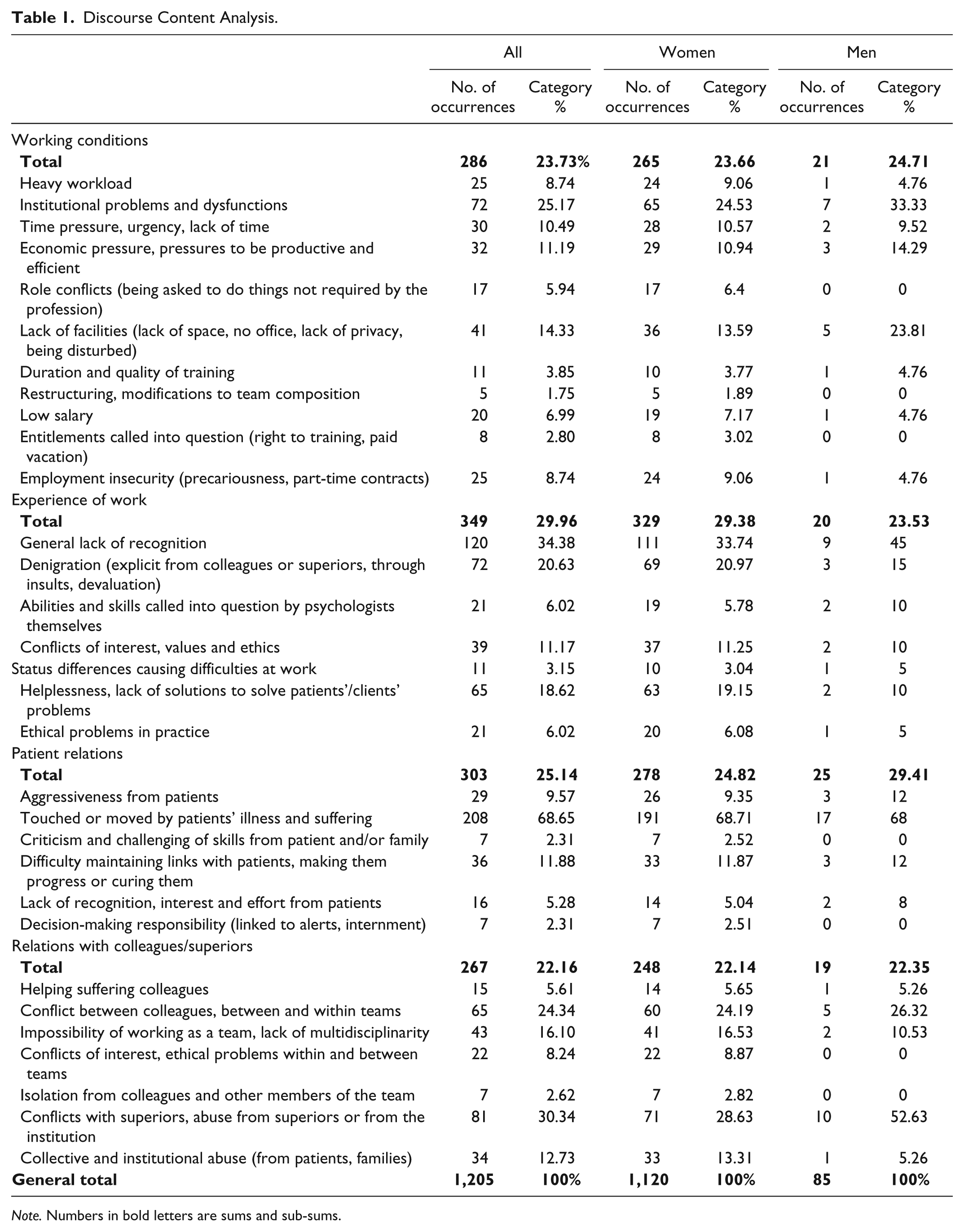
A total of 568 participants reported at least one difficult situation before responding to the PAIT (67.22%). The content of their reports was analyzed by two of the coauthors, who counted 1,205 occurrences (an occurrence corresponded to the citation of one specific source. Even if the same source was cited more than once, it was still only coded once), that is, 2.12 occurrences per respondent. The categorization was undertaken jointly by the two coauthors, who shared the coding out between them after they had coded about 70 participants together and arrived at a consensus on the definition of each category and the criteria for placing an occurrence in a particular category. If a problematic occurrence was encountered, it was discussed until a consensus was reached. Content analysis highlighted four types of work-related situations that represented sources of difficulty at work for French psychologists. These situations are set out in the following section, starting with those with the most occurrences (see Table 1).
Discourse Content Analysis.
Note. Numbers in bold letters are sums and sub-sums.
Experience of work
Occurrences in this category concerned the way in which psychologists experienced their work (29.96% of all occurrences). Coming top in this category was a general lack of recognition (34.38% of occurrences in this category), particularly in the case of psychologists working for private companies (33.33% of them), and hospitals (24.53% in private hospitals, 22.83% in public ones). Then came a sense of being devalued at work, through more or less explicit insults or derogatory remarks about their qualities and competence, criticism, scornful comments, and verbal attacks (20.63%). This was the case for those working in public administrations (16% of them) and hospitals (15.09% and 14.96% for private and public hospitals, respectively). Another frequently cited subcategory was the feeling of not being able to find a solution that psychologists can sometimes have when confronted with their clients’ problems. This subcategory represented 18.62% of occurrences in this category and was encountered mostly by those working for private companies (25% of them) and in public administrations (24%). The final subcategory concerned the conflicts they encountered over interests, values, and ethics (11.17%).
Patient relations
Occurrences of this category concerned difficult relationships with patients/clients and/or their families. They represented 24.82% of total occurrences and predominantly concerned instances where the psychologists had been touched or moved by the illness and suffering of their patients (68.65% of occurrences in this category), which is perceived as a difficult experience. All categories of psychologists frequently reported these events, ranging from 34.74% of those working in public hospitals to 48% of those working in public administrations. The other subcategories concerned direct difficulties with patients who either did not want to be cured or make progress (11.88%), or who were aggressive (9.57%).
Working conditions
Occurrences of this category represented 23.73% of all occurrences. They referred to the tangible physical, economic, and social conditions that psychologists encounter. Institutional problems and dysfunctions represented 25.17% of occurrences in this category. Psychologists complained of the slowness of the institutions, their peculiar and often counterintuitive logic that prevented them from practicing correctly, and the difficulties involved in planning or implementing projects. This was notably the case for psychologists working for associations (14.17% of them), public hospitals (15.35%), and administrations (12%). Poor facilities and lack of space (14.33%) were also often reported here. Psychologists cited the lack of a private office in which to practice (posing problems of confidentiality and requiring them to change location frequently). This was particularly true for psychologists working for private companies (12.5% of them). Finally, economic pressures (pressure to be productive and efficient; 11.19%) and time pressure (10.49%) were often reported in this category, particularly by psychologists working for companies (20.83% of them reported time pressure, 12.50% economic pressures). Other occurrences concerned difficulties such as large workloads (8.74%), lack of job security (8.74%), low salaries (6.99%), or conflicting roles (being asked to do something that is not in one’s job description; 5.94%).
Relations with colleagues and superiors
This category represented 22.16% of all occurrences and concerned problems the participants had with their colleagues (mostly in public hospitals), the teams in which they worked (24.34%), or their immediate superiors, who either abused them or were in direct conflict with them (30.34%, mostly in public administrations or associations). Some occurrences concerned a lack of teamwork, either because there was no such team or because the existing team excluded them or did not take them properly into account, which created conflicts (16.10%). Finally, some occurrences concerned collective (from colleagues) and/or institutional abuse (12.73%). This included verbal and physical abuse, and a total lack of consideration from patients or families (particularly so in hospitals).
Descriptive Statistics
As we did not know exactly what participants who had not reported any events were referring to when they responded to the PAIT, we only computed results for participants who had reported at least one event (n = 558). There were no significant differences in variables between those who reported an event and those who did not, except for the CPI subscale, F(1, 840) = 5.65, p < .02, as those who had reported at least one event judged the situation(s) to be less challenging to their identity than those who had not reported any.
To link sources of stress with other measures, we computed several indices. First of all, we summed the sources of difficulties the participants had cited (a) across all categories (total number of sources) and (b) within each of the four categories. Second, we calculated an index representing the number of categories cited (one, two, three, or four) by each participant.
As can be seen in Table 2, the psychologists appraised the situations they cited as being threatening to their professional identity (TSI: M = 2.91, SD = 1.19) and challenging to that identity (CSI: M = 3.43, SD = .87). Their level of satisfaction with their working conditions was just above the theoretical mean of the scale (M = 4.20, SD = 1.64), and they perceived their professional status as being extremely threatened (M = 5.70, SD = 1.30). They also perceived more stress (M = 2.84, SD = .96) than that observed among French employees in general (M = 2.51, SD = .54, t = 7.05, p < .0001; see Lesage & Berjot, 2012).
Means, Standard Deviations, and Correlations Between Measures.

Note. TPI = Threat to Personal Identity; TSI = Threat to Social Identity; CPI = Challenge to Personal Identity; CSI = Challenge to Social Identity.
p < .01. **p < .001.
As for events, Table 2 showed that the mean number of occurrences in each of the four categories logically reproduced the distribution found in the content analysis. The experience of work’s category had the highest mean number of occurrences (M = .63, SD =.78), followed by patient relations (M = .54, SD = .65), working conditions (M = .51, SD = .79), and relations with colleagues and superiors (M = .47, SD = .72).
The correlational analyses showed that number of sources and total number of categories were significantly linked to TPI (r = .24 and .17) and, even more so, to threat to professional identity (r = .34 and .29), indicating that the more participants reported events, the more they appraised them as a threats to their professional identity. These factors were not linked to challenge appraisals. The same pattern was found for each of the four categories, with the exception of patient relations, which was negatively correlated with TSI (r = −.35) and, to a lesser extent, with TPI (r = −.12), indicating that psychologists who encounter these kinds of situations do not regard them as threats to their identity. As for the link between reporting events and other measures, results showed that total number of sources and number of categories were correlated negatively with satisfaction with working conditions (r = −.20 and −.17), and positively with stress (r = .16 and .11). Only total number of sources was correlated with perceived threat to status (r = .13). As for types of sources, results showed that working conditions was correlated negatively with work satisfaction (r = −.26) and positively with threat to status and perceived stress (r = .18 and .17). Once again, patient relations was correlated positively with work satisfaction (r = .14) and negatively with threat to status (r = −.16). It was not linked to stress. Finally, relations with colleagues and superiors seemed particularly deleterious, as it was correlated negatively with work satisfaction (r = −.34), positively with threat to status (r = .12) and perceived stress (r = .46).
Analyses showed, however, that threat appraisals were significantly linked to other measures. Thus, TPI was linked to work satisfaction (r = −.34), threat to occupational status (r = .12) and perceived stress (r = .34), as was TSI (r = −.34, .34, .18). It is worth noting that CPI was correlated positively with threat to status and negatively with stress.
Threat Appraisals as Mediators Between Sources of Difficulties and Perceived Stress
To test for multiple mediations, we followed the procedure described by Preacher and Hayes, using their macro for SPSS 18. This statistical analysis is based on the Baron and Kenny procedure (1986) for testing for mediators, but makes it possible to test for more than one at a time. Given that the correlational analyses only showed significant relations for threat appraisals, we excluded challenge appraisals from these fresh analyses (expect for the patient relations category, which was linked to CPI). We ran a multiple regression analysis for all the independent variables (IVs), with the two types of threat as simultaneous mediators and perceived stress as a dependent variable (DV).
Total number of sources
The model was significant for this first analysis, R2 = .25, F(3, 799) = 89.18, p < .001, with a significant total effect of number of sources on perceived stress (corresponding to the direct link between the IV and DV, β = .14, p < .001) and a nonsignificant direct effect (corresponding to the effect between the IV and DV while the mediators were controlled, β = .14, p = .22, ns), showing that the relationship ceased to exist once we had entered the mediators. Moreover, the effects of number of sources on the two mediators (TPI and TSI) were only significant for TPI (β = .19, p < .001), ruling out TSI as a mediator. Finally, the link between TPI and perceived stress was significant (β = .48, p < .001), indicating that only TPI mediated the relationship between the sources of difficulties and perceived stress (TPI confidence interval = [.062, .13]).
Total number of categories
The model was again significant, R2 = .25, F(3, 799) = 89.14, p < .001, with a significant total effect of number of sources on stress (β = .11, p < .001) and a nonsignificant direct effect (β = .04, p = .27, ns). The links between the IV and each of the two mediators were both significant (β = .14, p < .001, for TPI and β = .24, p < .001, for TSI). As for the links between the mediators and the DV, only the one between TPI and perceived stress was significant (β = .49, p < .001), again indicating that TPI was the only mediator in the relationship between the number of categories cited and perceived stress.
Working conditions
The model was significant, R2 = .26, F(3, 799) = 92.10, p < .001, with a significant total effect of number of sources on stress (β = .16, p < .001) and a significant but smaller direct effect (β = .08, p < .01). The links between the IV and the mediators were significant (β = .13, p < .001, for TPI and β = .28, p < .001, for TSI). As for the links between the mediators and the DV, only the one between TPI and perceived stress was significant (β = .49, p < .001), indicating yet again that TPI was the only mediator.
Experience of work
The model was significant, R2 = .22, F(3, 799) = 92.10, p < .001, with a significant total effect of number of sources on stress (β = .10, p < .01) and a significant direct effect (β = −.02, p = ns). The links between the IV and each of the two mediators were significant (β = .20, p < .001, for TPI and .39, p < .001 for TSI). Only the link between TPI and perceived stress was significant (β = .49, p < .001), indicating that TPI was the only mediator.
Patient relations
The model was again significant, R2 = .25, F(4, 798) = 68.05, p < .001, with a nonsignificant total effect of number of sources on stress (β = −.05, p = ns) and a nonsignificant direct effect (β = .02, p = ns). The links between the IV and the three mediators showed that only TPI was significant (β = −.49, p < .001). Only the links between TPI and CPI and perceived stress were significant (β = .48, p < .001, for TPI and β = −.08, p < .03, for CPI), indicating the absence of a mediator.
Relations with colleagues and superiors
The model was again significant, R2 = .25, F(3, 799) = 88.51, p < .001, with a significant total effect of number of sources on stress (β = .07, p = .05) and a nonsignificant direct effect (β = .0005, p = ns). The links between the IV and the two mediators showed that both types of threat to identity were significant (β = .12, p < .001, for TPI and β = .21, p < .001, for TSI). However, only the link between TPI and perceived stress was significant (β = .49, p < .001), indicating that only TPI was a mediator.
Taken together, the results of these analyses showed that TPI mediated relations between several IVs and perceived stress, in particular total number of occurrences and total number of types of sources, as well as all categories of sources of difficulty, with the exception of patient relations.
Discussion
The aim of this study was to find out (a) whether difficult situations encountered at work can be identity relevant for psychologists—a population particularly committed to their work and at risk of stress and burnout (Ackerley et al., 1998; Raquepaw & Miller, 1989; Vredenburgh et al., 1999), (b) how those situations are appraised in terms of identity threat and/or challenge, (c) whether these situations are perceived of as stressful, and finally, (d) if this is the case, whether this relation is mediated by identity appraisals.
Our results showed that a great many everyday work situations were relevant to the psychologists’ identity. Some concerned working conditions and interpersonal problems (with colleagues and superiors). Others concerned situations that were more central to identity, such as experience of work and patient relations. More specifically, working conditions and relations with colleagues and superiors seemed to threaten the professional aspect of identity, whereas experience of work threatened both aspects of it. This can be explained by the fact that the latter category concerns the way in which people experience their work, rather than the actual physical and material conditions. Accordingly, while working conditions or conflicts with colleagues can represent a threat to the professional we think we are, calling us into question because we do not have adequate facilities to practice our profession properly, the denigration or lack of recognition we receive from others certainly has a deeper impact, calling not just our professional identity into question but also and above all our individual identity. If stressors such as harassment or violence are so harmful, it is precisely because they go beyond our professional identity and have an impact on ourselves as individuals.
We also noticed that the most identity-relevant sources were well represented. Taken together, lack of recognition and devaluation represented 55.01% of their category (almost 16% of total occurrences), while being moved by suffering represented 65.65% of its category (17.26% of total occurrences). This high frequency may have been due to the specificities of the sample population, who have daily contacts with patients and/or clients who are suffering or at least need help. However, the extensive literature on burnout shows that a great many occupations actually involve regular contacts with people who are suffering, have problems, or who are aggressive, unhappy, needy, or protesting (e.g., social services, health care, teaching, and private institutions such as banks and call centers; Schaufeli & Buunk, 2003)
Most of these situations have already been identified and are well-known sources of stress. For example, a recent memo from the French Department of Labor (Dares Analyses, 2010) divided psychosocial risks into six categories: (a) work demands (e.g., workload, time pressure), (b) emotional demands (e.g., contact with suffering, need to conceal emotions, relations with the public), (c) autonomy (e.g., prevented from using skills, lack of autonomy), (d) interpersonal relations (e.g., conflicts with colleagues and superiors, harassment, lack of recognition), (e) conflicting values, and (f) socioeconomic insecurity. Almost all our sources of difficulties figured in this classification, although some of our categories partly overlapped or were not specifically identified, doubtless because they were too specific.
One of our results did not, however, fit the usual pattern. Patient relations were correlated negatively with threat appraisals (especially TPI), and positively with CPI and work satisfaction. All the occurrences for this category concerned problems or, at the very least, things that were identified as problematic and/or painful. This pattern may be specific to psychologists or, at any rate, to professionals who frequently come into contact with patients and suffering or, as mentioned earlier, who identify closely with their profession. Psychologists certainly identify closely with their profession, and according to social identity theory and recent studies (Haslam et al., 2005), this may protect them from stress. Senter, Morgan, Serna-McDonald, and Bewley (2010), for example, reported a correlation of .30 between psychologists’ occupational identification and their score on the “personal accomplishment” subscale of burnout (correlation of −.21 between identification and the “emotional exhaustion” subscale). In a study of 521 counseling psychologists in private practice, Vredenburgh and colleagues (1999) reported a positive relationship between hours of client contact per week and sense of personal accomplishment (see also Rupert & Morgan, 2005; Rupert, Stevanovic, & Hunley, 2009, for a similar results). Moreover, for psychologists, this identification with occupation seems to be strongly associated with several specific and characteristic values, one of which is empathy (Carlozzi, Bull, Stein, Ray, & Barnes, 2002), as their definition of empathy is strongly linked to their identification with specific theories of psychotherapy. Accordingly, the more contacts psychologists have with patients and the more opportunities they have to exercise their professional skills, the more they can express their professional identity and feel useful and competent.
Finally, another aim of this study was to see whether identity-relevant situations had an impact on perceived stress and then to explore the processes that explained this relationship. The results of the multiple regression analyses showed that the personal aspect of identity explained the relationship between most sources of difficulty and perceived stress. In other words, if these situations affected stress, it was because of their impact on this specific aspect of identity. The literature exploring the effects of identity threats with regard to discrimination and stigmatization shows that threats to the personal aspect of identity are more painful than threats to the social aspect. For a start, there is a very complex relationship between social identity (and the identification it implies) and outcomes (e.g., lowered self-esteem, stress). TSI often elicits an increase in group identification, which can then serve as a resource for coping with the threat (in the form of social support or sharing the same faith) and thus lessen its effects. Second, the social and personal aspects of identity are not independent of each other. Group memberships and different identifications are part of who we are. As such, a threat to the social aspect of identity often has an impact on its personal aspect, too, especially for highly identified people (Branscombe, Schmitt, & Harvey, 1999; Schmitt & Branscombe, 2002). In short, a threat to the professional aspect of identity may well be particularly detrimental to the personal identity of individuals but at the same time be alleviated by this very identification, insofar as it serves as a resource for coping with the difficult situation (Haslam et al., 2004, Haslam et al., 2005).
To conclude, there is far too little research in the literature bearing on the identity-threatening aspects of particularly stressful working situations and the impact on stress (most studies focus on identity as a resource). Surprisingly, the centrality of identity is only highlighted in the literature on symptoms (not causes), such as burnout (Schaufeli & Buunk, 2003). For example, when Severinsson (2003) interviewed a nurse suffering from burnout, the results of her qualitative content analysis identified three themes, all related to the nurse’s identity (e.g., her personal experience, ethical problems, and feelings of helplessness–existential issues of suffering). However, even if extreme symptoms of stress are often accompanied by identity problems or effects (e.g., lowered self-esteem, depression), all too few studies in the workplace have explicitly explored the link between what is identity-threatening in an environment and its impact on health. There is much to gain from adopting the stress and coping with identity threat model to explore employees’ reactions to stressful situations in terms of antecedents and consequences. In particular, because this model draws on abundant literature (social identity theory in particular; see Ashforth & Mael, 1989, for a discussion of its application to organizational contexts), it could allow us to make more precise predictions about, for example, the strategies that people use to cope with such threats. The literature on identity contains descriptions of the specific strategies people use to cope with identity threats, such as self-affirmation or self-handicapping, some being more useful and efficient than others (Berjot & Gillet, 2011).
Drawing on the literature on organizational stress, the present study extended this area of investigation to situations that can threaten identity and the way in which these threats can affect stress. Moreover, we sought to differentiate between two aspects of identity that shape our daily working activities, that is, its personal and professional aspects. We are conscious that this is the first attempt to directly link stressful situations to identity threats and that much more research is needed to explore how and why specific stressful situations affect identity and stress.
Footnotes
Declaration of Conflicting Interests
The author(s) declared no potential conflicts of interest with respect to the research, authorship, and/or publication of this article.
Funding
The author(s) received no financial support for the research and/or authorship of this article.