




Abstract
Reverse education, where younger individuals teach older adults, has gained prominence but lacks comprehensive understanding regarding its dynamics and impacts. This study addresses this gap by exploring the cognitive processes of older adult learners who view young university students as their teachers. Through semi-structured interviews with 12 older adults learning to use smartphones, we identify and analyse 3 critical stages of their cognitive journey: pre-teaching, teaching interaction, and learning reflection. In the pre-teaching stage, older adults accept young students as teachers primarily due to the perceived authority of the educational institution. During the teaching interaction stage, they recognize the value of the younger generation’s teaching abilities and emotional support. In the learning reflection stage, older adults emphasize the quality of their learning experience and personal growth when evaluating young students as teachers. Our findings provide a nuanced understanding of why older adult learners embrace reverse education, highlighting the importance of teaching competencies and emotional engagement. These insights have significant implications for enhancing reverse education practices and the professional development of educators in senior university settings.
Plain language summary
This study explores how older adults learn from young university students, particularly in understanding new technology like smartphones. It involves interviews with 12 older adults and looks at their experiences in three stages: Before Teaching Begins: Older adults tend to trust young students as teachers mainly because they believe in the authority of the educational institution organizing the classes. During the Teaching: While learning, older adults start to appreciate the teaching skills and emotional support provided by the young students. Reflecting on Learning: After learning, older adults evaluate their experiences and often feel that they have learned effectively and grown personally due to the teaching abilities and support from the young students. The study shows that older adults are open to learning from younger individuals when they feel respected and supported. These insights can help improve teaching practices for older learners and support the professional development of educators working in such environments.
Keywords
Introduction
Information and communication technology has brought about significant changes in various aspects of contemporary society, including the economy, politics, culture, and ecology (Cath et al., 2018; Pannu, 2015; Schneider & Leyer, 2019). However, older adults may find themselves falling behind in terms of knowledge, skills, and values in this rapidly evolving landscape (Cheng et al., 2021; Gessl et al., 2019; S. Lee & Yu, 2021). To address this issue and enable older adults to adapt to such a society, numerous learning centers, such as senior universities and community colleges, have been established in many countries (Avila et al., 2009; Boulton-Lewis, 2010; De Santana et al., 2021).
A notable teaching approach that has emerged in these learning centers is reverse education, where younger generations instruct older adults (Hu, 2022; Y.-h. Lee, 2015; Yoruk & Sekerci, 2020). This approach aligns with the broader evolution of academic concepts represented by the “cultural reverse” (Xiaohong, 2020a, 2020b) and the transformation of human practices. Several countries have actively promoted this approach through policies and initiatives aimed at fostering intergenerational learning. For example, “Generations using training for social inclusion in 2020” was initiated and participated in by many countries in Europe (Grignoli et al., 2015). In the United States, the project “All in together: Creating places where young and old thrive” was proposed to promote intergenerational harmony (Generations United, 2018). “If you were in my shoes” as a project or campaign was widely developed and disseminated in Ireland (Gallagher & Fitzpatrick, 2018).
In China, the “On implementation plan to effectively solve the difficulties of older adults in using smart technology” notice (State Council of the People’s Republic of China, 2020) emphasized the role of young university students, senior university teachers, and other relevant personnel in supporting older adult learners to develop their information communication technology skills. As a result, many universities collaborated with learning centers for older adults to implement various educational practices across China (Anhui Youth Daily, 2022; China Youth Daily, 2020; Zhejiang Daily, 2022). This includes initiatives like the Nanjing Municipal People’s Government’s Report (2021) on “The practical development of the use of smart technology by older adults,” which encourages senior universities and older adult associations to create professional courses and recruit young university students to teach older adult learners smart technology, thus improving their adaptability to an intelligent society.
As the practice of young university students teaching innovative technology to older adult learners gains attention, previous research has predominantly focused on the motivation, materials, methods, and impact of reverse education (Lokon et al., 2012; Penick et al., 2014; Powers et al., 2013; Mariano Sánchez & Kaplan, 2014). The motivations for reverse education include creating an active aging society, helping older adult learners adapt to an intelligent society, and bridging the intergenerational gap. The materials used in reverse education are aligned with the knowledge, skills, and values necessary for older adult learners to thrive in an intelligent society, such as health, art, and language (Dauenhauer et al., 2016; Pstross et al., 2017; Marianos Sánchez et al., 2018). The impact of reverse education on older adult learners encompasses physical health, spiritual pleasure, social participation, and self-realization (Andreoletti & Howard, 2018; Hernandez & Gonzalez, 2008; Leedahl et al., 2019; Molina-Luque et al., 2018).
Despite the existing studies on the motivations, content, methods, and impact of reverse education, a critical gap remains in understanding the cognitive and emotional processes through which older adult learners come to recognize and accept young university students as their teachers. This recognition is particularly complex given the generational and experiential disparities between the older learners and their younger instructors. Therefore, the central research question of this study is: Why and how do older adult learners, as students, choose to accept and recognize young university students, who are younger and less experienced, as their teachers? This study aims to fill this gap by exploring the cognitive mechanisms and factors that contribute to acknowledging young university students as teachers by older adult learners. The study’s theoretical value lies in providing new insights into teacher-student relationships and pedagogical understanding, especially in the context of reverse education. Practically, the findings can inform the development of learner-centered teaching activities, foster positive teacher-student relationships, create a harmonious learning environment, and enhance the quality of education for older adults.
In the following sections, we first contextualize the research question within the broader relationship between the generational divide, older adults’ learning, and reverse education. We then critically review existing research on older adults’ perceptions of the younger generation, especially in educational settings. Drawing on theories from Max Weber, Margaret Mead, and others, we develop an analytical framework for legitimacy to explain the mechanisms by which older adult learners in reverse education recognize younger individuals as teachers. Subsequently, we outline our methodology, including case selection, participant recruitment, interview processes, and data analysis. Finally, we present our findings, discuss their theoretical implications, highlight the study’s contributions, and suggest future research directions.
Literature Review: Reverse Education and Older Adults’ Perceptions of Young Teachers
Generation Gap and Reverse Education
The rapid development of society has created a divide between two distinct groups, time migrants, and aborigines (Bennett et al., 2011; McNevin, 2020). Intergenerational disparities in knowledge, skills, and values were influenced by life trajectory, cultural, and educational backgrounds (Andreoletti & Howard, 2018; Clark, 2009). Reverse education, a vital initiative to bridge the generation gap and promote intergenerational harmony, involves the younger generation passing on ideas, skills, and culture that reflect the characteristics of the current society to the older generation (Mead, 1970). This process emphasized a relationship of equality and communication between intergenerational subjects (Xiaohong, 2012). Previous research has shown that reverse education brought intergenerational subjects closer together both physically and mentally (Cabanillas, 2011; Ho, 2010; Lyu et al., 2020), transforming their relationship from a one-way upbringing to a two-way learning process (Aemmi et al., 2017; Kenner et al., 2007; Monaco & Martin, 2007). While the role of the older generation as teachers was well recognized, understanding the identity of the younger generation as teachers remains an unexplored issue.
Young Teachers’ View of the Older Adult Students
Teacher-student interaction is crucial to the quality of education and is influenced by both teachers and students. Previous studies on how younger teachers perceive older adult learners shown varying attitudes (Gómez-Rey et al., 2016; Hagenauer & Volet, 2014; Uiboleht et al., 2018). Some indicated negative perceptions, disputing the intrinsic worth, learning disposition, and aptitude of older adult students (Duvall & Zint, 2007; Gerpott et al., 2017; Kernan & Cortellesi, 2019), while others highlighted positive attitudes, with young teachers recognizing older adult learners’ ability to keep up with trends and activities (Avcı & Erhan, 2022; Drury et al., 2016; Earl et al., 2018; Hinners & Potter, 2006). However, these studies tended to overlook the role of learners in co-creating the teacher-student connection (Biesta, 1994; Fuchs, 2020).
Older Adult Students’ Understanding of Young Teachers
Recently, some scholars started examining older adult learners’ perceptions of the younger generations, finding comprehensive appreciation and praise for the latter’s innovativeness, outstanding qualities, indigenous characteristics, and success (Ivan & Hebblethwaite, 2016; Li & Pan, 2021; Steinbach et al., 2019; Wise, 2010; Xiaohong, 2020b). However, little attention has been given to their perceptions of the younger generation as educators. A few relevant studies highlighted concerns about the younger generation losing traditional culture and adopting hostile methods toward older adults, raising questions about the legitimacy of the younger generation as teachers of older adult learners (Chung & Kim, 2021; Chung et al., 2021; Halberstadt et al., 2011).
Understanding how and why older adult learners recognize the younger generations as teachers is crucial for developing a positive teacher-student relationship from the older adult learners’ perspective. This acceptance of the younger generation as valid teachers is fundamental for the successful implementation of reverse education. However, this question remains understudied and warrants specialized attention. To enhance understanding of the student-teacher connection in older adult education, this study empirically investigated the practical mechanism by which older adult learners in China recognize young university students as teachers.
Theoretical Framework: Three Forces of Being Acknowledged as a Teacher
Being acknowledged as a teacher by others often stems from a person’s irreplaceable advantages in knowledge and skills (Cobb et al., 2018; Cuenca, 2011). These advantages are often grounded in authority, which forms the basis of a teacher’s legitimacy (Beauchamp & Thomas, 2009; Buchanan, 2015). The sources of legitimacy for young teachers’ identities can be understood through the lens of authority theory, prefigurative culture, and psychologists’ identity theories.
Max Weber, a German sociologist and one of the founders of sociology, proposed three types of legitimacy for political rule: traditional, charismatic, and legal-rational authority (Weber, 1958). Traditional authority is based on ancient traditions and practices, like the authority acquired through hereditary succession (Weber, 2016). Charismatic authority relies on the personal charisma and intellectual power of heroic figures, such as prophets, saints, and revolutionary leaders (Weber, 1958). Legal-rational authority is recognized and accepted by the people as a fair process, established through democratic elections and political rules (Weber, 1947). According to Weber’s authority theory, abundant knowledge, a charismatic personality, and wide recognition by the people are traits typically associated with older generations as teachers (Beetham, 2018).
However, as society evolves and information becomes more accessible, the association between age and authority is diminishing (Converso et al., 2018). Lifelong learning helps individuals adapt to rapid progress (Carr et al., 2018; Ossiannilsson, 2019). Moreover, cultural movements like neoliberalism, postmodernism, human rights advocacy, and feminism emphasize the importance of freedom, independence, and emancipation (Schmeichel, 2011). This has led to questioning and undermining of the traditional authority once granted to the older generations (Mwandiringana & Ye, 2021). Margaret Mead, an American cultural anthropologist, proposed the theory of prefigurative cultures in response to this phenomenon (Mead, 1969). She argued that while the older generation represents experience due to tradition and conservatism, the younger generations embody leadership and innovation with their advanced knowledge and spirit (Mead, 1940). According to Mead, the younger generation is well qualified to teach the older generation (Mead, 1970, 1974).
It is essential to recognize that focusing solely on an external authority perspective for the legitimacy of teacher identity may overlook the role and significance of learners in the process. Learners’ approval, recognition, and acknowledgment play an important role in establishing a stable and respected teacher identity. Therefore, some psychologists studied the dynamics of learners’ emotions in teacher-student interactions (Feldman, 2007; McPherson, 2006) and explored how learners identified with the educator’s identity (Anspal et al., 2012; Edwards & Edwards, 2017). Some studies showed that learners’ academic achievement was closely related to their recognition of teacher identity, making it a critical factor in the legitimacy of young teachers (Pan et al., 2020; Tsang & Jiang, 2018).
Building on these theoretical perspectives, we propose a three-stage model to explain the forces driving older adult learners’ acknowledgment of young university students as teachers. This model synthesizes insights from Weber’s authority theory, Mead’s prefigurative culture, and psychological identity theories, identifying three key sources of legitimacy:
(1) Institutional authority: Older adult learners initially acknowledge young university students as teachers based on the perceived legitimacy granted by educational institutions.
(2) Professional skills: During the teaching interaction, the effectiveness of young teachers’ instructional methods and emotional engagement become critical, aligning with charismatic authority and the learners’ perception of professional competency.
(3) Learners’ achievements: In the reflection stage, older adult learners evaluate their own learning outcomes and personal growth, reinforcing the young teachers’ legitimacy based on their contribution to learners’ achievements and satisfaction.
This model is supported by empirical findings that demonstrate how these sources of legitimacy manifest in educational settings. By applying this model to our data, we illustrate the cognitive process through which older adults come to recognize young university students as their teachers.
Methodology
The Context of the Case
This study was conducted at Long-Mei Senior University (LMSU) located in M district, Shanghai, China, which serves as an educational platform and learning service provider for older adult learners in the vicinity. From September to December 2021, LMSU organized a four-month training project focused on teaching older adult learners how to use smartphones. Before this training, LMSU had already been offering a diverse range of courses specifically tailored for older adult learners. These curricula, including knitting, financial management, and painting, were well-received by older adult learners as they were engaging and relevant to their daily lives. By providing a wide variety of courses, LMSU ensured that there were options to cater to the diverse interests and needs of older adult learners, promoting social interaction and intellectual stimulation.
In this training project, the first author of the study and 3 young university students served as trainers for a class consisting of 12 older adult learners. This arrangement provided an appropriate and convenient opportunity to investigate why older adult learners acknowledge younger university students as their teachers. It is noteworthy that all four trainers in this study studied at East China Normal University, which is a prominent research-oriented national key university known for its excellent education disciplines and teacher education programs that integrate theory and practice closely. The university is part of the “Double First Class” and “985 Project,” recognized for its educational and research achievements in China.
“Double First Class” and “985 Project” need to be further explained and illustrated. In May 1998, President at that time Zemin Jiang, at a conference celebrating the 100th anniversary of the founding of Peking University, advocated that “China should build world-class universities to achieve modernization.” Subsequently, the Chinese Ministry of Education focused on supporting 39 universities, including Peking University and Tsinghua University, to create world-class universities (Ministry of Education of the People’s Republic of China, 1998). The “985 Project” was named after the time of Zemin Jiang’s speech at the 100th anniversary of Peking University. In January 2017, to enhance the comprehensive strength of China’s higher education, the Chinese government issued the “Program for Promoting the Construction of World-Class Universities and First-Class Disciplines” (Central People’s Government of the People’s Republic of China, 2017). World-class universities and first-class disciplines are referred to as “double first-class,” which is a national strategy for higher education in China after the “985 Project.”
Qualitative Research Paradigm
The researchers selected the most appropriate research orientation based on the alignment between research questions, objectives, and expectations. Generally, qualitative research is employed to understand and construct social phenomena through interactions between researchers and research subjects (Ngozwana, 2018). Core characteristics of qualitative analysis include examining realistic situations, dynamic processes, and meaning construction (Stewart, 2022). Moreover, qualitative research has a significant advantage in discovering and disclosing new social phenomena. Given that this study was exploratory and interpretative, the qualitative approach was chosen to understand why older adult learners recognized young university students as their teachers.
Data Collection
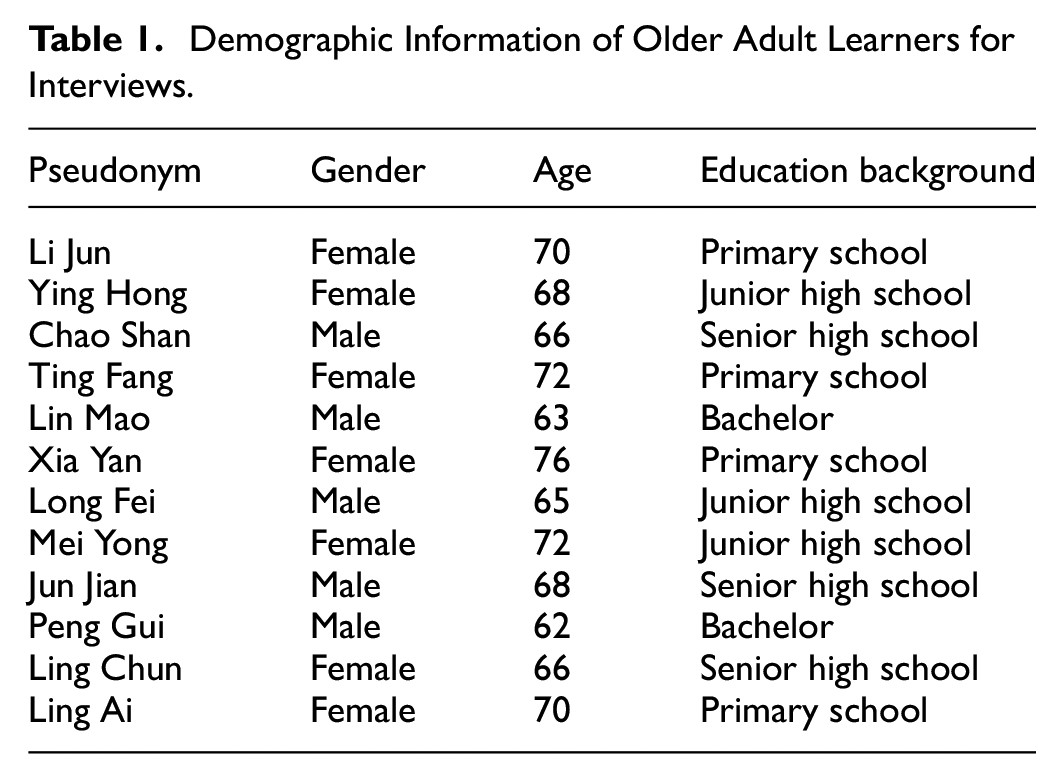
Following the completion of the smartphone training project, all 12 older adult learners who participated were invited to partake in interviews. The demographic information of the participants is presented in Table 1. Before the interviews, the researchers explained to the participants that all research materials would be treated with strict anonymity and confidentiality. They were assured that they could withdraw from the interview at any time if they felt uncomfortable. All participants were fully informed of their rights and provided informed consent by signing consent forms before participating in the interviews.
Demographic Information of Older Adult Learners for Interviews.
The interviews explored older adult learners’ understanding of the young university students’ teacher role. The older adult learners shared their feelings and experiences about being students and their interactions with the young university students as teachers. To ensure that the interview was grounded in research questions and a theoretical framework, the researchers tactically encouraged the participants to talk about the factors that forced them to recognize the young university students as teachers. Overall, each participant was interviewed for approximately 40 to 60 min. Considering the actual situation of the interview process and confirming the accuracy of the interview materials, five participants were interviewed twice. It is perhaps important to note that saturation is considered an important indication of sample size. Interview data from the 12 participants recruited effectively answered the research questions.
Data Analysis
In qualitative research, the process of meaning construction involves researchers organizing seemingly complex social phenomena into a relatively complete, clear, and logical map (Belotto, 2018). Data analysis, therefore, is a systematic process through which researchers arrange and combine interview data based on specific logic to portray a comprehensive image of the research objects (Mezmir, 2020; Xu & Zammit, 2020). For this study, qualitative thematic analysis was employed to identify the various forces influencing older adult learners’ acknowledgment of young university students as teachers. It needs to be highlighted that phenomenological analysis (Nizza et al., 2021), as focusing on describing an individual’s daily life, and complex life experiences, drives interview data to be coded, interpreted as well as constructed.
Thematic coding, mainly deductive and inductive coding, was used in conjunction with the data analysis. Top-down deductive coding was constructed and driven by the theories of Max Weber, Margaret Mead, and others. Bottom-up inductive coding was identified and categorized based on sufficient interview data. The following sequential steps were followed: (1) the authors transformed the recordings of 12 participants into visual texts word by word and sentence by sentence; (2) the authors familiarized themselves with the interview and generated initial codes independently; (3) the authors derived themes from the initial codes and then cross-checked their analysis; (4) the authors reviewed, negotiated, identified, and defined the themes; (5) based on the themes and categories that emerged from the qualitative data, the authors developed a framework to understand what makes older learners acknowledge university students as teachers.
Older learners frequently used the transitional expressions “I thought at the beginning, and then I found,” and “I become more and more trust/respect/… them,” indicating that they recognized young people as teachers as an incremental process. This led to the emergence of three recognition mechanisms that exist independently at different stages of teaching and learning. Specifically, authority-based recognition in the pre-teach stage, interaction-based recognition in the teaching stage, and development-based recognition in the reflection stage. We then recorded the data around those three main mechanisms, resulting in a dynamic map (Braun & Clarke, 2019) that illustrated the dynamic process of older adult learners recognizing young university students as teachers in reverse education.
To ensure authenticity and validity, the researchers shared the thematic coding and research results with the 12 participants for their input and validation. Additionally, a supervisor was invited to independently code the data, and the results were compared to confirm the reliability of the data analysis. No further modifications were required after this validation process.
Findings
On the whole, the dynamic process of older adult learners acknowledging young university students as teachers unfolded in three stages, and different recognition patterns emerged at each phase of teaching. In the pre-teaching stage, older adult learners acknowledged young university students as teachers due to the educational institution’s authority. In the teaching interaction stage, older adult learners identified young university students as their teachers when they displayed teaching skills and emotional care. During the learning reflection stage, older adult learners prioritized learning quality and self-improvement when evaluating young university teachers.
Pre-Teaching Stage: “Senior University Empowers Young University Students to Become Teachers”
During the pre-teaching stage, older adult learners focused on the institutional role of the school and the qualifications of the “young teachers.” The senior university, being a lifelong learning institution, served as a platform for older adults to pursue personal development, maintain cognitive abilities, and enhance social interaction. This institution has become the preferred place for older adult learners in China, and they identified themselves as students engaged in lifelong learning.
At this stage, older adult learners placed special importance on the identity of the young university students as teachers. They were curious about the background and qualifications of these young university students, seeking to build trust and confidence in the teaching process. Older adult learners perceived the young university students as teachers as individuals possessing modern knowledge and effective teaching techniques, which they believed could enhance the learning experience. Understanding the background and qualifications of young university students as teachers became a significant factor influencing older adult learners’ decision to participate in the educational program.
As we all know, all schools are professional places for teachers to teach and students to learn. I signed up for this class to learn how to use a mobile phone. (Chao Shan) The nature of the senior university is an educational institution, and the people who teach us here are teachers. We sometimes call the volunteer teachers because they help us adapt to the information age. (Li Jun) The senior university invites these young university students to teach us, and they stand on the platform in the classroom. Although the teaching effect may not well good sometimes, they are teachers. (Long Fei)
The young teachers, being students from a prestigious university like East China Normal University, were seen as “winners” who had successfully passed the highly selective admission process. The reputation and quality of educational resources of these universities played a crucial role in attracting a large number of students, creating a competitive and selective environment. In the context of the Confucian cultural orientation of valuing education for a better life (Stankov, 2010), older adult learners naturally regarded these young university student volunteers, with their advantage of cultural capital, as their teachers. As some participants stated:
Through my observation, they (young university students) are very skillful in living in the information technology society. Before they teach us to learn how to use smartphones, I guess that they are capable of performing the role of teachers. (Li Jun) Young university students today are indeed well-versed in navigating the digital landscape and are often skilled in using technology. It can be said that their generation is better than our generation. They are very likely to become our teachers. (Mei Yong) The educational background of these young university students is quite good. While we seniors are already behind the times, they are born with the genes of electronic information technology. They need to be tested in practice, but in theory, they are qualified to be our teachers. (Ling Ai)
In conclusion, during the pre-teaching stage, older adult learners were willing to recognize young university students as teachers because they believed that those young university students possessed valuable knowledge and skills, and there was a clear separation between teachers and students in the senior university setting. The institutional role of the senior school, the qualifications of the young university students as teachers, and the cultural capital associated with their university background contributed to the older adult learners’ acknowledgment of the young generation as their teachers.
Teaching Interaction Stage: “They are Professional, Knowledgeable, and Educators in the Class”
During the teaching interaction stage, older adult learners focus on the professional knowledge, skills, and identity demonstrated by the young university students as teachers. They specifically highlighted the curriculum knowledge and teaching methods of these young university students as teachers. The young university students’ proficiency in IT-related knowledge and skills became a significant factor that led older adult learners to recognize them as teachers. For instance, Ying Hong applied for this project because she felt left behind in such a digital world. So, she was more likely to recognize the people who specialized in IT-related knowledge and skills. As she said:
I felt upset when I could not find the e-pay button on my mobile phone. They, the young university students, understand more than we do in such a digital world. That’s why I call them teachers.
Similar to Ying Hong, Peng Gui simultaneously expressed that:
These young university students have been surrounded by the information technology era since they were born. The social environment and educational experiences provide important support for their proficiency in information technology knowledge, skills, and values.
Moreover, the teaching methods used by young teachers were deemed crucial by older adult learners. They appreciated the fact that those young university students understood the unique characteristics of older adults’ learning, such as faster forgetting and slower progress. These young university students as teachers designed teaching activities and used teaching methods that effectively cater to the needs of older adult learners. The ability to transfer knowledge and skills to older adult learners and create a positive and enjoyable teaching atmosphere further strengthened the older adult learners’ identification of young university students as teachers (Boulton-Lewis & Tam, 2018; Kim & Merriam, 2010). Ling Ai shared with us a previous experience in which she believed that teachers who cannot understand the psychology of older adult learners have difficulty designing quality teaching activities and effectively using teaching methods.
I signed up for piano lessons last year to fulfill my dream of becoming a pianist when I was young. I was not satisfied with my three-month learning experience because the teacher’s fast-paced lesson plan did not take into account all the characteristics of learning for us as older adults.
In contrast, Ling Ai believed that these university students were young, but they were extremely professional in teaching methods of their teaching objectives and activity design. The ability to effectively transfer knowledge to older adult learners was one of the core characteristics of their expertise in teaching.
Although they are very young, they are very good at teaching. The teaching methods they use, and the interaction they have are very interesting, and more importantly, they are very patient with us older adult learners. That is why I respectfully refer to them as teachers.
Besides this, older adult learners highlighted the enjoyable teaching atmosphere and positive teacher-student interactions in the classroom. Lin Mao, who participated in several learning projects, expressed:
To be honest, I am not satisfied with some former projects. I even don’t want to call them teachers. When I make mistakes or forget something, I feel their contempt and dislike for me. However, in this information technology classroom, I can feel that these young university students respect us very much, they are patient and friendly. So, I also respect them as teachers from the bottom of my heart.
It should also be emphasized that some older adult learners participated in this program not only for the knowledge they gained but also for social and emotional satisfaction. As Ling Chun expressed, her life after retirement was lonely and isolated. Emotional care and support were her important needs for interpersonal relationships in her senior life. The emotional transfer from the young university students in the classroom met her expectations for a teacher-student relationship, which naturally strengthened her identification with the young university students as teachers. She said:
In the classroom, I could perceive that the young university students had a positive attitude toward teaching, their teaching behaviors were serious and the teaching atmosphere was positive. From the emotions and behaviors they put into the teaching process, I think they are very willing to teach us, which strengthens my understanding and recognition of their status as teachers.
Lin Mao, whose wife passed away 6 years ago and whose two sons were working in America, had a similar opinion:
I believe that a qualified teacher should not only impart knowledge to students but also create a harmonious teaching atmosphere and teacher-student relationship in the classroom. The teaching activities of these young university students in the classroom have achieved both knowledge transfer and emotional support, which is an important reason for me to recognize them as my teachers from my heart.
Overall, the teaching interaction stage strengthened the older adult learners’ recognition of the young university students as teachers due to their knowledge, professional teaching skills, and emotional support provided during the learning process. The combination of content knowledge and general pedagogical knowledge in an era dominated by information technology and digital media further enhanced the young university students’ identity as effective teachers in the eyes of older adult learners (Jang & Chen, 2010; Jüttner et al., 2013).
Learning Reflection Stage: “They Made Me a Better Person, Which Reinforces My Recognition of Them as Teachers”
As observed by the first author, the final class brought about a poignant moment as the older adult learners showed deep reluctance to part ways with their young teachers. After the class, they continued to hold hands, expressing their heartfelt desire for the young teachers to return regularly. Even after the project concluded, they maintained consistent communication through WeChat, respectfully referring to them as “teachers.” In the latter stages of the project, the legitimacy of the young teachers’ role was firmly established through the older adult learners’ recognition of the profound impact these instructors had on their personal development and learning journey. For instance, Xia Yan shared her experience:
Before this training program, using a mobile phone was a challenge in my daily life. After going through and completing this program, I have learned many practical ways to use my phone. I think this is probably the biggest benefit I got from this program.
Similarly, Jun Jian, who had minimal prior knowledge of mobile phone use, echoed this sentiment:
I think mobile phones have become a tool for almost everyone’s life. By learning how to use a cell phone from young university students, I am now able to skillfully set alarms, shop online, and consume electronically. I think this training has accelerated my steps into the information technology society.
Beyond the acquisition of knowledge and skills, the training program also had a profound impact on the emotions and attitudes of older adult learners. While existing research often emphasizes external behaviors, this study highlighted the significant psychological transformation experienced by the participants (Hur, 2016; Mariano et al., 2022). Older adult learners expressed a shift from negative feelings, such as anxiety and fear, to positive emotions, including relaxation and comfort. As Ting Fang shared:
After participating in this training on using mobile phones, my mental state has changed dramatically from anxious to relaxed. They have made me a better person. One of my beliefs is that the people who teach me things are my teachers. Therefore, these young university students are my qualified teachers.
Jun Jian also echoed this sentiment:
I used to feel anxious, scared, and helpless when I did not know how to use my phone. After four months of training, I have learned how to take pictures, navigate, set alarms, and many other skills. I am now able to approach my phone with a good and positive attitude. I am truly grateful to these young university students for their patience in teaching me, they are the teachers who helped me adapt to this information age.
Recognizing those young university students as teachers was not a static state but a dynamic and evolving process. The older adult learners’ strong recognition of the young university students’ teacher identity deepened and solidified as they witnessed their growth in knowledge, skills, and psychological well-being throughout the training. This recognition extended beyond the confines of the classroom and permeated into their daily lives. Mei Yong expressed:
I learned how to download software and seek medical services online from those young university students. I feel that they made me a better person. I used to call them volunteers, but now I think it is more appropriate to call them teachers from the bottom of my heart.
Peng Gui, who valued the young teachers’ dedication, remarked:
I am deeply appreciative of the patience and dedication demonstrated by these young university students as teachers. Despite their modest self-perception, I find their teaching skills to be superior to many other formal teachers in senior universities.
The training program not only enriched the older adult learners’ knowledge and skills but also fulfilled their emotional needs for companionship and support. The emotional bond established during the training further strengthened their recognition of the young university students as teachers. As Ting Fang emphasized:
The positive and supportive atmosphere in the classroom created by the young teachers profoundly impacted my perception of them as educators. Their genuine willingness to teach and foster a harmonious teacher-student relationship solidified my understanding of their role as teachers.
Overall, the older adult learners were wholeheartedly willing to embrace the young university students as their teachers. The training provided them with not only practical knowledge and skills but also emotional fulfillment, making it a pivotal stepping stone in their journey towards adaptation to the information technology era. The collective impact of the school’s function, the college students’ teaching competence, and the older learners’ successful adaptation to the digital era coalesced to deepen the older adult learners’ identification with the young university students as teachers, extending far beyond the classroom into their daily lives.
Conclusion and Discussion
As technology continues to revolutionize society, embedding digital and artificial intelligence in everyday activities, older adults often struggle to keep pace with these rapid changes (Cath et al., 2018; Davenport & Ronanki, 2018; Schneider & Leyer, 2019). Lifelong learning, particularly through reverse education where younger individuals instruct older adults, has emerged as a crucial approach to bridging the generational divide (Avila et al., 2009; Cheng et al., 2021; De Santana et al., 2021; Hu, 2022; S. Lee & Yu, 2021; Yoruk & Sekerci, 2020). This study delves into the intricate dynamics of how older adult learners come to recognize and accept young university students as their teachers, focusing on a four-month smartphone training project at Long-Mei Senior University (LMSU) in Shanghai, China.
Our findings align with and extend the legitimacy theory as conceptualized by Max Weber (1958), demonstrating that older adult learners recognize young university students as teachers through a three-stage process: pre-teaching, teaching interaction, and learning reflection. During the pre-teaching stage, institutional authority plays a pivotal role in establishing initial teacher identity. This aligns with Weber’s notion of authority derived from institutional structures. As teaching progresses, recognition shifts to the younger instructors’ demonstrable skills and emotional support, reflecting Mead’s (1970) emphasis on the dynamic and evolving nature of teacher identity. Finally, the reflection stage underscores the practical outcomes of learning, where older adult learners assess their instructors based on educational effectiveness and personal development (see Figure 1).

The process that older adult learners to recognize young university students as teachers.
Prior research has predominantly examined traditional teacher-student relationships, where the older generation typically assumes the role of the teacher (Beetham, 2018; Buchanan, 2015; Robinson, 2022). In contrast, reverse education presents a paradigm shift, positioning younger individuals as educators. Existing studies on reverse education have focused on motivations, materials, methods, and impacts but have not fully explored the recognition process of younger individuals as legitimate teachers by older adults (Avcı & Erhan, 2022; Drury et al., 2016; Earl et al., 2018; Hinners & Potter, 2006). This study fills this gap by exploring the multi-stage process of recognition, integrating insights from Weber’s legitimacy theory (Weber, 1958), Mead’s prefigurative culture (Mead, 1970), and contemporary identity theories (Edwards & Edwards, 2017; Feldman, 2007). The proposed model of three forces of teacher legitimacy—derived from institutional authority, teaching skills, and learner outcomes—offers a comprehensive framework that reflects the complex interplay between these elements in reverse education.
The findings of this study underscore essential considerations for enhancing the practice of reverse education. Educational institutions and policymakers should adopt a holistic approach to training young educators, focusing not only on developing their technical skills but also on cultivating their interpersonal skills and emotional support capabilities to effectively assist older learners (Cropley & Dave, 2014; Halx, 2010; Tam, 2014). Emphasizing both technical and emotional support dimensions can significantly enhance the learning experiences and outcomes for older adults, thereby fostering a more supportive and inclusive educational environment. Furthermore, integrating the perspectives and emotional needs of older learners into educational strategies is crucial. Programs that address these aspects are more likely to foster positive intergenerational educational relationships and improve the effectiveness of reverse education initiatives (Augustin & Freshman, 2016).
The findings of this study provide insights into the dynamics of how older adult learners in Shanghai recognize young university students as teachers in reverse education settings. However, it is essential to consider the generalizability of these findings in light of several factors. First, the theoretical framework developed in this study offers a robust basis for understanding the teacher-student relationship in reverse education contexts. The conceptual insights into how older generations perceive younger teachers could potentially apply to similar cultural contexts where there is an emphasis on adapting to technological advancements and societal changes. Second, from an international perspective, the educational practices observed in this study, where older adults acknowledge younger generations as teachers, may resonate in cultural contexts that share similarities with China. These insights can inform theoretical constructs and practical strategies in diverse educational settings striving to bridge generational divides and promote lifelong learning. Third, while acknowledging cultural diversity, the findings of this study may not directly generalize to countries with distinct cultural backgrounds from China. Cultural nuances and educational systems play crucial roles in shaping teacher-student dynamics, which may vary significantly across different global contexts.
Despite its contributions, this study has certain limitations. It was conducted in Shanghai, where higher and senior education partnerships are well-developed, potentially limiting its generalizability to regions lacking collaborative conditions between higher and senior education. Moreover, the study primarily focused on the perspectives of older adult learners, providing valuable insights into their perceptions of young teachers. However, it did not extensively explore the experiences and perspectives of young teachers themselves, which could enrich our understanding of reciprocal dynamics in reverse education. Furthermore, while qualitative methods were instrumental in capturing rich insights within the Chinese cultural context, quantitative methods have yet to be explored to uncover broader patterns and regularities in how older adult learners recognize young university students as teachers.
Future research should continue to explore the nuanced dynamics of teacher-student relationships in reverse education settings. Specifically, investigating the reciprocal nature of learning interactions and the role of emotional intelligence in fostering effective educational practices would advance our understanding of intergenerational learning processes. Moreover, comparative studies across different cultural contexts would elucidate the universal principles underlying older adults’ recognition of young teachers as educators.
Footnotes
Acknowledgements
We sincerely thank the 12 older learners interviewed for their participation, support, and contribution to this study.
Declaration of Conflicting Interests
The author(s) declared no potential conflicts of interest with respect to the research, authorship, and/or publication of this article.
Funding
The author(s) disclosed receipt of the following financial support for the research, authorship, and/or publication of this article: This article is supported by the Postdoctoral Fellowship Program (Grade C) of China Postdoctoral Science Foundation under Grant Number GZC20230921.
Ethical Approval
This study was approved by the University Committee on Human Research Protection of East China Normal University, grant number HR 288-2022.
Informed Consent
Informed consent was obtained through the participant’s autograph and verbal commitment.

Data Availability Statement
All data analyzed are contained in the paper.