




Abstract
This study focuses on the different impacts of platform training and learning by doing on gig workers’ platform income. Based on survey data of China’s delivery riders on the platform in 2020, via quantitative methods combined with the case study, it is found that the platform training is negatively correlated with riders’ incomes, while learning by doing is positively correlated with their incomes. Workers with a high level of platform-income dependence earn more than those with an average level of dependence under the same platform training, or learning by doing. Overall, the incomes of the former are significantly lower than those of the latter, where the difference is mainly due to unobservable factors. Both platform training and learning by doing significantly reduce the income gap. In addition, the instrumental variable and the propensity score matching approaches are introduced to handle the endogeneity problem, and robust results are obtained.
Plain language summary
This study looks at how two different ways of learning affect gig workers’ earnings on platforms. We used data from a survey of delivery riders in China in 2020. We found that training provided by the platform tends to lower riders’ earnings, while learning from actual work experience tends to increase earnings. Riders who rely more on their platform income earn more than those who don’t, even after training or learning by doing. Both types of learning help reduce the income gap. We used special methods to make sure our results are accurate.
Introduction
Marx once predicted: “When the era of barbarous capitalist exploitation is over, and the legal wage system is universal, shorter working hours and the flexible working system will become one of the important development trends in the future.” With the development and popularization of emerging technologies and the changes in social and economic conditions, the Goldilocks conditions 1 for a considerable number of traditional enterprises and jobs have been exhausted, and Marx’s prediction has been proved.
The gig economy, accompanied by the free and flexible gig market, which aims to optimize the allocation of labor market resources in the new era, has come into being. A considerable number of jobs are deconstructed into fragmented tasks and work, which on the one hand, promotes the diversification of work patterns and enterprise governance models, and, on the other hand, continuously leads traditional employment relations gradually to cooperative relations. Platform enterprises and workers’ relationships, including formal employment and emerging working relations, are diversified. All the human capital modules of independent workers are represented by occupational competence [Occupational competence refers to the combination of workers’ abilities to be qualified for a certain job. However, there are no jobs in the gig economy. Therefore, gig workers’ occupational competence refers to the combination of workers’ abilities to be qualified for specific tasks (such as food delivery)] that can be utilized to obtain investment returns and become an important factor affecting their income level.
In the process of labor relations transformation, the ways of improving occupational competence are increasingly diverse. Especially in the gig economy, the role of the most common platform training and learning by doing exceeds that of formal school education to some extent. However, due to the differences in forms and motivations, the effectiveness of these two approaches may be different, as the former, initiated by enterprises, has the characteristics of purpose, planning and standardization, is relatively formal, and usually serves the needs of enterprises; the latter originates from individual self-experience in the process of work, which is the accumulation of human capital in informal channels and mainly serves the work needs of individual workers.
At the same time, advanced digital technology and lower digital costs have changed people’s living and dining habits. The development of delivery platforms not only brings great opportunities to the catering industry but also provides a large number of work opportunities for workers. Food delivery riders, regarded as the core player of the “Internet + service industry,” play a crucial role in people’s daily life. In 2020, the Ministry of Human Resources and Social Security officially defined the occupation of food delivery riders as “online delivery workers” and included them in the national occupational classification list (Ministry of Human Resources and Social Security, 2022). The number of online delivery workers is expected to exceed 10 million.
In recent years, a series of critical national directives on “decent work” and high-quality employment have set the general tone for ensuring the quality of work for workers: In 2013, Xi (2021, 11.23) emphasized the need “to strive to enable workers to achieve decent work to” (Hu & Liang, 2021); The report to the 19th National Congress of the CPC stated that “employment is the most important thing to people’s livelihood,” and we should “adhere to the strategy of giving priority to employment and a proactive employment policy to achieve higher quality and fuller employment” (Hu & Liang, 2021).
Improving workers’ income level is the fundamental problem in ensuring the quality of their work. The guarantee and advance of delivery riders’ income are not only directly related to their own interests but also can indirectly promote the improvement of enterprise operation efficiency and economic benefits and reduce the relevant litigation costs caused by labor conflicts. The classical human capital theory describes that both formal training and informal experience accumulation (learning by doing) can improve the income level of individuals to a certain extent (Aliaga, 2001; Zhang, 2011). Will the situation of riders in the gig market be different? In other words, can formal training and informal learning by doing still raise workers’ incomes in the gig economy? However, learning by doing is not explicitly taken as the core explanatory variable in the previous research. Moreover, less study compares the effects of informal learning by doing and formal platform training on workers’ incomes.
Since the gig economy has many new phenomena and features, classical theories cannot be fully applied. Only by combining qualitative analysis with quantitative methods can traditional theories be used to better explain new issues, in that part of the results obtained through quantitative analysis need to be supported by qualitative interview resources. Therefore, guided by practical needs and national policies, based on questionnaire survey data and interview data of China’s delivery riders, this study adopts the quantitative approach as well as case studies to explore the differences in the impact of platform training and individual learning by doing on gig workers’ platform incomes. On this basis, it analyzes whether the impact of the platform training and learning by doing on the income level of riders with different work types is heterogeneous and deeply discusses the specific contribution of the two to the income difference. In addition, the instrumental variable (IV) and the propensity score matching (PSM) methods will be taken to address the possible endogeneity problems. With aims to explore the occupational competence improvement pathways that can enhance the income of China’s delivery riders and narrow the income differences, this study will put forward feasible suggestions on the enrichment and improvement of the training content of the platform enterprises at the present stage, to promote the realization of high-quality employment of gig workers in the new era while balancing the interests of both gig workers and enterprises.
Literature Review
Human capital can be understood as a kind of work and production capacity. Suppose workers want to improve their abilities continuously. In that case, they need to invest part of the available resources to enhance their intelligence, physical strength or other abilities, such as experience accumulation, training, education, health care, etc. (Becker, 1964). Schultz once proposed that the essential attribute of human capital is that it can generate increasing returns, and the accumulation of human capital can improve the ability of individuals to deal with economic changes. He emphasized that humans’ economic value lies in seeking to improve working conditions and the working environment, including but not limited to the increase in income. In addition, the range and diversity of human capital affect the ability of individual workers to understand information, act and communicate with others (Stroombergen et al., 2022). Therefore, individuals with more talents, skills, and abilities are expected to obtain more income and have a more favorable position in the labor market.
The classical human capital theory proposes that enterprises can produce not only material products but also human capital to improve individual occupational competence (Zhang, 2011). First, in making products and providing services, workers’ production and service skills can be enhanced in different ways, which is the so-called learning by doing. Therefore, what the firm actually produces is a joint product; that is, it affirms the interaction between the human capital, including the professional capacity, and the production process in the course of the firm’s economic activities - the former has a decisive influence on the latter, and the latter will react on the former. Second, standardized formal training provided by enterprises can also promote the improvement of workers’ occupational competence (Becker, 1964). Therefore, enterprises become an essential place for individual occupational competence development, and meanwhile, practical experience becomes a crucial way for individuals’ occupational competence improvement (Stroombergen et al., 2022).
Unlike formal school education, which prioritizes general education, the development of human capital in traditional enterprises focuses more on applied skills and knowledge, which are usually closely related to enterprises’ primary production and service, namely occupational competence. Theoretically, human capital developed by enterprises is more practical, operational and professional. There are usually two kinds of occupational competence improvement paths in enterprises: formal training provided by enterprises and informal work experience accumulation (or learning by doing) in the workplace. The former reflects the individual human capital accumulated in the process of investment in workers under the arrangement of enterprises. At the same time, the latter is the human capital accumulated by workers through spontaneous learning in their working process (McDaniel et al., 1988); that is, with the growth of working years and accumulation of experience, the occupational competence of workers will be continuously improved (Tesluk & Jacobs, 1962). In the 1950s, a large body of research on the returns to investment in entrepreneurial training began to emerge from abroad. The central theme of these studies was to examine the relationship between entrepreneurial training and individual earnings growth and employment behavior. As a result, a new subdiscipline of economics, training economics, was born (Orley & Robert, 1996) In his seminal work, Becker first explored the income effects of enterprise on-the-job training (Becker, 1964). Regarding empirical research, Mincer developed an estimation model of the costs and benefits of entrepreneurial training to provide an empirical basis for further exploring the relationship between entrepreneurial training and earnings and employment behavior. Taken together, human capital theory suggests that entrepreneurial training is an economically valuable human capital investment that positively affects workers’ earnings. Based on Hirsch’s research on the differences of “learning curves” in various industries, Arrow is the first to model learning by doing and put forward the view that “even there is no new capital, experience accumulation and technological progress may exist.” In particular, technological progress will catalyze the realization efficiency of workers’ learning by doing and improve the learning efficiency of individuals at work. In theory, the longer the working life, the more experience an individual can acquire, indicating more progress in occupational competence (Zhang, 2011). Different from learning by doing, enterprise training needs to be arranged and organized by the enterprise, and most of the contents are related to the production or service process of the enterprise, but it takes a relatively independent form separated from production. This process not only costs time but also involves certain other direct costs, such as the expense of teaching materials and teaching AIDS. In addition, the enterprise training is planned, in batches, and periodical, while work experience may be associated with the employee’s career (Stroombergen et al., 2022).
The forms of learning by doing and enterprise training are entirely different, and their effectiveness is also different. However, in the traditional concept, both of the above form the improvement of individual income. However, will the situation be different under the loose working relations between gig workers and platforms? Especially in the food delivery sector, the platform trains riders every month or week. Can the training content meet the riders’ practical needs to increase their incomes, or is it just an ornament?
Early studies on the gig economy have focused on its pros and cons: on the one hand, it brings more opportunities to the traditional labor market (Burtch et al., 2018; Fraiberger & Sundararajan, 2021; Mulcahy, 2017; Schor, 2017; Zhan et al., 2018)and higher work flexibility (Donovan et al., 2016); On the other hand, it also causes problems and challenges such as welfare decline, uncertainty increase, privacy violation, lack of rights and interests protection (Friedman, 2014; Schneider & Harknett, 2019). Based on earlier research, relevant empirical studies are increasingly rich, including the protection of gig workers’ rights and the identification of employment relations (Kalleberg, 2009; Sutherland et al., 2020), platform labor control from the perspective of technological determinism (Gandini, 2019; Wu et al., 2019), workers’ perception of technological affordances (Curchod et al., 2020; Lehdonvirta, 2016), quality of odd jobs (Goods et al., 2019; Monteith & Giesbert, 2017) and the workers’ willingness to stay or leave the platform (Auer et al., 2021; Cameron, 2022; M. K. Chen et al., 2019; Sundararajan, 2016), the physical and mental health of casual workers (Apouey & Stabile, 2022; Cai et al., 2021; Morita et al., 2022; Patel & Waynforth, 2022).
The existing research on the gig economy has evolved from the initial debate on the “pros and cons” at the phenomenon level to exploring issues in the field, from different perspectives of sociology, economics, management and law, and via qualitative, quantitative and mixed empirical methods. Among them, many welfare-related studies focus on the issue of gig workers’ income, and most focus on the impact of participation in the gig economy on individual income. Those with favorable views indicate that the gig market provides workers with more flexible work, reduces transaction costs and improves economic efficiency (Fraiberger & Sundararajan, 2021). Participation in the gig economy can narrow the income difference among workers with different skills, as many workers with lower skills have the opportunity to make up for their income deficiency in the gig market (Zhan et al., 2018). Individuals with high human capital stock can diversify and expand their income sources through various gig platforms (Schor, 2017). However, some scholars hold an opposing view, believing that the gig economy has created a large number of “unstable proletarians,” and behind the surface of “sharing” and “equality” is the “inequality” and “instability” deeply embedded in “gamification” (L. Chen, 2020), where the workers’ income and welfare are controlled by platform algorithms (Rosenblat & Stark, 2016). In terms of the research on the determinants of individual income from platforms, the impact of the work-type decision is widely discussed (Zheng, 2021). It is claimed that the differential treatment within the platform is the main reason that the unit time income of gig workers with the high level of platform-income dependence is more than that of the workers with average income dependence on the platforms. Some have discussed the influence of traditional education on gig workers’ pay (He et al., 2021) and proposed that the higher the level of education, the higher the level of gig workers’ platform income. There are also discussions on the impact of work experience accumulation on individual income. Still, work experience is not explicitly taken as the core explanatory variable, and less research compares the effects of informal work experience accumulation (learning by doing) and formal platform training on incomes.
This study argues that the level of formal education cannot truly reflect the dynamic changes of individual human capital stock in the gig economy, coupled with the fact that most platform enterprises do not set thresholds for education level (L. Chen, 2020), and the occupational competence improvement of gig workers mostly comes from enterprises and working processes. Therefore, from the human capital perspective, the study will explore and compare the impact of formal platform training and informal learning by doing (work experience) on gig workers’ platform income while controlling the educational factors.
Given the traditional variables included in the theoretical model to represent learning by doing, most of them measure the accumulation of human capital in terms of material capital and working time. Based on the data of food delivery riders, this paper starts from the classical perspective of human capital to explore the impact of individual work experience (working months on the platform) and the training provided by the platform enterprises on the income level of the individual worker in the gig market. The study will discuss the application degree of classical theories to the emerging gig economy, and answer the question of which occupational competence improvement path (formal platform training and learning by doing) is more important for enhancing gig workers’ income level and welfare, as well as whether platform training in practice plays its supposed role?’. The conceptual framework of this paper is as follows (Figure 1):
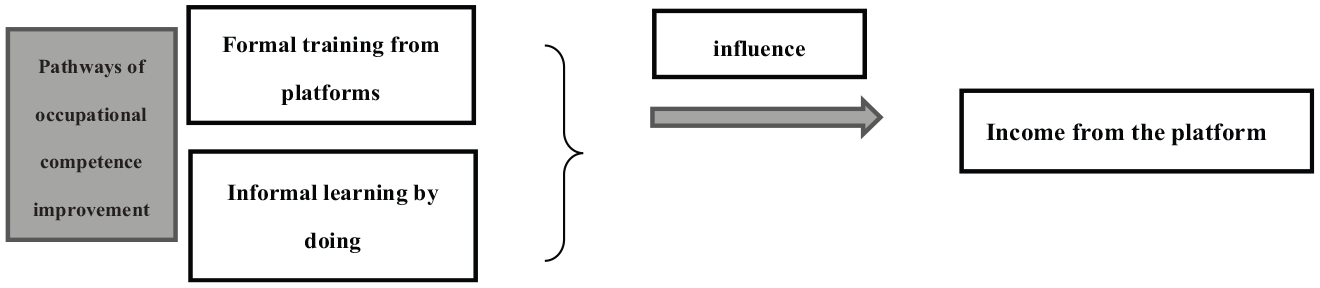
Conceptual framework.
Variables and Research Methods
Data Source and Variables
This analysis is based on survey data of food delivery riders from 2019 to 2020 drawn from the research project “Labor and Career Development of Food Delivery Riders” (2020) . The survey was designed to explore the living and working conditions of food delivery riders in the gig economy. The research group conducted a quota sampling of platform riders in five cities, including Beijing, Shenzhen, Chengdu, Hangzhou, and Harbin. The questionnaires were distributed between November 2019 and April 2020. The survey process was interrupted between February and March 2020 due to the outbreak of the novel coronavirus disease 2019 pandemic, which took 4 months. After deleting missing variables and extreme values, 9,133 valid samples were finally collected out of 11,471 samples. Additionally, supplemented by in-depth interview data of 20 platform delivery riders in Beijing from May 1 to August 31, 2021, this paper conducts the case analysis involving the living status, working conditions and rights and interests of the riders.
The explained variable is the platform income of individual riders, a continuous variable measured by hourly income, with an average level of 15.93 yuan/hr, where the minimum is 3.13 yuan/hr, and the maximum is 183.33 yuan/hr. The core explanatory variable is the pathways of riders’ occupational competence development, containing two variables: One is the formal training provided by the platform, measured by “whether the platform often provides formal training,” with 5,026 riders, 55.03% of the total, giving feedback of “formal training regularly provided”; The second is the accumulation of work experience from working for the platform, which reflects the learning by doing of the individual rider, and is measured by riders’ number of months for working on the platform.
This study also controls for individual factors (i.e., age, gender, educational level), family factors (i.e., marital status, number of children), regulatory factors (i.e., Hukou status 2 ), work factors (i.e., whether work for two or more platforms?), and city effects. Tables 1 and 2 show the definitions and statistical descriptions of the variables involved in this paper. The mean value and standard deviation are given for continuous variables, and the percentages are provided for categorical variables.
Variable Definitions.

Variable Descriptions.

Research Method
Ordinary Least Squares Method
Through the Ordinary Least Squares (OLS) method, this paper discusses the influence of regular platform formal training and learning by doing on the income level of the riders. The income determination model is as follows:

In Equation 1,
Oaxaca—Blinder Decomposition Model
Based on OLS regression, to investigate the income difference between riders with two levels of platform-income dependence and its causes, this study takes the platform income structure of gig workers as the benchmark and uses the traditional Oaxaca-Blinder (OB) method to break down and analyze the contribution degree of work experience and platform training to the individual income difference (Oaxaca, 1973). The income function is expressed as, and then, the income functions of full and part-time riders are, respectively:


In Equations 2 and 3, the mean values of the path vectors for improving the vocational ability of riders with high-income dependence on the platform and those with average-income dependence are denoted as


Instrumental Variable (IV) Method
Due to the endogeneity problem between the experience accumulation from individuals’ learning by doing and their income level, the results may be biased and cannot reflect the causal effect. The endogeneity problems above may come from: firstly, missing variables; secondly, the issue of reverse causality, where it is true that the accumulation of individual work experience can improve their income level, but the increase of individual income can also encourage individuals to accumulate more work experience under the same experience period.
To solve the above problems, “past express delivery work experience” satisfying both endogenous and correlation conditions is introduced as an IV; that is, express delivery work experience is closely related to the human capital accumulated (riders with express delivery experience can accumulate more human capital in the same working time) but does not directly affect the platform income level of individuals. The questionnaire concerns previous work experience, “Have you ever worked as a courier before being a food delivery rider?.”
Results
The Impact of Formal Platform Training Provision and Learning by Doing on the Income of Gig Workers
This paper first uses OLS regression to estimate the impact of the training provided by the platform where the rider works and the learning by doing of the rider on their income from the platform. Model 1 only contains individual and family factors besides the core explanatory variables, Model 2 further controls institutional factors (hukou status), and Model 3 considers all factors, including working factors (Table 3).
OLS Regression Results of Platform Training, Learning by Doing and Platform Income.

Note.*, **, *** represent significance at the 10%, 5%, and 1% levels, respectively. The figures in brackets are standard errors.
In Models 1, 2, and 3, regular platform training and work experience are significantly correlated with individual platform income at the significant levels of 5% and 1%, respectively, but the former is negatively while the latter is positively correlated. The classic human capital theory holds that enterprise training can bring workers an increase in human capital, including occupational competence (Aliaga, 2001). In addition, the study also learned through interviews that the platform’s training content mainly prioritizes traffic safety and service rules, but has less focus on training about ways of improving work efficiency. A large proportion of riders report that training is a “waste of time,” lacking content updates and disconnected from practical needs. As some riders respond, the platform training that should be conducive to occupational competence improvement is more similar to an orientation, which not only consumes time but also may delay the food delivery:
It’s the same training content every time. (Rider No. : BJT20210507-1) The platform provides training, but it will delay you in delivering orders. However, you have to participate in it. (Rider No. : BJT20210712-3) The content of each training is the same. It might help the new riders, but it doesn’t help me much. New riders may need training on rules and safety, which most old ones don’t want to join. It is a waste of time. (Rider No. : BJT20210501-1)
When asked about the training content of the platform, some riders report that the training content mainly focused on safety, traffic regulations, and other content, but fewer delivery skills:
Safety is emphasised in every training. (Rider No. : BJT20210510-3) The training will talk to us about some other people’s traffic accidents so that we must pay attention to safety. (Rider No. : BJT20210406-1) There must be safety issues and traffic rules in training every month. There are two or three [accidents] a month [for riders]. You can’t deliver orders without training. (Rider No. : BJT20210606-1) There’s training on the platform’s app. A lot of riders don’t see it. To tell the truth, I did not see it initially, and then I knew I should learn more about it. Otherwise, money will always be deducted. A slight mistake here will negatively impact the money (income from the platform). (Rider No. : BJT20210510-1)
Although safety training is crucial, riders also aspire to acquire additional professional skills training, which can not only enhance riders’ productivity and related income but also can ensure their safety during delivery operations. Therefore, the formal platform training content is limited at the present stage. To reduce operating costs and risks, the training mainly focuses on safety, traffic regulations, food delivery process, etc., which does not play its due role in helping riders increase their income due to the frequent but lack of practical value for riders such as the improvement of order delivery skills. Even in the eyes of the riders, regular training sessions on the platform increase their time and energy costs.
However, through the in-depth interview, it is found that the lack of platform training does not cause criticism from the riders. Most of the riders still have limited cognition of the formal training, believing that the delivery work “(delivery work) does not need any competency and skills” and “I can understand everything after one or two months of delivery.” Although a small number of riders have “masters (seniors),” the so-called “master leading apprentice” is mainly a channel to relieve work pressure rather than a real sense of competence improvement.
You don’t need to acquire skills to deliver food. (Rider No. : BJT20210606-1) No master is leading you to work. It is fine. I have friends. Who can teach you how to deliver food more efficiently except for friends? Friends can talk to me about it. Honestly, it’s better to have someone to communicate with if you want to work better. (Rider No. :BJT20210510-1)
In Model 3, the coefficient of work experience is 0.0034, indicating that the rider’s income level will increase by 0.34% with each additional month for the experience of delivery on the platform. The result is supported by classical theory and literature: the longer the working months, the higher the individual income, showing linear growth (Knight & Song, 2003). Relevant empirical studies (Mincer, 1997) have verified the conclusions above, that is, the longer the working time, the more experience the individual has, the higher the skill and competency levels are, and the higher the income level may be. The rider’s delivery skills and competence are often gradually improved through “trial and error” in the work process, as a rider says:
As long as you run for a month or two months, if you are skilled, you should be able to do it. (Rider No. : BJT20210507-1)
Hence, the longer riders spend delivering food, the more work experience they can gain and the more work-related skills they can develop. Therefore, the classical human capital theory still applies to explain the income promotion effect of learning by doing in the gig economy. The difference is that under the condition of formal employment, the indicator of work experience representing learning by doing is changed from the variable of working years to working months, weeks, or even shorter unit time.
Heterogeneity Test by Different Levels of Platform-Income Dependence
Due to the feature of discontinuous working hours in platform work, this paper classifies two levels of platform-income dependence: Riders whose platform income exceeds 75% of their total income are regarded as high-platform-income-dependence, while riders whose platform income is less than 75% are considered as low-platform-income-dependence.(This study mainly draws on the Spanish practice of classifying economically dependent self-employed. In 2007, Spain introduced the concept of “economically dependent self-employed”—those who earn more than 75% of a worker’s gross income from a single client—in an effort to protect the economically disadvantaged in the labor market. Therefore, gig workers with platform incomes more than 75% of the total could be classified as the highly-dependent, whereas those with platform incomes less than 75% of the total could be classified as the averagely-dependent). Due to the various degrees of dependence, the impact of formal training and learning by doing on riders’ income levels will also differ. This part analyzes the heterogeneity of the influence according to the two economic-dependence degrees of individuals.
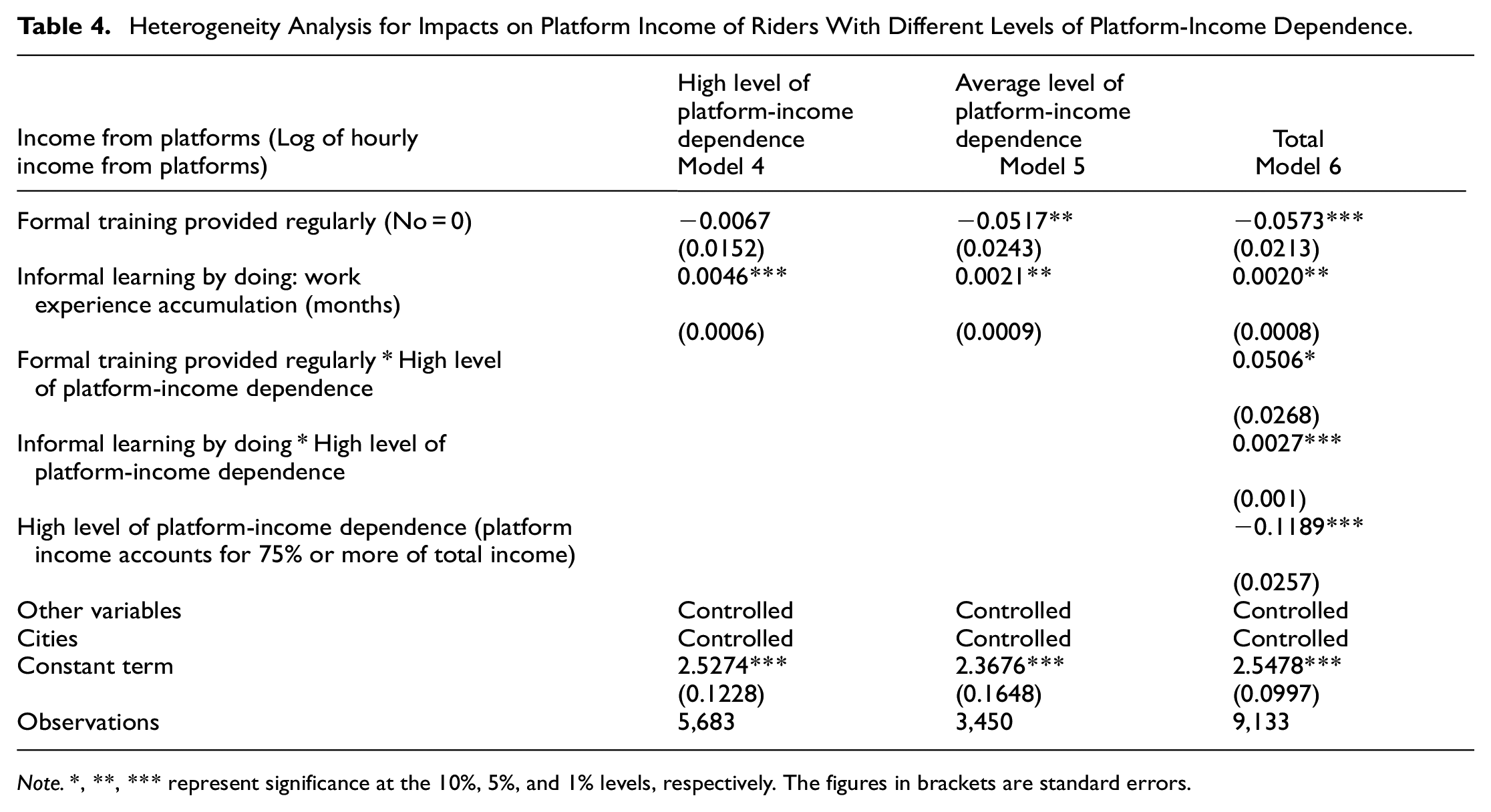
Table 4 reports the regression results of platform income based on the total sample, riders with high platform-income dependence and riders with average income dependence. Results from models 4 and 5 help us identify whether formal training and informal learning by doing significantly differ in their impacts on the income of riders with different platform-income dependence degrees. Model 6 constructs the interaction terms of high-income dependence degree and regular platform formal training and work experience, respectively, aiming to test whether there are significant differences between formal training and informal experience on the income of riders with different platform-income dependence.
Heterogeneity Analysis for Impacts on Platform Income of Riders With Different Levels of Platform-Income Dependence.
Note. *, **, *** represent significance at the 10%, 5%, and 1% levels, respectively. The figures in brackets are standard errors.
The regression results of Model 6 show significant differences in the impact of formal platform training and work experience accumulation on individual platform income under the two levels of platform-income dependence. The interaction coefficients are 0.0027 and 0.0506, respectively; that is, for riders with the same work experience, the income level of riders highly dependent on the platform income is significantly 0.27% higher than that of riders with the average platform-income dependence, at the 1% level, indicating that those with greater income dependence can more easily self-motivated to accumulate more occupational competence conducive to income enhancement under the same working experience. Under the same formal training provided, the platform income level of highly-dependent riders is significantly 5.06% more than that of averagely-dependent riders, at a 10% level. By comparison with the results of Models 4 and 5, regular formal training from the platform will significantly reduce the income level of riders with average income dependence but have no impact on riders with high dependence. Since the training content on the platform is less related to food delivery skills, where the former have limited working time on the platform, the more frequent training may cause enormous time and energy consumption for these riders. Learning by doing is significantly positively correlated with the platform income level of both riders, and the increase of 1 month’s work experience on the income of the highly-dependent is more than twice that of the averagely-dependent. In addition, the results of the total sample show that the unit income of riders with high dependence is 11.89% lower than that of their counterpart. Therefore, there is segregation between groups of different economic dependence within the platform. What are the factors that cause segregation?
Further Discussion—Platform Income Difference Based on Two Levels of Platform-Income Dependence
According to the dual labor market segmentation theory, the traditional labor market can be separated into two levels based on the different characteristics of wages, welfare and promotion system. Workers in the primary market have higher wages, a better working environment, richer resources and a more perfect career promotion system, while the secondary labor market is the opposite (Doeringer & Piore, 1971). Similarly, the gig economy also has internal segmentation, and there are great differences in income levels and working conditions among different markets (Chan & Wang, 2018). Based on the analysis above, given the significant differences in the platform income of riders with varying levels of income dependence on platforms, this study expands the application boundary of the classical labor market segmentation theory and holds that there is also a certain segregation among gig workers with different degrees of income dependence on platforms within a platform or the same types of platforms. We leverage the Oaxaca-Blinder model to delve deeply into the intricacies of income gap and comprehend the pivotal roles of platform training and learning by doing in shaping this divergence. This model serves as a powerful analytical tool to dissect the platform income of riders belonging to two distinct platform-income dependence. By applying this model, we aim to gain a nuanced understanding of the various factors contributing to the observed income disparities, particularly the impact of platform training and learning by doing. Such an approach allows us to formulate strategies to address income inequalities in a targeted and effective manner (Table 5).
Platform Income Oaxaca-Blinder Decomposition Results for Riders Based on Two Levels of Platform-Income Dependence.

The decomposition results showed that the total difference in the income per unit time of the riders with different degrees of income dependence on the platform is 0.0327, and the income of those with average income dependence is higher than that of those with high-income dependence. Explained and unexplained differences accounted for −84.71% and 184.71% of the total difference, respectively. The difference between the two is enormous. The observable factors reduce the income difference, while the unobservable widens the difference, which may come from the segregation of different income dependence within the gig economy, policy factors, and changes in the external environment.
The explained differences can be further decomposed into formal training, informal learning by doing, education level, age, gender, marital status, number of children, hukou status, and whether to work for two or more platforms. The core explanatory variables, platform training and learning by doing narrow the total difference by 179.51% and 81.96%, respectively, while education level and age tremendously expand the income difference, contributing 508.26% and 583.18%, respectively. Among other factors, having more children and working on multiple platforms also significantly reduce the income gap. It is worth noting that both learning by doing and platform training can substantially reduce the income gap between riders with different levels of platform-income dependence. In particular, although it fails to improve the income level of riders, platform training can still effectively narrow the income gap. Therefore, riders with average income dependence can narrow their income gap with those with greater income dependence on the platform through learning by doing and platform training, especially the former.
Instrumental Variable Analysis
Due to the endogeneity problem between experience accumulation from learning by doing and income level, this study introduces “previous express delivery experience” as an IV that meets the exogeneity and correlation conditions. Express delivery experience is closely related to accumulated human capital (people with past express delivery experience can accumulate more in the same working period). However, it does not directly affect the level of individual platform income. Detailed analysis is shown in Table 6:
IV Regression Results for Learning by Doing and Platform Income.

Note.*, **, *** represent significance at the 10%, 5%, and 1% levels, respectively. The figures in brackets are standard errors.
The values of the endogeneity test (XJ2 test and F test) in Table 6 are 6.0151 and 6.0086, respectively, passing the significance test, which proves that individual work experience is indeed an endogenous variable. Based on this, the estimation results of the IV model are better than the basic OLS regression. In the IV analysis, the coefficient of work experience is 0.0296, which is significant at the 5% level, indicating that after considering the homogeneity problem, work experience still has a significant positive impact on the individual income, although the effect is slightly less than that of the basic regression.
Robustness Test
The analysis process may have the problem of selection bias; that is, whether individuals participate in the platform training may result from “self-selection.” Therefore, this paper constructs a counterfactual framework through the propensity PSM method to further verify whether the reverse effect of platform training on individual income has a consistent and robust effect. However, the PSM method is mainly used to control the influence of the observable variables, and the improper selection of the observable variables will cause estimation bias. Since it cannot be proved that the observable variables selected in this study are not problematic, the PSM method is only used for the robust test. The regression results of matching samples constructed by the PSM show that the platform training coefficient is −0.007, which is significant at the 5% level. This result reflects that platform training will still reduce individual platform income even after eliminating the observable systematic differences in the samples.
Research Limitations and Future Directions
However, the results above still have the following limitations: First, they can only represent the group of delivery riders with a relatively low skill level, but cannot reflect the situation of gig workers with a high skill level (such as lawyers and doctors); Second, the research background is limited to the Chinese context. Due to political, economic, social and cultural differences, the conclusion cannot generalize the situation of gig workers in other areas. Future research may focus on: 1. Gig workers at different skill levels; 2. Informal learning by doing and platform training to promote gig workers’ occupational competence and the responsibilities and rights among individuals, platform enterprises and the government during the implementation of specific policies and programs; 3. Ways to increase the density of the gig market.
Conclusions and Suggestions
Research Conclusions
Based on the analysis above, this research draws the following conclusions:
First, regular formal training provided by the platform has a significant negative relation with the platform income level of the rider, inconsistent with the previous research (Zhang, 2011), while learning by doing from individual riders, as an essential way to improve occupational competence, has a significant positive impact on riders’ income, supported by previous the literature (McDaniel et al., 1988; Tesluk & Jacobs, 1962). Regarding income, the classical human capital theory is still partially applicable to the gig economy. The longer the working experience (learning by doing), the higher the individual’s income level. In the gig economy, where workers engage in short-term, project-based, or freelance tasks, “learning by doing” (accumulating working experience) still plays a crucial role in determining an individual’s income level. Individuals gain valuable skills and knowledge as they engage in more gigs and accumulate more experience in their respective fields. This enhanced capability translates into higher demand for their services, thus increasing their earning potential. While flexible and often transient, the gig economy still recognizes the value of expertise and experience gained through repeated practice. The only difference is that the measurement of work experience changes from the long-term length variable (such as years) to the short-term (such as working months) under the trend of “de-job.” However, under the cooperative relationship, riders have more mobility, and the platform pays more attention to reducing its operating costs and risks and improving the stickiness of riders rather than supporting the accumulation of individual human capital – the improvement of the occupational competence of riders. Therefore, at present, the formal training content of most delivery platforms focuses on traffic safety, service rules and procedures, etc., while the training of riders’ skills improvement is less so that the training is typically labeled as “nominal” and “a waste of time.” Although relevant to the rider’s work, platform training is usually separated from productivity enhancement, resulting in training content that has a limited effect on actual production skill enhancement and productivity improvement (Aliaga, 2001; Becker, 1964). However, the riders themselves do not realize the importance of formal training provided by enterprises to improve their food delivery competence and related income level, so few riders put forward requirements for enriching and enhancing the training content of the platform.
Second, due to the endogeneity and self-selection problems of the relationship between formal training and income on the platform, this paper does the robust test of the results by IV and PSM methods, finding that: firstly, after considering the endogeneity problem, the accumulation of individual experience still has a significant positive impact on individuals’ platform income; Secondly, formal platform training will still reduce riders’ platform income even after eliminating the observable systematic differences of samples.
Third, the heterogeneity analysis shows that: Firstly, the impact of formal training and informal learning by doing on the income of riders with different platform-income dependence is heterogeneous. Under the same work experience and the same formal training provided, the platform income of riders highly dependent on the platform income is significantly more than that of those averagely dependent, indicating that those with greater income dependence are more willing to be self-motivated to cultivate more skills and competence conducive to income promotion under the same human capital accumulation path and conditions. Secondly, regular training provided by the platform significantly reduces the income of riders who are less financially dependent, but has no impact on their counterparts. Since the training content from the platform is less related to practical delivery skills, and the part-time workers with average platform-income dependence have limited working time for the platform, the more frequent training might be consumption for them. Learning by doing is significantly positively correlated with the platform income level of two groups, but the increase of 1 month of experience on the income of riders dependent more on the platform income is more than twice as much as that of riders less dependently. Thirdly, the results of the total sample show that the platform income of riders with high-platform-income dependence is 11.89% lower than that of riders with average-platform-income dependence. Therefore, there may be segregation between riders with different levels of platform-income dependence.
Finally, in exploring the causes of income differences between riders with different platform-income dependence, this paper found that both formal platform training and informal learning by doing could significantly reduce the total difference. Most of the differences are due to unobservable factors. It is considered that the internal segregation of the gig economy causes income differences between gig workers with different platforms-income dependence. Such differences may come from inexplicable factors such as platform discrimination, internal market mechanisms, policy factors, or changes in the external environment.
Implications and Suggestions
From the perspective of workers, the ultimate purpose of labor relations research is to solve the problems of individual income, welfare and rights and interests protection. Based on the conclusions, this study puts forward the following suggestions:
Firstly, policies should be issued, and measures should be taken to encourage and support gig workers to learn by doing. Especially for food delivery with a relatively low demand for skills, learning by doing can enable workers to acquire practical working competence and skills quickly while increasing income for survival. As the saying goes, “Everything has its joys and sorrows, and one knows it by tasting it” (Xi, 2021).
Secondly, apart from safety, regulation, and work process considerations, it is imperative that formal training encompasses the development of pertinent occupational competencies and skill enhancement. By strengthening the construction of appropriate infrastructure, the overall income level of gig workers within the industry is increased, and the income gap between groups with different platform-income dependence is narrowed so as to truly realize fairness and efficiency. In terms of the specific implementation, this research suggests that: at the national level, based on the Labor Contract Law, it is possible to expand the contents of “vocational skills/abilities and occupational competence training for practitioners in gig economy.” At the local level, measures and regulations for gig workers’ occupational competence training can be formulated on the basis of the existing training policies, aiming to guide and regulate gig worker training within the region (Zheng et al., 2020). The training content should not be “in name only” regarding platform enterprises. The platform needs to include competence and skill training content besides safety and rules, and the content should be updated regularly. The training cannot be “cliche,” becoming a “killer” of the rider’s precious time to send orders. The platform training may include, for instance, imparting effective route planning techniques to riders to enhance delivery efficiency. By teaching riders how to plan their routes strategically, they can minimize unnecessary detours and delays, ultimately improving their overall performance. Furthermore, educating riders on the maintenance and usage of their delivery tools is essential to ensure that these tools are in optimal condition and capable of supporting efficient deliveries, which includes instructing riders on basic maintenance procedures and troubleshooting techniques to address any potential issues with their delivery vehicles. Additionally, riders must be trained on proper cargo handling and delivery procedures to guarantee that the quality of food and other goods remains unaffected during the transportation process, which involves teaching riders how to package, secure, and transport goods safely and securely, minimizing the risk of damage or contamination. Through these skill-oriented training programs, riders can develop the necessary skills and competencies to deliver high-quality services to their customers as well as increase their income.
It is worth mentioning that, although it is a minority, some platforms have begun to enrich the training content of “rider upgrading.” In the interview with Mr Zhang, the head of a regional operation of a platform in December 2021, it is learned that:
Our training now contains the riders’ (skill) upgrading, similar to helping riders to overcome the difficulties in t the game. For example, beginners need to be familiar with the basic policies of our company at the first level. Gradually, there will be some training for working experience, and we will take some experienced riders or riders with excellent performance as samples.
Finally, the lack of density in the gig market is the driving force behind the platform’s differentiated treatment of gig workers. Currently, the gig economy is still in the early stage of development, so it is not “dense” where “work continuity” can not be guaranteed. The platform will compensate for the lack of “density” by algorithm-based control and “game incentive” for riders (especially for less dependent gig workers) to “passively” extend their working hours. Because of the ’density’ problem, the governments and platform enterprises should work together through practice and scientific analysis to find the ’density’ most suitable for the supply and demand matching of a specific gig market. Only by guaranteeing the robust ’density’ of the gig market can its operations be streamlined for maximum efficiency, thus optimizing the utilization of human capital.
Footnotes
Declaration of Conflicting Interests
The author(s) declared no potential conflicts of interest with respect to the research, authorship, and/or publication of this article.
Funding
The author(s) disclosed receipt of the following financial support for the research, authorship, and/or publication of this article: Scientific Research Fund from Renmin University of China for the Major Planning Project- “Research on Digital Economy and Work Market” (23XNLG04)

Data Availability Statement
The original contributions presented in the study are included in the article/supplementary material, further inquiries can be directed to the corresponding authors.