




Abstract
Industrial buildings that conserve their authentic identities and provide cultural sustainability also appeal to the spatial perceptions of users through their old and new usage forms. It is thought that every generation will have different timeframes and experiencing forms in the spaces they are in, based on their own needs, and this is believed to reflect on their spatial perceptions. Accordingly, this study aims to reveal the effect of different generations’ characteristics on their perception of educational buildings converted from industrial buildings and to reflect users’ reactions to the relevant spaces. In this study, the evolving spatial perceptions regarding Abdullah Gül University Sümer Campus, which has been converted as an educational facility from Sümerbank Fabric Factory, were evaluated through the members of the Generation X and Z. This study which employed qualitative data collection and assessment methods was conducted as a particular case study. Furthermore, this study contained the holistic assessment of the physical, functional and psychological aspects of the re-functionalized campus considering the fact that these spaces whose functions were converted to be educational would include differences based on spatial perceptions. The results of this study indicated that Sümer Campus was considered by the Generation X as a location combining the old texture with the new, while the Generation Z assessed the campus as an esthetic formation where the old and new coexisted with contrasts.
Plain language summary
Purpose: Industrial buildings that conserve their authentic identities and provide cultural sustainability also appeal to the spatial perceptions of users through their old and new usage forms. It is thought that every generation will have different timeframes and experiencing forms in the spaces they are in, based on their own needs, and this is believed to reflect on their spatial perceptions. Accordingly, this study aims to reveal the effect of different generations’ characteristics on their perception of educational buildings converted from industrial buildings and to reflect users’ reactions to the relevant spaces. Methodology: In this study, the evolving spatial perceptions regarding Abdullah Gül University Sümer Campus, which has been converted as an educational facility from Sümerbank Fabric Factory, were evaluated through the members of the Generation X and Z. This study which employed qualitative data collection and assessment methods was conducted as a particular case study. Conclusions: The results of this study indicated that Sümer Campus was considered by the Generation X as a location combining the old texture with the new, while the Generation Z assessed the campus as an esthetic formation where the old and new coexisted with contrasts. Limitations: The study was limited with 12 people from the Department of Architecture at the Faculty of Architecture of Abdullah Gül University; five of them were lecturers, and seven were students. Accordingly, it may be recommended that the subject and group of the present study be expanded to achieve generalizable results, and that various studies be conducted to research the spatial perception regarding the re-functionalized industrial buildings.
Keywords
Introduction
The impacts of technological, social, cultural and economic developments experienced along with the Industrial Revolution have altered our social relationships and lifestyles. Following industrialization, numerous large-volume industrial buildings that focused on rapid production and consisted of new materials and methods were constructed. Palmer (2008) noted that these architecturally and historically important buildings constituted a significant part of the urban identity. Most of the industrial buildings in Türkiye were designed to be within a green campus that consisted of one or two-storey building blocks as well as production houses, schools, hospitals, public housing and social activity areas and that was located on a flat land.
These buildings, which became popular in Türkiye and other countries, could not follow the technology of the relevant time and underwent different forms of construction, which caused them to lose their functions in time. Depending upon whether the developmental and production-based areas spread in locations away from the urban center, the industrial buildings within the urban center are transform into unutilized spaces. Such industrial buildings maintain their physical existence although they no longer serve functionally, and they bear and reflect the cultural, social, economic, architectural and other characteristics of the era they were constructed. According to Karim et al. (2020), the historical, esthetic and psychological parameters which concern the architectural elements of industrial buildings and influence any decisions regarding these buildings should also be considered. Their potential to shed light on the past as well as their distinctive structural traits and significant locations within the urban centers make the idea of conserving their original forms and assigning them new functions more appropriate.
“The physical life of buildings last longer than their functions, and buildings undergo alterations much later than their functions do. Functions start to get outdated technologically, socially and culturally in time. Although their materials do not come to the end of life, buildings that functionally become outdated, do not meet the new standards, become abandoned if updates are not performed and tend to be demolished can be saved and transformed into livable spaces, which is called re-functionalization. This concept can be simply defined as making a building suitable for new needs through modifications” (Burden, 2004). Industrial buildings can be reused and continue existing, which results in numerous advantages. Reflecting the historical and cultural traits of the era they were constructed and continuing the function of being livable, these buildings provide ecological sustainability through the preference of old buildings, instead of new building stocks, offering new functions, and they also provide economic sustainability through the recycling process they offer. Moreover, according to Masatlıoğlu (2018), transformation of these buildings which were assigned the public space content through a holistic re-functionalization process, and which bear the traces of the past offers social and economic benefits to the areas hosting the buildings.
Determining the correct function regarding the relevant city and building is important during the process of re-functionalizing industrial buildings that no longer serve in the present time. Doğan Kuban’s statement (2000) “Re-functionalization differs from the classic intervention types as it causes an existing building to undergo a natural architectural design process. Such building must fulfill its new functions. Consequently, the building should change or gain new additional buildings to a certain degree when needed” supports the aforenoted idea. Lepel (2006, p. 72) notes that every condition that may arise from functional changes should be considered in conserving the industrial heritage and developing usage alternatives regarding buildings (Figure 1).

Future of industrial buildings that no longer serve (adapted from Lepel, 2006).
The relevant literature has numerous studies on the re-functionalization of industrial buildings, and these studies include “Endüstri yapılarında yeniden işlevlendirme: İş’i biten endüstri yapıları ne iş’e yarar?” by Cengizkan (2006), “Reused industrial buildings in Istanbul that are worth to conserve and their interior interventions: A case study/SantralIstanbul” by Kaşlı (2009), “Conservation and re-use of historical industrial buildings, case study Fabric neighbourhood, Timisoara, Romania” by Radu et al. (2012) who assessed the historical conservation and reuse of industrial buildings through the sample of Timisoara, “The design criteria of reused industrial buildings by means of examples from Istanbul” by Büyükarslan (2013) and “Industrial heritage valorisation and creative industry proliferation in Shanghai’s urban regeneration” by Wang and Wang (2018) who evaluated the reutilization of industrial heritage through the urban transformation that Shanghai underwent. Additionally, the following studies investigated the same topic the present study did: “Evaluation of Sümerbank Kayseri cloth factory main production structure conversion in the context of flexibility” by Kemaldar (2019) and “Re-functionalizing of post-industrial landscapes: The case study of Sümerbank Kayseri Cloth Factory” by Tırnakçı (2020).
The relevant literature has studies on the history of industrial buildings and their relationships with their environment, assessment of these buildings based on the concepts of conservation and re-functionalization, the reasons for re-functionalizing industrial buildings, the factors to determine new functions to be assigned to the industrial buildings, interventions made to the industrial buildings in line with their new functions, and relevant restoration and restitution projects. However, no studies that assessed the intergenerational spatial perceptions regarding the transformation of industrial buildings into the educational facilities were found.
Transformation of the industrial function into the educational one was performed in a single building in the cases of Kadir Has University and Istanbul Bilgi University, but the scope of the transformation included a campus in the case of Abdullah Gül University. This study focused on Abdullah Gül University Sümer Campus which is in a different geography compared to Kadir Has University and Istanbul Bilgi University in Istanbul. These points were taken into consideration while selecting the study site. Examining three samples which are Kadir Has University Cibali Campus, Istanbul Bilgi University santralistanbul Campus and Abdullah Gül University Sümer Campus, this study focused on the educational buildings converted from the industrial buildings in Türkiye. Accordingly, it detailed the buildings located within Abdullah Gül University Sümer Campus converted from Kayseri Sümerbank Fabric Factory which constituted the sampling area of the study.
Literature Review
Industrial Buildings Re-functionalized as Educational Buildings in Türkiye
Among the building stock that was converted from an industrial function to educational function in Türkiye, three buildings can be named in this regard: Kadir Has University Cibali Campus converted from Cibali Tobacco Factory, Istanbul Bilgi University santralistanbul Campus converted from Silahtarağa Power Plant and Abdullah Gül University Sümer Campus converted from Sümerbank Fabric Factory in Kayseri.
Cibali Tobacco and Cigarette Factory, which began production in 1884 and designed to have a Neoclassic facade style by Alexandre Vallaury and Hovsep, is located in Fatih district of Istanbul. Evacuated in 1995, the building was renewed in 2002 and converted into Kadir Has University. Following renovation with the functions of university and museum, the factory was divided into three blocks for its new functions. Management units and some of the laboratories are presented in Block A, while the seminar hall, multi-purpose hall, computer laboratories and institutes are located in Block B, and ateliers and classrooms of the Faculty of Fine Arts are in Block C (Alper, 2004; Table 1).
Kadir Has University Cibali Campus (TURES, 2017) and Cibali Tobacco and Cigarette Factory-Previous Forms (Köksal, 2005).

Silahtarağa Power Plant, the first power plant of Türkiye, was located in Kağıthane-Istanbul and generated electricity from 1914 to 1983. It was assigned to Bilgi University for 29 years by the Ministry of Energy and Natural Resources in 2004, and therefore its conversion into an educational facility occurred. The facility includes two boiler rooms, three engine rooms, management building, ateliers, public housing and a masjid (Kıraç, 2001). Following the renewal, engine rooms gained the function of museum, while the boiler rooms were converted into the Faculty of Architecture and libraries (santralistanbul, 2023; Table 2).
santralistanbul Campus (santralistanbul, 2023) and santralistanbul Before the Conversion (Aksoy et al., 2007).

Following the proclamation of the republic, various factories were installed in different cities to ensure industrial development with the “Industrial State” ideology. One of these factories is Kayseri Sümerbank Fabric Factory which is the first business constructed by the Republic of Türkiye in 1935 and which was reviewed in the present study (Table 3).
Pre-renewal Images of Abdullah Gül University Sümer Campus (AGU, 2023a) and Sümer Fabric Factory (SALT Research, 2023).

Re-Functionalized Kayseri Sümerbank Fabric Factory
The factory complex, which is located on the northwestern side of the city and near the railway line and urban center, was re-designed as a modern living area meeting numerous needs such as production, accommodation, health, education, and social and cultural activities. The complex also includes public housing for civil servants and workers, an association for employees, infirmary, kindergarten, movie house, grocery, volleyball, football and tennis pitches and a swimming pool (Asiliskender, 2002).
Reflecting the modernization ideas and traits of the Republican Era by sustaining its physical existence thanks to high-quality materials and proper methods, this factory was transformed into Abdullah Gül University Sümer Campus in 2012. Helping the transmission between the past and present, this conversion activity ensured that the complex could still serve as a campus with the educational function that could meet the social and cultural needs of the urban dwellers and that had a place in the urban memory. The master plan of the campus was set by B. Asiliskender, N. Baturayoğlu Yöney and Ö. Kevseroğlu who are the lecturers of the Faculty of Architecture at Abdullah Gül University. The buildings examined within the study were Product House (Large Warehouse), Central Power Building, Small Warehouse and Fire Department Building, all of which are present in Abdullah Gül University Sümer Campus (Figure 2).
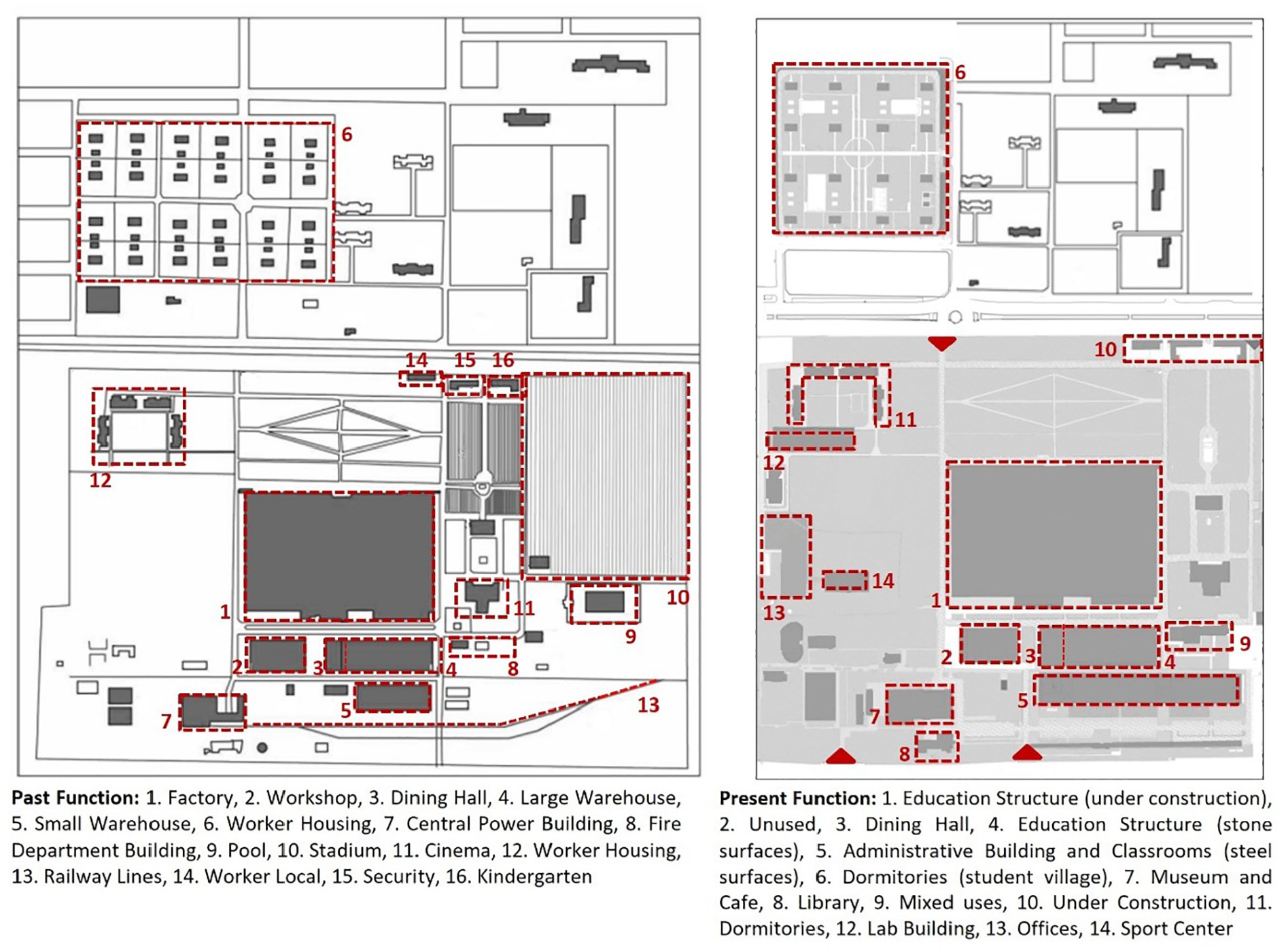
Site plan of the Sümerbank Kayseri Textile Factory (adapted from Aslanoglu, 1979) and Abdullah Gül University Sümer Campus settlement plan (adapted from AGU, 2023b).
The Product House, which had been used as a warehouse, was revised as the Faculty of Architecture in the re-functionalization plan. The shared classrooms as well as ateliers, cafeteria, cade and lecturer offices are present within this building. The building underwent certain changes considering its new function. The authentic walls on the eastern and western facades were conserved and turned into an empty wall with a steel and detachable envelope structure. A new space with offices was created with the two-storey steel addition on the high-ceiling middle axis, the main circulation line of the building (Figure 3).

The previous (Asiliskender & Yöney, 2015) and current state (photo by authors, 2022) of the Warehouse Building.
The Central Power Building that is located on the northside of the campus and that has a floor area of approximately 40 m × 60 m, three boilers and four storeys reflects the Russian Constructivism which is a modern architectural trend (Asiliskender & Eldek, 2008). The Central Power Building and the Steam Power Plant on the southside were transformed into the Presidency of the Republic of Türkiye, Abdullah Gül Museum and Library (Figure 4).

Previous (1938) (Asiliskender, 2002) and the current state (photo by authors, 2022) of the power plant.
A new additional building connected with the small warehouse constructed in 1964 was designed by Emre Arolat to function as the management building and a classroom, and it received 2016 National Architecture Award. The new module (approximately 240 m in length) positioned on the old warehouse whose concrete structure and walls are conserved defines the borders of the campus area with the grid-based facade layout (Figure 5).

New additional building (Management building and classroom) (photos by authors, 2022).
Fire Department Building, another element of the campus, was transformed into a social reinforcement structure. This building, where vehicles used to be maintained, began to serve as a Restaurant after its load-bearing system was reinformed, and the neighboring Office Buildings were functionalized as the Student Center (Figure 6).

Previous and current state of the Fire Department Building (AGU, 2017).
This re-functionalization process is thought to create differences regarding spatial perceptions based on users’ experiences. Accordingly, assessment of the spatial perceptions regarding these buildings that have historical and social traits and that were transformed into educational buildings without the previous functions becomes significant.
Spatial Perceptions of Generation X and Z
From a sociological perspective, the emotions as well as the ideas and experiences of the people of a certain generation affect their definitions and perceptions regarding spaces. Having unique characteristics, value judgments and attitudes, and strong and weak sides, the generations are named based on the year of birth. For instance, those born between 1965 and 1979 are called “Generation X,” while those born between 1980 and 1999 are called “Generation Y,” and those born between 2000 and 2021 are called “Generation Z” (Aka, 2018).
The Generation X, which was included in the present study, is believed to have their personalities shaped and guided by Baby Boomers, the generation that is older than the Generation X. Being the children of parents who are prudent, loyal and collectively-working, the Generation X is a generation affected by the financial stagnation that occurred during early 1900s, and the members of this generation make great efforts to adapt to the changing global conditions (Tolbize, 2008).
The Generation X is oriented to be loyal to its environment due to the structure and psychological impacts of their age. Valuing social thoughts, the members of this generation have high professional motivation, make efforts to be at the forefront and display attitudes to protect what they have (Acılıoğlu, 2015). They also prioritize the sense of belonging to where they are present, and they act in a contented and conservative manner (Çaycı & Karagülle, 2014). Accordingly, it is safe to state that this generation’s expectations regarding the environment are based on conservation and adding value. Moreover, the Generation X tends to assess the spaces they are in with their contended and traditional orientations (Dedeoğlu et al., 2019). Altuntuğ (2012) notes that the Generation X were grown with technological innovations and changed in line with the relevant case, and they questioned spatial preferences and defended values. According to that study, the Generation X is the first generation that assigns a meaning to spaces and acts with the relevant emotions thanks to their emotional ties.
With the impact of dynamics being specific to every geography, society and group, determining the timeframe of the Generation Z is different in Türkiye compared to other countries (Ercan, 2021). Although certain studies assessing the Generation Z set the beginning date as 1995, the Generation Z in Türkiye was born in 2000 and afterward. McCrindle and Wolfinger (2014) state that the Generation Z’s capacity to access information and improved opportunities to use technology and meet needs cause this generation to consider the spaces they are in as swiftly-consumable. Distorted domestic communication and the act of individualization drives the Generation Z to search for comfort in other spaces and meet their needs. Although the Generation Z is pushed toward individualization, members of this generation are socially quite active. Accordingly, they tend to minimize the time they spend in spaces with specific functions such as classrooms and to study in social spaces instead. While re-considering the educational spaces in line with the needs of the Generation Z, spaces where students can find their own comfort zones, socialize and have fun become more important. In accordance with their creative and social personalities, the Generation Z targets educational spaces where one can be active in group activities and the variety of ideas arising from differences is supported (Taş et al., 2017). Therefore, the presence of individual spaces which have flexible and shared usage areas and enable one to experience solitude when needed is important for the Generation Z so that their sense of belonging to the relevant space can develop (Unvan & Özturan, 2020). It is thought that every generation will have different timeframes and experiencing forms in the spaces they are in, based on their own needs, and this is believed to reflect on their spatial perceptions.
Method
Focusing on the impacts of generations’ characteristics on the perceptions regarding the educational buildings converted from industrial buildings, this study presents spatial evaluations with their various aspects. Lecturers in the study were the members of Generation X while the students represented the Generation Z. Based on the research question “How are the spatial perception assessments of Generation X and Z in regard to the industrial buildings re-functionalized as educational buildings?,” the aim was to evaluate the evolving spatial perceptions regarding Sümerbank Fabric Factory which was re-functionalized as Abdullah Gül University Sümer Campus through the members of the Generation X and Z.
Therefore, it was conducted as a particular case study which employed qualitative data collection and assessment methods. According to Yıldırım and Şimşek (2021), a case study is conducted in a natural environment such as a classroom, neighborhood or an organization, and it targets a holistic review of the environment or the events detailed in that study. With its traits that separate the case study from other study forms, a case study focuses on the questions based on “how” and “why.”
The qualitative data of the study were collected through interviews. As a data collection instrument used the most in the qualitative studies, interviewing is defined as a mutual and interactive communication activity that is performed for a pre-set, significant purpose and based on asking questions and receiving or giving answers. Interviews help understand the unobserved factors such as experiences, attitudes, ideas, comments and reactions (Yıldırım & Şimşek, 2021). According to Karasar (2016), interviewing is one of the most commonly used data collection methods employed for learning people’s knowledge, ideas, attitudes and behaviors along with reasons in various cases.
Procedure
The implementation phase of the study was conducted on a voluntary basis, and face-to-face interviews were performed at Abdullah Gül University Sümer Campus with 12 people, five lecturers (two females and three males) from the Department of Architecture at the Faculty of Architecture of Abdullah Gül University and seven students (three females, four males). Semi-structured interview form was used in the study with the idea that it would be effective in obtaining detailed information from the participants and answering research questions in a detailed manner. Interviews lasting 30 to 40 minutes on average were conducted with each participant of the sample group, and voice recording was performed to prevent data loss. Voice recording was performed after obtaining participants’ permissions. Everything that participants said during each interview were noted by the researcher as completely as possible. All data were assessed using qualitative analysis method.
The results of semi-structured interviews were interpretively evaluated using content analysis. Regarding the interpretive data analysis, themes are formed and data are analyzed and interpreted based on these themes (Alev & Yiğit, 2009; Yıldırım & Şimşek, 2021). The interviews recorded with voice recorder were deciphered by the researchers and converted into texts; then, first-grade coding was performed. Using the coding, certain themes regarding the research question were formed. These themes were classified in a manner so that the participants’ thoughts out of every data obtained could be reflected and represented. Names of the lecturers of Generation X (X1, X2, …) and students of Generation Z (Z1, Z2, …) were coded during the data analysis.
Results
The data were analyzed using the content analysis method. Moreover, classifications were performed based on themes and categories to develop meanings about results and describe what was reflected in the data set. Accordingly, three main themes were set as the following: the physical dimension including the assessments regarding re-functionalization, the functional dimension including the assessments regarding the current function, and the psychological dimension including the assessments regarding human-space interaction. Themes were associated with categories and presented in Table 4.
Themes and Categories Created in Line with the Results.

Physical Dimension/Assessments Regarding the Re-functionalization: Generation X
The thoughts of the lecturers of Generation X regarding the re-functionalization of Kayseri Sümerbank Fabric Factory were assessed under the physical dimension theme. Results showed that the lecturers could see the traces of previous functions through the old construction elements and certain constructional details and marks. Furthermore, it was understood that the historical texture and materials of the warehouse were reflected with success and that the constructional layout could be felt also in the new educational layout. Lecturers were of the belief that the Steel Building constructed in front of the Warehouse were not suitable in terms of designing approach but it offered the opportunity to use the old and new collectively. Thoughts from the certain participants of the Generation X regarding the traces of the previous function and adaptation to the historical texture are presented below.
X1: “They tried to conserve some of the trances on the building. Colors, textures or the signboard of a worker cafeteria take one back to the past.”
X2: “The marks of the previous building have been conserved. Old factory doors, ventilation systems etc. were kept in their original forms. For instance, ‘worker factory’ is still written on the entrance of the factory cafeteria.”
X4: “Adaptation to the historical building texture and material of the warehouse is quite proper. However, the Steel Building was constructed with a contemporary approach but without any concern of conserving the original.”
The thoughts that catch attention in regard to the spatial layouts are that the closeness of human scale and buildings which are added newly to the campus as well as these buildings’ relationships with the one another and green areas are considered positive. Like the strong relationship of Sümerbank Fabric Factory with the city in the past times, it is believed that the buildings in the current spatial layout have a strong relationship with one another and that they continue being important spots for the city. Some of lecturers’ opinions on the current spatial layout are as follows:
X1: “Sümerbank’s relationship with the city was strong in Türkiye. It is still strong; one can consider it as the urban dynamic. In the previous times, as Sümerbank was a factory, its buildings were associated with one another. Regarding the current times, these buildings are still connected, maintaining that relationship.”
X4: “Buildings’ relationship with one another and their master plan solution is quite successful. As Kayseri is a typical Anatolian city, there are not many green areas; Therefore, recreative usage is also targeted.”
X5: “I believe that most of the new buildings added here are integrated to the ground as they have one storey.”
Functional Dimension/Assessments Regarding the Current Function: Generation X
Comments of the lecturers of Generation X regarding the current function of Abdullah Gül University Sümer Campus were assessed under the functional dimension theme. They believed that the buildings in the campus were mostly suitable to the purpose of use. The dormitories which were mentioned by the lecturers and used as the public housing by the workers of the fabric factory paved the way for the idea that the current functions were in harmony with the previous functions. It was also expressed that the Warehouse and Steel Building did not have a special function, meaning they could be easily used for a new purpose. Furthermore, with the increased number of students, certain spaces such as cafeteria or classrooms were considered insufficient. Some of lecturers’ thoughts on spaces meeting the necessary functions are provided below.
X1: “All buildings here, including the factory building, atelier building, warehouse, fire department building, infirmary, social building and public housing, were functionalized to meet the modern needs.”
X4: “The Warehouse is a multifunctional building; we sometimes hold an exhibition or perform a presentation on the stairs. The Steel Building is used with a functional approach that suits its purpose of use. The functions selected in every industrial building are not that successful.”
X5: “Houses which were previously used as the public housing spaces of the fabric factory but now utilized as dormitories are present in front of the campus.”
Lecturers’ statements especially focus on the structural traits of the Steel Building and Warehouse within the campus. The Steel Building has a modern design with a layout on a horizontal axis, while the old Warehouse is a linear industrial building that as a box-shaped envelope. Based on the suggestions of the lecturers, the indoor arrangement of the Warehouse was re-considered and found simple and harmonious. Regarding the Steel Building, ventilation and illumination problems arising from the preference of dark colors in the indoor spaces were mentioned. Thoughts of certain Generation X participants about the structural features and indoor arrangements are presented below.
X2: “As darker tones were used in the internal design of the Steel Building, it feels depressive there; certain classrooms does not even have windows, and we experience ventilation-related problems as the number of students increases.”
X3: “There are long corridors in all buildings including Steel Building, Warehouse and Factory Building. The Steel Building catches attention with its horizontal appearance and length. This building reflects something completely different with its material, technology and color compared to the buildings built recently in Türkiye or other countries.”
X4: “The niches in the corridors of the Warehouse were successfully built. You can conduct your own individual efforts at everywhere in this building. A lot of money was spent on interior design, and the desired materials were used. The quality of materials and workmanship was very high.”
Psychological Dimension/Assessments Regarding the Human-Space Interaction: Generation X
Comments of the lecturers of Generation X regarding the human-space interaction at Abdullah Gül University Sümer Campus were assessed under the psychological dimension theme. Lecturers stated that the facility reminded them of an industrial facility. It was found that a distinctive spatial perception was dominant in the campus where contemporary and old were processed together and experiences varying according to the seasons and periods of the day were reflected on the green landscape, and which could establish social relations. The thoughts of certain Generation X participants on the spatial perception are as follows:
X1: “Even though the campus area is surrounded by walls, it does not feel like a wild place. I can say that it is an open campus that is not socially disconnected.”
X2: “I think green areas on campus are more beautiful in spring. In summer, indoor areas become airless and depressive if not ventilated. The air is mystical and not very bright at night.”
X3: “This place is old. It is not a decor though; it plays the leading role. When you enter an office or a classroom, you can internally feel it, while the entirety is not distorted externally. From the first moment you enter, you start to feel that it is an industrial building. The state of being inside the factory is felt in each building.”
Faculty members considered the conservation and reuse of these buildings, which were used as fabric factories before, as a valuable heritage especially for the city of Kayseri. This conversion created an astonishing and inviting effect on them, and this effect made them feel the past. Moreover, this effect was considered to be intertwined with the city, have a free spirit and create curiosity. Majority of the faculty members felt a sense of belonging to Sümer Campus. They stated that this sense was formed and strengthened by the process they spent here as a user. Some of the views of Generation X participants on the impact and adoption of conversion are presented below.
X1: “Before I became a part of this workplace, I did not experience an emotional process. Over time, an emotional bond was established with the buildings that we have used a lot. I want to meet with my friends here because I think it is a more qualified environment compared to the urban center.”
X2: “I think people want to come here because of the historical atmosphere of the campus. They usually get surprised when I show them around the campus. It feels different both from the outside and inside.”
X4: “The fact that the space has been conserved and evaluated in this way and the innovative perspective of the school creates a great potential for Kayseri. This place is so distinctive and different from Kayseri that it is like a space base in Kayseri.”
Physical Dimension/Assessments Regarding the Re-functionalization: Generation Z
The thoughts of the participants of Generation Z regarding the re-functionalization of Kayseri Sümerbank Fabric Factory were assessed under the physical dimension theme. Participants of Generation Z read the traces of the previous function through the old structures from the fabric factory, constructional elements (columns, walls, facade covers) and structural reinforcements (track traces on the landscape, machine parts, fuse panels). Most of the participants, who easily noticed the traces of the previous function, focused on the “workers' cafeteria” sign in the cafeteria and the walls left as gross. While the participants found the buildings used in the old fabric factory and restored later to be compatible with one another other, they thought that the new buildings in the campus had a contrasting relationship with the historical texture. Thoughts from the certain participants of the Generation Z regarding the traces of the previous function and adaptation to the historical texture are presented below.
Z2: “A reference was made to the old function by the method of leaving the walls as pure concrete, and the old sign in the cafeteria was not removed.”
Z5: “When looked from the outside, efforts were made to conserve the old texture. We can easily recognize fragments of the past. You can also see the facade covers, the landscape in the garden and the parts of the factory.”
Z6: “The Warehouse can reflect the historical texture of the campus of Abdullah Gül University from the outside. When the Steel Building is considered in terms of environmental analysis, it looks more dominant and modern. There is a sharp transition from historical texture to modernity.”
In line with the views of the Generation Z participants, there were clearly perceived axes connecting the horizontally-constructed buildings throughout the campus. Although each building, designed with various concepts, had a different interior layout, the idea that they were in harmony was dominant. Among these buildings, the design of the Steel Building was found to be less readable. Views of certain Generation Z participants on the existing spatial layout are presented below.
Z4: “There are sharp axes between the buildings in the campus, and the buildings are present at the intersections of these axes. That’s why being clear increases readability for axes.”
Z6: “The buildings throughout the campus were planned horizontally. The tallest building is the Steel Building with 2 floors and a minus one level.”
Z7: “The Steel Building has social areas downstairs, laboratories on the next side, and classrooms upstairs. When I entered the Steel Building from the ground floor, I could not see the classrooms as they were still further inside. I thought the staircase was going to the mezzanine, but the circulation continued from there.”
Functional Dimension/Assessments Regarding the Current Function: Generation Z
Comments of the participants of Generation Z regarding the current function of Abdullah Gül University Sümer Campus were assessed under the functional dimension theme. Participants of Generation Z evaluated the fulfillment of functions through the Warehouse where they spent most of their time. According to participants’ opinions, the Steel Building used as the rectorate and the Warehouse where education was provided were designed in accordance with their function and consisted of spaces where many functions could be performed together. Thoughts of some participants of the Generation Z on spaces meeting the necessary functions are provided below.
Z4: “We can play billiards on the lower floor of the Steel Building; competitions and exhibitions are held. In general, multifunctionality was prioritized in every section of the building.”
Z5: “Steel Building is a suitable location for management function. I find the area we work in (Warehouse) both suitable for its function and sufficient in regard to the space. The building receives light, has good acoustics, and lets students feel comfortable inside, which is very important for the educational function.”
Z6: “Steel Building is an administrative facility used as the rectorate building. It is a formal setting where high-ranking people gather, and it suits its function. The Warehouse is sufficient to meet all my needs both functionally and spatially. It can be converted as needed. The studio is also suitable for social use in addition to studying.”
Although the participants did not express a detailed opinion on the structural features, the Warehouse was found to be positive in terms of illumination, acoustics, flexibility and size. Furthermore, the transparent elements and furniture used in the interior layouts of the Warehouse were deemed compatible with the building. It was proposed to increase the number of indoor equipment such as furniture, tables, sockets and make them more special to use. Thoughts of certain Generation Z participants about the structural features and indoor arrangements are presented below.
Z1: “Transparent elements were used in the Warehouse. Due to the materials used on the facade, a transparence is present; we can see the interaction between indoors and outdoors.”
Z5: “The Warehouse, our place of work, is both suitable for its function and sufficient in terms of space. The building receives light, has good acoustics, and lets students feel comfortable inside, which is very important for their education.”
Z6: “It was built with the awareness that a larger area was needed for the department of architecture. It is a large area with large tables inside. However, the tables could have been designed to be very large with spaces between one another. It can be difficult for 10 people to work at a single table. A conversion into an atelier for smaller groups can happen.”
Psychological Dimension/Assessments Regarding the Human-Space Interaction: Generation Z
Comments of the participants of Generation Z regarding the human-space interaction at Abdullah Gül University Sümer Campus were assessed under the psychological dimension theme. The old construction parts, green landscape and preferred materials in the campus were among the factors that the participants attached importance to in their spatial perceptions. Various spatial effects created by seasonal changes, especially in landscape areas, could be felt. While the Steel Building created a frightening, dominant and cold atmosphere on the participants, the Warehouse formed the perception of a sincere, spacious, unfinished space that seemed to be a factory in the past. Participants of Generation Z generally stated that this complex was an office or had an educational structure. The thoughts of certain participants of Generation Z on the spatial perception are as follows:
Z3: “Since there is a walking distance between the buildings within the campus, the effect of walking through the green areas in summer and winter is different. The color of the journey is transforming; one is boring and fast while the other is slow and peaceful.”
Z5: “The feeling of sincerity and illumination in the Warehouse is absent in the Steel Building. Steel Building feels very cold to anyone. Steel Building is a structure for which efforts were made to make it more dominant with its height and material. The feeling of the Laboratory Building is completely different compared to that of the Warehouse or the Steel Building.”
Z6: “Campus of Abdullah Gül University is different from other universities. In other campuses, it is difficult to see the historical texture. The campus is a different place where there is a radical transition from past to the present.”
Participants of the Generation Z considered the act of re-functionalizing the fabric factory instead of leaving it in a passive state as important for conserving the Turkish values. In this context, combination of the historical texture with a modern design was found impressive. Participants believed that the conversion contributed to their architectural education. The participants of Generation Z felt a sense of belonging to the Warehouse, where they spent most of their time, and even saw it as their home. As the time they spent in the campus increased, the first feeling of being surprised was replaced with familiarity. Some of the views of Generation Z participants on the impact and adoption of conversion are presented below.
Z2: “I am more familiar with the Warehouse because this is our building with all of its elements. When I go to the Steel Building, I don’t feel like myself as much as I do in this corridor. The corridors here consist of the products we produce. I feel this in my room too; I create my own ecosystem.”
Z4: “I feel proud as an architecture student to learn about conversion. I feel lucky. We are impressed by the design of the school. I liked it more when I became more aware of the topic over time and learned the reasons for the steps taken. After a while, we get used to this place, and it becomes familiar.”
Z7: “It reflects the old function, which is a good trait; it shows us where we came from. This building has a history; it was not taken from somewhere and positioned here. It was processed and modified. People respect history here.”
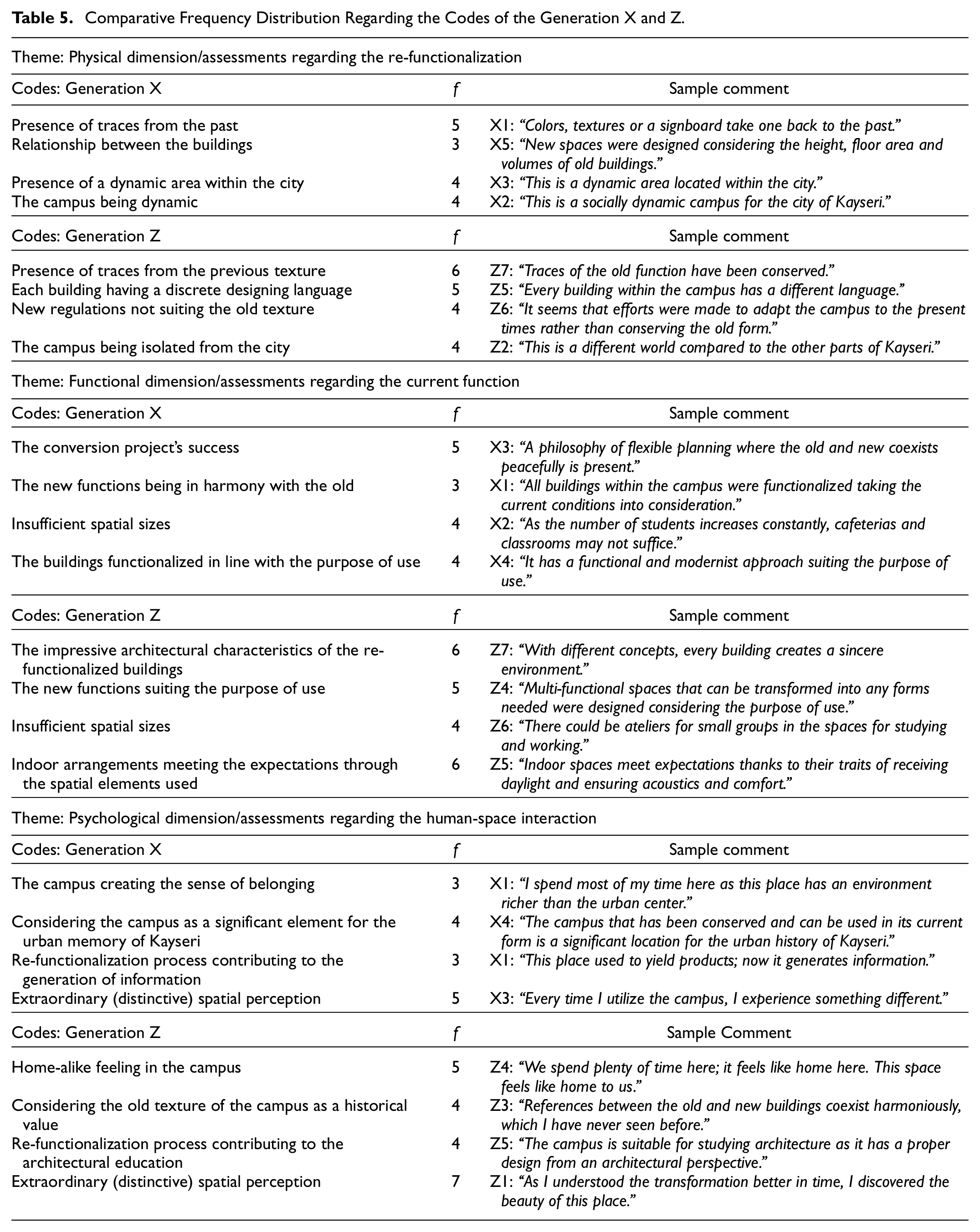
According to the results, the frequency distributions regarding the codes of the Generation X and Z are presented in Table 5.
Comparative Frequency Distribution Regarding the Codes of the Generation X and Z.
Discussion
Participants of the Generation X, who assessed the physical aspects of Sümer Campus, mentioned physical traits such as colors and textures as well as the structural elements such as doors and windows and the traces of the previous texture such as unmodified boards. The harmony between the buildings suggests that newly-designed buildings create an eccentric but not an anomalous perception. In terms of the relationship between the spaces and environment, participants noted that the buildings were on the human scale and naturally sensitive. There was a consensus regarding the spatial layout that the campus was formed through the old traces. It was also noted that the constructional steps taken horizontally arose from the functional impact of the factory era and that the buildings re-functionalized with an educational approach were re-organized accordingly. Accordingly, as emphasized by Acılıoğlu (2015), it is safe to state that the spatial perception of conserving what has been built emerged, which is specific to the Generation X. Tending to question more concepts, this generation’s characteristic of respecting the old and being open to the new is consistent with Çatalkaya’s statement (2014) in terms of the spatial perceptions/likes.
Thoughts of the Generation Z regarding the physical dimension indicate that the old traces on the re-functionalized campus could still be seen. Participants of this generation stated that they could read these traces through the ruins of old buildings, constructional elements such as windows as well as colors and textures. Participants who felt they spent time in a historical space mentioned that a process of re-functionalization that damaged the historical texture did not happen and that a design which is integrated with the new was planned and fulfilled. Participants of the Generation Z noted that Sümer Campus was an enclosed, separate world in the city of Kayseri. They added that they could see the design planned with contrasts in the current spatial layout and that the Steel Building was hierarchically more dominant.
From the functional aspect, it was realized that the lecturers of the Generation X thought a process of re-functionalization that was in harmony with the old functions was conducted. In parallel to Giddens’ (2010) idea that the Generation X tends to protect and utilize the historical environment, the campus was holistically assessed by the Generation X, and it was found that the buildings were suitable for the educational function. Classrooms, ateliers and the Warehouse where the shared studying areas were planned to be positioned were found to be sufficient for the educational function. Having been designed to provide an ideal studying environment for the students of architecture, the Warehouse was believed to be a flexible building meeting different functions. Although the use of educational function was deemed appropriate for the current buildings, it was also noted that the number of classrooms and social spaces should be increased considering the increasing number of students. Assessing buildings’ structural traits by comparing the old with the new, members of the Generation X mentioned that the structural layout consisted of old traces and that they were satisfied with this, which is in compliance with the idea of Jianrui (2011) that the Generation X questions and respects the traditional concepts and objects and that they are open to new information. Additionally, certain participants indicated that the Steel Building, which is a new building, were not considered with the old buildings and that it underwent a different designing approach. Furthermore, participants of the Generation X noted that the use of certain colors in indoor arrangements created a depressive sense and that there were ventilation-related problems.
Students of the Generation Z assessed the current function as that the buildings in the campus met the educational, administrative and social needs. Students’ belief that a functional designing was performed in these re-functionalized spaces indicates their satisfaction with these spaces. According to Unvan and Özturan, coffee shops with personal and group sitting areas are popular among the people of Generation Z (Unvan & Özturan, 2020). Accordingly, the participants of Generation Z wanted more social spaces such as coffee shops in the campus, which corresponds to their generation-related predictions. Participants of Generation Z assessed the current buildings in line with their functions and focused on the concepts of flexibility and transparency for indoor arrangements. They considered the ability to study in the corridors of Warehouse which they used as the spaces of meeting, chatting or eating, thanks to the spatial flexibility of building, as a positive trait. With a similar approach, Unvan and Özturan noted that the ability to meet with friend groups whenever desired, to focus on studies and to chat during breaks corresponds to the flexibility-based demands of the Generation Z (Unvan & Özturan, 2020). This flexible spatial layout that increases interaction creates a positive impact on the education of this generation and is considered positive for them. However, participants of Generation Z criticized certain indoor details such as the furniture and power outlets. Their ties with the technology resulted in the necessity to access the up-to-date and digital technology as the new users of educational buildings.
According to the psychological assessment of Sümer Campus by the Generation X, the campus came to the forefront during certain seasons thanks to its landscape creating a unique atmosphere. Another element making the campus distinctive in participants’ memories is the presence of a museum in the campus. Additionally, the importance of the campus for the urban memory of Kayseri was also mentioned. The concepts of authentic and characterful were used to represent the value created in the campus. The definition of the Generation X by Bayındır et al. (2020) as the group of people who strictly defend values, support loyalty to a space and demand environmentally harmonious spaces is consistent with the results of the present study. Feeling that they were actually in the factory building, the participants noted that the campus was perceived as an industrial facility from an external perspective. Accordingly, it was mentioned that the continuation of production, a result of industrial function, was sustained as the generation of information for educational functions. Participants of Generation X expressed their satisfaction with the campus, adding that they adapted to the space. The sense of belonging to the Warehouse where they often spent time indicated the level of adaptation which increased with experiences. As noted by Altuntuğ (2012), the Generation X assigning a meaning to the space with the emotional ties they established can be identified with the traditionalist and contented orientations.
From the psychological perspective, the members of the Generation Z used similar statements, compared to the Generation X, when spatially assessing the Sümer Campus. The participants who mentioned positive thoughts about the campus stated that the landscape elements created alterations in the spatial perceptions in different seasons, which was also said by the Generation X. The campus was noted to be suitable to human scale and have nature-oriented spaces, which is in parallel to the thoughts of Sterkenberg (2019) stating that the Generation Z preferred outdoor areas and liked spaces with natural ventilation and high energy efficiency. Additionally, participants of the Generation Z mentioned that they found the design of this campus, which underwent a functional conversion and had historical values, as an exciting style. Considering that this facility was in harmony with its new function although it was not perceived as an educational building externally, participants noted that the authentic value of the campus arose from this conversion and that the campus was an ideal place for architectural students. Participants of the Generation Z stated that they adapted to the spaces they used the most and that their adaptation turned into familiarity in time. Having been born into the consumption culture, this generation was limited with the spaces they experienced during the process of consuming new spaces. To be more specific, ability to use classrooms during day and night and to perform all actions there throughout the entire day provides tips about these consumption habits.
Conclusion
The results obtained from the interviews with the lecturers and students of the Department of Architecture at Abdullah Gül University revealed similarities/differences in terms of assessments regarding spatial perceptions. In the context of the influence arising from the transformation, traces of the previous function could be recognized by all participants. Members of the Generation X assessed the campus more holistically with its historical urban value, while the members of the Generation Z reviewed the campus without thinking beyond its borders. The re-functionalized and re-shaped Sümer Campus was understood by the Generation X as a location where the old texture was sustained and combined with the new; the Generation Z considered the campus as an esthetic formation that contained the conscious opposition of the old and new buildings. The productional continuity arising from the industrial function continued to exist as educational continuity in the present time according to what the participants of Generation X believed. Being aware of the historical value of the campus, participants of the Generation Z considered the functional transformation of the campus an opportunity for the students of architecture. The results regarding the spatial perception and adaptation to the re-functionalization of Sümer Campus are believed to guide the future studies that will focus on this topic.
The study was limited with 12 people from the Department of Architecture at the Faculty of Architecture of Abdullah Gül University; five of them were lecturers, and seven were students. Accordingly, it may be recommended that the subject and group of the present study be expanded to achieve generalizable results, and that various studies be conducted to research the spatial perception regarding the re-functionalized industrial buildings. Assessment with different dimensions can be performed considering the perception of spatial factors regarding the re-functionalized industrial buildings, processes of adaptation to these buildings and users’ thoughts in the context of human-space interaction.
Footnotes
Acknowledgements
We extend our gratitude to Prof. Dr. Burak Asiliskender, the Dean of the Faculty of Architecture at Abdullah Gül University, and the participating lecturers and students of the Department of Architecture for their contributions.
Declaration of Conflicting Interests
The author(s) declared no potential conflicts of interest with respect to the research, authorship, and/or publication of this article.
Funding
The author(s) received no financial support for the research, authorship, and/or publication of this article.
Ethical Approval
This study was carried out with the permission of Karadeniz Technical University Science and Engineering Ethics Committee with the decision dated 25.11.2022 and numbered E-82554930-050.01.04-313083-4627.

Data Availability Statement
Data sharing not applicable to this article as no datasets were generated or analyzed during the current study.