




Abstract
In the rapidly evolving landscape of Industry 4.0, understanding the factors influencing smart factory users’ intention to switch systems is paramount. This study aims to uncover the key determinants driving switching intention among smart factory users. Our theoretical framework emphasizes the significance of alternative attractiveness, peer influence, satisfaction, and switching cost in this context. We analyzed data from 163 smart factory users employing partial least squares structural equation modeling. The findings underscore that switching intention is majorly influenced by factors such as alternative attractiveness, peer influence, and switching cost. Further, perceived ease of use directly influences perceived usefulness and satisfaction. Moreover, satisfaction is found to be closely tied to perceived usefulness. Intriguingly, personal innovativeness stands out as a primary factor in shaping user satisfaction. We conclude by outlining the academic and practical implications of our findings, highlighting the need for organizations to strategize based on these insights.
Plain language summary
Imagine you’re using an old phone and decide to switch to a new smartphone because it has better features. Similarly, workers in factories sometimes decide to change the technology they use, moving from older systems to newer, smarter ones. This study looks at why people working in factories decide to make such changes, focusing on smart factories—places where everything is more automated and uses the latest technology. We asked a lot of people who work in these smart factories about their experiences and thoughts. We wanted to know what makes them stick with their current technology or switch to something new. Is it because the new technology is easier to use or more useful? Or do they switch because their colleagues recommend the new technology? Maybe they find another option that seems better or are simply not happy with what they currently have. Our findings showed that a few key reasons influence their decision. Firstly, if the new technology makes their work easier or improves how they do their job, they’re more likely to switch. Secondly, if people around them, like their coworkers, think the change is good, they might be persuaded to switch too. Also, if they find another technology that seems better than what they currently use, or if they’re just not satisfied with their current setup, they might decide to change. This study helps us understand what motivates people to adopt new technologies in their workplace, especially in advanced factory settings. This information is useful for companies that make these technologies, as it can guide them in developing systems that people will want to use.
Keywords
Introduction
As the 4th Industrial Revolution unfolds, Industry 4.0 presents new opportunities that can significantly impact both society and businesses (Büchi et al., 2020). Emerging technologies such as artificial intelligence (AI), big data, and the internet of things (IoT) have led to innovations in management methods, corporate strategies, and process procedures. In particular, the 4th Industrial Revolution has popularized the smart factory concept in the global manufacturing industry (Won & Park, 2020). A smart factory is an intelligent facility that analyzes real-time data and integrates various digital solutions to enhance productivity and customer satisfaction. To capitalize on the advanced functionalities and benefits of smart factories, many governments have established transfer schemes and implemented proactive initiatives to actualize a new production ideology (Reischauer, 2018; Thoben et al., 2017). The German government announced the High-Tech Strategy 2020 Action Plan, promoting the automation of manufacturing industries in Industry 4.0 (Bochmann et al., 2015). China’s state council discussed a long-term national initiative aimed at transforming China into a global manufacturing powerhouse (Li, 2018). The United States initiated the Smart Manufacturing Leadership Coalition (SMLC) to encourage widespread adoption of manufacturing intelligence (Coalition, 2011). In line with these governments, industries have rapidly increased investment in smart manufacturing. According to Capgemini (2019), 67% of manufacturers have invested at least USD 100 million. Furthermore, it was forecasted that the global economy would grow from USD 500 billion to USD 1.5 trillion over the next 5 years. As the market expands, new entrants are joining the smart factory market. Mittal et al. (2018) asserted that the entry barrier for the smart factory market would be lowered, and the risk associated with transitioning to smart manufacturing would be reduced. In this context, ensuring that users remain engaged and loyal to a particular smart factory system could lead to substantial economic benefits and operational efficiency. However, this demands a nuanced understanding of the myriad factors that could influence a user’s intent to switch. This study, therefore, emerges from a critical need to demystify the intricate determinants of switching intentions in the smart factory paradigm. By shedding light on these aspects, we aspire to offer actionable insights to organizations, helping them bolster user loyalty and, in turn, maximize returns on their technological investments.
Switching intention represents an individual or organization’s propensity to change from one product, service, or solution to another (Burnham et al., 2003). In the domain of smart factories, switching intention signifies the likelihood of stakeholders, be it managers, operators, or organizations as a whole, to transition from their current operational technologies or methodologies to new and potentially more effective ones. Understanding the switching intention is crucial, especially in rapidly evolving sectors like smart factories, as it provides insights into adoption behaviors and industry trajectories.
In the information system (IS) and marketing field, several studies have highlighted the importance of satisfaction in explaining users’ switching intentions (Bansal & Taylor, 1999; García & Curras-Perez, 2019; G. Kim et al., 2006). In the context of a smart factory, satisfied users would stay with the current system, while dissatisfied users would want to switch to another system. Perceived usefulness and perceived ease of use are critical contributors to technology acceptance, continuance intention, and satisfaction (Agag & El-Masry, 2016; Chang & Hsu, 2017; Chow et al., 2012; Venkatesh et al., 2003). Users who perceive a smart factory as easy to use and useful tend to have higher levels of satisfaction. Accordingly, this work examines the impacts of satisfaction, perceived usefulness, and perceived ease of use in describing users’ switching intentions.
Innovativeness, one of potential determinants of switching intention, is an inherent characteristic that can significantly influence how one perceives and reacts to emerging technologies, especially in fast-evolving areas such as smart factories (Senali et al., 2022). In the context of our study, innovativeness refers to the proclivity of individuals or organizations to embrace, explore, and adopt new technological advancements (Szymanski et al., 2007). It is related to the inclination to seek novelty, newness, or variety (F. Zhang et al., 2023). Innovativeness has been demonstrated as a leading factor in the adoption, continuance intention, and switching intention of information technology (IT) (Bartels & Reinders, 2011; Kaushik & Rahman, 2014; Lu, 2014). Since the smart factory is the epitome of emerging innovative technologies, a user’s innovativeness is expected to have a significant effect on satisfaction and switching intention. Our research postulates that individuals or firms with higher levels of innovativeness are more likely to perceive new smart factory solutions as beneficial, thereby affecting their switching intentions. This propensity to be open to new technologies and methodologies can thus act as a catalyst or deterrent for switching intentions. When we consider the technological advancements in the Industry 4.0 era, innovativeness becomes a crucial factor in determining the readiness and willingness to switch to more advanced smart factory solutions.
Switching intention also has been explained by innovativeness, alternative attractiveness, peer influence, and switching cost (Asimakopoulos & Asimakopoulos, 2014; Bansal & Taylor, 1999; Hou et al., 2012; Keaveney, 1995; Oliver, 1999; Yao et al., 2015). Alternative attractiveness is considered a crucial predictor of switching intention (Bansal et al., 2005; G. Kim et al., 2006). Currently, numerous solution providers are entering the market, each offering a range of advanced smart factory technologies (Manufacturing Technology Insights, 2020). If system users perceive an alternative system as more attractive, they are more likely to switch to that system. Peer influence is expected to significantly affect switching intention. Generally, many workers collaborate in a manufacturing environment. Workers may communicate about their work systems, advantages, or other new solutions. Users who are heavily influenced by their peers may consider switching to another system. Thus, this paper elucidates the role of alternative attractiveness and peer influence in developing switching intention in the smart factory domain.
Switching costs are identified as factors that deter IT users from changing service providers (Kim et al., 2014; Zengyan et al., 2009; K. Z. K. Zhang et al., 2009). Switching costs consist of learning, continuity, and setup costs (Jones et al., 2000). In the case of a smart factory, the switching process is quite complex because a smart factory deals with information on the overall operation of the factory and is integrated with cutting-edge technologies. Hence, this research suggests that switching costs impact switching intention.
Switching intention, a crucial phenomenon within the realm of information systems (IS), has predominantly been explored in sectors such as e-commerce and online services (Y.-W. Liao et al., 2019; Lisana, 2023). However, its application within the smart factory sector, a key component of Industry 4.0, has not been thoroughly investigated. This paper aims to bridge this gap by examining how factors like alternative attractiveness, peer influence, and innovativeness influence switching intentions among smart factory users. While previous research has individually addressed these factors (Fu et al., 2021; Yu et al., 2022), their collective impact in the smart factory setting remains unexplored. Moreover, the interplay between innovativeness and user satisfaction in this technologically advanced environment necessitates further investigation, especially regarding its potential influence on switching intentions.
Our study contributes significantly to the field by providing a comprehensive analysis of smart factory user behavior, integrating perspectives often overlooked in existing literature. By focusing on user experiences and perceptions, rather than solely on conceptual or managerial viewpoints, this research offers novel insights into the dynamics of switching intentions in smart factories. Additionally, it explores the combined effect of personal innovativeness, alternative attractiveness, and peer influence on users’ willingness to switch, employing a cross-sectional analysis that highlights the nuanced interactions between these variables. In doing so, this study not only addresses a notable research gap but also enriches our understanding of smart factory adoption and retention strategies. It underscores the importance of considering a wide array of factors that influence user behavior in complex technological ecosystems, thereby providing valuable implications for both practitioners and researchers in the field.
The rest of this paper unfolds in the following manner: The next section offers an extensive review of the literature and formulates the core hypotheses. Afterward, we delve into a detailed exposition of our research methodology, encompassing elements like instrument creation, data collection strategies, and analytical methods. Section “Research Results” showcases the empirical findings, with Section “Discussion” dedicating itself to a comprehensive discussion of these outcomes. We wrap up the paper in Section “Conclusion” with a recap of our findings, reflections on the theoretical implications, practical takeaways, study limitations, and avenues for subsequent research.
Literature Review and Research Model
Theoretical Background
Smart Factory
Research on smart factories has been extensively conducted from various perspectives in both academia and industry. Numerous studies have focused on the definitions, scope, features, and requirements of smart factories (Kumar & Lee, 2022; Lee et al., 2023; Mittal et al., 2018; Radziwon et al., 2014; Sajadieh et al., 2022; Soori et al., 2023; Thoben et al., 2017). A smart factory offers flexible production methods to address potential issues within a facility (Radziwon et al., 2014). These factories have garnered recognition for their potential to significantly enhance productivity, resource utilization, and overall operational performance (Hussein et al., 2021; Kamble et al., 2020). Mittal et al. (2018) delineated the specific requirements for small and medium-sized businesses by examining Industry 4.0 maturity models. Furthermore, Mittal et al. (2019) explored the features, technologies, and related components underpinning smart manufacturing. They identified five distinct characteristics: context awareness, modularity, heterogeneity, interoperability, and compositionality. Thoben et al. (2017) pinpointed research challenges in smart manufacturing, underscoring the transition to big data-centric supply networks, augmented automation, and human engagement. Jo (2023b) investigated the primary determinants of continuance intention in the smart factory setting, revealing that system quality, information quality, and personal innovativeness profoundly impact continuance intention through perceived usefulness. This author subsequently introduced an analytical framework for deciphering the satisfaction and loyalty of smart factory employees Jo (2023a), determining that IT infrastructure plays a crucial role in both satisfaction and loyalty.
Existing research has proposed frameworks and models for the development and execution of smart factories (Le et al., 2020; Sjödin et al., 2018). Le et al. (2020) suggested a conceptual model for developing smart heavy-load manipulators in smart factories, encompassing aspects like collision prevention, real-time positioning, and lean methodologies. Meanwhile, Sjödin et al. (2018) laid out a framework for smart factory implementation, rooted in three core principles to maximize management benefits: digital users, adaptable processes, and modular technologies.
Numerous studies have endeavored to gauge the performance of smart factories (Büchi et al., 2020; Kusiak, 2018). Kusiak (2018) presented evaluation criteria for automated factories incorporating the smart manufacturing paradigm, touching on elements such as materials, predictive engineering, data, resource allocation, sustainability, and networking. Büchi et al. (2020) conducted empirical research into the causal relationship between degrees of openness and performance, highlighting the expansive opportunities presented by Industry 4.0. They posited that micro-level local units yield optimal results when assimilating Industry 4.0.
Previous research has predominantly approached the topic from an engineering standpoint (Ryalat et al., 2023; Setiawan et al., 2020; Tao et al., 2018; Tuptuk & Hailes, 2018). For instance, Setiawan et al. (2020) fashioned a sensor network for a multi-agent system strategy in a smart factory, demonstrating the model’s ability to precisely monitor machine tool progress and job status. Tao et al. (2018) championed data-driven smart manufacturing, emphasizing the critical role of big data in smart manufacturing operations. Leveraging big data analytics, smart manufacturing can achieve customer-oriented product management, self-organization, self-execution, self-regulation, and self-learning. Tuptuk and Hailes (2018) explored the current security landscape in smart manufacturing, proposing robust security solutions and accentuating cryptographic methods, intrusion detection systems, and security training.
While there has been a burgeoning interest and a plethora of studies focusing on smart factories, a deeper dive into the existing literature reveals a significant oversight. Specifically, the realm of empirical research seems to have afforded minimal attention to understanding the intricacies of users’ switching intentions within the context of smart factories. Switching intention, a critical dimension in technology adoption and retention, delineates the propensity of users to transition from one technological solution to another. Given the rapid advancements and the dynamic nature of smart factory technologies, such insights are invaluable for both practitioners and scholars. Furthermore, it is not just the phenomenon of switching intention that remains underexplored; there is also a conspicuous absence of empirical evidence pertaining to the variables that influence or precipitate this switching behavior. Such variables could encompass a range of factors, from user satisfaction and system performance to peer influence and perceived value. Addressing this gap is not only crucial for theoretical completeness but also holds significant implications for industry stakeholders looking to optimize user retention and minimize system migration. In essence, while the broader domain of smart factories has witnessed extensive research, this specific facet remains conspicuously under-researched, thus underscoring the justification for the current study.
Switching Intention
Switching intention, commonly examined across various disciplines, fundamentally represents a user’s intent to change a chosen service or product in favor of an alternative (Oliver, 1999). In the context of technology and system adoption, Keaveney (1995) elucidates the various factors such as dissatisfaction, allure of alternatives, and influential peer recommendations that might induce users to contemplate switching. Similarly, in service industries, Burnham et al. (2003) describe the concept of switching barriers and their influence on retention rates. These barriers, often including factors like perceived risks, switching costs, and service performance satisfaction, have a profound impact on a user’s intention to switch. Iranmanesh et al. (2022) explored the antecedents of switching intention from web-based stores to retail apps by employing habit as a moderator. Yuwei (2019), investigated the affecting factors of switching intention to cloud enterprise system by incorporating multiple theories. S. Cheng et al. (2019) examined the determinants of switching intention for mobile cloud storage services based on push-pull-mooring framework. They found that usefulness and switching cost are significant on switching intention. In addition, numerous studies have shed light on switching intention in various contexts such as corporate ISs (Asimakopoulos & Asimakopoulos, 2014; Chang & Hsu, 2017) mobile apps (Kuo, 2020), social media (Hwang et al., 2019; Y.-W. Liao et al., 2019; Y.-L. Wu et al., 2011; Xu et al., 2013; Yao et al., 2015), telecommunication (Chuang, 2011; Martins et al., 2013; Park et al., 2014), shared economy (Liang et al., 2018), and high-technology products (Msaed et al., 2017).
The field of smart factories and Industry 4.0, although relatively nascent, poses a unique challenge for the examination of switching intention. As organizations invest considerable resources in the implementation of these new-age systems, the consequences of switching become more pronounced. The decision to switch in a smart factory context is thus multifaceted, influenced not just by the performance of the existing system but also by external factors like peer influence, perceived benefits of alternatives, and the costs associated with a switch. An in-depth examination of these factors within the smart factory landscape can provide invaluable insights into retention strategies and can help stakeholders make informed decisions.
Technology Acceptance Model (TAM)
The TAM has become a foundational model in understanding user acceptance and adoption of technology (Davis, 1989). The model aims to explain the determinants of computer acceptance that are general across a broad range of end-user computing technologies. Two primary factors in this model are perceived ease of use and perceived usefulness. Perceived ease of use refers to the degree to which an individual believes that using a particular system would be free from effort. In other words, it emphasizes the intuitive nature and user-friendliness of a technology or system. It has a direct impact on users’ intention to use a system and indirectly affects it through perceived usefulness. When a system is easier to use, users are more likely to find it useful, thereby increasing the likelihood of its acceptance. Perceived usefulness is defined as the extent to which an individual believes that using a system would enhance his or her job performance. This means that users are more likely to accept and use a system if they perceive it to be beneficial to their tasks or roles. Perceived usefulness has been consistently linked to the actual system use and intention to use.
Over the years, TAM has been validated and extended by numerous studies across various technologies and user groups (Ali et al., 2018; Raza & Khan, 2022; Raza et al., 2023). Ali et al. (2018) confirmed that perceived ease of use and perceived usefulness influence the behavioral intention of e-learning systems. Raza and Khan (2022) corroborated that perceived ease of use and perceived usefulness significantly influence cloud computing adoption. Raza et al. (2023) established that perceived ease of use and perceived usefulness impact the behavioral intention to use ride-sharing services. The reason for its pervasive use is its simplicity and the core idea that technology acceptance is a function of its perceived usefulness and perceived ease of use. In the context of our research on smart factories, the inclusion of these determinants from TAM helps in understanding the users’ intention to switch by analyzing their perceptions of the current system’s utility and usability.
Push-Pull-Mooring (PPM) Model
Originating from migration studies, the PPM model has been widely used to explain the dynamics that lead individuals to move from one place (or situation) to another (Jing et al., 2023; Y.-W. Wu et al., 2022; Yen, 2023). This model posits that three distinct forces govern this movement: Push factors (negative attributes or dissatisfactions associated with the current situation), pull factors (attractive attributes of an alternative situation), and mooring factors (factors that might either hamper or facilitate the movement, including personal, social, and structural forces)
Over the years, the PPM model has found relevance beyond migration studies. Within the domain of ISs, researchers have utilized the PPM framework to investigate various aspects of technology adoption, switching behavior, and retention (Dogra et al., 2023; Lisana, 2023; Zhu et al., 2023). Push factors in IS relate to the dissatisfaction or problems users encounter with their current system or technology (Ho, 2022). It can be issues related to system performance, high costs, lack of support, or any other aspect that might instigate users to consider alternatives (X. Lin et al., 2021). For instance, frequent system outages or the unavailability of desired features can push users to seek other systems or platforms. Pull factors in IS draw users toward a new system or technology (L. Chen et al., 2023). Innovations, better user experience, advanced features, or even aggressive marketing can serve as pull factors. The integration of AI or more intuitive user interfaces can pull users toward adopting newer technologies or platforms (Mourtzis et al., 2022). In the context of IS, mooring factors could be the costs associated with switching technologies (both monetary and effort-based), organizational policies or even individual’s inherent resistance to change. For instance, contractual obligations with a current technology provider or the training required to use a new system can be mooring factors that influence switching intentions.
The PPM model aligns well with several foundational theories in IS. The most notable among these is the TAM (Davis, 1989). TAM postulates that perceived usefulness and perceived ease of use determine an individual’s intention to use a system. The dissatisfaction arising from these two constructs (in TAM) can easily be related to the push factors in PPM. Similarly, the attractions of a new system resonate with pull factors.
Another supporting theory is the theory of planned behavior (TPB) (Ajzen, 1991), which underscores the role of attitude, subjective norm, and perceived behavioral control in shaping behavioral intentions. The subjective norm component of TPB, which represents social pressures, can be related to the pull factors (Y. Sun et al., 2017) or mooring factors (Mahajan et al., 2023) in the PPM model, indicating that both individual and societal influences play a role in technology switching decisions.
The PPM model offers a comprehensive framework to understand the intricate dynamics of switching behavior in the context of smart factory. For the current study, integrating the PPM model with its theoretical underpinnings can provide a holistic understanding of users’ intentions and behaviors.
Hypothesis Development
Perceived Ease of Use
Perceived ease of use reflects how effortlessly an individual perceives using an IS (Davis, 1989). This concept is key in discerning user behavior in technology adoption. A solid consensus in literature illustrates its positive correlation with perceived usefulness (Ardiansah et al., 2020; Chang & Hsu, 2017). Simplified, when a system is easy to use, its value to users rises. Parallelly, some researchers highlight that perceived ease amplifies users’ intentions to adopt an IS, indicating a system’s user-friendliness directly boosts its integration in daily tasks (Chow et al., 2012; Lu, 2014). Delving into user satisfaction, its link with perceived ease is undeniable. Findings from Islam (2012) and Shao (2020) reiterate that intuitive IS designs yield higher user contentment, influencing prolonged engagement and loyalty. Translating this to the realm of smart factories, representing complex IS frameworks, perceived ease of use stands out as a cornerstone. Its dual impact on both perceived usefulness and satisfaction can not be understated. Thus, within the smart factory landscape, we argue that perceived ease of use will crucially influence both user perceptions of utility and their overall satisfaction levels.
H1a. Perceived ease of use positively affects perceived usefulness.
H1b. Perceived ease of use positively affects satisfaction.
Perceived Usefulness
Perceived usefulness is anchored in the belief regarding the extent to which an IS enhances the effectiveness of task performance (Davis, 1989). This construct is not merely an ancillary measure; it sits at the epicenter of understanding user behavior in relation to technology, particularly when discussing intentions such as adoption or sustained usage. Several scholarly contributions underscore the pivotal role perceived usefulness plays in molding behavioral intention (Y. M. Cheng, 2012; Kanthawongs & Kanthawongs, 2013). Diving deeper into the construct’s influence, perceived usefulness has been empirically associated with heightened user satisfaction across diverse IS contexts. For instance, studies focused on internet utilization (Isaac et al., 2018), educational platforms (Islam, 2012; Jo, 2022a; Jo & Park, 2022), and even banking systems (Mohammadi, 2015) all highlight this consistent pattern. Each of these studies elucidates a logical pathway: when users discern tangible benefits from an IS, leading to amplified task efficiency, their contentment with the system naturally escalates. Transposing this understanding to the domain of smart factories, it is logical to deduce that if such a factory augment work processes and bolsters efficiency, user satisfaction will rise. Drawing upon this established association, we hypothesize that in a smart factory setting, perceived usefulness will serve as a potent catalyst, amplifying the propensity for switching intention among users.
H2. Perceived usefulness positively affects satisfaction.
Innovativeness
The concept of innovativeness is deeply rooted in the psychological predisposition of individuals toward embracing and integrating new ideas, methodologies, and environments into their operations (Agarwal & Prasad, 1998). This trait tends to manifest more conspicuously in certain individuals, characterizing them as early adopters who seamlessly assimilate innovations into their routines. This proclivity is not a peripheral characteristic; it stands prominently in influencing behavioral intentions as highlighted by an array of research (Acikgoz et al., 2022; Matute-Vallejo & Melero-Polo, 2019; Senali et al., 2022). Some authors further amplifies our understanding of this trait by positing that the innate human cravings for variety, change, and novelty significantly dictate patterns in switching behaviors (Handarkho & Harjoseputro, 2020; Lisana, 2023; W. Sun et al., 2020). The nexus between innovativeness and brand interactions has been further validated by a slew of contemporary studies. Pioneering works have reinforced the profound correlation between personal innovativeness, user satisfaction, and subsequent switching intentions (J. Chen, 2022; Handarkho & Harjoseputro, 2020; Khan et al., 2019; Z. Lin & Filieri, 2015; Lu, 2014; Weng & de Run, 2013). Contextualizing this to the domain of smart factories—a beacon of innovation that fuses diverse cutting-edge paradigms—it becomes evident that the disposition toward innovativeness can be a formidable determinant of satisfaction and switching intention. Therefore, drawing from this comprehensive synthesis, we postulate that in the dynamic landscape of smart factories, an individual’s inherent innovativeness will exert a decisive impact on both their satisfaction levels and their propensity to switch.
H3a. Innovativeness positively affects satisfaction.
H3b. Innovativeness positively affects switching intention.
Alternative Attractiveness
Alternative attractiveness corresponds to a consumer’s perception of the range and allure of competing options available in the marketplace (Jones et al., 2000). This facet of consumer psychology is not insular; it interplays extensively with behavioral dynamics, especially in contexts that involve potential switching behaviors. Substantiating this claim is a lineage of robust empirical studies, spanning both IS and the broader contours of marketing research (Zengyan et al., 2009; K. Z. K. Zhang et al., 2009). Many researchers distinctly converge on the premise that the allure of alternative offerings can substantially drive switching intentions (Kuo, 2020; J. Liao et al., 2021; Loh et al., 2020; Yao et al., 2015). This propensity to pivot is not solely anchored in the existence of alternatives, but pivots more pertinently on their perceived value relative to the current offering (Rusbult & Farrell, 1983). The allure of an alternative is not merely its standalone merit, but rather how it stacks up against the current offering. In the rapidly evolving realm of IT, this dynamic becomes even more pronounced. The corporate IS landscape is teeming with a proliferation of solutions, each vying for user adoption. As newer, more sophisticated smart factory solutions permeate the market, users, informed by their perceptions of alternative attractiveness, might manifest a proclivity to transition. Hence, we postulate the following hypothesis.
H4. Alternative attractiveness positively affects switching intention.
Peer Influence
Peer influence, as a pivotal construct in behavioral research, has long been recognized as a significant driving force in shaping individual choices and actions, especially in the domain of technology adoption (Hung et al., 2003). A rich tapestry of empirical studies paints a vivid picture of the magnitude of peer influence on switching intentions. Numerous studies converge on the assertion that peers, whether directly or indirectly, substantially sway the inclination of users to migrate from one system to another (Hou et al., 2012; Hou & Shiau, 2020; Hwang et al., 2019; Yao et al., 2015; Zengyan et al., 2009). In the unique ecosystem of a smart factory, the dynamics of peer influence take on a heightened relevance. Given the collaborative and interconnected nature of factory operations, where workers and system users interact and synergize, the ripple effects of one individual’s experience or perspective can permeate through the entire network. Furthermore, the smart factory is not just an isolated software solution; it represents a holistic operational paradigm spanning the breadth of an enterprise. Within such an integrated environment, the echo of peer sentiments becomes even more amplified. Given these intricate interplays of individual experiences, shared testimonials, and the overarching environment of a smart factory, it is postulated that peer influence will significantly augment the propensity of users to consider and ultimately adopt alternative systems.
H5. Peer influence positively affects switching intention.
Satisfaction
Satisfaction is a nuanced psychological construct stemming from a delicate balance between one’s consumption experiences and the potential gap with their initial expectations (Oliver, 1981). Across epochs, the crux of satisfaction and its profound influence on shaping behavioral intentions has been the focal point of myriad academic discourses. This spans from intentions to continue with a service to the polar inclination of switching to alternatives. Historically, a constellation of research has meticulously dissected the intricate dance between satisfaction and these intentions (Ali et al., 2022; Ashfaq et al., 2020; Jo, 2022a; Jo & Baek, 2023; Quoquab et al., 2018). These seminal studies form a solid bedrock, mapping out the contours of this relationship. Notably, Ali et al. (2022) explored the drivers, barriers, and facilitators of mobile payment usage behavior, emphasizing the pivotal role of user satisfaction in influencing behavioral intentions. In a smart factory setting, there is a situation where users find themselves contending with systems that fail to live up to their expectations. Each instance of misalignment, where the digital tool fails to meet the demands of the task or exacerbates complexities, contributes to dissatisfaction. This discontentment is not insular but cascades into larger behavioral outcomes. Users, when persistently confronted with such dissatisfaction, naturally commence a search for alternatives, hoping for a more seamless and productive experience. Given this inherent human drive for optimal experiences and the clearly established nexus between satisfaction and behavioral intentions, it’s posited that diminishing satisfaction levels in the smart factory milieu will serve as a catalyst. This will accentuate users’ intent to gravitate toward alternative ISs, amplifying the dynamics of switch intentions.
H6. Satisfaction negatively affects switching intention.
Switching Cost
Switching costs represent the costs that users must endure when they shift from the present service to the alternative (Dess et al., 2011). Users are encouraged to stay on a current service to save switching costs (Heide & Weiss, 1995). System users do not easily change the services because they spend considerable effort and costs in adopting functions (Kim et al., 2014). Various studies indicated that switching cost has a significant effect on switching intention (S. Cheng et al., 2019; G. Kim et al., 2006; Kuo, 2020; J. Liao et al., 2021; Loh et al., 2020; Yao et al., 2015; K. Z. K. Zhang et al., 2009). In a smart factory environment, users must invest significant time and effort to grasp operational procedures and system guidelines. This steep learning curve embodies the concept of switching costs, which extend beyond monetary considerations to include cognitive and emotional investments. Given the intensive adaptation required, users often view transitioning to another system as daunting, anticipating inefficiencies and potential errors. Consequently, as they perceive higher switching costs, their inclination to consider alternatives diminishes. Thus, we hypothesize that higher perceived switching costs negatively impact users’ switching intentions in a smart factory context.
H7. Switching cost negatively affects switching intention.
Research Model
The current study explores the switching intention based on mainly alternative attractiveness, peer influence, satisfaction, and switching cost. Placing model development in the domain of smart factories, it posits that perceived ease of use, perceived usefulness, and innovativeness are three enablers of satisfaction. Figure 1 shows the constructs and hypothesized paths of the research framework.

Research model.
Research Methodology
Instrument Development
In this research, the quantitative approach was used to confirm the validity of the proposed conceptual framework. To verify the constructs considered in the framework, the indicators of each construct were adopted from previous works in IS and marketing. The measurement items were slightly modified to assure their appropriateness in the smart factory context. For perceived ease of use and perceived usefulness, items were adopted from Davis (1989). The construct of innovativeness was guided by items from Agarwal and Prasad (1998). Alternative attractiveness incorporated elements from both Bansal et al. (2005) and G. Kim et al. (2006). We looked to Zengyan et al. (2009) for peer influence and to Russell-Bennett et al. (2007) for satisfaction. The construct of switching cost was influenced by Bansal et al. (2005), while switching intention was derived from Shin and Kim (2008). Each item, whether adopted or adapted, was scrupulously chosen to resonate with the context of our study and to preserve the essence of the original constructs. All constructs were all measured by a multiple-item. The questionnaire applied the 7-point Likert scale (1 = strongly disagree, 7 = strongly agree). An appendix describes the items of constructs and resources.
The authors first filled out the questionnaire in English. A Korean researcher who is fluent in English translated the questionnaire into Korean. There was only a small correction in the contents in the translation process. Before conducting a survey, three experts in IT and quantitative research took the questionnaire. They reviewed the overall flow of the questionnaire, ambiguous expressions, and differences in terms. Their feedback played a fatal role in improving the completeness of the questionnaire.
Data Collection
The research framework was empirically demonstrated by analyzing the data collected from online and offline surveys. The survey commenced by briefly explaining the concept of a smart factory, followed by inquiring the respondents about their experiences with the use of smart factories. The questionnaire was divided into three distinct sections: The first section primarily dealt with understanding the respondents’ general experiences associated with the use of smart factories. This section captured qualitative aspects of user interaction, the frequency of usage, and other pertinent experiential details. In the second section, the focus was on gauging the respondents’ perceptions concerning the major constructs of this study. This section aimed to directly derive insights that align with our research hypotheses. The third and final section solicited demographic details of the respondents, which would be crucial in analyzing and contextualizing the primary data within certain socio-economic bounds.
A pilot test was conducted on 10 workers in the smart factory. They presented opinions on the amount of the entire questionnaire, logical development, unnecessary questions, and redundant content. The questionnaire was completed after the final correction was performed.
The sampling technique adopted for this study is purposive sampling. In purposive sampling, specific groups or categories within a population are chosen based on pre-defined criteria or researcher’s judgment, ensuring that the sample obtained is relevant to the research objectives (Etikan et al., 2016). In the context of our study, the Gyeongnam region was selected due to its prominence in housing a higher number of organizations with smart factories. This surge in the adoption of smart factories was primarily driven by government and local initiatives promoting the Fourth Industrial Revolution in the region (Jeong, 2019). The selection of this region was crucial as it provided a rich context to understand the dynamics of smart factories, which was central to our study’s objectives. Our approach of directly communicating with companies operating smart factories or liaising with affiliated service providers and partners ensured that the respondents were genuinely associated with the domain of smart factories. By explaining the purpose of our research and securing their understanding and cooperation, we ensured that our sample was not only relevant but also adequately informed, leading to more reliable and valid results (Bryman, 2016). This ensured the legitimacy and relevance of our target audience.
To enhance the response rate and ensure comprehensive data collection, we employed both online and offline methods from the first to the last week of October 2019, approximately a four-week period. The online portion of the survey was distributed using Google Forms, chosen for its accessibility and ease of use. This approach was particularly important as we aimed to include participants who might find accessing online surveys challenging, such as factory floor employees working in smart factories. Their work environment often limits their access to computers or the internet, prompting us to also collect data through offline sources. For the offline data collection, we distributed printed questionnaires and soft copies via email and mobile messengers, actively encouraging participation through follow-up communications via email, phone calls, and messaging. Informed consent was gathered from all participants. A questionnaire was distributed to a total of 212 subjects. Specifically, 160 questionnaires were disseminated online, and 52 were distributed offline. Out of the distributed questionnaires, we received responses from 172 participants. Specifically, 124 responses were collected from the online distribution, while 48 were garnered from the offline method. The survey response rate was 81.1%. Since the online survey was designed to be completed only when all items were answered, there were no incomplete online responses. Among the responses retrieved in the form of soft copy or printed papers, there were five incomplete responses. Among the total responses retrieved, there were four frivolous responses. They were answered equally with one value, or too inconsistently with the indicators of one factor. After eliminating incomplete and frivolous responses, the remaining 163 responses were finally analyzed.
The benchmark for the sample size was established by previous studies that employed the same analysis methodology as this study (Qureshi et al., 2023; Raza et al., 2020a; Raza et al., 2020b), suggesting that a sample of 300 or more is acceptable. However, the target population for our research, which is the users of smart factories, was relatively small in number. As a result, we applied a new statistical sample size calculation. The sample size for this study was determined based on the GPower statistical analysis program (Faul et al., 2009; Faul et al., 2007). Assuming an effect size of 0.15, an alpha of .05, a power of 0.95, and with five predictors, the recommended sample size was 138. However, to ensure more robust results and accommodate potential incomplete responses, we collected data from 163 respondents.
Demographics
This research aimed to understand the dynamics related to the adoption and usage of smart factories. Our target audience for the survey was enterprises that are actively operating smart factories in their manufacturing processes. We chose to distribute our surveys to this specific cohort to capture the most authentic and experienced responses. Our target population consisted of individuals actively involved with smart factories, either as users or decision-makers, representing diverse roles within the organizations. The study was primarily conducted in South Korea, given the country’s progressive stance on Industry 4.0 and its rapid adoption of smart factory technologies.
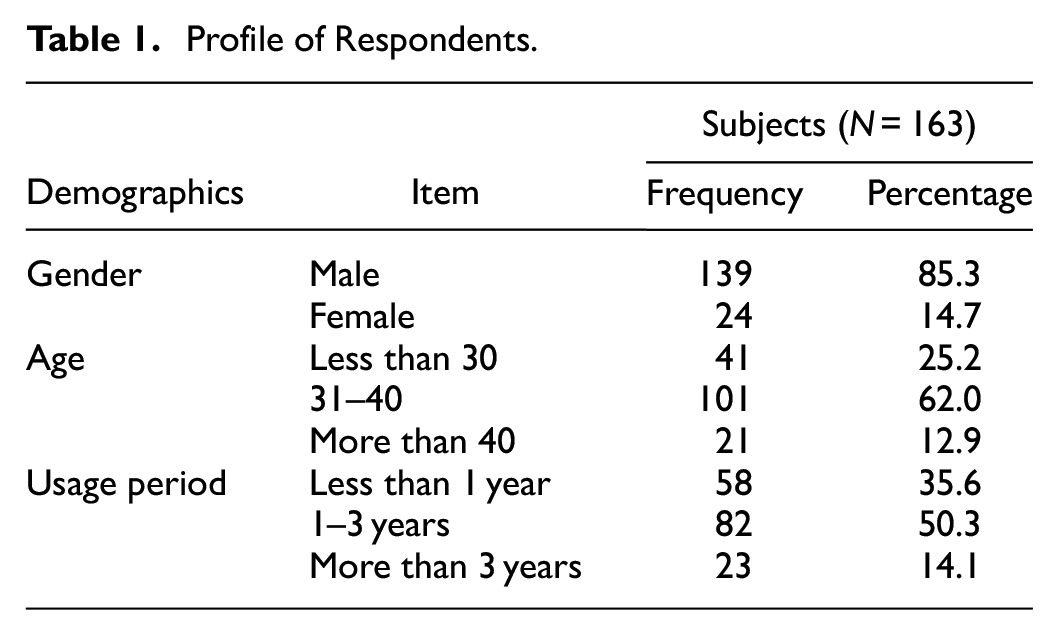
Table 1 presents the demographic profile of the respondents, capturing details from a total of 163 participants. In terms of gender distribution, a significant majority of the participants were male, comprising 85.3% (139 individuals), while females accounted for 14.7% (24 individuals). With respect to age, the majority fell within the 31 to 40 age bracket, constituting 62.0% (101 individuals). Participants aged less than 30 represented 25.2% (41 individuals) of the sample, and those aged above 40 constituted 12.9% (21 individuals). Examining the usage period of the smart factory system, half of the respondents (50.3% or 82 individuals) had an experience range of 1 to 3 years. Those with less than a year of experience made up 35.6% (58 individuals), and participants with over 3 years of experience comprised 14.1% (23 individuals) of the sample.
Profile of Respondents.
Data Analysis
The collected data were rigorously analyzed to draw meaningful insights and validate the proposed conceptual framework. Using statistical software such as IBM SPSS and SmartPLS 3.3 (Ringle et al., 2015), we conducted a series of analyses, including descriptive statistics, reliability, and validity tests, followed by hypothesis testing through structural equation modeling (SEM). This comprehensive approach allowed us to assess the relationships between the study’s constructs systematically and to evaluate the impact of each variable on the switching intentions among smart factory users.
Research Results
To ascertain the absence of common method bias (CMB), we utilized IBM SPSS. The software is renowned for its capability in handling various statistical tests, ensuring that the results we obtain are both reliable and valid. By using IBM SPSS, we were able to test for CMB, which adds to the credibility and robustness of our findings.
Furthermore, the current research carried out the partial least squares (PLS) SEM analysis to assess the measurement model and the structural model. The PLS method is widely used in IT because it has some benefits regarding restrictions on sample size and residual distributions (Chin, 1998; J. F. Hair et al., 2012). This work performed PLS in two steps. In the first step, the measurement model was validated. In the second step, the structural model was verified.
CMB
This study assessed the potential for CMB (Podsakoff et al., 2003), as all variables were gathered through a single survey. Initially, the Harman’s single-factor analysis demonstrated three factors, with the main factor explaining 32.629% of total variance. Additionally, the study analyzed variance inflation factors (VIFs). Kock (2015) posits that CMB might be a concern when VIFs surpass 3.3. The findings from our analysis indicate that the VIFs for all constructs remained below 3.3 (Table 2). Consequently, it is unlikely that CMB presents a significant issue in this study.
VIF.

Measurement Model
The present study assessed the measurement model by confirming convergent validity, reliability, and discriminant validity. Convergent validity was satisfied because the factor loading of each indicator was over 0.70 (J. Hair et al., 1998). The lowest factor loading was 0.731 (PEU3), ensuring an adequate level of convergent validity. To verify the reliability of the constructs, this work explored the composite reliability (CR), Cronbach’s alpha, and average variance extraction (AVE). Cronbach’s alpha is achieved if Cronbach’s alpha scores are greater than .70 (Nunnally, 1978). CR and AVE are acceptable when the CR values are higher than .70 and the AVE scores exceed 0.50 (Fornell & Larcker, 1981). As described in Table 3, all measures were acceptable, with a reliability above the recommended minimum value. The discriminant validity was ensured because the square root value of AVE for all factors is above the correlation values in corresponding columns or rows (Fornell & Larcker, 1981). The analysis results of discriminant validity are described in Table 4.
Scale Reliabilities.

Correlation Matrix and Discriminant Assessment.

Note. The square root of AVE values is shown on the diagonal.
Table 5 presents the HTMT (Heterotrait-Monotrait) values for the constructs. The table shows the correlations between these constructs, which can be used to assess discriminant validity in the research model (Henseler et al., 2015). The HTMT values range between 0.091 and 0.854, indicating varying degrees of correlation among the constructs. Since all HTMT values are below the threshold of 0.90 (Henseler et al., 2015), it suggests that the constructs are distinct from one another, supporting the discriminant validity of the measurement model.
HTMT.

Structural Model
This research conducted an SEM analysis to confirm the hypothesized relationships among the constructs. It used SmartPLS 3.3 which is the software for analyzing the theoretical model (Ringle et al., 2015). A bootstrap resampling method (5,000 resamples) was performed to assess the significance of the paths within the theoretical framework. The results of the structural model are presented in Figure 2.
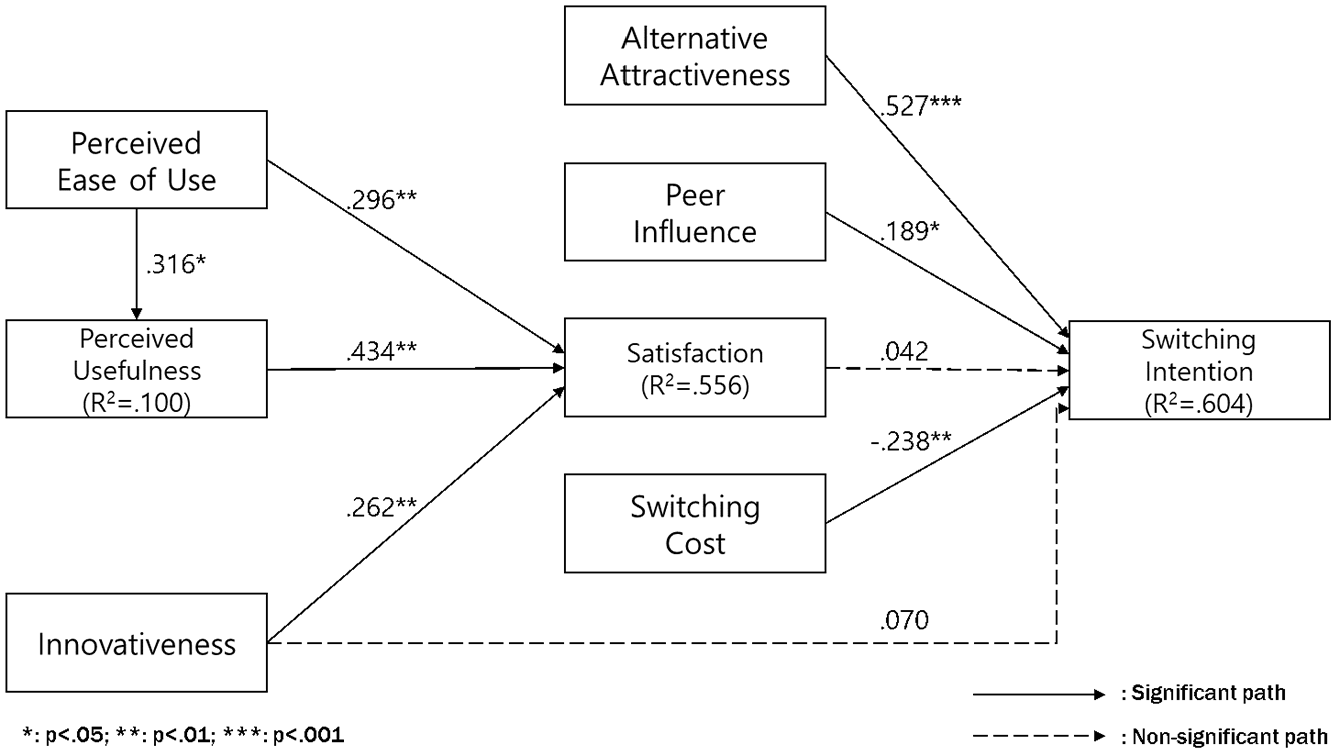
Results of the structural model.
Table 6 provides a detailed summary of the relationships assessed in the study, showcasing both the coefficients and the significance (p-values) of these relationships. Specifically, the perceived ease of use has a positive influence on perceived usefulness (β = .316, p = .027) and satisfaction (β = .296, p = .001), supporting H1a and H1b Additionally, perceived usefulness significantly impacts satisfaction (β = .434, p = .001), supporting H2. Innovativeness exhibits a notable effect on satisfaction (β = .262, p = .002), but not on switching intention (β = .070, p = .497). Thus, H3a is supported and H3b is not supported. Alternative attractiveness strongly affects switching intention (β = .527, p < .001), supporting H4. Peer influence also has a statistically significant effect on switching intention (β = .189, p = .045), whereas satisfaction does not show a significant influence on switching intention (β = .042, p = .647). H5 is thereby supported, while H6 is no supported. Lastly, switching cost is negatively associated with switching intention (β = −.238, p = .004), supporting H7. The proposed model accounted for 60.4% of the variance in switching intention.
Summary of the Results.

Discussion
The study aimed to explore the factors affecting the switching intention of the users in the smart factory context. This has been achieved by reflecting technological factors, market environment, social impact, and cost.
The empirical results figured out that perceived ease of use is the antecedent of satisfaction and perceived usefulness. The significant association between perceived ease of use and satisfaction was confirmed in past studies (Amin et al., 2014; Jung et al., 2013; Shao, 2020). A possible explanation for these results is that the simpler the operation of the smart factory, the higher the user’s satisfaction. Perceived ease of use has been demonstrated to be the major determinant of perceived usefulness in former research (Ardiansah et al., 2020; Isaac et al., 2018; Jo, 2022b). One possible explanation for these results is the fact that the easier the smart factory is to be handled, the more support users get from it. Thus, smart factory providers should prioritize designing user-friendly systems that are easy to learn and use, ensuring users perceive the technology as useful and satisfying.
The results pointed out that perceived usefulness is the antecedent factor of satisfaction. These results further support the results concluded in previous works (Al-Okaily et al., 2021; Isaac et al., 2018; Suzianti & Paramadini, 2021). This finding underscores the importance of delivering value to users in the smart factory context. Providers should focus on enhancing the usefulness of their systems by offering features and functionalities that effectively address users’ needs and requirements.
In line with previous studies (J. Chen, 2022; Khan et al., 2019), the findings of the present study revealed that innovativeness is significantly related to satisfaction. Previous studies have stated that individuals with higher innovativeness tend to be more satisfied with technology. The outcomes of previous works and this study could be attributed to the following reasons. More innovative people are more satisfied with the new features and benefits of smart factories. Since the smart factory is a relatively large and enterprise-wide system, it provides various benefits. A group more interested in new technologies and their effectiveness may be deeply satisfied with the innovative configuration and performance of smart factories. The analysis results validated that innovativeness is not the deciding factor in switching intention. Users may feel that the transition to a new system is not necessary because the smart factory has not been introduced for a long time. If the smart factory market grows and options are diversified, users with high innovativeness will be more willing to convert to other systems. These findings highlight the complexity of user behavior in the smart factory context and the need for a comprehensive understanding of the factors driving switching intention.
The study’s results revealed that alternative attractiveness is the affecting factor of switching intention. These findings further support the results concluded in previous studies (Kuo, 2020; J. Liao et al., 2021; Loh et al., 2020). This suggests that when users perceive attractive alternatives to their current smart factory system, they are more likely to consider switching. Thus, smart factory providers should continuously enhance their offerings to retain customers and prevent them from seeking more attractive alternatives.
The results of this study uncover that peer Influence is significantly associated with switching intention. The significant relationship between peer influence and switching intention was demonstrated in former works (Hou & Shiau, 2020; Hwang et al., 2019). These findings could be accredited to the reason that users are more likely to switch to another smart factory system when they observe their peers doing so. This highlights the importance of creating a positive network effect and encouraging user recommendations to minimize the likelihood of users switching to alternative systems.
Although past works have shown that satisfaction significantly influences switching intention (Calvo-Porral et al., 2017; Han et al., 2011), the findings verified that satisfaction does not have a significant association with switching intention. One possible explanation for the discrepancies is that satisfaction might be a necessary but not sufficient condition for retaining users. Other factors, such as the ones identified in this study, may play a more critical role in shaping switching intention. Since the introduction period of the smart factory is relatively short, workers would recognize that it takes time to check its actual organizational performance of it. Therefore, workers may not want to replace the system unless the degree of dissatisfaction is very high.
The findings of this study showed that switching cost hurts switching intention. These results further support the results concluded in past research (S. Cheng et al., 2019; Kuo, 2020; J. Liao et al., 2021; Loh et al., 2020). This finding indicates that users are less likely to switch when they perceive high costs associated with switching, such as financial investments, time, and effort required for transitioning to a new system. Switching cost to a new system adds a mental and physical burden to users. It makes users hesitant to replace the new system. Therefore, smart factory providers should focus on making the switching process as seamless as possible to reduce these costs and minimize switching intention.
Conclusion
Summary
The research was embarked upon with an aim to delve into the factors influencing the switching intention of users in the smart factory context. By employing a robust theoretical model, the study incorporated a comprehensive analysis of various elements, including technological factors (perceived ease of use and perceived usefulness), market environment (alternative attractiveness), social impacts (peer influence), and costs (switching cost). Utilizing a PLS-SEM technique, our findings underscored the pivotal roles of perceived ease of use, perceived usefulness, innovativeness, and the appeal of alternative systems. The study also highlighted the nuanced influences of peer influence and the implications of switching costs on users’ switching intentions.
Theoretical Contributions
Within the intricate landscape of user behavior and preferences, particularly concerning switching intention in the smart factory milieu, our exploration provides an invigorated viewpoint. The novelty of our research lies not only in its reaffirmation of established factors influencing switching intention but also in its contextual applicability to the smart factory environment. We champion the importance of alternative attractiveness, peer influence, satisfaction, and switching cost as pivotal determinants governing users’ propensity to transition between systems in this particular setting. While previous studies may have touched upon these factors individually or in more generalized contexts (S. Cheng et al., 2019; Hwang et al., 2019; Y.-W. Liao et al., 2019), our work intertwines them, highlighting their symbiotic relationships. This approach allows for a more comprehensive understanding of the multifaceted drivers behind user behavior in the smart factory domain. Where previous investigations may have offered piecemeal insights, our research endeavors to present a cohesive narrative, accentuating how these factors, in tandem, influence and mold user choices. By delving into the intricate interplay of these variables, we not only reinforce existing knowledge but also pave the way for future research to explore the nuanced dynamics of user behavior in technologically advanced environments.
In delving deeper into the intricacies of user behavior and preferences, our study has uncovered a nuanced perspective on the role of innovativeness. While prior scholarly endeavors, notably those by J. Chen (2022) and Khan et al. (2019), have emphasized the pivotal role of innovativeness in augmenting user satisfaction, our research has added another layer to this comprehension. While our findings do echo the sentiments of these prior studies in affirming the relationship between innovativeness and user satisfaction, we also unveil a compelling discrepancy. Our study suggests that an uptick in satisfaction driven by innovativeness does not directly inhibit user’s intention to switch. This revelation, not clearly outlined in earlier research, underscores the necessity for scholars to revisit and reconsider the broader implications and dynamics of innovativeness, especially as they manifest in diverse technological landscapes. Future academic inquiries could benefit immensely from dissecting this dichotomy further, potentially unearthing the underlying factors that contribute to this observed divergence.
The fabric of our analysis illuminates an oft-overlooked dimension: the pull of alternative attractiveness. Our insights orient the discourse toward a broader horizon. The analysis results indicated that alternative attractiveness is significant in eliciting users’ switching intention. We advocate that user satisfaction and switching intention are not binary opposites; rather, a user, even when satisfied, can be lured by the siren call of a seemingly more advantageous alternative. Such a perspective pivot challenges the conventional wisdom and nudges future researchers to reconceptualize their approach. Instead of solely dissecting the inadequacies of the current system, there is an imperative to equally consider the magnetic allure of potential alternatives. This shift does not just add a layer of complexity to our understanding but opens up an expansive terrain for academic exploration, urging scholars to factor in both push and pull dynamics in the landscape of switching intention.
In the annals of user behavior research, the potency of peer influence often remained shadowed. However, our investigation offers a contrarian standpoint. The study analysis intimates that peer influence has a significant association with switching intention. We not only reaffirm the relevance of peer influence but elevate it to a more central role, revealing its profound influence on switching intentions. Such a paradigm shift emphasizes the symbiotic interplay between technology and societal underpinnings. In the age of hyper-connectivity, where word-of-mouth and shared experiences resonate deeply, comprehending the mechanics of peer influence becomes paramount. We envision our insights as a beacon for the academic community, guiding them toward uncharted territories. We advocate for future endeavors that delve deeper into the intricate lattice of peer dynamics, amplifying our understanding of its ripple effects in technology engagement, adoption, and loyalty.
Practical Implications
For service providers and product manufacturers, the intertwined nature of technological attributes, market dynamics, and social influences is paramount. Rather than banking solely on the efficacy of their technology, it is vital to understand the holistic user experience. For instance, even if a smart factory system boasts superior performance, if it is deemed complex by users, its adoption could be jeopardized. As proven by the downfall of technically superior but user-unfriendly platforms (Gaurav et al., 2023; Hsieh et al., 2012), ensuring user-centric designs can be the differentiating factor.
Managers and developers, meanwhile, should reconsider the weightage given to innovativeness. Our findings show that while innovativeness can lead to heightened satisfaction, it does not guarantee loyalty. A practical example is the smartphone market. Though a company might introduce innovative features, if users do not perceive these features as beneficial or necessary, they may not stay loyal to the brand in the long run (Smith, 2020). Thus, innovation should be aligned with tangible benefits, ensuring users do not just admire the feature but also find genuine utility in it.
The role of marketers becomes increasingly challenging and pivotal within the smart factory context. Grasping the sheer magnetism of alternative attractiveness emerges as a fundamental cornerstone for these professionals. The glitter of a new system or a solution, perceived as superior, can easily eclipse the intrinsic merits of an existing product, even if it is robust (Zheng et al., 2019). In this hyper-competitive smart factory landscape, it is not just about selling a product but about continually reinforcing its evolving relevance. Marketers, therefore, need a dual-pronged strategy. First, they must persistently spotlight their product’s unique features that set it apart in the marketplace. But equally important is the emphasis on continuous evolution—regularly rolling out improvements, updates, and advancements. This dual focus not only reinforces the product’s current value but also preempts the allure of newer alternatives, ensuring that their smart factory solutions remain top-of-mind for potential users.
For users navigating the intricacies of the smart factory context, the newfound insight into the potent force of peer influence is a game-changer. The tech world has borne witness to the meteoric ascendancy of numerous products, primarily propelled by the powerful engine of word-of-mouth recommendations (Zhao et al., 2023). This phenomenon underscores the collective weight individual users hold; every choice they make ripples outwards, impacting the decisions of the broader community. When users align their preferences and speak in unison about a product’s benefits or drawbacks, they wield significant sway over market trends. Therefore, it becomes imperative for users to make well-informed decisions, derived from thorough research and understanding. Moreover, by sharing candid, constructive feedback with their peers, they not only educate others but actively participate in molding a technological landscape that is both at the cutting edge of innovation and attuned to user needs. This collaborative approach holds the promise of an optimized tech ecosystem that thrives on mutual trust and shared knowledge.
Limitations and Future Research
This paper has certain limitations. First, the survey was conducted in only one country, which means the analysis results may not be fully generalizable to other smart factory environments. Future studies should endeavor to include multiple countries to ensure the findings have broader applicability. Second, this study did not consider the moderating effects of influencing factors. For more valuable insights beneficial to both researchers and practitioners, subsequent research should delve into the roles of moderators in the smart factory domain. Future studies can also replicate this investigation to analyze the dynamic impacts of major determinants in this fast-evolving field.
Footnotes
Appendix
Declaration of Conflicting Interests
The author(s) declared no potential conflicts of interest with respect to the research, authorship, and/or publication of this article.
Funding
The author(s) disclosed receipt of the following financial support for the research, authorship, and/or publication of this article: This research was supported by the Yonsei Signature Research Cluster Program (2024-22-0167) and the Yonsei University Research Fund of 2024 (2024-22-0204).

Data Availability Statement
The data used in this study are available from the corresponding author upon reasonable request.