




Abstract
The purpose of this study is to investigate that how AI enabled HR practices impact employee task satisfaction and creative willingness. Therefore, an amalgamated research framework is established to determine employee task satisfaction and employee creative willingness with smart HR technology, disruptive technology, task technology interdependence, high performance work system, work environment, resource availability, and leader trustworthiness. Data are collected from employee working in manufacturing firms. In this research survey overall 305 employees have voluntarily participated. Findings indicate that exogenous factors have revealed substantial variance
Plain language summary
This study looks at how using AI in HR affects how happy employees are with their tasks and how willing they are to be creative at work. They created a framework that combines different factors like smart HR tech, disruptive tech, teamwork, a good work system, the work environment, having enough resources, and trusting leaders. They collected data from 305 employees in manufacturing companies who volunteered for the study. They found that factors outside of the employees’ control—like the tech they use and how well they work together—explained about 82% of why employees are satisfied with their tasks. Similarly, being satisfied with tasks and trusting their leaders explained about 73% of why employees are willing to be creative. The study suggests that using smart HR tech, creating a good work environment, having trustworthy leaders, and working well together all have a big impact on how happy employees are with their tasks and how creative they’re willing to be. This means managers should pay attention to these factors to improve how satisfied and creative their employees are. This study is one of the first to look at how AI in HR affects task satisfaction and creativity, and it also highlights the important role of trustworthy leaders in this process.
Keywords
Introduction
The constant changes in technologies and increasing digitalization have enabled organizations to gain maximum benefits through minimum human capital. Therefore, artificial intelligence and disruptive technologies have significantly improved business operations with minimum human capital. Although arrival of artificial intelligence and disruptive technologies have made business operations agile however organizations are still endeavoring for employee creative willingness and task satisfaction at workplace (Majumdar et al., 2018). According to Majumdar et al. (2018) have argued that growing demand of disruptive technology at organizational level could increase pressure among team members which in turn reduce team productivity. Therefore, understanding evolving digital business environment and impact of AI enabled human resource practices towards employee task satisfaction and creative willingness is essential. Prior literature has discussed that use of AI could reduce employee creativity due to complexity (Habbal et al., 2024; Majumdar et al., 2018). Notwithstanding, Ogbeibu, Pereira, Emelifeonwu, et al. (2021) have postulated that digital proliferation and AI adoption have encouraged employees to be creative and more engaged at workplace. Consistently this research strives to examine positive aspects of artificial intelligence at workplace instead of negative impact on employee performance. More recently author like Isaksen (2023) has also encouraged to investigate positive aspects of AI towards employee creativity. Although prior studies have discussed on disruptive technology and employee creativity Majumdar et al. (2018); Vittori et al. (2024) however there is paucity of literature that discuss association between AI enabled human resource practices and employee creative willingness.
To address this issue smart HR technology is conceptualized to investigate employee task satisfaction. The term smart HR technology is the degree wherein AI enabled technology is used to achieve HR goals including recruitment, training and employee development (Jatobá et al., 2023; Yin et al., 2024). Moreover, positive aspects of disruptive technology are highlighted in this study. For instance authors like Sousa and Rocha (2019) have explained that ambitious team members could be inspired by disruptive technology and use it for knowledge enhancement. Next to this task technology interdependence is referred to a digital platform that open avenue for employees to effectively communicate, engage and encourage to share new ideas using latest technology and boost creative willingness at workplace (Korzynski et al., 2020; Parry & Battista, 2023). Moving further high performance work system is referred to organizational strategy that improves employee ability through strategic human resource factors such as staffing and training and eventually increase employee creativity (Al-Ajlouni, 2021). Similarly, work environment and resource availability are found influential factor in determining employee task satisfaction and employee creative willingness (Gayed & El Ebrashi, 2023; Isaksen, 2023). Following above statements this study has stated following objectives:
To understand how AI enabled HR practices (i.e., smart HR technology and disruptive technology) improve employee task satisfaction.
To examine the impact of task technology interdependence, high performance work system, work environment, and resource availability towards employee task satisfaction.
To examine moderating effect of trust leader worthiness between the relationship of employee task satisfaction and employee creative willingness.
This study unique as it has conceptualized that higher level of leader trustworthiness will strengthen the relationship between employee task satisfaction and employee creative willingness. Another uniqueness of this research is to examine the impact of AI enabled HR factors towards employee task satisfaction and creative willingness. These factors are further studied in flowing section and hypothesized. The remaining of this research is comprised literature review, methodology, data analysis, discussion, research contributions, conclusion, and research limitation with future research directions.
Literature Review
Smart HR Technology
The evolving digital business environment have pushed leaders to adopt artificial intelligence enabled human resource practices also known as smart HR technologies to impend creativity and task satisfaction among employees. Authors like Ogbeibu, Pereira, Emelifeonwu, et al. (2021) espouse that constant digital proliferation and adaptation have encouraged employees to be creative and engaged at workplace. Therefore, it is important to understand impact of smart HR technology towards employee task satisfaction and creative willingness. The term smart HR technology is the degree wherein AI enabled technology is used to achieve HR goals including recruitment, training, and employee development (Jatobá et al., 2023; Yin et al., 2024). Prior studies have claimed that smart HR technology assist managers to achieve HR goals timely and cost effectively (Jatobá et al., 2023; Yin et al., 2024). Authors like Sivathanu and Pillai (2018) have argued that smart HR technology significantly contributes to employee task satisfaction and creative willingness. Recent study conducted by Yin et al. (2024) argued that AI enabled smart technology has positive impact employee innovative work behavior. Extant literature has established that smart HR technology assist employees to achieve tasks efficiently and boost team creativity (Bam et al., 2019; Kuepper et al., 2021; Sicotte et al., 2019; Sivathanu & Pillai, 2018; Sousa & Rocha, 2019). Therefore, smart HR technology is hypothesized as:
H1: Smart HR technology positively influences employee task satisfaction.
Disruptive Technology
The recent fourth industrial revolution has brought visible changes in existing business environment. Within these dynamic changes the disruptive technology is identified as an important emerging technology that impact on society and business environment. Although there is no universal consensus on the definition of disruptive technology nevertheless in this study it is identified as technology backed by artificial intelligence, big data, cloud computing, and internet of things applied through algorithm and act like human to detect, analyze, interpret, and implement task (Jatobá et al., 2023). There is long debate whether disruptive technology drives towards prosperity or be a source of exhaustion (Fong et al., 2018). For instance study has claimed that growing demand of disruptive technology at organizational level could increase pressure among team members which in turn reduce team productivity (Majumdar et al., 2018). For instant employees feel insecurity when they see efficiency of emerging technologies in performing task and develop perception that their jobs will be replaced by these emerging technologies resulting less willingness of employee towards task achievement (Majumdar et al., 2018). Notwithstanding above arguments developed by Majumdar et al. (2018) the focus of current research is to identify positive aspects of disruptive technology that motivate employee at workplace and bring creativity. Studies have argued that for organizational survival it is essential for team members to acquire new technology that improve ability to perform task and bring creativity at work place (Sousa & Rocha, 2019). Moreover it is found that ambitious team members could be inspired by disruptive technology and use disruptive technology to further knowledge enhancement purposes. Similarly, another positive aspect of disruptive technology is that it boost employee curiosity to learn new things with the adaptation of technology resulting more creativity and task satisfaction among employees (Sousa & Rocha, 2019). Therefore, disruptive technology is hypothesized as:
H2: Disruptive technology positively influences employee task satisfaction.
Task Technology Interdependence and High Performance Work System
Scholarly work has long debated that lack of task interdependence decreases employee creativity at workplace (Fong et al., 2018; Ogbeibu, Pereira, Emelifeonwu, et al., 2021). Nevertheless, coordination among team members at digital platform boosts creativity and enriches task performance. Author like Ogbeibu, Pereira, Emelifeonwu, et al. (2021) have postulated that digital task interdependence actually offer an opportunity to employees to share new ideas through interlinked technology and increase productivity. Therefore, it is essential to understand how employees get motivation to achieve task and creativity at workplace using task technology interdependence. The term task technology interdependence is referred to a digital platform that open avenue for employees to effectively communicate, engage them into different tasks, share new ideas using latest technology and boost task execution speed and bring willingness at workplace. Consistently prior studies have pointed that technology task interdependency increase team member engagement and enjoyment in achieving task (Korzynski et al., 2020; Parry & Battista, 2023). Therefore, it is inferred positive association between technology task interdependence and employee task satisfaction. Literature has revealed that high performance work system impact positively employee creative willingness and engagement towards task (Gigliotti et al., 2019; Han et al., 2018; Suseno et al., 2022). The notion of high performance work system is referred to organizational strategy that improves employee ability through strategic human resource factors such as staffing and training (Al-Ajlouni, 2021; Hariguna et al., 2023). The process of staffing assists organization to select right employee for right task. On the other hand extensive training programs enhances employee knowledge, ability, skills, and career opportunities and enable them to achieve task more effectively. Nevertheless, in current study context it is assumed that individual having right skills and knowledge about smart human resource management system and disruptive technology will perform better at workplace. Prior studies have asserted that implementing right high performance work system in organization encourage employees to participate in organization decision making, enhance creativity and task performance (Al-Ajlouni, 2021; Gigliotti et al., 2019; Han et al., 2018). Therefore, following hypotheses are assumed and indicate association of technology interdependence and high performance work system in achieving employee task satisfaction.
H3: Task technology interdependence positively influences employee task satisfaction.
H4: High performance work system positively influences employee task satisfaction.
Work Environment and Resource Availability
In competitive markets work environment plays vital in predicting employee satisfaction and creativity (Edmondson & Matthews, 2024). Therefore, organizations that need creativity and innovation must provide adequate work environment to employees. According to Mattarelli et al. (2022) organizations establishing such work practices that fulfill individual needs and encourage them to resolve problems through new and innovative ideas. Another study conducted by Isaksen (2023) has narrated that establishing creative work environment is compelling issue and therefore need policy makers attention. In addition to that literature has revealed that work environment conducive to innovation and gives enjoyable experience to employee and boost employee task satisfaction (Edmondson & Matthews, 2024; Isaksen, 2023). More precisely in this study work environment is comprehended as management practices that give freedom to employee, leader encouragement and work group support to bring creativity and employee task satisfaction (Ramos et al., 2018). Therefore, and consistent with prior studies Isaksen (2023); Ramos et al. (2018) one can assume that work environment provoke employee task satisfaction and boost creative willingness. Although work environment boost employee task satisfaction however the importance of resource availability cannot be ignored to achieve employee creative willingness. Literature has revealed that organizations with sufficient resources are more capable to produce creativity at workplace (Gayed & El Ebrashi, 2023; Isaksen, 2023).On the other hand slack resource would cause employee dissatisfaction towards creative task. Having said this, organization with sufficient resources would have more task satisfaction (Isaksen, 2023; Shafagatova et al., 2023). Therefore, following hypotheses are assumed:
H5: Work environment positively influences employee task satisfaction.
H6: Resource availability positively influences employee task satisfaction.
Leader Trustworthiness
The importance of leader trustworthiness cannot be ignored in human resource studies. Therefore, leader trustworthiness characteristics are highlighted in this study to examine employee task satisfaction and creative willingness. The term leader trustworthiness is referred to belief that a leader sufficiently comprises qualities to be trusted. According to Ertürk and Albayrak (2020) espouse that leader trust is a key facilitator between the relationship of task achievement and organizational attachment. Nevertheless literature has also established strong relationship between leader trust and employee creativity (Brown et al., 2019; Kulichyova et al., 2019; Ogbeibu, Pereira, Burgess, et al., 2021). For instance Ogbeibu, Pereira, Burgess, et al. (2021) have stated that leader trustworthiness characteristics empower employees to be confident at workplace and exchange creative ideas to achieve organizational tasks. Moreover trustworthy leader inspire employee to engage actively in organizational tasks and provoke creative willingness among employees (Brown et al., 2019; Lee, 2022). Following above arguments and supported by prior research work conducted by Brown et al. (2019), Ertürk and Albayrak (2020), Kulichyova et al. (2019), Ogbeibu, Pereira, Emelifeonwu, et al. (2021) leader trustworthiness is conceptualized as moderating factor between the relationship of employee task satisfaction and creative willingness. Author like Kulichyova et al. (2019) have stated that employees having perception of leader trustworthiness have shown less hesitancy to exchange new and creative ideas. Another study conducted by Wang et al. (2022) have argued that new initiatives or employee engagement in new experiments have certain kind of risk. Nevertheless, leader trustworthiness gives task autonomy to employees and enhances creative willingness among employees. Therefore, following hypotheses are assumed:
H7: Task satisfaction positively influences employee creative willingness.
H8: Leader trustworthiness moderates the relationship between employee task satisfaction and creative willingness.
Methodology
Research Methods
The use of information technology is growing and influencing significantly on all kinds of business practices. Therefore, this study sheds light on artificial intelligence enabled technology and examine how disruptive and smart human resource technology altogether with task interdependency, resource availability, and work environment enhance employee task satisfaction and creative willingness. At first conceptual linkage is developed among these factors and then hypotheses are assumed. In terms of study approach this research is designed under positivist research paradigm and quantitatively examined the phenomenon through hypotheses. The research framework comprises multiple exogenous and endogenous factors and therefore measured through empirical data. For data collection first step is to identify research population. Therefore, employees working in manufacturing firms are considered main population for this study. Selecting, employees from manufacturing firms are relevant due to the fact that these employees are facing real time changes led by technology. Therefore, it is assumed that these employees are in better position to respond how artificial enables technology has improved their task performance and enhance their creative willingness at workplace.
Data collection process is started through the development of survey questionnaire. Survey questionnaire comprises scale items and respondents demographic characteristics. Prior to questionnaire distribution sample size is selected following criterion suggested by Rahi (2017a) and (Hair, Anderson, et al., 2016). According to Rahi (2017a) for adequate sample size scale items can be multiply 5 time minimum or 10 times maximum. This indicates that minimum data for this study is of 150 and maximum of 300 responses required for empirical testing. For survey questionnaire respondents were approached physically through purposive sampling approach. Covering letter is developed that explain brief objective of this research. Respondents were requested to participate in this research and respond how they see role of artificial enabled technology in improving their task satisfaction and creative willingness. This research is cross sectional and therefore data were collected at one point in time. In addition to that employee participation was voluntarily in this research survey with promise that their identity would not be revealed. Overall, 343 respondents were approached for questionnaire filling. However, only 309 respondents had shown willingness to participate. Among 309 responses 4 questionnaires were discarded due to inadequate filling. Finally, research framework is tested through 305 empirical responses.
Scale Measurement
The research framework of this study has outlined nine factors including exogenous and endogenous factors. Scale items are taken from prior literature based on human resource practices, artificial intelligence, and employee creative willingness and enumerated on seven point Likert scale. Scale items are adapted from prior literature due to the fact that scale was already existed and demonstrated high factors reliability. Factor like smart human resource technology is measured with scale items adapted from Ogbeibu, Pereira, Emelifeonwu, et al. (2021) and Strohmeier (2020). Therefore, disruptive technology factor is measured with scale items validated by prior researchers Ogbeibu, Pereira, Emelifeonwu, et al. (2021) and Kaivo-oja and Lauraeus (2018). Scale items of technology task interdependence are adapted from Ogbeibu, Pereira, Emelifeonwu, et al. (2021) and Fong et al. (2018). Scale items for high performance work system are adapted from Wijayati et al. (2022) and Al-Ajlouni (2021). Scale for the factor work environment is adapted from Lindeberg et al. (2023). Resource availability factor is measured with scale items adapted from Gayed and El Ebrashi (2023). Scale for task satisfaction is adapted from Burr and Cordery (2001) and Ogbeibu, Pereira, Burgess, et al. (2021). Scale items for employee creative willingness are adapted from Van Vianen et al. (2011) and Ogbeibu, Pereira, Emelifeonwu, et al. (2021). Scale items for the factor leader trustworthiness are adapted from Jiang et al. (2016) and Ogbeibu, Pereira, Burgess, et al. (2021).
Missing Values and Data Bias
To ensure data validity it is mandatory to address missing values issue. Missing values occurs during data collection process. Nevertheless, missing values can be entertained through Little’s MCAR analysis. According to Rahi (2017b) if values are missing completely at random then missing data can be filled through expectation maximization method. Nevertheless, Little’s analysis has revealed insignificant p-value MCAR test: c2 = 78.165, DF = 96, Sig. = .908 depicting data is missing completely at random pattern and hence acceptable (Rahi, 2018). Therefore, using expectation maximization method complete data file is generated. Another issue in this empirical research is to address data common method bias. Therefore, CMB issue is addressed through Harman’s single factor analysis. This analysis suggest that threshold value of first factor must be less than 40% representing data is valid (Rahi, 2018, 2023). Findings indicate 19% variance explained by first factor and hence ensuring common method bias is not likely issue.
Data Analysis
Structural Equation Modeling Approach
There are two types of structural equation modeling namely variance based structural equation modeling and co-variance based structural equation modeling. According to Rahi (2017a) if the objective of the research is to develop new model then variance based structural equation modeling is adequate. Therefore, study that wants to test existing theory or model then co-variance based SEM is more reliable. Consistent with research objectives variance based structural equation modeling approach is selected. At first factors reliability is tested wherein indicator reliability is achieved following loadings threshold value 0.70 (Hair, Hult, et al., 2016; Rahi, 2017b). Therefore, factors internal consistency is established following threshold value 0.70 (Rahi, 2017b). Moving further factors convergent validity is confirmed following criteria that values of the average variance extracted must be greater than 0.50 (Rahi, 2017b). Data are estimated through PLS-algorithm and revealed satisfactory convergent validity, indicator and factors reliability. Table 1 exhibits results of the measurement model.
Factors Reliability.

Factors discriminant validity is established through cross loading analysis. The cross loading analysis indicate that loading of the indicators must be greater in comparison with other indicator loadings. Results of the cross loading analysis demonstrates that loadings of the factors are lower than other factors loadings and hence indicating satisfactory discriminant of the factors. Table 2 demonstrates results of the cross loading analysis.
Factors Loadings.

Factors discriminant validity is examined thorough Fornell Larcker methods (Fornell & Larcker, 1981; Rahi, 2022a). The Fornell Larcker criterion has recommended that AVE values on diagonal must be higher on co-relation table. Nevertheless results revealed that values of AVE are higher and therefore confirming satisfactory discriminate validity. Findings of the discriminant validity are shown in Table 3.
Discriminant Validity Analysis.

Hypotheses Analysis
The research model is tested through structural model. Nevertheless, before hypotheses testing multi collineraity issue is addressed through variance inflation factor. According to Rahi (2022a) VIF values must be lower than 3.3 demonstrating data are free from multi collineraity issue. Next, data are bootstrapped to disclose beta value, t-statistics and significance. Results of the hypotheses analysis are shown in Table 4.
Hypotheses Testing.

The finding of this study is impactful in determining employee task satisfaction and creative willingness using artificial enabled HR practices. For instance the coefficient of determination is found substantial and revealed that altogether smart HR technology, disruptive technology, task technology interdependence, high performance work system, work environment, and resource availability explained
Statistical findings have also shown significant impact of high performance work system in measuring employee task satisfaction and reinforced by β = −.117, t-statistics 2.197 significant at p = .014 and confirmed H4. Results have also shown positive impact of work environment in measuring task satisfaction and established through β = .249, t-statistics 4.402 significant at p = .000 and hence confirmed H5. Moving further resource availability has shown positive impact employee task satisfaction and established through β = .115, t-statistics 2.201 significant at p = .014 and hence confirmed H6. As this study has two outcome variables therefore impact of task satisfaction is tested towards employee creative willingness. Results indicate that task satisfaction is positively impact employee creative willingness and supported by β = .783, t-statistics 20.451 significant at p = .000 and hence confirming H7. Results of the statistical analysis are exhibited in Appendix 1 including values of t-statistics and path coefficient. Following above statistical results and substantial coefficient of determination have indicated that research framework has capability to determine employee task satisfaction and employee creative willingness. Nevertheless, factors importance is examined through importance performance matrix as given in following section.
Importance Performance Matrix
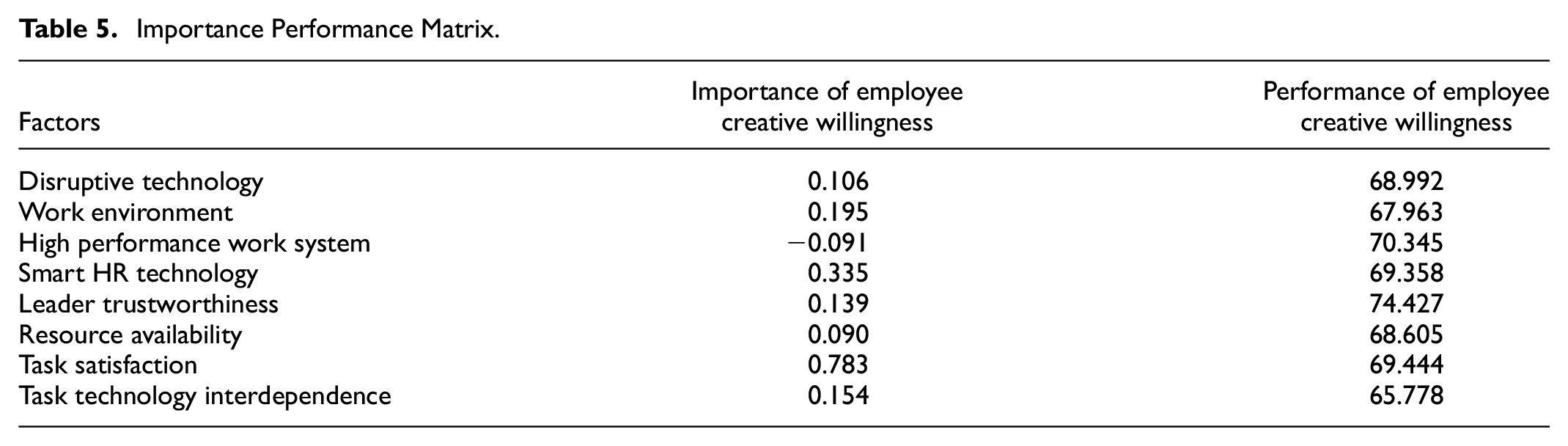
The importance performance matrix analysis gives broader view of factors underpinned research model and therefore must be incorporated in data analysis (Rahi, 2022a). Therefore, employee creative willingness is considered an outcome factor for impotence performance matrix. IPM analysis has revealed that employee task satisfaction is the most impactful factor in determining employee creative willingness. Next to this smart human resource technology is found the second important factor in determining employee creative willingness. Similarly, factors like work environment and task technology interdependence have shown medium level of impact in measuring employee creative willingness. Factors like disruptive technology and leader trustworthiness have too shown notable impact in measuring employee creative willingness. Nevertheless, resource availability and high performance work system have shown least impact in measuring employee creative willingness. To sum up factors like smart human resource practices, work environment, leader trustworthiness, disruptive technology, and task technology interdependence have shown sizable impact in measuring employee task satisfaction and employee creative willingness and therefore these factors must be considerable in developing new strategies. Table 5 depicts results of the importance performance matrix including importance and performance of the factors.
Importance Performance Matrix.
Effect Size Analysis
Factors effect size is tested through effect size analysis
Effect Sizes

Moderation Analysis
Although factors direct causal relationship among hypotheses is tested however moderating effect of leader trustworthiness is yet to be examined (Figure 1). Therefore, moderating effect of leader trustworthiness is examined between task satisfaction and employee creative willingness. The product indicator approach is incorporated to test interaction effect. Findings have shown significant moderating impact of leader trustworthiness between task satisfaction and employee creative willingness and supported by β = .049, t-statistics 1.842 significant at p = .033 and hence confirmed H8. Furthermore strength of the moderating analysis is tested with simple slope graph as depicted in Figure 2. Findings revealed that leader trustworthiness LT at +1SD is showing upwards trend and this indicate that higher leader trustworthiness will strengthen the relationship between task satisfaction and employee creative willingness.

Research framework.

Simple slope analysis.
Discussion
The extensive research is existed to discuss work environment and organizational creativity at workplace. Yet there is paucity of literature that discusses employee creative willingness and task satisfaction. Therefore, current research sheds light on employee task satisfaction and employee creative willingness with an amalgamated research model. The research framework of this study is empirically examined and revealed that altogether smart HR technology, disruptive technology, task technology interdependence, high performance work system, work environment, and resource availability explained
Another aspect of this research is to examine moderating effect of leader trustworthiness between task satisfaction and employee creative willingness. Results have established moderating effect of leader trustworthiness between task satisfaction and employee creative willingness and explained that higher leader trustworthiness will strengthen the relationship between task satisfaction and employee creative willingness. Aside of hypotheses testing effect size is tested with effect size analysis
Research Contributions to Theory and Practice
This research contributes to theory and practice expressively. For instance developing an integrated research framework to investigate employee task satisfaction contributes to organizational literature. Moreover smart HR technology is hardly studied in the context of task satisfaction. Therefore, conceptualizing and establishing relationship between smart HR technology and task satisfaction contributes to literature. Although factors like disruptive technology, task technology interdependence, high performance work system, work environment, and resource availability have been conceptualized in the context of organizational creativity. Nevertheless this study adds new dimension and conceptualized these factors in measuring employee task satisfaction and hence significantly contributes to literature. Another uniqueness of this research is to establish moderating effect of leader trustworthiness in such a way that higher leader trustworthiness will strengthen the relationship between task satisfaction and employee creative willingness. Therefore, establishing moderating effect of leader trustworthiness between task satisfaction and employee creative willingness substantially contributes to creativity and innovation literature. Pointing to practical contribution this study has taken help from effect size analysis and importance performance matrix. Importance performance matrix analysis has suggested that policy makers can enhance employee task satisfaction through smart human resource practices, work environment, leader trustworthiness, disruptive technology, and task technology interdependence. Moreover, effect size analysis has recommended that employee creative willingness could be achieved through employee task satisfaction. Nevertheless, if the focus of policy makers is towards employee task satisfaction and creative willingness then leader trustworthiness could play important role. This study has confirmed that higher leader trustworthiness will strengthen the relationship between task satisfaction and employee creative willingness. Therefore, policy makers should pay attention in building strong leader trust which in turn encourage employ towards task achievement and boost employee creative willingness.
Conclusion
Although arrival of artificial intelligence has made business operations agile however organizations are striving for employee creative willingness and task satisfaction at workplace. Therefore, current study aims to investigate factors that impact employee task satisfaction and creative willingness. Consistently, in this research study an amalgamated research framework is established to determine employee task satisfaction and employee creative willingness through smart HR technology, disruptive technology, task technology interdependence, high performance work system, work environment, resource availability, and leader trustworthiness. Data were analyzed and revealed that altogether smart HR technology, disruptive technology, task technology interdependence, high performance work system, work environment, and resource availability explained
Research Limitations and Future Directions
Although current study largely contributes innovation and creativity literature and provides useful directions to policy makers however, it has some limitations as well and therefore acknowledged for future research studies. First, smart human resource technology factor is studied as single factor and therefore does not claim to include all technology characteristics. Nevertheless, future researchers are suggested to conceptualize this factor with multiple dimensions that could reveal interesting results. Second, the outcome factor of this research is employee creative willingness. However, extending this framework with another outcome factor namely organizational performance could enhance the uniqueness of this research. Another limitation of this research is that it has not examined mediating role of task satisfaction between exogenous and endogenous factors. Future researchers may add new dimension in this research by examining mediating role of task satisfaction. This research is cross section and data were collected at one point in time. Nevertheless, testing current research framework in longitudinal time horizon could reveal interesting findings. Finally, replicating this model in other regions excluding Middle East could enhance generalizability of this study.
Footnotes
Appendix
Declaration of Conflicting Interests
The author(s) declared no potential conflicts of interest with respect to the research, authorship, and/or publication of this article.
Funding
The author(s) received no financial support for the research, authorship, and/or publication of this article.

Data Availability Statement
Data sharing not applicable to this article as no datasets were generated or analyzed during the current study.