




Abstract
Although most offenders who have committed a sex crime will not reoffend, an excessive amount of attention has been paid to the process that leads a minority to commit a new offense. What are the protective factors that contribute to the absence of recidivism among most of these sex offenders? This scoping review provides an overview of the current state of the literature on desistance among sex offenders as well as a list of the empirically tested protective factors that contribute to it. Peer-reviewed articles and grey literature were retrieved through database searches and reference harvesting following the elaboration of an internal grid composed of approximately 20 keywords and specific inclusion criteria. Articles were included if the majority of each study’s sample had committed a sex offense, factors explaining desistance from sexual offending were explicitly addressed, and all participants in the various studies were still considered desistors at the time of our search. From a database of 6,556 articles published between 1985 and 2022, 26 studies were retained, and more than 150 different protective factors were identified and grouped into 32 distinct subcategories. Our analysis revealed that the selected studies conceptualize desistance differently and that this choice not only affects the protective factors identified but could also influence ideas about how to intervene with sex offenders.
Sex offenders are generally despised, both because of the nature of their crimes and because it is believed that they are not open to reform or rehabilitation. However, research on desistance among sex offenders suggests that not only can they refrain from committing further sexual offenses but their rates of recidivism are no higher than those of non-sexual offenders (A. J. R. Harris & Hanson, 2004; Lussier et al., 2023). Nevertheless, the idea that sex offenders are constantly at risk of recidivism persists in the general population, perhaps because their crime is understood as a refusal to recognize the dignity and autonomy of others (Seto, 2018). Although the criminal career paradigm suggests that desistance is a necessary step toward ending a criminal career (Piquero et al., 2007), little is known about the impact of criminogenic factors on desistance (e.g., whether the type of crime, its intensity, or its seriousness influences the desistance process) (Vidal et al., 2020).
This scoping review examines the current state of knowledge about desistance and protective factors in sexual offending and looks at the way these factors are conceptualized by various researchers. We also identify empirically validated protective factors that may be of use to those developing programs for clinical interventions with sex offenders.
Criminal Desistance
There is a lack of consensus on the conceptual definition of desistance from crime (Lussier & Cale, 2013; Maruna, 2001). For some, it is understood as the abrupt and definitive cessation of criminal behavior (Shover, 2018). In this perspective, desistance is an objectively observable event, because there is a before (the period of criminal involvement) and an after (the sustained period during which no crime is committed) (Lussier et al., 2015). This conceptualization is useful for researchers who take a quantitative perspective as desistance is observable and objective (Harris et al., 2017). Furthermore, conceptualizing desistance in this way makes it possible to use official data (e.g., arrest, incarceration), making it easier for researchers to undertake studies of desistance.
However, understanding desistance this way has some limitations. First, it is recognized that official data underestimate the level of engagement in crime—offenders are unlikely to get caught every time they commit a crime (Ouellet & Bouchard, 2017), which means that the absence of a new conviction is not necessarily a guarantee of desistance (Ouellet et al., 2013). Studying desistance solely through official recidivism data thus does not permit an accurate portrayal of the phenomenon (Ouellet et al., 2013). Second, studies show that an episode of criminal inactivity is not necessarily synonymous with desistance—most criminal trajectories are characterized by alternating periods of criminal activity and criminal inactivity (Carlsson, 2012; Ouellet, 2019) and there is no sure way to determine the length of time that is sufficient to make it possible to assert that the absence of crime can be considered as desistance.
From an objective and observable approach, desistance can also be understood as the absence of recidivism based on the level of risk that an individual presents over a given period of time (Lussier et al., 2015). However, it could be argued that most studies that adopt this conceptualization are focused more on studying recidivism than desistance. Moreover, as noted above, the absence of recidivism is not a guarantee of desistance.
The second perspective on criminal desistance is as a process of maturation or cognitive transformation (Farmer et al., 2012). Desistance is then understood as a process in which a previous identity is abandoned and a new identity is created, one that disavows previous actions (Farmer et al., 2012; Lussier et al., 2015). Contrary to the first approach, desistance is not understood as an objective and observable event but rather as a subjective experience through which the participant comes to understand and reject previous actions. Furthermore, this process, as both Maruna and Farrall (2004) and Giordano et al. (2002) have argued, takes place in different stages, with a recognizable difference between desisting and deciding to desist (Maruna, 2001). Moreover, since this process occurs over time and is not linear, a person could continue to commit criminal offenses while decreasing their frequency (Lussier et al., 2015). Most studies of the process of desistance are based on qualitative methods, which provide access to the subjective experience (Harris et al., 2019; Richards et al., 2020), making it possible for the work to be both more flexible and more in-depth.
Protective Factors
Although the concept of protective factors first emerged in the criminological literature some time ago in the work of Farrington et al. (1988) and Rutter (1985), among others, it is only in the last few decades that this notion has begun to be studied in greater depth. However, as with desistance, defining a protective factor remains a complex exercise as it can be conceptualized differently by different researchers.
One approach is to define a protective factor as the opposite, or even the absence, of a risk factor: “protective factors and risk factors would be two sides of the same coin” (De Vries Robbé et al., 2015, p. 21). For example, while the absence of alcohol consumption is associated with lower risk of criminal recidivism, excessive consumption is often associated with increased risk (Baltieri & de Andrade, 2008). When applied to desistance, abstinence from crime is due to the absence of a risk factor.
A protective factor can also promote prosocial behavior (Farrington et al., 2016). The promotive-type protective factor, rather than being the absence or opposite of a risk factor, is the addition of an element that directly contributes to the absence (or reduction) of recidivism. Such factors could be considered pure protective factors due to the direct effect they have on desistance (Farrington et al., 2016).
A third definition of a protective factor is one that has an indirect effect, either moderating or mediating the effect of a risk factor (Farrington, 2007). The study of this sort of protective factor requires mediation and moderation-type statistical analyses to examine its impact (Farrington, 2007).
Current Study
While there are different perspectives on desistance, such as seeing it as an objective event or a statistical probability, it can also be conceptualized as the more subjective process of attempting to change an identity. Protective factors can also be conceptualized in different ways and understood as having different effects (direct or indirect). In addition to the conceptual diversity around desistance and protective factors, criminal populations are also diverse. For example, the challenges of social reintegration are different for sex offenders as compared to other offenders (Dubois & Ouellet, 2020; Rydberg, 2018). Given this, it is useful to examine how desistance and protective factors manifest within a group of offenders who have committed the same type of offense. This exercise makes it possible to look at the current state of knowledge and provide some suggestions for future research and practice.
The present study is a scoping review of the protective factors that contribute to desistance among sexual offenders and is intended to help in both understanding the present state of knowledge in this area and make recommendations for future avenues of research. More specifically, we examine the methodological choices used in studies in this area and the effect they have on the factors being studied. At the end of this exploratory examination, we highlight/identify different types of protective factors, which we hope will assist with clinical decision-making for the population under review. Indeed, the retained studies provide an overview of the protective factors that have demonstrated effectiveness in promoting desistance. Thus, the results of our study may guide interventions by listing such factors with measurable effects, helping individuals avoid reoffending.
Methodology
The decision to use a scoping review instead of a meta-analysis was based on several factors. Firstly, a scoping review provides a broader examination of the research landscape, mapping existing literature, and identifying knowledge gaps (Pham et al., 2014). It is suitable for exploratory research questions or heterogeneous literature. Secondly, a scoping review synthesizes diverse types of evidence, including qualitative and quantitative studies, expert opinions, and gray literature. Unlike a meta-analysis that primarily focuses on quantitative data, a scoping review provides a more inclusive analysis that encompasses a wide range of sources (Munn et al., 2018; Pham et al., 2014). Thirdly, it follows a systematic and transparent process, minimizing biases and enhancing reproducibility. Lastly, a scoping review can inform future focused reviews or meta-analyses by identifying research questions and refining inclusion criteria (Munn et al., 2018). Considering these factors, a scoping review was deemed the most appropriate methodology for our study’s objectives as it makes it possible to examine and critically scrutinize the conceptual definitions used in research in the field as well their limitations (Tricco et al., 2016).
Research Procedure
The database used was derived from a larger research project, a systematic review of empirical literature on the adoption of or desistance from trajectories leading to violent sexual behavior. This database covers work done between 1985 and 2019 and is comprised of 6,536 scientific articles, doctoral theses, and governmental and organizational reports, as well as chapters in books in French or English. Over forty keywords were used to examine titles and abstracts of articles (see Table 1). The following search tools and databases were used: International Bibliography of the Social Sciences (IBSS), Medline, NCRJS, ProQuest Central, ProQuest Dissertations & Theses Global, PsycINFO & PsycARTICLES, Social Sciences Abstracts, Social Services Abstracts, Social Work Abstracts, Sociological Abstracts, Sociological Index, Web of Science, CINAHL, Criminal Justice Abstracts, ERIC, Erudit, FRANCIS, Academic Search Complete, Google Scholar, Google. The bibliographic references of identified articles were also examined to ensure that any publication that might be considered relevant was identified.
List of Key Words.

Since the original database did not cover the period between 2019 and 2022, we updated it, following the same approach and keywords used to obtain the original database. This step made it possible to locate an additional 20 articles. The new database was therefore composed of 6,556 scientific papers, with 89 articles identified as related explicitly to desistance from sexual offending (see Figure 1). Through this exercise, we arrived at a similar conclusion to other researchers in the field of sexual offending. It is evident that there is a notable disparity in research attention between the study of desistance from sexual offending and the examination of the act of perpetrating such offenses (Farmer et al., 2012; Lussier & Gress, 2014; Lussier & McCuish, 2016). This finding highlights the relevance and importance of our own research.
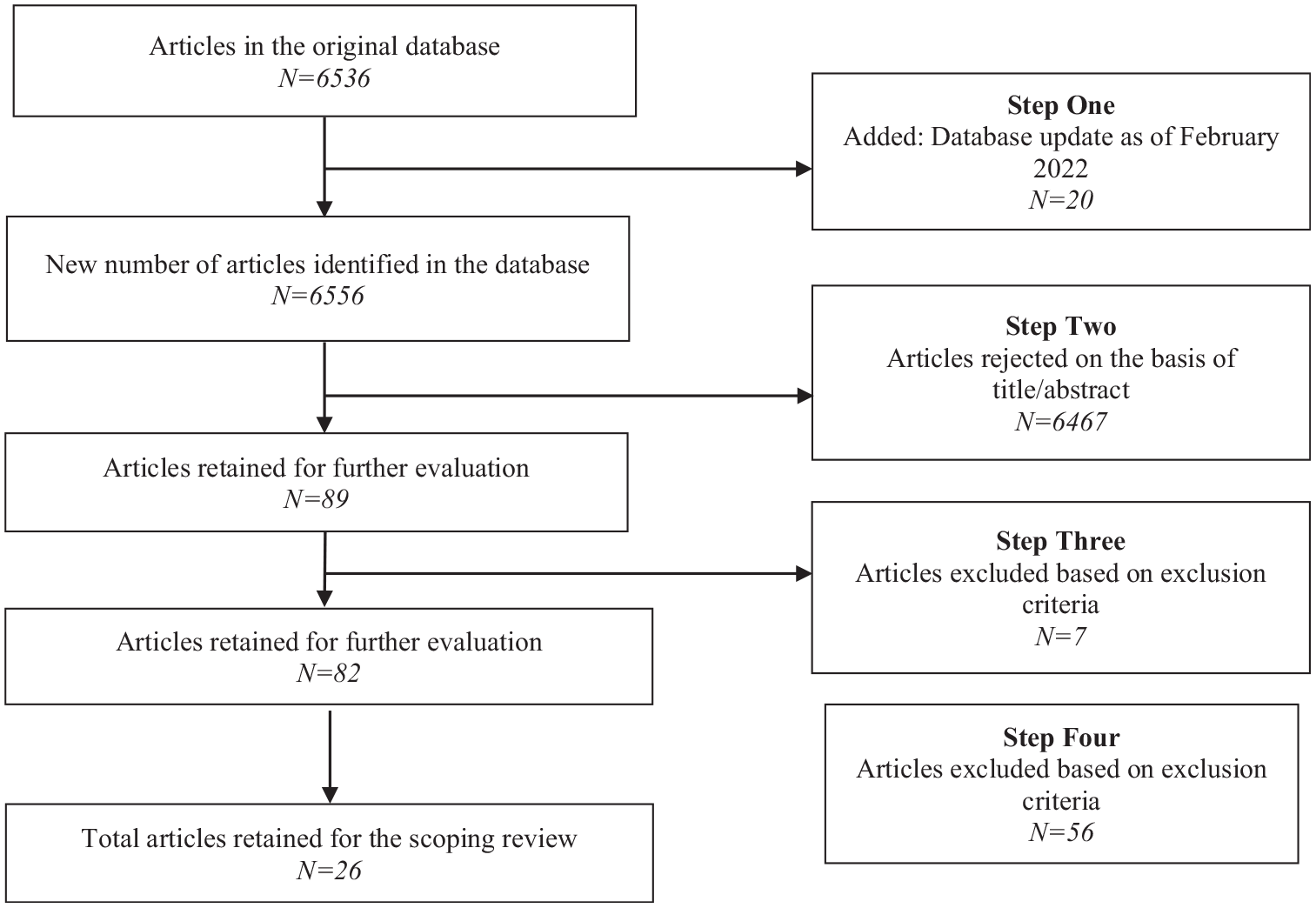
Summary of the study selection process.
Eligibility Criteria for Studies
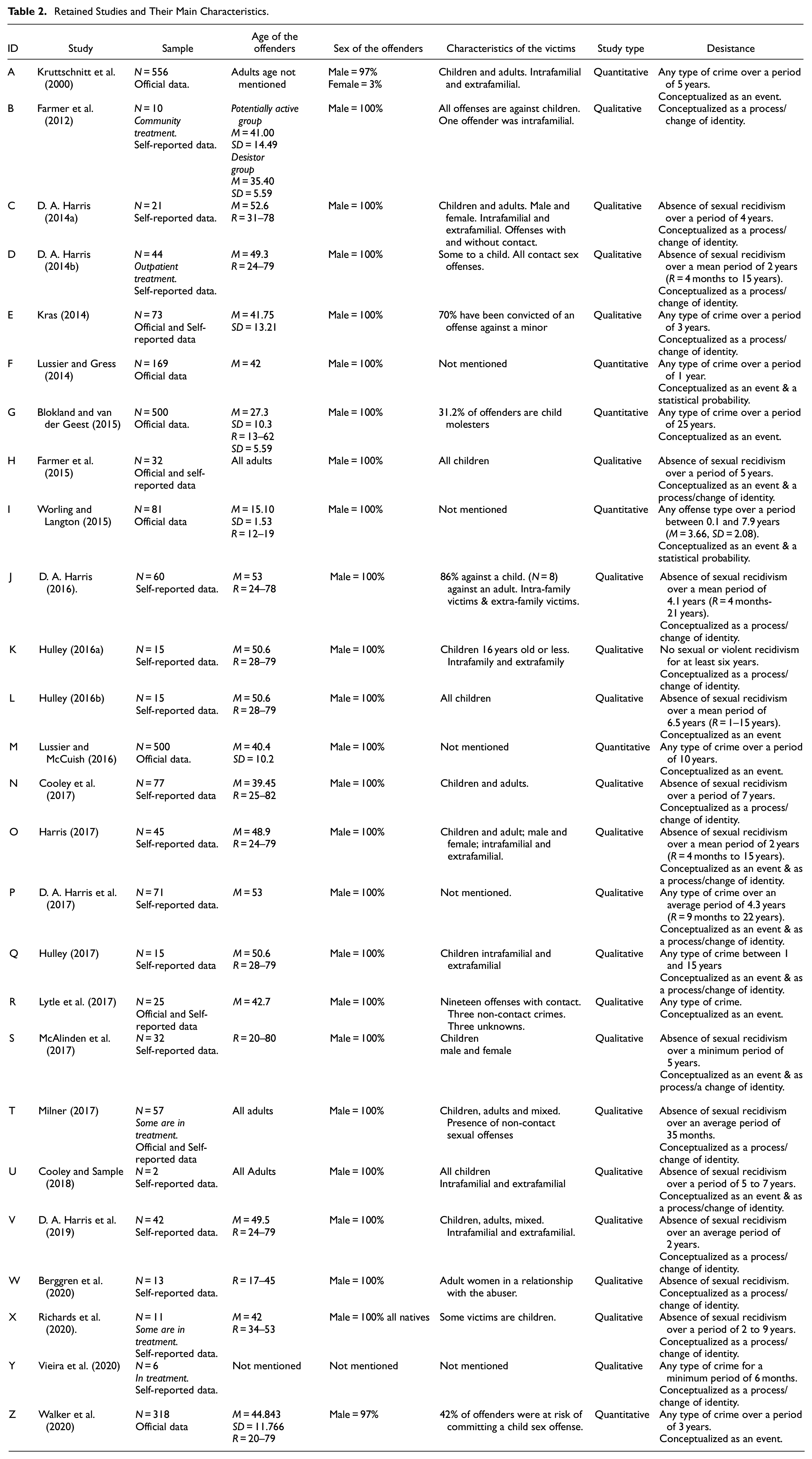
Seven of the 89 selected articles were excluded because they were duplicate. A further 24 articles were removed because the results were not derived from an empirical process. Fifty-eight articles were retained for further evaluation, based on four criteria: the publication had been peer reviewed, the majority of participants in the study sample had committed a sexual crime, factors contributing to the desistance from sexual offending were explicitly discussed, and all participants were in the community at the time of the research, making it possible to determine if they could still be considered desistors. Based on these criteria, 26 articles were retained: 20 were articles published in a scientific journal, 3 were book chapters, and 3 were doctoral theses. Table 2 presents the selected studies and their characteristics. It is worth noting that the oldest study was published in 2000, supporting De Vries Robbé et al.’s (2015) contention that the study of protective factors in sexual offending is a fairly recent phenomenon.
Retained Studies and Their Main Characteristics.
Analytic Strategy
Drawing inspiration from Braun and Clark’s (2006) work on thematic analysis, we employed their six-step approach to code and analyze our findings. However, it is worth noting that in recent years, many qualitative studies have wrongly claimed to utilize thematic analysis, as highlighted by Braun and Clark (2019). Thematic analysis requires more than a simple step-by-step procedure; it necessitates substantial institutional, structural, and even cultural re-examination to be considered as such (Braun & Clark, 2019). Given that our study did not pursue these objectives and although it was inspired by the steps suggested by Braun and Clark (2006), we cannot assert that we conducted a thematic analysis in its entirety.
After familiarizing ourselves with the database, the studies retained, and the concepts of desistance and protective factors, we created a coding grid of more than 15 questions to help extract pertinent information from the studies retained. We then identified themes related to desistance and protective factors. Three themes were identified for the concept of desistance: desistance as an event, desistance as a statistical probability, and desistance as a process/change of identity. Four themes were identified related to the concept of protective factors: absence of a risk factor, factors promotive of desistance, protective factors as mediators or moderators, and protective factors specific to sexual offending. The fourth theme was added as studies have shown that the difficulties sex offenders experience in their desistance journey differ from those of non-sex offenders (Dubois & Ouellet, 2020; Rydberg, 2018) and that there are protective factors specific to sex offending (De Vries Robbé et al., 2015).
Results
Nearly 150 different protective factors were identified in the 26 studies in our scoping review, suggesting that a wide variety of protective factors have been considered in studies of sexual offending. Based on our analysis, these different protective factors contributing to desistance were divided into 32 distinct subcategories related to our three main themes (absence of risk factors, factors promotive of desistance, and factors specific to sexual offending). The protective factors retained were those that had been identified as significantly contributing to desistance from criminal conduct by participants in the studies (qualitative) or by researchers through statistical analysis (quantitative).
As the reasoning and approach in quantitative and qualitative studies are very different, we distinguished studies that adopted a quantitative methodology from those that privileged a qualitative one. We looked first at how desistance is conceptualized in studies that used a particular approach and then examined the protective factors identified using that methodological approach.
The Conceptualization of Desistance in Quantitative Studies
In the six quantitative studies included in this scoping review (A, F, G, I, M, Z), desistance is understood as the absence of taking part in any activity that could be considered recidivism (sexual or nonsexual) or as the absence of any instances of recidivism in official data. In this dichotomic way of conceptualizing desistance, the notions of recidivism and desistance are intimately linked: the individual convicted of a sexual offense is either a desistor or a recidivist. Although the relatively homogeneous conceptual and operational definitions of desistance and recidivism facilitate comparisons across studies, they have the notable limitation that they rely on official data. Understanding desistance in this way offers only a narrow perspective on the phenomenon and the data it is based on is recognized as leading to an underestimation of criminal activity (Ouellet et al., 2013). Given the growing consensus that desistance is a gradual process rather than an abrupt transition to a crime-free lifestyle, excluding recidivism from discussions of the process of desistance seems overly restrictive (Bushway et al., 2001; Kazemian, 2016).
The Operationalization of Protective Factors in Quantitative Studies
Thirty significant protective factors were identified in the six quantitative studies, with an average of five significant protective factors per study. These factors were assigned to one of 14 broad categories (see Table 3). As in quantitative studies, these factors are often dichotomized and seen as contributing to either recidivism or desistance. A factor was thus considered to be protective if it can be shown that it is effective in preventing recidivism. The preventative factors most often discussed in the retained studies were abstaining from alcohol and drug use, avoiding criminalized environments, and lacking a history of criminal activity. Regression analyses were used in five of the six quantitative studies (A, F, G, M, Z), as were several types of survival curve analyses. Furthermore, when using survival curve analyses, researchers often argue for the presence and effectiveness of a protective factor not by demonstrating that that factor is present but by showing that a risk factor is ineffective (protective factor as the absence of risk factor).
Protective Factors Found in Quantitative Studies.

Of the 26 protective factors identified in the quantitative studies, 17 were categorized in the absence of a risk factor theme, 5 were categorized as promotive factors, and 4 as protective factors specific to sexual offending. Given the lack of quantitative research dealing with mediation and moderation factors, the category of mediating and moderating protective factors was removed from our analysis, although the literature on protective factors suggests that this type of factor may be of interest. Such factors are considered to be effective if the individual desists and ineffective if the individual reoffends. Having non-criminalized friends or having a job are considered to be influential protective factors because their opposites are generally seen as risk factors. However, while the research we looked at mentioned such factors as effective, little context—such as the quality of the relationship with non-criminalized friends, the degree of influence they may have, or the sense of accomplishment provided by work—was considered. The absence of a risk factor was considered sufficient to determine that its opposite was protective. Quantitative studies of protective factors focused only on direct effects: protective factors are seen as effective because they contribute to desistance or ineffective because they fail to counter recidivism.
The Conceptualization of Desistance in Qualitative Studies
In qualitative studies, in contrast to quantitative studies, desistance is defined by the subjective experience of the participants. Researchers thus conceptualize desistance as a process. Except for two studies (L and R), which conceptualize desistance as an event (desistance was restricted to the study of any new sexual offense and not crime in general), the other 20 qualitative studies saw desistance as a process that is related to a combination of behavioral, cognitive, and, ultimately, identity changes, with the process seen as successfully completed by at least some participants in three-quarters of the retained studies.
Desistance was sometimes seen as both an event and an identity: six qualitative studies (H, O, P, Q, S, U) presented individuals as progressing through a desistance journey with participants considered to be desistors if there were no instances of sexual recidivism. For the other studies, desistance included any type of recidivism (sexual or not). Thus, there were two main approaches in the retained studies—research that conceptualizes desistance as a process but focuses solely on sexual offenses (event) and research that conceptualizes desistance as a process which includes all types of crimes.
In research that focused solely on the absence of sexual recidivism, desistance was seen as a process that takes place in a series of stages provoked by introspection. Farmer et al. (2015, p. 328; H) describe this process as beginning with what they call early stages of desistance, which include, among others, the acceptance of social values related to dealing the shame and stigma of offending, and a “re-appraisal of the pros and cons of offending.” For Hulley (2017; K), the process is less linear but still involves negotiation with authorities, a sense of the legitimacy of the official position, and the ability to manage the stigma associated with sex offenses in order to achieve internal change. Research that focused solely on the absence of sexual recidivism does not determine whether the offender has reduced the number of or abstained from other forms of crime since it focuses exclusively on sexual offenses. These studies use the same definition of desistance and assess it in the same way (absence of sexual recidivism) but do not consider the characteristics of the criminal career and its intensity (e.g., frequency of crimes committed, seriousness, duration; Dubois & Ouellet, 2020), which may as demonstrated by Vidal et al. (2020), modulate the process of desistance. Nor do they take into account studies that have found that sex offenders are likely to be generalists rather than specialists (e.g., Lussier et al., 2012).
In studies that examine all types of crime, the desistance process is considered to involve the whole criminal career, not just sexual offenses. Desistance can then be understood in various ways, such as a decreased frequency of delinquent behaviors (Harris, 2014a; C, 2014b; D), a negotiation between multiple social identities (Berggren et al., 2020; W), or a continuum of behavioral and cognitive changes (see Kras, 2014; E). Desistance is then understood according to the way the process of refraining from crime is defined by participants. At the clinical level, the concept of desistance used in this research makes it possible to modulate expectations regarding the effectiveness of intervention since relapse does not necessarily mean the treatment has failed, but rather as an element in the desistance process.
The Operationalization of Protective Factors in Qualitative Studies
Nearly 130 protective factors were identified in the selected studies, with an approximate average of 6 protective factors per study. After synthesizing these factors, they were divided into 26 subcategories of protective factors that constitute two themes of our analysis. The majority (71) were identified as promotive with 31 seen as protective factors specific to sexual offending. None of the protective factors involved the absence of a risk factor, a finding that is consistent with a qualitive approach, where the objective is not to determine the effectiveness or absence of a factor but to identify the significant elements participants see as promoting their desistance process.
The protective factors the most frequently found were cognitive and identity introspection capacity, positive vision of the future, and social inclusion/meaningful relationships. In fact, due to the conceptualization of desistance as a process of identity change, these three protective factors, were present in all the retained qualitative research with the exception of two studies (P and R). This is consistent with the literature (Farmer et al., 2012; B; Maruna, 2001). However, unlike quantitative studies, qualitative research provides additional context on how these protective factors play a role in participants’ desistance journey. Protective factors are no longer simply the absence of a risk factor but play an active role in an individual’s desistance process. Participants’ discussion of their individual experiences provide information about the role and kind of protective factors, allowing insight into the mechanics of a desistance trajectory and increasing understanding of what a protective factor is.
Nearly one-third of all protective factors discussed in the retained qualitative research were specific to sexual offending, with factors such as the capacity to properly control emotions, developing conflict resolution skills, or the ability to deal with stigma reflecting the discourse and interpretation of participants. Two protective factors—desire for redemption and change and involvement in sexual offense treatment—were found in 15 of the 20 qualitative studies.
All of the qualitative research employed thematic analysis or one of its derivatives (such as the grounded theory approach). Protective factors were influential in two ways according to participants. The first was as a source of motivation/maintenance. Protective factors such as a positive view of the future, desire to lead a meaningful/busy life, and social inclusion/significant relationships were seen as having a positive impact on the offender’s daily life, encouraging them to continue their desistance process. Protective factors such as the possibility of being reincarcerated, family involvement, the role of supervision (cooperation with supervision), and even sometimes treatment were seen as effective in reducing the offender’s interest in reoffending. This finding reflects desistance literature that makes a distinction between the desire to desist and desistance from recidivism due to obligation or compulsion (Cooley & Sample, 2018; U; D. A. Harris, 2015).
Discussion
This scoping review had two main objectives. The first was to examine the state of knowledge about desistance and protective factors in the area of sexual offending. Different conceptualizations of desistance and protective factors were found in the literature, with the concept of desistance understood as either the complete and sudden cessation of involvement in any criminal behavior (Shover, 2018), the absence of recidivism over time (Lussier et al., 2015), or a process of gradual change in identity (Maruna & Farrall, 2004) (see Table 2 for more details). Three conceptions of protective factors were examined: the absence or opposite of a risk factor (Baltieri & de Andrade, 2008), a factor having a direct or indirect (moderating, mediating) effect on the perpetration of a crime (Farrington, 2007), and an independent element that contributes to the absence or reduction of recidivism (Farrington et al., 2016). However, there is a lack of consensus among researchers as to how these elements should be defined (Lussier & Cale, 2013; Maruna, 2001).
Our second objective was to identify empirically validated protective factors that might guide interventions with sex offenders. Twenty six empirical studies were retained with nearly 150 protective factors that were then aggregated into 32 distinct subcategories (Tables 3 and 4). Through our analysis, we were able to synthesize a considerable number of protective factors and assign them to the themes and subthemes based on our literature review (see Tables 3 and 4). However, a scoping review is not limited to simply capturing the state of knowledge on a topic as it is intended to explain how the operationalization of key concepts and the way they are discussed affect our understanding of a research topic (Pham et al., 2014; Tricco et al., 2016). Our second research objective was thus to explore how the conceptualization of desistance and of protective factors was affected by research methodology.
Protective Factors Found in Qualitative Studies.

While recidivism is an important indicator in the study of desistance, conceptualizing desistance solely as the absence of recidivism has limitations that need to be considered. While recidivism, defined as the occurrence of new criminal offenses after a period of desistance, is a commonly used indicator of desistance, it may not fully capture the complexities and nuances of the process. One limitation is that recidivism-based definitions of desistance tend to focus primarily on the external behavior of individuals. This narrow perspective overlooks the internal changes, personal growth, and transformation that individuals may undergo during their desistance journey (Maruna, 2001). Moreover, relying solely on recidivism as a measure of desistance assumes a binary outcome—either an individual is recidivating or they are not. However, desistance is often a complex and dynamic process that may involve fluctuations, setbacks, and different trajectories (Carlsson, 2012). Additionally, using recidivism as the sole criterion for desistance overlooks the social and systemic factors that influence reintegration and successful desistance. Factors such as employment stability, social support networks, access to resources, and community acceptance play crucial roles in the desistance process (as identified in Table 4). Failing to consider these contextual factors may limit our understanding of desistance and hinder the development of effective interventions and policies. A more comprehensive approach should consider the internal changes, individual experiences, and contextual factors that contribute to successful desistance, broadening our understanding and enabling more effective interventions.
Qualitative researchers generally conceptualize desistance as a non-linear process that involves a change in identity. Even those retained studies that focus solely on the desistance process as related to sexual offenses, excluding recidivism pertaining to other offenses, see desistance as an intermittent process in which recidivism does not indicate that the desistance process has been abandoned (Giordano et al., 2002; Maruna & Farrall, 2004). By allowing participants to indicate how they see their process, qualitative studies make it easier to understand the nuances in the desistance process. Participants’ subjective interpretation of their desistance process also makes it possible to learn which elements they consider effective and essential. According to this interpretation, protective factors appear to encourage participants to continue in desistance rather than diminishing their interest in recidivism, suggesting that there is a difference between desisting and deciding to desist (Maruna, 2001). Perhaps one of the most important aspects of qualitative studies is that the protective factors are consistent across studies. Many of the retained studies included factors such as a capacity for introspection about aspects of cognition and identity (15), having a positive view of the future, (9) being in treatment, (13) and commitment to redemption and change (9) (see Table 4). While qualitative studies, which take an inductive approach, are more subjective than quantitative research, this does not mean that their findings are any less valid. This finding proves the value of an inductive approach since these factors are not exclusive to a small group of people and therefore have a significant value in the study of desistance. Moreover, it is interesting to note that when participants’ opinions are solicited, the protective factors cited seem more diversified from those in quantitative studies.
Both quantitative and qualitative studies on desistance and, more specifically, protective factors in the field of sexual offending are important. On one hand, the quantitative approach tries to determine whether decades of research on acting out and risk factors are relevant to the study of desistance and protective factors. On the other hand, qualitative studies provide new knowledge on these concepts through participant information about their daily experiences. While the two approaches provide different but complementary information, it is important that researchers recognize the differences and take it into account if future research is to provide the same quality of information as that found in studies of acting out and risk factors.
Limits
There are three main limitations to our research findings. The first is that the database that was the source of most of the studies originated from a project focused on the trajectories of individuals who committed or desisted from violent sexual behavior. However, the keywords used in the initial project included terms specific to the literature on protective factors and desistance. The second possible limitation is that, except for one study, all of the participants in the retained studies were male. The exclusion of females was not intentional but reflects the available data. In addition to being over-represented in criminal justice data concerning sexual crimes, men are significantly more likely of both perpetrating such offenses and of being convicted for it (Walklate, 2013). Although interest in sexual offending among women has increased in recent years (see Cortoni et al., 2017), there is still little research in this area. Finally, our work may have been limited by the absence of a universal definition of a protective factor. Many studies refer to the term protective factors, without discussing and defining what they are and how they interact. Protective factors may also be discussed in terms of the absence of a risk factor and studies that provide post-hoc explanations for the absence of recidivism may not have been included. Ultimately, the use of different definitions of what constitutes a protective factor may have complicated our attempts to assess protective factors and to include other research in the present study.
Conclusion
What is desistance in sexual offending, and how does a protective factor operate? Should desistance be understood as the complete cessation of all criminal behavior or as a process of identity change, marked by the occasional relapse, undertaken by an offender over a period of time? We believe that the answer to this question lies somewhere in between. Although ideally the goal in desistance is that the offender ceases all types of criminal behaviors, discussing offenders in terms of an opposition between the desistor and the recidivist is harmful at the level of both practice and social policy. It also creates two classes of offender—desistors who are accepted because they are no longer committing crimes and recidivists who, while making attempts to desist, are unable to completely avoid criminal activity. Understanding desistance as a process of identity change not only takes into account research that suggest that the criminal career is marked by intermittent periods of commission and desistance but also makes it possible to see the process as a continuum. While our scoping review does not offer a complete conceptualization of desistance or of protective factors, it encourages reflections on these issues and provides a list of empirically validated elements that can be helpful to individuals wishing to refrain from crime. It is obvious, however, that more studies on desistance and on the factors that contribute to it are needed. Finally, it is challenging to disregard the fact that our study, while examining protective factors affecting desistance, may overlooks broader cultural and institutional issues. Men exhibit a disproportionate representation in sexual offenses, and while it is crucial to address recidivism through effective protective factors, it is equally if not more important to engage in a broader conversation regarding men’s misconceptions regarding sexuality and consent. Such reflection at an earlier stage could yield valuable insights.
Footnotes
Declaration of Conflicting Interests
The author(s) declared no potential conflicts of interest with respect to the research, authorship, and/or publication of this article.
Funding
The author(s) received no financial support for the research, authorship, and/or publication of this article.

Data Availability Statement
The data used in this study are available online and can be accessed through the journals in which the articles were published.