



Abstract
Abusive supervision is a type of dysfunctional leadership that fosters continuous verbal or nonverbal infractions on subordinates and undoubtedly negatively impacts various work outcomes. Past literature has explored the underlying rules of how this form of destructive leadership influences employees’ negative working attitudes. However, research focusing on exploring factors that buffer abusive supervision’s harmful effects on voice behavior is relatively scarce. Distinctively, this study seeks to examine under a lens the process through which abusive supervision will harm voice behavior while taking into account emotional exhaustion as a mediator. According to the conservation of resources theory, we propose a cross-domain buffering approach of the negative effect of abusive supervision on voice behavior by considering subordinates’ forgiveness and communication openness acting as the moderators. We test the hypotheses by analyzing 430 sample data from an enterprise in Zhejiang Province, China, using Mplus and SPSS software. The results reveal that emotional exhaustion plays a mediating role in the path analysis of abusive supervision and voice behavior. Moreover, subordinates’ forgiveness and communication openness negatively moderate the mediation path. We enrich current literature by investigating the mechanism of abusive supervision and the impact of this kind of dysfunctional leadership on voice behavior and how to minimize the negative effects. The suggestions proposed can be referred to by practitioners and researchers in establishing a positive working environment.
Keywords
Introduction
Since Tepper proposed abusive management in 2000, other management research scholars following the same footsteps have pointed out abusive management’s harmfulness. Past studies mainly focused on employees’ aggressiveness or deviant behavior and highlighted factors such as psychological pressure, job dissatisfaction, and employee turnover as detrimental impacts of abusive supervision (Martinko et al., 2013; Whitman et al., 2014). As a form of “toxic” leadership in management, abusive supervision has been studied in human resources management, organizational behavior, and ethical leadership (Tepper, 2000; Whitman et al., 2014). Abusive supervision is defined as the perception of the extent to which subordinates perceive leaders to be engaged in continuous abuse, excluding any physical contact (Tepper, 2000). When employees endure such abuse from their supervisors, they may suffer psychological pain and stress (D. Liu et al., 2012; Mackey et al., 2017). Subordinates may choose to restrain themselves and follow their supervisors’ orders instead of speaking out their thoughts and openly expressing their feelings to avoid receiving continuous aggressive behavior from supervisors due to noncompliance (Frieder et al., 2015).
We regard voice behavior as a coping strategy used by employees when they invest their ideas to acquire leverage or preferential treatment in organizations (e.g., approval or support from their leaders). Voice behavior is an understandable way to encourage nonmanagerial team members to make decisions together. Voice behavior can improve employees’ sense of ownership and encourages employees to become more proactive (Dyne et al., 2003). When people contribute ideas to the organizations, their suggestions may be accepted by organizations that may satisfy their psychological needs. In turn, they can have an added advantage in acquiring information from top management. Past research reveals that abusive supervision can influence subordinates’ voice behavior (R. Li et al., 2009; Y. Li & Sun, 2015). For example, Tran et al. (2014) believe that workplace loyalty and voice behavior will be hindered by destructive leadership. It is also duly noted that different leadership behaviors influence employees’ decisions involuntarily by providing comments or suggestions through various communication channels (Detert & Burris, 2007).
Furthermore, Frieder et al. (2015) posit that voice behavior has a more sensitive response to disruptive leadership behavior than positive leadership behavior. There has been considerable interest among research scholars in exploring the mechanism of how abusive leadership affects voice behavior. For example, Wang and Jiang (2015) found that supervisors’ abusive behaviors could decrease employees’ voice behavior via interactional justice. Some research has shown that proper interventions may be introduced to reduce the negative effects of abusive leadership and how it influences subordinates’ behaviors (e.g., Frieder et al., 2015; Nandkeolyar et al., 2014; Xu et al., 2020). However, it is necessary to explore whether and how the effect of abusive leadership can be mitigated (Farh & Chen, 2014). It is of paramount importance for researchers to understand the underlying rules of how leaders’ abusive manners influence voice behavior; thus, we seek to extend the current scope of literature in this body of research.
Previous studies on abusive management have widely adopted the social exchange theory proposed by Blau (1964) to explore voice behavior as a means of improving the quality of social networking in fostering a positive work environment (Ng & Feldman, 2012). The Conservation of Resource Theory (COR) states that people will try to prevent the loss of resources and maximize the possibility of acquiring potential resources as they endure a stressful working environment (Hobfoll, 1989). Thus, in our study context, voice behavior is considered as a coping strategy used by employees to cope with the stress they face from their supervisors (i.e., aggression from abusive leaders). Based on the COR theory, voice behavior enables workers to acquire future resources and avoid losing their current resources. Supervisors’ abusive behaviors will cause great distress to their subordinates in the workplace (Tepper, 2000). This result will push subordinates to find new ways to cope with these negative emotions to maintain an ordinary working environment (Carlson et al., 2012). Subordinates will reduce their stress and lighten their burden of losing emotional resources by airing their grievances and expressing their ideas and emotions to top management. Thus, subordinates try to find opportunities to acquire future resources to enhance their future career goals. In addition, this study seeks to analyze voice behavior using a two-stage approach. Previous research conducted from the leaders’ perspective maintains that different leadership styles will influence employees’ voice behavior (e.g., Carnevale et al., 2018; A. S. Y. Chen & Hou, 2016). However, some of the research conducted from the subordinates’ perspective states that voice behavior can be influenced by different factors (e.g., Ng & Feldman, 2012; Xia et al., 2020). Our study hinges upon the COR theory to explore how abusive supervision affects voice behavior. We divide the process of how abusive supervision fosters voice behavior using a two-stage approach. The COR theory proposes that a reduction in emotional response to cope with the stress that occurs when an individual lacks positive emotion to deal with interpersonal stress. Harvey et al. (2007) put forward the concept of emotional exhaustion and define it as a chronic condition of emotional and physical depletion generated from prolonged stress. In this study, we regard voice behavior as the coping strategy to deal with stress, and we propose that emotional exhaustion is the intermediary of the whole process. In the first stage, we aim to explore what variables can mitigate the abusive leadership’s negative effects on employees’ psychological feelings. Forgiveness may be a useful relaxant tool in helping individuals deal with negative emotions, thus enabling them to gain composure in a workplace setting (Belicki et al., 2020; Karremans et al., 2003). Therefore, we introduce subordinates’ forgiveness in our research model. In the second stage, we aim to examine what factors attenuate the harm of abusive behavior on employees’ voice behavior. Attenuating negative emotions through forgiveness is beneficial in resource management. Besides, it is worth enhancing effective communication with feedback between supervisors and subordinates for organizations to balance peoples’ resources (Hobfoll, 1989). Redding (1972) proposes communication openness and affirms that it may open new channels for idea exchange. Communication openness is regarded as an interpersonal relationship resource (Tucker et al., 1996). If organizations provide employees with channels for emotional expressions and suggestions, they will feel the care. Employees will then provide their interpersonal relationship resources, recover from the depression due to abusive management, and return to work. Therefore, we introduce communication openness in the research model to explore its role in the process.
This research aims to enrich current literature on the following aspects: First, it will reveal the mechanism of how abusive supervision affects subordinates’ voice behavior employing a two-stage approach. Second, it will investigate the effect of subordinates’ forgiveness in a high-level power–distance context (i.e., China). Third, it will study the effect of communication openness in the relationship between abusive leadership and voice behavior.
We introduce the hypotheses of the research model in Part 2. We also present the research methods in Part 3. Then, Part 4 demonstrates the results. Next, the findings, contributions to theory and practice, and the limitations are discussed in Part 5. Finally, Part 6 summarizes the whole study.
Hypotheses
COR Theory
Hobfoll (1998) puts forward the notion of how human desires motivate peoples’ behavior in maintaining current existing resources, accumulating resources, and obtaining future resources. Resources are defined as conditions, personal characteristics, objects, psychological needs, energies, and social influences regarded as valuable by people (Hobfoll, 1989, 2001, 2002). According to the COR theory, individuals will try their best to balance their existing resources and extend their opportunities in acquiring new resources. If an imbalance occurs, individuals will conduct a series of behavior to fill the resource gaps. Past scholars have proposed several fundamental principles on how people behave from a resources’ perspective. Hobfoll & Freedy (2017) acknowledge that resource loss plays a more influential role in determining peoples’ behaviors than resource acquisition. In other words, facing the existing or potential threats, people will first consider protecting existing resources instead of acquiring future resources. According to Hobfoll (2001), individuals will consider the possibility of resource return before they conduct resource investment. Halbesleben and Bowler (2007) explain this principle by taking reciprocal behavior as an example. They believe that people may be willing to help others when they have been assured of the possibility that their resources will be returned. Subsequently, Hobfoll (1998) suggests that resource investing behavior relies on the possibility of resource replenishment. If people have more resources from work, they will take up additional tasks to help others. In contrast, a sense of resource depletion will lead employees to be more cautious and conservative (Hobfoll, 2001). When subordinates’ psychological needs are unmet due to the ill-treatment they face from supervisors, this may lead to job dissatisfaction and demotivation. Subordinates will try to find ways to express their emotions and cope with the stress they endure from their supervisors to fill the resource gap to maintain the balance in psychology.
Abusive Supervision and Employees’ Voice Behavior
As a destructive leadership behavior, abusive supervision refers to leaders’ continuous verbal or nonverbal abuse (excluding physical hostile touch) toward subordinates (Tepper, 2000). In the previous research literature, notable abusive supervision’s detrimental effects, such as the reduction in employees’ positive job behavior (Nandkeolyar et al., 2014), loss of quality sleep, reduction in creativity (Han et al., 2017; Zhang & Liao, 2015), decrease in job satisfaction and commitment to the organization, and less display of organizational citizenship behavior (Mackey et al., 2017; Mitchell & Ambrose, 2007), have been widely cited. Organizational citizenship behavior (OCBs) can be divided into those citizenship behaviors aiming at helping other individuals (OCBIs) and those aiming at contributing to the organization (OCBOs) (Williams & Anderson, 1991). As a form of OCBO (N. P. Podsakoff et al., 2009) and a kind of extra-role behavior (Liang et al., 2012), voice behavior is first proposed by Hirschman (1970) and defined as constructive oration that offers new ideas and innovative suggestions to improve the situation in organizations (Van Dyne & LePine, 1998). Generally, voice behavior is categorized into promotive behavior and prohibitive behavior (Liang & Tang, 2009). The promotive voice describes the new idea proposed to improve the organization’s operation. In contrast, the prohibitive voice refers to the suggestions put forward to solve the problems (e.g., suggestions for inappropriate policies). Past literature has advised organizations to promote voice behavior because of its positive effect on performance (Perlow & Williams, 2003), organizational effectiveness (Morrison, 2011), and low staff turnover (McClean et al., 2013). However, in some instances, employees may be hesitant to share their ideas with their peers (e.g., C. Li et al., 2018). Influencing factors of voice behavior (Tepper et al., 2011) from the following perspectives, management openness of leaders, transformational leadership, and leader-member exchange (Detert & Burris, 2007; W. Liu et al., 2010; Van Dyne et al., 2008), have conjured a noteworthy inquiry. As supervisors’ leadership styles will influence this extra-role behavior (e.g., Afsar et al., 2019; Ye et al., 2019), the supervisor’s reaction is essential in affecting voice behavior.
Leaders play a crucial role in the process of employee voice behavior (Detert & Burris, 2007). Ryan and Deci (2000) suggest that employees tend to control workplace issues and make decisions according to their needs. However, abusive supervision harms subordinates’ psychology, attitude, and behavior (Wei & Si, 2013). We believe that abusive supervision will reduce employee voice behaviors due to the following reasons: First of all, subordinates may redefine their potential status in the organization and change their behavior according to supervisors’ responses (R. Li et al., 2009). If the supervisor is narrow-minded and self-righteous, they may regard subordinates’ suggestions as criticism or challenges. This idea may lead them to show offensive expressions and conduct aggressive actions toward subordinates (Detert & Burris, 2007; Van Dyne & LePine, 1998). As employees feel the offenses and aggressiveness from leaders, their self-esteem and sense of belonging may be affected negatively (Lian et al., 2012). The hurts on employees’ feelings may break the emotional conditions, cause psychological imbalance (Thau & Mitchell, 2010), and lead to demotivation (Farh & Chen, 2014). Afraid of being hurt again, subordinates may be unwilling to share suggestions with their supervisors (Detert & Burris, 2007). Furthermore, being afraid of unfriendly treatment by supervisors and being pushed into disadvantaged positions in the workplace, employees may avoid enraging supervisors. Subsequently, although voice behavior has a certain constructive significance, it also challenges the status quo and, at the same time, attacks and negates leaders or colleagues to a certain extent. These challenges and attacks may hurt the relationships among colleagues and supervisors and push employees into uncertain situations. Thus, given the possible negative effects (i.e., hurt others’ feelings) of voice behavior, employees will concern whether their voice behavior will be friendly accepted before exhibiting voice behavior (Kish-Gephart et al., 2009) to avoid unnecessary conflicts among colleagues and supervisors. This worry will be amplified in an abusive supervision context because the aggressiveness will be amplified by leaders who will return much more hurts back. Therefore, in an abusive management context, employees will likely reduce their voice behavior to maintain their positions and psychological situations when unsure whether their voice behavior can lead to positive feedback or negative results. Therefore, this study hypothesizes that:
Emotional Exhaustion
Abusive supervision is a kind of negative leadership that can make people feel depressed and demotivated, indirectly leading to low performance (Wei & Si, 2013). When employees are in a threatening and stressful work environment, they have to cope up with the frustration and psychological burden they face (Tepper, 2000; Wright & Cropanzano, 1998) by acquiring positive emotions before they return to work (Whitman et al., 2014). However, it is not easy to continuously acquire positive psychological resources to recover from depression. Whitman et al. (2014) conclude that in the long run, abusive supervision may cause a vicious cycle termed “from lacking feedback to emotional exhaustion.” Although subordinates may try their best to recover from the emotional drain due to the chronic abuse at work, they will feel inferior and end up withdrawing from difficult tasks over time. Furthermore, their supervisors’ indifference and disrespect toward their negative attitudes will lead to the spread of rejection among subordinates and estrangement between subordinates and supervisors. Zohar (1997) uses emotional exhaustion to describe the collapse of physical and emotional resources due to long-term overworking. Psychological feelings may be considered as a kind of resource (Hobfoll, 2001). People will try their best to acquire, protect, and retain valuable resources (e.g., emotional resources) to control the potential resource loss as individuals face threats of losing resources (Hobfoll, 2002). In the vicious circle mentioned earlier, abusive supervision makes employees feel a sense of resource loss and experience heightened emotional exhaustion at work, which limits their courage to acquire additional resources for a future career (Anasori et al., 2020; Bowen & Blackmon, 2003).
Following the COR theory, individuals with fewer resources may invest less of their time and energy to work and display less concern about the organization’s development as they assume that the benefits are limited (Ito & Brotheridge, 2003). As voicing out one’s ideas may be considered as criticism toward supervisors, hostility and indifference may occur in the workplace. Therefore, as subordinates suffer the pain from supervisors’ offenses, they may hold back their suggestions to avoid criticism from supervisors and recover from the emotional exhaustion. Contrarily, when subordinates feel more empowered and engaged at work, they will contribute their ideas to organizations (Ford & Fottler, 1995). In this study, we argue that the more subordinates suffer emotional exhaustion and cannot quickly gain enough emotional resources in the future, the more they may have less courage to invest in future resources acquisition.
Subordinates’ Forgiveness
As we mentioned previously, subordinates will feel stressed and depressed as supervisors offend them (Wei & Si, 2013). Although people may try their best to control their temper and calm down for the coming working tasks, they will feel exhausted and finally suffer emotional exhaustion and lose interest in working for the same organization. Hobfoll (1989) and Hobfoll et al. (2018) contend that individuals will actively construct and maintain current resource reserves to cope with the possibility of greater resource loss in the future. They also assert that personal characteristic resources are important factors influencing individuals’ behavior (Hobfoll, 1998). As an internally cognitive and emotional change (Merolla et al., 2013), forgiveness includes individuals’ inner ideas and interpersonal responses (Baumeister et al., 1998). It retains individuals’ enthusiasm and trust and releases negative emotions and sets aside prejudices toward others within the organization (Karremans et al., 2003; McCullough et al., 1998). As individuals’ inner ideas and interpersonal responses are different, forgiveness and the extent of influence are different from one individual to the other. In this study, we argue that forgiveness can be a resource that helps individuals relieve stress (Dominian, 1968).
In the organizational context, Ferch and Mitchell (2001) define subordinates’ forgiveness as the process that enables subordinates to eliminate anger and resentment and give up their hostility and revenge after they experience hurt and unfair treatment from their supervisors. Chi and Liang (2013) also declare that the forgiveness process will help subordinates modify the perceived subordinate–supervisor relationships and reduce negative emotions by adjusting their emotional experience. In addition, as subordinates put aside their bias and critically diagnose their situation by deciding to react rationally to their supervisors’ behavior, they may succeed in eliminating anger and revenge and actively build friendly relationships with supervisors (Goodstein & Aquino, 2010).
Accordingly, subordinates who have displayed high-level forgiveness behavior in personal characteristics may endure less abusive behavior from supervisors and recover easily from the emotional pain and rebuild healthy relationships with their supervisors. Then, subordinates are willing to voice. Thus, this study hypothesizes that:
Communication Openness as a Moderator
Communication enables people to exchange meanings (Robbins & Coulter, 2016). Norton (1978) defines communication styles as the way of meanings being transferred, received, interpreted, and understood through verbal or nonverbal interactions. Kristof-Brown et al. (2005) propose dyadic communication as interactive communication between leaders and their subordinates. Past literature has confirmed the relationship between leadership style and communication style (e.g., Pacleb & Bocarnea, 2016). A communication style featuring supportiveness and expressiveness is related to people-oriented leadership (De Vries et al., 2010). Contrast to people-oriented leadership that encourages, supports, and develops employees (León Eyzaguirre & Morales, 2018), abusive leadership usually verbally or nonverbally hurts subordinates. Therefore, it can be assumed that abusive leadership may be related to a communication style with verbal aggressiveness. According to Priesemuth et al. (2014), as employees perceive leaders’ abusive behaviors as a shared consensus, the abusive supervision climate will initiate. Given the characteristic of abusive leadership is aggressiveness, the abusive supervision climate may be less related to humane and care less about employees’ interests. Ruppel and Harrington (2000) found that to what extent organizations concern people positively influenced the openness of employees’ communications. Therefore, in an abusive supervision climate, employees’ interests and feelings will be less concerned, and the openness of employees’ communications will be hindered. According to Stamper and Masterson (2002), employees will describe organizations’ images and conduct responsive actions based on their supervisors’ actions because employees regard supervisors as representatives of the organization. Supervisors’ aggressive expressions toward the suggestions will hurt employees’ feelings and make employees assume that the suggestions are not welcomed in organizations.
Ayoko (2007) defines communication openness as the ease of talking and the extent of understanding among people. The concept extends to the relationship between supervisors and subordinates in the workplace by Rogers (1987). As communication openness is the main factor for the organizations’ success (Rogers, 1987), this study focuses on the communication openness between supervisors and their subordinates. Eisenberg and Witten (1987) believe that the higher the level of openness of communication that exists in organizations, the smoother the communication between supervisors and subordinates will be. On most occasions, communication openness can establish convenient channels for subordinates to inquire about task-oriented information instead of task-confirming information (Rogers, 1987). Through open communication, subordinates and supervisors may discover hidden problems in the workplace and propose solutions to solve the underlying problems. Open communication creates opportunities for the subordinates to express their emotions to their supervisors, eliminating misunderstandings and decreasing the negative relationships between them. It indirectly leads to positive job satisfaction (e.g., Burke & Wilcox, 1969; Rings, 1976), better job performance (e.g., Indik et al., 1961; Willits, 1967), and role clarity (e.g., Klauss & Bass, 1982).
In an abusive supervision context, supervisors’ hostile behaviors may hurt subordinates’ emotions and communication motivations (Farh & Chen, 2014; Thau & Mitchell, 2010). However, they can still establish good interpersonal relationships if the employees sense the open atmosphere of communication within the organization and try to communicate with their leaders. From the perspective of the conservation of resources theory, when employees experience emotional exhaustion after offending by their leaders, their resources are lost. Compared with resource maintenance, resource acquisition is more significant in balancing people’s resources (Hobfoll, 1989, 1998). As an effective way to get resources provided by the organization, communication openness can help employees eliminate the pain in resource loss. When employees perceive that the communication between them and supervisors is open and easy within the organization, they may easily recognize that they can establish relationships with leaders and access good interpersonal relationship resources (Tucker et al., 1996). Motivated by the eagerness to access organizational resources (i.e., relationship) to supplement resources loss, they will choose to openly communicate with leaders and put forward their suggestions and ideas to seek future relationship resources.
Moreover, Stamper and Masterson (2002) assert that employees regard supervisors as representatives of the organizations and can change their attitudes according to the responses. Previous studies have shown that subordinates usually hold positive attitudes to supervisors who enthusiastically ask subordinates for information, listen to suggestions, and act based on the information they receive (Rogers, 1987). Therefore, if supervisors show an open-minded and friendly attitude, their changes will inspire subordinates to feel the care from organizations and join the communication to propose advice.
To sum up, as communication in organizations become more open between leaders and subordinates, employees will have more chances to access more relationship resources and recover from the resource loss and emotional exhaustion caused by abusive supervision. Furthermore, if employees perceive that leaders show open and friendly attitudes, they may believe that organizations are open and friendly to open expressions. Then, they may contribute ideas to respond to leaders’ positive actions and seek benefits from future organizational development. Thus, this study hypothesizes that:
As mentioned earlier, leaders’ offensive manners will make subordinates suffer emotional exhaustion and hold pessimistic attitudes in working due to the decrease in their commitment (McDowell et al., 2019; Wright & Hobfoll, 2004). Kay and Christophel (1995) found that the more openly the supervisors interacted with employees, the more motivated employees would be. Z. Chen et al. (2012) also suggest that as the organization opens proper channels for subordinates to exchange with supervisors, the performance will be better. Myers and Sadaghiani (2010) found that compared with the old generation, current employees become more active, are willing to change organizations, are concerned about the degree of ease in the workplace, and prefer to openly communicate in organizations. Their growing experience makes them more willing to interact with supervisors to deal with problems (Myers & Sadaghiani, 2010). Therefore, when employees suffer hurt from abusive supervision, they may seek communication approaches to solve the problem.
Furthermore, their motivation in changing organizations may inspire them to interact with superiors to break the abusive supervision climate in organizations (Myers & Sadaghiani, 2010). Myers and Sadaghiani (2010) argued that organizational openness would help to solve supervisor–subordinate conflicts for present organizations. Therefore, open communication channels in organizations can satisfy employees’ eagerness for communicating and changing the situation. Employees may use all the resources provided by organizations under the atmosphere of open communication within the organization (Hobfoll, 1989, 1998) to access the relationship-related resources and contribute more ideas to organizational improvement.
To sum up, open communication will satisfy employees’ eagerness for changing the situation and solving existing conflicts. Then, interactions via open communications may help employees solve the problems and gain new relationship-related resources, which help them eliminate the negative effect of abusive supervision and further contribute to organizational improvement. The hypothesis is formulated as follows:
Figure 1 shows the research model.

The theoretical model.
Research Method
Research Design
To better observe the dependent variable of our current research model (i.e., voice behavior), we chose an industry that needs employees to contribute new ideas for organizations’ development. Compared with other industries, high-tech enterprises require employees to propose new ideas and conduct innovation in this digital age. Furthermore, to maximize innovation in organizations, high-tech enterprises may choose to open communication channels for the employees. Therefore, we conducted a study in a high-tech enterprise located in Zhejiang Province, China, using paper-based surveys. With the help of the founders and managers, a simple random sampling method was applied to collect data among all employees from different departments.
Measurement
The questionnaires consisted of questions addressing the demographics of the participants (i.e., gender, age, educational level, and the tenure of work). In the initial stages of data collection, we discovered that people were unwilling to report their specific age in questionnaires. Thus, to get more valid data, we set age as an ordinal variable. Abusive supervision, emotional exhaustion, subordinates’ forgiveness, communication openness, and employees’ voice behavior were measured using 5-point Likert-type scales adopted from past literature. This study followed the guidelines of Brislin (1986) and translated the original English version to a Chinese version to make the questionnaire available in Chinese. To ensure the questionnaires’ validity and accuracy, two bilingual professors of human resource management were invited to help with the translation–back translation of the questionnaire (Brislin, 1986).
A 15-item scale proposed by Tepper (2000) was adopted for measuring abusive supervision. Participants were required to report their perceptions about their supervisors’ attitudes and behavior. The reliability of this scale satisfies the requirement as the value of Cronbach’s alpha is .95.
We evaluated emotional exhaustion by using a 9-item scale adapted from Maslach and Jackson (1981). Participants were required to report their emotional situation in daily and working environments. The measurement reaches good reliability (Cronbach’s alpha was .93).
A 5-item scale from Wade (1989) was applied to measure the subordinates’ forgiveness. Participants were required to report their changes of attitudes toward outside hurts. The reliability is ensured because of the high value of Cronbach’s alpha (.89).
A 13-item scale from Rogers (1987) was selected to measure communication openness. Participants were required to report their perceptions toward to what extent they were willing to communicate with others. The value of Cronbach’s alpha (.94) stands in an acceptable zone.
Voice behavior was assessed through a 6-item scale from Van Dyne and LePine (1998). Participants were required to report their intention of contributing their ideas to the organizations. The value of Cronbach’s alpha (.89) stands in an acceptable zone.
Following previous works (e.g., Hoobler & Hu, 2013; S. Lee et al., 2018), we controlled demographic variables to extenuate the ambiguous influences on the research constructs (Ng & Feldman, 2008).
Participants and Procedures
To reduce the possibility of the common method bias (CMB), we collected data in different time periods (P. M. Podsakoff et al., 2003). From May 05, 2018, to May 10, 2018, a total of 500 employees were invited to fill in the questions related to abusive supervision, voice behavior, communication openness, and demographic questions. The related information about the research was communicated to the employees in advance. At this stage, 95.6% of the participants submitted their questionnaires. We numbered the participants as they returned the questionnaires, aiming to return the right surveys to the right people. Two months later, the questionnaires were sent to the same group of participants to measure their perceptions toward subordinates’ forgiveness and emotional exhaustion. For the second period, the rate of return was 89.96%. Finally, 430 samples were enrolled for the data analysis stage after eliminating the invalid responses. According to Krejcie and Morgan (1970), our final sample size was acceptable on a 95% confidence level and a 5% confidence interval (430 was larger than 384). To be specific, males shared 35.8% of the whole proportions, and the rest were females. In all, 55.8% of participants held bachelor’s degrees, 34% attained master’s degrees, and 10.2% were Doctor’s degree holders. In terms of age, 50.6% of participants were between 18 and 28 years old, 34.1% were 29 to 39 years old, 10.2% were 40 to 50 years old, and 5.1% were older than 51.
We also applied two approaches to diagnose the degree of CMB, including Harman’s single factor test and controlling an unmeasured latent method factor (P. M. Podsakoff et al., 2003). Harman’s test shows that the first factor explains 30.646% of the variance (<50%). We compared the results of a measurement model with a common latent factor and a model without a common latent factor. The results show that the χ2, Tucker–Lewis index (TLI), comparative fit index (CFI), and root mean square error of approximation (RMSEA) of the original model are 1,298.431, 0.981, 0.982, and 0.022, respectively. After adding a common latent factor, the values of these indexes become better (χ2 = 1,176.446, TLI = 0.987, CFI = 0.988, and RMSEA=0.019). As the change in RMSEA is <0.05, and the changes in TLI and CFI are <0.1 (Xie & Long, 2008), we believe that the common method bias is not serious.
Results
Descriptive Statistics and Correlations
Table 1 shows a negative correlation between abusive supervision and employee voice behavior (r = −.46***, p < .001). Abusive supervision is positively correlated with emotional exhaustion (r = .46***, p < .001). Emotional exhaustion is negatively correlated with employee voice behavior (r = .46***, p < .001). The subordinates’ forgiveness is positively correlated with employee voice behavior (r = .26***, p < .001). Communication openness is positively correlated with employee voice behavior (r = .26***, p < .001).
Descriptive Statistics and Correlations.

Note. N = 430. Gender: Male = 0, Female = 1. Age: 18~28, 29~39, 40~50, older than 50. Most of the participants are between 29 and 39 years old, which leads us to choose 29~39 years as a reference group. Age1 = 18~28, Age2 = 40~50, Age3 = older than 50. Most of the participants have college degrees or below. Thus, we choose college degrees or below as a reference group. Education: College degree or below, Master’s degree, and Doctor’s degree or above. Education1 = Master’s degree, Education2 = Doctor’s degree. VIF = variance inflation factor.
p < .05. **p < .01. ***p < .001.
In addition, we conducted the normality test with the Shapiro-Wilk test (Thode, 2002) and collinearity test (Dormann et al., 2013). The Shapiro-Wilk test shows that the data are non-normally distributed because the p values of all the variables are .000<.05 (Ghasemi & Zahediasl, 2012). For the Collinearity assessment, Dormann et al. (2013) and Allison (1999) suggest that if the absolute values of all correlations are less than .7 and all the variance inflation factors (VIF) are <5, researchers can conclude that there was no multicollinearity among variables. The results show that the largest absolute value of all correlations is .46 (<0.7). Furthermore, the largest VIF is 1.379 (<5). Thus, we believed that the multicollinearity among variables is not severe.
Confirmatory Factor Analysis
The distinctiveness of the constructs was tested by confirmatory factor analysis using Mplus software based on cross-sectional and continuous data. Table 2 reports the results of model criteria indexes (Medsker et al., 1994), which show that different from the alternative models, the hypothesized five-factor model more fits the data (χ2 = 1,301.46, df = 1,070, standardized root mean square residual = 0.03, TLI = 0.98, RMSEA = 0.02, CFI = 0.98). Therefore, the measurement model reaches a good discriminant validity.
Confirmatory Factor Analysis.

Note. Both △χ2and △df are difference values after comparing with the hypothesized five-factor model. SRMR = standardized root mean square residual; TLI = Tucker–Lewis Index; CFI = comparative fit index; RMSEA = root mean square error of approximation.
p < .001.
Hypotheses Testing
Gender, age, educational level, and the tenure of work were regarded as control variables to extenuate ambiguous influences on the research constructs (Ng & Feldman, 2008) and used a linear regression method to test the hypotheses.
Main effects
Hypothesis 1 predicts that the increase in abusive supervision will decrease employees’ voice behavior. Model 3 in Table 3 supports Hypothesis 1 and reveals that the relationship between abusive supervision and employee voice behavior is negative (β = −0.48***, SE = 0.04, p < .001).
The Results of the Hypotheses Test.

p < .05. **p < .01. ***p < .001.
Mediation test
We applied 5,000-time bootstrap (Hayes, 2017) to test Hypothesis 2. The result shows that Hypothesis 2 is supported. To be specific, Table 3 shows that abusive supervision predicts emotional exhaustion (β = .46***, SE = 0.04, p< .001, Model 1); emotional exhaustion is negatively associated with employees’ voice behavior (β = −0.33***, SE = 0.04, p < .001, Model 4). Furthermore, the result shows the indirect effect of abusive supervision on voice behavior is [−0.21, −0.11] in the 95% confidence interval. The confidence interval excludes “0.” Therefore, the mediating effect of emotional exhaustion is significant (estimate = −0.15, 95% CI = [−0.21, −0.11]).
Moderation test
Table 3 reported that the result of Hypothesis 3a indicates that the interaction between abusive supervision and subordinates’ forgiveness negatively relates to emotional exhaustion (β = −0.27***, SE = 0.04, p < .001, Model 2). Table 4 shows that when the level of subordinates’ forgiveness is low (1 SD below the mean), the relationship between abusive supervision and emotional exhaustion is significantly positive (β = 0.71**, SE = 0.06, p < .001); in contrast, when the level of subordinates’ forgiveness is high (1 SD above the mean), the relationship between abusive supervision and emotional exhaustion becomes nonsignificant (β = 0.08, SE = 0.07, n.s.). Differences between low and high conditions is significant (β = −0.63**, SE = 0.09, p < .001). Thus, the subordinates’ forgiveness negatively moderates the effect of abusive supervision on emotional exhaustion.
Moderated Mediation Model Test Results.

Note. CI = confidence interval.
*p < .05. ***p < .001.
Table 3 reports the result of the Hypothesis 4a test, showing that the interaction of emotional exhaustion and communication openness is positively related to voice behavior (β = 0.22***, SE = 0.04, p < .001, Model 5). Table 4 shows that the relationship between emotional exhaustion and employees’ voice behavior is significantly negative as communication openness maintains at a low level (β = −0.46**, SE = 0.05, p < .001) and reaches a high level (β = −0.08, SE = 0.07, p < .05). Furthermore, the difference in coefficients between low and high conditions is significant (β = 0.38**, SE = 0.07, p < .001). Thus, Hypothesis 4a is supported.
Moderated mediation model test
Table 4 reports the results of the H3b test and shows that for low-level subordinates’ forgiveness (1 SD below the mean), the indirect effect of abusive supervision on employees’ voice behavior via emotional exhaustion is significant (β = −0.20, 95% CI= [−0.26, −0.14]). However, the effect of the main path is no-significant (β= −0.20, 95% CI= [−0.06, 0.02]), as subordinates’ forgiveness stays at a high level (1 SD above the mean). Moreover, the difference in coefficients of the effect of forgiveness between low level and high level on the main path is significant (β = 0.17, 95% CI = [0.11, 0.24]). Figure 2 shows the moderating effect of forgiveness on the main path. Therefore, Hypothesis 3 is supported.
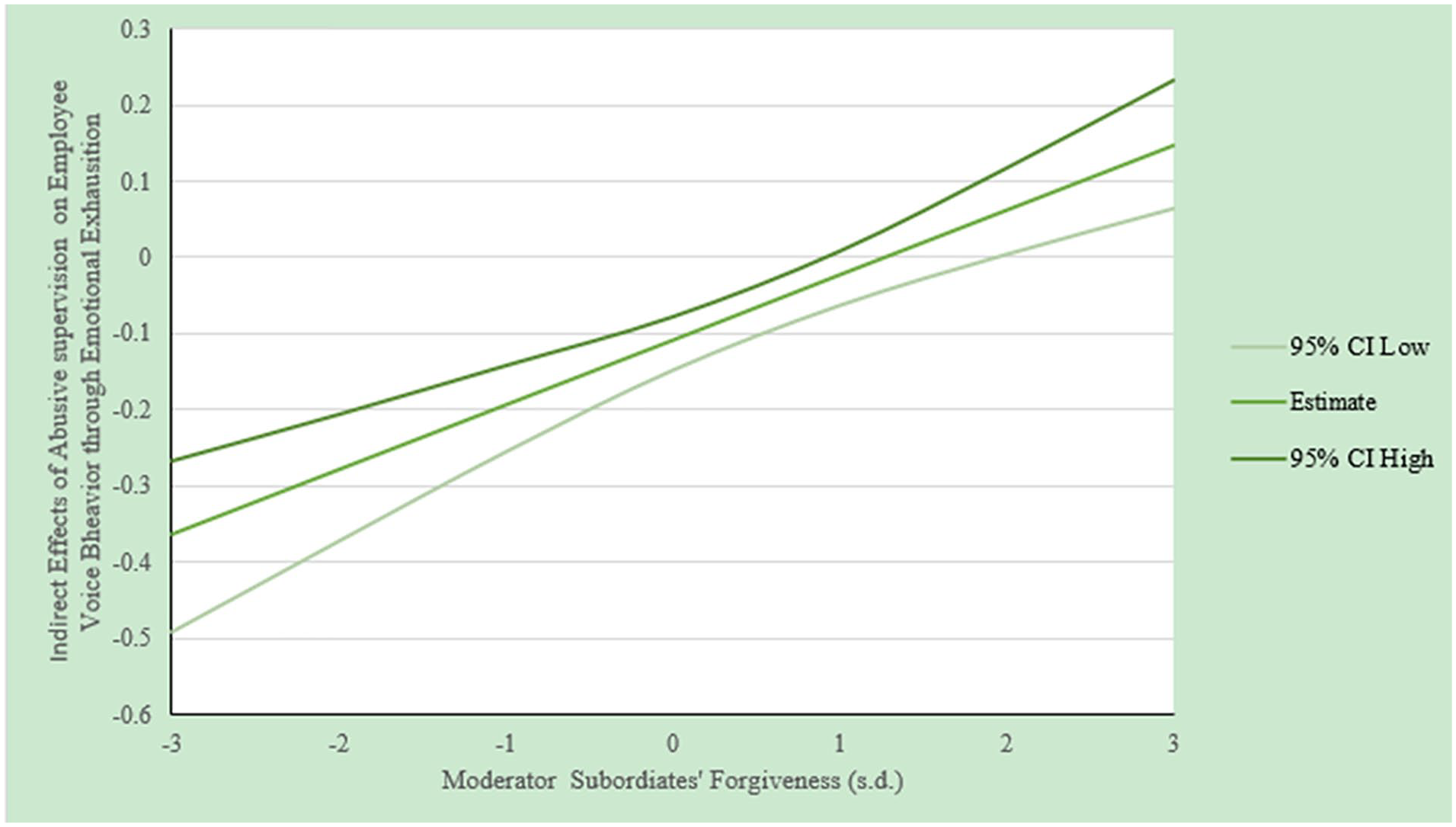
Indirect effects of abusive supervision on employees’ voice behavior through emotional exhaustion when subordinates’ forgiveness as moderator.
Table 4 reports the results of the H4b test and shows that the indirect effect of abusive supervision on employees’ voice behavior via emotional exhaustion is significant (β = −0.18, 95% CI= [−0.24, −0.13]) as communication openness maintains at a low level (1 SD below the mean). However, the mediation effect is nonsignificant (β = −0.03, 95% CI= [−0.08, 0.01]) as communication openness maintains at a high level (1 SD above the mean). Moreover, the difference in coefficients of the effect of communication openness on the main path at the low and the high level is significant (β = 0.15, 95% CI = [0.09, 0.22]). Figure 3 shows the interaction plot. Therefore, Hypothesis 4b is supported.
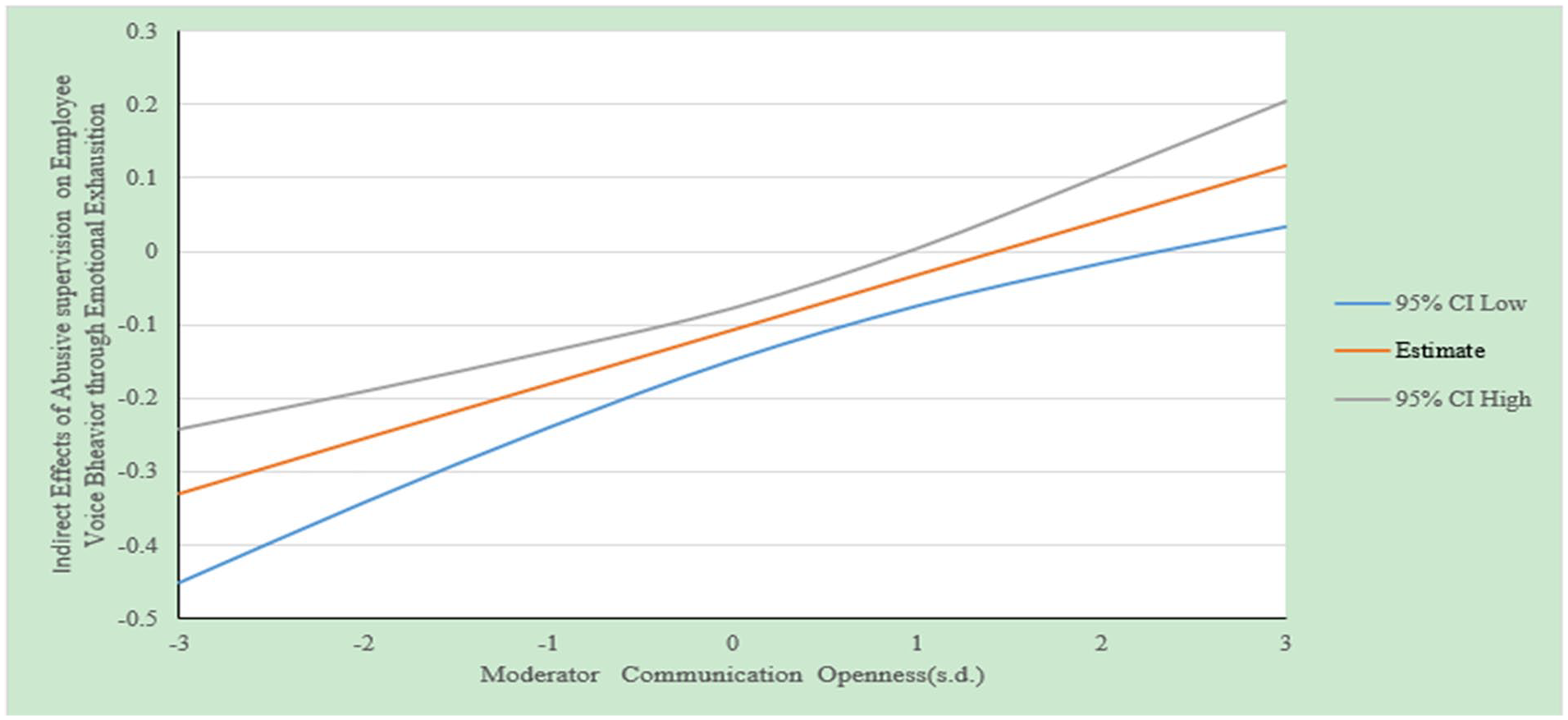
Indirect effects of abusive supervision on employees’ voice behavior through emotional exhaustion when communication openness as moderator.
Discussion
Findings
The results answer the two research aims that we brought forward. The first research aim was to explore how abusive supervision impacts voice behavior. Emotional exhaustion was adopted as a mediator on the relationship between abusive supervision and voice behavior. The results showed that as leaders frequently conduct offensive behavior, subordinates may exhaust available emotional resources to recover from the high stress and face emotional exhaustion. Furthermore, subordinates may lose more courage in investing resources into the organization to gain future resources as the extent of emotional exhaustion becomes more serious (i.e., voice behavior in this study). The second research aim was to examine the potential buffering factors for the negative effect of abusive supervision on employees’ attitudes and behavior. The results support the moderating effects of subordinates’ forgiveness and communication openness on the main path. The results showed that forgiveness, as a characteristic of emotional resource, may help subordinates recover the depression resulting from abusive supervision and overcome the emotional exhaustion. Thus, when subordinates suffer hostility from the leaders, some of them who have high-level forgiveness recover more quickly from the emotional exhaustion and tend to contribute ideas to the organizations to gain future resources for their career. Subsequently, the results show that opening communications between supervisors and subordinates may help employees recover from emotional exhaustion and try to get future resources by exchanging ideas with supervisors (i.e., voice behavior). Moreover, if opening communication becomes a conventional policy, the organizations’ climate may be more open, which may inspire employees’ commitment to the organizations and positive working performance.
Implications
The study makes some contributions in understanding the effect of abusive leadership on subordinates’ behavior. First, this study expands the study of Frieder et al. (2015) and verifies the adoption of the COR in exploring the mediator between abusive supervision and voice behavior. In this study, we regard voice behavior as a kind of resource acquisition behavior and find that emotional exhaustion is the mediator between abusive supervision and voice behavior. The findings point out the fitness of the COR in abusive leadership study and the importance of voice behavior in studying abusive leadership. Second, this study enriches the literature by exploring buffering factors toward abusive leadership (e.g., Mackey et al., 2013). We find that the negative effect of abusive supervision can be controlled and transformed into a positive outcome (i.e., voice behavior) through the interventions of forgiveness and communication openness. As the study is conducted in China, which is a high context culture, forgiveness’s positive effect shows a promising future in studying this factor in high-power distanced countries. Third, this study finds that communication openness plays a buffering role in the negative relationship between emotional exhaustion and voice behavior and abusive supervision and voice behavior. Open communication is discussed based on interactions that exist between supervisors and subordinates and also between colleagues. It is conducive to understanding the exogenous conditions under which abusive management and emotional exhaustion exert their influence.
The findings of this study can be referred to by organizations. First, the results show that high-level abusive supervision may lead to subordinates’ high-level emotional exhaustion and low-level voice behavior. It means that the less offensive behavior leaders conduct, the less stress the subordinates suffer, leading to more voice behavior. These findings are consistent with M. D. P. Lee (2008) and S. Lee et al. (2018) who argue that emotional exhaustion will reduce knowledge sharing between subordinates and supervisors. Differing from the traditional practice in hiring low-class managers, we suggest that organizations be more concerned about the harm of abusive supervision and adopt the personality test, capability in dealing with interpersonal relationships and technical abilities together into standards of employee recruitment. Open-ended questions proposed in the interviews can be adopted to observe candidates’ behaviors when they face difficulties at work (Gubrium & Holstein, 2002). During the talent training period, organizations may apply anonymous surveys to assess whether abusive supervision exists and build open conversations with subordinates to fix the problems as soon as possible. Second, the results show that high-level subordinates’ forgiveness may buffer the negative effect of abusive supervision on subordinates’ voice behavior via emotional exhaustion. Traditional recruitment mostly focuses on candidates’ knowledge, skills, and other positive personalities; however, we suggest that organizations may add forgiveness as a measurement in the recruitment stage to hire candidates who can adapt better to diverse working environments. During the early days after recruits have joined the company, organizations may try to cultivate a climate of mutual tolerance to help supervisors and subordinates to know each other better and release the depression through emotional control training (e.g., mindfulness training). Leaders may develop empathy skills to their fullest potential since empathy provide leaders with the awareness to listen, communicate with their followers. Third, the results show that high-level communication openness may buffer the negative effect of abusive supervision on subordinates’ voice behavior via emotional exhaustion. It means that the more open the communication between supervisors and subordinates are, the less emotional exhaustion the subordinates suffer, leading to more voice behavior. Therefore, we suggest that organizations may regard the importance of communication openness in the workplace and adopt various channels for employees’ freedom of expression. However, it is not easy to implement open communication channels in organizations with abusive leadership (e.g., different perceptions toward the supervisor–subordinate relationship between leaders and employees, limited communication channels, and no regulation related to communication). Although there are some barriers for organizations to implement open communication channels and strategies in an environment with violent leaders, organizational training may guide leaders to change their way of thinking and cultivate habits in communicating with employees. Subsequently, organizations can be committed to leading the organizational culture construction in different departments and constructing communication channels. These actions will establish different communication approaches (e.g., social media discussion broad, regular meetings, anonymous feedback, and group activities) to encourage interactions among colleagues, improve the openness of organizational communication, and inspire advice behaviors. As employees feel that organizations concern them, they may release their negative emotions, and show commitments and trust to the organizations, indirectly inspiring their voice behavior. As a result, the negative effects of abusive supervision on voice behavior can be alleviated.
Limitation and Future Research
A few limitations are brought to light. First, the results from a single company in China cannot reflect all the phenomena; thus, it will be hard to generalize the current results of this study. More research may be conducted in various industries and cultural contexts to test whether the conclusions are supported. Second, the causality direction cannot be perfectly ensured because the data used were cross-sectional. For example, although emotional exhaustion is detrimental to voice behavior in this study, other relationships may also exist. For example, it reveals the nonlinear relationship between emotional exhaustion and voice behavior (Qin et al., 2014). Third, in this study we merely regard the demographic variables as control variables. In fact, contextual variables and demographic variables may influence focused variables. Thus, future researchers may focus their attention on the effect of the contextual variables and adopt a longitudinal research design. Fourth, employees may hide their feelings when they completed the self-report survey because abusive supervision is more related to employees’ perceptions, which may be different from the behavior of real supervisors. Therefore, abusive management can be measured from multiple perspectives to avoid collinearity and common method bias in the future, such as collecting from subordinates or a third party. Fifth, the study does not investigate the potential interactive effect between organizational climate and individuals’ reactions, which can be a promising research direction. As employees in different organizational environments respond differently to abusive management, researchers can explore this problem from the perspective of the interaction between the environment and the people. For example, researchers may explore how abusive management affects voice behavior under the interaction between employees with different personality traits and different organizational atmospheres.
Conclusion
Abusive leadership has a negative effect on employees’ performance and job satisfaction in past scholarly research. We assert that it is time to study how to make this destructive leadership lead to positive working behaviors. Based on the COR, we proposed a series of hypotheses that regarded emotional exhaustion as a mediator, and subordinates’ forgiveness and communication openness as two moderators, to explore the mechanism of how abusive supervision influences employees’ voice behavior. Results revealed that abusive supervision would hinder voice behavior with emotional exhaustion as a mediator. Besides, the subordinates’ forgiveness and communication openness negatively moderated the main path. The findings of the study enrich the literature in voice behavior and abusive leadership and offer ideas for practitioners.
Footnotes
Acknowledgements
We would like to thank the employees and enterprises who gave support for the data collection. Subsequently, we would like to thank Dr Xuefeng Shao’s valuable suggestions on the manuscript. Finally, we also would like to thank the anonymous reviewers and editors for commenting on this paper.
Author Contributions
Conceptualization, C.L.L.; methodology, C.L.L. and S.W.S.; resources, C.L.L.; writing-original draft preparation, C.L.L. and S.W.S.; writing-review and editing, S.W.S.; C.L.L. and F.N.M.D.
Declaration of Conflicting Interests
The author(s) declared no potential conflicts of interest with respect to the research, authorship, and/or publication of this article.
Funding
The author(s) received no financial support for the research, authorship, and/or publication of this article.