




Abstract
Scientific literature has shown abundantly that teacher professional development is a crucial factor for improving the quality of education. In this frame, this research analyzes teacher professional development of in-service higher education teachers who participated in training activities. This research has five goals not previously studied simultaneously in teachers’ professional development, namely: (A) improve teachers’ conceptions and beliefs; (B) improve argumentative teaching practices; (C) analyze teachers’ reflections; (D) establish the hypothetical relationships between types of knowledge of objectives (A), (B), and (C); and (E) analyze knowledge decay after 7 years. The research can be considered as a case study developed in-depth using multiple techniques for data collection and triangulation. The findings strongly evidence a relationship between conceptions and beliefs, argumentative teaching practices, and reflections. In addition, three stages are characterized for teacher professional development, as well as the relationships between the types of knowledge for each stage.
Plain language summary
This research falls within the field of in-service higher education training of Colombian science teachers. We inquire into the professional development of three higher education teachers—AXL, MYA, PAB—which participated in several training activities developed in 2012, as well as the degree of permanence of the existing changes in 2019, 7 years after the training process. It is about a case study on the professional development of teachers. It is concluded that not all teachers change in the same way. This means that each change is representative of the stage in which the teacher is. After 7 years, a decline is identified in a teacher who had difficulties in his personal life in order to continue consolidating what he learned 7 years ago.
Keywords
Introduction
Training of in-service higher education teachers is, versus primary or secondary teachers, a much more recent challenge faced by higher education institutions in the 21st century. Many higher education institutions, aware of the need for teaching qualifications in higher education teachers (Jacob et al., 2015; Law, 2011), offer training initiatives. Nonetheless, these initiatives are sometimes unstructured, lack a research tradition, and do not have a defined theoretical framework that integrates isolated proposals (Feixas & Martínez-Usarralde, 2022).
Among the terms used to refer to teacher training, teachers’ professional development (TPD) better adjusts to the conception of teachers as teaching professionals and to the connotation of progression (Simon & Campbell, 2012). Based on this perspective, changes in teachers do not occur linearly, but rather as a process of constructive reorganization of their knowledge and teaching practice (Vanassche & Kelchtermans, 2014).
TPD is focused on understanding how to learn to teach, and therefore, how educational practices are transformed for the benefit of students’ comprehensive development (Avalos, 2011; King, 2014). Under this context, the process of learning to teach at a higher education level can be structured into hierarchical stages of TPD, from the most basic to the most complex (Dall’Alba & Sandberg, 2016; Kugel, 2006). Yet, it has been claimed that these stages can be characterized by a pedagogical teacher approach that progresses from (i) being self-centered to (ii) being teaching-centered, and finally (iii) being student-centered (Feixas, 2010). Often, a final stage is added, (iv) being student learning-centered, in which the teacher does not only seek the student’s short-term participation and satisfaction, but, ultimately, that their student’s continue learning and find their lessons useful.
Teaching knowledge is complex. The features that affect it include knowledge of practice (knowledge), knowledge in action (actions), and knowledge about practice (reflections) (Furlong, 2002). From this perspective, the progression in the learning-to-teach process is coupled with an improvement in conceptions and beliefs about the teaching process; a change and sophistication of their teaching strategies and practices; and a change in reflecting on their practice, a product of their own personal and professional baggage (Fraser et al., 2007).
A plethora of publications have faced problems related to TPD (Bates & Morgan, 2018; Gospodinov et al., 2020; Sprott, 2019; Srinivasacharlu, 2019). However, although there are many doubts about how teachers develop professionally (Smith, 2003), there is significant consensus that the progress between stages does not depend exclusively on age or experience, but rather on the quality of the teachers’ experiences and reflections on their practice (Sancar et al., 2021; Wallace & Loughran, 2012).
Besides, teachers exhibit knowledge decay and it is possible to forget what they have learned in weeks or years (Liu & Phelps, 2020). Some authors have mentioned that knowledge decay is an unexplored topic in the university environment (Belanger et al., 2017). Nonetheless, it is of the utmost importance to recognize that teachers themselves are responsible for their professional development (Luft & Hewson, 2014). Additionally, current TPD practices are characterized by a lack of effort to engage and motivate teachers within the community of practice, encourage them to reflect on their professional practice, and provide them with ongoing support. Moreover, research has shown that many TPD initiatives appear ineffective in supporting changes in teacher practices and student learning (Darling-Hammond et al., 2017). Indeed, TPD highlights the need to recognize the importance of teachers’ beliefs and practical knowledge and their integration in collaborative learning to ensure its success (Desimone, 2023; Ronen, 2020; Salonen & Savander-Ranne, 2015).
Considering the gap in TPD research, this work addresses the following research questions:
(A) how to improve higher education teachers’ teaching conceptions and beliefs;
(B) how to improve argumentative teaching practices;
(C) how to analyze higher education teachers’ reflections;
(D) how to establish the hypothetical relationships between the types of knowledge of objectives (A), (B), and (C);
(E) how knowledge decay occurred after 7 years. The purpose of this latter phase was to establish if the changes achieved as result of a training process, may somehow be retained over time.
Finally, as far as the authors have been able to verify, no publications have been found that relate in one single study improvements between knowledge and beliefs, teaching practices, and reflections of teachers at university level, nor the learning results of those teachers’ students to evaluate the effects of a TPD strategy.
Theoretical Framework
Teachers’ Knowledge and Beliefs
Teachers’ beliefs are the most acknowledged and valued psychological constructs for TPD. The basic underlying idea of these works is that teachers’ beliefs act as non-rational or unconscious mediators of their performance in the classroom (Nghia, 2017). They are resistant to change since they are anchored in many years of teaching practice, even as students. They are part of the culture of the institutions and of other teachers, managers, inspectors, relatives, and students, as well as of the assessment culture of both students and higher education teachers.
It is understood that teachers in higher education develop their teaching practices mediated by their conceptions and beliefs about the nature of science (NoS), the learning of science (LoS), and its teaching (ToS) (Betoret et al., 2006). Based on this perspective, assessment instruments that can be integrated into training processes and whose pretest-posttest assessment enables evaluating the learning and quality of those processes are especially relevant.
For instance, in Colombia, it is common for psychologists to be responsible for some science courses because of their strong background in statistics and research methodology. In that case, they also built beliefs related to NoS, LoS, and ToS. These beliefs need to be assessed and improved through TPD programs.
Despite that the understanding of NoS is a crucial component that might improve teaching, it has been reported that non-scientific teachers exhibit an adequate comprehension of scientific texts from multiple perspectives encompassing both scientific and social dimensions (Leung et al., 2014).
A recent publication has shown that non-science majors have an enhanced perception of NoS in comparison to science majors (Akgun & Kaya, 2020). Thus, it is plausible to claim that a TPD program might be useful for understanding how NoS can be integrated to science teaching for both science and non-science teachers (Wheeler et al., 2019).
Argumentative Teaching Practices
Learning science nowadays is participating in scientific practices and therefore in argumentation. Argumentation implies choosing, interpreting, and using evidence to persuade with this reasoning those who think differently. The analysis of classroom discourse has proven to be a good resource for investigating teachers’ teaching practices from their verbal interaction perspective (what do teachers say in their classes, how do they encourage argumentation among students, how do students participate) (Jiménez-Aleixandre & de Bustamante, 2003; Soysal & Soysal, 2022). Some authors claim that the argumentative discourse that a teacher uses in the classroom may favor, to a lesser or greater extent, students’ argumentative reasoning (Chen et al., 2017). Nonetheless, the development of argumentative activities poses an important challenge for teachers. To address this challenge, teacher training must foster teaching in an intelligent, flexible, resourceful way, rather than by applying common institutional routines (Zohar, 2007).
Teachers’ Reflections
In this research, teachers are conceived as reflective professionals (Feixas & Euler, 2013), capable of making the best decisions for their teaching practices, through activities in which they can share and socialize classroom innovations with other peers (Feixas et al., 2018, 2020; Feixas & Zellweger, 2019). Reflective practice is a training methodology that begins with each teacher’s experience and context, and involves them reflecting on their practice. For many authors (Hanuscin, 2017; Joglar & Rojas, 2019; Lotter & Miller, 2017), it can become a powerful tool as a training methodology that aspires to TPD.
It is necessary to focus on certain aspects of the teaching process, on a specific reflection objective, which may be a case, a practical professional problem, a didactic element, etc., or any aspect sought to be improved in TPD, based on their actual needs. This research focused on increasing the argumentative reasoning of both teachers and students.
Relationships Between Knowledge and Beliefs, Reflections, and Teaching Practices
The influence of teaching knowledge on student learning has been a recurring concern in research on TPD (Diamond et al., 2014). Subsequently, the analysis of teaching practice was incorporated into those studies (Gess-Newsome et al., 2017), whose relationship to pedagogical knowledge has also been a constant in TPD studies. Studies suggest an intense relationship between general pedagogical knowledge and teaching practice. These relationships have found teacher’s academic knowledge explains an important part of students’ academic performance. For Liepertz and Borowski (2019), it is the content’s structural interconnections that are related to students’ academic performance.
In a more qualitative line, other works (Nilsson & Karlsson, 2018; Ni Shuilleabhain & Seery, 2017) use support tools and reflection to improve TPD and, ultimately, the acquisition of new pedagogical practices. However, there are no studies that simultaneously attempt to relate teachers’ knowledge and beliefs, teaching practices, and reflections; there are even fewer on higher education teachers. These studies are important to learn more about the stages of TPD in higher education institutions and to aid in focusing on the initial training of future teachers. Figure 1 synthesizes the teaching knowledge that converges in TPD in this research.
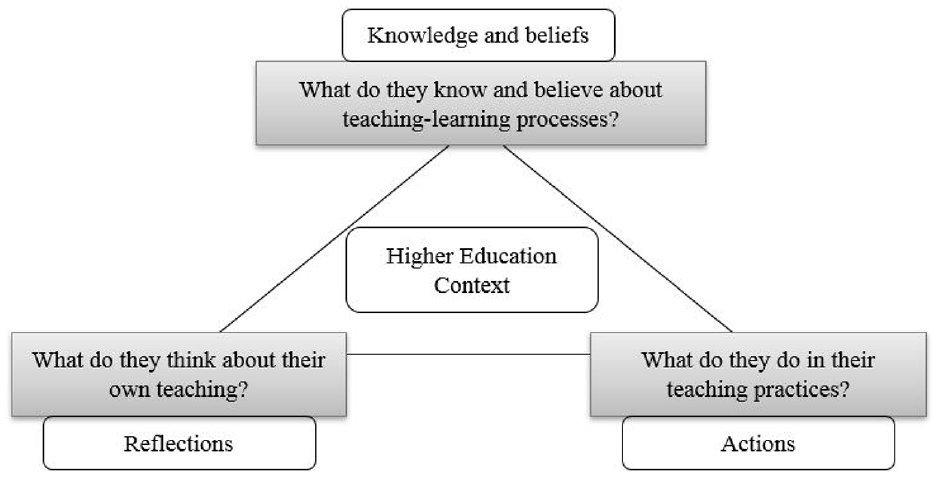
Vertices of the professional development of higher education teachers.
Methodology
This research was carried out in 2012 at a Colombian university, whose management endorsed the training project and called for participating teachers. The authors assessed the degree of permanence of the changes brought about by the training process in 2019. It is a case study in which three university teachers taught scientific research methodology. The collected information is classified as mixed (qualitative and quantitative). Specifically, conceptions and beliefs are analyzed through a quantitative methodology. However, a qualitative methodology was used to analyze teaching practices and reflections.
Participants
The participants were three teachers, whose pseudonyms are: AXL, PAB, and MYA. The first two are men and the last one, is a woman. They volunteered.
AXL is a psychologist. In 2012, he was 29 years old and had 2 years of teaching experience at the Corporación Universitaria Iberoamericana (Uibero), teaching the scientific research methodology course to health sciences, business, finance, and logistics students. From 2012 to 2019, he continued at another higher education institution and completed a master’s degree in psychology. In total, he has 9 years of higher education teaching experience.
PAB has a teaching degree in mathematics (in Colombia, a teaching degree means completing studies to specifically be able to teach). In 2012, he was 31 years old and had already obtained a master’s in education. He taught two mathematics and statistics courses at the Uibero and still works there. Since then, he has continued expanding his pedagogical and didactic training. He has 9 years of higher education teaching experience.
MYA is a psychologist. In 2012, she was 30 years old and had a master’s degree in psychology. She had been teaching for 7 years, all of them at the Uibero, where she taught scientific research methodology. She ended her work as a higher education teacher in 2014, and since then, she worked in a school as a psycho-pedagogical counsellor. In 2019, she had just applied for indefinite disability leave, after 2 years of working intermittently due to health problems.
Training Strategies (Year 2012)
The training strategies were divided into two parts. The first one was a course on conceptions and beliefs about NoS, LoS, and ToS (hereinafter CBNLT Course). Duration: 42 hr. Participants: Nine teachers from the Department of Basic Sciences.
The second part was supervision. It was proposed to improve teaching practice through reflection and argumentation (hereinafter Supervision). Duration: 12 hr. Participants: AXL, MYA, and PAB. These three teachers were also participating in the CBNLT course.
Both processes were developed simultaneously during the first half of 2012, as shown in Figure 2.
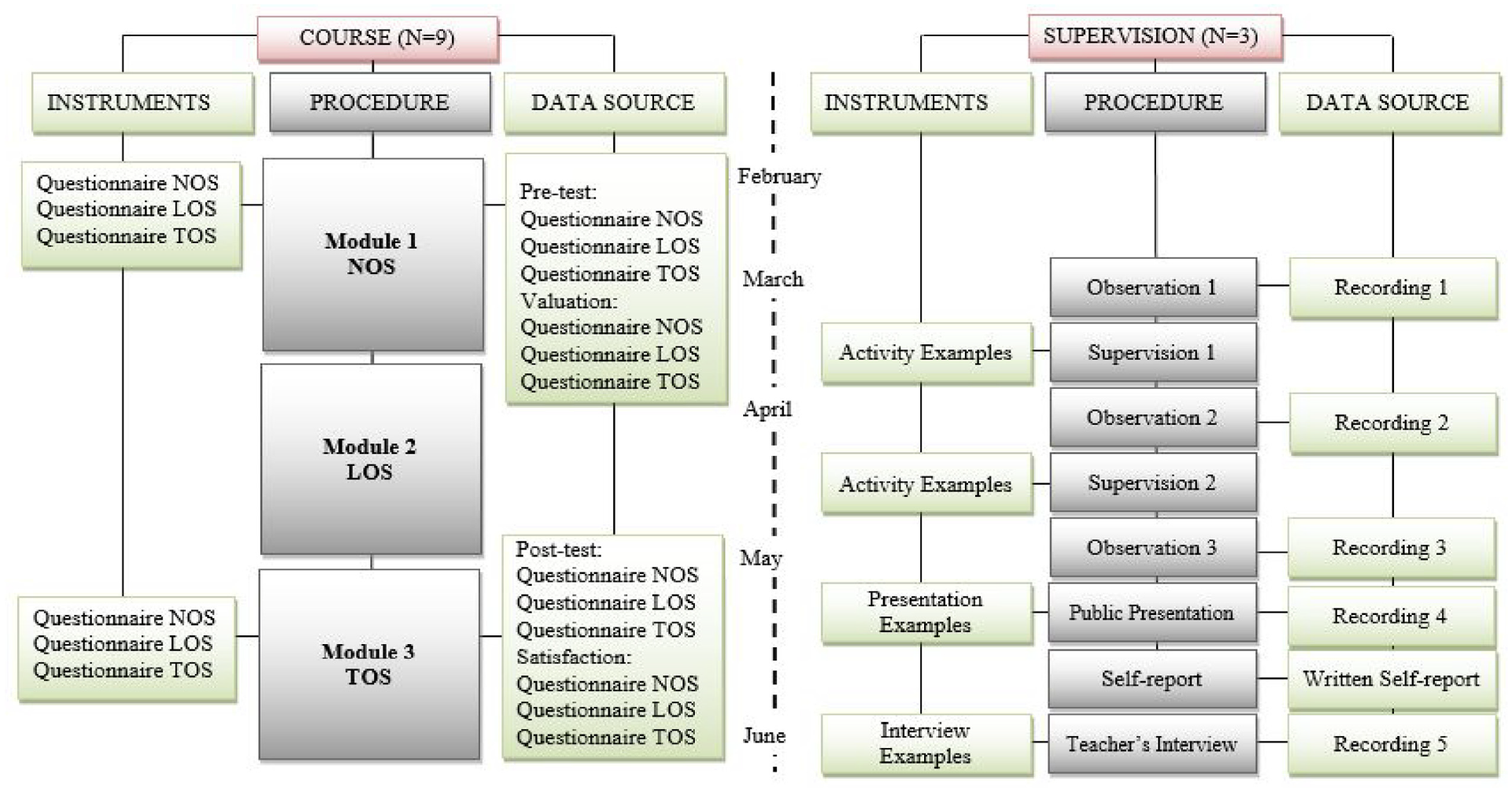
Training process outline (CBNLT course and supervision) in 2012.
The CBNLT course is outlined on the left part of Figure 2 in three columns: the instruments used, the procedure followed, and the experimental data sources. The activities designed in each module to assess NoS, LoS, and ToS were taken and adapted from previous works (Marín & Benarroch, 2009, 2010; Benarroch & Marín, 2011).
The supervision was a training support process carried out by one of the authors with three volunteer teachers: AXL, MYA, and PAB. It consisted of eight successive activities, carried out individually by each teacher. In order to avoid alterations in the class schedule, there were not changes in the content of the subject and the activities were designed for teaching the topic that was planned originally. The activities were:
Observation 1: the supervisor made a non-participating observation and an audio recording of a teacher’s usual class session, on a date previously agreed with the teacher.
Supervision 1: after observation 1, the supervisor discussed with the teacher what aspects the latter would like to improve for the next session, suggesting, for example, listen to students more; promote working in small groups; improve the level of reflexivity in student interventions, etc. On the other hand, the supervisor helped the teacher design an activity to promote student argumentation.
Observation 2: the supervisor made the second observation in the classroom (and records an audio) where the teacher implemented the argumentative activity with students.
Supervision 2: the supervisor commented on the positive aspects found in the second observation regarding the previous one, but also highlighted elements that could be further improved. This was intended to make teachers more aware of their teaching actions. At the same time, adjustments were proposed to the first argumentative activity to be implemented in the next –second– argumentative activity.
Observation 3: the teacher implemented the second argumentative activity, and the supervisor made the third non-participating observation, once again recording audio of the session.
Public presentation: teachers presented their opinions and perceptions about the results of their training process. Each teacher had 20 min to present and 10 min for discussion or debate.
Self-report: the supervisor invited the three teachers to describe and reflect, in writing, on their training processes, their main achievements and difficulties, as well as the influences that, to the best of their knowledge, they have had on their students’ academic results.
Individual Interview: teachers reflected on the supervision training process in a semi-structured interview. It was the process’s final activity. Some of the interview questions were:
What did you think about the course? What about the supervision?
Of all the reflections that emerged during the course and supervision, which one affected you the most?
What can you tell me about the argumentative activities that you designed in the classroom? Are they easy or difficult to design? Are they useful or not in improving students’ learning?
What weaknesses or obstacles did you identify throughout the entire training process?
CBNLT Course Instruments
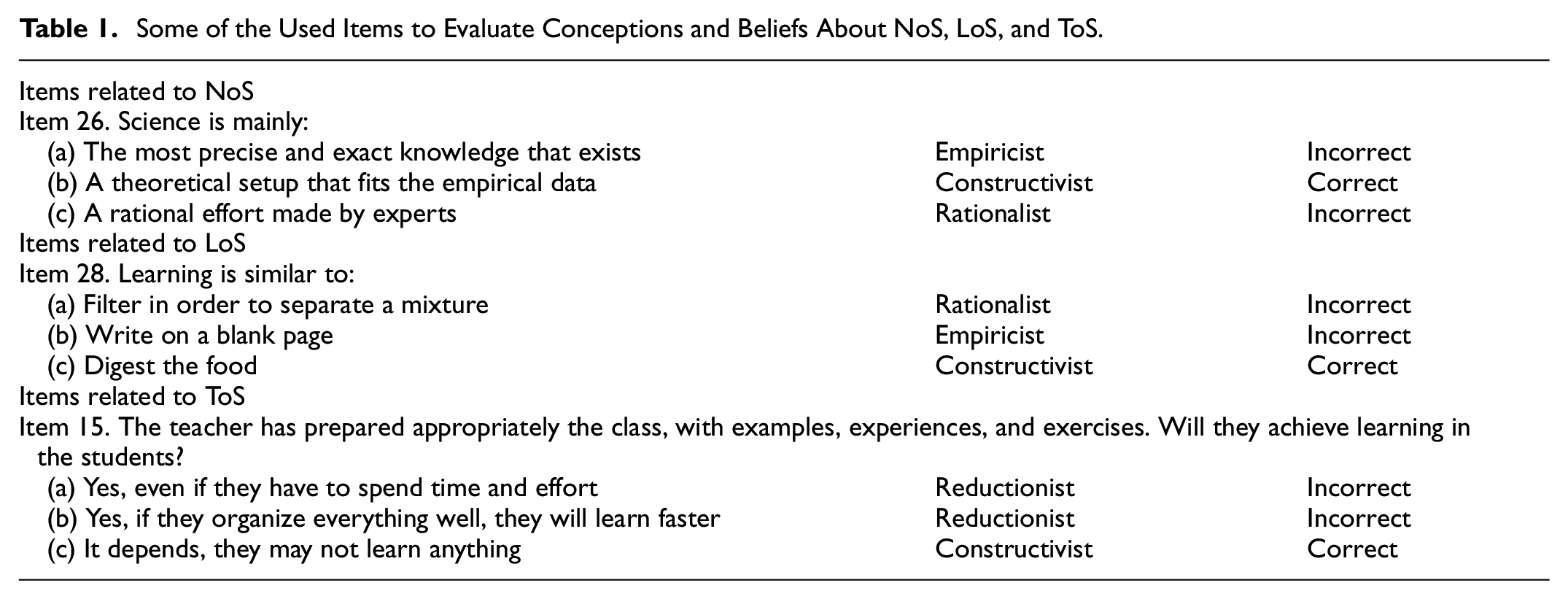
The CBNLT course was assessed using questionnaires on the nature of science (NoS) (Marin & Benarroch, 2009), learning of science (LoS) (Marín & Benarroch, 2010), and teaching of science (ToS) (Benarroch & Marín, 2011), which teachers completed before and after the course. Each instrument was built with multiple-choice items; specifically, both the NoS and LoS questionnaires consisted of 40 items, while the ToS questionnaire consisted of 35 items. In all cases, the constructivist vision was used to formulate the correct option, and empiricist, rationalist, realistic, or reductionist positions were used as distractors. These questionnaires become a fundamental tool in this research to identify progress in the conceptions and beliefs of higher education teachers. Table 1 shows an item from each questionnaire as an example.
Some of the Used Items to Evaluate Conceptions and Beliefs About NoS, LoS, and ToS.
First-Order Instruments in Supervision (Year 2012)
The physical documents obtained from the procedures used to obtain data in the Supervision training process were referred to as first-order instruments. Six documents were collected for AXL, identified as P1-P6; six for PAB (P7-P12); and another six for MYA (P13-P18). AXL’s are:
P1: Transcript of Professor AXL’s observation 1
P2: Transcript of Professor AXL’s observation 2
P3: Transcript of Professor AXL’s observation 3
P4: Transcript of Professor AXL’s public presentation
P5: Professor AXL’s self-report
P6: Transcript of Professor AXL’s interview
The software used to classify these documents was Atlas.ti 7.0. The Atlas.ti 7.0 nomenclature is considered to identify the location of the quotes within the list of physical documents. For example, if a citation is [P 7: 6 (21:23)], this means it is citation number 6 of document 7 and it begins on paragraph 21 and ends at paragraph 23.
System of Categories to Analyze Teaching Practice (OC: Observational Codes)
To analyze the teaching practice, the category system shown in Table 2 was used. In it, two large groups of codes to analyze teaching practice are distinguished, called PPAR (promoting student participation), which includes the expressions where the teacher encourages their students to participate, and SPAR (student participation), which collects the actual participation of students.
Category System Used to Analyze Teaching Practice.

Within each group, a distinction has been made between argumentative and non-argumentative interventions (Jiménez-Aleixandre, 2011). Table 2 shows the code system used to analyze teaching practice with Atlas.ti.
The documents were analyzed with this system of categories; P1, P2, and P3 for AXL; P7, P8, and P9 for PAB; and P13, P14, and P15 for MYA, as well as the results of the transcripts of their classroom observations. The analysis made it possible to reach the Observational Codes (OC) that describe the teacher’s teaching practice.
Category System to Analyze Teacher Reflection (RC: Reflective Codes)
Unlike the previous section where we found a deductive (and therefore much more coherent) category system to analyze teachers reflection, this one uses an inductive category system, as shown in Table 3. We identified 320 codes grouped into six categories, five of which were relevant to identify a common base structure to explain all three teachers’ reflection process. These categories were: ACCH (Acknowledging changes); SACH (Satisfaction with changes); INCH (Intentions of permanence of changes); ASCH (Assessments of changes); and AOBS (Acknowledging obstacles).
Category System Used to Analyze the Teacher’s Reflection.

The documents were analyzed with this system of categories; P4, P5, and P6 for AXL; P10, P11, and P12 for PAB; and P16, P17, and P18 for MYA, as well as public presentation results, transcripts, self-reports, and interviews. Thus, resulting in the Reflective Codes (RC) that describe each teacher’s reflection.
Assessment of the Permanence of the Changes (Year 2019)
In 2019 AXL, MYA, and PAB were contacted again, and they were asked to re-engage in this research. During the interval between 2012 and 2019, the authors of this paper did not have any contact whatsoever with the teachers, who, once again and voluntarily, expressed their acceptance and commitment to participate.
It is relevant to mention that knowledge decay may occur for years or even months after the TPD. There is no consensus among the academic community on the most relevant time in years that may provide results on this topic.
Specifically, the three teachers were asked to design an argumentative activity, using the conceptual and methodological benchmarks learned in 2012. The activities carried out in 2019 were: Observation (typified as number 4), and Individual interview (typified as interview 2) with the next questions:
(1) What do you remember about the supervision process we conducted in 2012?
(2) What do you remember about the argumentation? Have you designed argumentative activities after supervision again? How has that process of working on argumentation in the classroom been?
(3) How is your teaching practice now? How are your students learning now? How are your teachings?
Results
The results are organized into five sections. The first four were for 2012 and the last for 2019.
Results about the conceptions and beliefs about NoS, LoS, and ToS.
Results of argumentative teaching practice.
Results referring to reflecting on practice.
The analysis of the relationships between conceptions and beliefs, teaching practice, and reflections.
Results over time in 2019.
Conceptions and Beliefs About NoS, LoS, and ToS
Table 4 shows the number of items answered correctly by AXL, PAB, and MYA in the three questionnaires on NoS, LoS, and ToS, before starting the CBNLT course of the training process (pre-test), once it ended (posttest), as well as the progress they experienced, estimated as the differences between post-test and pre-test. AXL is the teacher who obtained the lowest results (weighted average of 16.8 and 22.7 in the pre-test and posttest, respectively), whereas PAB had the highest results (an average of 23.8 and 28.4 in the pre-test and posttest, respectively). MYA maintained intermediate results before and after the training process (an average of 20.5 in the pre-test and 25.3 in the posttest).
Number of Correct Items in NoS, LoS, and ToS (Pre-test and Post-test).

Note. The maximum number of items in NoS (Nature of Science) and in LoS (Learning of Science) is 40, while in ToS (Teaching of Science) it is 35.
The progress ranges experienced by PAB and MYA are quantitatively similar to each other and somewhat lower than those experienced by AXL. This can be verified by comparing the differences between the weighted averages between the posttest and pre-test. In the case of PAB and MYA, the differences between these means are 4.6 and 4.8, respectively, versus the differences between AXL that are 5.9.
When comparing the improvements between contexts, there is no constant trend.
Results of Argumentative Teaching Practice
Table 5 summarizes the frequency of the observational codes—for each of the three observations and the total—of each teacher. The meaning of the codes can be found in Table 2.
Frequency of Observational Codes (OC) Obtained from Teaching Practice.
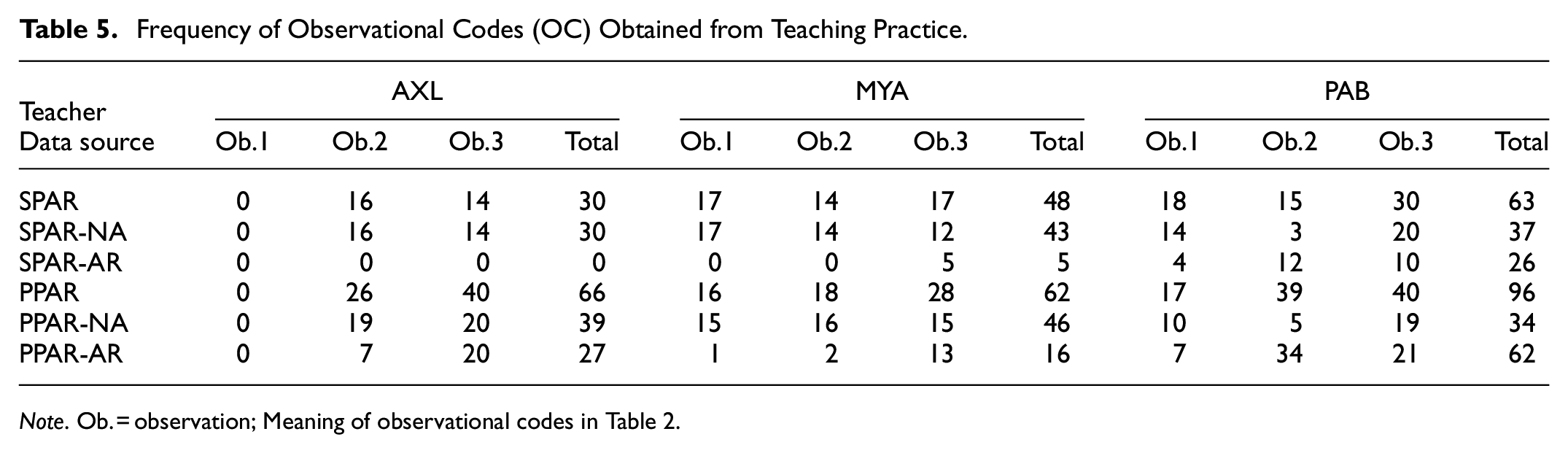
Note. Ob. = observation; Meaning of observational codes in Table 2.
AXL is a teacher who simply did not interact with the student in the first observation (all OC are null). His class was like a monologue in which there was a lack of student participation and no attempt from the teacher of promoting that participation. Although null in the first observation, the promotion of participation by AXL increased in the following ones. Table 5 shows that the frequency of code PPAR in the first observation started at 0, increased to 26, and ended at 40 in the third observation. In the second observation, the type of promotion was still fundamentally non-argumentative. In the third observation, he promoted argumentative and non-argumentative participation, as shown by the frequencies of the codes PPAR-NA and PPAR-AR, which reached an individual value of 20. Regarding the participation of their students, SPAR codes skyrocket in the second and third observations. However, the mentioned participation is not argumentative. In fact, in Table 5, all SPAR codes are of the SPAR-NA type, while the SPAR-AR group has a null frequency during the three observations.
For MYA, the SPAR group did not show a great variation throughout the observations (Table 5); this is, students, participate in their classes from the beginning of the supervision process. This participation was not argumentative until the third observation, in which the PARE-AR group reached a value of 5.
Likewise, the analysis of the PPAR group indicates that MYA is a teacher who interacted with her students from the first observation, although she did not promote argumentation until the third observation where the PPAR-AR group reached a frequency of 13 (Table 5).
Regarding PAB, the high number of SPAR codes in the three observations indicates that their students participated in the class even before the supervision process. Nonetheless, it is evident that this participation especially increased at the end of the process (see in Table 5 that the SPAR frequency started at 18 in the first observation and ended at 30 in the third observation).
It is possible to identify that student interventions engaged in argumentation as of the first observation, although this type of intervention grows a lot through the training process, which is verified with the SPAR-AR code that goes from having a frequency of 4 in the first observation to 10 in the third.
Something similar can be said of PAB’s promoting students to participate (PPAR group), which is already quite typical from the first observation, although it increases throughout the process (the frequency of PPAR in the first observation starts at 17 and ends at 40 in the third observation). This teacher promoted non-argumentative participation, PPAR-NA, which is the hardest to achieve, and argumentative participation, PPAR-AR, which shows. a greater frequency in the second observation than in the first and third ones.
Results of Reflecting on Practice
Table 6 synthesizes the frequencies of the reflective codes obtained from the three reflective data sources programmed in the supervision: public presentation, self-report, and interview.
Frequency of Reflective Codes (RC).

Note. P.P. = public presentation; S.R. = self-report; Int. = interview; Meaning of codes in Table 3.
Based on the relationships between reflective codes, it is possible to synthesize each teacher’s reflection:
For AXL, the changes in his teaching strategies (ACCH) reinforced by the satisfaction detected in students (SACH), led him to hold firm intentions of change (INCH). To him, the obstacles (AOBS) overcome (related to his concepts and skills) and to be overcome (“I know I have this weakness from my lack of educational training, as a teacher”), are less important than students’ satisfaction.
MYA, like AXL, acknowledges the changes she has experienced in her teaching strategies (ACCH), accompanied in this case by the fact that her students’ academic results were better (ASCH), which also encouraged her intentions of change for the future (INCH). This teacher also identified obstacles (AOBS) she had to face (related to her usual way of teaching and her students’ lack of motivation) but considered herself ready to deal with them.
PAB also acknowledged the changes in his teaching strategies throughout the training process (ACCH), his satisfaction (SACH), and the better academic outcomes from his students (ASCH). However, for this teacher, the new argumentation teaching models involved much more work and greater effort than the expository model, thus constituting an obstacle (AOBS) which he rated more highly than previous satisfaction. Consequently, he displayed no intention to change in terms of his professional future (no INCH codes).
Relationships Between Conceptions and Beliefs, Teaching Practice, and Reflections
Figure 3 shows the quantitative results obtained in this research. In it, the results of each teacher are distinguished by colors: blue for AXL, green for MYA, and pink for PAB. On the left side of the figure, a Cartesian diagram is shown where:
On the vertical axis, the conceptions and beliefs have been represented through the weighted average, value obtained from the questionnaires in their pretest and posttest instances.
On the horizontal axis, the frequency of the observational code, the CO called SPAR-AR, was adopted as the most representative variable of achievement, which includes the argumentative participation of students in the classroom, in the first and third instances of observation.
On the right side, the most outstanding reflective codes for each teacher are collected.
AXL’s progress is represented by the vertical blue line in Figure 3, which represents his high increase in conceptions and beliefs but his null result in terms of his students’ argumentative participation. However, his reflections indicate his high intentions to change.

Relationships between conceptions and beliefs, teaching practices and reflections of the three teachers in 2012. Reflective codes: ACCH = acknowledging teachers’ changes; SACH = satisfied with change; ASCH = assessments of change; AOBS = acknowledging obstacles; INCH = indications of the permanence of change.
PAB is represented in his training change by the pink line in Figure 3, whose rectangular graphic space is completely separated from that of AXL. The reason for this is that since the beginning of the training process, PAB already had a good level of conceptions and beliefs and promoted his students’ argumentative participation. The main characteristic of his reflections is that he is perfectly aware of the extra work involved in argumentative teaching based on problems, and he considers that the university does not deploy sufficient aids and rewards to carry it out. Therefore, he lacks intentions to change.
MYA’s progress is symbolized by the green rectangle. This teacher makes progress in her conceptions and beliefs, as well as in the ability to promote argumentation in her students. In her reflections, she also shows intentions to change (INCH), associated with her teaching strategies (ACCH), although less frequently than AXL, since MYA is more aware of what is being requested and the obstacles it entails (AOBS).
Results Over Time Until 2019
As stated in the methodological section, in 2019, teachers are asked to (a) complete the questionnaires again in retest instances; (b) design a new argumentative class to attend, observe and record it; and (c) agree to be interviewed again. Table 7 shows the results of the questionnaires in 2019 versus those of 2012 in the form of pre-test and post-test. It is important to highlight the rise that AXL obtained in the three questionnaires. However, MYA has a strong setback and obtains a score in some cases even lower than that obtained in the 2012 pre-test. Finally, PAB’s results are quite like those of the 2012 post-test.
Number of Correct Items in NoS, LoS, and ToS (in 2012 and 2019).
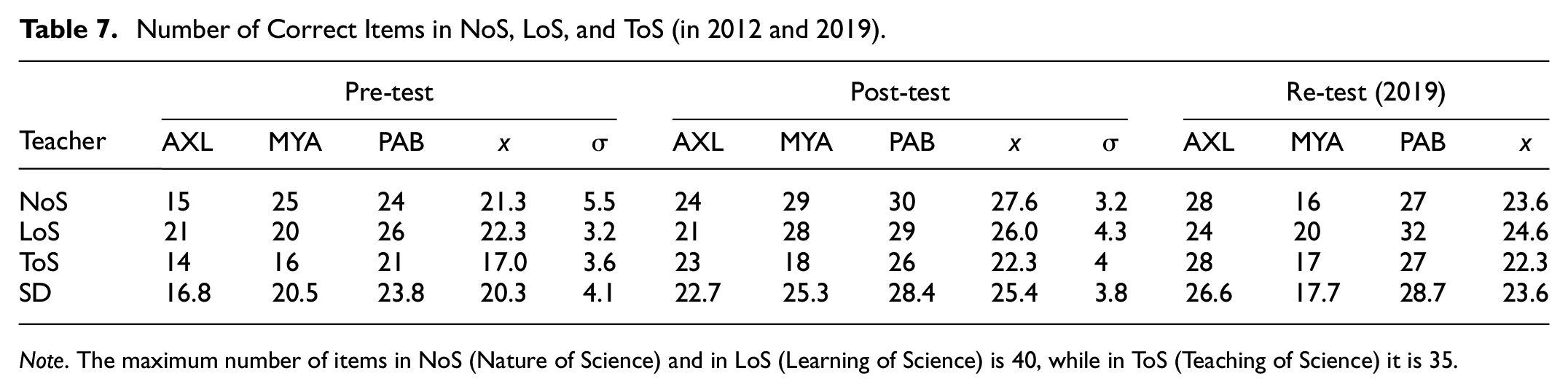
Note. The maximum number of items in NoS (Nature of Science) and in LoS (Learning of Science) is 40, while in ToS (Teaching of Science) it is 35.
Table 8 summarizes the code frequencies of the new observations made in 2019, identified as observation 4, against those already made in 2012. In the case of AXL, the class session was quite similar to the last one in 2012, although he achieves a higher frequency of argumentative student participations (the SPAR-AR code reaches a value of 7 in this new class session). However, MYA’s class is much more interactive than the ones carried out in 2012, although it is an interaction that does not promote much argumentative participation. Regarding PAB, the class is also much more interactive than in 2012 and, in this case, he does promote argumentative participation and achieves it partially (PPAR-AR code with a frequency of 76 and SPAR-AR with a frequency of 11 in Table 8).
Frequency of Observational Codes (OC) Including the Observation Made in 2019.

Note: Ob: Observation; Meaning of observational codes in Table 2.
The RC frequencies obtained from the classification of the interviews conducted in 2019 are summarized in Table 9, against those obtained in 2012. There are a couple of aspects worth highlighting:
(1) The ASCH codes are indications of pedagogical maturity and teacher decentralization since they imply the assessment of changes in terms of the benefits they provide to students. In 2019, all three teachers have ASCH codes. In the case of AXL, this almost did not occur in 2012 (0.7%). MYA, in turn, already had a considerable presence in 2012 (8.9%) and this frequency decreases in 2019 (down to 3.1%). PAB already had ASCH codes in 2012 (10.5%) and his frequency skyrocketed in 2019 (23.8%).
(2) Regarding the INCH codes, it was shown that AXL has a higher proportion than MYA, and MYA got higher scores than PAB.
Frequency of Reflective Codes Obtained in 2019, Against those Obtained in 2012.

Note. Meaning of reflective codes in Table 3.
Figure 4 summarizes the quantitative results expanded to 2019. On the left side of the Cartesian plane, the continuous lines correspond to the 2012 changes and the dashed lines to those reached in 2019. On the right-hand side, the proportions of the Reflective Codes are shown.

Relationships between conceptions and beliefs, teaching practices and reflections of the three teachers in 2012 (continuous lines) and 2019 (dashed lines). Reflective codes: ACCH = acknowledging teacher’s changes; SACH = satisfied with change; ASCH = assessments of change; AOBS = acknowledging obstacles; INCH = indications of the permanence of change.
Discussion and Conclusions
The results show that the three teachers make progress thanks to the training process carried out in 2012. This progress impacts their conceptions and beliefs, their teaching practices, and the reflective processes that accompanied them in their changes. The strong relationship between these forms of knowledge is confirmed (Fraser et al., 2007; Gess-Newsome et al., 2017). Other researchers have asserted that this progress is specific to each teacher’s unique personal and professional characteristics (Wallace & Loughran, 2012). In our case, two teachers, AXL and PAB, have certain similar personal and professional characteristics (at least, in age, number of years of professional experience, and centers where they have worked) but the latter’s pedagogical maturity (better results in conceptions and beliefs, teaching practices and reflections) allow him to ‘go further’ and obtain better results even before starting the training process.
AXL, in 2012 (Figure 3), improved his conceptions and beliefs, as well as his teaching practices that become much more interactive, although he did not achieve his students’ argumentative participations; his reflections indicated an enormous satisfaction with the changes, as well as a strong optimism with frequent intentions to change. In 2019 (Figure 4), AXL performed better than in 2012, both in his conceptions and beliefs, as well as in his students’ argumentative participations. His reflections also indicated greater pedagogical maturity, as they have ASCH codes, that are evaluators of their students’ changes. These improvements obtained over time, in the case of AXL, may be because the changes in 2012 were significant and he has participated in further training during the time elapsed.
PAB, in 2012 (Figure 3), began his training process with good results both in conceptions and beliefs, as well as in his teaching practices, where he already fostered—and achieved—his students’ argumentative participation. His reflections indicated a high pedagogical maturity—with the presence of ASCH codes. Moreover, he is aware that these more advanced stages of TPD requires a workload and therefore, he lacks indications to change. Although he continues training during the period elapsed up to 2019, his results in this last year (Figure 4), both in conceptions and beliefs and in teaching practices and reflections did not differ very much from those in 2012. Everything indicates that in more advanced stages of TPD, changes are costly and should be accompanied by acknowledgments, rewards, and/or remuneration from the higher education institution.
MYA, in 2012 (Figure 3), showed intermediate results between the other two teachers, both in her conceptions and beliefs and her teaching practices. In this last sense, at the end of the training process, she promoted and achieved classes with argumentative participation from her students. Regarding her reflections, they indicated a high degree of awareness of her changes, as well as the positive assessments she conducts of her student’s learning, which leads her to have intentions to change over time. However, in 2019 (Figure 4), MYA obtained worse results in conceptions and beliefs as well as in the argumentative participation of her students. Regarding her reflections, she also showed a decrease in the proportion of the ASCH codes. These codes are indicative of pedagogical maturity. There seems to be no doubt that these anomalous results in 2019 are a consequence of the blockage that this teacher is experiencing because of her personal health problems.
These results indicated that learning to teach, like any other type of learning, is a process that takes place with progress, corrections, trial and error, and other “backward” processes (Desimone, 2023; Feixas, 2010; Feixas & Martínez-Usarralde, 2022). When this learning-to-teach focuses on argumentative ability, the teacher can favor it through their way of teaching through argumentation (Chen et al., 2017). Setbacks can have many reasons (McNeill et al., 2018). In this research, MYA has a personal motive, but it should be verified whether others, such as institutional pressures or those from other peers, could cause the same setbacks (Liu & Phelps, 2020; Stewart, 2014).
The most important question that we highlight in this section is the legitimacy of the generalization of their results; specifically, those related to the stages of argumentative learning associated with TPD. It is not a question of generalizing the results from a case study, but whether the theoretical model has successfully led to them (Giménez, 2012). The levels of progression of argumentation learning in TPD have been characterized by calibrating the changes of these three teachers as progressive stages of TPD. There are four levels and three of them are stages of change. Each stage is represented by one of the participants (Figure 5).
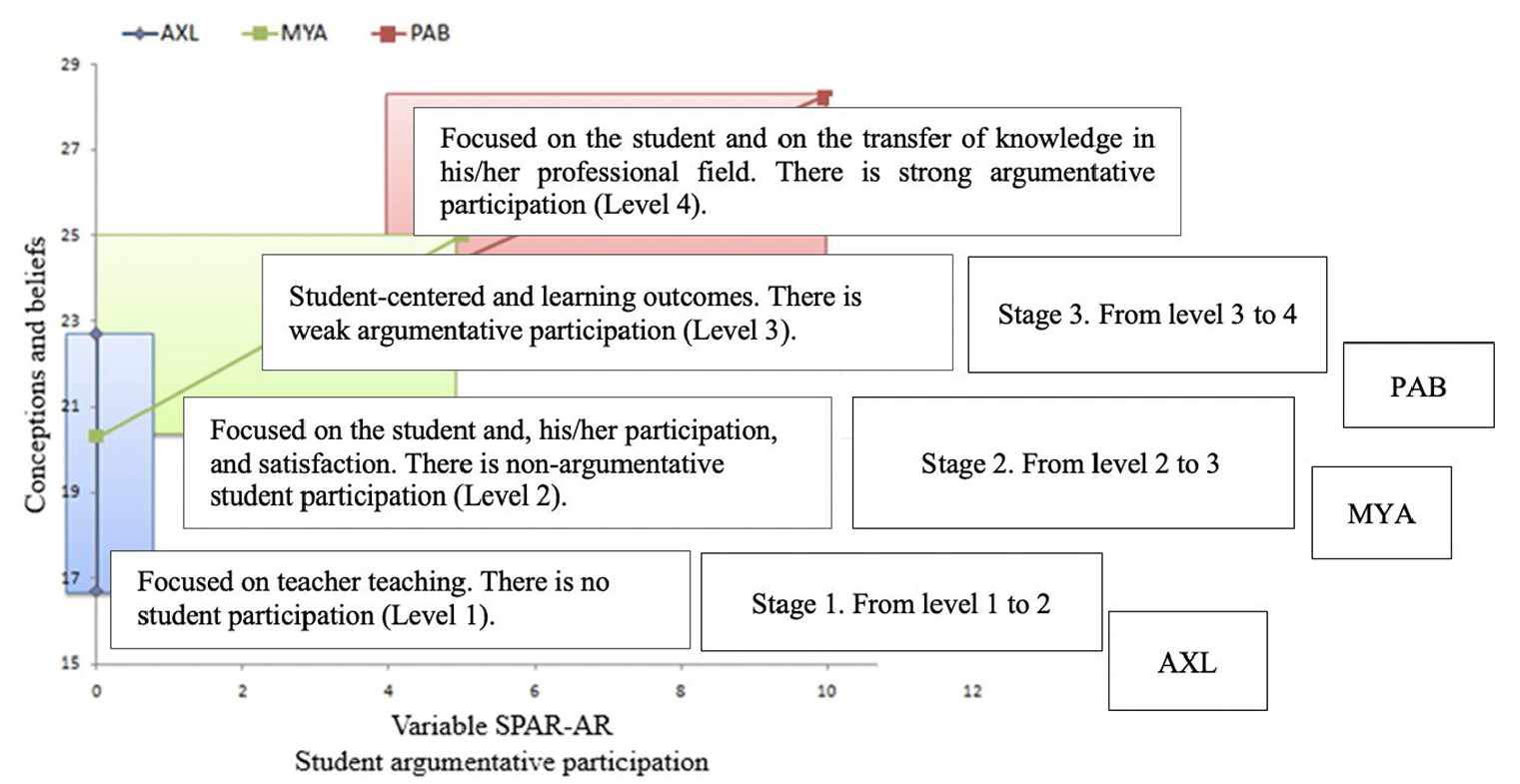
Progression stages for TPD.
The first stage, represented by AXL, involves a change from a teacher-centered teaching model, to a model centered on student participation and satisfaction. In it, interactive teaching is achieved, which produces enormous satisfaction for both students and the teacher, who shows important intentions to change. It is a rapid change that does not require excessive effort. At this stage, student argumentation is not achieved. The mediating factors facilitating change are of a conceptual and procedural type, in other words, knowledge and beliefs that substantiate the action of teaching science.
In the second stage, represented by MYA, progress was made from an interactive teaching model centered on the student (final model of the previous stage—see Figure 5) to another that favors certain weak argumentative strategies. The teacher begins to be less concerned about students’ satisfaction and participation and more concerned about their better academic results. It is a slower change than the previous one because it implies greater obstacles versus non-immediate benefits. At this stage, student argumentation is achieved. The mediating factors facilitating change are mainly procedural since it is necessary to develop new teaching strategies involving novel action schemes.
Finally, the third stage characterized by PAB, represents the change from an argumentative model centered on students’ academic results (the final model of the previous stage). This model could be characterized as a weak argumentative model. As can be expected, the purpose of TPD is promote another strong argumentative model centered on achieving the student knowledge to their future professional field. In other words, that the teacher’s teachings are useful for their students in an uncertain future. The mediating factors facilitating change are mainly of an attitudinal type, given that the teachers who face this change already have the necessary knowledge and skills. Moreover, they have varied and flexible action schemes, and are perfectly aware of the effort involved in teaching these characteristics, which is why, without external rewards (professional assessments, economic considerations, etc.), they are not willing to face it continuously.
Therefore, this study supports that the teacher’s professional development can be attributed, at least in part, to their initial characteristics, and that progress in the three participants, AXL, MYA, and PAB, are representative of their stages of teacher professional development (Figure 5). That is, they do not all change in the same way (Feixas, 2010).
AXL undergoes a change that go from levels 1 to 2 (Figure 5). After this change, he feels enormously satisfied and optimistic, as he is aware of his stunning improvement in a short time. His boost is related both to his conceptions and beliefs and to his skills and abilities to encourage participation in the classroom. However, he is also aware of the need to extend his training period because he does not reach the argumentative participation of his students.
MYA evidenced an improvement from levels 2 to 3 (Figure 5). After this change, she feels satisfied, especially since she sees the best academic results of her students. Her improvements are related both to her conceptions and beliefs and to her strategic skills to promote the argumentative participation of her students, which she still barely achieves, since, as she admits, she lacks more advanced teaching strategies.
PAB represents the best qualification since he achieves an improvement from level 3 to 4 (Figure 5). He has sufficient knowledge and strategies to develop changes, and, in fact, he quickly achieves strong argumentative participation from his students. However, he is perfectly aware that working with teaching models focused on learning and transferring student knowledge implies an important personal effort. He doubts that he will be able to continue over time carrying out these activities if there are no more rewards than their students’ learning. At this level, procedural and, above all, attitudinal obstacles are important.
The model of teacher professional development in Figure 5 should be contrasted with larger samples and from other contexts. However, based on the results of this research, it is plausible to proclaim the existence of three stages of change in teacher professional development. In the first one, the importance of knowledge and beliefs stands out. In the second, skills, and in the third and last one, above all, attitudes.
We can also claim that changes at the first stage are easier and faster than in a subsequent part of the process. These changes are based on achieving better conceptions and beliefs and more skills to facilitate student participation (both conceptual and procedural training requirements). Moreover, the modifications are associated with the progress that an interactive teaching methodology requires compared to a merely expository one.
In the middle stage, more subtle changes were evidenced. Additional efforts are required to achieve tangible results in students. The requirements are fundamentally conceptual, procedural, and attitudinal, although the procedural represents in a deeper extent the stage.
In the third stage, achieving change is extremely difficult. The teachers at this point have already carried out interactive classes in which they also encourage their students to think. However, from there to achieve a teaching model truly focused on student learning requires an effort from the teacher that probably will not occur if there are no other external rewards (financial rewards, etc.) (Luft et al., 2018). The requirements are procedural and, above all, attitudinal.
These results suggest that the university teachers’ training needs are not the same for everyone. On the contrary, these needs depend on the initial profile of the teacher, and changes and improvements will occur consequently. This paper also supports those who have asserted that teachers only have optimal tools to face the challenge of argumentation when they are already trained to teach flexibly and ingeniously (González-Howard, 2019). To teach argumentatively is to stimulate comparisons and justifications through evidence, rather than providing the correct answers (Simon et al., 2007; Soysal & Soysal, 2022; Zohar, 2007). Therefore, that scientific practice is only achieved in the advanced stages of pedagogical maturity and TPD.
Footnotes
Declaration of Conflicting Interests
The author(s) declared no potential conflicts of interest with respect to the research, authorship, and/or publication of this article.
Funding
The author(s) disclosed receipt of the following financial support for the research, authorship, and/or publication of this article: The authors would like to express their gratitude to the Asociación Universitaria Iberoamericana de Postgrado (AUIP), at the Universidad Antonio Nariño and to the Project TED2021-129474B-I00 financed by MCIN/AEI /10.13039/501100011033 and by the European Union NextGenerationEU/PRTR.
Ethical Approval
All procedures performed in this research involving human participants were by the ethical standards in the frame of the 1964 Helsinki Declaration.
Informed Consent
Informed consent was obtained from all individual participants involved in the study.

Data Availability Statement
The author confirms that all data generated or analyzed during this study are included in this published article.