




Abstract
One of the institutionalized collaborative practices among teachers and other educators is the conduct of lesson study (LS). Considering the growing interest in the potential of LS to improve the quality of education through collaboration, it is worth exploring its potential contribution to enhancing the teaching competencies of teachers. This study determined the effects of LS on the teaching competencies as perceived by preservice and in-service teachers in mathematics and special education. A quasi-experimental study was undertaken in two selected middle schools (years 7–10). The participants’ perceived teaching competencies before and after the four LS cycles were determined using a survey questionnaire with indicators grouped into four dimensions: concept of diversity, teaching methodology, support services, and community participation. The Wilcoxon Signed-Rank test demonstrated a statistically significant large difference (r = .85, Z = 3.29, p < .001) between the pre-survey (Mdn = 4.08) and post-survey (Mdn = 4.34) ranks of the experimental groups. In contrast, the teaching competency gains of participants in the control group were statistically small and insignificant (r = .05, Z = 0.14, p = .889). Qualitative data obtained through observations, document analyses, and interviews further demonstrated that LS provided opportunities for enhancing the experimental groups’ understanding of classroom diversity, inclusive pedagogical content knowledge, and teaching math skills. Moreover, this study revealed that LS participation fostered increased self-esteem, confidence, and a sense of ownership and accountability among the LS participants.
Keywords
Introduction
Among the Sustainable Development Goals (SDG), ensuring quality education and reducing social, economic, and political inequalities remain as significant challenges based on the recent SDGs scorecard (UN Sustainable Development Group, 2024). Arguably, educational inequality reflects wider inequality in society. According to a World Bank report (Belghith et al., 2022), inequality remains high, although several countries have made an essential gain in poverty reduction. Consequently, governmental bodies ought to prioritize policies aimed at mitigating disparities, particularly by advancing equitable access to quality health, education, and housing services. Common challenges in the education sector are demographic (e.g., large student-teacher ratio), technological (e.g., slow internet connectivity), political (e.g., insufficient funding for education), and pedagogical (e.g., sudden changes in educational landscape). Addressing such challenges will undoubtedly require collaboration and sustained strategic innovations.
Collaborations can generate new approaches that can help us deal with new challenges and eventually address complex problems in education. Specifically, collaborative activities among education stakeholders from different backgrounds and disciplines can generate new transformational teaching approaches (Basister & Valenzuela, 2021; Paulsrud & Nilholm, 2020). Indeed, the transdisciplinary partnerships between various education professionals, such as between general education and special education (SPED) teachers, are related to the development of educational innovations. Specifically, these collaborations allow the blending of possible disconnected and radical pools of ideas in generating solutions for specific complex academic problems (Abu-Alghayth, 2021; Mäkimattila et al., 2015).
Additionally, examining the results of collaboration between preservice and in-service teachers can also provide significant input on how teacher education institutions can further develop the collaborative skills of future teachers. Previous studies (Karlberg-Granlund & Pastuhov, 2023; Levin & Rock, 2003) found that collaboration between preservice and in-service teachers can foster strong professional relationships. These relationships create opportunities for meaningful discussions about teaching and learning, providing valuable insights into each other’s personal and professional perspectives. Thus, it will benefit the primary education sector and teacher education institutions to create a mechanism for these education community members to discuss their ideas and participate in implementing and evaluating innovative educational solutions through collaborative processes.
Generally, a diverse group of students will find mainstream education beneficial if special provisions accommodate their individual needs. In fact, Bagger et al. (2020) claimed that to improve the delivery of inclusive mathematics education, researchers and practitioners should be informed and involved in the three directions of intentionalities: (a) teachers and teaching competence, (b) enhanced academic achievement, and (c) individual student’s learning. This means that teachers should aspire to be knowledgeable and skillful in promoting inclusivity in the classroom. Thus, current and future teachers must know that contextualized pedagogy is appropriate for diverse learners. However, it will be challenging for education professionals to know everything about the learning needs of every learner. In this case, working collaboratively with colleagues and other education specialists will redound to the students’ and teachers’ development.
While general education teachers are increasingly responsible for inclusive education (Bruggink et al., 2013), more research is needed about their competency level in handling diverse learners. In the Philippines, an academic course on handling children with special educational needs (CSENs) is not required in the preservice courses for general education teachers (Commission on Higher Education [CHED], 2017). Without formal SPED training, it will be challenging for mathematics teachers to acquire sufficient knowledge and skills to address the educational needs of every learner. Previous studies (Cabanová et al., 2024) showed that teachers’ perceptions of inclusive education were strongly linked to their perceived teaching competency. The perceived teaching competency refers to a teacher’s self-assessment or belief in their own ability to effectively teach and manage a classroom (Woodcock et al., 2022). This is not necessarily about their actual, objectively measured skill, but rather their subjective confidence in their teaching capabilities. Kuyini et al. (2023) found that modifying content, identifying CSENs, and using scaffolding strategies were deemed the most important inclusive teaching competencies as perceived by teachers. The beliefs of teachers on how capable they are in their role can significantly influence their actual performance and their approach to teaching, especially in inclusive settings (Zhao et al., 2025). Thus, the knowledge of teachers’ perceived competency levels in working with diverse learners is valuable information in designing teacher preparation and continuing professional development initiatives. While previous research (Damore & Murray, 2009; Sileo, 2011) has shown professional competency affects collaborative relationships, the impact of collaborative activities on teachers’ perceived competencies remains unclear and requires investigation.
Some forms of collaborative practices in the education sector are Lesson Study (LS), learning study, and the scholarship of teaching and learning (Dibaba et al., 2024; Hoessler et al., 2024; Wood, 2020). LS is a collaborative and reflective professional learning technique that involves a cyclical process of planning, teaching, observing, reflecting, and revising lessons (Baptista et al., 2025; Schipper et al., 2020). This cyclical nature makes it well-suited for continuous improvement in teaching practices. It begins with a group of teachers collaborating to create a lesson plan. One teacher then delivers the lesson while the others observe. The process involves ongoing meetings with educators like instructional leaders and specialists over extended periods (months or even a year). Together, they work on designing, implementing, testing, and refining one or more lessons, often referred to as “research lessons.”Stigler and Hiebert (1999) identified eight key stages in this process. These stages include planning, teaching, evaluating, revising, and sharing the results. Previous studies (Delahunty et al., 2023; Jhang, 2019) have established a relationship between LS and teachers’ perceived teaching competency. While these studies identify perceived competency as a predictor of LS participation, the impact of LS exposure on participants’ perceived teaching competencies warrants further exploration. The collaborative experiences inherent in LS, such as joint planning, observation, reflection, and lesson improvement, offer opportunities to gather data on teaching, learning, curriculum, and student experiences. These LS experiences could potentially enhance the perceived teaching competencies of LS participants.
Currently, there is an increasing number of countries adopting LS to improve the learning outcomes of their students and as a tool for the professional development of teachers (Baptista et al., 2025; Dibaba et al., 2024; Schipper et al., 2020; Wood, 2020). This approach is widely practiced in Science and Mathematics education and usually involves in-service educators (Dibaba et al., 2024; Foster & Trundley, 2024; Herlanti et al., 2024). Presently, more is needed to know about the potential of this approach to improve the quality of inclusive education, preservice education, and continuing professional development activities. Specifically, a gap exists in research examining LS practices involving pre-service, in-service, mathematics, and SPED teachers. Considering the growing interest in the potential of LS to improve the quality of education through collaboration, it is worth exploring its potential contribution to enhancing the perceived teaching competencies of preservice, in-service, mathematics, and SPED teachers. Thus, this study determined how transdisciplinary collaboration through LS enhanced teaching competencies as perceived by the preservice and in-service teachers specializing either in mathematics or SPED.
Methods
This study integrates both qualitative and quantitative methods to understand social settings. It follows an interpretivist approach, focusing on the processes, meanings, and interpretations within these settings. Quasi-experimental research with a multi-site design was chosen. Thus, the participants in this study were not randomly assigned. However, the conduct of this study resembles actual experimental studies involving control and experimental groups. This design involves collecting data from different sources before, during, and after the introduction of an intervention in the experimental groups to achieve the two main objectives: completeness and corroboration of data (Yin, 2003). Specifically, the rationale underpinning the selection of this design is the fact that this study (a) necessitates a holistic comprehension of the selected groups, (b) encompasses multiple bounded cases, (c) qualifies as both an explanatory and exploratory approach, and (d) seeks to understand the impact of LS on the teaching competencies of preservice and in-service teachers in special education and mathematics.
The use of two experimental and one control groups in this study was guided by Yin (2003) and Merriam (1998), emphasizing that viewing the implementation of LS through multiple lenses will eventually require the application of multiple sources of evidence to ensure that the findings and interpretations are more compelling. According to Engel and Schutt (2014), having more than one experimental group corroborates, qualifies, or extends the findings that might occur compared to having only one experimental group. Moreover, having multiple experimental groups allows researchers to test different levels of an experimental variable and compare their effects on both the control group and each other (JoVE, 2023).
As shown in Table 1, this study consists of three groups, with two experimental groups formed as LS teams, each consisting of eight preservice and in-service education professionals. The members of the two experimental groups both implemented LS cycles for 4 months, from January to April 2024. These cycles of LS involve planning a lesson, teaching it, evaluating its impact, revising the lesson, and then re-teaching and evaluating it again. The difference in the treatment for the two experimental groups is the level of support to the team throughout the LS implementation. The first experimental group E1 received training and further guidance throughout the conduct of LS cycles. In contrast, the members of the other experimental group E2 were oriented and trained only once before the intervention and were allowed to explore further on their own initiative, how to conduct LS effectively. The third group was considered a control group and went through their usual activities without involvement in an LS practice or any other similar practice.
Type and Distribution of Participants.

An inductive approach (Farquhar, 2012; Stake, 2010) through document analyses, observations, and interviews was followed to explore how the experimental groups perceived LS’s effects. Furthermore, quantitative measures through the administration of pre-surveys and post-surveys were also applied to objectively assess the outcomes of implementing and not implementing this form of community of practice on the teaching competencies of the participating teachers.
Study Sites
The study took place in public secondary schools in Naga City, Philippines, known for their inclusive education practices in mathematics. These schools were selected based on several criteria, including catering to students with special educational needs, having available special education teachers, implementing inclusive practices for over a year, and showing consistent improvement in math performance based on the national achievement test results of the education department. Recommendations from experts and leaders (i.e., university professors, education supervisors, school heads) in mathematics and special education were also considered in the selection process. The study period was from January to April 2024, during the second semester of the 2023 to 2024 school year.
Participants
The participants described in Table 1 served as members of the LS groups formed in each study site. A power analysis was conducted using G*Power statistical software (Kang, 2021) to determine the sample size for each group. This statistical measure is commonly used to calculate the minimum sample size needed in an experimental study, given the desired power level, significance level, and expected effect size (Kemal, 2020). In this study, to determine the minimum sample size for each group, the significance level was set to 5%, the desired power level to 83%, and the effect size was set to large (0.8). The results showed a minimum sample size of eight for each group and this was equally distributed to the four identified types of participants in this study. Thus, each group was composed of two preservice math teachers, two preservice SPED teachers, two in-service math teachers, and two in-service SPED teachers.
This study employed purposive sampling (Lodico et al., 2010) to focus on the type of teachers needed to achieve the objectives of this study. Thus, the participants were situated in a context being studied and were purposefully selected to provide information essential to address the research objective of this study. In this study, the characteristics of units studied are those of teachers in the in-service and preservice institutions specializing either in mathematics or special education.
The same criteria were used to select the participants for the experimental and control groups. The in-service teachers considered in this study were either mathematics or SPED teachers teaching at the selected study sites or other schools in Naga City division (Philippines) for at least 5 years. In the case of preservice teachers, they were selected from a teacher education institution in Naga City offering either mathematics or special education programs. The preservice teachers specializing either in mathematics or special education selected in this study are those in the final level of their program. These preservice teachers and in-service teachers served as members of the formed LS team in each selected study site. Since the study focused on participants’ experiences with LS, there was no direct danger or exposure to risks of harm for the selected teachers. Written informed consent was obtained from each participant after they were informed about the nature and purpose of this study, their potential role, the researchers’ identity, the funding source, and how the research findings would be used.
LS Implementation Procedure
In the conduct of this study, a group of preservice and in-service teachers in special education or mathematics was formed as an LS team. Each team was trained on the process, including its goals, challenges, and advantages. This group collaboratively planned lessons and selected a teacher to deliver the lesson while the others observed. In each LS cycle, the team freely chose the lesson topic, class, and teacher to deliver the collaboratively planned lesson.
In the conduct of this study, LS implementations started with the formation of a group of preservice and in-service teachers in the field of mathematics or special education who were then oriented and trained on how to conduct the LS, including its aims, challenges, and benefits. The selected group of preservice and in-service teachers jointly prepared lessons and chose one teacher to deliver the lesson while the other involved teachers observed the subsequent lesson delivery. In every LS cycle, the members of the LS team were free to select a lesson topic, a class, and a main teacher from their team who delivered the collaboratively planned lessons.
The topics covered in the LS implementations include concepts of math variations, radicals, laws of exponents, circles, permutations, quadrilaterals, and statistics. The involved teachers were the ones who selected the topics, and these selections were based on the difficulty of the lessons as perceived by the teachers or based on the recorded previous year’s performance of students in the concerned topic. These lessons were conducted in middle school classrooms (years 7–10) with diverse groups of students in terms of abilities and educational needs. Specifically, the identified CSENs in the classes where LS were implemented include deaf, visually impaired, and children with autism, learning disabilities, and intellectual disabilities.
The LS implementations involved regular meetings where the LS team collaborated to design, implement, test, and refine one or more “research lessons.” The participating pre-service and in-service teachers were familiarized with the typical LS process outlined by Stigler and Hiebert (1999), which was followed throughout the study. As illustrated in Figure 1, the LS process consisted of planning the lesson, teaching the research lesson, evaluating and reflecting on its impact, revising the lesson, and then re-teaching and evaluating it again.

LS process.
Data Collection
The approval of the UPLB Research Ethics Board (REB) was secured before the conduct of this study. Formal letters were sent to school principals to secure access to the chosen research sites. To address the research objective, the study employed a mixed-methods approach using various data collection methods, including site visits, observations, interviews, surveys, and document analysis. Both primary and secondary data sources were considered, such as information about participants, school documents (lesson plans, worksheets, textbooks), and available literature about the schools (brochures, websites, news articles).
The data collection for this study ran for 8 months, specifically from November 2023 to June 2024. The key informant interviews, focus group discussions, and administration of survey questionnaires were conducted before (November to December 2023) and after (May to June 2024) the LS cycles (January to April 2024). The first author conducted observations, video surveys, and elicitation interviews during four LS cycles after securing informed consent from the participants. Also, the first author personally conducted all the procedures involving human participants, each with an estimated duration of less than 60 min. All selected participants participated fully in the data collection procedure.
The discussions below are the details of each of the data collection instruments utilized in this study:
Survey Questionnaire
The researchers adopted the CEFI-R survey questionnaire (González-Gil et al., 2019) to assess the participants’ perceived teaching competencies. This questionnaire evaluates four dimensions: understanding diversity, teaching methods, support systems, and community engagement. Participants rated each indicator on a five-point Likert scale (1–5): 1 being “Strongly Disagree,” 2 “Disagree,” 3 “Neutral,” 4 “Agree,” and 5 “Strongly Agree.” Under the understanding diversity dimension, the five items gauged the extent to which teachers comprehended the needs of diverse students. The methodology indicators assessed the degree to which teachers adapted their instructional methodologies, didactic units, assessment practices, materials, and communication techniques to accommodate the characteristics of diverse learners. The survey items on support services assessed teachers’ perspectives on how to best support students with special needs, including collaboration among teachers, the role of support teachers, and their placement within the regular classroom. Items on community engagement explored the involvement of various stakeholders in the educational process. The CEFI-R questionnaire used to measure teachers’ perceived teaching competencies demonstrated strong reliability (Cronbach’s α = .79) and validity (Cronbach’s α = .74), as shown by the study of González-Gil et al. (2019) and Rojo-Ramos et al. (2023). This indicates that the CEFI-R questionnaire used in this study accurately measures what it intends to measure and consistently measures the constructs being measured (Ranganathan et al., 2024).
Key Informant Interview
This study utilized structured and unstructured key informant interviews to gather the perspectives and experiences of involved participants before, during, and after the implementation of LS cycles. This data collection instrument was selected since it allows the authors to access data from the participants’ perspectives and words, including their non-verbal clues (Burton & Bartlett, 2009; Simons, 2009; Stake, 2010). Specifically, unstructured interviews were chosen because they allow participants to discuss sensitive topics more openly, providing deeper insights into their behaviors and motivations (Chin Lin, 2013; Simons, 2009). In this study, the first author personally interviewed participants to understand the implications of involving the members of the LS team in their perceived teaching competencies.
Interview guides were used to describe the effects of LS on the teaching competencies perceived by preservice and in-service teachers after the implementation of LS cycles. The guides were created through refinement and finalization to elicit responses for particular research questions following the theoretical constructs considered in this study. Specifically, the process of crafting the interview guides includes (a) a review of literature relevant to perceptions, teachers’ collaborations, and dimensions of teaching competencies considered: understanding diversity, teaching methodology, support services, and community engagement, (b) conduct of thematic analyses to identify themes and codes using an inductive process, (c) validation by experts who played significant roles in the field of inclusive or mathematics education.
Data Analysis
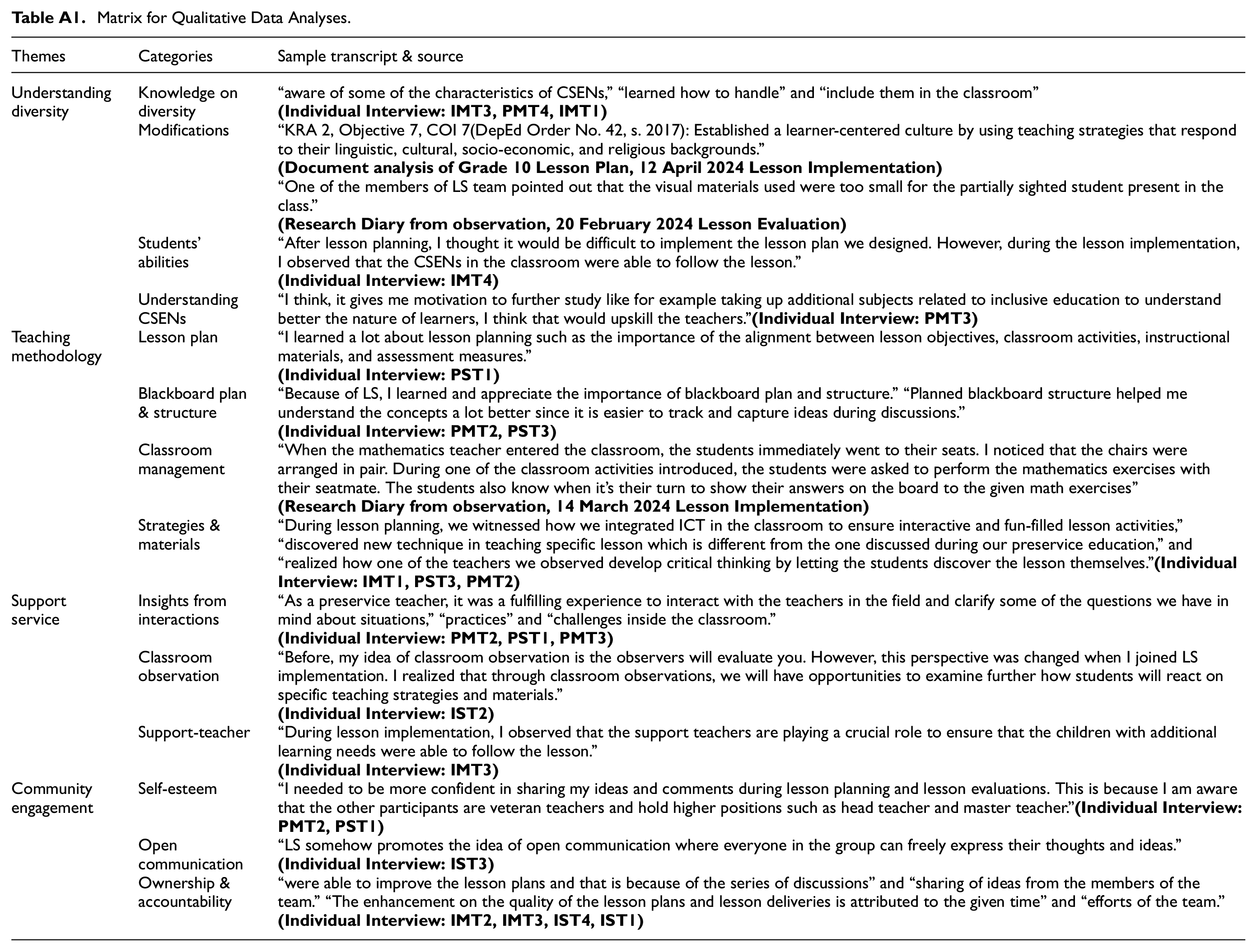
Both qualitative and quantitative data were collected and organized to address the research questions. Qualitative data provided detailed descriptions and insights, while quantitative data confirmed or refuted these findings and offered additional details. Within-group and cross-group analyses were conducted to compare results and identify similarities, differences, common themes, and patterns related to teachers’ perceived teaching competencies. Matrices (see Appendix A; Table A1) were constructed to organize data, and thick descriptions (Cruzes et al., 2014; Raufelder et al., 2013) were employed to understand the cultural context and symbolic actions that shaped participants’ experiences during LS implementation.
To assess the changes in the perceived teaching competencies among participants, the CEFI-R median ranks were compared before and after four LS cycles. A visual inspection revealed that the datasets depart from normality, as evidenced by the bell-curve histograms and normal Q-Q plots. Thus, a Wilcoxon Signed-Rank test (Berry et al., 2018) was subsequently employed to further analyze the change in the median ranks. The Wilcoxon effect size (r) per dimension was also calculated to determine the magnitude of this change. Pearson’s r criteria (Hu, 2010) were used to interpret the computed effect sizes (small: 0.1, medium: 0.3, large: 0.5). Incorporating effect size further highlights the potential promise of LS implementation as a professional development approach for teachers.
Results
By analyzing data from survey results, interviews, documents, and observations of LS cycles, the researchers identified similarities and differences in the perceived teaching competencies of the participants from the experimental and control groups. The study focused on the changes in four specific areas: understanding diversity, teaching methods, support services, and community engagement. The quantitative data gathered before and after the four-month implementation of LS cycles are presented in tables. These data were analyzed and discussed integrating the qualitative data gathered from the observations, interviews, and document analyses conducted.
Effects of LS on the Perceived Teaching Competencies
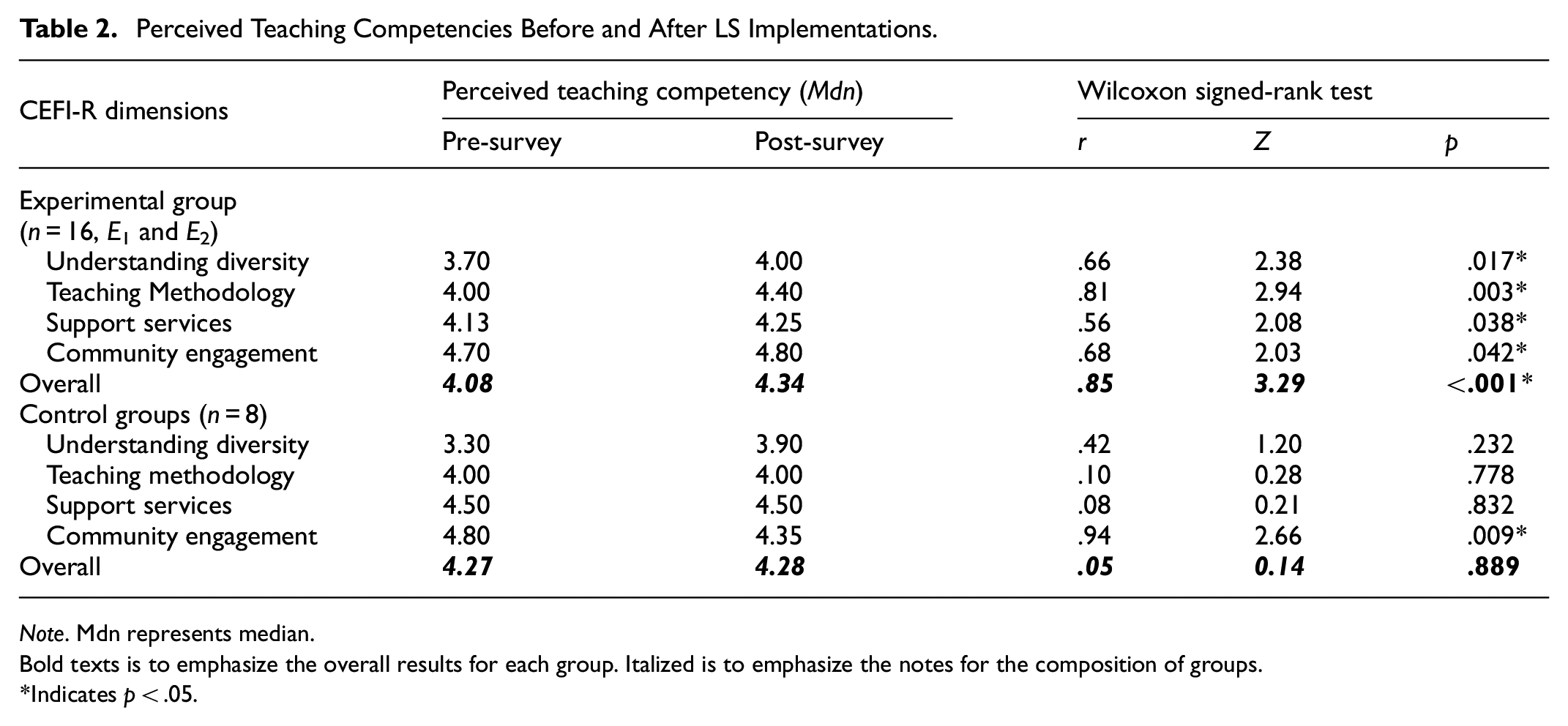
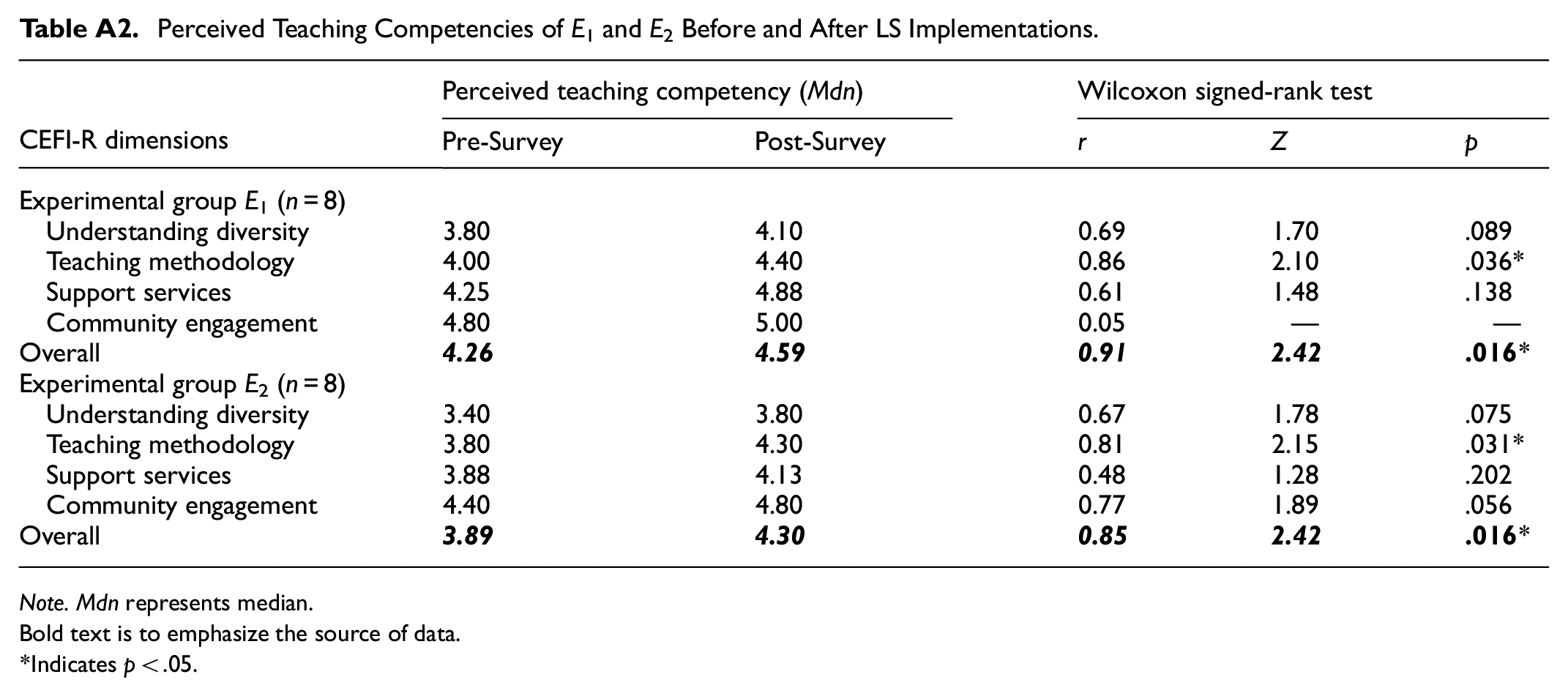
The data from the experimental groups E1 and E2 were combined since an initial test showed both groups posted significant differences in the pre-survey and post-survey ranks (see Appendix B; Table A2). Although the experimental groups E1 and E2 both posted significant improvement in their perceived teaching competencies (Z = 2.42, p = .016), Appendix B (Table A2) also shows that experimental group E1 posted a slightly higher effect size (r = .91) than experimental group E2 (r = .85). Table 2 shows the combined E1 and E2 data for participants’ perceived teaching competencies before and after LS implementations.
Perceived Teaching Competencies Before and After LS Implementations.
Note. Mdn represents median.
Bold texts is to emphasize the overall results for each group. Italized is to emphasize the notes for the composition of groups.
Indicates p < .05.
It can be noted that in the experimental groups, the overall changes in the pre-survey (Mdn = 4.08) and post-survey (Mdn = 4.34) ranks were significantly different based on the Wilcoxon Signed-Rank test (Z = 3.29, p < .001). Further, the magnitude of this overall change was statistically large based on the computed Wilcoxon effect size (r = .85). A closer examination by dimension also demonstrated that the LS implementation had significant large effects on all aspects of the experimental groups’ perceived teaching competencies.
The control group’s perceived teaching competencies also changed as shown by the overall pre-survey (Mdn = 4.27) and post-survey (Mdn = 4.28) ranks. However, this change was not significantly different based on the Wilcoxon Signed-Rank test (Z = 0.14, p = .889). The overall effect of LS on the control group’s perceived teaching competencies was also small based on the computed Wilcoxon effect size (r = .05). Considering the results per dimension, the LS implementation posted small to large effects on the control group’s perceived teaching competencies. For the community engagement dimension, it is interesting to note that the pre-survey rank (Mdn = 4.80) was higher than the post-survey rank (Mdn = 4.35). Further, this difference was statistically large and significant based on the Wilcoxon Signed-Rank test (r = .94, Z = 2.66, p = .009).
Understanding Diversity
This section and the preceding sections examine further the effects of LS implementations on each dimension of the perceived teaching competencies of the experimental groups (E1 and E2). The data from the control group were not further examined since the Wilcoxon Signed-Rank test showed no significant improvement in their teaching competencies.
Table 3 presents the combined results for the “understanding diversity” dimension from groups E1 and E2. The effect size of LS on the perceived teaching competency of the teachers in terms of their understanding of diversity was statistically large (r = .66). It is also worth noting that the indicator with the highest effect size (r = .62) is the willingness of teachers to accommodate CSENs in their classrooms.
Effects of LS on Understanding Diversity (n = 16, E1 and E2).

Bold text is to emphasize the overall results data.
The following interview, document analyses, and observation data also revealed specific effects of LS in terms of the teachers’ understanding of diversity:
Improved Knowledge About the Diverse Needs of Students
All participants claimed that their involvement in LS provided them with opportunities to gain more ideas on how to handle different types of learners. According to them, this knowledge helped them develop a more positive and supportive response toward the behavior and performances of students inside their classrooms. An in-service mathematics teacher (IMT) and preservice mathematics teacher (PMT) recounted that because of the participation of preservice and in-service teachers they became:
“aware of some of the characteristics of CSENs,”“learned how to handle” and “include them in the classroom” (IMT3, PMT4, IMT1)
Awareness of Modifying Activities and Materials Based on the Needs of Students
The participating teachers shared that the lesson planning and evaluation stages helped ensure that every student is included in the classroom. Having teachers knowledgeable about CSENS, the LS teams were able to design and introduce inclusive classroom activities utilizing appropriate teaching and learning materials. One of the lesson plans and notes taken by the first author during lesson evaluation stated that:
KRA 2, Objective 7, COI 7(DepEd Order No. 42, s. 2017): Established a learner-centered culture by using teaching strategies that respond to their linguistic, cultural, socio-economic, and religious backgrounds. (Grade 10 Lesson Plan, 12 April 2024 Lesson Implementation) One of the members of the LS team pointed out that the visual materials used were too small for the partially sighted student present in the class. (Research Diary, 20 February 2024 Lesson Evaluation)
Participating preservice teachers also disclosed that their involvement in LS helped them more knowledgeable and skillful in designing lessons that could cater to their future learners’ diverse needs.
Developed Confidence in the Various Abilities of Students
The LS experience of the participants, especially the current and future math teachers, made them realize that given the appropriate support and materials, CSENs can perform the designed classroom activities. An in-service math teacher who implemented one of the research lessons revealed that:
After lesson planning, I thought It would be difficult to implement the lesson plan we designed. However, during the lesson implementation, I observed that the CSENs in the classroom were able to follow the lesson. (IMT4)
Motivated to Learn More About CSENs
After attending several cycles of LS, one of the preservice math teachers shared that:
I think, it gives me motivation to further study like for example taking up additional subjects related to inclusive education to understand better the nature of learners, I think that would upskill the teachers. (PMT3)
Teaching Methodology
The data on the teaching methodology dimension is shown in Table 4. The computed effect size indicates that the effect of LS intervention on this dimension was statistically large (r = .81). The indicator with the highest effect size (r = .95) is the ability to use differentiated instruction for students with different characteristics.
Effects of LS on Teaching Methodology (n = 16, E1 and E2).

Bold text is to emphasize the overall results data.
As discussed below, qualitative data from the interviews and observations also revealed specific effects of LS on the teachers’ teaching competency in terms of teaching methodology:
Improved Knowledge and Skills in Preparing Lesson Plans
In every LS cycle, all members of the LS team participated in the lesson planning stages. This is where they discuss the following: (a) the level of involved students in terms of knowledge, skills, and educational needs; (b) the skills and competencies to be developed; (c) how to facilitate teaching and learning using appropriate instructional materials and strategies; and (d) how to monitor and assess students’ learning outcomes. One preservice SPED teacher (PST) claimed that:
I learned a lot about lesson planning such as the importance of the alignment between lesson objectives, classroom activities, instructional materials, and assessment measures. (PST1)
Preservice teachers also shared that some points for consideration in preparing lesson plans during LS are new to them. This includes identifying or including specific parts of the lesson plan that will let students apply knowledge of content within and across the curriculum teaching areas. Additionally, a segment of the process is dedicated to the identification of activities designed to cultivate critical, creative, and higher-order thinking abilities. Preservice teachers also recollect an insightful exercise during lesson planning wherein the team classified teaching strategies and activities based on their suitability for Indigenous students and those from diverse linguistic, cultural, socioeconomic, and religious backgrounds.
Awareness of the Importance of Blackboard Plan and Structure
In the lesson planning conducted, one of the additional concepts learned by most of the LS team members is the blackboard planning concept. This involves planning what the blackboard will look like after implementing a research lesson.
“Because of LS, I learned and appreciate the importance of blackboard plan and structure.”“Planned blackboard structure helped me understand the concepts a lot better since it is easier to track and capture ideas during discussions.” (PMT2, PST3)
A blackboard plan aims to show the structured record of the mathematics topics covered during the lesson (Baba & Kojima, 2004; Stigler & Hiebert, 1999). Throughout lesson implementations, the blackboard content and structure provided written records of the interactions between the teacher and among learners. Most of the content of the blackboard included ideas from students, inquiries from students, responses from teachers, lesson objectives, and other essential information about the lesson. This practice is helpful for all learners, especially those struggling, since they will have more time to process the information presented (Basister & Kawai, 2018).
Enhanced Classroom Management Skills
Organizing and managing classrooms is one of the crucial skills needed by teachers. The teachers reported that their participation in LS implementations helped them develop strategies for effective classroom management, particularly in selecting classroom activities aligned with lesson objectives. Some teachers who delivered a research lesson claimed that LS helped them produce well-planned lesson plans, activities, and materials that captured the students’ interest. This also helped them address their usual problem with time management in terms of finishing a lesson in a given session.
“My involvement in LS helped me deliver various teaching strategies” and “improved my classroom management skills, especially in classrooms with diverse types of learners.” (IMT4, IMT1) When the mathematics teacher entered the classroom, the students immediately went to their seats. I noticed that the chairs were arranged in pairs. During one of the classroom activities introduced, the students were asked to perform the mathematics exercises with their seatmates. The students also know when it’s their turn to show their answers on the board to the given math exercises. (Research Diary, 14 March 2024 Lesson Implementation)
The above observation showed that the teacher who implemented the lesson observes a regular classroom routine. This includes forming a team or tandem for class activities and emphasizing order during classroom exercises. A well-managed classroom, especially those with learners having additional educational needs, encourages higher rates of academic achievement and reduces problem behavior (Oliver & Reschly, 2010).
Additional Ideas on Various Teaching and Learning Strategies and Materials
The LS experience provided opportunities for participants to benchmark ideas on the different teaching strategies and materials they can use for their learners. LS participants recalled that:
“During lesson planning, we witnessed how we integrated ICT in the classroom to ensure interactive and fun-filled lesson activities,”“discovered new techniques in teaching specific lessons which are different from the one discussed during our preservice education,” and “realized how one of the teachers we observed develop critical thinking by letting the students discover the lesson themselves.” (IMT1, PST3, PMT2)
Support Services
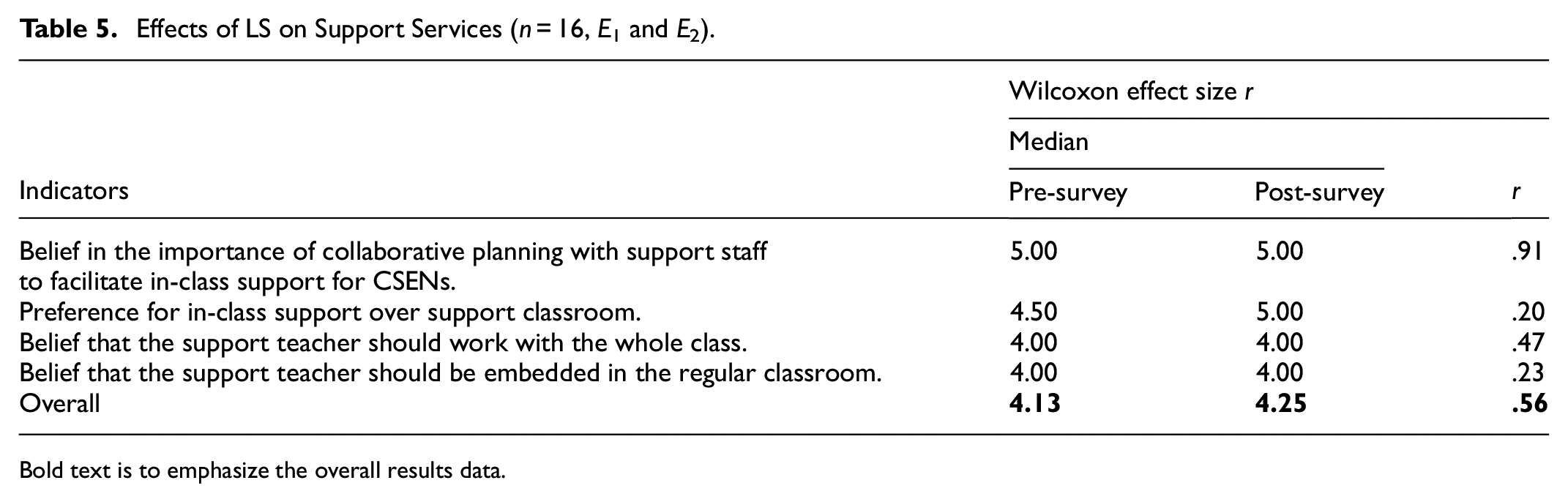
The data for the support services dimension shown in Table 5 revealed that the change in this dimension was statistically large (r = .56). The indicator with the highest effect size (r = .91) was related to the importance of collaborative planning between teachers and support staff in providing classroom support.
Effects of LS on Support Services (n = 16, E1 and E2).
Bold text is to emphasize the overall results data.
The specific effects of LS on the perceived teaching competency of teachers in terms of support services are discussed below based on the qualitative data from the interviews conducted:
New Insights from Interactions with Other Teachers
One of the substantial features of LS was the opportunity for teachers to collaborate and exchange ideas with their colleagues. In-service teachers shared that they were delighted to listen to the ideas and experiences of the other team members, which advanced their abilities to teach.
“As a preservice teacher, it was a fulfilling experience to interact with the teachers in the field and clarify some of the questions we have in mind about situations,”“practices” and “challenges inside the classroom.” (PMT2, PST1, PMT3)
Additionally, as disclosed by one participating veteran teacher, the presence of preservice teachers allowed them to discuss ideas, strategies, and learning resources that are more relevant and well-suited to younger generations.
Improved Perception of Classroom Observation
After collaborative lesson planning, another significant feature of LS is the conduct of classroom observations. During LS orientation, it was emphasized to the participants that the focus of observing the delivery of the research lesson is on the students’ reactions. After participating in the conducted LS cycles, an in-service SPED teacher (IST) shared that:
Before, my idea of classroom observation was that the observers would evaluate you. However, this perspective was changed when I joined LS implementation. I realized that through classroom observations, we will have opportunities to examine further how students will react to specific teaching strategies and materials. (IST2)
The statement of the participant above showed a change in her perception of classroom observation from a mere tool for performance appraisal to an alternative tool for improving the teaching and learning process.
Awareness of the Significant Role of Support-Teacher
The involvement of the support teacher during lesson planning made it easier for them to assist CSENs during the actual implementation of the lesson. SPED teachers further elaborated that in the conducted LS, they have a voice during the selection of appropriate learning materials. Additionally, the lesson planning stage gave them an idea of what the classroom activities would be for the whole session. One participant recalled that:
During lesson implementation, I observed that the support teachers are playing a crucial role to ensure that the children with additional learning needs were able to follow the lesson. (IMT3)
Community Engagement
Table 6 shows that the teachers’ perceived teaching competency in terms of community engagement improved largely after the intervention (r = .68). The indicator regarding the importance of the participation of various stakeholders in reviewing educational projects posted the largest change (r = .92).
Effects of LS on Community Engagement (n = 16, E1 and E2).

Qualitative data from the interviews conducted with experimental groups also revealed specific effects of LS on their perceived teaching competency in terms of community engagement. The details of these data are thematically discussed below:
Improved Self-Esteem
One of the preservice teachers confided that during the first few LS sessions felt that:
I needed to be more confident in sharing my ideas and comments during lesson planning and lesson evaluations. This is because I am aware that the other participants are veteran teachers and hold higher positions such as headteacher and master teacher. (PMT2, PST1)
However, with the persistence and encouragement of the veteran teachers to hear from preservice teachers, the first author observed that they eventually tried participating in the discussions and became confident in sharing their thoughts with the group.
Nurture Open Communication
During lesson planning and lesson evaluations, all members of the team were encouraged to comment on the strengths and areas for improvement of a lesson plan or a lesson delivery. One of the participants felt that
LS somehow promotes the idea of open communication where everyone in the group can freely express their thoughts and ideas. (IST3)
Additionally, one of the participants who delivered a research lesson recounted that the ideas and comments shared during lesson planning and lesson evaluations were all beneficial to enhance her delivery of the lesson. One in-service teacher also recognized the importance of having preservice and younger teachers in the group since they made significant contributions in terms of ideas on integrating technology in the research lessons. The other team members also welcomed the participation of SPED teachers because of their significant input in modifying instructional materials and strategies to accommodate the diverse needs of students.
Developed Shared Ownership and Accountability
The in-service teachers emphasized that before joining LS, they felt that they had the sole responsibility for the learning outcomes of their respective students. However, after attending various LS cycles, they disclosed that they:
“were able to improve the lesson plans and that is because of the series of discussions” and “sharing of ideas from the members of the team.”“The enhancement of the quality of the lesson plans and lesson deliveries is attributed to the given time” and “efforts of the team.” (IMT2, IMT3, IST4, IST1)
The LS cycles in this study involved collaborations among preservice, in-service, mathematics, and SPED teachers. Interviews reveal interesting ideas from the participants who are imagining a wider scope of LS implementation such as:
“involving teachers from senior high schools,”“from other subjects/fields,”“other schools in the district,”“parents” and “other instructional leaders such as school heads and education supervisors.” (IMT1, IMT2, IST3, IST1, IMT4)
Discussion
Comparing the results between the experimental and control groups, it can be argued that involvement in LS contributes to the significant improvement in the perceived teaching competencies of teachers. Furthermore, implementing LS involving preservice, in-service, mathematics, and SPED teachers can lead to the promotion of a more inclusive mathematics learning environment. This is supported by other studies (Dibaba et al., 2024; Foster & Trundley, 2024; Schipper et al., 2020; Wood, 2020) showing LS to be beneficial as perceived by both novice and veteran teachers to their growth as educators in a variety of ways. These include building their professional community, setting clear goals for lessons, units, and subjects, deepening their understanding of how students think, and expanding their teaching knowledge.
Additionally, the higher effect size in the experimental group E1 could be attributed to the series of training and further guidance they received throughout the conduct of LS cycles. This training and guidance are valuable in ensuring that the teachers maintain LS’s core elements. Wolthuis et al. (2020) emphasized the importance of teachers’ appropriate understanding of LS as a professional development practice. If teachers continue practicing LS that no longer captures its core elements, they may not sustain LS implementations or may not realize the full benefits of the practice on their professional development.
The interesting result in the control group where the pre-survey score was higher than the post-survey score signifies a decline in their perceived teaching competency in terms of community engagement. This decline in the control groups’ perceived teaching competency warrants further examination. Vlasblom et al. (2020) claimed that professionals’ competence decreases over time and this competence decay could be attributed to various factors, including the availability and quality of professional development activities. Since the control group went through their usual activities without any involvement in an LS practice, the results can serve as crucial data in examining further the sufficiency and effectiveness of existing professional development activities available for them.
Understanding Diversity
Quantitative and qualitative data showed that engaging the teachers in collaborative activities such as LS helped them become aware of and concerned about the various needs of their students. The statements from participants show that the collaboration between mathematics and SPED teachers through LS serves as a good opportunity to enhance the knowledge of participating mathematics teachers on inclusive education. Actual classroom immersions through LS also afforded opportunities for preservice teachers to have a glimpse of what is happening in the classrooms, predominantly if these are composed of diverse students. These immersions gave them an idea of how to handle different learners and create an inclusive learning environment for their future learners. The discussions between members of the LS team during lesson planning and lesson evaluations provided great opportunities for everyone to reflect on what could be done better to ensure a more inclusive learning environment. Specifically, lesson planning assists the teachers in identifying which activities, strategies, or materials will cater to the various needs of students in the class.
The statements from participating teachers also showed how LS experience can change the beliefs of a teacher on the abilities of their students, especially those with additional learning needs. Teachers’ belief in student learning is crucial in shaping a positive classroom environment. One of the factors that could change or improve these beliefs is the students’ responses to new instructional practices introduced by teachers. Turner et al. (2009) claimed that teachers are usually motivated by the students’ engagement and learning. However, to sustain learners’ engagement and content learning, the teachers must be willing to innovate instructional practices. Undeniably, changes in beliefs and practice are reciprocal and both can initiate change. Indeed, LS can be considered an inclusive education tool because of the opportunities it can provide to teachers in responding to the needs of every learner. Specifically, scholars (Holmqvist, 2020; Norwich et al., 2014) found that LS project directed at students with mild learning difficulties positively affects the performances of teachers and students. Norwich et al. (2014) further claimed that improved teacher awareness of students’ learning needs led to better engagement in lessons. However, the impact on academic outcomes was minimal, with more noticeable effects on students’ confidence, attitudes, and motivation (Ylonen & Norwich, 2012). Moreover, other studies (Goei et al., 2021; Norwich et al., 2014) further substantiate that LS could be used to identify students with learning difficulties and enhance understanding of their needs.
Teaching Methodology
The results showed that LS can serve as one of the components of preparation programs for preservice teachers as well as of continuing professional development programs for in-service teachers. Scholars (McMahon et al., 2010; Wolthuis et al., 2020), found that LS can be a valuable tool for teachers, enhancing their lesson planning skills, enabling immediate assessment of instructional quality, and providing peer recognition for their efforts and expertise. Other studies (Cajkler et al., 2013; Cohan & Honigsfeld, 2007), also revealed that LS helped the preservice teachers develop as teachers, impacted their students’ learning, and provided them with new pedagogical skills. Additional LS benefits include increased teacher confidence and a better understanding of culturally diverse students. The practice of LS enables teachers to gain a deeper understanding of their students and explore innovative teaching methods to enhance their practice. This collaborative approach also contributes to the professional development of teachers and other educators, improving their content knowledge and pedagogical skills.
Quantitative and qualitative data from this study also showed that LS helped the participants improve their skills in lesson planning, blackboard planning, and classroom management. One way to ensure that teachers are developing appropriate strategies and accommodations for students’ diverse needs is to formulate effective lesson plans. As emphasized by Causton-Theoharis et al. (2008), to effectively teach diverse student populations, teachers must re-evaluate their lesson planning and structure to ensure that all students can succeed. Other scholars (Dibaba et al., 2024; Mutton et al. (2011) also argued that lesson planning enables teachers to learn about teaching and through teaching they learn about planning.
The discussions during LS cycles enable the participants to think of innovative ideas and strategies to deliver the research lessons and manage the class. Indeed, professional learning communities such as LS facilitate the discovery and development of innovative teaching practices and diffusing effective strategies and available resources. Wong (2010) identified two types of professional learning communities: innovation-driven and inheritance-led. Innovation-driven communities foster creativity and new ideas through continuous inquiry, while inheritance-led communities primarily rely on the transmission of existing knowledge and experience. Furthermore, the inclusion of preservice teachers in the conduct of LS enables them to gain fruitful and authentic experiences in their field’s teaching and learning processes. Given the limited exposure of pre-service teachers to diverse learners during their training, it may take years for their academic learning to be applied in real-world classrooms. LS participation provides a valuable opportunity for both pre-service and in-service teachers to collaborate and develop innovative teaching strategies, especially for diverse student populations.
Support Services
The interactions during LS help both preservice and in-service teachers become more expert and abreast in pedagogical and content knowledge in mathematics and inclusive education. Vangrieken et al. (2015) claimed that collaborations between teachers helped them become more motivated and efficient, improved their technological skills, and designed more student-centered lessons. Previous studies indicate that engaging preservice teachers in communities of practice with in-service teachers showed a better understanding of the relationship between theory in practice (Baptista et al., 2025; Schipper et al., 2020). The opportunities to collaborate with in-service teachers provided opportunities to socialize and cultivate the preservice teachers’ identities as both teachers and learners of themselves (Elipane, 2017; Jimenez-Silva & Olson, 2012). This conceptual model of organizing learning, thought, and action in teacher education can help preservice teachers see themselves as part of a community that extends beyond their front doors and prepares them to better serve their future students.
The results also showed a change in the perception of teachers in conducting class observation from evaluation activity to professional learning opportunities for teachers. Lam (2001) found that teachers perceived classroom observation as primarily for appraisal and that some of them (especially primary educators) are less likely to welcome observers. Ribosa et al. (2024) summarized that one of the measures to address teachers’ resistance to peer observation is the conduct of proper training or orientation on the roles of observers and observee. Furthermore, Corcelles-Seuba et al. (2024) also argued that classroom observation can significantly promote a collaborative school culture. From the conduct of LS, classroom observation can be used as an opportunity for teachers to jointly resolve challenges in the classroom. However, the full benefits of engaging in classroom observation can be realized if the resistance of teachers is effectively addressed.
Additionally, the recognition of the support-teachers’ function inside the classroom is an indication that their knowledge and skills in addressing the specific needs of CSENs are welcomed by the mathematics teachers. The success of integrating CSENs in a regular classroom largely depends on support-teacher since their participation facilitates the selection, analyses, and sharing of the results of educational experiences for CSENs (Voinea & Topalã, 2018). Recognition and accurate understanding of how every member of the team plays a vital role in ensuring an inclusive learning environment is crucial in sustaining a collaborative practice such as LS.
Community Engagement
One of the characteristics of a collaborative practice such as LS is having an interaction where every member respects the individual ability and contribution of their peers. Johnson and Johnson (2009) argued that collaboration increases an individual’s self-esteem by nurturing a supportive environment. In an LS, team members will actively engage if their abilities and inclusion in the group are also valued (Flanagan et al., 2024). Gómez-Jorge and Díaz-Garrido (2023) also claimed that the combination of self-confidence and collaboration can drive the team to achieve their objectives. Higher self-esteem means increased motivation and belief in themselves to share their ideas, participate in discussions, and contribute efforts that can amplify the achievement of desired outcomes. Additionally, the promotion of open communication during LS also contributes to a more productive engagement between members of the team. Studies (Cabrera et al., 2006; Koo et al., 2022) confirm that communication positively affects a team’s performance. It facilitates relationships between people, establishing a supportive environment that encourages work engagement, knowledge sharing, and innovative behavior (Escribá-Carda et al., 2023). Regular communication between team members also enables them to identify their differences and resolve possible conflicts (Johnson, 2003; Johnson & Johnson, 2009).
The experience of participants in LS cycles also lets them develop a sense of ownership and accountability for the learning outcomes of the students. Teachers sharing ownership of the quality of their teaching and its impact on learners is one of the best opportunities to nurture innovative practices and professional accountability in bringing instructional vision to life (Horse, 2021; Unda et al., 2023). The literature is replete (Comer & Haynes, 1991; Torre & Voyce, 2007; Unda et al., 2023) that the involvement of various members of education stakeholders contributes to the performance of the students and the school. However, each group’s involvement might be complex and challenging because of potential diversity in perspectives, approaches to solutions, and interests. For example, Aboelmaaty et al. (2023) argued that schools should involve parents in their children’s education. However, the involvement of parents in the conduct of LS may need further planning and examination since parents and teachers may have different perspectives on their roles in a child’s learning activities. Sayers et al. (2019) found that the perception of teachers on the role of parents in children’s learning is culturally related. One cultural group of teachers may perceive home as an extension of school, while other groups see it as separate from school. Thus, the development of a framework clarifying role expectations and providing a mechanism for consistent interpersonal exchanges between stakeholders can help shape professional accountability in ensuring the achievement of desired learning outcomes for students.
Conclusion
Given the increasing emphasis on collaboration as a key strategy for schools to foster innovative and creative educational practices (Ghedin, 2021), it is essential to encourage new approaches that promote transdisciplinary collaboration. This involves creating teams of general education and special education teachers, including other relevant professionals. Aside from activities assisting teachers to learn about specific content areas and increase their competencies for teaching content, preparing them to work with diverse populations and transdisciplinary environments are also beneficial. The analyzed quantitative and qualitative data in this study showed that LS could be considered an alternative and transdisciplinary professional development practice to improve the teaching competencies of both preservice and in-service teachers in special or mathematics education. Specifically, LS was able to significantly increase the perceived level of teaching competencies of the involved teachers and provided opportunities to improve understanding of diversity in the classroom, be abreast with inclusive pedagogical content knowledge and skills in teaching math, improve self-worth and confidence, and develop a sense of ownership and accountability. Allowing teachers from diverse backgrounds to collaborate promotes effective transdisciplinary professional development. This fosters a more critical, analytical, and reflective approach to teaching practices. This specifically includes being open to ideas from different perspectives, having a sense of ownership and accountability for students’ learning outcomes, and improving knowledge and skills in addressing the diverse needs of students.
Limitations and Future Research
While the study yielded promising results, it’s important to consider its limitations. Despite using various data collection methods, the sample size was relatively small, and the study was confined to only two schools. Due to the sample selection process, the findings may not be representative of all schools or personnel. Nevertheless, building on the findings from this study, future research may explore how transdisciplinary collaboration between different groups of teachers (e.g., novice and veteran, math and special education) can promote professional dialogue and improve student learning outcomes. A collaboration model based on the experiences of teachers may be developed to best enhance the results of their professional development activities. Additionally, support structures should be carefully studied and be in place to encourage and facilitate these collaborations. Indeed, a mechanism or a practice that promotes a culture of transdisciplinary collaboration in improving the quality of education service delivery is worth exploring. Finally, the evidence of competence decay in the control group of this study warrants further examination of the effectiveness of the existing professional development activities for teachers.
Footnotes
Appendix A
Matrix for Qualitative Data Analyses.
| Themes | Categories | Sample transcript & source |
|---|---|---|
| Understanding diversity | Knowledge on diversity | “aware of some of the characteristics of CSENs,”“learned how to handle” and “include them in the classroom” |
| Modifications | “KRA 2, Objective 7, COI 7(DepEd Order No. 42, s. 2017): Established a learner-centered culture by using teaching strategies that respond to their linguistic, cultural, socio-economic, and religious backgrounds.” “One of the members of LS team pointed out that the visual materials used were too small for the partially sighted student present in the class.” |
|
| Students’ abilities | “After lesson planning, I thought it would be difficult to implement the lesson plan we designed. However, during the lesson implementation, I observed that the CSENs in the classroom were able to follow the lesson.” |
|
| Understanding CSENs | “I think, it gives me motivation to further study like for example taking up additional subjects related to inclusive education to understand better the nature of learners, I think that would upskill the teachers.” |
|
| Teaching methodology | Lesson plan | “I learned a lot about lesson planning such as the importance of the alignment between lesson objectives, classroom activities, instructional materials, and assessment measures.” |
| Blackboard plan & structure | “Because of LS, I learned and appreciate the importance of blackboard plan and structure.”“Planned blackboard structure helped me understand the concepts a lot better since it is easier to track and capture ideas during discussions.” |
|
| Classroom management | “When the mathematics teacher entered the classroom, the students immediately went to their seats. I noticed that the chairs were arranged in pair. During one of the classroom activities introduced, the students were asked to perform the mathematics exercises with their seatmate. The students also know when it’s their turn to show their answers on the board to the given math exercises” |
|
| Strategies & materials | “During lesson planning, we witnessed how we integrated ICT in the classroom to ensure interactive and fun-filled lesson activities,”“discovered new technique in teaching specific lesson which is different from the one discussed during our preservice education,” and “realized how one of the teachers we observed develop critical thinking by letting the students discover the lesson themselves.” |
|
| Support service | Insights from interactions | “As a preservice teacher, it was a fulfilling experience to interact with the teachers in the field and clarify some of the questions we have in mind about situations,”“practices” and “challenges inside the classroom.” |
| Classroom observation | “Before, my idea of classroom observation is the observers will evaluate you. However, this perspective was changed when I joined LS implementation. I realized that through classroom observations, we will have opportunities to examine further how students will react on specific teaching strategies and materials.” |
|
| Support-teacher | “During lesson implementation, I observed that the support teachers are playing a crucial role to ensure that the children with additional learning needs were able to follow the lesson.” |
|
| Community engagement | Self-esteem | “I needed to be more confident in sharing my ideas and comments during lesson planning and lesson evaluations. This is because I am aware that the other participants are veteran teachers and hold higher positions such as head teacher and master teacher.” |
| Open communication | “LS somehow promotes the idea of open communication where everyone in the group can freely express their thoughts and ideas.” |
|
| Ownership & accountability | “were able to improve the lesson plans and that is because of the series of discussions” and “sharing of ideas from the members of the team.”“The enhancement on the quality of the lesson plans and lesson deliveries is attributed to the given time” and “efforts of the team.” |
Appendix B
Perceived Teaching Competencies of E1 and E2 Before and After LS Implementations.
| CEFI-R dimensions | Perceived teaching competency (Mdn) | Wilcoxon signed-rank test | |||
|---|---|---|---|---|---|
| Pre-Survey | Post-Survey | r | Z | p | |
| Experimental group E1 (n = 8) | |||||
| Understanding diversity | 3.80 | 4.10 | 0.69 | 1.70 | .089 |
| Teaching methodology | 4.00 | 4.40 | 0.86 | 2.10 | .036* |
| Support services | 4.25 | 4.88 | 0.61 | 1.48 | .138 |
| Community engagement | 4.80 | 5.00 | 0.05 | — | — |
| Overall |
|
|
|
|
|
| Experimental group E2 (n = 8) | |||||
| Understanding diversity | 3.40 | 3.80 | 0.67 | 1.78 | .075 |
| Teaching methodology | 3.80 | 4.30 | 0.81 | 2.15 | .031* |
| Support services | 3.88 | 4.13 | 0.48 | 1.28 | .202 |
| Community engagement | 4.40 | 4.80 | 0.77 | 1.89 | .056 |
| Overall |
|
|
|
|
|
Note. Mdn represents median.
Bold text is to emphasize the source of data.
Indicates p < .05.
Acknowledgements
The authors gratefully acknowledge the support of the University of the Philippines and Malmö University through the UP Office of International Linkages COOPERATE grant program.

Ethical Considerations
This study was approved by the UPLB Research Ethics Board on October 12, 2023 with study protocol code UPLB REB 2023-0075. Identifying information, such as names, images, or specific locations, have been anonymised to ensure participants’ safety and privacy.
Informed Consent
Written informed consent was obtained from each participant after they were informed about the nature and purpose of this study, their potential role, the researchers’ identity, the funding source, and how the research findings would be used.
Funding
The author(s) disclosed receipt of the following financial support for the research, authorship, and/or publication of this article: This research was supported by the Office of International Linkages, University of the Philippines, Quezon City, Philippines (grant numbers OILCOOP-2024-11 and OILCOOP-2024-12) and the Faculty of Education and Society, Malmö University, Malmö, Sweden.
Declaration of Conflicting Interests
The author(s) declared no potential conflicts of interest with respect to the research, authorship, and/or publication of this article.
Data Availability Statement
The datasets generated during and/or analysed during the current study are available from the corresponding author upon reasonable request.