




Abstract
Anxiety, an affective factor, is pivotal in language learners’ success or failure. Findings pointed to its correlation with oral performance, test results, and language skills, namely listening and writing, but only a little with reading. At the current research site, a Vietnamese context, very little evaluation on reading anxiety in English foreign language learning could be found. Therefore, this investigation aimed to explore learners’ English foreign language reading anxiety levels, reading techniques used, and the correlation between foreign language reading anxiety (FLRA) and reading strategies (RS). A cross-sectional survey was conducted on 324 university students (including 152 females and 172 males) in a private educational Vietnamese context with two main data-gathering instruments: the Foreign Language Reading Anxiety Scale (FLRAS) and Survey of Reading Strategies (SORS). Results revealed a moderate level of reading anxiety among 68.5% of respondents, while 31.4% had hi- and lo-anxiety levels with the same percentage of 15.7% each. Regarding reading techniques, Problem-Solving Strategies were found to be the most favorable, and those with lo-anxiety used strategic reading more regularly than the others (hi- and mid-anxiety level groups). When it comes to the correlation between FLRA and RS, a statistically negative correlation was found. It means FLRA could decrease when RS increases. Additionally, FLRA was negatively correlated with three RS subscales. Based on the findings, several pedagogical implications were also discussed.
Keywords
Introduction
Reading is a highly complex cognitive process (Nunan, 2015; Septiyana et al., 2021) that is affected by the text, the context, and the reader (Soomro et al., 2019). Reader variables include not only readers’ knowledge, skills, and abilities, but also “reader affect,” particularly anxiety (Alderson, 2000). Anxiety is “the subjective feeling of tension, apprehension, nervousness, and worry associated with an arousal of the automatic nervous system” (Spielberger, 1983, as cited in Horwitz et al., 1986, p. 125). In second language (L2) learning, a little apprehension could facilitate learners’ learning processes (Krashen, 1982), while anxiety is debilitating when it is a mental block (Horwitz et al., 1986) that could “pervasively obstruct the learning process” (Arnold & Brown, 1999, p. 8).
Compared with other language skills, reading was deemed to be the “least susceptible to anxiety effects” (Saito et al., 1999, p. 202) until Saito et al. (1999) termed it as “a phenomenon related to, but distinct from, general FL anxiety” (p. 211). Foreign language reading provokes learners’ anxiety in such conditions as the shortage of and the inappropriate application of reading strategies (e.g., Isler & Yildirim, 2017; Miao & Vibulphol, 2021), unfamiliarity with lexical resources, content, language rules, among others (e.g., Faruq, 2019; Miao & Vibulphol, 2021; Tsai & Lee, 2018), and many other conditions. Among these anxiety sources, reading strategy usage is believed to help solve issues arising from academic reading (Lien, 2011). Both reading anxiety and reading strategies are closely related to reading performance; thus, the association between these two variables should be investigated (Sari, 2017).
However, there has been low evidence on the FLRA-reading strategy use relationship (Li, 2022). For this reason, further research on whether the two variables are related to each other is necessary (Dang & Nguyen, 2023; Li, 2022). Furthermore, the published literature on this relationship has yielded different effect sizes but on small sample sizes; therefore, studies on larger samples were called for (Li, 2022). In Vietnamese contexts, the investigation by Le (2020) was the only one examining the FLRA-reading strategy use relationship; nevertheless, his research poses several limitations that would be discussed in the Literature Review.
Another gap was found from classroom realities at the research site. Specifically, students struggled with excessively long reading passages during the reading process. Readers were also observed to be tense, tired, worried, discouraged, and demotivated. Moreover, they seemed to do the reading on emotions rather than apply instructed reading strategies. These realities aroused the researcher’s curiosity and urged her to explore learners’ learning to read in general education (GE). A gap was detected that, in GE, students read 280–300-word passages (the longest as required for Grade 12 students) on familiar topics (e.g., social media, life) for main ideas and details, according to the Circular 32/2018/TT-BGDĐT issued by the Ministry of Education and Training (MOET, 2018). In contrast, at the tertiary level, specifically in the first year at the research site, learners coped with longer academic texts with complex authentic content of about 300 to 3,500 words and were provided with multiple reading strategies. This gap showed that students might be anxious when coping with higher-level readings and they seemed not to apply reading strategies effectively.
By virtue of the aforementioned preliminary findings, the current research attempted to fill the voids of the existing literature and have the answer for the problem at the research site by examining students’ apprehension in English language reading and the FLRA-reading strategy correlation. The specific aims of the present research are threefold. It is necessary to examine (i) how anxious learners are during the reading process, (ii) what reading strategies (RS) they employ, and (iii) whether FLRA is correlated with the use of RS. To accomplish these aims, the research answered the following questions:
At what level is learners’ English foreign language reading anxiety?
What reading strategy subscale is most adopted? Is there a difference in adopting reading strategy subscales for hi-, lo-, and mid-anxiety level groups?
How is English foreign language reading anxiety correlated with reading strategy use?
The research partly replicates Lien’s (2011) study and contributes to both theory and practice. Theoretically, the study responds to Li’s (2022) and Dang and Nguyen’s (2023) calls for further examination of the association between FLRA and reading strategy use (RSU). It also contributes a small part to the body of the published literature by providing a fragment of reading anxiety from a Vietnamese context. Practically, further insights into reading anxiety levels are believed to call teachers’ attention to negative emotional states during the reading process. Thus, the study is pedagogically significant to English instructors at the research site and similar contexts. Teachers could be more aware of the significance of psychological states facilitating or debilitating learning processes, hence devising intervening methods to cope with them.
Literature Review
Foreign Language Reading Anxiety
By definition, foreign language anxiety (FLA) is “a distinct set of beliefs, perceptions, and feelings in response to foreign language learning in the classroom and not merely a composite of other anxieties” (Horwitz et al., 1986, p. 130). The first instrument to measure FLA, the Foreign Language Classroom Anxiety Scale (FLCAS), was also developed by Horwitz et al. (1986). From this scale, subsequent researchers undertook research on each specific language skill (e.g., Faqihi, 2023; Hidayati et al., 2020; Zhang & Zhang, 2022). Regarding reading skills, Saito et al. (1999) were the pioneers of research on foreign language reading anxiety (FLRA). They concluded that FLRA is “a phenomenon related to, but distinct from, general FL anxiety” (p. 211) and relates to “actual difficulties in text processing rather than the reading difficulties stemming from anxiety reactions” (p. 125). Following researchers referred FLRA to an intense dread or worry associated with situations that necessitate textual information processing when reading foreign language texts (Hamada & Takaki, 2021; Ramirez et al., 2019). The current study defines FLRA as FL reading domain-specific anxiety that occurs in the textual data processing during the reading process and is a personal feeling with worry being a dominant component.
Reading Strategies
Reading strategies (RS) refer to “deliberate, goal-directed attempts to control and modify the reader’s effort to decode text, understand words, and construct meanings of text” (Afflerbach et al., 2008, p. 368). To further understand the term, it is essential to distinguish reading strategies from reading skills. While the former is deliberate, conscious, effortful, goal-directed, and reader-oriented, the latter is automatic, unconscious, effortless, goal-free, and text-oriented (Manoli & Papadopoulou, 2012). The division of reading strategy types varies by different researchers. The current research followed Mokhtari and Reichard’s (2002) classification. Mokhtari and Reichard (2002) developed the Metacognitive Awareness of Reading Strategies Inventory (MARSI) for native usage, in which they classified RS into cognitive, metacognitive, and support strategies. Later, Mokhtari and Sheorey (2002) developed the Survey of Reading Strategies (SORS) based on MARSI but for non-native speakers such as students of English as a foreign language or English as a second language (EFL/ESL). Three SORS sub-scales are global reading strategies (GLOB), problem-solving strategies (PROB), and support strategies (SUP). The SORS was chosen as the main tool for data collection of the present project as it was apt for the research subjects who are EFL/ESL students.
Anxiety Levels Among EFL/ESL Readers
Since the FLRA scale development by Saito et al. (1999), researchers took a further step towards a formula for FL reading anxiety levels. Based on the formula proposed by Sellers (2000), Kuru-Gönen (2007) suggested a more specific calculation as below:
“Hi-anxiety: Mean + Standard Deviation = The score higher than this Lo-anxiety: Mean − Standard Deviation = The score lower than this Mid-anxiety: The score between Mean − Standard Deviation and Mean + Standard Deviation” (Kuru-Gönen, 2007, p. 1034)
Using this formula, researchers have subsequently extended investigations on FL reading anxiety (e.g., Dang, 2022a, 2022b; Dang & Nguyen, 2023; Bensalem, 2020; Lu & Liu, 2015; Mardianti et al., 2021; Mawardah et al., 2019; Um et al., 2013). Overall, more evidence of mid-anxiety levels was established (Dang, 2022a, 2022b; Dang & Nguyen, 2023; Mardianti et al., 2021; Mawardah et al., 2019). Applying the formula by Kuru-Gönen (2007), Dang (2022a, 2022b), and Dang and Nguyen (2023) in a series of FLRA have detected medium anxiety among non-English majored Vietnamese students with a percentage of 71.8%, 96.7%, and 96.6%, respectively. Similarly, Mardianti et al. (2021) and Mawardah et al. (2019) also reported a moderate level of anxiety in Indonesian contexts, with a percentage of 44% and 76% respectively.
Few results of students with low and no anxiety were revealed. More participants in Um et al.’s (2013) study felt less anxious when reading, while Lu and Liu (2015) disclosed that over 50% of 1,702 Chinese students reported no anxiety while reading. However, both studies by Um et al. (2013) and Lu and Liu (2015) depended on mean scores of all questionnaire items to gauge RA levels, not cut-off criteria, which may generate less exact outcomes. Considering students with high anxiety, Bensalem (2020) followed Kuru-Gönen’s (2007) formula and reported 52.44% of cases.
The Adoption of Reading Strategies Among FLRA Groups
The analysis of learners’ reading strategy usage from past studies demonstrated flexible results (e.g., Alharbi, 2019; Ghonsooly & Loghmani, 2012; Lien, 2011). Lien (2011) conducted a quantitative study on 108 EFL students at a Taiwanese university to differentiate the use of RS among lo-, mid, and hi-anxiety groups and disclosed that PROB was generally the most preferred; conversely, SUP was the least favorable. More specifically, students with low anxiety employed context clues the most to decode the text meaning while they rarely took notes. Mid-anxiety groups could quickly get back on track whenever they got distracted and lost attention, but they did not favor critical analysis and evaluation of information. Interestingly, hi-anxiety participants relied much on translating tools for comprehension, and similar to moderately anxious students, they did not highly value critical analysis and evaluation of texts.
Ghonsooly and Loghmani (2012) quantitatively researched 196 Iranian university students and pointed out that low-anxiety students had greater awareness of PROB than high-anxiety learners. Highly anxious participants adopted more support strategies than readers with less anxiety. Students with low anxiety preferred global strategies to hi-anxiety members. Distinct from Lien (2011) and Ghonsooly and Loghmani (2012), Alharbi (2019) merely reported the most favorable reading strategy subscale without any differentiation of RSU among research respondents. Alharbi (2019) found that PROB was the most highly adopted, while GLOB and SUP ranked second and third, respectively. Compared with Lien’s (2011) investigation, the weakness of Ghonsooly and Loghmani’s (2012) and Alharbi’s (2019) studies lies in a deficiency in result analysis.
Correlation Between FL Reading Anxiety and Reading Strategies
The existing literature has documented conflicting results of the FLRA-RSU relationship (e.g., Çapan & Pektaş, 2013; Le, 2020; Lien, 2011; Lu & Liu, 2015; Marashi & Rahmati, 2017; Tsai & Lee, 2018; Zarei, 2014). Some researchers have found that two variables were not statistically significant. For instance, Zarei (2014) utilized FLRAS and SORS to examine the influence of reading anxiety levels on reading strategies used by 202 Iranian female students. The finding revealed that differences in RSU among anxiety level groups were not statistically significant. Using the same instruments, Le (2020) investigated 48 Vietnamese EFL learners and found no relationship between the two variables as well. However, neither of the two studies provided reasons for investigating a small sample size (202 and 48 participants). Creswell (2012) suggested approximately 350 participants for a survey to make generalizations for the population; therefore, their results seem inadequate to generalize for other contexts. Meanwhile, Çapan and Pektaş (2013) carried out an experiment study and found that the use of reading strategies is directly proportional to reading anxiety. Specifically, the more reading strategies the experiment group applied, the more anxious they felt.
Another striking finding is the negative relationship between FL reading anxiety and RS usage. Lu and Liu (2015) disclosed that increased FLRA led to a decrease in the adoption of reading strategies. To clarify, the frequency of reading strategy use became less when participants were anxious during the reading process. Conversely, in Taiwanese contexts, FLRA was found to be inversely proportional to reading strategies in Tsai and Lee’s (2018) and Lien’s (2011) studies. Results from Tsai and Lee’s (2018) mixed methods research displayed a negative correlation (r (202) = −.410, p < .001). In the same manner, the analysis of quantitative data by Lien (2011) also demonstrated a negative correlation between the two variables. It means that the more anxious respondents were, the fewer strategies they adopted. Furthermore, Lien (2011) also found a relationship between FLRA and SORS subscales. Less anxious learners tended to adopt more GLOB and PROB, but a weak association was detected with support strategies. In another experiment study on 55 Iranian EFL students by Marashi and Rahmati (2017), the negative relationship was that the experiment group became less anxious when reading after being coached with reading strategies compared with the control group without the instruction of reading strategies. In simpler words, strategic reading contributed to lowering learners’ reading anxiety.
In summary, the review of past studies on the FLRA-reading strategy use correlation displayed limited publications. This limitedness calls for further examinations of the research problem, as Miao and Vibulphol (2021) suggested that more in-depth research should be conducted on FLRA in other contexts. Li (2022) also asserted that the results of the relationship between two variables differ among studies; thus, there is a need for additional analysis with a larger sample size. Most importantly, only one study on the FLRA-reading strategy relationship conducted by Le (2020) in a Vietnamese context has been found so far, to the best of the author’s knowledge. Le’s (2020) study posed several limitations that need to be removed, such as (1) an inadequate small sample size for a survey as suggested by Creswell (2012), (2) the shortage of discussions and justifications for no correlation between FLRA and SORS, which made the research finding rather questionable, and (3) the lack of a detailed analysis of reading anxiety levels as suggested by Sellers (2000).
The limitations, as mentioned earlier and particularly the absence of FLRA research in the Vietnamese contexts, led to the current research, which employed a cross-sectional survey study on a relatively large sample size (324 participants) at a private Vietnamese university to add a small picture of Vietnamese voices to the literature. The research also answered Li’s (2022) and Dang and Nguyen’s (2023) calls for further investigations into the FLRA-reading strategy relationship to extend the growing literature.
Methods
Research Design
With an expectation of seeking a large group of learners’ opinions on reading anxiety and reading strategy use at one point, a cross-sectional survey design was apt, as Fraenkel et al. (2012) suggested. Gathering data at one time is cost-saving and quick, especially when a Google Form-based questionnaire was administered. Using the online questionnaire allowed the researcher to collect hundreds of responses within a week. Moreover, the design is helpful for the study objectives: to identify beliefs in reading anxiety and to correlate variables between FLRA and RSU to learn about the sample as suggested by Creswell (2012).
Research Setting and Participants
The research site was a private Vietnamese university where English is regarded as a prerequisite for all university students in the preparational period before switching to studying specialized majors. During the preparational courses, learners are instructed on how to read effectively in one 14-week semester, divided into two parts, each being 7 weeks. Coursebooks are Advanced Reading University Success and Reading University Success Transition Level, full of challenging, authentic content expertly written by top professors from Stanford University. The books aim to prepare students for success in English-speaking university courses with subjects such as Linguistics, Medieval Culture, Humanities, Biology, Sociology, Environmental Engineering, Economics, and the rest.
Research participants included 324 non-English major students who just completed English courses in the preparational period and were about to study their specialized major. The research participants have one point in common with each other; that is, they regularly read textbooks written in English for assignments and finals. As demonstrated in Table 1, there were more male participants than female ones, with a percentage of 53.1% and 46.9% respectively. More than half come from rural areas (52.8%) opposed to those from urban (47.2%). Regarding weekly reading time, 46.3% of respondents affirmed below 1 to 3 hr, while over 3 to 6 hr accounts for 33%, and the others are below 10%.
Description of Demographic Information.

The current researcher used snowball sampling for participant selection. It means the survey was sent to faculties first, then forwarded to students. As supporting roles, the faculties thoroughly explained the purpose of the research and often reminded learners to do the survey, which helped ensure the expected number of participants.
Instruments
Data collection was made through three main sections of the Google Form. The first one is the adapted FLRA scale by Saito et al. (1999) (See Appendix A) which was administered on 324 first-semester university students. The FLRA questionnaire encompasses 20 five-point Likert scale items, initially scored from 20 to 100, implying that the higher the ratings, the more worried the respondents feel. The present research subjects were EFL learners; thus, the replacement of words such as “French, Russian, Japanese” in the original scale for “English” was made for appropriateness. The original scoring ranges were also converted into 1 to 5 (1: “strongly disagree,” 2: “disagree,” 3: “neither agree nor disagree,” 4: “agree,” 5: “strongly agree”). The internal reliability of the scale was good, with a consistency coefficient of .86 (n = 383) in Saito et al.’s (1999) study. Other studies on university students, such as Kim (2021), Ghaith (2020), and Aghajani and Gholamrezapour (2019) also yielded good internal reliability with Cronbach’s α = .84; .93 and .93, respectively.
The second section is the adopted Survey of Reading Strategies (SORS) developed by Mokhtari and Sheorey (2002) (See Appendix B) for EFL/ESL learners, making the scale suitable for the current subjects studying English as a foreign language. ESL students from two US. Universities validated the survey (Mokhtari & Sheorey, 2002), and it has been used by various researchers (e.g., Lien, 2011; Zarei, 2014). The instrument includes 30 five-point Likert scale items with 1 meaning “I never or almost never do this,” 2 meaning “I do this only occasionally,” 3 meaning “I sometimes do this,” 4 meaning “I usually do this,” and 5 meaning “I always or almost always do this.” There are three subscales in the survey: (i) Global Reading Strategies (GLOB), (ii) Problem-Solving Strategies (PROB), and (iii) Support Strategies (SUP). The first category (GLOB), including 13 items, is “those intentional, carefully planned techniques” that assist readers in controlling their reading (Mokhtari & Sheorey, 2002, p. 4). Eight items of PROB refer to “the actions and procedures” utilized by readers when reading (e.g., examples, locating information, guessing word meaning, among others), while nine items of SUP are support techniques, namely dictionaries, note-taking, and the rest. Additionally, the reliability of the overall scale was .93 in the study by Mokhtari and Sheorey (2002). The internal consistency coefficients of GLOB, PROB, and SUP categories were .92, .79, and .87, respectively. The last section of the Google-Form questionnaire is concerned with demographic information, which asked research participants for data on gender, place of birth, and time spent on reading weekly.
Data Collection Procedures
Because of using snowball sampling techniques, the researcher needed help from faculties. She emailed them an attachment of a consent letter in which the researcher presented the research purpose and asked them for help forwarding the survey. Those who replied then received the second email with a Google Form hyperlink. The Google Form was chosen since the data collection procedure was online due to the lockdown and school closure during the Covid-19 pandemic. On the Form was an item with two options (Accept and Don’t Accept) asking respondents for voluntary participation in the research. If respondents tick Accept, they will receive FLRA and SORS items. If not, there would be no appearance of questionnaire items. Ultimately, over 800 students got the link, but only 383 responded with a response rate of 47.5%.
Data Analysis
Data was then downloaded from the Google Form and numerically coded from 1 to 5. Before entering the statistical Excel file into IBM SPSS Software (version 26) for analysis, the investigator proceeded to exclude wrong answers (e.g., indistinguishable options for all items in the survey). Finally, there remained 324 valid responses with a response rate of 40.5%.
After screening and cleaning data, the researcher followed preliminary analyses suggested by Pallant (2011), such as describing statistics using Frequency, and then mean scores were calculated for research questions regarding levels of reading anxiety and the adoption of SORS subscales. Referential data analysis was applied for research questions considering the difference in the use of RS among anxiety levels and the FLRA-RSU correlation. To calculate the correlation between the two variables, the researcher followed steps, namely checking for outliers, checking the normality distribution of data, then choosing the right statistics as Pallant’s (2011) suggestion.
Reliability and Validity
Two PhD colleagues initially checked the Vietnamese versions of both questionnaires. Then it was pilot tested by 20 English-majored students for readability and intelligibility before official use. Changes in wording were subsequently made to make the questionnaires more straightforward.
The Cronbach’s coefficient alpha values were gauged for two scales (FLRA and SORS) and SORS subscales to ensure reliability. The resulting α coefficient is good internal reliability (α = .88, n = 324) for FLRAS and very good internal consistency reliability (α = .91, n = 324) for SORS, according to Pallant (2011). The results for subscales (GLOB, PROB, and SUP) were .83, .8, and .67, respectively.
Results
Research Question 1: At What Level Is Learners’ English Foreign Language Reading Anxiety?
Except items numbered 12, 13, and 14, the others in FLRAS are negatively worded, implying that the higher the ratings, the more concerned respondents. Before calculating FLRA levels, these positively worded items were, therefore, reversed to avert response bias, as noted by Pallant (2011). The overall mean score of FLRAS revealed 3.0, with a standard deviation (SD) of 1.0, indicating that respondents agreed with the items presented in the scale. To gauge the FLRA level, the researcher computed 20 FLRAS items into one and calculated the total mean score. Results showed that Mean (M) is 3.0 and SD is 0.58. Based on the formula suggested by Kuru-Gönen (2007) (see the Literature Review again), hi-anxiety was the sum of Mean and SD (3.00 + 0.58 = 3.58), while the subtraction from the mean score to SD yielded lo-anxiety (3.00–0.58 = 2.42). From these outcomes, FLRA levels were determined as follows:
Hi-anxiety: The score higher than 3.58.
Lo-anxiety: The score lower than 2.42.
Mid-anxiety: The score between 2.42 and 3.58.
Subsequently, the researcher identified the percentage of each FLRA level. As demonstrated in Table 2, more than two thirds of respondents (68.5%) were moderately anxious, while the number of respondents belonging to hi- and mid-anxiety constituted an equal percentage (15.7% each).
Description of FLRA Levels.

Research Question 2: What Reading Strategy Subscale Is Most Adopted? Is There a Difference in Adopting Reading Strategy Subscales for Hi-, Lo-, and Mid-Anxiety Level Groups?
The overall mean scores of SORS displayed 3.0, indicating that respondents agreed with the information provided in the survey. In other words, they sometimes utilized specific reading techniques when reading academic English materials. The preferable reading strategy subscale was the computation of mean scores of each subscale. Table 3 reveals that PROB was the most favorable reading strategy group by research participants (M = 3.15, SD = 1.051), while GLOB and SUP ranked second and third (M = 2.96, SD = 1.083 and M = 2.91, SD = 1.086 respectively).
Descriptive Information on Mean Scores of SORS Categories.

Before statistical tests to identify the preferable strategic reading subscale to each FLRA level group, an assessment of the data normality of FLRA level scores (namely lo-, mid-, and hi-anxiety levels) and RS subscale scores was a prerequisite as Pallant (2011) suggested. With a large sample size (n = 324), the Kolmogorov–Smirnov test was selected for this assessment other than the Shapiro–Wilk test for a small sample size (Pallant, 2011). The results of the Kolmogorov–Smirnov statistic suggested that all the scores were not normally distributed with Sig. value of less than .05 (see Table 4).
Normality Distribution Results of FLRA Levels and RS Subscales.
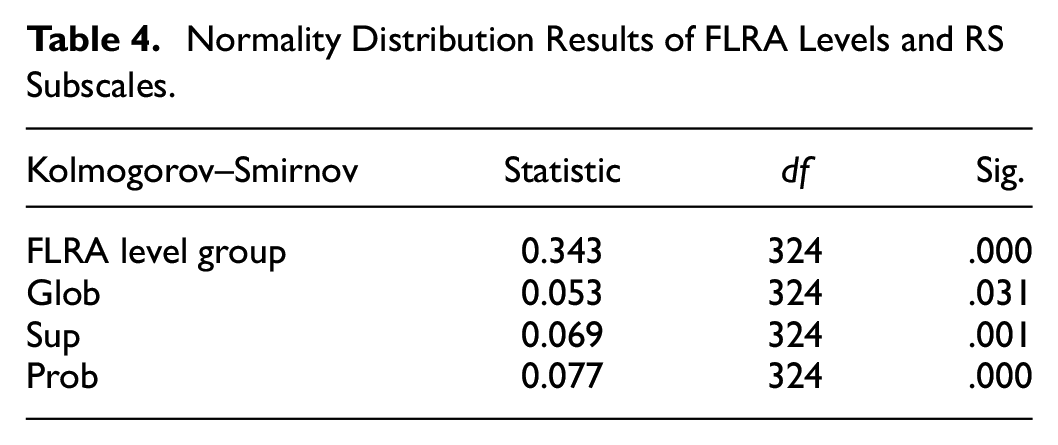
Due to the abnormal distribution of scores of FLRA levels and SORS subscales, a Kruskal–Wallis Test (a nonparametric test) was subsequently conducted three times to determine discrepancies in the adoption of reading strategy subscales (GLOB, SUP, PROB) across three different anxiety level groups (Gr1, hi-anxiety, n = 51: Gr2, mid-anxiety, n = 222: Gr3, lo-anxiety, n = 51).
As presented in Table 5, the employment of SUP among RA levels was not statistically significant, χ2(2, n = 324) = 5.674, p = .059 (p > .05). It means the choice of SUP among three groups has no discrepancies. Meanwhile, the opposite was found in using GLOB among three FLRA groups, with the χ2 value being 23.583 and p value less than .05 (p = .000), which means a statistically significant difference. Of the three levels, the lo-anxiety group recorded the highest mean rank (M = 233.58) compared to hi- and mid-anxiety groups (M = 117.39 and 156.53, respectively).
Results of Kruskal–Wallis Tests.

Similarly, there was a difference in the use of PROB among the groups, χ2(2, n = 324) = 26.808, p = .000 (p < .05). Again, group 3 (lo-anxiety) ranked first with mean scores being 228.06, followed by group 2 (mid-anxiety) and 1 (hi-anxiety) with mean scores being 159.80 and 108.68 respectively.
Research Question 3: How Is English Foreign Language Reading Anxiety Correlated with Reading Strategy Use?
This question aimed to establish the correlation between FLRA and RS and between FLRA and RS subscales. The preliminary steps were checking the outliers and assessing the distribution normality of FLRA and RS scores. No extreme outliers were deleted as there were not too high or too low scores. The Sig. value is .097 and .098 (more than .05), as presented in Table 6, suggesting the normal distribution of FLRA and RS scores.
Normality Distribution Results of FLRA and RS.

The assumption of normality is not violated; therefore, the relationship between FLRA and RS was examined by using Pearson’s correlation. The result showed a medium, negative correlation, r = −.37, n = 324, p < .005, with high reading anxiety correlating with lower reading strategy use, as seen in Table 7. According to Plonsky and Oswald (2014), it is considered medium if the correlation magnitude is close to .40 or −.40. Depending on their suggestion, the strength of the FLRA-reading strategy use relationship in the current study is medium (r = −.37).
Pearson’s Correlation Between FLRA and RS.

Correlation is significant at the .01 level (2-tailed).
Correlation is significant at the .05 level (2-tailed).
With respect to the relationship between FLRA and RS subscales (GLOB, SUP, and PROB), Spearman’s rank-order correlation was run due to the violation of the normality distribution of RS subscales as demonstrated in Research Question 2.
Table 8 indicates a statistically significant negative correlation between FLRA and GLOB, r = −.394, n = 324, p < .005. Similar results were found between FLRA and SUP, r = −.197, n = 324, p < .005, and between FLRA and PROB, r = −.385, n = 324, p < .005. The results suggest that FLRA increases when global, problem-solving, and support reading strategies decrease and vice versa. Plonsky and Oswald (2014) suggested a small strength of correlation if the correlation coefficient is close to .25 or −.25 and medium if r close to .40 or −.40. As such, the correlation between FLRA and GLOB and PROB is medium (r = −.394 and −.385 respectively) while between FL reading anxiety and SUP is a small correlation magnitude (r = −.197).
Spearman Rho Correlation Between FLRA and RS Subscales.
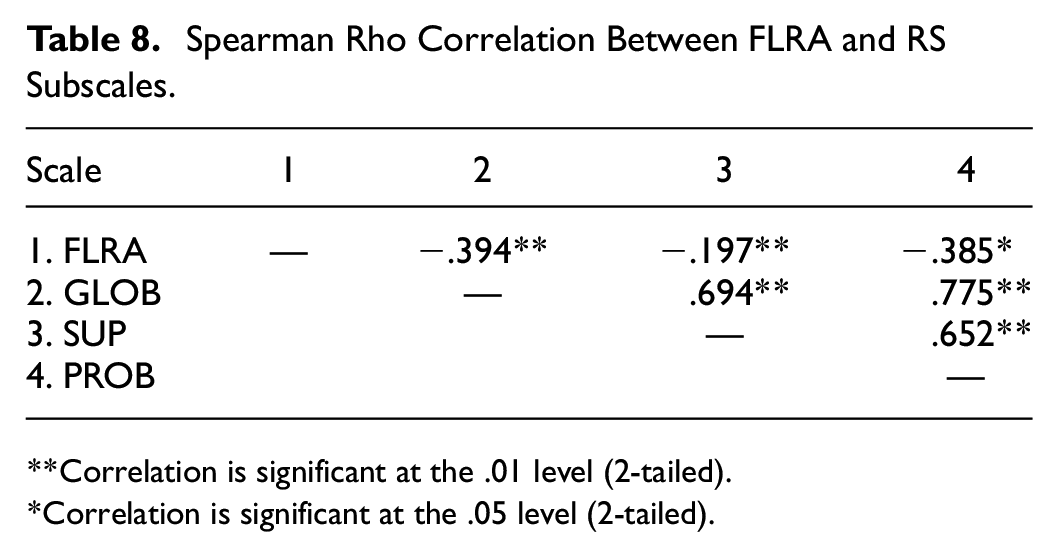
Correlation is significant at the .01 level (2-tailed).
Correlation is significant at the .05 level (2-tailed).
Discussions
This part discusses the results presented in the previous part in light of three research questions and draws implications. In terms of reading anxiety levels (Research Question 1), the data shows that more than two thirds (68.5%) of respondents were moderately anxious while reading. The presence of more moderately anxious readers than those with high and low anxiety is possibly due to reading strategy instruction before the survey, which might have partly prepared them for comprehension. Why the percentage of medium anxiety accounted for over two thirds of the total appears to derive from a quick switch of knowledge from general education (from Grade 3 to 12) to higher education. As discussed in the Introduction and described in the Research Setting, students were required to read 280–300-word passages about familiar topics for main ideas and details during high school time while they were exposed to 300–3,500-word authentic content with highly lexical density. Authentic content expertly developed by top professors in university coursebooks pushes them to be cognitively mature while time is so short. This might lead to slow readiness for comprehension, hence increasing reading worries. Additionally, reading for main ideas and details in general education means students are coping with the literal meaning of reading, which refers to what is directly stated in the texts (Alderson, 2000). In contrast, the level of understanding in higher education is two steps further. It means learners have to deal with more inferred meanings and critical understanding (Alderson, 2000). As such, a quick switch from easiness to difficulties without adequate preparation seems to generate their reading worries. The result of moderate reading anxiety is in agreement with preceding studies such as Dang (2022a, 2022b), Dang and Nguyen (2023), Mardianti et al. (2021), and Mawardah et al. (2019); however, the percentage of moderate anxiety differs among studies. Conducting studies at the same research site as the current study but at different times of data collection, Dang (2022a, 2022b) and Dang and Nguyen (2023) found that 71.8%, 96.7%, and 96.6%, respectively of respondents were moderately anxious during the reading process compared with 65.8% of the current one. It is evident that individual differences yielded different results, that is, the same research problem examined on different sample sizes at different times produced different percentages of anxiety levels. The data also suggests that anxiety degrees are dynamic and change occasionally.
Concerning the most adopted reading strategy subscale from SORS (Research Question 2), respondents preferred PROB (e.g., reading carefully and slowly, adjusting reading speed, visualizing information, re-reading texts, predicting meanings of new vocabulary items) to GLOB (e.g., having a purpose, thinking about prior knowledge, reviewing the text, among others) and SUP (reading aloud, underlining or circling information, paying closer attention, and the rest) with the highest mean scores of 3.15. Indeed, problem-solving strategies are more comfortable with students than global reading (Bishop et al., 2006). They are tactics that learners develop, accommodate, and balance independently. Compared with global reading skills that seem more challenging to teach (Bishop et al., 2006), problem-solving techniques could be adjusted at the spot of reading texts and are more accessible than the others. PROB does not require much time to learn and practice as SUP and GLOB. Both support and global strategies need much training and practicing to become “automatic actions that result in decoding and comprehension with speed, efficiency, and fluency” (Afflerbach et al., 2008, p. 368). The finding of the most frequently used reading strategy subscale supports Lien’s (2011) research which also confirmed that PROB was the most frequently employed and SUP the least. Another interesting finding related to reading strategy use indicates that learners with low anxiety utilized more GLOB and PROB than hi- and mid-anxiety groups. In other words, the less anxious learners were, the more strategies they employed. Perhaps, lo-anxiety participants better adopted strategic reading than hi- and mid-anxiety members; therefore, they felt less anxious. In simpler words, better knowledge of reading strategies might lower students’ anxiety. The result of the preferable reading strategy subscale agrees with Lien’s (2011) and Zarei’s (2014) findings; however, FLRA-level groups (hi-, mid-, and lo-anxiety participants) in Lien’s (2011) research, distinct from the current research, took turns keeping the highest scores on reading strategies. Specifically, lo-anxiety respondents adopted GLOB most frequently, while hi- and mid-anxiety participants held the first place with SUP and PROB, respectively. The difference between the present research and Lien’s (2011) study might be due to the dichotomy of research participants from Taiwan and Vietnam: 108 English majors in Lien’s (2011) study and 324 non-English majors in the current. It is evident that different quantities of research participants might lead to different results. English majors and non-English majors also have various reading purposes and materials. In addition, the discrepancy may be contextually situated because there could be distinctive teaching and learning English reading strategies between Taiwanese and Vietnamese contexts.
In the realm of the FLRA-reading strategy use relationship (Research Question 3), the FLRA-SORS relationship was found statistically negative, r = - .37, n = 324, meaning that FL reading anxiety decreased when SORS increased and vice versa. Put simply, adopting strategic reading helped lower worries, apprehension, and tension among readers. Wright and Brown (2006) stated that reading strategy training could enhance confidence in reading, and Grenfell (1995, as cited in Wright & Brown, 2006) asserted that reading techniques help learners become more independent readers, even more “active and purposeful” (p. 30). Possibly, the positive feeling of confidence plus support from reading tactics overwhelms anxiety and helps readers relieve their psychological and negative emotional state of anxiety. The finding is aligned with Tsai and Lee’s (2018) and Marashi and Rahmati’s (2017) results. Tsai and Lee (2018) found that participants felt less anxious when they used more reading strategies during the reading process. In a like manner, Marashi and Rahmati (2017) suggested that reading anxiety was reduced after the instruction of reading strategies. Conversely, the current result conflicts with the findings by Zarei (2014), Çapan and Pektaş (2013), and Le (2020). Both Zarei (2014) and Le (2020) found no differences between the reading strategy use and FLRA, while Çapan and Pektaş (2013) found a positive relationship between the two variables. The present study could be distinguishable from Le’s (2020) research, which was also conducted in the Vietnamese context, but at another research site. Specifically, Le’s (2020) sample size (48 first-year students) is too small compared with 324 participants of the current study, which is insufficient to generalize. The present research also provided explanations for the relationship between the two variables that were missing in Le’s (2020) research.
Pedagogical Implications
There are some pedagogical implications based on the findings of this research. To institutional leaders, authentic content from textbooks might be an issue for the present participants, non-English majors, as discussed in the Introduction and described in the Research Setting. Challenging and complex content seems to be more appropriate for English majors. Thus, the selection of a more satisfactory textbook should be of concern. To teachers, it was revealed that (i) students were moderately anxious when reading English texts, (ii) their overall use of reading strategies was medium, (iii) problem-solving strategies were the most adopted, and (iv) FLRA had a negative correlation with RS which means FLRA could decrease when RS increased. The results showed that the adoption of reading strategies could lower learners’ reading anxiety; nonetheless, their strategy use is still medium, not high. Thus, reading strategy instruction should be a greater focus as it could affect reading comprehension. More importantly, one step further, which aims to transfer strategies into skills, needs more effort from teachers as what learners are instructed to get over the meaning is called strategies, “conscious actions” while “a skill is a strategy that has become automatic” (Nunan, 2003, p. 77). To do so, teachers should instruct students on various reading strategies and support their learners’ reading strategy application. For example, instructors could pair students during reading practices and require them to confirm strategies employed in the “after reading” stage. This practice should be repeated in all reading classes to be developed into habits. Specifically, guessing the content of the text should be practiced many times during learning and practicing processes until it becomes automatic. Alternatively, a think-aloud protocol with a list of strategies can be utilized for students’ confirmation of what tactics they have employed. Additionally, learning from and interactions with peers might comfort students, leading to eagerness to read. Working with peers might also bolster reading motivation and support learners to memorize specialist knowledge, recall new vocabulary items, and prepare prior knowledge for prosperous readings.
Conclusion
The present quantitative research explored 324 students’ FLRA levels, their strategic reading adoption, and the relationship between FLRA and reading strategy use. Findings revealed that 68.5% of participants experienced a medium reading anxiety level. Problem-solving strategies were most preferred, and learners with a low level of anxiety used GLOB and PROB more frequently than hi- and mid-anxiety groups. Between FLRA and RS exists a statistically negative correlation, which means FLRA decreased when RS increased.
The present study also possesses some limitations. Methodologically, the study needs participants’ voices via face-to-face interviews to comprehensively understand what made learners anxious, what single strategies they utilized, and whether the use of RS increased or decreased their reading anxiety. In terms of the sample size, 324 respondents (including 152 females and 172 males) seem insufficient for a survey as suggested to be at least 350 by Creswell (2012) to make generalizations. Finally, the frequency of single reading strategy use should have been reported to have a more comprehensive picture of the reading strategy use.
From those limitations, future research is also recommended. A combination of both quantitative and qualitative data on a larger sample size should be considered. If it were in the same research site, students of Information Technology, who make up the majority, should be a priority. Furthermore, the effects of FLRA on other variables such as reading performance, reading habits, reading efficacy, and reading motivation should be analyzed. Importantly, the mediating role of RSU in the FLRA-reading performance relationship needs to be of great concern. Additionally, studies should describe single strategy use to have detailed implications for instructors of English reading. Last, gender differences in reading anxiety and reading strategies should be of concern as the number of males and females in the research is nearly equal, and there might be discrepancies in their emotional state and actions or behaviors to reading strategy use.
Footnotes
Appendix A: Questionnaire adapted from Saito et al. (1999)
Appendix B: Questionnaire adopted from Mokhtari and Sheorey (2002)
Declaration of Conflicting Interests
The author(s) declared no potential conflicts of interest with respect to the research, authorship, and/or publication of this article.
Funding
The author(s) received no financial support for the research, authorship, and/or publication of this article.

Data Availability Statement
Data sharing not applicable to this article as no datasets were generated or analyzed during the current study.