




Abstract
This experimental research investigates the impact of teaching metacognitive reading strategies on the reading comprehension of engineering students in the English for Science and Technology(EST) context. This research is the first empirical study of its kind in Libyan English as a Foreign Language (EFL/EST) context. The study utilizes the Survey of Reading Strategies (SORS) and a reading comprehension achievement test extracted from ‘Oxford English for Computing’ by Boechner and Brown (instruction manual). The treatment incorporates the explicit teaching of metacognitive strategies to the participants in the experimental group via the Cognitive Academic Language Learning Approach (CALLA) model. Paired-samples t-test results signify a considerable treatment effect among the experimental group. In conclusion, the findings support previous research indicating that explicit instruction effectively improves Libyan EST students’ metacognitive awareness and produces statistically significant gains in reading comprehension.
Keywords
Reading is a process in which the reader utilizes strategies and techniques to find main ideas and cognitively process information through the organization, monitoring, summarizing, and evaluating comprehension outcomes against own reading purposes (Grabe, 2009). Reading a text and comprehending the meaning requires the learner to employ specific techniques or strategies to interact with the text. Ghafournia and Afghari (2013) argue that strategic competence is mandatory and involves the ability to judge, organize, and apply strategies to process text. According to Muhid et al. (2020), a study on the impact of metacognitive strategies on students’ reading comprehension found a positive effect on students’ reading abilities. By implementing metacognitive reading strategies in the reading process, the students will gain strategic competence and become strategic readers. Strategic readers can organize, monitor, and evaluate their reading performance according to their involvement in practicing metacognitive strategies.
Furthermore, when readers automatically and continuously monitor their reading and strategy use in the reading process, they gain strategic competence. Strategic readers have metacognitive knowledge, which gives them complete control while reading Pang (2008). They instinctively control their strategy use, employ it in the context, and purposefully regulate their behaviors while reading. The less proficient readers lack this skill and behavior (Paris & Myers, 1981). The interaction of effective readers with the text through their control of behaviors and strategy use results in comprehension. Effective readers know how to maneuver their attention while reading to more critical text features. This metacognitive knowledge helps them stay in control of the reading process. They also know how, when, and where to apply specific strategies to fully comprehend the task (Arabsolghar & Elkins, 2001). According to McNamara and Magliano (2009), readers’ knowledge of strategies and metacognitive awareness determine the degree of strategic comprehension engagement in the reading process. Ultimately, reading ability is critical for learners to comprehend texts and progress academically (Naidu et al., 2013). Thus, for readers to interact with a text and understand the writer’s intent, they must learn how to read strategically.
In addition, Gurses and Adiguzel (2013) further highlight the importance of the cognitive awareness of the learner. According to Baker and Brown (1984), the metacognition concept refers to the learners’ understanding of their cognitive steps and control over the reading process. This awareness results in effective performance in actively accomplishing reading tasks and employing self-regulating strategies. Metacognition is the awareness of one’s cognitive function (Flavell, 1976). Piaget’s theory of cognitive development is also essential in the concept of cognitive development. This awareness enables learners to find the problem while reading and guides them to be selective in strategy use such as repetition, deduction, elaboration, inference making, and summarizing. They help readers become efficient readers (Ozek & Civelek, 2006). Cognitive awareness requires the reader to recall previously learned reading experiences to break up the text, understand the writer’s intentions, and ultimately comprehend the text.
Literature Review
Reading Comprehension
According to Slaouti et al. (2013), reading comprehension helps readers identify clear goals during reading to motivate them and enhance their awareness of reading strategies experience. Ismail et al. (2015) cite three stages that exist in the comprehension process:
Literal comprehension, which is related to decoding and recognition.
Inferential skills that help with decoding analysis.
Critical comprehension involves making inferences and predictions based on the text and moving beyond the literal meaning.
Generating inferences is essential for critical comprehension (McNamara & Kendeou, 2011). According to Mayer (1996), extensive research indicates the effect of metacognitive strategies on students’ ability to generate inferences. Reading via processes such as integrating existing and prior knowledge, inferences generation, and selection of essential features from the text can promote comprehension McNamara and Kintsch (1996). Effective use of strategies in the reading process promotes the generation of accurate inferences and leads to comprehension Best et al. (2005). Follmer and Sperling (2018) claim that readers who have the skill to seek inference generation can comprehend text better and monitor their performance. They can utilize reading strategies effectively too.
In addition, as McNamara and Kendeou (2011) summarize, first, teachers should teach comprehension skills in early childhood. Second, instruction should focus on processes to improve learners’ reading performance (i.e., product). Third, scaffolding is crucial for generating inferences when the text is ambiguous. Fourth, comprehension is an interactive process that rests on the instructed reading task and the reader. This process necessitates the proper selection of materials for the instruction of specific individuals and groups. Fifth, educators can benefit from using standardized reading comprehension assessments to understand students’ strengths and weaknesses better.
Needs of ESP and EST Programs
A program design must cater to the fundamental requirements of a successful ESP program. The instruction program must reflect the learners’ needs (Kashef et al., 2012). As stressed by Dudley-Evans et al. (1998), the role of an ESP instructor is to teach appropriate language programs following the needs of learners. The role of the teacher must be acknowledged, as he is the one to equip students with the proper language skills. To ensure students have the appropriate language skills, teachers should teach them language through the development of generic skills, including critical thinking, problem-solving, and communication skills (Knezović, 2016).
Similarly, Flowerdew (2013) argued that there is a need for EST teachers who could play the role of disciplinary outsiders taking into account varied discourse features along with grammar, terminologies, and genres. The relevant discourse contexts need to be measured by teachers, for they are not experts in the concerned field. Discourse genres of science and technology, whether written or oral, should be the center of research focus for academics.
Another significant aspect of students’ learning in the EST context is the importance of visual information Johns (1998). Johns (2013) held that there was a need to study the interaction between visual information and verbal information for ESP learners, specifically in the context of EST. This skill would enable students to present data effectively and grasp abstract concepts to integrate new knowledge with the existing one. According to Hyland and Jiang (2021), learners possess varying skills in the field of ESP and are inclined to employ interpretative strategies. These strategies help the learners extract meaning from secondary resources such as tables and diagrams and relate information to the text. Indeed, these tactics enhance comprehension and reading skills.
Furthermore, recalling background knowledge and knowledge of vocabulary enrich the reading experience of ESP&EST learners. Tabataba’ian and Zabihi (2011) acknowledged the significance of prior knowledge in comprehending the reading text. Another study by Taghizadeh and Khalili (2019) stated the effect of vocabulary knowledge on reading performance among engineering students. The findings revealed a statistical contribution to the depth of vocabulary knowledge in academic reading. In addition, Tsai and Chang (2014) constructed an Online Cumulative Sentence Analysis (CSA) instruction to enhance students’ reading comprehension of technical texts. They argued that reading skills are fundamental for ESP/EST students to transfer knowledge of their profession from an academic setting to their future workplace. The students can attain these reading skills through exposure to authentic reading materials published in English. The outcome of the instruction was positive and helped students to deal with problems associated with reading.
Therefore, an appropriate methodological approach, necessary language competencies, and learning strategies are fundamental to helping ESP students achieve their goals (Kashef et al., 2012).
Metacognitive Reading Strategies Instruction
Reading strategy use and instruction have gained the attention of researchers interested in helping readers develop their skills and become strategic readers (Grabe, 2009). However, there are many difficulties in designing an appropriate strategy instruction model for instructors (Billmeyer, 2006). Integration of strategies into classroom activities is a demanding task for both teachers and students. It requires teachers’ and students’ planning, definition, and modeling to take responsibility for their learning. According to Nelson and Manset-Williamson (2006), this supports the claim of the importance of integrating explicit strategy instruction into classroom activities regardless of the difficulties teachers might face at the start of the intervention. According to Pressley et al. (1989), not all teachers successfully integrate explicit strategy into classroom reading activities. In a study by Gooden (2012), most of the 56 teachers were unaware of their students’ strategy application in the reading process. They started learning more about their students’ strategy preferences and cognitive thinking as time passed. Teachers should carefully design the instruction according to their students’ needs and cognitive abilities. Before starting the instruction process, teachers should select strategies carefully, keeping in view the specific needs of the students (Iwai, 2011).
Another view by Nelson and Manset-Williamson (2006) claims that the disadvantage of explicit instruction is the possibility of demotivating students to read and find appropriate strategies independently. However, instructors must teach students to self-regulate their learning and apply strategies to develop awareness and improve comprehension. Thus, the main advantage of explicit instruction is that it will equip students with a repertoire of strategies to tackle complex tasks. Teachers should consider different learners’ styles and needs to design appropriate instruction material.
Previous research by Mehrpour et al. (2012) examines the effect of explicit teaching of metacognitive reading strategies on students’ awareness and use. The results show that some strategies are challenging to instruct; overall, the students’ understanding improves. According to Takallou (2011), when teachers select authentic, meaningful reading texts for their students, they face the problem of finding appropriate strategies to put them into the proper context. At the same time, strategy training appears to raise students’ awareness of reading strategies and encourages strategy use. However, some students find some strategies hard to acquire. Moreover, the reading strategy instruction cannot significantly enhance the student’s reading performance based on the results from a reading comprehension test given to the participants at the end of the program. This difficulty is a challenging task that needs consideration when conducting strategy instruction. However, short authentic reading texts lead to motivation and engagement if the appropriate strategies are crafted correctly in the context of students’ needs and cognitive abilities. The goal of explicit strategy instruction is to engage students and motivate task completion in an effective manner (Takallou, 2011).
Despite the challenges described above, a considerable body of literature still investigates the effect of metacognitive strategies in English as a second language (ESL). Many studies have examined readers’ awareness and use of metacognitive strategies (e.g., Ajideh et al., 2018; Magogwe, 2013; Tavakoli, 2014) and have found varying patterns of strategy preferences. Magogwe (2013) explored university students’ strategy preferences. The most favored reading strategies were cognitive strategies followed by metacognitive and support strategies. This finding is in line with Ajideh et al. (2018), who acknowledged that the most preferred reading strategies among students in the ESP context were cognitive strategies. However, according to Tavakoli (2014), the findings revealed moderate awareness and use of reading strategies. The most preferred reading strategy subclass among students was support strategies (SUP), and the least preferred among them was the problem-solving subclass (PROB). The study also revealed no significant difference in how male and female students applied strategy preferences.
Furthermore, several researchers have studied the effect of metacognitive reading strategies in the ESL context (e.g., Aghaie & Zhang, 2012; Al-Qahtani & Lin, 2016; Khonamri & Karimabadi, 2015; Tavakoli, 2018) and have reported improvements in students’ reading comprehension after strategies instruction. However, less attention to investigating English for Specific Purposes (ESP) and English for Science and Technology (EST) contexts exists. Researchers argue that metacognitive reading strategies are crucial in ESP learning as they allow students to be responsible learners (Pirsl et al., 2013). The impact of teaching metacognitive reading strategies on ESP and EST students’ reading comprehension is scarce (e.g., Kashef et al., 2012; Taghizadeh & Khalili, 2019; Ziyaeeimehr, 2012). The findings indicate that metacognitive reading strategies’ instruction is productive at improving the reading comprehension abilities of ESP and EST students.
Prior research has revealed the benefits of strategy instruction. The study by Kashef et al. (2012) aimed to explore the impact of teaching strategies on ESP students’ reading performance. The results indicated a significant impact of the treatment on students’ reading skills. Another study by Ziyaeeimehr (2012) compared the effect of instruction with the traditional Grammar-Translation Method (GTM) on reading comprehension strategies among engineering students. The results revealed that reading comprehension strategies instruction improved the reading performance of the learners in the experimental group. Dhieb-Henia (2003) also examined the impact of strategy instruction in the EFL/ESP context. The findings revealed improvement in students’ ability to read research articles. According to Ahmadi et al. (2013), metacognitive reading instruction helps students become good reading strategists in the context of EFL.
Current Status of ESP and EST Programs in the Libyan EFL Context
The current status of research on metacognitive reading instruction in English as a foreign language (EFL/ESP) in Libya is not promising. It lags far behind in terms of recent developments in the field. Until the late 1980s, English was a primary and secondary school subject and the medium of instruction in Libyan universities. For many years, the Libyan government prohibited English classes, which was a disadvantage. This omission denied an entire generation of people the opportunity to learn the language. It negatively impacted on students’ academic performance. However, using only Arabic was unprofitable due to insufficient academic materials and resources (Tamtam et al., 2013). According to Tamtam et al. (2011), the students were unable to use the available learning materials and data due to language barriers.
Furthermore, given the limited published research, there is not enough data to determine the viability of instruction of metacognitive reading strategies in the Libyan contexts of ESP/EST. The establishments of Higher education in Libya struggle to stay competitive with the demand for ongoing developments in science and technology. However, Abuklaish (2014) attempted to determine the needs of university students in the department of science in Libya. He observed the English language playing a leading role, specifically in the academic setting of computer science, where most of the discourse teaching is via English. Mohsen (2014) studied the problems associated with teaching EFL in educational institutions in Libya. The results revealed that the main issues involved a vast scarcity of sufficient teaching resources, unqualified teachers, and a lack of adequate teacher training programs. Moreover, Elmadwi and Shepherd (2014) examined the use of cognitive strategies among university students in Libya and discovered that Libyan EFL university students used moderate cognitive reading strategies. Finally, an action study by Tarhuni (2013) investigated the impact of teaching language-learning strategies on Libyan EFL adult learners. The outcomes revealed that strategy-based instruction (SBI) helped raise teachers’ and students’ awareness of language learning strategies (LLS).
In addition, a lack of strategic reading programs aimed at Libyan engineering university students is also noticeable. Those students must learn to read lengthy technical texts prescribed in their academic courses. The inability to comprehend those complicated texts often leads them to memorization and adds to their frustration. This issue posed an immediate challenge to both teachers and students alike. Thus, there is an urgent need to fill the gap by conducting research in the Libyan EST context, investigating the effect of metacognitive strategy instruction on students’ reading comprehension, and comparing the outcome with other identical contexts.
This scarcity of empirical evidence leads to a knowledge gap in the literature that must be filled, particularly in the Libyan EST context. However, to bridge this gap, an appropriate reading model is needed. One practical and applicable model is the Cognitive Academic Language Learning Approach (Chamot, 2005; Chamot et al., 1999)—the CALLA model. This model combines academic content instruction and language development instruction to engage intermediate or advanced English proficiency students in explicit instruction of metacognitive reading strategies. Hence, this model appears suitable for the current study, given the students’ proficiency levels and the parallel needs of academic content and language development in the EST context.
While recent studies (e.g., Ahangari & Mohseni, 2016; Ajideh et al., 2018; Takallou, 2011) have acknowledged improvements in students’ reading performance, the use of the CALLA model was effective. It is unclear whether the CALLA model applies to other learning frameworks, such as the Libyan EST context. Moreover, until now, no studies have utilized the CALLA model and the Survey of Reading Strategies (SORS) to investigate the impact of strategies instruction on students’ reading comprehension in the Libyan EST context. Thus, the current study aims at furthering the results of previous research and adds to the existing body of literature by identifying whether metacognitive strategies instruction through the CALLA model is viable in the Libyan EST context or not. The paper is the first of its attempt to address the issue in the local context. Such a study aims to probe if the outcome is favorable in enhancing students’ reading comprehension.
The current investigation addresses the following specific research questions:
RQ1: Are there any significant differences in students’ awareness and use of metacognitive reading strategies before and after receiving the instruction program?
RQ2: Is there any significant difference in students’ comprehension performance before and after receiving the metacognitive reading strategies instruction program?
To answer these questions, a quasi-experimental design has been adopted to compare the impact of the treatment (experimental group) relative to a control group.
Study Focus
The current study implements the CALLA model to teach metacognitive reading strategies, as explained in the main study’s second segment. According to (Atherton, 2011), through the CALLA model, students learn how to connect prior knowledge with the newly acquired information in an active process. This process proceeds to practice language functions and learning strategies to understand discourse features and evaluate the learning process (Chamot, 2005). Babiker et al. (2016) also assessed reading strategy instruction programs using CALLA and found a significant correlation between CALLA metacognitive strategies and improvement in students’ reading skills. Shih (1992) recommended using the CALLA model for English for Academic Purposes (EAP) students.
Furthermore, in this study, reading comprehension scores have been used to indicate success in implementing metacognitive reading instruction. The inquiry uses the CALLA model and SORS questionnaire for the treatment in the Libyan EST context. Practices and reading comprehension questions are based on authentic material (Oxford English for Computing by Boechner and Brown (2006)) as the instruction manual. In this experimental research, explicitly instructing strategies minimizes diversity in research findings to find differences between control and experimental groups, excluding the effect of other variables such as gender and variance in proficiency. The focus included the differences in strategy use and reading comprehension performance among experimental and control groups. The calculation of the effect measures the impact of the intervention.
Methodology
Subjects
Participants for the current investigation comprised students from two pre-existing classes available to EST undergraduates majoring in computing engineering within the Faculty of Engineering Technology in Libya. The students were registered with the English for Computing Course in Semester 1, 2021. All students had the same academic English backgrounds. Each class consisted of 30 students and was assigned to either the control group (n = 30) or the experimental group (n = 30). The control and the experimental groups had a mix of males and females aged 22 to 24. Thirty-eight participants were male (60%), and 24 were female (40%). Before starting the study, all participants underwent the standard International English Language Testing System (IELTS) reading test to determine their English language proficiency levels. That was to ensure that all students had the required proficiency level for implementing the CALLA model (intermediate to advanced proficiency level). Most students obtained scores within the upper intermediate range, considered appropriate for implementing the CALLA model. Two female instructors with the same teaching experience participated in the study as the class instructors. The classes were matched as the teachers’ criteria required before grouping in terms of gender and language proficiency.
Instruments
Instruction Materials for Reading Strategies
An authentic book entitled Oxford English for Computing by Boechner and Brown (2006) was selected to conduct the metacognitive reading strategies instruction. It was made available to each participant in the experimental group. The book was selected based on its authenticity in academic content and intended to teach crucial metacognitive reading strategies to undergraduate students of computing engineering. The book provides a valuable guide for learning and using metacognitive reading strategies. The CALLA model was used to teach those metacognitive strategies available in the SORS questionnaire on selected texts from the instruction material book. Examples of metacognitive strategies practiced via the CALLA model on the selected texts include skimming, predicting (GLOB), and text paraphrasing, revisiting read text (SUP), guessing unknown words, and visualizing information (PROB). The framework of the model includes preparing, presenting, practicing, evaluating, and expanding each strategy (Oxford et al., 1990). A sample of the computing engineering text is enclosed in Appendix 1 and 1a (reproduced with the permission of Oxford University).
CALLA Model
The teaching of metacognitive reading strategies to the experimental group was performed in line with the CALLA model (Chamot et al., 1999). The model integrates academic content and language development instruction well to form a recursive strategy learning approach (Chamot, 2005). The implementation of the model is described in the second phase of the current study.
Reading Comprehension Achievement Test
This test is designed to correctly measure engineering students’ reading abilities. The test components are related to metacognitive reading skills and strategies. The test questions are based on the material from “Oxford English for Computing” by Boechner and Brown (2006). The test comprises ten questions, each worth four marks; thus, the maximum score is 40. The test took 90 minutes to complete. The same test was administered to both the groups, pre-, and post-study. As described in the procedure section, the reading comprehension test was piloted before being applied in the main study. A sample of reading comprehension test questions is provided in Appendix 2 and 2a (reproduced with the permission of Oxford University).
SORS Questionnaire
This questionnaire analyzes students’ awareness and use of reading strategies. This instrument was designed and validated by Mokhtari and Sheorey (2002). The authors presented 100 strategies for initial validation held by experts in the concerned field. The specialists checked and evaluated those strategies in terms of clarity and appropriateness. During validation of the instrument, the experts reduced the number of strategies from 100 to 40. Later, they were reduced further to 30 strategies. The strategies were grouped into three subclasses. Those subclasses of metacognitive strategies interact with each other and affect the comprehension process. The first subclass, Global Reading Strategies (GLOB), is generally related to preparation for the reading process and includes evaluation of the text, skimming, and predicting (this subclass contains 13 strategies). Support Reading Strategies (SUP) is also called practical strategies and includes text paraphrasing, revisiting read text, and using reference materials (this subclass contains nine strategies). Problem-solving Strategies (PROB) are used to solve problems presented in the text, including slow reading, guessing unknown words, and visualizing information (this subclass contains eight strategies).
All items are scored on a five-point Likert scale as follows:
1 = “I never do this.” 2 = “I do this only occasionally.” 3 = “I sometimes do this.”
4 = “I usually do this.” 5 = “I always do this.”
The mean of each subclass can be interpreted as follows: low use (mean of 2.4 or lower), moderate use (mean of 2.5 to 3.4), and high use (mean of 3.5 or higher). Mokhtari and Sheorey (2002) applied this measure to a sample of college students. They obtained a Cronbach’s α of .89. Written permission for using this measure in the current study has been granted from the authors.
Procedures
Pilot Study
Participants were randomly selected to participate in the pilot study (20 males and 20 females). All were ESP engineering undergraduates with equivalent characteristics as participants in the main study. The pilot study was conducted to check the difficulty and reliability of the instruments. Faculty teachers checked the content validity of the survey. Five experts who had experience teaching English for more than 10 years modified some of the questions to simplify and improve the order of presentation of the items. Then, the survey was administered to the pilot sample participants. The reliability was measured using the KR-21 reliability indicator; the estimated value was .747 for the pilot study and 0.82 for the main study, indicating that the measure was stable and reliable. The Cronbach’s α of the SORS instrument for Libyan students was also computed during the pilot study. The overall Cronbach’s α for the pilot study was 0.83, while it was 0.85 for the main study, as shown in Table 1 below.
Cronbach’s α.

Since Cronbach’s α for the overall survey was 0.853, which is greater than the minimum acceptable value of 0.60, it was concluded that the survey had acceptable reliability. Two weeks before the main study commenced, the researcher gave the language instructors guidelines about the instruction approach. Two female instructors with the same teaching experience took part in the study. The instructors were advised to follow the procedures of the study. Due to the technical content of the instruction material, and given the researcher’s extensive background in engineering and teaching the English language, language instructors in the study were provided with an overview of all the technical concepts within the course’ English for Computing Engineering’ material. This overview stimulated the engineering students’ background knowledge while learning and practicing the metacognitive reading strategies. The data were collected per the steps described below in the main study.
Main Study
Copies of the reading comprehension test and SORS questionnaire were distributed to all students in both groups before starting the treatment. To explore the effectiveness of the instruction, in the first phase, for the pre-test, all participants in both groups completed the reading comprehension test and SORS questionnaire. Students were allocated 90 minutes to complete the reading comprehension test and 20 minutes to complete the SORS. Instructions for completing the questionnaire were provided, along with some examples. The Likert rating scale and the response options were also explained. Students were encouraged to select their responses carefully. In addition, students were familiarized with the format and style of the reading comprehension test to ensure they completed all test components. The participants in both groups undertook the exact two tests as a post-test at the end of the 8-week instruction program.
In the second phase, the treatment commenced, and participants in the experimental group completed 90-minute of eight instructional sessions in which they explored and practiced metacognitive reading strategies. Exercises and various relevant, authentic texts were extracted from the Oxford English for computing book by Boechner and Brown (2006). At the beginning of the treatment, the students were introduced to all 30 metacognitive strategies in the SORS questionnaire. They were made aware of the benefits of employing those strategies in the process of reading that enable them better comprehend the reading material prescribed in the course. At every training session, four metacognitive strategies were introduced for instruction. The students were assigned reading tasks and appropriate metacognitive reading strategies. That was followed by a discussion of the efficacy of the strategies (as explained in the SORS). Finally, the instructor encouraged the participants to tackle the comprehension questions provided with each reading text.
CALLA model was implemented as follows:
The instructor discussed with the students how to appropriately select reading strategies and use them.
That was followed by an explanation of the selected strategies, and students were encouraged to self-monitor their awareness and use of these strategies in appropriate situations.
The students were instructed to practice those strategies for selected readings.
The instructor sought students’ feedback and evaluation of the strategies used.
Finally, students were taught how to use those strategies in different situations and tasks.
The above procedure was followed in the teaching and practice of most metacognitive reading strategies included in the three subclasses of SORS.
The control group followed the traditional method of instruction in which the learning process revolved around the instructor. The students received embedded instruction without any deliberate or explicit explanation of the strategies. According to the traditional approach, for the students to achieve improved reading comprehension, the instructor should repeatedly expose them to reading texts and questions until they reach the desired level of mastery. The English language instructor for the control group possessed an equivalent formal qualification and experience as that of the experimental group language instructor. During each session, the instructors offered help. They provided explanations of complex vocabulary and feedback without engaging them in the explicit process of providing correct answers. The classes were frequently observed during the observation to provide constant feedback to the teaching team. During the third phase, as a post-test, the SORS questionnaire and the comprehension test were again administered to all students of both groups.
Design
The study adopted an experimental design to assess the impact of metacognitive strategies instruction on the reading performance of computing engineering students in Libya. The quantitative method was employed for pre-test and post-test assessments of the experimental and control groups.
Data Analysis
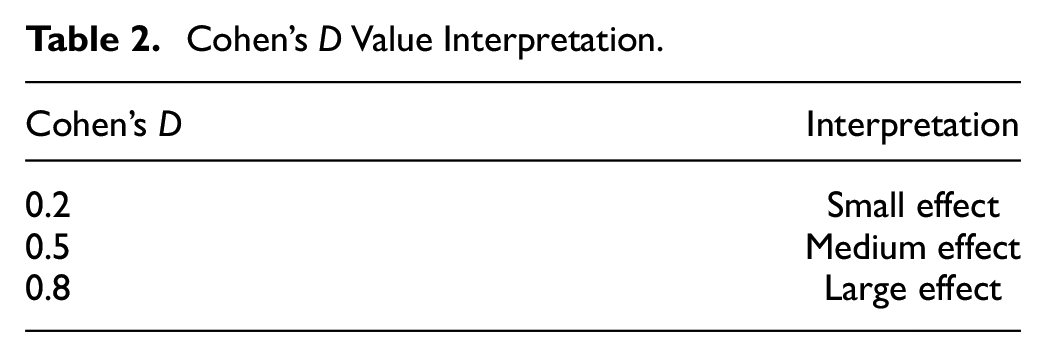
Descriptive statistics were calculated for the variables, including means and standard deviations. Statistical analysis was carried out using independent and paired samples t-tests. The scores for each SORS subclass were processed to obtain the group averages. Similarly, for the reading comprehension test, all scores of students were administered to obtain the group averages. Then, learners’ performance within and between the groups was compared for the pre-and post-test. For all statistical analyses, an α level of .05 was set. To check the importance of the instruction (intervention) effect, Cohen’s D effect size method was used. Effect size can be computed and interpreted using, Table 2 given below.
Cohen’s D Value Interpretation.
Findings
The experimental findings show that in the post-test, the experimental group exhibited increased awareness and use of all metacognitive strategies compared to the control group. For the control group, there was an increase in the reading strategy awareness and use level from pre-test to post-test, but the scores remained within the medium range of strategy use. The paired samples t-test results for the experimental group show that the effect size is large. The magnitude of the difference was 1.51 for metacognitive awareness and strategy use. A large effect can be observed. Thus, the impact is significant. This is interpreted as substantial differences in the students’ mean scores before and after the instruction. To explore the differences in the levels of metacognitive reading strategies awareness and use before and after the treatment, both between and within the control and experimental groups, independent samples t-tests and paired samples t-tests were performed.
Experimental Findings on Metacognitive Awareness and Use
Comparison of the Pre-Test Scores Between the Groups
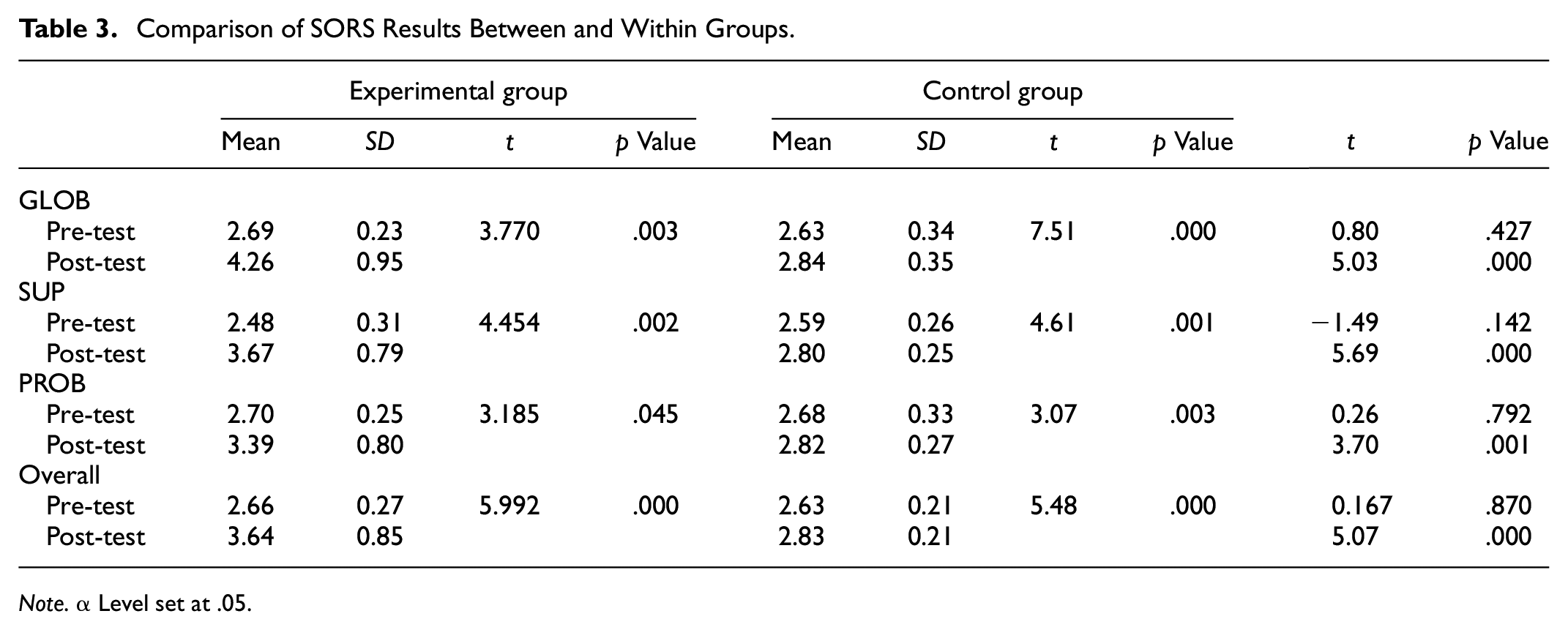
As shown in Table 3, an independent samples t-test indicated no significant difference in the pre-test’s overall mean number of strategies used between the experimental and control groups. The overall mean number of strategies used among the experimental and control groups during the pre-test was (M = 2.66, SD = 0.27) and (M = 2.63, SD = 0.21), respectively, t(58) = 0.167, p > .05.
Comparison of SORS Results Between and Within Groups.
Note. α Level set at .05.
In addition, there were no significant differences in the mean values for the three subclasses of the SORS between the two groups in the pre-test; the means were all <3.5, which, according to the SORS assessment guidelines, represents a moderate level of strategy use. Thus, it is observed that both groups had a similar degree of awareness and use of metacognitive reading strategies before the treatment.
Comparison of the Post-Test Scores Between the Groups
An independent samples t-test indicated a significant difference in the overall mean number of strategies used between the experimental and control groups in the post-test. The overall mean number of strategies used among the experimental and control groups during the post-test was (M = 3.64, SD = 0.85) and (M = 2.83, SD = 0.21), respectively, t(58) = 5.07, p < 0.5. (See Table 3). In addition, there were significant differences in the mean scores for the three subclasses of the SORS between the experimental and the control groups in the post-test. The calculation of the magnitude of the difference was 1.31 for the independent-samples t-test results of metacognitive awareness and use between the groups in the post-test. A large effect size is observed, implying the impact of instruction is significant. The students in the experimental group outperformed the control group. Their mean scores for metacognitive awareness and use were significantly different in contrast to the control group’s mean scores in the post-study.
In the post-test, the mean scores for all three subclasses of SORS in the experimental group exceeded those in the control group. For the experimental group, the mean value of the GLOB score was (M = 4.26), the mean SUP score was (M = 3.67), and the mean PROB score was (M = 3.39). According to the SORS assessment guidelines, values of 3.5 or higher represent a high level of strategy use. Thus, in the post-test, the experimental group exhibited a high level of support strategies and global strategies use but a moderate level of problem-solving strategies use. In the post-test, for the control group, the mean GLOB score was (M = 2.84), the mean SUP score was (M = 2.80), and the mean PROB score was (M = 2.82). According to the SORS assessment guidelines, values of 2.5 to 3.4 represent a moderate level of strategy use.
Paired-samples t-tests were used to determine any differences in students’ levels of awareness and use of metacognitive strategies after the treatment in the experimental group. As shown in Table 3, the overall mean number of strategies used by the experimental group was significantly higher in the post-test (M = 3.64, SD = 0.85) than in the pre-test (M = 2.66, SD = 0.27), t(29) = 5.99, p < .05. The paired-samples t-test results for the experimental group show that the effect size is large. The magnitude of the difference was 1.51 for metacognitive awareness and strategy use. A large effect can be observed. Thus, the impact is significant. This is interpreted as substantial differences in the students’ mean scores before and after the instruction. In addition, the mean scores for the three subclasses of the SORS were significantly different in the post-test compared to the pre-test. The mean scores in the post-test exceeded those of the pre-test. In the post-test, the mean GLOB score was (M = 4.26), the mean SUP score was (M = 3.67), and the mean PROB score was (M = 3.39). According to the SORS assessment guidelines, values of 3.5 or higher represent a high level of strategy use. In the pre-test, the mean GLOB score was (M = 2.69), the mean SUP score was (M = 2.48), and the mean PROB score was (M = 2.70). According to the SORS assessment guidelines, values of 2.5 to 3.4 represent a moderate level of strategy use. Thus, it is noticed that after the treatment, the experimental group exhibited increased metacognitive reading strategy awareness and use.
Comparison of the Pre- and Post-Test Within the Control Group
The pre- and post-test scores of the control group were compared using paired samples t-tests to identify if there were any changes in the students’ levels of awareness. As illustrated in Table 3, the overall mean number of strategies used was significantly higher in the post-test (M = 3.83, SD = 0.21) than in the pre-test (M = 2.63, SD = 0.21), t(29) = 5.48, p < .05. In addition, for the control group, the mean scores for the three subclasses of the SORS were significantly different in the post-test compared to the pre-test. The mean values for the three subclasses of the SORS in the post-test exceeded those in the pre-test. For the control group, in the post-test, the mean GLOB score was (M = 2.84), the mean SUP score was (M = 2.80), and the mean PROB score was (M = 2.82). According to the SORS assessment guidelines, values of 2.5 to 3.4 represent a moderate level of strategy use. For the control group, in the pre-test, the mean GLOB score was (M = 2.63), the mean SUP score was (M = 2.59), and the mean PROB score was (M = 2.68). According to the SORS assessment guidelines, values of 2.5 to 3.4 represent a moderate level of strategy use.
As illustrated in Table 4, after the treatment, for most strategy subclasses, participants exhibited a high level of strategy use, except for the problem subclass, which remained within the medium range of strategy use.
Levels of Strategy Use.

The results revealed no statistically significant differences in the SORS scores between the experimental and control groups before the treatment was applied. However, after the direct instruction intervention, the experimental group’s performance exceeded the control group. The control group had received the traditional method of teaching. Thus, students in the experimental group exhibited increased metacognitive awareness after receiving effective instruction on metacognitive strategies. Further, the experimental group showed significant differences in the SORS scores between the pre-test and post-test. That further demonstrates that participants’ frequency of reading strategy use noticeably increased after the treatment.
The results revealed significant differences between the pre-test and post-test scores for the experimental group for the two subclasses of the SORS, the GLOB, SUP, and PROB. These differences indicate the assumption that the treatment positively affected students’ awareness and frequency of reading strategy use. The least preferred group was the SUB subclass among the students of computing engineering during the pre-test assessment. However, the SUP subclass recorded the second-highest mean value during the post-test. The noteworthy increase after the treatment in the awareness and level of use of support strategies by EST students in Libya highlights the advantage of teaching metacognitive reading strategies among EST students. Paraphrasing and summarization strategies, examples of support strategies, are valuable practices for EST readers; these practices help students comprehend the text in their own way. It is worth noting that, during the investigation, at the pre-test, the problem strategies subclass was a second preference among students in the experimental group.
However, after the treatment, at the post-test, their second preference was the support strategies subclass rather than the problem strategies subclass. This change in strategy preferences could be related to the needs of learners and the difficulty they face in reading their academic subject material in English. The students are constantly challenged by having to read their academic subjects in English while the medium of instruction is Arabic. This issue may have led to the students practicing and utilizing the support strategies subclass more often than the problem strategies subclass.
The findings revealed that the experimental group exhibited an improved reading comprehension level compared to the control group at the post-test. It was also noticed that there was a significant difference in the overall mean reading comprehension scores for the experimental group between the pre- and post-test. For the experimental group, the calculation of the magnitude of the difference was 1.54 for reading comprehension. This value shows that the effect size was large for the paired-samples t-test results meaning there are significant differences in the students’ mean scores before and after the instruction. To explore the differences in reading comprehension performance before and after the treatment, both between and within the control and the experimental group, independent samples t-tests and paired samples t-tests were used.
Experimental Findings on Reading Comprehension
Comparison of the Pre-Test Scores Between the Groups
As shown in Table 5, an independent samples t-test indicated no significant difference in the experimental and control groups’ overall mean reading comprehension scores in the pre-test. The overall mean reading comprehension scores for the experimental and control groups during the pre-test were (M = 17.26, SD = 3.61) and (M = 17.23, SD = 3.39), respectively, t(58) = 0.971, p > .05. Thus, it can be seen that both groups had a similar level of reading comprehension performance before the treatment.
Comparison of Pre- and Post-Test Reading Comprehension Scores Between and Within Groups.

Note. α Level set at .05.
Comparison of the Post-Test Scores Between the Groups
An independent samples t-test indicated a significant difference in the experimental and control groups’ overall mean reading comprehension scores in the post-test. The overall mean reading comprehension scores of the experimental and control groups during the post-test were (M = 24.83, SD = 5.73) and (M = 19.36, SD = 4.12), respectively, t(58) = 4.24, p < .05. The calculation of the magnitude of the difference was 1.08 for the independent-samples t-test results of which mean scores in reading comprehension showed a large effect size. This shows significant differences between the control and experimental groups in the post-treatment. As shown in Table 5, the experimental group exhibited an increased reading comprehension level compared to the control group at the post-test.
Comparison of the Pre- and Post-Test Scores Within the Experimental Group
A paired samples t-test was used to determine if there was any difference in students’ reading comprehension after the treatment. As illustrated in Table 5, there was a significant difference in the experimental group’s overall mean reading comprehension scores between the pre- and post-test. The overall mean reading comprehension scores of the experimental group for the post- and pre-test were (M = 24.83, SD = 5.73) and (M = 17.26, SD = 3.61), respectively, t(29) = 8.21, p < .05. For the experimental group, the calculation of the magnitude of the difference was 1.54 for reading comprehension. It is observed that the effect size is large, and the impact is significant for the paired-samples t-test results implying substantial differences in the students’ mean scores before and after the instruction.
Comparison of the Pre- and Post-Test Scores Within the Control Group
A paired samples t-test indicated a significant difference in the control group’s overall mean reading comprehension scores between the pre- and post-test. As shown in Table 4, the overall mean reading comprehension scores at the post- and pre-test for the control group were (M = 19.36, SD = 4.12) and (M = 17.23, SD = 3.39), respectively, t(29) = 4.34, p < .05. For the control group, the calculation of the magnitude of the difference was 0.55 for the paired-samples t-test results of reading comprehension. This value shows that the effect size was medium, meaning a reasonable overall impact. The students’ mean scores before and after the instruction are significant differences and moderate. For the control group, this gain in reading comprehension could be attributed to the effect of repeated exposure to the reading comprehension test. This significant difference indicates a slight improvement in the reading comprehension performance of the control group following exposure to the traditional English course.
The results indicated no significant difference in the reading comprehension performance of the experimental and control groups during the pre-test. However, after the explicit instruction of metacognitive strategies to the experimental group, the experimental group’s performance exceeded that of the control group; the latter group only received traditional teaching. Moreover, a paired samples t-test indicated that, for the experimental group, reading comprehension performance at the post-test was significantly better than that of reading comprehension performance at the pre-test. Furthermore, for the control group, the statistical analysis showed a significant improvement in students’ reading performance in the post-test compared to the pre-test. The improvement in reading performance of students after exposure to the traditional method of teaching English represents a slight increase in the performance of reading abilities of the participants. This improvement could be attributed to repeated exposure to the reading comprehension test.
Discussion
The study explored the effect of explicit metacognitive reading strategies instruction on the awareness and use of strategies as well as the reading performance of EST students. The metacognitive strategy instruction intervention improved metacognitive awareness and produced statistically significant gains in reading comprehension of EST students in Libya. The results revealed better performance on the reading comprehension achievement test for the experimental group who received explicit instruction on metacognitive reading strategies compared to the control group who did not receive such instruction. The paired samples t-test results for the experimental group show that the effect size is large. The magnitude of the difference was 1.51 for metacognitive awareness and strategy use. As for reading comprehension, the magnitude of the difference was 1.54. A large effect can be observed. Thus, the impact is significant. This is interpreted as substantial differences in the students’ mean scores before and after the instruction. Therefore, the current research findings indicate that exposure to explicit instruction on metacognitive reading strategies results in improved awareness and use of metacognitive reading strategies. This is consistent with previous research (e.g., Aghaie & Zhang, 2012; Takallou, 2011).
The GLOB subclass was the most preferred strategy, with the highest mean value among the three SORS subclasses at the post-test. This is consistent with other studies that have found that the global strategies subclass is the most frequently used metacognitive strategy subclass (e.g., Dabarera et al., 2014; Mudra, 2018). The least preferred group among the computing engineering students during the pre-test assessment was the SUB subclass. This finding is consistent with the study by Sheorey and Mokhtari (2001), in which it was found that, despite differing reading abilities, students tended to use support strategies. The PROB subclass had the highest mean value at the pre-test. However, this subclass showed the lowest mean value at the post-test. The problem strategies subclass was the least used among the computing engineering students after the treatment. This strategy subclass contrasts with other studies that found the PROB subclass to be the second-most preferred subclass among learners (Chumworatayee, 2012; Mudra, 2018).
Many previous studies indicate that the support strategies subclass is the least frequently used class of strategies (Alami, 2016; Alhaqbani & Riazi, 2012; Taki & Soleimani, 2012). Further, previous research in the field (e.g., Dabarera et al., 2014) has witnessed varying results in terms of the metacognitive reading strategies preferences identical to the current study in which the global and support subclasses were the first and second preferred subclasses, respectively, among computing engineering undergraduates. In the present study, for the experimental group at the post-test, the mean scores for the three subclasses of the SORS were over 3.5, except that the mean score for PROB remained at an intermediate level. In contrast, for the experimental group in the pre-test, the mean scores for the three subclasses of SORS ranged from 2.5 to 3.4. Scores of 3.5 or more represent a high level of strategy use. Thus, the treatment was effective and led to an increased level of students’ awareness and use of SORS metacognitive reading strategies.
The paired-samples t-test indicated that, for the experimental group, reading comprehension performance at the post-test was significantly better than reading performance at the pre-test. The improvement in reading performance could be interpreted as increased participants’ metacognitive awareness. This interpretation is validated by various other findings in the concerned field, such as the studies by Iranmehr et al. (2011), Kashef et al. (2012), and Tsai and Chang (2014). This interpretation reinforces that explicit teaching of metacognitive reading strategies improves reading comprehension. Consistent with the current study, Thongwichit and Buripakdi (2021) also studied the impact of direct instruction on strategies and its positive effect on improved reading performance. Thus, implementing metacognitive strategies instruction is vital for promoting the effective reading process among computing engineering students. It also adds to the student’s performance in reading comprehension.
The use of the CALLA model to explicitly teach metacognitive strategies was successful in the current study, consistent with recent ESP studies. Ahangari and Mohseni (2016) investigated the impact of explicit instruction of metacognitive strategies on the reading performance of ESP students in civil engineering. The results indicated that the treatment group outperformed the control group in the reading comprehension test after the intervention. Another recent study by Ajideh et al. (2018) reported the benefit of explicit instruction in reading strategies for ESP participants. In the current study, the treatment improved participants’ reading comprehension abilities. However, considering the time length of the treatment, which only lasted 8 weeks, participants possibly, could have remembered the answer pattern from the pre-study.
Another critical consideration in this study is the time limitation for effectively implementing the CALLA model on all the metacognitive strategies in the three subclasses of SORS. The students needed extended time to practice the CALLA procedure to apply these strategies in different reading tasks. Thus, they need more exposure to enable them to become skilled readers. The CALLA model effectively improved students’ strategy awareness and reading comprehension. Teachers should seek continuous training for their students on using metacognitive strategies to facilitate more practice over longer periods.
The treatment resulted in improvements in participants’ reading comprehension abilities. In line with other recent studies on the effectiveness of CALLA, such as (Rahman, 2020; Rafidi, 2021) found an improvement in students’ reading comprehension ability. Together, those findings provide positive empirical evidence indicating that the CALLA model is an appropriate and effective instrument for instructing metacognitive strategies in ESP& EST contexts for students in Libya. It is not easy to conclude and generalize research results about reading because of the varying factors in the nature and characteristics of learners under study (Brantmeier, 2002; Grabe, 1991).
Framework for Metacognitive Strategies Instruction in the EST Context
The findings of this study lead to the visualization of an appropriate framework for metacognitive strategies instruction in the EST context based on the study findings and the cited literature. To implement an appropriate metacognitive reading strategies framework in the EST context, the issues and challenges that impact effective strategies instruction in the field of EST must be explored. The fundamental roles of ESP and EST instructors, the needs of the students, and the discrepancies in the practices of English Language Teaching (ELT) and ESP/EST instructors must also be considered.
Practices of ELT Instructors and Subject Teachers Within the ESP Context
A recent study by Soleimani and Alibabaee (2018) acknowledged the extension of the discussion by Atai and Fatahi-Majd (2014). Further, it investigated the practices and cognitive approaches among six ELT teachers and six academic subject teachers during the delivery of EAP courses and class activities. Consistent with Atai and Fatahi-Majd (2014), Soleimani and Alibabaee (2018) found that there were substantial inconsistencies and considerable discrepancies in teachers’ practices. Those results highlight the need to incorporate new ideas and reflection on the consistency of EAP teaching practices and cognitions. In addition, Luo and Garner (2017) argued that the role of ESP teachers was noticeably changed in China. The authors claim that the role of language teachers has shifted from being the expert to being more of a collaborator with academic subject teachers and students. Instructors face similar issues in the ESP and English for Academic Purpose (EAP) contexts (see Ahyar & Sari, 2018; Tavakoli & Tavakol, 2018), in which it is observed that English instructors find it challenging to design and implement ESP and EAP courses for university students.
Ultimately, the following can be viewed as mandatory requirements for teaching metacognitive reading strategies and should be considered seriously before performing metacognitive reading strategies instruction in the EST context. The appropriate framework for metacognitive strategies instruction, as disclosed by the results of the current study and the broader published literature, can be found in Figure 1 below and involves:
Appropriate authentic material selection for instruction.
Empowering participants to take active roles in their study.
Allocate time before the treatment to ensure that the English instructors are familiar with the EST discourse genre.
Relevant approach to conducting instruction according to students’ proficiency levels.
Encouraging metacognitive skills transfer of ESP participants to their academic reading tasks.

Visualization of an appropriate framework for metacognitive strategies instruction in the EST context based on the study findings and the cited literature.
Conclusions and Implications
The current research explores the effect of explicit teaching of metacognitive reading strategies on the reading performance of computing engineering university students in the Libyan EST context. The statistical analyses reveal a significant difference in reading performance between the experimental group, which received metacognitive reading strategies instruction, and the control group, which only received traditional English instruction. After the explicit instruction of metacognitive reading strategies, the experimental group’s performance exceeds the control group’s performance. In addition, the treatment is deemed efficient in improving awareness and strategy use among learners. Thus, the current investigation’s findings indicate that direct instruction of metacognitive reading strategies positively contributes to enhanced reading performance among engineering undergraduates. The procured results are consistent with those of other similar studies (e.g., Banditvilai, 2020; Zhang & Guo, 2019).
Furthermore, the SORS questionnaire and CALLA approach have been utilized successfully in the current study. They are appropriate for assessing metacognitive awareness and its effect on reading comprehension among computing engineering undergraduates. Thus, explicit teaching of metacognitive reading strategies is recommended for EST courses in undergraduate programs and in other similar contexts. Implementing instruction can enhance students’ metacognitive strategy use and reading comprehension abilities. In addition to this explicit instruction, other approaches such as creative circles on reading comprehension, reflective journals, and interviews are valuable tools to be utilized in the process of strategy instruction (Al-Qahtani & Lin, 2016; Khonamri & Karimabadi, 2015). In the future, more research is required to validate the effects of strategy instruction on reading comprehension performance among larger samples that incorporate other engineering disciplines within the ESP and EST contexts. These findings will add to existing knowledge and may benefit ESP and EST instructors, including learners.
The advantage of explicit strategy instruction is that teachers can help learners become more aware of their learning and self-regulated. The objective of teaching metacognitive strategies should be mobilized to engage participants and motivate task completion effectively (Takallou, 2011). Thus, the current study’s findings have pedagogical implications for teachers and material developers. It is worth noting that the selected material and the participants’ needs are matched to encourage ESP and EST participants to practice and explore metacognitive reading strategies to understand written subject material.
In addition, the findings of this study lead to the visualization of an appropriate framework for metacognitive strategies instruction in the EST context based on the study findings and the cited literature. To implement an appropriate metacognitive reading strategies framework in the EST context, the fundamental roles of ESP and EST instructors, and the needs of the students must be considered.
Footnotes
Appendix 1 and 1a (Reading Strategies Instruction Materials)
“Oxford English for Computing” by Boechner and Brown (2006) © Oxford University Press
Reproduced by permission of Oxford University Press
Appendix 2 and 2a (Reading Comprehension Achievement Test)
“Oxford English for Computing” by Boechner and Brown (2006) © Oxford University Press
Reproduced by permission of Oxford University Press
Declaration of Conflicting Interests
The author(s) declared no potential conflicts of interest with respect to the research, authorship, and/or publication of this article.
Funding
The author(s) received no financial support for the research, authorship, and/or publication of this article.

References
