




Abstract
China’s urbanization demonstrates an imbalance whereby population urbanization lags behind land urbanization. This indicates that urban areas are increasing, while many rural people are hesitant to seek urban hukou and settle in the city permanently. Instead, they temporarily work there and returning to their rural homes during important holidays. According to some analysts, this is the result of migrant workers’ reluctance to cede control of the land in their native communities. Therefore, we wonder if the rural population who own land at home are less likely to move into cities. With the willingness of rural household registration population to urbanize as the dependent variable and land resource endowment of rural household registration population as the independent variable, this study empirically explores the impact of land resource endowment on the willingness of rural household population to urbanize based on data from 2017 China Mobile Population Dynamics Survey (CMDS) Volume A by logit regression analysis. The results found that land resource endowment significantly affected the rural population’s willingness to urbanize. In particular, there was a 4.49% lower likelihood of moving to the city among the rural household registration population with contracted land than among the rural household registration population without contracted land. In comparison to the rural household registration population without homestead land, there was a 9.2% reduced likelihood that those with homestead land would be willing to relocate their family to the city.
Plain language summary
The purpose of this study is to examine whether land resource endowment affects the rural population’s willingness to urbanize. We mainly used data survey and regression analysis methods. The results after robustness tests show that land resource endowment has a significant effect on the rural population’s willingness to urbanize, implying that the rural population with land at home is more reluctant to become a real urban resident. This implies that promoting population urbanization requires a linkage reform between land system reform and household registration system reform.
Introduction
Urbanization usually refers to the process of population concentration in urban areas and the transformation of rural areas into urban areas (W. Yang, 1999). Population and land become significant markers of the level of regional urbanization because changes in population structure and land nature are crucial indications of the urbanization process (L. Ji & Zhang, 2019). Population urbanization refers to the process of population concentration in urban areas or the change of an agricultural population to a non-agricultural population (S. Lin et al., 2017). Land urbanization refers to transforming land conditions from rural to urban forms in the urbanization process of a region (S. Zhang et al., 2021). There is an interdependent and mutually constraining relationship between population urbanization and land urbanization (Y. Ji et al., 2020; Cheng et al., 2006). Promoting the coordinated development of land urbanization and population urbanization is necessary for sustainable economic development and urbanization. China has gone through a period of increasing urbanization in recent decades. However, studies by scholars Y. Zhang et al. (2016), Wang et al. (2017), and Q. Liu et al. (2018) have concluded that the land urbanization and population urbanization of China develop in an imbalance.
The imbalance between land urbanization and population urbanization in China is manifested because population urbanization has lagged behind land urbanization. China has made world-renowned advancements in urban construction since the reform and opening up, with rapid urban spatial expansion. However, the rate of urban population growth has never kept up with the rate of urban spatial expansion, and urban modernization has not been accompanied by an increase in the rate of population urbanization(Han & Li, 2020). According to the data from the China Bureau of Statistics, the growth rate of urban built-up areas in China was 54.91% between 2008 and 2017, while the growth rate of the urban population was only 30.36% during the same period. Since the growth rate of urban built-up area is much higher than the growth rate of the urban population, land urbanization is happening much more quickly than population urbanization. The growth rate of urban built-up areas is 1.81 times faster than the growth rate of the urban population, which is much higher than the internationally accepted reasonable threshold value of 1.12.
Due to the excessively rapid of urban space expansion on the one hand and the slow rate of population urbanization on the other, there is an imbalance between land urbanization and population urbanization. The fact that the urbanization of the household registration population lags behind that of the resident population is the key indicator of China’s low pace of population urbanization. In other words, the urbanization rate of the household registration population is lower than the urbanization rate of the resident population. The urbanization rate of the household registration population refers to the proportion of the total population in a particular area with urban household registration. The urbanization rate of the resident population refers to the proportion of the population in a particular area who have lived in the city for more than half a year. China’s population management is based on a dualistic urban-rural household registration system, which has long controlled the migration of people between different administrative regions, especially the migration of rural people to cities. However, the reform of the household registration system has not changed the low rate of population urbanization. In 2016, the State Council of the People’s Republic of China issued the Program to Promote the Settlement of 100 Million Non-Home-Registered Population in Cities, which made detailed arrangements to deepen the reform of the household registration system and effectively increase the urbanization rate of the household population. The threshold for urban settlement was significantly reduced. In addition to megacities and large cities, the restrictions on settling in small and medium-sized cities and established towns have been largely eliminated. However, the household registration system reform has not brought about the expected large-scale urban settlement of the rural population. Instead, there has been a generally low willingness of the rural population to settle in cities.
The number of people living in urban areas went from 170 million in 1978 to 850 million in 2019, and the rate of urbanization of the resident population rose from 17.9% to 60.6%. The resident population’s rates of urbanization were 26.4%, 36.2%, and 60.6% in 1990, 2000, and 2019, respectively, while the household population’s corresponding urbanization growth rates were 21.1%, 26.1%, and 44.4%. The gap between the urbanization of the household registration population and the urbanization of the resident population was getting more extensive and more significant (Y. Liu, 2021). Many agricultural migrants are not entirely integrated into urban society and travel between urban and rural areas all the time, forming a phenomenon of “semi-urbanization” (Li & Liu, 2020; Zhao, 1999). The contradiction that the rural population and the land are both separated and attached is the crux of “semi-urbanization.” For a long time, homestead land has been the carrier of rural people’s housing, and contracted land is the most important means of production in rural society. Rural land, which mainly consists of homestead land and contracted land, sustains the survival and development of rural people, assuming the dual functions of material security and emotional dependence. In recent years, with implementing policies and measures such as land titling, an extension of the land contracting period, and reform of “three pieces of land” (it refers to the reform of rural land requisition, the reform of putting rural collective construction land on the market and the reform of homestead system), rural people who move to cities can retain their land-related rights and interests. Even if they move out for employment, rural land is the “backbone” of the rural migrant population to remain in their hometowns. The link between the rural population and rural land is difficult to sever, and rural land prevents them from becoming new citizens. Only by solving the problem of rural land withdrawal and rural population’s urban entry can the trap of “semi-urbanization” be overcome (Zhu, 2007).
The solution to the problem of rural land withdrawal and urban entry of the rural population must be based on respecting the wishes of the rural population and ensuring that the land rights of the rural population are not damaged. The problem of the urbanization of the rural household registration population has changed from “not being able to transfer” to “not wanting to transfer.” The main task is to stimulate the urbanization of the rural household registration population. Therefore, this paper investigates the impact of land resource endowment on rural people’s decision to urbanize, examines the link between land resource endowment and rural people’s willingness to urbanize, and then suggests workable solutions for safeguarding the land rights of the rural household registration population and promoting rural people’s citizenship.
Literature Review
Research on rural-urban transfer of labor or population urbanization has been around for a long time and there is a rich body of studies. The push-pull theory model is one of the most widely used theoretical models in population migration research. Its main idea is that in the context of market economy and free movement of population, improvement of living conditions is the main reason for population migration. Cheng et al. (2006) and Herbera (1938) proposed push-pull theory, respectively, in which they argued that unfavorable conditions at the outflow site, such as underemployment, insufficient arable land, lack of infrastructure, alienation and tension in relations, and natural disasters, create a push force, and favorable conditions at the inflow site, such as better employment opportunities, higher wages, and better infrastructure, create a pull force. Lewis (1954) proposed a dualistic economic model of labor migration in developing countries and explored economic development under the condition of infinite labor supply, arguing that economic development depends on the continuous growth of the modern industrial sector, which requires abundant cheap labor from the agricultural sector, and that labor migration and urbanization are the driving forces for the development of underdeveloped economies, while labor migration mainly depends on the difference in labor productivity between the two sectors, the difference in technological progress between the two sectors, and the level of wages in the two sectors. Todaro (1969) proposed a model of rural-urban labor migration decision and employment probability labor mobility behavior, where the motivation of agricultural laborers to move to cities is mainly determined by the expected income difference between urban and rural areas, and the larger the difference, the greater the inflow to cities. The traditional theory of rural-urban migration in developing countries does not emphasize the role of land in rural labor migration.
In the classical theories of rural-urban migration by Lewis (1954), Todaro (1969), and others, the importance of land was not considered. However, since their seminal studies, many literatures have explored the drivers of rural-urban labor migration, and land has begun to attract attention. Studies by Taylor and Yunez-Naude (2000) for Mexico, Vanwey (2003) for Thailand, and Kuhn (2005) for Bangladesh all found that rural household or individual migration declines with increasing land holdings, but Rozelle et al. (1999), and Olowa and Awoyemi (2012) show a positive relationship between land size and migration. Some researchers (Bardhan et al., 2014; Liu and Guo, 2021; Ma et al., 2016; Yan et al., 2014) argue that if land assets can be marketed and traded, that is, land transfer, land will not be a barrier to rural-urban migration, and they argue that land transfer promotes rural-urban migration of labor and reallocation of labor resources. However, some scholars point out that the realization of land transfers will make rural households bear the risk of “land loss,” which will reduce the willingness of the rural population to migrate. Therefore, the rural-urban transfer of rural population is also affected by the institutional arrangement of rural land (D. Chen et al., 2017; Jin et al., 2019). An increasing number of scholars have selected certain provincial data or conducted region-wide questionnaire surveys to empirically analyze the relationship between land and rural populations’ rural-urban transfer or urbanization, and in general, there is a certain positive or negative relationship between land and farmers’ urbanization (An, 2021; Y. Y. Liu, 2021; Jin et al., 2019; Liu Yuping, 2019).
The existing studies provide good references and insights for our study. However, it is clear from the existing literature that scholars have not reached a clear and consistent conclusion on the relationship between rural land and the rural population’s urbanization, and there are also some shortcomings in existing studies. First, most of the existing studies have used local-scale research data to study the impact of rural land on the rural population’s willingness to urbanize from a local perspective, and few studies have been conducted at the level of the whole country. Second, there are huge internal differences in rural population groups, especially the new generation of migrant workers has unique characteristics in terms of migration motivation and economic and social behavior. Therefore, this study focuses on the group of migrant workers, and on the basis of constructing a binary choice Logit model that includes land resource endowment, individual characteristics, family characteristics, and migration characteristics, we use high-quality, large-sample, nationally representative micro data to empirically analyze the impact of rural contracted land and homestead on migrant workers’ willingness to urbanize, and explore the impact of land on different types of migrant workers through heterogeneity analysis. The rest of the paper is structured as follows: Section 3 introduces the variables, data sources, and model settings. Section 4 presents the regression results of the model, robustness testing, and results analysis. Section 5 discusses the findings of the study. Section 6 summarizes the implications and applications of this study.
Data and Methods
Data
Data Source
In this study, we use microdata to investigate how the endowment of land resources affects the population’s willingness to urbanize. Data from a microsurvey are required to support the investigation. The 2017 China Mobile Population Dynamics Survey (CMDS) Volume A data were used in this study (http://chinaldrk.org.cn/wjw/#/data/classify/population). For the 2017 CMDS, the overall statistical population of the survey is the national mobile population who came to the local city at least 1 month before the survey and were not household registrations of the district (county or city) and were aged 15 years or older in May 2017. The statistical subpopulation of the survey is the mobile population in provinces (autonomous regions and municipalities) and the Xinjiang Production and Construction Corps. A stratified, multi-stage, proportional to size PPS sampling method was used. The survey results represent the whole country and each local community. The data from 2017 CMDS Volume A covers 169,989 samples and provides a comprehensive survey in five aspects, including family members, income and expenditure, employment, willingness to migrate, health and public services, and social integration (China Health and Family Planning Commission, 2017). Among the many indicators in this extensive survey database are data on the migration intentions of urban migrants with rural household registration and data on the land resource status of their households, which provide excellent data support for this study.
Explained Variables
Due to the existence of “semi-urbanization,” there is a general direct urbanization process of “rural population - urban population” and a specific urbanization process of “rural population - semi-urbanized population - urbanized population” (X. Lin et al., 2015; Y. Lin et al., 2018). The impact of land resource endowment on rural population urbanization is the focus of this essay, and both general and specific population urbanization processes should be taken into account when describing China’s population urbanization. Although the process path differs between the two types of urbanization, the constraints or impacts of land resource endowments faced by subjects in both processes in the urbanization process are similar or even the same. Therefore, the influence of land resource endowment on the two types of urbanization processes can be studied together.
In this paper, we choose to conduct empirical analysis at the micro level. To explore population urbanization or population migration at the micro level, we can analyze it from two perspectives: “behavioral state” and “willingness” (S. Yang & Guo, 2018; Zhu & Chen, 2010). In contrast to intentions, which are more ambiguous, subjective, and uncertain, behavioral states are realities that have already happened and can be described more precisely and accurately. Therefore, it is more accurate and rigorous to study from the perspective of “behavioral state” than from the perspective of “will.” Unfortunately, due to the non-tracking nature of the best available data, we cannot separate the population groups that used to be rural household registration and now are household registration urban from those are still rural household registration. And we cannot be sure whether it is only a matter of time before those eligible and willing to change to urban household registration do so. Therefore, the conclusions obtained from the behavioral perspective are prone to bias. Although there is subjectivity in measuring population migration from the willingness perspective, the data quality of the national floating population dynamic monitoring data to be used in this study is high. It has the advantage of a large sample, which can measure the urban migration characteristics of the population more comprehensively and accurately from the willingness perspective.
Considering the characteristics of population mobility in the urbanization process of China’s rural population and the characteristics of the data obtained in this study, this study uses question 313 “If you meet the conditions for local settlement, are you willing to move your household registration to the current city” in the “2017 CMDS (Volume A).” 1 means the person is willing to move his or her household registration to the city, and 0 means the person is unwilling to move his or her household registration to the city.
Explanatory Variables
The core explanatory variable of this study is land resource endowment. In this paper, the measurement of land resource endowment variables mainly considers contracted land and homestead land. Due to the characteristics of the survey data, we cannot further obtain the specific amount of contracted land and homestead land of the respondents. We can only measure them by whether the respondents have contracted land and homestead land at their hometown. We used the questions, “Do you have contracted land in your hometown (household registration site)? Do you have homestead land in your hometown? ” to measure.
In addition to the core explanatory variables, necessary control variables need to be added to the regression analysis. The factors affecting the willingness of rural household registration populations to urbanize are complex and diverse. Referring to the research results of scholars on the willingness of rural transfer populations to settle down, this paper focuses on three aspects of personal characteristics, family characteristics, and mobility characteristics (H. Chen et al., 2017; Z. Liu et al., 2017; Zhou et al., 2022) as control variables in the regression model. Personal characteristics include respondents’ gender, years of education, marriage, age, and political status. Gender, marriage, and political status were set as dummy variables with a value of 0 or 1. Among them, the marital status is set to 1 only for the legal and normal marital status of married, including newly married and remarried, and 0 for all other statuses. The number of family members reflects the household size. The household income is characterized by the average monthly income of the respondent’s household. the household living condition is divided into three progressive levels from poor to good: irregular rental, regular rental and own housing, with values of 1, 2, and 3 respectively. The migration span is divided into three levels: intra-city cross-county, intra-province cross-city, and cross-province, with values of 1, 2, and 3, respectively. All cities are divided into three levels, with the highest level being the new first-tier or first-tier cities with a value of 3, the second level being second-tier cities with a value of 2, and the third level being third- and fourth-tier cities with a value of 1. The classification of city ranks is based on the “2017 China City Business Attractiveness Ranking” (First Financial Network, 2017), because the year 2017 is close to the year of the data we used.
Method and Model
Based on the rational economic person assumption, migration subjects make decisions according to the principle of maximizing utility. The rural household registration population’s migration decision depends on the influence of land resource endowment, individual condition characteristics, household condition characteristics, and migration characteristics under the constraint of the impact of rural and urban household registration on welfare utility. The specific utility function can be expressed as follows.

Where

where

In China, the land rights owned by rural households are mainly land contract management rights and homestead land use rights. Expand the variables of individual characteristics, household characteristics, and migration behavior characteristics, the final regression model can be set as Equation 4 under the influence of land resource endowment constraints.

In the formula,
Empirical Results
Descriptive Analysis
Table 1 shows the definitions and statistical descriptions of all variables, and we screened out the samples that matched our study population as rural household members from the total database, and the final number of samples involved in the statistical description was 96,005. The mean value of the dependent variable willingness to move was 0.531, which was greater than 0.5, indicating that the number of groups willing to move their rural household registration to the city was greater than the number of groups not willing to move rural household registration to the city, but just a little more. For land resource endowment, the mean value of the contracted land variable is 0.536, and the mean value of the homestead land variable is 0.685, both of which are greater than 0.5, indicating that more households have contracted land and homestead land than those who do not, and more households have homestead land than those with contracted land.
Variable Definition and Statistical Description.

Regression Results
This paper uses logit regression analysis with migration intention as the dependent variable and land resource endowment as the core explanatory variable to empirically analyze the effect of land resource endowment on the urbanization intention of the rural household registration population. In order to find the optimal model and improve the reliability of the regression results, this paper adopts the stepwise regression method, adding control variables to the basic model step by step, finally obtaining six logit regression models. The regression results are summarized in Table 2 using the great likelihood estimation method to estimate the logit regression models. Because the logit regression model is different from the general linear regression model, the regression results cannot be directly taken as the marginal effects of the independent variables on the dependent variable. In order to facilitate the interpretation of the effect of the independent variable on the dependent variable, the marginal effect coefficients of the regression results were further calculated, and Table 3 shows the summary of the marginal effect coefficients of the logit regression analysis results.
Results of Logit Regression Analysis.

Note. z -values are enclosed in parentheses.
p < .1. **p < .05. ***p < .01.
Marginal Effects of Land Resource Endowment.

p < .1. **p < .05. ***p < .01.
From Table 2, it can be seen that the two variables, contractual land and homestead land, have negative regression coefficients across all six regression models and all pass the significance test. When comparing the coefficient magnitude and significant changes of the two variables across several models, it can be shown that they both exhibit very stable coefficient magnitude and significance. The absolute values of the regression coefficients for the homestead variable are higher than those for the contracted land variable in all three models—the basic model, process models, and final model with the addition of control variables. This suggests that homestead land has a stronger impact on rural people’s willingness to relocate to cities than contractual land does. Using model 3 as an illustration, Table 3 reveals that the marginal effect coefficients of the contracted land variable and homestead land variable are −0.072 and −0.087, respectively. It indicates that contracted land and homestead land have significant negative effects on the rural population’s willingness to urbanize. After adding all control variables, in model 6, the marginal effect coefficients of the contracted land variable and the homestead land variable are −0.049 and −0.092, respectively. It indicates that holding the values of other variables constant, the probability that rural household registration migrants with contracted land are willing to move their rural household registration to the city is 4.49% lower than that of the rural household registration population without contracted land. The probability that the rural household registration population is willing to move their rural household registration to the city is 9.2% lower than that of the rural household registration population without a contracted land. Combining the regression results of the models, it can be concluded that land resource endowment has a significant negative effect on the rural population’s willingness to urbanize.
In terms of individual characteristics, gender, years of education, marriage, age, and political status all have significant effects on rural migrants’ willingness to transfer their household registration. The negative effect of gender on the willingness to transfer household registration of the rural migrant population indicates that men are more reluctant to move from rural household registration to urban household registration than women. The effect of years of education on the willingness of rural migrant households to transfer household registration is positive, meaning that those with higher education are more willing to move from rural household registration to urban household registration. Marriage has a positive effect on the willingness of rural household registration migrants to transfer to urban household registration, indicating that those who are married are more willing to transfer their rural household registration to urban household registration than those who are in other marriages. The willingness of rural household registration migrants to transfer to urban household registration is negatively correlated with age, suggesting that older migrants are less likely to migrate from rural to urban household registration. The effect of political status on the willingness of rural household registration migrants to transfer to urban household registration is positive, indicating that party members are more willing to transfer rural household registration to urban household registration than non-party members.
In terms of household characteristics, household income and household living conditions have a significant effect on rural household registration migrants’ willingness to transfer their household registration. But the family size cannot be fully determined because of the large differences between Model 5 and Model 6. The effect of household income on the willingness of rural household registration migrants to transfer to urban household registration is positive, indicating that the higher the household income, the more willing the rural household registration migrant is to transfer rural household registration to urban household registration. The effect of household living conditions on the willingness of rural household registration migrants to transfer to urban household registration is positive, indicating that the better the household living conditions, the more willing the rural household registration migrant is to transfer rural household registration to urban household registration. This is in line with the observation that families who have adequate accommodation in the city are more likely to settle down there and have a stronger willingness to transfer their household registration.
In terms of migration characteristics, both migration span and city rating have significant effects on the willingness of rural household registration migrants to transfer their household registration. The effect of the migration span on the willingness of rural household registration migrants to transfer their household registration is positive. It indicates that the larger the migration span of migrating subjects, the more willing they are to transfer their rural household registration to an urban household registration. The possible reason is that the greater the migration span, the stronger the non-local household registration discrimination suffered in the inflowing city, and the more willing people are to transfer their household registration to eliminate household registration discrimination. The effect of city rating on the willingness of rural household registration migrants to transfer their household registration is positive, indicating that the higher the city rating of the settling city, the more willing the migrants are to transfer their rural household registration. Perhaps it is because the higher the city rating of the settling city, the higher the value of urban household registration tends to be and has a stronger attraction.
Robustness Test
To ensure the reliability of empirical results, it needs further verification of the robustness of the regression results. In this paper, we use two ways to conduct the robustness test: replacing logit regression with Probit regression and selecting different group data for regression. Table 4 shows the results of the robustness test for the regression analysis. Among them, the Probit model is the regression results using the Probit model with the variable settings the same as model 6. From the regression results of the Probit model, the regression coefficients of the two variables of contracted land and homestead land are negative and significant, which are consistent with the regression results of the logit model. The difference between Probit model results and Logit model results is that the absolute value of the coefficients in Probit model is slightly smaller than the absolute value of the logit model regression results. In terms of selecting different group data for regression, this paper selects the sample data of the 15 to 55-year-old group and the sample data of the post-80s and post-90s respectively, for regression. As they are the main force of the working population and the new generation of the mobile population. Also, the male sample and the female sample are selected for regression in this paper. From the regression results in Table 4, we can see that the regression coefficients of both contracted land and homestead land are relatively stable and are consistent with the logit model regression results. It indicates that the regression results of the logit regression of the impact of land resource endowment on the urbanization willingness of the rural household registration population are robust.
Robustness Test of Regression Analysis.
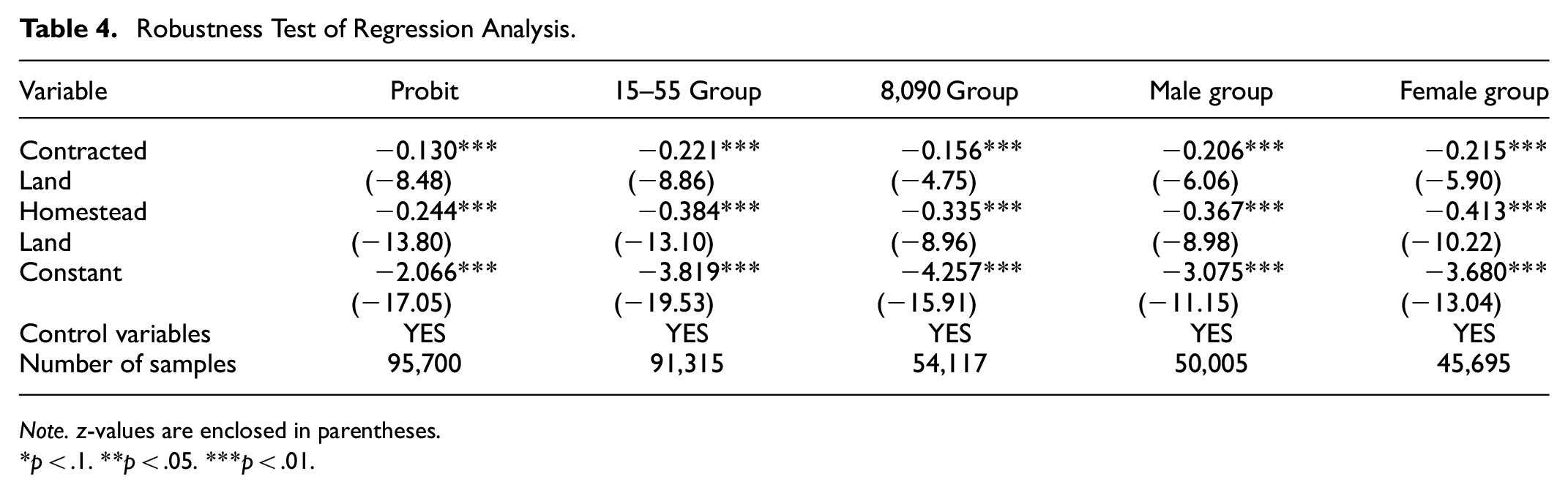
Note. z-values are enclosed in parentheses.
p < .1. **p < .05. ***p < .01.
Discussion
Contracted Land and the Urbanization Willingness of the Rural Household Registration Population
Land is the main materials of production and livelihood for the rural population, the rural land in China is collectively owned and the farmland are contracted to households, and peasants have land contracting rights. The latest round of land contracting in China began in 1997 and will end in 2027, with a 30-year contracting period. The Chairman of the People’s Republic of China, Xi Jinping, proposed in the report of the 19th National Congress of the Communist Party of China that the second round of land contracting be extended for another 30 years after its expiration. The long-term unchanged right to contract land management is a long-term stable income for rural household registration migrants moving to the city, and the expectation of income brought by the land rises year by year with the transfer and large-scale exploitation of rural land (Mullan et al., 2008). For the rural household registration population, land has the following main values (Wen & Xiong, 2014): first, land income through engaging in agricultural production; second, property utility, such as receiving land rent and compensation for expropriation; third, security utility, as farmers can use land to maintain their livelihood after returning home from urban unemployment; fourth, psychological dependence, long-term rural life makes farmers emotionally attached to land. Compared with other values, the property value of land currently has the greatest impact on the willingness of rural household registration populations to settle in cities. The value of land is directly related to its use. Compared to hired farming and farming by relatives, renting land to enterprises and thus receiving higher returns will increase the importance of land contract rights for the rural household population and affect their willingness to settle in cities (Siciliano, 2014).
At present, although the government of China stipulates in its policy that the land contracting right remains unchanged after the agricultural migrant population moves to the city. In practice, the contracting right of land is tied to the membership in rural collective economic organizations, which is bound by both the land law and local village rules and customs, and it is likely to lose the contracting right of land once they do not have a rural household registration. Therefore, the desire to retain contracted land is the main reason why most rural household registration migrant workers are reluctant to transfer to non-agricultural household registration.
Homestead Land and Rural Household Registration Population’s Willingness to Urbanize
Compared with contracted land, the nature of homestead land belongs to rural collective construction land, which is a special asset with security and property functions. At present, China has formed a unique system of rural homestead land, that is, collectively owned and used by members, one house per family, limited standards, planning control, free access, long-term occupation; and internal circulation. For rural household registration migrant workers, the current function of homestead land has been greatly reduced, and many rural homesteads have been left idle. However, as a kind of property, rural household registration migrant workers are more concerned about the practical benefits brought by the homestead land (Fan, 2011; Xie & Chen, 2018). If the use right of homestead land can be withdrawn for payment, the constraints of homestead land on the urbanization willingness of the rural household registration population will be greatly weakened (Huang et al., 2018).
For the issue of transferring or withdrawing the right to use homestead land, there are currently no operable methods at either the policy level or the legal level. For example, the newly revised Land Management Law of the People’s Republic of China stipulates that the state allows rural residents who have settled in cities to voluntarily withdraw their homestead land for compensation according to law, and encourages rural collective economic organizations and their members to revitalize the use of idle homestead land and idle residences. However, at the same time, it is also stipulated that rural homestead land is “one house per household,” so it is difficult to transfer homestead land within the collective economic organization when there is a large exodus of young people from rural areas. According to the Land Management Law of the People’s Republic of China and the Property Rights Law of the People’s Republic of China, which were revised in 1998, homestead land can only be used by rural residents. So the use, lease, and inheritance of homestead land are all related to the status of rural household registration. In the absence of a reasonable exit mechanism for the right to use homestead land, the rural household registration population will choose not to transfer their rural household registration to urban household registration to retain the right to use homestead land (Gao et al., 2022; Gu et al., 2020).
Conclusions
This paper empirically analyzes the impact of land resource endowment on the rural household registration population’s willingness to urbanize based on data from the 2017 China Mobile Population Dynamics Survey (CMDS) Volume A, using logit regression analysis, with the rural household registration population’s willingness to urbanize as the dependent variable and the rural household registration population’s land resource endowment as the independent variable. The results found that land resource endowment has a significant negative effect on the rural population’s willingness to urbanize; specifically, the probability that the rural household registration population with contracted land is willing to transfer their rural household registration to the city is 4.49% lower than that of the rural household registration population without contracted land, and the probability that the rural household registration population with homestead land is willing to transfer their rural household registration to the city is 9.2% lower than that of the rural household registration population without homestead land.
The urbanization process in western developed countries is that farmers tend to achieve permanent migration at once, and in the process of industrialization and urbanization, rural residents move geographically from rural to urban areas and achieve a change of status at the same time (M. Chen et al., 2016). Compared with western developed countries, China’s population urbanization is characterized by a large number of “semi-urbanizations” of the rural population, where the identity of the farmer does not change after moving to the city, and their assets such as land and houses in rural areas are still tied to them. This leads to the unstable urbanization of China’s population, which affects the quality of China’s urbanization and brings instability to the labor supply, thus affecting China’s economic development (Zhou et al., 2021). Moreover, the land that the rural population is tied to, whether contracted land or homestead land, is lacks transferability. The value of land is difficult to truly realize, the benefits brought by land are only a numerical level of economic benefits.
To promote the permanent migration of the rural population, we should promote the linkage reform of the land system and the household registration system in the future, and build a perfect land exit mechanism focusing on the benefits realization mechanism. In the long run, the land withdrawal mechanism can not only improve the efficiency of rural land use, and avoid idle and wasteful land, but also help to expand domestic demand and enhance the momentum of China’s economic growth. To realize the benefits of rural land exit, on the one hand, it is necessary to improve the mechanism of contracted land transfer based on the separation of the three rights of ownership, contracting, and management, and improve the transfer mechanism of contracted land by the measures such as the transfer of rural land contracting rights for capital contribution, the transfer of land in the form of shares, and the development of the market of rural collective construction land. On the other hand, it is necessary to promote the market-oriented reform of the allocation of the right to use homestead land, implement the discounted price of rural homestead land and the use of different places in exchange, and actively promote the market-oriented transfer of homestead land, ensure that the rural homestead land of the rural population has the same property rights as the private housing of urban residents. The focus of the reform of the household registration system should shift from urban to rural, reduce the association between the household registration system and land rights, and promote the unbundling of land rights from rural household registration status.
Footnotes
Declaration of Conflicting Interests
The author(s) declared no potential conflicts of interest with respect to the research, authorship, and/or publication of this article.
Funding
The author(s) disclosed receipt of the following financial support for the research, authorship, and/or publication of this article: This work was supported by the National Social Science Foundation of China (grant number 15BJY050) & (grant number 20CJY011) and Humanities and Social Sciences Foundation for Colleges and Universities of Jiangxi Province (grant number JJ19208) & (grant number JJ21106).
Ethics Statement for Animal and Human Studies
This study does not involve humans and animals subjects.
Research Interests
Dan Liu: Rural Economic System Reform and Development
Chuanbin Yin: Land Resources Management, Population Policy and Urbanization
Xuan Zhou: Land economics, Rural Land System Reform

Data Availability Statement
All the data used to support the findings of the study are available from the corresponding author upon request.