




Abstract
During the COVID-19 pandemic, China’s “Zero-COVID” policy and strong government actions led to significant disruptions in daily life. Using Shanghai’s 2022 lockdown as an example, this study investigated how the government’s actions influenced people’s intentions to share information about risks and content with positive emotions. By employing the Third-Person Effect theory, this study further explores the underlying socio-psychological mechanism. A survey was conducted with 7,962 participants, and multiple linear regressions and structural equation models were applied to analyze the data. We found that (1) the policies that led to inconvenience whetted the dissemination of risk information and restricted the sharing of positive-emotion content; (2) “status-led” motivation was the critical reason why people shared both types of messages; and (3) Third-Person Perception mediated both of these influences. These findings expand our understanding of social communication during public health crises, particularly how the Third-Person Effect works.
Plain language summary
During public crises like the COVID-19 pandemic, information about the risk is usually the primary type of messages disseminated on social media. People also tend to share content with positive emotions to encourage each other. In China, the “Zero-COVID” policy during 2020 to 2022 led to significant disruptions in daily life, and consequently influenced people’s behaviors on social media. Such potent governmental behaviors offered a typical social circumstance which allowed scholars to examine the influence of the influence of government’s actions on people’s behaviors on social media. We conducted a large-scale online survey and collected 7,962 valid replies during Shanghai’s lockdown in 2022, which was regarded as the hardest time of the 3-year pandemic in China. It was found that, the policies that led to inconvenience substantially whetted the dissemination of information about the risk, and hindered the sharing of content with positive emotions. Confronting different government’s actions, people perceived different potential effects of the information. Those who suffered relatively less inconvenience from the lockdown tended to consider others were more vulnerable, and hence reduced the behaviors of sharing so as to protect the surrounding people. Such sociopsychological mechanism partially explained why the government’s actions played their roles.
Keywords
When the COVID-19 wave rapidly burst in Shanghai in March 2022, harsh containment measures were implemented. Although these measures contained the outbreak of this pandemic, they caused a number of social problems, such as inconveniences in daily life and mental health symptoms (Taylor, 2022; X. Zhang et al., 2022). The lockdown and the resulting problems seriously impacted the opinion climate on social media.
Two types of information were disseminated on social media during this period. Information about the inconvenience of the lockdown (Gao et al., 2022; Zhou et al., 2020) often paralleled the fear of the disease (Q. Liu et al., 2020; Xie et al., 2021) and played a crucial role in the aforementioned social problem. This type of information has been considered a type of “infodemic” (Cinelli et al., 2020). Despite a growing body of literature on infodemics in public health, the Shanghai lockdown under the “Zero-COVID” policy seemed to be different from what had been seen in the rest of the world. In addition to information about the infection, government policies, such as restrictions on going out, were a crucial source of uncertainty. This requires researchers to pay more attention to the correlation between infodemics and government actions. On the contrary, content with “ZhengNengLiang (正能量)” was a different type. “ZhengNengLiang,” a popular Chinese catchphrase in recent years, literally means “positive moment” or “positive energy,” referring to content that encourages dedication, builds confidence, motivates pride, and shapes people’s value systems (W. Zhang & Ling, 2021). During the pandemic, this type of information was typically presented as stories praising the good deeds of anti-pandemic measures, emphasizing hope, confidence, and solidarity (Le, 2021). However, few studies have provided quantitative evidence of these effects on social media. Similar to the infodemic, government actions likely influenced this effect. In brief, it is valuable to explore the patterns of people’s intentions to share both types of information and the relevant influencing factors.
Particularly, the reason for our interest in these questions is likely due to the recent development of the pandemic. The virus genomes in Shanghai were clustered into BA.2.2 (X. Zhang et al., 2022), whose virulence (i.e., symptomatic, severe, and lethal rates) was much lower (Arnaout & Arnaout, 2022; Barre et al., 2022; Flores-Vega et al., 2022; Katzourakis, 2022). Uncertainty about the global pandemic situation was also reduced (The Lancet, 2022). As a result, people’s concerns tended to shift toward government action, including lockdown policies and related relief measures (Nam et al., 2022). This emerging phenomenon allowed us to include the lockdown and relief measures as succinct independent variables.
Third-Person Effects (TPE) theory (Davison, 1983) provides a perspective from which to explore the socio-psychological mechanism behind the above possible affections. TPE suggests that there is a disparity between how people perceive the impact of media on themselves and on others, which is referred to as third-person perception (TPP). The degree of TPP is influenced by multiple factors and predicts a number of behaviors, including the intention to participate in social communication (e.g., Sun et al., 2008b; F. Yang & Horning, 2020). Therefore, by investigating the role of TPE, we aim to endow our models with subtler theoretical explanations. Moreover, scholars often call for nuanced research on emerging scenarios that employ diverse influencing factors to more comprehensively specify the logic of TPE. As Sun et al. (2008a) argued, the “domains” that should adopt TPE are “very broad.” Thus, we hope to make theoretical contributions regarding how TPP mediates the influence of environmental variables on behavioral outcomes.
To investigate these issues and mechanisms, the current study conducted a survey with 7,962 respondents. The results show that the duration of the lockdown and people’s satisfaction with the government’s relief packages significantly influenced their sharing behavior on social media, and TPPs play mediating roles in some scenarios.
Infodemic, Content with “ZhengNengLiang,” and Government Actions
Information About the Risk of the Pandemic on Social Media
In the era of traditional mass media, mainstream content was generally published by news agencies, authoritative scientific institutions, and governments, which tended to convey messages such as the latest progress of the pandemic, scientific protection tips, and relevant policies (K.-W. Fu et al., 2012; Parmer et al., 2016). Nowadays, owing to the greater diversity of information sources (Li et al., 2020; Su et al., 2021) and more socialized fermentation processes (Cinelli et al., 2020; Shi et al., 2022), messages spread on social media are no longer limited to information published by traditional media and show a trend of polarization. “We-media” senders such as bloggers and vloggers are currently expanding their traditional news sources, and creating messages with more personal experiences and emotions that provide audiences with a stronger motivation to share and discuss (Gan, 2016; Nip & Fu, 2016). Specific to the pandemic, information such as the increasing number of infections, possibility of expanding the lockdown area, and resulting inconvenience to daily life were the major types of messages on social media that reinforced perceptions of risk (Nam et al., 2022). The government’s anti-pandemic measures are considered to be the most important factors influencing people’s participation in social communication. As reported by Li et al. (2020) as people’s trust in the government increased and their perception of risk decreased, their willingness to share relevant messages decreased. However, as people’s perceptions of risk shifted from fear of infection to concern about inconvenience caused by the lockdown, such a possible association needs to be further investigated.
Content with “ZhengNengLiang”
“ZhengNengLiang (正能量)” was another common type supposed to be spread on social media. From an authoritative perspective that aims to maintain “harmonious climates of opinion,” this type of content should be widely disseminated on social networks (Chang, 2021). However, despite its popularity, only a few papers have been written in Chinese and empirical evidence is lacking.
In the context of western academics, the connotations of “ZhengNengLiang” are to some extent similar to constructive journalism, as the former also emphasizes “empowering the audience” and “combating the negativity bias” (Lough & McIntyre, 2023), which are considered to be two typical characteristics of the latter. Existing studies (Dahmen et al., 2019; Meier, 2018; Overgaard, 2023) have found that constructive journalism stimulates more positive psychological effects on audiences than non-constructive content, but differences in consequent behaviors on social networks (e.g., sharing, liking, discussing) were not necessarily observed. However, this depends on the topic. Dahmen et al. (2019) suggested that when people read content whose topic is close to their daily lives with innate human tendencies, they feel positive and participate in social discussions.
Specific to this pandemic, Antwerpen et al. (2022) summarized the views of journalism professionals and suggested that journalism should provide hope, encourage solidarity and convey positive responses to COVID-19. From a similar perspective, Le (2021) presented evidence in a case study and reported that “Chinese news media engaged in a series of constructive journalistic practices” that achieved good social communication effects. In this sense, facing the risk of infection and the inconvenience caused by the lockdown, people in Shanghai may be more willing to share content with “ZhengNengLiang” than information about risks. Nevertheless, constructive journalism aims to empower audiences by providing them “with a fair, accurate, and contextualized picture of the world” (Constructive Institute, 2022), while content with “ZhengNengLiang” lays more emphasis on praising good personalities and their deeds, and tends to be disseminated by the social media accounts of the government, official institutions (e.g., neighborhood committee) and their personnel (W. Zhang & Ling, 2021). However, some scholars (Nip & Fu, 2016; Stockmann & Luo, 2017) do not fully agree that the content created by official and semi-official accounts will achieve the expected effect. They further argued that people may not buy such praise due to its alienation from real life and its powerlessness in providing solutions.
Therefore, the following research question is investigated.
RQ1: In the Shanghai lockdown, is the intention to share content with “ZhengNengLiang” (sZNL) different from the intention to share information about the risk (sRisk)?
Similar to sRisk, we examined the factors that influence the willingness to share this type of sZNL.
The Role of Government Action in Lockdown
During the lockdown, people’s free interpersonal socioeconomic behaviors in real life are usually forced to be restricted, so their perceptions of the social environment largely come from the government and/or local administrators (Y. Fu, 2020; Scott English et al., 2022). Therefore, the correlation between government actions and people’s behavior on social media needs to be further investigated, not only because of the practical sense from an administrative perspective, but also because of the more succinct variables provided by this specific social context.
There were two main measures implemented by the government, including the lockdown of the community with medium and high risk, and the free “relief package” with food and groceries. The latter is considered one of the most important ways to hedge against this inconvenience, and consequently, to influence social media behavior (Domalewska, 2021; Droit-Volet et al., 2020; Shuvo et al., 2022). Thus, we set up three indicators: “number of days of lockdown” (dLD), “frequency of ‘relief packages” (frRP), and “satisfaction with relief package” (saRP). The first two objectively reflect the strength of government policy, while the last one is used to measure people’s subjective attitudes.
There may be two different pathways through which these independent variables influence sRisk and sZNL. For the former, lockdown is likely to predict people’s willingness to share information about risk, but the effectiveness of government action and people’s satisfaction with it may be negatively associated with this willingness. For instance, as analyzed by Su et al. (2021), people living in under-resourced areas were more likely to share information about the risks with “negative expression.” For the latter, however, these correlations may be reversed. Although there is little research using the “ZhengNengLiang” connotation, research applying the Civic Voluntarism Model (CVM) provides some evidence to support this assumption. Political efficacy derived from effective government actions was positively related to citizens’ willingness to share information published on government social media accounts (Guo et al., 2021; Phang et al., 2015). As mentioned above, content with “ZhengNengLiang” was highly advocated by the government and local administrators, who initially posted a large proportion of such content. Thus, it is reasonable to assume that the mechanisms proposed by the CVM would similarly emerge in the context of the current study. Therefore, the following hypotheses are proposed:
H1a: In the Shanghai lockdown, sRisk is positively associated with dLD and negatively associated with frRP and saRP.
H1b: In Shanghai lockdown, sZNL is negatively associated with dLD and positively associated with frRP and saRP.
Moreover, it is widely agreed that different types of information are competitive and antagonistic in social networks due to complex network effects (AlFalahi et al., 2014; Fan et al., 2018; Vosoughi et al., 2018). Even if the willingness to share one type of information slightly exceeds the willingness to share another type of information, the overall “climate of opinion” could be changed on a large scale. Hence, in terms of practical implications, practitioners might be interested not only in H1, but also in whether dLD, frRP, and saRP influence the difference between sZNL and sRisk. Intuitively, if both H1a and H1b are supported, it is easy to infer that a decrease in dLD and/or an increase in frRP and saRP will increase the advantage of sZNL over sRisk. However, this inference is not necessarily statistically true. Because H1a and H1b focus on the general values of sZNL and sRisk, respectively, for individuals, the disparities of these two variables do not necessarily follow such influence paths. For instance, as dLD increases, both sZNL and sRisk may decline due to depression or apathy. If sRisk decreases faster than sZNL, then the disparity between sZNL and sRisk will increase. Thus, we propose the following hypotheses:
H2: The difference between sZNL and sRisk (ΔsZR) is negatively associated with dLD and positively associated with frRP and saRP.
Sociopsychological Mechanisms of Sharing
It is natural to assume that there should be intrinsic socio-psychological mechanisms that “bridge” between the aforementioned external factors derived from government measures and people’s sharing behavior.
“Status-Led” Motivation
Despite the diversity of theoretical frameworks applied, numerous studies have attributed the motivation to share to the need to socialize with others. For instance, applying the Use & Gratification Approach and Social Cognitive Theory, “socializing” was found to be the most significant among a number of factors influencing people’s intention to share on social media (Lee & Ma, 2012). From the perspective of micro-motivations and agenda setting, “status-led” components, referring to factors that can make people perceive “to be important,” among others, were considered the root of the motivation to share (Bright, 2016). Remarkably, information with negative potential influence, such as news about risks or even misinformation and disinformation, could also stimulate people’s enthusiasm for sharing, as long as it is conducive to starting conversations among social connections and subsequently enhancing social cohesion (Apuke & Omar, 2021; Duffy et al., 2019).
In the context of this study, when people perceive that content is more influential in their social networks, they are more likely to share it. Therefore, we propose the following hypotheses:
H3a: People’s perceived influence of information about the risk on others (pRiskOt) positively predicts sRisk.
H3b: People’s perceived influence of content with “ZhengNengLiang” on others (pZNLOt) positively predicts sZNL.
Furthermore, in health communication, environmental variables are considered important factors that influence people’s perceptions of the importance of information (P. L. Liu & Huang, 2020; Parmer et al., 2016). As proposed in H1, government actions could potentially affect people’s intentions to share. Therefore, it is possible that the influence of government actions could be mediated by people’s perceptions of the impact of media on others. This could be because as inconvenience increases, people feel that the relevant content is more influential. In this sense, we would also investigate
RQ2: Do (a) pRiskOt and (b) pZNLOt mediate the influence of dLD, frRP, and saRP on (a) sRisk and (b) sZNL, respectively?
Third-Person Effect (TPE)
The theory of the Third-Person Effect (TPE) proposed by Davison (1983), which also focuses on the perceived influence on others, connotes that the above-assumed mechanism may not work simply.
The basic assumption of TPE is TPP, which refers to the extent to which people overestimate the vulnerability of others under media influence, which is the “perceptual component” of TPE; and, this overestimation is assumed to be correlated with some behavioral consequences, which is called the “behavioral component” (for systematic reviews: see Eisend, 2017; Sun et al., 2008b). In some scenarios, perceived media influence and TPP simultaneously predict certain behaviors (Shah et al., 1999; Sun et al., 2008). However, these effects are not necessarily in the same direction. For example, Sun et al. (2008b) found that the perceived effect of public service announcements had a positive effect on promotional behavior (e.g., urging local media to spread such content more actively), while the TPP had a negative effect. In other words, when people’s perceptions of the importance of such information are equivalent, those with a greater TPP will have a lower intention to share than those with a lower TPP. Thus, employing TPP as a variable can facilitate the explanatory power of our models. Moreover, TPE has shown strong robustness in a number of studies on COVID-19 related communication (Buturoiu et al., 2021; J. Yang & Tian, 2021; Zhu et al., 2021). They suggested that people tend to believe that others are more affected by information about the pandemic than they are, and that these affections subsequently influence social media behaviors (e.g., commenting and sharing). Hence, applying the TPE framework also enabled us to compare the situation of the Shanghai lockdown with that of the previous outbreaks of COVID-19.
More importantly, unlike the perceived media effect, whose influence is relatively obvious and intuitive, TPE tends to imply subtle psychological mechanisms. The patterns of both the perceptual and behavioral components of TPE are likely to demonstrate various details of such mechanisms, especially in some studies whose results appear to be inconsistent.
Perceptual Component of TPE
For the perceptual component, TPP reflects people’s attitudes toward given content. In fact, in some of the early research on TPE, TPP had not yet been defined as the perceptual “vulnerability” of others, but rather as the overestimation of media “influence” on others. More recent literature has suggested that such “overestimation” can sometimes be shown to be insignificant or even reversed. In some scenarios, people may perceive the media as having a greater influence on themselves than on others. This reversal of TPP is called “First-Person Perception” (FPP, for a systematic review, see Golan & Day, 2008). A typical phenomenon is that when content is perceived as “desirable,” viewers tend to feel that they are more sensitive than others because they are more sensible (Duck et al., 1995; Meirick, 2002; Ran et al., 2016; Sun et al., 2008b). Golan and Day (2008) concluded that content attributes such as uncertainty, harmfulness, desirability, and social benefits can lead to differential perceptions of others’ vulnerability. TPP is based on the self-confidence that one is not easily affected by negative emotions, whereas FPP is derived from one’s subconscious optimistic bias. In addition, extant research has mainly discussed such psychological mechanisms in a speculative manner, with little empirical evidence. Scholars have often called for employing environmental variables to better support their claims.
Therefore, the extent of TPP, or its reverse indicator—FPP, may indicate how people evaluate different types of content. It is worth noting that according to previous studies (Golan & Day, 2008; Sun et al., 2008b), either third- or first-person perception should be labeled as a variable, calculated by subtracting the perceived effect on self from that on others. Here, following the suggestion of Sun et al. (2008b), we used TPP as a uniform indicator of both third- and first-person perceptions, with the following basic form:

If TPP is significantly greater than zero, then TPP is generally observed; if the difference between TPP and zero is not significant, then neither third- nor first-person perception is generally observed; otherwise, FPP can be considered to be dominant.
In the context of this study, considering the attitude toward the content, the risk information mainly stimulates the TPP with a positive value, whereas the mean value of the TPP for the content with “ZhengNengLiang” is more likely to be less than zero. Here, the TPP of information about the risk is denoted as TPPRisk, and that of the content with “ZhengNengLiang” is denoted as TPPZNL. Note that the mean value of TPP does not indicate that all people have a uniform bias of third- or first-person perception, and its test merely reflects the overall situation (Sun et al., 2008b). In brief, we test the following baseline hypotheses:
H4: Whereas (a) information about risk has a greater perceptual effect on others than on self (TPPRisk > 0), (b) content with “ZhengNengLiang” is perceived as having a greater effect on self than on others (TPPZNL < 0).
As mentioned above, the typical social environment during the Shanghai lockdown enables us to investigate the mechanisms of health communication on social media in more detail. Through the engagement of dLD, frRP, and saRP, there seems to be a way to obtain evidence on the relationship between TPP and people’s psychology. According to social comparison theory, objective factors are more likely to be associated with self-confidence, whereas subjective factors are related to optimism (Gerber et al., 2018). For instance, if objective variables such as dLD and frRP have a significant impact on TPP, self-confidence would be an important psychological underpinning. For instance, if dLD increases or frRP decreases, and the other-self disparity of the perceptual effect of undesirable content increases, people may feel that others are more sensitive to the inconvenience caused by the lockdown. This reflects their self-confidence. In contrast, the negative correlation between saRP and TPP of desirable content is more likely to reflect optimism. Therefore, we investigate the following questions.
RQ3: How do dLD, frRP, and saRP influence (a) TPPRisk and (b) TPPZNL, respectively?
Behavioral Component of TPE
With regard to the behavioral component, some findings appear to be inconsistent across studies, and the relevant psychological mechanisms likely need to be discussed in more detail. For instance, the extent to which people perceive others as vulnerable has been found to negatively predict the intention to share misinformation (F. Yang & Horning, 2020) and positively predict the intention to correct misinformation (Koo et al., 2021), both of which are altruistic behaviors consistent with social enhancement theory. In contrast, some researchers (Duffy et al., 2019; Kim, 2013; Sun et al., 2008b) found that such an other-self gap is negatively associated with altruistic behaviors (e.g., donating, promoting desirable information, and sharing content with positive emotions). They further asserted that people with higher TPP may “feel less of a need to take action,” which is consistent with the logic of social comparison theory. According to attribution theory, these inconsistencies in findings, as well as the corresponding diversity of theoretical explanations, are likely due to the social environment, attributes of information, and types of behavior (Hoffner et al., 2001; Prinzing et al., 2021; Turnipseed, 2009). Particularly, “desirable” content seems to be more closely related to social comparison theory.
In this sense, investigating the influence path of environmental variables also helps to clarify the psychological mechanism of people’s social media sharing behavior during Shanghai’s lockdown. Therefore, we would like to conduct a two-step investigation. First, we examine the correlation between TPP and sharing intentions. Regarding messages about risk, it is clear that people are less likely to share them when TPP is higher. This indicates an altruistic motivation to protect vulnerable others. The situation of content with “ZhengNengLiang” can be assumed based on social comparison theory. Those who feel that others are more sensitive to such content may have less intention to share. Specifically, we propose the following hypothesis:
H5a: TPP of information about the risk (TPPRisk) negatively predicts intention to share (sRisk);
H5b: TPP of content with “ZhengNengLiang” (TPPZNL) negatively predicts intention to share (sZNL).
Second, since we have assumed the correlation between environmental factors representing government actions (i.e., dLD, frRP, and saRP) and people’s intentions to share in H1, we would also like to examine the mediating effects of the TPP by combining the questions we proposed in RQ2. If the influence of environmental factors is mediated by the TPP, the evidence for the relevant psychological mechanisms will be strengthened. For instance, if saRP positively predicts sZNL and TPPZNL shows a mediation effect, we can infer that social companion theory provides explanatory power in the full model. One possible path could be, that higher saRP predicts greater FPP (i.e., lower TPPZNL), and that such an influence then translates into stronger intentions to share content with “ZhengNengLiang.” In this situation, people’s optimism may be reflected in the correlation between saRP and TPPZNL, and the intention to share is likely due to showing such optimism to others who are perceived as insufficiently optimistic. Therefore, we propose the following hypotheses:
RQ4: Does TPP mediate the influences of dLD, frRP, and saRP on intentions to share (a) information about the risk and (b) content with “ZhengNengLiang”?
Research Structure
The complete models of the research questions and hypotheses are presented in Figure 1.

Structure of the hypotheses and research questions.
Variables, Measures, and Descriptive Statistics.

N = 7,962.
Three hundred and sixty one participants claimed they never received any relief packages, for whom the values of these two variables were set as 0. The descriptive statistics included these cases.
Methodology
Procedure, Participants, and Eligibility Check
An online survey was conducted through Tencent Survey from April 7 to 10, 2022. 1 To obtain a large sample size and extensive representativeness, we used a word-of-mouth strategy to recruit participants. During this wave of the COVID-19 outbreak in Shanghai, citizens were highly concerned about the government policies released at daily press conferences; however, some official words were difficult to understand. Thus, we designed a series of posters that graphically illustrated these policies rather than just describing them in text (e.g., a flowchart explaining “under what circumstances would a community be locked down”). They were accompanied by the QR code for the questionnaire. Initially, we shared these posters through our personal social spaces, such as WeChat Moment, WeChat Group, and Weibo, and some of our friends participated in the initial sharing. People showed great enthusiasm for sharing these posters, perhaps because the information was practical and understandable. After rounds of interpersonal sharing, nearly 10,000 people scanned the QR codes, and 8,301 participants completed the survey. An introduction to the study was provided on the cover page of the questionnaire and participants were required to sign a consent form.
The questionnaire included a number of attention and eligibility checks. We established bogus items by applying the methods described by Meade and Craig (2012). Questions on common sense and questions whose answers could be easily found on the same page were also asked. If any of these questions were answered incorrectly, the case was considered invalid. Following Johnson’s (2005) suggestion, if the answers to all odd- or even-numbered questions were the same, the case was filtered out.
Finally, 7,962 responses were confirmed as valid. These participants covered 210 of the 213 towns and subdistricts in Shanghai, ranging in age from 13 to 85 years (mean = 38.153, SD = 11.875). Of these, 51.2% were female (n = 3,885) and 48.8% were male (n = 4,077). Of these, 68.4% (n = 5,448) had a bachelor’s degree or higher.
Measures
Table 1 demonstrates the definitions of the variables, their abbreviations, the general measures, and their descriptive statistics. Details are provided below.
Variables About the Lockdown
For the object variables, a participant was asked to report the number of days (dLD, M = 16.070, SD = 6.971) that the community they lived in was under lockdown and the number of times they received government relief packages. The latter was divided by the former to calculate frRP (M = 0.119, SD = 0.076).
To measure the subject variable—satisfaction with the relief packages (saRP), we used a 5-point Likert scale with six items, three of which are inversed, including “Do you agree that the food and groceries in the relief packages are: diversified / sufficient /able to meet my needs; of poor quality / unbalanced in collocation/ unsuitable for me” (1 = strongly disagree; 5 = strongly agree). If a participant did not receive any relief packages, the saRP was set to 0. Otherwise, the saRP was created by averaging the six items after recoding the latter three (M = 2.972, SD = 1.131, α = .821). Thus, the minimum saRP was 0 but not 1, and the maximum was 5.
Perceived Effects and Sharing Intention of Information About the Risk
At the beginning of this measurement, the “information about the risk” was described as “the messages about the progress of the pandemic and Shanghai’s lockdown spread online in recent days.” Then, three examples randomly captured from recent news or social media were shown, such as “the number of newly infected persons in each district,”“newly introduced prevention and control measures,” and so on. The examples are presented in the form of screenshots.
Following the scales proposed by Zhu et al. (2021), participants were asked two parallel sets of questions each with 4 items, including: whether such information made “me” and “others” concerned about (1) the outbreak spreading more widely and rapidly; (2) becoming infected or having family members become infected; (3) inconvenience at work during the lockdown; and (4) inconvenience in life during the lockdown. The response categories used a 7-point Likert scale, with 1 indicating “strongly disagree” and 7 indicating “strongly agree.” Four items in each group were averaged to create composite measures of “perceived effects of information about the risk on self”—pRiskSe (M = 5.622, SD = 1.333, α = .735) and “perceived effects of information about the risk on others”—pRiskOt (M = 6.159, SD = 1.095, α = .856). Applying Formula TPP = Perceptual media effects on others−Perceptual media effects on self (1), the latter minus the former yielded TPPrisk (M = 0.537, SD = 1.035).
As Chinese people tend to share messages on various types of social media (J. Fu & Cook, 2019; Shen & Gong, 2019; Stockmann & Luo, 2017), we measured their intention to share content using a 7-point Likert scale with four items covering four mainstream spaces. Participants were asked, “During this wave of the COVID-19 outbreak in Shanghai, how likely are you to share information about the risk (1) in one-on-one chat / (2) in group chat / (3) on private social media (e.g., WeChat Moment) / (4) on public social media (e.g., Weibo),” with 1 indicating “never” and 7 indicating “with great intention.” These four were averaged into a single scale—sRisk (M = 4.075, SD = 1.694, α = .805).
Perceived Effects and Sharing Intention of Content with “ZhengNengLiang.”
Since “ZhengNengLiang” was a well-known catchphrase in China, before asking questions, we directly described it as “the content with ‘ZhengNengLiang’ spread online in recent days.” In addition, three randomly selected examples from recent news or social media were shown: reports of good deeds and messages that encouraged trust.
Participants were asked two parallel sets of questions with four items in each, including: whether such information made “me” and “others” (1) more confident that the crisis will end soon; (2) more confident that I/others or my/their family members will not be infected; (3) believe that the impact of the lockdown on life will be alleviated; and (4) believe that the impact of the lockdown on work will be alleviated. The response categories were rated on a 7-point Likert scale. Average values of each group were also calculated as composite measures of “perceived effects of content with ‘ZhengNengLiang’ on self”—pZNLSe (M = 4.599, SD = 1.825, α = .928) and “perceived effects of content with ‘ZhengNengLiang’ on others”—pZNLOt (M = 4.554, SD = 1.756, α = .957). The latter minus the former yielded TPPZNL (M = −0.045, SD = 0.976).
Variables related to intention to share content with ZhengNengLiang were measured in a similar manner to their counterparts for information about risk. The scores of four items were averaged into a single scale—sZNL (M = 4.075, SD = 1.694, α = .885).
Analyses
Analyses were conducted using JASP 0.16. with Rosseel’s (2012) package for structural equation models (SeMs). Paired t-tests were conducted to examine differences in intentions to share different types of content (RQ1) and the presence of TPP (H4), multiple linear regressions (MLR) were applied to examine the main effects of independent variables (H1 and H2), and SeMs were employed to examine detailed mechanisms (RQ2~4, H3, and H5).
Gender, age, education, and income were controlled in the MLR and SeM because previous research on similar scenarios indicated that they were related to sharing behavior during COVID-19, TPE, etc. (e.g., Sun et al., 2008a; Wang & Zhang, 2023). Some participants (n = 1,476, 18.5%) did not report their income. These missing values were replaced by means.
Results
The Intentions to Share Different Types of Information
RQ1 asked if sZNL differed from sRisk. The result of the paired t-test shows a slightly significant difference, t(7,961) = −2.547, p = .011, Cohen’s d = −0.029. In general, people presented less intention to share content with “ZhengNengLiang” than to share information about the risk (mean difference = −0.058). Specifically, 42.7% of participants scored sRisk higher than sZNL, 20.0% scored the same, and 37.3% were more likely to intend to share content with “ZhengNengLiang.” As illustrated in Figure 2, there was a spike indicating that many people were not willing to share content with “ZhengNengLiang,” which may be the reason for this disparity.
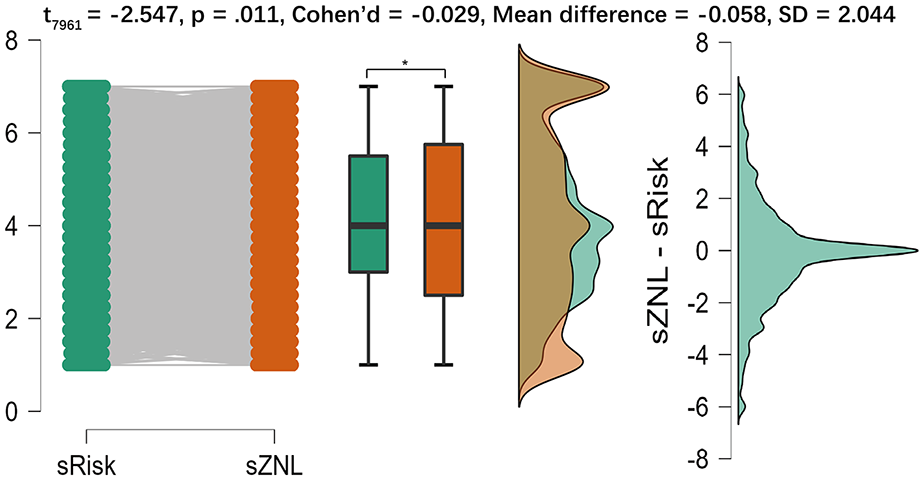
Raincloud plots of sZNL and sRisk.
Do Government Measures Influence People’s Intentions to Share?
H1 predicted the correlations between the government measures during the lockdown and people’s intentions to share information about the risk instead of sharing content, with “ZhengNengLiang.” The results of the two MLRs showed that the influence of frRP was not significant, while those of dLD and saRP were significant factors.
As expected, sRisk was positively associated with dLD, but negatively associated with saRP, and sZNL was negatively associated with dLD, but positively associated with saRP. Thus, H1 was partially supported (see Table 2, Columns 1 and 2).
Hierarchical Regression Analysis of Intentions to share.

Note. Values of β are standardized regression coefficients. N = 7,962 *p < .05. **p < .01. ***p < .001.
H2 hypothesized that the patterns found in H1 would continue to influence these three independent variables on the paired disparities between the two dependent variables. Similar to the results of H1, the effect of frRP was not significant. Since H2 is partially supported, it is not surprising that the advantage of sZNL over sRisk is positively correlated with saRP, but negatively correlated with dLD (see Table 2, Column 3).
These findings suggest that as the duration of the lockdown increases and satisfaction with the relief package decreases, people are more likely to share information about risk than to share content with “ZhengNengLiang.” Such correlations were reflected not only in the overall trends of these two intentions but also in the paired differences (Figure 3).

The influence of the government’s measures on people’s intentions to share different types of information: (a) the duration of the lockdown on people’s intentions to share, (b) satisfaction with the relief packages on people’s intentions to share.
In addition, demographic factors, particularly education level and age, were significant predictors. Those who were younger or had a higher level of education were more likely to share information about the pandemic and lockdown.
The Perceptual Component of TPE
H4 tested the overall significance of TPP or its reverse, FPP. The results of the paired t-tests (Figure 4a) show that the perceptual effect of risk information on others is significantly greater than that on the self (t7961 = 46.301, p < .001, Cohen’s d = 0.519). On average, participants scored 0.537 points higher on sRiskOt than on sRiskSe. Overall, TPPs were observed. Thus, H4a is strongly supported.
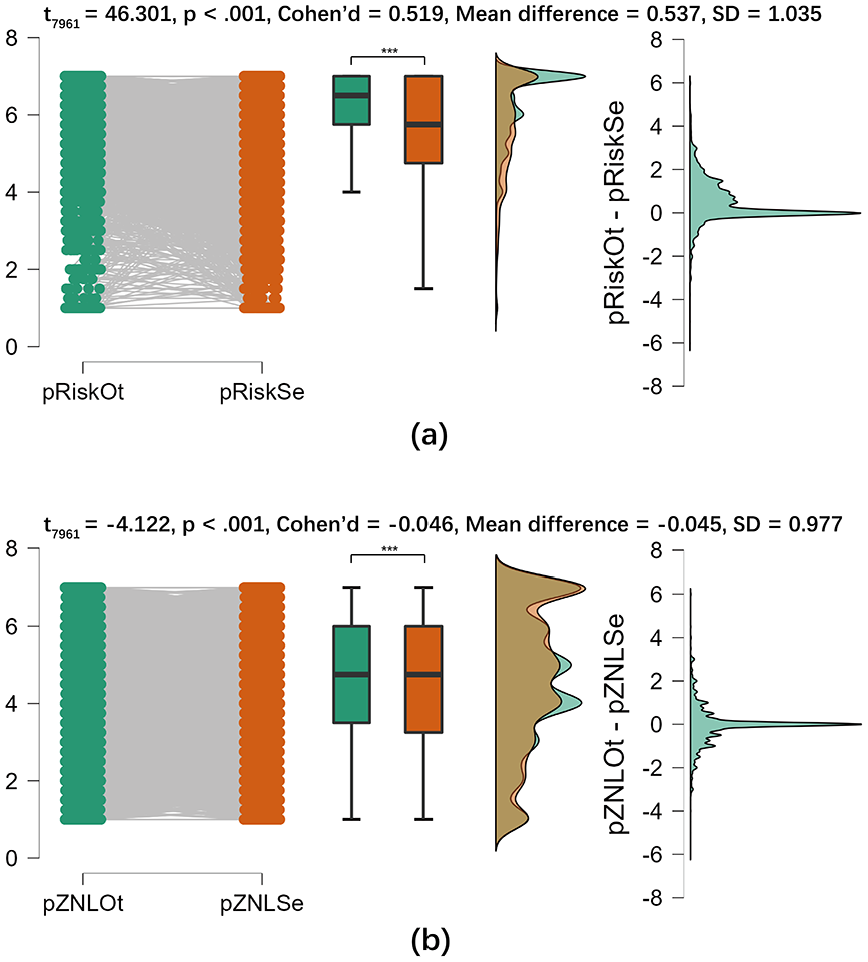
Raincloud plots of TPPs of (a) information about the risk and (b) content with “ZhengNengLiang.”
In contrast, the perceptual effect of content with “ZhengNengLiang” on others was slightly smaller than that on oneself (t7961 = −4.122, p < .001, Cohen’s d = −0.045, see Figure 4b), which was also significant despite the small effect size. In general, this result implies a low FPP, which was mainly contributed by 33.2% of the participants. However, 40.8% of participants reported “equivalent” perceived effects on others and on themselves and TPPs were observed in 26.0% of participants. Thus, H4b is weakly supported.
RQ3 asked whether government measures influenced TPPs for both types of information. The MLR results showed that the influence of frRP was not significant in either model. In the risk information model, TPPRisk is found to be significantly affected by both dLD (β = −.046, p < .001) and saRP (β = .081, p < .001). The former is negative, and the latter is positive. In the model of content with “ZhengNengLiang,” only saRP significantly predicts TPPZNL (β = −.029, p = .015).
The Role of “Status-Led” Motivation and TPP
H3 and H5 aimed to examine the influence of “status-led” motivation and TPP. RQ2 and RQ4 further asked whether they mediate the influence of government measures. To explore these patterns, two SeMs were constructed that included the MLRs for testing H3 and H5. Since the tests for both H1 and RQ3 indicated that the influence of frRP was not significant, combining the results of another MLR that found no significant correlations between frRP and perceptual media effects on others (i.e., pRiskOt and pZNLOt), only dLD and saRP were used as independent variables to make the models more succinct. Figure 5 illustrates the coefficients of the variables, and more detailed results of the mediation effects are listed in Table 3. Due to the removal of frRP, some regression coefficients may differ from the results of the MLRs above.

SeM analyses of the proposed models: (a) the effects on sRisk, total adjusted R2 = 8.5%, (b) the effects on sZNL; total adjusted R2 = 35.1%.
(a) Mediation Effects on Intention to Share Information About Risk

Note. Values of β are standardized regression coefficients. N = 7,962 *p < .05. **p < .01. ***p < .001.
(b) Mediation Effects on the Intention to Share Content with “ZhengNengLiang”

Note. Values of β are standardized regression coefficients. N = 7,962 *p < .05. **p < .01. ***p < .001.
As expected, people’s perceived effects of information on others are positively correlated with their intention to share both types of information (sRisk, β = .234, p < .001; sZNL, β = .541, p < .001). Consistent with previous research, egocentricity plays an important role in social media message sharing. H3 is supported. For both types of information, TPPs negatively predict sharing intentions (sRisk, β = −.184, p < .001; sZNL, β = −.231, p < .001). H5 is also supported. Excluding the contributions of dLD, saRP, and demographic variables, the combined effects of “Status-led” motivation and TPP explain 7.1% and 26.2% of the variability in sRisk and sZNL, respectively.
As shown in Table 3, the mediation effects differ between the two models. For risk information, only the TPP mediates the influence of government measures, leaving the direct effects of the latter. The total adjusted R2 for the model is 8.5%. In contrast, in the model of content with “ZhengNengLiang,” full mediation effects were found, and perceived media effects on others played an important role. However, the mediating role of TPP was less significant. The total adjusted R2 of this model is 35.1%, to which the perceived media effect on others contributes a lot (β = .541, p < .001).
According to previous research, the influence of third- and first-person perceptions on behavioral consequences may differ. For instance, Sun et al. (2008b) suggested that such an influence was significant only in the TPP group, but not in the FPP group. Therefore, for each model, we further divided participants into different groups according to their third- or first-person perceptions and conducted the above analyses. All results remained robust, and the relevant regression coefficients were not significantly different between groups.
Discussion
In the current study, we focused on the influence of government actions on people’s social media behavior. As two mainstream types of content spread during Shanghai’s lockdown, we observed and compared people’s intentions to share information about risks and content with “ZhengNengLiang.”
Contrary to previous research (Antwerpen et al., 2022; Le, 2021), at an overall level, content with positive emotions does not seem to increase people’s willingness to share. This may be due to the typical situation of this outbreak in Shanghai. As noted by Nam et al. (2022), people were “anxious and concerned about their family well-being” because of the harsh policies rather than the virus itself. Such policies may reinforce a sense of separation between positive content and everyday life experiences. From the perspective of constructive journalism, the proximity of news is an important basis for people to embrace it (Dahmen et al., 2019), which echoes the above arguments.
As expected, the measures that caused inconvenience (i.e., lockdowns) whetted the spread of information about risks on social media. It is the quality of relief measures, not their quantity, that can mitigate this impact. It is worth noting that the reason why the influence of frRP is not significant may be due to its insufficient variability (M = 0.119, SD = 0.076). At the time of our study, the frequency of the government’s distribution of aid packages was roughly uniform, once a week, with little difference among the communities. However, the quality differed. In contrast, satisfaction with relief efforts was positively correlated with people’s intention to share content with “ZhengNengLiang,” which decreased as the duration of the lockdown increased. More importantly, the influence of the duration of the lockdown was found to be less significant than that of the relief packages, suggesting that people understand the lockdown measures and tend to pay more attention to effective relief measures. Moreover, the evidence provided by this study suggests that there are critical points where the content with “ZhengNengLiang” showed its advantages (Figure 3). Interestingly, these critical points are located near point 4, which indicates a neutral attitude toward sharing, because we used a 7-point Likert scale. This implies that, if the government takes appropriate measures, the spread of negative information can be suppressed.
Our findings also provide evidence for the socio-psychological mechanisms underlying sharing intentions. “Status-led” motivation was reconfirmed as a unifying factor influencing people’s sharing behavior on social media. However, this motivation is hindered by third-person perceptions. As extant research tends to attribute the consequential component of TPE to social enhancement theory and/or social comparison theory (Gerber et al., 2018; Koo et al., 2021; F. Yang & Horning, 2020), this study extends relevant empirical materials.
On the one hand, it is found that negative daily life experiences reduced and even reversed the other-self disparity of the perceived media effect of negative information, which further made people feel less need to “protect others” or participate in social enhancement (Figure 5a). According to social enhancement theory, superior living conditions are assumed to be correlated with the perception of others’ vulnerability and the motivation to protect others (Danaher, 2016; McCaslin et al., 2010). Our results support such claims.
On the other hand, in the model regarding content with “ZhengNengLiang,” TPP seems to be influenced to a limited extent by environmental variables. Perceived media effects on others almost completely mediate the influence of government actions on the intention to share (Figure 5b). This implies that when people are exposed to positive content, they tend to judge its importance based on their own experiences rather than the disparity between themselves and others. When people experienced a better life situation, they were more likely to share positive content, regardless of whether others were more sensitive to it or had already received it. Indeed, we also found that other-self disparity mitigated this tendency and made people feel less inclined to share, but such disparity was more likely to stem from people’s personalities and less influenced by external factors. As suggested by J. Fu and Cook (2019), Chinese people tend to exhibit self-optimism stimulated by external factors rather than comparative optimism, which is consistent with our findings. In this sense, there is little evidence to support the social comparison theory in our context.
We also extend our understanding of the theory of TPE. As TPE was observed in a number of health communication studies during the COVID-19 pandemic (Buturoiu et al., 2021; J. Yang & Tian, 2021; Zhu et al., 2021), we further enhanced its robustness. In particular, despite the decline in viral toxicity, the TPP for the pandemic still existed, which nevertheless moved to concerns about incontinence caused by lockdown. A slight FPP was observed for the desirable information. Moreover, perhaps owing to the large sample size, the patterns of behavioral components were robust through both third- and first-person perceptions.
This study has several implications. Practically, we argue that although the government’s actions contributed to the variability in people’s intentions to share different types of content to a limited extent, the critical points were significant. This may inspire practitioners to better consider their social communication policies. In other words, appropriate policies can reverse the opinion climate. Theoretically, we provided new dependent variables for the effects of constructive journalism and TPE. We suggest that scholars pay more attention to the policies proposed by the authorities, especially in the context of China.
Our findings are intriguing yet tentative, based on limited data and observations. This study has several limitations. For instance, saRP is a subjective indicator that may be related to subjective indicators such as perceived media effects. They may originate from a common psychological mechanism, such as an optimistic personality. Further research should include additional psychological factors as controlled variables. Moreover, there were too many participants with high levels of education and income in our sample, and there were fewer elderly people than expected, according to the report of the recent census. Further research could improve the sampling method and make the investigation more comprehensive.
Conclusion
To the best of our knowledge, there has been little empirical research with large sample sizes on health communication during Shanghai’s 2022 lockdown. This study investigates how government measures influence people’s intentions to share different types of messages. This context provides typical variables for understanding health communication during public health crises. Our findings indicate that government actions influence communication behaviors. The advantage of people’s intentions to share negatively biased messages (e.g., information about risk) over those to share positive ones (e.g., content with “ZhengNengLiang”) can be reversed by effective measures by the authorities. Moreover, people’s motivation to enhance their “status” on social media plays a significant mediating role. Furthermore, this study extends our understanding of the classical theory of third-person effects. The TPP of negative information is more likely to be influenced by environmental factors, whereas the TPP of desirable content may be more robust, which seems to depend on people’s personalities and is not likely to be easily influenced. Overall, we contribute to communication research with a set of empirical materials, particularly on the correlation between environmental variables and third-person perceptions.
Footnotes
Acknowledgements

Declaration of Conflicting Interests
The author declared no potential conflicts of interest with respect to the research, authorship, and/or publication of this article.
Funding
The author disclosed receipt of the following financial support for the research, authorship, and/or publication of this article: This project was partially supported by Major projects of National Social Science Foundation of China (21&ZD325)
Ethical Approval
The ethical permission was not applicable according to the regulation of IRB of the author’s institution, because there were no stimuli or materials in this study that might cause any physical or psychological changes to the participants.
Data Availability Statement
Comprehensive data is not publicly available due to anonymity concerns. Readers interested in the data can contact the corresponding author upon reasonable request.