



Abstract
This article investigates the evolution of social distancing terms in Chinese and English in two geographically close yet culturally distinct metropolitan cities: Hong Kong and Guangzhou. This study of bilingual public health campaign posters during the COVID-19 pandemic focuses on how the evolution of neologisms and linguistic strategies in public health campaigns adapts to different societal contexts. A baseline meaning of the re-purposed linguistic expressions was established according to the BNC corpus for English and the Chinese Gigaword Corpus for Chinese. To establish the link between linguistic expressions and public health events, we converted them to eventive structures using the Module-Attribute Representation of Verbs and added interpersonal meaning interpretations based on Systemic Functional Linguistics. The two cities are found to have taken divergent approaches. Guangzhou prefers “contact prevention” with behavior-inhibiting imperatives and high value modality. Conversely, the original use of “contact prevention” in Hong Kong was gradually replaced by the neologism social distancing in English, triggering competing loan translations in Chinese. In Hong Kong, behavior-encouraging expressions are predominantly used with positive polarity and varying modality and mood devices, which fluctuate to track the epidemic curve of COVID-19. We conclude that lexical evolution interacts with social realities. Different speech acts, prohibition in Guangzhou but advice and warning in Hong Kong, are constructed with a careful bilingual reconfiguration of eventive information, mood, modality, and polarity to tactfully address the social dynamics in the two cities.
Introduction
The COVID-19 pandemic is transmitted through respiratory droplets primarily as a result of close interpersonal contact within a community. To combat COVID-19, there has been a global call for social distancing as a public health practice for infection control (Fong et al., 2020; Wilder-Smith et al., 2020; Wilder-Smith & Freedman, 2020). According to the United States Centers for Disease Control and Prevention (CDC), social distancing during the COVID-19 pandemic means “remaining out of congregate settings, avoiding mass gatherings and maintaining distance—approximately 6 feet or 2 meters—from others when possible” (cf. Wanga et al., 2020, p. 182). From a public health perspective, social distancing is defined as a nonpharmaceutical intervention designed to reduce interactions with individuals who may unknowingly be infectious and have therefore yet to quarantine themselves (Wilder-Smith & Freedman, 2020). In terms of decision science, social distancing practices are behavioral changes aimed at preventing disease transmission by reducing contact between susceptible and infectious individuals (Reluga, 2010). In March 2020, the online Merriam-Webster (2020) Dictionary added social distancing as a new entry, describing it as a medical term that was first used in print during the SARS epidemic in 2003. It is referred to as the practice of maintaining a greater than usual physical distance (such as six feet or more) from other people or of avoiding direct contact with people or objects in public places during the outbreak of a contagious disease in order to minimize exposure and reduce the transmission of infection. (Merriam-Webster, n.d.)
Linguistically, social distancing is a nominalized eventive expression, with the implicit meaning of keeping physical distance from others due to an obligation to act in the best interest of society.
The implementation of effective risk communication in public media is known to influence the public response to an epidemic (Chew & Eysenbach, 2010; Ding & Zhang, 2010; Guidry et al., 2017; Idoiaga Mondragon et al., 2018; Karan et al., 2007; Richardson, 2005; Zhang et al., 2020). Previous studies have also demonstrated that the strategic choice of terms and linguistic devices is critical in risk communication during public health crises. For example, Gesser-Edelsburg et al. (2016) showed that President Obama’s choice to describe the Ebola crisis as an “epidemic” rather than an “outbreak” changed how the disease was conceptualized in the American media. Barry et al. (2018) also demonstrated that a small change in the name of drug intervention sites could enhance public support for harm reduction interventions to control the ongoing opioid epidemic. Coppola and Girandola’s (2016) experimental study proved that adopting scalar adverbs in epidemiological information messages can facilitate the readers’ cognitive processing of the designed communicative intentions in a preventive program. Other scholars have focused on how infectious diseases such as SARS, Ebola, and the flu are socially constructed in newspapers by deploying linguistic resources, such as conceptual metaphors (Baehr, 2006; Chung, 2011; Dobric & Weder, 2016; Wallis & Nerlich, 2005), “othering” mechanism (Washer, 2004), lexis choice, foci of attention, and tone of writing (Chung, 2011), demonstrating that such linguistic choices often reflect ideological concerns, as well as social and cultural values.
The challenge of managing COVID-19 has quickly put social distancing at the center of a heated debate, including the term’s “misleading” semantics (Gale, 2020) as well as various expressions and discursive strategies for addressing social distancing in different language communities. The way that these linguistic choices have facilitated the successful adaptation of social distancing and helped to reduce the spread of COVID-19 has yet to be studied. Furthermore, a systematic investigation of the linguistic features, lexical variations, and the change in public health campaigns is missing from the existing literature. Such studies were never conducted in vivo during a pandemic. In light of this unique opportunity, this study synthesizes the Module-Attribute Representation of Verbal Semantics (MARVS) theory (Huang et al., 2000) and Systemic Functional Linguistics (SFL) (Halliday, 2000) to examine the co-evolution of bilingual neologisms and public health campaigns to combat COVID-19. This linguistic study examines the different trajectories of the development of social distancing terms in specific cultural and linguistic environments by extracting bilingual data from two neighboring global cities with different social structures: Guangzhou and Hong Kong.
Guangzhou and Hong Kong have been selected for this study as they are two global cities that share a similar Cantonese–English–Mandarin trilingual background and similar natural environments due to their close physical proximity, yet they each have distinct sociopolitical systems. First, Hong Kong’s social dynamics and political structure are greatly influenced by its colonial legacy. Conversely, Guangzhou has undoubtedly maintained its Chinese identity and political system. The capital city of Guangdong, Guangzhou, has a population of over 15 million people. Hong Kong has come to be known as Asia’s global city and has a population of 7.5 million people. Second, both cities are trilingual in Cantonese–English–Mandarin, although in different orders of dominance. As such, both cities provide English–Chinese bilingual versions of public announcements. This allows for a comparison between public messages urging for social distancing and enables the exploration of the nuanced contrasts underlined by sociocultural differences in bilingual texts, thereby uncovering the influence of social dynamics on language.
Research Questions and Hypotheses
The research questions are designed with the critical role of social distancing in mind. It is both a neologism coined in reaction to the COVID-19 pandemic and a coded attempt to modify collective human behavior throughout (almost) all cultures worldwide. To achieve nearly uniform collective behavior with a single dictum that is translated into different languages is a herculean task. The present study takes this rare opportunity to explore how the same concept of social distancing is linguistically realized in conjunction with the linguistic devices employed to promote it in different languages and cultures.
The answer to RQ1 will be framed in terms of the following hypothesis:
The answer to RQ2 will be framed in terms of the following hypothesis:
The answer to RQ3 will be framed in terms of the following hypotheses:
Theoretical Framework
Theoretical Framework for the Present Study
This study adopts the position that lexical evolution interacts with social realities and examines the intersection of lexical semantics and communicative functions. The lexical semantic theory we adopt is MARVS (Huang et al., 2000; Huang & Hsieh, 2014), which is a theory of verbal event representation. MARVS aims to represent word senses in terms of eventive structure, participants, and their properties. These design features will be explored to link meaning with social context. In addition, Systemic Functional Linguistics (SFL) is adopted as the functional communication theory. SFL, proposed by M. A. K. Halliday, views language as a social semiotic system and thus links lexicogrammatical analysis with context (Ezeifeka, 2015). Although neither theoretical angle independently addresses the mechanism of lexical evolution under social dynamics, together, they construe the linguistic dynamics underlying each. The theoretical framework used in this study is illustrated in Figure 1.

The theoretical framework for studying lexical events under social dynamics.
To study the evolution of terms that address social distancing, we propose examining the changes in lexical eventive information through MARVS and then analyzing how the evolved (or original) eventive information is used in context by SFL. Specifically, we compare the alignment of the different interpersonal devices of mood, polarity, and modality with different social distancing terms in Guangzhou and Hong Kong to reveal the illocutionary acts that call for social distancing. More importantly, as is indicated in Figure 1, the dissemination of (evolved or original) eventive meanings is in fact achieved through a multi-brain mechanism that orients actual messages from the brain of the speech producer (P), mediated by the translator (T), to the brains of the audience (A) (Huang & Wang, 2020). During this process, it is the gearing of eventive information, mood, modality, and polarity, situated in the specific sociopolitical, cultural, and linguistic contexts, that prompts (possibly) suitable illocutionary speech acts to the audience in each community. It should be noted that Searle’s (1979) taxonomy of “illocutionary speech acts” (doing something by uttering messages to the hearer in a certain context) is adopted. In the analysis of social distancing campaign messages, we only focus on the subcategory of illocutionary acts that Searle (1979) calls “directive speech acts,” that is, the speaker’s attempts (to various degrees) to get the hearer to do something, which can include acts such as advice, prohibitions, warnings, orders, questions, challenges, permissions, or requests.
In the following section, a brief introduction to the MARVS theory and Halliday’s account of interpersonal meaning will be given.
MARVS Theory
The MARVS theory was proposed by Chu-Ren Huang and his colleagues in 2000 (Huang et al., 2000). This theory states that verbal senses are bundles of eventive information, and that the meaning of every verb can be decomposed into a single event, or a combination of events, each associated with participating roles. Therefore, the eventive information encoded in a verb can be represented in terms of two types of modules, the event modules and role modules, both in turn bearing certain internal attributes. Modules can be regarded as pre-packaged semantic information, while the attached attributes provide a more detailed description (Huang et al., 2000).
Event modules are the “building blocks of event structures” (Huang & Hsieh, 2014, p. 300). Event structures in MARVS are constructed with five atomic event modules (Huang et al., 2000). These modules can form atomic event structures when they are used alone, or they can form composite event structures when they are used in combination. The definitions and symbols for the atomic event modules are listed below (Huang et al., 2000):
1. • Boundary (including a Complete Event): The event module of boundary can be identified with a temporal point and must be regarded as a whole. For example, “to begin,” “to die,” “to end.”
2. / Punctuality: The event module of punctuality represents the single occurrence of an activity that cannot be measured by duration. For example, “to intend” or Chinese 打算 dǎsuàn “to plan to.”
3. ///// Process: The event module of process represents an activity that has a time course. These represented events are typically measured by their temporal duration. For example, “to run,” “to sing.” These are activities that can be measured in terms of duration, such as an hour.
4. _____ State: State is a homogeneous event module. The concept of temporal duration is irrelevant in this module. It is bounded neither to a specific time point nor to a time course. For example, “to be happy,” “to be smart.”
5. ^^^^^ Stage: The event module of stage consists of iterative subevents. For example, Chinese 凋谢 diāoxiè “wither,” or English “to decay,” “to blink,” or “to flicker.”
Event modules can either stand alone or be combined together. For example, 坐 zuò “to sit” is represented as /___ (Huang et al., 2000). This represents a sitting event that is linguistically conceptualized as starting with a punctuality event of instantaneous body movement, followed by a state of keeping a sitting posture. The atomic boundary event, which is symbolized by a dot, often copes with other event modules to form composite events. An inchoative event is when the other event module has a starting boundary, for example, the inchoative process event 開會kāihuì “to convene a meeting,” which is symbolized as •/////. A resultative event is when an end boundary point follows the other event module, for example, the resultative punctuality event 打死 dǎsǐ “to hit and kill,” which is symbolized as /•. A bounded event is when the other event module is bounded at both starting and ending points, for example, the bounded process event 蓋gài “to build,” which is symbolized as •/////•. Furthermore, regardless of the kind of event, the event-internal attributes are attached. Event-internal attributes are the properties associated with an event module. Examples include [control] for an event that can be controlled by the agent (e.g., 高興 gāoxìng “happy”), [effect] for an event that triggers certain specified effect (e.g., 割gē “slice”), and [accelerated] for an event that is carried out at an accelerated pace (e.g., 趕 gǎn “rush”).
The role modules are composed of focused roles (participants) of events. The inventory of roles consists of well-established thematic roles, such as AGENT, THEME, GOAL, CAUSE, CAUSER, COMPARISON, INCREMENTAL THEME, and LOCUS. Their internal attributes refer to the semantic properties of these participants (Huang et al., 2000), such as [volition], which is assigned to the event participant who has the power to decide on whether to participate in the event or not.
The Interplay among Mood, Modality, and Polarity from the Systemic Functional Perspective
Interpersonal meaning addresses how speakers use language to relate to an audience and influence their attitude or behavior (Thompson, 2000). According to SFL (Halliday & Matthiessen, 2014), it is mainly realized through grammatical systems such as mood, polarity, and modality, the choice of which reflects the relationship between the speaker and the audience.
The first system, mood, relates to grammatical structures, such as declaratives, interrogatives, or imperatives, that project basic speech functions, such as statements, questions, offers, and commands. Typically, a speaker questions by interrogatives, commands by imperatives, and states by declaratives (Halliday, 2000).
The second system is positive versus negative polarity (Halliday & Matthiessen, 2014). A negation marker, such as not in English and 不 bù in Chinese, is the most common polarity shifter (Halliday & Matthiessen, 2014).
Finally, modality is the intermediate space between yes and no (Halliday & Matthiessen, 2014). Modality reveals the speaker’s stance about the truth or event that is articulated. There are two types of modality: modalization (epistemic modality) and modulation (deontic modality). The former focuses on “usuality” and “probability,” and the latter deals with “inclination” and “obligation” (Halliday & Matthiessen, 2014). Each type of modality is assigned a different degree of value: high, median, and low. The subtype that we focus on in this study, “obligation,” means “required” at a high value, “supposed” at a median value, and “allowed” at a low value. Modality of different values can be realized by modal operators such as finite verbal operators and modal adjuncts. The former consists of high value finite verbal operators such as must, ought to, need, has to, and is to; median value operators such as will, would, shall, should; and low value operators such as may, might, can, could. The latter, modal adjuncts, typically include non-finite elements such as adverbials (e.g., possibly) or prepositional phrases (e.g., by all means) that express interpersonal meaning (Halliday & Matthiessen, 2014).
The three systems interact to deliver the interpersonal meaning: It is through the mood element that polarity and modality are realized, yet polarity decides the limits that modality works in (Halliday & Matthiessen, 2014), and mood can be modalized or modulated by certain modality operators to make the speech functions indirect or tempered (Eggins, 2004). In our analysis, we will further elucidate how each system disseminates the obligation-driven event of social distancing.
Data and Methodology
This study takes a comparative data-driven approach. The English and Chinese bilingual public health campaign posters calling for social distancing that were officially released in Guangzhou (P_GZ) and Hong Kong (P_HK) from January 1 to April 30, 2020, were collected for comparison. For P_GZ, only one version of the poster was found, which was jointly produced by the Publicity Department and the Health Department of Guangdong Province on March 4 (Chen et al., 2020). For P_HK, 17 posters were found from the governmental thematic website on COVID-19 and the Facebook page for the Center for Health Protection in Hong Kong, which were jointly made by the Department of Health and the Center for Health Protection, Hong Kong. The two neighboring cities were among the earliest metropolises in the world to combat COVID-19 due to their connectivity to Wuhan by air and ground transportation. Both local governments activated emergency responses in late January 2020 and actively worked to push forward social distancing measures.
To precisely analyze the collected data, a comparable corpora approach is adopted to establish the baseline meaning of social distancing expressions. This study relies on the British National Corpus (BNC, 2007) and the Tagged Chinese Gigaword 2.0 corpus (Gigaword) (Huang, 2009) to establish the eventive verbal semantics of these expressions. BNC contains 100 million tokens of both written and spoken British English texts from the later part of the 20th century. A sub-corpus of Gigaword, Gigaword_XIN, is adopted in the current study, which contains Chinese news texts of 311,660,000 tokens from the Xinhua News Agency in the Chinese Mainland. The newly released COVID-19 corpus (CORD19C) is also employed to be compared with the BNC for detecting the possible evolution in eventive information of certain English expressions. This corpus contains texts of academic articles about COVID-19 (195,070,375 tokens) from the COVID-19 Open Research Dataset (Kohlmeier et al., 2020; Wang et al., 2020). The two English corpora were analyzed with the corpus query system Sketch Engine (Kilgarriff et al., 2014), while the Gigaword Chinese corpus was searched through Chinese Word Sketch (CWS) (Huang et al., 2005), which is a language-specific version of Sketch Engine. Both Sketch Engine and CWS provide a special function called “Word Sketch,” which automatically summarizes the collocates of a lemma in various grammatical categories and relations (e.g., subjects of) based on statistical calculations. There are different methods that can measure the collocation strength in Word Sketch: Sketch Engine uses logDice and CWS adopts Mutual Information (MI); both are able to indicate how strong a lemma is collocated with the search lemma. A detailed discussion of the measurements can be found in Church and Hanks (1990), Rychlý (2008), and Norberg (2016).
The data analyses in this study include three steps: (a) dictionaries were consulted for basic interpretations of expressions for social distancing; (b) MARVS representations of these expressions were analyzed based on corpus statistics; (c) the interpersonal devices used to disseminate the eventive information of social distancing associated events, including mood, modality, and polarity, were examined based on SFL.
Results and Discussion
The results of this study are presented in three parts. The first section aims to address RQ1 and the related hypothesis (H1) by comparing the bilingual terms for social distancing that were used in public health campaigns in Guangzhou and Hong Kong. In the second part, semantic changes in the words that were used to represent the meaning of social distancing in the two cities are analyzed based on MARVS theory, with the goal of addressing RQ2 and H2. Finally, RQ3 and the relevant hypotheses (H3–H4) are addressed based on SFL, which compares the interpersonal linguistic devices used to promote social distancing in the two cities, as well as the underlying social dynamics.
RQ 1—Bilingual Terms for Social Distancing in Guangzhou and Hong Kong
One officially released bilingual poster was found in Guangzhou and 17 posters were collected in Hong Kong. To more accurately analyze the use of social distancing terms, posters in Hong Kong were divided into four stages according to the themes of the public health campaigns in response to the epistemic situations (Figure 2). Stage 1 (S1) (January 25–February 27), featuring “Fighting together: Reduce social contact,” started on January 25, when the emergency response level, which is the highest level, under the “Preparedness and Response Plan for Novel Infectious Disease of Public Health Significance” in Hong Kong was activated. Stage 2 (S2) (February 28–March 26), which highlights “social distancing,” began when the epidemic curve went down, and the government declared that public services were to gradually resume. Stage 3 (S3) (March 27–April 20) was urgently initiated to increase public awareness of the new requirements to reduce gatherings in anticipation of a second round of virus spread. Stage 4 (S4) (Apr 21–) is an ongoing stage that began on April 21, the date that the requirements were extended. Comparing the development of campaign stages and the epidemic curve (Figure 2), it can easily be seen that the shifts of campaign stages “chase” the waves of the epidemic curve.

The public health campaign stages in relation to the epidemic curve of confirmed COVID-19 cases in Hong Kong by April 30, 2020: (A) epidemic curve of confirmed COVID-19 cases in Hong Kong (by 30 Apr 2020); (B) public health campaign stages.
The social distancing terms used in posters in Guangzhou and Hong Kong were compared across campaign stages to test whether the social distancing terms differed between the two cities in the English and Chinese versions (H1). Substantial differences were identified in the following two periods.
First, in the posters during Stage 1 from Hong Kong and the poster from Guangzhou (released on March 4, right after Stage 1 in Hong Kong), the meaning of social distancing was represented as “contact prevention” in both Chinese and English; however, a sharp contrast existed in the specific type of contact. In Hong Kong, social distancing was clearly depicted as
Second, in the English posters during Stages 2 to 4 in Hong Kong, the neologism (maintain) social distancing emerged and soon replaced the “contact prevention” term used at Stage 1. Conversely, the corresponding Chinese version seems rather unstable, undergoing gradual changes from the faithful equivalent 保持社交距離 bǎochí-shèjiāo-jùlí “maintain-social-distance” in Stage 2 to the “contact prevention” term 减少社交接觸 jiǎnshǎo-shèjiāo-jiēchù “reduce-social-contact” in Stages 3 to 4, which is inconsistent with the English term.
In all, the above results show that the “contact prevention” expression is preferred in both the English and the Chinese versions in Guangzhou, but it is challenged by the neologism social distancing in Hong Kong in both languages. Therefore, H1 is fully supported.
RQ2—Semantic Changes in Social Distancing Terms in Guangzhou and Hong Kong
The differences discovered above indicate possible tendencies of lexical evolution that challenge the existing terms in public health. The question of whether the introduction of the new concept of social distancing in the time of COVID-19 would lead to semantic changes in the words chosen to represent this new meaning remains unanswered. To answer this question, it must be determined whether semantic changes exist in the eventive information of contact, (social) distancing, and their Chinese equivalents based on MARVS theory.
Comparing “jiēchù” in Guangzhou and Hong Kong: Preventing “physical contact” or “social contact”?
As mentioned above, both Guangzhou and Hong Kong adopted “contact prevention” expression in the initial stage of the COVID-19 pandemic, but the same Chinese word jiēchù was represented differently in English in the two cities (i.e., physical contact in Guangzhou vs. social contact at Stage 1 in Hong Kong). To explain this, the senses of contact and jiēchù were identified in dictionaries, and then their lexical behaviors were examined in BNC and Gigaword_XIN. The possible deviations from the baseline meanings of these expressions in English and Chinese are carefully captured and compared in the following.
Contact in English
According to the online English dictionary Lexico.com (Oxford University Press, 2020), contact as a noun or verb has two broad senses, either physical or social, as shown below.
contact
NOUN
① The state of physical touching.
② The action of communicating or meeting.
VERB
① Communicate with (someone), typically in order to give or receive
② Touch
Word Sketch results in BNC show that contact is used 2.56 times less frequently as a verb than as a noun (frequency 3,973/10,161). There seems to be little restriction on the social status of human participants for either nouns or verbs. As a noun, its closely collocated modifiers include both physical and social (see Table 1). It can also be modified by the words personal, informal, frequent, intimate, and be used in “and/or” parallel relation with friends, friendship, and client, indicating that it can be used in a wide range of contexts. As a verb, no specific requirement for the social status of subjects and objects has been attested. Its subjects (Table 2) can either be people, like officer or police, that own a relatively high social status, or staff that does not indicate any special status. In addition, its objects (Table 3) range widely from police, manager, and bureau, which are typically used in a formal context, to friends and mother, which are typically used in an informal context.
The Word Sketch Result of Contact (as Noun) in British National Corpus.
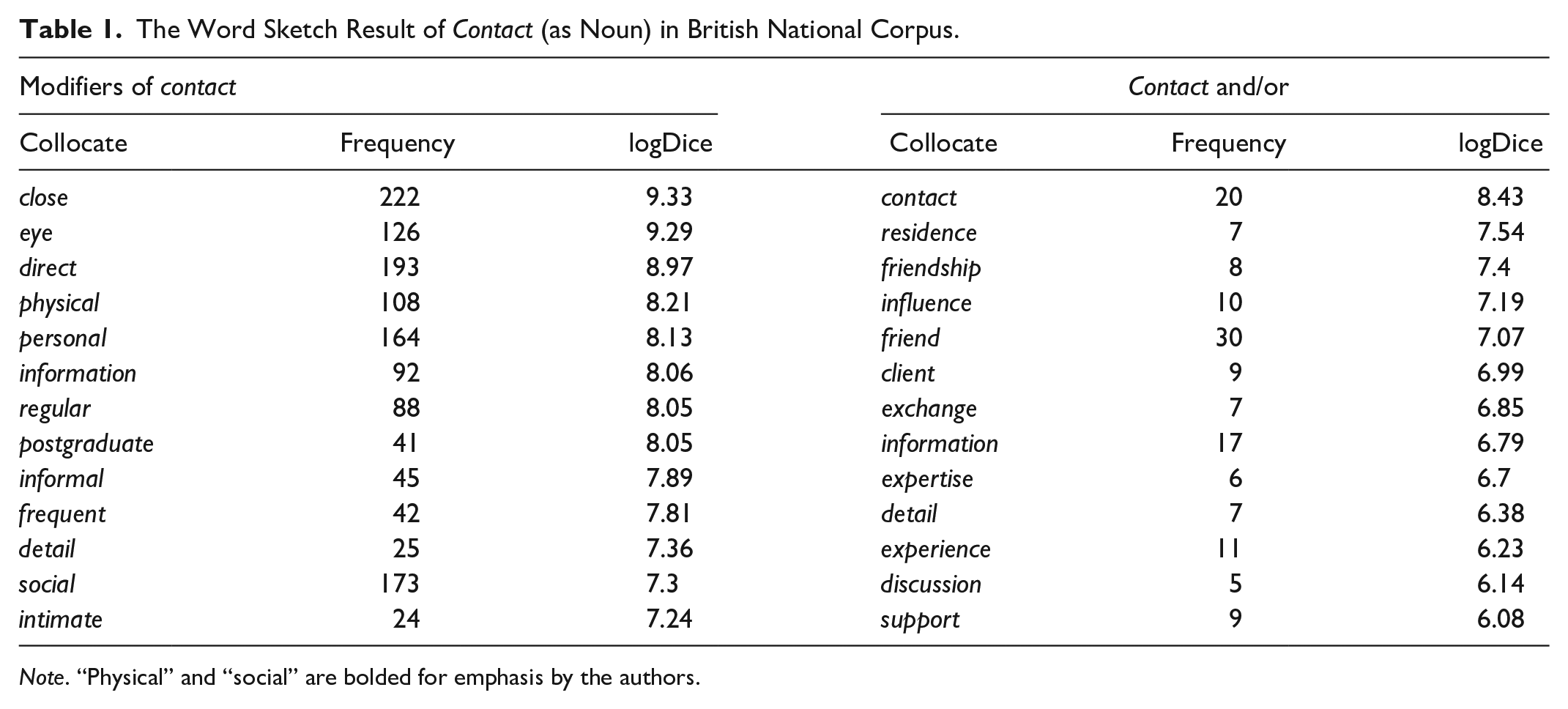
Note. “Physical” and “social” are bolded for emphasis by the authors.
The Subjects of Contact (as Verb) in British National Corpus.
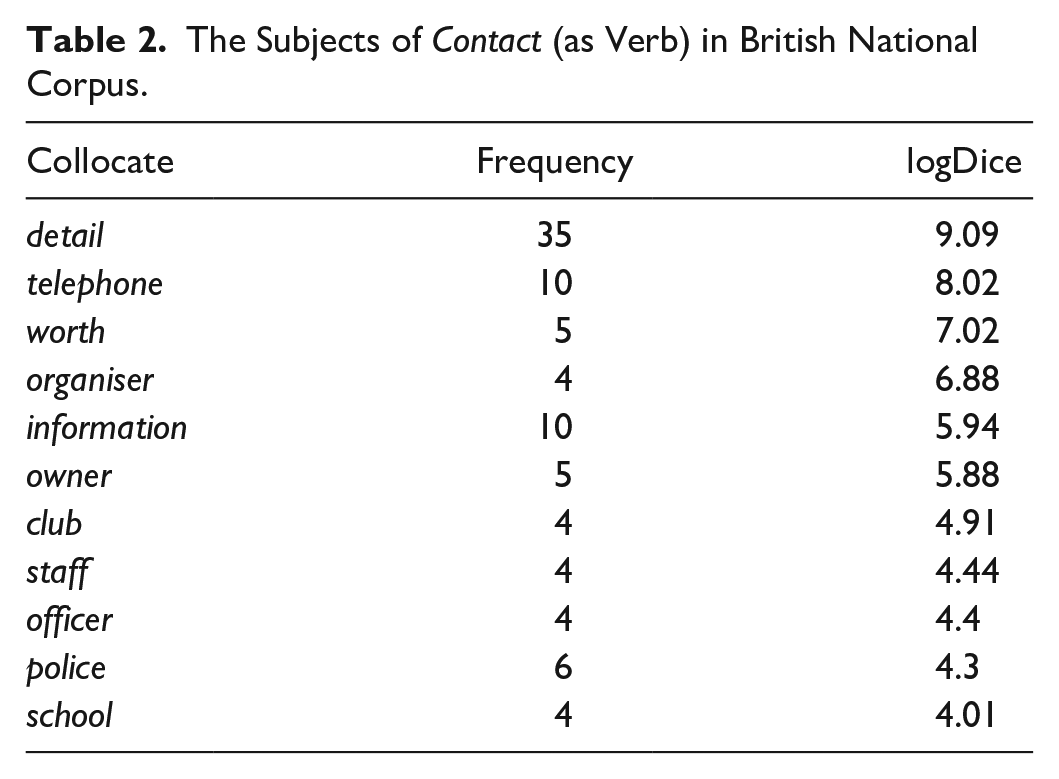
The Objects of Contact (as Verb) in British National Corpus.

Based on the dictionary interpretation and corpus analysis, a tentative sketch of the baseline meaning of contact can be made, as seen in (1). It is represented as a punctuality event (symbolized as “/”) that can be either social (Sense 1) or physical (Sense 2), as it indicates a single occurrence of an activity that is typically not measured by duration (i.e., contacting for an hour marks the duration of the time spent on the repeated events, rather than the duration of an individual event). In Sense 1, contact is represented as an inchoative event and is symbolized by a boundary dot before the slash to indicate a combination of two atomic event modules—boundary and punctuality, meaning that it initiates communication with other people. That is to say, by the contacting event, a communication starts, but the ending result of this communication is not specified, be it successful or not. It is a social event with the human agent and theme as participating roles, and the event can be controlled by the agent, so [social] and [control] are its event attributes. In Sense 2, it is a complete punctuality event that happens instantaneously, meaning to touch physically, with the theme and goal as participating roles and [physical] as the event attribute.
(1) MARVS representation of the baseline meaning of contact in two senses
Sense 1: “to communicate”
| |
[human] [human]
Sense 2: “to touch” <Theme, Goal> || [physical]
In particular, a further comparison of the Word Sketch Results (Table 4) of avoid contact in BNC (frequency = 57) and CORD19C (frequency = 677) reveals that avoid social contact has gained prominence at the expense of avoid physical contact in the time of COVID-19. The logDice value of physical as a modifier of contact in the pattern “avoid . . . contact” is higher than that of social in both corpora, but the value for social as a collocate increased significantly (from 0.05 to 3.45 in CORD19C), while the value of physical as a collocate decreased (from 4.43 to 3.63 in CORD19C). In addition, the top five collocates in terms of logDice in CORD19C refer predominantly to social contact (i.e., interpersonal interaction), while the top collocates from BNC are predominantly words of physical contact, with eye being the only social contact word.
Comparing Word Sketch Results of Avoid Contact in BNC (Left) and CORD19C (Right).

Note. BNC = British National Corpus; CORD19C = COVID-19 corpus.
“Physical” and “social” are bolded for emphasis by the authors. The frequent collocates (frequency>=5) that indicate social contact are shaded by the authors for emphasis.
As cross-validation, log-likelihood tests were run for the use of avoid social contact and avoid physical contact, comparing the frequency of occurrence in BNC and CORD19C. As Table 5 shows, avoid social contact is used significantly more in CORD19C (p < .05) than in BNC, but there is no significant difference for the use of avoid physical contact in these two corpora; this suggests that the use of “to avoid social contact” gained popularity because of COVID-19’s impact on society.
The Log-Likelihood Values for Avoid Social Contact and Avoid Physical Contact in BNC and CORD19C.

Note. BNC = British National Corpus; CORD19C = COVID-19 corpus; Freq = frequency; Sig. = significance.
Significance at 5%; –: underused by BNC compared to CORD19C; +: overused by BNC compared to CORD19C.
Jiēchù in Chinese
The Contemporary Chinese Dictionary (Dictionary Editing Office, Institute of Linguistics, Chinese Academy of Social Sciences, 2002) assigns two senses to 接触 jiēchù:
① 挨上, 碰著 come into contact with; touch
②(人跟人)接近並發生交往或沖突 come into contact with; interact with; engage
An examination of jiēchù in Gigaword_XIN (Table 6) suggests that the baseline meaning of this word in Mandarin Chinese is highly context dependent and that there are many limitations in its event and role attributes in each context type; therefore, grouping senses into contexts may give a clearer interpretation. For the purpose of this study, only two kinds of contexts are focused on: the medical context and the general social context. Below a summary of their eventive information is presented. Other contexts, such as the military context, will be discussed in separate article in the future.
The Word Sketch Result of jiēchù in Gigaword_XIN.

Note. Freq = frequency; MI = mutual information.
A. Sense 1: jiēchù “to come into physical contact with” in the medical context
(2) MARVS representation of jiēchù in the medical context
/ • < Agent ←→ Goal> || [physical]
│→ [potential affectedness]←│
│ │[human][-volition] [-volition] [potential harm]
Different from contact as a verb in English, the verb jiēchù in Chinese has an extra sense that relates to the medical context, meaning “to come into physical contact with (someone or something with potential harm such as infection with contagious diseases).” As represented in (2), when used in the medical context, jiēchù is a resultative punctuality event attached with a clear [physical] attribute. The starting of this event may not be controlled by the agent, so it may not have a noticeable starting time, but it does have an end boundary point completing the event (symbolized by putting a dot after a slash). According to the Word Sketch result in Gigaword_XIN (Table 6), its subjects are typically humans (病人 bìngrén “patient”), and its objects are mainly humans (病人 bìngrén “patient”), animals (禽鳥 qín-niǎo “poultry and birds”), micro-organisms (病毒 bìngdú “virus”), and potentially infectious (血液 xiěyè “blood”) or hazardous materials (貧鈾彈 pínyóudàn “depleted uranium bomb”). The participating roles of this event include an agent and a goal, both being typically non-volitional in this particular context. The roles can be bi-directional (symbolized by “
B. Sense 2:jiēchù “to come into social contact with” in a general social context
(3) MARVS representation of jiēchù in a general social context
• / <Agent ←→ Theme> || [control][social] [change of state]
| |
[human][official] [human]
As represented in (3), jiēchù can also apply in a general social context as an inchoative punctuality event meaning “to come into social contact with,” which is somewhat similar to contact in Sense 1 in English. It can also be controlled by the agent (represented as [control]) and owns a starting point; however, the difference from contact in English lies in that the human agents typically bear an [official] attribute, predominantly being governments, authorities, officials, or public figures (e.g., 高層 gāocéng “senior officials,” 領導人 lǐngdǎorén “leaders,” 人士 rénshì “personage”) (see “subjects” in Table 6), and the themes are typically public figures (rénshì 人士 “personage”) (see “objects” in Table 6). Furthermore, the verbs that indicate a change of state, namely, 開始 kāishǐ “start to” and 繼續 jìxù “resume,” often take jiēchù as the object (see “SentObjects_of” in Table 6), suggesting that the event of jiēchù normally involves a change of state in the relationship between the agent and the theme. In a general social context, the eventive information of jiēchù in Chinese is far more complicated than contact in English, bearing an additional event attribute ([change of state]) for the event module, as well as an extra limitation of being [official] for the role of agent.
C. The blending of Sense 1 and Sense 2: Emergence of shèjiāo-jiēchù in Hong Kong
(4) MARVS representation of shèjiāo-jiēchù in a social-medical context in Hong Kong Chinese
___• < Agent , Goal > ||[physical] [control] [social]
│→ [-kinship] ←│
│→[potential affectedness]←│
[human][volition] [human] [volition]
Our search for shèjiāo-jiēchù “social-contact” in Gigaword_XIN generated only one instance, which is an indirect quotation of the opinion given by a medical expert in Hong Kong, indicating that the use of shèjiāo-jiēchù may conflict with the baseline meaning of jiēchù before the COVID-19 pandemic. We believe that shèjiāo-jiēchù might be an evolved compound in Hong Kong Chinese, which can be understood as “doing physical contact in a social context.” Its eventive information is tentatively depicted in (4). Through blending the medical and social contexts, the whole event becomes a nominalized state event (symbolized by “___”) that inherits attributes from the two original senses shown in Sections A and B, with [control][social] from jiēchù in the social context (Sense 2) and [physical][potential affectedness] from the medical context (Sense 1). As a result, [physical] prevails over [social] in the emergent structure of shèjiāo-jiēchù. The attribute [change of state] in Sense 2 is also taken up, that is, the emergent meaning of shèjiāo-jiēchù is converted from a punctuality event with a [change of state] internal attribute to a resultative state event to be changed. It is typically used after 減少 jiǎnshǎo “reduce” but not after 開始 kāishǐ “start,” nor is it followed by the perfective aspectual marker 了 le, so this event has an end boundary point but does not own a starting boundary point. The role attributes are also adjusted in range: the agent now refers to the general public in a collective sense, waiving original restrictions on social status in Sense 2, while the goal typically incorporates non-family members of the agent (symbolized by [-kinship]).
Physical contact in Guangzhou vs. social contact in Hong Kong
Through comparing the senses of contact and jiēchù, this study has revealed that jiēchù in Chinese owns a sense specific to the medical context, which contact as a verb in English does not have. Although they share a sense that is used in the social context with the same event structure, the English and Chinese versions vary substantially for that sense: the Chinese word jiēchù bears role limitations that typically restrict non-official, common people from serving as the agent of jiēchù in the social context. Therefore, the translation of bù-jiēchù “no-contact” into “avoiding physical contact” in Guangzhou rather than “avoiding social contact” or “don’t contact” adheres to the baseline meaning of jiēchù in the medical context in standard Chinese, and simultaneously conforms to the baseline usage of contact in English.
As has been analyzed above, the term shèjiāo-jiēchù “social-contact” used at Stages 1, 3, and 4 in Hong Kong shows a notable deviation from the baseline meaning of standard Chinese. While the adoption of avoid social contact at Stage 1 in Hong Kong accurately reflects the significantly increasing popularity of this collocation pattern in English in the time of COVID-19, it can be assumed that the coinage of the compound word shèjiāo-jiēchù in Chinese was triggered by the loan translation from the English expression social contact. Although reducing social contact is replaced by the neologism social distancing at Stages 2 to 4 in Hong Kong, the formidable reconfiguration of medical and social senses of jiēchù substantiates the emergent term shèjiāo-jiēchù, allowing it to compete with the literal translation of social distancing. This might be the reason for the adoption of the “contact prevention” term jiǎnshǎo-shèjiāo-jiēchù “reduce-social-contact” as the corresponding Chinese expression for social distancing at Stages 3 to 4.
To conclude our corpus-based semantic analysis of contact and jiēchù, in the context of social distancing during the pandemic, a semantic change was not observed in the bilingual data from Guangzhou, which translated jiēchù faithfully to physical contact. Conversely, the emergent term shèjiāo-jiēchù in Hong Kong underwent a radical semantic change by acquiring a new event structure. The semantic change was triggered by the increasing popularity in the use of social contact in English; however, it was formed by reconfiguring elements in baseline eventive information in relevant Chinese senses.
Social distancing in later stages of Hong Kong: New meaning and its dis-ambiguation
The term social distancing appears after Stage 1 in Hong Kong. This compound was first included in the Oxford English dictionary in early April 2020 as one of the new vocabularies “ushered” to the general populace by COVID-19 (Paton, 2020).
Social distancing, first used in 1957, was originally an attitude rather than a physical term, referring to an aloofness or deliberate attempt to distance oneself from others socially—now we all understand it as keeping a physical distance between ourselves and others to avoid infection (Paton, 2020).
A concordance search for social distancing in BNC and CORD19C provided 0 and 1,447 (7.42 per million) instances, respectively, showing that the term quickly gained popularity in the time of COVID-19. A Word Sketch search for social distancing in CORD19C (Table 7) was conducted and visualized Word Sketch results for distancing in BNC and CORD19C in Sketch Engine (Figures 3 and 4) were compared. The MARVS representation for its present eventive information, based on corpus results, is described in (5).
(5) MARVS representation (to date) of (doing) social distancing in the time of COVID-19:
•/////•____< Agent, Theme >|| [control] [social] [implicit: physical]
| |
[human] [obligation] [human]
The Word Sketch Result of Social Distancing in COVID-19 Corpus.

Note. Freq = frequency.

Visualized word sketch results for the modifiers of distancing in BNC (A) and CORD19C (B).
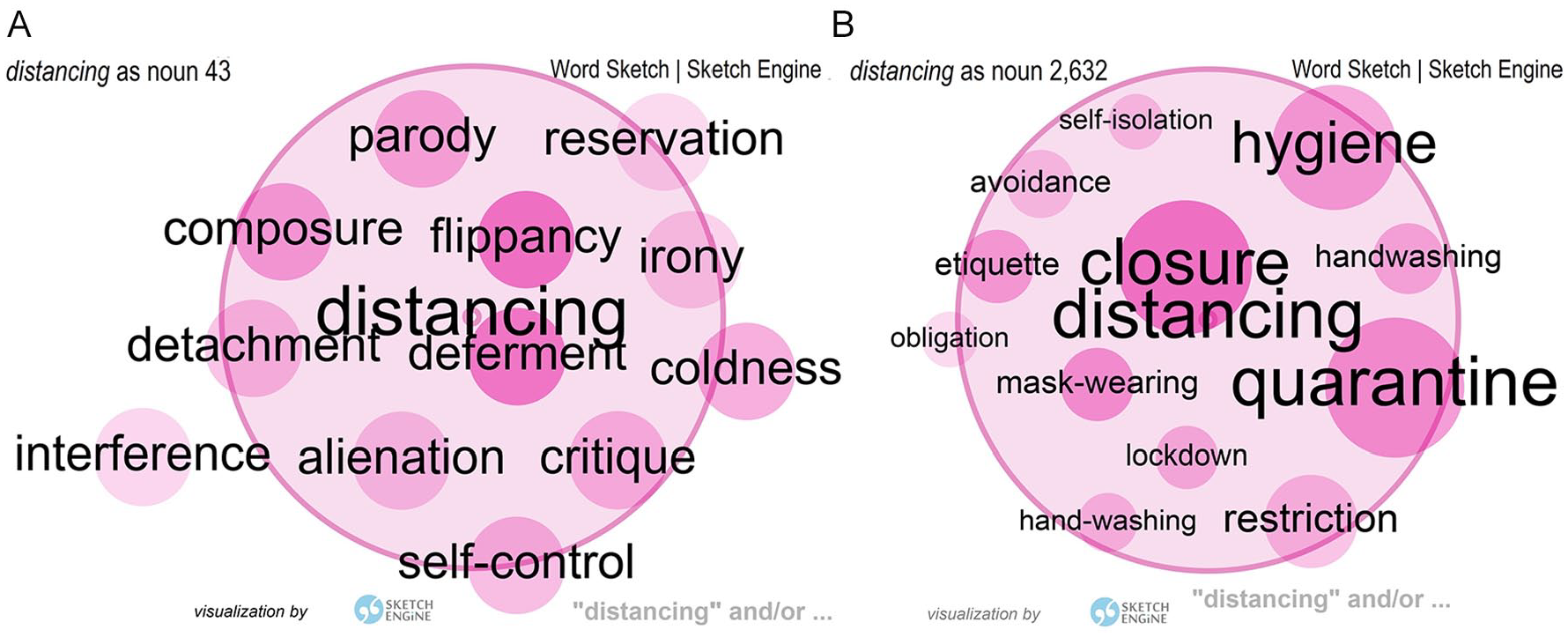
Visualized word sketch results for the collocates in “and/or” relation with distancing in BNC (A) and CORD19C (B).
Semantic changes can be clearly observed in the neologism social distancing. It is a nominalized eventive expression, often following a light verb (e.g., practice, implement) (Table 7) to realize its verbal event. In contrast with the Word Sketch result in BNC in which social does not modify distancing (Figure 3A), social is the most salient modifier (frequency = 861, logDice = 10.38) of distancing in CORD19C (Figure 3B). In BNC, collocates in “and/or” relation with distancing, such as coldness, detachment, flippancy, alienation, and critique (Figure 4A), all indicate an aloof meaning with a negative connotation in the social context. In CORD19C, distancing is associated with words related to epidemic prevention such as closure, etiquette, obligation, lockdown, quarantine, and mask-wearing (Figure 4B). Consistent with the explanation in the Oxford English Dictionary, the stark contrast in the collocates of distancing in BNC and CORD19C shows that distancing in the social context has shifted from a self-initiated individual action of deliberate alienation to a collective action of keeping distance from others to avoid infection. Social distancing is modified by intermittent, rigorous, self-imposed, and government-imposed in CORD19C (Table 7), so it can be inferred that the newly evolved event is an obligation-driven, durable process that initiates a follow-up state of physically keeping away from other social contacts. Therefore, this term can be represented in MARVS as a composite event structure composed of a bounded process event and a state event, the participating roles of which are the [human] agent and the [human] theme. The whole event is apparently social but implicitly physical, and the agent controls his own practice of this event out of social responsibility, so the event attributes include [control], [social] and [implicit: physical], and the role attributes for the agent include [human] and [obligation].
Our observation of this implicit [physical] attribute corroborates Schlücker’s (2016) finding that in Germanic languages an implicit element, other than the constitute morphemes, can be incorporated into a compound in its formation process. Yet this self-contradictory characteristic of using the word social to imply “physical” in social distancing poses challenges for its translation. The noun 距離 jùlí “distance” can, to some extent, indicate the implicit [physical] attribute; however, it still suggests a weakening social bond when collocated with shèjiāo. Absent a simple solution, the “contact prevention” expression used first in Stage 1 (jiǎnshǎo-shèjiāo-jiēchù) is taken back in Stages 3 to 4 as the way to articulate the newly incorporated implicit meaning in Chinese.
In summary, the neologism social distancing that is used in Hong Kong undergoes a radical semantic change by acquiring a new event structure in the time of COVID-19, changing from a [social] event to an ambiguous composite event with mixed [social] and [physical] attributes.
In all, H3 is fully supported by the data in Hong Kong, but it is not supported by the data in Guangzhou.
RQ3—Interpersonal Devices Used to Promote Social Distancing in Guangzhou and Hong Kong
The eventive evolution of the social distancing expressions does not occur in isolation. Rather, these expressions are strategically disseminated with a variety of interpersonal devices in Guangzhou and Hong Kong. From the perspective of SFL, the mainly used devices include mood, modality, and polarity. To capture the differences in their use of interpersonal devices, the two posters that were made during a similar time period in the two cities were compared, and then the posters in Hong Kong were further analyzed across its campaign stages.
First, the poster in Guangzhou (P_GZ) and a featured poster in the COVID-19 thematic website at Stage 2 (P_HK_S2_1), which were made in March 2020, were compared. Figures 5 and 6 represent the text of the original posters, pinpointing events clustered under the frame of social distancing terms. Modal operators are bolded, and negative polarity markers are underlined.

The text showing framing events of avoid physical contact in the poster from Guangzhou.

The text showing framing events of social distancing in a poster released at Stage 2 in Hong Kong (P_HK_S2_1).
In both posters (Figures 5 and 6), the imperative mood, the typical mood for “command,” is consistently seen; however, the use of modality and polarity differ considerably. For modality, the poster in Hong Kong uses the median-level modality operator 應 yīng “should” and even adopts the modal adjunct 盡量 jìnliàng (“if possible,” or “as much as possible” are the English equivalents) to soften the imposed obligation from the government. In sharp contrast, the high modality operator 必 bì “must” is used in Guangzhou. As has been introduced, a high value modality in “obligation” modality means that the audience is required to carry out the event, and a median value means that they are only supposed to do so. Therefore, the use of a higher value modality in Guangzhou gives the imperative sentence a stronger mandatory tone.
Regarding polarity, the extensive use of the negative polarity maker 不 bù “no; not” can be observed in P_GZ, whereas only one is included in P_HK_S2_1. Most of the English equivalents of bù are the corresponding negative imperative markers don’t. The negative imperatives in P_GZ are clearly behavior-inhibiting, whereas the positive imperative bǎochí-shèjiāo-jùlí “maintain-social-distance” (social distancing being the English counterpart) in P_HK_S2_1 is behavior-encouraging.
Given the cohesive mood, yet the variation in modality and polarity in promoting social distancing, different subtypes of directive speech acts are constructed in Guangzhou and Hong Kong. Specifically, prohibition (through contact prevention) is seen in P_GZ, and advice (for social distancing) is seen in P_HK_S2_1.
Second, similar to the social distancing terms that vary across campaign stages in Hong Kong, the interpersonal devices used to promote social distancing messages also vary throughout the campaign stages. A detailed analysis of all of the sample texts in P_HK can be found in the Supplemental Appendix, and a summary of their linguistic variations among campaign stages is provided in Table 8.
The Use of Social Distancing Terms, Interpersonal Devices, and Speech Acts throughout Campaign Stages in P_HK (by April 30, 2020).

Table 8 illustrates variations in the use of modality, mood, and polarity to frame different directive speech acts across the different stages: from advice (for contact prevention) to warning and advice (for social distancing). Interestingly, the tendency to avoid a direct prohibition is persistent in Hong Kong.
The degree of modality value follows and mimics the epidemic curve of COVID-19 in Hong Kong (Figure 2); it drops in Stage 2 in response to the curve falling in late February but soars in Stage 3 when the second wave of the coronavirus outbreak surged with global transmission.
In Stages 3 to 4, when the new requirements to reduce gatherings in Hong Kong were issued to combat the rising threat of COVID-19, the mood switched from imperative to declarative to deliver the warning messages. For example, the legal modal operator shall is used in Stage 3 within the declarative sentence “如違反規定,最高
As for polarity, it has been predominantly positive in Hong Kong across the stages, which differs sharply from the extensive use of negative markers in Guangzhou that serves to trigger a typical prohibition speech act. Marked use of negative polarity can only be found in one poster (P_HK_S3_1), in the way of a Q & A between a master and his apprentice, rather than a direct prohibition to the public.
To conclude the above analysis, H3 and H4 are fully supported. In both of the Chinese and English posters, the use of mood, modality, and polarity to disseminate the eventive information for social distancing across campaign stages diverges markedly between the two cities.
Furthermore, more diversified mood, modality, and polarity devices are used in Hong Kong to adapt to the shifting concerns across campaign stages, reflecting a different social interaction pattern compared with Guangzhou (H7). In general, the shift from “contact prevention” (in Stage 1) to social distancing (in Stages 2 to 4), together with the strategic choice to use diversified interpersonal devices to promote social distancing to avoid a directly imposed prohibition, reflect Hong Kong’s style of governance and complex social dynamics. In health-related activities, the intention motivating one’s behavior influences their actual behavior (Shin et al., 2017), and intention is mainly predicted by one’s gratification and confirmation for taking the activity (Shin & Biocca, 2017). In a society that is used to a high degree of individualism in social interaction, creating a uniform social behavior pattern with voluntary gratification and confirmation from individual community members is very complicated. It is negotiated with the gradually changing mood and modality and the very slight shift from positive encouraging to inhibition words in Hong Kong. It is crucial to note that these devices did not move uniformly as at least one device needs to be weakened to mitigate the stronger command expressed otherwise; this prevents the change from being too abrupt. Nevertheless, in Stage 4, the announcement in Hong Kong contained a uniformly strong stance with imperatives, declaratives, and strong modal verbs. This suggests that, through the stages, the uniform collective behavior of social distancing has been established and accepted. This staged transition directly contrasts the social interaction pattern in Guangzhou, where only one single, definitive announcement is needed.
The above analysis validated H7. The diversity in interpersonal devices in Hong Kong demonstrates that the single illocutionary act of a prohibition that is considered adequate in Guangzhou is inadequate in Hong Kong. The social dynamics in Hong Kong require the government to tactfully “negotiate” the transition to a more complex social interaction pattern through a series of speech acts that are seen in the four stages of posters. These steps toward a uniform behavioral pattern were carefully staged through the balanced (though consistently stronger) use of mood, modality, and polarity items. The release of each new set of stronger announcements also directly followed a major development in the pandemic and hence appeared (by design or by nature) as a reaction to the pandemic instead of government initiatives for tighter control.
Conclusion
In this article, the public health posters in Guangzhou and Hong Kong are studied to examine the evolution of social distancing terms and interpersonal linguistic strategies in public health campaigns. This study specifically focuses on how language use in public health campaigns adapts to different societal contexts, especially in terms of the different pathways needed to motivate people to accept the new behavior pattern of social distancing. Altogether four hypotheses have been tested. The first hypothesis, which is focused on the choice of social distancing terms in the two cities, is fully supported, showing that Guangzhou and Hong Kong diverged greatly in their choice of social distancing terms, with the “contact prevention” term being the only choice in Guangzhou and the neologism social distancing competing with the “contact prevention” term in Hong Kong. This demonstrates that the health campaign terms that are used are driven by patterns of social interactions. The second hypothesis, about the semantic changes in the event structure of social distancing terms, is only attested in Hong Kong. This shows that the emergence of a new verbal meaning arose from a new pattern of social behavior that is encoded with a new eventive structure, and the process of lexical evolution is also influenced by the patterns of social interactions. Guangzhou’s single public health campaign suggests that the public is not directly engaged in the formation of the concept, and as such, the emergent event type is not assigned a new word sense. Finally, the last two hypotheses regarding the different use of interpersonal linguistic devices are both proven. The two cities differed in the use of mood, modality, and polarity to promote social distancing, with Hong Kong exhibiting a more diversified style that reflects its more complex pattern of social interaction. This shows that the choice of different interpersonal devices can be predicted by the different social dynamics of the two societies. By testing these hypotheses, it can be seen that lexical evolution interacts with social realities. The lexical evolution of social distancing terms and the interpersonal devices used to disseminate the evolved eventive information come together across campaign stages, and their bilingual reconfiguration is influenced, or “filtered” by the specific sociopolitical, cultural, and linguistic contexts of speech communities, resulting in different illocutionary acts on the audience: prohibition in Guangzhou, and conversely advice and warning in Hong Kong. Guangzhou adopted the “contact prevention” term with standard conventionalized meanings in both Chinese and English and relied on one single illocutionary act to complete the public health campaign. The lack of need to amend or strengthen this direct prohibition speech act in Guangzhou underlines the collectivist culture of the city. This sharply contrasts Hong Kong’s elaborately constructed four-stage negotiation to slowly build the need for and the mandate to create new, uniform social behavior. From “contact prevention” to social distancing, co-evolution between neologisms and public health campaigns resonates with varying interpersonal devices in both English and Chinese. The shifts of these linguistic expressions over time use subtle cues to strengthen the illocutionary speech acts and slowly coax uniformity for social distancing actions; this is seen by the transition from unenforceable advice to a direct warning that is substantiated by a legal penalty. Yet, avoidance of direct prohibition was carefully adhered to, which reflects Hong Kong’s individualist culture and complex social dynamics.
In conclusion, the careful examination of the co-evolution between social distancing terms and COVID-19 public health campaigns can inform the design of future public health information materials and contribute to the understanding of multilingual risk communication in public health crises. Further studies in other languages or for future lexical evolution will lead to a better understanding of both our social dynamics and the roles of linguistic devices in facilitating behavioral changes in a time of common threats.
Supplemental Material
sj-pdf-1-sgo-10.1177_21582440211031556 – Supplemental material for From Contact Prevention to Social Distancing: The Co-Evolution of Bilingual Neologisms and Public Health Campaigns in Two Cities in the Time of COVID-19
Supplemental material, sj-pdf-1-sgo-10.1177_21582440211031556 for From Contact Prevention to Social Distancing: The Co-Evolution of Bilingual Neologisms and Public Health Campaigns in Two Cities in the Time of COVID-19 by Xiaowen Wang and Chu-Ren Huang in SAGE Open
Footnotes
Acknowledgements
We thank the anonymous reviewers for their helpful comments.
Data Sources

Declaration of Conflicting Interests
The author(s) declared no potential conflicts of interest with respect to the research, authorship, and/or publication of this article.
Funding
The author(s) received no financial support for the research and/or authorship of this article.
Supplemental Material
Supplemental material for this article is available online.
References
Supplementary Material
Please find the following supplemental material available below.
For Open Access articles published under a Creative Commons License, all supplemental material carries the same license as the article it is associated with.
For non-Open Access articles published, all supplemental material carries a non-exclusive license, and permission requests for re-use of supplemental material or any part of supplemental material shall be sent directly to the copyright owner as specified in the copyright notice associated with the article.
