




Abstract
Organizational politics can lead to stigmatization among employees, creating division within an organization. As a result, researchers are interested in studying this topic. This study aims to identify trends and developments in scientific publications related to organizational politics, using 828 international journals in the Web of Science database. The study employs various factorial analysis visualizations, including correspondence analysis, multiple correspondence analysis, and multidimensional scaling analysis. The present study shows that research on organizational politics has increased over time, with a significant focus on perception in the most recent years. Further analysis reveals that perception and performance are the most frequently associated topics with organizational politics. Besides, the three-factor analysis approach highlights the keyword “perception” as having the largest cluster among the three approaches. However, bibliometric analysis of this topic is limited, particularly regarding the use of biblioshiny software as an analytical tool. The findings suggest potential areas for future research, including creativity and employee personality, using the bibliometric method with a time evolution approach.
Keywords
Introduction
Studies on organizational politics is a pervasive and important phenomenon within the workplace in the last two decades. Power struggles, strategic maneuvering, and influence dynamics are common in contemporary organizations, and political behavior significantly impacts decision-making, resource allocation, and overall organizational effectiveness (Kirk, 2005). Organizational politics encompasses the actions, processes, and behaviors that individuals employ to acquire power, influence, and achieve their goals within the organizational context. However, understanding and navigating organizational politics can be challenging due to its complexity and multidimensionality, which can lead to ethical dilemmas and negative consequences for individuals and the organization as a whole. Therefore, a comprehensive understanding of organizational politics necessitates a multidimensional analysis that illuminates its various facets and their interplay.
Organizational politics has been extensively researched and has significant implications for the study of management and organizational behavior. Researchers have examined the concept from various perspectives, including the political behavior of individuals and groups within organizations, sources of power (Patel et al., 2019), and influence (Akuffo & Kivipõld, 2021; Kapur, 2018), and the consequences of political behavior (Agung & SeTin, 2021; Cheong & Kim, 2018; Kumari & Saradadevi, 2016). Despite the extensive research conducted on this topic, there are still gaps in our understanding of the key themes, trends, and knowledge gaps in this area. Therefore, a comprehensive analysis of existing research in this field is necessary.
Recent studies have proposed new theoretical frameworks and empirical research methods to investigate the complex phenomenon of organizational politics and address gaps in our understanding. For instance, Hu et al. (2020) explored the needs and implementation of organizational politics in the organizational environment, while Liu and Mei (2016) examined inappropriate behavior in the organizational climate. Other researchers have investigated the impact of organizational politics on organizational commitment, job satisfaction, job performance, and organizational citizenship behaviors. Some have also focused on the effect of organizational politics on the work environment and politically charged organizations, including stress and burnout among employees, intent to move, political tendencies, conflicting employee relations, and employee silence (Kidron & Vinarski Peretz, 2018; Tahamtan & Bornmann, 2019).
Meanwhile, some researchers prefer to use quantitative methods to study organizational politics, as demonstrated by De Clercq et al. (2018) and Sun and Xia (2018). In De Clercq et al.′s research, a three-wave study design was used to collect data from employees and supervisors in three organizations in Peru. The participants were required to complete a survey featuring a three-week time lag between each wave. Meanwhile, Sun and Xia (2018) conducted a study to examine the bibliometric characteristics and trends of political patronage journal articles in Indonesia indexed in Scopus. Their study employed standard statistical methods and bibliometric analysis, using VosViewer software, to visualize patterns of keyword co-occurrence (Martínez et al., 2015; Subandi et al., 2022), document citations (Taqi et al., 2021), co-citation relationships (Halverson et al., 2012; Mejia & Kajikawa, 2017), and bibliographic incorporation (Merigó et al., 2015). Additionally, Liu and Mei (2016) used bibliometric analysis methods in his research paper, albeit with a different focus, examining the features and research trends of unethical pro-organizational behavior in business and management (Fontelo & Liu, 2018). The study identified 89 articles and 4,523 references from 49 journals. Although no research has yet been found on the topic of organizational politics using the bibliometric method, the current study sought to fill this gap, given the significance of organizational politics in organizational existence.
According to the Scopus database, research on organizational politics has been increasing from 1977 to 2022. It is intriguing to explore the development of this research and its trends. Sun and Xia (2018) utilized VosViewer for bibliometric analysis, which visualized co-occurrence patterns of keywords, document citations, co-citation relationships, and bibliographies. However, a more detailed explanation and visualization of the mapping trends is needed. We propose utilizing Biblioshiny (Su & Lee, 2010; Turek, 2022), a less common tool in bibliometric analysis. Some of the latest research incorporates it, such as Carroll et al. (2022), and some combine it with VosViewer, such as Gao et al. (2022) and Patel (2019). In the current research, the following research questions are formulated to investigate the trends and developments in scientific publications related to organizational politics:
To answer this question, we need to examine the development of scientific publications related to organizational politics, taking into account aspects beyond just the growth in the number of publications. It is important to consider factors such as the diversity of authors and content. It is worth noting that our analysis will be limited to research development in this field.
To answer this question, we will use factorial analysis to identify the connection between keywords and how closely related they are. This will help us understand if certain keywords have a relationship with each other or not. However, to make the analysis more comprehensive, we will also need to examine the research or author’s network. It is important to note that the scope of this analysis will be limited to the network or connection of the research.
To address the questions above we will utilize bibliometric analysis to identify research trends and developments related to organizational politics. This will involve employing factorial analysis methods such as correspondence analysis, multiple correspondence analysis, and multidimensional scaling analysis. These methods will contribute to a better understanding of scientific publications related to organizational politics by systematically evaluating the impact and productivity of academic research in the field and identifying the most frequently associated topics.
Moreover, this analysis can offer valuable insights into the historical development, current status, and future directions of the research field, enabling researchers to identify gaps in the literature and develop research agendas that contribute to the field’s advancement. Additionally, this analysis can also provide practitioners and policymakers with the necessary insights to develop effective strategies for managing organizational politics and promoting a positive organizational culture, which could have a significant impact.
This article takes a unique approach to studying organizational politics by utilizing bibliometric analysis, specifically three-factor analysis (correspondence analysis, multiple correspondence analysis, and multidimensional scaling analysis), and Biblioshiny software. While there have been numerous studies on organizational politics, few have employed these methods to examine the intellectual structure of the field. Through analyzing patterns of publication, citation, and collaboration among scholars, this study provides a comprehensive and quantitative understanding of the current state of the field of organizational politics.
The article is divided into several sections. First, it presents a comprehensive literature review of organizational politics, highlighting theoretical approaches and research findings in this area. Second, it describes the methodology of the study, including the data collection and analysis techniques used. Third, it presents the results of the bibliometric analysis. Fourth, it discusses the implications of the findings and compares them to previous research. Finally, the article concludes with a summary of its main contributions to the field of organizational politics.
Literature Review
Organizational Politics
Politics is a process that involves assessing empirical data and activities within organizations. Organizational politics is a reality in our social life that is inevitably encountered by organization members in their interactions (Gunawan & Santosa, 2012). It is often interpreted as a process by actors or groups within an organization to gain power and influence decision-making processes to meet individual or group objectives (Noman et al., 2022; Yalçın & Yayla, 2016).
However, organizations cannot exist without politics, and it has both positive and negative impacts. Uncontrolled organizational politics can decrease performance and create negative perceptions of politics as a source of conflict (Agung & SeTin, 2021; Cheong & Kim, 2018; Kumari & Saradadevi, 2016). Conversely, when properly and objectively controlled, it can increase work effectiveness within an organization (Akuffo & Kivipõld, 2021).
Researchers studying organizational politics often emphasize the realities of organizational life (Akuffo & Kivipõld, 2021, such as office politics, workplace politics, and organizational climates (Drory & Vigoda-Gadot, 2010). This emphasis has resulted in a stigma attached to organizational politics, especially in policy-making (Gotsis & Kortezi, 2010). Moreover, employees who are aware of politicizing activities within their organization may deny information that could be useful.
Bibliometrics
Bibliometric analysis is a popular method for analyzing large amounts of scientific data. It has contributed significantly to the study of the structure and expansion of knowledge in social work. There are several approaches to bibliometric analysis that can be used to assess the progress of a discipline, such as conceptual, social, and intellectual structures (Sun & Xia, 2018). For instance, researchers have used bibliometric methods to analyze the development of scientific research in multidisciplinary fields. Some examples include the identification of trends in SIS-related research (susceptible-infected-susceptible), which is the most cited scientific publication (Ge et al., 2022); trend analysis and empirical research topics on TPACK (Technological Pedagogical and Content Knowledge) (Zyoud et al., 2022); machine learning and AI (Artificial Intelligence) in circular economy, and many other topics. Bibliometric analysis is also used as a research method in various fields, such as science, agriculture, business models (McDonough et al., 2017), social robotics (Mellon, 1986), ideology (X. Du et al., 2018), and Geographic Information Systems.
Studies related to trends often involve organizational politics. For example, Sun and Xia (2018) studied the trends and identified the bibliometric characteristics of political patronage journals in Indonesia indexed by Scopus, using biblioshiny and factorial analysis. In addition, co-occurrence and co-citation approaches were also investigated to see trends in political discourse research in translation. Furthermore, Zyoud et al. (2022) conducted bibliometric research to map trends, citations, and keywords, using 652 scientific papers from 2011 to 2020. They analyzed the data using VOSViewer and CiteSpace applications (Mira & Breda, 2021).
Dhakal (2022) and Pisuko et al. (2022) also used NVivo to analyze their research content because it is a helpful tool for sorting, organizing, and analyzing qualitative data. Based on their research, the study found that the combination resulting from the internationalization of tourism destinations includes: (i) integration between organizational and stakeholder interests; (ii) an understanding of endogenous and exogenous business opportunities that drive these elements; (iii) integration of external chances objectivity by adapting the territorial identity; (iv) the achievement of the relationship between the three prior components through the application of governance models; (v) determining the destination of organizations facilitated by governance models through reconciling readability, resources, and chances; (vi) and the resulting dynamics between the elements of this system which are coordinated by DMOs (Destination Management Organizations), making it possible to regulate supply according to their territorial identity.
Nelson and Quick (1991) utilized the VosViewer application to conduct a bibliometric review of work-family conflict with a specific focus on job satisfaction. They also employed the R software to analyze and present graphs. The study analyzed 146 documents from the Scopus database, and the results revealed that the number of publications on work-family conflict is currently increasing, which could be attributed to low fecundity and average citations per document or increased collaboration between authors. Furthermore, the study identified potential areas for future research using thematic maps, topic trends, bibliometric coupling, three-field plots, and co-occurrence networks.
In contrast, Martinho conducted a bibliometric study using 25 scientific papers from the Web of Science (WoS) database and journal citation reports. The study produced eight guidelines, including social services, health services, violence, women, HIV/AIDS, social service specialists, education, and child labor. Additionally, a re-analysis was conducted to observe cluster variations in three distinct periods: 1930 to 1989, 1990 to 2002, and 2003 to 2012. The analysis revealed that most of the cited fields of study varied in distinct periods.
Meanwhile, in their study, Zupic and Cater analyzed 543 scientific papers indexed by Scopus and the WoS on the topic of “pedagogical content knowledge technology” published between 2008 and 2015, using the CiteSpace II program. They found that the number of articles on this topic has increased over time and that the subjects cited were more diverse, leading to an increase in the number of citations.
Similarly, Ladebo (2006) conducted a bibliometric analysis of academic literature on the topic of transparency in modern government. The study explores the interrelationships between the ethics of transparency and the external environment, using guided historiography and shared event analysis to provide insight. Kwon also contextualized and summarized the main themes in the transparency discourse into three new sources of risk in expanded visibility, namely organizational operations separated from the goal of transparency, undisclosed power relations on the politics of disclosure, and dependence on decontextualized digital.
Based on these research results, the critical message is that bibliometric data analysis, using correspondence analysis, multiple correspondence analysis, and multidimensional scaling analysis, is effective and efficient. The three-factor analysis approach, along with visual cues like visualization diagrams related to the results, provides multiple context-aware views that allow users to intuitively consider various angles during evaluation.
Method
To map research trends in scientific publications on organizational politics topics, we employed the bibliometric method, which is an analytical tool that utilizes statistical techniques to measure the level of published research (Wickenberg & Kylén, 2004). Furthermore, bibliometrics can also be used to assess the productivity of journal articles quantitatively (Derviş, 2020). This method was used in order to identify insights from published research and provide information that can add to our understanding of organizational politics. Therefore, this research aimed to reveal the trend and development of scientific publications related to organizational politics.
Data Source
To collect data for this research, we obtained keywords, abstracts, and author information from the WoS database (Carvalho et al., 2013). This database was chosen because it is the second-largest database on the web, containing over 15,000 journals and >90 million documents. We specifically searched for data related to organizational politics, using keywords such as “organizational” or “political,” and collected information from the years 1977 to 2022.
Data Analysis
We analyzed the data using Biblioshiny software, which employs factorial analysis approaches. Biblioshiny is a significant tool for bibliometric analysis as it provides an easy-to-use platform for analyzing and visualizing bibliographic data. The implementation of Biblioshiny, which uses the R programming language and the Shiny package to build personalized and interactive visualizations, makes it an indispensable tool for bibliometric studies. Factorial analysis is a statistical technique that aims to identify a small number of factors that can represent the correlation between several variables. There are three types of factorial analysis based on the type of analysis:
Correspondence Analysis
Correspondence analysis (CA) is a data analysis tool that simplifies data by visually displaying it. It examines the relationship between two categorical variables and is a type of exploratory data analysis that can identify patterns in data through visualization. CA works by summarizing data in a contingency table and then projecting it onto a two-dimensional space. The resulting map shows the relationship between the table’s rows and columns and can assist in identifying any underlying patterns or linkages. This can save time, as it simplifies complex cross-tabulations by representing the rows and columns of the table as a dotted map (Blasius & Greenacre, 2006). CA is used in bibliometric analysis to explore the relationship between documents and the terms used within them.
Multiple Correspondence Analysis
Multiple correspondence analysis (MCA) is a statistical tool used in data analysis when dealing with more than two categories of variables with levels. This tool is related to correspondence analysis, but it is much more advanced in its analysis. It is often used to evaluate data from surveys or questionnaires that contain many questions with categorical answers. MCA generates a new set of variables known as principal components, which summarize the relationships between categorical variables. These components can then be plotted on a two-dimensional space to visualize the relationships between variables. In bibliometrics, MCA is useful when dealing with several categorical variables, such as authors, institutions, or subject categories. It can identify linkages and patterns that would otherwise be missed by standard co-occurrence analysis.
Multidimensional Scaling Analysis
Multidimensional scaling analysis (MDS) is a powerful analytical tool used to analyze various types of matrices that share a common trait. The method involves calculating the degree of similarity or dissimilarity between each pair of objects and plotting the resulting data on a two- or three-dimensional space to visualize the relationships among the items. MDS generates an object map that consists of two low-dimensional spaces where objects with similar traits are located closer to each other. However, interpreting the dimensional properties of MDS can be challenging since there are no set rules, and it cannot visually display the relationships between objects (Börner et al., 2003). Despite these limitations, MDS is particularly useful in bibliometric analysis for visualizing complex relationships between documents or terms. It helps identify clusters of related documents or terms, including any outliers that may play a crucial role in understanding the overall structure of the data.
Framework
The framework for the bibliometric analysis conducted in this study is presented in Figure 1, outlining the step-by-step procedure carried out. The process begins with the search for relevant data and concludes with the visualization of the results. The specific details of each step are described below.
Searching; this process involves searching for data in the WoS database using the keywords “organizational politics” and the Boolean logic “OR” strategy within the 1977–2022 time range. The data was saved in bib format.
Cleaning; this process involves selecting data based on its relevance to the topic of organizational politics and the year of publication. In this step, 23 journal articles were excluded, leaving 828 articles for analysis.
Analysis; the selected 828 journal articles were analyzed using Biblioshiny software, which employs a three-factor analysis approach (correspondence analysis, multiple correspondence analysis, and multidimensional scaling analysis), along with other approaches such as treemaps, author coupling clustering, author collaboration networks, annual and state scientific production, most cited countries, and co-occurrence analysis.
Visualization; this final step involves visualizing the analyzed data using tables, maps, network maps, diagrams, and other visual aids.

Illustration of the research process.
Results
Research Development in the Organizational Politic Field From 1977 to 2022
Characteristics of Organizational Politics Data
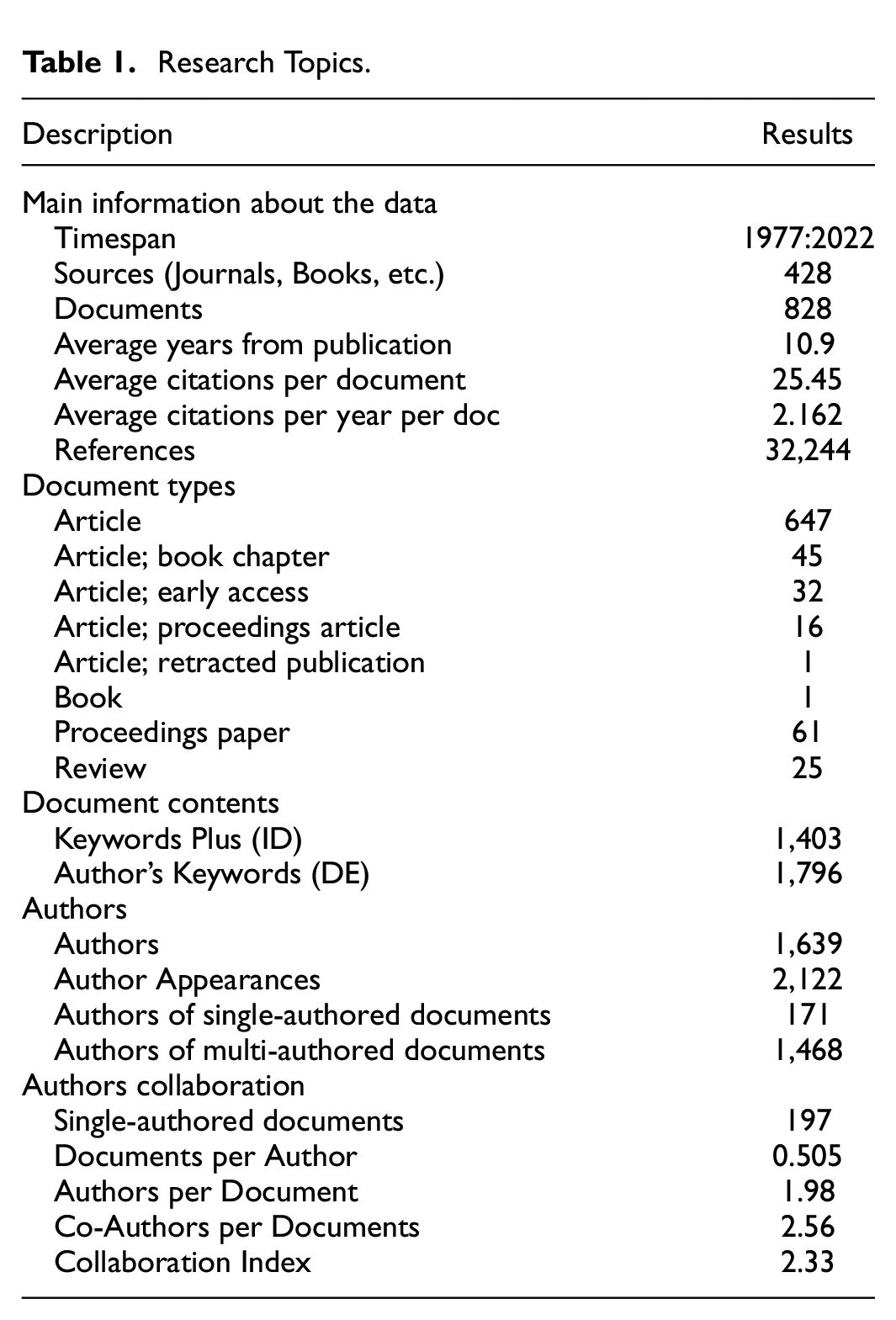
Table 1 summarizes the characteristics of scientific publications related to organizational politics from the WoS database, processed using Biblioshiny for bibliometric analysis. The data covers the period between 1977 and 2022. The table shows that 828 documents, originating from 428 sources (including journals and books), were written by 1,639 authors on the topic of organizational politics. On average, 10.9 articles were published per year, with an average citation of 25.45 per document and an average of 2,162 citations per year. Only one reference was indexed in the WoS out of 828 documents. The documents were classified as articles (647 documents), articles from book chapters (45 documents), articles with early access (32 documents), proceeding articles (16 documents), retracted publication (one document), books (one document), proceedings papers (61 documents), and reviews (25 documents). The author’s keywords produced 1,796 keywords, while 1,403 keywords were identified as keywords plus (ID). The analysis found that 197 documents were written by a single author, and 631 documents were co-authored.
Research Topics.
Over the span of 45 years, a total of 828 documents have been published on the topic of organizational politics. Table 2 reveals that the top 10 journals that have published the most articles on this topic, contributing 158 articles in total. Among these journals, Human Relations published the highest number of articles with 25, followed by Personnel Review with 24. On the other hand, Frontiers in Psychology published the least number of articles. The majority of articles were contributed by authors from the United Kingdom and the United States. Interestingly, it appears that the subject area is not limited to organizational politics, but also encompasses the fields of psychology and social sciences.
The Top 10 Journals for Scientific Production.

Treemap
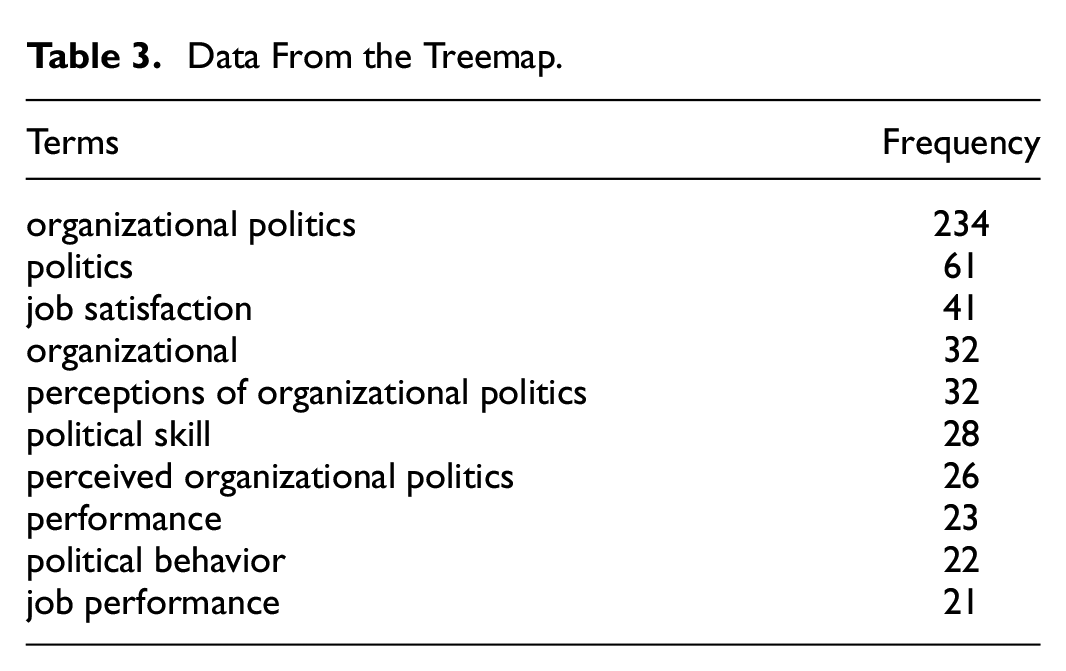
Table 3 and Figure 2 display a treemap focus on the most relevant combinations of keywords (Campra et al., 2022) in relation to the topic of organizational politics. The treemap indicates the 50 most frequently used keywords in articles, with organizational politics being the most common. This feature enables readers to locate articles that are relevant to the keywords and can assist in identifying research trends and gaps in research topics (Zyoud et al., 2022). Table 4 presents the top 10 keywords from the treemap, with organization politics being the most frequent keyword, appearing 234 times, and job performance appearing 21 times.
Data From the Treemap.

Treemap.
Most Cited Countries’ Data.

Annual Scientific Production
Figure 3 displays the annual scientific production of the topic “organizational politics” from 1977 to 2021, spanning 45 years. The changes in productivity from year to year are divided into three research stages, as identified by Aparicio et al. (2019). The initial stage, from 1977 to 1988, saw minimal interest in the topic of organizational politics. The next development stage spanned from 1989 to 1994, marked by an increase in publications from one to nine. The last stage from 1995 to 2021 shows a significant rise in publications from under 10 to over 50. Despite a decline in some periods (1996–1998, 2000–2003, 2006–2007, 2013–2015, 2017–2018), researchers continue to show great attention to the topic of organizational politics, resulting in an overall increase in the number of publications over the last 45 years. As of this research’s publication in 2022, the data does not include the entire year, and it is possible that there will be an increase or decrease in the number of publications for that year. Overall, the average annual publication rate for “organizational politics” from 1977 to 2021 is 10.9.

Annual scientific production.
Most Cited Countries
Figure 4 and Table 4 present the average number of citations for papers on the topic of “organizational politics.”Table 4 provides a clearer breakdown of the total number of citations and the average citations for articles from each country. The United States ranks first with the most citations, with a total of 10,705 and an average citation of 44,053 papers. The second position is held by the UK, with a total citation of 1,948 and an average citation of 25,632. Israel ranks third, with a total citation of 1,638 and an average citation of 31.5. This indicates that the United States has the highest number of publications on the topic of organizational politics and is the most cited country compared to other countries’ publications on the same topic from 1977 to 2022. In contrast, Norway has a total of 116 citations, and Korea has a total of 129 citations. These countries have the lowest number of total citations and average citations on the topic.

List of the most cited countries.
The Connection Between One Research and Another in the Organizational Politic Field
Cluster by Author Coupling
The above graphic illustrates the most common topics found in documents related to the topic of organizational politics, based on author coupling. Figure 5 displays four clusters: purple, blue, green, and red. The first cluster includes the words “political organization,”“model,” and “dimensions” with conf proportions of 6.3%, 9.6%, and 56.2%, respectively. The second cluster consists of the words “perception,”“model,” and “display” with slightly different conf proportions of 14.1%, 32.7%, and 16.8%, respectively. The third cluster includes the word “perception” with the largest proportion of conf at 36.4%, followed by “organizational politics” at 29%, and “performance” at 32.3%. The fourth cluster is the largest with the highest proportions, as indicated by the size of the circle. This cluster includes the words “perception” accounting for 46.9% conf, “organizational politics” at 57%, and “performance” at 45.5%.

Instructions by the author of the clutch.
Authors’ Collaboration Networks
Figure 6 displays nine different clusters of collaborating authors with different colors. The blue and red clusters are the most prolific in terms of author collaboration. Ferris Gr is the most cited article by the author in the red cluster, followed by Hochwarter wa as the second most cited article by the author in the red cluster and Kacmar km as the third most cited article by the author in the blue cluster. On the other hand, the other authors have fewer citations than the three authors mentioned above, which is reflected in the size of the nodes in their respective clusters. The size of the node represents the level of collaboration of the author, with smaller nodes indicating less collaboration. The analysis shows that all authors collaborate with each other in one way or another, and there is no single author who does not collaborate with other authors. Therefore, the nine clusters indicate collaboration between authors.

Authors’ collaboration networks.
Co-Occurrence Analysis
The co-occurrence analysis results are presented in Figure 7. This traditional bibliometric analysis method is commonly employed to investigate the possible relationship between two bibliographic topics that are found in the same research (Zyoud et al., 2022). The identified topics are categorized into three clusters. The most significant cluster, illustrated in red, comprises the frequently identified topics: perception, organizational politics, and performance. The second cluster, depicted in blue, includes the topic “attitude,” while the last cluster, presented in green, consists of the topic “validation.”

Co-occurrence analysis.
Factorial Analysis
In addition, we conducted a bibliometric analysis on the topic “political organization” using another approach called factorial analysis. This approach is a statistical procedure used to identify the smallest number of factors that can represent the relationship between several variables. In this study, we used three methods of bibliometric factorial analysis: correspondence analysis, multiple correspondence analysis, and multidimensional scaling analysis. These methods were used to determine the closeness between keywords and the overall topic. It was expected that this approach would reveal a close relationship. The conceptual structure maps (Figures 8 –10) provide a more detailed view of the closeness and divergence in the research area.

Correspondence analysis.

Multidimensional scaling analysis.

Multiple correspondences analysis.
Correspondence Analysis
The correspondence analysis output revealed one large cluster and one small cluster of topics (Figure 8). The red cluster represents the presence of keywords such as “power,”“management,”“politics,”“organization,”“trust,”“determinants,”“models,” and “perspectives,” while the blue cluster contains the keyword “innovation.” The relationship between the keywords in the topic “Organizational Politics” is not strong. However, it can be observed that the keywords “organization,”“politics,”“management,”“trust,”“determinant,”“management,”“model,” and “perspective” are closely associated with each other. On the other hand, the keyword “power” appears considerably distant from other keywords in the same cluster, indicating that its relationship with other keywords is not strong.
Multidimensional Scaling Analysis
Multidimensional scaling analysis was conducted to investigate the topics, and it generated two clusters: the red cluster and the blue cluster (Figure 9). The keyword “burnout” is found in the blue cluster, while the red cluster contains keywords such as “workplace,”“perception,” and “fairness.” Based on the cluster hierarchy visualization, the red cluster is the largest cluster, and it is considerably distant from the blue cluster. In the red cluster, the biggest keywords are “organization” and “politics,” which are located rather far from the center of the coordinates, indicating that the relationship between these keywords is not close.
Analysis of Multiple Correspondences
The results of the analysis of multiple correspondences can be seen in Figure 10. The relative positions of the points and their allocation along the dimensions provide insights into the outcomes. The analysis produced two clusters—a large red cluster containing keywords such as perception, validation, and personality, and a blue cluster containing keywords such as management, politics, organization, innovation, and power perspective. Both clusters are equidistant from the center of the coordinates. By visualizing the keyword hierarchy, it is clear that the red cluster is the largest cluster with a relatively close distance to the blue cluster, although there is no mutual relationship or resemblance between the blue and red clusters.
Discussion
This study aimed to use bibliometric analysis of academic research publications in the WoS database to identify authors, journal articles, papers, and the field of study related to the topic of “organizational politics.” The publications analyzed ranged from 1977 to 2022, and a total of 1,639 authors working on this topic were identified. The 828 documents analyzed came from 428 sources and were in the form of journal articles, proceedings, and book chapters.
The findings of this study highlight the most frequently appearing topics in research documents related to “organizational politics” and the collaboration networks of the authors. The largest number of documents pertained to the topics of “dimension” (56.2%), “models” (32.7%), “perceptions” (36.4%), and “organizational politics” (57%). The smallest number of research documents were in the first cluster, which had the smallest circle visualization with the keywords “organizational politics” (with a proportion of conf 6.3%) and “model” (with a proportion of conf 9.6%). This suggests that there is little interest among authors in studying organizational politics and organizational models within the topic of “organizational politics.” Additionally, the collaboration network data revealed that Ferris Gr was the most cited author among other authors in this field of study.
The analysis also revealed that the trend of annual publications related to “organizational politics” increased significantly from less than one citation in 1977 to over 50 citations in 2021. The United States had the most publications and citations of articles, and the most frequent keywords used in articles were “perception,”“organizational politics,” and “performance.” Using Correspondence Analysis, Multiple Correspondences Analysis, and Multidimensional Scale Analysis, the study identified two clusters, the red and blue clusters, which were quite distant from each other. The red cluster had a considerable distance from other keywords.
In a similar study by Martinho, 25 journals from 1930 to 2012 were analyzed using bibliometric analysis methods. Using the Science Mapping software, eight clusters were discovered, including “children,”“social services,”“health services,”“violence,”“women,”“HIV/AIDS,”“social services,” and “specialist education.” The analysis was re-conducted to see cluster variations in three distinct periods, 1930 to 1989, 1990 to 2002, and 2003 to 2012, revealing that most of the cited fields of study varied during each period.
Another study by Zupic and Cater analyzed 543 academic works related to “pedagogical content knowledge technology” published between 2008 and 2015 on WoS and Scopus databases. The analysis revealed an increasing number of research conducted in this field, and identified the most cited authors, journals, and countries producing the most works through time-based burst analysis.
The previous findings are consistent with the current article, which revealed a significant increase in the number of citations from <10 to >50 between 1977 and 2022, and identified four clusters, namely “perceptions,”“organizational politics,”“performance,” and “models.” The research question in this study aimed to explore the development of scientific publications and trends within the topic of organizational politics, which has been shown to increase significantly over time and become more diverse. This growth is likely to continue, with new areas of research and perspectives emerging and leading to increased publication diversity. However, it is uncertain whether the identified research areas will continue to be the focus of future studies or not. Researchers may explore these areas further to gain a deeper understanding of organizational politics and its impact on organizational performance or explore other areas to understand it in different contexts.
The increasing number of publications and trends within the topic of “organizational politics” are associated with the keywords: “perception,”“performance,” and “organizational politic.” This is expected to raise awareness and provide opportunities for future researchers to further expand the variety of their research topics. This can encourage more researchers to investigate the topic to get a greater understanding of the complexities of organizational politics and the various factors that impact it. This also applies to organizational stakeholders to have positive impacts on organizational politics by treating the employees fairly by taking into account their perspective, performance, and organizational politics. This means it can lead to higher job satisfaction, motivation, and productivity, ultimately contributing to better organizational performance. On the other hand, it is also impactful for organizational culture since it can increase a supportive and collaborative organizational culture or can lead to a toxic and competitive culture.
The increasing number of publications and trends within the topic of “organizational politics” are associated with the keywords: “perception,”“performance,” and “organizational politic.” This trend is expected to increase awareness and provide more opportunities for future researchers to expand their research topics, encouraging them to explore the complexities of organizational politics and the various factors that affect it. Additionally, organizational stakeholders can have a positive impact on organizational politics by treating employees fairly, taking into account their perspective, performance, and organizational politics. This can lead to higher job satisfaction, motivation, and productivity, ultimately contributing to better organizational performance. It can also have a significant impact on organizational culture, leading to a supportive and collaborative culture or a toxic and competitive one.
Conclusion
This study analyzed data on scientific publications related to the topic of “organizational politics” and found that there are many publications on the topic, with keywords such as “perception,”“politics,” and “organizational performance.” The United States had the largest amount of publications and citations, with the frequently used keyword being “organizational politics.”
The study used a three-factor analysis approach and found that there were large clusters of keywords such as “power,”“management,”“politics,”“organization,”“trust,”“determinant,”“model,” and “perspective,” as well as a small cluster with the keyword “innovation.” The multiple correspondence analysis resulted in two clusters, the large red cluster containing the keyword “perception,”“validation,” and “personality,” and the blue cluster containing the keywords “management,”“politics,”“organization,”“innovation,” and “power perspective.” The multidimensional scaling analysis produced two clusters, the largest red cluster with the keywords “model,”“workplace,”“perception,” and “fairness,” while the blue cluster contained the keyword “burnout.”
The study also found that research on organizational politics began in 1977, and the largest number of publications were found in 2021, with the trending topic being “perception.” For future research, the authors suggest studying the topics of creativity or employee personality in organizational politics since these are scarcely used in research on this topic. They also recommend using the time evolution approach with the bibliometric method.
In summary, this study provides valuable insights into the current state of research on organizational politics and offers suggestions for future research directions.
Footnotes
Declaration of Conflicting Interests
The author(s) declared no potential conflicts of interest with respect to the research, authorship, and/or publication of this article.
Funding
The author(s) received no financial support for the research, authorship, and/or publication of this article.
