




Abstract
As a new method for health knowledge dissemination, the short video has promoted the development of health communication greatly. In the context of the post-epidemic era, we selected the short home fitness video a kind of short video to guide users to do exercise at home and impart health knowledge to users as the research object, to provide suggestions on how to make better use of short videos for health communication. Liu Genghong is a home fitness coach who has gained 60 million fans in 3 months by teaching in-door aerobics originated by himself, and short home fitness videos he released are representative. We selected short home fitness videos published by Liu Genghong on Tiktok as the research sample, and obtained relevant data through crawler code. We applied a uses and gratifications approach, which is a theory about analyzing the motivation of users, to use media to analyze the collected data. The analysis result indicated that users watch the home fitness video mainly because of health cognition, personal relations, idolatry and entertainment. This study enriches the related research on health communication and shows theoretical and practical significance.
Plain language summary
Short video is a new method for spreading health knowledge, and the home fitness video belongs to the health knowledge videos. We selected short home fitness videos on Tiktok released by Liu Genghong, a popular Chinese home fitness coach. The purpose of our study is to understand the motivation of users who watch Liu’s short home fitness videos, so as to make better suggestions on how to use short videos for health communication. We collected users data who made comments on Liu’s videos and their comments by program. We applied uses and gratifications approach which is a theory about analyzing the motivation of users to use media to analyze the collected data. The analysis result indicated that users watch the home fitness video mainly because of health cognition, personal relations, idolatry and entertainment. There are two limitations in our research. One limitation in this study is that the obtained data were limited. We only collected the comments before and during the period that Liu Genghong became popular, and payed little attention to the subsequent development. Furthermore, we collected comments published by users on public platforms. Whether users’ comments published on the public platform are completely motivated by themselves and are not interfered by other factors is still a question.
Introduction
Short video is a kind of Internet content dissemination method, which is usually a video with a duration of less than 5 minutes. With the continuous iteration of Internet applications, the short video application has stood out from other applications successfully due to its unique advantages. It has become one of the most widely used Internet applications apart from instant messaging. According to the 49th “Statistical Report on Internet Development in China” released by CNNIC, as of December 2021, the number of online video users in China reached 975 million, of which the number of short video users reached 934 million. Short video users increased by 60.8 million compared with December 2020, accounting for 90.5%of the total Internet users. While users use the short video media widely, the short video media also reacts to users and society. McLuhan believed that “the media is the message,” and the precious information was not the content of the information transmitted through the media, but the media itself and the social changes and possibilities it brought (Gao et al., 2022). The short video media affects and changes people’s way of life and values.
Driven by the social environment, the content of short video is being segmented vertically. In China, the short video platform has accelerated its layout in the field of knowledge. While supporting creators of high-quality knowledge content, it has launched new functions such as live broadcast open classes and video collections, striving to create a new pattern of knowledge dissemination that includes knowledge in various fields. The short video is becoming an essential media in a new way for knowledge dissemination.
Early in the 2020 COVID-19 outbreak, short videos played an important role in transmitting health knowledge of epidemic prevention and interpreting the anti-epidemic situation in China. The anti-epidemic situation includes news about the epidemic situation, and the measures the government taken against epidemic. Short videos promoted the development of health communication during the epidemic. Nowadays, with improved epidemic prevention and control, short video media will witness growing usefulness during the period, thus contributing to a high-standard health communication. In addition to knowledge of epidemic prevention and common diseases, home fitness knowledge has also received widespread attention and recognition from users. Under the circumstance that the restricted opening of public activity places, home fitness exercise virtually infiltrated into every household with short home fitness videos being a critical source for users to access approaches in keeping fitness.
As a star in the home fitness segment with a surge in fans in early 2022, Liu Genghong’s short fitness videos are representative. This paper used the short videos released by Liu Genghong on the TikTok platform as a research object, and selected seven representative videos. We developed a crawler program to obtain relevant data, combined with the theory of uses and gratifications, to investigate the motivation of users to watch Liu’s short fitness videos and develop ideas for better use of short videos for health communication in the future.
Literature Review
Development and Application of Uses and Gratification Approach
Mass communication scholars believed that the “uses and gratifications approach” was an important branch of media effect research (McQuail, 1987). The early research on uses and gratifications approach stopped in interviewing users’ purpose of using media, and summarized the interview results. It was not until 1973 that Katz and other scholars put forward the concept of “uses and gratifications approach” formally, and explained the theoretical framework, basic assumptions, research methods and other contents related to use and gratification approach in publications. Since then, the “uses and gratifications approach” gained recognition and attention from academia, and became the main research theory in the United States in the 1970s and 1980s.
In the 21st century, new media is developing rapidly. New media give users more opportunities to participate, and users’ initiative is also improved. A new interaction model between media and users has been formed. It also made the uses and gratifications approach, which is a theory based on users’ perspective, get more attention. According to the characteristics of different media, scholars used uses and gratifications approach to discuss the motivation of users to use media. Whiting and Williams (2013) used the uses and gratifications approach to analyze the users’ motivation of using social media, and divided user motivation into social interaction, information seeking, pass time, entertainment, relaxation, communicatory utility, expression of opinions, convenience utility, information sharing, and surveillance and watching of others. With the development of UGM (user-generated media) such as YouTube, Shao (2009) analyzed the purpose of users using UGM from the perspective of uses and gratifications. Shao found that users used UGM for fulfilling their information, entertainment and mood management needs, and took advantage of UGM to interact with others, realize self-expression and self-actualization.
Tik-Tok, as a representative of UGM which has developed rapidly in recent years, main content is presented in the form of short video. Therefore, from the perspective of uses and gratifications approach, we discussed the purpose of users watching home fitness short video in TikTok, in order to make suggestions for using short videos for better health communication.
Development and Application of Health Communication Research and Short Video Applications
Development of Health Communication Research
In academia, the question about the definition of health communication has always been concerned by scholars. Although scholars have discussed this question for many years, they have not come up with a unanimous answer. At present, the most widely used and cited definition of health communication is proposed by American scholar Rogers (1996): “Any type of human communication that involves health is health communication.”
In 1971, the “Stanford Heart Disease Prevention Program” implemented by American cardiologist Farquhar and communicator scholar Maccoby jointly was identified as the beginning of foreign health communication research. In 1972, the “Therapeutic Communication Interest Group” affiliated to the International Communication Association (ICA) was established. The establishment of the group laid the foundation for health communication. Health communication developed rapidly and became an independent major in 1980s.
As a new discipline, health communication integrates the contents of sociology, medicine, communication, and other disciplines. Health communication is gaining recognition because it lays emphasis on integrating theory and practice partly. By gathering researchers and practitioners from different disciplines and adopting multi-level theoretical methods, health communication provides a unique opportunity to improve the quality of healthy life for the general public and save lives (Rimal & Lapinski, 2009).
Compared with the research about health communication in other countries, the research about health communication in China started relatively late. In 1987, the first national seminar on the study of health education theory held in Beijing was regarded as the starting point of health communication research in mainland China. From 1989 to 1993, both UNICEF and the Chinese government added the content of health education in the fourth phase of health cooperation. In this cooperation, the concept of “health communication” was first proposed and established (D. Wang, 2006). However, the early health communication research in mainland China was mainly conducted by medical and health professionals, and communication scholars were in a state of absence (Han, 2004).
With the development of domestic health communication research, communication scholars have gradually deepened into the study of health communication. Qin and Su (2014) sorted out the literature on health communication published on CNKI (China National Knowledge Infrastructure) before 2013 and found that the research on the topics of “media research,”“development trend/theoretical research” and “audience research” accounted for 64.8% (136/210) of the total research samples. It indicated that, in the field of health communication, the proportion of communication is increasing.
Yan and Li (2015) pointed out the further development of health communication should not describe the phenomenon of health communication and put forward some vague suggestions, but should capture first-hand data for empirical analysis and use the results of data analysis to verify or supplement classical theories. Combining empirical research methods with communication theories, Sun and Chen (2018) summarized papers on health communication in mainland China. They found that these papers not only generally lacked a focus on the research method and theory combination, but also macro theory and mid-range theory (such as Framing Theory, and Agenda-setting Theory) are used widely, while micro theory (such as Use and Gratifications Approach) is not used frequently.
In summary, the research on health communication in China should put research methods and communication theories in a more critical position. Therefore, this paper combines uses and gratifications approach with empirical research from a practical perspective to explore how to better promote health communication
Development of Short Video Applications
The rapid development of short video applications attributed to the popularity of smartphones initially, the progress of mobile networks, and the daily use of social media by netizens. After studying the development process of the short video industry, some domestic scholars found that the scale of the short video industry has entered a slow development phase after experiencing explosive growth (Peng, 2019). In short video content, after transitioning from the initial simple UGC (User Generated Content) production model to the UGC + PGC (Professional Generated Content) scale production model, short video content production has shifted to a vertical and specialized production model at present. Coupled with the introduction of some norms, the content of the short video has become more high-quality (Huang & Wu, 2020; W. B. Wang, 2017). Foreign scholars and Chinese scholars focus on different aspects of short videos. Taking the research on short videos on YouTube as an example, scholars overseas not only research the types and duration of short videos but also analyze the video transmission model, media server load capacity, etc. They also focus on the social network on YouTube (Cheng et al., 2013).
As short videos continue to penetrate all aspects of users’ lives, short videos have brought a new way of survival for users called “video survival,” and the emergence of this new way of survival marks that short videos are influencing users’ actual lifestyles and values (Peng, 2020). Nirobaier and Zheng (2021) pointed out that high-quality short video production should be encouraged, and short videos should be used to enhance users’ esthetics and conduct value guidance. Panknowledge short videos, an important branch of short video verticalization, play a significant role in knowledge dissemination and national learning, and high-quality pan-knowledge short videos can form a new trend of learning knowledge and respecting knowledge (Huang, 2022). In this paper, we conduct a case to explore the motivation of users to watch the short home fitness video which is affiliated with short health knowledge videos.
Impact of Short Videos on Health Communication
In the traditional media era, information is mainly disseminated by newspapers, radio and television, and the dissemination is monodirectional. In this period, most of the health knowledge was carried out through newspapers in China, and the news cited in newspapers mostly came from medical experts and professional medical institutions. In China, Food safety was the most dominant health topic in newspapers at that time (Liang & Mo, 2007).
In the Internet era, the way for people to acquire health knowledge is beyond reading newspapers with limited layouts and fixed distribution time. The Internet has become an important channel for the dissemination of health knowledge. According to the 2008 China Internet Media Survey (IMR) released by ePanel, the browsing of health information has ranked first in the general income target groups aged 25 years and above. During this period, netizens paid a lot of attention to topics related to health care. However, due to the lack of professional and authoritative certification, the Internet health information, coupled with the flooding of pharmaceutical advertisements, led to general dissatisfaction with Internet health information (X. C. Wang & Liu, 2012) among netizens. However, L. Li et al. (2013) argued that the Internet still has great potential for health communication, as long as it is regulated well and updated based on users’ needs. The worldwide research on the role of the Internet in health communication is significantly earlier than that in China. Cassell et al. (1998) believed that the Internet has both the advantage of interpersonal communication in persuasion and the advantages of mass communication in terms of communication scope. The Internet is an effective channel to improve people’s health behavior. Professionals in the field of public health should design a new set of Internet health communication programs based on the advantages of the Internet.
With the advent of the Web 2.0 era, the information transmission model has been changed by new media represented by social media. For health communication, it is also necessary to understand and adapt to the impact of social media on health communication. WeChat, as one of the most dominant social media platforms in China, is inextricably linked to health communication. W. F. Li (2014) believed that WeChat with inherent advantages in publishing health knowledge, enables to carry out health consultation and we should make better use of WeChat for health communication. After traversing the use of social media in health communication, foreign scholars concluded that there are no racial or ethnic differences among people who use social media for health communication. In social media, the information posted by professional medical institutions and medical workers is more popular (Huo et al., 2019). Park et al. (2016) studied the tweets now known as posts by the American Heart Association, the American Cancer Society and the American Diabetes Association, and found that most of tweets posted by these professional organizations were for publicizing these organizations. Posts related to personal health only account for a small part of the sample, but users are most concerned about this kind of post .
With the popularity of the short video, how to make better use of short videos for health communication has become the focus of some scholars. Since the outbreak of COVID-19, many scholars have placed high value on the function and role of short videos in public health emergencies. Y. Li et al. (2021) found that, during the COVID-19 pandemic, TikTok was an important tool for public health professionals to transmit health information to the public. Xu (2020) conducted an empirical study with the example of short videos released by “Dr. Clove” on TikTok, and concluded that short videos played an important role in disseminating obscure medical knowledge. These short videos transmitted knowledge about epidemic prevention to users quickly and effectively because it is easy to broadcast and understand.
In the context of the normalization of epidemic prevention, short video health communication should not only spread knowledge of epidemic prevention, but also popularize more health knowledge related to daily life. Short home fitness videos have received a lot of attention from users, and it is of great help to teach users to exercise and keep fit at home under these circumstances (W. F. Li, 2022; Zhou et al., 2021). YouTube, as the main international video platform, also played the same role. Vancini et al. (2021) also pointed out that YouTube was the main source for users to obtain sports information at home when the access to public places was restricted, and it played a greater role in maintaining and improving the physical and mental health of different populations.
Therefore, in this paper, we chose the short videos posted by the popular home fitness coach Liu Genghong on TikTok as the research object to examine what motivated users to watch Liu’s short videos from the perspective of use and gratification approach. On this basis, we would like to make some suggestions for the development of health communication in future.
Research Questions and Research Methods
In 1969, Mc Quail divided users’ purpose of watching TV into four types:1. Diversion; 2. Personal Relations; 3. Personal Identity; 4. Surveillance(Guo, 2011). We combined the characteristics of Liu Genghong’s videos and Mc Quail’s research and divided users’ purpose of watching Liu’s videos into five types:1. Health cognition; 2. Personal Identity; 3. Idolatry; 4. Entertainment.
The main problems we discussed are as follows:
RQ1: Do users watch Liu’s videos because of health cognition?
RQ2: Do users watch Liu’s videos because of personal relations?
RQ3: Do users watch Liu’s videos because of idolatry?
RQ4: Do users watch Liu’s videos because of entertainment?
RQ5: What is the attitude of users to Liu’s videos? What are the reasons for users’ negative attitudes?
RQ6: Are there any significant differences in the users’ purpose of watching Liu’s videos in different regions?
RQ7: Do users have different attitudes toward Liu’s different aerobics videos?
We sorted the videos released by Liu, and selected seven representative videos he released from February 16th to May 4th, 2022. On February 16th, Liu Genghong published the first fitness video. At this time, the number of his fans was around 1.35 million. On May 4th, the number of his fans reached 60 million. During this period, the number of Liu’s fans has increased by tens of million. We obtained 115,965 valid data through Python, including users’ comment text, Tik Tok number, IP address, comment date, and other information. We ran Jieba, which is a Python package that can process Chinese texts, including the functions of tokenization, dropping stop terms, and calculating the Term Frequency (TF) of words. The higher the TF of a word, the higher frequency the word appears in the comment text. We ran the Jieba package to process the comment text, and got the high-frequency words in the user comments according to the algorithm. We linked the representative words with high TF with the users’ motivation, so as to verify research questions 1 to 4.
In the part of emotion recognition, we divided users’ comments into positive and negative categories manually, and used the Bert model to train data to acquire the proportion of two types emotions in all comments. After adjustment, the accuracy of the model reaches 94%. We used this emotional analysis model to verify question 5.
We jointly used user distribution data and user comments text to verify research problem 6. We used the Jieba package to clean out the high-frequency words of user comments in different areas, and investigated if there are great differences in the high-frequency words of user comments in different areas.
The seven videos chosen were the most popular fitness videos released by Liu Genghong, of which four are aerobics videos. We processed these aerobics videos comments we got, and compared the high-frequency words in different video comments to verify research question 7.
Results and Research Summary
After sifting, we obtained 107,708 user data; 80,972 comment content data; 98,079 IP address, and 84,775 comment date data. According to these data, we conducted data analysis.
Results
Demographics
Because the nickname of TikTok’s users may be repeated and the TikTok number is the only sign to judge the identity of user. Therefore, we analyzed the collected TikTok number to check whether users have comments on Liu’s videos frequently. According to statistics, users who commented more than once accounted for 6.04% of total number of users (Figure 1).
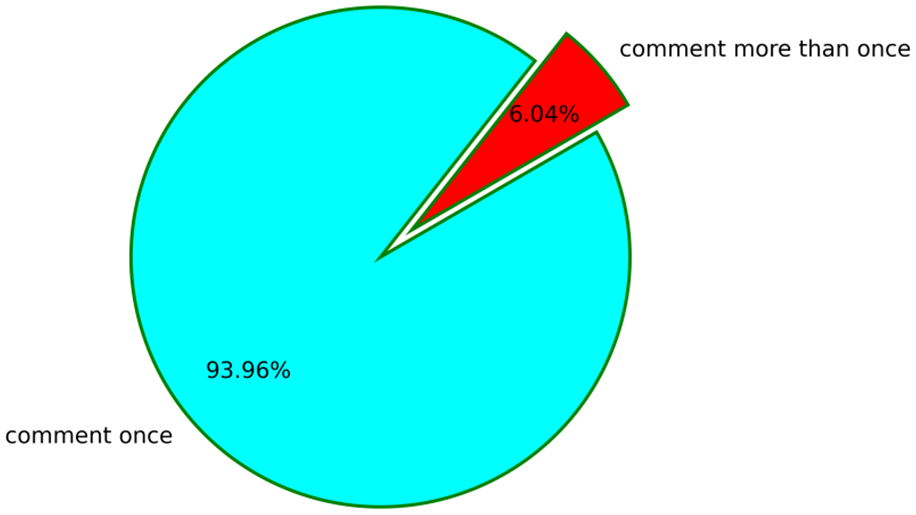
The proportion of user comment frequency.
User Type
In this paper, the number of users’ fans is the standard for judging users’ type. Users whose number of fans is more than or equal to 10,000 are judged as influencers, while those whose number of fans is less than 10,000 are judged as ordinary users. According to statistics, 1.56% of users who have comments on Liu’s videos are influencers, and 98.44% are ordinary users (Figure 2).

The proportion of user type.
User Distribution
After collecting the IP addresses of the users, we found that the users who posted comments were distributed in various provinces of China, and a few users were overseas. According to statistics (Figure 3), the top five provinces in terms of the number of users who have commented are Guangdong, Jiangsu, Zhejiang, Shandong, and Henan.

Top five number of users from different provinces.
Combined with the census data of each province, we analyzed the relative ratio of user comments in different provinces (the proportion of the number of comments in each province/the proportion of the population in each province). The top five provinces are Shanghai, Guangdong, Beijing, Zhejiang and Fujian (Figure 4).

The relative ratio of user comments in different provinces.
User Comment Date
Liu Genghong delivered 44 videos on TikTok from February 16th to May 4th in total, and we selected seven representative videos to analyze. The number of chosen videos is limited so it is impossible to count the changes in the number of comments within this period completely. However, according to the available data, we found that around April 20th, the number of comments on Liu’s videos reached the first peak, just as the number of Liu’s fans exceeded 20 million. It reached the second peak around April 27th, when the number of Liu’s fans exceeded 50 million (Figure 5).

The changes in the number of user comments on different dates.
User Comment Content
After processing the comment text, we counted the top 100 words with the highest Term Frequency. The top high Term Frequency 10 words after removing the expression words and stop terms were as follows: (singer) “Jay Chou,”“Jay,”“Liu Genghong,”“Broadcast,”“Fans,”“Coach Liu,”“Wife,”“Focus,”“Follow,”“Like” (Figure 6). We ran Stylecloud package to generate a wordcloud, so as to display the words with high Term Frequency clearly (Table 1).

A wordcloud composed of the top 100 words with the highest term frequency.
The Top 20 Words With the HIGHEST Term Frequency (Not Including Expression Words and Stop Terms).

Note. The higher the Term Frequency of a word, the higher frequency the word appears in the comments.
Research Summary
RQ1: Do users watch Liu’s videos because of health cognition?
After managing user comments, we found that words related to sports and health, such as “fitness,”“weight loss,”“sports,”“exercise” and “moving,” have high term frequency. It proved that most users who made comments watched Liu Genghong’s videos because they have a need for health cognition. After observing the content of comments, we found that users have a wide demand for health cognition. Users often take the initiative to ask about stretching before exercise, health care after exercise, daily health habits, and other aspects. Some users with underlying diseases also ask whether there is a suitable exercise for them by way of comments.
RQ2: Do users watch Liu’s videos because of personal relations?
Personal relations mainly include real personal relation and virtual personal relation. We discuss the virtual personal relation in the paper primarily. Through the processing of the comment text, we got some high term frequency words such as “Coach Liu,”“Teacher Liu,”“Genghong” and “Vivi.” All these words are terms of the address for Liu Genghong and his wife. Vivi is Liu Genghong’s wife, she appeared as a partner in Liu’s videos and exercised with Liu together. Users have established a virtual personal relation with Liu Genghong and his wife, and treated them as their coaches and friends in real life. Users can meet their needs for personal relations through online communication.
In addition, the virtual community named “Liu Genghong Girl” is composed of girls who like doing exercise with Liu Genghong. The phrase “Liu Genghong Girl” also appears in the high-frequency vocabulary obtained by statistics. It can conclude that users who watched Liu’s videos are influenced by the virtual community relationship.
RQ3: Do users watch Liu’s videos because of idolatry?
When we counted the high-frequency vocabulary, the phrases in terms of the address for celebrities like “Jay Chou,”“Jay,”“Little Puff” appeared more frequently. Jay Chou is a famous singer, and he is Liu’s friend. Most of Liu’s fitness videos were based on Jay Chou’s music. Many viewers watch Liu’s videos and exercise with Liu because they like Jay Chou’s music. Little puff is a popular child star with a lot of fans in China, and she is Liu’ daughter. Many viewers commented that they wanted Little Puff to appear in Liu’s video. It means that quite a lot of users who have commented on Liu Genghong’s videos are fans of other stars. Out of the love for other stars, some users watched Liu’s videos and participated in his fitness broadcast because of idolatry. In the comments referring to other stars, a large number of users hope that their favorite celebrities can do exercise with Liu Genghong together.
RQ4: Do users watch Liu’s videos because of entertainment?
Words associated with positive emotions, such as “ha ha ha,”“happy” and “funny” appeared more frequently in user reviews. It is enough to prove that users watched Liu Genghong’s fitness videos for recreation and entertainment.
RQ5: What is the attitude of users to Liu’s videos? What are the reasons for users’ negative attitudes?
According to the result of Bert model training, the proportion of users’ positive and negative emotions in Liu’s comments is about 8:2.
These negative comments can be divided into four types: 1. Attacking Liu in language because his native place is Taiwan Province. 2. Some users believed that Liu’s popularity is driven by capital, and the reason why Liu broadcast fitness is for profit. 3. Some users think Liu is not a professional fitness coach, and the effect of doing exercise with Liu is not good. 4. Some users are not interested in Liu’s fitness and think it is very boring to do exercise with him.
RQ6: Are there any significant differences in the users’ purpose of watching Liu’s videos in different regions?
We divided users into seven types according to geographical division, including users from East, South, Central, North, Northeast, Northwest, and Southwest China.
The differences in comment content between people from different regions are subtle, which cannot prove that the users’ purposes of watching Liu’s videos are different because of their location. We thought that this phenomenon was caused by the universality of the Internet.
RQ7: Do users have different attitudes toward Liu’s different aerobics videos?
The seven videos we analyzed were the most popular fitness videos released by Liu Genghong, of which four are the explanations and demonstrations of the hottest aerobics originated by Liu Genghong, and the other three are about daily sports knowledge explained by Liu.
Aiming at this problem, we have chosen four different aerobics videos published by Liu Genghong, including shuttlecock aerobics (the most popular), a targeted exercise to improve hunchback, a challenging boxing exercise, and an easy shoulder-shaking exercise. Through the management of video comments, we found that users’ comments on different aerobics videos are different. The review of the differences between these comments indicated that the results do not entirely depend on the different content of videos, from which we also noted that there are differences in the release time of the selected videos. Shuttlecock aerobics and back aerobics were issued earlier, and at that time Liu’s popularity had not reached its peak. In the comments of these two videos, words related to the video content such as “knee” and “hunchback” appeared frequently. It indicated that people discussed video content principally. The boxing exercise and shoulder-shaking exercise were published relatively later. During this period, Liu Genghong’s fans increased greatly, and more and more media reported the events of Liu Genghong’s fitness. Many users paid attention to Liu Genghong because of these reports. Therefore, video reviews of the boxing exercise and shoulder aerobics were more related to the increase of the number of fans than the video content. Thus, as an event or a person gets more attention, the reason why people pay attention to it will change.
Recommendations
The Combination of Stages and the Whole Process
We should pay attention to every stage of exercise. Therefore, home fitness with little equipment and limited exercise space should have a complete set of procedures. The content of the short home fitness videos should cover the preparation before exercising, matters needing attention during exercise, stretching after exercising, and daily healthy habits.
The producers of short home fitness videos should not only popularize knowledge during exercising, but also spread health knowledge across the board before and after exercise, so as to ensure a complete connection between every step, and make users have a good home fitness experience as much as possible.
We should also consider this point when using short videos for other aspects of health communication. When we popularize the knowledge of a class of disease to users, we should not only describe the symptoms of the disease, but also spread a series of information such as disease prevention, disease treatment, and follow-up health care work to users.
The Combination of Popularization and Demassification
Iimited public places have made fitness at home become the most crucial way of exercising. The producers of home fitness videos should consider the general needs of the public and the unique needs of different users.
It is necessary to publish some popular videos that most users can follow, as well as make customized videos for special groups with underlying diseases. Making short video collections according to the unique needs of different groups, so as to meet the health cognition needs of other user groups, is an integral part of promoting short videos.
Health communication is a complicated field, which contains all kinds of health knowledge. In the post-epidemic era, when short videos are used for health communication, we should not only spread the epidemic prevention knowledge that users generally are concerned about, but also classify the health knowledge according to users’ needs. Besides, refining and updating the different types of health knowledge constantly, and improving the health knowledge network, demand urgent answers.
The Combination of Professionalism and User Friendliness
Health communication, as an important branch of communication, is of paramount in social life. False information from unknown sources will not only harm users’ physical and mental health, but also contribute to social chaos. Therefore, the subject of health communication must be professional. The short video platform can cooperate with scholars in the field of health care, and transmit the knowledge mastered by experts and scholars to the public in the form of short videos. It can break the current dilemma of a low information arrival rate in traditional health communication mode.
However, if the producer of short fitness videos simply relays health knowledge without considering users’ preferences, it can be difficult to attract users’ attention.
One of the reasons why Liu Genghong’s fitness videos are so popular is that they adopt the song of the famous singer Jay Chou. Users participated in Liu’s home fitness exercise out of their love for the song and Jay Chou. When it comes to the production of short health knowledge videos in the future, producers can learn from this and combine health knowledge with other fields that users are interested in.
We can invite public figures with high national favorites to cooperate and use well-known songs in short videos to meet the need of users for interpersonal relations. In order to expand the spread and influence scope of short health communication videos.
The Combination of Platform and Technology
As an indispensable platform for health communication, short video platforms need to make good use of the advantages of its large number of users and accurate user profiles to promote health communication. The platform can send more health information to users through optimizing a recommendation algorithm, so that short health videos can enjoy a wider spread.
By observing the text of comments, we found that some users expressed their demand for screen projection and landscape broadcast. In view of this point, short video platforms should instantly update their technology, and combine short videos broadcast with ultra-HD screen, augmented reality (AR), virtual reality (VR) and other technologies, so as to broaden the application scope of short videos and make the playing of the short video not limited to mobile phones.
Conclusion and Limitations
We used a new method to investigate the motivation of users to watch short home fitness videos. It focused on a relatively understudied field of journalism and communication that combined research methods with theory. The conclusion showed that users watched this kind of short video frequently for the reasons of health cognition, personal relations, entertainment and idolatry, and most users showed a positive attitude in video comments. Short video has become a new channel for health communication. This study provides practical methods to promote health communication.
One limitation in this study is that the data obtained were limited. We only collected the comments before and during the period that Liu Genghong became popular, and paid little attention to the subsequent development. Furthermore, we collected comments published by users on public platforms. Whether users’ comments published on the public platform are completely motivated by themselves and are not interfered by other factors is still a question, and further in-depth interviews and analysis are needed.
Footnotes
Acknowledgements
The authors acknowledge the reviewers and editors who persevered through revisions of this paper, and helped nurture it to completion.
Declaration of Conflicting Interests
The author(s) declared no potential conflicts of interest with respect to the research, authorship, and/or publication of this article.
Funding
The author(s) received no financial support for the research, authorship, and/or publication of this article.
An ethics statement (including the committee approval number) for animal and human studies. If this is not applicable,please state this instead.
This work was in compliance with the human subjects research guidelines of the affiliated institutions.

Data Availability Statement
Research data is available when contacting the corresponding author.