




Abstract
Firms need resilience to help them get rid of failures or crises when facing emergency, yet—surprisingly—the issue of how to activate and develop organizational resilience has not been effectively addressed. Underpinned by configuration thinking, this study uses the fsQCA method to reveal the coordination and causal complexity between the six conditions that promote or inhibit the formation of organizational resilience. Specifically, the cognitive level includes manager self-efficacy and mindful organizing; the behavioral level includes exploratory innovation and exploitative innovation; the contextual reinforcement level includes bonding social capital and bridging social capital. Using survey data from 155 firms in China, the study found that: (1) Single antecedent condition is difficult to form high organizational resilience, but the lack of bonding social capital is a necessary condition for generating non-high organizational resilience. (2) Among the different configurations of six conditions, there are four pathways to form high organizational resilience, which can be specifically classified into three modes: Exploration, Ambidextrous, and Defensive configuration. (3) Three formation pathways for non-high organizational resilience, and there is an asymmetric causal relationship with high organizational resilience. The findings enrich the theory of crisis management and organizational resilience and provide a valuable reference for enterprises to effectively stimulate organizational resilience to respond to emergencies.
Keywords
Introduction
In the current business field, enterprises not only need to deal with the fierce competitive environment and technological changes but also often face high-risk and destructive emergencies, such as natural disasters, epidemic diseases, economic crises, and wars (Do et al., 2022; Williams et al., 2017). The rapid outbreak of emergency can cut across all organizations and even countries, posing a serious threat to the survival and development of enterprises. For example, the COVID-19 pandemic, which has been recognized by the World Health Organization as a public health emergency, poses serious challenges for individuals, businesses, communities, and even countries. But why are some firms able to recover or even grow rapidly from the emergency, while others are stuck in the mire or forced to exit? Organizational resilience is a key concept for an organization to survive, adapt, and grow in a VUCA (volatile, uncertain, complex, and ambiguous) environment. It reflects the ability of a firm to withstand threats, and the speed of recovery to its original or target state after disruption (Duchek, 2019). Recent research has also shown that organizational resilience is key to the viability and growth of businesses in times of crisis and adversity (Velu et al., 2019). Thus, while organizational resilience is a new construct in management literature, it is increasingly the focus of academic and industry attention, as it is regarded as an organizational characteristic and an ability to cope with various adversities.
Extant literature mainly focused on the concept, type, dimension, or measurement of organizational resilience (Chen et al., 2021; Kantur & Iseri-Say, 2015), with a small of empirical studies focusing on its “net effects” on outcome variables such as organizational capability and organizational performance (Núñez-Ríos et al., 2022; Tasic et al., 2020). Although other studies emphasize the coordination and linkage among multiple factors, they are mostly based on conceptual models or propositions and lack empirical support (Kantur & Iseri-Say, 2012; Lengnick-Hall & Beck, 2005). The conceptual model proposed by Williams et al. (2017) distinguished the different formation mechanisms of organizational resilience under different types of crises (crisis as event and crisis as process), emphasizing that the formation of organizational resilience under emergency is the result of dynamic relationships between cognitive response, behavioral response, and contextual reinforcement, which has attracted widespread attention and discussion in recent literature. Then, on this basis, which conditions are conducive to the formation of organizational resilience to cope with the negative impact of emergencies? How to match the conditions to drive the formation of high-level organizational resilience, so that the company can maintain its core activities in the adverse environment, even beyond the original status? Which pathways inhibit organizational resilience formation and how are they related? Existing studies have not paid attention.
Fuzzy set Qualitative Comparative Analysis (fsQCA) is a combination of qualitative and quantitative analysis method, it allows for a detailed analysis of how causal conditions collectively contribute to the outcome in question (Fiss, 2011). By matching the configuration of multiple antecedents that lead to a particular outcome, fsQCA can help to rationally further explain the complex causes of the result (Ragin, 2008). Given this, based on the perspective of typology and configuration, this study is rooted in the integration framework of event crisis and organizational resilience, and takes the COVID-19 epidemic as the background to explore the different combination effects of managerial cognitive factor (manager self-efficacy), organizational cognitive factor (mindful organizing), innovative behaviors (exploratory and exploitative innovation), and social capital (bonding and bridging social capital) on organizational resilience. The innovation of this study is that, for the first time, a combination of qualitative and quantitative research method is being used to explore the necessary or sufficient conditions to promote or inhibit the formation of organizational resilience, and to explore the pathways to activate and restrict organizational resilience. This paper also provides theoretical and management implications for firms to develop organizational resilience to deal with the adverse effect of emergencies.
Literature Review
Organizational Resilience
Organizational resilience, as an emerging research field, is regarded as an ideal organizational characteristic that can cope with various adversities. More and more studies discuss and define organizational resilience from multiple perspectives, which can be classified as characteristic view, ability view, process view, and outcome view. The first perspective emphasizes that organizational resilience is a stable characteristic or attribute possessed by the firm (e.g., Burnard & Bhamra, 2011; Home & Orr, 1997). The second perspective emphasizes organizational resilience as the ability to survive in the face of major setbacks or disruptions, to maintain one’s position, and to benefit from adverse conditions (e.g., Kantur & Iseri-Say, 2015; Lengnick-Hall et al., 2011). The third perspective emphasizes organizational resilience is not static, but a dynamic behavior process that matches the enterprise with the external environment (e.g., Williams & Shepherd, 2016). The outcome view emphasizes the state of recovery (e.g., Sutcliffe & Vogus, 2003). In this study, we focus on the ability and outcome view and define organizational resilience as the capacity of an organization to survive, adapt, and grow in the process of coping with adversity crises, which helps enterprises to recover and even surpass the original state.
Most scholars argue that organizational resilience is the result of the interaction of individual, organizational, and environmental levels. For Weick (1993), improvisation and bricolage, virtual character systems, sensible attitudes, and respectful interactions contribute to organizational resilience. Sutcliffe and Vogus (2003) suggested that resilience develops at multiple levels within an organization (individual, group, and organizational levels), and these levels interact with each other. Based on grounded theory, McManus et al. (2008) noticed that situational awareness, critical vulnerability management, and adaptability are key features that shape organizational resilience. Lengnick-Hall and Beck (2005) pointed out that organizational resilience is constructed in three dimensions: cognitive responding, behavioral responding, and contextual reinforcement. Similarly, Kantur and Iseri-Say (2012) emphasized the dynamic combination of perceptual stance, contextual integrity, strategic acting, and strategic capacity leads to organizational resilience. Unfortunately, these studies are conceptual models that have not yet been further tested. In empirical research, Sajko et al. (2020) explored the impact of CEO greed and corporate social responsibility on organizational resilience after emergency shocks. Pal et al. (2014) classified the antecedents of organizational resilience into three categories: assets and resources; dynamic capabilities; and learning and culture. The empirical results show that corporate network, strategic flexibility, and leadership are key antecedents of organizational resilience. However, how these key variables are coordinated, scholars have not pointed out.
Organizational Resilience Under Emergency
Emergency response is the main content of crisis management. The crisis is divided into process crisis and event crisis. Process crisis develops in stages, with continuity in space and time; while event crisis refers to those events with low probability and high impact that affect organizational viability (Williams et al., 2017). It is worth noting that, compared with process crises with long incubation periods and space-time expansion, event crises are characterized by great destructiveness and high impact. These vague and unpredictable emergencies pose a serious threat to the survival and development of the organization. If a process crisis is ignored, it can turn into an event crisis with major implications for the survival of the enterprise. Therefore, Williams et al. (2017) developed an integrative framework for the formation of organizational resilience under different crises.
In the process crisis, Williams et al. (2017) emphasized that the resource endowment (e.g., finance, cognition, and emotion-regulation) of the enterprise plays an important role in the formation of organizational resilience. However, when responding to major disturbances caused by emergencies, the formation of organizational resilience is reflected in the dynamic process of cognitive, behavioral, and contextual reinforcement (see Figure 1). Williams et al. (2017) pointed that cognitive responding reflects the cognition and analysis orientation of the enterprise towards the event; behavioral responding helps translate cognition into practical action; contextual reinforcement helps integrate cognitive and behavioral responses and provides a favorable organizational environment for resilience development. A high level of organizational resilience will then further strengthen the cognitive, behavioral, and contextual responding of the enterprise, and this cyclic system can help the enterprise effectively cope with emergencies (Lengnick-Hall & Beck, 2005; Williams et al., 2017).
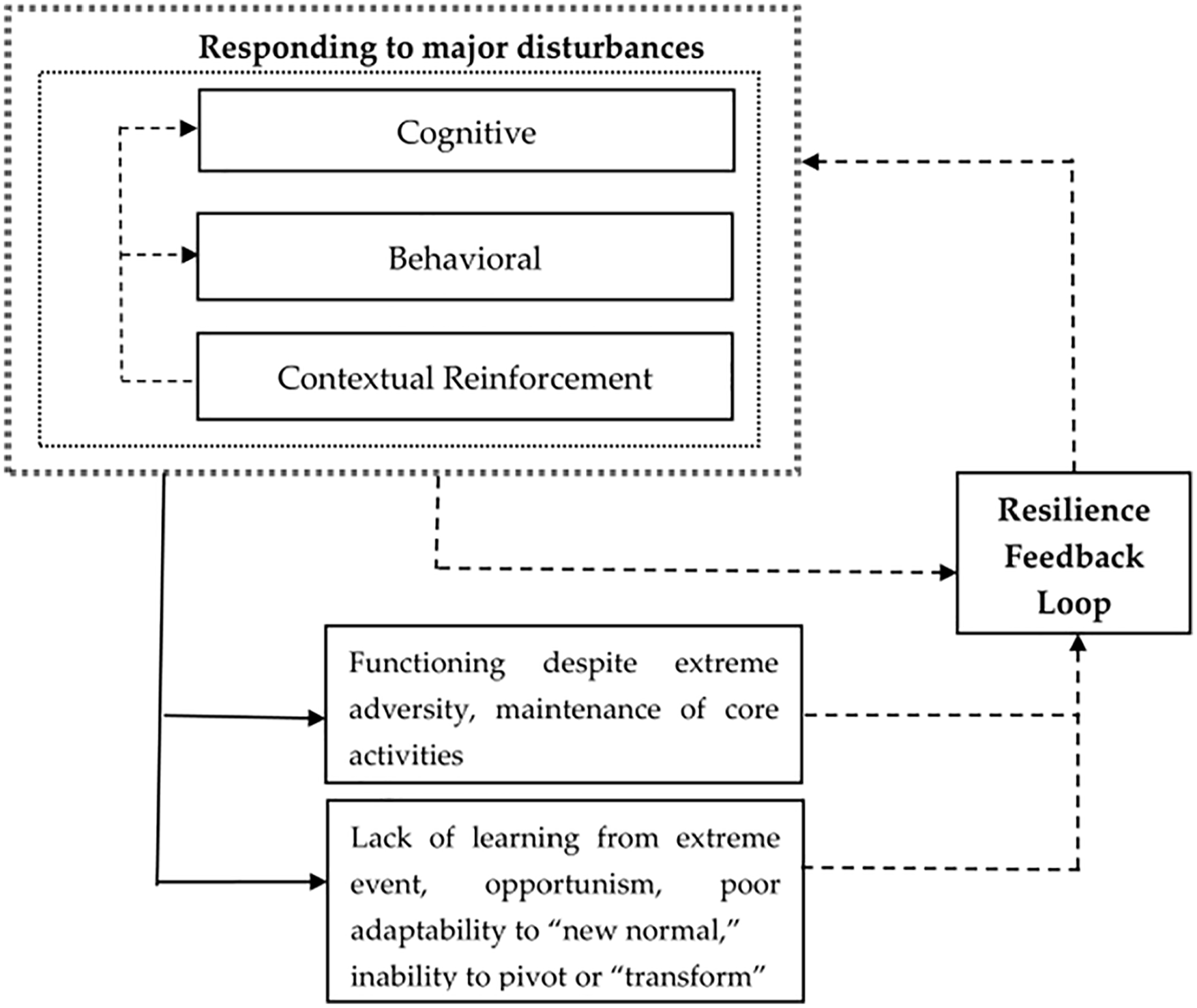
Adapted from Williams et al. (2017) process view model based on crisis management and resilience.
Research Framework
Referring to the research by Williams et al. (2017), we hold that organizational resilience is a continuous dynamic process, which contributes to the formation of organizational resilience under the coordination and matching of cognition, behavior, and contextual reinforcement (Kantur & Iseri-Say, 2012; Lengnick-Hall & Beck, 2005; Williams et al., 2017). However, these three constructs contain numerous content and factors, and any study aimed at spanning more than three levels would be preferable to select a representative set of categories to describe each level (Fiss, 2011). Therefore, we use the induction method proposed by Ketchen et al. (1993) to determine the antecedents of organizational resilience by summarizing the existing research results or practical experience (Ketchen et al., 1993). In view of this, our study explores the multiple concurrent antecedents and complex formation mechanisms that influence the differences in organizational resilience from four aspects: manager self-efficacy, mindful organizing, innovative behavior, and social capital. The reasons are as follows.
First, the cognitive level is based on goals, value orientations, beliefs, and organizational culture, reflecting the interpretation and meaning-giving of external environments or emergencies (Lengnick-Hall & Beck, 2005). The theory of emergency management emphasizes that cognitive capability help maintain positive functioning in the face of major disturbances, especially for managers who take the lead (Pal et al., 2014). Manager self-efficacy can reduce the stress and suffering caused by emergencies, and lead the company to improve the ability of preventive action and emergency management (Fang et al., 2020). Besides the manager, mindful organizing reflects an objective, calm and open attitude towards negative outcomes such as conflict, adversity, and failure, as well as the interpretation and meaning-giving of emergencies. Therefore, enterprises with high mindful organizing are often more resilient (Vogus, 2011).
Second, at the behavioral responding level, innovation is the key factor for a company to achieve sustainable development. Especially after emergencies, the business model or consumption patterns of enterprises is often accompanied by major changes. McManus et al. (2008) found that resilient firms often respond to new and unpredictable problems by innovating or adapting existing tools and processes. After the crisis, companies that focus on delivering superior performance in line with current goals, while constantly innovating to adapt to market and technological changes are more likely to rebound and outperform (Robb, 2000).
Finally, the level of contextual responding reflects the extent to which the corporate environment is conducive to taking risks and developing effective interpersonal relationships, and provides the necessary conditions for the manifestation of values and the implementation of behaviors (Velu et al., 2019). Most existing studies emphasize that contextual conditions for resilience depend on the internal and external social capital of organizations (Kantur & Iseri-Say, 2012; Lengnick-Hall & Beck, 2005; Williams et al., 2017).
Manager Self-Efficacy and Organizational Resilience
Self-efficacy is the central concept in cognitive theory, referring to the individual’s interpretation and meaning of unexpected events, as well as their level of confidence in their ability to perform corresponding specific activity (Bandura, 1982). Kim et al. (2012) suggested that self-efficacy has a positive influence on the prevention and improvement of emergency management capacity, and whether managers and employees view the crisis from a positive and opportunistic perspective is important for crisis adaptation and resolution, especially managers who with decision-making and benchmarking roles. On the one hand, managers with high self-efficacy not only have confidence in themselves but also have a positive attitude towards the success of their companies in overcoming adversity. On the other hand, manager self-efficacy reflects the manager’s ability and confidence in whether the action plan can cope with stress and threats (Bandura, 1982). Therefore, in the face of emergencies, manager self-efficacy helps motivate enterprises to take positive action and overcome obstacles to survive or adapt, rather than avoid or complain.
Mindful Organizing and Organizational Resilience
Mindful organizing is a cognitive ability that focuses on a clear understanding of and active response to emerging threats and risks (Bayraktar & Ndubisi, 2014). It not only reflects differences in the values, vision, and conceptualization of enterprise solutions but also enables enterprises to continuously assess possible threats and opportunities to become more adept at managing complex environments and contingencies (Weick, 2009). Businesses with mindful organizing are able to respond quickly and reliably to emergencies or system failures (Vogus, 2011). Therefore, on the one hand, mindful organizing helps the organization maintain a positive attitude, relieves the pressure and threat of adversity, and provides the cognitive psychological strength needed to persevere. On the other hand, it emphasizes critical and dialectical thinking, which helps the organization realize the inevitability of unexpected events and unexpected results, and emphasizes analyzing, coping, and learning from adversity. Such cognitive attitude and thinking are necessary when the organization faces volatility or risk in its operating environment.
Innovation and Organizational Resilience
Businesses today not only face an increasingly competitive environment but also have to deal with unexpected contingencies that could have a deadly impact. These professed or perceived threats to diversity require enterprises to be innovative and take proactive rather than reactive stances in adversity (Biggs et al., 2012). According to B. J. Zhang and Pei (2020), the market and technological innovation drive has become the inevitable choice for Chinese enterprises to improve organizational resilience and stay active during the crisis. Timely and effective innovation behavior is the key to whether an enterprise can maintain robustness, agility, and novelty after emergencies. Therefore, whether and to what extent an enterprise engages in innovative behavior has important implications for organizational resilience (Cho et al., 2007). However, different types or degrees of innovation may lead to different effects. Exploratory innovation is characterized by radical innovation and pursues long-term competitive advantages, aiming to meet emerging customers or market demands. Exploitative innovation is characterized by incremental innovation, pursuing short-term results and aiming to meet existing customers or market demands (Jansen et al., 2006). Compared with exploitative innovation, exploratory innovation advocates the pursuit of new knowledge and new technology, and emphasizes the active search, experiment, or creation of areas that have not been explored before, so it is also more risk-taking.
Under an emergency, companies that adopt exploratory innovation usually regard adversity as an opportunity and seize the opportunity aggressively and quickly to achieve business transformation or diversification. This agility and initiative can help companies create a new business model in turbulent environments, attract new customers or break into new markets (Annarelli & Nonino, 2016), and create better performance than before with a high level of organizational resilience. Exploitative innovation builds on existing knowledge and advocates improving existing ideas and information and integrating them into new practices to extend existing products and services (Benner & Tushman, 2002). Therefore, firms that adopt exploitative innovation can adjust or improve their products or services flexibly and timely according to the changes of the emergency, contributing to maintaining the status quo or recovering quickly from adversity.
Exploitative innovation can enable enterprises to meet the existing product and market demand and obtain short-term benefits; exploratory innovation emphasizes the development and exploration of new market opportunities to obtain and maintain long-term competitive advantages. The former emphasizes the use of existing knowledge and technology to achieve innovation, while the latter emphasizes the acquisition of new knowledge through various channels and methods. All in all, both exploratory and exploitative innovation reflect the proactive adjustment, adaptation, and remodeling of business models, rather than being forced to act after changes in the external environment. As a result, some scholars have pointed out that, to achieve long-term development, enterprises need to adopt both exploratory and exploitative innovation, i.e., ambidextrous innovation (Cao et al., 2009; J. Zhang et al., 2021). Firms with ambidextrous innovation capabilities have synergies between leveraging existing resources and capabilities and developing new opportunities (Gibson & Birkinshaw, 2004), in other words, they complement each other. Ambidextrous innovation focuses on both current viability and the development of new products or services. After an emergency, firms can reconfigure and reorganize their resources through ambidextrous innovation, so as to perceive and seize these incremental and radical innovation opportunities, which will not only help firms to recover quickly but also facilitate them to surpass the original state and achieve development.
Social Capital and Organizational Resilience
Social capital refers to the sum of actual and potential resources embedded within, available, and derived from the relationship network owned by individuals or organizations (Nahapiet & Ghoshal, 1998). In addition to resource endowment, the social capital of an organization is more important if it is to maintain its ability to sustain itself in an emergency (Norris et al., 2008; Williams et al., 2017). Gittell et al. (2006) took American airlines after 9/11 as the research object and pointed out that social capital is an important source of organizational resilience. Lengnick-Hall and Beck (2005) argued that deep social capital and extensive resource networks are fundamental contextual conditions that enable enterprises to respond effectively to complex environments. Besides, there are different types of social capital, and different types of social capital play a complementary role in helping enterprises withstand and recover from adversity (Han & Hovav, 2013). A common way to divide is based on the type of links of the focal actor, which can be divided into bonding social capital and bridging social capital (Adler & Kwon, 2002). Bonding social capital is characterized by strong and close ties, emphasizing the close relationships between members within the organization; bridging social capital uses external networks to connect and collaborate with other weak, scarce but diverse networks (Adler & Kwon, 2002; Han & Hovav, 2013; Subramaniam & Youndt, 2005).
Therefore, in coping with external threats and changing environments, bonding social capital can enhance trust and cohesion among enterprise members, and expand the organization’s resources, learning and disaster response ability (Waller et al., 2014), thus contributing to the formation and development of resilience. On another front, bridging social capital, as an internal resource, can help enterprises acquire new information and knowledge, and even obtain tool support or resource flow in terms of talents, finances, materials, and other aspects. For example, Wicker et al. (2013) pointed out that government subsidies and positive inter-organizational relationships are key factors for sports clubs to become more resilient to natural disasters. These tangible or intangible resources, such as information, loans, emotional, and psychological support, will also have a positive impact on organizational resilience development (Hawkins & Maurer, 2010). As emphasized by Herbane (2019), strong external social capital is the core engine of recovery and renewal.
Taken together, these six factors may have complex synergistic effects in driving the formation of organizational resilience. Based on this, we constructed a framework as shown in Figure 2.

The framework of this research.
Methods
FsQCA and Data Collection
The use of fsQCA can more fully capture the subtle effects of variable changes in different degrees (Ragin, 2008). Therefore, fsQCA was used for analysis in this study.
Traditional quantitative analysis methods (e.g., regression analysis and structural equation model) focus on the “net effect” of a single antecedent variable, that is, its unique and non-overlapping contribution to the dependent variable, which is suitable for the theoretical derivation of interactions within three variables, and the causal relationship is symmetric (Ragin, 2008). However, as scholars have always emphasized, the firm-specific outcome-high organizational resilience is multiple and complex. It may be characterized by causal asymmetry due to the linkage and complexity of multiple internal factors, as well as the high degree of uncertainty of the external environment in an emergency. QCA (Qualitative Comparative Analysis) is concerned with how antecedent conditions are combined or configured to produce specific outcomes. It analyzes interdependent conditions based on set theory, takes different combinations of conditions as cases, and carries out comparative analysis at the case level to obtain the configuration of the result. According to the data type, QCA can be divided into csQCA (crisp-sets QCA), mvQCA (multi value QCA), and fsQCA (fuzzy-sets QCA). FsQCA is suitable for dealing with three to eight continuous variables and considering the interdependence between conditions. It can more fully capture the subtle effects of variable changes in different degrees, better explain how multiple causes combine to produce equivalent results, and distinguish between key core conditions and peripheral conditions (Fiss, 2011; Ragin, 2008), so as to provide an empirical basis for abduction. Therefore, fsQCA was used in this study to reveal the complex formation patterns and pathways of organizational resilience under emergency.
In the context of data collection, the sudden outbreak of COVID-19 has spread rapidly around the world, and the number of infections is still rising, which provides an ideal background for this study. This “black swan” event has affected businesses across the board, with many struggling or even failing. It has the typical characteristics of an emergency: low probability and high impact, firms urgently need organizational resilience to deal with enormous pressure and challenges. Furthermore, we used the questionnaire method to measure the six antecedent conditions and results in this study. Unlike traditional quantitative research, QCA is not based on the assumption that data comes from a given probability distribution (Fiss, 2011), so we used geographic distance and snowball sampling to collect samples. On the basis of the pre-investigation, a formal investigation was conducted during the initial and severe period of the COVID-19 outbreak (i.e., March–June 2020 in China). Affected by the epidemic, online surveys were mainly adopted. Two reminders were sent during the survey, which increased the response rate. A total of 400 questionnaires were distributed and 216 were collected. Excluding invalid questionnaires with missing and consistent options, a total of 155 valid responses were received, representing a response rate of 38.8%. Respondents were middle-level or above managers, of whom 45.8% were male and 54.2% were female. The characteristics of the case firms are shown in Table 1.
Characteristics of the Case (N = 155).

Measures
First, we used eight items adopted from Schwarzer et al. (1997) for measuring manager self-efficacy. Second, we used seven items adopted from Vogus (2011) for measuring mindful organizing. Third, we used 12 items adopted from Jansen et al. (2006) for measuring innovation. Fourth, social capital was measured using a 11 items scale developed by Han and Hovav (2013) but originally developed by Subramaniam and Youndt (2005). Finally, we used nine items adopted from Kantur and Iseri-Say (2015) for measuring organizational resilience. We used the Chinese and English back translation method and integrated it into the Chinese context based on the COVID-19 outbreak. All items were measured on 7-point Likert scales, with 1 = strongly disagree, and 7 = strongly agree. For details of constructs and scale items, see the Appendix.
Reliability and Validity
In terms of content validation, on the one hand, we adopt the maturity scale which is widely used in academia; on the other hand, we invite five academic experts and two industry experts to evaluate and revise the topics and contents of the questionnaire. Then we used SPSS 24.0 and AMOS 25.0 to further test the reliability and validity of the scale. Results (Table 2) show that Cronbach’s α and CR values of all variables were greater than .7, indicating that the scale reliability was acceptable (Bagozzi & Yi, 1988; Nunnally, 1978). Exploratory factor analysis extracted seven factors with an eigenvalue greater than 1, which explained 77.389% of the variance, and the KMO value was 0.925, suggesting adequate reliability (Kaiser & Rice,1974). Confirmatory factor analysis results show that all loading estimates, ranging from 0.645 to 0.861, are greater than 0.5 (Fornell & Larcker, 1981). Similarly, the AVE values of all variables are more than 0.5, suggesting good measurement validity (Fornell & Larcker, 1981).
Construct Reliability and Validity.

Note. MSE = manager self-efficacy; MO = mindful organizing; PLOR = exploratory innovation; PLOI = exploitative innovation; BON = bonding social capital; BRI = bridging social capital; OR = organizational resilience; similarly hereinafter.
Calibration
Analysis using fsQCA requires the transformation of variables into a set calibrated three anchors: full non-membership, full membership, and the crossover point (Ragin, 2008). As all variables were measured by the Likert 7-point scale, we take the maximum, mean, and minimum values after the mean, corresponding to “0.95 full membership,” “0.5 crossover point,” and “0.05 full non-membership,” respectively. The specific calibration anchor points are shown in Table 3.
Calibration Parameters for fsQCA.

Results
Analysis of Necessary Conditions
We first examine whether a single condition can be a necessary condition for high and non-high organizational resilience. The results (Table 4) show none of the antecedent conditions exceeded the consistency threshold of 0.9 (Ragin, 2008). However, bonding social capital negation is a necessary condition for non-high organizational resilience (consistency 0.909 > 0.9), suggesting that lack of bonding social capital has a strong explanatory for non-high organizational resilience. In social science research or practice, the necessary and sufficient conditions are rare. To ensure the integrity of the research framework and practice analysis, the necessary conditions were reserved in subsequent research (Schneider & Wagemann, 2012).
Analysis of Necessary Conditions.

Note. “~” indicates the logical operation “NOT.”
Analysis of Sufficient Conditions
We use fsQCA 3.0 to conduct sufficient conditional analysis on the data of 155 firms. After constructing the truth table, we set the case frequency to 3 to ensure that more than 75% of the cases are retained (Fiss, 2011; Ragin, 2008). Considering the approximate balance of 0 and 1 results in the truth table row, and to reduce the configuration of potential contradictions, the consistency threshold was set at 0.8 and the PRI (proportional reduction in inconsistency) threshold was set at 0.7 in this study. Then we get three results: complex solution, parsimonious solution, and intermediate solution. In general, the conditions appearing in both the intermediate solution and the parsimonious solution are classified as the core conditions, that is, the conditions indicating a strong causal relationship with the results. The conditions only appearing in the intermediate solution were divided into peripheral conditions, that is, conditions with auxiliary contributions (Fiss, 2011). The antecedent condition configuration results of high and non-high organizational resilience from the perspective of emergency are shown in Table 5.
Configurations Sufficient for OR.
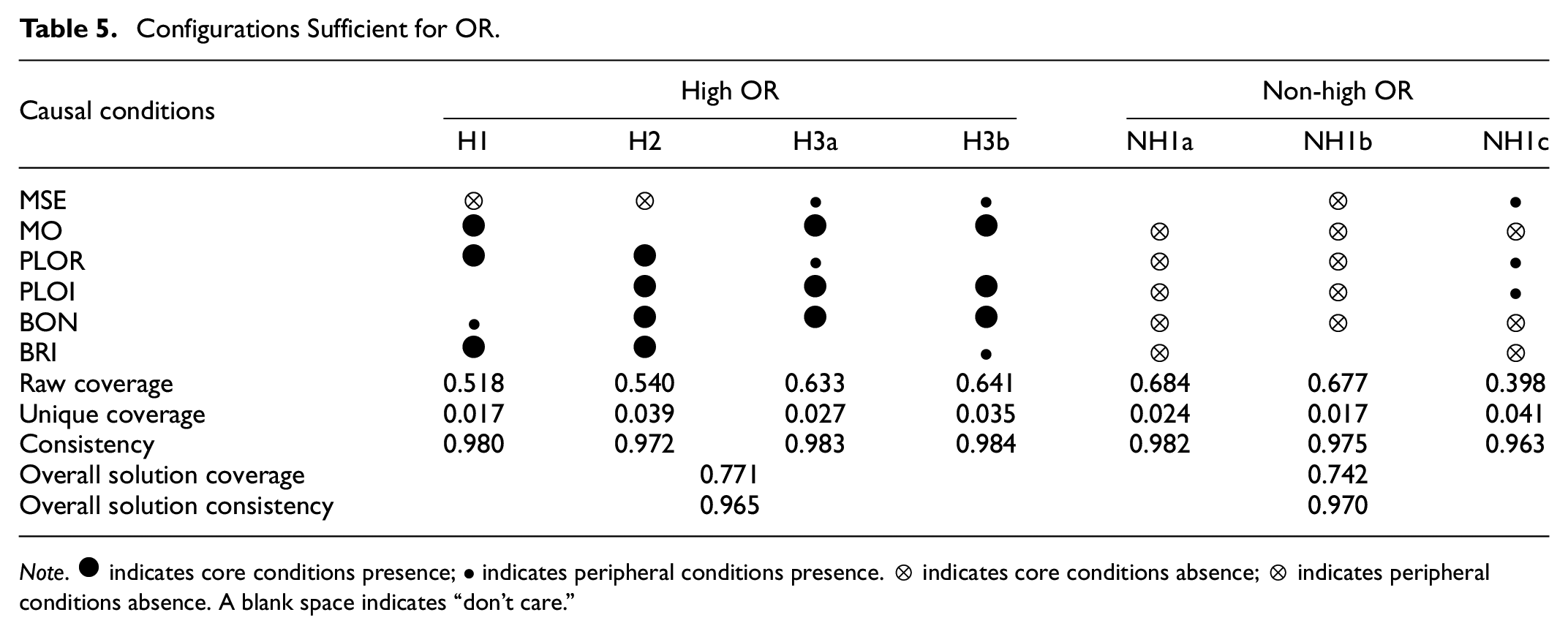
Note.  indicates core conditions presence; ● indicates peripheral conditions presence. ⊗ indicates core conditions absence; ⊗ indicates peripheral conditions absence. A blank space indicates “don’t care.”
High Organizational Resilience Configurations
There are four configurations for high organizational resilience (solutions H1, H2, H3a, and H3b), among them, H3a and H3b exhibit neutral permutations, that is, they show the same core conditions but differ only in periphery conditions. In the configuration path, both the single path consistency and the overall solution consistency are higher than the threshold of 0.8, and the overall solution coverage is 0.771, indicating that configuration explains the main reason for the formation of high organizational resilience.
We label pathway H1 (∼MSE* MO* PLOR* BON* BRI) as
We label pathway H2 (∼MSE* PLOR* PLOI* BON* BRI) as
We label pathway H3a (MSE* MO* PLOR* PLOI* BON) and H3b (MSE* MO* PLOI* BON* BRI) as depicting
Comparing the coverage index of configurations H1, H2, H3a, and H3b, the interpretation rate of the four paths to the results is similar, between 51.8% and 64.1%. The number of core conditions of each path is 3 or 4, which indicates that there are fewer choices and greater constraints when the goal is high organizational resilience. It further verifies that previous studies emphasize that organizational resilience is a dynamic coordination process of cognitive, behavioral, and contextual reinforcement.
Non-High Organizational Resilience Configurations
This study also examined configurations generated by non-high organizational resilience, namely configuration NH1a, NH1b, and NH1c.
First, the configuration NH1a (∼MO* ∼PLOR* ∼PLOI* ∼BON* ∼BRI) shows that when the core condition bonding social capital is not high, and the peripheral condition mindful organizing, exploratory, and exploitative innovation, and bridging social capital are all absent, the formation of organizational resilience is inhibited. It indicates that in firms with low mindful organizing, even if managers are more optimistic and confident, but lack social support and innovative actions after emergencies, their organizational resilience will not be high. A representative case of this configuration is Pangolin Engineering Technology co., LTD. in Liaoning Province, whose manager is a centralized leader. Since the business mainly carries on the operation activity in project situations, most employees are migrant workers with high mobility, so the group cohesion and mindful organizing are not high, correspondingly lacking bonding social capital. Moreover, due to the particularity of the business, which mainly relies on machinery and equipment, managers said that innovation is not encouraged and unlikely to be carried out. Therefore, after the outbreak of the epidemic, it has been in a state of shutdown, making it difficult to form organizational resilience to deal with emergencies.
Second, similar to the configuration NH1a, the configuration NH1b (∼MSE* ∼MO* ∼PLOR* ∼PLOI* ∼BON) shows that the core condition bonding social capital is not high, and the peripheral condition manager self-efficacy, mindful organizing, and innovative actions are all absent, the organizational resilience formation is inhibited. It indicates that firms lacking self-efficacy, mindful organizing, innovative actions, and internal social capital fail to generate high organizational resilience. A representative case of this configuration is a large state-owned furniture manufacturing company with rigid internal systems and a lack of effective communication between superiors and subordinates. Before the epidemic, the company had been losing money for consecutive years. Survival has become more difficult in the wake of the epidemic and it has been difficult to mobilize resources for action. It has applied for judicial restructuring currently.
Finally, the configuration NH1c (MSE* ∼MO* PLOR* PLOI* ∼BON* ∼BRI) shows that, in enterprises with core condition bonding social capital absent, and peripheral condition mindful organizing and bridging social capital absent, even manager self-efficacy is high, and both exploratory and exploitative innovations are adopted, their organizational resilience is also not high. High self-efficacy of managers reflects the firm belief of decision makers to overcome difficulties and the confidence to take action. However, in the absence of mindful organizing and social capital support, the risks of innovation are enormous. Overconfident managers may take innovative actions that are doomed to fail. The representative case of this configuration is a new travel agency with fewer than 20 employees and a lack of close communication. Therefore, a cohesive organizational culture and shared beliefs have not yet been developed, and social capital is still in its initial accumulation stage. However, since the managers are new entrepreneurial college students with high self-efficacy and innovative spirit, they have made a series of innovations to break through after the epidemic, including the exploitative innovation of shooting short videos on the Douyin platform to promote products, as well as the exploratory innovation of showing personal thoughts or life in the form of live broadcast to increase the popularity of travel agency indirectly. Unfortunately, it did not have the desired effect.
Comparing the coverage index of configuration NH1a, NH1b, and NH1c, configuration NH1a and NH1b explained nearly 70% of the results, which is nearly twice that of NH1c. In other words, the reasons that inhibit the formation of high organizational resilience in most firms are pathways NH1a and NH1b. In addition, in the three non-high organizational resilience pathways, bonding social capital absence is both a core condition and a necessary condition. At the same time, low mindful organizing in each pathway is also included in the peripheral condition, indicating that the two are the main reasons for the formation of non-high organizational resilience.
Analysis of Robustness
In order to further verify the robustness of the results, this study adopted the method of adjusting the PRI consistency and case thresholds for testing. As shown in Table 6, after raising the threshold, the coverage of the solution decreases but the consistency of the solution increased. Moreover, while the high organizational resilience configuration varied slightly in the number of solutions and sub-solutions, the interpretation of the results remained largely unchanged, indicating that the research conclusions had considerable robustness.
Improve PRI Consistency and Frequency Robustness.

Note. indicates core conditions presence; ● indicates peripheral conditions presence. ⊗ indicates core conditions absence; ⊗ indicates peripheral conditions absence. A blank space indicates “don’t care.”
Conclusions
This study posits that manager self-efficacy, mindful organizing, innovation (exploratory and exploitative innovation), and social capital (bonding and bridging social capital) are configurational conditions for organizational resilience. Using the fsQCA method combining qualitative and quantitative analysis to analyze 155 enterprises, the result show that: Single antecedent condition is difficult to form high organizational resilience, but the lack of bonding social capital is a necessary condition for generating non-high organizational resilience. Among the different configurations of six conditions, there are four pathways to form high organizational resilience, which can be specifically classified into three modes: Exploration, Ambidextrous, and Defensive configuration. Three formation pathways for non-high organizational resilience, and there is an asymmetric causal relationship with high organizational resilience.
Discussion
Theoretical Implications
First, this study expands the research literature on organizational resilience. The literature on organizational resilience is still in the preliminary exploration stage, especially the research that drives the formation of organizational resilience is mostly based on propositions or conceptual models. The conceptual model proposed by Williams et al. (2017) has received extensive attention, but the different formation mechanisms of organizational resilience under different types of crises (process crises and event crises) proposed by them have not received empirical support. We have discussed the configuration effect of multiple factors in the context of emergencies, and divided the specific paths into Exploratory, Ambidextrous, and Defensive. Each type can reach the same goal of high organizational resilience by different pathways.
Second, this study addresses an important gap in the literature. Whether it is high organizational resilience or non-high organizational resilience, a single level of conditions cannot form organizational resilience, but must rely on the coordination and matching of other levels of conditions. In addition, the formation mechanism of organizational resilience is asymmetric, that is, the three paths of non-high organizational resilience are not the opposite of the four paths of high organizational resilience. For example, high manager self-efficacy, high ambidextrous innovation, high mindful organizing, and high bonding social capital contribute to high organizational resilience (configuration H3a), while high manager self-efficacy, high ambidextrous innovation, low mindful organizing, and low social capital inhibit the formation of organizational resilience (configuration NH1c). Therefore, this study explains the reasons for the difference in organizational resilience of different firms after an emergency.
Managerial Implications
After an emergency, enterprises should exert the synergistic effect of cognitive, behavioral, and contextual reinforcement to develop organizational resilience to overcome difficulties. Especially the synergy of managers and organizational cognition, innovation behavior, and social capital. The results suggest that whether or not firms innovate and to what extent and type of innovation can form high organizational resilience depends mainly on the level of mindful organizing and social capital. First, firms that adopt exploratory innovation should ensure that they have high organizational mindfulness and actively search for innovative ideas and opportunities by utilizing high-bridging social capital that facilitates the exchange of ideas and resources.
Second, ambidextrous innovation is beneficial for firms to rebound, even beyond the pre-event state, but this approach is better suited to large, mature companies. It may have counterproductive effects for companies that lack organizational mindfulness and social capital. Therefore, managers should jump out of the egocentric, cultivate, and construct a high level of mindful culture and social capital as the premise of ambidextrous innovation. Third, firms that adopt exploitative innovation should further strengthen the communication and collaboration among their internal members, create a climate of mutual trust and creativity, and expand or improve existing products and services to improve their resilience to shocks.
Limitations and Further Work
This study also has some limitations that offer suggestions for further research. First, we adopted the international maturity scale, which was revised appropriately according to the context of this study. Such an advantage is that it can focus on the research purpose and ensure the reliability and validity of the constructs. However, different industries, institutional backgrounds, etc., may give different characteristics to variables. Therefore, we can develop scales suitable for localization in the future, especially the Chinese contextual organizational resilience scale. Second, although we have analyzed and studied 155 cases, the external reliability and validity of this study still need to be further verified due to time, cost, and other constraints. We recommend that future research continue to track these cases, while expanding the industry and investigation area to conduct more in-depth and comprehensive research. Third, the behavioral and contextual reinforcement levels only consider one key aspect, which is far from comprehensive in explaining the formation mechanism of organizational resilience. Future research may attempt to include other conditions (e.g., ownership, training, organizational learning, flexible working, and government environmental support) for further discussion. Fourth, this study is from the perspective of COVID-19, while other emergencies (e.g., natural disasters, financial crises, and wars) may have different potential impacts on organizational resilience. In the future, it will be possible to verify whether the antecedent configuration of organizational resilience has changed in different types of emergencies.
Footnotes
Appendix
Construct Items.

| Constructs | Label | Measurement items | Sources |
|---|---|---|---|
| MSE | MSE1 | I am capable of accomplishing most of the goals I set for myself | Schwarzer et al. (1997) |
| MSE2 | When faced with a difficult task, I am sure I can complete it | ||
| MSE3 | Overall, I can achieve results that are important to me | ||
| MSE4 | I believe that as long as I am determined to try to do anything, most of it will be successful | ||
| MSE5 | I can successfully overcome many challenges | ||
| MSE6 | I believe I can perform well on many different tasks | ||
| MSE7 | I can do most things well relative to other people | ||
| MSE8 | Even when things are hard, I can do pretty well | ||
| MO | MO1 | We spend time identifying activities we do not want to go wrong | Vogus (2011) |
| MO2 | We usually discuss what to look out for when handing off an activity to the employee | ||
| MO3 | We discuss alternatives on how to go about normal work activities | ||
| MO4 | We have a good “map” of each other’s talents and skills | ||
| MO5 | We talk about mistakes and ways to learn from them | ||
| MO6 | When errors and mistakes happen, we discuss how we could have prevented them | ||
| MO7 | When attempting to solve problems, we take advantage of the unique skills of our colleagues | ||
| PLOR | PLOR1 | Our company always accepts needs beyond existing products and services | Jansen et al. (2006) |
| PLOR2 | Our company is always developing new products and services | ||
| PLOR3 | Our company tries new products and services in the local market | ||
| PLOR4 | Our company will commercialize completely novel products and services | ||
| PLOR5 | Our company often takes advantage of new opportunities in new markets | ||
| PLOR6 | Our company frequently uses new distribution channels | ||
| PLOI | PLOI1 | Our company often improves existing products and services to suit current needs | |
| PLOI2 | Our company regularly makes small adjustments and improvements to existing products and services | ||
| PLOI3 | Our company often introduces improved products and services to the market | ||
| PLOI4 | Our company improves the efficiency of products and services | ||
| PLOI5 | Our company increases economies of scale in existing markets | ||
| PLOI6 | Our company expands the scope of services for existing customers | ||
| BON | BON1 | We maintain close cooperation within our company | Subramaniam and Youndt (2005) and Han and Hovav (2013) |
| BON2 | We cooperate with each other within our company to solve problems | ||
| BON3 | Knowledge is often shared within our company | ||
| BON4 | Our internal relationships are trustworthy | ||
| BON5 | Information provided within our company is reliable | ||
| BON6 | We have similar sources for problem solving in regard to technology | ||
| BRI | BRI1 | Active communication between our company and external partners (such as customers, suppliers, distributors, and alliance partners) | |
| BRI2 | Our company cooperates with external partners to solve problems | ||
| BRI3 | Our company uses external knowledge to solve its own problems | ||
| BRI4 | When there is a problem with our company and external partners, we can consider each other’s interests | ||
| BRI5 | Trust between our company and external partners | ||
| OR | OR1 | In the face of emergencies, our company can persist and maintain the current market position unchanged | Kantur and Iseri-Say (2015) |
| OR2 | Our company has produced a variety of effective solutions to problems | ||
| OR3 | In order not to lose, our company shows resilience to the end | ||
| OR4 | In the face of emergencies, our company does not give up and continues our path | ||
| OR5 | Our company responds and takes action quickly | ||
| OR6 | In order to benefit from the negative circumstances, our company has developed alternatives | ||
| OR7 | Our company has the flexibility to act when necessary | ||
| OR8 | Our company is a place where all employees can work as required | ||
| OR9 | Our company acts effectively with all employees |
Note. All items were of seven-point Likert scale in the questionnaire. MSE = manager self-efficacy; MO = mindful organizing; PLOR = exploratory innovation; PLOI = exploitative innovation; BON = bonding social capital; BRI = bridging social capital; OR = organizational resilience.
Acknowledgements
We would like to thank the Jilin Province Social Science Foundation of China, the Special Project on the Fundamental Research Fund of Jilin University, and the Northeast Revitalization and Development Special Research Project of Jilin University for supporting this research.
Declaration of Conflicting Interests
The author(s) declared no potential conflicts of interest with respect to the research, authorship, and/or publication of this article.
Funding
The author(s) disclosed receipt of the following financial support for the research, authorship, and/or publication of this article: This research was supported by the Jilin Province Social Science Foundation of China (grant 2022C051084), the Special Project on the Fundamental Research Fund of Jilin University (grant 2022ESD04), and the Northeast Revitalization and Development Special Research Project of Jilin University (grant 21dbzx13).
