




Abstract
Firms are increasingly expected to exhibit social responsibility and contribute to sustainability goals. Emerging studies have highlighted the importance of responsible leaders who stimulate their employees, which then results in employee voluntary behavior toward the environmental practices, referred to as organizational citizenship behavior for the environment (OCBE). Drawing from social learning theory, the current study explores the impact of responsible leadership (RL) on OCBE using data obtained from employees of Turkish manufacturing firms. Additionally, employee harmonious environmental passion and environmental transformational leadership (ETL) were examined as mediator and moderator respectively. The results indicated that RL has a positive effect on OCBE. RL has a positive effect on employee harmonious environmental passion. Employee harmonious environmental passion has a positive effect on OCE. The relationship between RL and OCBE was mediated by employee harmonious environmental passion. Also, it was discovered that high level of ETL, the link between RL and OCBE is stronger for firms’ whose employees perceived high ETL. Based on the findings, implications for practice and research were discussed.
Keywords
Introduction
The issue of environmental degradation represents a major challenge that is currently being confronted by the world today. This is attributed to adverse effect it poses on biodiversity, air quality, ozone layer, natural resources such as forests, soil and water, as well as overall human health. The escalating global trend of CO2 emissions, which is directly tied to increased energy demand, is one of the primary contributors to this problem. The manufacturing sector is responsible for 36% of the global energy CO2 emissions and about a third global energy consumption (Yuan et al., 2017). Based on this, firm are adopting sustainable business practices, including green finance, green supply chain management and green human resource management (Gawusu et al., 2022; Irfan et al., 2022; Tuan, 2022). The importance of stakeholders in promoting sustainable development cannot be overstated, as it applies to all organizational levels (Abbas et al., 2021). Despite the considerable attention given by management studies to corporate operational and strategic environmental behavior, the crucial contribution of employees’ behavior regarding environmental protection and sustainable practices have received less attention (Abbas et al., 2021; Galpin & Lee Whittington, 2012).
According to Felin et al. (2015), the environmental protection behavior of firms is heavily reliant on the interaction and environmental behaviors of their employees. In recent times, there has been a resurgence in scholarly attention toward green behaviors of employees, particularly organizational citizenship behavior for the environment (OCBE) (Abbas et al., 2021; Tuan, 2022; Zhao & Zhou, 2021). OCBE relates to the behavior that promotes a firm’s environmental oriented practices and activities by its employees that is not formally recognized (Boiral & Paillé, 2012). The crucial importance of employees’ environmental oriented behaviors and its implications have triggered attention toward the factors that promote OCBE; perceived organizational support (Temminck et al., 2015), corporate social responsibility (Tuan, 2018) and green culture (Muisyo et al., 2022). However, the relationship between employees and leaders inside the organization has an impact on the organizational citizen behavior regarding the environment (Han et al., 2019). This suggests leadership plays a crucial role in shaping the attitude and actions of employees regarding environmental initiatives. Due to this, it is crucial to examine how leadership influences employee environmental behavior.
While numerous studies have investigated the influence of leadership on OCBE (e.g., Ahmad et al., 2021; Islam et al., 2021; Thabet et al., 2023), only few studies have explored the role of responsible leadership on OCBE (Abbas et al., 2021; H. Lu et al., 2022). Moreover, how responsible leadership translate to OCBE is far from being clearly understood. Further, there has been research calls in the extant literature for empirical studies to examine the underlying mechanisms on how responsible leadership can channel into employee green outcomes, such as employee OCBE (Tuan, 2022). Hence, in-part this study responds to this research calls and closes this gap in the extant literature. Specifically, social learning theory (SLT) provides a more effective theoretical foundation for understanding the relationship between responsible leadership and OCBE. SLT holds that social cues can shape individual behaviors by observing and imitating the behavior of others (Bandura, 1986). Based on this theoretical viewpoint, responsible leadership’s social cues can stimulate employee harmonious environmental passion (EHEP), which then leads to OCBE. According to Robertson and Barling (2013) harmonious environmental passion relates constructive emotional state that stimulate self-directed motivation to engage in green initiatives.
In addition to the aforementioned gap, Abbas et al. (2021) underscored the need for more research regarding the conditions through which responsible leadership translate into employee OCBE. From this standpoint, less is known under what conditions responsible leadership improves employee OCBE. This research aims to fill this second void by drawing on social learning theory and built a moderated moderation model to explore employee harmonious environment passion as a mediating mechanism and the moderating role of environmental transformational leadership in the responsible leadership-employee OCBE relationship in the context of Turkish manufacturing industry.
This research contributes significantly to the growing body of knowledge on responsible leadership and OCBE. Classic leadership styles focus on the interaction between leaders and subordinates in the firms, RL takes into account the interest of individuals, stakeholders and the environment. The present study aims to enrich our comprehension regarding the antecedents of OCBE. The research also examines the mediating role of employee harmonious environmental passion on the relationship between RL and OCBE. Hence, the current study has the potential to uncover the underlying mechanism regarding how OCBE occurs at the workplace. Further, we aim to extend the current literature (Abbas et al., 2021; Tuan, 2022; Zhao & Zhou, 2021) by exploring the condition under which the proposed predictor of employees’ OCBE could be diminished or further strengthened. Responsible leaders who demonstrate environmental transformational leadership can motivate and inspire employees by stimulating positive and idealistic aspect, which encourages individuals to go further than their personal convenience and actively participate in environmentally sustainable practices (Huang et al., 2021). Based on this, it is reasonable to expect that this important construct could provide insights on the condition under which RL impact employee harmonious environmental passion and OCBE. An important additional to the theory within this research.
Literature Review and Hypotheses Development
Responsible Leadership
In recent times, responsible leadership has gained popularity based on its emphasis on relational aspects, alongside other leadership styles. According to Maak et al. (2016), the concept of responsible leadership has its roots in ethical and social relations theories, and is characterized by leadership approach that is embedded in the process of social interaction. They propose that the social interaction process of responsible leadership emerges from interaction of different stakeholders, such as those between leaders and employees, which ultimately impacts the long-term objectives of the organizations.
Responsible leadership necessitates balanced responsibility across every aspect of a firm. It involves making well-reasoned decisions based on a thorough analysis of the interests of all stakeholders, with the aim of promoting sustainable development, fostering trust and prioritizing mindful environmental actions (Afsar et al., 2020; Zhao & Zhou, 2019). The approach of responsible leadership is characterized by greater complexity and diversity compared to conventional forms of leadership. According to Pless et al. (2011), responsible leadership is distinguished from other types of leaderships by its focus on a broad range of factors, including environment, society, values and promoting positive change while obsolete leadership styles tend to overemphasize their impact while disregarding the contextual factors and neglecting the concerns of stakeholders. From this standpoint, Voegtlin (2016) emphasized that other leadership styles fail to consider the element of accountability, which is a vital component of responsible leadership behaviors. Contrary, responsible leadership style prioritizes intricate stakeholder-leader connections while addressing the needs of all the stakeholders and safeguarding the interests of shareholders.
Employee Harmonious Environmental Passion
Passion refers to an individual’s inherent inclination toward an activity that they find enjoyable, consider important, and dedicate their time and energy to engage in Vallerand et al. (2003). However, work-related passion can be classified into two categories: harmonious work passion and obsessive passion. Bayraktar and Jiménez (2022) suggested that individuals who possess harmonious passion not only dedicate themselves to their work, but they also derive enjoyment from their work, allowing them to fully concentrate on both work-related and non-work-related tasks. On the other hand, individuals who possess obsessive passion tend to experience emotional dependence on their work, leading to a lack of separation between themselves and their professional responsibilities (Bayraktar & Jiménez, 2022). According to Vallerand et al. (2003) harmonious work passion can be attributed to the autonomous internalization of an activity into an individual’s identity. This occurs when an individual consistently engages in a particular activity, derives enjoyment from it, invests time and effort into it, and perceives it as an integral aspect of their identity, demonstrating a strong commitment and enthusiasm toward its accomplishment. Based on this, Robertson and Barling (2013), proposes that harmonious environmental passion, which includes a sense of autonomy in environmental engagement, can stimulate employee engagement in prosocial behavior toward the environment. Therefore, this study focuses on employee harmonious environmental passion because it allows employees undertake prosocial behavior regarding the environment and positive work workplace behaviors (Robertson & Barling, 2013; Sia & Duari, 2018).
OCBE
The concept of OCBE was first proposed by Daily et al. (2009) and has since grown in popularity among scholars in the management field. Daily et al. (2009) described OCBE as voluntary actions of individuals toward the environment within a firm that are not incentivized by any formal structure. The voluntary acts of OCBE include reducing the use of resources and energy, limiting papers use to preserve trees, minimizing carbon footprint, providing assistance to coworkers and environmental conscious work recommendations (e.g., Afsar et al., 2020). The authors additionally stated that the behavior of OCBE operates across three dimensions, namely eco-initiatives, eco-assistance, and eco-civic engagement. Eco-initiatives relate to self-driven and seemingly minor steps undertaken by individuals to sustain environmental practices. Eco-assistance relates to work environment where coworkers participate in activities that promote environmental sustainability and assist one another in doing so. Eco-civic engagement relates to mindful environmental conscious actions taken within the firm, such as measures and behaviors that protect the environment. From this standpoint OCBE aims to address environmental issues that are not recognized or addressed by the formal system (Paillé et al., 2014).
Responsible Leadership and OCBE
Prior studies have suggested that leadership styles significantly impact firms’ green initiatives and employee OCBE (Boiral et al., 2014; Egri & Herman, 2000; Pless, 2007). Based on this reasoning, it can be implied that employee OCBE may be deeply connected within the concept of responsible leadership. When responsible leaders establish value-based future vision, they are more likely to portray a desirable human, social and sustainable aspects (Kets de Vries et al., 2004). This would influence the perspectives of the employees regarding their choices, such as their concern and encourage employees to consider their firm sustainable efforts. Subsequently, through the conveyance of appropriate impulse to the organizational members concerning sustainable values and priorities, responsible leaders will improve employees understanding of their responsibilities by leading by example (Bowler et al., 2010; Yaffe & Kark, 2011).
Responsible leaders actively advocate for and ensure the adoption of behavioral measures and codes that are aimed at environmental protection through clarification of environmental conscious practices (Stahl & Sully de Luque, 2014). Leaders who exhibit responsible behaviors can motivate their employees to engage in extra-role, which benefit all the stakeholders in the firm (Zhao & Zhou, 2019). Additionally, from the perspective of corporate social responsibility, responsible leadership prioritize the consideration of employees’ career development and personal growth, as well as fostering humane work environment. The implementation off such initiatives could generate reactions from the employees toward the firm, which may involve their willingness to devote personal time and energy in response to standards regarding sustainable practices and OCBE (). Based on the above discussion, we posit that:
H1: Responsible leadership has a positive effect on OCBE
Responsible Leadership and EHEP
Harmonious environmental passion pertains to individual’s self-determined motivational state and is characterized emotional state that drives one to indulge in pro-environmental behavior (Robertson & Barling, 2013). The concept of responsible leadership can be thoroughly explained through the framework of social learning theory (Abbas et al., 2021; Bandura, 1986). The theory postulates that employees engage in social construction process to assimilate their work environment by interpreting social cues. In relation to such social cues, employees build their reasons for actions, beliefs and attitudes. Based on this, responsible leadership can stimulate individuals and instill a sense of responsibility in them (Han et al., 2019).
As discussed earlier, responsible leadership can shape employees’ behavior regarding sustainable developments. Based on social learning theory, it is anticipated that responsible leadership may stimulate harmonious environmental passion among the employees. Leadership behaviors can shape employees’ social cues and perceptions due to their ability to impact subordinates (Rego et al., 2019). Further, according to J. Lu et al. (2019) employees tend to acquire social cues and crucial information from the utterances and actions of their leaders and subsequently exhibit behaviors and attitudes that are expected of them. Similarly, employees are likely to depend on social cues from leaders to confirm their comprehension of the work setting and manage their positive affective and cognitive attitudes (Gu et al., 2016; Wang et al., 2022). Specifically, employees may develop a harmonious environmental passion as a result of these cues. Hence, based on the above discussion it is posited that:
H2: Responsible leadership has a positive effect on EHEP
EHEP and OCBE
Robertson and Barling (2013) emphasized that harmonious passion is a crucial factor that stimulates positive emotions and drive employees to engage in pro-environmental behavior. From this perspective, individuals with high harmonious environmental passion for the environment will be highly motivated to make a difference through their participation in environmental development activities. Along this line, Afsar et al. (2016) pointed out that these individuals have the ability to devote their time and efforts toward pro-environmental initiatives without encountering any conflicts with other daily activities.
Prior empirical studies on both Canadian (Robertson & Barling, 2013) and Thai employees (Afsar et al., 2016) have reported that a harmonious passion for the environment is a crucial determinant of pro-environmental behavior. Employees’ inclination toward harmonious passion can promote positive affection and motivate them to engage in extra-role practices that promote sustainable development in the organization. Since OCBE is a discretionary behavior of the employees that is not controlled by formal organizational structure, employee harmonious environmental passion serves as a driving force which encourages employees to be passionately involve in OCBE. Hence, we posit that:
H3: EHEP has a positive effect on OCBE
Employee Harmonious Environmental Passion Mediation
Responsible leadership facilitates a work environment that encourages employee participation by demonstrating and taking into account stakeholders’ interests (Voegtlin et al., 2020). From this standpoint, Tuan (2022) emphasized that responsible leaders establish an environment that welcomes employee contributions. As a result, responsible leadership can promote a workplace environment that encourages employees to feel a sense of responsibility for the environment. Since employee often look to their leaders for social cues to validate their assimilation of the work setting to guide their positive affective and cognitive attitudes (Gu et al., 2016; Wang et al., 2022), it is possible that RL can transmit social cues that shape manufacturing employee’s harmonious environmental passion, which can the lead to OCBE.
While harmonious passion has not been empirically examined as a mediator between responsible leadership and OCBE, prior research has indicated that passion can serve as a mediator between other leadership styles and employees’ green outcome (Li et al., 2020). Harmonious passion involves both cognitive and affective aspects that reflect an individual’s recognition of the importance of their work and the level of affection they have toward it (Sirén et al., 2016; Vallerand et al., 2003). From this perspective, Robertson and Barling (2013) suggested that harmonious environmental passion may motivate employees to partake in environmental activities with enthusiasm. Additionally, it has been reported that harmonious passion stimulates greater cognitive engagement in an activity (Ho et al., 2018). As a result, employees who possess strong of harmonious passion toward environmental concerns are more likely to dedicate their efforts and cognitive resources toward environmental activities, and offer valuable recommendations toward resolving environmental issues. Additionally, Vallerand et al. (2003) stated that individuals who are harmoniously passionate may experience a boost in attitudes toward autonomy as a result of their autonomous internalization of external activities. In line with this, Robertson and Barling (2013) propose that harmonious environmental passion, which encompasses perceived autonomy in environmental engagement, can foster employee involvement in prosocial behavior toward the environment. Hence, we posit that:
H4: The link between RL and OCBE is mediated by employee harmonious environmental passion
Environmental Transformational Leadership as a Moderator
Transformational leadership relates to a leadership style whereby leaders identify the required change that is sought and assist followers through motivation and inspiration to achieve a vision (Avolio et al., 1999). Singh et al. (2020) stated that transformational leadership is a leadership approach that aims to promote individual awareness and motivation with the goal of effectively attaining organizational objectives. Environmental transformation leadership is used by firms’ leaders to motivate employees to meet environmental targets on schedule and inspire them to exceed anticipated environmental performance level (Bass & Riggio, 2006). However, the role of environmental transformational leadership as an organizational condition has not been studied. In line with this, we propose environmental transformational leadership as a driving force that can lessen or strengthen certain relationships (depicted in Figure 1) in our adopted theoretical model, which will be discussed extensively below.

Conceptual framework.
In order to reflect environmental idealistic influence, environmental transformational leaders exemplify eco-consciousness through their conducts, pro-environmental practices, active participation in resource preservation and appropriate passion to promoting and implementation of environmentally sustainable practices that prioritize the survival of the natural habitat (Priyadarshini et al., 2023). According to Öğretmenoğlu et al. (2022), a key aspect of their leadership is the cultivation of an environmental vision that serves to motivate and inspire their followers. By means of this behavior, leaders who are committed to environmental transformational leadership communicate vision that establishes a standard of excellence and presents the firm as a responsible entity (Mansoor et al., 2021; Robertson & Barling, 2017), thus improving employee OCBE. Additionally, the implementation of such initiatives nurtures a favorable perception of the leader within the cognitive faculties of the employees such as harmonious passion, thereby inciting their dedication and involvement toward fulfilling the environmental objectives of the firm (Çop et al., 2021). In this study, we argue that responsible leaders who also exhibit environmental transformational leadership behavior can inspire and motivate their employees through idealistic and positive outlook, encouraging them to overcome physical and emotional obstacles to go beyond their individual convenience and engage in environmentally sustainable practices (Huang et al., 2021). In line with the above discussion, it is reasonable to infer that when employees perceive that their leaders exhibit high (low) environmental leadership, the relationship between RL and employee harmonious environmental passion is likely to be further strengthened (weaker). Likewise, it is assumed that when employees perceive that their leaders exhibit high (low) environmental leadership, the link between responsible leadership and OCBE is likely to be further strengthened (weaker). Hence, we propose the following;
H5: At low level of environmental transformational leadership, the relationship between responsible leadership and employee harmonious environmental passion is weaker for firms’ whose employees perceived low environmental transformational leadership.
H6: At high level of environmental transformational leadership, the relationship between RL and OCBE is stronger for firms’ whose employees perceived high environmental transformational leadership.
Method
Research Context
This research’s sample comprises 477 employees of selected Turkish manufacturing firms located in Istanbul, Izmir and Konya of Turkey, which are recognized as industrial cities. Turkey’s strategic location as a bridge between Asia and Europe, combined with its sizeable and youthful population has established it as a major manufacturing and distribution hub. While the manufacturing industry contributes substantially to the nation’s gross domestic product (GDP), Turkey is one of the nations that is significantly impacted by environmental issues due to its geographical position (Nationally Determined Contribution, 2023). Turkey is currently implementing a policy of green initiatives and environmental protection making significant contributions to global efforts in this regard (Nationally Determined Contribution, 2023). Therefore, the country presents an interesting research context for our study.
We considered the selected firms to examine their OCBE and as well as their efforts toward green initiatives. This study adopts purposive sampling method in data collection. The rationale behind employing this sampling method is because the authors obtained full details of the firms that prioritize environmental protection and sustainability.
Sample and Data Collection
A cross sectional research method through the use of self-administered survey was used to collect data from the employees of manufacturing firms in Turkey. Prior to data collection, the human resource managers of the surveyed firms were contacted to sought their approval. The questionnaires were administered both electronically (via email) and physically at two distinct points in time, separated by one-month interval in order to reduce common method bias (CMB) (Podsakoff et al., 2003). Initially, demographic information, responsible leadership and employee harmonious environmental passion were first collected. Subsequently, at the second phase of data collection, we requested that the participants should provide their feedback regarding environmental transformational leadership practices and OCBE in their workplace. The survey participants were duly notified that the study was solely intended for academic purposes. Further, complete anonymity of the survey participants was ensured. About 781 questionnaires were administered and a number of 477 valid responses were recovered, resulting in a response rate of 61.07%.
Table 1 presents the demographic profile of the respondents. Among the 447 sample, females account for 142 (29.77%) and males 335 (70.23%). The majority of the participants had bachelor degree 301 (63.10%), masters 105 (22.01%), PhD 16 (3.35%), and others 55 (11.54%), implying that large proportion of the participants had sufficient education and are well qualified for the survey. In terms of working experience, majority of the participants 383 (80.29%) had over 5 years work experience, indicating the respondents had sufficient experience to rate the study variables. Finally, based on firm size, a large proportion of the participants were from firms with employees’ number that ranged between 51 and 100, 265 (55.56%), this is followed by 124 (26%) and firms with over 100 employees account for 88 (18.44%).
Demographic Profile.

Measures
The theoretical constructs in this study were assessed through the use of established and empirically-validated instruments, implying that the measurement items adopted by this study have good content validity. Environmental protection and sustainability studies frequently adopt validated instruments from prior research (Abbas et al., 2021; Tuan, 2022). Responsible leadership was measured through 5 items adopted from (Voegtlin, 2011). Employee harmonious environmental passion was measured using 10 items adopted from (Robertson & Barling, 2013). Environmental transformational leadership was measured through four items adopted from (Graves et al., 2013). OCBE was measured through six items adopted from (Boiral & Paillé, 2012).
Analytical Approach
This research used SPSS (v.27) and AMOS (v.24) for data analyses. AMOS (V.24) Confirmatory factor analysis (CFA) was used to estimate measurement model. The PROCESS 4.1 plug-in (Hayes, 2018) which provides the capability to examine moderation, mediation and moderated mediation was employed to test our proposed research model (illustrated in Figure 1). Specifically, PROCESS model 4 and 8 was adopted to test the mediation model and moderated mediation model respectively. Further, this research adhered to Hayes (2013) procedure for performing bootstrapping for analyzing indirect effects. A significant effect is obtained where confidence interval (CI) does not contain zero. We opted for PROCESS over AMOS for our mediation and moderation analyses due to multiple reasons. The PROCESS technique has gained prominence and is often employed for complex statistical models (Aliasghar & Haar, 2023; Goel et al., 2023). Further, the PROCESS technique has been said to not only sophisticated but also streamlined statistical procedure, particularly due to its proficiency in handling mediation, and moderated mediation tests (Lythreatis et al., 2021). Lastly, Hayes et al. (2017) demonstrated that the end results of PROCESS and SEM software are highly similar.
CMB
Given the survey-based nature of our data, it is acknowledged that the issue of CMB may arise. Due to this, we adopted various procedural and empirical techniques to minimize this concern as suggested in the literature (Podsakoff et al., 2003). From procedural perspective, we separated the dependent variable and the moderator from the independent variable and the mediator so that the survey participants would have time to answer the questions associated with each variable (Podsakoff et al., 2003). On empirical basis and to determine the extent in which a single factor may account for variance in the latent variables, Harman single factor test was employed. According to the results obtained from the test, only 40.189% of the variance is explained by the first factor. Therefore, the result of the test indicate CMB is not a serious concern in this study (Podsakoff et al., 2003).
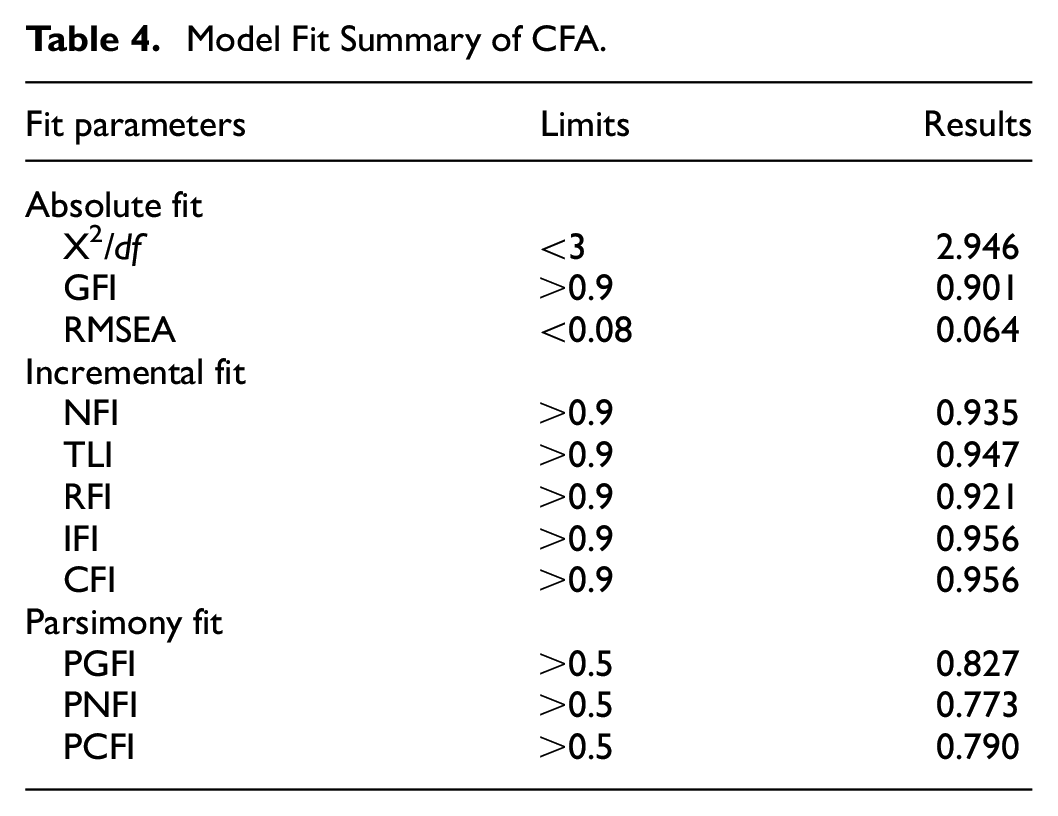
We further check for CMB, we employ common latent factor via CFA. This technique involved the creation of a shared latent factor and the inclusion of a regression line to each of the measurement items. The analyses revealed that the model fit metrics of the single-latent factor model was demonstrably poor and unsatisfactory (X2/df = 4.098, GFI = 0.841, RMSEA = 0.081, NFI = 0.902, TLI = 0.915, RFI = 0.891, IFI = 0.924, CFI = 0.924) when compared to the research model (X2/df = 2.946, GFI = 0.901, RMSEA = 0.064, NFI = 0.935, TLI = 0.947, RFI = 0.921, IFI = 0.956, CFI = 0.956). This suggests that measurement items lack a unidimensional structure. Based on the techniques employed during the survey design and the comprehensiveness of the statistical evaluations (Harman’s single factor, common latent factor and CFA), it can be concluded that CMB is not a significant issue in the current study.
Lastly, to assess the potential issue of multicollinearity, we computed variance inflation factors (VIF). The VIF values obtained were found to be below 3, indicating our results do not suffer from multicollinearity issues (Hairs et al., 1998; Iyiola & Rjoub, 2020).
Assessment of the Measurement Model
The use of pre-existing and validated measurement items enhances the validity and reliability of our measures. Furthermore, a number of analyses were conducted to estimate the reliability and validity. Construct reliability was computed via Cronbach’s alpha. According to Churchill (1979) and Rahimnia and Hassanzadeh (2013), Cronbach alpha should exceed .6. As presented in Table 2, Cronbach alpha values for the constructs in this study range from (.934 to .948). Therefore, our scales exhibit excellent reliability.
Reliability and CFA Results.

aSMC = squared multiple correlations.
CR = composite reliability.
AVE = average variance extracted.
p < 0.001, highly significant
Furthermore, we estimated convergent and discriminant validity via CFA. The obtained results revealed the adopted theoretical model exhibit satisfactory fit (Hu & Bentler, 1999); X2/df = 2.946, GFI = 0.901, RMSEA = 0.064, NFI = 0.935, TLI = 0.947, RFI = 0.921, IFI = 0.956, CFI = 0.956 as illustrated in Table 4. Furthermore, the parsimony fit indices as can be seen in Table 4, including PCFI, PGFI, and PNFI, exhibited values that were considerably higher than the minimum acceptable threshold of 0.5, as stipulated by Browne and Cudeck (1992).
The results also indicated that all CR values (0.936–0.949) exceeded 0.70 and AVE values (0.628–0.787) were higher than 0.5 as recommended by Fornell and Larcker (1981) as displayed in Table 2 and displayed in Figure 2. For discriminant validity, Fornell and Larcker (1981) recommended that to ensure discriminant validity, the square root of AVE should be higher than the surrounding correlation coefficient. As can be seen in Table 3, the square root of each AVEs (in bold parentheses) were higher than the surrounding correlation coefficient, revealing evidence of discriminant validity.

CFA results.
Assessment of Discriminant Validity.

Note. Values in brackets are square root of AVEs. M = mean; SD = standard deviation. **p < 0.01, significant.
Direct and Mediation Effects
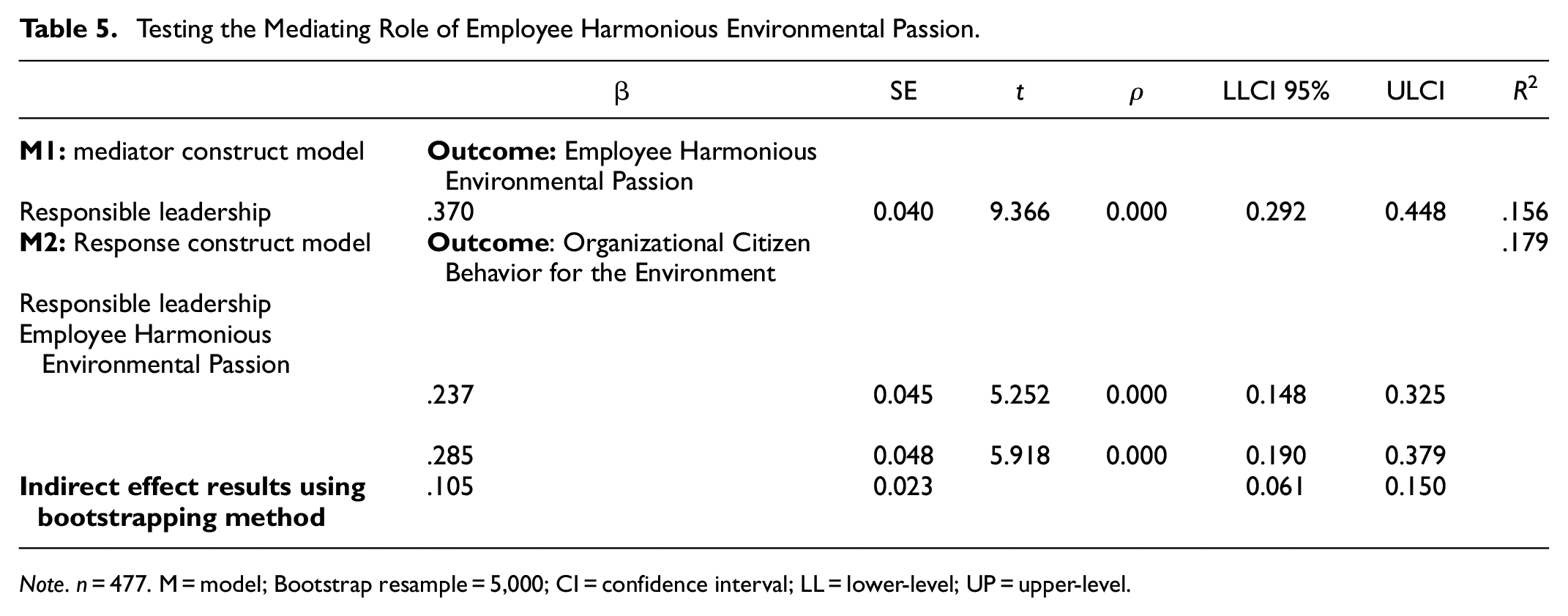
Model 4 of PROCESS was employed to verify H1, H2, H3, and H4. Table 4 presents the direct and mediation effect model. The approach recommended by Baron and Kenny (1986) 4-step procedure for mediation analysis. First, the results revealed that responsible leadership has a positive effect on employee harmonious environmental passion (β = .370, t = 9.366, p < .001). Second, employee harmonious environmental passion has a positive effect on OCBE (β = .285, t = 5.918, p < .001). Third, Responsible leadership has a positive effect on OCBE (β = .237, t = 5.252, p < .001). Therefore, H1, H2, and H3 were all validated as demonstrated in Table 5.
Model Fit Summary of CFA.
Testing the Mediating Role of Employee Harmonious Environmental Passion.
Note. n = 477. M = model; Bootstrap resample = 5,000; CI = confidence interval; LL = lower-level; UP = upper-level.
According to a full mediation would be observed where the direct effect is found to be insignificant after the inclusion of the mediator construct. A partial mediation would be observed where the direct effect is found to be significant after the inclusion of the mediator, while no mediator would be observed when neither of the effect showed significance. The technique involves the verification of a significant indirect effect via bias-corrected bootstrap CI. Fourth, the outcome of the bias-corrected bootstrap technique using 5,000 resamples validates the mediating role of EHEP (β = .105, SE = 0.025, CI [0.061, 0.150]) supporting H4 as illustrated in Table 4. Hence, EHEP partially mediated the link between responsible leadership and OCBE.
Examining Moderated Mediation Model
The study employed PROCESS model 8 to explore the moderating role of environmental transformational leadership on the link between responsible leadership and Employee harmonious environmental passion (H5) and the link between responsible leadership and OCBE (H6). According to Hayes (2013) a moderated mediation can be established if either or both of the aforementioned relationships were established. Table 6 presents the results of the moderated mediation model.
Testing the Moderated Mediation Effect.

Note. n = 477. M = model; Bootstrap resample = 5,000; CI = confidence interval; LL = lower-level; UP = upper-level; Co = control variable.
In the moderated mediation model, experience, education and firm size were added as covariates. The findings from the moderated mediation model revealed that in model 1 of Table 6, adding experience, education and firm size as covariates, the main effect of responsible leadership on employee harmonious environmental passion was significant (β = .259, t = 6.689, p < .001) but the direct effect was not moderated by environmental transformational leadership (β = .009, t = 0.226, p > .05). Hence, environmental transformational leadership did not moderate the relationship between RL and EHEP.
Similar to the moderation hypothesis above, the results revealed that in model 2 of Table 6, adding experience, education and firm size as covariates, the main effect of responsible leadership on OCBE was significant (β = .201, t = 4.467, p < .001) and the direct effect was moderated by environmental transformational leadership (β = .192, t = 2.558, p < .05). Hence, environmental transformational leadership moderates the link between responsible leadership and OCBE. To provide the most reliable results for moderation analysis, the significant interaction effect was further probed through simple slope test. The aforementioned significant interaction was graphically plotted at ± standard deviation of environmental transformational leadership as illustrated in Figure 3. This was done to assess the strength of the link between responsible leadership on OCBE at low and high levels of ETL. The findings indicate the relationship was weaker at low ETL (β = .119, t = 2.224, p < .05), whereas the relationship was stronger at high ETL (β = .308, t = 4.022, p < .05) supporting H6.

Moderating effect of ETL.
Discussion
The current study examines study examines the effect of responsible leadership on OCBE in the context of Turkish manufacturing industry by drawing from social learning theory as theoretical framework. In addition, the study sought to provide understanding on how responsible leadership affects OCBE through employee harmonious environmental passion. As a result, we set out to demonstrate the impact of RL on OCBE via the mediating role of employee harmonious environmental passion. Furthermore, the moderating role of environmental transformational leadership was then examined.
Our results indicated that responsible leadership has a positive effect on OCBE. This finding is consistent with (Abbas et al., 2021; Stahl & Sully de Luque, 2014). The congruity of this result pattern may suggest that responsible leaders act as role models in the organization and such leadership behavior motivates employees to participate in initiatives for OCBE. The findings showed that responsible leadership has a positive effect on employee harmonious environmental passion. This specific result provides empirical support for the conclusions of Gu et al. (2016) and Wang et al. (2022) that social cues obtained from responsible leaders by employees could be crucial in managing their positive cognitive and affective attitude and develop harmonious environmental passion. It was discovered that employee harmonious environmental passion is a positive determinant of employee OCBE. This aligns with prior research conclusions of Afsar et al. (2016) and Robertson & Barling (2013). The observation here is that the proclivity of employees toward harmonious passion can foster favorable sentiments and stimulate them to participate in supplementary activities that advance the cause of sustainable development within the firm for OCBE initiatives.
Employee harmonious environmental passion was found to be a partial mediator of the link between responsible leadership and OCBE. This result could imply that the experience of positive affective states, such as harmonious environmental passion, may enhance employees’ propensity to display pro-active environmental behavior and encourage their colleagues in undertaking environmentally responsible behavior within the organization.
Our result did not provide empirical validation that environmental transformation leadership moderated the relationship between RL and EHEP. Lastly, the findings validated that at high level of environmental transformational leadership, the relationship between RL and OCBE is stronger for firms’ whose employees perceived high environmental transformational leadership. Hence, employee harmonious environmental passion and environmental transformational leadership are two important constructs that play essential roles in the link between responsible leadership and OCBE.
Theoretical Contributions
The present study significantly advances the existing literature on responsible leadership and employee OCBE in various ways with respect to firm environmental initiatives. Specifically, this is the initial study that examines and substantiates the current conceptual model in this way. By drawing on social learning theory and to the best of our knowledge, this is the initial study that explicitly examined the impact of responsible leadership on employee harmonious environmental passion and provide empirical evidence on the link between the aforementioned relationship in the extant literature. Further, this study explicitly provided empirical evidence how employee harmonious environmental passion affects employee OCBE, an important contribution to the current literature.
Previous studies have reported that responsible leadership influences employee OCBE (Abbas et al., 2021; Han et al., 2019), the specific mechanisms that explain this relationship have not been fully understood. This study proposed and provided empirical evidence that employees harmonious environmental passion is a crucial mechanism through which responsible leadership influences employee OBCE and closes the gap identified by Tuan (2022).
Another significant contribution of the present research is that it offers insight that is not currently found in the current body of knowledge concerning the condition under which the relationship between responsible leadership and employee OCBE could either be dampened or further enhanced. Through the examination of employees’ perception of their firms’ environmental transformational leadership and providing empirical evidence that environmental transformational leadership moderated the link between responsible leadership and employee OCBE in a manner that the aforementioned relationship is further enhanced. This findings align with prior results in the literature that demonstrated that transformational leadership helps out a lot in establishing a sense of empowerment among employees and motivating them to engage in extra-role behaviors (such as organizational citizen behavior) within the firm, and this is also true with respect to environmental sustainable initiatives in the modern day firms.
Managerial Contributions
This study offers crucial managerial implications for managers and leaders of manufacturing firms, especially in Turkey to consider responsible leadership, employee harmonious environmental passion and environmental transformational leadership as crucial components in encouraging employees’ involvement pro-environmental behaviors, such as OCBE. Specifically, the following are the practical implications that are drawn from the results of the present research for managers and policymakers to consider. First, it is imperative to underscore the crucial role of responsible leadership in stimulating organizational citizen behavior regarding the environment within the firm. In the firm setting, environmental-related behaviors portrayed by managers significantly impacts the behaviors and attitudes of the employees. Hence, it is crucial for the management of manufacturing firms to pay sufficient attention to attributes of responsible leadership exhibited by their managers. Based on this, it is crucial that manufacturing firms prioritize the recruitment of managers who exhibit the attributes of responsible leadership. Alternatively, firms should implement training programs centered on nurturing responsible leadership behavior among managers. Additionally, encouraging collaboration between managers and employees can help to promote positive attitudes toward environmentally sustainable practices in the workplace.
It is also recommended that manufacturing firms train their managers in cultivating the characteristics of responsible leadership including moral and empathy traits, and virtuousness (Agarwal & Bhal, 2020; Antunes & Franco, 2016). It would be beneficial to consider the assessment and development of responsible leadership behavior since responsible leadership can stimulate employee environmental harmonious passion and in turn which will promote employee OCBE by establishing a firm setting that embraces green behaviors.
Finally, regular effort is required to advance eco-friendly leadership, specifically environmental transformational leadership to stimulate employees’ behaviors toward sustainable green practices. Given that leaders serve as role models for their followers, it is crucial that top management offer guidance and support in the adoption of sustainable management practices within the firms to promote OCBE behaviors. Further, during selection and recruitment process, it is important for top management to take environmental considerations into account.
Limitations and Direction for Future Research
Despite the accomplishment of this research, this study has few limitations that future studies should be aware of and which also presents research opportunities. First, data obtained was based on employees’ perception of their leaders and self-ratings of their own OCBE, wish may give rise to bias. It is important to consider the perspectives of managers and leaders in future studies, as they serve as examples for employees within the firms. This can provide valuable insights into the overall functioning of the organization regarding sustainable practices. Second, this study focuses on Turkish manufacturing firms of three specific cities, future research should broaden the scope to other regions of the country to obtain intriguing findings. Third, though the use of time-lagged data and other statistical procedures are effective in minimizing common method. Longitudinal study design is suggested for future research in order to establish causal relationships.
Finally, additional suggestion could be to explore various mechanisms the implementation of environmentally-friendly behaviors within the organization and their impact on employees green behavior. One example could be, employees’ green creativity may be a mediating mechanism that steers responsible leader toward OCBE.
Footnotes
Acknowledgements
We express our gratitude to the participants who generously shared their time and insights for this study. We also thank our colleagues who offered invaluable suggestions and critiques during the research process. Finally, our heartfelt appreciation to our families for their patience and unwavering support throughout this research project.
Declaration of Conflicting Interests
The author(s) declared no potential conflicts of interest with respect to the research, authorship, and/or publication of this article.
Funding
The author(s) received no financial support for the research, authorship, and/or publication of this article.
An ethics statement (including the committee approval number) for animal and human studies. If this is not applicable,please state this instead
This research did not involve human subjects or animal experiments. As such, ethical committee approval was not required. We affirm that all research practices adhered to the principles of research integrity and ethics appropriate to our field. We confirm that this study complied with all relevant legislation and institutional guidelines.

Data Availability Statement
The data that support the findings of this study are available from the corresponding author upon reasonable request.