




Abstract
Vocabulary is an important part of language which is central to all language skills and meaningful communication. One way through which vocabulary learning can be facilitated is by the use of vocabulary learning strategies (VLS). VLSs can empower language learners to be more self-directed, regulated, and autonomous. Also, they can help language learners to discover and consolidate the meaning of the words more effectively. Teachers’ and students’ behavior, functioning, and learning are, however, controlled by their thoughts, beliefs, attitudes, and perceptions. The present study was an effort to explore the Iranian EFL (English as a Foreign Language) learners’ and teachers’ beliefs about the usefulness of different types of VLSs. To that end, a VLS questionnaire developed for this purpose was given to 392 EFL teachers and learners. Based on the results of the study, the Iranian EFL learners and teachers believed that strategies such as paying attention to vocabulary forms, functions, and semantic relations; guessing the meaning of new words from the context; and using monolingual dictionaries can be very useful in discovering and consolidating the meaning of new words. They, nevertheless, expressed hesitancy to use L1, bilingual dictionaries, and mnemonic devices. The results of Kruskal–Wallis Test also showed that the preference for a few strategies differed across levels of education.
Introduction
In the past, vocabulary was sidelined in the area of language learning and teaching because grammar was considered to be the most important part of language and vocabulary was secondary to it (Milton, 2009). The developments in the area of linguistics along with new sociocultural demands challenged the status quo (Richards & Rodgers, 2003). More recently, researchers (Amiryousefi & Kassaian, 2010; Amiryousefi & Ketabi, 2011; Coady & Huckin, 1997; Hedge, 2008; Oxford & Scarcella, 1994; Richards & Renandya, 2002; Schmitt, 2010) have viewed vocabulary as an important part of language on which effective communication relies. Schmitt (2010), for example, believes that meaningful communication in a foreign language depends mostly on words. If learners do not have the available words to express their ideas, mastering grammatical rules does not help. Vocabulary has, consequently, gained popularity in the general field of English language teaching and learning, and research in second language lexical acquisition, retention, and instruction has increased (Coady & Huckin, 1997; Hedge, 2008; Richards & Renandya, 2002).
During the previous decades, the area of language learning and teaching has also been marked with the attempts to make language learners autonomous (Harmer, 2001; Hedge, 2008). Autonomy is believed to be the essence of language acquisition which can help language learners take charge of their own learning (Little, 2007). One way through which language learners can become autonomous is to help them use language learning strategies (LLS) (Zarei & Elekaie, 2012). LLSs are a set of conscious or semi-conscious thoughts and behavior which are used by language learners to facilitate their learning process (Cohen & Dornyei, 2002). Vocabulary learning strategies (VLS) are also a part of LLSs which are defined by Gu (2003) as those behavior and actions used by language learners to use and to know vocabulary items.
The present study is, therefore, an attempt to explore the Iranian EFL (English as a Foreign Language) learners’ and teachers’ beliefs about the usefulness of different types of VLSs and to examine the effects of level of education on their strategy preference.
VLS
Although research on VLSs has been done for several decades, the field has not been able to form a common and unified definition of what the term exactly means. Various authors and researchers (Catalan, 2003; Cohen & Dornyei, 2002; Gu, 2003; Nation, 2001; Takac, 2008) have defined VLSs differently. Nation (2001), for example, believes that VLSs are a part of LLSs which need to 1) involve choice. That is, there are several strategies to choose from, 2) be complex. That is, there are several steps to learn, 3) require knowledge and benefit from training, 4) increase the efficiency of vocabulary learning and vocabulary use. (p. 352)
Cohen and Dornyei (2002), however, believe that VLSs involve memorizing, recalling, reviewing, and using vocabulary items. Catalan (2003) also believes that VLSs are those actions which are taken by language learners to find out the meaning of the words, to send them to their long-term memory which is, based on Schmitt (2010), the ultimate goal of vocabulary learning, to recall and to use the words when needed. Takac (2008), however, believes that VLSs are those strategies which are solely used for vocabulary learning tasks.
In spite of the differences in definitions, almost all researchers believe that studying VLSs can give teachers and researchers useful insights. First, by exploring VLSs used by different language learners, useful information can be obtained regarding the cognitive, social, and affective processes involved in vocabulary learning (Chamot, 2001). Second, by exploring the VLSs used by successful learners a list of useful strategies can be prepared to be taught to less successful language learners to help and support them in their language learning process (H. D. Brown, 2014). Third, by exploring the beliefs and attitudes of language learners about different VLSs, useful information can be obtained about their desired and expected behavior and actions (Schmitt, 2010). Learners’ expectations and desires have big impacts on their learning behavior because, according to Schmitt (2010), if language learners do not value specific behavior and actions, they will not have the needed motivation which is the very first step in the language learning process. Fourth, Tseng, Dornyei, and Schmitt (2006) believe that VLSs are the ways through which language learners can be empowered to be more self-directed in their learning. By exploring the beliefs and attitudes about different VLSs or by getting information about the whats and hows of VLSs, teachers can raise their awareness about what works for and what works against their learners (H. D. Brown, 2014). Finally, research has shown that students from different cultural, linguistic, and educational backgrounds do not benefit from the same strategies (Gu, 2003; Tran, 2011). It means that culture plays an important role in vocabulary learning and VLS use. Language learners from different cultures may find different VLSs useful (Schmitt, 2000). By exploring the beliefs and perceptions of language learners about different VLSs, teachers will know what strategies to focus on.
VLS Classifications
Different taxonomies and classifications of VLSs are available in the literature of vocabulary learning and teaching (Klapper, 2008; Nation, 2001; Rubin & Thompson, 1994; Schmitt, 1997). Rubin and Thompson’s (1994) taxonomy of VLS, for example, consists of three major parts: (a) direct approach, (b) indirect approach, and (c) mnemonics. Direct approach contains strategies such as saying or writing the words several times and putting the words on cards which direct language learners’ attention to vocabulary items themselves. Indirect approach, however, contains those strategies such as reading a text and trying to make sense of it which focus learners’ attention to language learning tasks rather than individual vocabulary items. Mnemonics also contain strategies such as grouping the words and relating them to a picture which are used to retain the words in the memory. Schmitt’s (1997) taxonomy, however, consists of 58 strategies which can be divided into two broad categories, namely, discovery strategies which are used to discover the meaning of the words and consolidation strategies which are used to retain them. Schmitt’s (1997) taxonomy is believed to be the most comprehensive one because it is specifically prepared for vocabulary learning, and there is little overlap between the classifications of the strategies (Akbari & Tahririan, 2009). Nation (2001) in his taxonomy of different kinds of VLSs makes a difference between aspects of vocabulary knowledge, sources of vocabulary knowledge, and learning processes (pp. 352-353). Aspects of vocabulary knowledge refer to what is involved in knowing a word such as its written and spoken forms, sources of vocabulary knowledge refer to the context in which the word is used and learning processes refer to those actions that lead to the learning and retention of the given words. His taxonomy, therefore, consists of three major parts, namely, planning strategies which are used to choose what to focus on, source strategies which are used to find information about words, and process strategies which are used to establish vocabulary knowledge. Klapper (2008), however, divides VLSs into the strategies which are used in explicit learning of vocabulary and those which are used in implicit vocabulary learning. Strategies such as analyzing vocabulary items, using cards, or keeping vocabulary notebooks are used in implicit learning, whereas strategies such as listening to stories, watching movies, or reading stories are the ones used in implicit learning. Tran (2011) modified the taxonomy developed by Catalan (2003) to study the Vietnamese EFL teachers’ perceptions about vocabulary learning and teaching. His taxonomy contains 68 items which are also divided into two main parts, namely, discovery strategies and consolidation strategies. The discovery part has strategies such as leafing through the dictionary to learn words and asking the teacher for an L1 translation which can help language learners to discover the meaning of the words. The consolidation part, however, has strategies such as using scales for gradable adjectives and using mnemonic devices which can be helpful in consolidating the meaning of the learned items.
The Importance of Students’ and Teachers’ Beliefs
Research (Borg, 2003; Nation & Macalister, 2010; Phipps & Borg, 2009; Rashidi & Moghadam, 2014; Riley, 2009) in the field of language teaching and learning has shown that students’ and teachers’ beliefs about the nature of language and language learning and teaching affect their pedagogical practices in the classroom. It is believed that beliefs affect students’ and teachers’ autonomy and success in language learning and teaching, and underlie all choices they make. Differences in beliefs can, therefore, make students’ and teachers’ approach a learning task differently despite their similarities in language proficiency and level of education. Beliefs also influence students’ and teachers’ personal attributes such as anxiety and motivation (Riley, 2009). Nation and Macalister (2010) believe that what teachers and students do is determined by their beliefs. In the same fashion, Phipps and Borg (2009) believe that students’ and teachers’ beliefs act as a filter through which all practices and experiences are passed and interpreted. The social-cognitive theory also states that a student or a teacher’s behavior, learning, and actions are products of a continuous interaction between cognitive, behavioral, and contextual factors. That is, a student or a teacher’s behavior, actions, and learning or teaching are shaped by factors such as the reinforcements experienced by himself or herself and/or by other’s beliefs, perceptions, and interpretation of the task and context (Bembenutty & White, 2013; Kitsantas & Zimmerman, 2009). Language learners’ use of LLSs in general and VLSs in particular is, consequently, affected by factors such as their own and their classmates’ and teachers’ beliefs about their usefulness and effectiveness. Beliefs are, nevertheless, considered to be dynamic and may change over time or may change as teachers’ and students’ factors such as level of education change (Barcelos & Kalaja, 2011; Zhong, 2014).
Riley (2009), however, believes that if teachers’ and students’ beliefs are consistent with each other, there will be a supportive atmosphere in the classroom which will enhance the quality of learning and teaching. Otherwise, there will be a clash and lack of understanding between the teachers and the students which may lead to dissatisfaction (Rashidi & Moghadam, 2014; Riley, 2009). Examining students’ and teachers’ beliefs about different aspects of language teaching and learning can, therefore, provide valuable information about what practices and tasks are considered useful by teachers and students to be included and what differences exist between their beliefs to be taken into account.
The Purpose of the Present Study
Under the umbrella of social-cognitive theory (Bembenutty & White, 2013; Kitsantas & Zimmerman, 2009), which states that beliefs and thoughts are powerful and can affect human beings’ behavior and functioning and with regard to the importance attached to the role of LLSs in making language learners autonomous (Zarei & Elekaie, 2012), the value credited to the role of vocabulary in language learning and the role of culture in vocabulary learning and VLS use (Schmitt, 2000, 2010), the present study is an endeavor to explore the Iranian EFL learners’ and teachers’ beliefs about the usefulness of different types of VLSs. The present study, therefore, addresses the following research questions:
The Study
The Participants
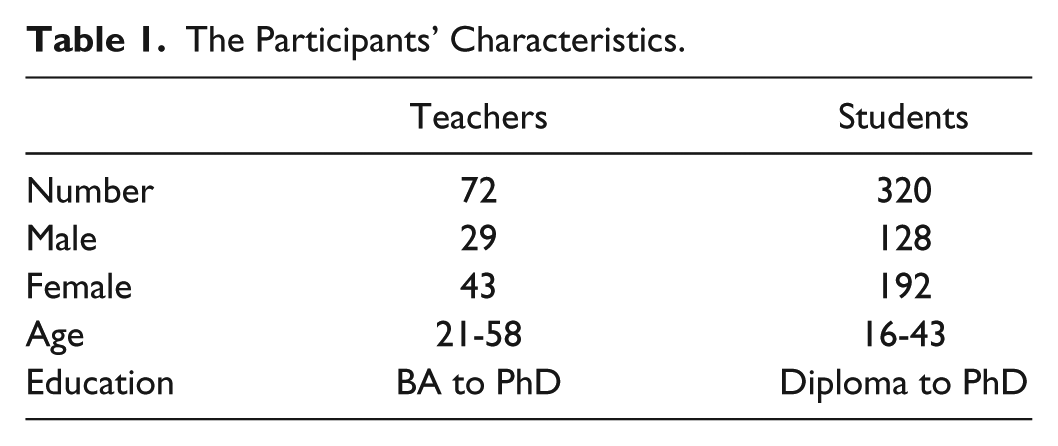
The sample of the study included 392 participants comprising 320 students and 72 English teachers. The participants of the study were English learners and teachers of four big and famous institutes (Iran Language Institute, Pouyesh, Gouyesh, and Iranian Academic Center for Education, Culture and Research (ACECR) in Isfahan, Iran. The students participated in this study were learning English in different levels from elementary to advanced at the adults’ departments of these institutes in the spring semester of 2014. Their age ranged from 16 to 43, and their degrees ranged from high school diploma to PhD. The majority of the teachers were also female. Their age ranged from 21 to 58, and they had different degrees in English from BA to PhD. Table 1 shows the characteristics of the participants of the study.
The Participants’ Characteristics.
The Instrument
To elicit the required data, a 5-point Likert-type scale questionnaire was used. The VLS questionnaire was developed based on the questionnaire used by Tran (2011) to study the Vietnamese teachers’ beliefs about vocabulary learning and teaching. The original questionnaire contained 63 items which were divided into two broad categories of discovery strategies and consolidation strategies. Based on the characteristics of the Iranian EFL learners, teachers, and teaching and learning context, it was, however, reduced to 54 items, and some of the items were also reworded. The anchor points for the existing items ranged from 1 = very useless to 5 = very useful. It was also divided into discovery strategies with 15 items and consolidation strategies with 39 items. Discovery part of the questionnaire contained strategies such as checking the meaning of the words in a bilingual or monolingual dictionary and guessing the meaning of the unknown words which can be used by language learners to arrive at the meaning of the words, while consolidation part contained strategies such as writing words down or saying them aloud several times to remember them, reviewing the words, and relating the words to personal experiences or pictures which are used to consolidate their meaning. Based on J. D. Brown’s (2001) suggestion to minimize the measurement errors, the questionnaire was translated into Farsi, the participants’ native language and the Farsi format was given to the participants.
The final format was reviewed by six experienced teachers and scholars, and based on their validation necessary changes were made. To check the validity of the questionnaire, factor analysis with varimax rotation was also used. As shown in Table 2, the Kaiser–Meyer–Olkin (KMO) is bigger than 0.6 (KMO = 0.618 > 0.6), which shows that the 54 strategies fit into the two main tentative factors as originally hypothesized (i.e., discovery and consolidation strategies).
The Results of KMO and Bartlett’s Test.

Note. KMO = Kaiser–Meyer–Olkin.
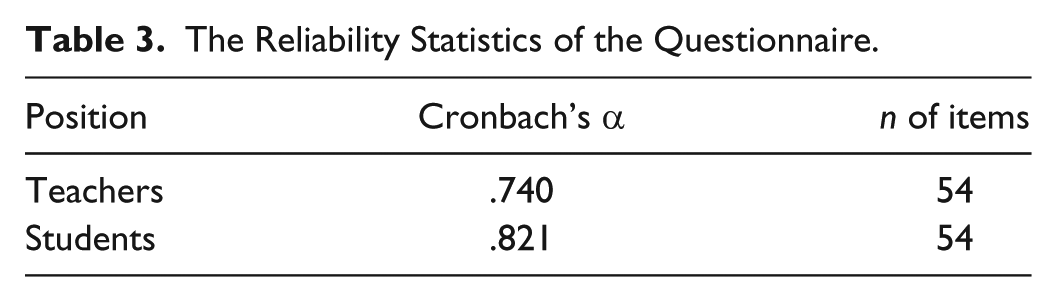
It was also given to a group of 32 English teachers and 69 English learners which were comparable with the participants of the study to explore its reliability and the following results were obtained. As shown in Table 3, αis bigger than .7 for both the students and the teachers, which shows the reliability of the instrument used.
The Reliability Statistics of the Questionnaire.
Results
The data were prepared for analysis and then analyzed using the statistical package for the Social Sciences (SPSS) version 16. Descriptive statistics were used to describe the responses to the items available in the questionnaire. For the sake of simplicity and space, the responses of the students and teachers to each part of the questionnaire are summarized in Table 4. The first column of Table 4 (ranks) presents Likert-type scale values (from very useless to very useful), and the numbers in the next columns show the percent of the students and teachers who selected those scales for each part.
The Students’ Responses to Each Part of VLS Questionnaire.

Note. VLS = vocabulary learning strategies.
As shown in Table 4, around 89% of the students and 87% of teachers had selected either useful or very useful for the items available in the discovery part of the questionnaire, and around 87% of the students and 88% of the teachers had selected useful or very useful for the items available in the consolidation part. Generally speaking, the results show that the majority of the participants believed that both discovery and consolidation strategies are useful in vocabulary learning. These results are, however, too general and belong to those participants who had selected one of the anchor points of very useless, useless, useful, and very useful. The rest who had not responded or had selected “no idea” were excluded in the calculation of the general percent of each part of the questionnaire. The details about the most valued strategies are, however, presented in the following parts.
The Most Useful Strategies
To extract the most useful strategies in the participants’ opinions, the frequency of the responses to each item of the questionnaire was calculated. The items for which at least 60% of the respondents had selected the anchor points of useful or very useful were marked as the most useful and the rest were discarded. Finally, 6 discovery and 20 consolidation strategies remained for the students, and 8 discovery and 25 consolidation strategies remained for the teachers. The results are shown in the following tables. Numbers 1 to 5 used in the tables, respectively, show 1 = very useless, 2 = useless, 3 = no idea, 4 = useful, 5 = very useful, and the numbers used under them show the percent of the teachers and the students who selected each of these anchor points. The letter “M” stands for the mean and “SD” for the standard deviation of the responses to the items listed. As it is clear, the teachers and the students did not agree on the usefulness of several strategies.
Table 5 shows the results for those discovery strategies which were rated as the most useful by both the students and teachers. As shown in Table 5, both the teachers and the students believed that strategies such as paying attention to the function, suffixes and prefixes of the words, using monolingual dictionaries, guessing the meaning of the words and asking the teacher to use the words in English sentences, or give synonyms for them can be useful in discovering their meaning.
The Most Useful Discovery Strategies in Both Students’ and Teachers’ Opinions.

Note. 1 = very useless, 2 = useless, 3 = no idea, 4 = useful, 5 = very useful.
Table 6, however, shows those strategies which were rated as the most useful only by the teachers. The teachers, unlike the students, believed that if the learners try to link English words to some Farsi ones and pay attention to the available pictures and clues, they can get their meaning better. The majority of the students did not, however, think so.
The Most Useful Discovery Strategies in Teachers’ Opinions.

Note. 1 = very useless, 2 = useless, 3 = no idea, 4 = useful, 5 = very useful.
Table 7, on the other hand, shows the most useful consolidation strategies in both the teachers’ and students’ opinions. As stated earlier, these strategies can be used to consolidate the meaning of the learned vocabulary elements. As shown in Table 7, both the teachers and the students believed that strategies such as using the words in interactions, learning the words in sentences, checking the pronunciation of the words, repeating the words, listening to English music, and watching English movies can be useful in consolidating the meaning of the words and sending them to long-term memory for future use.
The Most Useful Consolidation Strategies in Both Students’ and Teachers’ Opinions.

Note. 1 = very useless, 2 = useless, 3 = no idea, 4 = useful, 5 = very useful.
Table 8, however, contains those consolidation strategies which were rated only by the teachers as the most useful strategies to be used to consolidate the meaning of the already learned vocabulary elements. The Iranian EFL teachers, consequently, believed that activities such as relating the words to personal experiences, using flash cards, listening to tapes or CDs containing the words, and keeping a vocabulary notebook can be useful in consolidating the meaning of vocabulary elements.
The Most Useful Consolidation Strategies in Teachers’ Opinions.
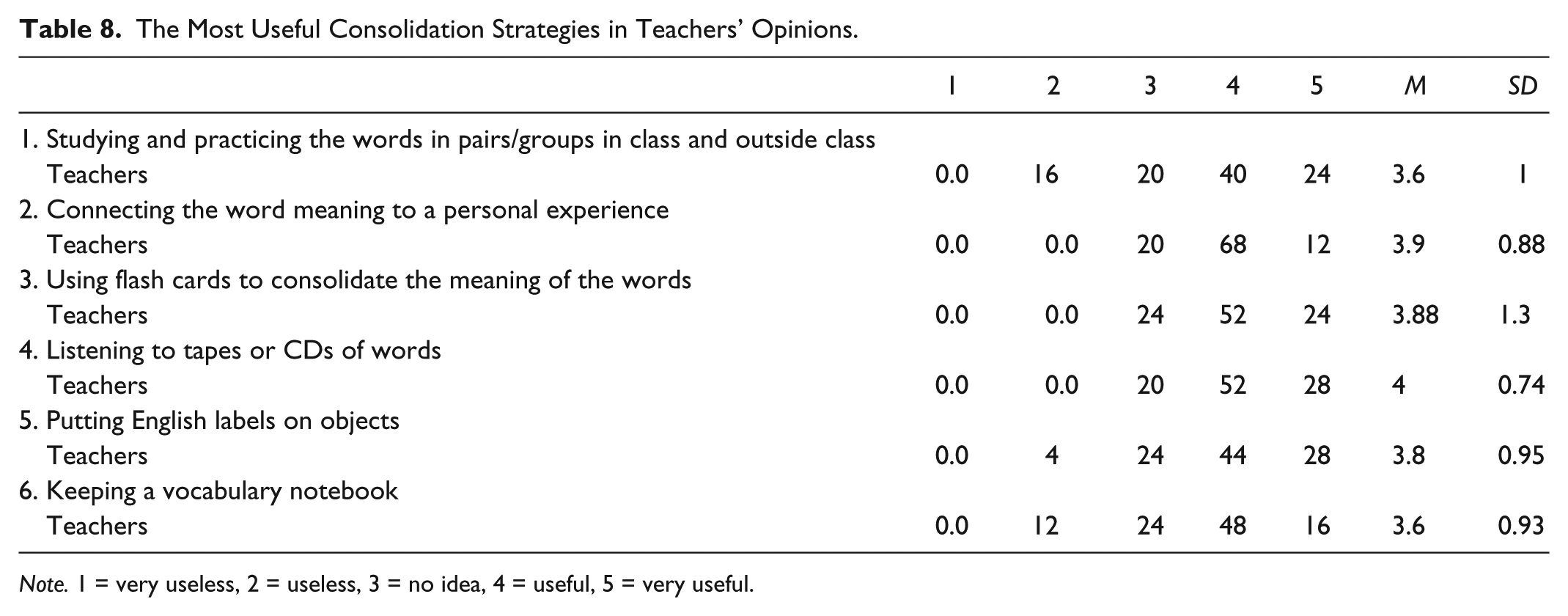
Note. 1 = very useless, 2 = useless, 3 = no idea, 4 = useful, 5 = very useful.
The majority of the Iranian EFL learners did not, however, agree on the usefulness of the strategies listed in Table 8. As shown in Table 9, they believed that, along with the strategies listed in Table 7, memorizing the newly learned vocabulary items can also be a useful practice in consolidating their meaning. However, the majority of the teachers did not believe that memorization can be a useful activity in this regard.
The Most Useful Consolidation Strategies in Students’ Opinions.

Note. 1 = very useless, 2 = useless, 3 = no idea, 4 = useful, 5 = very useful.
The Iranian EFL learners and teachers did not, nevertheless, believe in the usefulness of mnemonic strategies such as the key-word method and the loci method which have a long-standing position in the literature.
The Effect of Educational Level on Strategy Preference
To examine the effects of level of education on the strategy preference, at first the participants were divided into different groups based on the degrees they held. Accordingly, the teachers were divided into three groups: (a) BA, (b) MA, and (c) PhD, and the students into four groups: (a) diploma, (b) associate degree, (c) BA, and (d) MA and higher. The reason why the students with MA and PhD degrees were classified into one group was that only a very small number (3) of the students had a PhD degree. Then the Kruskal–Wallis Test was used due to the nonexistence of normality in the data to measure the effects of level of education on the students’ and teachers’ strategy preference. The results of the Kruskal–Wallis Test used for the teachers showed that for all 54 items available in the VLS questionnaire the p values were bigger than .05 showing that there was not a meaningful difference between the responses of the teachers in the three groups to the items available in the VLS questionnaire.
However, as shown in Table 10, the results of the Kruskal–Wallis Test used for the students suggested that for the consolidation strategies (a) trying to use the words in interactions; (b) associating the word with its word coordinates, for instance, apple is associated with peach, orange . . .; and (c) reviewing the vocabulary section of the textbook the p values were, respectively, .023, .034, and .025 which were less than .05 representing a meaningful difference between the responses of the students in the four groups to these items.
The Results of the Kruskal–Wallis Test Used for the Students.
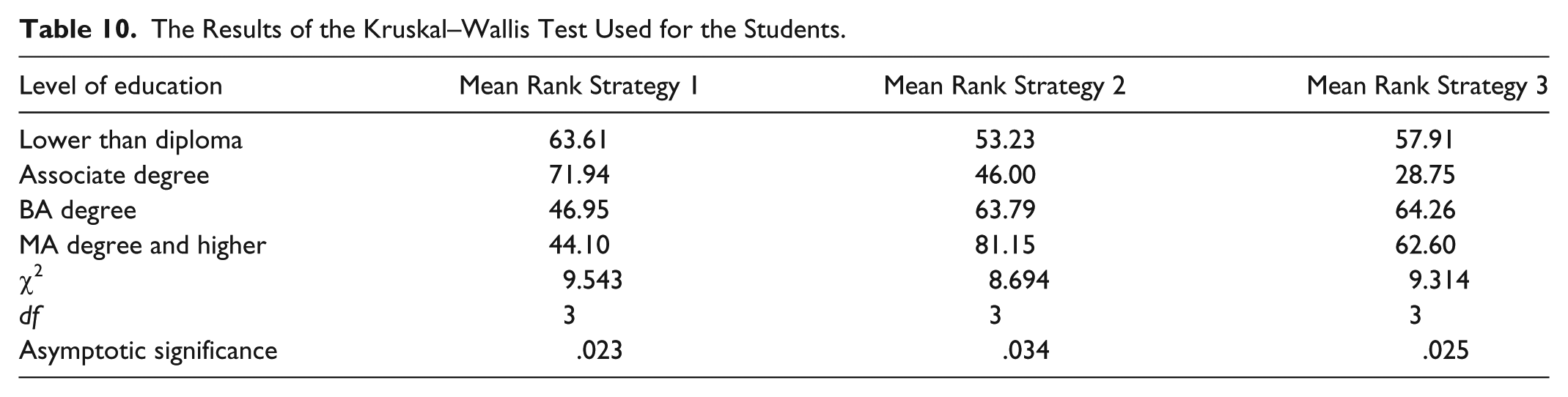
An inspection of the mean ranks showed (Table 10) that for Strategy Number 1, the mean rank of the students with an associate degree was 71.94, which was the highest. The frequency of the responses of the students in different groups to the options available for this strategy also showed that all the students (100%) with an associate degree had selected the anchor points of useful or very useful indicating that in these students’ opinions trying to use the newly learned vocabulary elements in interactions can be a very good practice to consolidate their meaning. This strategy was also selected as one of the most useful consolidation strategies in both the teachers’ and the students’ opinions (Table 7).
For Strategy Number 2, the highest rank, as shown in Table 10, was 81.15 which belonged to the students holding MA or higher. The frequency of the students’ responses to the options available for this strategy showed that around 50% of these students had selected either useful or very useful showing that about half of these students believed that associating a word with its word coordinates can help them consolidate its meaning. The majority of the students in other groups had either no idea regarding the usefulness of this strategy or selected useless or very useless.
The highest rank for Strategy Number 3 was 64.26 which belonged to the students with a BA degree. The frequency of the responses of the students with a BA degree to this item showed that around 85% of them had selected useful or very useful for this strategy. As indicated in Table 7, this strategy was also selected as one of the most useful consolidating strategies in both the teachers’ and the students’ opinions.
Discussion and Conclusion
From the last half of the 20th century on, the field of language teaching and learning has been marked with the efforts to shift the attentions from teacher-centered classes to learner-centered ones. To this end, terms such as autonomy, awareness-raising, and self-regulation have made their way into the field (H.D. Brown, 2014). In learner-centered classes, the emphasis is on making the learners independent and self-regulated. To do so, learners should become strategic learners, that is, they should be instructed to use LLSs (Schmitt, 2010). Teachers’ and students’ thoughts, perceptions, and beliefs are, however, important forces that can have great effects on the decisions they make and the pedagogical practices they use. Teachers’ and students’ actions, decisions, and functioning are, therefore, sifted through their thoughts and beliefs (Bembenutty & White, 2013; Kitsantas & Zimmerman, 2009). Exploring their beliefs about different aspects of language teaching and learning can provide useful insights about the processes involved. It can also raise teachers’ and learners’ awareness about what works and what does not (H.D. Brown, 2014).
The present study was, therefore, an effort to explore the Iranian EFL teachers’ and learners’ beliefs about the usefulness of different types of VLSs and to examine the effects of level of education on their strategy preference. The results of the study showed that the students valued 6 discovery strategies (e.g., paying attention to the function of the word in the sentence, paying attention to the prefixes and suffixes, and guessing the meaning of the words) and 19 consolidation strategies (e.g., using the words in interactions, connecting the words to their synonyms and antonyms, and imagining the meaning of the words). The teachers also believed that these strategies were useful for vocabulary learning except for memorizing the words which was believed to be useful only by the students as a consolidation strategy. The teachers, however, valued 2 more discovery strategies (linking the English word to a Farsi one that reminds the learners of the English word’s form and meaning, and analyzing the available pictures and clues) and 6 more consolidation strategies (e.g., connecting the word meaning to a personal experience, using flash cards and keeping a vocabulary notebook) for which the students did not show a high esteem. The results of Kruskal–Wallis Test also showed that the teachers’ beliefs about the usefulness of different VLSs were not affected by their level of education. However, the preference for a few strategies differed across levels of education for the students.
By considering the strategies which were valued by the participants of the study, it can be inferred that for the Iranian EFL teachers and learners: (a) Paying attention to the form of vocabulary items is considered to be important in both discovering the meaning of the words and consolidating them. It can be seen in strategies such as paying attention to the grammatical functions of the words, analyzing the word affixes or considering them, and paying attention to the spelling and the spoken form of the words; (b) mechanical activities such as repeating the words, saying them aloud, or writing them down several times are also deemed essential; (c) the context is very important both during the first encounter with the words to understand their meaning and during the time the learners try to retain them; (d) guessing the meaning from the context and paying attention to the word relations can also promote vocabulary learning; and (e) vocabulary production has also an important place. It can be done through activities such as linking the new words in a story or using them in the interactions with peers and teachers. Strategy preference may, however, be affected by learners’ factors such as level of education.
The results of the present study can further support the importance of context, word lists, semantic relation among words, guessing the meaning of words from context, and vocabulary production in vocabulary learning and retention which are also proved useful by the studies done in the literature (Krashen, 2004; Nassaji, 2003; Nation, 2002; Schmitt, 1997, 2010; Tran, 2011; Waring, 1997). However, the results of the present study do not support the results of the studies done by researchers such as Folse (2004) and Prince (1996), who found that L1 can be facilitative in vocabulary learning, and bilingual dictionaries can provide students with useful information. The present study, on the contrary, showed that the majority of the Iranian EFL teachers and learners expressed hesitancy to use translation activities and tasks, L1 equivalents, and English to Farsi dictionaries for vocabulary learning. Also, the majority of the participants did not agree on the usefulness of mnemonic devices such as the key-word method and the loci method which have a long-standing position in the literature of vocabulary learning and teaching and are believed to contribute to vocabulary learning and retention (Amiryousefi & Ketabi, 2011; Sagarra & Alba, 2006). It can be due to the cultural factors which are believed to have an important role in VLS use (Schmitt, 2000). The results of the present study can, to some extent, support the fact that beliefs are dynamic and the changes in the learners’ and teachers’ attributes such as the level of education may result in a change in their beliefs about different aspects of language learning and teaching (Barcelos & Kalaja, 2011; Zhong, 2014).
As the results of the present study suggest, teachers should be cognizant of the fact that their beliefs do not always match their students’ beliefs. Teachers and students are, consequently, recommended to articulate their educational beliefs. In this way, teachers can raise their awareness about their students’ accurate and inaccurate beliefs about all aspects of language learning and teaching in general and about vocabulary learning and teaching in particular. It can help teachers justify their educational practices which in their students’ opinions are not useful or logical to stimulate satisfaction and cooperation in their students and hence increase the quality of teaching and learning (H. D. Brown, 2014; Murray & Christison, 2011; Rashidi & Moghadam, 2014).
Footnotes
Declaration of Conflicting Interests
The author(s) declared no potential conflicts of interest with respect to the research, authorship, and/or publication of this article.
Funding
The author(s) received no financial support for the research and/or authorship of this article.