




Abstract
With the development of artificial intelligence technology, virtual live streamers emerge in the field of live streaming e-commerce. Previous studies have identified how human live streamers affect online sales performance. However, little is known about the virtual live streamer. Can virtual live streamers play a role in e-commerce as well as their human counterparts? The purpose of this study is to examine the influence of virtual live streamers on online sales performance from the perspective of source credibility. The perceived credibility of virtual live streamers can modify viewer behavior in the virtual live streaming room. The relevant data is thus generated and recorded by the e-commerce platform. We collected data from 300 virtual live streaming rooms in the e-commerce platform known as Taobao.com. Using the behavior data, a multiple regression model was built to empirically study the relationship between the characteristics of virtual live streamers and online sales performance. The results showed that virtual live streamers’ characteristics of trustworthiness, attractiveness, and expertise had a positive effect on online sales performance, whereas the characteristic of interactivity had an adverse effect. This study provides insight into the virtual live streamer. Virtual live streamers are still unable to interact with viewers in a human live streamer manner. Marketing managers should improve virtual live streamers to meet viewers’ hedonic shopping motivations in the future.
Plain language summary
With the development of artificial intelligence technology, virtual live streamers emerge in the field of live streaming e-commerce. With the advantage of real-time interaction, human live streamers have been proven to be effective in improving online sales performance. Can virtual live streamers play a role in e-commerce as well as their human counterparts? The purpose of this study is to examine the influence of virtual live streamers on online sales performance from the perspective of source credibility. We measure virtual live streamers’ credibility from the dimensions of trustworthiness, attractiveness, expertise, and interactivity. Viewers participate in live streaming, receive product information from the virtual live streamer, interact with the virtual live streamer, and make a purchase decision ultimately. Throughout this process, the viewers can perceive the credibility of virtual live streamers and modify their behavior in the virtual live streaming room. The results of this study showed that virtual live streamers’ characteristics of trustworthiness, attractiveness, and expertise had a positive effect on online sales performance, whereas the characteristics of interactivity had an adverse effect. This study helps managers understand virtual live streamers better and design a suitable virtual live streamer. The main drawback of virtual live streamers is that they are still unable to interact with viewers in a human live streamer manner due to insufficient support from artificial intelligence technology. Improvement of interactivity to meet viewers’ hedonic shopping motivations is the main direction for the development of virtual live streamers.
Keywords
Introduction
Live streaming e-commerce has been increasingly adopted by marketers worldwide. With the advantage of real-time interaction, live streaming e-commerce can make customers enjoy their shopping experience and evaluate products more easily (Ang et al., 2018). The sales performance of live streaming e-commerce is determined by the number of viewers as well as the conversion rate. The conversion rate is measured by dividing the number of buyers by the total number of viewers. Both the number of viewers and the conversion rate can be effectively influenced by the live streamer (Jiang et al., 2010). Live streamers are responsible for establishing relationships with viewers, transmitting product information, and promoting purchase intention (Wongkitrungrueng et al., 2020). It can be concluded that live streamers take up the core position in the online sales process. However, managers will be faced with several problems when they intend to employ a human live streamer. First, human live streamers have limited daily working hours in the situation that viewers can watch live streaming conveniently with their mobile phones. Second, it is sometimes difficult for managers to select an appropriate human live streamer to match the products or marketing strategies. Moreover, a negative public event of a human live streamer may even deliver a fatal blow to the business (Xu et al., 2022).
In recent years, with the development of artificial intelligence technology, more and more managers have chosen to employ a virtual live streamer rather than a human live streamer. The virtual live streamer can be understood as a virtual person who engages in live streaming e-commerce to promote product sales (F. L. Li et al., 2021). Taobao.com, the largest e-commerce platform in China, has taken virtual live streamers as one of the three main areas of online marketing in the coming years. Philips, L’Oreal, and other world-famous brands have established their own virtual live streaming rooms on this platform.
The Source Credibility theory has been widely used in previous studies on sales performance. The relevant information sources include celebrities (Ohanian, 1990), social media influencers (Weismueller et al., 2020), human live streamers (Park & Lin, 2020; Todd & Melancon, 2018), etc. Virtual live streamers have emerged in the field of e-commerce for only three years. Due to relevant research still focusing on human live streamers, few studies on virtual live streamers have been conducted from the perspective of source credibility. Little is known about the differences between virtual live streamers and human live streamers. There is also a lack of research on the characteristics of virtual live streamers associated with online sales performance. To better understand the performance of virtual live streamers in the field of e-commerce and provide theoretical support for the improvement of virtual live streamers, this study aims to explore how the credibility of virtual live streamers influences online sales performance. First, this study identifies the characteristics of virtual live streamers in terms of source credibility. Previous studies have compared virtual humans and real humans in terms of appearance and behavior differences (Deng & Jiang, 2023; Robb et al., 2015). However, they have not yet proposed what these differences mean for online sales performance. It is necessary to make a comparison between the two kinds of live streamers as information sources of e-commerce. The AI-driven virtual streamers redefine source credibility by the origin of characteristics. The characteristics of virtual live streamers are developed with artificial intelligence technology, while the characteristics of human live streamers are related to learning and experience. Second, a multiple regression model is established based on the Source Credibility theory to test the influence of virtual live streamers’ credibility on online sales performance. There are two lines of empirical research methods used in previous studies on live streamers. The first one focuses on viewers’ motivation with survey data, and the other one focuses on viewer behavior in a live streaming room (Wongkitrungrueng et al., 2020). Since viewer behavior can be recorded by e-commerce platforms, this study measures the credibility of virtual live streamers with behavior data rather than respondents’ self-reports in survey questionnaires. The empirical analysis includes several steps: identifying behaviors reflecting the viewers’ perception of source credibility; collecting behavior data and eliminating invalid data to ensure data reliability; developing a model on the basis of descriptive statistics; and conducting regression tests for the established model. Finally, this study discusses how the results contribute to the Source Credibility theory and what strategies should be adopted by managers to improve the credibility of virtual live streamers.
Literature Review
Source Credibility Theory
The term source credibility refers to the characteristics of an information source that affect the degree of information acceptance (Ohanian, 1990). Research in this field has a long history. The Source Credibility Model and the Source Attractiveness Model are commonly applied to research source credibility. The two models can be collectively named the Source Models (Erdogan, 1999). Relying on the two models, Ohanian (1990) develops a reliable and valid scale for measuring source credibility. The dimensions of source credibility consist of trustworthiness, expertise, and attractiveness in this scale. Although various dimensions have been provided by many other factor-analytic studies, most researchers agree on the three dimensions mentioned above (Eisend, 2010). Pornpitakpan (2004) provides a review of the persuasiveness of source credibility and concludes that a highly credible source is always more persuasive. In the context of offline business, the relevant studies focus on celebrity endorsements and influencers in social media. Customers’ attitude toward the brand is an important factor in purchasing decisions (Chiou et al., 2013). Celebrities perceived as trustworthy and attractive have a positive effect on brand evaluation (Bergkvist & Zhou, 2016). Influencers in social media play an important role in advertising (Balaban & Mustatea, 2019). Consumers tend to perceive social media influencers with a large number of followers as trustworthy, expert, and attractive. They are more willing to purchase products recommended by credible influencers (Weismueller et al., 2020).
The development of e-commerce provides a new direction for research on source credibility. The dimensions of source credibility can be used to establish a reputation rating mechanism in B2B e-commerce to increase customers’ confidence. Expertise and trustworthiness, as the two classical dimensions of source credibility, are the basis for rater weights setting in the reputation rating mechanism (Ekstrom, 2005). Besides B2B e-commerce, a credible information source also has a positive effect on online sales performance in B2C e-commerce, C2C e-commerce, and social e-commerce (X. Zhao et al., 2006). Information asymmetry and seller opportunism still exist in e-commerce, especially for C2C e-commerce. Perception of information asymmetry and seller opportunism is harmful to customers’ trust in e-commerce (Wang & Tao et al., 2022). Therefore, product descriptions must be consistent with the product quality in C2C e-commerce to ensure the credibility of the information source (Jones & Leonard, 2014). In recent years, live streamers have been proven to be an important information source in live streaming e-commerce (Zhang et al., 2022). On B2C live streaming e-commerce platforms, the word-of-mouth reputation of the live streamer is determined by four dimensions of source credibility including trustworthiness, expertise, attractiveness, and interactivity (Wang & Zhao et al., 2022).
Influence of Live Streamers on Online Sales Performance
Live streaming e-commerce is more efficient at delivering information through face-to-face communication (Xu et al., 2022). It embeds live streaming in e-commerce platforms to free customers from misgivings (Cao et al., 2022). Most of the product information is delivered by live streamers in live streaming e-commerce. The role of the live streamer is to introduce products and interact with viewers in real-time (Lv et al., 2022). Some of the previous studies investigate the influence of live streamers on online sales performance from the perspective of IT affordance. Guidance shopping affordance, visibility affordance, and meta-voicing affordance can impact live streaming shopping significantly by enhancing customer engagement (Y. Sun et al., 2019). However, it is very common in reality that live streamers have different sales performances with the same level of IT affordance. Therefore, it is also meaningful to conduct research from the perspective of the information source itself.
Beautiful live streamers can take advantage of their attractive appearance to recruit viewers and gain viewers’ recognition (J. N. Sun et al., 2022). An attractive live streamer is more likely to be an opinion leader and have a large scale of viewers (J. N. Sun et al., 2022). Live streamers with a larger scale of viewers can achieve better online sales performance (Xu et al., 2022). Guo et al. (2021) highlight the importance of expertise and conclude that expertise is positively related to both hedonic value and utilitarian value in live streaming e-commerce. The live streamers’ perceived trustworthiness is a vital factor affecting viewers’ willingness to shop online (Park & Lin, 2020). The live streamer is a salesperson, an opinion leader, and also a friend who is good at interaction (Zhang et al., 2022). Interaction with the live streamer in real-time is one of the most important reasons why customers prefer live streaming e-commerce to other business modes (Cai et al., 2018). Therefore, interactivity has been introduced into studies on live streamers as a new dimension of source credibility (Zhou & Tong, 2022). Live streamers’ perceived expertise as well as interactivity can effectively influence purchase intention (K. Zhao et al., 2021). Although it is generally believed that live streamers’ interactivity has a positive effect on online purchase intention, some studies argue that too much interaction may make viewers feel overstated. Meaningful product information will appear scarce among too many interactive sessions (Luo et al., 2021). The widely popular live streamers are called online celebrities (Chang et al., 2023). Online celebrities who match the products will have higher credibility (Rungruangjit, 2022).
Source Credibility in the Context of Virtual People
Virtual live streamer, as a new phenomenon, has so far received little research attention. We can draw lessons from the relevant research on another kind of virtual people applied earlier in e-commerce. Most researchers call it Avatar. The avatar is a chat robot embedded in a web page to play the role of a virtual sales consultant (Miao et al., 2021). The avatar as a graphic representation animated by artificial intelligence technology adapts to the impersonal nature of e-commerce (Holzwarth et al., 2006). The difference between virtual live streamers and avatars lies in their functions. The web-based avatar delivers information simply by chatting with customers, and the virtual live streamer is capable of multi-modal interaction (F. L. Li et al., 2021). Although virtual live streamers are more powerful than avatars, they also rely on artificial intelligence technology for support. The two kinds of virtual people thus have similar characteristics. Some of the previous research focus on the influence of avatars on online sales performance from the perspective of source credibility. In the internet world, avatars can be more credible than human persons. Well-designed avatars are widely accepted by consumers (Keeling et al., 2009). E-commerce websites with credible avatars can attract and retain more customers. Credible avatars induce a greater sense of website social support and lower perceptions of website financial risk in users (Tan et al., 2021). When customers are exposed to their expectant avatars, they will be more willing to communicate and express their opinions (M. Y. Chen et al., 2020). Virtual human socialness has a positive significant effect on utilitarian value and hedonic value (Wu et al., 2023). Improvement of avatars’ characteristics of attractiveness, expertise, and trustworthiness will bring about a higher purchase intention (Gonzales-Chavez & Vila-Lopez, 2020). Expert avatars should be designed according to product needs. For example, avatars promoting clothing have different physical appearances from avatars promoting computers (Tan et al., 2021). In addition, different avatars are suitable for different customers. Attractive avatars are more persuasive to customers who are moderately interested in the product, and expert avatars are more persuasive to customers who are highly interested in the product (Holzwarth et al., 2006). Gender differences in perception of avatars do exist, especially for expert or trustworthy avatars (Gonzales-Chavez & Vila-Lopez, 2020).
Summary
The review of previous research provides evidence that human live streamers’ characteristics of trustworthiness, attractiveness, expertise, and interactivity can effectively influence sales performance. However, as AI-driven virtual live streamers are fundamentally different from human live streamers, the virtual environment provides a brand new research object for Source Credibility theory. The viewers’ perception of source credibility can be influenced by human live streamers’ reputations and activities in the real world. On the contrary, the characteristics of virtual live streamers are completely created by artificial intelligence. Previous research has shown that credible avatars can effectively promote sales performance. Nevertheless, further study is still necessary because virtual live streamers with multi-modal interaction capabilities are also different from avatars embedded in a web page. Therefore, the source credibility of virtual live steamers in the e-commerce field is an unexplored area. There is an interesting research gap in understanding virtual live streamers as an information source. E-commerce practitioners are in need of theoretical support on how to improve virtual live streamers from the perspective of source credibility.
Methods
The virtual live streamer is a kind of virtual people used for recruiting viewers and promoting online purchase intention. They are powered by artificial intelligence technology and their appearance meets the imagination of most Internet users. The target virtual live streamers of this study are developed based on product features and online marketing strategies. They can conduct live streaming independently and tirelessly work 24 hrs a day, without the help of human assistants. Virtual live streamers attract viewers to participate in the live streaming, convey product information to them, interact with them, and ultimately encourage them to make a purchase decision.
This study tries to extend the Source Credibility theory to understand the influence of virtual live streamers. The traditional questionnaire method has a limitation for this study. The questionnaire method is based on the Truth of Consensus. That is to say, we must find enough respondents to answer the questions in the questionnaire. Unfortunately, virtual live streamers are not as common as human live streamers nowadays. The Taobao platform started virtual live streaming in April 2020, which is four years later than human live streaming. Although Taobao has identified virtual live streaming as a new direction for e-commerce, human live streaming is the main business currently. At the Taobao Live MCN institutional conference in April 2022, it was announced that the total number of virtual live streaming rooms was about 1,000, while the number of human live streaming rooms with annual sales of over 1 million yuan is about 27,000. It is difficult to get sufficient respondents who are familiar with the characteristics of virtual live streamers. Therefore, we use behavior data rather than questionnaire data to carry out the research. Throughout the live streaming process, the viewers can perceive the credibility of virtual live streamers and modify their behavior in the virtual live streaming room. All the behavior data can be recorded by the e-commerce platform. Zhang et al. (2020) collect behavior data from Taobao.com using a Python-based web crawler method. Then they conduct an experiment according to the behavior data to study the influence of live streamers on online sales performance. M. Y. Chen et al. (2020) conduct a similar experiment with the behavior data obtained through a live streaming data statistics software. In this study, we explain how to use behavior data to measure the credibility of virtual live streamers, and then establish a multiple regression model to test the influence of virtual live streamers’ credibility on sales performance with the behavior data collected from Taobao.com.
Measuring Source Credibility of Virtual Live Streamers
Although source credibility is a subjective concept, it can be measured with behavior data in the context of live streaming e-commerce. Viewers can express their perception of virtual live streamers’ credibility with corresponding behavior. Based on the Source Credibility theory, we measure virtual live streamers’ credibility from the dimensions of attractiveness, expertise, interactivity, and trustworthiness with the behavior data recorded by the e-commerce platform (see Table 1).
Measuring Source Credibility of Virtual Live Streamers.

When viewers perceive that the virtual live streamer is attractive, they will participate in live streaming frequently and establish a close relationship with the virtual live streamer. So an attractive virtual live streamer always has a large number of viewers. In the entire process of watching, viewers may give likes to the virtual live streamer if they perceive that the information is helpful. The number of likes reflects the expertise of the virtual live streamer. Additionally, virtual live streamers who work longer hours are considered to be more expert than others because they can deliver more information. While receiving product information, viewers engage in interactions with the virtual live streamer. Due to technical limitations, virtual live streamers are still unable to perform and play games in a human live streamer manner. The interactions that the viewers can engage in only include greeting each other with the virtual live streamer, making comments, and asking questions. All interactions are conducted by leaving a message in the comment area. The virtual live streamer responds based on the keywords captured from the messages. As a result, the interactivity of the virtual live streamer can be measured with the number of messages left in the comment area. Some viewers will make a purchase decision after evaluating the information conveyed by the virtual live streamer. After comparing the actual product quality with the product information received from the virtual live streamer, the buyers will give an appropriate credit score to the virtual live streamer. The average credit score is a reflection of trustworthiness. Furthermore, some viewers will join the follower team once the virtual live streamer is highly trusted. On the other hand, followers may choose to unfollow the virtual live streamer when trust is lost. The number of followers can reflect the trustworthiness of the virtual live streamer too.
Hypothesis
In the practice of live streaming e-commerce, online sales performance depends on the number of viewers and viewers’ purchase intention. From the perspective of Source Credibility theory, both of the two factors can be influenced by live streamers’ credibility including the characteristics of trustworthiness, expertise, attractiveness, and interactivity. An attractive and interactive live streamer can quickly recruit a large scale of viewers (Clement et al., 2021). The ability of live streamers to recruit viewers can be described by the term Centrality. Live streamers with a high level of centrality can increase purchase intention more effectively (Xu et al., 2022). Thus, this study intends to propose a research framework based on the Source Credibility theory to understand the influence of virtual live streamers’ credibility on online sales performance. As shown in Table 1, viewer behavior in the virtual live streaming room can reasonably reflect the characteristics of virtual live streamers. Therefore, the research framework can be shown in Figure 1.
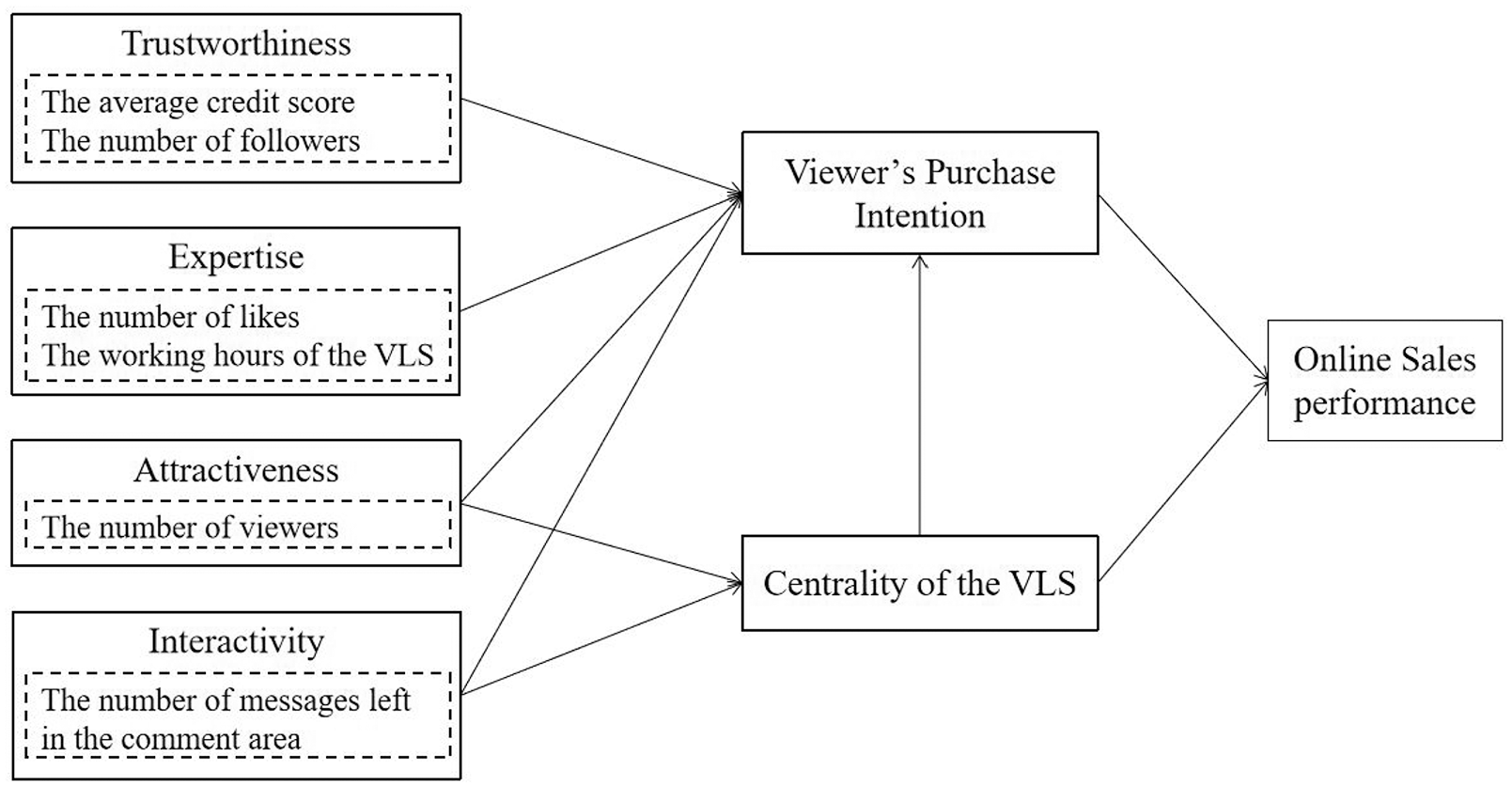
Research framework.
Trustworthiness
The term Trustworthiness means that the virtual live streamer is dependable, honest, and reliable (Pornpitakpan, 2004). The trustworthiness of human live streamers can’t be separated from their reputation in the real world. On the contrary, the trustworthiness of virtual live streamers depends entirely on viewers’ evaluation because they are completely created for live streaming e-commerce. At Taobao.com, customers have a chance to grade the trustworthiness of the virtual live streamer. If there is a big gap between the actual product quality and the product description, customers will give a low credit score and lose trust in the virtual live streamer. That is to say, virtual live streamers’ trustworthiness can be measured with the average credit score. Potential customers (viewers) will refer to the average credit score before making a purchase decision. A low average credit score means that the product quality has disappointed many customers. The virtual live streamer’s product description seems unreliable. It can be concluded that a high level of average credit score has a positive impact on the viewer’s purchase intention. Furthermore, some viewers will join the follower team when they are sure that the virtual live streamer is trustworthy. Live streaming e-commerce is different from entertainment live streaming. In entertainment live streaming, the number of followers reflects the popularity of the live streamer. In live streaming e-commerce, viewers join the follower group because of their high trust in the live streamer, which facilitates repeated shopping. Followers are the group with the strongest purchase intention. Virtual live streamers with more followers have better sales performance. Hypothesis 1 and Hypothesis 2 are listed below.
Expertise
The term Expertise means that the virtual live streamer is skilled in describing products and answering questions accurately. Expertise is more important than attractiveness in promoting viewers’ purchase intention (Guo et al., 2021). The expertise of human live streamers depends mainly on their knowledge and experience related to the products. What’s more, a human live streamer whose self-image matches the product will appear to be more expert (Erdogan et al., 2001). For example, some viewers will find it difficult to accept basketball stars promoting cosmetics. However, the expertise of virtual live streamers depends on different things. It seems somewhat odd when viewers are asked whether the virtual live streamer has abundant knowledge and experience of the products. After all, the virtual live streamer is a virtual people developed with artificial intelligence technology. The fact is that virtual live streamers deliver information according to established procedures and scripts. The expertise of virtual live streamers mainly depends on the procedure and script design. The product information conveyed by the virtual live streamer comes from the content of the script. The quality of script content determines the effectiveness of product information. The way virtual live streamers convey product information depends on the procedures. A good procedure should be a combination of multiple information transmission methods. For example, it would appear more professional if reference pictures appeared synchronously on the screen when the virtual live streamer was describing the product. At Taobao.com, viewers will give likes to the virtual live streamer whose product description is helpful. Professional information is beneficial for viewers to have a comprehensive understanding of the product. Viewers who have given likes to the virtual live streamer usually have a higher purchase intention. For marketing strategy reasons, virtual live streamers are scheduled for different working hours. The term working hours refers to the aggregate time the virtual live streamer is active in the virtual live streaming room. Because viewers need time to know the products and the virtual live streamer well, longer working hours help viewers perceive the expertise of the virtual live streamer. Hypothesis 3 and Hypothesis 4 are listed below.
Attractiveness
The term Attractiveness refers to the beauty, elegance, sexiness, and charisma of virtual live streamers (Pornpitakpan, 2004). Attractive virtual live streamers have a word-of-mouth reputation among viewers (Wang & Zhao et al., 2022), and an advantage in recruiting and retaining viewers (Xu et al., 2022) . The number of viewers in the virtual live streaming room thus reflects the attractiveness of the virtual live streamer. The marketing campaigns and platform algorithms do affect the viewership. However, these impacts are short-term and not continuous. If the virtual live streamer lacks attractiveness, viewers will leave quickly and never come back. In the long run, the attractiveness of virtual live streamers is the main factor in the number of viewers. Viewers attracted by the virtual live streamer will stay in the virtual live streaming room and receive information consistently. Virtual social relationships are gradually established in this process. Viewers are more likely to trust the virtual live streamer due to the relationship (Arora et al., 2019). Therefore, virtual live streamers’ attractiveness positively correlates with online sales performance. The aforementioned followers come from the viewer group. However, virtual live streamers with more viewers do not always have more followers. There should be no significant correlation between the number of viewers and the number of followers. We propose that:
Interactivity
Previous studies consider interactivity as an important dimension of live streamers’ credibility (J. D. Chen & Liao, 2022; Y. Li & Peng, 2021; Xu et al., 2022). Real-time interaction between live streamers and viewers can enliven the atmosphere in the live streaming room and bring viewers a pleasant shopping experience (Ang et al., 2018). Generally, an interactive live streamer must be friendly, responsive, and recreational. There are several ways for human live streamers to interact with viewers. They can say hello to viewers, answer questions, give performances, and play games with viewers. However, virtual live streamers can not interact with viewers in a human live streamer manner so far. They can only react mechanically according to the procedures and scripts. If there are some questions about the product description, viewers will ask questions by leaving a message in the comment area. The job of virtual live streamers is to answer questions and deliver relevant detailed product information by capturing the keywords from the messages. The viewers will not make a purchase decision until they receive satisfactory answers. To this end, virtual live streamers should encourage viewers to ask questions and respond quickly to all questions. Some viewers will also make a comment to express their own opinions on the products. In this context, a larger number of comments means that the virtual live streamer is more interactive. We propose that:
Data and Methodology
Data Collection
The characteristics of virtual live streamers can influence viewer behavior in virtual live streaming rooms. The relevant data is thus generated and recorded by the e-commerce platform. Therefore, we can use the behavior data to quantify the characteristics of virtual live streamers. Each e-commerce platform has its own rules. To eliminate the impact of platform rules on online sales performance, all the samples of this study came from the largest e-commerce platform in China (Taobao.com). According to the sales ranking of virtual live streaming rooms shown on Taobao.com, we screened 300 virtual live streaming rooms from the list and collected data from March to May 2023. The Taobao platform ranks virtual live streaming rooms based on total sales for some popular product categories, including cosmetics, snacks, intelligent home appliances, clothes, digital electronic products, etc. There is a list for each product category. We found that only the top-ranked virtual live streaming rooms in each list maintained daily live streaming with sustained sales performance. Virtual live streaming rooms that had no new sales performance in this period need to be eliminated. Therefore, the 300 virtual live streaming rooms selected in this study are approaching the maximum sample size that can be obtained from the lists.
Taobao.com updates the sales performance of each product in real-time. Sales performance (Y) covered all products introduced by the virtual live streamer for the three consecutive months. It is in terms of product quantity, not a monetary notion. Playback videos provided by Taobao.com after every live streaming gave us enough time to obtain most of the data required, including the number of followers (X2), the number of likes (X3), the working hours of the virtual live streamer (X4), the number of viewers (X5), and the number of messages left in the comment area (X6). The average credit score (X1) was displayed on the store page of the virtual live streaming room. It was updated every 24 hrs. To make the data clearer, we averaged each data by day. As shown in Table 2, the dependent variable Y ranged from 1.41 to 796.07. The independent variables (X2, X3, X5) varied significantly among different virtual live streamers. Taobao.com set the value range of average credit score from 0 to 5. The independent variable X1 thereby ranged from 4.21 to 4.99. The working hours of each virtual live streamer were relatively similar, and the sample mean reached 178.21 mins per day. There were at least 3.67 messages per day in the comment area, and the maximum number of messages was 327.47.
Variable Value.

Model Testing
To investigate the relationship between the credibility of virtual live streamers and online sales performance, a multiple linear regression model was developed to test the hypothesis:

A regression analysis was conducted on the data with EVIEWS to obtain the following equation:

According to the statistical test results shown in Table 3, the variables X2, X3, X5, and X6 passed the t-test (p < .01). However, variable X1 did not pass the t-test, and the p-value of variable X4 was not ideal either. The results indicated that both of the two variables had no significant influence on sales performance. Given the presence of non-significant variables in the model, we used the stepwise regression method to screen the variables. The stepwise regression method introduces variables one by one to ensure that every variable in the regression model is meaningful. Finally, as shown in Table 4, the variables X2, X3, X5, and X6 were filtered. The p-value of each variable was less than .01. The p-value associated with the F-statistic was also less than .01, indicating that these four independent variables as a whole had a significant correlation with the dependent variable. Furthermore, the centered variable inflation factor value of each variable was below 10, which indicated that there was no serious multicollinearity problem in the model. The results of correlation analysis in Table 5 showed that there was no significant correlation between any two variables. We thus obtained an optimized multiple linear regression equation:
The Test Results of Equation 1.

The Test Results of Equation 2.

The Correlation Coefficient Absolute Value.


Results
The number of followers (β = 1.5620, t = 17.1551) reflecting trustworthiness, the number of likes (β = 3.0389, t = 11.5315) reflecting expertise, and the number of viewers (β = 0.6481, t = 15.4652) reflecting attractiveness had a significant positive effect on the sales performance. The results indicated that these three dimensions of source credibility were applicable to the study of virtual live streamers. The Source Credibility theory can be extended to virtual live streamers. However, the number of messages left in the comment area (β = −2.2619, t = −29.9338) reflecting interactivity negatively correlated with sales performance. The result was unexpected because real-time interaction was widely considered to be a major advantage of live streaming e-commerce (Cai et al., 2018). We will discuss it in detail in the next section. The average credit score did not pass the test. It had no significant effect on sales performance. The reason may be that viewers had lost trust in the credit evaluation mechanism of Taobao.com. The working hours of the virtual live streamer also failed to pass the test. We may attribute the reason to the repetition of product descriptions. Virtual live streamers delivered the same information again and again according to the procedure and script settings. Although the virtual live streamer worked longer, viewers still couldn’t get more effective information. To sum up, the results of the statistical test showed that Hypothesis 2, Hypothesis 3, and Hypothesis 5 were supported, and Hypothesis 6 was not supported. Virtual live streamers’ credibility has a positive influence on online sales performance except for the characteristic of interactivity.
Discussion
The Source Credibility theory considers trustworthiness, expertise, and attractiveness as the three main dimensions of source credibility that have a positive effect on purchase intention (Ohanian, 1990). Previous studies on human live streamers introduce interactivity as an additional dimension into the Source Model. In this study, we take the lead in applying the Source Credibility theory to virtual live streamers to reveal the influence of virtual live streamers’ credibility on online sales performance.
First, the results of the statistical test show that the virtual live streamers’ trustworthiness, expertise, and attractiveness have a positive impact on sales performance. Previous studies on human live streamers conclude that these three dimensions of source credibility have a positive effect on sales performance (Guo et al., 2021; Park & Lin, 2020; J. N. Sun et al., 2022). Given the differences between virtual live streamers and human live streamers, it is questionable whether the conclusions can be extended to virtual live streamers. This study verifies that virtual live streamers’ characteristics of trustworthiness, expertise, and attractiveness are also beneficial for sales performance. The further contribution of this study is to compare the viewers’ perception of source credibility between virtual environment and realistic environment. Human live streamers should maintain a good reputation outside the live streaming room to make themselves more trustworthy and update their knowledge continuously to make themselves more expert. As to virtual live streamers, their trustworthiness is only related to the authenticity of product information and their expertise depends on the programmed procedures and scripts. In the dimension of attractiveness, the physical appearance of virtual live streamers can be designed and customized according to viewer preferences.
Second, this study draws the opposite conclusion about the influence of interactivity in the context of virtual live streamers. Previous studies on human live streamers conclude that the characteristic of interactivity has a positive impact on sales performance (Cai et al., 2018; J. D. Chen & Liao, 2022; K. Zhao et al., 2021). However, the results of this study do not support the hypothesis that virtual live streamers’ interactivity contributes to increasing sales performance. Why is the interactivity of virtual live streamers not helpful for sales performance? Viewers who purchase in live streaming e-commerce are motivated by hedonic values and utilitarian values (Babin et al., 1994). The utilitarian value refers that the product is purchased in an efficient manner and satisfactory to viewers in terms of price and quality. The hedonic value reflects entertainment and emotional worth. Viewers find that shopping in live streaming rooms is funny. Interacting with the virtual live streamer is an important way for viewers to achieve hedonic value and utilitarian value. Correspondingly, interaction in live streaming e-commerce can be divided into hedonic interaction and utilitarian interaction (O’Brien, 2010). The hedonic interaction makes shopping more enjoyable, and the utilitarian interaction solves problems in shopping. Virtual live streaming lacks hedonic interaction due to the limitations of current artificial intelligence technology. So the viewers can only engage in utilitarian interaction with virtual live streamers. Almost all of the messages left in the comment area come from viewers’ concerns about the products. When viewers have some questions about the product description, they leave a message in the comment area and expect to receive useful answers from the virtual live streamer. More messages indicate more questions about the products. Viewers’ purchase intention will be reduced when the questions are still unresolved after an interaction. That’s why the number of messages left in the comment area negatively correlated with sales performance. In the future, viewers may engage in rich hedonic interactions with virtual live streamers by leaving messages in the comment area. Then, these messages should have a positive relationship with sales performance. This finding is the key to understanding the differences between virtual live streamers and human live streamers in the present situation. A comparison of the two kinds of live streamers based on the Source Credibility theory is shown in Table 6.
Comparison of the Two Kinds of Live Streamers.

Finally, this study uses source credibility to bridge the gap between artificial intelligence technology and sales performance in live streaming e-commerce. Previous studies on avatars conduct similar research (Holzwarth et al., 2006; Miao et al., 2021; Tan & Liew, 2022). However, virtual live streamers with multi-modal interaction capabilities are more complex than avatars embedded in a web page. Compared to avatars, viewers prefer the physical appearance and behavior pattern of virtual live streamers to be closer to real people. Technicians need to personalize virtual live streamers to make them establish emotional connections with viewers more effectively. Only virtual live streamers with emotional connections to the viewers can maintain attractiveness. The expertise of virtual live streamers also poses challenges to artificial intelligence technology. To provide useful information, virtual live streamers must be able to understand the viewers’ needs accurately. Virtual live streamers analyze viewers’ needs by capturing the keywords from the messages left by viewers in the comment area. Unfortunately, this method often leads to misunderstandings and undermines information efficiency. The improvement of interactivity depends most on technological advancement. Virtual live streamers are still unable to interact with viewers in a human live streamer manner, especially for hedonic interactions.
Implications
Theoretical Implications
This study makes several theoretical contributions. We try to go a step further in the field of Source Credibility theory. As a kind of virtual people, virtual live streamers have different characteristics from human live streamers. Few previous studies have paid attention to this point. Therefore, this study is devoted to understanding and measuring source credibility in the context of the virtual live streamer and then identifying the influence of virtual live streamers’ credibility on online sales performance from the perspective of source credibility.
First, this study provides a deep understanding of virtual live streamers by comparing them with human live streamers. The characteristics of human live streamers are closely related to their reputation, knowledge, experience, etc (Xu et al., 2022), whereas the characteristics of virtual live streamers are closely related to the current artificial intelligence technology. Based on this principle, this study compares virtual live streamers with human live streamers in terms of trustworthiness, expertise, attractiveness, and interactivity. The contribution of this comparative study lies in establishing the relationship between artificial intelligence technology and the credibility of virtual live streamers. It helps practitioners understand how artificial intelligence technology supports sales performance in live streaming e-commerce. Second, this study takes a new method to measure source credibility with behavior data. The questionnaire method is the general method adopted in previous studies on Source Credibility. However, this method does not apply to virtual live streamers currently. It is difficult to get a high degree of agreement because virtual live streamers are not as popular as human live streamers nowadays. We thus explored the behavior data and established a multiple linear regression to test the hypothesis. The behavior data used in this study enriches the empirical evidence of virtual live streamers’ credibility. Third, this study demonstrates that the trustworthiness, expertise, and attractiveness of virtual live streamers have a positive effect on online sales performance. It also reveals the reason why the interactivity of virtual live streamers has a negative effect on online sales performance. The main drawback of virtual live streamers is that they are still unable to interact with viewers in a human live streamer manner due to insufficient support from artificial intelligence technology.
Practical Implications
From a marketing manager’s standpoint, this study has several practical implications. First, managers can improve virtual live streamers’ characteristics of attractiveness, trustworthiness, and expertise to achieve better sales performance. There is a way for managers to identify which of the three characteristics has shortcomings according to the viewer behavior data, and take measures to solve the problem. The continuous decrease in the number of viewers indicates insufficient attractiveness of the virtual live streamer. Managers should customize a popular physical appearance design based on viewer preferences so that the virtual live streamer can recruit more viewers and close the psychological distance with them. The decrease in the number of followers means that some viewers have lost trust in the virtual live streamer. In this event, managers should modify the product description scripts to ensure the information authenticity. The script content must be consistent with the actual situation of the product. Exaggerating script content should be avoided as much as possible. A low number of likes shows that the information conveyed by the virtual live streamer is not helpful for shopping, even though the information is authentic. Under the circumstances, managers should enrich the content of scripts. In addition to providing professional descriptions of the product, some popular science knowledge related to the product can be added to the script.
Second, managers should focus on improving the interactivity of virtual live streamers, especially for hedonic interactions. In terms of utilitarian interactions, managers should enhance the data processing capabilities of virtual live streamers to respond to questions in the comment area. For example, the application of ChatGPT will enable virtual live streamers to capture keywords in the comment area, infer the specific needs of the viewers, and automatically generate script content to respond. The improvement of hedonic interaction will make virtual live streamers more effective in improving sales performance. However, managers will find it hard to achieve based on the current technical support. It is suggested that multiple interactive modes such as short videos should be expanded on the basis of graphic and textual interactive modes at this stage. The application of short video automatic generation technology can enable virtual live streamers to automatically generate entertainment short videos and present them to the viewer.
Third, we propose a conceptual suggestion that managers should adopt virtual live streamers as early as possible. Due to insufficient support of current artificial intelligence technology, the interactivity of virtual live streamers falls behind that of human live streamers. As a result, some managers hold a wait-and-see attitude toward virtual live streamers. However, it will be a wise strategic decision for managers to take the lead in using virtual live streamers in e-commerce. The pioneers can always make virtual live streamers better than those of their successors. As the results show, the number of messages left in the comment area negatively correlates with sales performance. However, it does not mean that this kind of interaction itself is an adverse mode. The key to the problem is that a larger number of messages means that the viewers have more questions about the product information. Managers can identify deficiencies in the script content according to the messages and make up for them.
Limitations and Future Research
Several limitations in this study need to be addressed. First, this study does not consider the heterogeneity of viewers. Viewers of different ages or genders may have different preferences and react differently to the same virtual live streamer (Long & Tefertiller, 2020). The heterogeneity of viewers may affect the significance of variable coefficients in the model. Further research based on viewer heterogeneity can help managers design different virtual live streamers according to the preferences of the target viewers. It is important to hire a suitable live streamer according to the target viewers (Todd & Melancon, 2018). In the context of avatars, an expert avatar works better than an attractive avatar among the feminine target (Gonzales-Chavez & Vila-Lopez, 2020). Managers may focus on one of the characteristics based on the target viewers when they are designing the virtual live streamer. For this purpose, segmented behavior data are required. We can sort out these data from the statistical database provided by Taobao.com.
Second, product type can be taken as a moderating variable in future research. Product type has a moderating effect on the relationship between live streaming and perceived uncertainty (Zhang et al., 2020). It may be useful to divide products into experience products and search products (Weathers et al., 2007). Experience products such as clothes and food are difficult to describe clearly in words. Live streamers need to convey product information through user experience and real-time interaction. The characteristics of experience products may expand the negative impact of interactivity on sales performance. Conversely, search products such as digital electronic products and intelligent home appliances have stable and specific attributes. The live streamer’s description is sufficient for consumers to evaluate the products. The expertise of virtual live streamers may have a greater influence on the sales performance of these products.
Third, further research will track the improvement of virtual live streamers, especially for the characteristic of interactivity. The empirical analysis of this study is based on the current situation of virtual live streamers. Although the results are reliable at present, they may not necessarily be applicable to future situations. Nowadays, viewers can only interact with virtual live streamers by leaving a message in the comment area. In the future, virtual live streamers may become as smart as human live streamers. The interaction methods will be diverse. Further research may test the relationship between the interactivity of virtual live streamers and sales performance with different variables and data. The results may also be different.
Conclusion
Live streamers are the main information source in live streaming e-commerce. They can promote products by recruiting viewers, introducing products to viewers, and interacting with viewers in real-time. Their characteristics of trustworthiness, attractiveness, expertise, and interactivity are the main factors affecting online sales performance from the perspective of Source Credibility theory. In recent years, virtual live streamers supported by artificial intelligence technology have emerged. Can virtual live streamers have the same impact on online sales performance as human live streamers? This study shows that the characteristics of trustworthiness, attractiveness, and expertise also have a positive impact on sales performance in the context of virtual live streamers. Surprisingly, interactivity has a negative impact on sales performance. The reason lies in the limitations of current artificial intelligence technology. Viewers can only interact with the virtual live streamer by leaving a message in the comment area for utilitarian value. It is thus clear that the interaction is mainly used to solve problems. More interactions indicate that viewers have more questions about the product information and the virtual live streamer seems less credible. Improvement of interactivity to meet viewers’ hedonic shopping motivations is the main direction for the development of virtual live streamers. How to design virtual live streamers with different characteristics based on product type and market segments remains to further studies.
Footnotes
Acknowledgements
The author is grateful to the insightful comments suggested by the editor and the anonymous reviewers.
Declaration of Conflicting Interests
The author declared no potential conflicts of interest with respect to the research, authorship, and/or publication of this article.
Funding
The author disclosed receipt of the following financial support for the research, authorship, and/or publication of this article: The Higher Education Teaching Reform Project of Zhejiang Province, Grant Number: JG20190871.

Data Availability Statement
The data that support the findings of this study are available on request from the corresponding author Xiaowei Ji.