



Abstract
Counterproductive work behavior (CWB) causes financial losses and psychologically affects other employees exposed to verbal or physical attacks from their colleagues. This issue creates a stressful workplace and has a negative impact on organizational outputs. The objective of this study is to develop a coherent logic and a thorough comprehension of the CWB’s predecessors and their relationships to the CWB. Our research applied partial least squares structural equation modeling (PLS-SEM) to test hypotheses on a sample of 390 healthcare personnel in a hospital. We propose an approach in which administrators can reduce counterproductive work behaviors by strengthening psychological capital. Also, eliminating work alienation and workplace procrastination is an original and critical argument for preventing counterproductive work behavior. The findings reveal that high psychological capital negatively affected counterproductive work behaviors and reduced these behaviors in the workplace. However, the partial mediation role of work alienation and the mediation role of workplace procrastination were determined in the relationship between psychological capital and counterproductive work behavior.
Keywords
Introduction
Health services are one of the most important sectors of society and the economy (ILO, 2022). The healthcare sector is constantly renewing and improving itself with the developing technology. In this change process, healthcare employees work under challenging conditions, just like in the production sector. In 2050, the Organization for Economic Cooperation and Development (OECD) predicts that nearly 27% of the population will be over 65 years old and more than 10% will be over 80. This trend has the potential to result in a rise in demand for healthcare services (Krijgsheld et al., 2022). A healthcare professional refers to an individual who offers care and services to individuals who are ill or injured, either through direct means such as being a doctor or nurse, or indirectly by serving as an assistant, aide, or laboratory technician (Joseph & Joseph, 2016). Nevertheless, the healthcare sector stands apart from other sectors primarily due to its inherent capacity to impact human life adversely through the occurrence of production issues in health services. Counterproductive work behavior (CWB) at work is one of the problems that need to be addressed for healthcare organizations (Ahmed et al., 2013; Zaghini et al., 2016, 2020). According to a recent study conducted by Adugna et al. (2022), it has been found that a significant proportion of individuals employed in the health sector, specifically 40%, engage in counterproductive work behavior. For this reason, healthcare professionals are expected to stay away from CWB that will disrupt service production, and they show a stable performance of efficiency.
CWB refers to any behavior of employees that could cause potential or significant harm to an organization’s legitimate interests and members, regardless of whether it violates the norms (Shen & Lei, 2022). These deviant behaviors psychologically affect other employees exposed to verbal or physical attacks by their colleagues and cause a stressful working environment (Bennett & Robinson, 2000). CWB has social, financial, and psychological effects, such as low production levels, commitment, loyalty, and satisfaction. Such effects include increased employee turnover and absenteeism rates (Adugna et al., 2022). Moreover, it causes financial losses due to negative organizational outputs. CWB is a significant concern for managers because of costing businesses billions yearly (Bennett & Robinson, 2000). Estimates of the organizational consequences caused by the CWB better explain its devastating effects. For example, employee retail theft causes an estimated annual loss of $41 billion worldwide, and the median financial loss associated with each employee fraud is $150,000 (Mercado et al., 2018). Up to 95% of all organizations experience some form of CWB, and up to 75% of employees are believed to have committed some CWB (Wurthmann, 2020). Therefore, organizations should thoroughly understand the causes of CWB and prevent this behavior. Previous studies have found that several factors can lead to CWB. Among the antecedents discussed in the literature are factors such as incompatibilities between the employee and the organization, job stress, poor management styles of leaders, mobbing, organizational injustice, discrimination, employees’ perception of themselves as inadequate, or the organization’s disapproval of an employee regarding job quality (Chand & Chand, 2014). On the other hand, Chen et al. (2020) determined that the emotional exhaustion experienced by the employee can cause CWB. Also, Murad et al. (2021) found that despotic leadership styles affect CWB positively.
Another employee behavior issue is workplace procrastination (WP). WP refers to employee behavior that voluntarily delays an intended action plan, even though they know that delay will have harmful consequences (Metin et al., 2018). Chronic WP can have significant implications for CWB. Indeed, the WP of leaders and employees causes adverse effects such as decreased business performance and productivity. For example, the WP of leaders causes detrimental situations such as deviant behavior and dissatisfaction in the workplace (Legood et al., 2018; Ma et al., 2021). WP accounts for over a quarter of the working day and costs employers about $10,000 per employee (Nguyen et al., 2013). According to Metin et al. (2018), employees who procrastinate may work longer hours to complete their daily work (causing low concentration levels and more fatigue) or rush their work (possibly resulting in errors). Especially in professions that concern human life, procrastination becomes even more critical. According to Khoshouei (2017), one of the most common problems in nurses is procrastination due to the heavy workload and constantly changing shifts in the health sector.
Furthermore, work alienation, also referred to as WA, is an additional behavioral concern that is likely to contribute to CWB. WA occurs when the individual cannot express himself through work and therefore reflects a contradiction between the nature of work and the nature of man (Mehta, 2022). According to Sarwar et al. (2022), the attitudes of employees alienated from work toward the workplace reflect their psychological break with the organization. Accordingly, WA undermines and erodes commitment to work, leads to unproductive behaviors (such as frequent patient absenteeism and conflicts with colleagues), and causes self-harm (through alcohol/substance abuse; Iliffe & Manthorpe, 2019). Individuals working in massive organizational structures may experience feelings of separation from their colleagues or lack of support, cooperation, or social interaction. Also, control resulting from bureaucracy has been widely seen as a source of alienation because control reduces employee freedom of work (Bhatnagar & Aggarwal, 2020). For this reason, the fact that hospital organizations rely on bureaucratic structures with unchanging processes increases the potential for the alienation of health workers from work. Since WA refers to a separation of employee from job context, this disengagement reduces the likelihood of obtaining necessary resources at work, which can exhaust them emotionally and physically (Usman et al., 2020). Therefore, a conscious inability to access the resources they need to perform their duties can trigger employees to unleash an overt or implicit CWB simultaneously.
CWB, WP, and WA are closely tied to the psychological well-being of individuals. Leveraging psychological resources to overcome employees’ negative attitudes and behaviors is crucial. One such resource is psychological capital (PsyCap), which refers to the resource needed to consider the many ways to achieve goals, eliminate adversity and setbacks, and take stressful events step by step (Ahmad et al., 2019). Empirical evidence supporting a high-level construct showed that the combination of hope, optimism, and resilience, indicating the common, high-level factor, had a more substantial effect on performance than separately (Nolzen, 2018). Therefore, by recognizing the significance of PsyCap and its positive impact on employee attitudes and behaviors, organizations can strive to build a structure that empowers employees and facilitates a more productive work environment. Despite this theoretical background, the mechanisms regarding the causes of CWB and possible measures need to be clarified.
We want to develop this whole discussion within the framework of COR theory. Because as a motivation theory, the basic principle of the Conservation of Resources (COR) theory is that people are motivated to protect their existing resources and obtain new resources (Halbesleben et al., 2014). These valuable assets are called resources and can be defined as objects, states, traits, and energy resources (Hobfoll, 2001). On this basis, the loss of resources causes more pain to the person than the gain. Therefore, loss or deprivation of PsyCap can have dramatic consequences for the organization. Based on this framework, our research provides several contributions to related fields. First, we aim to develop coherent logic and comprehensive insight into the antecedents of CWB in the healthcare industry and their relationship to CWB. The emergence of CWB in hospitals, sometimes explicitly and sometimes implicitly, makes it difficult to recognize, measure and develop solutions to the problem. To meet this challenge, we focus on the personal factors that cause CWB. “Do the behaviors and attitudes of WP and WA serve the diffusion and persistence of CWB in the workplace?” questions can encourage the development of new understandings. Second, focusing on CBW from a personal point of view, this study models PsyCap as the main predictor that may also negatively affect other variables. Third, it brings crucial implications to the field of discussion by linking our findings to the health sector and filling theoretical gaps about the individual causes of CWB.
Counterproductive Work Behavior
CWB is voluntary behavior in which employees violate important organizational norms and, at the same time, threaten the well-being of the organization (Mount et al., 2006). Many studies have examined different workplace behaviors that can be defined as IBW. The physical or verbal attack on others in the workplace, gossiping, knowingly making the error, sabotage, stealing, deliberate withdrawal behaviors such as mobbing and discrimination, misuse of information, time, and resources, decreased labor productivity, humiliating coworkers or supervisors, social and cyberloafing and non-compliance with occupational health and safety rules are generally CBW (Kozhina & Vinokurov, 2020; Murad et al., 2021; Piccoli, 2013; Siegel et al., 2022). According to Spanouli et al. (2023), CWB is a term that describes harmful actions that employees take outside their job responsibilities. Despite different approaches, all previous studies agree that CWB devastating affects the organization and its members.
Psychological Capital
PsyCap is a multidimensional positive psychological construct that includes efficacy, hope, resilience, and optimism (Shah et al., 2019; Youssef-Morgan & Craig, 2019). According to Luthans et al. (2007), efficacy refers to a person’s positive mental development, making and applying the necessary effort to overcome challenging responsibilities with self-confidence. Optimism has a positive attribution to being successful now and in the future. The hope is to set goals with a specific purpose and be successful. On the other hand, resilience is managing this process to stand up again and achieve success when a person is affected by problems and ailments (Caza et al., 2010; Katircioglu et al., 2022). The PsyCap is an emerging high-level foundation for organizations to invest and develop their workforce to achieve accurate, sustainable growth and performance (Luthans et al., 2008). Therefore, leaders who want to prevent unfavorable organizational behaviors should evaluate PsyCap as an effective management tool and benefit from it.
Work Alienation
WA is the cognitive disengagement from one’s job, frustration, and behavioral disinterest resulting from not achieving one’s goals at work (Lee et al., 2022), and it is psychological disconnection from work and the organization (Shahzad et al., 2022). WA originates from the inability of employees to meet their social needs. Powerlessness, meaninglessness, normlessness, social isolation, and self-estrangement are all examples of WA (Dash & Vohra, 2019). WA leads to decreased job satisfaction and performance, decreased organizational commitment and identification, impaired well-being, increased turnover intention, and unsafe behavior (Guo et al., 2022). The contemporary work context creates a sense of alienation due to the nature of many jobs, especially specialization and a lack of control over work incomes (Bhatnagar & Aggarwal, 2020). Individual psychological strategies such as self-knowledge and self-actualization support the employee to prevent WA.
Workplace Procrastination
WP refers to quitting work-related actions by taking non-work-related activities during working hours (Metin et al., 2016). Nguyen et al. (2013) stated that WP is a self-regulated failure to perform an intended work task. Personality traits such as low self-esteem, low efficacy, extreme extroversion, perfectionism, indecision, sensitive personality (easily hurt and offended), dependence on others, and pessimism are the reasons for WP. In addition, employees’ worries, such as being unable to control the situation, fear of failure, and disappointment, also cause job delays. Job procrastination may develop from a lack of harmony between the individual’s personality traits and the job characteristics, a monotonous, troublesome, or dull working environment, and low motivation (Choy & Cheung, 2018; Kaplan, 2018). Failure to take action can result in severe consequences for the organization due to WP.
Theoretical Framework and Hypotheses
The Relationship Between PsyCap and CWB
Xanthopoulou et al. (2009) stated that optimistic and high-efficacy employees create a good working environment with their skills and dedicate themselves to work more than others. Employees with high PsyCap tend to have positive emotions to create a higher attitude of work engagement than other employees (Tsaur et al., 2019). According to the COR theory, losing resources is psychologically more harmful for individuals than trying to regain the resources they lost (Halbesleben et al., 2014). For this reason, employees who lose their PsyCap are more likely to display destructive behaviors toward the organization and themselves. So, there is a high degree of correlation between personal values and organizational values. When the employee’s goals and values do not match the organization, CWB may occur. Attitudes such as provoking themselves to negative emotions and being aware of their feelings of injustice can lead to CWB, such as aggression and anger that reduce the performance of employees (Chand & Chand, 2014). A high PsyCap level is associated with reduced CWBs because such optimistic and positive states make people friendly rather than unpleasant toward colleagues (Ahmad et al., 2019). According to Bayona and Guevara (2019), a negative relationship exists between PsyCap and CWB. Based on these theoretical evidence, the H1 hypothesis of the research is as follows:
H1: PsyCap negatively affects CWB.
The Relationship Between PsyCap and WA
PsyCap is part of the motivation theory that examines optimism, hope, self-efficacy, and resilience variables (Mahfud et al., 2020). COR theory defines the value of a resource for an individual as the individual’s willingness to invest in other resources (e.g., time and opportunity costs) to acquire the resource (Halbesleben et al., 2014). In this direction, a strong psychology can be a valuable resource for the employee. Having PsyCap resources can help one overcome the powerlessness one feels at work. In a study on Dutch employees, Vanderstukken and Caniëls (2021) uncovered that the WA of individuals with high PsyCap has decreased. Fatima et al. (2018) stated that a high level of PsyCap encourages optimism in the workplace, increases confidence, and helps achieve business goals. On the other hand, its lack is responsible for a general loss of interest and motivation. Empirical evidence generally indicates that PsyCap does indeed have a negative effect on WA. Thus, a workplace that supports PsyCap and meets the emotional needs of employees can help reduce the risk of WA. Considering the empirical evidence in question, the H2 hypothesis is as follows:
H2: PsyCap negatively affects WA.
The Relationship Between PsyCap and WP
A positive attitude internally motivates and satisfies employees, enabling them to act proactively and fulfill their duties without delay (Shahzad et al., 2022). The basic principle of COR theory is that individuals try to acquire, retain, protect, and develop the things they value (Hobfoll, 2001). Employees willing to do the job may need more psychological resources to get it done. Therefore, we argue that PsyCap is a critical resource that prevents negative behavior in the workplace. There is much evidence in the literature for the negative effect of PsyCap on WP. For example, the findings of Saman and Wirawan (2021) showed that students’ PsyCap had a negative direct effect on academic procrastination. The findings of Hazan-Liran (2023) gave similar results and showed that higher PsyCap would lead to lower procrastination behavior. In their study on nursing students, Lina et al. (2023) revealed that PsyCap was negatively associated with WR. Individuals with PsyCap can cope with difficulties more effectively, thanks to their positive mood and resilience. This ability can be essential in reducing the tendency to procrastinate because employees who strengthen self-regulation can deal with their work more disciplined. Indeed, empirical evidence indicates that employees with PsyCap perform WP behaviors less often.
H3: PsyCap negatively affects WP.
The Relationship Among PsyCap, WA, and CWB
COR theory claims that events related to resource loss will have a significant impact, and stress will occur as a result (Hobfoll, 2001). At the same time, this stress is an appropriate psychological state for forming WA. While WA causes a decrease in individual performance, job satisfaction, organizational citizenship behavior, and organizational commitment (Sulu et al., 2010), it may result in aggression and resistance to the organization and alcohol addiction (Shantz et al., 2015). However, WA manifests as powerlessness, and employees feel little control over their work activities (Mehta, 2022). Guo et al. (2022) stated that WA causes emotional exhaustion for the employee. Because better job performance requires investing a lot of motivation and psychological resources, WA does not allow employees to put in more effort as positive resources are less balanced with them (Fatima et al., 2018). Also, PsyCap is negatively associated with the undesirable behavior of employees and harmful behavior like CWB (Khattak & Rizvi, 2021). Based on the literature cited above, we propose that WA smoothes the relationship between PsyCap and CWB. Our H4 and H5 hypotheses supported the literature discussed above:
H4: WA positively affects CWB.
H5: WA has a mediating role in the relationship between PsyCap and CWB.
The Relationship Among PsyCap, WP, and CWB
We argue that the moderator role of PsyCap on CWB, similar to that of WA, also applies to WP. The stronger individuals’ perceptions of their controlling behaviors toward the goals they want to achieve, the higher the probability of their behavior being successful (Mahfud et al., 2020). From the COR perspective, traits are as many resources as they help cope with stress (Alarcon et al., 2011). Adverse sources can cause unfavorable behavioral outcomes. Research on procrastination concludes that procrastination creates undesirable effects on individuals, such as poor well-being and job performance (Nguyen et al., 2013; Saman & Wirawan, 2021). Gupta et al. (2012) recommend that procrastinators lack the necessary impulse control, discipline, perseverance, work ethic, and time management skills despite being aware of the consequences of failure. Hen et al. (2021) explained that employees who insist on procrastination trigger job delays, risk project success, and procrastination among colleagues. In addition, procrastination is an emotion regulation strategy in which individuals temporarily avoid or alleviate negative emotions by procrastinating (H. Wang & Zong, 2023). WP’s link with emotions also hints at its relationship with PsyCap. In this context, while procrastination behavior occurs due to some psychological deficiencies, this behavior negatively affects the production results. Although previous research results highlight the negative impact of PsyCap on CWB (Ahmad et al., 2019; Bayona & Guevara, 2019), we argue that WP is a critical variable that softens (as well as complicates) this relationship. In this framework, we redefine the conventional relationship between PsyCap and CWB with the moderation of WP. The hypotheses H6 and H7 developed within the framework of this conceptual relationship are as follows.
H6: WP positively affects CWB.
H7: WP has a mediating role in the relationship between PsyCap and CWB.
Figure 1 illustrates the relationships among concepts. The case study process and findings for this organization are explained below.

Conceptual Framework.
The data acquired from healthcare professionals was subjected to analysis within a conceptual framework, and the findings were subsequently interpreted within the context of the health sector.
Method
Sample and Data
Our study was carried out using the survey method through quantitative data. The survey method is recognized as the primary data-gathering approach since it provides consistent data collection, allowing researchers to generate information in response to significant variable questions (Yudatama et al., 2019). The research is a case study covering a private hospital on the European side of Istanbul, Türkiye. Physicians, nurses, and other healthcare personnel participated in the study. The literature shows that data collection requires a confidentiality agreement, it is difficult to access data sources, and studies that require participant homogeneity can be conducted in a single institution (see Bianco et al., 2022; Rosenberg et al., 2023; B. Wang et al., 2019). Because of the confidentiality agreement, we do not share the institution’s name or the personal information of the participants. We asked the hospital management for employee numbers to calculate the population size. According to the human resources department’s data, 600 health personnel work in the hospital. The sample size to be selected from this population was calculated as 107 in the private hospital, with a 95% [confidence interval] and a 5% significance level. The planned time for the implementation of the questionnaires was 1 month. The designed questionnaires were given to 600 employees, and 400 responses were received. The inability to reach the full population can be attributed to the current study’s continuation during the pandemic. In this process, the focus was on determining the statistically acceptable number of individuals since the entire population could not be reached. The necessary ethical permissions were obtained from the appropriate authorities in the country where the study was conducted.
After 400 questionnaire forms were examined in detail, incompletely filled forms that were not appropriate for statistical analysis were excluded from the scope of the research. Only 390 of the returned questionnaires were suitable for statistical analysis. The valid questionnaire return rate is 65% (390/600). Table 1 shows that the duties of the participants are doctors, nurses, psychologists, dieticians, midwives, technicians, service personnel, civil servants, and others. In addition, nurses are the largest employee group, with 33.3% (n = 130). When the educational status of the participants is examined, 30% (n = 117) associate degree, 24.1% (n = 94) undergraduate, 21.3% (n = 83) high school, 11.5% (n = 45) primary education, 9.7% (n = 38) medical specialization, 3.1% (n = 12) graduate and 0.3% (n = 1) doctoral degree. The findings show that the education level of the participants is high. However, the participants were predominantly (34.1%; n = 133) between 20% to 24% and 61.5% (n = 240) were female. The total working time of 55.6% (n = 217) of the participants is 0 to 5 years in the sector, and the working period of all 390 participants in the hospital is between 0 and 5 years.
Demographic Characteristics.

Measurement Tools
Psychological Capital Scale: The scale used in this study originates from Luthans et al. (2007)’s Psychological Capital Questionnaire (PCQ), which encompasses the dimensions of effectiveness, optimism, hope, and resilience. The scale was adapted to the Turkish language through research conducted by Erkuş and Fındıklı (2013) In the context of our research, we employed a five-point Likert-type scale to elicit responses for a 20-item measure, where participants were asked to rate their level of agreement on a scale ranging from 1 (strongly disagree) to 5 (strongly agree).
Counterproductive Work Behavior Scale: Spector et al. (2006) developed the Counterproductive Work Behavior Scale (CWBS) consisting of 33 statements and withdrawal, sabotage, abuse, theft, and production deviance dimensions. Kılıç (2013) adapted this scale into Turkish by adding four new expressions to the withdrawal dimension and three to the production deviance dimension, adding seven new expressions. We used the Turkish version of the scale in the study. The scale has five response choices ranged from “1 = strongly disagree” to “5 = strongly agree.” A higher score indicates more CWB among respondents.
Work Alienation Scale: The measurement of work alienation was conducted using the Work Alienation Scale (WAS), which was first designed by Hirschfeld and Feild (2000) and afterward modified into Turkish by Özbek (2011). The scale has 10 questions and assesses a single dimension of work alienation. Participants are commonly requested to evaluate their preference for each item using a Likert-type scale consisting of five points, where the options range from “1 = strongly disagree” to “5 = strongly agree.”
Workplace Procrastination Scale: The study employed the Workplace Procrastination Scale (WPS), which was initially developed by Tuckman (1991) and then adapted into Turkish by Özer et al. (2013). The scale has 14 items and measures a single dimension. The scale utilized a five-point rating system ranging from 1 (strongly disagree) to 5 (strongly agree) and exhibited a unidimensional factor structure.
Normality Tests
Firstly Kolmogorov-Smirnov (K-S) test was used for all variables in the research model through the SPPS 25 program to determine the normal distribution of the data. To accept that the data are normally distributed, the p-values of the K-S test results should be greater than .05 (Karagöz, 2016). As a result of the test, the significance level of the K-S statistics in all variables was <.05. According to George and Mallery (2010), the kurtosis and skewness values must be between +2.0 and −2.0 to accept that the data are normally distributed. The kurtosis–skewness values of the model variables are above acceptable. Because of these normality test results, it was decided to use nonparametric tests for model analysis.
Results
Scale Reliability and Convergent Validity Results
Covariance-based structural equation modeling cannot be used when the variables are not normally distributed. For this reason, analyses (path and mediation analyses) were performed using the least-squares method using the SmartPLS. In cases where the theory is not entirely developed and the research has exploratory purposes, structural equation modeling (SEM) analysis can be performed with the partial least-squares (PLS) method (Hair Jr et al., 2017). PLS simultaneously evaluates the reliability and validity of the scale used to measure each variable in the measurement model and the degree and significance level of the relationship between the variables. Although the PLS method has no assumptions about data distribution, it uses nonparametric methods such as bootstrapping and jackknifing to determine the statistical significance of the estimates (Eroğluer & Yılmaz, 2015). Before the model test, the validity and reliability tests of the structures in the research were carried out.
Internal consistency reliability, convergent validity, and discriminant validity tests were performed within the validity and reliability studies. Cronbach’s Alpha and Composite Reliability (CR) coefficients were examined for internal consistency reliability. Average variance (AVE = Average Variance Extracted) values explained by factor loads were used to determine convergent validity. Factor loads were ≥0.70; Cronbach Alpha and combined reliability coefficients were ≥.70; the AVE is expected to be ≥.50 (Fornell & Larcker, 1981; Hair Jr et al., 2017). The AVE and CR coefficients of the variables with factor loadings between .40 and .70 are removed from the measurement model. The analysis is repeated until the threshold value is reached, starting with the lowest factor loading (Yıldız, 2020). The CR coefficients of all variables in the research model were above the threshold value. Still, the AVE values in the WPS and CWBS variables remained below the threshold value. Therefore, items with a factor load of less than .40 (WIT1, SAB1, SAB2, WP10, WP12, and WP14) of these items were removed, and the analysis was repeated. The results are shown in Table 2.
Reliability and Convergent Validity Results for Factors.

Analyses up to this step have determined that convergent validity and internal consistency reliability are provided. With the criterion proposed by Fornell and Larcker (1981) in determining discriminant validity, Henseler et al. (2015) suggested the (Heterotrait-Monotrait Ratio) HTMT criterion was used. Table 3 shows the results of Fornell and Larcker’s (1981) criteria.
Discriminant Validity Results (Fornell and Larcker Criteria).

According to Fornell and Larcker’s (1981) criteria, the square root of the average variance extracted (AVE) values of the structures included in the research should be higher than the correlation coefficients between the structures included in the study. Values in parentheses in the table are the square root values of AVE. When the values in the table are examined, it is seen that the square root of the AVE value of each structure is higher than the correlation coefficients with other structures. HTMT coefficients are shown in Table 4.
Discriminant Validity Results (HTMT Criteria).

According to Henseler et al. (2015), the HTMT criterion is the ratio of the average of the correlations of the items belonging to all the variables in the study to the geometric mean of the correlations of the items belonging to the same variable. Moreover, HTMT value should be below 0.90 in theoretically close concepts and 0.85 in distant concepts (Yıldız, 2020). Table 4 shows that the HTMT coefficients are below the threshold value. Discriminant validity was confirmed according to cross-loadings, Fornell-Larcker, and HTMT criterion.
Mean Scores, Standard Deviation Values, and Correlation Coefficients of Variables
Spearman correlation analysis is used in cases where the data regarding the variables do not meet the normal distribution condition as one of the nonparametric relationship tests (Xiao et al., 2016). In this direction, Spearman correlation analysis was performed as a nonparametric analysis to determine the correlation coefficients among the variables. The mean scores, standard deviation values, and Spearman correlation coefficients of the variables are shown in Table 5.
Mean, Standard Deviation, and Spearman Correlation Coefficients of Variables.

p < .01.
Table 5 shows that the relationships among all the variables in the research model are statistically significant. There was a negative and significant relationship (r = 0.204; p < .01) at a rate of 20.4% between PsyCap and WA and a negative and significant relationship at a rate of 37.8% between PsyCap and WP (r = 0.378; p < .01). However, there is a negative and significant (r = 0.175; p < .01) significant relationship between PsyCap and CWB at a rate of 17.5%. When the relations of the mediator variables with the independent variable are examined, there is a positive and significant relationship (r = 0.176; p < .01) between WA and CWB with a rate of 17.6%. In addition, there is a positive and significant (r = 0.180; p < .01) relationship between WP and CWB at the rate of 18%.
Mediating Variable Tests
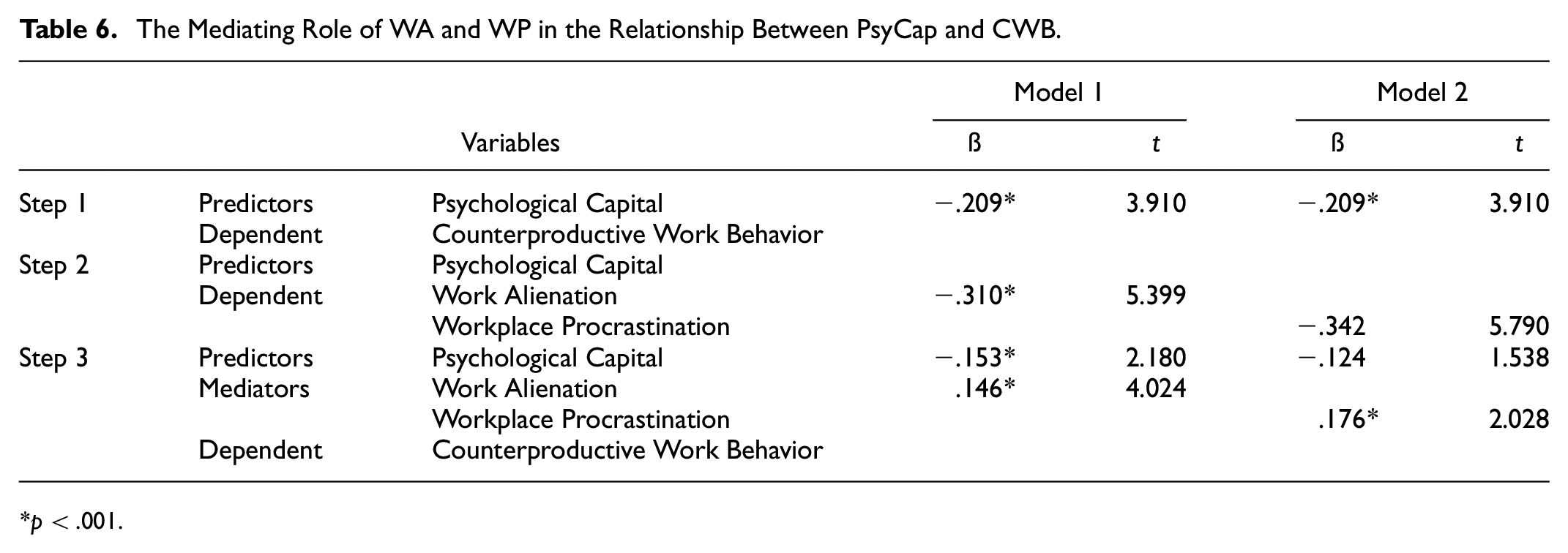
Hierarchical regression analysis was performed, as stated by Baron and Kenny (1986), to test the mediating roles of WA and WP variables in the research model. It was examined whether the effect of the independent variable (PsyCap) on the dependent variable (CWB) was significant. If this relationship is significant, then the effect of the independent variable on the mediator variable (WP, WA) is examined, and this relationship is expected to be significant as well. Finally, the independent and mediator variables are added together. At this stage, if the effect of the independent variable on the dependent variable is insignificant, the mediator variable is fully mediated. If this effect is significant but decreased, partial mediation is determined. Accordingly, to test the mediating effect of WP, firstly, the significance level of the direct effect of PsyCap on CWB was examined without the mediating variable, using the bootstrapping process in SmartPLS. Then, the mediating variable WP was included in the model, and the path coefficients and the significance level of the indirect effect were examined. If the indirect effect in the model is not significant, there is no mediating effect. The indirect effect must be significant for identifying the mediating effect. The results of the mediation test conducted within this framework are shown in Table 6.
The Mediating Role of WA and WP in the Relationship Between PsyCap and CWB.
p < .001.
The first step of Table 6 shows that PsyCap affects CWB negatively and significantly by −20.9% (β = −.209; p < .01). Therefore, the H1 hypothesis of the study was accepted. In the second step of Model 1, PsyCap affects WA −31% negatively and significantly (β = −.310; p < .01). So H2 hypothesis was supported. In the third step of Model 1, WA positively affected CWB, and the H4 hypothesis was supported. However, the effect of PsyCap on CWB decreased from −20.9% to −15.3% (β = −.153; p < .01). Accordingly, the H5 hypothesis was partially confirmed by determining the partial mediating role of WA in the relationship between PsyCap and CWB. In Model 2, PsyCap had a negative and significant effect on WR (β = −.342; p < .01). Thus, hypothesis H3 was supported. The third step of Model 2 determined that WP affected CWB by 17.6% (β = .176; p < .01), and It is seen that the effect of PsyCap on CWB is insignificant (p > .05). So, H6 and H7 hypothesis was supported. Accordingly, the mediating role of WP in the relationship between PsyCap and CWB has been determined. The H7 hypothesis of the study was supported.
Structural Model Test
Partial least squares path analysis was used to analyze the research model. The data were analyzed using the Smart-PLS 3.3.3. Regarding the research model, the PLS algorithm for calculating linearity, path coefficients, R2, and effect size (f2); Blindfolding analysis was also run to calculate the predictive power (Q2). To evaluate the significance of the PLS path coefficients, t values were calculated by taking 5,000 subsamples from the sample with bootstrapping. Regarding the research results, VIF, R2, f2, and Q2 values are presented in Table 7. When the VIF (Variance Inflation Factor) values between the variables were examined, it was understood that there was no linearity problem between the variables since the values were below the threshold value of 5. The R2 value of 0.25 and above indicates weak, 0.50 and above indicates moderate, 0.75 and above indicates strong explanatory power.
Research Model Coefficients.

The effect size (f2) is calculated for each exogenous variable and shows the shares of the exogenous variables in the disclosure rate of the endogenous variables. An f2 value of 0.02 and above is considered low, a value of 0.15 and above is considered medium, and a value of 0.35 and above is considered high (Yıldız, 2020). The fact that the predictive power coefficients (Q2) calculated for endogenous variables are greater than zero indicates that the research model has the power to predict endogenous variables (Silaparasetti et al., 2017). Since the Q2 values in Table 7 are greater than zero, it can be stated that the research model has the power to predict WA, WP, and CWB variables. Table 8 shows the direct effects of the variables.
Direct Effect Coefficients of Variables.

The effect of PsyCap on CWB (β = −.117; p > .05), the effect of WP on CWB (β = .137; p > .05), and the effect of WA on CWB (β = .076; p > .05) were insignificant. The effect of PsyCap on WP (β = −.341; p < .001) and the effect of PsyCap on WA (β = −.258; p < .001) was negative and significant. Table 9 shows the indirect effect coefficients of the variables.
Indirect Effect Coefficients of Variables.

According to the findings, the indirect effect of PsyCap on CWB via WA (β = −.020; p > .05) and indirect effect of PsyCap via WP on CWB (β = −.047; p > .05) are insignificant. Figure 2 shows the structural equation model and path coefficients.

Structural equation model.
Discussion
The proposed model enabled critical inferences about the antecedents of the CWB in the healthcare industry and the extent to which these antecedents interact. These implications can be discussed theoretically and practically. In this direction, firstly, explanations will be about the theoretical implications.
Theoretical Implications
Identifying personal factors that cause CWB can provide researchers with unique insights into solving the problem. For this reason, early research on CWB focused on the individual and organizational causes of the issue. For example, Miles et al. (2002) stated that negative emotions cause CWB. The authors emphasize that controllable workplace situations cause employees’ positive emotions, and uncontrollable problems cause negative emotions. However, considering the dimensions that make up the PsyCap, it is expected that employees with efficacy and hope will be able to change the insufficient in the workplace positively. Hence, the first hypothesis of the study predicted the negative effect of PsyCap on CW. According to analysis result, PsyCap affects CWB negatively and significantly by −20.9% (β = −.209; p < .01). Our findings showed that PsyCap is a critical resource for overcoming negative attitudes and behaviors in the workplace.
For this reason, the impact power of adverse conditions may cause CWB in enterprises with high PsyCaps to weaken or disappear. Our findings support this logic of the relationship between variables and consistent with Khattak and Rizvi’s (2021) study in the construction industry. The authors’ study revealed that when employees’ PsyCap empowerment increases, it leads to a decrease in the CWB environment, so organizational management should develop policies and practices that cause employees to increase their PsyCap. Employees with self-efficacy are more confident in dealing with job challenges. So, they are less likely to engage in CWB to cope with pressure or avoid tasks they think they can’t complete. Also, Kelloway et al. (2010) evaluated CWB as a protest behavior against organizational conditions such as injustice that employees are not satisfied with. When protest behaviors are examined within the framework of PsyCap’s resilience and optimism dimension, employees with powerful PsyCap’s are expected to manage this process by showing constructive behaviors instead of harmful behaviors to overcome unjust organizational practices. When faced with hardship or stress, health employees are less likely to engage in CWB to vent frustration or get revenge. Therefore, understanding resilient and optimistic employee behavior is critical in understanding the negative impact of PsyCap on CWB.
However, the employees’ personalities also have the potential to affect the cognitive, emotional, and behavioral stages of the CWB process. In this context, the CWB can affect employees’ perceptions and evaluations of the environment, their attribution of the causes of events, their emotional reactions, and their ability to inhibit aggressive and unproductive impulses (Spector, 2010). Based on this definition and considering that the PsyCap is an essential element that forms the employee’s personality that it can be predicted that the processes of perceiving, and interpreting the internal and external environmental conditions of the organization by employees with high and stable PsyCap capacity. Ahmad et al. (2019) state that a high PsyCap level is associated with decreased CWBs because optimistic and positive perceptions make individuals more friendly to colleagues than unpleasant. Our results are consistent with these arguments. Furthermore, when we evaluate this relationship from the perspective of COR, higher PsyCap can help individuals cope with the loss of resources and make them more resilient in challenging situations. Even PsyCap itself can be a substitute resource. In this context, we offer researchers a unique theoretical perspective in conceptualizing the causes of CWB and the relationships between these causes.
The second hypothesis of our study predicted the negative effect of PsyCap on WA. Our findings show that PsyCap affects WA −31% negatively and significantly (β = −.310; p < .01) and support the H2 hypothesis. Our findings are similar to the results of Vanderstukken and Caniëls (2021) study on Dutch EMPLOYEES. Also, Tummers and Den Dulk (2013) determined that the feelings of powerlessness and meaninglessness underlying WA in health organizations cause negative organizational outcomes. At the same time, Al Hosani et al. (2020) stated that employees’ negative emotions could lead to alienation. The emotional disconnect between the employee and the organization is challenging for management. Song et al. (2023) found the positive impact of compulsory citizenship behavior on the CWB. Our analysis results are consistent with previous research results. Employees with lower PsyCap may be more susceptible to WA, feeling disconnected and dissatisfied with their job duties and general work environment. Whereas healthcare workers with strong PsyCap are more likely to feel satisfied and engaged in their work because they have the psychological resources to overcome challenges.
Moreover, we argue that the PsyCap is a critical tool in preventing WP. In this respect, we found that PsyCap negatively affected WP, as predicted by the third hypothesis of our study. According to our result is a negative and significant relationship at a rate of 37.8% between PsyCap and WP (r = 0.378; p < .01). Our results consented with previous studies in different industries demonstrating that PsyCap negatively affects WP (Hazan-Liran, 2023; Lina et al., 2023; Saman & Wirawan, 2021). Prem et al. (2018) stated that procrastination might be related to personality, self-regulation and motivation, anxiety and depression, or task characteristics. These attributes can be observed in workers with low PsyCap. Individuals in the healthcare industry who possess high levels of PsyCap are likely to be more focused, motivated, and confident when completing tasks efficiently. Conversely, those with lower levels of PsyCap may struggle with procrastination due to negative thinking, self-doubt, and difficulty initiating and completing tasks. Therefore, it is an understandable point of view that the main predictor underlying our model’s logic is PsyCap.
The fourth hypothesis of our research claimed that WA had a positive effect on CWB. Accordingly, our findings showed the positive effect of WA on CWB. Our findings are similar to previous study results. Li and Chen (2018) determined the mediating effect of WA between psychological contract breach and CWB. In addition, Amzulescu and Butucescu (2021) determined the mediating effect of WA on the effect of perceived lack of justice on CWP. After considering the results of previous studies and our findings, it becomes clear that both positive and negative factors are associated with CWP. WA is a negative variable that plays a determining role in the strength of these relationships. Associating WA with devastating individual and organizational outcomes like CWB is a powerful theoretical approach based on empirical evidence.
At the same time, our fifth hypothesis test result supported the critical link of WA between CWB and PsyCap. According to Luthans et al. (2008), individuals and groups have higher positive emotions and can operate at more optimal cognitive and emotional functioning. In this context, it can be deduced that it is more difficult for optimistic employees to have negative feelings toward the organization. Our findings showed that while PsyCap negatively affected WA, WA positively affected CWB. However, we identified the partial mediating role of WA between PsyCap and CWB. Similar to our finding, Fatima et al. (2018) emphasize that WA has been proven to be an issue associated with adverse business outcomes. This result highlights another structure that has a role in reducing the effect of PsyCap on CWB. Therefore, we argue that researchers should focus on negative moderators that complicate these conceptual relationships and the predictors that should be focused on to reduce CWB.
Another factor affecting the emergence of CWB is the behavior of employees to procrastinate. The sixth hypothesis of the study predicted the positive effect of WP on CWB, and our hypothesis testing results supported this prediction. Many studies have examined the link between WP and adverse individual and organizational outcomes (Munjal & Mishra, 2019; Sirois & Pychyl, 2013), and evidence suggests that higher levels of procrastination are associated with increased engagement in CWB (Haider & Yean, 2023). Our result is consistent with the results of previous studies examining this relationship. Metin et al. (2018) stated that despite the limited research available in work settings, chronic procrastination is mainly associated with negative outcomes such as lower wages, shorter employment periods, and the tendency to be underemployed. According to Hen et al. (2021), when employees procrastinate, it can cause delays in job completion, jeopardize project success, and even encourage colleagues to procrastinate as well. In this context, our research model predicts that if procrastination is not prevented, it may lead to behaviors such as CWB that have more destructive consequences for the organization over time.
The seventh and final hypothesis of the study predicted that WP had a mediating effect between PsyCap and CWB. Hierarchical regression analysis results supported the mediating role of WP. From a psychological perspective on procrastination, procrastinators tend to be more excited, pessimistic, anxious, and unhappy in the long run and become bored (Gupta et al., 2012). In addition, Pearlman-Avnion and Zibenberg (2018) emphasize that the relationship between personal characteristics and procrastination behavior is not fixed; it is affected by different contexts and interacts with other personality traits (e.g., dysregulation of anxiety). On the other hand, understanding PsyCap found to reduce WP and implementing strategies to address it can help reduce the negative impact of CWP on employee performance and organizational results. According to our result, the critical mediation link of WP suggests that researchers should broaden their perspectives, examine the CWB and focus on different antecedents simultaneously.
Practical Implications
The study results have practical implications for Türkiye’s healthcare industry regarding terms of CWB control. The findings may help hospital administrators understand the dynamics of WA and WP behaviors causing CWB and the impact of PsyCap. Firstly, avoidance of CWB is a crucial dimension of work performance (Mercado et al., 2018). Therefore, researchers have proposed different solutions to overcome CWB. For example, Siegel et al. (2022) argued that electronic monitoring should be increased to prevent CWB. In this context, Ahmad et al. (2019) highlight the positive impact of abusive supervision on CWB. When our findings are evaluated from a managerial perspective, they offer practical solutions to the CWB problem for practitioners. When assigning appropriate tasks, leaders should consider employees’ skills, abilities, personal characteristics, values, and experiences (Kaymakcı et al., 2022). For this reason, managers are expected to focus on the psychological characteristics of the employees and to produce organizational behavior strategies that develop these characteristics to create meaning and value for the organization. For example, some perceptions of justice or equality (e.g., pay) may result in CWB through anger (Mercado et al., 2018). Therefore, employing high PsyCap capacity and positive and constructive perceptions toward organizational justice helps managers prevent such a difficulty.
Secondly, from a practical point of view, our results highlight that establishing a direct relationship between CWB and PsyCap does not offer sufficient insight to eliminate CWB. Gupta et al. (2012) argue that procrastinators fail to accomplish critical long-term tasks. According to the author, overwhelmingly, these people focus their attention on short-term goals. Therefore, insufficient time to complete long-term tasks that require careful consideration and planning breaks performance (Chauhan et al., 2020). In this direction, we determined that the behavior of procrastination can give leading signals to the managers for the CWB to be experienced in the future. Recognizing these early warning codes of behavior, managers can ensure that these negative behaviors are eliminated by implementing policies that help improve employee PsyCaps. In this context, giving instant feedback on procrastination behavior, updating work calendars by making routine meetings more frequent, measuring employees’ efficacy, and taking temporary measures can quickly reduce WP. However, recruiting candidates with high PsyCap levels is expected to reduce managers’ staff training and development burden.
Thirdly, based on the findings, we can conclude that employees with strong PsyCaps cannot prevent CWB in hospital employees. CWB should be approached holistically from a broader perspective, considering WP and WA. So much so that no matter how much managers invest in PsyCap to prevent CWB, it seems that it would be a logical managerial approach to support this investment by preventing employees’ WA and WP. According to Hussain et al. (2020), PsyCap is considered an internal characteristic of the employee required to build self-esteem, which may decrease negative behavior. Supporting the self-esteem of healthcare professionals can help them avoid behaviors that will damage this respect within the organization. For this reason, the WA of employees with a high PsyCap is expected to be low. Our analysis results confirmed this expectation and found that PsyCap negatively affects WA. Accordingly, our results warn managers to be aware of the positive pressure of WA and WP on the CWB and to develop managerial practices to prevent the pressure. In addition, our findings again underlined that PsyCap deficiency in employees is one of the critical individual factors that cause unfavorable organizational outcomes.
Limitations and Future Directions
Future studies should take into account the limitations included in this research. The present study was conducted with cross-sectional self-report measures of single hospital employees. Therefore, there are several restrictions. The first is that the study was carried out with the data obtained from the employees’ perceptions. It is a constraint worthy of questioning how objectively the participants gave answers in evaluating negative behaviors such as work alienation, work procrastination, and CWB. Also, collecting data on dependent, independent, and mediator variables from the same participant will likely cause common method bias. However, collecting data for different variables from different participants (supervisor, colleague, subordinate) in future studies may solve this potential bias. The second limitation of the study is that the study unit is a health organization. Testing the research model in other sectors can help develop different understandings of the strength of the relationship between variables. The third and final constraint is tested in a model country. Comparative retesting of the research model in different cultures and contexts may contribute to developing new theoretical and practical approaches. Lastly, research in organizational psychology and management needs to focus more on negative mediators in overcoming CWB.
Conclusion
This study explained the positive effect of PsyCap on the prevention of CWB in healthcare workers and the mediating roles of WA and WP in reducing this effect within the scope of COR theory. Overall, the current findings indicate that PysCap may have a negative effect on CWP and the mediating roles of WA and WP. Especially those working in the healthcare sector with harsh working conditions are exposed to WA. This negative psychological state can have devastating individual and organizational consequences. Therefore, the health sector needs employees with high PsyCap. At the same time, excessive work pressure caused by the sector’s structure, overtime, and stressful working environment may cause employees to show WR behavior. This behavior can trigger CWB in employees. PsyCap also plays a critical role in reducing WR. In this context, CWB, the most undesirable employee behavior for managers in an organization, is constantly triggered by WA and WP. The mediating effects of WA and WP continually diminish the power of PsyCap to prevent CWB. Therefore, health managers should consider the role of negative moderators by examining the psychological mechanisms that prevent CWB.
Footnotes
Acknowledgements
We thank all the participants who answered the questionnaire used in our research.
Declaration of Conflicting Interests
The author(s) declared no potential conflicts of interest with respect to the research, authorship, and/or publication of this article.
Funding
The author(s) received no financial support for the research, authorship, and/or publication of this article.
Ethics Statement
All procedures performed in this study involving human participants were conducted in strict accordance with the ethical standards of our institutional and national research committee. This study also adheres to the principles outlined in the 1964 Helsinki Declaration and its subsequent amendments, or equivalent ethical standards. All participants were provided with comprehensive information about the purpose of the research, the procedures involved, and their rights, including the right to withdraw at any point without any repercussions. Measures were taken to ensure the confidentiality and anonymity of the participants’ data.

Data Availability Statement
The data that supports the findings of this study is available on request from the authors. The data are not publicly available due to being obtained from a private institution in the health sector.