




Abstract
Sexism is often expressed in subtle and ambiguous ways, causing targets to doubt their own capabilities or to show stereotype-confirming behavior. This research examines whether the self-confidence and stereotype (dis-)confirming behavior of targets of sexism can be bolstered when other male versus female sources suggest that sexism may have played a role. Both Study 1 (N = 78) and Study 2 (N = 90) show that a suggestion of sexism has more beneficial effects when it is made by male sources than when it is made by female sources. When males suggested that sexism had taken place, targets reported more self-confidence (less self-handicapping and higher personal performance state self-esteem) and showed less stereotype confirmation (less self-stereotyping and better task performance) than when sexism was suggested by a female source. Study 2 additionally revealed that targets are more likely to file a complaint when men suggest that sexism took place than when this same suggestion was made by women. These results indicate that men can constitute important allies against sexism if they speak out when sexist treatment takes place.
Keywords
Introduction
Imagine that you are a woman who has just completed a job interview. As you reflect on your performance, you hear other candidates suggest that the interviewer seemed sexist. You then find out you are rejected for the job. How does this make you feel? Prior research has shown that a mere suggestion of sexism can have a range of harmful effects for those exposed to it (Adams, Garcia, Purdie-Vaughns, & Steele, 2006). This is because a suggestion of sexism introduces a social identity threat, that is, a reminder of the often negative and hostile views held about women in society (Steele, Spencer, & Aronson, 2002). This reminder has damaging effects for individual women and can induce a psychological state that actually promotes stereotype confirmation, for instance, through poor task performance. For example, Adams and colleagues (2006) showed that when it was suggested to female participants that sexist treatment may have occurred in an instruction situation, they reported a more negative experience and performed worse on a test than female participants who were not exposed to a suggestion of sexism (see also Schmitt, Branscombe, & Postmes, 2003, Study 2, and Schmitt & Branscombe, 2002, for a review of the negative psychological effects of discrimination).
However, other evidence indicates that a suggestion of sexism might at times be beneficial. Suggesting that sexism may have occurred can create a climate that condemns sexist treatment, thereby reducing sexist beliefs (Blanchard, Crandall, Brigham, & Vaughn, 1994), and it can communicate social support that has an important role in promoting collective protest for social change (Van Zomeren, Spears, Fischer, & Leach, 2004). Importantly, a suggestion of sexism can actually protect the self-confidence of individual women by helping to discount personal responsibility for a negative outcome (Major, Quinton, & Schmader, 2003; see Major, Quinton, & McCoy, 2002, for a review). Indeed, in one study, women who received negative feedback reported higher personal self-esteem when they heard a confederate suggest that the evaluator was sexist than when they did not hear such a suggestion (Major et al., 2003).
In sum, prior investigations of the effects of a suggestion of sexism have revealed rather mixed findings. Both harmful and self-protective effects of a suggestion of sexism have been documented on similar outcome variables, which can be seen as indicators of self-confidence and of stereotype confirmation. Our goal is to provide further evidence bearing on this topic and to examine a potential moderator of this effect. Specifically, we propose that a suggestion of sexism might have rather different effects depending on who makes it—whether the source of this suggestion is male or female.
Men as Allies Against Sexism
Although it is clear that men often voice discontent with the sexist treatment of women (see Tougas & Beaton, 2002, for a review), research on the consequences of this behavior is as yet scarce. What is currently known pertains to how male perpetrators react when men versus women confront them about their sexist behavior (Czopp & Monteith, 2003). This work showed that (male and female) sexist perpetrators were more likely to feel guilty and found the confronter more reasonable if they were confronted by men than if they were confronted by women. However, the point of view of the target has not been examined in prior research. Thus, we do not know how female targets react when men (vs. women) suggest that they might have been targets of sexism. Nevertheless, as long as it cannot be fully prevented or avoided that women are exposed to sexist treatment, it is as important if not more so to understand how they can be helped to best cope with such experiences.
A suggestion of sexism can protect individual women from the conclusion that they are incompetent, but it can also make clear that one’s social identity is not valued by others (see, for example, Adams et al., 2006; Major et al., 2003). Whether the negative or the positive potential will be realized is likely to depend on a series of factors (Major et al., 2002; Schmitt & Branscombe, 2002, for reviews of evidence bearing on both points). In the current research, we focus on the gender of those making the suggestion that sexism may have played a role. We propose that when men suggest that sexism has taken place, this is likely to have more beneficial effects on the target, compared with when the same suggestion is made by women.
To understand this prediction, it is important to consider that a suggestion of sexism can be threatening. This is the case first because reminding people that sexist views persist reinforces the notion that an important part of one’s identity (i.e., her gender) is devalued by others. Second, noting the existence of sexist treatment raises the expectation that one will be exposed to biased treatment on future occasions as well (Adams et al., 2006; see also Schmitt et al., 2003; Stroebe, Dovidio, Barreto, Ellemers, & John, 2011). When people perceive that they have subjected to prejudice by members of a given outgroup, they expect a similar treatment on future encounters with other members of that outgroup (Tropp, 2003). However, this is less likely to be the case when members of that same outgroup expose and label prior treatment as prejudicial. Indeed, males who point out that women might have been targets of sexism on one hand make salient that sexist treatment may re-occur, but on the other hand also convey that not all men are sexist or hostile toward women. As sexism is expected from males but less so from females (Baron, Burgess, & Kao, 1991), female sources who suggest that sexism has taken place only raise negative expectations about biased treatment in the future, and do little to alleviate the concern that other men might be sexist too. Based on this reasoning, we propose that when a male source suggests that sexism may have played a role, this is likely to have self-protective effects, while this is less likely to be the case when the same suggestion is voiced by a female source.
In sum, our main prediction is that when a suggestion of sexism is made by a male (vs. female) source, this reduces the social identity threat implied in acknowledging group-based discrimination, and makes it easier for targets to engage in self-protective responses. As such, a suggestion of sexism made by a male source is likely to induce more self-confidence after negative feedback than when this suggestion stems from a female source. This is akin to what happens when discrimination is presented as rare instead of as pervasive: While discrimination perceived as pervasive seems to have mainly negative effects on well-being, targets can profit from attributing a negative outcome to discrimination that is seen as a rare occurrence, which helps them protect their self-esteem (Schmitt et al., 2003; see also Cihangir, Scheepers, Barreto, & Ellemers, 2013; Foster, 2009; Schmitt, Branscombe, Kobrynowicz, & Owen, 2002; Stroebe et al., 2011). The novelty of the approach we take in this article is that we propose a similar effect without changing anything about what is suggested (i.e., about the frequency of occurrence), but merely as a consequence of who indicates sexism may have played a role.
Overview of the present research
In two studies, we examined responses of individual women to a suggestion of sexism depending on whether it was made by male or by female sources. We tested our predictions in a job-interview paradigm where women were exposed to subtle sexism in all conditions (through gender-biased questions allegedly posed by the interviewer) and subsequently to a suggestion that sexism may (not) have played a role, which was made by a group of either males or females. We chose to focus on a situation of subtle sexism because such a situation makes both a suggestion of sexism and the lack thereof plausible for the participants. This choice has important implications. Prior research has shown that exposure to subtle stereotypes or prejudice creates a “threat in the air,” which is associated with harmful effects on variables related to self-confidence and to stereotype confirmation (Steele & Aronson, 1995; see Steele et al., 2002, for a review). As all participants were exposed to subtle sexism, we expected relatively low scores on measures assessing these outcomes when no suggestion of sexism was made. When a suggestion of sexism was voiced, we expected higher self-confidence and less stereotype confirmation, in particular, when the source of the suggestion was male rather than female.
Self-confidence was tapped in Study 1 with a measure of self-handicapping to which in Study 2 we added a measure of state performance self-esteem. While personal state performance self-esteem assesses self-confidence quite directly (Heatherton & Polivy, 1991), self-handicapping does so more indirectly. People who self-handicap pave the way for attributions to failure that do not reflect lack of competence, for example, by stressing a momentary physical illness, lack of effort, or the role of external factors (Jones & Berglas, 1978; Rhodewalt, 1990). In this sense, and when associated with the likelihood of failure, self-handicapping is a form of discounting, but unlike attributional discounting, discounting through self-handicapping is prophylactic (Urdan, 2004), but potentially self-destructive. To our knowledge, this outcome has never been studied in the context of examining the impact of discrimination on its targets and is thus another novel contribution of this research. Less self-handicapping is expected when performance is less threatening to the individual, or when the individual is more confident in his or her ability to perform well (McCrea, Hirt, & Milner, 2008). We expect this to be the case when male sources voice a suggestion of sexism. In sum, we expect less self-handicapping (Studies 1 and 2) and higher personal state performance self-esteem (Study 2) when male sources suggests that sexism has taken place than when female sources make the same suggestion (Hypothesis 1).
We also included two indicators of stereotype confirmation: stereotypical self-descriptions (Studies 1 and 2) and task performance (Study 2). In the bogus job-interview paradigm used in these studies, participants confirm the negative stereotype of which they were target if they describe themselves in line with the female stereotype and if they underperform on a task that is presented as a check of whether or not the interviewer made the correct (gender stereotypical) decision. In line with research on stereotype threat, we expected exposure to subtle sexism to lead to stereotype confirmation (i.e., more self-stereotyping and poorer task performance). We did not expect a suggestion of sexism made by women to alter this situation. However, we expected less self-stereotyping and better task performance for participants who were exposed to male sources who suggested that sexism had taken place (Hypothesis 2).
In both studies, we also measured causal attributions for the rejection (to lack of competence or to gender discrimination). We did this to rule out the possibility that the effect of the source of the suggestion of sexism on self-confidence and stereotype confirmation would relate to differential attributions of the rejection to discrimination, due to the gender of the source. Indeed, we expected that in a context of subtle sexism, any cue that sexism might have taken place should make such an attribution more likely, irrespective of the source (Major et al., 2003). Thus, we expected that whether or not a suggestion of sexism was made would affect attributional discounting, but this would not depend on the gender of the source of the suggestion (Hypothesis 3).
In Study 2, we additionally examined the likelihood that participants would file a complaint against the treatment received as a function of the manipulations. On one hand, as social support from ingroup members has been shown to be an important precursor of (collective) protest (Van Zomeren et al., 2004), one might expect that a suggestion of sexism from female sources would make it more likely that participants would file a complaint than any other condition. However, because in the situation we examined the focus was on individual outcomes against which a complaint could be made, the possibility of collective protest was less salient. In this type of context, one might also expect that participants would be more inclined to file a complaint when they felt best about themselves and their abilities, and were the least convinced that the stereotype of which they were target was applicable to the self. If so, then one should expect that participants would file most complaints when a male source suggested sexism. Prior research has shown that outgroup sources are likely to disapprove of complaints that discrimination has taken place (Dodd, Giuliano, Boutell, & Moran, 2001; Kaiser & Miller, 2001), and that targets tend to refrain from making such claims in front of outgroup audiences (Stangor, Swim, Van Allen, & Sechrist, 2002; Swim & Hyers, 1999). However, research so far has not contemplated the possibility that this might be different when the suggestion that discrimination has taken place actually stems from outgroup members. Thus, a novel aspect of the present research is that we compare the effects of suggested sexism made by male versus female sources.
Before reporting on the main studies, we describe a pilot study that was conducted to test whether the method we developed to manipulate suggestions of sexism from male versus female sources would differ only in the extent to which these sources affect perceived pervasiveness of sexism, and not in other relevant ways. It seemed particularly important to test whether the male and female sources were seen as equally credible and equally trustworthy. Also, given existing research on the derogation of women who claim to be targets of sexism (e.g., Dodd et al., 2001; Kaiser, Hagiwara, Malahy, & Wilkins, 2009), we assessed whether male and female sources would be differently evaluated, in general, or seen as complainers, in particular. We did not expect this to be the case because, differently from past research on this topic, the sources in this study were neither confronting the perpetrator, nor making attributions for their own outcomes, but instead they were simply suggesting that sexism might have been a cause for the outcomes received by the female participant. Still, it seemed important to directly test whether or not this was the case.
Pilot Study
A total of 61 Dutch females studying at Leiden University, with an average age of 21.56 (SD = 1.46 years) took part in this online study. The study was programmed in an online survey tool designated as NetQ. Participants were approached by an experimenter and given the link to the online study if they agreed to participate.
Participants read a vignette describing the context that would be experienced by participants in the main study. Participants imagined that they were taking part in a job interview and subsequently received a negative feedback. Participants then imagined that they met three other candidates who told them that they thought that the interviewer might be sexist and that the participants’ rejection might have been due to sexism. For half of the participants, the source of sexism was three other women, while for the remaining participants the source was three men. Participants then answered a range of questions about this vignette. Specifically, participants indicated the percentage of men they estimated to be sexist in Dutch society. Participants also indicated what they thought of the three males/females who suggested that sexism might have been the cause of the rejection: their general evaluation of the sources, the extent to which they were credible, the extent to which their comments reflected what they really thought, and the extent to which they saw them as trustworthy, sincere, honest, problematic, difficult, or complainers (all responses were made on 7-point rating scales ranging from 1 = not at all to 7 = very much, unless otherwise indicated). Analyses of mean differences with t tests for independent samples revealed only one reliable difference between the male and female sources: When the suggestion of sexism stemmed from a female source, participants estimated that the majority of Dutch men were sexist (M = 59.19%, SD = 21.61%), while this dropped significantly when sexism was suggested by male sources (M = 44.74%, SD = 26.41%), t(59) = 2.29, p < .05. Male and female sources were thus seen as equally credible (overall M = 4.50, SD = 1.50), trustworthy (overall M = 3.96, SD = 1.18), sincere (overall M = 4.55, SD = 1.42), honest (overall M = 4.57, SD = 1.40), problematic (overall M = 3.58, SD = 1.49), difficult (overall M = 4.25, SD = 1.53), or complainers (overall M = 4.92, SD = 1.58), and their comments were seen as reflecting what they really thought to an equal extent (overall M = 4.78, SD = 1.47). Study 1 employs the same manipulation of source of sexism and adds as control a condition where the sources do not mention that sexism might have played a role in their rejection.
Study 1
Method
Design and participants
The study consisted of a 2 (Suggestion of sexism: yes. vs. no) × 2 (Gender of source of the suggestion: male vs. female) between-participants factorial design. Participants were 78 female students at Leiden University with a mean age of 21. Each session of the experiment lasted approximately 40 min, after which all participants were fully debriefed and received 4 Euros (approximately US$5.50) for their participation.
Procedure
All participants were seated in separate cubicles and were equipped with personal computers. We used a bogus job-interview paradigm in which participants were asked to act as though they were being interviewed for a job to help us train interviewers (see also Cihangir, Barreto, & Ellemers, 2010). After the computer made a (simulated) connection with the interviewer but prior to the interview, some personal information about the interviewer was provided to the participant (Last name and title: Drs. Zomeren; 30 years old). Next, participants received the 10 interview questions, which indirectly referred to the participants’ gender identity (e.g., do you dress yourself attractively to influence other people?). Once the interview was finished, the interviewer indicated that some time was needed to decide whether the participant in question would be selected. While they ostensibly waited for the interviewer’s decision, we told the participant that she could use the computer to chat about the interview with three other participants who allegedly participated in the same interview procedure. We used three common Dutch female names in the condition where the source was female and three common Dutch male names in the condition where the source was male. Participants were then asked to enter their names into a login screen. Next, they saw three other names and their own name appearing below a screen, which contained a chat room. We manipulated the presence versus absence of a suggestion of sexism by pre-programming what the three other alleged participants said. In the condition where others suggested sexism, the messages made clear that the others “disliked the interview procedure because it was placing women at a disadvantage,” “disliked the interviewer who seemed to be unfriendly toward women,” and “thought the interview questions were not appropriate for women who were applying for the position.” In the condition where no suggestion of sexism was made, the others indicated that they “approved of the interview procedure because it seemed appropriate,” “considered the interviewer to be an experienced person to conduct this kind of interview,” and “found the interview questions appropriate for selecting people for this kind of position.” In both conditions, we also included information in the messages that was unrelated to the selection procedure (e.g., “I feel like having a coffee, anyone joining me when this is finished?”), to increase credibility and to avoid suspicion about the goals of the study. After three rounds of information exchange, the session was ended and the participants were asked to answer some questions about the other people with whom they had supposedly been chatting. This included some filler questions and questions that were meant to check for the effectiveness of the manipulation of the suggestion of sexism. Next, we told participants that the interviewer had come to a decision and the connection with the interviewer was renewed. In all conditions, the interviewer told participants, “I am sorry to inform you that you are not selected. You did not answer the crucial questions properly.” We used this ambiguous rejection on the basis of gender-biased interview questions in all conditions to induce subtle sexism (see Cihangir et al., 2010). After participants read that they were rejected, the connection with the interviewer was supposedly terminated, and the participants were asked to answer a set of questions about the interview procedure (manipulation checks and dependent variables). We explained that these questions could serve to improve the selection procedure, assured participants that neither the interviewer nor the other interviewees could see their answers, and urged them to respond honestly to all questions.
Dependent variables
All responses were made on 7-point rating scales ranging from (1) not at all to (7) very much, unless otherwise indicated. We checked for the effectiveness of the manipulation of the suggestion of sexism by asking participants to what degree others were critical of the interviewer, of the interview procedure, and of the interview questions (last item recoded; α = .99). To check the effectiveness of the source manipulation, we asked participants to indicate the gender of the other interviewees with whom they had been chatting. Participants’ own attributions to discrimination were measured with four items (the selection decision that was made was the result of gender discrimination, this selection procedure disadvantages women, there was clearly discrimination in this procedure, the selection made was due to prejudiced questions, α = .91), and attributions to (lack of) personal competence were measured with two items (the selection decision that was made was due to my performance/to my competence, r = .39, p = <.001). A principal components analysis confirmed that attributions to discrimination and attributions to personal competence loaded on different factors that together explained 76.32% of variance in the individual items (all items loaded at least .82 on their respective factor).
The measurement of self-handicapping is best achieved, if it refers to an upcoming task. Accordingly, we first informed participants that we were interested in ascertaining to what extent the interviewer had made a correct decision and that they would be asked to perform an additional task to help us do that (see also Cihangir et al., 2010). We told participants that we needed some information about themselves before they could start working on the task. The questions for additional information contained the self-handicapping and self-stereotyping measures. Self-handicapping was measured with 12 items adapted from Rhodewalt (1990; see also Cihangir et al., 2010), which consisted of items such as “I am nervous about the upcoming test,” “I am easily distracted during this type of test,” or “I am hungry” (α = .80). The self-stereotyping measure consisted of nine female stereotypical traits, which were adapted from the Dutch version of the Bem sex roles inventory (Bem, 1974; Willemsen & Fischer, 1997). The traits were as follows: dependent, considerate, understanding, indecisive, emotional, over-sensitive, romantic, sentimental, and caring (α = .68). Once participants had answered these questions the experiment ended, participants were debriefed and compensated for their participation.
Results
Unless otherwise indicated, all variables were analyzed with a 2 (Suggestion of sexism: yes vs. no) × 2 (Gender of source of suggestion of sexism: male vs. female) between-participants ANOVA.
Manipulation checks
Participants indicated that the three other interviewees were more critical of the procedure, the interviewer, and the interview questions when they suggested sexism (M = 6.69, SD = 0.40), than when they did not (M = 1.58, SD = 0.68), F(1, 74) = 1,616.18, p < .0001,
Attributions
Participant’s own attributions of the outcome to discrimination and to (lack of) personal competence were analyzed with a MANOVA. This analysis revealed a multivariate main effect of the suggestion of sexism, F(2, 73) = 13.35, p < .001,
Self-handicapping
We submitted the self-handicapping measure to a between-participants ANOVA. This analysis revealed only a reliable two-way interaction between the two factors, F(1, 74) = 8.43, p < .005,
Descriptive Statistics and Indication of Simple Effects for the Dependent Variables in Study 1.
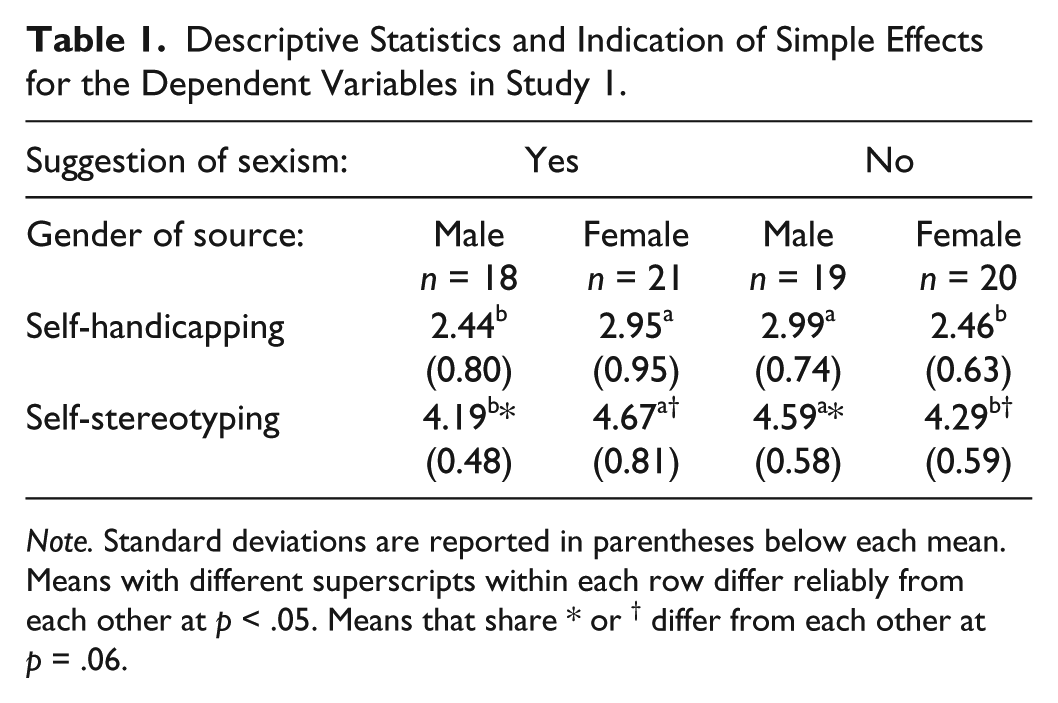
Note. Standard deviations are reported in parentheses below each mean. Means with different superscripts within each row differ reliably from each other at p < .05. Means that share * or † differ from each other at p = .06.
Self-stereotyping
An ANOVA on this measure only revealed a reliable interaction between the two factors, F(1, 74) = 7.47, p < .01,
Discussion
In line with our hypotheses, the results of this study indicate that the effect of a suggestion of sexism on self-confidence and stereotype confirmation is moderated by the gender of the source of this suggestion. When men suggested that sexism had taken place, participants reported less self-handicapping and less self-stereotyping than when the same suggestion was made by female sources. Also, consistent with the findings reported by Adams et al. (2006), a suggestion of sexism by a female source was even counter-productive, leading to more self-handicapping and more self-stereotyping than when no such suggestion was made. A novel contribution of the present research is that a suggestion of sexism by a male source had self-protective effects, in that it led to less self-handicapping and less self-stereotyping than no suggestion of sexism—although admittedly this contrast was only marginally reliable for self-stereotyping.
It is also important to note that a suggestion of sexism (vs. no suggestion) was equally influential of participants’ attributions, irrespective of the gender of the source. That is, the effect of the gender of the source of the suggestion cannot be attributed to a heightened (or reduced) awareness that sexism might have taken place. Instead, we propose that a suggestion of sexism can provide targets with an opportunity to protect their self-confidence but only when it is accompanied by the demonstration that male hostility toward women is not inevitable. While prior research has shown a similar effect by varying the extent to which sexism was described as rare or as pervasive (Schmitt et al., 2003; Stroebe et al., 2011), our research shows that the impact of people’s exposure to an identical sexist treatment can also differ, depending on who acknowledges the possibility of sexism.
Although our focus in this study was on how source modifies the effects of a suggestion of sexism, we included as control two conditions in which male or female sources did not suggest that sexism might have been a cause for the rejection. We found an inversion of the source effect in these conditions, such that female participants self-handicapped and self-stereotyped to a greater extent when the others were males than when they were females. Although at first sight this might seem inconsistent with prior research on stereotype threat, it is important to note that this study was not designed to test stereotype threat effects, so it does not include the standard “no threat” condition which makes such comparisons possible. Indeed, gender stereotypes were made salient in all conditions, through the gender-biased interview questions used by the interviewer. Instead, the pattern we found is in fact consistent with prior research, showing that the mere presence of men can be threatening for women, as they anticipate being devalued by them—as long as there is no explicit information to contradict this (e.g., Inzlicht & Ben-Zeev, 2000; Sekaquaptewa & Thomson, 2003). This can lead to lower self-confidence and poorer performance compared with a situation in which no men are present. This explanation and findings of prior research are consistent with the source effects we obtained in this research when no suggestion of sexism was made. Importantly however, these processes emerge due to the inferences women make about men’s attitudes toward them when more concrete information about their attitudes is lacking. Consequently, such inferences become irrelevant when participants are explicitly told what the male sources really think—in our research, this was the case when the men present suggested that sexism may have taken place.
Study 2
Study 2 was designed to replicate and extend Study 1 with a slightly different experimental manipulation and additional measures. In Study 1, we compared what happened when others suggested that sexism had taken place with what happened when others approved of the selection procedure. In Study 2, sexism was mentioned in all conditions, but it was either suggested that sexism had played a role or that it had not. This allows us to further examine whether merely mentioning sexism might lead to self-protective effects (by raising awareness that it is a possible cause of the negative outcome), or whether the effects observed indeed depend on other people’s suggestions as to whether or not sexism may have played a role (the way others judge the situation), as well as whether these others are male or female, as we predicted. An additional goal of Study 2 was to relate these novel findings to two indicators of self-confidence and of stereotype confirmation that are commonly used in this literature: personal self-esteem and task performance. As in Study 1, we expected to find less self-handicapping and higher self-esteem (as indicators of self-confidence, Hypothesis 1) but also less self-stereotyping and better task performance (as indicators of stereotype (dis-)confirmation, Hypothesis 2) when a suggestion of sexism is made by male sources than when it is made by female sources.
Similar to Study 1, we expected more attributions to discrimination and less attributions to personal failure when others suggest sexism than when others deny sexist treatment, and anticipated that this would occur regardless of who makes this suggestion (Hypothesis 3). Finally, we examined the extent to which participants would file a complaint against their treatment, as an additional indicator of how others’ suggestions affect the way targets respond to discriminatory treatment.
Method
Design and participants
The study followed a 2 (Suggestion of sexism: yes vs. no) × 2 (Gender of the source of the suggestion of sexism: male vs. female) between-participants factorial design. Participants were 90 female students at Leiden University with a mean age of 20. Each session of the experiment lasted approximately 45 min, after which all participants were fully debriefed and received 4.50 Euros (approximately US$6.22) for their participation.
Procedure
The procedure of this study was identical to that of Study 1, except that in the “no suggestion of sexism” condition instead of others simply approving of the procedure, they explicitly indicated that no sexism had taken place. Specifically, in this condition others allegedly indicated that they “liked the interview procedure because the procedure was well designed for women as well as for men,” that they “liked the interviewer who seemed to be friendly towards women,” and that “the interview questions seemed appropriate for women who were applying for the position.”
Dependent measures
All responses were made on 7-point rating scales ranging from (1) not at all to (7) very much. The effectiveness of the manipulations was checked with the same items as in Study 1 (three item checked the manipulation of others’ comments, α = .97 and one item checked the gender of the source). The same scales as in Study 1 were used to measure attributions (attributions to discrimination: α = .94; attributions to [lack of] personal competence: r = .39, p < .001).
We used an abbreviated version of the self-handicapping scale used in Study 1 (five items; α = .64) and the same self-stereotyping scale as in Study 1 (α = .68). We measured performance state self-esteem (PSSE) with items from the Heatherton and Polivy (1991) State Performance Self-Esteem subscale (α = .80). We assessed performance in an IQ-test consisting of 15 items that were selected from existing IQ-test questions. All participants received 10 min to complete the task. We stressed that this performance task would help us evaluate the decision of the interviewer and that their performance on this task would potentially enable the participant to be selected despite the interviewers’ decision. After they finished this task (or after the time allotted for this task had elapsed), we presented participants with a binary choice to communicate whether or not they wanted to file a complaint against the selection decision (“Yes, I wish to complain” or “No, I do not wish to complain”). At this stage, participants who indicated a wish to file a complaint were actually provided the opportunity to do so by completing and submitting a message indicating their protest about the interview procedure via the computer. That is, participants were given the chance to complain at the very end of the study, after having responded to all other questions and performed the task. The possibility to file a complaint was not mentioned to participants before they reached this final stage of the study. Participants who did not file a complaint were given the score 0, while participants who submitted a complaint were given the score 1.
Results
All variables were analyzed with a 2 (Suggestion of sexism: yes vs. no) × 2 (Source: male vs. female) between-participants (multivariate) ANOVA, unless otherwise indicated.
Manipulation check
Participants reported that the three other interviewees were more satisfied with the procedure, with the interviewer, and with the interview questions when they denied sexism (M = 6.42, SD = 0.70) than when they suggested sexism (M = 1.47, SD = 0.74), F(2, 86) = 1,039.73, p < .0001,
Attributions
We submitted attributions to discrimination and attributions to personal competence to a between-participants MANOVA. These analyses revealed a multivariate main effect of the suggestion of sexism, F(2, 85) = 8.59, p < .001,
Self-handicapping and PSSE
The two indicators of self-confidence were analyzed with a between-participants MANOVA, which only revealed a reliable interaction between the two factors, F(2, 85) = 4.30, p < .05,
Descriptive Statistics and Indication of Simple Effects for All Dependent Measures in Study 2.

Note. Standard deviations are reported in parentheses below each mean. Means with different superscripts within each row differ reliably from each other with p < .05. Means with * are different at .05 < p < .12. For complaints filed, numbers indicate amount of participants in each condition who filed a complaint.
With regard to self-esteem, the results show that female participants reported reliably lower self-esteem when women suggested sexism than when men suggested sexism, whereas there was no effect of source when no suggestion of sexism was made (see Table 2 for the means and the indication of the reliability of simple effects). In addition, when the source was female, a suggestion of sexism led to lower self-esteem than when no suggestion of sexism was made, whereas when the source was male a suggestion of sexism led to higher self-esteem than when no suggestion was made. This is consistent with our hypotheses and with the results of Study 1.
Self-stereotyping and task performance
We submitted the two stereotype confirmation measures to a between-participants MANOVA. This analysis only revealed a multivariate interaction between the two factors, F(2, 85) = 4.33, p < .05,
With regard to task performance, the results showed that when men suggested sexism, female participants showed reliably better task performance than when women made the same suggestion, while there was no such effect of source when sexism was not suggested (see Table 2 for means and simple effects). In addition, when the source was male, a suggestion of sexism led to better performance than when no suggestion of sexism was made. No other contrasts were reliable for this measure.
Filing a complaint
Logistic regression on the dichotomous scores of complaints filed revealed a reliable interaction between the suggestion of sexism and gender of source, B = 1.87, Wald’s χ2(1, N = 90) = 4.50, p < .05. When men suggested sexism, participants were more likely to file a complaint than when women did so, B = −1.59, Wald’s χ2(1, N = 45) = 6.09, p < .05. Filing a complaint was not affected by gender of the source when sexism was not suggested, B = 0.28, Wald’s χ2(1, N = 45) = .22, ns. Also, participants filled more complaints if a male source suggested than if it did not suggest sexism, although this was only marginally reliable, B = 1.13, Wald’s χ2(1, N = 45) = 3.21, p = .07. Whether a female source suggested or did not suggest, sexism did not affect the extent to which complaints were filled, B = −.74, Wald’s χ2(1, N = 45) = 1.44, ns.
Discussion
The results of this study replicate and extend the results of Study 1 with a slightly different procedure and additional measures. In line with Hypotheses 1 and 2, the results again indicate that a suggestion of sexism from a male source has more beneficial effects on targets than a suggestion of sexism from a female source. This study established this effect on the same variables used in Study 1 to assess self-confidence and stereotype confirmation but also extended it to two additional indicators that are commonly studied in this literature: personal state performance self-esteem and task performance. When male sources suggested that participants might have been targets of sexism, participants self-handicapped less, reported higher personal state performance self-esteem, self-stereotyped less, and performed better than when the exact same suggestion was made by female sources. Because this study compared the suggestion of sexism with a condition in which the possibility of sexism was also mentioned but rejected by others, this provides further evidence that the effects observed are indeed caused by other people’s judgments of the situation–not by the mere fact that targets are made aware of the possibility of sexism.
In a different way, in line with the findings of Study 1 and those reported by Adams et al. (2006), our findings also indicate that a suggestion of sexism by a female source can even be counter-productive as it lowers self-esteem and (marginally) increases self-handicapping. Again, new to this article but in replication of what we found in Study 1, a suggestion of sexism by male sources had quite the opposite effect, increasing self-esteem and improving task performance, compared with when no suggestion of sexism was made.
As in Study 1, gender of source did not affect causal attributions, or attributional discounting, which only depended on whether or not a suggestion of sexism was made. Again, this excludes the possibility that the effects observed are driven by differences in participants’ own perceptions of the situation, in line with our reasoning. Importantly, this study also extended the findings of Study 1 by showing that targets were most likely to file a complaint about the way they were treated when they had heard a suggestion of sexism from a male source. This supports the idea that when male sources suggest sexist treatment, this creates an environment where sexism is condemned and complaints of sexism are not necessarily frowned upon (Blanchard et al., 1994). In such circumstances, female targets are less likely to expect to endure social costs for filing their complaints. This is not communicated when a female source suggests that sexism has taken place because women’s reactions are not the ones that are feared by female targets of sexism (Dodd et al., 2001; Kaiser & Miller, 2001).
General Discussion
Suggestions of sexism have the potential both to harm and to protect their targets. Whether one or the other effect will take place is likely to depend on a range of variables (see Major et al., 2003, for a review). The studies reported in this article extend prior research by indicating that when others suggest sexism may have played a role, this can have different effects depending on whether these others are men or women. Results of a pilot study showed that a suggestion of sexism made by men led to lower perceived pervasiveness of sexism than a suggestion of sexism made by women. Importantly, male sources of a suggestion of sexism were not perceived differently than female sources on a range of measures tapping into their credibility, trustworthiness, general evaluation, and impression as difficult, problematic, or complainers. Moreover, the results of the main studies show that a suggestion of sexism from male sources was associated with higher self-confidence and less stereotype confirmation, than when the very same suggestion was made by female sources. This is consistent with the proposition that a suggestion of sexism introduces a social identity threat that includes the idea that men are generally hostile toward women (Adams et al., 2006). If this is indeed true, then such a threat should be reduced when there is evidence that men can instead be allies against sexism. This is what happens when a male source suggests that a female might have been the target of sexism. In this situation, the threat experienced by the suggestion of sexism must be measured against the potential this suggestion has to protect target’s self-confidence. When the suggestion stemmed from male sources, our participants experienced a lift in self-confidence compared with when the suggestion was made by female sources. This is also what happened in earlier studies when gender discrimination was either described as rare or as pervasive: Although discrimination described as pervasive was mainly harmful, targets were willing to reap the benefit of discrimination that was described as rare to protect their self-image (e.g., Schmitt et al., 2003; Stroebe et al., 2011). The current studies extend this past research because instead of varying how discrimination was described, we merely varied who suggested that it might have taken place.
It is important to note that self-confidence and stereotype confirmation were neither affected by any main effects of the group membership of the source, nor by main effects of the suggestion of sexism, but only revealed reliable interactions between the two factors. This is consistent with our theoretical reasoning and rules out the possibility that results might have been simply due to effects of gender of source on salience of gender identity or of the suggestion of sexism on generalized mood.
These studies also extend past research by illuminating some of the factors that might facilitate complaints of discrimination. At first sight, this finding may seem inconsistent with work showing that support from fellow ingroup members is an important factor in people’s decision to engage in protest (Klandermans, 1997). However, this previous work focused on engagement in collective protest and participation in the activities of political interest groups, which is different from the situation we studied. Notably, we studied a job-interview context in which people only are informed about their individual treatment and individual outcomes, and where collective action was not an option. In such situations occurring in real life, participants could individually file a complaint if they did not agree with the way they were treated. Thus, our findings complement prior work: Whereas support from other ingroup members may facilitate participation in collective protest, the current results suggest that support from the outgroup may help people protest against their individual treatment. This extends past evidence showing that people are reluctant to report the discrimination of which they are target (e.g., Swim & Hyers, 1999), especially to outgroup members (Sechrist, Swim, & Stangor, 2004), and that this is likely to be linked to the social costs that are associated with making such claims, particularly to members of the outgroup (Dodd et al., 2001; Kaiser & Miller, 2001). We found that our female participants were most likely to file a complaint when they heard male sources suggest that they might have been targets of sexism than when they heard female sources make the same suggestion. Thus, female targets were more likely to file complaints of discrimination, when it was clear that at least some outgroup members would be likely to support their claims. This suggests that social support from dominant group members may be just as important as social support from ingroup members (the latter illustrated, for example, by Van Zomeren et al., 2004)—albeit for different reasons—and underlines the important role of outgroup allies in promoting social change.
There are admittedly some limitations to this research. First, although the manipulation of gender of source (male vs. female) is rather self-evident, the effects obtained are likely to stem from expectations about the prevalence of sexism that were only measured in the pilot study. As such, it was not possible to test their mediating role. Now that we have established that male versus female sources have a different impact on the way targets respond to sexism, future research can further investigate the mediating processes associated with these differential effects. Second, our research only presented the opinion of a relatively small (three individuals) group of males versus females, who were present in the same context. While this type of situation is likely to occur in real life (e.g., with one’s direct colleagues commenting on events and decisions in the workplace), it is also possible that similar comments are voiced by a single individual (e.g., one’s partner or best friend), by mixed gender sources (where people might be particularly sensitive to the opinion of males present in this group), or by larger groups of people who form their opinion based on the account provided by the target instead of witnessing the situation themselves. Future research might explore whether the suggestion of sexism can also impact on targets’ responses when voiced by these different types of sources. Finally, it is important to note that these studies focused on a situation of subtle sexism, and our findings must be understood in this context. We think that this is valid, because this is the type of sexism that is currently most prevalent and also most pernicious in the effects it has on its targets. Nevertheless, future research might examine whether similar effects are obtained when a suggestion of sexism appears less plausible, or whether targets’ responses are equally dependent on the opinions of others when the occurrence of sexism is more unambiguous. In addition, the targets in the current study were female university students who faced gender discrimination despite their educational qualifications. Replications of the current effects in other contexts with targets from different social backgrounds could improve the robustness and validity of our effects in other types of situations where sexism might play a role. Also, the current study focused on gender of the source as an explanatory variable of interest. Future research might additionally examine other explanatory variables that might moderate the impact of suggesting sexist treatment, such as prior career experiences of the target, or social support received from family or friends (see Barreto, Ellemers, Cihangir, & Stroebe, 2009; Schmitt, Branscombe, Postmes, & Garcia, in press, for a meta analytic review on the effects of perceived discrimination on well-being).
In sum, this research demonstrates that men can constitute important allies against sexism not only because perpetrators are more likely to feel bad about their sexist beliefs when confronted by males (as documented by Czopp & Monteith, 2003) but also because a suggestion of sexism from male sources is more beneficial for its targets and potentially more instrumental in reducing gender inequalities.
Footnotes
Declaration of Conflicting Interests
The author(s) declared no potential conflicts of interest with respect to the research, authorship, and/or publication of this article.
Funding
The author(s) received no financial support for the research and/or authorship of this article.