




Abstract
The Hollywood narrative film is often viewed as an overall causal relationship driven by the protagonist’s pursuits. Contrary to this point of view, this study treats the Hollywood narrative film as a complex of primary and secondary causal relationships dominated by protagonists and supporting roles, respectively, and proposes to use the protagonist-led causal relationship to segment the Hollywood narrative film. The paper also advocates the use of visual, verbal, and aural performance cues to demarcate primary and secondary narrative units. The narrative units obtained through this segmentation method can be used to study Hollywood narrative film development, characters, and the relation between narrative and performance. This paper selects four Hollywood films (Roman Holiday, Interstellar, Joker, and Lolita) representing different narrative paths to test the segmentation method. The validation process shows that the proposed method can effectively segment linear and non-linear Hollywood narrative films and distinguish narrative units. However, this study only applies the proposed segmentation method to limited Hollywood narrative films. Larger-scale validations are required in the future to test the effectiveness of the method and further refine it.
Plain language summary
This study examines how the protagonist-led causal relationship segments linear and non-linear Hollywood narrative films and how performative clues signify narrative unit boundaries. In order to achieve the research objectives, this study first proposes a Hollywood narrative film segmentation method, and then applies the method to small-scale Hollywood films with different running times and narrative techniques to test its effectiveness. The test result shows that the proffered method allows the segmentation of Hollywood narrative films with linear or non-linear sequences and the study of narrative techniques. The new method also contributes to the literature on the cognitive study of narratives by disclosing how the changes in visual, verbal, and aural performative clues form the boundaries between various primary and secondary narrative units. However, it should be admitted that this study has its limitations. The proposed segmentation method has only been tested on a small scale on linear and non-linear Hollywood narrative films. Future research needs to conduct large-scale tests on linear and non-linear Hollywood narrative films, especially non-linear films that unfold through various narrative techniques such as backstory, flashback, foreshadowing, and flash-forward.
Keywords
Introduction
This study examines how the protagonist-led causal relationship segments linear and non-linear Hollywood narrative films and how performative clues signify narrative unit boundaries. Hollywood narrative films feature predictable conventions in which conflicts create disequilibrium and are either resolved or unsolved at the end (Bordwell et al., 2019; Grant, 2007; Ryall, 1998). Characters in such films are represented and developed through their conflicts with other characters and society. This study chooses Hollywood films as the entry point for the study of film narrative segmentation because this film category has relatively prominent narrative characteristics, and these characteristics have been widely studied by scholars. These films and theories can provide the basis for this research. Although researchers worldwide have done considerable work on the broad narrative (fictional or non-fictional), this article will only review studies particularly relevant to film narratives.
A review of the literature finds that the exploration of the Hollywood narrative progresses along four main approaches. The first approach is influenced by formalism. Motivated by the Russian formalists, Bordwell (1985) trichotomizes film storytelling into fabula, syuzhet, and style. According to him, fabula stands for abstract propositions, syuzhet refers to a narrative or argument, and style refers to cinematic effects. Bordwell (1985, p. 241) states that gathering syuzhet and rhetorical thrust can create distinctive narrations. However, his trichotomy focuses more on forms and storytelling techniques than on context and meaning.
The second approach is influenced by the plotline. This approach extends back to Aristotle’s “Beginning-Middle-End” schema and Gustav Freytag’s (1894) “Introduction-Rising Movement-Climax-Return-Catastrophe” division of acts (Cohn, 2013, p. 443). Although Aristotle and Freytag’s original intention was to provide a narrative model for plays, their ideas have become the intellectual forebears of later narrative structure studies. The recent Hollywood narrative structure is based on Field’s (2005) three-act schema, a format influenced by the models of Aristotle and Freytag. According to Field, a typical Hollywood narrative film can be structured into three acts (see Figure 1). Two plot points facilitate the transition of one act to another. Act I is the set-up act. The screenwriter establishes characters, creates their relationships, launches the dramatic premise, and depicts the situation. Plot Point I, which “is defined as any incident, episode, or event that hooks into the action and spins it around in another direction” (Field, 2005, p. 26), occurs at the end of Act I, moving it forward to Act II. Act II is defined by confrontation, where the main characters encounter obstacles that prevent them from achieving their goals. Plot Point II aids the transition from Act II to Act III—the resolution. It should be noted that resolution is defined as a solution rather than an ending. Plot points do not have to be large, dynamic scenes or sequences. Rather, they can be quiet scenes, in which a decision is made or there is a change in the film’s atmosphere.

Field’s narrative structure.
Kristin Thompson claims that the “act schema” must be modified for films of nonstandard lengths (Cutting, 2016, p. 1718). Thompson (1999) and Bordwell (2006) proffer a four-act narrative structure, dividing Field’s (2005) act II in half—complication and development. The complication, where the protagonist’s goals are derailed, follows the setup. This is, in turn, followed by the development where the character’s conflicts are further complicated. Thompson (1999) holds the view that depending on the duration, a Hollywood narrative film longer than 150 min may have five or more acts; a film between 60 and 90 min may have three or four acts; and a film less than 60 min may have three acts or less (Cutting, 2016). However, no matter how many acts it may incorporate, the task of these acts is to develop the overall causal relationship of the film.
The third approach is stimulated by linguistic theories. John Carroll (1980) derives linguistic syntagmatic mechanisms from Chomsky’s (2015) transformational-generative grammar (TGG) to describe narrative film scenes. He conceives a narrative generative structure with action, event, and sequence. Transformational rules help to gradually transform actions into sequences. Nonetheless, Carroll’s (1980) narrative structure is an overly simplified, syntactically based view, making it impossible to profitably reuse it across semiotic modes.
Michel Colin (1995) attempts to model filmic “grammar” based on Christian Metz’s (1974) grande syntagmatique (GS). Colin (1995) resolves the anomalies and asymmetries in Metz’s GS and produces a completely symmetrical diagram, in which the syntagmatic types are represented in terms of selected features. Further, Colin (1995) analyzes the links between shots to uncover the relatedness between visual and conceptual structures. Colin’s (1995) revisit to GS is heavily influenced by the TGG. However, his TGG-based exploration is exact, fragmentary, and over detailed.
The research done by Carroll (1980) and Colin (1995) is characterized by attempts at the syntagmatic level. In their explorations, syntactic surface structures are generated from underlying semantic representations. When the primary constituents of film shots are organized into phrase structures in Carroll’s (1980) and Colin’s (1995) research, they are handled by transformational rules in Carroll’s (1980) investigation (Cohn, 2013, p. 444). In contrast to the plotline-inspired linear approach, Carroll (1980) and Colin (1995) represent narrative structures hierarchically.
Informed by systemic functional linguistics, particularly stratification and paradigmatic-syntagmatic axes, Bateman and Schmidt (2012) investigate the material-semantics-context “tri-stratal” organization of semiotic modes in films (Bateman & Schmidt, 2012, p. 292) before re-constructing Metz’s GS. Bateman and Schmidt focus on the semantic side of films which is in contrast to Colin (1995) who focuses on their structural study. When Colin (1995) examines the syntagmatic units of films, Bateman and Schmidt broaden their research domain by including paradigmatic choices. While Carroll’s (1980) and Colin’s (1995) models are hierarchical, Bateman and Schmidt’s (2012) is non-directional and discursive.
Unlike the first two approaches, which work on the prescriptive model from a practitioner’s angle, the linguistic-influenced narrative studies present the descriptive model from an analyst’s perspective. When the former provides suggestions for developing Hollywood narrative films, the latter unveils how they are produced. While the first two approaches focus on how narratives unfold along narrative structures, the third approach addresses how narratives are constructed through semantic strategies. These three directions offer different ways of fragmenting Hollywood narratives.
The last approach is informed by cognitive experimentations. Marking film narrative boundaries has been studied by researchers such as Jeff Zacks, Joseph Magliano, and James Cutting from the viewer’s angle and the cognitive perspective. By measuring the brain activities of film viewers, Zacks et al. (2010) find that viewers segment ongoing activity into meaningful events with perceptual clues such as the changes in characters and their interactions, in their interactions with objects and spatial locations, in their goals and causes. Using a similar test, Magliano and Zacks (2011) analyze the impact of continuity editing in the narrative film on viewers’ event segmentation. They find that the characters’ actions, space, and time are important boundary markers. They discover that discontinuity in actions plays a more significant role in suggesting an event shift than space and time. Cutting (2016) argues that films can be divided into four acts—setup, complication, development, and climax—and two optional subunits: prolog and epilog. Each narrative unit features different normative patterns in the use of the shot scale, duration, motion and transition, character, luminance, music, and action, and in the distribution of the conversation. These normative patterns provide perceptual clues for detecting narrative shifts. Later, Cutting (2019) divides films into events, sequences, and subscenes following a downward sequence. He discovers that changes in location, character, and time signify narrative shifts. The reviewed research is more concerned with the cinematographic and acting characteristics that distinguish one narrative unit from another rather than focusing on exploring the boundary clues between narrative units.
Enlightened by the plotline approach, this study develops a causal segmentation method to fragment linear and non-linear Hollywood narrative films. Further, stimulated by the cognitive approach, this study examines how boundary cues split narrative units. Details will be introduced in the next section.
The Causal Segmentation Method
A Hollywood narrative film is “a chain of events in cause-effect relationship occurring in time and space” (Bordwell et al., 2019, p. 75). The characters’ desires drive the development of Hollywood narrative films. The processes of characters pursuing desires form cause-effect relationships. The Hollywood narrative develops around an overarching causal relationship. Researchers are often confronted with the question of how to effectively decompose such films, before delving into issues such as film development, the relation between narrative and performance style, and character behavior.
Considering that Hollywood narrative films are built around causalities and protagonists are usually well-developed and often studied characters, this study proposes to segment them using the protagonist-led causal relationship. More specifically, this study argues that Hollywood narrative films are composed of primary and secondary narrative units. Each primary narrative unit is driven by a primary causal relationship dominated by the protagonist. Each secondary narrative unit is propelled by a secondary causal relationship controlled by the supporting character. This study also proposes using visual, verbal, and aural performance cues, such as the coming and going of characters, the changes in characters’ verbal and non-verbal behaviors, mise-en-scène, cinematography and editing, to distinguish primary and secondary narrative units. The proposed segmentation method requires users to be familiar with the target film and its characters.
Although the proposed segmentation method is inspired by the plotline approach, it differs from it in the following aspects. Firstly, while the plotline approach sees the Hollywood narrative as an overall causal relationship (developing along set-up—confrontation-resolution), this study regards it as a complex of primary and secondary causal relationships. Secondly, the method developed by the plotline approach is linear, but the method developed by this study enables both linear and non-linear narrative studies. Thirdly, when the method developed by the plotline approach is used to instruct Hollywood narrative script writing, the method of this study is to segment Hollywood narrative films.
Although the proposed segmentation method is influenced by the cognitive approach, it investigates the performative clues between narrative units, not the performative information forming narrative units and differentiating them. Although this study, likes the linguistic-motivated approach, takes the analyst’s angle, it does not use the notion of “linguistic grammar” to explore narrative segmentation because it contends that language and visual language are governed by different mechanisms. “[V]erbal and visual media are fundamentally different at lower levels of descriptive abstraction and so drawing analogies too soon will tend to distort the respective subject matters (Bateman & Wildfeuer, 2014, p. 181).” In addition, unlike research influenced by formalism, the proposed approach relies on context and meaning to distinguish causal relationships.
The Validation of the Proposed Segmentation Method
In the following part, Roman Holiday (1953), Interstellar (2014), Joker (2019), and Lolita (1997), vary in their running time (relate to narrative complexity) and represent different unfolding methods 1 (linear and non-linear), are chosen to demonstrate how this proposed segmentation method works and how it responds to changed narrative schemas and techniques. Roman Holiday (1953) is a romantic comedy directed by William Wyler. In the film, a princess is overwhelmed by her suffocating schedule and decides to take a day off to visit Rome on her own. An American news reporter, Joe Bradley, finds the princess on the street and plans to obtain her exclusive news secretly, but the two soon fall in love. The causal segmentation of this film is based on the leading character, Princess Ann. In the film, Ann has three main goals to achieve: paying official visits to European capitals, visiting Rome secretly, and attending a press conference. The three primary causal relationships (PCx) are connected (∞…∞) by two secondary causal relationships (SCx) that act as turning points, moving the film to new directions (see Figure 2).

The narrative pattern of Roman Holiday (1953).
Table 1 demonstrates that the transitions of the five narrative units in Roman Holiday (1953) are supported by changes in editing, camerawork, time, locations, settings, sound effects, participants, acting styles, and causal relationships. Paramount Newsreel opens Ann’s first goal. The newsreel indicates that she is visiting London in an eye-level-medium-shot. Thereafter, the special coverage illustrates the princess performing her duties in different European capitals without stopping. Her desire for freedom keeps getting thwarted by a full schedule. The frustration is so unbearable that she flees from her country’s embassy in a school uniform at night during a state visit to Rome. As she disappears on a bustling street in a right-panning low-angle-long shot, the first primary causal relationship comes to an end. Ann’s disappearance causes all her official duties to be postponed.
The Causal Segmentation of Roman Holiday.


Source. Wyler (1953) Copyright holder: Paramount Pictures. Copyright year: 1953.
The first primary causal relationship is then cut to Joe who is gambling with his friends using a fixed high-angle-medium-shot. This scene marks the beginning of the film’s first secondary causal relationship which is led by the supporting character Joe. Thereafter, Ann and Joe on the Spanish Steps in a fixed front low-angle-medium-long-shot signify the end of this relationship. More precisely, after leaving his friend’s place, Joe spots Ann on a communal bench and lets her spend the night in his apartment for safety reasons. Realizing that Ann is a princess, he decides to get an exclusive on her. To carry out his scheme, he proposes to show Ann Rome on the Spanish Steps. This relationship divides the first primary causal relationship from the second and spins the story forward by assigning Ann a new goal—going for a private tour of Rome. The characters’ verbal and non-verbal behaviors become informal from this causal relationship to the end of the second secondary causal relationship.
To fulfill the new goal, Ann and Joe visit several historical spots, including the Mouth of Truth, Trevi Fountain, and Colosseum. From the Spanish Steps to the café, the changed locations and settings demarcate the second primary causal relationship from the first secondary causal relationship. Aspects of the camerawork and editing play an additional role in bookending them. Specifically, the fixed front low-angle-medium-long-shot of Joe and Ann on the Spanish Steps dissolves into a down tilting high-angle-long-shot of the pair, seen from behind, indicating the beginning of the second primary causal relationship. As the film progresses, the unexpected romance between Ann and Joe further complicates this causal relationship. Ann is subsequently trapped in the dilemma of choosing royal duty or love. The complication ends with Ann returning to her royal life at night. The end of this causal relationship is indicated by Ann standing in her nightgown in front of her Embassy’s window using a fixed low-angle-long-shot.
Thereafter, it cuts to Joe and a high-angle-long-shot depicts him sitting at his room’s window in the daytime. The changes in time, location, setting, and participant announce the opening of the second secondary causal relationship. Here, Joe’s feelings for Ann pushes him to abandon his plan of publishing her news. This can be seen as a turning point of the story because if Joe releases the scoop, the news will become a royal scandal, potentially resulting in the cancellation of the conference and Ann not getting an opportunity to fulfill her third goal.
The third primary causal relationship transitions from the second twist by dissolving from Joe’s room to the Conference Hall—that is, from a quiet private space to a noisy public one and from a medium-long-shot of him leaning against the bed’s headboard to a long shot of him, his colleague, and other pressmen. Meanwhile, there is a change from an eye-level to a high angle, from a fixed to a tilt down camera, and from an informal to formal costume, speech, and behavior. These shifts suggest the beginning of Ann’s third goal. Expressly, Ann chooses to resume her royal duties after the clandestine trip. To complete the planned official activities, she attends the postponed press conference the day after she returned. However, Joe and his colleagues’ unexpected presence surprises her. After Joe assures her that her secret is safe with them, Ann bids them a farewell with coded non-verbal messages. This primary causal relationship ends with a fixed low-angle-long-shot of Ann and other conference attendees.
The analysis of Roman Holiday (1953) notices that Ann does not fully achieve any of her goals in the three primary causal relationships. This is perhaps because the filmmaker wants to use these unfinished goals to propel the story. The analysis finds that the two secondary causal relationships in the film are created by less intricate events. In other words, the development of secondary causal relationships is simpler than that of primary causal relationships. This may be due to the supporting character’s sidekick’s role in the film. It is necessary to note that there is no apparent difference in the boundary markers that divide narrative units, and editing—cut and dissolve—is the most effective realization of narrative shifts. The same is found in other films analyzed in this study.
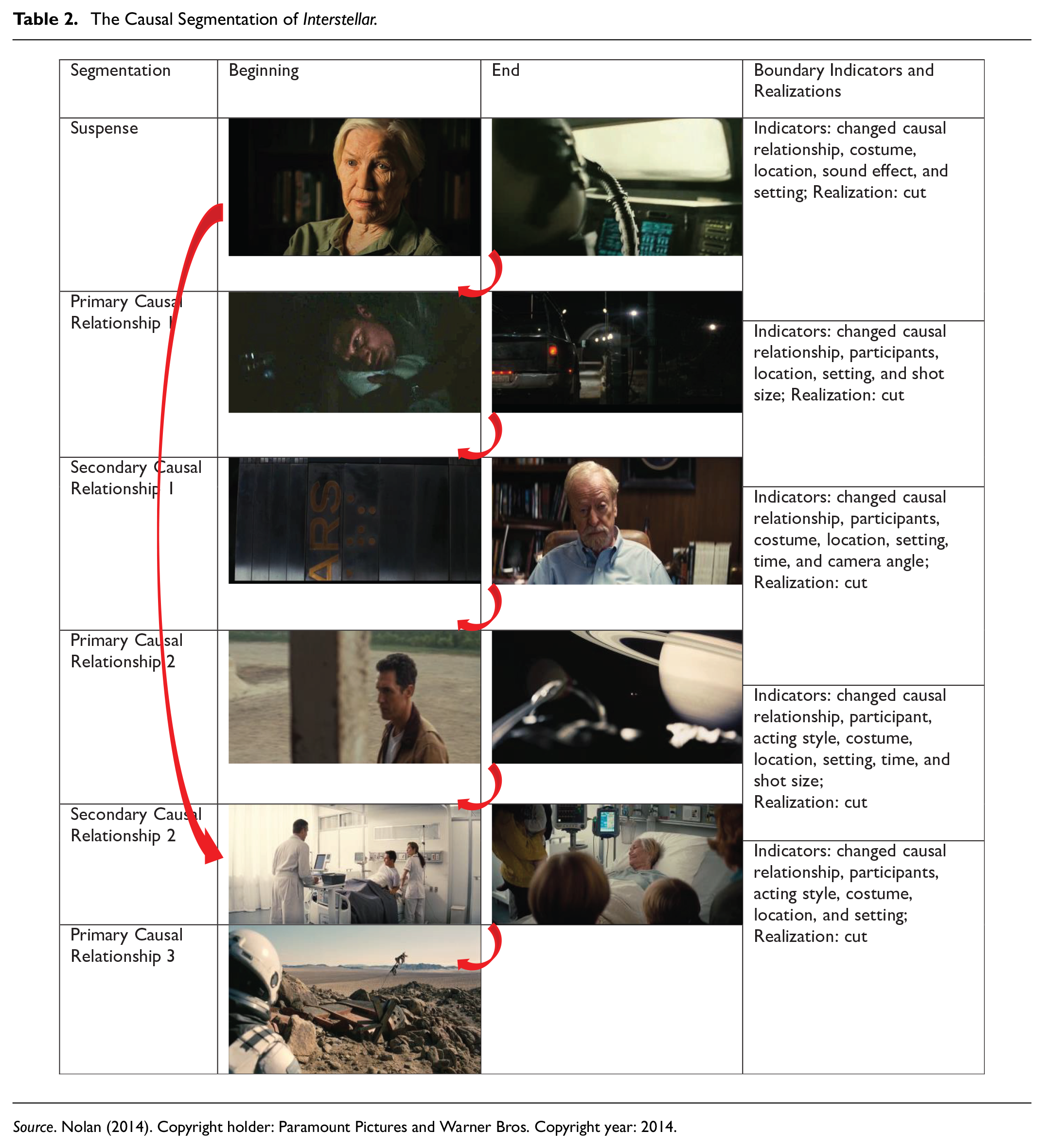
Interstellar (2014) is a science fiction film directed by Christopher Nolan about a team of NASA scientists who travel through a wormhole in space to find habitable planets for human beings. The film consists of one suspense (S), three primary and two secondary causal relationships (see Figure 3). The boundaries of these narrative units are signified by the changed causal relationships, participants, acting styles, costumes, locations, settings, time, sound effects, camerawork, and editing techniques. The protagonist, Joseph Cooper, a NASA pilot turned farmer, is the driving force behind the three main causal relationships. Supporting characters Dr. Brand and Murph Cooper drive the development of the two secondary causal relationships.

The narrative pattern of Interstellar (2014).
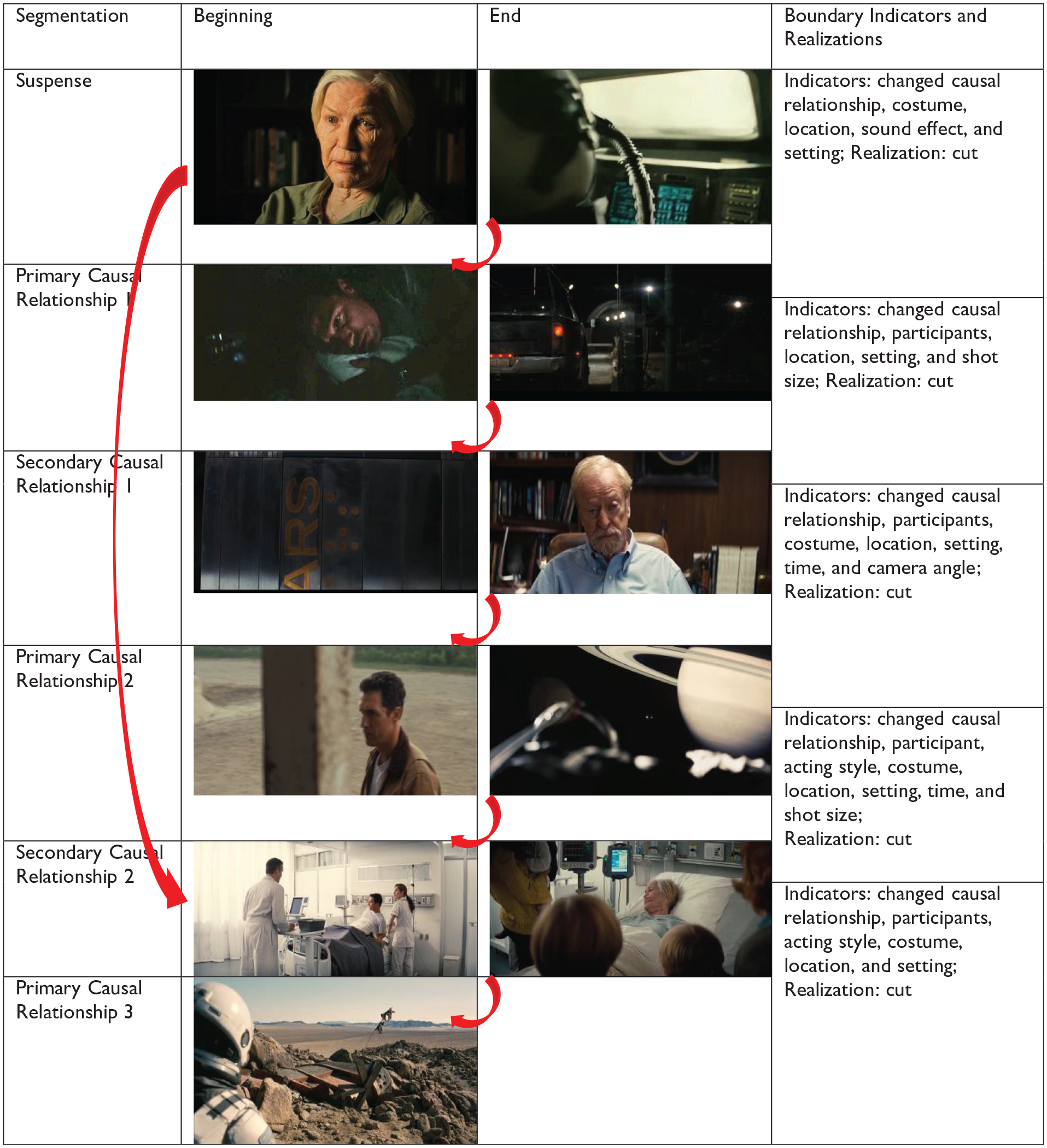
As indicated in Table 2, the story begins with suspense. The suspense begins with Murph Cooper reminiscing about her father in a fixed side-angle-medium-close-shot in her room and ends with her father flying an aircraft that is about to crash in a shaky close-up-shot. It is worth mentioning that the suspense is a flash-forward ( ) of the second secondary causal relationship (see Figures 4 and 5). This arrangement is meant to evoke anticipation or uncertainty in the audience about what might happen.
The Causal Segmentation of Interstellar.
Source. Nolan (2014). Copyright holder: Paramount Pictures and Warner Bros. Copyright year: 2014.

The beginning of suspense.

A scene of the secondary causality 2.
Subsequently, a cut moves the suspense, with the sound of the aircraft crashing, to the beginning of the first primary causal relationship, with Cooper lying quietly in the dark in a moving front-angle-medium-close-shot. In this causality, he is confused by the strange dust patterns in Murph’s bedroom. He deduces that the patterns were caused by gravity variations and represent geographic coordinates. To solve the mystery, he follows the coordinates to a secret place. The closure of this causal relationship is marked by Cooper’s vehicle driving into the secret base in a deep focus shot in the dark. A cut then transitions the first primary causal relationship to the opening of the first secondary causal relationship, which takes place inside the secret base. There, Dr. Brand assures Cooper that the Earth is dying. A space mission is about to leave to explore potential human habitable planets. The first secondary causal relationship then ends with a fixed front-angle-medium-close-shot, where Dr. Brand reiterates his preference for Cooper to fly the spaceship. Dr. Brand’s request leads Cooper to his second goal.
To save humanity and explore the most habitable planets, Cooper decides to accomplish the mission given by Dr. Brand and goes to space with his colleagues in the second primary causal relationship. There, Cooper discovers that the mission of getting the centrifuge into orbit as a space station and rescuing people is not impossible. The shifts from the NASA base to Cooper’s home and from night to day represent the transition from the first secondary causal relationship to the second primary causal relationship. This transition is realized by a cut. Specifically, the second primary causal relationship starts when Cooper returns home to inform his family about his decision in a front high-angle-medium-close-shot and ends with him floating in outer space in a low-angle-close-up-shot, seen from behind. Additional aspects of changed costumes (from everyday clothes to spacesuits), props (from the ordinary car to the spacecraft), and acting styles (from normal walking to spacewalking) also demarcate this causality from the narrative units preceding and following it.
After, a cut from outer space to NASA’s space station realizes the transition from the second primary causal relationship to the second secondary causal relationship. The second secondary causal relationship opens with Cooper trying to get out of his ward bed in a fixed low-angle-long-shot and is bookended by Murph surrounded by her family in a medium shot from a high angle. Settings, costumes, and characters’ movements all change to restore the appearance and behavior on the Earth in this causal relationship. The relationship shows Cooper is knocked unconscious while passing the wormhole and is then saved by NASA’s space station. There, Murph advises him to find Amelia Brand who has landed on Edmond’s Planet and started colonizing. Murph’s last wish motivates his father to the last primary causal relationship of the film. It must be noted that this secondary causal relationship is brief and can even be considered less developed.
The last primary causal relationship begins when it cuts from Murph’s ward to Edmond’s Planet and Amelia in a spacesuit in the fixed high-angle-medium-close-shot, shown from behind. However, it must be noted that the last primary causal relationship only suggests that Cooper takes Murph’s advice and resumes his space mission but does not provide a definite ending. As in Roman Holiday (1953), secondary causal relationships in Interstellar (2014) are simpler than primary causal relationships, and their roles are to push primary causal relationships to new directions; primary and secondary narrative units are demarcated by similar boundary clues, and editing is the key factor in enabling narrative transitions. The same findings are discovered in Joker (2019) and Lolita (1997) in the following part.
Joker (2019) is a psychological thriller film directed by Todd Phillips. The story is set in Gotham, a fictional lawless city where the upper and lower classes are clearly divided, and the rich can capriciously trample the destitute. The protagonist Arthur Fleck is a comedian working as a clown for “Haha” entertainment business. He has several mental illnesses one of which is laughing uncontrollably under stress. Like the films discussed earlier, this one is segmented by focusing on the protagonist’s goals. In the film, Arthur’s life unfolds in two stages. Each stage is driven by a distinct goal. While he is expected to respect Gotham’s social norms at the first stage, he is supposed to challenge them at the second stage (see Table 3). The subway scene facilitates the transition of these two life-stage-defined primary causal relationships (see Figure 6). The changed causal relationships, acting styles, locations, and settings draw lines for the three narrative units. Aspects of the camerawork and editing play an additional role in bookending them.
The Causal Segmentation of Joker.


Source. Phillips (2019). Copyright holder: Warner Bros. Copyright year: 2019.

The narrative pattern of Joker (2019).
The first primary causal relationship begins with Arthur doing makeup in the front of a mirror in a deep focus shot at “Haha” entertainment and ends with him standing in a telephone booth in a fixed eye-level-medium-close-shot. In this relationship, to be a socially acceptable citizen, Arthur fits himself into Gotham’s social norms by becoming a submissive citizen, even under constant attack. For example, he simply curls up on the ground and lets a street gang assault him at Gotham Square without taking any action to fight back. For another example, he keeps silent and wears a happy face when his boss, Hoyt, reproaches and humiliates him.
The first primary causal relationship then transitions to the secondary causal relationship by a cut, and changes in location and setting (from a phone booth to a train). This causal relationship then ends with Arthur’s escape from the train station in a deep focus low-angle-long-shot. Specifically, three Wall Street stockbrokers are irritated by Arthur’s inopportune laughter when they are flirting with a girl. They then assault Arthur. Unlike before, Arthur uses a gun to protect himself this time. Shooting the stockbrokers is considered the dividing line of Arthur’s two life stages. This causal relationship transforms the meek Arthur into a criminal mastermind.
The transition between this secondary causal relationship and the second primary causal relationship is realized by editing, changes in settings, camera angles, Arthur’s behaviors, and his movement tempos. Expressly, the opening of the second primary causal relationship is announced by a cut, which transitions from Arthur running fast on the street in a deep focus low-angle-long-shot to him leaning over a bathroom door in a deep focus high-angle-long-shot. This relationship ends with Arthur wearing a hospital gown dancing in the hospital in a deep focus eye-level-long shot. In this causal relationship, Arthur conducts a series of revengeful acts, including smothering his mother, butchering his former colleague, and murdering Murray. This causality is an outburst of Arthur’s past experiences of mistreatment and disregard.
The film Lolita (1997) is a romantic tragedy. It is adapted from Vladimir Nabokov’s 1955 novel of the same name and directed by Adrian Lyne. The film tells a story of a middle-aged male professor Humbert who marries his landlady Charlotte Haze to be closer to her daughter Dolores (also known as Lo or Lolita). Humbert and Lo develop a relationship that goes beyond stepfather and stepdaughter after Charlotte died. However, their relationship is threatened by a mysterious figure. The film can be divided into one suspense and two primary causal relationships—Humbert’s desire for Lo and Humbert’s goal of finding out who took Lo away. The first primary causal relationship is attached to the second by an embedded secondary causal relationship (see Figure 7). Narrative unit transitions are assisted by the changed causalities, locations, settings, sound effects, camerawork and editing techniques.

The narrative pattern of Lolita (1997).
The suspense of Lolita (1997) begins with soothing background music and a car on the highway presented in an establishing shot. It ends with Humbert’s narration and sad face using a zooming-in-eye-level-close-up-shot (see Table 4). The suspense is a flash-forward () of the second primary causal relationship and foreshadows what is to come.
The Causal Segmentation of Lolita.


Source. Lyne (1997). Copyright holder: Pathe and Warner Bros. Entertainment, Inc. Copyright year: 1997.
Thereupon, the suspense transitions to the beginning of the first primary causal relationship by a dissolve, from Humbert’s narration and sad face to a busy 1921 Cannes Street and by changed camerawork, from the zooming-in-eye-level-close-up-shot to a tilting-down-long-shot. The end of this causal relationship is symbolized by Humbert’s exit from Lo’s hospital in a deep focus high-angle-long-shot. Namely, this causality starts with Humbert marring his landlady Charlotte to be near her daughter Lo, who is about the age of the French girl he was obsessed with in boyhood. To gain Lo’s favor, Humbert takes her on road trips after Charlotte was killed by a car. As Humbert expected, the two soon form a romantic relationship along the way. Over time, Humbert’s increasing desire for Lo and Lo’s growing desire for independence fuel ongoing tensions between them. This eventually leads Lo to run away with a mysterious man.
The second primary causal relationship begins when Humbert, who is exiting from Lo’s hospital in a deep focus high-angle-long-shot dissolves into the exterior of the motel, where Humbert and Lo live, in a tilting-up-long-shot. This causality ends with a black screen with the writing, “Humber died in prison of a coronary thrombosis on November 16, 1950.” The main goal of Humbert in this causal relationship is to find out who caused Lo to disappear. He murders Clare Quilty with a gun after Lo told him that Quilty is the mysterious person who stalked them and took her to his place to make child pornography and abandoned her after she refused to star in one of his films. Humbert’s revenge results in his arrest and death in prison.
A secondary causal relationship is embedded in the first primary causal relationship, spinning it forward to the second primary causal relationship. The secondary causal relationship begins when the mysterious man and a dog are shown on the screen. He pursues Lo after meeting her. It ends with Lo escaping from the hospital with him. As depicted in Table 5, changed locations, camera angles, shot sizes, and sound effects bookend this causal relationship. Specifically, the causal relationship starts when Humbert in an eye-level-medium-shot is cut to Lo, the mysterious man, and the dog in a high-angle-long-shot, when the lobby is cut to the lounge, and when people’s voices are replaced with the dog’s barking. This causal relationship ends with a deep focus low-angle-long-shot in which a nurse tells Humbert that Lo has been discharged from hospital. The end of this secondary causal relationship is demarcated from the rest of the first primary causal relationship by a cut and changes in locations (hospital to street), camerawork (deep focus low-angle-long-shot to low-angle-close-up-shot), and sound effects (quiet hospital to screeching car tires).
The Segmentation of the Secondary Causal Relationship of Lolita.


Source. Lyne (1997). Copyright holder: Pathe and Warner Bros. Entertainment, Inc. Copyright year: 1997.
Conclusion
This study proposes a protagonist-led causal approach to segment linear and non-linear Hollywood narrative films. The newly proposed segmentation method broadens the existing literature, especially the plotline and cognitive approaches mentioned in the literature review above. Distant from the plotline approach, the study argues that the Hollywood narrative film is padded with protagonists and supporting characters propelled primary and secondary causal relationships rather than just being stuffed by one universal causal relationship. The proposed method allows the segmentation of films with linear (Roman Holiday and Joker) or non-linear sequences (Interstellar and Lolita) and the study of narrative techniques (see Figures 2, 3, 6, and 7). The new method also contributes to the literature on the cognitive approach by disclosing how the changes in visual, verbal, and aural performative clues form the boundaries between various primary and secondary narrative units. Obtained segmented narrative units can be used to study narrative development, character behavior, and the relation between narrative and performance style (although they are not the focus of this research). For example, in the second primary causal relationship of Interstellar (2014), Cooper’s activities, costumes, and acting style in space are all different from when he was on Earth (in the first two causal relationships).
In addition, the detailed investigation of the four selected films uncovers: (1) compared to the primary causal relationship, the secondary causal relationship appears to be simpler or even underdeveloped and functions to fuel the primary causal relationship forward. Arthur in Joker (2019) shoots four men who attacked him on the train. The shooting scene (the film’s secondary causal relationship) becomes Arthur’s turning point: from a meek man to a murderer. Arthur then sets out to take revenge on society (in the second primary causal relationship). To accomplish his goals, he engages in a series of acts of revenge, including killing his mother, former colleague, and idol. Four killings push the story to its climax step by step. It can be seen from this example that the primary causal relationship is much more complex than the secondary causal relationship; (2) among boundary clues, editing (e.g., cut) is the most time-efficient realization of narrative shifts; and (3) primary and secondary narrative units are demarcated by similar boundary clues (see Tables 1–5). While narrative units are more semantic and formed by causal relationships, boundaries are often transitional and carry limited semantic significance. In the case of Roman Holiday (1953), the opening scene details Ann’s busy political visit. Paying the official European visit develops into the film’s first primary causal relationship (a narrative unit). The princess’ frustrations during this visit lay the groundwork for her escape, linking the first primary causal relationship to the first secondary causal relationship (another narrative unit). The transition between two causal relationships (a boundary) is achieved by a cut, which carries less semantic information.
However, it should be admitted that this study has its limitations. First, the proposed segmentation method was only tested on a small scale on linear and non-linear Hollywood narrative films. Future research needs to conduct large-scale tests on these two types of Hollywood films, especially non-linear films that unfold through various narrative techniques such as backstory, flashback, foreshadowing, and flash-forward. Second, this study only examined Hollywood films. Follow-up research could apply this approach to protagonist-driven Asian films (e.g., Lost in the Stars) to test its validity and extend its applicability. Third, this study found that films with the shorter running time and linear narrative structure have less complex causal relationships (see Figures 2, 3, 6, and 7). Subsequent research could verify whether this finding, based on a small-scale study, is correct.
Footnotes
Declaration of Conflicting Interests
The author declared the following potential conflicts of interest with respect to the research, authorship, and/or publication of this article: The author has conflicts of interests with Professor John Bateman, Dr. Chiao-I Tseng, Dr. Janina Wildfeuer, and Dr. Elisabetta Adami.
Funding
The author received no financial support for the research, authorship, and/or publication of this article.

Data Availability Statement
Data sharing not applicable to this article as no datasets were generated or analyzed during the current study.