



Abstract
This study aims to identify tourists’ values, develop a tool that measures tourist values with regard to visiting culturally significant, but forbidden, destinations, such as North Korea, and segment the relevant market. A composite method of qualitative and quantitative approaches constituted the procedure for the value measurement scale development. Using this scale, market segments were constructed based on the value profile in order to test the differences among the segments with respect to key factors. Application of a mixed method approach indicates four values relevant to visiting North Korea: curiosity/novelty; historical nostalgia/wish for reunification; natural landscape appreciation; and ease of travel. Three value profiles emerged: nostalgia and reunification advocate, middle of the roader, and nature espouser. The findings of this study indicate unique values for tourists to want to visit North Korea and add to existing evidence on alternative motives, addressing the absence of a customized tourists’ value scale, in that it extracted authentic values to visit North Korea by focusing on cultural and historical context. The findings will provide DMOs, developers, and policy-makers with practical guidelines to create useful marketing tools and design targeted promotions and tourism products.
Plain Language Summary
This study aims to determine the utility of current measurement scales related to tourists values to visit North Korea, Culturally Significant but Forbidden Land. It is also purported to construct market segments adopting a factor-cluster segmentation approach. Using both qualitative and quantitative methods, a scale to measure the unique aspects of tourists values to visit North Korea was developed and it turned out to have four dimensions of such values: curiosity/ novelty; historical nostalgia/wish for reunification; natural landscape appreciation; and ease of travel. Three distinctive groups were identified based on their value profile, namely nostalgia and reunification advocate, middle of the roader, and nature espouser. The findings of this study will provide destination management organization, developers, and policy-makers with practical guidelines to approach the new markets and understand their needs and the benefits they seek to provide positive tourism experiences.
Introduction
Historically, the unique geo-political juxtaposition of three influential countries, China, Japan, and Russia, has imposed on both North and South Koreas the very difficult tasks of maintaining peace and balance in the Far East region. Two Koreas, divided into two different regimes based on ideology since World War II, has evoked political issues internationally. The serious tension caused by this situation of temporal cease fire encapsulated within the peninsula has impacted global hegemonies, such as Russia and the USA, for almost 70 years. The ultimate goal of North Korea is permanent political stabilization and international recognition as a country. Recent moves between South and North Korea have spurred an impending need to terminate the “cease fire” situation and eradicate the threat of nuclear weapons from North Korea by implementing permanent peace in the Korean Peninsula. As the moves related to the Korean issues are complicated, peace on the Korean Peninsula remains an ongoing challenge; however, generally all of the parties involved are in consensus regarding the necessity of such endeavors (S. Choe, 2018). Tourism is considered as a work-horse for quick and positive changes in North Korea for two reasons: contributing to the development of the national infrastructure and creating decent employment in a relatively short period of time. In addition, it is believed that tourism will help the long-isolated regime open to the world (G. Lee et al., 2019; Learing & McDonald, 2002).
Understanding value behind a particular course of action and behaviors related to tourism is a fundamental step to develop and promote any tourism activities, especially in a new destination (Y. Choe et al., 2022). However, research that delves into tourists’ values regarding culturally significant, but forbidden, destinations, is scarce. Shin et al. (2014) define a forbidden destination as a tourism environment involving limited information, restricted access, and psychological distance, due to issues such as safety and conflicts between political beliefs and ideologies. A desire to search for “dark, forbidden and possibly dangerous activities and locations” motivates tourists to visit unusual areas (Buda & Shim, 2015, p. 4), but only a few empirical studies have examined values to visit unknown tourism destinations (J. S. Kim et al., 2021).
This research addresses this gap, focusing on North Korea as a destination for South Koreans as a case study. North Korea is important in international politics due to its buildup of nuclear and other weapons (Kwon, 2019). Many believe that the country is dangerous, secretive, and unusual due to its regime’s highly rigid political system. The risks associated with the country have caused many Western countries to issue travel advisories (S. S. Kim et al., 2007). While travel to North Korea is prohibited only by South Korea and (since mid-2017) the United States (Connell, 2019), because of entry bans, visa constraints, and quotas set by the North Korean government, a limited number of Western tourists can visit (Li & Ryan, 2018).
Despite the perceived risks, North Korea has slowly opened up to tourism in the last 15 years, due to the need to acquire foreign exchange and create employment in a short period (Connell, 2019). Its tourism market is growing and becoming ever more competitive (Nam, 2018). Interestingly, demand for North Korea’s tourism markets is preceding the offering of products to tourists. The number of inbound tourists in North Korea has been estimated to increase from 100,000 in 2014 reaching the estimated income of $43.2 million to 350,000 in 2019, generating as much as $175 million (38 North, 2021). Temporarily, South Korean tourists could visit Mt. Kumgang in North Korea from 1998 to 2008; this flagship project saw a record number of around 2 million tourists during the period.
The little research so far conducted on values for visiting North Korea has focused on Chinese tourists. Prior literature has proposed further research on North Korea, including investigation of tourists from other countries who may perceive the tourism process differently from Chinese tourists (Li & Ryan, 2018). Given the unique history and political environment, South Korean tourists are likely to perceive North Korea as a culturally significant but forbidden land. As such, existing value scales may not accurately depict the true values of tourists to North Korea in the primary source market, South Korea, mainly because the access to this destination for any leisure purposes has been almost completely blocked.
Although the situation in North Korea is unusual, many cases and destinations exist where tourism activities are strictly prohibited and not capitalized enough to remedy local socio-economic problems causing poverty and social inequality, for example, Cuba (Wilson & Látková, 2016). Insufficient understanding might inhibit the tourism industry’s providing quality tourism services for the development and management of the destination in the near future. Thus, research to understand tourists’ values to travel to this kind of destination from South Korea’s perspectives may be informative. This study focuses on developing a measurement scale for the values of tourists to visit North Korea and constructing market segments using a value sought market segmentation method.
Utilizing both qualitative and quantitative approaches to investigate these underlying value factors, we pursued three research objectives:(1) to determine the utility of current measurement scales for the values of potential tourists to visit North Korea; (2) using a modified scale, to construct market segments based on the value profile in order to test differences among the segments with respect to key factors such as socio-demographics, perception of reunification, perception of safety, and political orientation; and (3) to provide relevant managerial suggestions for destination management organizations (DMOs) and tourism developers.
Although the study site is limited to the specific area, the meaning and contribution of this study can be extrapolated for several reasons. First, as there are many untrodden destinations in culturally significant but forbidden lands, the approach of this research—value sought market segmentation—can provide insight for fruitful tourism development in similar cases. Second, in other markets, as in North Korea, substantial demand is found to precede products’ being offered (Noh, 2019). Thus, our findings can serve as a benchmark to approach similar cases where potential demand exists before products are marketed. The value scale developed here is also more broadly applicable to similar destinations.
Literature Review
Values and Cultural Values
The construct of value is considered to guide peoples’ judgment on right or wrong and good or bad and an evaluation of what is worthy in their life. Hence, it offers a criterion to guide peoples’ evaluation of action (Schwartz, 2006). Values are motivational constructs, defined as desirable goals that motivate actions, giving meaning to actions and behavior (Schwartz, 2006). As such, values clarify the fundamental motivational goal of human behavior and also evident desirable end-states and desirable goals that motivate action (Schwartz, 1992). Schwartz’s (2012) theory of basic human values is one of the most widely studied in behavioral research, he includes 10 values, self-direction, stimulation, hedonism, achievement, power, security, conformity, tradition, benevolence, and universalism. Schwartz (2006) classified ten values with respect to four motivational goals that each value conveys: self-transcendence (universalism, benevolence), conservation (conformity, tradition, security), self-enhancement (achievement, power), and openness to change (self-direction, stimulation, hedonism). The salient value basically depends on the nature or implication of action; each individual has a range of values concurrently, which differ in importance to the actor (Schwartz, 1992, 2015).
Based on the Schwartz theory of basic human values, value can be defined as the major motivation for the choice of a particular action. Values form a circular motivation structure based on the motives each value expresses (Schwartz, 2012). Attached to intrinsic human behavior motives, values act together based on the meanings and importance of actions (Schwartz, 2012). As value is vital to exploring consumer behavior, recent marketing applications utilize the value construct to provide criteria for dividing a total market into homogenous groups of individuals who have a similar value system (Novak & MacEvoy, 1990). Values are tied to the society’s culture and broadly shared by the members of the society (Pizam & Calantone, 1987). Cultural values correlate with consumer needs and motivations, and a country’s culture helps to form environmental characteristics that influence consumer behavior (Iversen et al., 2016).
The fundamental core of culture encompasses historically derived traditional ideas and especially their attached values (Kluckhohn, 1954). Culture is the total of beliefs, perceptions, attitudes, behaviors, customs, and traditions, which has led to an amalgamation of cultural values (Litvin & Kar, 2004). Moreover, cultural values can be recognized on both a national basis and a personal basis (S. S. Kim & Prideaux, 2005). Visiting a culturally significant but forbidden land can be a value-laden or value-driven endeavor to seek values and connection/reconnection with the sense of belonging to an ethnic group that cannot be experienced in other places. The defining goal of cultural values is meaning and inner harmony through the sense of belonging to an ethnic group (Schwartz, 2015). If finding ultimate meaning is a basic human need, then visiting culturally significant but forbidden lands might be a unique value sought via connections to people gained in cultural immersion experiences such as rich storytelling and ancestral food tasting, promoting understanding among people and unearthing a deep connection to nature.
A thorough review of the theory of basic human values readily suggests that the values tourists seek from their trips may be embedded in this cultural value. Some researchers have suggested that cultural values (i.e., nationalism, patriotism, ancestry, ethnicity, home) can stimulate visits where the sense of belonging to an ethnic group is the main travel value (Gholamian et al., 2021). Particularly for countries with divided lands, such as South and North Korea, the main travel values of ancestral tourists differ from the values of other tourists. Researchers have suggested that tourism as a means to foster individuals’ national and cultural identities is an expression of nationalism (Bhandari, 2016). Bhandari (2016) extended this nationalism argument to indicate that tourism can enhance nationalist sentiment by providing experiences that stress tourists’ shared cultural similarities to their ancestral land. Figure 1 demonstrates how values govern and influence participants during the tourism process.

The perceptual roles of value sought by tourists (Yoo et al., 2022 ).
Motives and Values Sought by Tourists to Visit a Culturally Significant, But Forbidden Destination
Motives refer to the processes and forces that lead to human behaviors; tourists’ motivations to consume are complex and varied (Crompton, 1979). While the theory and definition of tourist motivation have been widely researched, mostly in the Western context, research on tourists’ values in a culturally significant but forbidden land and the resulting segmentation conducted in Asian contexts is still limited (J. S. Kim et al., 2021; Noh, 2019). C. Lee et al. (2012) discussed South Koreans’ visiting a culturally significant but forbidden destination, North Korea, as a convergence of the Korean ideas of Han or Haan, heterotopias of comparison and thanatourism. Han, or Haan, is the concept of an emotion often described as a feeling of deep sorrow, grief, resentment, regret, and/or anger, or similar emotions (C. Lee et al., 2012). It is a deep cultural and spiritual pain held within, not made visible, which individuals resolve rarely, of daily relevance in Korean life, particularly for the divided generations of Korean families who have lived through the war and the continued division of Korea (C. Lee et al., 2012).
Noh (2019) also focused on North Korea, measuring multi-dimensional tourism images using text mining analysis. The motivations were classified into novelty, adventure, sociality, nostalgia, pursuit of pleasure, learning/discovery, value of pursuing historical culture, experiencing tourism resources, experiencing different cultures, and pursuit of cultural exchange. She concluded that forbidden destinations have distinctive systems of forming tourism destination image due to the psychological distance of tourists and the structural constraints they encounter. In addition, Wilson and Látková (2016) examined American travelers’ destination images of Cuba and found that Americans exemplified Cuba as a “forbidden fruit, a desirable destination that Americans are not allowed to or at least should not visit” (p. 6). The image of Cuba has been tainted by the history of political antagonism between the U.S. and Cuba, which is related to concerns about perceived safety, cost, and a limited marketplace. Thus, traveling to Cuba was considered uncommon and had the perception of being overtly or covertly prohibited, resulting in it being a forbidden but exciting tourism destination. The perceptions of tourists who took advantage of a scarce opportunity to travel there were somewhat altered, in that they perceived the country as safer but the marketplace as more limited, while other aspects of their perception remained constant.
North Korea, while culturally significant, is also widely inaccessible, risky, mysterious, and unusual (Kwon, 2019) and a novel destination (Nam, 2018). Although perceived risks related to politics and threatening weaponry in North Korea have led many nations to ban travel to the country, the isolationist, restricted, and Communist nature of North Korea has motivated many international tourists to travel the country (Li & Ryan, 2015). North Korea limits contact between the international tourists and the locals to protect its citizens from foreign influences (Li & Ryan, 2018). Overseas travel agencies are responsible for marketing and sales, and tourism in North Korea must be accompanied by North Korean guides, who offer contexts, pre-plan itineraries, control photos, and ensure that travel groups stick together (Connell, 2019). Tourism destinations in North Korea include built heritage resources, such as temples, museums, royal tombs, and historical monuments in Pyongyang and Gaesong; natural resources, such as mountain landscapes and spas at Mt. Gumgang, Mt. Myohang, Mt. Baekdu, Mt. Guweol and beaches in Wonsan (S. S. Kim et al., 2007); border/security-related tourism sites such as Panmunjom and the Demilitarized Zone; and political sites of heritage interest for Chinese tourists such as the grave of Mao Zedong’s son Mao Anying, located in Hoechang (Nam, 2018).
Tourists’ values to visit North Korea differ from typical holiday motives, which involve beach resorts, theme parks, self-driven exploring, or relaxation (Codrington, 2013). Instead, curiosity motivates tourists to visit forbidden destinations for novelty and uniqueness. Tourists want a more direct understanding of North Korea than is obtainable from the mass media (Buda & Shim, 2015; Li & Ryan, 2015). In addition, Shim (2014) stated that North Korea’s mystery and isolation make it a global other of the contemporary age, which works as a powerful stimulant and enhances desire toward it. Similarly, desire is influenced by local restrictions of movement in North Korea (Buda & Shim, 2015). Li and Ryan (2015) found that most Chinese tourists to North Korea are motivated by curiosity about the country and want to experience its closed and mysterious life. More recently, J. S. Kim et al. (2021) also investigated Chinese tourists to North Korea and revealed four motives: redness, uniqueness, convenience, and escape, among which uniqueness had the strongest influence on tourists’ attitudes.
One of the top motivations for visiting forbidden destinations was appreciating the natural environment, which has been less impacted by human activities compared to other tourism areas (Li & Ryan, 2015; Slade, 2014). Slade (2014) found that areas of great natural beauty in North Korea are preserved, and the scenery is filled with mountains, streams, and waterfalls. Li and Ryan (2015) also mention that the unspoiled natural environment is one of the pull factors that motivated Chinese tourists to visit North Korea. S. S. Kim et al. (2007) found that for South Korean visitors to Mt. Kumgang, appreciating the area’s natural beauty was more significant than becoming acquainted with North Korea. The country’s unspoiled natural beauty, mountains and forests, lakes and beaches, and great diversity of flora and fauna yield a cultural significance for Koreans.
Nostalgia is another possible motivation for people to visit North Korea. Nostalgia is a sentimentality for the past in general or past people, places, experiences, or things; individuals have unique sentiment of historical nostalgia, which is not directly experienced by the individual (personal nostalgia), but is rather collective memories shaped or shared in a group or society (Fairley, 2003). Historical factors influencing the motivations for South Koreans to visit North Korea concern the complicated nature of the Korean War and the Cold War, whereby Korea has been divided into two different regimes based on ideology (Mun et al., 2018). Many Koreans lost their homelands, and about 57,000 families were divided (Hincks, 2018). In the separation of over 70 years, young South Korean tourists have acquired indirect experience in North Korea from history, mass media, or even their own imaginations, and they feel nostalgic toward North Korea without necessarily having actual relevant experiences (Mun et al., 2018). Interestingly, the most salient motivation for Chinese visiting North Korea is nostalgia for the old communist regime, due to the common communism background (J. S. Kim et al., 2021; Li & Ryan, 2015). Chinese tourists view their travels as a journey back into the Mao Zedong’s cultural revolution era; more specifically, they treat their experience as journeying into China of 50 years ago (Lankov, 2017).
Value Sought Segmentation
Market segmentation is a basic approach to market differentiation that divides a market into heterogeneous subsets with distinct needs, characteristics, and/or behaviors, thus requiring separate products or marketing mixes (Andereck & Caldwell, 1994). Psychographic segmentation classifies buyers into different characteristics based on their personalities, lifestyles, social classes, and other personal factors, while behavioral segmentation bases groups on behavioral variables, such as purchase or usage occasions, benefits sought, user status, usage rates, loyalty, readiness stage, and attitude toward products (Kotler, 2012). Many marketers have emphasized that behavioral variables are the best mechanism to construct market segments in order to design and execute better targeting strategies (Y. Choe et al., 2017; Kotler, 2012).
When segmenting markets, it is important to maximize heterogeneity among and homogeneity within the segments. To this end, different methodological approaches, such as the factor-cluster segmentation method, criterion segmentation, and neural network models, have been widely used (Beh & Bruyere, 2007). Beh and Bruyere (2007) used a factor-cluster segmentation analysis to define profiles and motives of tourists to three Kenyan national reserves and revealed three segments: escapists, learners, and spiritualists. Prior research has shown that heterogeneous tourist segmentation based on motives can be the most reliable approach to understanding different visitor segments to protected areas and travel value is an effective and valuable way to conduct market segmentations (G. Lee et al., 2002). Specifically, G. Lee et al. (2002) found motivational factors to be the most important factors in destination selection and vacation activity participation in a set of variables including trip length, budget, socio-demographics, etc. Current measures have not yet captured the unique values of tourists who want to visit North Korea; therefore, this study investigates alternative values by developing new measurement scales for their values.
Research Methods
Adopting Churchill’s (1979) suggested scale development procedure, we implemented five stages to address the study objectives. In the literature review, we developed new value items related to tourists to North Korea. We then analyzed qualitative data from personal interviews to generate 35 value items for six factors. Next, a panel reviewed the generated items, which narrowed down the 35 items to 26 values in four factors. In the pilot test, we refined the 26-item value scale, then administered surveys to 60 respondents in order to determine the factor structure of the item pool and conducted reliability tests. We also performed an exploratory factor analysis (EFA) to determine the dimensions of the value scale. Finally, in an online panel survey, we conducted EFA with 364 respondents to validate the value scale and develop segments. We divided the respondents into value sought market segments using cluster and discriminant analysis and then described and tested the heterogeneity of segments using ANOVA.
Personal Interviews
The personal interview stage was qualitative and exploratory in nature, and the sample was based on two criteria: aged at least19 and willing to visit North Korea. Semi-structured interviews were conducted to derive measurement items for the value scale with those individuals who met the selection criteria and were willing to participate in the interviews. In-person interviews were conducted in July 2018 near large universities in Seoul, using convenience sampling. The research team stopped actively recruiting respondents when a point of data saturation was reached and no new information was obtained. Twenty-eight participants were interviewed, of whom 10 had previously visited North Korea and 18 had not.
The interviews applied semi-structured technique based on the literature reviewed here. The main interview questions were “Why do you want to visit North Korea?,”“What interests you to visit North Korea?,” and “What is your expectation?” These open-ended questions allowed the participants to openly express their thoughts and feelings. Each interview lasted 20 to 30 min.
After the interviews, the researchers employed an open-coding approach to build the basic concepts and categories from the inductive content analysis. These initial codes were based on words and phrases extracted from the interviews and field notes. The research team then combined various themes based on their interrelation and co-occurrences in the interviews to identify the final themes of the tourists’ values to visit North Korea. These themes were checked and revised for exclusivity. Thus, the initial list of preliminary themes was subsequently translated into the final themes.
Trustworthiness of the data was determined by methods developed by Lincoln and Guba (1985). Credibility was enhanced using a member check and by debriefing peers among the research teams to interpret the results obtained from the quantitative methods. Transferability was obtained by using thick descriptions, allowing readers to make inferences about the findings in regard to applicability in other contexts. Dependability of this study was enhanced by an inquiry audit, where colleagues reviewed the process and product of the research inquiry. Confirmability of the study was ensured via triangulation and use of the computer assisted qualitative data analysis software program ATLAS.ti to ensure the mitigation of the researchers’ biases using transcripts, field notes, documents, and probing questions.
Panel of Experts
A panel consisting of four faculty members and researchers who have conducted research on tourism development in North Korea assessed 35 value items based on the redundancy, applicability, and representativeness of the measurement items. The panel evaluation process resulted in similar themes being reorganized into four broader themes that were checked and modified for the development of mutually exclusive defined themes. A final consensus resulted in 26 items grouped into four themes.
Pilot Test
A pilot test conducted with 60 respondents based on convenience sampling further refined the value measurement scale as a result of the factor analysis. Four distinctive factors related to the respondents’ value to visit North Korea were identified. The pilot test result indicated that the scale had appropriate levels of reliability (Cronbach’s alpha = .922) and validity (CR = 0.902, AVE = 0.612). Therefore, a full online panel survey was conducted, using a research firm’s national panel.
Online Panel Survey
The online panel survey further validated the scale to measure value and develop segments accordingly. Conducted in August 2018, the survey adopted a quota sampling in terms of age, gender, and geographical regions based on 2017 census data from the Korean Statistical Information Service (https://kosis.kr/eng/). An online research firm with five million national panelists was hired to conduct the survey. Respondents were required to be at least 19 years old and willing to take a specially priced packaged tour to North Korea given a scenario in which South Koreans are allowed to travel to North Korea, which may be feasible in the foreseeable future. People who satisfied these two criteria were invited to participate in the survey. The online research firm distributed a total of 393 screened attempts of the survey and collected 386 responses, a response rate of 92.62%. A total of 364 questionnaires were used for data analysis; partially completed questionnaires were eliminated.
The online panel survey data analysis consisted of five stages. First, the respondents’ socio-demographic characteristics were analyzed using descriptive statistics. Second, the 26 value items were factor analyzed to reconfirm the dimensionality of the scale. A principal component analysis (PCA) with a varimax rotation was performed to extract the factors. To retain the number of factors, eigenvalues over 1.0 were retained; items with communalities and a loading over 0.5 were included in the final factor structure. Cronbach’s alphas within each dimension were used to estimate the factor’s internal consistency. Third, to find distinct segments among potential tourists according to their values, Ward’s hierarchy clustering analysis was performed to fix an appropriate number of clusters from the agglomeration schedule on the cluster analysis. Fourth, the K-means cluster analysis was used to refine the initial solution of clusters (Beh & Bruyere, 2007). In order to verify the cluster solution, a discriminant analysis was further applied. Fifth, ANOVA tests were used to compare and contrast the emerged segments with respect to the value factors, socio-demographic characteristics, perception of reunification, safety, and political orientation.
Results
In-Person Interviews
Of the 28 participants interviewed in person, 15 were male and 13 were female, ranging in age from 19 to 85. Analysis of interview data led to the identification of six key facets and a corresponding count of text units reported by the interviewees. Thus, from 35 value items from the inductive qualitative approach, six themes evolved: curiosity/novelty, appreciating the natural landscape, experiencing locality, ease of travel, relationship, and - unique to South Koreans - historical nostalgia/wish for reunification (see Appendix A).
While some value items matched more general motivations for leisure travel found in prior research (Codrington, 2013), other common tourism values, such as relaxation, developing social relationships, and enhancement of kinship/friendship, did not emerge in this study. The particular instantiation of nostalgia differed from that found in previous research, where the most salient motivation for Chinese visiting North Korea was nostalgia for the old communist regime (J. S. Kim et al., 2021; Li & Ryan, 2015). Chinese tourists visiting North Korea view their travels as a journey back into the Mao Zedong’s cultural revolution era, into the China of 50 years ago (Lankov, 2017). On the other hand, the South Korean nostalgia value appears to stem from the division of the country, which caused such vast loss of homeland and family (Hincks, 2018). This value, historical nostalgia/wish for reunification, was reported among South Koreans whose hope to see a unified Korea has been replaced by seething sorrow and the historic nostalgia for the past (Halloran, 2004).
Panel of Experts
The panel of experts reviewed and refined a list of value items and emergent themes to see if there were contradictions or overlaps (Antonovsky, 1987). Items from the instrument were not included in the value scale if they were (a) not essential, (b) omissible because they were not relevant to the construct, or (c) redundant. The panel reduced the 35 scale items in six themes into 26 scale items in four discrete, but interconnected, themes that were checked and modified for exclusivity. Thus, based on these criteria, the experiencing locality theme that emerged from the original interviews was combined with its related theme (curiosity/novelty), and relationship was removed entirely. The four themes that emerged, curiosity/novelty, historical nostalgia/wish for reunification, appreciating the natural landscape, and ease of travel, were employed in the pilot test.
Pilot Test
The EFA procedure yielded four factors used to finalize the scale for the online panel survey.
Online Panel Survey
Exploratory Factor Analysis of the Visitors’ Values
A sample of 364 respondents was used to conduct the EFA in order to sustain the validity and reconfirm the dimensionality of the value scale (Table 1). A principal components analysis (PCA) with a varimax rotation produced four components from the 26 value items. The total variance explained was 65.39%. The 26 value items showed that the Cronbach’s alpha score was over .7 and reliability was considered acceptable. The online panel result indicated that the scale had an appropriate level of reliability (Cronbach’s alpha = .922) and validity (CR > 0.8, AVE > 0.5). Each component/factor was labeled according to the shared themes of the variables it included.
Exploratory Factor Analysis of the Motivations for Visiting North Korea.

Note. Comm. = Commonalities; KMO = 0.893; Bartlett = 6363.234; df = 325; Sig. < .001.
The first value factor, novelty/curiosity, included several value items expressing a general openness to learning about the local people and their lives in North Korea caused by the division of the Korean peninsula, as well as experiencing novel things about North Korea. This factor explained 34.5% of the total variance with a reliability coefficient of 0.90. With an eigenvalue of 8.98, the eight value items loading on Factor 1 produced a mean score of 3.52.
The second factor, historical nostalgia/wish for reunification, included eight variables that focused on the allure of the past, the hope to achieve reunification, and the revitalization of patriotism through visiting North Korea. This factor explained 13.8% of the total variance with a reliability coefficient of 0.91. The six items loaded on Factor 2 yielded a mean score of 3.45.
The third factor, appreciating the natural landscape, was categorized by six items associated with the natural landscape of the destination, such as scenic beauty, famous mountain landscapes, and natural landscapes. This factor explained 9.24% of the total variance with a reliability coefficient of 0.88. Factor 3 yielded an eigenvalue of 2.4 with a mean score of 4.2.
The fourth factor, ease of travel, included four items focused on convenient time/cost/itinerary to travel and minimal language barriers. This factor explained 7.83% of the total variance with a reliability coefficient of 0.88. Factor 4 yielded a mean score of 3.06 and an eigenvalue of 2.04. The four-factor solution was adopted and the value factors used for clustering the respondents. The value sought market segments were developed and their validated is explained in the following section.
Value Sought Market Segmentation
This study employed the four factors identified in EFA as composite variables in a hierarchical cluster analysis. The Ward method was used to find the number of existing clusters. The tree from Ward’s method showed a three-cluster solution. Then, a K-means cluster analysis was performed to further tune the initial three cluster solution based on the individuals’ value profiles. The three clusters were then labeled according to their most salient values and, for validation of the cluster solution, a discriminant analysis was performed. ANOVA tests were conducted to highlight the extracted factors distinguishing these three identified clusters. Also, a chi-square test was carried out on the socio-demographic data to determine statistically significant differences. Finally, the perception of reunification and safety factors were compared in order to suggest practical implications for the marketing design.
Cluster Analysis of Visitors’ Value
As shown in Table 2, three distinct segments were identified via the cluster analysis based on the potential travelers’ values: nostalgia and reunification advocate, middle of the roader, and nature espouser. The first segment, nostalgia and reunification advocate, differed in value from the other groups in having greater historical nostalgia/wish for reunification. The second group, middle of the roader, had a moderate to high interest in all facets of the benefits they sought from visiting North Korea. The third group, nature espouser, consisted of tourists who seek out experiences involving nature and the natural landscape but, overall, they are not highly motivated. Across all three segments, the most important value factor was to see the country’s natural beauty, followed by curiosity/novelty and historical nostalgia/wish for reunification of North Korea, while ease of travel was the least important.
ANOVA Test for Differences of Three Clusters by Motivational Factors.

Note. Mean values were derived from a five-point Likert scale ranging from 1 (strongly disagree) to 5 (strongly agree). Subscripts with different letters at p value.
Significant at p < .001.
Nostalgia and reunification advocate: This segment was the second largest segment (39.8%) of the respondents. While all of the respondents expressed high interest in appreciating the natural landscape, this group particularly exhibited high value in this area (mean = 4.45) and in historical nostalgia/wish for reunification (mean = 3.94).
Middle of the roader: This group was the largest tourist group (47%) in the study. Compared with the other segments, these tourists had the moderate level of mean scores for all of the types of values, including appreciating the natural landscape (mean = 4.06), curiosity/novelty (mean = 3.55), and historical nostalgia/wish for reunification (mean = 3.33). The only value observed as not relatively significant to this segment was ease of use (mean = 2.75).
Nature espouser: This group comprised the lowest percentage of respondents (13.2%). They showed the lower level of value in all factors than the other two counterparts of them. This group’s interest in appreciating the natural landscape (mean = 3.98), was notably higher than the other factors. Although less motivated than other groups, these tourists have higher interest in appreciating the natural landscape of North Korea.
A Scheffe Post Hoc test identified significant differences among the three clusters. However, in terms of appreciating the natural landscape factor, no differences existed between Clusters 2 and 3.
Discriminant Analysis
Based on the three segments from the results of the previous K-means cluster analysis, two canonical discriminant functions were calculated based on the four value factors in order to verify the cluster solutions. The four value factors were used as the discriminating factors to determine the membership in one of the three clusters as defined above. The results of this analysis are summarized in Table 3. As measured by the chi-square statistic, the two functions were statistically significant. With eigenvalues of 2.833 and 0.209, the first eigenvalue (2.833) accounted for the largest proportion of variance. Functions 1 and 2 explained 93.1% and 6.9% of the variation, respectively. The canonical correlations were 0.86 and 0.416, demonstrating a positive relationship between the variables.
Discriminant Analysis for Validating Segments.

Note. *p < .05. ***p < .001.
An F-test examined the significance of the four value factors, demonstrating that the four factors were statistically significant for each discriminant function. The F-test showed the most differentiated variable of the three clusters was appreciating the natural landscape. The standard coefficients revealed that, in Function 1, curiosity/novelty and historical nostalgia/wish for reunification best distinguished the three groups. In Function 2, the two factors were appreciating the natural landscape and ease of use. The results of the chi-square test also showed prediction accuracy for the classification for each function (p < .05).
Using classification matrices, a discriminant function analysis was performed to determine whether the discriminant functions were valid predictors (Table 4). The results showed that almost all (98.1%) of the 364 respondents were accurately classified, achieving high classification accuracies. In addition, the results illustrated that the nostalgia and reunification advocate (98.6%), middle of the roader (97.1%), and nature espouser (100%) participants were correctly classified into their respective groups.
Evaluation of the Classification Results.

Note. 98.1% of original grouped cases correctly classified.
Cluster Differences by Tourists’ Characteristics
A chi-square test examined whether significant differences existed in relation to the socio-demographic characteristics (Table 5). No statistically significant differences were found among the three clusters with regard to socio-demographic variables; however, significant differences existed in terms of education levels and political orientations. In each cluster, the nostalgia and reunification advocate and middle of the roader segments, more than 80% of the respondents held at least one university degree, whereas in the nature espouser segment this was true of 65%. Half of all visitors had moderate political orientations; however, one-fourth of the nostalgia and reunification advocate and middle of the roader groups tended to be liberal or very liberal compared to the nature espouser group. An ANOVA was conducted to see whether differences existed among the three clusters. Where the F-values indicated significant differences between the group means, post hoc comparisons tests with least significant difference were performed to explore the differences in the means of the responses (Table 6).
Socio-demographic Profile of Three Clusters on Tourists’ Motivation to Visit North Korea.

p < .05.
ANOVA Test for Perception of Reunification and Safety Factors.

Note. Subscripts with different letters at p value. *Significant at p < .05, ** Significant at p < .01; ***Significant at p < .001; Mean values measured on the basis of five-point Likert scale ranging from 1 (strongly disagree) to 5 (strongly agree).
Discussion and Implications
Discussion
The findings of this study indicate unique values for tourists to want to visit North Korea and add to existing evidence on alternative motives, addressing the absence of a customized tourists’ value scale, in that it extracted authentic values to visit North Korea by focusing on historical and political context. The 26 items emerging from the mixed-method approach were classified into four value factors: curiosity/novelty, historical nostalgia/wish for reunification, appreciating the natural landscape, and ease of travel. In light of these factors, value to visit this place is likely to differ from that regarding typical tourism destinations. Although this study deals with North Korea’s inbound tourism market for South Koreans, it contributes to understanding a value-laden or value-driven endeavor to visit forbidden areas covertly and overtly.
The most salient values to visit North Korea were curiosity to experience novel things about the previously hidden society and the unique culture. These results are consistent with other studies showing that curiosity/mystery value is linked to isolated, dangerous, mysterious, unfamiliar countries (Kwon, 2019) and novel destinations (Nam, 2018), serving as a catalyst for tourists’ visits.
Distinct from general travel values, historical nostalgia/wish for reunification turned out to be the most salient factor motivating potential travelers to visit North Korea. The findings of the present study differ from that of J. S. Kim et al. (2021) and Li and Ryan (2015), who argue that Chinese visiting North Korea are nostalgic for communism. The current research shows that historical nostalgia/wish for reunification values are important for South Koreans, who perceive ancestral and cultural connections, in light of the pain and trauma of Korean families divided across the border (C. Lee et al., 2012). Thus, reunification is the ardent desire of South Koreans, though the hope has been largely replaced by seething resentment and historic nostalgia for the past (Halloran, 2004). These particular tourists’ special sentiment and memories of a shared history are embedded with a wish for reunification, as South Koreans rank North Korea highest on the list of places they wish to visit before die and yearn for reunification of the two Koreas (Gholamian et al., 2021; Halloran, 2004)
Tourists also want to visit North Korea to appreciate the natural landscape of the destination. These results accord with those of previous studies that have shown that North Korea preserves great natural beauty because it has been less impacted by human activities than other tourism areas (S. S. Kim et al., 2007; Slade, 2014).
Ease of travel is a possible value for visiting North Korea that extends beyond South Koreans, as the country also borders on China and Russia. Easy access to geographically proximate tourism destinations is an important factor reducing the friction of distance (Jeuring & Haartsen, 2017). Our findings are similarly consistent with prior research that has shown that convenience motivates Chinese tourists to visit North Korea as they are closely tied in political exchange as well as proximity (J. S. Kim et al., 2021). In particular, North Korean tourism development would provide better opportunities for South Koreans who currently have to take a detour through China to visit North Korea.
Based on the four value factors, this study identified three distinctive market segments, which revealed the values sought through South Koreans: nostalgia and reunification advocate, middle of the roader, and nature espouser. The nostalgia and reunification advocate segment tended to share the same interests as the nature espouser group; however, the individuals focused on shared memory who wished for a peace process among the Korean people to achieve reunification and hoped to inspire patriotism through visiting North Korea were prevalent only in the nostalgia and reunification advocate group. Our results cast a new light on this unique segment, which was the second largest segment of the respondents, and support potential tourism development and marketing associated with a greater interest in a peace process in Korea. The largest segment, middle of the roader, was categorized by moderate to high interest in all facets of the tourism experience, except ease of use. This group was consistent with the multiple value groups identified in previous studies, such as want-it-all tourists (Jeong et al., 2018). Similarly, the nature espouser group in this study was directly in line with the nature groups revealed in prior research, such as nature-seeking tourists (Jeong et al., 2018). Thus, these findings can be considered further validation of a segment interested only in appreciating the natural landscape.
All three segments showed relatively high scores for appreciating the natural landscape, which corresponds to past findings such as those of Jeong et al. (2018) on international tourism where all of the segments showed higher values for experiencing nature, and thus helps us better understand the values of tourists to visit tourism destinations with well-preserved nature. It also confirms that value sought segmentation is an effective approach to identify potential target markets with different values, motives and needs, helping the tourism industry and DMOs to develop strategic marketing communications and products once barriers are removed.
Implications
Taking the case of North Korea, notoriously isolated, dangerous, but yet attractive to many international travelers, this study sheds light on how this kind of unusual travel destination can be marketed even before the products are offered to the market. The current study contributes to tourism literature by developing a scale reflecting such specificities. We identified the value of people who want to visit a forbidden country opting for novelty/curiosity over unsafety/insecurity and developed a scale that measures such sentiments.
Further, the utility of the scale was tested by developing a value sought market segmentation. For practicality, a segmentation approach was adopted to identify and differentiate potential target markets according to their value profile to visit such a novel and unusual destination. Determining the utility of current measurement scales offers a timely advance in methodology and a stepping stone for future research in the related research area. Using both qualitative and quantitative approaches to develop a value measurement scale, the mixed method taken in this study adopted the rigorous scale development procedure, and the utility of the scale for destination marketing was confirmed.
The findings have practical implications for all stakeholders involved in tourism marketing and development related to this kind of destination regarding management strategies for sustainable growth as a unique tourism destination and destination marketing practices. First, DMOs, tour operators, developers, and policymakers need practical guidelines for resource allocation based on understanding of the potential markets to develop marketing strategies (Y. Choe & Schuett, 2020; Y. Choe et al., 2023). This topic is relatively noteworthy in tourism research in that it identifies a new market and suggests focused marketing strategies to reach such a new broad market if and when international travel bans are lifted or eased. The market segments in this study can help marketers create useful tools and design targeted promotions, activities, and products to attract the tourists with a rare glimpse into the isolated country and develop the destination’s competitiveness. In addition, we propose providing varied marketing activities to the distinct market segments. Creating a strong marketing message based on the appeal to curiosity may lead middle of the roaders toward travels involving novel items related to the area and interaction with the locals. The nature espouser will be more interested in the nature in North Korea that has been less impacted by human activities than in other tourist destinations. North Korean tourism marketers may emphasize the natural resources of the destination and the effective use of historic nostalgia, which constitutes a unique sentiment, in their marketing efforts to the nostalgia and reunification advocate group.
Second, different dimensions of the tourists’ values provide DMOs and developers solid guidelines for North Korea tourism development projects and establish effective marketing strategies. Curiosity about North Korea is the main factor that motivates tourists to visit, so it can be a major strategic priority for DMOs to develop promotional campaigns based on what the potential target market is uniquely curious about. Hence, themed visits may be effective for attracting the potential target market interested in a high-adventure experience. Also, the marketing message can appeal to tourists who want to see real-life local culture in North Korea. For nostalgia marketing campaigns, strategies evoking the allure of the untouched past that vitalizes patriotism and reunification hopes through visiting North Korea can offer the chance to connect with tourism themes common to the two Koreas. A mutual tourist value resides in appreciating nature, as expressed by the significance of preserving natural resources in North Korea. Ease of travel to cut travel time and cost are prerequisites for increasing North Korea’s competitiveness in the global tourism arena. DMOs can attract their target tourists from nearby countries such as China, Russia, and South Korea by way of more targeted communication strategies and collaborate with other DMOs located close by and stakeholders.
Finally, this study contributes to peace-making by understanding why South Koreans want to visit this culturally significant but forbidden destination. The more information that is available about South Koreans’ historical nostalgia/wish for reunification, as a unique sentimental, cultural, and historical attachment, the greater the potential for the tourists to become private diplomats who may further the Korean peace process.
Limitations and Future Research
This study is limited to a specific destination and a limited tourism market, though the meaning and contribution of this study may reach beyond its geographical limitation. This research confirmed the applicability of the methodology to segment North Korea’s tourism market based on the value profile, but the limits of extrapolation of the methodology remains to be seen. Additional testing of the scale on other samples can be helpful to refine the measurement scale and increase the scale’s generalizability.
Second, this study was conducted to provide management insights before visitation actually happens to prepare for the development of products related to values of potential South Korean tourists to North Korea. At this early stage, knowledge of values of South Koreans who wish to visit North Korea are limited. While the unique sentiment was important in this study, future research may find alternative values. For example, in places with complex political environments, existing and commonly accepted travel values may not adequately capture all the reasons that people want to travel. Future research should further attempt to understand the potential tourists’ values and clarify the tourist characteristics for each segment during the tourism planning process.
It should be noted that this study was conducted before the global COVID-19 pandemic. Clearly travel values and the ability of people to travel has been, and will continue to be, dramatically impacted by the pandemic (Y. Choe et al., 2021; Liu & Choe, 2023; Wang et al., 2021). It is likely that safety and security will emerge as a more salient value. Safety is of particular importance, as North Korea is already considered a risky destination with very limited information and experiences that are not well-known and shared by the traveling public relevant to the current situation in North Korea, especially regarding COVID-19. Thus, the results of this study warrant a cautious interpretation and should be adopted with great care. Even so, this study findings have utility for marketing for a novel destination with substantial potential to attract a lucrative market, although the safety and security concerns will remain constant.
Footnotes
Appendix
Values Reported by Interviewees.
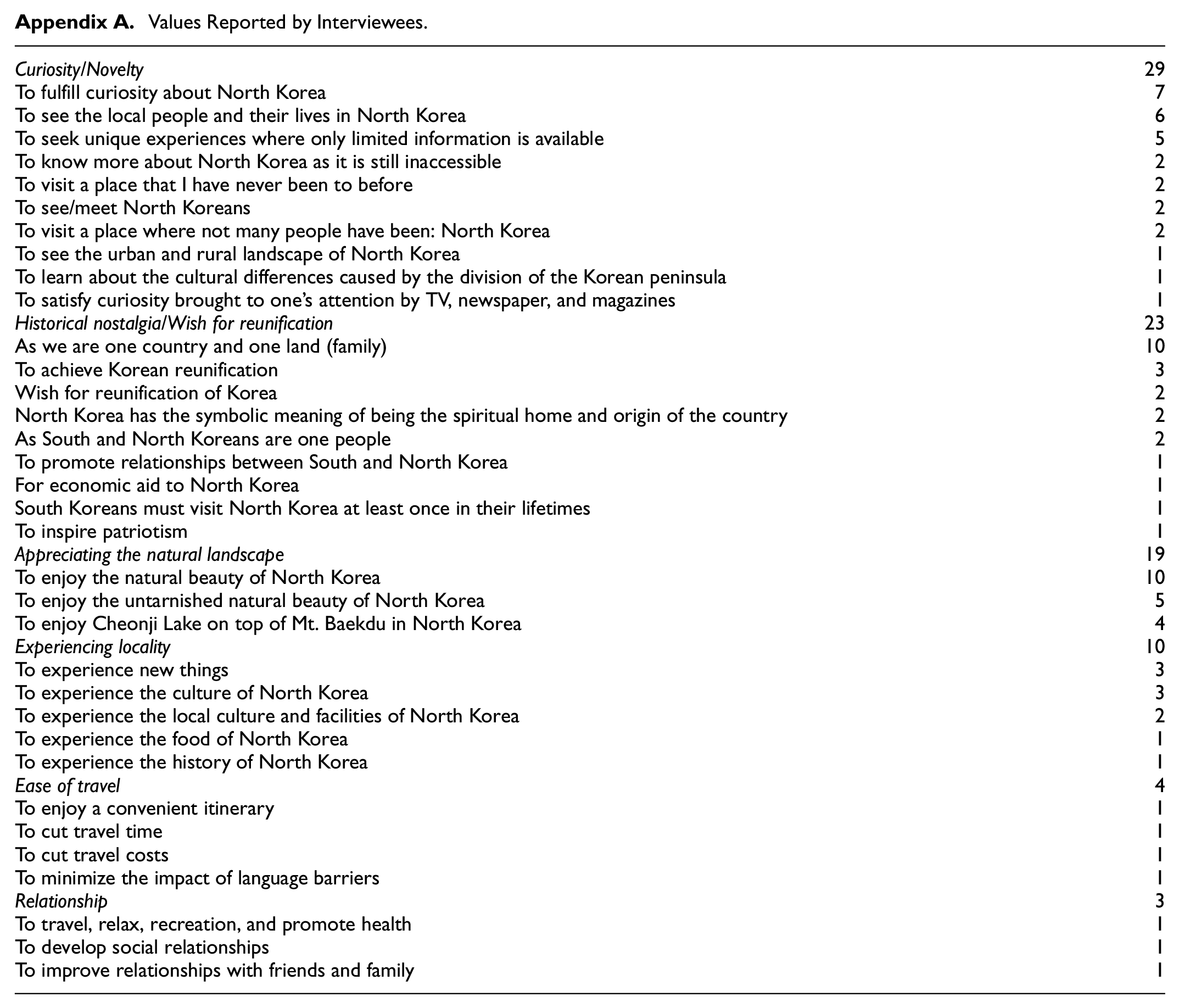
| Curiosity/Novelty | 29 |
| To fulfill curiosity about North Korea | 7 |
| To see the local people and their lives in North Korea | 6 |
| To seek unique experiences where only limited information is available | 5 |
| To know more about North Korea as it is still inaccessible | 2 |
| To visit a place that I have never been to before | 2 |
| To see/meet North Koreans | 2 |
| To visit a place where not many people have been: North Korea | 2 |
| To see the urban and rural landscape of North Korea | 1 |
| To learn about the cultural differences caused by the division of the Korean peninsula | 1 |
| To satisfy curiosity brought to one’s attention by TV, newspaper, and magazines | 1 |
| Historical nostalgia/Wish for reunification | 23 |
| As we are one country and one land (family) | 10 |
| To achieve Korean reunification | 3 |
| Wish for reunification of Korea | 2 |
| North Korea has the symbolic meaning of being the spiritual home and origin of the country | 2 |
| As South and North Koreans are one people | 2 |
| To promote relationships between South and North Korea | 1 |
| For economic aid to North Korea | 1 |
| South Koreans must visit North Korea at least once in their lifetimes | 1 |
| To inspire patriotism | 1 |
| Appreciating the natural landscape | 19 |
| To enjoy the natural beauty of North Korea | 10 |
| To enjoy the untarnished natural beauty of North Korea | 5 |
| To enjoy Cheonji Lake on top of Mt. Baekdu in North Korea | 4 |
| Experiencing locality | 10 |
| To experience new things | 3 |
| To experience the culture of North Korea | 3 |
| To experience the local culture and facilities of North Korea | 2 |
| To experience the food of North Korea | 1 |
| To experience the history of North Korea | 1 |
| Ease of travel | 4 |
| To enjoy a convenient itinerary | 1 |
| To cut travel time | 1 |
| To cut travel costs | 1 |
| To minimize the impact of language barriers | 1 |
| Relationship | 3 |
| To travel, relax, recreation, and promote health | 1 |
| To develop social relationships | 1 |
| To improve relationships with friends and family | 1 |
Declaration of Conflicting Interests
The author(s) declared no potential conflicts of interest with respect to the research, authorship, and/or publication of this article.
Funding
The author(s) received no financial support for the research, authorship, and/or publication of this article.

Data Availability Statement
Data sharing not applicable to this article as no datasets were generated or analyzed during the current study.