



Abstract
Extant literature suggests a positive correlation between social trust (also called generalized trust) and life satisfaction. However, the psychological pathways underlying this relationship can be complex. Using the Bayesian Mindsponge Framework (BMF), we examined the influence of social trust in a high-violence environment. Employing Bayesian analysis on a sample of 1,237 adults in Cali, Colombia, we found that in a linear relationship, generalized trust is positively associated with life satisfaction. However, in a model including the interactions between trust and education level as well as between trust and socioeconomic status, generalized trust is found to be negatively associated with life satisfaction. In this non-linear relationship, both education level and socioeconomic status have moderating effects against the negative association between generalized trust and life satisfaction. In other words, less educated people living in worse socioeconomic conditions are more likely to have lower life satisfaction when they have higher levels of social trust. In contrast, highly educated people living in better socioeconomic conditions are more likely to have higher life satisfaction when they have higher levels of social trust. Due to the facilitating function of trust in information processing, lowering the rigor of the filtering system in a high-violence social environment will likely put an individual at risk. Based on our findings, we suggest that policymakers should be more meticulous and consider many socioeconomic factors when advocating for increasing social trust. We also recommend that researchers should investigate deeper the complexity of human psychology and the information-processing mechanisms of social trust.
Plain language summary
Employing Bayesian analysis aided by the MCMC technique on 1,237 urban people in Colombia, we found that generalized trust is positively associated with life satisfaction. However, people with lower educational levels whose socioeconomic status are lower are more likely to have lower life satisfaction when they have higher levels of social trust, whereas people with higher educational levels whose socioeconomic status is higher will be more likely to have higher life satisfaction when they have higher levels of social trust. Our findings also suggest that education level has a bigger impact compared to socioeconomic status in moderating the relationship between social trust and life satisfaction. Based on our findings, promoting social trust in communities with lower education levels, poor living conditions, and a violent social context should be carefully planned due to the complexity of related information processes’ interactions.
Keywords
Introduction
Social Trust and Life Satisfaction
Trust refers to the trustor’s willingness to accept vulnerabilities under the assumption that the trustee will act in the trustor’s best interests (Mayer et al., 1995; Schilke et al., 2021). In other words, trust is often considered a second-order emotion that is based on the emotional state of someone else (Belli & Broncano, 2017). In social science studies, trust is a critical component that would facilitate a range of dynamic social processes, including organizational effectiveness, economic development, and so on (Roth, 2022; Rousseau et al., 1998; Tabellini, 2010). Some believe that trust is one of the critical components in corruption reduction and state-building (Rose-Ackerman, 2001). Others suggest that trust is one of the most essential components of modern civilizations and that social conflict and chaos are too commonplace in the absence of it (Gambetta, 2011; Harraka, 2002; Muraskin, 1974; Vuong, 2022).
Social trust (also called generalized trust) is trust toward other people in society in general. It is an important form of trust in modern society that involves a large number of social interactions among strangers (Algan & Cahuc, 2013; Intravia et al., 2016). Social trust is the bedrock of interactions between individuals in a society, and without trust in the acts of others, individuals may need to contemplate too many contingencies and uncertainties before acting, which would ruin the foundation of community and civilization (Kwon, 2019). As a result, the level of social trust would have an impact on individuals’ life satisfaction.
Defined as one’s self-evaluation of one’s own quality of life based on one’s own rules (Shin & Johnson, 1978), life satisfaction refers to the cognitive component of subjective well-being (Pavot & Diener, 1993). According to Pavot and Diener (1993), life satisfaction is an important indicator that represents an individual’s life situation as well as their mental state. Many studies have concluded that increased social trust would lead to better life satisfaction (Graafland & Lous, 2019; Shao et al., 2021; Vyrost et al., 2007). Social trust was also found to be positively associated with individual happiness (Hamamura et al., 2017; Kuroki, 2011). In addition, when life satisfaction and social trust in society are both low, individuals are more likely to suffer from mental illness due to health distress (L. M. Martínez et al., 2019). Therefore, researchers often suggest policymakers aim for increasing social trust.
However, the relationship between social trust and life satisfaction is not simple or straightforward. Daukas (2006) asserted that trust towards new knowledge and information is a complex concept that is shaped by social location (including race, gender, religious beliefs, etc.). Therefore, in various social contexts, people in diverse social locations would view trust and life satisfaction differently. For example, Adjaye-Gbewonyo et al. (2018) found that high individual-level generalized trust was unexpectedly associated with increased depressive symptoms in South Africa. The authors of that study argued that in a low-trust society, blindly trusting others may be detrimental due to risks of crime or fraud. Hamamura et al. (2017) found that generalized trust was more strongly associated with happiness in developed societies than in developing societies. Bi et al. (2021)’s study also found inconsistency in the relationship between social trust and life satisfaction. Specifically, in probing the moderating role of social trust on the life satisfaction of adolescents, Bi et al. (2021) argued that in countries with higher levels of social trust, adolescents were reported to have lower levels of life satisfaction because with a higher level of trust would anticipate more social cooperation and mutual respect from others, particularly those who are not compelled to assist them. Consequently, their life satisfaction would be diminished if their expectations were not satisfied. To investigate deeper into the psychological pathways in the relationship between social trust and life satisfaction, the approach of information processing can be advantageous.
The mindsponge mechanism of the human mind’s information processing was originally conceptualized by Vuong and Napier (2015) to describe how a person absorbs and incorporates new values into their mindset. Throughout the mindsponge process, trust plays a crucial role as a facilitator for filtering newly received information (Nguyen et al., 2021; Vuong, Le, La, & Nguyen, 2022). Trust can influence the cost-benefit judgment by adding preconceived positive or negative values, which helps accelerate the evaluation process. Normally, trust (or distrust) is attached to a source of information or a collection of information with similar features (Vuong, Le, La, Nguyen, et al., 2022). Thus, the mind can save time and energy by quickly accepting or rejecting information from the same source or group without going through a thorough evaluation process (Le et al., 2022; Vuong, 2022). Due to the function of trust in terms of information processing, the psychological pathways to life satisfaction may be different in a high-violence sociopolitical context.
The High-Violence Social Infosphere in Columbia
The phrase “high-violence context” in this study refers to a living condition with aggressions that may cause physical harm or psychological trauma, such as assault, murder, drug trading, fraud, etc. (L. M. Martínez et al., 2019). According to United Nations Office on Drug and Crime (UNODC), Colombia is one of the countries that has the highest homicide rates in the world (United Nations Office on Drugs and Crime [UNODC], 2006). Although the number of intentional homicide cases dropped in the past 30 years from 73 per 100,000 inhabitants in 1990 to 23 per 100,000 inhabitants in 2020, the ratio is still striking when compared to that of the average countries (6 per 100,000) (World Bank, 2022). In addition, crimes other than homicide also persisted in Columbia due to the existence of illegal armed organizations and criminal groups’ involvement in drug trading and serious crimes, including kidnapping, money laundering, and running extortion and prostitution rackets. Consequently, Verisk Maplecroft, a risk analysis firm based in the United Kingdom, in its global risk report, listed Columbia’s Medellín as a nucleus of transnational crime networks and tagged Colombia’s capital Bogotá as one of the top 3 riskiest among the world’s 30 largest cities (Parkes & Blanco, 2022). In the context of rampant violent crimes, exposing one’s vulnerabilities to others poses relatively higher risks of physical, mental, or financial harm.
While many studies have been conducted about social trust and life satisfaction in developed countries, few have been conducted regarding social trust in a highly violent sociopolitical context, namely, in this case, Columbia. Moreover, it is imperative to probe the information processing mechanism in this relationship, as to how trust/distrust of strangers would affect one’s overall life satisfaction at a personal-societal level under specific conditions. Possible significant moderating factors in this process include education level and socioeconomic status, which determine the immediate infosphere that an individual interacts with (e.g., living environment and social circles). Thus, using the Bayesian Mindsponge Framework (Nguyen et al., 2022b; Vuong, La, & Nguyen, 2022)—an effective tool for sociopsychological research—as the basis for theoretical conceptualization and statistical analysis, our study aims to examine the following research questions (RQ):
RQ1: What is the relationship between social trust and life satisfaction in a high-violence context such as the case of Columbia?
RQ2: Do education level and socioeconomic status play a role in the association between social trust and life satisfaction?
Materials and Methods
Materials, Variables, and Models
This study employs secondary data, with the dataset from the article “Trust, life satisfaction and health: Population data in a mid-size city in the Global South” (L. Martínez, 2019). Data collection was conducted in 2017 by the Observatory of Public Policy of ICESI University using face-to-face interviews. Respondents were explained about the purpose of the study and assured confidentiality. There was a total of 1,237 responses from adults in the city of Cali. The male/female ratio is approximately 1:1. The average age of the respondents is 39.
The outcome variable in the present study is life satisfaction, and the independent variables are generalized trust, education level, and socioeconomic status (see descriptions in Table 1). Life satisfaction is measured with the following question: “On a scale of zero to ten (zero means you have no satisfaction and ten means you have complete satisfaction), in general, how satisfied are you with your life?” The average score of life satisfaction for this sample is 8.4. The measurement of trust followed the OECD guidelines, which measures generalized trust using the following question: “On a scale from zero to ten, where zero is ‘not at all,’ and ten is ‘completely,’ in general, how much do you trust most people?” (OECD, 2017). The average score of generalized trust for the sample is 4.5. For socioeconomic status, the stratification system in Colombia classifies households into six categories numbered 1 to 6, where 1 means worst conditions and 6 means best conditions. For education level, in this study, we use a four-level classification, where 1 is uneducated or primary education, 2 is secondary education, 3 is undergraduate degrees or equivalent, and 4 is Master or Doctorate. The average education length of respondents in the sample is 11.8 years.
Variable Description.

Following the research questions stated, two models are constructed. In order to increase predictability, we adhere to the principle of parsimonious model construction for Bayesian analytics (Nguyen et al., 2022a). Parsimonious models have high predictive power, and they allow us to focus on examining specific factors and relationships. While such parsimonious models mean there are many unknown parameters, the properties of Bayesian inference and validating techniques in analysis help increase the prediction’s accuracy (see the subsection below for more detail). Model 1 examines the linear relationship between Satisfaction and GenTrust. In Model 2, the moderation of Edulevel and Socioeconomic are added through their interactions with GenTrust.


Statistical Analysis
The Bayesian analysis method was used because it is compatible with mindsponge-based reasoning, among other advantages (Nguyen et al., 2022b). While parsimonious models have high predictability, there are also many unknown parameters. The advantage of Bayesian inference for this problem is that it treats all parameters probabilistically, including unknown ones (Gill, 2015). Moreover, prediction accuracy in fitting complex models containing interaction terms is increased thanks to the Markov Chain Monte Carlo (MCMC) algorithms, which iteratively generate a large number of samples from the joint posterior distribution of the parameters (Cowles, 2013; Dunson, 2001; Wagenmakers et al., 2018). Another major advantage of using Bayesian analysis in psychological research is that it does not make binary judgments based on p-values to evaluate statistical results but rather makes interpretations with estimated and visualized credible intervals. The current reproducibility crisis in social sciences, especially psychology, is partly attributed to the over-reliance on p-value as a dichotomous threshold for rejecting null hypotheses (Camerer et al., 2018; Open Science Collaboration, 2015). Visualizing estimated coefficients in the Bayesian approach is a reliable alternative for evaluating statistical results instead of p-values (Halsey et al., 2015).
Both models were fitted using the following MCMC setups: 5,000 iterations, 2,000 warm-up iterations, and 4 Markov chains. Due to the exploratory nature of the study, we used uninformative priors to provide the least amount of prior information possible to the model estimation (Diaconis & Ylvisaker, 1985). To test the models’ goodness-of-fit, Pareto smoothed importance-sampling leave-one-out cross-validation (PSIS-LOO) test was employed (Vehtari et al., 2017). To validate the simulated posteriors, we used diagnostic statistics of effective sample size (n_eff) and Gelman-Rubin shrink factor (Rhat) to check Markov’s chains’ convergence. The model’s Markov chains are generally considered to be convergent if n_eff is greater than 1,000 and Rhat is equal to 1. Graphical representations such as trace plots, Gelman-Rubin-Brooks plots, and autocorrelation plots were also used for convergence diagnosis. Due to the following advantages, the present study’s Bayesian analysis was carried out using the
Considering the importance of transparency in research procedures and cost management (Vuong, 2018, 2020), the study’s data files and code snippets were deposited at the Open Science Framework (OSF) server (DOI: 10.17605/OSF.IO/H8GQ7).
Results
Model 1
PSIS diagnostic for Model 1 shows that the Pareto k-values are less than 0.5 (see Figure 1), indicating that the model fits the actual data well. In other words, the model has an acceptable goodness-of-fit.
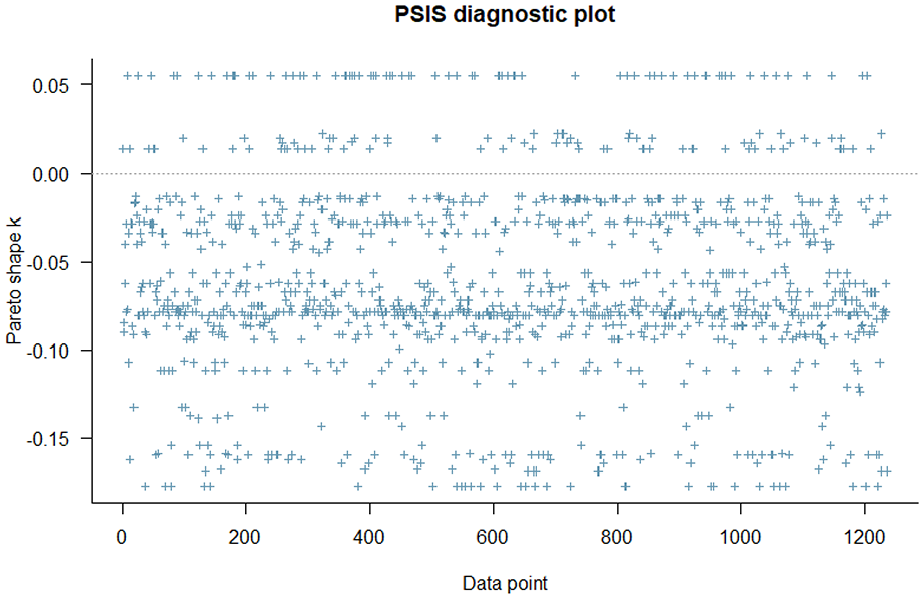
Model 1’s PSIS diagnostic plot.
In Table 2, we see that the n_eff values are greater than 1,000, and Rhat values are equal to 1, generally considered to be signals of good convergence of the Markov chains. The trace plots for Model 1 (see Figure 2) show fluctuations around a central equilibrium, meaning that there are no divergent chains after warmup iterations. This indicates that the Markov chains converge to the same posteriors and the results are reliable.
Model 1’s Simulated Posterior Coefficients.

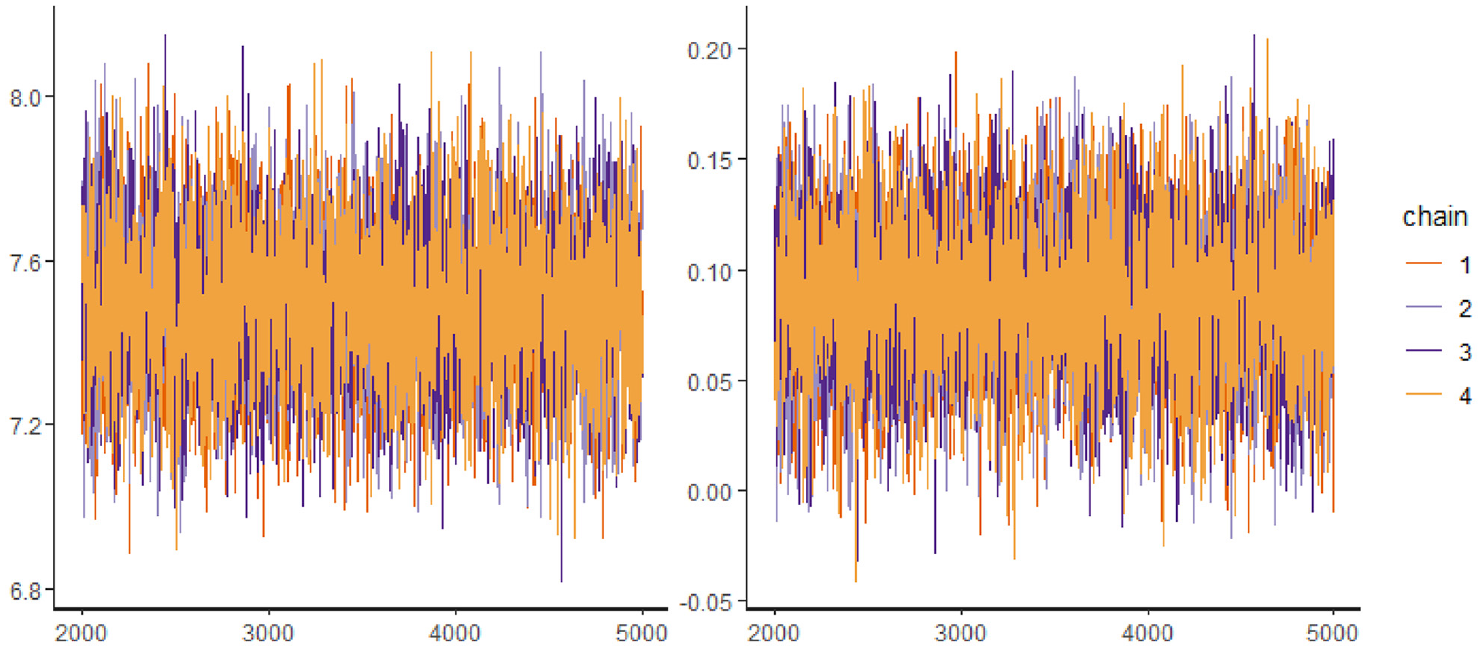
Model 1’s trace plots.
The Gelman plots (see Figure 3) support the healthy convergence by showing that the shrink factors reduce to one after warmup iterations, meaning that there is almost no difference between variance between chains and variance within chains.
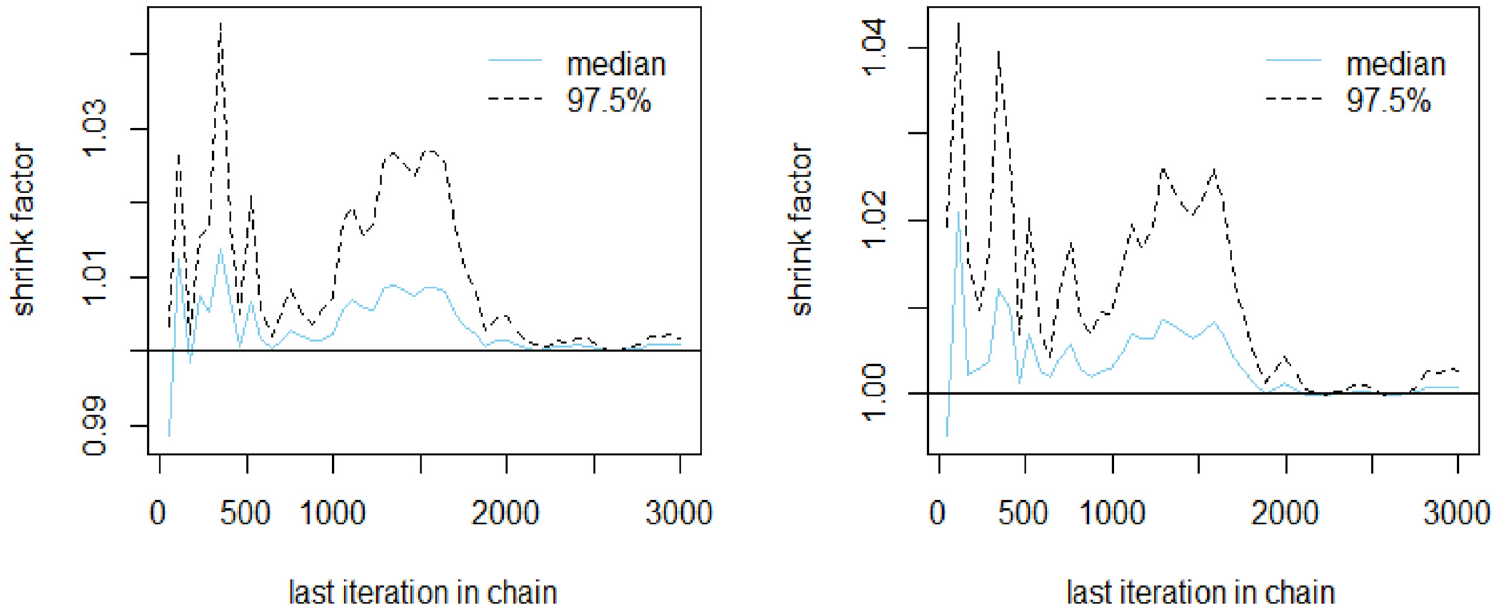
Model 1’s Gelman plots.
The autocorrelation plots (see Figure 4) also indicate that the Markov property is held by showing autocorrelations being eliminated rapidly, meaning that MCMC-simulated samples are memoryless during the stochastic simulation process.

Model 1’s autocorrelation plots.
Analysis results show that generalized trust is positively associated with life satisfaction (

Model 1’s posterior distribution plots with HPDI at 95%.
Model 2
The relationship tree for the parameters in Model 2 is shown in Figure 6. GenTrust affects Satisfaction in a linear relationship and through two interacting pathways with Edulevel and Socioeconomic.
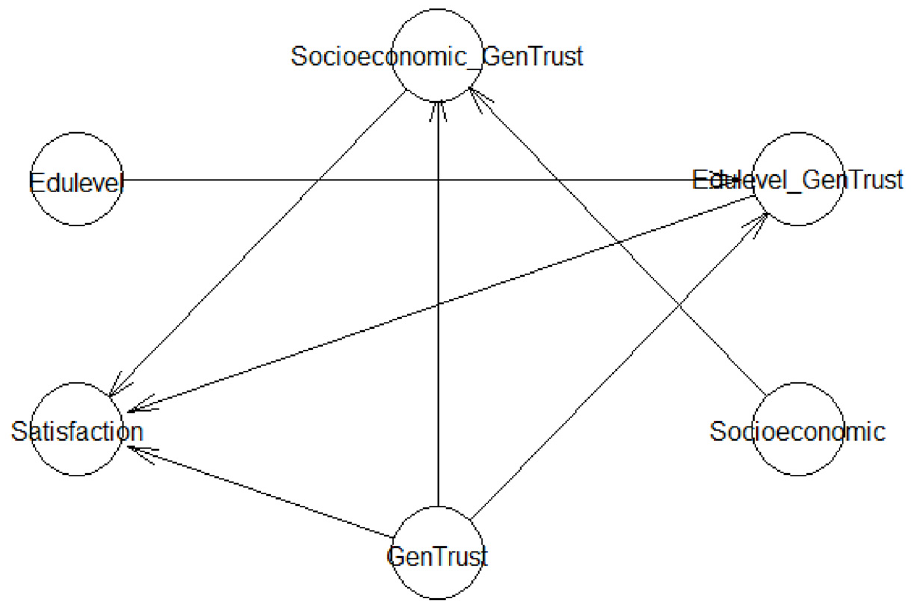
Relationship tree of Model 2.
The k values of the PSIS diagnostic plot for Model 2 are less than 0.5 (see Figure 7), indicating that the model is well-specified.

Model 2’s PSIS diagnostic plot.
Similar to the explanation of statistical validation in Model 1, Model 2 also shows good convergence of the Markov chains, as seen through the n_eff and Rhat values (see Table 3) as well as the trace plots (Figure 8), the Gelman plots (Figure 9), and the autocorrelation plots (Figure 10).
Model 2’s Simulated Posterior Coefficients.

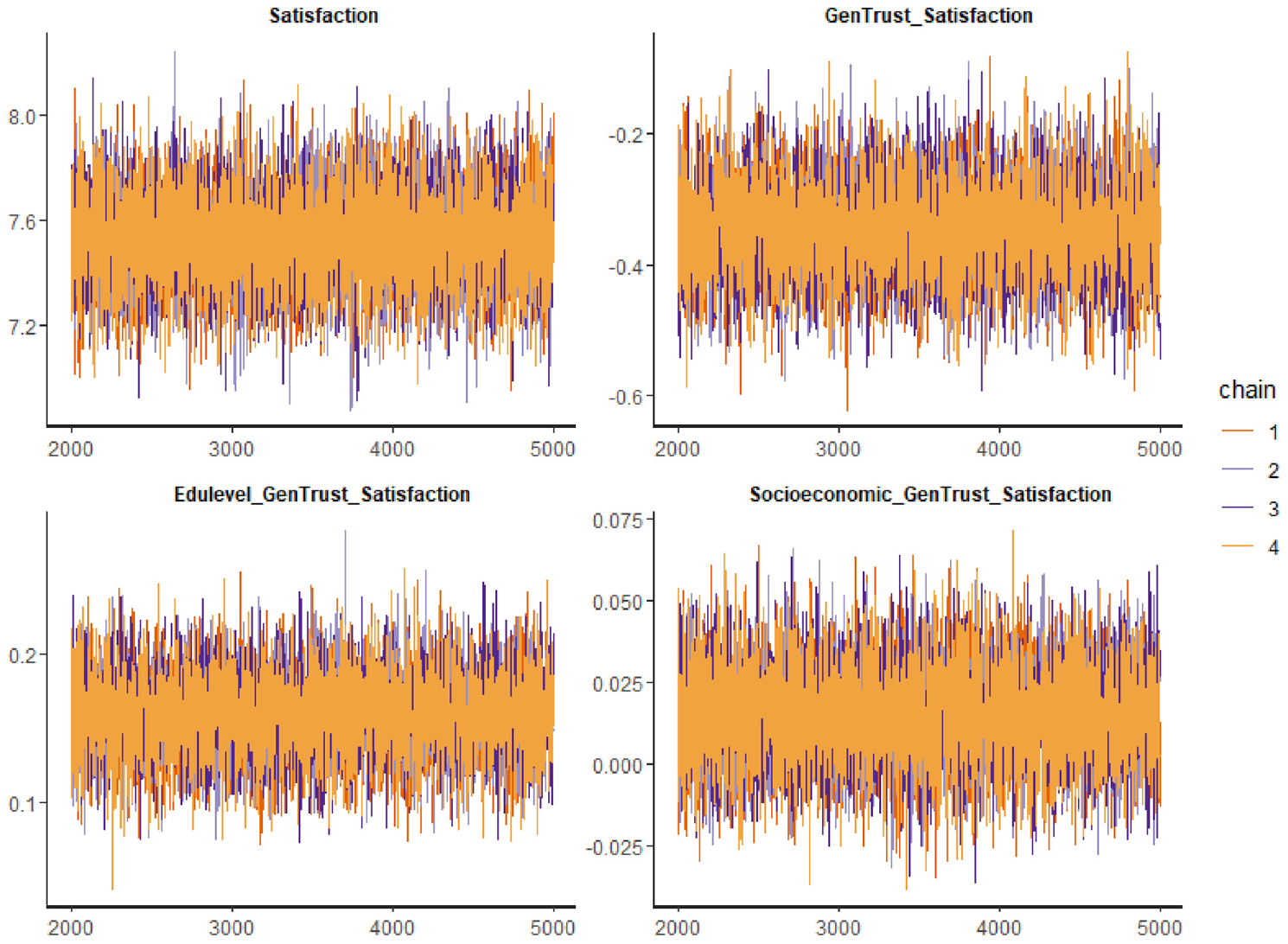
Model 2’s trace plots.
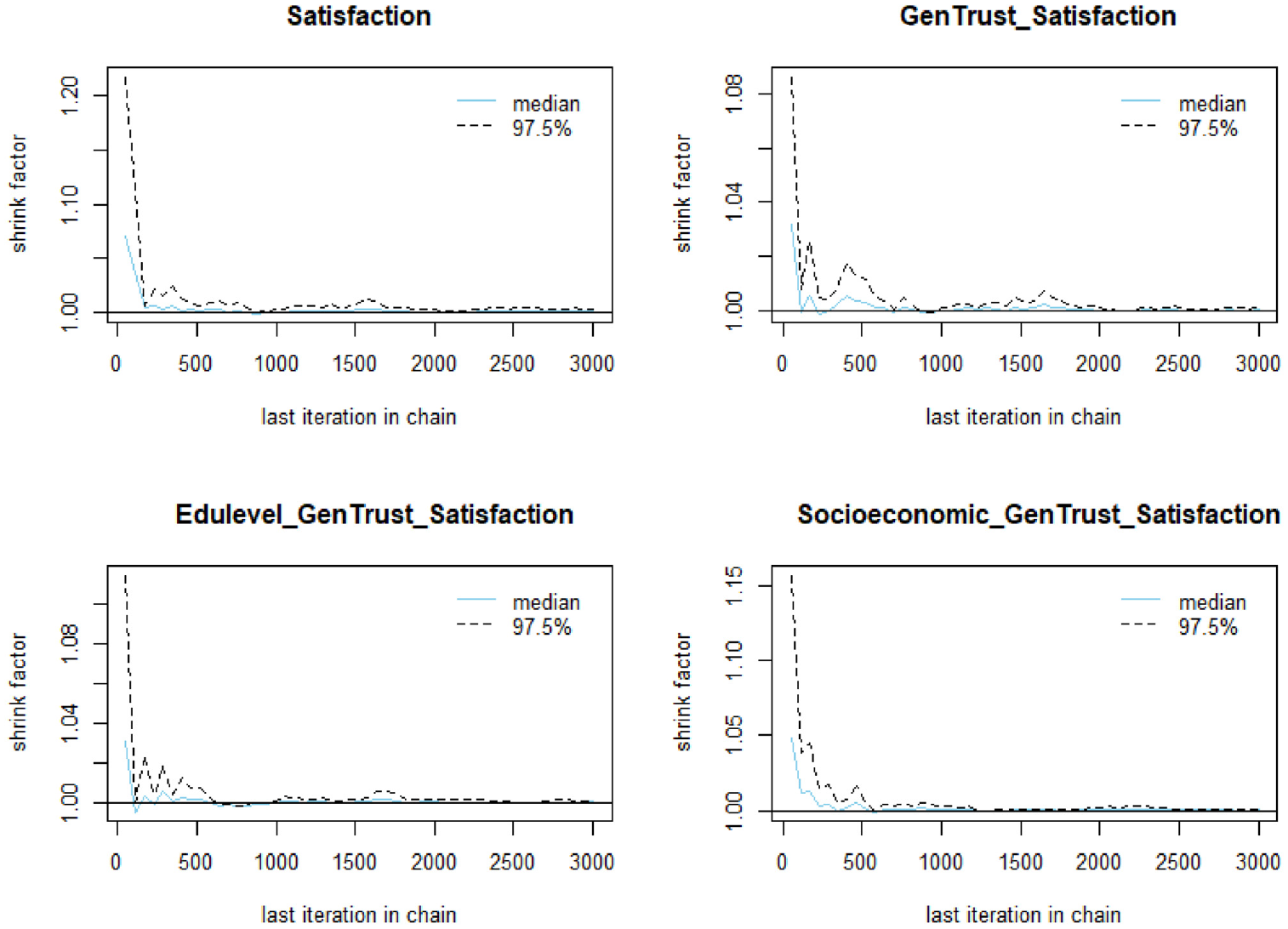
Model 2’s Gelman plots.
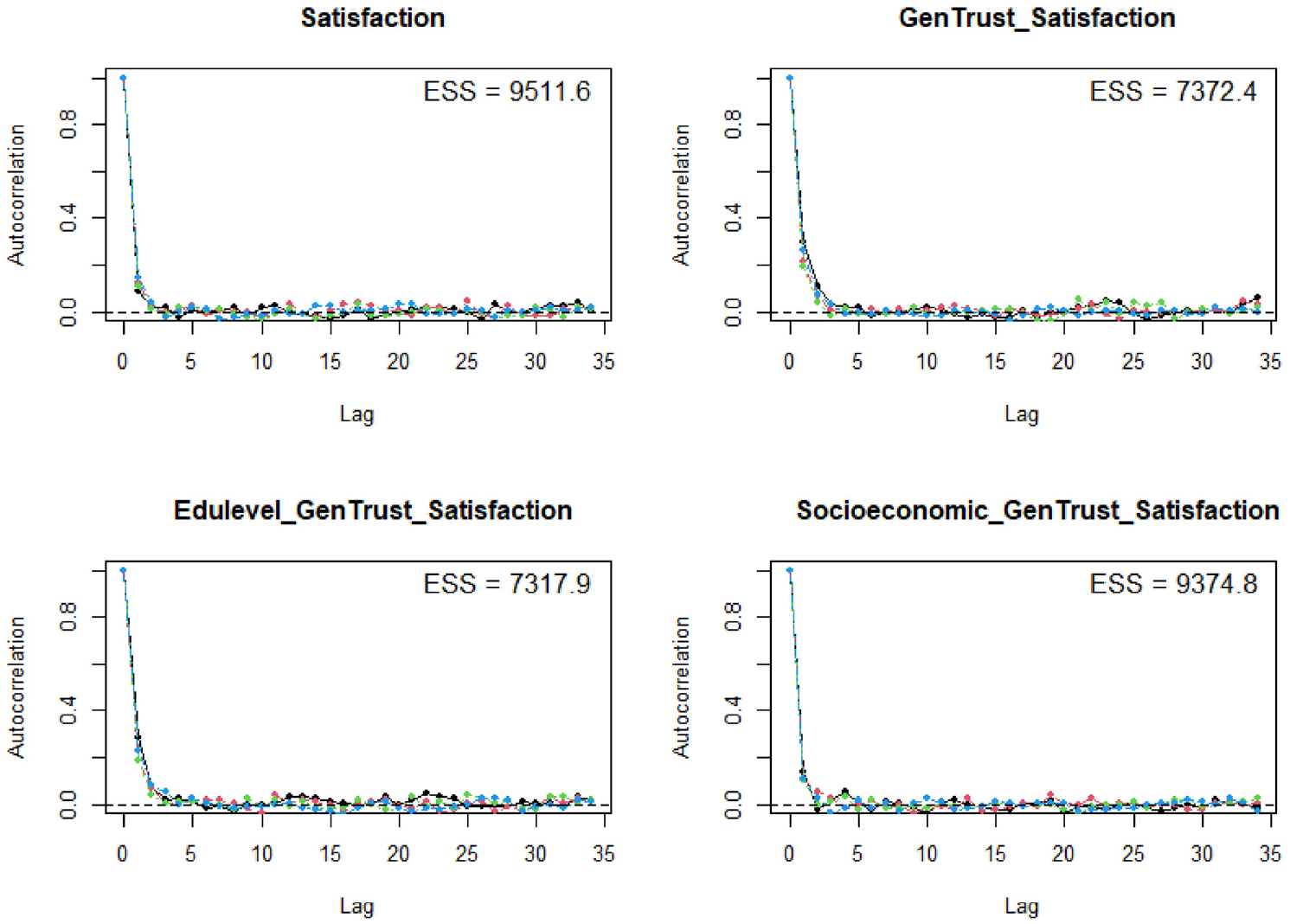
Model 2’s autocorrelation plots.
When considering the interactions with education level and socioeconomic status in the model, generalized trust is negatively associated with life satisfaction (
The visualization of the posterior distributions are presented in the interval plots (see Figure 11) and the two-dimensional density plots (see Figure 12). The distributions of GenTrust lie completely on the negative; the distributions of Edulevel*GenTrust lie completely on the positive; the distributions of Socioeconomic*GenTrust lie mostly on the positive.

Posterior distributions of Model 2’s parameters.

Model 2’s two-dimensional density plot of Edulevel*GenTrust and Socioeconomic*GenTrust.
To aid in interpreting the results of Model 2, the estimation of life satisfaction values based on the posterior coefficients is presented below. The mean values are used because they have the highest probabilities of occurrence. For example, the estimated Satisfaction value of a person having a GenTrust value of 5, Edulevel value of 3 (undergraduate degrees or equivalent), and Socioeconomic value of 4 (slightly above average) is as follows:

Similarly, the estimated Satisfaction values for Edulevel of 1 (uneducated or primary education) and Edulevel of 2 (secondary education) are visualized in Figures 13 and 14, respectively. The x-axis represents the degree of generalized trust, the y-axis represents the degree of life satisfaction, and the line color represents socioeconomic status. Figure 13 shows a downward trend as the degree of trust increases, whereas Figure 14 shows an upward trend instead. Edulevel of 3 and 4 continue further in this upward tendency.

Estimated life satisfaction in those with no educated or primary education level.

Estimated life satisfaction in those with secondary education level.
Discussion
Employing Bayesian analysis aided by the MCMC technique on 1,237 urban people in Colombia, we found that generalized trust is positively associated with life satisfaction. This result aligns with the findings in other studies (Graafland & Lous, 2019; Kuroki, 2011; Shao et al., 2021; Vyrost et al., 2007). However, in a model including the interactions between trust and education levels as well as between trust and socioeconomic status, generalized trust is found to be negatively associated with life satisfaction. In this non-linear relationship, both education levels and socioeconomic status have moderating effects against the negative association between generalized trust and life satisfaction. In other words, people with lower educational levels whose socioeconomic status are lower are more likely to have lower life satisfaction when they have higher levels of social trust, whereas people with higher educational levels whose socioeconomic status is higher will be more likely to have higher life satisfaction when they have higher levels of social trust. Our findings also suggest that education level has a bigger impact compared to socioeconomic status in moderating the relationship between social trust and life satisfaction. People with lower educational levels (primary education or uneducated) tend to have lower life satisfaction as social trust increases, regardless of socioeconomic status (poor people have a stronger negative association). For those with secondary education levels or above, life satisfaction tends to increase as social trust increases, regardless of socioeconomic status (wealthy people have a stronger positive association). These findings suggest that the relationship between generalized trust and life satisfaction can have different and complex information-processing pathways underneath its linear association
From the mindsponge standpoint, trust acts as the “gatekeeper” of an information absorption channel (Le et al., 2022; Vuong, Le, La, & Nguyen, 2022). The more people trust a certain piece of information (meaning that its carried value was integrated into the mindset), the more likely and quickly they will accept related information carrying similar values. Likewise, when a source of information (including other people—as in interpersonal trust) is trusted, new information coming from that source is filtered more quickly and favorably. On the other hand, under the influence of distrust, related information carrying similar values will likely be rejected quickly. In a high-violence social environment (treated as an infosphere), a high level of generalized trust means that one is more open and susceptible to information coming from other people in society, including strangers. Less educated and poor people surround themselves with “bad” social circles where deception and hostility are more prevalent, which will create more risks if they lower the rigor of the information filtering system. Intuitively, it is commonly considered an unwise idea to trust strangers in a “bad neighborhood.” This result aligns with Adjaye-Gbewonyo et al. (2018) findings, which suggest that having a high level of trust in a low-trust society may increase the likelihood of depression due to risks of crime or fraud. This result is in alignment with the claim made by Daukas (2006) that epistemic trust is shaped by social location.
A higher level of generalized trust does not mean naiveness. The impact of the received information is largely determined by the processing capacity of a system. This also involves the quality of stored information in memory used as references in information filtering. In other words, knowledge and thinking skills are very important for effectively utilizing the function of trust in an information process (to speed up evaluation). Information processing capacity is enhanced by education (Clouston et al., 2012; Mather, 2020), and our results show that those with higher education levels likely are not negatively affected by high levels of social trust. In fact, from secondary to undergraduate and graduate levels, the higher the education levels are, the stronger the positive correlation between generalized trust and life satisfaction is. Overall, the relationship between social trust and life satisfaction has complex underlying psychological pathways. Social trust heavily depends on social contexts (Boyadjieva & Ilieva-Trichkova, 2015; Vuong et al., 2021), and complex information processes can sometimes produce a negative correlation in specific cases (Bi et al., 2021).
Based on our findings, there are some implications for policymakers and researchers on the issue of social trust. While it is beneficial to advocate for increasing social trust in communities with high education levels and relatively good socioeconomic conditions, promoting the same thing in communities with lower education levels, poor living conditions, and a violent social context should be carefully planned due to the complexity of related information processes’ interactions. So, policymakers in countries and regions plagued by uneven education resource distribution, underdeveloped economies, and violent crimes should take extra steps to monitor and assess the social conditions of their regions before advocating social trust enhancement as an attempt to enhance life satisfaction. Regarding related research efforts, human psychology is multiplex and often context-dependent, so researchers should pay more attention to context-specified psychological processes during their analysis and reasoning to provide more accurate suggestions for policymaking. Regarding future research direction, further qualitative studies on the relationship between social trust and life satisfaction may help shed more light on possible psychological pathways in specific social contexts.
Limitations
First of all, the interplay between social trust and the high-violence infosphere in a given social context is highly dynamic, but the study could not go into detail and examine the complex real-time interactions due to data limitations. Therefore, further studies are needed to explore such specific information processes more clearly. Secondly, the study’s sample size of 1,237 participants in Cali may not sufficiently reflect the overall situation in Columbia or other developing countries having similar issues. Follow-up studies using Bayesian inference can update the existing beliefs on the factors and interactions. Thirdly, culture (as a collective mindset from an information processing perspective) may potentially be a significant moderator in the relationship between social trust and life satisfaction; thus, future studies may want to focus on exploring this aspect.
Footnotes
Acknowledgements
None.
Author Contributions
Conceptualization: Tam-Tri Le, Minh-Hoang Nguyen; Methodology: Minh-Hoang Nguyen, Viet-Phuong La, Quan-Hoang Vuong, Tam-Tri Le; Formal analysis and investigation: Tam-Tri Le, Viet-Phuong La; Writing—original draft preparation: Tam-Tri Le, Ruining Jin, Hong-Son Nguyen; Writing—review and editing: Tam-Tri Le, Minh-Hoang Nguyen; Validation: Minh-Hoang Nguyen, Quan-Hoang Vuong; Resources: Viet-Phuong La, Tam-Tri Le; Supervision: Quan-Hoang Vuong.
Declaration of Conflicting Interests
The author(s) declared no potential conflicts of interest with respect to the research, authorship, and/or publication of this article.
Funding
The author(s) disclosed receipt of the following financial support for the research, authorship, and/or publication of this article: This work did not receive any financial support.
Ethical Approval
The data collection followed the local and international rules for empirical research and was approved by the Institutional Review Board of Universidad Icesi.
Informed Consent
All the respondents’ consents were obtained before survey commencement.
