




Abstract
Extramarital affairs can be detrimental to family stability and individual happiness. Existing literature on the issue suggests that gender and moral qualities can be major influencing factors. Particularly, it is suggested that males are more likely to have affairs compared to females. In this study, we explore deeper possible gender differences together with the sense of responsibility and fairness in young people’s attitudes toward extramarital affairs from the perspective of information processing. Following the Bayesian Mindsponge Framework (BMF), we conducted Bayesian analyses on 493 university students from Germany, Vietnam, China, Taiwan, and Japan. Our analysis results show that males are more likely than females to think that extramarital affairs can be justified, but this gender difference is small in magnitude. In linear relationships, importance perceptions of fairness and responsibility do not have any clear effect on attitudes toward affairs. However, when considering the interactions between gender and these moral factors, we found that among males, those who put more importance on responsibility are less likely to think that extramarital affairs are justifiable, but those who put more importance on fairness are more likely to think that extramarital affairs are justifiable. These patterns may be due to how men interpret moral values in their subjective cost-benefit judgments toward marital relationships involving social expectations and personal preferences.
Plain language summary
This research examined how gender and moral values affect young people’s views on extramarital affairs. The study used a survey on 493 college students from five countries about whether affairs could ever be justified. The study also probed how important they felt responsibility and fairness are to see if gender or morals predicted attitudes on affairs. The study found that men were a bit more likely than women to say affairs could sometimes be justified, but the difference was small. More interestingly, men who valued responsibility more were less likely to justify affairs. But men who valued fairness more were more likely to justify affairs. This suggests men may think about responsibility and fairness differently when evaluating affairs. Responsibility may connect more to social norms against affairs for men. But some men may see affairs as personally fair, even if norms suggest it’s wrong. Their own sense of fairness may justify affairs, despite social disapproval. In contrast, women’s views were less affected by their senses of responsibility and fairness. This implies men do complex moral calculations about affairs weighing social norms versus personal preferences. Their interpretations of morals like fairness shape their attitudes. More research on this gender difference is needed. The study has limitations as it relied on students, not actual married people. The study also focused only on heterosexual relationships in a few countries, so the relationships in LGBTQ communities are not included in this study.
Keywords
Introduction
Extramarital affairs, also known as infidelity, is a term describing an emotional, sexual, or romantic involvement of one party that violates an existing relationship’s commitment norm (Glass, 2002). An extramarital affair could lead to many undesirable outcomes for the parties involved. First of all, extramarital affairs have a negative impact on family relations and children. It is suggested the associations between affairs and domestic violence, child abuse, and other destructive familial impacts (Allen et al., 2005); similarly, another study concluded that extramarital sex has destabilizing effects on marital stability, quality, and duration (Williams, 2011). On the children’s side, children of divorced families could face severe consequences, including lower educational attainment, increased behavioral problems, and poorer mental health (Amato, 2001; Dean, 2011; Fincham & May, 2017; Negash & Morgan, 2016).
Having said that, however, the magnitude of extramarital affairs’ impacts varies significantly based on several factors such as context, personality, and marital understanding. Contextual factors such as the length of the affair, the emotional involvement, and the presence of other relationship issues can all shape the consequences (Mark et al., 2011); on the other hand, individual personality differences can also play a role in how an affair affects individuals and relationships, as it has been proven that attachment style, self-esteem, and coping strategies can moderate the impact of infidelity (Allen & Baucom, 2004); lastly, the perception of an affair and its effects can vary depending on the understandings and agreements that exist inside a marriage or committed partnership. Monogamy may be expected in some relationships, and any violation of that understanding can be extremely upsetting. However, there are also situations where non-monogamy is done consensually (Conley et al., 2013).
Furthermore, extramarital affairs could also hurt the betrayer and the betrayed. Individuals who engaged in extramarital affairs went through higher levels of emotional distress and suffer lower levels of life satisfaction compared to those who remained loyal (Allen & Atkins, 2012). Those who cheated in their relationships were also more likely to develop mental distress such as encountering guilt, regret, and confusion (Olson et al., 2002). Additionally, the financial consequences of extramarital affairs can be significant, particularly in cases of divorce—legal fees, spousal support, and child support can be financially challenging (Amato, 2010). A possible explanation to this is that extramarital affairs may not be perceived as dire, or as immoral by everyone. In a study published by Pew Research Center (2013), 40,117 respondents from 40 countries voiced their opinions on extramarital affairs, and although a predominant majority of participants (84%) believed that such an act is unacceptable, there are still 16% of respondents expressed that extramarital affairs are acceptable or not a moral issue.
In marriage, moral qualities such as responsibility and fairness are considered important. In other words, people don’t unanimously perceive extramarital affairs to an equal degree of immorality because of many factors, including culture, religion, personality, income, and gender. Firstly, the sense of morality and immorality is context-based. Extant research suggested that moral identity is a context-dependent construct tied to varying social and cultural obligations. For example, western moral identity stresses an individually oriented morality, whereas people from Eastern cultures consider a highly moral person to be societally oriented (Jia & Krettenauer, 2017). Secondly, culture and belief systems would alter people’s attitudes toward extramarital affairs. Different cultures have varying norms and values regarding relationship expectations and the acceptability of extramarital affairs. Certain cultures in some countries in the Middle East and Africa make women more accepting of polygamy (Al-Krenawi, 2013; Bove & Valeggia, 2009), whereas in Western countries such as the United Kingdom, the culture of “compulsory monogamy” would suppress extramarital affairs (Ritchie & Barker, 2016). Religion, on the other hand, also plays a crucial role in affecting beliefs and shaping attitudes toward extramarital affairs. It is maintained that the more people attended religious events, the more loyal they were to their partners, and the less likely they would engage in extramarital affairs (Atkins & Kessel, 2008; Lambert & Dollahite, 2008). Personality-wise, it has been concluded that some personality traits, such as narcissism could lead to higher chances of conducting infidelity, whereas individuals’ conscientiousness can lower the likelihood of extramarital affairs (Buss & Shackelford, 1997). Economic factors can influence attitudes toward extramarital affairs, too. For instance, individuals with higher incomes might feel more entitled or have more opportunities to engage in infidelity, while lower-income individuals might perceive extramarital affairs as a threat to their financial stability (Lammers et al., 2011).
Among influencing factors, gender considerably affects one’s perception and acceptance of extramarital affairs. Namely, some studies suggest that men were more likely to engage in infidelity than women (Atkins et al., 2001; Babaei & Zavrei, 2021; Laumann et al., 2000; Mark et al., 2011). The differences between men’s and women’s attitudes toward extramarital affairs stem from several factors. From an evolutionist perspective, men have evolved to seek multiple sexual partners to increase their chances of reproductive success (Buss, 2016). This drive may contribute to their increased likelihood of engaging in extramarital affairs. From a hormonal perspective, testosterone—a major male sexual hormone—affects sexual desires and pleasure-seeking activities in me (Bancroft, 2005). In nature, many mammals institute polygamy in which male mammals gather and safeguard the group in exchange for exclusive mating rights with many females in the group. A polygamy system can be found in mammals such as lions, gorillas, and red deer (Clutton-Brock et al., 1982; Packer & Pusey, 1983; Robbins, 1995); There also exists polygamy and polyandry systems in human societies, such as in a few regions of Islamic, African, and indigenous cultures where men are allowed to have multiple wives, or women are allowed to have multiple husbands (Al-Qaradawi, 2013; Chagnon, 1992; Murdock, 1967; Starkweather & Hames, 2012).
However, human beings exist not only for hedonism and reproduction; rather, the development of human altruism from advanced cognition as the moral compass is very influential in a family construct (Fehr & Fischbacher, 2003). Family responsibility refers to the obligations and duties that individuals have toward their family members, encompassing emotional, financial, and instrumental support (Bianchi et al., 2006). The extent of family responsibility can be influenced by factors such as socioeconomic status, cultural background, and family dynamics. Fairness, on the other hand, refers to the equitable distribution of resources, opportunities, and responsibilities within a familial unit, and perceived fairness can motivate individuals to sacrifice personal gains in order to eliminate inequalities (Almås et al., 2016). Specifically, couples who perceive their division of labor as fair are more likely to experience higher levels of marital satisfaction and stability (Lavee et al., 2016). On the other hand, perceived unfairness be detrimental to an individual’s mental health as well as a family relationship. Perception of unfairness in the division of household labor was related to increased depressive symptoms, which negatively impact their mental health and lead to family instability (Claffey & Mickelson, 2008).
Yet responsibility and fairness are two social constructs that the meanings and requirements of these constructs vary based on different social contexts. Family responsibility, as Donnelly et al. (2016) suggested, is changing constantly in the past couple of decades when it is associated with specific gender roles. As American society experienced social changes, there has been an increase in support for egalitarian roles, with fewer Americans endorsing traditional separate spheres in a family; fairness, on the other hand, is also a contextual-based notion. One study argued that fairness is highly subjective and intangible, so it is not an objective concept but rather influenced by social and subjective factors (Gudbrandsdottir et al., 2021). Another study introduces the legal perceptions of policing and procedural fairness across cultures and societies, highlighting the fact that fair procedure in one cultural context may not be viewed the same in another (Bottoms & Tankebe, 2012). Lastly, speaking of family fairness, one study found that wives and husbands hold different views on what constitutes a fair division of housework, with women expecting more egalitarian sharing than men (Zuo & Bian, 2001).
Based on the background information presented above, in this study, we aim to explore deeper the psychological aspects of gender differences in young people’s attitudes toward extramarital affairs, especially regarding moral qualities. For this purpose, the information processing approach for psychological research is helpful. In this study, we will use Bayesian Mindsponge Framework (BMF) analytics (Vuong et al., 2022) for conceptual model construction and statistical analysis. Detailed reasoning for employing this framework is presented in the Methodology section. The research questions (RQs) are as follows.
RQ1: Are there gender differences in young people’s attitudes toward extramarital affairs?
RQ2: How does the perceived importance of responsibility affect attitudes toward extramarital affairs in general and when considering its interaction with gender?
RQ3: How does the perceived importance of fairness affect attitudes toward extramarital affairs in general and when considering its interaction with gender?
Methodology
Theoretical Foundation: Mindsponge Theory and the Basic Properties of the Mind
The concept of mindsponge was originally coined as a dynamic process of how a mindset absorbs new cultural values and discards waning ones in different environments, with the metaphor of a sponge that squeezes out unfitting values and absorbs fitting ones (Vuong & Napier, 2015). The mindsponge concept has been further developed into a theory of information processing (Vuong, 2023), which describes the mind as a collection-cum-processor of knowledge, applied to both biological and social systems of various levels. The extended mindsponge theory was based on evidence from natural sciences, including functions and processes from molecular and cellular levels to organisms and communities. A mindsponge information process has the following basic properties: (1) It reflects fundamental patterns found in the biosphere; (2) It is dynamically balanced; (3) It aims to maximize the perceived benefit for the system; (4) It consumes energy and adheres to the principle of energy conservation; (5) Its objectives and priorities are based on needs of the system; (6) Its primary purpose is to ensure the continued existence of the system.
The physiological aspects of the human system (bodily functions, brain structure, etc.) and the psychological aspects (thoughts, intentions, attitudes, beliefs, social behaviors, etc.) are closely connected (Eagleman, 2015; Maliske & Kanske, 2022). Information is stored in memory as inputs for future processes of creating mental products. Information is stored in the brain in the form of engrams—cognitive information imprinted in a physical substance—thanks to the flexible structural changes in neurons. As a result of DNA (deoxyribonucleic acid) methylation activated by neural signals, memory consolidation can take place in engram neurons (Alberini & Kandel, 2015; Bernstein, 2022). Synaptic connections become stronger as signals continued to be transmitted across those synapses, which is called long-term potentiation (Bliss & Collingridge, 1993). These dynamic information storage structures are the basis of neuroplasticity, which allows the processing system to adapt in a flexible manner (Eagleman, 2015). On the foundation of dynamic information storage, neuroplasticity enables flexible adaptive responses in the system. As the memory’s content changes, responses to external stimuli also change accordingly (Vuong, 2023).
The activities of a system are fundamentally for the sake of the survival (prolonged functioning) of its own as well as its group or species, which are expressed in different aspects (self-preservation, growth, controlling, reproduction, etc.). Adaptive responses to environmental information can aid survivability: obtaining sustenance, avoiding harm, finding sexual partners, communicating, learning new skills, anticipating danger, simulating future scenarios, etc. Regardless of context-specific pathways, information filtering (selectivity) aims to make the system better fit the objective world (Darwin, 2003; Nguyen et al., 2023). Due to the reliance on physical structures and functions, mental activities and subjective value optimization tendencies are dependent on energy constraints. All biological systems on Earth rely on consumable resources to function, especially in terms of energy consumption (Schrödinger, 1992). The neural wiring in the human neocortex was evolved to be highly interconnected and coordinated, which helps carry out complex computations while minimizing energy and material expenditure (Hofman, 2014). While the human brain has advanced capabilities of mental simulation, physiological influences still exist in information processes to various degrees.
The mindsponge theory and the information-processing-based BMF analytics have been employed effectively in studies on gender-related individual and collective psychology (Jin, Le, Vuong, et al., 2023; Nguyen, Nguyen, et al., 2021; Vuong, La, et al., 2023a) as well as physiology- and morality-influenced ideation and decision making (Jin, Le, Nguyen, et al., 2023; Nguyen, Le, et al., 2021; Vuong, La, et al., 2023b; Vuong, Le, et al., 2023). It should be noted that information-processing-based psychological research requires a relatively deeper understanding of connections between physical (including biological and neurological) platforms and their non-physical expressions and complex functions (cognition, social system, collective values, etc.). On the front of practical applications, the mindsponge theory serves as an effective framework to construct analytical models for empirical testing (Vuong et al., 2022).
Materials and Model Construction
This study uses secondary data from the article “Cheating, Trust and Social Norms: Data from Germany, Vietnam, China, Taiwan, and Japan” (Huynh et al., 2022). The sample includes 493 university students from these five countries/regions. Students were invited to join an experiment on cheating behavior, and also fill out a questionnaire on socioeconomic factors, social norms, trust, and cognitive reflection tests. The data collection was approved by the Institutional Review Board Committee #01112022 of the University of Economics Ho Chi Minh City (November 1, 2020). Informed consent was obtained from all participants by the research team conducting the experiment. The participants’ mean age was 20.87 years. In the sample, there were 44% males and 56% females. There were 21%, 34%, 17%, 13%, and 14% of German, Vietnamese, Chinese, Taiwanese, and Japanese students, respectively. Note that the regions of origin are not for the purpose of specific comparison in this study. The diversity in the sample help increase the accuracy of estimated patterns in Bayesian analysis with aided Markov Chain Monte Carlo (MCMC) algorithms for information processing pathways in the human mind.
The variable description is presented in Table 1. The reasoning for variable selection and model formulation is presented afterward.
Variable Description.

The variable Affair comes from asking participants their attitudes toward the statement “Having an affair when you are married,” where they rank the action’s justifiability from low to high. Regarding the variable Gender, 7 data points were excluded because these participants chose not to identify as either male or female. Both variables Responsibility and Fairness come from asking participants to rank the importance of these qualities from low to high on a 5-point Likert scale.
An attitude toward extramarital affairs is a result of a multi-factor information process. To generate this mental product, the mind needs to use existing trusted values as inputs for the filtering/optimization process. As affairs are commonly condemnable in most social contexts (or at least controversial), related information used as references should include general moral qualities. Here, both responsibility and fairness represent internal intents that aim to fit social expectations as well as personal expectations from mental simulations. While both qualities have certain degrees of external (social) and internal (personal) influences due to how the corresponding knowledge is acquired and how its values are reinforced, responsibility may tend to lean toward social norms and fairness may tend to lean toward personal beliefs. The gender factor is a focus of this study. Gender differences in attitudes toward affairs and moral qualities may have many underlying reasons such as physiological differences, sexual preferences, social roles and expectations, etc. Regardless of specific influencing factors, we can observe overall patterns if they exist.
In Model 1, we examine how gender and moral perceptions of responsibility and fairness affect attitudes toward affairs in linear relationships.

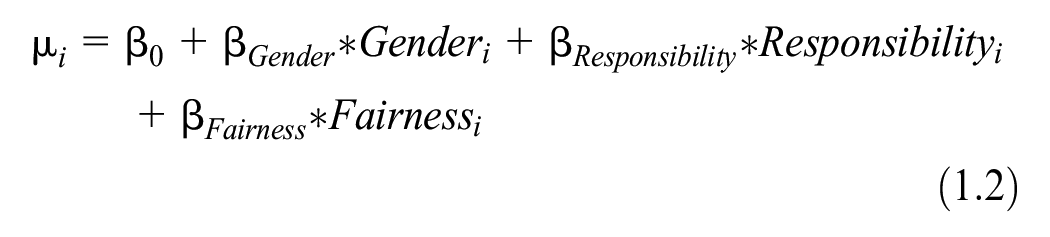

Regarding the outcome variable Affair, the probability around
The logical network of Model 1 is visualized in Figure 1.
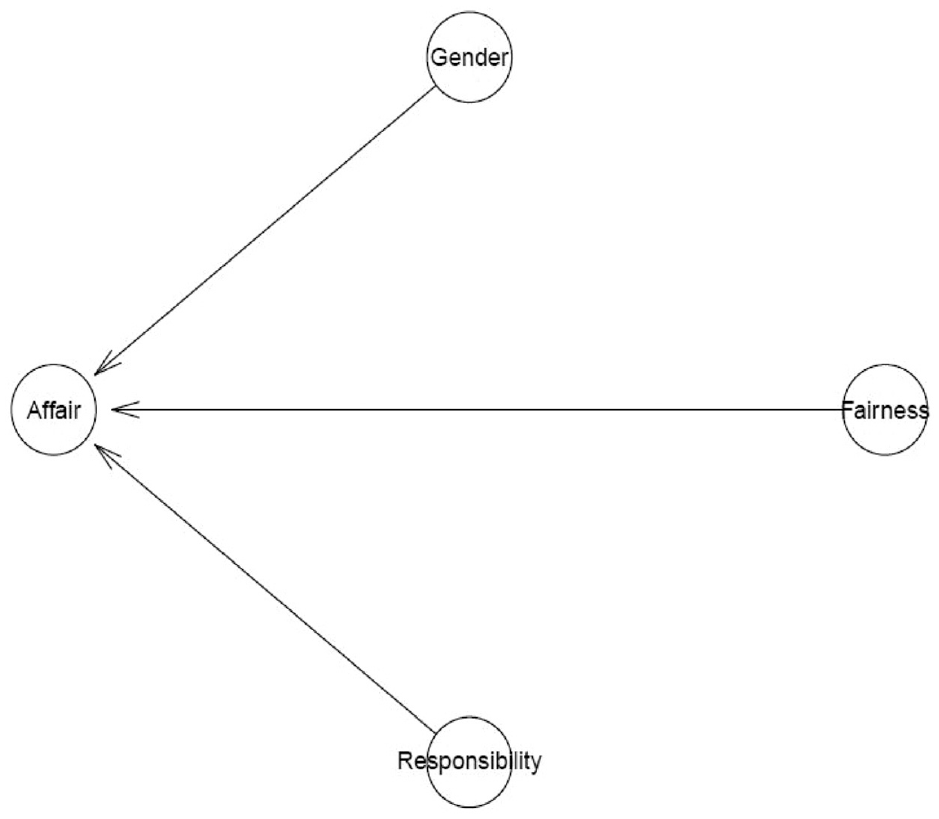
Model 1’s logical network.
In Model 2, we examine the possible influences of moral quality perceptions when considering them in interactions with the gender factor in non-linear relationships.


Model 2 has an intercept
The logical network of Model 2 is visualized in Figure 2.
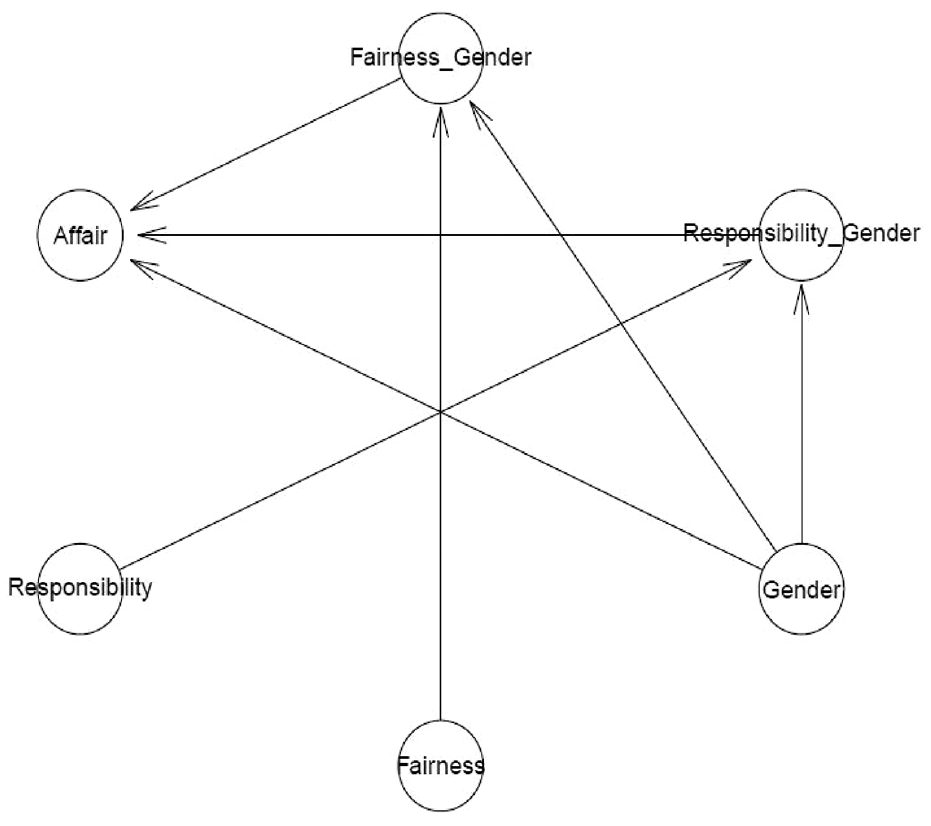
Model 2’s logical network.
For statistical analysis, we employ Bayesian analysis assisted by Markov Chain Monte Carlo (MCMC) algorithms (Nguyen et al., 2022; Vuong et al., 2022). The mindsponge mechanism and Bayesian inference are compatible, in both conceptual and technical aspects. Bayesian inference treats all properties probabilistically, including unknown parameters, which provides more accurate estimations for parsimonious models with higher predictive power (Vuong et al., 2022). Thanks to aided MCMC algorithms (Nguyen & Vuong, 2007; Nguyen et al., 2005), the estimation accuracy and computational flexibility of Bayesian analysis are further increased. For statistical validation, we can check the model’s goodness-of-fit using the Pareto-smoothed importance sampling leave-one-out (PSIS-LOO) method (Vehtari et al., 2017), as well as the effective sample size (n_eff) and the Gelman-Rubin shrink factor (Rhat). Visually, the Markov chain convergence is also checked using trace plots, Gelman-Rubin-Brooks plots, and autocorrelation plots. Regarding software for conducting the analysis, we use the
Results
The latest model fitting runs for both models were on April 5, 2023, R version 4.2.1, Windows 11, with a total elapsed time of 67.2 s for Model 1 and 72.8 s for Model 2.
Model 1
Figure 3 shows the result of PSIS diagnostics for Model 1. All k-values are below the 0.5 threshold, indicating an acceptable goodness-of-fit.

PSIS-LOO diagnostic plot for Model 1.
Table 2 shows the statistical results of the Bayesian analysis for Model 1. For all parameters, the n_eff values are above 1,000 and the Rhat values equal 1, indicating good convergence of the Markov chains. The convergence is also validated visually through the trace plots, the Gelman-Rubin-Brooks plots, and the autocorrelation plots (see Appendix, Figures A1–A3, respectively). These validation results show that the chains fluctuate around central equilibriums, and the Rhat values and the correlation levels quickly drop to acceptable thresholds during the estimation process.
Model 1’s Estimated Posteriors.

Gender is positively associated with Affair (
Model 2
Figure 4 shows the result of PSIS diagnostics for Model 2. All k-values are below the 0.5 threshold, indicating an acceptable goodness-of-fit.

PSIS-LOO diagnostic plot for Model 2.
Table 3 shows the statistical results of the Bayesian analysis for Model 1. The n_eff and Rhat values for all parameters are healthy. Similar to the explanations in Model 1, the trace plots, the Gelman-Rubin-Brooks plots, and the autocorrelation plots for Model 2 (see Appendix, Figures A4–A6, respectively) all indicate good convergence of the Markov chains.
Model 2’s Estimated Posteriors.

Responsibility × Gender is negatively associated with Affair (
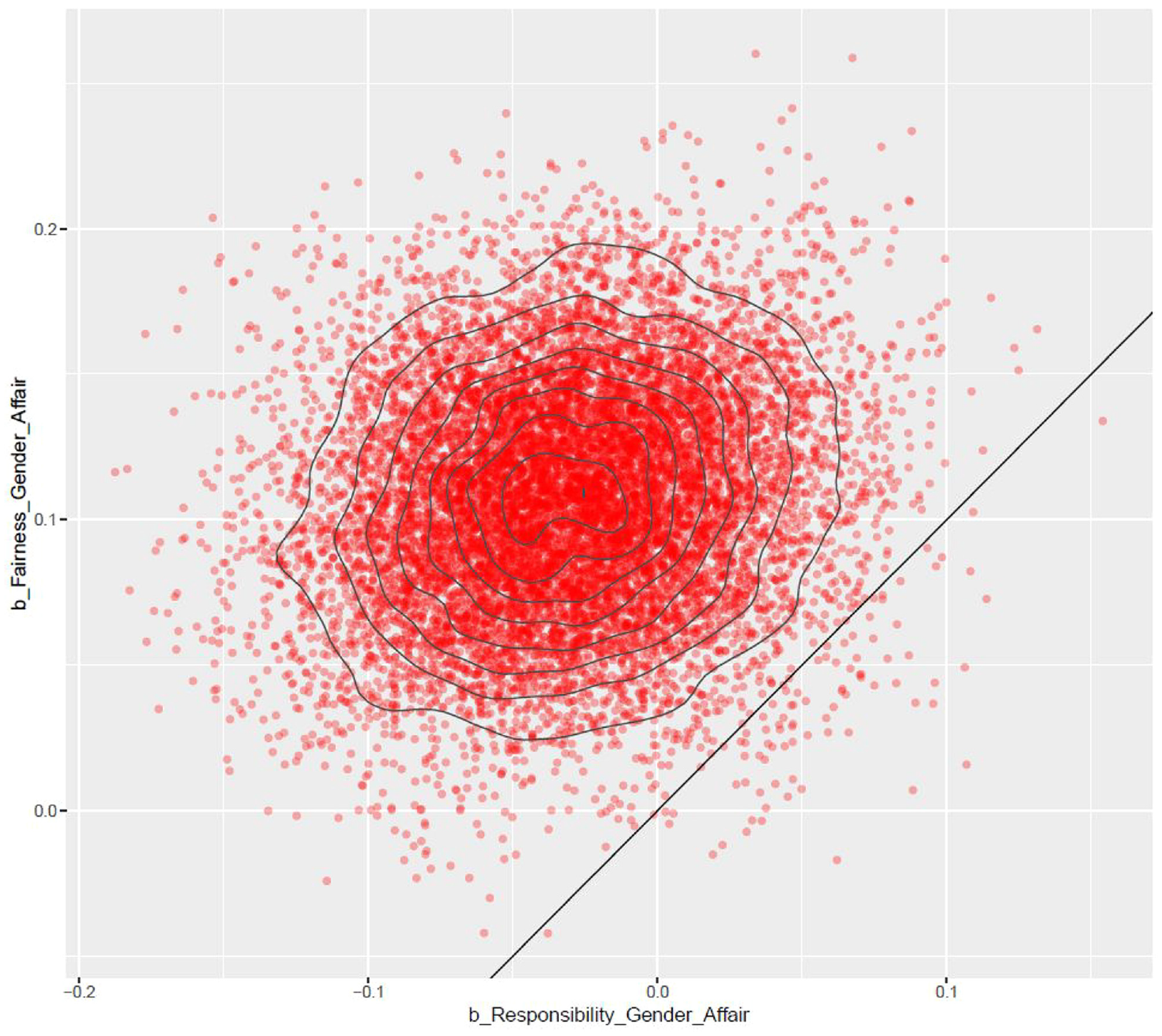
Pairwise posterior distributions of Responsibility × Gender and Fairness × Gender.
Discussion
Employing Bayesian analysis on 493 university students in Germany, Vietnam, China, Taiwan, and Japan, the study found that gender is positively associated with the attitude towards extramarital affairs, although the difference is very small in magnitude. Namely, males are slightly more likely than females to think that extramarital affairs can be justified. It is also found that, when considering the interactions between gender and these factors, males who put more importance on responsibility are less likely to think that extramarital affairs are justifiable. Interestingly, among males, those who put more importance on fairness are more likely to think that extramarital affairs are justifiable.
The result that males are slightly more likely than females to think that extramarital affairs are justifiable is in alignment with previous research findings that men are more likely to engage in extramarital affairs than women (Atkins et al., 2001; Babaei & Zavrei, 2021; Laumann et al., 2000; Mark et al., 2011). From an information-processing perspective, the mind conducts subjective cost-benefit evaluations that aim to maximize the perceived benefit of the system and decrease its perceived cost (Vuong, 2023). This evaluation processes use inputs from all available stored values in the system, including various physical and mental factors. Mental simulations help optimize a value to fit its subjectively expected corresponding reality (Nguyen et al., 2023). In this sense, males’ attitude towards infidelity can be considered as a result of cost-benefit analyses, where the perceived cost such as divorce, negative impacts on children, and mental and financial hardship on couples (Allen & Atkins, 2012; Amato, 2001; Fincham & May, 2017) are weighted against the perceived benefits including instinctual reproductive desires, sexual desires, and other forms of expected psychological satisfaction (Bancroft, 2005; Buss, 2016).
Regarding moral qualities, in family contexts, responsibilities may include providing emotional support, and financial stability, taking care of physical needs, and nurturing the well-being of each family member. Previous studies have indicated that responsibility could promote an individual to foster a sense of ownership in the workplace, organization citizenship behavior, and among human beings in general (Avey et al., 2009; Furby, 1978; Van Dyne & Pierce, 2004). The sense of ownership in males may induce greater efforts to prolong a family’s existence and integrity. Given that extramarital affairs could bring so many devastating impacts to the family as a whole, individuals with greater responsibilities would be more likely to reject information containing extramarital affairs because it is incompatible with the existing mindset where family stability is prioritized. Additionally, while a sense of responsibility involves a sense of control within the scope of the individual, the values of responsibilities are often adopted from social norms due to the underlying collective purposes. Thus, they are more in line with collective expectations. For example, here, the expectations of a responsible husband or father figure act as pressures for the optimization process.
Perceived fairness, however, reflects individuals’ subjective feelings regarding treatment, contribution, and resource allocation (Adams, 1963; Deutsch, 2010). A family needs to operate based on members’ contributions in various areas such as financial support, child raising, and household chores. Family members’ contribution in these areas, however, cannot be fully quantified, therefore, an individual’s subjective evaluation of his/her contribution may not well match the objective contribution. Therefore, those who place higher importance on fairness may experience a discrepancy between mental simulations and feedback from reality, which in turn produces a sense of unfairness. It is worth noting that fairness may involve a relatively higher degree of individual beliefs as references for the evaluation process compared to responsibilities that rely more on collectively filtered values. A man may think that his affair is justifiable based on self-assessed values of fairness which do not fit his spouse’s perceptions as well as social expectations. For example, women’s sexual and physical appearance issues during pregnancy often affect usual activities in marital relationships (Pauls et al., 2008), which may cause their male partners to ponder upon socially undesirable personal preferences on the basis of subjective fairness.
This study has some limitations. Firstly, the sample used in our analysis consists of university students, who are relatively young and may not have direct experience with marriage. Older males with more marital life experience may think differently about moral qualities. Secondly, the discussions in the study focus on a heterosexual perspective. However, males with other sexual orientations as well as other groups with non-binary sexual identities may also seek extramarital sexual activities due to more context-specific reasons. Thirdly, proper examination of specific demographic and sociocultural factors such as education, finance, religiosity, customs, legal systems, personal social circles, etc. would require a different approach. Further studies may provide more insights by focusing on these aspects, and the qualitative approach may provide a more in-depth understanding of particular context-based matters.
Footnotes
Appendix
Acknowledgements
We would like to express our sincere gratitude to the following organization who have contributed to this project/study in various ways: A.I. for Social Data Lab (AISDL). We would like to acknowledge the AISDL for their commitment to advancing the field of AI in the social sciences, and for creating a stimulating and supportive research environment that encourages innovative research.
Declaration of Conflicting Interests
The author(s) declared no potential conflicts of interest with respect to the research, authorship, and/or publication of this article.
Funding
The author(s) received no financial support for the research, authorship, and/or publication of this article.
Ethical Approval
This study was conducted in accordance with ethical principles, and all procedures were approved by the Institutional Review Board Committee (#01112022) of the University of Economics Ho Chi Minh City on November 1, 2020. The committee authorized the data acquisition for this study. All data were collected and analyzed in compliance with relevant regulations and ethical principles governing research involving human subjects. The study adhered to the principles outlined in the Declaration of Helsinki and the Belmont Report. We would like to thank the participants for their participation and cooperation in this study, as well as the Institutional Review Board Committee for their valuable input and guidance throughout the study.
Informed Consent Statement
Informed consent was obtained from all participants included in the study. The confidentiality and anonymity of all participants were strictly maintained throughout the study, and all data collected were securely stored in accordance with institutional guidelines.
Public Significance Statement
This study investigates gender differences and the influence of moral values on young people’s attitudes toward extramarital affairs. Results indicate that while males are more likely to justify affairs, the difference is small. Interestingly, males valuing responsibility are less likely to justify affairs, while those valuing fairness are more likely. This suggests that men’s interpretations of moral values in cost-benefit judgments regarding marital relationships may be key to understanding these patterns.
