




Abstract
Researchers have done a great deal of research on the variables associated with early childhood teacher burnout, but the findings are numerous and inconsistent. Therefore, this study explored the variables most associated with burnout among early childhood teachers through meta-analysis. The National Assembly Electronic Library in Korea, Riss, the National Electronic Library, and DBpia databases were all thoroughly searched by researchers. Strict inclusion criteria resulted in the inclusion of 201 studies, and 35 variables total—divided into 5 variable groups—were analyzed. The results showed that the most correlated variable group with burnout was the psychological personality protective variable, and the largest effect size variables among the variable groups were age (r = −.3052), resilience (r = −.5415), calling (r = −.526), turnover intention (r = .5021), and interpersonal relationships (r = −.4552). However, the variables in the psychological personality risk variable were not statistically significant. Although more thorough validation by follow-up studies is still required, these findings offer a more scientific data reference for the prevention and improvement of burnout among early childhood teachers in Korea and suggest a direction for future research.
Plain language summary
A meta-analysis of teacher burnout’s variables
This study explored the variables most associated with burnout among early childhood teachers through meta-analysis. The results showed that the largest effect size variables among the variable groups were age, resilience, calling, turnover intention, and interpersonal relationships.
Introduction
Burnout is a condition marked by low achievement, depersonalization of psychological stress, and emotional tiredness brought on by an individual’s incapacity to manage the demands of their line of work (Maslach & Florian, 1988; Maslach & Jackson, 1984). Burnout is common in many helping professions, such as doctors (Jackson-Koku & Grime, 2019; Lin et al., 2022), police officers (Zeng et al., 2020), and teachers (Pereira et al., 2022; Sánchez-Pujalte et al., 2021). Within the context of education, teacher burnout is defined as a state in which educators experience “depersonalization,”“emotional exhaustion,” and “decreased personal achievement” at a specific point in their employment (Maslach et al., 2001; Zhou, 2022). According to Sabagh et al. (2018), teachers who experience physical and mental exhaustion, have a poor attitude toward their work and underestimate their work-related competencies are unable to carry out their assigned activities in an efficient manner (Sabagh et al., 2018; Zhou, 2022). In short, an individual teacher who believes he or she is in a state of “burnout” can no longer be a successful teacher (Brasfield, et al., 2019; Zhou, 2022). Additionally, it has been observed that burnout has an impact on the goals of instruction and the learning environment and that poor performance, health issues, and subpar student outcomes are among the negative effects of teacher burnout (S. Li et al., 2020). Early childhood teachers are one of the groups most prone to burnout, as they face pressure from parents, kindergartens, and society in addition to the heavy daily workload of care and education. There is a 56% burnout rate among ECE teachers (Koch et al., 2015; Schaack et al., 2020). Early childhood teacher burnout can impair parent-child interactions (J. Y. Kim & Choi, 2018). Additionally, according to some research, overworked teachers and those under stress are more likely to be emotionally detached from their students and to have more conflicts with them (Fang, 2023; Whitaker et al., 2015).
During the COVID-19 period, the multiple challenges associated with distance learning and the increasing responsibilities of teachers caused considerable emotional and psychological stress and increased levels of teacher burnout (Geraci et al., 2023; Karakose, Ozdemir et al., 2022; Karakose, Yirci et al., 2021). In this regard, research indicates that among teachers, anxiety, depression, stress, burnout, exhaustion, and sleep issues are more prevalent disorders (Karakose, Yirci et al., 2022). Scholars have endeavored to examine the variables linked to burnout (De Brito Mota et al., 2018). One study noted the importance of school principals’ digital leadership for teacher instructional support during COVID-19 (Karakose, Polat, et al., 2021). Teacher burnout during COVID-19 was associated with anxiety, parent communication, and administrative support (Pressley, 2021). It has also been noted that psychological distress, social media addiction, and depression among teachers are all associated with burnout during COVID-19 (Karakose, Yirci et al., 2022). A Spanish study points to a significant relationship between teacher burnout depression, and emotional intelligence during COVID-19 (Sánchez-Pujalte et al., 2023). However, the fact is that there are many more variables related to burnout, and the search revealed nearly one hundred variables related to burnout, while this study involves up to 35 variables, such as resilience (Hao, 2023), job satisfaction (Marti-Gonzalez et al., 2023), job stress (Yuan et al., 2023), well-being (Gossmann et al., 2023), calling (X. Zhao, Wu, et al., 2022), turnover intention (Li, Zhang, & Gamble, 2022), teaching efficacy (E. Daniel &Van Bergen, 2023), stress coping strategies (Chu & Gong, 2023), mindfulness (Burleson et al., 2023), emotional intelligence (Sánchez-Pujalte et al., 2023), job satisfaction (Akerstrom et al., 2023), emotional labor (Yin, 2023), social support (Afonso et al., 2024), leadership (Frank et al., 2023), organizational culture (Headley et al., 2023), Empowerment (Tsang et al., 2022), etc. These investigations have looked at the connection between one or more variables and burnout and have confirmed the existence of the connection. However, the fact is that it is not possible to propose solutions to reduce or prevent burnout for every variable but rather to propose solutions for the variables that are most closely associated with burnout. Exactly which variables are most closely related to burnout? Previous studies have not provided a basis for this. Secondly, the results of previous studies on the same variable are often inconsistent, for example, the effect sizes on resilience and burnout ranged from −0.02 to −0.78 (Burleson et al., 2023; S. S. Li, 2023; Schoeps et al., 2023; Y. J. Shin & Lee, 2020; Velando-Soriano et al., 2023), these inconsistent results hardly provide a scientifically reliable basis for reality. Then, the meta-analysis method can solve these problems effectively. A statistical technique for incorporating data analysis findings into a methodical assessment is meta-analysis. It is a technique for quantitative statistical analysis of data from several studies that have similar goals and characteristics, which strengthens the study’s conclusions and makes them more reputable, authoritative, scientific, and rigorous (Glass, 1976; Xu et al., 2023). The meta-study method in this study allows for the formation of a composite effect size for each variable, which leads to the variables that are closely related to burnout. Therefore, Meta-analysis is a good method to integrate and analyze existing studies on early childhood teacher burnout. The following two research questions were established for this study to identify the variables that are most closely linked to burnout among Korean early childhood teachers: 1. Among early childhood teachers, which variables are most associated with burnout? 2. How do these variables and burnout correlate? What are the effect sizes?
Literature Review
Classification of Variables
D. Kim (2019) divided the variables linked to burnout among early childhood teachers into job variables, organizational variables, psychological variables, and demographic variables (D. Kim, 2019; Xu et al., 2023). This research employed Kim’s (2019) classification criteria to group variables associated with burnout in early childhood teachers into four categories: job, organizational, psychological personality, and demographic (D. Kim, 2019). Generally speaking, demographic variables include age, years of work, education, and wage. Emotional intelligence, resilience, grit, mindfulness, well-being, and teaching efficacy are among the psychological personality variables. The variables associated with an early childhood teacher’s employment or profession are referred to as job variables. Organizational variables are those that have to do with the internal and exterior environments of kindergartens and nurseries, rather than the intentions of early childhood teachers (D. Kim, 2019; Xu et al., 2023).
The effect size between two variables is calculated in this study to determine the degree of correlation between the variables. So to measure the degree of correlation of a variable it is important to derive the overall effect size. There are positive and negative effect sizes, when the effect size is positive, there is a positive correlation between the two variables and it is a risk variable (Qutishat et al., 2022). When the effect size is negative, there is a negative correlation between the two variables and it is a protective variable. When combining effect size, if risk factors and protective factors are not distinguished, the effect size will cancel out, interpretation will be difficult, and the results will be meaningless (D. Kim, 2019). It is also necessary to distinguish between risk and protective variables in the prevention and improvement of teacher burnout in practice, the protective variables should be strengthened while the risk variables should be weakened. From prior studies, many studies on burnout among social workers and nurses have distinguished between risk factors and protective factors for meta-analysis (D. Kim, 2019).
Demographic Variables
The main demographic variables of interest in Korea to date include age, education, years of work, marital status, salary, type of institution, age of young children, working hours, and the number of young children in charge. Burnout is positively connected with the number of young children, meaning that the more children in charge, the higher the burnout. The type of institution has a weaker correlation with burnout (S. K. Kim, 2018). Burnout and salary have a negative correlation, meaning that burnout decreases with increasing salary (Hee & Sun, 2016). Burnout was positively correlated with working hours, and higher levels of burnout were related to longer working hours (A. Kim et al., 2015). Burnout is strongly connected with the age of the child, the older the child, the higher the burnout (A. L. Han & Youngmi, 2019). Burnout was weakly connected with education, negatively correlated with the age of teachers, positively associated with years of work, and negatively associated with education (M. H. Kim & Kim, 2019; Xu et al., 2023). Marital status is negatively correlated with burnout, and married have lower levels of burnout compared to unmarried (A. L. Han & Youngmi, 2019).
Psychological Personality Variables
Korean psychological personality variables mainly include grit, teaching efficacy, resilience, well-being, stress-coping strategies, mindfulness, positive psychological capital, self-esteem, and emotional intelligence. “Grit” is defined as “the ability to persevere in pursuing long-term goals in the face of challenges, setbacks, or hardships” (Duckworth & Gross, 2014; Zhou, 2022). In the Philippines, the impact of grit on teacher burnout was investigated by Fabelico and Afalla (2020). The results showed that grit negatively predicted burnout among Filipino teachers, meaning that grit was a protective variable for burnout (Fabelico & Afalla, 2020). According to H. Y. Park (2020), resilience is the capacity to sustain a healthy adaptive state in the face of stressful and harmful environmental changes, or the capacity to bounce back swiftly from adversity while exercising self-control and regulation (H. Y. Park, 2020; Xu et al., 2023). A Spanish study indicated that psychological resilience should be considered in the prevention and treatment of burnout (Velando-Soriano et al., 2023), resilience was negatively associated with burnout (Galindo-Domínguez et al., 2020). H. Y. Park (2020) defined the teaching efficacy of preschool teachers as the teachers’ conviction that they can provide care and instruction that will benefit young children, or that they have positive feelings about their ability to perform so (H. Y. Park, 2020; Xu et al., 2023). A study of teacher burnout in Australia showed that lower teaching efficacy predicted higher burnout during COVID-19 (Daniel et al., 2023). One key aspect in reducing the risk of burnout is teaching efficacy, which has a negative correlation with burnout (S. S. Li, 2023; Velando-Soriano et al., 2023). According to Lazarus and Folkman (1984), “well-being” is a subjective experience that implies a cognitive state along with the joyous feelings that come with achieving a significant goal. According to Hok (2022), well-being has a negative relationship with burnout (Hok, 2022; Xu et al., 2023). A U.S. study noted that increasing happiness was effective in reducing burnout (Afonso et al., 2024). The process of evaluating and choosing among the different resources at one’s disposal to address the current issue is known as stress coping (Lazarus & Folkman, 1984). Positive coping strategies can alleviate burnout. Conversely, negative coping strategies can predict burnout (Wallace et al., 2011). Job burnout is negatively associated with positive coping strategies (Chu & Gong, 2023). Teachers who experience less burnout tend to employ positive coping strategies more often and steer clear of negative ones (Smetackova et al., 2019; Xu et al., 2023). Mindfulness emphasizes non-judgmental acceptance of the present state, which helps to promote individuals’ re-perception of their emotional and behavioral reactions and reduce non-adaptive emotional and behavioral reactions (Xiong et al., 2023). H. M. Park and Lee (2019) state that mindfulness can reduce physical symptoms and reduce stress and depression (H. M. Park & Lee, 2019). A study in the United States showed that mindfulness education is an effective measure to reduce burnout (Burleson et al., 2023). An Australian study noted that mindfulness can reduce stress and burnout (Hidajat et al., 2023). Psychological capital is “a state of positive personal psychological development” (Luthans et al., 2003; Manzano-García & Ayala, 2017), and as an important personal resource, it can be considered an exceptional job resource to alleviate burnout (X. Zhao, Wu, et al., 2022). Numerous researches have indicated that self-esteem plays a significant role in reducing burnout (Beer & Beer, 1992; Yu et al, 2022), A Spanish study found low levels of burnout among teachers with high levels of self-esteem (Cece et al., 2021; Méndez et al., 2020). The ability to sense one’s own emotions as well as those of others, identify distinctions, and apply emotional knowledge to one’s actions and thoughts is known as emotional intelligence (Law et al., 2004). A Spanish study pointed out that teachers’ emotional intelligence is a protective factor for burnout during COVID-19, and it is necessary to improve teachers’ emotional intelligence to reduce teacher burnout (Sánchez-Pujalte et al., 2023).
Job Variables
Korean job variables include job satisfaction, emotional labor, teacher-child interaction, organizational commitment, professional development, professionalism, calling, job stress, and turnover intention. The most common definition of job satisfaction is a person’s happy or good emotional state that results from having their needs and expectations met at work (Kader et al., 2021; Puhanić et al., 2022). Job satisfaction was significantly negatively predicted by burnout, which was also highly and negatively correlated with it. According to this finding, instructors who experienced more burnout also experienced lower levels of job satisfaction (Chen et al., 2022; Sang et al., 2022). A Swedish study has also shown that job satisfaction is closely related to burnout (Akerstrom et al., 2023). For teachers, job stress is an unpleasant, upsetting emotional experience that can result in extreme physical and mental exhaustion, anxiety, annoyance, or anguish (Roeser et al., 2013). Burnout is significantly positively predicted by job stress (W. G. Zhao, Liao, et al., 2022). One risk factor for burnout is job stress; the greater the stress, the greater the likelihood of burnout (W.G. Zhao, Liao, et al., 2022). Hochschild (1983) refers to emotional labor as “the various strategies employees use to control their emotions while building relationships with customers to meet the organization’s requirements” (Hochschild, 1983). Some academics divide emotional labor into three categories: deep, surface, and natural actions. Surface acting had a positive correlation and deep acting and natural acting had a negative correlation with job burnout in college teachers (Yin, 2023). Regular contacts between teachers and children that enhance students’ emotional and behavioral functioning as well as their learning capacity are widely considered to be effective teacher-child interactions (Denham et al., 2012; Sandilos et al., 2020). There is increasing evidence that educators who experience high levels of burnout are less likely to interact with students in a high-quality way (Sandilos et al., 2018, 2020). According to H. K. Kim (2018) organizational commitment is defined as a strong desire from employees to remain part of an organization, willing to exert their abilities for the organization, and to be sure and believe in organizational goals (Kim, H. K., 2018). Some scholars have classified organizational commitment into continuance commitment, normative, and affective commitments, all of which are significantly and negatively associated with burnout (Kusuma & Syah, 2020). It has also been argued that providing teachers with professional development activities is effective in reducing burnout (Soper, 2022). Teacher professionalism is the knowledge, skills, attitudes, and beliefs needed to implement education that requires solving multiple problems and contributes to autonomous decision-making in the early childhood education field (Yun & Lee, 2021). Research shows that burnout is negatively related to professionalism and that it is important to increase professionalism and reduce burnout among early childhood teachers (Yun & Lee, 2021). The concept of calling at work is an internal psychological structure of the individual, implying that work pursues meaningful values beyond personal interests and becomes the driving force for individuals to perform their duties more actively (Yun & Lee, 2021). Calling is both a preventative measure and a predictive factor for burnout (W. G. Zhao, Wu, et al., 2022). Burnout has long been known to be a major cause of higher turnover rates (Rajendran et al., 2020; X. Li, Zhang, et al., 2022). According to Price and Mueller (1981), turnover intention is the resolve, plans, and intentions of an organizational member to quit their position or the company they work for. Burnout was positively associated with leaving, and teachers with the persistent intention to leave experienced higher levels of burnout symptoms on average (Rajendran et al., 2020).
Organizational Variables
The main organizational variables in Korea include social support, leadership, organizational culture, interpersonal relationships, empowerment, and work environment. According to Dimond (1979), social support is described as interactions and support in interpersonal relationships that involve giving others material, financial, and emotional assistance as well as approving of their actions and perspectives (Dimond, 1979; Xu et al., 2023). The study revealed a substantial correlation between burnout and social support among early childhood teachers. Therefore, it may be possible to prevent burnout by providing more social support to these teachers (Jungju & Suhee, 2022; Xu et al., 2023). One American study identified a lack of social support as a strong contributor to high levels of burnout (Afonso et al., 2024). An essential component of the external environment that lessens teacher burnout is leadership (Tian et al., 2022). A study of U.S. schools suggests that the COVID-19 pandemic may make leadership more salient in reducing the risk of educator burnout (Fleming et al., 2023). Leaders play a key role in both causing and preventing burnout (Frank & Jay, 2023; Y. Li & Zhang, 2024). A study in the United States showed a negative correlation between organizational climate and burnout (Headley et al., 2023; Wang, 2022). It has been shown that interpersonal relationships with students, coworkers, and supervisors have a significant role in burnout and that strengthening these relationships can help lower teacher burnout (Rodriguez-Mantilla & Fernandez-Diaz, 2017). Empowerment in the structural sense is opening the way for employees to reach knowledge, support, resources, and facilities to fulfill their duties and improve themselves (Armstrong & Laschinger, 2006). In short, empowerment is when organizations provide a facilitative environment for employees (Vacharakiat, 2008). Empowerment negatively predicts burnout (Tsang et al., 2022). Increased levels of empowerment can reduce burnout (Çağlar & Yahya, 2018). An Australian study indicated that the work environment is strongly associated with burnout (Carroll et al., 2022). Since early childhood teacher burnout has been the subject of so many studies in Korea, it is practically impossible to suggest solutions for every variable. Instead, prevention measures and solutions should be suggested for the variables that have the greatest influence on early childhood teacher burnout to have the biggest impact. Thus, which of the several contributing factors needs to be prioritized to have the biggest impact on avoiding and mitigating early childhood teachers’ burnout? For this goal, meta-analysis can offer a scientific and comprehensive database that the prior study was unable to supply. This study is a supplement and improvement to the previous studies (D. Kim, 2019). D. Kim (2019), a Korean physician, analyzed the variables related to burnout of childcare teachers. She included only 113 articles and many variables with less than 3 cases. The included literature was primarily published before 2018, while a significant amount of literature emerged from 2019, 2020, and 2021.
Methods
Research Design
To integrate the findings of data analysis in a systematic evaluation, this study employed a statistical technique called meta-analysis, which is a quantitative statistical examination of data from several studies that had a similar goal. Currently, meta-analysis is categorized as the highest level of evidence in the hierarchy of evidence standards and is the most frequently cited source of evidence in guidelines and decision-making practices (Yang, 2018). Effect sizes are standard measures used in meta-analysis studies to determine the strength and direction of relationships (Borenstein et al., 2009; Kasalak et al., 2022). In this study, Meta-analysis was used to determine the strength of the relationship between each variable and burnout by calculating the combined effect size of each variable using the combined effect size formula through the R program. Jackson (1980) proposed six steps for conducting a meta-analysis: 1. establishing research hypotheses. 2. choosing research arguments. 3. categorizing or characterizing study data. 4. statistically analyzing and integrating study results. 5. interpreting data from the statistical analysis. a 6. Compiling the meta-analysis’s results (Jackson, 1980; Xu et al., 2023). Therefore, the flow of this study is set up as shown in Figure 1.
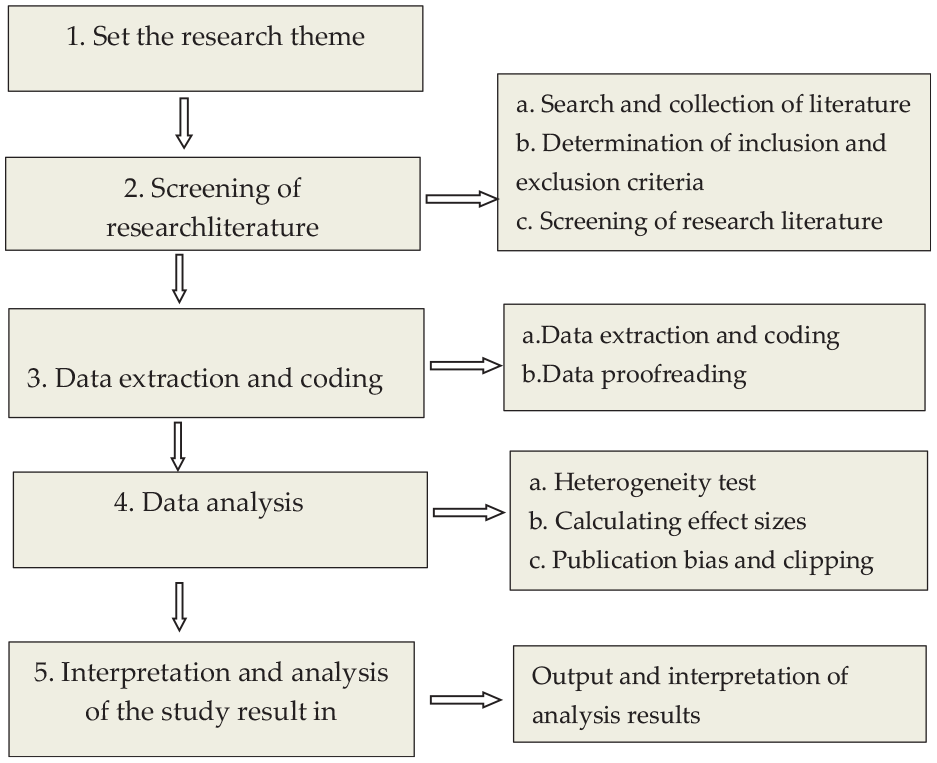
Study procedure diagram.
Literature Search
This study started the search with the first published papers in Korea, including master’s and doctoral dissertations and papers published in academic journals from 1999 to 2021. The search sites were National Assembly Electronic Library (http://www.nanet.go.kr), Academic Research Information Service (http://www.riss.go.kr), National Electronic Book (http://www.dlibrary.go.kr), DBpia (http://www.dbpia.com). Searches were conducted using the subject terms “early childhood teachers” & “burnout,”“kindergarten teachers” & “burnout,”“infant teachers” & “burnout,”“childcare teachers” & “burnout,” and “nursery teachers” & “burnout.” A total of 699 articles were retrieved. Among them, 35 articles could not be downloaded due to copyright limitations, and a total of 664 articles were collected.
Study Sample and Selection Criteria
The following inclusion criteria were defined by this study: 1. A cross-sectional study design was used. 2. Research was conducted on the association between relevant variables and burnout among preschool teachers. 3. One can get the Pearson correlation coefficient. 4. The MBI measurement tool is the instrument used to measure burnout. 5. Korean was used to write the studies. 6. The research’s publication time is restricted to December 31, 2021. Exclusion criteria were as follows: 1. Review articles and conference abstracts. 2. Research that published the same information. 3. Poor quality studies. 4. Research with a subset of special education teachers. 5. Research on a single variable that includes less than two studies.
The screening was performed according to the screening criteria set in this study. In the first stage of initial screening, 15 papers were deleted from the duplicate downloads by checking the title and author information one by one in the first step, leaving 649 papers. In the second step, by reading the titles and abstracts, the conference abstracts and review articles were directly excluded, as well as the studies whose research object was special early school teachers. A total of 141 papers were excluded. Excluding 20 papers with incomplete posters, incomplete paper information, and poor paper quality, there are 488 papers left. Thirdly, by reading the full text, 85 papers without Pearson r correlation coefficient were excluded. Fifty papers with repeated publication were excluded, 130 papers excluded that the measuring tool was not MBI, and 223 remained. The fourth step was the exclusion of variables and literature with fewer than two studies; in all, 22 papers were eliminated. Ultimately, 201 items were present. Figure 2 illustrates the literature screening procedure.

The flow chart of the study selection process.
Quality Assessment
Two researchers independently assessed the methodological quality of 201 studies. Quality was assessed using the Joanna Briggs Assessment Checklist (Joanna Briggs Institute, 2014; Li, Bai, et al., 2022). The assessment tool consists of 10 questions with a simple yes, no, or unclear content that is intended to evaluate research quickly and effectively. Every criterion received a score (Yes = 2, No = 0, Unclear = 1), giving each study a total score of 20 (P. Han et al., 2022). After that, a percentage was created from these scores. Following a consensus-building discussion, the results were evaluated for quality, with studies scoring higher than 70% being deemed acceptable and those scoring lower than 70% being removed (P. Han et al., 2022). All 201 included studies passed the quality assessment.
Data Extraction and Coding
Coding is the process of extracting data from the information gathered for the studies that allow for the extraction of clear data and data appropriate for the study (Karadağ, 2020; Kasalak et al., 2022). Microsoft Excel or EpiData software is often used to design the data extraction form and perform the extraction. This study used Microsoft Excel to design the data extraction form and perform the data extraction. To ensure the accuracy of data extraction, this study was conducted by two people who extracted the data and coded them independently, and in case of disagreement, both parties discussed and resolved, with the assistance of a third researcher if necessary. Every independent variable in this study had a unique code assigned to it. The related ones were coded numerous times if a paper had multiple variables and impact values at the same time. The following information was coded: sample size, Pearson r value, author information, year of publication, area, type of paper, teacher type, teacher age, organization type, years of work, and education. We focused on emotional exhaustion, depersonalization, and decreased personal achievement following the three dimensions of the Maslach Burnout Inventory (Maslach & Jackson, 1984; E. Y. Park & Shin, 2020). Therefore Pearson r’s values were extracted for the effect size between each variable and emotional exhaustion, depersonalization and decreased personal achievement, and burnout overall, respectively. Ducksun (2019) divided the factors influencing burnout in early childhood teachers into four categories: job, organizational, psychological personality, and demographic (D. Kim, 2019), according to this variable categorization method we categorized 35 variables during the coding process into demographic variables, psychological personality protective variables, psychological personality risk variables, job protective variables, job risk variables, and organizational protective variables. Organizational risk variables were not included in the study due to the small amount of literature, so organizational risk was not categorized separately.
Characteristics of Included Studies
Strict inclusion and exclusion criteria were used to get a sample that was appropriate for meta-analysis. In the study sample, 508 independent data were collected for 201 distinct documents (Table 1). A statistical analysis of the study population reveals 131 articles from 2016 to 2021, 52 articles from 2011 to 2015, 13 articles from 2006 to 2010, 5 articles from 2001 to 2005, and only 2 articles before 2000. In terms of the types of papers, there are 112 journal papers, 80 master’s degree papers, and 9 doctoral degree papers. With a total of 508 cases, the psychological personality risk variable had the fewest number of cases (4), while the psychological personality protective variable had the greatest number of cases (136). The sample size falls between 100 and 700 or more, with the majority of samples falling between 200 and 300, for a total sample size of 87, 620. The samples came from nine provinces across Korea, which have a large geographic coverage.
Basic Characteristics of the Included Studies.

Data Analysis
R was the data analysis program used in this investigation. R is an open-source, free, and open-source data processing, calculation, and charting software system that is part of the GNU system. Some of its statistical functions are integrated into the base layer of the R environment, but most of the functions are provided in the form of extension packages. These extensions are the largest concentration of statisticians’ thinking in the world, and represent the integration of the world’s best statistical applications. At present, there are many statisticians to provide a lot of excellent, can be used for Meta-analysis of the extension package. It is not hyperbole to state that practically every meta-analysis technique, whether traditional or sophisticated, can be implemented in R (Yang, 2018). In this study, the Pearson r-value was used to calculate the combined effect size and combined with the 95% confidence interval value to measure the relationship between the two variables. The 95% confidence interval (CI) solution method is a method to determine whether the effect size is statistically significant by whether the confidence interval contains zero after finding the 95% confidence interval (CI) of the effect size (Borenstein et al., 2009; da Silva Teixeira, et al., 2023), which is statistically significant when it does not contain zero. The transformed Fisher’s Z values were used to examine the study by the recommendations made by Borenstein et al. (2009). Fisher’s Z is calculated using Equation 1; the variance is calculated using Equation 2; standard error is calculated using Equation 3; and lastly, the summary r value is obtained from Equation 4. The range of the absolute value of summary r indicates the degree of correlation between the variables (Borenstein et al., 2009; Higgins & Green, 2011; E. Y. Park & Shin, 2020; Xu et al., 2023).


Heterogeneity and Publication Bias
Heterogeneity was examined in this study using Q and I2. If p > .10 and I2 was less than 50%, no heterogeneity between studies was considered to exist and the data were combined using the fixed effects model M-H method. Heterogeneity between studies was deemed to exist if p < .10 and I2 was greater than 50%. The random effects model D-L method was then used to merge the studies (Higgins & Green, 2011; Jung-Sup et al., 2020; Xu et al., 2023). Publication bias, also known as systematic error, refers to the tendency of the study results to deviate systematically from the true value (Yang, 2018). Regarding publication bias analysis was first observed using funnel plots and then further validated using Egger’s linear regression method. Duval and Tweedie (2000) argued that the publication bias problem can be overcome by the Trim-and-Fill test (Duval & Tweedie, 2000). If p < .05 indicates publication bias, the reliability of the data was further verified after correction by the cut-and-patch method (Xu et al., 2023).
Results
In this study, the variables related to burnout are divided into demographic variables, psychological personality protective variables, psychological personality risk variables, job protective variables, job risk variables, and organizational protective variables. No literature on organizational risk variables met the inclusion criteria, so organizational risk variables were not studied.
The Effect Size of the Variable Groups
According to Table 2, the 95% CI of psychological personality protective variables (r = −.4605), job risk variables (r = .4551), job protective variables (r = −.3627), and organizational protective variables (r = −.3536) were all statistically significant with no 0. The variable group with the largest effect size was psychological personality protective variables (r = −.4605, 95% CI = [−0.4898, −0.4301]) with an I2 value greater than 80%, which had significant heterogeneity and used a random effects model. In contrast, the 95% CI of the demographic variables and the psychological personality risk variables contained 0. Therefore, neither the demographic variables nor the psychological personality risk variables have statistical significance.
The Effect Size of the Variable Groups.

The Effect Size of Demographic Variables
As seen in Table 3, 95% CI of age (−0.3052), marital status (−0.1695), working hours (0.1559), age of young children (0.1219), number of children (0.0896), and type of institution (0.0708) were not 0 which were statistically significant. The largest effect size variable was age (r = −.3052, 95% CI = [−0.5472, −0.0162]), which had a negative correlation with burnout, using the random effects model.
The Effect Size of Demographic Variables.

The Effect Size of Psychological Personality Protective Variables
As shown in Table 4, the 95% CI for resilience (−0.5415), self-esteem (−0.524), positive psychological capital (−0.5127), emotional intelligence (−0.48), grit (−0.474), teaching efficacy (−0.4335), well-being (−0.3897), mindfulness (−0.3186), and positive coping strategies (−0.1635) did not contain 0. They are all statistically significant and negatively related to burnout, and they are protective variables. The largest effect size variable was resilience (r = −.5415, 95% CI = [−0.579, −0.5018]) with I2 = 89.3%, which was heterogeneous, using a random effects model.
The Effect Size of Psychological Personality Protective Variables.

The Effect Size of the Psychological Personality Risk Variable
According to Table 5, the 95% CI of negative coping strategies contains 0, and negative coping strategies have no statistical significance.
The Effect Size of Psychological Personality Risk Variables.

The Effect Size of Job Protective Variables
As shown in Table 6, the 95% CI for calling (−0.526), teacher-children interaction (−0.447), job satisfaction (−0.402), organizational commitment (−0.3604), professional development (−0.2865), professionalism (−0.2707), and emotional labor-intrinsic behavior (−0.2516) was all non-zero, so they were all statistical significance, all were negatively related to burnout and were protective variables. The variable with the largest effect size was calling (r = −.526, 95% CI = [−0.8036, −0.0604]) with I2 = 99%, high heterogeneity, using a random effects model.
The Effect Size of Job Protective Variables.

The Effect Size of Job Risk Variables
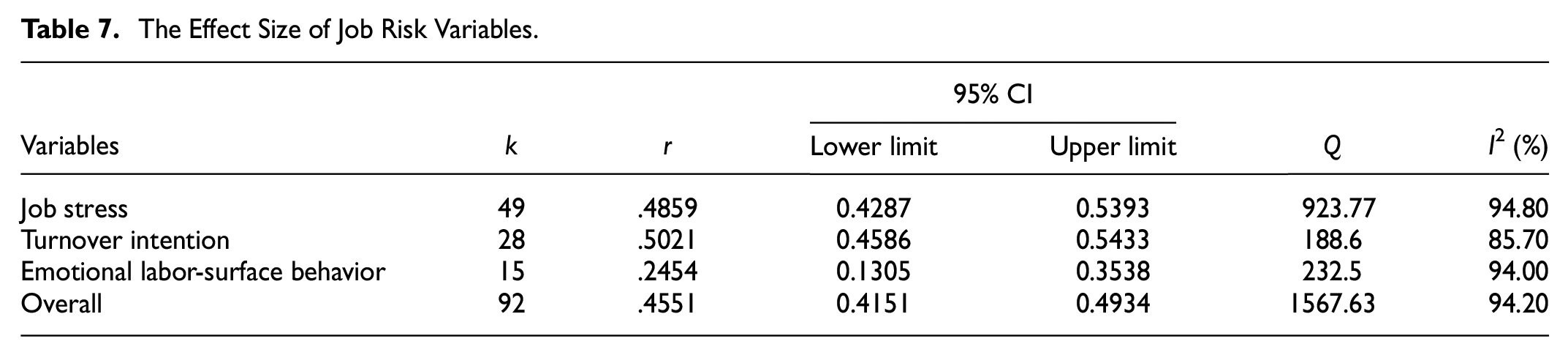
According to Table 7, turnover intention (0.5021), job stress (0.4859), and emotional labor-surface behavior (0.2454) all had 95% CI not containing 0, all were statistically significant, all were positively associated with burnout, and were risk variables. The largest effect size variable was the turnover intention (r = .5021, 95% CI = [0.4586, −0.5433]) with I2 = 85.70%, which had high heterogeneity, using a random effects model.
The Effect Size of Job Risk Variables.
The Effect Size of Organizational Protective Variables
As shown in Table 8, the 95% CI of interpersonal relationships (−0.4552), leadership (−0.4236), social support (−0.3368), work environment (−0.3325), organizational culture (−0.3089), and empowerment (−0.3017) was all non-zero, all of these variables were statistically significant, and they were all negatively associated with burnout and were protective variables. The largest effect size variable was interpersonal relationships (r = −.4552, 95% CI = [−0.5103, −0.3963]), I2 = 73.30%, with heterogeneity, using a random effects model.
The Effect Size of Organizational Protective Variables.

Publication Bias
As shown in Figure 3, the overall observed scatter points are symmetrical on both sides, and the further quantitative test shows that, as shown in Table 9, the Egger’s test of other variables shows good symmetry of funnel plot, and no publication bias is suggested (Egger’s test: p ≥ .05) except for the psychological personality protective variables.

Funnel plot of burnout.
Publication Bias Egger’s Test of Burnout.

The psychological personality protective variable (Egger’s test: t = −3.28, p = .0013 < .05) suggested a publication bias in the relationship between psychological protective variables and burnout. The correction was carried out using the clipping and patching approach. Figure 4 was virtually symmetrical after clipping and patching, with a combined effect size r [95% CI] of −.379 [−0.4144, −0.3424]. The cut-and-complement method’s corrected results did not materially differ from the initial results, suggesting the validity of the data.

Funnel plot after shearing and patching of psychological protective variables.
Discussion
Through meta-analysis, this study examined variables associated with burnout among early childhood teachers using empirical data. It was found that the most relevant variable group to burnout was the psychological personality protective variable (−0.4605). The most relevant variables to burnout in each variable group were age (−0.3052), resilience (−0.5415), calling (−0.526), turnover intention (0.5021), and interpersonal relationships (−0.4552). Since this study focuses on the variables most associated with burnout among early childhood teachers, the discussion will center on the variables in each variable group with the largest effect sizes.
Age and Burnout
Age (−0.3052) had the biggest effect size variable in the demographic variable group and was inversely connected with burnout, meaning that the older one is, the less burnt out one is. Additionally, it was discovered that there was a substantial negative correlation (r = −.30) between burnout and age, indicating that the older one becomes, the lower the level of burnout (M. H. Kim & Kim, 2019). This is consistent with the study’s findings. While the effect size of age was noted as (−0.165) in the study of D. Kim (2019), he concluded that the largest effect size variable in the demographic variables was education (−0.210), but the number of cases of education was only two (D. Kim, 2019). The study by Kim, S. K (2018) stated that age (r = −.174) was the largest effect size variable in the demographic variables (Kim, S. K., 2018; X. Zhang & Zeng, 2023), which is consistent with the results of this study. Age is a very important factor associated with burnout. Compared to younger early childhood teachers, older early childhood teachers become more experienced in teaching and can handle various emergencies with ease, they accumulate a wealth of experience in handling interpersonal relationships and can deal flexibly with various types of people. In addition, the older an early childhood teacher is, the more experience she will have in performing her parental duties, and the more knowledge and understanding she will have of young children and mothers. This effectively buffers job stress and reduces burnout (M. H. Kim & Kim, 2019).
Resilience and Burnout
Resilience was the biggest effect size variable (−0.5415) among the psychological personality protective variables. Resilience was also a protective variable for burnout, meaning that the stronger the resilience, the lower the burnout. Additionally, several studies have found a negative correlation (r = −.67) between burnout and resilience (Y. J. Shin & Lee, 2020). There was a substantial negative predictive relationship between teacher resilience and job burnout, with an effect size of (r = −.473) (Liu, Chen et al., 2021). The current investigation agrees with prior studies’ findings. According to D. Kim’s (2019) research, the relationship between burnout and resilience was shown to have an effect size of (r = −.573), with resilience being the biggest effect size in the psychological personality variable (D. Kim, 2019; X. Zhang & Zeng, 2023). But in A. N. Kim’s (2018) study, burnout and resilience were shown to have different impact sizes (r = −.531), but self-esteem had the biggest effect size (r = −.613) among psychological personality variables, with only two examples of self-esteem (S. K. Kim, 2018). This is not very consistent with the results of this study. In terms of the effect sizes and correlations between burnout and resilience, this study agrees with the results of previous studies. Resilience is a crucial psychological and social resource that can assist people in effectively overcoming adversity, adjusting to stress, and growing, including both internal positive psychological resources and external social support resources (Holloway et al., 2019; Liu, Chen et al., 2021). When faced with challenges brought on by work stress, educators who possess high resilience levels can adapt and get beyond obstacles. To some extent, their cheerful, upbeat, self-assured, and healthy feelings assist them avoid the emotional anguish brought on by job burnout (Liu, Chen et al., 2021). Resilience is a protective factor for burnout (Schoeps et al., 2023), and resilience education is an effective intervention for burnout (Burleson et al., 2023). Resilience has an impact not only on reducing the negative consequences of burnout but also on promoting positive effects on work performance. Thus, resilience needs to be taken into consideration while developing educational initiatives aimed at preventing or treating burnout (Y. J. Shin & Lee, 2020).
Calling and Burnout
Calling had the biggest effect size (−0.526) among the job protective variables. Calling was also inversely connected with burnout; that is, the more one calls, the less one burns; calling was therefore a protective factor against burnout. In one study, the results showed a significant negative correlation between burnout and calling, with effect sizes of −0.397, −0.373, and −0.575 between emotional exhaustion, dehumanization, and lack of achievement and calling, respectively (Y. J. Shin & Lee, 2020; X. Zhang & Zeng, 2023) which is consistent with the results of this study. Ducksun (2019) pointed out that the effect size between calling and burnout was −0.400 (D. Kim, 2019). But calling is not the largest effect size variable in the job protective variable group (M. H. Kim & Kim, 2019). The difference in studies may be because most of Ducksun’s literature was published before 2018, while new literature appeared after 2018, leading to changes in the included data, and the research results would inevitably change (D. Kim, 2019). It has also been found that calling has a negative prediction of burnout. Additionally, it has been discovered that calling is a predictor of burnout. Calling can stem fulfilling experiences and positive attitudes toward work, which can raise more happy feelings and thus lessen burnout (W. G. Zhao, Wu, et al., 2022). A career calling suggests that people have a strong internal motivation for what they do which reduces burnout (Duffy et al., 2018; Lian et al., 2021; W. G. Zhao, Wu, et al., 2022). The Calling motivates teachers to give purpose and meaning to their work and to have the conviction that they feel meaningful and dedicated to their work. The more people who see their work as a calling, the higher their passion for life, life satisfaction, and job satisfaction. Teachers with a high calling like this want to do meaningful things through their work as teachers, so even when there are difficult and stressful situations, the calling becomes a psychological protective resource for guarding teachers, and it is the most important teacher quality for early childhood teachers whose overwork and professional characteristics lead to emotional labor and stress (Y. J. Shin & Lee, 2020). Since there is a strong inverse relationship between burnout and career calling, teachers ought to be supported to lower burnout (J. Li et al., 2023; Su & Jiang, 2023). Therefore, to manage early childhood teacher burnout, programs that can enhance teacher callings should be developed and relevant support programs should be developed.
Turnover Intention and Burnout
Turnover intention had the biggest effect size (r = .5021) in the job risk variables. Additionally, there was a positive correlation between turnover intention and burnout, meaning that the higher the intention, the higher the level of burnout. In other words, turnover intention was a risk factor for burnout. This has also been confirmed by numerous other studies. For instance, turnover intention has a strong positive predictive effect on burnout, with a correlation coefficient of r = .581 (Chen et al., 2022; E. J. Kim et al., 2022; Liu et al., 2021). Also, Li, Zhang, et al. (2002) concluded that the correlation coefficient between turnover intention and burnout was .732 (Li, Zhang, et al., 2022). It can be seen that the results of previous studies are consistent with the results of this study. D. Kim (2019) concluded that the effect size of turnover intention with burnout was (r = .523), and turnover intention was the second largest variable in the group of job variables (D. Kim, 2019). The reason for the difference with this study may be because many new studies have emerged since 2019, and the inclusion literature has changed and the results are bound to change as well. However, in terms of correlations and effect sizes, the present study is consistent with previous studies. It is commonly acknowledged that reducing or avoiding burnout and the intention to leave an organization is crucial to its success and long-term viability (Y. Li, Zhang, et al., 2022; I. Shin & Jeung, 2019). As expected, burnout is a strong predictor of the propensity to leave a job, as individuals who perceive a more stressful environment experience a higher propensity to leave a job (Li, Zhang, et al., 2022). The average degree of burnout symptoms was higher among teachers who had a persistent intention to leave the teaching profession, and burnout symptoms were strongly linked to persistent thoughts of quitting teaching (Räsänen et al., 2022). The results of a Finnish study indicated that teachers with a persistent tendency to leave had higher burnout symptoms than teachers without a tendency to leave and that teachers with a persistent tendency to leave had an increased risk of alienation from the professional community and burnout (Räsänen et al., 2022).
Interpersonal Relationship and Burnout
Interpersonal relationship (−0.4552) was the largest effect size in the organizational variable which was negatively correlated with burnout, meaning that the better one’s interpersonal relationship, the less burnout one experiences. In other words, interpersonal relationship was a protective factor against burnout. Hee and Sun (2016) categorized interpersonal relationships into those with Directors, Co-workers, and Parents (Hee & Sun, 2016). The magnitude of the correlation coefficients was −.48, −.37, and −.39, respectively, with overall interpersonal relationships having a significant impact on burnout (Hee & Sun, 2016). Y. J. Shin and Lee (2020) concluded that the magnitude of the correlation coefficient between interpersonal relationships and burnout was −.58 and that early childhood teachers experienced burnout in social relationships such as relationships with directors, colleagues, and parents (Y. J. Shin & Lee, 2020). All of these studies are consistent with the results of the present study. However, A. N. Kim (2018) concluded that the effect size of interpersonal relationships and burnout was (r = −.421), while the largest variable of effect size was organizational culture −0.521, not interpersonal relationship, but the number of cases of organizational culture was only 1, which was not convincing (A. N. Kim, 2018). Maslach (2009) argues that the most destructive thing to a community is chronic, unresolved conflict with others (Maslach, 2009). In the long run, encouraging integration and building strong bonds among school personnel might be a more successful strategy for lowering staff burnout than other approaches (Fleming et al., 2023). Yun and Lee (2021) emphasized that interpersonal relationships contribute the most to the job performance of early childhood teachers, that constant interaction with children, directors, colleagues, and parents, and that early childhood teachers with good interpersonal relationships are good communicators and will be creative in their teaching, create a positive teaching atmosphere, form positive relationships with fellow teachers, and have a positive attitude toward work, which improves performance (Yun & Lee, 2021). We can find that teaching and childcare institutions are largely small-scale operations that are formed through interpersonal relationships. Compared to other professions, it is psychologically close and is an intensive organization, so the effects of interpersonal relationships are more directly communicated to early childhood teachers. Early school institutions should always treat early school teachers with trust and respect, strive to establish close interpersonal relationships among members provide opportunities to effectively communicate with early school teachers, and participate in training to enhance interpersonal relationship skills (Hee & Sun, 2016).
Limitations
The present study has the following limitations. First, for a variety of reasons, the study did not include the unpublished material from this investigation. As a result, there may be a few errors in this paper’s findings. Second, even though the included literature verified the data’s reliability following publication bias cut and fill, some of the findings still require confirmation from additional research because there isn’t enough included literature for some variables. This also offers a feasible foundation for future study directions. Thirdly, this study only examines the correlation between early childhood teachers’ burnout and related variables; further research is necessary to confirm the true nature of this relationship, which may be more complex and difficult to fully describe and measure using correlation analysis alone.
Conclusion
The following two research questions were established for this study to identify the variables that are most closely related to burnout among Korean early childhood teachers: 1. Among early childhood teachers, which variables are most associated with burnout? 2. How do these variables and burnout correlate? What are the effect sizes? The primary goal of this meta-analysis was to determine which variables were most closely associated with early childhood teacher burnout. The results showed that among the demographic variables, psychological personality protective variables, job protective variables, job risk variables, and organizational protective variables, the variables with the largest effect sizes were age, resilience, calling, turnover intention, and interpersonal relationships, respectively. Therefore age, resilience, calling, turnover intention, and interpersonal relationships are the most relevant variables for early childhood teacher burnout. Age (r = −.3052), resilience (r = −.5415), calling (r = −.526), While turnover intention (r = .5021) was positively associated with burnout and a risk factor for burnout, interpersonal relationships (r = −.4552) was inversely connected with burnout and a protective variable for burnout. Therefore, it is suggested that Korea can focus on age, resilience, calling, turnover intention, and interpersonal relationships when developing educational programs and measures to prevent and reduce early childhood teacher burnout. For example, it is recommended that Korea should help young teachers grow, as they are more likely to experience burnout. Focus on investing more energy, financial resources, and policy support in improving the resilience of early childhood teachers, strengthening calling education for early childhood teachers, reducing turnover intention, and improving interpersonal relationships. Also, this study provides directions for subsequent research, such as further verifying how resilience interacts with burnout, or what the factors associated with resilience are and how to enhance it. This study may also be useful for researchers who are interested in meta-analysis and burnout. They can also seek the overall situation of variables related to burnout of early childhood teachers in their own countries through meta-analysis. This researcher will conduct a comparative analysis between Korea and China to analyze the similarities and differences between the two countries and finally provide data support for the two countries to learn from and improve each other.
Footnotes
Acknowledgements
This research was supported by the Future Education Research Team at Lishui University. We thank all members of the Future Education Research Team for their guidance and assistance with this manuscript.
Author Contributions
X.X. wrote the first draft of this manuscript. L.C. extracted the data and coding, and Y.J. performed the data analysis, and Y.C. made the final revision. All authors contributed to the manuscript revision, and all authors have read and agreed to the published version of the manuscript.
Declaration of Conflicting Interests
The author(s) declared no potential conflicts of interest with respect to the research, authorship, and/or publication of this article.
Funding
The author(s) disclosed receipt of the following financial support for the research, authorship, and/or publication of this article: This research received grants from the Guangdong Provincial Philosophy and Social Sciences Plan 2023 discipline co-construction project (GD23XJY38), Project of Key Laboratory of Science, Technology and Standards of Publishing Industry, State Press and Publication Administration of China (RJB0123006), and National Office for Philosophy and Social Sciences (BHA200130).
Institutional Review Board Statement
Not applicable.
Informed Consent Statement
Not applicable.

Data Availability Statement
The research data covered in this manuscript can be obtained by contacting the author.