




Abstract
This article aims to explain how ECE teachers’ discourses of participation in Chilean professional associations (ECEPAs) are a core trait and builds professionalism in the field. Following the Constructivist-Grounded Theory approach, it adopted a holistic abductive case study method, with a sample of 18 national ECEPA cases and 78 ECE teachers. Data collection drew on 18 individual in-depth interviews and nine discussion groups analyzed in a four-stage Constant Comparison coding process. Findings show ECE teachers relate participation in diverse ECEPAs with building professionalism around four intertwined discourses: transformational politics; pedagogical empowerment; decent working conditions, and historical and renewed struggles. We discuss how these discourses ensemble an emergent ECEPA ecosystem. The significance of this theorization is in making visible how ECE teachers’ multifaceted participation reorganizes in the fragmented neoliberal context, making possible dialog, debate, and partnerships. This participation in ECEPAs blurs the traditional understandings of professionalism, opening to new notions based on more democratic, ground-up, and postmodern professionalism.
Introduction
Strong professional associations constitute a core trait of professionalism (Collins, 1990), including teacher professionalism (Reis Monteiro, 2015). Researchers posit teachers’ professional associations are essential to constructing new forms of professionalism, such as postmodern professionalism (Hargreaves, 2000) and democratic professionalism (Whitty & Wisby, 2006).
Though early childhood teachers’ professional associations (ECEPAs) behold less research, they, too, constitute a core element in building professionalism (Mitchell, 2019). Furthermore, the weakness of ECEPAs would express the fragility of professionalism in the ECE field (Cameron et al., 2018; Goffin, 2012, 2013; Pardo & Adlerstein, 2016). Despite its relevance, research has paid little attention to this phenomenon (Cameron et al., 2018; McCollow, 2017).
Currently, the Chilean ECE field has 18 national ECEPAs (still proliferating), which reach an affiliation rate under 10% of the 32,500 in-service ECE teacher workforce (MINEDUC, 2019). Despite their underrepresentation, Chilean ECEPAs foreground professional issues in the public sphere. Historical ones, like disadvantaged children’s rights and working conditions (Peralta, 2006; Rojas Flores, 2016), and new ones, like gender bias and educational justice (Matamoros, 2020). Participation in ECEPAs occurs in the context of neoliberal educational policies with a fragmented ECE system (Adlerstein & Pardo, 2019, 2020). It weakens teachers’ professional associations (Lizana, 2022; Matamoros, 2022) by enshrining what had previously been negotiable with standardization (Bascia, 2005; Bascia & Stevenson, 2017) and undermining collective strength stimulating individual performance (Gavin, 2019, 2021).
Research on Chilean ECEPAs and other similar ECE contexts is nonexistent, preventing a comprehensive understanding of how participation in these associations unfolds in neoliberal contexts and builds professionalism in the ECE field. This paper’s purpose is to fill this void by explaining how ECE teachers’ discourses of participation in Chilean ECEPAs build professionalism in the ECE field. We answer the research question, what discourses explain ECE teachers’ participation in professional associations, and how do they build professionalism in the Chilean field? The significance of this theorization is in making visible how ECE teachers’ multifaceted participation reorganizes in the fragmented neoliberal context, making possible dialog, debate, and partnerships. This participation in ECEPAs blurs the traditional understandings of professionalism, opening to new notions based on more democratic, ground-up, and postmodern professionalism.
Literature Review
Research on teachers’ participation in professional associations and ECEPAs has tended to focus on portraying specific cases’ achievements (Mitchell, 2019) and reporting their members’ strong cohesion (Bascia, 2019; McCollow, 2017), shared purposes or positions (Fitzgerald, 2011; Weiner & Asselin, 2020), and strategies for collective action (Mitchell, 2019). Even the historical (Fitzgerald, 2011) and comparative research (Finger & Gindin, 2015; Silman et al., 2021) depict teachers’ professional associations having shared struggles against education reform and active unified roles in education policymaking.
However, few investigations report more conflicting and widespread trends that foreground tensions within teachers’ participation in professional associations and a broader analysis of how these associations relate beyond individual action. Bascia (2015) observes that teacher professional associations and unions are multifaceted organizations, convening teachers with diverse priorities and agendas. Likewise, McCollow (2017) posits that teacher associations do not only operate individually as narrow self-interest groups but also engage with other entities to advocate for professionalism. Research is starting to show a relational landscape where ECEPAs connect to build professionalism advocating for status, economic sufficiency, participation in public decision-making, professional development, and learning opportunities (Bascia, 2008; Silman et al., 2021). In doing so, ECEPAs have the State, employers, and policymakers as their prime counterparts (Bascia & Osmond, 2013; Carter et al., 2009; Finger & Gindin, 2015; Ginsburg & Kamat, 2009).
The literature shows two opposing perspectives regarding the link between participation in professional associations and teachers’ professionalism. On the one hand, authors argue that teachers’ professional associations positively contribute to educational policymaking (Finger & Gindin, 2015; Gindin & Finger, 2013; Hung, 2019) and strengthen public confidence in teachers (Bascia, 2016; Cowen & Strunk, 2014; Rubinstein & McCarthy, 2014). This approach describes ECEPAs as legitimate actors “encompassing social movements advocating for public education” (McCollow, 2017, p. 11). Furthermore, observing Latin America, Gindin and Finger (2013) show that teachers’ professional associations are “major actors in education politics” and positively contribute to instruction and a teachers’ sense of purpose. These researchers encourage teachers’ participation in unions and recommend establishing formal spaces for ECEPAs’ involvement in policymaking.
Within this research strand, authors critically evidence how neoliberal reforms disengage teachers from professional associations (Bascia & Stevenson, 2017; Finger & Gindin, 2015; Moss et al., 2016; Symeonidis & Stromquist, 2020). It shows how standards and accountability mechanisms ignore teachers’ collective interests and professional agreements, reducing what was previously negotiable (Bascia, 2005). The little research on Chile and Latin American countries converge with this evidence. Neoliberal educational accountability reduces participation in ECEPAs’, forcing teachers to perform and comply with centrally defined criteria (Falabella, 2014; Falabella et al., 2018), even if these seem contradictory to ECE’s professional nature and ECEPA’s meanings (Pardo & Adlerstein, 2020). Furthermore, research in neoliberal educational systems of middle and low-income countries evidence ECEPAs as absent or marginal in the advocacy and construction of ECE policies and public debate (Neuman & Powers, 2021).
In opposition to this research strand, authors have called teachers’ professional associations into question, highlighting their structural and political limitations and portraying them as illegitimate, unprofessional, simplistic, and selfish. Moe (2011) is a noteworthy leading exponent of the case against teachers’ participation in unions and professional associations. He describes them as “special interest groups” that have “exercised provider capture” and whose activities on behalf of education are harmful. At the same time, other authors highlight teachers’ professional associations’ deficits concerning professionalism, evidencing their scarce authority on teachers, unexclusive memberships, and minimum influence on policy development, describing them as obstacles to positive educational change (Johnson, 2004; Lieberman, 1993, 2000).
In the single work focused on the ECE field and within the supporters’ strand, Mitchell (2019) describes how New Zealand ECEPAs associate for collective action, depicting these associations as a positive influence in building teachers’ professionalism and public ECE. She foregrounds two contrasting “alliances behind the scenes” (Mitchell, 2019, p. 110) that achieve relevant collective action between ECEPAs. The first way involved ECEPAs’ concerted agency through academic leadership to build the Te Whariki curriculum and agree on a discourse about children and commitment to equity. The second form involved a coalition of the seven largest national organizations of ECE provision to contest governmental marketized discourses and advocate for alternative policies. According to Mitchell, this accomplishment is possible because ECEPAs’ discourses and collective action are committed to shared values and ideals of public good instead of ECEPAs’ self-interests. In addition, Mitchell concluded that practitioners’ willingness to discuss their practice critically resembles what Oberhuemer has termed “democratic professionalism,” implying the professional sensitivity to discuss diverse viewpoints and examine personal and collective assumptions (Oberhuemer, 2005).
Research has mainly contributed to understanding schoolteachers’ professional associations and their relation with professionalism rather than ECEPAs context. Research shows that ECE teachers uphold a distinctive professional identity within the pedagogical field (Grieshaber, 2001; McGillivray, 2011; Pardo & Opazo, 2019; Pardo & Woodrow, 2014), for which the replicability of this knowledge can’t be taken for granted. Furthermore, ECEPA’s research registers no background for Chile, so we argue the need for a specific and contextualized analysis of ECEPAs. Filling this void would contribute to a better understanding of professionalism building in the ECE field through the participation of ECE teachers in ECEPA’s within a neoliberal ECE context.
Methodology
The research’s methodology is qualitative, approached through Constructivist Grounded Theory—CGT—(Clarke, 2019; Charmaz, 2006a; Bryant & Charmaz, 2010), which enables the production of middle-range theory with explanatory power (Bryant & Charmaz, 2019; Urquhart, 2019). It develops a process based on a coherent and rigorous methodological structure (Charmaz, 2006b; Gilgun, 2009) and general qualitative trustworthiness procedures (Charmaz & Thornberg, 2021; Clarke & Keller, 2014; Denzin & Lincoln, 2005). CGT is one of the earliest formalized qualitative methods (Bryant & Charmaz, 2019; Holton, 2017), and its Constructivist variant “is by far the most widely used research method in social sciences” (Bryant & Charmaz, 2019, p. 32). In using CGT, we advance the criticized case study approach of the teachers’ associations field, which remains in descriptions and constricts a multilevel analysis (Mitchell, 2019; Sancho-Gil & Domingo-Coscollola, 2022; Symeonidis & Stromquist, 2020), impeding the building of substantive theory. Hence, we use it to understand ECE teachers’ participation in Chilean ECEPAs and to theorize how it builds professionalism in the field.
Research Design
The research design involved an 18-month qualitative inquiry from 2020 to 2021. Following the CGT approach, we unfolded a holistic abductive case design (Earl Rinehart, 2021; Vasilachis, 2006) to examine ECE teachers’ participation at national and local levels of the complete Chilean ECEPA spectrum.
Our holistic case design comprised an abductive four-stage research process (Cooper & White, 2022; Haig, 2010). Being abductive, it integrated inductive and deductive research design, moving recursively between observations and theoretical generalizations (Earl Rinehart, 2021; Tavory & Timmermans, 2014). Hence, each methodological stage progressively merged sampling with data collection and analysis in a systematic multilevel inquiry (Cooper & White, 2022). In doing so, the process iterated inductive exploration of lived participation in ECEPAs, with deductive verification and saturation of categories explaining the building of professionalism in Chilean ECE. Based on CGT researchers (Charmaz, 2006a; Cooper & White, 2022; Mills et al., 2017; Stough & Lee, 2021), we refined the four-stage abductive process commonly used in CGT holistic design (see explicative pictogram in Figure 1 N°1 at the end of this methodology section).
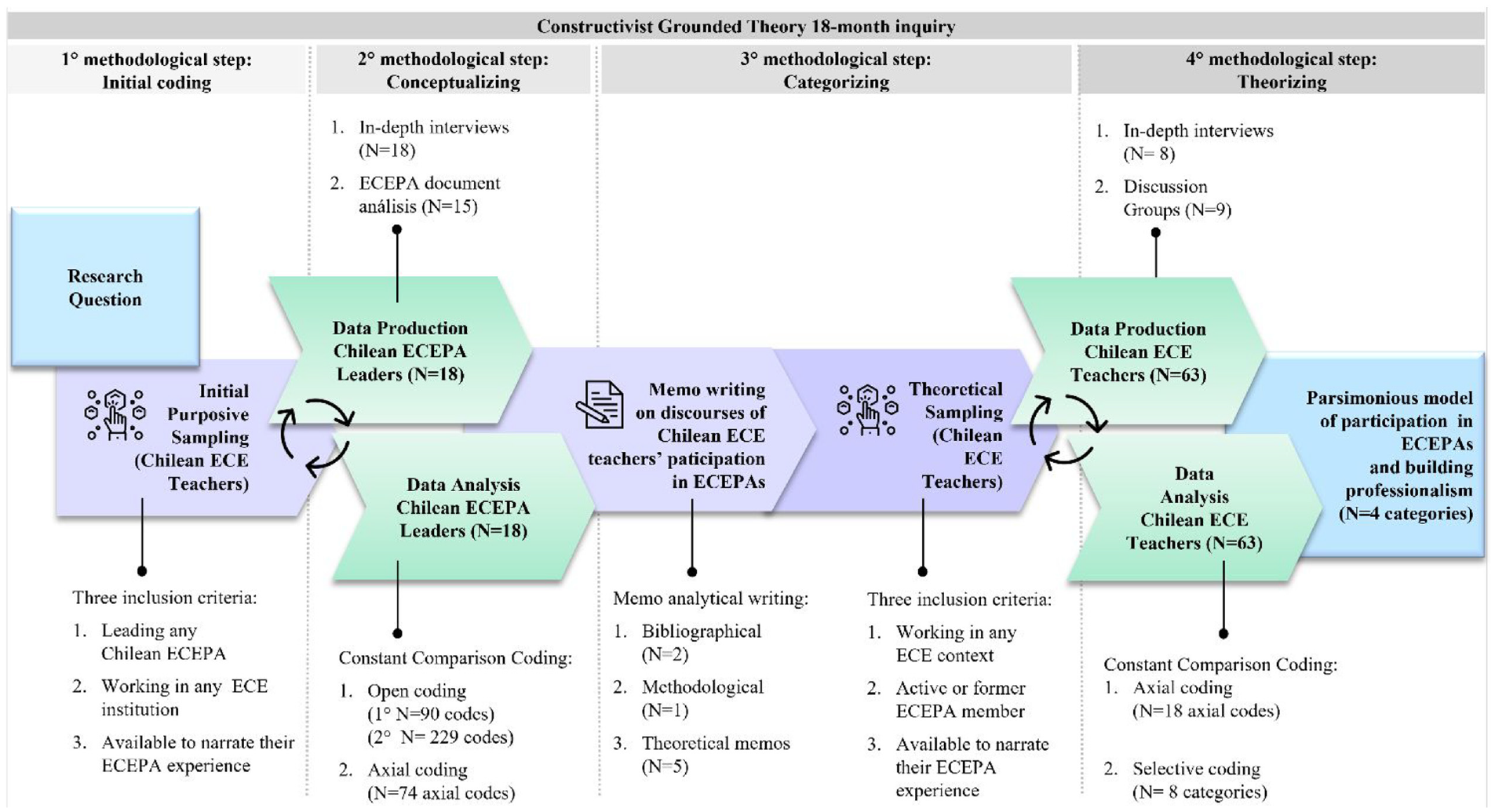
Pictogram of the Constructivist Grounded Theory methodology used in the research.
The first methodological stage focused on the initial coding of meanings of participation in ECEPAs, drawing on the research question and purposive sampling of ECEPA leaders. The second stage targeted conceptualizing the dimensions of participation in ECEPAs by collecting similar content codes and grouping them under axial concepts of the phenomena. The third stage’s core was categorizing these types of ECEPA participations intra-categorially by determining groups of similar concepts and generating premises on professionalism building. The fourth stage produced a parsimonious theorization that related saturated categories of participation in ECEPAs with diverse understandings of building professionalism in the Chilean ECE field.
Our four-stage holistic design overcomes criticisms of inductive case studies that remain descriptive of teacher unions’ positive attributes as self-interest groups (Bascia, 2005, 2015; Mitchell, 2019; Stevenson, 2014). Also, we exceed deductive case studies that simplify participation in ECEPAs to the confirmation of structural variables such as affiliation, organizational structure, and salary improvement (Bascia, 2015; McCollow, 2017). By contrast, this abductive holistic design moves to producing the best explanatory hypotheses and conclusions (Bryant & Charmaz, 2019; DePoy & Gitlin, 2016), showing nuances and tensions on ECE teachers’ discourses of participation in ECEPAs and the building of professionalism (Bascia, 2015; Carter et al., 2009; Mitchell, 2019; Silman et al., 2021).
Participants, Sampling, and Samples
The first participants were the national ECEPA leaders, selected through initial purposive sampling (Bryant & Charmaz, 2019; Charmaz, 2006a). This sampling comprised ECE teachers who met three criteria: (1) currently leading any Chilean professional association; (2) presently working in an institution that is part of the Chilean ECE field and (3) availability to narrate their own experience participating in one or more ECEPAs. This initial sample recruited 18 ECEPA leaders (17 female and one male) from diverse professional contexts: private foundations (N = 3), academia (N = 7), practitioners (N = 5), and ECE’s public administration (N = 3). One of these participants was a collective subject comprised of five female ECE teachers (we declare them as one participant acknowledging their will to be considered an ECE professional collective voice).
Then, we generated a second sample through theoretical sampling (Clarke., 2021) to build and saturate the analytic categories elicited by ECEPA leaders. To maximize the variation of discourses relating the participation in ECE professional associations with professionalism, we selected in-service ECE teachers representing all professional working contexts and self-defined as active or former members of any Chilean ECEPA. This theoretical sample recruited 63 participants (18 from academia, nine from ECE foundations, 12 kindergarten principals, and 24 practitioners).
Data Collection
The data collection drew on 15 ECEPA document analyzes, 18 in-depth interviews (Brinkmann & Kvale, 2015; Kvale, 2011) with the ECEPA leaders, and nine discussion groups—1.5-hr long approx.—(Canales & Peinado, 1994) with ECE teacher-participants. All sources enabled eliciting ECE teachers’ voices, explaining why they (do not) sustain memberships, how it contributes (or not) to professionalism, and which are their horizons for improvement (Bascia, 1990, 2015). Data collection sources discussed ECE teachers’ understandings of emerging codes and categories (Charmaz, 2006b) relating the participation in ECEPAs and professionalism building. This data collection enabled what Naylor’s research on teacher unions identifies as a “going-deeper inquiry that encourages teachers’ in-depth reflection and engages in discourse about their practice and of other members” (Naylor, 2015, p. 146).
All interviews with ECEPA leaders were held individually, except for the aforementioned collective ECEPA, and had a 1-hr duration. Discussion groups convened an average of seven participants for almost 2 hr, reflecting on a question or instruction to produce certain premises or conclusions. All 27 data-collection sources were recorded, transcribed, and coded along iterative analytical moments of the method (Bryant & Charmaz, 2019; Clarke, 2021).
Data Analysis
The data analysis followed the Constant Comparison Method, the CGT’s coding paradigm (Bryant, 2017; Bryant & Charmaz, 2019; Charmaz & Thornberg, 2021). As announced above, following the CGT four-stage process, we completed four analytical moments iterating between data collection and emerging analytic categories (Charmaz & Thornberg, 2021), following zig-zag stages, as Creswell (2015) termed it. First, we examined and open-coded an initial set of five ECEPA leader interviews and 15 association documents provided during conversations. Following Charmaz’s stance on constructing codes (Charmaz, 2006a; Flick et al., 2014), we defined what we sought significant in the data and described the phenomenon, interpreting participants’ tacit meanings. This initial coding step (Bryant, 2017) identified 90 open codes or concepts that related participation in ECEPAs and professionalism-building, grouping them into 32 preliminary code families or topics.
We continued unfolding the 13 remaining ECEPA leader interviews and open coding. We built the second analytical moment on axial coding to conceptualize professionalism based on participation in ECEPAs. This analytical stage augmented the code-corpus to 229 open and 74 axial codes.
As CGT researchers suggest (Bryant & Charmaz, 2019; Bryant et al., 2012), the third analytical step in Constant Comparison Method strives for a higher level of abstraction in coding, enabling categorizing. In this third step, we did memo analytical writing to describe eight categories that identified discursive dimensions of ECE teachers’ participation in professional associations. We submitted these eight categories to nine discussion groups and eight in-depth interviews with ECE teachers from diverse professional contexts. The further axial and selective coding significantly reduced the codebook, arriving at 18 axial codes and subsequently to a network of four categories that explain how Chilean ECE teachers link participation in ECEPAs with building professionalism.
Finally, in the fourth analytical stage, we applied theoretical or selective coding to connect these categories into a validated coherent network of related discourses. We developed three final discussion groups with new ECE teacher-participants (theoretically sampling again) from academia, classroom teaching, and kindergarten principals. Simultaneously, we reached out for extant theory to enhance our theoretical sensitivity and “go beyond spurious associations” (Holton, 2017, p. 283). This fourth analytical stage drove us to the four main categories that theorize Chilean ECE teachers’ discourse on professional associations and professionalism, which we describe below.
Findings
Our findings show that ECE teachers relate participation in ECEPAs and building professionalism around four discourses: (1) Doing transformational politics, (2) Supporting pedagogical learning and professional empowerment, (3) Fighting for decent working conditions and against labor harassment, and (4) Advocating for historical struggles and renewed directions. These discursive dimensions are transversal to ECE teachers participating in different ECEPAS and working in the various ECE contexts that composed our samples, carrying each one a foundational mandate or mission and aspects of internal cohesion and tensions that we now describe.
Discourse 1: Doing Transformational Politics
In this discourse, participation in professional associations builds professionalism by making the field’s public role visible and contributing to transforming educational and social conditions for young children and families. As a leader from a newly created ECEPA said: “We are not interested in joining for the benefits, that’s not why we are members, we do it to influence the formation and education of children […] the construction of a healthy country and an equal society” (MZ, collective leader interview, 2020). Within this discursive dimension, professionalism has a political nature. ECE teachers participating in professional associations (novel and senior) acknowledge a foundational mandate that seeks social justice and well-being for all children, cultural groups, and societies. Hence, professional associations foreground the transformational politics of professionalism. Which “takes up spaces of power in public policy through movements, social organizations or unions” (MD, leader interview, 2020) to “advocate for the full development of people and childhoods” (DLM, leader interview, 2020) and “influence the country and society’s destiny” (MJC, leader interview, 2020).
Interviewed ECE teachers are cohesive around a common axis in the transformational politics of professionalism: the ownership of a legitimate public voice. Whether their memberships are more closely linked to trade union movements or technical advocacy of the profession, their participation shares the struggle for a legitimate public voice and, therefore, a socially heard position in public dialog. ECE teachers leading recently created associations explain that the Chilean social outbreak and the COVID pandemic brought them together with a common question: “when things happen, why are ECE teachers always invisible? Why are we never anywhere? We are not even the last ones; we do not exist, no no no, we are not part of society” (CDM, leader interview, 2020). ECE teachers’ participation unites? On building a knowledgeable and empowered professional discourse through associations. But this joint professional struggle is expertise-based or intellectual. Transformational politics cohesion also draws on shared feelings of overcoming social discrimination and personal experiences of systematic segregation within the ECE field. As the leader of a men’s ECEPA comments about the foundation of their organization: “the emotional issue came all together when we started interacting with other men that studied to be ECE teachers. All kinds of emotions began to flourish. Everybody shared personal stories, the most brutal struggles of being ECE men teachers. Do you get it? We came together because male ECE teachers feel disadvantaged!”
The transformational politics of the ECE profession also entails a critical view regarding ECEPA’s discredited and fragmented political action. Within discussion groups, affiliated and non-affiliated ECE teachers tense the social and public commitment of ECEPAs, especially when implementing their transformational ambitions. ECE practitioners and academics strongly argue that professional associations “criticize a lot, maybe too much, but there is no real action to change. There is plenty of talking, but there ain’t any doing!” (GD EA 2, 2021). They explain this problem as a twofold phenomenon. Firstly, associations have closed boards that monopolize professional discourse. Whether a unionist or an academic elite leads them, their actions “forget children’s lives, what truly happens in classrooms” (GD EA 1, 2021) and “simply grow obscure political practices” (GD EF, 2021). Secondly, ECE teachers observe that none of the professional associations’ transformational politics starts with young pre-service professionals. Professional associations dramatically detach from university programs preparing new professionals; with that, they miss out on new forms of political action and summoning social transformation.
Discourse 2: Supporting Pedagogical Learning and Professional Empowerment
A second discourse posited that participating in ECEPAs supports ECE teachers’ pedagogical learning and professional empowerment, considered fundamental in constructing ECE’s professionalism. Participants’ discourses were cohesive around the tenet that professionalism entails highly competent ECE teachers; knowledgeable of the diverse matters involved in early childhood education. Thus, they acknowledged ECEPA’s historical role in organizing seminars, workshops, and courses for ECE teachers, as a critical collective action for ECE teachers’ pedagogical learning, development, and, thus, the construction of professionalism in this field. As a teacher emphasized: “The fostering of key issues in early childhood, that’s the thing! This association is not a union; the aim is not labor union; its early childhood education, its development, and projection […] being here has to do with training, reflecting, improvement, and professional development” (F1-L3).
Furthermore, participants proposed that participating in ECEPAs enabled them to master pedagogical competence and learn matters of relevance for this educational level. ECE teachers’ discourse highlights how their participation creates pedagogical growth and professional empowerment. They explained that participating in ECEPAs is not a mere detail of professionalism but an essential condition to build it. In their words, it contributes to sustaining the efficacy and legitimacy of their professional actions. “Understanding affiliation for a cause makes you want to know more, study, debate, and prepare to defend it. So, if you’re fighting for children’s rights, you must be aware that you must study, so you will be able to do a better job” (F1-L5). Moreover, as ECEPAs have historically undertaken the national leadership to promote ECE teachers’ pedagogical learning and development, participants appreciated their role as evidence of their professionalism and self-empowerment. Notably, the gratitude for this leading role mainly evoked ECEPAs during the military dictatorship period (1973–1990), when they covered the practical absence of ECE teachers’ professional development programs imparted by either the Ministry of Education or universities.
Nevertheless, this discursive dimension bears three internal tensions. According to participants, these tensions contradictorily emerge in ECEPAs focused on pedagogical empowerment. One conflict comes from the difficulty of deciding on the topics to be addressed in professional development activities, as ECEPA members have political biases and diverse pedagogical perspectives. Thus, their participation introduces a strange element to the declared ECEPA’s aims. A teacher explained: “we proposed to train in pedagogical projects to improve what we were doing. But then, well, political issues interposed during conversations. Political issues interfered because when you say I want to improve, and how are we going to improve, you start making questions, and the inner paradigm emerges.” (F1-L2)
The second reason for ECEPAs hindering professionalism, albeit pedagogical growth, is that they induce ECE teachers’ isolation. As participants explained, ECEPA’s mode of professional development pulls ECE teachers back so forcefully into their own identity and individual practices that they get disconnected from the more extensive educational system and non-ECEPA-member ECE teachers. “Anyone at home can attend 10 or 15 webinars, even in the bathroom while taking a shower. But is this lonely learning how she is going to change ECE? Is this how we are going to be more professionals? From my perspective, professionalism is not where ECE teachers remain isolated.” (F1-L4)
The third reason is that ECEPAs focused on pedagogical development and learning are not self-sufficient. Far from that, ECEPAs need to collaborate with universities and other academic centers to construct and share pedagogical knowledge. According to participants’ perspectives, the feasibility of this collaboration is challenging because the institutional demands within universities prevent scholars from participating in ECEPAs and because universities may have viewpoints that conflict with those of ECEPAs. An ECE academic explained, “there is also a deficiency among ECE teacher professors. Professors are so immersed within a machine to respond to the university’s demands that there is no time to share experiences. The university is just against associations’ ideas about ECE. On the other side, associations lack the time and expertise to undertake empowering training” (F1-L11).
Discourse 3: Fighting for Decent Working Conditions and Protection From Labor Harassment
This discourse posits that participating in ECEPAs is the best strategy to achieve decent working conditions for ECE teachers and protect these professionals from labor harassment. Specifically, interviewees asserted that ECEPAs could equalize the share of power ECE teachers have to negotiate with their respective employing institutions, surpassing that available for isolated individuals. “We, ECE human beings, cannot live alone. We [ECEPAs] need to share and create this interest in social participation because groups like ours are well organized and have concrete and clear proposals, which can achieve better results for their organization and people.” (F1-L1)
ECE teachers were cohesive around the idea that participating in ECEPAs—particularly in unions—has been one of the most crucial factors of their significant improvement in the last five decades in terms of both wages and employment stability. On this track, ECEPA leaders especially highlight that through participation, “working conditions are protected; in particular, the stability of work, concerning the case of a one-year work contract” (F1-L14). Globally, ECE teachers posited that participating in ECEPAs benefits their members and the entire profession, breaking the historically deprofessionalizing precarious working conditions of the Chilean ECE field (particularly their public sector).
Participants also coalesced around the idea that participating in ECEPAs provides invaluable protection from labor harassment. They agreed to participate in these professional associations because it shields them from hostilities, including gender and class discrimination and political persecution. Besides, they explain that labor harassment has been a long-lasting problem within the numerous ECE-employing institutions since the military dictatorship period when ECEPAs played a crucial role in protecting the life, physical and psychological integrity, and the job of threatened ECE teachers. “Political persecutions infiltrated ECE jobs. And also, we had workers who got harassed within ECE centers. Some workers were locked up within ECE centers until police officers arrived and battered them. Those situations typical of that time still move us. Then, nobody dared to denounce or say anything as simple as ECE teachers and assistants. And that was the beginning! That is why we wanted to organize an association.” (F1-L7)
Participants shared a broad understanding of advocating for decent working conditions and protection through ECEPAs. They described it as not solely related to the construction of professionalism. Instead, a more extensive social vocation to build common public goods, like quality education or gender equity and overcoming poverty. On this track, their discourse enclosed a narrative where participation in ECEPAs goes beyond improving the current income and benefiting ECEPAs’ members, reaching the realms of citizenship and ethics. As an ECEPA leader posited about her struggles for decent work: “what motivates me the most is the citizen responsibility which I consider an imperative. Fighting to live in a time and place requires certain ethics because it does not make sense to people’s jobs and lives” (F1-L3). ECE teachers agreed on an ethical fight that is rarely noticed: “Yes! They [ECEPAs] are not only fighting for their members. They are also fighting for professional ethics, the foundational principles of ECE. These unions get prepared, invite leaders, debate, and study. Perhaps they started protecting and fighting for their workers, salaries, and conditions in their origins. But now that ECE privatization advances, fights are more profound and much more is in bet” (F1-L12).
Although this discourse is robust, participants pointed out an internal tension that discourages ECE teachers’ participation and contravenes professionalism. They acknowledged that ECEPAs’ fight for decent work and against job harassment is so intense they tend to neglect ECE’s pedagogical core. ECE teachers criticize how ECEPAs reduce professional participation to “a mere bargaining group” (DG3, ECE practitioners, 2020) that frequently ignores “children’s lives and their learning when that should be the horizon of all associations’ fights” (F2-GD6). This tension was also strongly highlighted in an ECE practitioners’ discussion group: “In the long run, the protests and all those fights for better wages and respect for ECE work leave the children without attention, in oblivion, and the same poverty as always. That is why these associations are a double-edged sword.” (F2-GD4)
Discourse 4: Advocating for Historical Struggles and Renewed Directions
The fourth discourse dimension acknowledges that professionalism is an ongoing construction firmly grounded in reviving early childhood historical fights and renewing ECE professionalism’s directions. Interestingly, through this discursive dimension, ECE teachers’ participation in associations implies a broad critical and transversal nature that resists partisan activism or linkages to left-or-right-wing governances. Instead, participation in ECEPAs draws on foundational struggles of the ECE field and raises novel topics that build a current and frontier professionalism. As a senior union leader argued about their leadership and decision-making: “We are not partisans! Nothing to do with political parties. Those political positions are more personal. We use them in Congress to get help from specific parliamentarians. But in our decision-making within the Union, there is a current leadership that protects the fundamentals of the profession. We don’t do party politics. ‘We’re transversal! Critical but broad” (F1-L7).
Within this discursive dimension, we find three topics that cohesion ECE teachers’ participation in associations: advocating children’s right to education, breaking down professional stereotypes, and strengthening the profession’s social value. These issues motivate and sustain ECE teachers’ involvement, regardless of their professional association’s mission and nature. Moreover, it is frequent that ECE teachers affiliate simultaneously with various ECEPAs, expecting they will contribute multidimensionally to the construction of professionalism in the field. An academic explained in a discussion group while receiving many gestures of affirmation: “In professional associations, we find the motivation to fight together and unite in revitalizing historical ECE issues, like childhood rights, or representing our people timely, ain’t this true? Through associations, we have a voice. When ECE and childhood are in a scattered debate, we can put things together and protect the professionalism with which things are made. Anyways, fighting for this recognition is so old as black thread” (F2-GD1).
Under this perspective, ECE teachers’ participation in ECEPAs also seeks to open new professional crossroads to challenge present assumptions and political pressure and contest imposed foreign knowledge, or “colonialist wisdom” (GM, leader interview, 2020). In the participants’ view, professionalism builds when associations fully and currently represent the ECE teachers’ sector and minorities, finding ways to fight gender, educational, and labor injustice. A senior ECE leader highlighted her association’s fundamentals: “Though educational circumstances might be fierce and ruthless, we want ECE teachers to know and feel that ours is the fundamental association that represents them professionally. This full representation is the mission, the basis previous to neuroscience, economies, and political agendas. We always go straightforward with our professional struggles; we always have and always will” (F1-L1).
However, participants were also critical of ECEPAs advocating for historical struggles and renewed directions, tensioning this historical advocacy from a generational and technical perspective. They critiqued senior ECE associations for embracing worn and anachronic leaderships that ignored young emergent associations’ controversial but necessary professional fights. Furthermore, the generational gap was evident to most participants, albeit senior leaders emphasized other tensions that hinder participation in associations and building professionalism (e.g., junior ECE teachers tend to be individualistic and uncommitted). On this tension, a discussion group of ECE directives and academics ironically pointed out two foundational ECEPAs: “Listen, we are old in this, but anyways tired with the same old ladies leading since ever, sleeping beauties at the top of our profession […] these historic associations need urgent renewal! […] They do not seem to understand the current complexities of the ECE profession. These associations are always despising the empowering work young associations do for professionalism. […] It’s obvious to everybody that new ECE associations have young, fresh, and current leadership, more located in these times of social networks. While our senior heroic leaders don’t even answer emails to give out a website user!” (F2-GD5).
The generational divide in this discursive dimension deepens with a second tension between the theoretical-elitist professional associations—represented by senior ECEPAs—and the practical-pluralist participation—represented by junior ECEPAs—. According to members of the latter, the old generation fights for historical ECE principles (e.g., children’s rights, free play, and well-being), drawing on an over-intellectualized involvement in professional associations that distance from everyday classroom lives. In doing so, this builds elitist participation that is only accessible to “great masters of all times in the ECE field” (F1-L11) and includes only “heroic ECE teachers that are disciples or dolphins of these super intellectuals of childology” (F1-L12 ). As a way of contestation, junior ECE teachers created new professional associations, like COEDEM and Green Smocks, “where participation reconnects with the classroom” (F2-GD4) and fight to “renew old schemes that wake up these sleeping historical associations” (F2-GD5).
Beyond the generational bias, when ECEPAs do not offer sufficiently pluralistic, practical, and pertinent forms of participation, ECE teachers disaffiliate or look for other professional spaces to fight for new ways to build professionalism. As a young ECE academic explained her alternative roads in fighting for educational quality and justice: “There are other ways to contribute that don’t require being in a professional association. In my case, everything that has to do with vocation and social sensitivity, I worked for 10 years in a foundation. I didn’t need any association. It’s just another road I chose to develop. I mean, there are different roads to fight the same challenges. Maybe I’m more practical or pluralist than our associations. One finally chooses where and how to grow professionally. Some people have a more political profile, they will choose a union, a professional college, or a political party, and they’ll work fighting on these issues. I chose the field of foundations, and from there, I fight for the same quality, justice, and no child poverty that associations do” (F2-GD2).
Discussion
ECE teachers participate in ECEPAs around four discourses: (1) Doing transformational politics; (2) Supporting pedagogical learning and empowerment; (3) Fighting for decent working conditions; and (4) Advocating for historical struggles and renewed directions. We argue these discourses are relevant for organizing and mobilizing ECE teachers around ideas that renew the building of professionalism (Gavin, 2021). They raise ECE teachers’ collective action (Mitchell, 2019) and an organizational capacity (Gavin, 2021) that is a core trait of professionalism (Cameron et al., 2018) and essential for strengthening the power of ECEPAs’ in neoliberal environments (Gavin, 2019).
Though each discourse carries a clear purpose, they entangle ECEPAs activism and ECE teachers’ multifaceted participation in Chilean ECEPAs, raising cohesion and tension and intertwining different engagement mechanisms in building professionalism. In this regard, we agree with Bascia’s observation that teachers build professionalism in multifaceted ways, convening different agendas, priorities, and levels of involvement in professional associations (Bascia, 2015).
On the one hand, these discourses cohesion ECE teachers’ participation around influencing social justice, children’s right to education, professional empowerment, and decent working conditions. These topics resemble the values of public good that sustain New Zealand’s ECEPAs’ collective action (Mitchell, 2019; NZEI Te Riu Roa, 2017), suggesting that they, too, carry the profession’s collective voice. On this track, we posit discourses cohesion topics build professionalism featuring postmodern professionalism (Hargreaves, 2000), democratic professionalism (Mitchell, 2019; Whitty & Wisby, 2006), and ground-up professionalism (Dalli, 2008).
On the other hand, these discourses have tensions that weaken ECE teachers’ participation in ECEPAs, opening to the reconceptualization of multiple forms of professionalism and challenging ECEPAs’ very nature as “monolithic, self-interested and faceless organizations” (Bascia, 2015, p.4). The central tensions criticize participation in ECEPAs for sustaining a public commitment that is politically biased and monopolized by elite groups of senior ECE teachers. Also, these discourses stress the narrow involvement of ECE teachers in ECEPAs, reduced to bargaining working conditions that put pedagogical core and children’s matters in oblivion. Furthermore, these tensions show a fine-grained picture of subgroups and members pursuing different strategic directions and agendas, often simultaneously and entangled.
The four discourses organize ECE teachers’ participation in multiple ECEPAs, operating as collective professional values and empowering teachers to amplify their voices to assert influence in the public sphere (Stevenson & Gilliland, 2015). Similarly to Stevenson (2008), Stevenson et al. (2020) and Gavin (2021), we observe that ECE teachers’ participation in ECEPAs, beyond tensions and cohesion, positions them as “organizers of ideas” in building ECE professionalism in neoliberal reforms. We argue the Chilean ECEPA landscape evidences the complexity of professional organizations blurring the traditional understandings of professionalism and opening to new notions based on more democratic (Oberhuemer, 2005), ground-up (Dalli, 2008) and postmodern professionalisms (Hargreaves, 2000).
These discourses intertwine as a whole, raising an alternative and more optimistic vision to the neoliberal Chilean ECE agenda of professionalism. ECE teachers’ participation in Chilean ECEPAs shapes an ecosystem (Thomas & Autio, 2018). Chilean ECEPAs, as an ecosystem, associate in diverse ways, produce multiple affiliations and highlight collective action (Mitchell, 2019) to build new professionalisms (Bartolo et al., 2021; Falkner et al., 2018; Thomas & Autio, 2018). As ECEPA’s literature rarely uses the “ecosystem” notion (Maharaj & Bascia, 2021), we bring it from the fields of professional development (Bartolo et al., 2021; Falkner et al., 2018; Sancho-Gil & Domingo-Coscollola, 2022) and organizational research (Thomas & Autio, 2018; Yu, 2018). In doing so, we intend to highlight the loose-emergent connectedness we observe between Chilean ECEPAs, within a neoliberal policy environment hostile to ECEPAs’ existence.
This ecosystem builds on a solid awareness of collective action. In it, ECEPAs have diverse partners and counterparts (e.g., universities, NGOs) at various levels (e.g., national, regional), with different agendas (e.g., professional status, children’s rights), as described in the newer research of the field (Bascia & Osmond, 2012; Finger & Gindin, 2015; Mitchell, 2019). In doing so, we argue ECE teachers’ participation differs from research that depicts teacher associations as special self-interested groups (Moe, 2011), moved by individualistic concerns and detached from large-scale policy development (Johnson, 2004; Lieberman, 1993, 2000; Moe, 2011). The Chilean ECEPA ecosystem enables conditions that strengthen low ECEPA affiliation and the enshrining negotiable interests of the Chilean ECE field. Contrastingly to robust international ECE fields that find cohesion in extensive and unified ECEPAs, the Chilean case operates in a neoliberal fragmented ECE context that finds cohesion within the emergent ecosystem, where they can dialog, debate, and establish partnerships to build professionalism.
Conclusions
Our findings show that four discourses explain ECE teachers’ professionalism building through participation in professional associations in the Chilean field. This finding is significant in several ways.
Firstly, the ecosystem (Thomas & Autio, 2018) intertwines these four discourses, empowering ECE teachers’ organization and contributing to professionalism building. This contribution implies opening the notion of professionalism (Hargreaves, 2000; Whitty & Wisby, 2006) like previous works have posited concerning ECE teachers (Dalli, 2008; Mitchell, 2019; Oberhuemer, 2005).
Secondly, as it entwines ECE teachers from diverse ECEPAs, the ecosystem may constitute the basis for a broader collaboration culture (Hargreaves, 2019) among ECE teachers aimed at building professionalism. Thus, it may bring the Chilean case closer to other countries with more prominent ECEPAs, like Iceland, New Zealand, and Canada.
Thirdly, the ecosystem—as it may create synergy among the different ECEPAs—allows a better understanding of how professionalism builds through the participation of ECE teachers in ECEPAs within neoliberal contexts, complementing the literature that has debated this issue (Bascia & Stevenson, 2017; Finger & Gindin, 2015; Moss et al., 2016; Symeonidis & Stromquist, 2020).
Footnotes
Acknowledgements
Both authors gratefully acknowledge support from the National Agency of Research and Development (ANID) and ECE teachers engaged in ECE’s professionalism, whether within or without professional associations.
Cynthia Adlerstein gratefully acknowledges support from CEPPE and the Faculty of Education of the Pontifical Catholic University of Chile.
Marcela Pardo gratefully acknowledges support from ANID/PIA/Basal Funds for Centers of Excellence FB0003.
Declaration of Conflicting Interests
The author(s) declared no potential conflicts of interest with respect to the research, authorship, and/or publication of this article.
Funding
The author(s) disclosed receipt of the following financial support for the research, authorship, and/or publication of this article: Both authors gratefully acknowledge the funding grant from the National Agency of Research and Development (ANID) through the FONDECYT Regular Program to the Project N° 1200136: “Construction of professionalism and participation in professional associations: Toward a theoretical model of ECE teachers in Chile.”
Ethics Statement
The Institutional Review Board of Social Sciences of the Pontifical Catholic University of Chile (PUC) has approved this research process with the protocol ID N° 190610002. Every participant signed an informed consent approved by this Committee, guaranteeing their right to voluntary participation, anonymity, confidentiality, and integrity during and after the research process.
