




Abstract
Non-academic achievement refers to the positive learning quality, personality, and social adaptability students develop during the learning process, which is essential for growth and social development. Can popular student-centered education assume the responsibility of cultivating learners with excellent learning qualities and extraordinary social competencies, as expected by educators globally? Using a meta-analysis, we reviewed and summarized 65 effect sizes from 31 quantitative research papers on the impact of student-centered education on students’ non-academic achievements, published from January 2010 to April 2021. The results showed that student-centered education had a positive impact on students’ non-academic achievements. The impact was greatest at the secondary and higher education levels and over a 3-month experimental period; however, no significant differences were found in curricula, teaching models, teaching strategies, or learning forms. Our results confirm that student-centered education should be widely adopted and accepted in the long term, at secondary and higher education levels.
Introduction
The concept of “midwifery” from the ancient Greek philosopher Socrates (Plato & Rouse, 2002) and the perspective of “teaching students according to their aptitude” from Confucius (Confucius, 2000) have been inspirational for teachers in advancing the role of students in education. Student-centered education is a teaching method in which students take a dominant position in the teaching process, influence the content, form, and progress of teaching, and learn independently under the guidance of teachers (Prince, 1992). This teaching method enables students to perform both independent and cooperative study, which was advanced by the school of progressivism, as pioneered by Dewey (1916). This theory was also supported by humanistic psychologists such as Jean Piaget (a Swiss child psychologist), Lev Vygotsky (a Soviet psychologist), and Carl Rogers (an American psychologist). Piaget (1970) believed that teaching must follow the general stages of children’s psychological and cognitive development and that children’s level of cognitive maturity should be determined first, before their cognitive development. However, Vygotsky (1979) focused on the relationship between teaching and development and emphasized that teaching should be based on students’ development. Later, Rogers (1969) redefined the role of teachers as learning facilitators for developing a “whole person” who would integrate emotion and cognition and believed the center of teaching must be shifted from teachers to students. The focus should be on cultivating students’ positive and active learning qualities, and developing healthy personalities that integrate value, attitude, and emotion. Therefore, a certain consensus has emerged regarding the shifting of the teaching center from the teacher to the student.
The counter to student-centered education is teacher-centered education. The latter is believed by many to have originated with Johann Friedrich Herbart. Herbart (1806) did not neglect students’ subjectivity, although he was mindful of the teachers’ role. For example, he believed that textbooks should include the content that arouses students’ interest and motivation (Herbart, 1806). In the late 19th century, the Herbart School embraced the theory of teacher-centered teaching. Since then, the traditional education theory consisting of teacher-centered, teaching-material-centered, and classroom-centered has dominated. In addition, Buber (2013) considers “I–Thou” as a basic relationship. Based on this philosophical theory, the subject theory of pedagogy was called “double subjects,” meaning that both teachers and students were the subjects, as was reflected by “relation ontology.”
Opponents of student-centered education misunderstood student-centered as individualist and teacher-centered as socialist, which put the two ideologies into sharp opposition. They believed that promoting student-centered education tended to breed individualistic tendencies among students, which led to a weakening of their self-control, disruption of classroom discipline, and a decrease in teaching efficiency (Dewey, 1899). Both the teacher-centered and double-subjects principles ignore that learning is constructed by students themselves. Information-based societies require lifelong learning, and good learning qualities and the distinctive characteristics of the learner are the impetus for the sustainable development of human life.
Student-centered education focuses more on the process of teaching and learning than on the outcome. It emphasizes the development of students’ non-academic achievements, rather than the enhancement of their academic achievements. Students’ non-academic achievements mainly include personal competencies and social competencies. The former comprises curiosity, interest, initiative, persistence, attention, creativity, motivation, and learning attitude, among others. The latter includes cohesiveness, self-efficacy, interpersonal skills, team spirit, and adaptability. As a dependent variable, the non-academic achievement is more difficult to detect quantitatively and operationalize; therefore, it provides fewer relevant research outcomes, compared with the academic achievement. Most researchers have suggested that student-centered education can significantly improve students’ non-academic achievements, based on existing research results. These include studies by Lencioni (2013), K. Öztürk and Akkaş (2013), and Ç. Öztürk and Korkmaz (2020), who conducted teaching experiments in different subjects using college, primary school, and middle school students, respectively. The results show that student-centered education can significantly enhance students’ learning motivation. Ç. Öztürk and Korkmaz’s (2020) experiments also referred to love, effectiveness, interest, trust, attitude, cooperation, and other non-academic achievements; each experimental group’s improvement was significant. However, additional experimental research shows different results. X. L. Ma et al. (2016) conducted a flipped classroom experiment on a college computer course and obtained experimental data on autonomous learning ability and cooperation ability using the Learning and Study Skills Inventory. They found that when the course content was more logical and systematic, the concentration of students in the experimental group was significantly lower than that in the control group. In addition, after K. Öztürk and Akkaş (2013) adopted the cooperative learning teaching strategy, the students’ learning motivation decreased. Therefore, whether the student-centered teaching model has a positive impact on the improvement of learners’ qualities needs to be further confirmed.
Furthermore, quantitative research based on a small sample size and qualitative research based on subjective opinions cannot answer the overall effect of student-centered education on students’ non-academic achievements. Quantitative research can show the teaching effect accurately and objectively; however, choices of experimental object, teaching model, and teaching strategy are often restricted to a single factor, given the limitations on the experimenter’s energy and resources. In contrast, even though general qualitative analysis has been based on many published experimental conclusions, it is too subjective to form a definite conclusion. For example, Ding (2005) summarized several researchers’ arguments by way of an overview: “The results were mixed, and even if there was a boost, the effect might not seem obvious.” Regarding general qualitative analysis, this would be a vague, but the plausible conclusion.
Overall, there has been no definitive conclusion regarding the effect of student-centered education on students’ non-academic achievements. This study used a meta-analysis of published data to analyze and evaluate the overall effect of student-centered education on their non-academic achievements, and the effect of different moderators. Strong evidence regarding the need for and ways to implement student-centered education and suggestions for researchers and teachers are provided in this article. Three questions, which have perplexed educational researchers, educational policymakers, and front-line teachers, were posed in this study:
(1) Do different experimental designs and classification of achievements have an impact on non-academic achievements in student-centered education?
(2) To what extent does student-centered education influence students’ non-academic achievement?
(3) Is the impact of student-centered education on students’ non-academic achievements affected by various regulatory factors, such as curriculum, education level, experimental period, teaching model, teaching strategy, and autonomous learning form?
Method
Many scholars in China and other countries, who have studied student-centered education, focused on the effects of various learning styles including cooperative learning (or mutual learning, group learning), autonomous learning, experiential learning, and flipped classrooms, on students’ academic or non-academic achievements. However, different conclusions could be drawn from these studies due to differences in age of objects, sample sizes, or experimental periods. Therefore, we used a meta-analysis method to determine the following: (1) the influence of student-centered education on students’ non-academic achievements; (2) the differences in students’ non-academic achievements among different methodological features (year of publication and study design); and (3) the impact of substantive features (classification of non-academic achievements, curriculum, education level, experimental period, teaching model, teaching strategy, and autonomous learning form).
A meta-analysis was performed using data in the literature that met the inclusion criteria, and we calculated the effect sizes, drew funnel plots, examined funnel plot asymmetry, and performed a heterogeneity test, influence analysis, meta-regression, and subgroup analysis in the meta-package (version 4.18-2) using R 4.1.0.
Search Strategy
A variety of resources (CNKI, CQVIP, Wanfang Data, and EBSCO in the e-library of Zhejiang Normal University (http://lib.zjnu.edu.cn); Google Scholar (https://scholar.google.com)) were used to find quantitative papers and dissertations on the effects of student-centered education on students’ academic achievements, published from January 2010 to April 2021. When choosing keywords, we considered that student-centered education is usually implemented by cooperative learning, a flipped classroom, autonomous learning, or experiential learning. Based on these conditions, the keywords included:  (subjectivity);
  (teaching);
  (empirical research);
  (cooperative learning);
  (group study);
  (mutual study);
  (flipped classroom);
  (autonomous learning); and
  (experiential learning). First, the keywords were used to index literature in the corresponding database, and quantitative research papers consistent with the subject were downloaded. Further, when a document could not be downloaded in full from these databases, academic help-seeking methods were used in the supplementary retrieval. Finally, the method of literature backtracking was used for secondary supplementary retrieval.
Criteria for the Selection of Studies
After the papers were retrieved, they were re-screened according to the following inclusion criteria: (1) the content of the paper must conform to the subject of student-centered education’s impact on students’ non-academic achievements; (2) the paper must adopt a quantitative research method; (3) the paper must have been published between January 2010 and April 2021; (4) the teaching experiment in the paper must have been conducted on school education; and (5) data such as mean values of a dependent variable measured in an experiment, sample sizes, and standard deviations or standard errors must have been provided. According to the nine keywords, 8,579 papers were obtained preliminarily. After screening for duplicates, 1,360 papers remained. Subsequently, excluding the full-text literature without relevant outcomes, lack of experimental data, and inadequate sample size, 134 full-text papers were retained. Finally, after strict re-screening according to the inclusion criteria, 31 papers containing valid data for meta-analysis were used in this study (Figure 1). Some of the included papers contain multiple effects, and a total of 65 effect sizes were available for this study (Supplemental Appendix 1).

Literature search process with number of records considered.
Data Management and Coding
The coding in this study was generated by combining the precoding of two researchers, and inconsistent precoding was addressed through deliberation and verification by the two researchers. Documents that met the inclusion criteria were encoded in terms of documents, dependent variables, and moderating variables, all in the form of characters. Papers were numbered; the dependent variable was students’ non-academic achievements and the moderating variables included methodological features (year of publication and study design), and substantive features (classification of non-academic achievements, curriculum, education level, experimental period, teaching model, teaching strategy, and autonomous learning form). The basic information of the study included author, year, sample size of the experimental group, sample size of the control group, means and standard deviations from pre-test/post-test of the experimental group, means and standard deviations from pre-test/post-test of the control group, t-values, and p-values. The study design was coded as comparison group design and one-group pre–post design; classifications of non-academic achievements were coded as personal competencies and social competencies; the educational period was coded as primary, secondary, or higher; the experimental level was coded as fewer than 3 months, 3 to 6 months, or more than 6 months; teaching model was divided into offline (physical classrooms) and online-offline (mixed virtual and physical classrooms); teaching strategy and autonomous learning form were classified based on Pei’s (2000) report. The teaching strategies included subject participation (autonomous learning, flipped classroom, role-playing, visiting, and drama performance), cooperative learning (group cooperation and collective cooperation), and autonomous learning form, all of which were coded as inquiry learning (an autonomous learning process that engages students to acquire knowledge through exploration and high-level questioning) and receptive learning (an autonomous learning process in which students acquire knowledge by reading and listening). The codes are as follows: Study design: 1 = comparison group design; 2 = one-group pre–post design. Classification of non-academic achievements: 1 = personal competencies, 2 = social competencies. Curriculum: 1 = natural sciences, 2 = humanities and social sciences. Education level: 1 = primary, 2 = secondary, 3 = higher. Experimental period: 1 = less than 3 months, 2 = 3–6 months, 3 = more than 6 months. Teaching model: 1 = offline, 2 = online-offline. Teaching strategy: 1 = subject participation, 2 = cooperative learning. Autonomous learning form: 1 = inquiry learning, 2 = receptive learning.
Selection of Effect Value
Standardized mean difference (SMD) was used as the effect size to evaluate the effects of student-centered education, and that of various regulatory variables on students’ non-academic achievements. According to Cohen (1992), the classification of effect size based on the SMD was interpreted, so that when the SMD is approximately 0.2, 0.5, or 0.8, it is accepted as small, medium, or large, respectively (cited in Strelan et al., 2020). The differences were considered statistically significant at p < .05.
Results
Overall Effect Size, Heterogeneity Test, and Influence Analysis
It was hypothesized that the 65 effect sizes were different in many aspects (e.g., curriculum, education level, and experimental period). The Q-test and I2-statistics confirmed the hypothesis and showed that there are significant differences between these studies (Q = 22,791.00, df = 64, p < .0001), and that the heterogeneity is due to a real difference in the effect value (I2 = 99.7%); only 0.3% was due to the error. This difference might be due to factors such as publication time, experimental cycle, and the uneven basic level of the items tested in the selected samples. Therefore, a random-effects model was used to evaluate the effect of student-centered education on achievements (Hedges & Vevea, 1998).
Based on the random-effects model, the overall effect size of student-centered education on students’ non-academic achievements and related data were obtained, as shown in Table 1. The overall effect size of student-centered education on students’ non-academic achievements was 0.7158, which had a large and significant effect (p < .001). This indicates that student-centered education could significantly improve students’ non-academic achievement levels.
Overall Effect Size, Test of Mean, and Heterogeneity Test.

An influence analysis was used to test the stability of the overall effect size. When the included effect sizes were omitted one by one, the significance of the overall effect size (mean SMD ranged from 0.683 to 0.7321) did not disappear (all p < .001), indicating that there was no extreme effect size in the included studies.
To explore the reasons for variations in effect sizes, the following sections will introduce key methodological features and substantive features of the studies as moderators.
Methodological Features of the Studies
To determine the reasons for the heterogeneity in this collection of effect sizes, two key methodological features were examined: year of publication and study design.
Year of Publication
A meta-regression was used to analyze the effect of the year of publication on the 65 collected effect sizes from January 2010 to April 2021. The findings indicate that the year of publication was not a regulatory factor for the overall effect size. There was no significant difference in the impact of student-centered education on learners’ non-academic achievements in different publication years (r = .0132, intercept = 27.3136, Q = 0.5618, df = 1, p > .05).
Study Design
In terms of effect sizes, there were 57 effect sizes in 31 papers from the comparison group design; the remaining eight effect sizes (e.g., AbuSeileek, 2012; Cheng, 2016; Lencioni, 2013; Liu, 2013; L. J. Ma, 2013; Xie & Zhou, 2015) were from a one-group pre–post design. As indicated in Table 2a, the effect size of the comparison group design (SMD = 0.7113) was similar to that of the one-group pre–post design (SMD = 0.7425), and they were not significantly heterogeneous (Q = 0.01, df = 1, p > .05).
Effect Sizes of Student-Centered Education in Study Design, Classification of Non-Academic Achievements, Curriculum, Education Level, Experimental Period, Teaching Model, Teaching Strategy, and Autonomous Learning Form.

Publication Bias
Publication bias can have a great impact on the results of the meta-analysis, making the conclusions biased or even wrong. We used funnel plots and Egger’s regression to evaluate publication bias in this study. As shown in Figure 2, the plot was an inverted funnel-shaped symmetry with scattered points evenly distributed on both sides of the mean effect value. This indicates a small publication bias. The lower distribution of the bottom points of the funnel plot was due to studies with small sample sizes and high dispersion that were not searched for or published. Egger’s regression showed that there was no publication bias in this study (t = 1.8311, df = 63, p > .05).
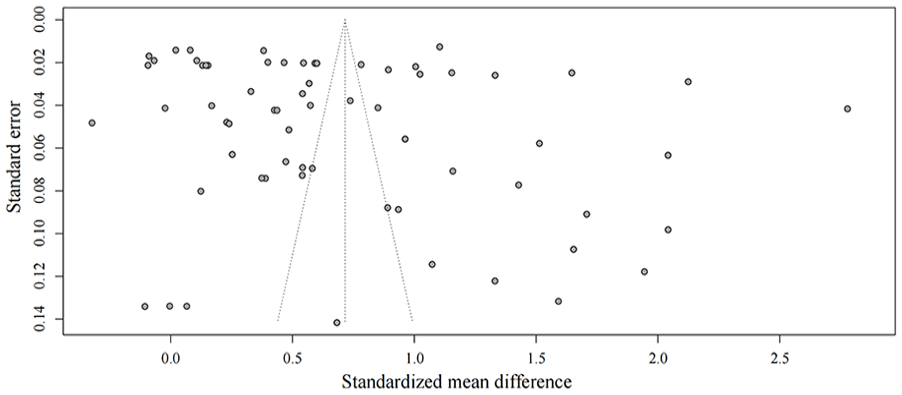
Funnel plot.
Substantive Features of the Studies
Seven key substantive features were incorporated in this study: (1) classification of non-academic achievements, (2) curriculum, (3) education level, (4) experimental period, (5) teaching model, (6) teaching strategy, and (7) autonomous learning form.
Classification of Non-Academic Achievements
The 65 effect sizes were classified into two non-academic achievement categories: personal competencies (SMD = 0.6160) and social competencies (SMD = 0.8456). The findings indicated that the effect sizes did not differ by different non-academic achievement categories (Q = 2.25, df = 1, p > .05; Table 2b).
Curriculum
The SMD values in the curricula of natural science and humanities and social sciences were essentially the same, with values of 0.7900 and 0.6469, respectively, and there was no significant difference between them (Q = 1.08, df = 1, p > .05; Table 2c).
Education Level
Table 2d summarizes the results based on education level. The SMD values in secondary education, higher education, and primary education were 0.9776, 0.7169, and 0.2488, respectively. There was a significant difference between primary education, and secondary and higher education, in terms of students’ non-academic achievements (Q = 18.14, df = 2, p < .001; Table 2d). In addition, the effect of primary education on students’ non-academic achievement was significantly different from that of secondary education (Q = 13.81, df = 1, p < .001) or higher education (Q = 11.75, df = 1, p < .001), and there was no significant difference between secondary education and higher education (Q = 1.94, df = 1, p > .05).
Experimental Period
Table 2e shows that the maximum SMD was more than 6 months (SMD = 1.0819), and the SMD of 3 to 6 months and less than 3 months were 0.6292 and 0.7221, respectively. The influence on students’ non-academic achievements was significant between over 6 months and 6 months or less (Q = 8.36, df = 2, p < .05).
Teaching Model
The SMD of offline, and online-offline models of teaching were essentially the same, 0.7048 and 0.7340, respectively. The result of the heterogeneous test was not significant (Q = 0.04, df = 1, p > .05; Table 2f).
Teaching Strategy
The SMDs of cooperative learning and subject participation were 0.7627 and 0.6896, respectively. The influence of different teaching strategies on students’ non-academic achievements was not significant (Q = 0.18, df = 1, p > .05; Table 2g).
Autonomous Learning Form
The SMD of inquiry learning and receptive learning were 0.8072 and 0.5939, respectively, and there was no significant difference between them (Q = 0.18, df = 1, p > .05; Table 2h).
Discussion
The results of our meta-analysis show that student-centered education has a large impact on students’ non-academic achievements, meaning that it could significantly improve students’ academic achievement. This result was consistent with the findings of the included studies (e.g., Cui & Fang, 2018; Jdaitawi, 2021; Tao, 2013; Xu, 2012; L. J. Zhang, 2010); however, these intervention experiments have some disadvantages, such as small sample size, single impact factor, and one-sided result, because of the limitations of the cost and the experimenter’s energy. The meta-analysis method based on a large sample size overcame these shortcomings and resulted in more credible and referential results. The effect of student-centered education on academic achievements (SMD = 0.5446) was also positive (Li et al., 2021), however, its effect size was lower than that on non-academic achievement (SMD = 0.7158). We observed that student-centered education had positive significance for the cultivation of personal and social competencies. Students could perfect their non-academic achievement from the experience of being the teaching subject to adapt to the challenges of study and life. Additionally, differences in experimental design and classification of achievements did not diverge on the positive impacts of student-centered education, indicating that the combination of these data in this study was appropriate and did not bias the final results.
The positive effect of student-centered education on non-academic achievements at the secondary and higher education stages was significantly greater than that at the primary education stage. Student-centered education requires a high degree of autonomy, learning ability, team spirit, and participation. The intellectual and psychological level of students in secondary and higher education has developed into formal operations (Piaget, 1970), which allows for stronger learning ability and autonomy among them, compared to students in primary education; moreover, they are better able to adapt to and implement student-centered education. Lu (2019) conducted student-centered education in social courses for 13 weeks and found that students in higher education improved significantly in interest and initiative, communication and interpersonal relationships, self-efficiency, logic, and theoretical thinking. However, Bursa and Kose’s (2020) 10-week student-centered education program of social science courses in primary schools, did not significantly improve students’ non-academic achievements. Through a comparison of the data, we found that the experimental period at the secondary and higher education levels generally lasted 3 months or more, while at the primary education level, the study period was generally shorter than 3 months. The length of the experimental period might be limited by the acceptance degree of different students and other practical difficulties, but the length of the experimental period might indirectly affect the impact of this regulatory variable (educational level).
The longer the experimental period, the greater the influence on students’ non-academic achievements. Most of the effects for more than 6 months were significant positive effects (e.g., AbuSeileek, 2012; Liu, 2013; Lu, 2019), differing from those with periods of fewer than 6 months (e.g., Bursa & Kose, 2020; Hava, 2021). An intercomparison of the three groups showed that there was no significant difference between the effects of 3 to 6 months and that of more than 6 months, but there was a significant difference between the effects of 3 to 6 months and that of more than 6 months. The results indicated that student-centered education had the maximum positive effect on students’ non-academic achievements when the experimental period was longer than 6 months. It also showed that student-centered education needed to be implemented consistently for a long time and that the effect on students’ non-academic achievements increased with an increase in the experimental period (the longest experimental period included in this study was 18 months). Reasons may include the following two aspects. On the one hand, there is the factor of student adaptability. It is difficult for students to adapt to changes in teaching methods—from traditional teacher-centered to student-centered—in a short time. Students’ subjectivity has not been brought into full play, which has affected the results of the experiment. The effect of student-centered education can be displayed when students have adapted to the new teaching model. On the other hand, there is the consideration of teaching method suitability. Only when the teaching mode is suitable for students and teachers can its results be seen. If we force teachers to use methods of student-centered education, the results are unlikely to be better (or may be even worse) than when they use traditional methods, since they do not trust in student-centered methods and therefore unconsciously sabotage positive effects. However, if students’ non-academic achievements showed a downward trend because of their boredom and confusion with the progress of the experiment, student-centered education would not be suitable for daily teaching. One problem that the finding might not help is that the courses students take in high school and college are generally less than 6 months.
There were no significant differences in the degree of positive effects of student-centered education on students’ non-academic achievements by subject, teaching model, teaching strategy, and learning form; however, they all had medium or large positive effects on students’ non-academic achievements. Student-centered education could promote non-academic achievement in all subjects. Although the effect of the teaching model on non-academic achievements was not significant, the SMD value of mixed online and offline learning was larger than that of offline learning. Thus, it is necessary to make rational use of the Internet to cultivate students’ learning autonomy.
Subject participation mainly included flipped classrooms, autonomous learning, and experiential learning. Cooperative learning included a group study and mutual study. However, there was no significant difference between these forms of participation in improving students’ non-academic accomplishments. Compared with the teaching strategy of subject participation, the traditional teaching strategy generally focuses on lecture and demonstration. Although the advantage of the subject participation teaching lies in the full excavation of students’ initiative, the type of teaching strategy should be adopted based on the teaching content and actual teaching conditions.
Inquiry learning involves helping students find problems independently and solve them cooperatively, which can stimulate students’ internal motivation, such as exploration desire and competence. Although there was no significant difference between the inquiry and receptive learning in this study, the SMD value of inquiry learning was larger than that of receptive learning. This result is more significant in case studies. For example, the result of a teaching experiment by J. Wang (2021) showed that inquiry learning could significantly improve learners’ non-academic achievements, while some teaching experiments using receptive learning had no significant effect on non-academic achievements (e.g., Altas & Mede, 2021; Shi & Ji, 2010). However, the student-centered teaching model had different effects on academic achievement in different teaching models, teaching strategies, and learning forms (Li et al., 2021). This indicated that the development of students’ non-academic achievements may not be related to teaching models and strategies adopted. If the teaching processes adhere to the concept of the student-centered model and selected appropriate teaching media, teaching strategies, and learning forms, students’ non-academic achievements will improve.
Conclusions and Contributions
Based on our analysis, student-centered education had a positive effect on students’ non-academic achievements, which did not diverge across experimental designs and achievement classifications. Moreover, there were positive effects on students’ non-academic achievements in different curricula, education phases, experimental periods, teaching models, teaching strategies, and learning forms. Therefore, this study’s findings support student-centered education as an effective teaching tool for the development of students’ competencies. Based on these findings, we make the following recommendations:
First, student-centered education should be widely adopted in secondary and higher education. Student-centered education highlights students’ subjectivity, which is in line with the inner needs of secondary and higher education students in their pursuit of individuality and social interaction. Students build self-cognition while demonstrating the power of subjectivity to strengthen their positive values. Once a positive trend is determined, it will promote both learning and teaching. Teachers must provide more help and arrange activities suitable for students’ mental development to ensure their participation and learning confidence when implementing student-centered teaching in primary education.
Second, student-centered education should be normalized and encouraged. This is in line with personal instincts to explore the unknown. Finding and solving problems from the standpoint of the subject is the premise for people to explore the unknown, by using scientific research methods. Teaching follows the law of scientific research aimed at helping students develop skepticism and a scientific spirit that best reflects people’s subjective initiative. Additionally, children and adolescents have a strong curiosity to explore the unknown, which is the intrinsic motivation of students’ subjective learning (Dewey, 1910). Owing to these two points, student-centered education has become an educational idea that corresponds with the nature of students to seek knowledge independently. Encouraging students’ subjectivity and individual personalities will help to improve their innovation (and therefore society’s innovation), which is a powerful tool for improving national competitiveness.
Third, diversified teaching strategies and learning forms should be adopted to implement student-centered education. Considering that all the teaching strategies and learning forms of student-centered education showed positive effects and there were no significant differences in the effect of which teaching strategies and learning forms were adopted for students’ non-academic achievements, the key to enhancing it is to adopt strategies reasonably according to the teaching needs and to guide students in selecting appropriate learning methods, without too much consideration of the impact of these regulatory factors. Three points should be considered when choosing teaching strategies and learning methods: (1) suitability of teaching content, (2) matching students’ mental development level, and (3) integration with the teaching models.
Fourth, the education administration should provide more training opportunities for teachers. The key to implementing student-centered education lies with teachers. Based on the principle of “congruence” described by Rogers (1975), teachers need to be authentic and genuine during the teaching process. Whether teachers have a firm grasp of student-centered education, role awareness as leaders and helpers, and good professional teaching knowledge of student-centered education, will directly affect its process and results. We should not force teachers to use student-centered teaching strategies until they fully realize the value of student-centered education. In addition, teaching strategies, teaching aids, and organizational forms of student-centered education are constantly developing. Relevant training should be arranged at regular intervals, to enrich teachers’ knowledge about teaching and strengthen their teaching confidence, thereby enabling them to better adhere to the implementation of student-centered teaching strategies; this, in turn, will firmly implement student-centered education.
Limitations
The results of the overall effect of student-centered education and the impact of substantive characteristics on students’ non-academic achievements were obtained by meta-analysis in this study. The results were comprehensive and of the reference value. However, there are still three deficiencies as follows. First of all, the regional deviation was inevitable in this study. Several important kinds of literature might have been omitted due to the issues of search technology and limits of authority. For example, there were few papers in the European/U.S. sector, which might cause some deviations. After that, due to differences in technological and teaching support resources in different countries (Sahonero & Calderon, 2018), the implementation of student-centered educational strategies might bring different teaching effects. Finally, the data is too discrete in several studies (e.g., Capodieci et al., 2019; Hava, 2021), which may be caused by the relatively poor control of irrelevant variables or insufficient experimental duration during the intervention experiment. Therefore, these limitations should be addressed in future research to obtain better conclusions for student-centered education.
Supplemental Material
sj-docx-1-sgo-10.1177_21582440231168792 – Supplemental material for Student-Centered Education: A Meta-Analysis of Its Effects on Non-Academic Achievements
Supplemental material, sj-docx-1-sgo-10.1177_21582440231168792 for Student-Centered Education: A Meta-Analysis of Its Effects on Non-Academic Achievements by Yin-Die Li and Guo-Hua Ding in SAGE Open
Footnotes
Author Contributions
Yin-Die Li: data search and curation; funding acquisition; project administration; writing original draft; review & editing draft of the paper; the final draft approval. Guo-Hua Ding: formal analysis; figures and table preparation; writing original draft; review & editing draft of the paper; the final draft approval.
Declaration of Conflicting Interests
The author(s) declared no potential conflicts of interest with respect to the research, authorship, and/or publication of this article.
Funding
The author(s) disclosed receipt of the following financial support for the research, authorship, and/or publication of this article: This work was supported by the National Social Science Foundation of China (No. BHA200130), Zhejiang Province’s Graduate Education Reform Project for the 14th Five-Year Plan to Y.D.L. (No. ZXWB[2023]-1-371), and Rural Education Special Project of Lishui University to Y.D.L. (No. RE202215). The funding agency had no role in the study design; collection, analysis, and interpretation of data; writing of the report; and the decision to submit the article for publication.
Ethical Approval
We used data available from published papers and dissertations by searching the databases (CNKI, CQVIP, Wanfang Data, EBSCO, and Google Scholar), 2010–2021. Thus, ethical approval is not applicable to this study.

Supplemental Material
Supplemental material for this article is available online.
References
Supplementary Material
Please find the following supplemental material available below.
For Open Access articles published under a Creative Commons License, all supplemental material carries the same license as the article it is associated with.
For non-Open Access articles published, all supplemental material carries a non-exclusive license, and permission requests for re-use of supplemental material or any part of supplemental material shall be sent directly to the copyright owner as specified in the copyright notice associated with the article.
