




Abstract
Subscription to multiple subscription video-on-demand (SVOD) services, known as multi-homing, is increasingly prevalent. This research explores the relationship between multi-homing and traditional media consumption and identifies the key factors that predict multi-homing tendencies among SVOD users. We analyzed data from 2019 to 2021 across the U.S., Canada, China, Japan, Germany, and France to investigate the impact of SVOD usage on legacy media viewing time, and then explored the predictors of multi-homing behaviors. Our findings indicate that multi-homing users are more inclined to consume content on legacy media platforms, such as terrestrial or cable television, compared with single-homing users. Critical differentiators between multi-homing and single-homing users include demographic profiles, lifestyle preferences, content expectations, and usage habits, particularly in terms of account sharing and primary devices for content consumption. These results are crucial for both SVOD and traditional media providers, as they offer strategic guidance for companies to effectively operate in various international markets. Such a comprehensive analysis of multi-homing behavior also offers a new perspective on the dynamics of global media consumption.
Plain language summary
This study delves into the growing trend of “multi-homing” in media consumption, where individuals subscribe to multiple online streaming platforms alongside their traditional TV viewing. We sought to uncover who these multi-homers are and how their behavior impacts their engagement with conventional television. Over 3 years, we surveyed participants across six countries: the USA, Canada, China, Japan, Germany, and France. Our analysis reveals that multi-homing is not just about having more choices; it’s about a shift in how people engage with media. Those who subscribe to several streaming services also tend to watch more traditional TV, suggesting that rather than replacing old with new, digital and traditional media consumption can coexist and complement each other. Demographically, younger individuals, those with higher education levels, and people with greater household incomes are more inclined to be multi-homers. This group values diversity in their content and expects a high-quality viewing experience. Lifestyle choices, content expectations, and viewing habits also play significant roles in their propensity to subscribe to multiple services. Our findings offer valuable insights for streaming service providers and traditional TV broadcasters, highlighting the importance of understanding viewer preferences and consumption patterns in the evolving media landscape. For academia, this research contributes to the broader discourse on digital media’s impact on traditional media consumption, offering a nuanced understanding of viewer behavior in the age of streaming services.
Keywords
Introduction
With the surge in streaming service usage, “multi-homing”—that is, subscription to multiple subscription video-on-demand (SVOD) services simultaneously—is on the rise (Bakos & Halaburda, 2020; Belleflamme & Peitz, 2019; Wu & Chiu, 2023). People in the U.S. subscribe to an average of 4.5 SVODs per month (Gruenwedel, 2022), while in Germany, the average is 3 SVODs per month (Prange, 2021). According to The Guardian, many SVOD subscribers believe that canceling cable television and using only some SVOD services is more economical (Aratani, 2022). However, the monthly cost of subscribing to multiple SVOD services such as Netflix, Disney Plus, Hulu, and HBO Max can be as high as $50, which is comparable to a basic cable plan’s price. On average, U.S. consumers spend $552 annually on streaming services (Orentas & Allen, 2024). Despite the high cost of subscribing to multiple SVOD services, a significant number of global users are subscribed to at least two SVOD services (Gruenwedel, 2022; Orentas & Allen, 2024; Prange, 2021). However, subscriber retention requires SVOD providers to offer reasonable prices. In North America, for instance, Netflix recently increased its prices to increase profits, which resulted in its first decline in subscribers in a decade (Aratani, 2022; Sperling, 2022). Netflix’s attempt to stop account sharing has also been received negatively by users (Orentas & Allen, 2024). Netflix’s case shows that SVOD providers must attract new subscribers while retaining their existing base by grasping the traits of multi-homing users.
In today’s digital media landscape, consumer behavior generally falls into one of two distinct patterns: “single-homing,” that is, preferring a single service, and “multi-homing,” that is, subscribing to several services to fulfill diverse needs. Multi-homing users differ from single-homing users in several ways. People who socialize with others of different genders and ages are more likely to be multi-homers who also use multiple social network services (Kwon et al., 2017). Gender, age, education, and monthly frequency of platform use are predictors of multi-homing (Singh et al., 2022). While numerous studies have explored multi-homing and single-homing behaviors in the context of social media and online shopping (Gu et al., 2016; B. C. Kim et al., 2017; Kwon et al., 2017; Singh et al., 2022; Wan et al., 2020), few target users of streaming services such as Netflix. Although Bravo and Farro-Mejía (2023) utilized semi-structured interviews to explore perceptions of multi-homers, empirical research on media usage among SVOD multi-homers is still limited. We thus explore the prevalent patterns of media use among SVOD subscribers and identify the predictors of multi-homing to better understand such users’ behaviors.
People who subscribe to multiple SVODs are “heavy users” who appreciate the diverse content offered by each SVOD provider and are willing to pay the cost of accessing such variety (Kimura, 2016). Multi-homing users differ in their service utilization compared with single-homers. Goode (2020) investigated the factors influencing users’ likelihood of switching services to identify distinctions between multi-homers and single-homers. SVOD platforms provide users with the flexibility to watch content at their convenience, offering a versatile viewing experience (Li, 2020; Mulla, 2022). The convenience and variety of choices in SVOD services can complement users’ consumption of legacy media, resulting in a balanced viewing experience encompassing both digital and traditional media. Many countries have shown simultaneous growth in both SVOD services and traditional pay TV, which confirms their complementary relationship (S. Lee et al., 2021).
Nonetheless, research exploring how users’ multi-homing behavior regarding online streaming services influences their consumption of legacy media is scarce. This gap in knowledge makes it challenging to determine whether the use of multiple streaming services leads users to substitute traditional media or use both services. The limited knowledge of factors influencing multi-homing makes it difficult for SVOD services to develop business strategies for subscribers. We thus examined the relationship between SVOD multi-homing and legacy media viewing times to understand users’ characteristics and media consumption patterns. The results of this study will provide operators with insights into multi-homing subscriber acquisition and retention strategies.
While research exists on the relationship between demographics and multi-homing (Amendola et al., 2015; Byun & Baek, 2022; Singh et al., 2022), there is no clear conclusion about how users’ lifestyles, SVOD expectations, and usage habits affect multi-homing. Accordingly, we conducted surveys between 2019 and 2021 targeting users in the U.S., the U.K., China, Japan, Germany, and France—regions with high penetration of pay TV (both traditional and virtual; Stoll, 2023). As a higher proportion of households in these regions watch TV than in other regions, we expect our sample to provide us valuable insights into the legacy media usage habits of multi-homing users. These multiyear and cross-national data analyses are further crucial for identifying those most likely to subscribe to multiple SVODs. Based on the number of SVODs used, we categorized SVOD users as single-homing, heavy multi-homing, or light multi-homing users. We also investigated (1) how multi-homing affects terrestrial or cable network viewing and (2) how user characteristics, such as demographics, lifestyle, quality expectations, and usage patterns, influence multi-homing. To investigate the differentiated impact of multi-homing among SVOD users on terrestrial and paid broadcast viewing time across various countries, we applied the seemingly unrelated regression (SUR) model, and then conducted a logistic regression analysis to identify predictors of multi-homing behavior among users.
In summary, we conducted a detailed examination of multi-homing behaviors among SVOD users by utilizing an extensive dataset that spans multiple regions to deliver a comprehensive perspective on global media consumption trends. The insights thereof will unravel the interaction between traditional and digital media and offer SVOD providers critical knowledge to strategically navigate the competitive market.
Literature Review
SVOD Multi-Homing
Multi-homing refers to the practice of utilizing multiple technologies to fulfill one’s media consumption needs (Bravo & Farro-Mejía, 2023). In SVOD multi-homing, users subscribe to multiple SVODs simultaneously (Bakos & Halaburda, 2020; Belleflamme & Peitz, 2019; Wu & Chiu, 2023). The emergence of diversified subscription-based video streaming services has made SVOD multi-homing increasingly common. On average, individuals in the U.S. maintain subscriptions to 4.5 streaming services per month (Gruenwedel, 2022), while in Germany, people subscribe to at least 3 (Prange, 2021). Multi-homing is marked by a desire to access a variety of entertainment and information; such multi-homers actively engage across multiple platforms (Hyrynsalmi et al., 2016) and are willing to pay for a wider range of content provided by different SVOD platforms (Kimura, 2016). Unlike single-homing subscribers, who remain loyal to one service, multi-homers have flexible viewing habits and an interest in diverse media content. This change in media consumption is noteworthy (Bravo & Farro-Mejía, 2023), and it emphasizes the need for service providers to gain a comprehensive understanding of multi-homing users.
As noted earlier, digital media consumers are either single-homers or multi-homers, where the latter tend to socialize with diverse age groups and genders, engage with various social networking services (Kwon et al., 2017), and often use multiple credit cards in the case of older multi-homers with higher incomes (Amendola et al., 2015). Gender, age, education, and monthly frequency of food platform use are predictors of multi-homing on food platforms (Singh et al., 2022). Prior studies comparing multi- and single-homers mostly focus on social media usage (Gu et al., 2016; Kwon et al., 2017) and commerce (B. C. Kim et al., 2017; Singh et al., 2022; Wan et al., 2020), with few studies on SVOD services. Although Bravo and Farro-Mejía (2023) used semi-structured interviews to examine perceptions of multi-homing, the media usage patterns of SVOD multi-homers are less known. We fill this gap in knowledge by understanding how SVOD users consume mainstream media and what drives their multi-homing behavior.
Media Substitution Theory
Media substitution theory suggests that various media types compete for our time and attention; one implication is that new media replace older media (McCombs, 1972; Yamatsu & Lee, 2023). In the framework of media substitution theory, individuals allocate their time to consume media within certain constraints. That is, when people engage with a specific media, they naturally reduce their usage time of other media. This behavior makes it crucial to know how people manage their media time under the condition of multiple choices. McCombs (1972) suggests that new media’s entry into the market leads audiences to redistribute their financial and time resources between both old and new platforms. As mass media fulfill similar roles, new platforms with comparable features might displace older ones. Media substitution theory posits that new media advancements lead to the decline of traditional media, while complementary theory argues that both can coexist and potentially enhance one another, especially when offering different functions and satisfying various needs (S. J. Kim et al., 2020).
Numerous studies in this area investigate whether new media serves to replace or enhance traditional media. Studies based on the media replacement theory argue that people have limited resources of time and money (McCombs, 1972) and that using one type of media reduces the resources necessary for using other existing media (McCombs, 1972). These studies primarily compare usage times between new and traditional media (H. Kim et al., 2013; P. S. Lee & Leung, 2008; S. Y. Lee et al., 2016). The literature on media consumption yields diverse findings: a substitution pattern between traditional and new media usage (Budzinski et al., 2021; S. Y. Lee & Lee, 2013; Nimrod, 2019; Yamatsu & Lee, 2023); a complementary relationship between traditional and new media (S. J. Kim et al., 2020; Udoakpan & Tengeh, 2020), or neither (Hall et al., 2019).
Subscribing to two or more SVOD services is becoming increasingly common all over the world (Gruenwedel, 2022; Prange, 2021). Owing to time constraints, multi-homing users might watch fewer terrestrial or cable channels and spend more time watching SVOD than single-homing users. Scholars have also examined the relationship between genre and home television viewing time of a single SVOD service (Han & Lee, 2012) and the effect of paid broadcast viewing (e.g., cable TV, Internet Protocol Television [IPTV], satellite TV) and paid VOD expenditure on SVOD usage (S. Lee, 2021). Their studies have mainly investigated the substitutive or complementary relationship between cable television and SVOD.
Despite the growing number of multi-homing users globally, very few studies have examined the relationship between SVOD multi-homing and legacy media. Jung and Melguizo (2023) found that the period from 2015 to 2020 witnessed a significant rise in the adoption of over-the-top streaming services in Latin America, aligning with a notable trend toward cord-cutting—terminating traditional cable or satellite TV subscriptions—and cord-shaving—diminishing usage without full termination. Despite the surge in multiple SVOD subscriptions, there exists no definitive evidence to assert that multi-homing is replacing traditional media consumption.
We thus investigated how multi-homing influences variations in legacy media usage by focusing on SVOD multi-homing users, which has not been previously studied. Discussing how SVODs have displaced or supplemented legacy media across countries is challenging, as most research has been limited to a single nation. Hence, we examined data collected from six countries between 2019 and 2021 to address this research gap. Examining the relationship between SVOD multi-homing and legacy media consumption across countries will reveal global media substitution or supplementation trends.
Research Question 1. Does multi-homing cause an increase or decrease in the time spent watching terrestrial and cable television? Do these relationships differ across countries?
Predictors of SVOD Multi-Homing
Lifestyle and Demographics
A lifestyle is the pattern of a person’s life, shaped by the employment of personal resources such as time and money in specific circumstances (Kaynak & Kara, 2001). Lifestyle is a crucial concept for market segmentation and identifying target customers (Kahle & Kennedy, 1988; Novak & MacEvoy, 1990; Plummer, 1974). People’s lifestyles, which reflect their values, opinions, and interests, influence their media consumption (Chan & Leung, 2005; Kwak et al., 2021).
Lifestyles may be categorized using the list of values (LoV) model (Kahle & Kennedy, 1988). This model distinguishes lifestyles based on how people prioritize internal values such as excitement, achievement, and self-esteem; external values such as respect, belonging, and safety; or those centered on interpersonal relationships and warmth. In this context, “yuppies” are characterized by a focus on success and social status, and are more inclined to adopt new media compared with “strugglers,” who face financial constraints and prioritize basic needs over technological adoption (Wei, 2006). Those who seek fun and enjoyment in life and value warm relationships with others tend to spend more on SVOD services than those who do not (Kwak et al., 2021). People with traditional, family-oriented lifestyles tend to use multiple media forms more than those in other lifestyle groups (Shim et al., 2008), indicating that SVOD multi-homing may also be influenced by one’s lifestyle.
Plummer (1974) suggests that demographics and lifestyles should be considered together to comprehend people’s purchasing behavior. Demographics are a fundamental factor in describing an individual’s media consumption patterns (Dupagne, 1999; Kwak et al., 2021; Palomba, 2020). SVOD multi-homing is likely influenced by demographic factors, such as age and education, which are associated with an individual’s technology acceptance and willingness to pay (Goyanes, 2014; Kwak et al., 2021; Singh et al., 2022). Additionally, income and educational levels might significantly impact multi-homing, as users with multiple SVOD subscriptions typically incur higher costs than those who single-home.
While it is reasonable to assume that multi-homing behaviors may differ based on users’ lifestyle choices and demographic factors, we have limited extant findings on these potential variations. We thus investigated whether the lifestyles and demographic characteristics of SVOD users in each country predict their tendencies towards multi-homing. Comparing these relationships between SVOD subscribers in key regions—such as North America (U.S., Canada), East Asia (China, Japan), and Western Europe (Germany, France)—could have substantial implications for market segmentation.
Research Question 2. Do user demographics and lifestyles affect SVOD multi-homing? Do these relationships differ across countries?
Expectations for SVOD
According to expectation-disconfirmation theory, satisfaction fluctuates based on the discrepancy between an individual’s prior expectations and the actual performance of a product or service (Oliver, 1980). Positive confirmation arises when the product or service exceeds expectations, leading to user satisfaction. Conversely, negative disconfirmation, stemming from unmet expectations, diminishes user satisfaction (McCollough et al., 2000). This theory has been applied across diverse use contexts, including on websites (Cheung & Lee, 2011), social networks (Ha et al., 2021; Kourouthanassis et al., 2015), e-learning platforms (Dai et al., 2020; Dangaiso et al., 2022), and mobile applications (Wang & Zhou, 2023; Wen et al., 2023). Indeed, we do find a consistent link between heightened expectations of system and service quality and increased user satisfaction (Chen & Chang, 2018; Dangaiso et al., 2022; Park, 2020). Despite extensive studies on expectations and satisfaction, we know little of how expectations impact multi-homing behavior. Users who pay the monthly membership cost for SVOD are likely to anticipate a high level of quality. Especially, multi-homers may expect far higher quality, because they pay higher subscription prices than single-homers. Thus, we sought to answer whether user expectations regarding content quality, system reliability, service excellence, and cost-effectiveness can predict multi-homing behavior.
Research Question 3. Do users’ SVOD expectations (e.g., content, systems, services, and costs) affect SVOD multi-homing? Do these relationships differ across countries?
SVOD Usage Habits
Users struggling with the cost of monthly SVOD subscriptions often resort to sharing their accounts with others, including strangers, family, or friends. Subscription sharing is particularly prevalent among multi-homers, whose media consumption patterns are costlier to sustain (Orentas & Allen, 2024). This behavior, driven by a desire for diverse content, suggests that account sharing may be an important predictor of multi-homing.
The type of device used can also influence media consumption patterns. The rise of the Internet has led to a decrease in the use of legacy media (S. Y. Lee et al., 2016; Woo et al., 2014), with an uptick in online video consumption correspondingly reducing the time spent on traditional video media (Jung & Melguizo, 2023; S. Y. Lee et al., 2016). The more content users watch on smartphones, the less they watch it on television (Jang & Park, 2016). Smartphone usage may further affect time spent on personal computers (PCs) and televisions for media consumption (Hwang & Lee, 2011). The convenience of mobile devices, which allows users to access content anytime and anywhere, appears to particularly appeal to multi-homers. Consequently, the choice of a primary viewing device—especially the preference for smartphones over traditional devices—may serve as an important predictor of multi-homing behavior.
Users who predominantly consume content at home are likely to engage with media for prolonged durations, creating a favorable environment for subscribing to multiple SVOD services to satisfy their varied content needs (Starosta et al., 2020). In contrast, individuals who primarily watch content outside the home might exhibit different consumption patterns and motivations. Given the distractions and time constraints associated with external environments, these users may prefer shorter viewing sessions, diminishing the necessity for a broad variety of content. Consequently, they might perceive a single SVOD platform as sufficient for their entertainment needs, as it provides adequate variety within the limited time they allocate for content consumption outside the home. This distinction suggests that the primary viewing location where users engage with content could be a significant predictor in determining their likelihood to adopt multi-homing behavior.
While there is potential for users’ media consumption patterns to distinguish between single-homing and multi-homing behaviors, empirical research in this area remains scarce. We fill this gap by examining whether factors such as account sharing, the primary device for content consumption, and the location of content consumption serve as predictors of multi-homing behavior among SVOD users (Figure 1).
Research Question 4. Do user usage habits (e.g., account sharing, primary viewing device, and viewing location) affect SVOD multi-homing? Do these relationships differ across countries?

Research model.
Methodology
Sample and Data Collection
To gather user samples, we collaborated with the market research firm Macromill Embrain to conduct quota sampling, which was based on country, gender, and age criteria. Responses were obtained from 1,400 terrestrial or cable TV users, with an even distribution of 200 individuals per country, covering a wide age range from the 20s to the 70s. We collected responses from 7,200 participants over 3 years. Considering the year-over-year growth of the SVOD market in North America (U.S., Canada), East Asia (China, Japan), and Western Europe (Germany, France) (Statista, 2023), we targeted six countries with a substantial SVOD user base. The final analysis, aimed at understanding multi-homing users, incorporated 3,032 individuals who subscribed to more than one SVOD service and also consumed terrestrial or pay TV. Table 1 reports the distribution of these respondents across the six countries.
Country-Wise SVOD Use.

Measure
To assess the impact of users’ multi-homing behavior on legacy media consumption, we investigated the number of SVOD services participants subscribed to and their viewing habits for both terrestrial and pay TV. Participants reported the number of SVOD services they are currently subscribed to, with the maximum possible response capped at three. To classify SVOD users, we divided participants into two main categories based on their subscription patterns: single-homing and multi-homing. Single-homers are defined as those subscribed to only one SVOD service, while multi-homers are characterized by subscriptions to two or more SVOD services. We further segmented multi-homers into two subcategories to capture varying levels of service usage: light multi-homers (subscribed to exactly two SVOD services) and heavy multi-homers (subscribed to three SVOD services). For analytical purposes, single-homing was coded as 1, light multi-homing as 2, and heavy multi-homing as 3.
Legacy media usage refers to the average time spent per day watching videos on terrestrial or pay TV. This variable was measured using a 7-point Likert scale (1 = less than 30 min to 7 = more than 5 hr).
To find the predictors of multi-homing, we investigated the demographics, lifestyle, expectations for SVOD, and usage habits of SVOD users. Demographic data were collected from participants, which included details on their gender, age, educational attainment, occupational status, household income, and the size of their household. For analysis, respondents’ employment status was classified into two categories: employed and unemployed.
Lifestyles in this study were categorized into six distinct dimensions using LoV and employed as predictors. The concept of “lifestyles” was understood as a cognitive manifestation of users’ underlying fundamental needs and objectives (Kwak et al., 2021). These persistent beliefs shape specific choices, attitudes, and behaviors in users (Homer & Kahle, 1988; Rokeach, 1969; Schwartz, 1994). Measurements based on the LoV scale can be better explained when used with demographic variables (Novak & MacEvoy, 1990). Items that focus on LoV were adapted from Kwak et al. (2021).
Social relationships refer to the desire to interact with others, while family-oriented is the desire to support or spend time with family members. Self-confidence refers to one’s trust in oneself. Self-management refers to having one’s responsibilities, whereas self-fulfillment refers to gaining satisfaction from indulging in creative activities. Culture and consumption-focused refers to the tendency to be passionate about sports and popular culture. Individuality refers to the inclination to value one’s personality. Finally, achievement refers to the disposition to appreciate one’s success and accomplishments. All dimensions were measured using a 5-point Likert scale (1 = strongly disagree to 5 = strongly agree), which showed adequate reliability (Nunnally, 1978).
Expectations for SVOD are the extent to which users expect SVOD to provide a certain level of content, services, systems, and price. Content expectations relate to the content provided by an SVOD, whereas system expectations are related to an SVODS’s operation and usage procedures. Finally, service expectations refer to SVOD service quality expectations, whereas cost expectations refer to SVOD price expectations. All items were adapted from Al-Fraihat et al. (2020) and Shin and Park (2021). All dimensions were measured using a 5-point Likert scale (1 = strongly disagree to 5 = strongly agree), which showed adequate reliability (Nunnally, 1978).
SVOD usage habits were categorized based on account sharing, primary viewing devices, and viewing location. Account sharing was determined by whether an SVOD account is used by multiple individuals, with non-sharers coded as 0 and sharers as 1. The primary viewing device was identified as the device predominantly used to access SVOD content, categorizing users of stationary devices (e.g., desktop PCs, TVs) as 0 and those using portable devices (e.g., smartphones, laptops, tablets) as 1. Primary viewing location was defined by the preferred location for viewing SVOD content, coding users who predominantly watch outside their home as 0 and those who watch primarily at home as 1. Table 2 shows the items used in the study, Cronbach’s alpha for the measures, and the means and standard deviations of the variables.
Measurement of Items.

Analytical Strategies
The objective of this study is twofold: (1) to investigate the impact of multi-homing on legacy media viewing time and (2) to explore the predictors of users’ multi-homing behaviors. To this end, SVOD users were categorized into three segments: single-homing, light multi-homing, and heavy multi-homing. Multiple regression analysis was conducted to examine the effects of these categorical segments on legacy media viewing time. To uncover how these impacts vary across different countries, we employed SUR. This method is particularly beneficial for our analysis, as it allows for the estimation of multiple, interrelated regression equations, thus enhancing the efficiency and accuracy of our findings by accounting for the potential correlation of error terms across the different country-specific models (Budzinski et al., 2021). To investigate the predictors of users’ multi-homing behaviors, we employed a multinomial logistic regression model, as it facilitates the prediction of the probabilities of the different categories of multi-homing behavior based on the independent variables (H. Kim et al., 2021). Light multi-homing and heavy multi-homing were set as dependent variables, while demographics, lifestyles, expectations for SVOD, and usage habits were set as independent variables. A multinomial logistic analysis was conducted with single-homing as the reference category.
Results
Impact of Multi-Homing on Legacy Media Viewing Time
Multiple linear regression was used to examine the effect of SVOD users’ multi-homing on legacy media usage (Research Question 1). The analysis, as detailed in Table 3, indicated that demographic factors—age (β = .017, p < .001), occupation (β = .219, p < .01), and household income (β = .023, p < .05)—positively influenced legacy media usage. Specifically, older individuals, those not currently employed, and individuals with higher household incomes were found to spend more time viewing legacy media. Multi-homing, as a predictor, also positively affected legacy media usage. Compared with users who engage in single-homing, those categorized as light (β = .213, p < .01) and heavy (β = .542, p < .001) multi-homers demonstrated a significantly higher propensity to watch terrestrial or cable television.
Regression Analysis Results on Legacy Media Usage.
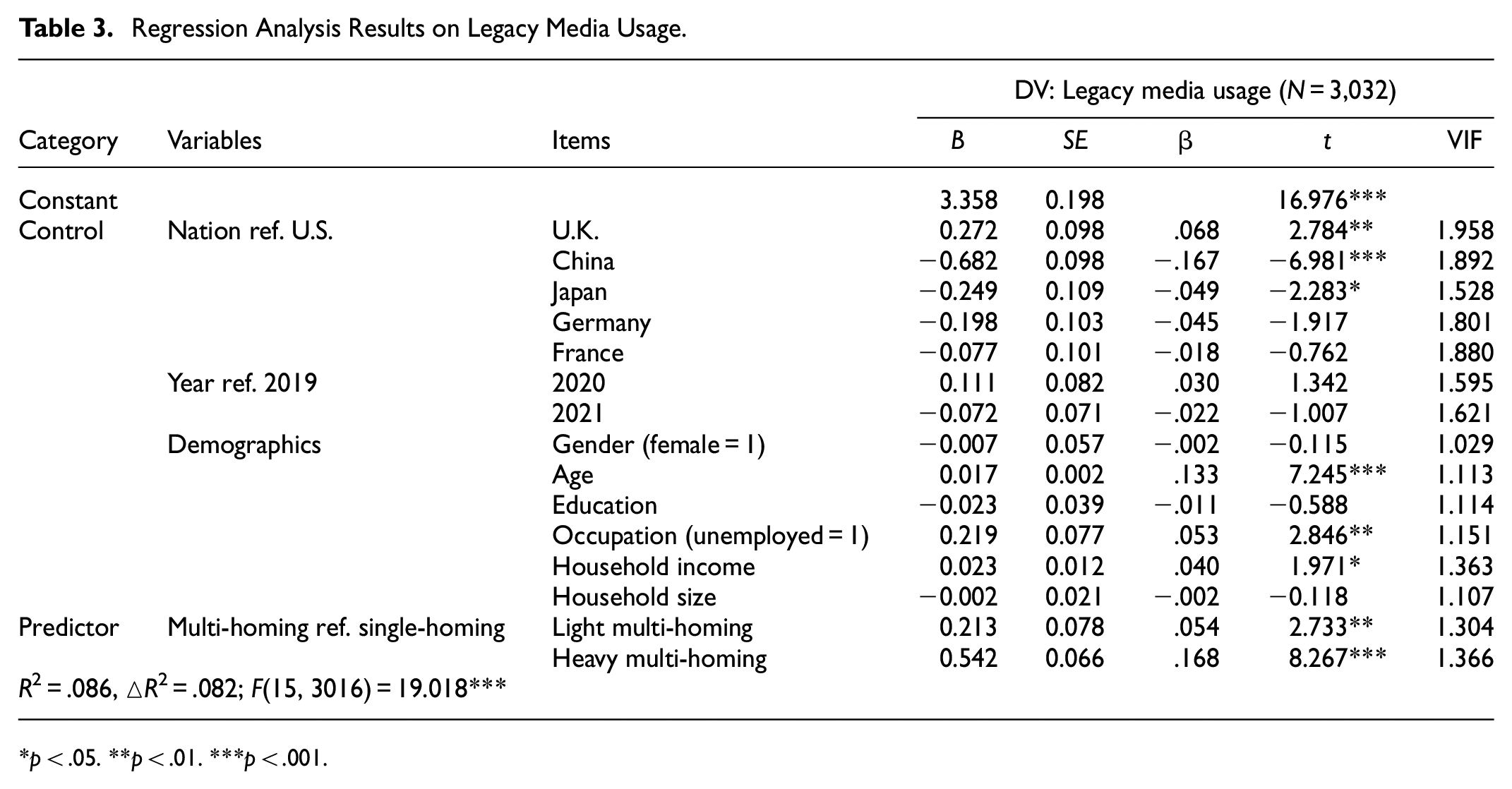
p < .05. **p < .01. ***p < .001.
The SUR model was employed to examine the effects of SVOD multi-homing on legacy media viewing times across various countries. This model considers the correlation between the error terms of the dependent variable, allowing for more efficient estimation than ordinary least squares (OLS) (Koo & Choo, 2021). The SUR model’s findings, which align with the OLS results (see Table 4). Light (β = .469, p < .05) and heavy multi-homers (β = .868, p < .001) in the U.S. and heavy multi-homers in the U.K. (β = .527, p < .001), China (β = .466, p < .001), Japan (β = .492, p < .05), and France (β = .532, p < .01) were more inclined to watch terrestrial or cable television than single-homers were. These results suggest a complementary relationship between SVOD and terrestrial or cable television for all countries, except Germany.
Country-Wise SUR Analysis Results on Legacy Media Usage.

Note. DV: legacy media usage.
p < .05. **p < .01. ***p < .001.
Predictors of Multi-Homing: Demographic and Lifestyle
To explore the predictors of users’ multi-homing behaviors, we employed a multinomial logistic regression model. Multi-homing segment variables were set as the dependent variable, while demographic and lifestyle variables were used as predictors. Light multi-homing differed from single-homing by gender (B = −0.306, p < .01), age (B = −0.017, p < .001), and education (B = 0.148, p < .05) (see Table 5). Men, young people, and highly educated people were more likely to be light multi-homers than single-homers.
Multinomial Logistic Regression Analysis Results: Demographics and Lifestyles.
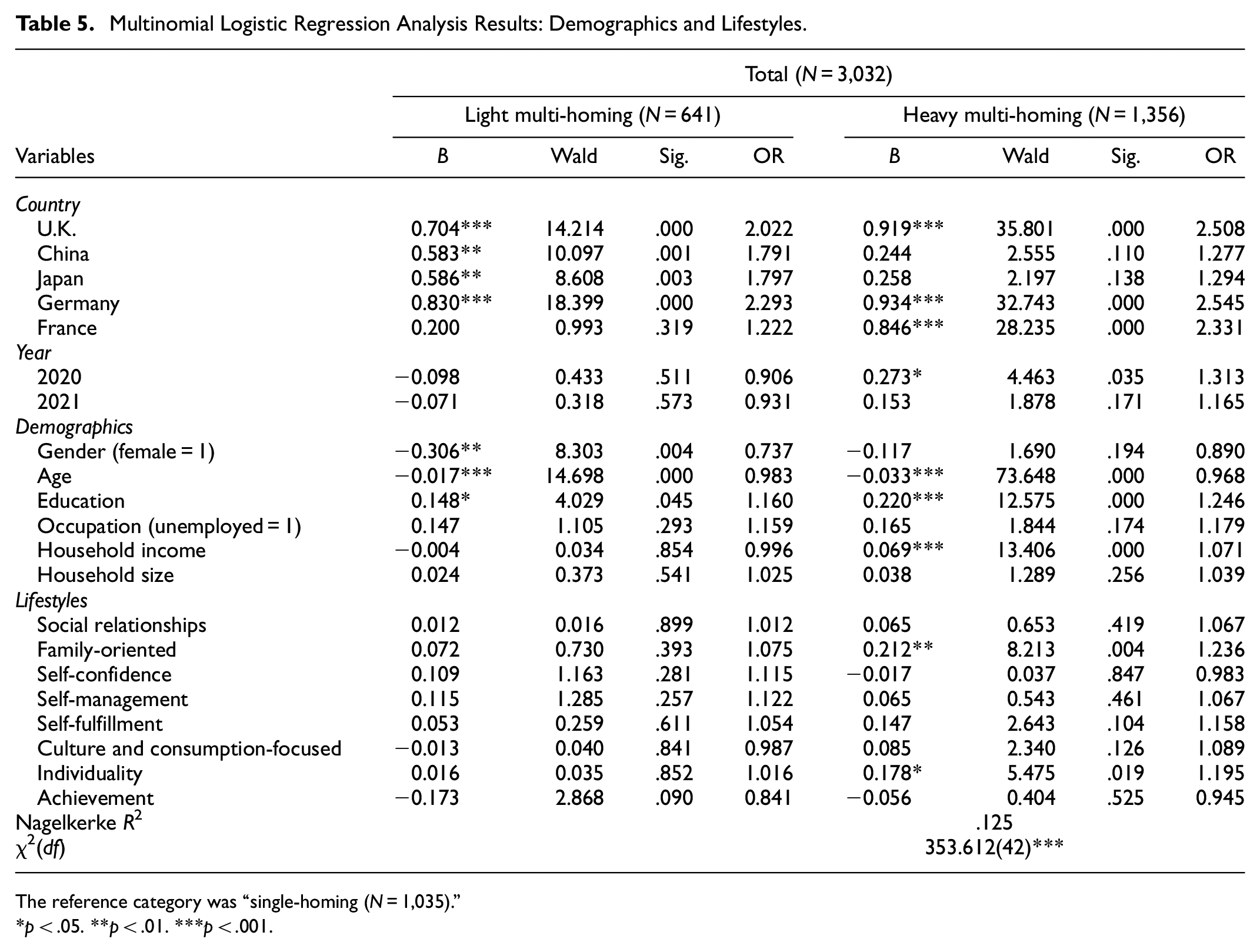
The reference category was “single-homing (N = 1,035).”
p < .05. **p < .01. ***p < .001.
Heavy multi-homing differed from single-homing by age (B = −0.033, p < .001), education (B = 0.220, p < .001), and household income (B = 0.069, p < .001). Young and highly educated individuals with a high household income were more likely to be heavy multi-homers than single-homers. People with high family-oriented (B = 0.212, p < .01) or individuality (B = 0.178, p < .05) lifestyle scores were more likely to be heavy multi-homers than single-homers.
In conclusion, light multi-homers were more likely to be male, young, and highly educated than single-homers were; and heavy multi-homers were more likely to be young, highly educated, with high household incomes, family-oriented, and individuality lifestyle scores. The test results based on all predictors explained 12.5% of the variance in users’ multi-homing (χ 2(42) = 353.612, p < .001).
Appendix A presents the country-wise results of the multi-logistic analysis. Light multi-homing differed from single-homing by gender only in France, that is, women were more inclined to be single-homing than light multi-homing users (B = −0.707, p < .05). Light multi-homing differed from single-homing by the user’s age in all six countries. Young users in the U.S. (B = −0.044, p < .001), the U.K. (B = −0.027, p < .01), China (B = −0.047, p < .001), Japan (B = −0.034, p < .01), Germany (B = −0.037, p < .01), and France (B = −0.030, p < .01) tended to be heavy multi-homers. Highly educated users were more likely to be light (B = 0.494, p < .05) or heavy multi-homers (B = 0.685, p < .001) than single-homers only in the U.S. In the U.K., people with high household incomes were more likely to be single-homers than light multi-homers (B = −0.119, p < .05). In contrast, people with high household incomes were likely to be heavy multi-homers in China (B = 0.113, p < .05), Japan (B = 0.179, p < .01), and Germany (B = 0.174, p < .01).
The impact of lifestyle varies by country. People with a family-oriented lifestyle were more likely to be heavy multi-homers than single-homers in Western European countries such as the U.K. (B = 0.348, p < .05) and Germany (B = 0.365, p < .05). The Chinese with a self-fulfillment lifestyle (valuing accomplishing something themselves) were more likely to be heavy multi-homers than single-homers (B = 0.495, p < .05). Asians with a culture and consumption-focused lifestyle were more likely to be heavy multi-homers than single-homers (China: B = 0.582, p < .01; Japan: B = 0.502, p < .05). The Chinese with a lifestyle valuing individuality were less likely to be light (B = −0.589, p < .01) or heavy multi-homers (B = −0.414, p < .05) than single-homers. However, the Japanese with a lifestyle prioritizing individuality were more likely to be heavy multi-homers (B = .742, p < .01) than single-homers. Lastly, the French pursuing an achievement lifestyle were more likely to be single-homers than heavy multi-homers (B = −0.443, p < .05).
Predictors of Multi-Homing: Expectations for SVOD and Usage Habits
Research Questions 3 and 4 investigated whether the degree of multi-homing among users differed depending on users’ SVOD expectations and usage habits. We conducted a multinomial logistic analysis with expectations for SVOD and users’ usage habits as predictors, and multi-homing as the dependent variable. Single-homing users were the reference group. Table 6 presents the analysis results.
Multinomial Logistic Regression Analysis Results: Expectations for SVOD and SVOD Usage Habits.

The reference category was “single-homing (N = 1,035).”
p < .05. **p < .01. ***p < .001.
Heavy multi-homing differed from single-homing in terms of users’ content (B = 0.317, p < .01) and service expectations (B = 0.264, p < .01). People with high expectations for content and services were more likely to be heavy multi-homers than single-homers. People sharing an account with others were more likely to be heavy multi-homers than single-homers (B = 0.694, p < .001). People using mobile devices (e.g., smartphones, laptops, tablet PCs) to watch videos tended to be light (B = 0.223, p < .05) or heavy multi-homers (B = 0.265, p < .01) compared with single-homers. The test results based on all predictors explained 12.5% of the variance in users’ multi-homing (χ2(28) = 230.039, p < .001).
Appendix B details the outcomes of the country-specific multi-logistic analysis, demonstrating how users’ expectations for SVOD services influence their light and heavy multi-homing behaviors. In Japan, individuals with heightened expectations for SVOD content were more likely to engage in both light (B = 0.987, p < .01) and heavy multi-homing (B = 1.096, p < .01) relative to single-homing. In Germany, users with more significant expectations of SVOD services exhibited a stronger tendency toward light multi-homing (B = 0.616, p < .01) than toward single-homing. Conversely, in France, users with high expectations for the SVOD system were less inclined to participate in either light (B = −0.942, p < .01) or heavy multi-homing (B = −0.486, p < .05) than single-homing.
Heavy multi-homing differed from single-homing in terms of users’ SVOD account sharing in all countries except France. People sharing accounts with others were more likely to be heavy multi-homers than single-homers (U.S.: B = 0.732, p < .01; U.K.: B = 0.701, p < .01; China: B = 0.943, p < .001; Japan: B = 0.862, p < .01; Germany: B = 0.635, p < .05). In China and France, individuals who predominantly used mobile devices for viewing SVOD content demonstrated a higher propensity for both light (China: B = 0.501, p < .05; France: B = 0.624, p < .05) and heavy multi-homing (China: B = 0.524, p < .05) than did single-homers. In the U.S., individuals who predominantly viewed SVOD content at home were less likely to engage in heavy multi-homing than were single-homing users (B = −0.598, p < .05). Conversely, in the U.K., those primarily watching SVOD at home showed a greater likelihood of being light multi-homers than single-homers (B = 1.235, p < .01).
Table 7 summarizes the main results for each research question. First, multi-homers watched more terrestrial or cable television than single-homers, indicating that SVOD services and legacy media were complementary (Research Question 1). Second, young and highly educated people with large household incomes were more likely to be multi-homers than single-homers. Those with family-oriented or individuality-focused lifestyles were more likely to be multi-homers than single-homers (Research Question 2). Third, people with considerable expectations regarding SVOD content or services were more likely to be multi-homers than single-homers (Research Question 3). Finally, people who shared their SVOD accounts or often watched SVOD on their mobile devices (e.g., mobiles or tablet PCs) were more likely to be multi-homers than single-homers (Research Question 4).
Comparison of Multi-Homing Users Based on the Predictors.

Table 8 summarizes the country-wise results. Multi-homers in the U.S., U.K., China, Japan, and France watched more terrestrial or cable television than single-homers.
Country-Wise Comparison of Multi-Homing Subscribers.

Young and highly educated Americans were more likely to be multi-homers than single-homers. Low-income British were more likely to be light multi-homers, and young and family-oriented British were more likely to be heavy multi-homers than single-homers.
Young Chinese with high household income and self-fulfillment or culture and consumption-focused lifestyles were more likely to be heavy multi-homers than single-homers. Individuality-oriented Chinese people were more likely to be single-homers. Young Japanese were more likely to be light multi-homers than single-homers, and those young, well-earning with culture and consumption-focused or individuality-oriented lifestyles were more likely to be heavy multi-homers than single-homers.
Young Germans were more likely to be light multi-homers than single-homers, and those who were young and well-earning with family-oriented lifestyles were more likely to be heavy multi-homers than single-homers. Males and young French were more likely to be light multi-homers than single-homers, and older people with achievement-focused lifestyles were more likely to be single-homers than heavy multi-homers.
Discussion
Let us now discuss our findings. First, multi-homers showed higher terrestrial or cable television viewing times than single-homers (Research Question 1). Similar findings were found for all countries, with heavy multi-homers being more inclined to watch terrestrial or cable television than single-homers. The result that multi-homers viewed legacy media more than single-homers indicates that legacy media and SVOD are complementary (S. J. Kim et al., 2020; S. Lee et al., 2021; Udoakpan & Tengeh, 2020).
According to this study, multi-homers can be regarded as cord couplers who use both pay TV and SVOD services concurrently depending on their needs and preferences (Jung & Melguizo, 2023), as well as heavy users who enjoy a variety of content via legacy media and SVOD services. Recently, however, many SVOD providers have introduced password-sharing restriction policies to enhance their profitability. Providers such as Netflix, Disney, and Hulu have eliminated password sharing, resulting in increased revenue (Pequeño, 2024). However, the increased costs of anti-sharing policies have led to an uptick in the cancellation of subscriptions (Orentas & Allen, 2024). Although Netflix recorded its highest revenue after implementing its anti-sharing policy, the longevity of this success remains uncertain. Similarly, the outlook for other SVOD providers such as Disney, Hulu, and MAX is not very optimistic (Saul, 2024). SVOD operators need to adopt diversified pricing strategies to lock multi-homers into their services. Currently, terrestrial and cable broadcasters provide their programs to SVOD via partnerships, a strategy anticipated to attract multi-homers successfully. SVOD services must retain existing subscribers by bundling current terrestrial/cable plans with a subscription SVOD service plan or by combining multiple SVODs to offer services at a slightly discounted rate to reduce multi-homing consumers’ financial burdens.
Second, SVOD multi-homing differed from single-homing in terms of their lifestyles and demographics (Research Question 2). People who were young, highly educated, and high-income earners with family-oriented or individuality-focused lifestyles were more likely to be multi-homers than single-homers. In Western countries (U.K. and Germany), those with a family-oriented lifestyle were more likely to be multi-homers than single-homers. This may be because Disney Plus, which offers family-friendly programming, was first launched in the West. Therefore, operators should consider offering family-friendly content that families can access internationally. Users in Asian countries (China and Japan) with lifestyles valuing sports and pop culture are more likely to be multi-homers than single-homers, satisfying their need to consume such content via multi-homing. Asian operators can retain multi-homers on their platforms by rapidly acquiring and distributing sports and pop culture content based on users’ preferences. U-next, a prominent Japanese over-the-top platform, exemplifies how understanding and catering to local cultural preferences can lead to success in the SVOD market (Frater, 2024). Boasting an extensive library of Korean content, including K-pop artist performances, dramas, and variety shows, U-next has tapped into the growing popularity of Hallyu (the Korean Wave) in Japan. Besides Korean content, the platform offers a wide array of Japanese animations, comics, novels, and more, showcasing its commitment to content diversification.
The pursuit of individuality was also significant in Asia, but in a different way. In China, people with an individualized lifestyle are less likely to be multi- than single-homers, while the opposite is true in Japan. These results can be interpreted considering the sociocultural features of these countries. People who value their individuality tend to accept the new culture well while hesitating to accept the dominant culture (Michael, 2015). Individuality-seeking individuals appreciate experimental culture and embrace diversity to express their genuine selves. (Michael, 2015). Therefore, they will likely prefer watching new content from other countries to consuming the existing mainstream culture. However, abroad video streaming platforms have never been launched in China until now (Kharpal, 2019), making it difficult for Chinese viewers to access Netflix and Disney Plus. In recent years, the lack of free content has made Chinese users more openly express concerns about the excessive fee structures of SVOD providers (Zhanhang & Zuer, 2023). As domestic platforms in China lack content diversity compared with global platforms, Chinese users who pursue individuality are more likely to choose single-homing over subscribing to multiple domestic platforms. In Japan, in contrast, foreign operators such as Netflix, Amazon Plus, Hulu, and Disney Plus established themselves relatively quickly. Consequently, those valuing individuality might be more likely to be multi-homers than single-homers to satisfy their tastes.
Third, multiple-and single-homing differed according to user expectations for SVODs (Research Question 3). Users with considerable expectations for SVODs’ content or services are more likely to be multi-homers than single-homers. Hence, the overall SVODs’ content and service quality must be improved to attract multi-homers. SVODs must provide a wide range of content, improve the algorithms of the recommended systems, and respond quickly to negative user feedback.
Fourth, multi- and single-homing differed according to the users’ usage habits (Research Question 4). The results showed that people sharing SVOD accounts with others and primarily watching videos using mobile devices (e.g., mobile phones and laptops) were more likely to be heavy multi-homers than single-homers in all countries, except France. Netflix’s strategy of restricting account sharing to improve revenue might negatively impact users all over the world, as evidenced by the rise in user complaints (Kelly, 2022; Orentas & Allen, 2024). Instead of prohibiting users from sharing their accounts unilaterally, operators should consider creating an advertising plan or diversifying their rate plan services for multi-homers in partnership with SVOD.
Finally, users who primarily watched SVOD on their mobile devices were more likely to be multi-homers. To retain multi-homers’ subscriptions, a strategy that differentiates SVOD plans for mobile device users must be implemented.
Implications
Theoretical Implications
Our findings have several interesting implications. First, we empirically examined the relationship between multi-homing and terrestrial or cable television viewing from the perspective of media replacement and complementarity. Media replacement theory argues that, if new media even partially compete with current media, the risk of competitive displacement heightens (Dimmick et al., 2004). However, research also shows that SVOD use could be complementary to traditional media (S. J. Kim et al., 2020; Udoakpan & Tengeh, 2020). Our findings add a significant dimension to this discussion by confirming that multi-homing behavior is also complementary to traditional media.
Second, our study is noteworthy because we investigated the predictors of multi-homers. Although some studies have examined the relationship between lifestyle and SVOD use (Kwak et al., 2021), few studies have evaluated whether lifestyle can predict multi-homers. We found that multi-homing and single-homing differed in terms of demographics, lifestyle, expectations for SVOD, and SVOD viewing patterns.
Practical Implications
First, our results suggest that multi-homers watch more terrestrial or cable televisions than single-homers. This implies that multi-homers see and use the two media as complementary, and not as one replacing the other. If operators combine terrestrial or cable broadcasting plans with their services and make both media affordable, SVOD operators could successfully retain multi-homers.
Second, this study can help SVOD operators develop strategies to retain and recruit multi-homers. Those who valued family and individuality were more likely to be multi-homers than single-homers. Multi-homers are likely to use several SVODs to spend their leisure time with their families and watch unique content. For multi-homers, SVOD operators should provide family-friendly content. Operators must obtain content with various ratings, production countries, genres, and formats for users who value their individuality.
Lastly, operators must make efforts to meet users’ expectations of content or services, and SVOD providers should develop strategies for providing high-quality content and services. Operators must provide up-to-date and varied content, and creating a recommendation service that accurately reflects user preferences is also necessary. Providing services that respond quickly to user complaints can also be beneficial. Differentiating multi-homers’ rate plans based on the primary viewing device can also help prevent subscription cancellation. Multi-homers are more likely to share accounts than single-homers; therefore, the regulation of charging an additional fee to account-sharing users must be carefully implemented.
Limitations
This study has some limitations. First, it was impossible to quantify the total number of subscriptions because users were only questioned about the first three SVOD services they were using during the study. As U.S. users have been shown to subscribe to an average of 4.5 video streaming services (Gruenwedel, 2022), most multi-homers are most likely to use more than two SVODs. Further research is required to determine the number of SVOD subscriptions indicating “light” or “heavy” use based on averages.
Second, our study analyzed data collected from 2019 to 2021 and did not survey the same individual at each time point. Analyzing panel data in future studies would allow us to grasp the characteristics of multi-homers more precisely.
At the time of the study, the COVID-19 pandemic increased time spent at home, which correlated with a surge in SVOD subscriptions. Our findings could be specific to the pandemic period, so caution should be exercised when interpreting and generalizing these results. We expect a more detailed investigation into the volatility of SVOD multi-homing subscriber numbers through time-series analysis that encompasses the periods before, during, and after the pandemic.
Third, we utilized quota sampling based on gender and age, which might have limited the representativeness of our findings. To mitigate this issue, we recommend employing a more systematic approach, such as stratified or cluster sampling techniques, to obtain less biased samples.
Lastly, our study did not consider cultural factors such as religion and language in the analysis of users’ demographic characteristics. With the global expansion of SVOD services, it is becoming increasingly important to collect and analyze more detailed demographic information, including users’ cultural backgrounds. This could play a crucial role in understanding the usage patterns of SVOD services. Including these cultural variables would offer opportunities for a more thorough investigation of user characteristics.
Footnotes
Appendix
Country-Wise Multinomial Logistic Analysis: Relationship Between Expectations for SVOD, SVOD Usage Habits, and Multi-Homing.

| U.S. | U.K. | China | Japan | Germany | France | |||||||
|---|---|---|---|---|---|---|---|---|---|---|---|---|
| Light | Heavy | Light | Heavy | Light | Heavy | Light | Heavy | Light | Heavy | Light | Heavy | |
| (N = 83) | (N = 221) | (N = 129) | (N = 300) | (N = 145) | (N = 235) | (N = 83) | (N = 221) | (N = 129) | (N = 300) | (N = 145) | (N = 235) | |
| Year | ||||||||||||
| 2020 | −.119 (.414) [0.888] | −.072 (.351) [0.931] | .194 (.356) [1.214] | .418 (.294) [1.520] | −.885** (.318) [0.413] | .029 (.281) [1.030] | −.407 (.454) [0.665] | .103 (.391) [1.108] | −.051 (.347) [0.950] | −.013 (.307) [0.987] | .448 (.407) [1.566] | .313 (.300) [1.368] |
| 2021 | −.882* (.357) [0.414] | −.501 (.292) [0.606] | .120 (.295) [1.128] | .136 (.245) [1.146] | −.527* (.263) [0.590] | −.121 (.256) [0.886] | .305 (.344) [1.356] | .134 (.334) [1.144] | .204 (.319) [1.227] | .460 (.280) [1.584] | .371 (.358) [1.449] | .583* (.257) [1.792] |
| Expectations for SVOD | ||||||||||||
| Content | .095 (.283) [1.110] | .134 (.215) [1.143] | .047 (.323) [1.048] | −.022 (.264) [0.978] | −.117 (.252) [0.889] | .251 (.236) [1.285] | .987** (.350) [2.682] | 1.096** (.340) [2.993] | −.579 (.324) [0.561] | .194 (.282) [1.214] | .590 (.329) [1.804] | .466 (.240) [1.593] |
| System | .479 (.261) [1.615] | .211 (.197) [1.235] | −.200 (.252) [0.818] | .001 (.214) [1.001] | .111 (.246) [1.118] | .235 (.230) [1.265] | −.394 (.351) [0.674] | −.747 (.333) [0.474] | .219 (.289) [1.245] | .168 (.249) [1.183] | −.942** (.302) [0.390] | −.486* (.231) [0.615] |
| Service | .048 (.235) [1.050] | .281 (.186) [1.324] | .052 (.243) [1.053] | .318 (.203) [1.374] | .200 (.259) [1.222] | .224 (.238) [1.251] | −.372 (.336) [0.689] | .123 (.321) [1.131] | .616** (.240) [1.851] | .312 (.203) [1.367] | −.166 (.286) [0.847] | .368 (.214) [1.445] |
| Price | −.248 (.232) [0.780] | .090 (.183) [1.094] | −.158 (.233) [0.853] | .019 (.194) [1.019] | −.053 (.206) [0.949] | .142 (.192) [1.152] | −.140 (.303) [0.869] | .158 (.289) [1.171] | .060 (.296) [1.062] | −.157 (.254) [0.854] | .497 (.283) [1.644] | −.072 (.209) [0.931] |
| SVOD usage habits | ||||||||||||
| Account sharing | .215 (.288) [1.240] | .732** (.235) [2.079] | .247 (.243) [1.280] | .701** (.205) [2.015] | .277 (.228) [1.320] | .943*** (.207) [2.567] | .211 (.311) [1.235] | .862** (.284) [2.368] | −.203 (.300) [0.816] | .635* (.253) [1.888] | .457 (.280) [1.579] | .379 (.205) [1.461] |
| Primary viewing device (share = 1) | .162 (.279) [1.176] | .206 (.211) [1.229] | −.188 (.255) [0.829] | .074 (.207) [1.076] | .501* (.250) [1.650] | .524* (.226) [1.688] | .533 (.287) [1.704] | .482 (.268) [1.619] | .202 (.287) [1.224] | .197 (.250) [1.217] | .624* (.287) [1.867] | .348 (.214) [1.416] |
| Primary viewing location (home = 1) | .064 (.363) [1.067] | −.598* (.248) [0.550] | 1.235** (.442) [3.440] | .172 (.286) [1.188] | −.567 (.321) [0.567] | −.528 (.300) [0.590] | .207 (.702) [1.230] | 1.131 (.869) [3.098] | .088 (.448) [1.092] | .064 (.369) [1.066] | .288 (.531) [1.333] | .205 (.402) [1.228] |
| R2 Nagelkerke | .127 | .074 | .129 | .156 | .091 | .087 | ||||||
| χ2(df) | 60.851(18)*** | 40.578(18)** | 69.582(18)*** | 50.834(18)*** | 38.973(18)** | 40.878(18)** | ||||||
The reference category is “Single-homing.”
p < .05. **p < .01. ***p < .001.
Declaration of Conflicting Interests
The author(s) declared no potential conflicts of interest with respect to the research, authorship, and/or publication of this article.
Funding
The author(s) disclosed receipt of the following financial support for the research, authorship, and/or publication of this article: This research was supported by the MSIT (Ministry of Science and ICT), Korea, under the ITRC (Information Technology Research Center) support program (IITP-2024-2020-0-01749) supervised by the IITP (Institute of Information & Communications Technology Planning & Evaluation).

Data Availability Statement
Data sharing not applicable to this article as no datasets were generated or analyzed during the current study.