




Abstract
Organizational commitment is key to sustainable development and the success of farmer cooperatives. The relationship and effectiveness of contractual and relational governance as important means of managing partnerships remain debatable, and their impact on organizational commitment is unclear, particularly in the context of farmer cooperatives. Based on transaction cost theory and social exchange theory, we investigate how contractual and relational governance affect members’ organizational commitment (MOC) under different market uncertainties. Using survey data of 239 farmer cooperatives in China, we examined the conceptual model utilizing hierarchical regression and bootstrapping techniques. The results showed that both contractual and relational governance have significant positive impacts on members’ continuance and affective commitment, but relational governance exerts more positive effects. Contractual governance can significantly promote relational governance; the two have complementary rather than substitute relationships. Moreover, relational governance mediates the link between contractual governance and members’ continuance/affective commitment, and this mediating role strengthens as market uncertainty increases. This study expands the literature on MOC from the perspective of alliance governance, and has important implications for cooperative governance mechanisms and partnership management.
Plain language summary
Farmer cooperatives, as collective action organizations primarily formed by farmers for mutual benefit, play increasingly important roles in connecting smallholder farmers to markets and increasing members’ well-being, but they are currently facing a challenge of declining member commitment with increasing heterogeneity in members’ attitudes and perceptions as they grow and expand. The challenge is especially severe in developing-country cooperatives because their relationships with members are more akin to buyer-supplier relationships than ownership relationships. Contractual and relational governance are important means of managing partnerships; however, their relationship and effectiveness are debatable due to their context-dependence, and their impact on organizational commitment is unclear. This study takes China’s farmer cooperatives as our research context and investigates how contractual and relational governance affect members’ organizational commitment (MOC) under different market uncertainties. Based on face-to-face survey data from 239 farmer cooperatives, hierarchical regression and the bootstrapping technique were used to test the hypothesis. The results show that both contractual and relational governance can significantly enhance members’ continuance and affective commitment. Contractual governance complements rather than replaces relational governance; it can significantly promote relational governance, thus increasing members’ continuance and affective commitment. This positive indirect effect is reinforced by the increased market uncertainty for farmer cooperatives. This study expands the MOC literature from the perspective of alliance governance and offers new insights into cooperative governance mechanisms and partnership management. Such knowledge would assist cooperatives in scientifically leveraging contractual and relational governance according to market uncertainty, thereby increasing MOC and cooperative sustainability.
Keywords
Introduction
Organizational commitment, as a psychological link between members and their organization, has a significant impact on the organization’s competitive advantage and performance and is a crucial basis for the organization’s sustainable development (Donkor et al., 2021; Gundlach et al., 1995; Marić et al., 2021). This is especially true for farmer cooperatives (Fulton, 1999). Farmer cooperatives are voluntary alliances formed by agricultural producers to act collectively in order to increase bargaining power and economic scale. They have both an ownership and a transactional relationship with their members (Peng et al., 2020) and depend largely on members’ collective actions to achieve good performance (Deng et al., 2021). However, they are susceptible to opportunism and conflict issues due to their collective nature (Slade Shantz et al., 2020). Low-commitment members have a greater tendency to engage in opportunistic behaviors such as investing less effort into providing high-quality products (Cechin et al., 2013) and side-selling to higher-bidder purchasers (Bijman et al., 2013; Liu et al., 2019).
After more than a century of development, farmer cooperatives have played a vital role in sustainable agricultural development by promoting farmers’ well-being, food quality and safety, as well as sustainable farm practices, and have become the most important business organizations in many countries (Candemir et al., 2021; Huang et al., 2021; Tran, 2022). Their growth and expansion, however, have been accompanied by increasing heterogeneity in member goals and attitudes (Höhler & Kühl, 2018). Meanwhile, they face a slew of external developments that affect their survival and longevity, such as consumer segmentation, competition, tight profit margins, and high volatility in commodity prices (Grashuis & Su, 2019; Krishna et al., 2020). These factors weaken members’ organizational commitment (MOC), thus impeding cooperatives’ sustainable development (Grashuis & Cook, 2019; Iliopoulos & Valentinov, 2018). As a result, in today’s volatile environment, it is important and necessary to effectively strengthen cooperative MOC.
According to transaction cost theory and social exchange theory, the governance mechanism serves to align cooperation interests (Bijman et al., 2013) and has been demonstrated to have significant effects on partners’ attitudes and behaviors in inter-organizational collaboration, such as satisfaction and opportunism (Cao & Lumineau, 2015; Jia et al., 2020; Lu et al., 2015). However, there is a lack of understanding of how governance mechanisms affect organizational commitment in partnerships, particularly in farmer cooperative contexts. Specifically, only a few studies have examined the impact of formal governance (with regard to ownership, decision, and income rights distribution) and member participation in governance on MOC (Bijman et al., 2014; Grashuis & Cook, 2019; Liang et al., 2018), and less attention has been paid to the impact of relational governance based on informal institutional arrangements on MOC. Moreover, most studies on the determinants of MOC have been theoretical (Puusa et al., 2017) and carried out in farmer cooperatives in developed countries. Farmer cooperatives in developing countries have some unique traits that set them apart from those in developed countries. On the one hand, the vast majority of members are cooperatives’ users and beneficiaries, but they are not controllers or funders (Wolz et al., 2020; Xu et al., 2018). Namely, the cooperative-member relationship is more akin to a buyer-supplier relationship than an ownership relationship. Relational governance, on the other hand, may play a larger role in cooperatives in developing countries where the legal system is not insufficient and agricultural production is dominated by smallholders with limited knowledge (Wan et al., 2019; Zhou et al., 2019). As a result, cooperative governance mechanisms in developing countries are better divided into contractual and relational governance from the perspective of alliance governance.
Although contractual and relational governance have been extensively researched in inter-organizational relationships, their effectiveness and interplay remain equivocal (Keller et al., 2021; Poppo & Zenger, 2002). Several studies have revealed that contractual and relational governance have favorable impacts on collaborative outcomes and that they are mutually substitutable, meaning that using one type of governance reduces the use of or benefits from utilizing the other (Huber et al., 2013; Liu et al., 2022). Other studies, however, suggest that they both have a “dark side” that hinders cooperation and may have no or even a negative effect on collaborative outcomes; due to their complementary strengths in relationship management, the two types of governance may complement one another, meaning that using one raises the use of or benefits of utilizing the other one (Cao & Lumineau, 2015; Poppo & Zenger, 2002). The context-dependent nature of contractual and relational governance may account for the inconsistency of findings regarding their relationship and effectiveness (Abdi & Aulakh, 2017). Cooperatives in developing countries are distinct from inter-organizational collaboration. They are characterized as one-to-many collaboration relationships that are deeply embedded in the rural social network between single cooperative enterprises and multiple farmer members. Furthermore, due to the high level of natural and market risk in the agriculture sector (Li et al., 2020), farmer cooperatives are subject to high levels of market uncertainty, which may affect the use and effectiveness of contractual and relational governance (Abdi & Aulakh, 2017; Schilke & Lumineau, 2018). These qualities present some unique challenges in managing cooperative-member relationships. However, it remains unknown whether and how cooperative contractual and relational governance under different levels of market uncertainty affects MOC, particularly in cooperatives in developing countries.
To fill the aforementioned research gaps, we develop a moderated mediation model based on transaction cost theory and social exchange theory to empirically investigate how governance mechanisms of farmer cooperatives affect MOC in China. Specifically, we aim to examine the independent impacts of contractual and relational governance on the MOC. Moreover, we intend to investigate whether contractual and relational governance are complements or substitutes and to further investigate how contractual governance affects MOC via the mediating path of relational governance, and “how” this mediating impact is influenced by market uncertainty. This study primarily makes three important contributions to existing research. First, it extends farmer cooperative literature by empirically investigating how contractual and relational governance, as governance mechanisms, shape member commitment to cooperatives, which supported transaction cost theory and social exchange theory and demonstrated the theory’s relevance in explaining cooperative governance. Second, this study contributes to the existing relationship management literature by investigating the complementary relationship between contractual and relational governance on organizational commitment and relational governance’s mediating role on the contractual governance-MOC relationship in the context of farmer cooperatives in developing countries. Third, this study examines market uncertainty as a crucial boundary condition in the contractual governance-MOC relationship to clarify under what conditions contractual governance may have greater effects on relational governance and MOC, which highlights differences in governance mechanism selection and effectiveness under different environments.
The rest of our research is organized as follows. Section 2 reviews related literature in more detail and develops our hypotheses. Section 3 focuses on research designs, including data sources and variable measurement. Section 4 presents the data analysis and results. Section 5 summarizes research results, discusses the theoretical and practical implications, and presents limitations and potential future research directions.
Literature Review and Hypotheses
The Connotations and Dimensions of MOC
Organizational commitment initially characterizes the relationship between employees and the company they work for; it refers to the fact that employees identify with the goals and values of the organization, devote themselves to their work, and affirm and remain loyal to their organizational membership (Buchanan, 1974). With the extensive development of network cooperation among economic subjects, organizational forms of alliances are increasing day by day, and organizational commitment is gradually applied to the study of various kinds of alliance organizations (Paluri & Mishal, 2020). Its connotation is constantly expanded and enriched, and it is gradually regarded as a multi-dimensional concept. MOC in farmer cooperatives refers to members’ willingness to maintain long-term stability relationship with cooperatives and to devote themselves to cooperative success (Bijman et al., 2013). It is generally classified as continuance commitment, affective commitment, and normative commitment, indicating how much members “need,”“want,” and “should” keep their membership (Allen & Meyer, 1990; Jussila et al., 2012). However, because normative commitment is so difficult to distinguish from affective commitment empirically, it has been dropped from empirical studies (Bijman et al., 2013). Furthermore, normative commitment has less organizational specificity than affective commitment, is influenced primarily by social culture and norms, and may be less influenced by organizational governance. As a result, the focus of this study is on member continuance and affective commitment.
Contractual Governance and Organizational Commitment
The Connotations and Dimensions of Contractual Governance
Contractual governance employs formal guidelines and procedures to clearly define the rights, obligations, and behavioral boundaries of the transaction’s parties, as well as to describe future situations and disputes and their corresponding settlement methods (Poppo & Zenger, 2002). Contractual governance can be deconstructed into different dimensions based on different theories and transaction contexts. The most common classifications are as follows. First, based on the contract function, it is divided into contractual control and contractual coordination (Hofman et al., 2017; Lumineau & Henderson, 2012). Second, from the standpoint of contract signing and execution, it is divided into detailed contracts and contract applications (Huo et al., 2016; Wang et al., 2020). These two methods, however, are not appropriate for cooperatives in China. On the one hand, contract functions are primarily defined and measured in accordance with contractual provisions, some of which may have multiple functions that are difficult to distinguish. Contractual trading price provisions, for example, serve not only an incentive function but also a coordination and control function. On the other hand, cooperatives and members do not conclude detailed and standardized contracts and strictly enforce them due to farmers’ low level of legal literacy and an acquaintance relationship network in rural society. Furthermore, more detailed contracts do not imply a better governance function. In reality, most contractual provisions signed by cooperatives and members are rough or even verbal. What really matters in the governance of cooperative-member relationships are the core provisions that are closely related to their cooperation costs and benefits: product quality requirements and residual settlement methods. As a result, based on the core content of the contract, this study deconstructs cooperative contractual governance into quality control intensity and residual settlement incentives.
The Impact of Contractual Governance on MOC
According to transaction cost theory, members may engage in opportunistic behavior violating their cooperation commitment, such as side-selling to higher-bidder purchasers, due to the information asymmetry in cooperative-member relationships (Liu et al., 2019); contractual and relational governance are effective safeguards against opportunism (Morgan et al., 2007; Williamson, 1985), which help reduce transaction costs and improve performance (Williamson, 2002). Social exchange theory maintains that people engage in and maintain an exchange relationship in anticipation of economic and social rewards (Miles, 2012). This theory emphasizes that reciprocity is the basic rule in exchange processes (Cropanzano & Mitchell, 2005), and exchangers maintain a balance between giving and receiving (Blau, 1964). Members are more likely to show greater commitment in exchange for the cooperative’s friendly behavior if they receive better economic benefits or have higher cooperation satisfaction (Grashuis & Cook, 2019; Jussila et al., 2012). In light of transaction cost theory and social exchange theory, cooperatives have exchange relationships with their members, and their contractual and relational governance behavior may impact member opportunistic behaviors and the economic and social benefits received from cooperatives, thereby affecting MOC.
As previously stated, contractual governance may have positive or negative influences on cooperation because it can restrain opportunism and safeguard cooperation by explicitly stating each party’s cooperation duties and responsibilities, but its rigid application can lead to trust deterioration, conflict, and degrade cooperation (Cao & Lumineau, 2015; Poppo & Zenger, 2002). We contend that contractual governance in China’s cooperatives is more likely to exhibit positive effects on MOC for two reasons. To begin, since cooperatives in China are typically small and localized, with managers and members who are familiar with one another (Deng et al., 2021), members are able to understand the benefits of contractual governance without regard it as an indication of distrust. Second, contractual governance can increase cooperation performance and satisfaction (Cao & Lumineau, 2015), thus improving member commitment to cooperatives. Members are more likely to act collaboratively rather than opportunistically when cooperatives implement good quality control and residual settlement provisions because these provisions effectively “bundle” member interests with cooperatives and clearly define product quality requirements and penalties for violations. Under such conditions, cooperative internal conflicts diminish and product quality improves, increasing the quality premium and cooperative operating performance and, as a result, increasing cooperative income and member satisfaction. Hence, we hypothesize:
Relational Governance and Organizational Commitment
The Connotations and Dimensions of Relational Governance
Relational governance originates from the relational contract theory proposed by Macneil (1978). It primarily employs relational norms or relational expectations to inhibit opportunistic behavior and govern transactional relationships (Lusch & Brown, 1996), with characteristics of informal rule and self-enforcement (Dyer & Singh, 1998). Relational governance is a multidimensional social relationship activity that can be classified according to transactional context. In general, relational governance has two dimensions: trust and communication (information exchange) (Lu et al., 2015; Ju & Gao, 2017). The majority of members in China’s cooperatives are from the same village, and members frequently live close to each other or have blood or kinship ties, so they communicate frequently and trust each other relatively well. Thus, trust and communication can be viewed as important dimensions of relational governance in China’s cooperative. Furthermore, influenced by the “mianzi” culture, Chinese people place a premium on reputation in interpersonal interactions, particularly in rural areas. This is due to the relatively closed social network in rural China, and individuals with a damaged reputation face not only a loss of economic benefits but also social sanctions such as “gossip” and ostracism in social interaction activities. Clearly, reputation is likely to be an important aspect of cooperative relational governance. As a result, this study divides the relational governance of China’s cooperatives into three dimensions: trust, communication, and reputation.
The Impact of Relational Governance on MOC
The net effectiveness of relational governance’s positive and negative roles determines its impact on MOC. On the one hand, relational governance has coordination and incentive functions (Wan et al., 2019), which can enhance cooperation satisfaction and performance (Yang et al., 2016), potentially fostering organizational commitment. On the other side, because relational governance is vague and easily abused by opportunism (Cao & Lumineau, 2015), it can diminish relationship performance (Ju & Gao, 2017) and may not or may even negatively affect MOC. We contend that relational governance’s benefits for MOC are more likely to offset its drawbacks in cooperatives. First, relational norms are effective in curbing opportunism due to the effective role of social penalties in cooperatives strongly established in a social network of rural acquaintances (Liang et al., 2015). Second, some aspects of relational governance have been shown to improve MOC. For instance, the reputation of the cooperative as being advantageous to the members theoretically promotes members’ continuance commitment (Jussila et al., 2012); trust and satisfaction contribute significantly to member commitment to cooperatives in Finnish (Puusa et al., 2017). Thus, we hypothesize:
The Mediating Role of Relational Governance
Contractual and relational governance are typically used simultaneously to manage partnerships, because both have advantages and limitations in complex and changing transaction situations (Sánchez et al., 2012). Relational governance based on relational norms to achieve self-enforcement is relatively flexible and can compensate for the limited adaptability of contractual governance caused by contractual incompleteness and rigid requirements (Mollering, 2002). However, relational governance faces the dilemma of insufficient binding power and relational instability, whereas the authoritative binding power of legal-based contractual governance can precisely compensate for its lack (Li et al., 2010). The two complement each other to have a better governance effect. However, some researchers argue that the existence of either contractual or relational governance will reduce demand for the other party and may even inhibit and destroy the other party’s formation/role because contractual and relational governance perform similar governance functions at the same time (Huber et al., 2013; Young et al., 2021). This has sparked a heated debate over whether contractual and relational governance are substitutes or complements (Keller et al., 2021). Indeed, the interrelationship of contractual and relational governance is greatly influenced by the “situation” in which such governance mechanisms are implemented (Abdi & Aulakh, 2017).
We contend that contractual governance complements rather than substitutes relational governance and that it can improve MOC by fostering relational governance in China’s farmer cooperatives for the following reasons. First, members are less likely to regard contractual governance as a sign that cooperatives distrust them, as previously stated, because cooperative managers and members are mutually familiar and understanding in a social network of rural acquaintances (Deng et al., 2021). Instead, contractual governance provisions represent a long-term commitment to each other that can improve mutual trust and thus strengthen relational governance (Huber et al., 2013). Second, contract conclusion and execution promote increased communication among cooperating parties, enhancing mutual understanding and trust (Burkert et al., 2012), and thus promoting relational governance. Third, contractual governance establishes the fundamental boundary conditions of the parties’ transactions, which can reduce short-term profit motivation while increasing mutual cooperation confidence and thus strengthening relational governance (Cao & Lumineau, 2015). The empirical research by Lu et al. (2015) showed that contractual governance positively affects the level of relational governance in construction projects. Obviously, contractual governance is likely to promote relational governance in farmer cooperatives. Combining the analysis of hypotheses 1 and 2, we could infer that relational governance serves as a bridge between contractual governance and organizational commitment. As a result, we propose that:
The Moderating Role of Market Uncertainty
Market uncertainty refers to the fluctuation and unpredictability of the organization’s market environment (Cheung et al., 2010). Market uncertainty, according to transaction cost theory, entails exchange hazards that necessitate governance because of the challenge in requiring all exchange parties to adapt to problems caused by unforeseeable changes (Poppo & Zenger, 2002). Market uncertainty plays a significant role in influencing the use and effectiveness of contractual and relational governance (Abdi & Aulakh, 2017). We contend that market uncertainty reinforces contractual governance’s promoting effect on relational governance, thereby enhancing relational governance’s mediating role between contractual governance and MOC. This process facilitates communication and understanding among partners, thereby promoting relational governance. Furthermore, dealing with market uncertainty necessitates strengthening the role of relational governance as a complement to contractual governance. When market uncertainty is high, it is challenging and expensive for cooperatives to design contracts that specify the remedies for potential future changes or contingencies. They are more likely to reinforce relational governance to adapt quickly to unforeseeable contingencies. To summarize, as market uncertainty increases, cooperatives would enhance the formulation and optimization of contractual provisions, as well as strengthen relational governance, to compensate for contract governance deficiencies. This makes the promoting effect of contractual governance on relational governance more obvious. Under such circumstances, the mediating effect of relational governance on the contractual governance-MOC relationship will be strengthened. Thus, we hypothesize that:
Figure 1 depicts the conceptual model constructed in this study based on the preceding theoretical analysis and research hypotheses.

Conceptual model.
Method
Procedure and Participants
The data were gathered via a face-to-face survey of China’s farmer cooperatives that took place between July 2018 and January 2019. We chose seven prefecture-level cities in the provinces of Guangdong, Jiangxi, Guangxi, and Guizhou at random to serve as survey regions, taking into account the regional differences between east, center, and west China as well as the feasibility of a field survey. To avoid interference from shell cooperatives, we collected a list of 946 cooperatives in survey areas from government websites that can be judged to actually operate, and selected 350 cooperatives at random from the list. With the assistance of relevant government departments, we obtained contact information for the selected cooperatives and invited them to join our face-to-face investigation. The chairpersons of farmer cooperatives were chosen as the target respondents because they are knowledgeable about cooperatives’ operations, governance, and member attitudes and behaviors. Meanwhile, the managerial-rated approach can correctly assess members’ commitment because managerial perceptions of member commitment are significantly correlated with self-rated commitment (Yun et al., 2007), and self-rated commitment may be higher than the actual value due to members’ concern about their own image.
Several measures were taken to assure the survey data’s accuracy and validity. First, we conducted two pre-surveys in Guangdong Province to finalize the final questionnaire after several rounds of revisions. Second, a structured questionnaire was utilized to interview the chairperson, and it was completed by trained investigators based on the chairperson’s responses. Third, we clearly explain the purpose of the research and the confidentiality of the information, obtain information in a relaxed and friendly chat-style questionnaire interview method, guide respondents to correctly understand the questionnaire and provide objective answers, and reduce the respondents’ guard and concealment mentality. The procedure of data collection followed all ethical guidelines and standards of the research and obtained ethical approval from the ethics committee of South China Agricultural University. Ultimately, 309 cooperatives accepted our investigation invitation, and 239 valid responses were obtained, yielding a 77.35% effective response rate.
The majority of cooperatives in the sample have been in establishment for 9 to 11 years (41.84%), with an average of 7.28 years and a maximum of 13 years. This is consistent with the fact that China’s cooperatives have experienced a surge in growth as a result of policy promotion since 2007, as well as roughly with the sample cooperatives of Liang et al. (2018), which have a maximum establishment time of 13 years. In terms of membership size, 53.14% of cooperatives have 50 to 150 members. The chairperson’s capital shares range from 0 to 100%, with an average of 50.93%. This is in line with the findings of studies such as Huang and Liang (2018), which discovered that the capital shares of most cooperatives are mainly held by chairpersons. In terms of cooperative demonstration levels, 23.43% were national, 39.75% were provincial, 20.92% were city, and 11.30% were non-demonstration cooperatives. Regarding cooperatives at the demonstration level, 23.43% were at the national level, 39.75% were at the provincial level, 25.52% were at the county and city level, and 11.30% were non-demonstration cooperatives.
Measures
Members’ continuance and affective commitment were measured using five-point Likert scales adapted from Allen and Meyer (1990) and Yun et al. (2007). In accordance with Yun et al. (2007)’s research, we used managerial-rated approaches to measure MOC and changed the subject of the scale items to members. Relational governance is a second-order construct that includes first-order factors such as trust, communication, and reputation. These first-order factors are measured using a five-point Likert scale with 13 items adapted from Lee and Kim (1999), Ganesan (1994), and Ju and Gao (2017). The entropy weight method was used to evaluate contractual governance by adding the seven sub-indicators of quality control intensity and residual settlement incentive. Quality control intensity was measured using four sub-indicators based on the content of quality control: the extent of requirements for members to purchase and use agricultural inputs, the extent of reinforcing members’ willingness and ability to control product quality. Three sub-indicators based on the interest linkage between cooperatives and members were used to calculate the residual settlement incentive. Specifically, the extent of price concessions to members in the transaction of providing agricultural production services and purchasing products, as well as the extent of year-end surplus distribution to members. In accordance with Lev et al. (2021), market uncertainty was measured with the survey item “Our cooperatives face great volatility in product sale channels and prices” using the Likert scale (1 = strongly disagree, 5 = strongly agree). On the basis of prior research, we also controlled for cooperative age, membership sizes, chairperson capital shares, cooperative types, and cooperative demonstration level (Grashuis & Su, 2019; Liang et al., 2018). The first three are measured by the logarithm of their actual values. Cooperative types are defined as dummy variables: 0 = “cooperative + farmers,” 1 = “company + cooperative + farmers.” Cooperative demonstration levels are classified into five categories: 1 = non-demonstration, 2 = county level, 3 = city level, 4 = provincial level, and 5 = national level.
Results
Common Method Bias Tests
There was a risk of introducing common method bias because our data was collected using cross-sectional methods and all variables were gathered from the same survey participants. We used two procedural control measures to mitigate the impact of common method bias. To begin, we invited experts to participate in the questionnaire’s revision and continuously optimized it based on pre-research to improve the comprehensibility of the questionnaire items. Second, we stressed the research’s purpose and anonymity to respondents during face-to-face questionnaire interviews, and we assisted them in correctly understanding the questionnaire content. Furthermore, we performed the Harman single factor test to assess common method bias (Podsakoff et al., 2003). The results of the unrotated exploratory factor analysis revealed that the largest factor only accounted for 36.797% (below 50%) of the variance. As a result, we can conclude that common method bias is not likely to influence our empirical results.
Reliability and Validity Analysis
The coefficient of internal consistency (Cronbach’s α) and composite reliability value were employed to evaluate the reliability of the constructs. According to Table 1, the Cronbach’s α for each construct ranged between .654 and .832, which is higher than the acceptable level of .60. (Bhatnagar et al., 2014). The composite reliability value for each construct was also much higher than the critical value of 0.50, ranging from 0.800 to 0.896. These suggest that the data in this study have good internal consistency and sound reliability.
Results of Reliability and Validity Analysis.

Note. N = 239. Diagonally arranged values in bold entries are the square root of the AVE of each variable; The values below the diagonal represent the correlation coefficients. AC = affective commitment; CC = continuance commitment; TR = trust; CO = communication; RE = reputation; α = Cronbach’s α; CR = composite reliability; AVE = average extraction variance.
Second-order confirmatory factor analysis was employed to evaluate validity because the scales chosen for each construct are relatively mature and relational governance is a second-order factorial variable. The results show that the standard loading of each measurement item was greater than 0.5. Additionally, Table 2 shows that all constructs had average extraction variance (AVE) values greater than 0.5, demonstrating that the convergence validity of these constructs was acceptable. Each variable’s square root of the AVE value exceeded its correlation coefficient with other variables, indicating that the constructs have relatively ideal discriminant validity as well. In summary, the study’s data have solid validity.
Descriptive Statistics and Correlation Analysis of Variables.
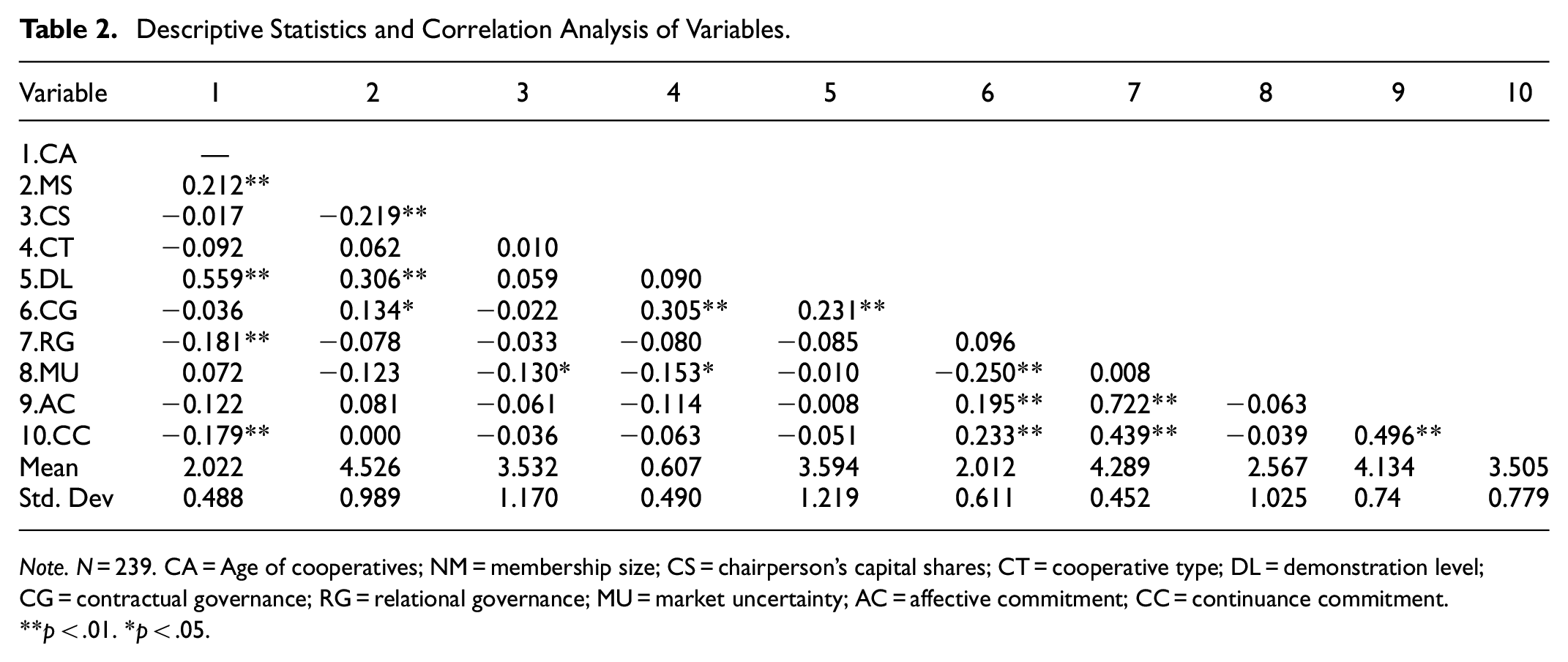
Note. N = 239. CA = Age of cooperatives; NM = membership size; CS = chairperson’s capital shares; CT = cooperative type; DL = demonstration level; CG = contractual governance; RG = relational governance; MU = market uncertainty; AC = affective commitment; CC = continuance commitment.
p < .01. *p < .05.
Descriptive Statistical Analysis
Table 2 displays the descriptive statistics and correlation analysis for the variables. The mean contractual governance is 2.012, while the mean relational governance is 4.289, indicating that relational governance is more prevalent in cooperative-member relationship governance. Contractual governance is positively correlated with members’ continuance and affective commitment, and relational governance is positively associated with members’ continuance and affective commitment. These findings provide preliminary support for our hypotheses.
Hypothesis Testing
We used hierarchical regressions to examine the hypotheses. Tables 3 and 4 display the regression results. The variance inflation factor (VIF) of each variable in each regression model is less than 1.716, indicating that multicollinearity is not an issue in this study. The F statistics have very low p values, indicating that the regression models in this study have good fitting goodness and high reliability.
Results of Hierarchical Regression Analysis for Model 1-8.
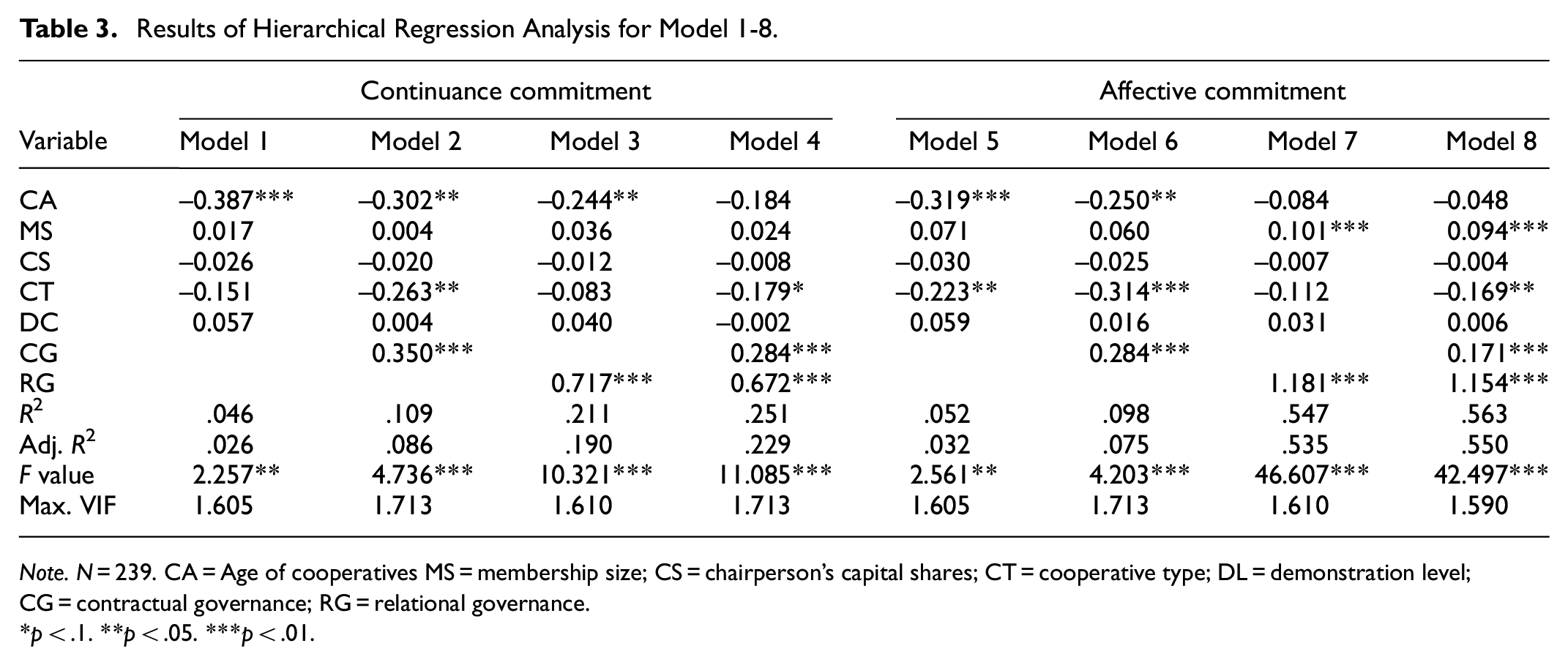
Note. N = 239. CA = Age of cooperatives MS = membership size; CS = chairperson’s capital shares; CT = cooperative type; DL = demonstration level; CG = contractual governance; RG = relational governance.
p < .1. **p < .05. ***p < .01.
Results of Hierarchical Regression Analysis for Model 9-11.

Note. N = 239. CG = contractual governance; MU = market uncertainty.
p < .1. ***p < .01.
The Direct Effect of Governance Mechanism on the MOC
As indicated in Table 3, we only included control variables in Models 1 and 5, then introduced contractual governance. The results show that the coefficient of contractual governance is positive and significant in Models 2 and 6, implying that contractual governance has a significantly positive effect on members’ affective and continuance commitment. As a result, both H1a and H1b are supported. Similarly, as Models 3 and 7 considering the control variables in Table 3 show, relational governance is positively related to both members’ continuance commitment (β = .717, p < .01) and affective commitment (β = 1.181, p < .01). Therefore, H2a and H2b are verified. Furthermore, in Models 4 and 8, the coefficients of contractual and relational governance are both positive and significant, but the former is smaller. This indicates that relational governance can increase members’ affective and continuance commitment more than contractual governance.
The Mediating Effect of Relational Governance
The causal-steps method popularized by Baron and Kenny (1986) and bootstrap analysis were used to investigate the mediating role of relational governance. Model 10 in Table 4 shows that contractual governance positively affects relational governance (β = .098, p < .1), supporting H3. It means that contractual governance can significantly promote relational governance. We can thus conclude that relational and contractual governance are complementary rather than substitutive. Additionally, relational governance is positively associated with members’ continuance and affective commitment; when relational governance is included in Models 2 and 6, the effect of contractual governance on members’ continuance and affective commitment remains positively significant, but the coefficients decrease from 0.350 to 0.284 and from 0.284 to 0.171, respectively. As a result, relational governance mediates the link between contractual governance and members’ continuance/affective commitment, thereby supporting H4a and H4b.
A bootstrapping analysis was then used to confirm relational governance’s mediating effect. The results in Table 5 show that the 90% confidence intervals for the direct effect of contractual governance on members’ continuance and affective commitment are [0.152, 0.416], [0.075, 0.267], respectively, with neither containing 0. Meanwhile, the 90% confidence intervals for contractual governance’s indirect effects on members’ continuance and affective commitment via relational governance are [0.009, 0.138], [0.016, 0.219], respectively, neither of which contains 0. This further suggests that the relationship between contractual governance and members’ continuance/affective commitment is significantly mediated by relational governance.
Bootstrapping Analysis Results of the Mediation Effect in Relational Governance.

Note. Resampling times = 5,000. CR = contractual governance; RG = relational governance. AC = affective commitment; CC = continuance commitment.
p < .1. ***p < .01.
The Moderating Effect of Market Uncertainty
The coefficient of the interaction term between contractual governance and market uncertainty is positive and significant (β = .092, p < .1), as shown in Model 11 in Table 4. Figure 2 shows that the impact of contractual governance on relational governance was stronger when market uncertainty was higher than average (Mean +1 SD) than when it was lower (Mean −1 SD). This suggests that as market uncertainty levels improve, the positive influence of contractual governance on relational governance strengthens.

Moderating effect of market uncertainty on contractual-relational governance relationships.
Edwards and Lambert’s (2007) moderated path analysis method was utilized to test the moderated mediation hypothesis (H6a and H6b). When market uncertainty is at or above the mean, the 90% confidence interval for relational governance’s mediating does not contain zero. This suggests that the mediating effect of contractual governance on members’ continuance and affective commitment through relational governance is important in this situation. To test the moderated mediation hypothesis (H6a and H6b). Table 6 displays the results. When market uncertainty is at the mean or one standard deviation above the mean, the 90% confidence interval for relational governance’s mediating does not contain 0. This indicates that the indirect impact of contractual governance on members’ continuance and affective commitment via relational governance is significant in this situation. When market uncertainty is one standard deviation below the mean, the 90% confidence interval for the mediating effect of relational governance is [−0.065, 0.090], which contains 0. This suggests that relational governance’s mediating effect is insignificant at low levels of market uncertainty. Furthermore, at high levels of market uncertainty, the indirect impact of contractual governance on members’ continuance and affective commitment is strongest via relational governance, with effect values of 0.121 and 0.208, respectively. Collectively, market uncertainty will strengthen the mediating role of relational governance in the contractual governance-members’ continuance/affective commitment relationship. As a result, H6a and H6b were supported.
Moderated Mediation Effect of Contractual Governance on Members’ Commitment at Various Levels of Market Uncertainty.

Note. M = mean value of market uncertainty; −1 SD = one standard deviation below mean; +1 SD = one standard deviation above mean; Effects = estimated moderated mediation effect.
Robustness Test
The instrumental variable method was further used for robustness checks to avoid the influence of endogeneity issues on the results of this study. The mean value of relational governance of other cooperatives in the same prefecture-level city, other than itself, was selected as the instrumental variable for relational governance. On the one hand, relational governance coordinates cooperation relationships via social norms, and its effectiveness and usage are influenced by the institutional environment and social culture (Cao & Lumineau, 2015; Zhou & Xu, 2012). As a result, a cooperative’s level of relational governance is closely related to the average level of relational governance among cooperatives in its region. Regional cooperative relational governance, on the other hand, is a macro-level indicator that has no direct effect on member commitment to cooperatives. The form of the contract concluded between the cooperative and its members is chosen as an instrumental variable for contractual governance. The use of written rather than oral contracts by cooperatives indicates that they prioritize the use of formal institutions and are more likely to have high levels of contractual governance. The content of the contract, rather than its form, is critical to the role of contractual governance, and the form of contract concluded has little direct impact on member commitment. Table 7 displays the key regression results of the two-stage instrumental variable method. The Kleibergen-Paap rk LM statistic is all significant at the 1% level, indicating that the selected instrumental variables are not under-identified. Additionally, the Cragg-Donald Wald F statistic in Columns (2) to (3) and (4) to (6) is greater than the Stock-Yogo critical values of 16.38 at the 10% level and 8.96 at the 15% level, respectively, showing that the instrumental variable for relational governance is “very powerful” and the instrumental variable for contractual governance is “powerful” (Güney, 2021; Stock & Yogo, 2005). That is, our analysis does not have a weak instrument problem. After a correction using the instrumental variables method, both relational and contractual governance still have a significant positive impact on members’ continuance and affective commitment, and contractual governance still significantly promotes relational governance. As a result, the empirical findings in this study are robust.
Results of Robustness Check Using Instrumental Variables Method.

p < .1. **p < .05. ***p < .01.
Conclusions and Discussion
Drawing on transaction cost theory and social exchange theory, we develop a moderated mediation model to highlight the joint impact of contractual and relational governance and market uncertainty on MOC. The findings indicate that both contractual and relational governance have positive impacts on MOC, and they function as complements rather than substitutes. These findings echo the view that it is vital to make use of the complementary roles of formal and informal governance to promote farmer cooperatives (Liang et al., 2018). Furthermore, relational governance mediates the relationship between contractual governance and members’ continuance/affective commitment, and the mediating effect is stronger in cooperatives with high market uncertainty than in cooperatives with low market uncertainty. These findings support the claim of other researchers that environmental uncertainty influences the effectiveness of contractual and relational governance (Rhee et al., 2014; Schilke & Lumineau, 2018).
Theoretical Implications
Several major theoretical contributions to the extant literature are made by our research. First, we contribute to the literature on organizational commitment by empirically examining how governance mechanisms affect MOC in a farmer cooperative context. Prior research has mostly centered on employee organizational commitment, with little focus on organizational commitment in partnerships and the linkage between governance mechanisms and organizational commitment (Al-Jabari & Ghazzawi, 2019; Paluri & Mishal, 2020). Most studies on the antecedents of MOC have been carried out in developed countries utilizing theoretical methods (Puusa et al., 2017). They mainly focused on the effects of members’ trust, members’ participation in governance, financial benefits, and membership satisfaction on MOC (Barraud-Didier et al., 2012; Grashuis & Cook, 2019; Jussila et al., 2012), but it remains unknown how governance mechanisms shape MOC. In developing countries, farmer cooperatives typically feature high membership heterogeneity, with a few core members controlling ownership and control rights and a large number of common members acting as suppliers/clients (Peng et al., 2020; Wolz et al., 2020). Thus, they resemble alliances composed of cooperative enterprises and members rather than member-owned and democratically ruled organizations and face greater MOC problems. This offers academics a favorable empirical setting to further deepen and comprehend cooperative development issues (Zhong et al., 2018). Our study provides compelling evidence of the positive impacts of governance mechanisms on MOC in farmer cooperatives from developing countries, thus contributing to deepening our understanding about the antecedents of organizational commitment.
Second, we extend the existing literature on farmer cooperative governance and partnership management by classifying cooperative governance mechanisms as contractual and relational governance and investigating their relationship and effectiveness. Unlike previous studies, which have analyzed cooperative governance mechanisms from the perspective of corporate governance, we divided their governance mechanisms into contractual and relational governance from the perspective of alliance governance because cooperatives in developing countries have only transactional relationships with most of their members. While the relationship and effectiveness of these two types of governance have been widely explored, most of them focused on inter-organizational partnerships, and their conclusions are inconclusive because they are context-dependent. (Lu et al., 2015). We take China’s farmer cooperatives as our research context and empirically confirm the complementary relationship between contractual and relational governance on MOC and the mediating role of relational governance in the contractual governance-MOC relationship. This not only supports Liang et al. (2018)’s argument that formal governance and social capital (a type of informal governance) are complementary in China’s farmer cooperatives, but it also demonstrates the relevance of transaction cost theory and social exchange theory in illustrating cooperative governance, as well as enriching our understanding of the selection and effectiveness of contractual and relational governance in partnership management.
Third, we offer new insights into how farmer cooperatives can jointly leverage contractual and relational governance to better respond to market uncertainty and create more value in relationship management. The effective application of a mix of contractual and relational governance in governing partnerships has been challenged by their different advantages and limitations as well as the ambiguity of their interplay (Roehrich et al., 2020). Inconsistent findings on the relationship and effectiveness of these two types of governance have prompted scholars to investigate their boundary conditions in given transactional contexts; however, most relevant studies examine their boundary conditions separately, with a few of them exploring the boundary conditions of their joint impact (Abdi & Aulakh, 2017; Jia et al., 2020). This study introduced market uncertainty as a critical boundary condition to build a moderated mediation model and revealed that contractual governance has a stronger positive effect on MOC via relational governance for farmer cooperatives with high market uncertainty. Namely, market uncertainty reinforces relational governance’s complementary role to contractual governance, enhancing their positive effects on MOC. As a result, we contributed to relationship management by demonstrating that market uncertainty is a critical boundary condition in the relationship and the effectiveness of contractual and relational governance on organizational commitment.
Practical Implications
Our findings offer meaningful insights for practice. First, the results indicate that governance mechanisms are critical for increasing MOC and fostering cooperative sustainable development. As a result, the government should prioritize governance optimization in the process of fostering cooperative development. The government should focus on improving cooperative managers’ governance awareness and capacity through various training programs, as well as actively guiding cooperatives to improve their governance mechanisms. Second, this study found that relational governance has a greater impact on MOC than contractual governance, and the two complement each other. Cooperatives should therefore strengthen relational governance by focusing on improving communication and trust with members and actively working to improve organizational reputation. Third, contractual governance does not signal a distrustful atmosphere, but rather promotes relational governance. Cooperatives should also work to improve the effectiveness of contractual governance. Relational governance is likely to face the dilemma of weak constraints and high uncertainty as rural social networks become increasingly loose and the size and heterogeneity of members increase. Contractual governance, with its strong binding force and diminishing marginal cost, may have a greater impact on MOC in the future. Lastly, we discovered that the external environment (e.g., market uncertainty) influences the effectiveness of cooperative governance mechanisms. Cooperatives should select appropriate combinations of governance tools based on the market environment in order to fully leverage the joint role of contractual and relational governance in managing the cooperative-member relationship and thus increasing member commitment.
Limitations and Future Directions
Our study has some limitations offering new avenues for future research. First, we use cross-sectional data to validate the research hypothesis, which makes it hard to identify causal links between variables. Future research could collect panel data for longitudinal studies to determine whether causal relationships exist and to explore the dynamic matching linkage between governance mechanisms and organizational commitment. Second, we focus primarily on farmer cooperatives in China. The means and effectiveness of cooperative governance mechanisms may vary across industries or countries, implying that generalizing the findings should be done with caution. Follow-up research could use cross-cultural or multi-industry samples to validate our findings. Third, we examined only market uncertainty as a boundary condition between contractual governance and organizational commitment. To better understand the conditions under which their relationship is stronger or weaker, additional studies could examine other factors as moderating variables, such as relationship length, cooperation dependence, asset specificity, and institutional environment.
Footnotes
Appendix. Scales of Organizational Commitment and Relational Governance
Acknowledgements
The authors thank the team of graduate students supervised by Professor Junyi Wan for their help in questionnaire collection.
Declaration of Conflicting Interests
The author(s) declared no potential conflicts of interest with respect to the research, authorship, and/or publication of this article.
Funding
The authors disclosed receipt of the following financial support for the research, authorship, and/or publication of this article: The authors thank for the funding from the Youth Project of the National Social Science Foundation of China (23CGL035); the Major Project of National Social Science Foundation of China (21&ZD090); the Social Science Foundation of Guangdong Province of China (GD21YGL04); the Natural Science Foundation of Guangdong Province of China (2021A1515011444); the High-level Introduction of Talent Research Foundation of Guangdong Polytechnic Normal University of China (2021SDYKB033); and the Guangdong Provincial Universities Innovation Team Project “Characteristic Agricultural Development Research Team”(2023WCXTD003).
Ethics Statement
The procedure of data collecting followed all ethical guidelines and standards of the research and obtained ethical approval from the ethics committee of South China Agricultural University. Verbally informed consent was obtained from all respondents involved in our study.

Data Availability Statement
Data sharing not applicable to this article as no datasets were generated or analyzed during the current study.