




Abstract
The enhancement of scientific research capabilities among museum personnel—personnel is a crucial aspect in driving the advancement of museums. However, it is observed that museum personnel in Chinese mainland, particularly the younger ones, have not demonstrated sufficient engagement in this regard. The objective of this paper is to investigate the underlying causes of this phenomena. This study employs in-depth interviews with a sample of 10 young museum personnel. The methodology is guided by Weiner’s Cognitive (attribution)-emotion-action model (CEAM) of motivation framework. The findings indicate that there are 14 elements that influence the motivation of museum personnel to engage in scientific research. These characteristics are associated with three aspects of attribution, namely Locus, Stability, and Controllability. Especially, the “external-stable-uncontrollable” and “external-unstable-uncontrollable” two attribution will serve as a catalyst for museums to enhance their efforts in optimizing the research willingness of their professionals, so facilitating the provision of sustained and immediate support.
Introduction
Although the role of museums as informal educational institutions has been widely accepted by the public, research remains one of the core functions of museums (Conn, 1998), and this is no exception in China. On the one hand, China has a large number of museums. According to statistics from the National Cultural Heritage Administration, the number of museums registered with the government in mainland China reached 6,565 in 2023. On the other hand, for museum personnel in China, engaging in a certain scale and quantity of research activities, including publishing papers and applying for funding support, is typically an important aspect of their career development process. The inclination of museum personnel to engage in scientific research, however, is typically limited. Changwen Wu examines the scientific research production efficiency of museum personnel by analyzing data from 96 first-level museums in Chinese mainland. The findings indicate that the yearly average number of papers published per professionals member is merely 0.16 (吴昌稳, 2019). While the quantity of papers produced is merely an indication of research capability, it is evident from this outcome that the Chinese mainland museum personnel currently exhibit a lack of enthusiasm toward scientific research. Indeed, both the investigation of collections and the organization and analysis of displays and educational initiatives contribute to the advancement of museum practice. Within this setting, the absence of scientific research motivation among museum personnel has emerged as a significant impediment to the further advancement of museums.
The present study focuses on investigating the factors that influence the scientific research motivation of museum personnel. Specifically, the research is centered on young professionals working in museums located in Chinese mainland. Drawing upon the theoretical framework of attribution theory, this study aims to explore the content and interrelationships of these influencing factors. The concept of attribution theory encompasses a collection of theories that aim to elucidate the underlying causes and inferences behind the behaviors and expressions exhibited by individuals or groups. These theories offer a comprehensive understanding of how individuals attribute meaning to their own actions and the actions of others within the social context, thereby influencing their emotional development (Martinko & Thomson, 1998). Hence, this theory is frequently employed to elucidate the underlying factors contributing to a distinct behavior exhibited by an individual or a collective entity. Its application extends across various disciplines, including psychology (Ruybal & Siegel, 2021), management (Ginder et al., 2021), tourism, and leisure (Ginder et al., 2021). In recent years, there has been a notable surge in the growth and expansion of museums in Chinese mainland. Based on the recently published data in 2023, it has been observed that the total count of museums has reached a significant figure of 6,565. 1 In a parallel manner, it is noteworthy to observe that the quantity of personnel employed by museums has likewise transitioned into a novel phase. The demographic cohort primarily responsible for driving the advancement of Chinese museums in the current era is notably the population segment below the age of 40. In this context, we should pay greater attention to this group’s situation and difficulties.
Literature Review
Museum Personnel
The research of museum personnel primarily encompasses four key dimensions. Firstly, the staff members of a museum are considered to be integral components of the museum’s offerings. Alongside exhibitions and educational activities, they possess the potential to influence the visitors’ experience to differing extents (Pattison et al., 2017; Pattison & Dierking, 2012, 2013). Secondly, the professionals are commonly regarded as the other of the audience, serving as a means for researchers to examine any disparities in views or attitudes between groups within and outside the museum when confronted with the same event. For instance, scholarly investigations have explored the subject of attitudes toward family learning (Brown et al., 2019; Davidsson & Jakobsson, 2009; Porter & Cohen, 2012) as well as attitudes toward digital technology (Carvalho & Matos, 2018; Shehade & Stylianou-Lambert, 2020).
Thirdly, the museum’s professionals are widely recognized as an essential component of its practical capabilities. The researchers have opted to examine the correlation between museum personnel and their professional development via the lens of human resource management. The significance of creating standards for museum personnel training was emphasized by the researchers (Boylan, 2006). The topic of adjusting the professional skills of museum staff has become increasingly significant, particularly in light of the ongoing changes in the social context (Ebitz, 2005). Within this particular framework, the discrepancy between museum professional education and the demands of museum practice has been acknowledged (J. Davis, 2005; J. A. Davis, 2011). Additionally, several academics have consistently underscored the significance of a practical approach in professional education. Furthermore, several scholars have engaged in discussions regarding particular competences that have historically received insufficient attention. For instance, Kubarek (2015) and Steeleinama (2015) have highlighted the importance of enhancing the proficiency of museum personnel in the area of museum evaluation. Similarly, Levent and Reich (2013) have emphasized the significance of conducting visitor studies. It is important to acknowledge that several scholars consider museums, libraries, archives, and similar establishments as an integrated entity, with the intention of highlighting the necessity for professional education to adequately cater to the diverse requirements of various cultural institutions (Kelly, 2018; Kennan & Lymn, 2019; Trant, 2009).
Finally, the issue of staff identity and their personal career advancement has garnered differing levels of consideration. The identity of museum personnel was examined by the researchers from both a diachronic and synchronic standpoint. The former perspective argues that museums should prioritize the empowerment of museum educators and view them as crucial agents in promoting transformative change within museums (Kristinsdóttir, 2017). Another viewpoint emphasizes the significance of examining the actual responsibilities and challenges faced by museum staff within the present context (Isa, 2017; McIntosh, 2011; Reid, 2013). Furthermore, several scholars place particular emphasis on the determinants that influence career development. Researchers of many cultural backgrounds hold the belief that the working motivation (Ji et al., 2016; Spock, 2000) and working experience (Gausch, 2017) will exert a significant influence on the trajectory of professional growth for museum personnel in the forthcoming years.
The primary objective of this study is to examine the scientific research proficiency exhibited by professionals employed in museums. This paper posits that enhancing the scientific research proficiency constitutes a crucial aspect of augmenting the practical capabilities of museums. Simultaneously, the examination of the factors that impede scientific research necessitates a comprehensive exploration of the staff’s identity and role.
Attribution Theory
The concept of Attribution Theory emerged as a result of previous investigations conducted in the field of social psychology. Fritz Heider’s work, The Psychology of Interpersonal Relations was released in 1958 and introduced the notion of attribution for the first time (Heider, 1958). According to Heider, individuals’ action can be attributed to either situational factors, which are objective reasons stemming from the external world, or personal factors, which are subjective reasons originating from the individual. The process of speculating and describing these reasons is known as attribution. Personal reasons encompass several factors such as personality, qualities, motivation, emotion, attitudes, efforts, and abilities. Environmental considerations primarily encompass situational variables, such as task complexity, incentives or penalties associated with activities, and fortuitous circumstances, among others. Heider further underscores the significance of the individualistic aspect of attribution. He posits that unless there are specific external conditions that necessitate the outcome of human actions, it should be ascribed to inherent personal traits. As the impact of the environment on human action increases, the corresponding level of individual responsibility decreases. The attribution model proposed by Heider elucidated the dynamic interplay between individuals and environmental circumstances, so establishing a fundamental framework for subsequent researchers to build upon and conduct further investigations.
The article titled the processes of causal attribution was authored by Harold H. Kelley, an esteemed American social psychologist. In this publication, Kelley extensively elucidates his attribution theory, employing the Covariance Principle as a systematic framework for his analysis (Kelley, 1973). In the initial study conducted by Kelley, a comprehensive categorization of information was established, encompassing three distinct types: distinctiveness, consensus, and consistency. Furthermore, Kelley proceeded to elucidate three distinct categories of causes: stimulus as a causal factor, characterized by high consensus, distinctiveness, and consistency; causes attributable to the individual, characterized by low consensus and distinctiveness but high consistency; and causes attributable to the environment, characterized by low consensus and consistency but high distinctiveness. The research conducted by Kelley undoubtedly made significant contributions to the development of the attribution theory. However, it is worth noting that this emphasis on logic may have inadvertently diminished the practical applicability of the theory. The research findings of Bernard Weiner have significantly contributed to the widespread influence of attribution theory across various domains.
Weiner’s notable contribution resides in his innovative integration of attribution research and motivation research, thereby pioneering a novel domain within psychological inquiry. This endeavor has led to the establishment of a connection between attribution theory and the realms of emotion and behavior, commonly referred to as the cognitive-emotion-action model (CEAM) (Weiner, 1980). The establishment of a link between attribution and individual emotion and behavior has been accomplished by CEAM in theoretical research. According to Weiner, it is posited that researchers have the ability to elucidate an individual’s subsequent emotional and behavioral choices through a comprehensive analysis of the individual’s attribution attributes. To enhance the elucidation of the effects of various attributions on emotions and behaviors, Weiner, in a manner akin to Kelley’s approach, put forth a framework consisting of three dimensions of attribution: locus, stability, and controllability. In the context of his scholarly investigation into achievement motivation, Weiner conducted a study that aimed to enhance our understanding of the influence of attributes on individual explanations of success and failure. In doing so, he also expanded upon the existing frameworks of intentionality and globality by incorporating additional dimensions. CEAM has gained significant traction across various disciplines such as psychology, sociology, tourism, management, education, and other related fields (Weiner, 1985). It has emerged as a prominent framework for studying motivation and is recognized as the most extensively employed research model in this domain to date (Hsu & Chen, 2019).
This paper employs attribution theory as a framework to examine the phenomena of diminished motivation toward scientific research among young museum personnel in Chinese mainland. The chosen framework for this study is Weiner’s CEAM, specifically focusing on the characteristics of locus, stability, and controllability in attributing behavior. According to Weiner’s interpretation, the concept of locus pertains to the distinction between attributions that are external or internal to the actor. This dimension is widely studied and frequently employed in attribution research. Additionally, the term stability denotes the cause is perceived as temporary or permanent. The concept of controllability pertains to the extent to whether or not the cause is subject to personal influence. In light of this, Sandra Graham (1991) utilized the ability and effort as illustrations to expound upon the connotation of the three dimensions, as depicted in Table 1. CEAM offers a significant perspective on the underlying factors influencing behavior. This understanding will have a direct impact on the research design and analysis employed in this study.
Ability and Effort Ascriptions Related to Causal Dimensions (Graham, 1991).

Methods
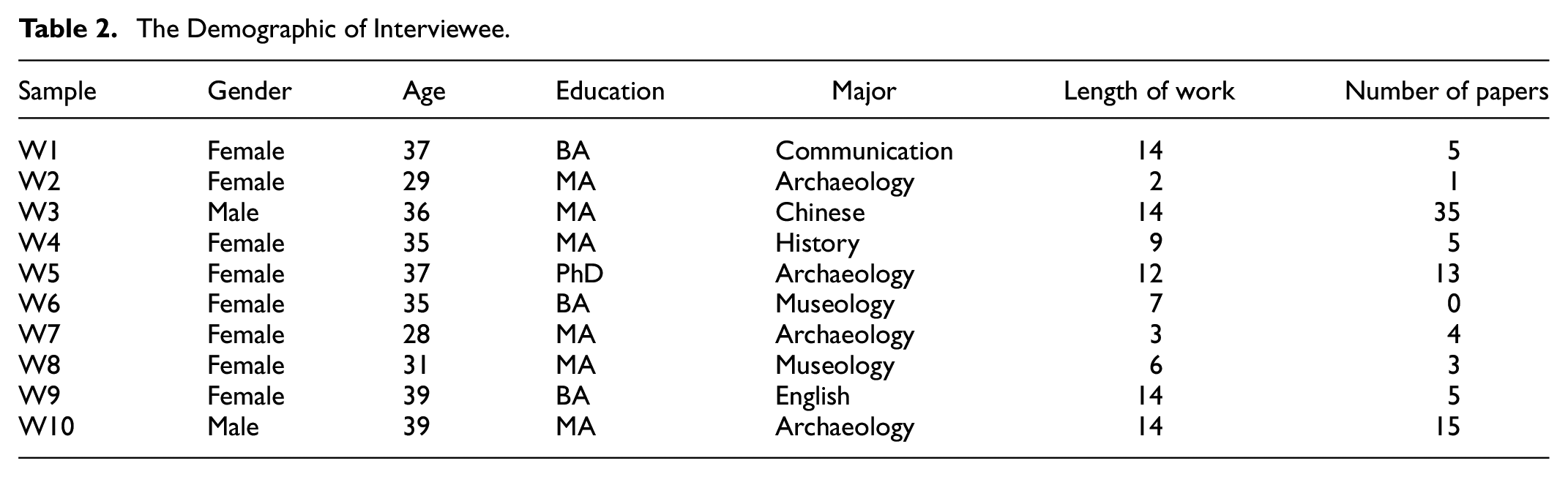
This study employs a qualitative research methodology and conducts data collecting by in-depth interviews with a sample of 10 museum personnel. The utilization of depth interviews enables researchers to thoroughly investigate the overarching perspectives and attitudes of participants toward a certain issue or behavior. This method is particularly appropriate for obtaining extensive and detailed information in studies with limited sample sizes. In this study, a sample size of 10 museum personnel members were interviewed. There exists variation in the respondents’ educational backgrounds and their experiences in academic paper publishing, as illustrated in Table 2. The rationale behind selecting the youth group as the focus of this research lies in two key factors. Firstly, this group frequently assumes responsibility for a significant amount of practical work within the museum. Secondly, the youth group also experiences a relatively higher level of pressure stemming from personal advancement opportunities. When this particular cohort exhibits a comparatively diminished inclination toward engaging in scientific research, this inherent conflict will facilitate our in-depth investigation into the underlying factors contributing to this phenomenon. Based on the precise content of the interview, it can be observed that the responses provided by the 10 respondents do not introduce any novel information. Furthermore, the sample size appears to have reached a point of saturation. In addition, considering the characteristics and types of the museums to which the interviewee belong, the survey basically covers institutions of different regions and sizes in mainland China, thus possessing relatively good representativeness.
The Demographic of Interviewee.
The present interview is conducted in the format of a semi-structured interview. The interview questions primarily focused on two key dimensions of scientific research: motivation and needs. The interview outline is presented in Table 3. The interview data underwent processing in accordance with the principles of grounded theory. The results of the interviews were transcribed in a word-for-word manner, and the text was subsequently subjected to three-level coding. The process of encoding is facilitated with the utilization of the MAXQDA2022 software.
Interview Outline.

Results
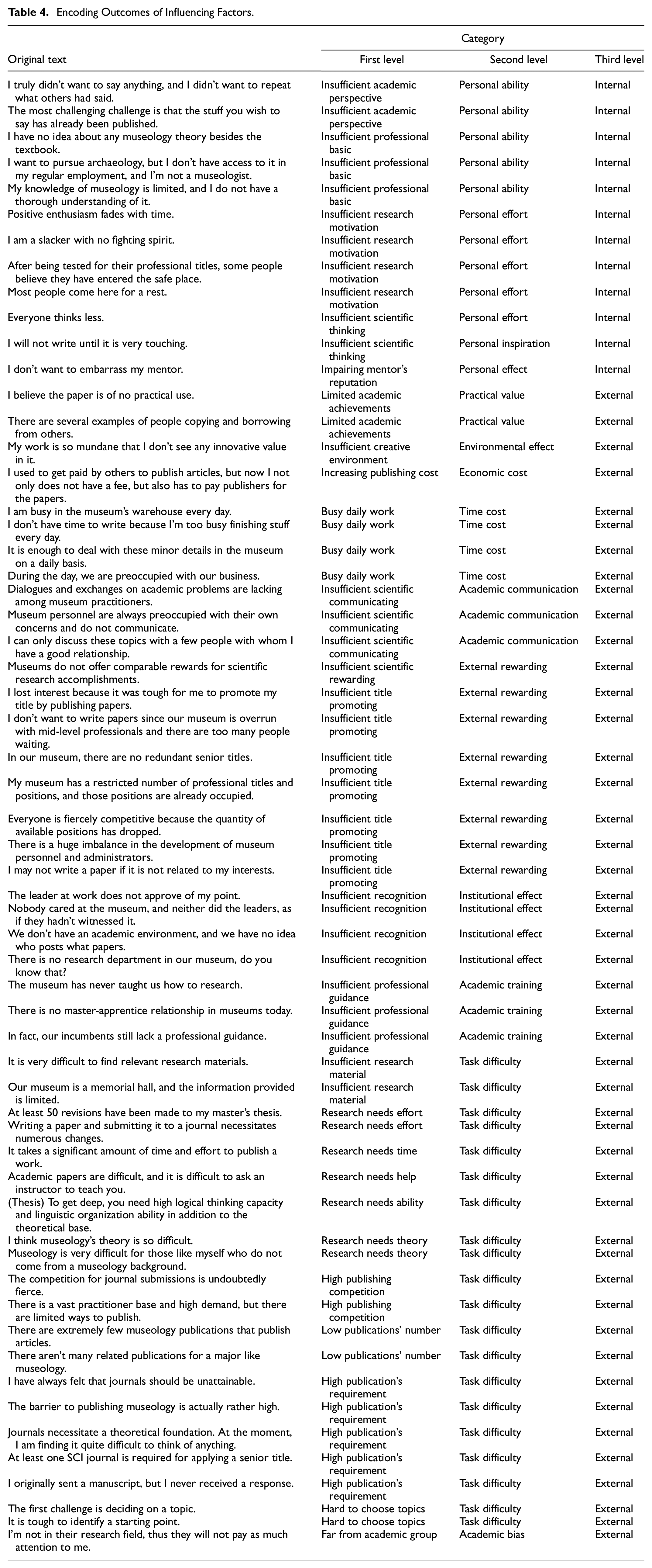
This paper adheres to two fundamental principles in the coding process. One approach involves the analysis of interview texts to identify the elements that impede motivation in scientific research. Another approach is to utilize Weiner’s CEAM framework as the theoretical foundation for coding. It is imperative to highlight that when coding the third-level categories, the initial step involves dividing the second-level categories into internal and external variables, based on the Locus dimension. The rationale behind this is twofold. Firstly, locus is a dimension within the CEAM framework that exhibits the broadest scope of applicability and garners the highest level of agreement among scholars. Secondly, the dimension of stability and controllability primarily relies on the concept of locus (Harvey et al., 2014).
The Table 4 below displays the specific encoding outcomes.
Encoding Outcomes of Influencing Factors.
Discussion
The coding outcomes provide us with a clear understanding of the various factors that exert an influence on the research motivation of young museum personnel in Chinese mainland. The CEAM framework facilitated a deeper comprehension of the interplay among these variables. Initially, the 14 second-level coding was classified into two distinct categories, namely internal and external, based on the locus dimension. Based on this foundation, we integrated the concepts of stability and controllability, along with the insights provided by the interview participants, to reclassify the 14 second-level codes. The classification outcomes are presented in Table 5.
Influencing Factors Under the Framework of CEAM.

Locus
Locus dimension are crucial components within the CEAM attribution framework, which is frequently employed in several study domains. One of the primary rationales for employing this categorization of internal and external components is in its propensity to facilitate consensus among academics. Additionally, the locus dimension is frequently intertwined with an individual’s subsequent emotions and behaviors, rendering it a crucial factor to consider (Martinko & Thomson, 1998). This analysis reveals notable distinctions between the internal and external attribution of the 14 secondary categories.
Internal attribution refers to the process of assigning causality to personal factors within an individual. This attribution framework encompasses four distinct outcomes: personal ability, personal effort, personal effect, and personal inspiration. Notably, personal ability and personal effort are considered the most prominent manifestations within this framework. Approximately 50% of the participants exhibit personal ability, highlighting that the hindrance to scientific inquiry primarily stems from insufficient scholastic aptitude. This encompasses not just the insufficiency of comprehensive training in museological theory, but also the absence of distinct scholarly perspectives. As per the statement provided by interviewee No. 6, it was expressed that her comprehension of museology is very limited, lacking a profound understanding. Additionally, interviewee No. 1 held the belief that the content they intended to publish had already been authored by others. While these two forms of expressions place emphasis on distinct aspects, the former highlights the individual’s lack of professional expertise, while the latter stresses the clash of their own academic perspectives. However, both phrases unequivocally attribute the cause to the internal factors within the individual.
The concept of personal effort pertains to the ascription of research resistance to an insufficiency of requisite exertion or endeavor on the part of the individual. While the interview yielded agreement on this point from only two participants, there were discernible variations in the emphasis of their respective statements. Respondent No. 1 explicitly expressed his disinclination toward scientific research, attributing it to a deficiency in the spirit of perseverance and a tendency toward indolence. It is worth noting that despite exhibiting positive behaviors in the past, these inclinations have gradually waned over time. While interviewee No. 1 highlighted the lack of motivation as a factor influencing individuals’ willingness to engage in scientific research, interviewee No. 5 takes a different approach by considering the perspective of the other. According to her, there is a perception among some individuals that obtaining professional titles provides a sense of security, “This sense of security kills their motivation to do scientific research.”
In contrast to internal attribution, external attribution is found to constitute a greater proportion of the explanations provided by the interviewees. The analysis of the coding results reveals that there are a total of 10 secondary codes associated with external factors. Several attribution outcomes, including task difficulty, external rewarding, and academic training, exhibit distinct characteristics. The majority of the interview participants hold the belief that the diminished inclination of individuals to engage in scientific research may be attributed primarily to the level of complexity associated with the tasks involved. The difficulty of the task at hand encompasses not only the inherent attributes of scientific research work, such as a lack of research material, the need for effort, time, and ability, but also the elevated standards and intense competition associated with scientific research publication platforms, including rigorous publishing requirements, limited publication opportunities, and a highly competitive environment. Furthermore, the absence of external incentives is a significant external factor that diminishes the motivation for scientific research. This is primarily evident in the challenging environment that hinders individuals from attaining professional growth through immediate scientific research accomplishments. The aforementioned sentiment is clearly expressed by the interviewee No. 2, who states that “my museum has a restricted number of professional titles and positions, and those positions are already occupied.”
Stability
Stability pertains to an individual’s subjective perception regarding the degree of variability or constancy exhibited by a particular attribute. One often employed method for differentiation involves evaluating the correlation between exertion and aptitude. Individuals tend to perceive ability as a relatively enduring attribute, while perceiving effort as more amenable to modification (Weiner, 1971). In contrast to the locus dimension, stability is less frequently utilized solely, typically being accompanied by locus. While the impact of attribution on emotion and behavior is often limited, stability can either diminish or intensify this influence (Weiner, 1985). This study introduces the stability dimension as a novel framework to enhance our comprehension of the limited inclination among museum workers to engage in scientific research.
Within the 14 secondary categories, it is seen that both the stable and unstable categories consist of 7 attribution causes. The primary distinction in the internal dimension pertains to the attribution outcomes of Personal Ability and Personal Effort, which aligns with Weiner’s characterization of the stability of ability and effort discussed earlier. The inclusion of the interviewees’ detailed explanations about the two attribution outcomes serves to provide more evidence supporting the notable disparity in stability between ability and effort.
Within the realm of external influences, the respondents exhibited a diverse range of attribution outcomes, which can be further categorized based on the concept of stability. For instance, whereas both the Institutional Effect and Academic Training are categorized as external factors influencing attribution, their levels of stability differ. Specifically, while the workplace remains unchanged, the Institutional Effect exhibits a greater degree of stability compared to Academic Training. As exemplified by the statement made by respondent No. 9, it was highlighted that the museum lacks a distinct research department. While the foundation of museum institutions is subject to change, the presence of institutional and structural hurdles often remains unchanged in the short term. Furthermore, even if these barriers were to be transformed in a short period, their impact on individual motivation for scientific research is of long-term significance. On the other hand, it is worth noting that Academic Training is subject to external influences, which may include certain shortcomings within the museum system. As indicated by interviewee No. 8, it has been seen that the current individuals in positions lack enough professional training. However, in contrast to the Institutional Effect, external academic instruction can potentially have a direct influence on an individual’s motivation for scientific research, albeit in a temporary manner. Hence, despite both attribution outcomes being influenced by external circumstances, it is important to include the stability dimension when examining the impact of these factors on individuals’ inclination toward scientific research.
Controllability
Controllability pertains to the extent to which attribution is influenced by an individual’s volition. Factors like as fortune or task difficulty are commonly perceived as uncontrolled, but effort and ability are regarded as controllable by the individual (Weiner, 1985). Similar to the concept of stability, the study of controllability is generally examined in conjunction with locus and stability, rather than being analyzed in isolation.
Out of the total of 14 attribution outcomes, 6 were found to be within the realm of controllable factors, while the remaining 8 were determined to be influenced by uncontrollable variables. Within the internal dimension, Personal Ability and Personal Effort are regarded as factors that can be controlled. This suggests that while abilities and efforts may vary in terms of stability, they fundamentally fall within the domain of individual volition. Conversely, the two personalized attribution outcomes, namely Personal Effect and Personal Inspiration, pertain to uncontrollable internal causes. Respondent No. 2 expressed hesitancy about participating in scientific research endeavors due to concerns about perhaps causing embarrassment to her mentor. In a similar vein, Respondent No. 5 conveyed a stance of only committing to writing papers when they are genuinely inspired. The two aforementioned concepts, Personal Effect and Personal Inspiration, share some common ground with Personal Effort. However, their distinct expressions primarily stem from variances in controllability. In contrast to the level of control exerted over Personal Effort, Personal Effect and Personal Inspiration are predominantly influenced by factors beyond an individual’s complete volition. The former encompasses the sentiments of others, specifically mentors, while the latter bears some resemblance to fortuitous occurrences.
Out of the total of 10 attribution results pertaining to extrinsic factors, it was seen that 4 of them were classified within the controllable category, while the remaining 6 were classified under the uncontrolled category. Consider Academic Training and Academic Communication as illustrative examples. Despite their shared characteristic of being external and unstable factors, there exists a discernible divergence in terms of controllability. As previously stated, Academic Training pertains to the museum’s organizational framework, thereby surpassing individual volition. While Academic Communication also bears some connection to the system, individuals retain ample opportunities and flexibility to facilitate the actualization of scholarly exchange. According to the explanation provided by Interviewee No. 10, the ability to engage in discussions on academic matters is limited to persons who possess strong interpersonal connections. While museum personnel currently face a dearth of possibilities for academic discourse, it is still possible for individuals to intervene and change via personal will.
Conclusion and Practical Impact
This paper uses the CEAM attribution framework and conducts in-depth interviews to examine the factors that influence the research motivation of young museum personnel in Chinese mainland, as well as the interconnectedness among these elements. Based on the aforementioned research findings, it is not straightforward to ascribe the reluctance or lack of active involvement of museum personnel in scientific research just to individual lazy. Alternatively, it is necessary to have a thorough understanding of the youth population by considering several factors. The three characteristics of locus, stability, and controllability not only facilitate our comprehension of the resistance encountered in scientific research, but also enable us to engage in critical reflection of museums from a practical standpoint.
Initially, it is imperative for museums to actively pursue modifications in external, stable, and uncontrollable variables. The resistance encountered in this domain surpasses the boundaries of individual involvement, thereby necessitating museums to have a more proactive role in this field. In the preceding discourse, it has been determined that the attributions pertaining to this particular domain mostly revolve on Task Difficulty, Institutional Effect, and External Rewarding. Notably, museums possess the necessary conditions to actively interfere in the latter two elements. In conjunction with the specific information provided by the interviewees, it is our contention that museums in Chinese mainland provide potential for refinement in the correlation between scientific research accomplishments and career promotion.
To foster the growth of museum personnel in Chinese mainland, the Ministry of Human Resources and Social Security and the National Cultural Heritage Administration introduced the Guiding Opinions on Deepening the Reform of Professional Title System for Cultural Relics and Museums in December 2019. 2 The objective of this initiative is to enhance the institutional framework and evaluation criteria. The ultimate goal is to establish and enhance a professional title system that aligns with the unique characteristics of the cultural institution, encompassing professionals at all levels and across various cultural domains. However, in light of the current circumstances, it has been observed that the majority of museums have adopted a system that integrates the assessment and recruitment of professional and technical professionals based on the specific job needs defined by public organizations. There exists a correlation between the number of job vacancies and individual title promotion. This approach possesses inherent benefits and fosters the development of competitive awareness among professionals. However, it is important to acknowledge the evident drawback. The proliferation of senior professional titles may impede the career promotion opportunities for young professionals, thus diminishing their motivation and excitement. A significant number of participants in the present study expressed their concerns, attributing their unfavorable sentiments toward the career development system. Hence, it is imperative to prioritize the enhancement of the long-term scientific research motivation among museum personnel, while concurrently fostering a profound sense of belonging and value for each individual professionals member. This objective should be seen as a crucial aim within the ongoing reform of the museum career development system.
External, unstable, and uncontrollable factors should be the focus of museum work regarding human resource management. Enhancing employees’ research enthusiasm and promoting their career development have always been one of the priorities of human resource work in museums. These factors primarily encompass the three aspects of Academic Training, Practical Value, and Economic Cost. Museums have the capacity to actively and successfully intervene in factors related to Academic Training. It is our contention that museums ought to be incentivized to engage in diverse forms of research writing instruction. In addition to establishing a sustainable scientific research incentive mechanism, museums can pursue short-term cooperation through two approaches: firstly, by actively promoting professionals’ engagement in diverse scientific research training programs and academic forums; and secondly, by establishing collaborative relationships with universities or other well-established academic training platforms. According to the interviewees, it is well acknowledged that possessing substantial practical experience in museums is crucial for fostering the sound advancement of scientific research. However, the process of effectively converting practical experience into tangible scientific research outcomes remains fraught with difficulties.
This research still has several limitations. While an initial examination has been conducted on the determinants impacting the inclination of museum personnel to engage in scientific research, the relative significance of these factors remains unknown. While the present study does not encompass the research aims outlined in this paper, it is vital to acknowledge the practical implications of this matter and consider the potential for future discourse on the subject.
Footnotes
Acknowledgements
Thank the interviewees for their support.
Declaration of Conflicting Interests
The author(s) declared no potential conflicts of interest with respect to the research, authorship, and/or publication of this article.
Funding
The author(s) disclosed receipt of the following financial support for the research, authorship, and/or publication of this article: Supported by the Fundamental Research Funds for the Central Universities (No.2024300221).
Ethical Approval
All 10 participants fully concurred that the information obtained from the interview would be utilized for scholarly purposes by the researchers.

Data Availability Statement
Data sharing not applicable to this article as no datasets were generated or analyzed during the current study.