




Abstract
Scientific research is the important task of lecturers in universities. However, university lecturers often struggle to balance research and teaching and focus more on teaching than research. In addition, the motivation for lecturers to do research is a little. This article surveys lecturers at some universities in Vietnam to find the factors that motivate lecturers to do science. The motivating factors include intrinsic factors (creativity, passion…), extrinsic factors (financial, promotion ..), and barriers to the scientific research activities of lecturers. Research results show that intrinsic and extrinsic factors positively impact the scientific research activities of lecturers, and the barrier factors negatively affect the research activities of lectures. Based on the research results, the authors make some suggestions to strengthen further the research activities of lecturers at universities in Vietnam.
Plain Language Summary
Scientific research is one of the important tasks of lecturers in universities. However, university lecturers often find it difficult to balance teaching and research and focus more on teaching than research. In addition, the motivation for lecturers to do research is a little. This article surveys lecturers at some universities in Vietnam to determine the factors that motivate lecturers to do science. The motivating factors include intrinsic factors (creativity, passion…) and extrinsic factors (financial, promotion ..), and barriers to the scientific research activities of lecturers. Research results show that intrinsic and extrinsic factors positively impact the scientific research activities of lecturers, and the barriers factors negatively affect the research activities of lectures. Based on the research results, the authors make some suggestions to strengthen further the research activities of lecturers at universities in Vietnam.
Introduction
Scientific research is one of the important activities of university lecturers and one factor distinguishing a good university or a vocational training school. The university trains not only people who know how to work but also to train elite individuals. So, scientific research is the focus of all universities; most university rankings worldwide give high scientific research weight in the university ranking indicators. Research weighting (quantity and quality) typically contributes between 20% and 60% of the rating score, depending on the ranking (Boulton & Lucas, 2011). Therefore, Vietnam universities must invest in scientific research activities for internationalization and for universities to reach out to the world to participate in the international university ranking system.
In addition, along with the formation and development of the knowledge society, lecturers not only limit their activities within the framework of the university but also have to reach out through social service activities. Recently, this concept has been mentioned extensively under the rhetorical name “third mission.” According to Shin et al. (2014), the university function has changed in today’s knowledge society and has extended beyond its original educational goals. Today’s universities are heavily research-focused and are anticipated to be crucial for advancing economic and social conditions. The role of the teaching staff has also become more complex as the third mission of universities to contribute to socio-economic development is emphasized more than ever (Teichler et al., 2013).
However, scientific research activities at Vietnam universities have not been paid attention in years. The number of scientific studies published in foreign journals is low. Government spending on education activities has also not met the demand (Le & Tran, 2021). In Vietnam, the system of legal documents clearly states the scientific research tasks of educational institutions and lecturers. Education Law 2019, Article 19 of the Vietnam Government clearly states: “Scientific and technological activities are a task of the educational institution,” and “Educational institutions self-deploy or cooperate with science and technology organizations, production, business, and service establishments in training, scientific research, and technology transfer, serving socio-economic development.” Article 55, Law on Higher Education 2012 (amended in 2018) states that one of the duties and rights of lecturers is to “Research, develop scientific application and transfer technology, and ensure the quality of training.” The lecturers have to specify the number of teaching and scientific research hours according to different levels depending on the academic rank, and title. For example, according to a regulation in 2020 of the Vietnam Ministry of Education and Training, the lecturer’s working level, the lecturer must spend at least 1/3 of the total working time in the school year on scientific research tasks.
Most of the lecturers need to be more active in scientific research. The lecturers’ ability to conduct research still needs to improve, from research design to applying quantitative methods and statistical and analytical software. The reasons for faculty members’ limitations in scientific research have been discussed extensively. Some fundamental reasons can be seen: Vietnam’s state budget investment in scientific research activities still needs to be revised. According to Le and Tran (2021), financial investment in scientific research activities in Vietnam in 2010–2020 averaged about 1.7% of the state budget. The state budget investment for scientific research activities in the education sector is relatively modest and unreasonable, precisely equal to 35% of the investment in scientific research activities of the Agricultural sector, 44.9% compared to the Vietnam Academy of Science and Technology and 18.3% compared to the Ministry of Science and Technology (H. T. L. Nguyen, 2020). In addition, allocating scientific and technological non-business funding is not reasonable, mainly based on the number of initial levels not associated with output products and according to the number of researchers. This situation is unlikely to lead to achieving the goal of the national strategy of developing science and technology potential. It is challenging to attract scientists working abroad to be involved in higher education institutions’ scientific and technological research activities.
The method of allocating funds for scientific research is not equal, not considering the effectiveness of using funds. Although the encouragement of enterprises, individuals, and organizations to invest in the development of science and technology activities among higher education institutions has been regulated by the Government in Decree No. 99/2014/ND-CP2. and many related documents (Tien et al., 2020). However, these policies are only directional. There is no specific solution to problems arising in investment in science and technology by organizations and individuals in educational institutions. Subjective reasons can include: (i) the research culture of the universities has not yet formed or is not strong enough, and the remuneration for scientific research depends heavily on the vision and perception of the leader. The total funding for scientific research in the university is minimal. Sometimes, lecturers only consider scientific research a mandatory condition to be completed; (ii) there is no effective mechanism for lecturers to find it necessary and forced to participate in scientific research actively.
So, there is a small number of lecturers participating in scientific research in some universities. Scientific research activities in higher education institutions focus on only a few lecturers. Many lecturers need to have scientific research hours or carry out the required amount of scientific research hours. The average amount of scientific research hours of lecturers accounts for a low proportion of the total standard hours of the year. Therefore, studying the motivation to encourage the development of the lecturers’ research is necessary. What can influence university lecturers’ scientific research in some universities in Viet Nam? What impact does research finance have on faculty at universities? To answer the above question, the authors conducted a survey of lecturers at some universities in Vietnam to find out the primary factors affecting the decision to conduct research of lecturers in the university.
Literature Reviews
Intrinsic Factors in Scientific Research
The intrinsic motivations of lecturers for doing research come from lecturers. Intrinsic research motivation is the researcher’s passion for research, pursuing science to discover new knowledge that contributes to a new understanding of mankind, self-control, and the desire to contribute to society through research activities.
Blackmore and Kandiko (2011) conclude that intrinsic motivation is very meaningful, related to the opportunity to learn and practice skills and enrich knowledge. Another important aspect is the hobby of wanting to be independent, self-sufficient in work, and want to achieve something through their efforts. Lecturers passionate about research can overcome barriers and difficulties in carrying out research activities. Passion for research is measured by willingness to participate, ability to devote time to research activities, interest in finding answers, and asking questions about one’s research area (Renko et al., 2013 ). Passion for research also shows interest in research activities and the faculty/scientist’s ability to participate or cooperate in research. Passion for research influences the faculty’s ability to conduct research and the willingness to do research. As a result, lecturers with strong research interests can do more research than others. In other words, the passion for research influences the research results of the lecturers at the university. Academic motivation is the lecturer’s/researchers’ desire to pursue a scientific career. Pursue academically toward creating and developing new knowledge through scientific research to build a faculty’s scientific career. Motivation for academic pursuit is expressed through the desire to improve research capacity and skills and to improve professional knowledge in the field through research activities.
Research activity is the extent to which lectures are involved in research development activities such as publishing in reviewed journals, writing books or book chapters, and giving conference papers (Nygaard, 2017). Research activities also include data collection and analysis, student guidance, and research and conduct of funded research. Abramo et al. (2011) assert that research is a production process in which the primary inputs are resources such as publishing activities, patents, databases, consulting activities, and knowledge awake. Some researches show that two core elements for lecturers in universities are research and teaching (Elen et al., 2007; Nicholls, 2005; Ramganesh & Paulraj, 2015). However, in some countries, research and teaching are two separate tasks. The increasing focus on teaching instead of research activities is due to the adoption a corporate culture with increased accountability and results (Nafukho et al., 2019). There is a distinction between the two missions of research and teaching in universities in a number of countries around the world. Many universities focus only on teaching, not on research. Furthermore, many universities consider the measurement of research productivity to be complicated.
American universities and colleges are divided into two groups; one group is research-oriented schools, and the other group is other schools (the training period is 4 years)(Brass et al., 2010). The results show that lecturers of research universities have an average number of teaching hours a week of 16.7 (compared to 23.4 for lecturers of the other group of universities) (O’Meara et al., 2017). The number of research hours is 18.6 (compared to 23.4 for lecturers of different universities). The teaching rate is 38.9%, and the research rate is 61.1% (compared to the other group of schools’ corresponding rates of 73.9% and 26.1%). In addition, the average number of articles in the last 3 years of the lecturers of the research university was more than twice that of the lecturers of the other group. The authors make a table comparing the volume of teaching, research, and published articles between male and female lecturers. Male lecturers have fewer average teaching hours than women. An important factor influencing research results is the collaboration (Sonnenwald, 2007). As research of an interdisciplinary and interdisciplinary nature increases, teamwork plays an increasingly important role in modern science. Collaboration increases outcomes in men’s and women’s (Lee & Bozeman, 2005).
Extrinsic Factors in Scientific Research
Extrinsic research motives are external stimuli such as research rewards, income, or reputation for research that the lecturers/scientists can gain through research. Extrinsic motives are usually material stimuli, prestige, or reputation. These motives also motivate faculty/scientists to increase research activities. Because research activities are closely tied to their interests in terms of reputation or income, as a result, lecturers/scientists will increase their research and publication activities. In other words, lecturers/scientists with strong external research motivation will try to do more research and publish more research outputs than researchers without motivation.
Financial rewards are the oldest and most basic method applied in the institutional environment. Zhao and Zhang (2008) state that the official income of academic positions in China is low, especially considering that most of China’s 211 universities are located in the provinces and capitals, where most of China’s 211 universities have a relatively high cost of living. To attract and retain researchers, the key to promoting research is a certain degree of appropriateness in distributing research funds and direct cash rewards for research results. Research by Robert (2005) shows that work motivation affects work performance. Moreover, if performance comes with rewards, it is also a factor that positively affects work motivation. In management work, promotion is one of the driving factors of the reward system in motivating employees. Fox (1992) has suggested that higher academic institutions can influence faculty behavior through the skillful manipulation of the award structure in the promotion. Zhang (2014) believe that promotion positively impacts research productivity when research volume is considered a valuable indicator of academic advancement opportunities. Santo et al. (2009) state that as professional rank increases, research productivity decreases, indicating that faculty members are no longer anxious about receiving formal appointments, and their motivation to publish decreases. Chen et al. (2006) conclude that those appointed as full-time employees are motivated by internal rewards, while those who have not been appointed as full-time employees are motivated by extrinsic rewards. Formal appointment and promotion are powerful motivators of employee research performance, but conversely, a salary increase is not linked enough with research productivity to be a good incentive.
The lack of collaboration significantly negatively impacts women’s productivity (Kyvik & Teigen, 1996). Women may be less secure in their professional abilities and more reliant on the workplace than males, or it could be that they frequently do not concentrate on one specific area of research (Leahey, 2006). Besides personal factors, the external environment and working environment impact scientists’ research results. Many factors of the working environment affect the research results, including the reward structure, the allocation of teaching and research time of the faculty (Link et al., 2008), the fairness in the organization (Intriligator & Smith, 1966), level of research assistance by students, clear research expectations of the institution, financial motivation for research, availability of doctoral instruction programs (Musiige & Maassen, 2015). There is a shortage of academic journals, specialized journals, and new books. Clear reward structure, allocation of time for researchers, level of research assistance, availability of highly specialized programs, and transparent research orientation incentivize organization members to improve research capacity. Limited literature, peer-reviewed journals, connections to research resources, and inequity negatively affect individual research and research outcomes. Some studies use the data available in SCIE (Science Citation Index Expanded) from Web of Science (Lee & Bozeman, 2005), an equivalent index for scientific publications (reduced to one point unit) (Kyvik & Teigen, 1996), GVCI index (Glenn-Villemez Comprehensive Index) (Clemente, 1973 ) and analysis by LISREL (Wichian et al., 2009).
Edabu and Anumaka (2014) and Osakwe (2014) have done descriptive analysis and independent t-sample tests for private universities in Uganda using a research design export-factor study. The lecturers wanted more from the way of promoting work used in private universities in central Uganda. Negash et al. (2014) found that faculty members were unsatisfied with the university’s payment system. They argue that all aspects of payment can lead to disagreement. It shows that overtime is unfairly paid and that vacation allowance is not an employee’s motivation. Incentive and fair standards have also yet to play their role well. Work appreciation is essential in creating motivation and satisfaction (Ali & Anwar, 2021). In addition, the impact of the factors “work motivation” and “satisfaction” of the lecturers play an essential role in their working process. Rowley (1996) points out that work motivation is at the heart of quality work culture. As educational institutions have become more sophisticated in their approach to quality and today’s self-centered talk about quality assurance and improvement, motivation has become a more central issue and has an important role.
Mawoli and Babandako (2012) said that working conditions are one of the ideal factors. The authors also point out that the performance of lecturers in committing to research could be a lot higher. Orawan (2014) used quantitative research using t-value analysis to calculate Pearson correlation coefficients for 400 samples at Suan Sunandha Rajabhat University and found that research showed the correlation with respect and acceptance ranks high. Motivation in task performance, remuneration and benefits, career development, and working conditions were also moderately important. In addition, overall work behavior that ranked highly included working by rules and regulations, decision-making, and working as a team (Tan & Waheed, 2011; Timmreck, 2001). Buberwa (2015) found lecturers’ intrinsic and extrinsic backgrounds and motivation roles at Tanzania Public University. The irrelevant aspects such as salary, allowance, and working conditions and internal elements such as career advancement opportunities are recognized as motivating factors for employees in the university (Hanaysha & Hussain, 2018).
Their sense of work drive significantly increases the productivity of lecturers. The management team at the school has been very successful in improving the motivation of the teaching staff by ensuring the motivational aspects. Badawo (2006) applied the theory of change in work motivation. The Hygiene-Motivator theory shows that motivational factors such as pay and benefits may not motivate employees (Ghazi et al., 2013). Therefore, it will be important if managers provide different motivations such as development opportunities, sense and responsibility in work, recognition, and provision of good working conditions. In addition, expectations theory suggests that managers must provide valuable rewards to their employees and show employees that achieving goals with high performance leads to corresponding rewards. Goals should be specific, complicated enough, acceptable to employees, and self-established (Gallagher & Einhorn, 1976). In addition, the distribution of rewards needs to be fair to enhance trust, performance, and motivation. Job characteristics are also a strong influence on work motivation. Jobs with various activities, nature, autonomy, and feedback mechanisms increase work motivation. An essential element to strengthening and maintaining employee motivation is the reward. Distributing rewards instead of granting confirmation on task completion helps strengthen the organization’s trust.
In summary, the literature review shows that few studies still evaluate Intrinsic and extrinsic factors as research motivation for university lecturers, especially studies conducted in Vietnam. Therefore, this article will study the internal and external factors and barriers for lecturers when doing scientific research at universities.
Research Methodology
Research Design
This study uses linear structural modeling (SEM) to evaluate the collected data. The SEM model has an advantage over some other impact factor evaluation models because it can evaluate the potential relationships between the observed variables. This is one of the outstanding advantages of the SEM model. In addition, SEM also supports the estimation of nominal values, which can measure more dependent variables simultaneously than other regression models. SEM also provides indicators of model fit and thus helps authors make better decisions in using the model.
The authors conducted an interview survey of 450 votes from 6 to 2022 to December 2022. The number of votes collected was carried out according to the correct process: inputting and cleaning the ballots. The result after cleaning the remaining votes is 358 votes. The survey is divided into two basic parts, including basic information of the interviewees and the part of questions using the Linkert scale from 1 to 5. The interviewees are lecturers at a number of universities in Vietnam. Surveys are collected through direct responses and online means such as Google Forms. With the final number of votes collected, 358, it is suitable for using SEM.
Research Model
Self-determination theory distinguishes three types of individual motivation: intrinsic, extrinsic, and unmotivated. People need to have intrinsic motivation to pursue their passion and find fulfillment. Meanwhile, extrinsic motivation refers to doing something to produce results and obtain extrinsic rewards (Ryan & Deci, 2000). A motivation is a state in which an individual has no intention to act because of a lack of interest in or evaluation of the outcome of the activity (Ryan, 1995). Self-determination theory suggests that an individual’s behavior when acting can change the self-determination continuum. It proceeds sequentially from lack of motivation and self-determination of the individual to intrinsic motivation, which are self-determining motivations that arise from spontaneous interests instead of external conditions. Extrinsic motivation reflects an individual’s self-determination for behaviors that are fully externally regulated or partially externally integrated to make them compatible with intrinsic motivation. Self-determination theory argues that external actions/influences can be internalized or internalized. When this happens, these values become self-sufficient and do not need external rewards for acting (Figure 1).
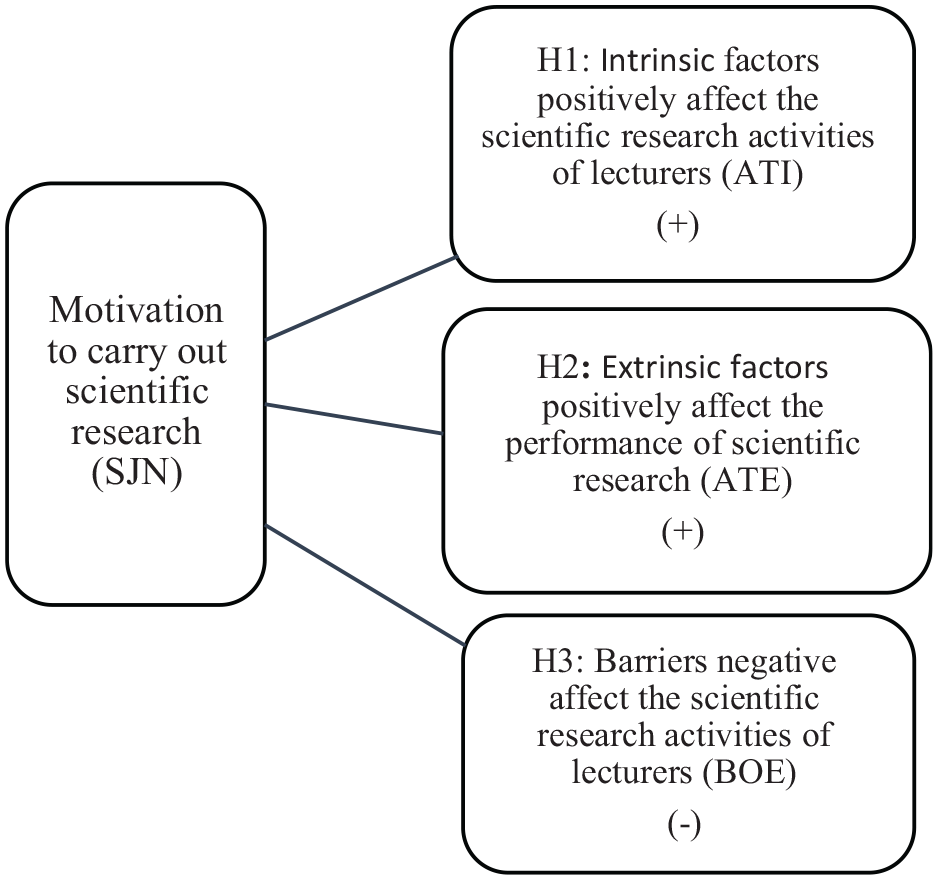
Model of factors to motivate the research activities.
The authors test the following factors to evaluate the motivations affecting the scientific research activities of lecturers:
Motivation to carry out scientific research
H1: External factors positively affect the scientific research activities of lecturers (ATE)
External factors are considered the driving force behind the faculty’s scientific research performance, including promotion opportunities, earning additional income, enhancing personal reputation, strengthening connections with the academic community, and participating in domestic and international conferences. Lam (2011) developed a self-determination theory model to explain the relationship between action motivation and scientific output in the UK. According to Lam (2011), the research motivation is complicated and only partially because of the monetary motivation for researchers/lecturers to pursue research activities. The scientific incentive scheme is multifaceted and includes three groups of rewards: honors, rewards or financial benefits, and solving complex problems and challenges (Audretsch et al., 2002). In academia, the reward is the most significant honor for scientists, not only because they are strongly motivated by peer recognition but also because it relates to research grants and associated financial rewards.
Honor is a deeply institutionalized characteristic of the academic system, and scientists feel it. Although there are not many honorary awards for research activities, they indirectly affect the creation of research funds and the research budget of scientists (Hong & Walsh, 2009). In the traditional model, scientific publications are seen as a voucher or currency for honors. Scientific products can be combined with commercial forms, and scientists can use patents as a voucher to gain recognition, building credibility to obtain traditional rewards (Owen-Smith, 2003). Work motivation can affect the performance of employees in the organization as a whole. Ifinedo (2005) studied the work motivation of individuals and found that if individuals are motivated, they will find them more enthusiastic to work and more focused on work. There are many types of motivation, but they can be divided into two groups: intrinsic and extrinsic. Whatever the motivation, it is directed toward the goal of promoting the efforts of the faculty to achieve the goals of the scientific publication.
Different motivational processes can coexist, and scientists may be internally and externally motivated to varying degrees in their research pursuits. The university is like an administrative apparatus where the faculty members have a relatively high degree of autonomy, and they can choose or not to participate in the commercialization process. However, the trend of mercantilizing science is putting pressure on scientists/lecturers to engage them in commercial activities, depending on the potential benefits of such activities.
H2: Internal factors have a constructive influence on lecturers’ scientific research activity (ATI)
Buberwa (2015), when researching the intrinsic and extrinsic background along with the role of motivation for lecturers at Tanzania Public University, found that extrinsic aspects such as salary, allowance, and working conditions and internal aspects such as career advancement opportunities are recognized as motivating factors for employees at the school. Work motivation has a significant impact on improving the productivity of lecturers. The management team at the school has been very successful in improving the motivation of the teaching staff by ensuring the motivational aspects.
Hosoi (2005) applies the theory of change in work motivation. The Hygien-Motivator theory shows that motivational factors such as pay and benefits alone may not motivate employees. Therefore, it will be important if managers provide different motivations such as development opportunities, sense and responsibility in work, recognition, and provision of good working conditions. In addition, expectations theory suggests that managers must provide valuable rewards to their employees and show employees that achieving goals with high performance leads to corresponding rewards.
H3: Barriers affecting the scientific research activities of lecturers (BOE)
Most of the lecturers feel dissatisfied with the management policies at the university; besides, they think that the university should be responsible for the weaknesses in motivating work. That is the view Mawoli and Babandako (2012) drew from quantitative research. The authors also suggest that most lecturers feel unmotivated and unsatisfied with their current salary. According to Yamoah and Ocansey (2013), employees showed that the two most important factors were high salaries and personal development. Besides, except for benefits and high salaries, other motivational factors have no significant impact and differ significantly from the actual desire of employees (Table 1).
Code of Variables.

The questionnaire is divided into two sections: the first section contains questions for the Likert scale and basic information about the respondents.
Results
Statistical Analysis
There 450 questionnaires were submitted. However, 92 of them were disqualified because they didn’t fit the study’s qualifying requirements. 53.8% of the research sample’s participants are women, and 46.2% are men. The age ranges of 25 to 34, 35 to 44, 45 to 54, 54 to 60, and more than 60 years old each accounted for 20.5%, 18.5%, 31.7%, 22.1%, and 7.1% of the sample, respectively. Regarding occupation, all of them are lectures from prominent universities in Viet Nam such as Thuongmai University, Hanoi National University, Foreign Trade University, and Hanoi University of Science and Technology.
Check the Reliability of the Scale
The test results show that Cronbach’s Alpha (CA) coefficient of all the scales is more significant than .9 (the lowest in the price competition scale with α = .900). The correlation coefficient of all variables is more significant than .3 (Table 2).
CA Statistics.

Source. Analytical results of the authors.
Note. SMID = Scale Mean if Item Deleted; SVID = Scale Variance if Item Deleted; ITC = Item-Total Correlation; SMC = Squared Multiple Correlation; CAID = Cronbach’s Alpha if Item Deleted.
Factor Analysis (EFA)
With four factors affecting the scientific research motivation of lecturers at some universities and 14 observed variables, the results are shown in Table 3. The results of factor analysis show that the variables are divided into four groups, and the total variance extracted is 74,442 > 50%, satisfying the condition of the scale. The KMO coefficient in Table 4 is 0.889, satisfying the requirement (0.5 ≤ KMO ≤ 1).
Total Variance Explained.

Note. IE = initial Eigenvalues; ESSL = extraction sums of squared loadings; RSSL = rotation sums of squared loadings; 1 = total; 2 = % of variance; 3 = cumulative %).
The Results of the KMO Test.

Source. Analytical results of the authors.
The test results in Table 4 show that the Sig value meets the criteria to reject the hypothesis H0.
The rotation matrix reveals three factors taken from the data and guarantees the prerequisites for the SEM model’s application (Table 5).
Matrix of Component.

SEM Results
The linear structural research model (SEM) can be used in many cases and has many advantages over the conventional regression model (Hair et al., 2009). However, when using the linear structural model, it is necessary to ensure that the indexes are in accordance with the standards. The results show chi-squared/df = 4.525 with p = .000, TLI = 0.885, CFI = 0.876. These signs demonstrate that the model (Figure 2) is quite good. According to the correlations between the concepts, these coefficients are all less than 1 (statistically significant).
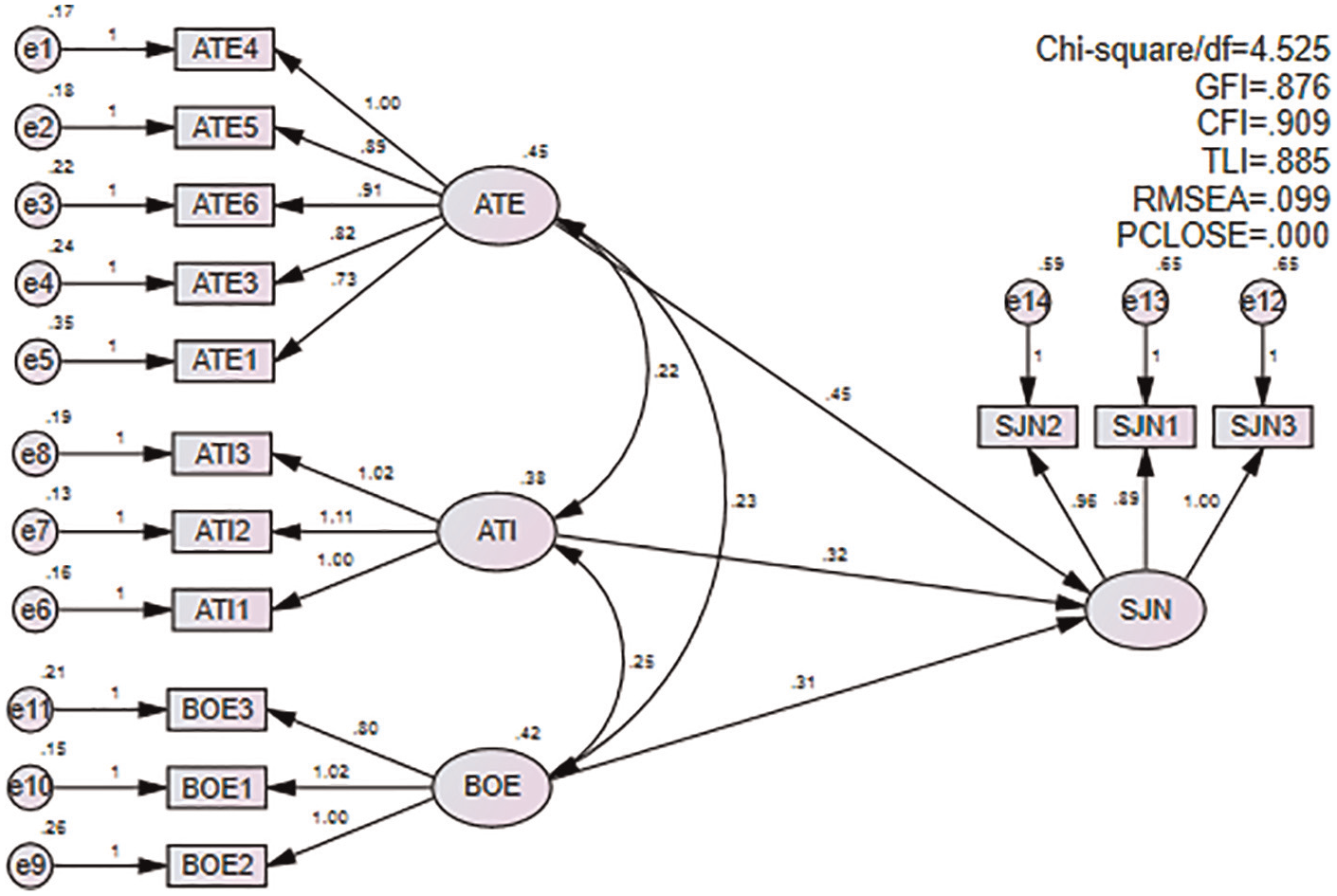
The model of SEM.
It is hypothesized that external factors (ATE), personal motivations (ATI), and policy barriers (BOE) all positively affect the research activities of lecturers. From the normalized beta weights, it can be seen that the external factors (ATEs) significantly impact the lecturers’ research activities. Thus, two of three factors in the research hypothesis positively impact the lecturers’ research activities (Table 6).
Relationship Impact Assessment.

Hypothesis ATE (external factors) positively affects the research activities of lecturers. From the normalized weights beta and p-value = .00. Concluding, ATE involves the research activities of lecturers with β = .447. Like the ATI and BOE factors, the p-value is statistically significant, and the impact level is .316 and −.305, respectively (Table 6).
Discussion and Conclusion
Exploratory factor analysis (EFA) shows that the extrinsic motivations have only two conceptual structures, the internal motives have three conceptual structures, and the barriers are four conceptual structures. This result indicates a difference in the perception of Vietnamese lecturers and scientists compared to other studies worldwide. This difference may be due to differences in scientific culture and research context. Using research models in a new environment can change concepts and social science studies without zero-level repeat research. Assessing the value of the content and testing the reliability through analysis by the correlation coefficient of the total variable and the coefficient of Cronbach Alpha shows that these conceptual structures are appropriate and reliable. This indicates that research models can be adapted to different research contexts. These research concepts are relevant; their scales can be used as references for evaluating motivation and barriers for scientists in universities of social sciences and the economy.
Research results also show that all research hypotheses are partially accepted in different aspects. In other words, the factors of internal motivation, external motivation, and elements of scientists’ characteristics all affect the scientific investigation results of lecturers at different levels.
H1: External factors positively affect the scientific research activities of lecturers (ATE)
Research results show that external factors positively impact the scientific research activities of lecturers, with an impact level of 31.6%. This investigation’s results are also consistent with those of Vasileiadou and Vliegenthart’s (2009) investigation, which discovered that academic gatherings involving information exchange were the most significant predictors of research output. The size and effectiveness of the authors’ networks were shown by Besancenot et al. (2017) to correlate with output positively. To examine the characteristics of a network of 412 eminent social scientists from Vietnam (Ho et al., 2017) identifying the low density and high clustering were associated with poor knowledge transfer and low scientific production among Vietnamese social scientists. Similarly, Valsangkar et al. (2016) discovered that greater faculty involvement in an academic association contributed to association members’ enhanced scientific impact and production.
H2: Internal factors have a positive influence on the scientific research activities of lecturers (ATI)
For the aspect of internal motivations, there are two out of three motivations that affect lecturers’ scientific research results: (1) passion for research and (2) academic pursuits (p-value < .05). The desire for autonomy and social contribution influence the lecturers’ research results (p-value < .05). However, contrary to expectations, academic pursuit negatively affects the lecturers’ research results. This outcome is in line with the research of Blackmore and Kandiko (2011) and Deci and Ryan (1985), concluding that intrinsic motivation is very significant. It is related to the opportunity to learn and practice skills, enriching knowledge. Another important aspect is the hobby of wanting to be independent, self-sufficient in work, and want to achieve something through their efforts. Lam (2011) and Renko (2013) also showed that passion for research influences the faculty’s ability and willingness to conduct research. As a result, faculty with vital research interests can do more research than others. In other words, the passion for research influences the research results of the lecturers at the university.
H3: Barriers affecting the scientific research activities of lecturers (BOE)
Barrier factors have a negative impact on the scientific research motivation of lecturers in some universities. Barriers to scientific research are obstacles and difficulties from lecturers themselves and from universities or policies that affect the ability of lecturers/scientists to conduct research. Barriers from lecturers are often related to knowledge, scientific research experience, health problems, or age. Barriers from the university and policy may be the system of facilities to support research activities. Lecturers/scientists feel that many obstacles in their research activities may affect their research output, such as the publication of research publications. Similarly, T. V. Nguyen et al. (2017) also used the questionnaire to assess the motivations for participating in research as well as the opportunities and limitations of lecturers in conducting research. Research results also show some barriers, such as funding for research, institutions, and government policies. In addition, the study also discovered the difficulties of lecturers when they have to balance between teaching and doing research. The relative length of teaching time is one factor affecting the time lecturers can devote to scientific research.
The research results show that the issue of policy institutions is critical to increasing the motivation of scientific research for lecturers. The survey results show that barriers to scientific research have a negative impact on lecturers’ motivation to do scientific research. Therefore, to develop scientific research activities in schools, it is necessary to improve the scientific research capacity of lecturers. To do this, universities can take several measures as follows: Firstly, organize training courses on modern research methods for lecturers. The current standard research method still needs improvement by many Vietnamese lecturers, and updating new methods still needs improvement. However, the existing resources are relatively abundant, especially publications in English. Another fact is that up to 70% of scientific papers are rejected in international journals due to problems with research methods. Therefore, equipping modern research methods, following the trend of the international scientific community, is an urgent need. Universities can invite lecturers and researchers with international publication experience and who are well-trained in research methods to organize short-term training courses associated with practical research activities at the university. Second, organize an academic club at the university. Academic clubs can be organized as spontaneous or school-sponsored science groups. Forms of academic clubs may include professional activities in each discipline, organization of publication clubs, or peer review of publications. Participating members can share published research products by club members or influential research in the field. Universities should encourage this form by creating conditions in terms of physical facilities (living rooms, seminars, etc.) and mental incentives to form such healthy groups of scientific activities. The formation of academic clubs will promote the research motivation of lecturers and partly break down barriers to research activities. Third, organize scientific instruction groups to help each other. Today’s scientific research activities are mostly not isolated activities but cooperative activities. Forming scientific guidance groups will promote confidence in research and break down obstacles and difficulties for young lecturers just entering the scientific research path. Therefore, the university should encourage or have a policy to form solid scientific research groups to guide and help each other and jointly achieve the goals of scientific research. This activity is still quite modest in economic universities; some universities, like Foreign Trade University, have a policy of establishing strong research groups towards high-quality research activities and international publication. This is a bright spot; other universities can expand their learning to promote motivation and research pressure on their faculty. Fourth, scientific research activities in Vietnamese universities always have “implicit” constraints, avoiding issues considered sensitive, especially social science research groups. Self-limitation and self-censorship reduce the energy of research. In other words, the lack of academic freedom limits the faculty’s ability to research and publish. Academic freedom is seen as an essential premise of the university. It means freedom to teach, research, or discuss science, publish research results, and freedom of spiritual discourse science. In particular, the right to freedom of instruction includes choosing curricula, referencing materials, developing curriculum frameworks and subject outlines, freely choosing teaching methods, and evaluating students. Teaching freedom is associated with the responsibility to ensure objectivity and unbiased teaching content, student assessment, and the appropriateness of teaching methods. Freedom of research is the right to choose appropriate topics and methods freely and access equitable funding sources. Freedom of research is also associated with the freedom to publish and publish research results. Freedom of speech is the right to discuss and express yourself without censorship and imposition of professional issues and common issues of society. Expanding academic freedom is the first step in creating a healthy educational environment in universities that encourages faculty participation in research.
Footnotes
Declaration of Conflicting Interests
The author(s) declared no potential conflicts of interest with respect to the research, authorship, and/or publication of this article.
Funding
The author(s) disclosed receipt of the following financial support for the research, authorship, and/or publication of this article: This research received funding from Thuongmai University

Data Availability Statement
Data sharing not applicable to this article as no datasets were generated or analyzed during the current study.