




Abstract
The Fraud Diamond theory (rationalization, opportunity, motivation and perceived capability) has been widely used as a framework to explain criminal behavior. However, little is known about its application in an academic context. Research on the relationship between the prevalence of academic fraud (e.g., cheating on exams, plagiarizing essays) and students’ perceptions of the severity of such behaviors is also lacking. We surveyed 1,032 university students and asked them whether they engaged in fraudulent behaviors and how severe they thought these behaviors were. The results showed that motivation, rationalization, and perceived capability dimensions of the Fraud Diamond theory are important factors in predicting the prevalence of students’ academic fraudulent behavior, but not opportunity. We also found that the more students reported that they engaged in fraudulent academic behaviors, the less severe they perceived those behaviors to be. However, only rationalization emerged as a predictor of perceived severity. The results suggest that the more students are able to find justifications for their fraudulent behavior, the less severe they perceive those behaviors to be. Rationalization seems to explain, therefore, the tendency to disassociate moral values from dishonest behavior. Taken together, the study shows a vicious cycle between engaging in fraudulent academic behavior and the ability to justify these acts. Implications for Higher Education Institutions (HEIs) are discussed.
Plain language summary
Purpose: To examine whether the Fraud Diamond theory explains fraudulent academic behavior (e.g., cheating on exams, plagiarizing essays). More specifically, to determine the relationship between the prevalence of academic fraud and students’ perceptions of the severity and whether the ability to justify fraudulent academic behavior is related to the students’ perception of its severity. Methods: A survey was administered to 1,032 university students who agreed to participate in the study. Hypotheses were tested using correlational and predictive statistical techniques. Conclusions: The Fraud Diamond theory can be used to explain the prevalence of students’ fraudulent academic behavior. The severity of such behavior is explained by the students’ ability to justify their fraudulent actions. The more the students cheat, the less severe they find this behavior to be, suggesting that students feel that cheating occasionally is not a big deal. Implications: Promoting a culture of integrity is more than just the implementation of control mechanisms of face-to-face and virtual invigilation. Programs of academic integrity including institutional, group, and individual level approaches are needed to create a sense of moral identity and self-control mechanisms which will reduce the propensity to cheat. Limitations: The data for this study is drawn from the students subjective self-reported experiences of their fraudulent behavior and may not accurately reflect objective prevalence of fraudulent behavior.
In the current academic context competition is valued, giving rise to an instrumental perspective of education where ethical norms and moral values are difficult to maintain (e.g., Carr, 2005; Tomlinson, 2018). A widely disseminated message in society tells students that they need a degree, not only for personal reasons but also to achieve employment and financial security (McCabe et al., 2006; Witherspoon et al., 2012). As Bretag (2013) asserts, students regard higher education primarily as a means to a vocational end. This is particularly the case when competition for desired jobs is increasing due to fewer employment opportunities as well as an increasing demand by employers for graduates from prestigious universities (Georgetown University Center on Education and the Workforce, 2018; Jacob et al., 2019). In this context, undergraduate students experience considerable pressure to do well, as grades have become an important measure of an individual’s value in society (McCabe et al., 1999, 2001; Shanahan et al., 2013). These conditions and pressures felt by students to be successful are likely to increase dishonesty and unethical behaviors, such as academic fraud (McCabe et al., 2006; Witherspoon et al., 2012). This supports Fevre’s (2003) claim that moral erosion takes place when economic rationality pervades other domains of the social realm.
Different forms and measures of academic dishonesty have been identified in the literature regarding the prevalence, severity, and mode of cheating (e.g., McCabe et al., 2001; Shanahan et al., 2013; Orosz et al., 2018 More recently, Burgason et al. (2019) assessed the differences between face-to-face and online cheating. Information technology was seen as a facilitator that has made information and resources more accessible and available. For example, the use of devices, such as smartphones, smartwatches, and calculators, to store information or access the internet during an examination increases the opportunities for academic dishonesty. More recently, the development of Generative Artificial Intelligence (GAI) tools has resulted in significant discussion on the use of these tools to further facilitate academic dishonesty (Cotton et al., 2023; Dehouche, 2021). Nevertheless, in a study that compared face-to-face and distance learners, Burgason et al. (2019) found a significant percentage of both groups of students involved in dishonest academic behaviors “normatively defined as cheating”; and in that context, students considered their actions to be morally acceptable. It seems that the opportunities provided by technology for cheating are less relevant than how the students justify their behaviors.
Regardless of the context where academic fraud occurs, the implications for the individual, Higher Education Institutions (HEIs), and wider society are profound (Bretag, 2013; Milovanovitch, 2013). Academic fraud committed by students not only affects the fairness of their academic evaluations but also students’ willingness to transgress legal and moral standards once they enter the job market (Gama et al., 2013). Teixeira (2013) assessed whether cheating behavior by university students predicted “real world” corruption in business and politics. A large sample of students (n = 7,602) recruited from 46 business and economic schools in 21 countries completed a questionnaire on cheating behaviors in examinations. The findings from the study revealed that higher levels of academic fraud were associated with higher levels of corruption. That is, students who committed fraud at university repeated the dishonest behavior in other areas, particularly in their professional lives. Thus, as many authors have recognized that academic fraud has a high moral, social, and economic cost not only to HEI, but also for wider society (e.g., Hallak, 2016; Lovett-Hooper et al., 2007; Magnus et al., 2002; Shanahan et al., 2013; Teixeira, 2013). The different forms of academic fraud (e.g., prevalence, severity, and mode), their consequences, and above all, the context of moral erosion where cheating behaviors take place make this topic an important focus of study. This research aims to explore (1) how students perceive and respond to environmental opportunities and incentives for engaging in dishonest academic behavior, and (2) the relationship between the prevalence of academic fraud and perceptions of the severity of these behaviors. In addition, differences between socio-demographic groups of students will be analyzed.
Theoretical Frameworks: The Fraud Triangle and the Fraud Diamond
There is not a consensus around the definition of academic fraud. In its broader sense, and for the purposes of this paper, academic fraud encompasses any illegal or deceptive behavior that intends to achieve personal advantage or gain in the academic context and that impedes meaningful learning (Anderman & Murdock, 2007). Thus, as described by Hughes and McCabe (2006a), academic fraud includes a number of different dishonest behaviors and misconduct, such as cheating on examinations, plagiarizing essays, and presenting work written by someone else as their own.
One of the most cited theories that attempts to explain the causes of fraud is the Fraud Triangle theory (Cressey, 1953). According to the theory, fraud is more likely to occur when the following three elements are present: (1) motivation; (2) opportunity; and (3) rationalization (Brown et al., 2016; MacGregor & Stuebs, 2014).
Motivation, also known as pressure or incentives, refers to the idea that every unethical behavior has some kind of attractive motive to be committed, whether it is financial, political, or social pressure (Abdullahi & Mansor, 2015; Singleton & Singleton, 2010; Shanahan et al., 2013). From a social-cognitive perspective, pressure arises when someone feels that their goals are not achievable and, subsequently, misconduct becomes an option (Anderman & Koenka, 2017). For example, a student who feels pressured into achieving high grades and is afraid to fail might be more prone to cheat on an exam if they perceive that such behavior might help to raise their grades. This is supported by research which demonstrates that fear of failure positively predicted academic cheating (Mih & Mih, 2016). Another source of pressure might be explained from individuals observing socially significant others. Drawing on social learning theory (Bandura, 1986) a student is more likely to cheat when they witness other students benefiting from cheating behaviors, even knowing that such behaviors violate academic norms (O’Rourke et al., 2010). Thus, according to this theory, students will be more likely to cheat if they perceive a culture of cheating in their institution.
The second element refers to opportunity, which suggests that individuals take advantage of circumstances in their environment (Hartley & Kelly, 2010). Opportunity for fraudulent behavior is often created by nonexistent or ineffective controls over that behavior, or when there is the possibility and ability to override controls (Abdullahi & Mansor, 2015; Brown et al., 2016; Ernest-Jones et al., 2011). Research on fund investment, for example, suggests that when individuals were primed for a mindset of vigilance, this form of control increased their ability to notice and regulate their own fraudulent behavior (Zhang et al., 2015). Moreover, the opportunity does not necessarily need to be real; that is, the individual’s perception or belief that the opportunity exists is a sufficient condition (Abdullahi & Mansor, 2015). As a result, if a student perceives that cheating is easy, for instance, due to lack of invigilation during an examination, then they might perceive that there are opportunities in this context to behave dishonestly.
Rationalization is a cognitive process of self-justification (Rahn et al., 1994; Scheufele, 2000). It refers to the justification for the fraudulent behavior that the perpetrator needs to make the behavior morally acceptable (Abdullahi & Mansor, 2015). In other words, it is the moral argument that is used by the individual to justify the act. Previous research on social distance (e.g., Tumasjan et al., 2011) suggests that individuals tend to perceive the unethical behavior of others as more severe than their own. Hence, one’s perceptions of severity when judging unethical behavior depends on their rationalization mechanisms. Indeed, individuals have more information regarding their behavior than that of others, making it easier to justify their dishonest behavior.
This is in line with neutralization theory whereby students use neutralization techniques to maintain a positive self-image even when they violate social norms (e.g., Rettinger & Kramer, 2009). For example, students justify their cheating with the notion that “is no big deal” since “lectures do not always explain the materials very well.” This neutralization technique will reduce or displace students’ responsibility by attributing the causes of their cheating behaviors to others and to external factors. However, as Waltzer and Dahl (2023) note, neutralizing moral concerns does not necessarily suggest that students are morally disengaged. Indeed, Stephens (2017) states that most students still evaluate their past cheating behaviors negatively even after using neutralization to justify their cheating behaviors.
Wolfe and Hermanson (2004) extended the Fraud Triangle theory to the Fraud Diamond theory to include a fourth dimension of perceived capability. The authors claim that although “opportunity opens the doorway to fraud, and incentive and rationalization can draw a person to it” (p. 38), it is the individual’s self-efficacy, such as their beliefs of their capability to cheat, that makes them more prone to take advantage of the situation and commit fraud. Therefore, the authors argue that even when motivation, opportunity, and rationalization are present, fraudulent behavior is only likely to occur if the perpetrator believes that they have the skills to commit fraud.
Both the Fraud Triangle theory and the Fraud Diamond theory have been applied to a number of contexts, such as leadership wrongdoing, accounting firms, banking institutions, and whistleblowing in universities (e.g., Brown et al., 2016; Machado & Gartner, 2017; Schnatterly et al., 2018). However, these theories have yet to be further applied to academic fraud. Considering the four components of the Fraud Diamond theory, we would expect that students would be more likely to commit academic fraud when they are able to find justifications to do so, and when motivation, opportunity, and perceived capability are present. Hence, the first hypothesis aims to establish whether the Fraud Diamond theory predicts the prevalence of students’ fraudulent behavior.
H1. The Fraud Diamond (rationalization, motivation, opportunity, and perceived capability) positively predicts the prevalence of academic fraudulent behavior.
Students’ Academic Fraudulent Behavior: Prevalence and Severity
The prevalence of academic fraudulent behavior among HEI students is alarming (Jones, 2011; McCabe, 2009). McCabe et al. (2006) surveyed 5,331 students from 54 American and Canadian universities and colleges who were enrolled in a wide range of courses. They found that over 50% of business students reported having cheated at least once in the previous academic year. When the entire duration of their studies is considered, the reported rates of academic fraud are even higher. For example, in a study of dental hygiene students, 87% reported that they had cheated at some point during their degree (Muhney et al., 2008). Similarly, Witherspoon et al. (2012) surveyed 186 undergraduate students taking different majors in American universities. Eighty percent reported that they cheated at least once during their degree. Remarkably, in a comparison of students’ actual cheating behavior and their perception of their peers’ cheating behavior, Hegmann (2008) found that 50% of physician assistant students cheated in the process of logging patient information, whereas 90% of students believed that their classmates engaged in such behavior. This is in accordance with the literature that suggests a response bias when individuals consider themselves to be more ethical than their peers (Brown et al., 2016).
To date, research has been focused on the prevalence of fraudulent behavior. Less attention has been given to students’ perceptions of the severity of these behaviors. In this sense, severity might be conceptualized along a spectrum from behaviors not perceived to be fraud to behaviors that are perceived to be seriously fraudulent (McCabe et al., 2001). More specifically, little is known about the relationship between the prevalence of academic fraud and students’ perceptions of the severity along the spectrum. However, based on the findings from previous research we could argue that desensitization has an effect on individual behavior to the severity of their actions (Fida et al., 2018; Granitz & Loewy, 2007; Scott, 2017). In this case, through repeated fraudulent behaviors individuals became desensitized which leads to a more favorable perception of wrongdoing. For example, in Granitz and Loewy’s (2007) study, students reported that if they were clever enough to get away with cheating then they were entitled to the benefits of doing it. In addition, those students rationalized their dishonest behavior based on the belief that academic cheating is an act of intelligence and thus it is perceived as an acceptable or even desirable behavior. As such, rationalization seems to play a key role in the perception of the severity of dishonest behavior.
In a different context, but with similar fraudulent behavior, Wexler (2006) found that professionals and managers who succeeded in embellishing their resumés showed moral disengagement through the use of neutralization techniques devaluing their misconduct and making it more acceptable, that is, less severe. From a social identity perspective (Tajfel & Turner, 1986), when a leader is from the same group as the members, the members tend to be more accepting of a leader’s dishonest behavior (Abrams et al., 2013). Consequently, they act as role models for others normalizing dishonest practice.
Several authors claim that even people who believe that they have high moral standards violate their moral norms or beliefs for different reasons (Tenbrunsel et al., 2010). As a result of this bounded morality, for example, an individual may not be able to resist the temptation of acting unethically or they may fail to recognize conflicts of interest that lead to corrupt behavior (Gino et al., 2011; Mead et al., 2009; Shu et al., 2011). Similarly, previous research in academic fraud shows that students who engage in such behaviors are aware that cheating is wrong (Hughes & McCabe, 2006b; Murdock & Stephens, 2007). Nevertheless, academic cheating is widespread in HEI and remains a problem as students are able to morally justify their academic dishonesty (Tayan, 2017).
In line with Bandura (1990), students practice a form of self-disengagement which allows them to cognitively reconstruct their fraudulent behavior. That is, through a process of moral justification which allows students to overcome the harm of dishonest behavior, students will engage in academic cheating. This process preserves the students’ view of themselves as moral agents while making the assessment process unfair to others. Self-justification or rationalization may result, for example, when students observe their peers cheating, or when the exam is perceived to be too difficult, or when students need a good grade to maintain their scholarship funding. In these circumstances, students rationalize their fraudulent behavior as beneficial and in their self-interest. Potentially reducing the perception of fraud severity (McCabe et al., 2002; Stone et al., 2009).
Therefore, we predict a relationship between the prevalence of academic cheating and perceptions of its severity. Students who commit academic fraud may feel more willing to repeat the dishonest behavior which they perceive to be less severe, particularly when students believe that their peers are also cheating . We expect students to attribute less severity to academic fraudulent behaviors that they are more often engaged in. We also expect a positive relationship between rationalization and perceptions of the severity of academic dishonesty. Hence, the second and third hypotheses aim to establish the causal paths of the relationship between prevalence and perception of severity, and rationalization of dishonest behavior and perception of severity, respectively.
H2. The prevalence of academic fraudulent behavior is negatively correlated with perceptions of the severity of the fraudulent behavior.
H3. Rationalization negatively predicts the perception of severity of academic fraudulent behavior.
Method
Participants
The final sample included 1,032 university students 1 (58% females) who agreed to participate in our study (cf. Table 1), 96% of participants were (Nationality), aged between 17 and 70 years old (M = 20.37, SD = 2.81). The majority of participants were from upper-middle socioeconomic groups (45%) and middle socioeconomic groups (36%).
Summary of Participants’ Sociodemographic Characteristics.
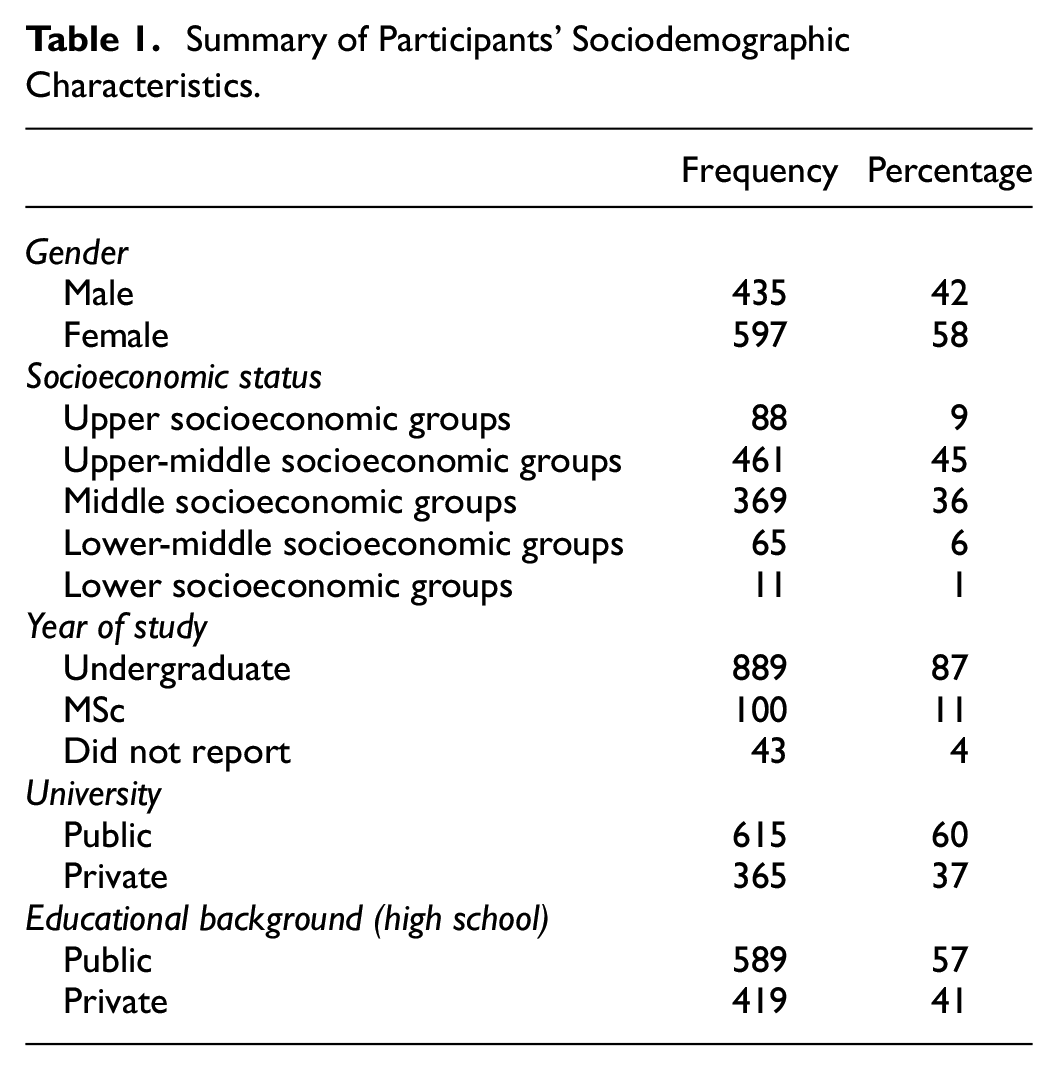
Eighty-seven percent of participants were undergraduate students (1st- to 3rd-year students), from a wide range of degrees at public (60%) or private (37%) universities. In terms of participants’ educational background, 57% of them studied at a public secondary school and 41% studied at a private secondary school. Their Grade Point Average (GPA) ranged between 9.50 and 20 (M = 15.41, (SD = 1.94). 2
Procedure
This study was part of a broader project aiming to identify university students’ perceptions of their academic environment. A convenience sample was recruited. Students participated in the study as part of their coursework and had also the task of disseminating the questionnaire amongst their peers belonging to other HEI. The questionnaire was sent via email, using the online software QualtricsXM. Once participants received the informed consent and agreed to participate, they were asked to reflect on their experience as university students and to complete the questionnaire. The confidentiality of the data and voluntary participation were guaranteed. Additional ethical precautions were taken to protect study participants. The data collection process was carried out in accordance with the Ethical Charter of the Portuguese Society of Education Sciences (Sociedade Portuguesa de Ciências da Educação, 2020) and the Code of Ethics and Conduct of Ethics and Conduct of the Portuguese Catholic University (Universidade Católica Portuguesa, 2015). The data collection in this study did not imply risks for the participants, nor were any monetary contributions made for their participation. Completing the questionnaire took approximately 35 min.
Measures
Motivation, Opportunity, and Rationalization
Participants responded to a 15-item scale (1 = completely disagree, 7 = completely agree) adapted from several authors (Bandura et al., 1996; Farnese et al., 2011; Harrison et al., 2016). A factor analysis with Promax rotation was conducted. As expected, the results yielded three factors: (1) Motivation (e.g., “Cheating can significantly increase grades”; two items, explaining 6% of variance, r = .275, p < .001); (2) Opportunity (e.g., “In general, a student can easily cheat at my faculty”; three items, explaining 7% of variance, α = .68); and (3) Rationalization (e.g., “Cheating is acceptable because teachers do not always explain the materials very well”; eight items, explaining 32% of variance, α = .87). Two items were removed from the scale because they loaded in more than one factor. The score of each factor was calculated by averaging participants’ responses.
Perceived Capability
Participants were asked to rate on a 7-point scale (1 = completely disagree, 7 = completely agree) the extent to which they agreed with three statements (e.g., “If I want to, I have the necessary confidence to cheat without being caught”), adapted from Harrison et al. (2016). The average of responses was computed to form a perceived capability score, α = .69.
Prevalence of Fraudulent Behavior
Participants were asked to read 17 statements of different academic fraudulent behaviors adapted from the South East European Project on Policies for Academic Integrity (SEEPPAI, 2016) and Teixeira (2011, 2015) (e.g., “cheat on exams”). For each statement, participants were asked to indicate how frequently they have engaged in that behavior (0 = never, 1 = once, 2 = more than once). A frequency score was computed through the sum of their responses.
Severity of Fraudulent Behavior
Based on the procedure designed by SEEPPAI (2016), participants indicated how severe they considered each of the fraudulent behaviors presented in the previous scale to be (0 = not fraud, 1 = trivial fraud, 2 = moderate fraud, 3 = serious fraud). The sum of their responses was used to calculate a severity score.
Data Analysis Procedure
First, normality assumption for the continuous variables was assessed using Kline’s (2015) criteria of skewness values within −3 and 3, and kurtosis values between −10 and 10. Then, descriptive statistics and Pearson correlations were calculated to describe relationships between dependent variables. A second step consisted of determining which sociodemographic variables should be included in the remaining analyses as covariates, using independent-sample t tests (for gender, type of university, educational background), One-Way ANOVA (for socioeconomic status and year of degree), and linear regression (for GPA and age).
To test whether fraud prevalence and perceived severity were predicted by Fraud Diamond (H1 and H3, respectively), hierarchical regressions were conducted, including covariates on step 1, fraud triangle variables on step 2, and perceived capability on step 3. Hypothesis 2 stated that a negative correlation would be found between fraud prevalence and perceived severity. A partial correlation including the covariates was performed to test it.
Results
Preliminary Data Analyses and Descriptive Statistics
The first step consisted of analyzing normality assumptions. All variables’ skewness and kurtosis fall within the intervals of −3 and 3, −10 and 10, respectively (−0.59 > sk < 0.72; −0.80 > ku < 0.29) and, therefore, no severe deviations from normality were found (cf. Kline, 2015). Regarding variables’ descriptive statistics, Table 2 shows the means, standard deviations and correlation coefficients among the dependent variables of the study. All variables are positively correlated among each other, and negatively correlated with perceived fraud severity. In other words, higher levels of motivation are associated with higher levels of opportunity, rationalization, self-efficacy and fraud prevalence and with lower levels of perceived fraud severity.
Means, Standard Deviations, and Correlations Among the Variables of the Study.

p < .001.
Prevalence of Fraudulent Behavior Based on Participants’ Characteristics
Gender
An independent-sample t-test showed that fraudulent behavior is significantly higher in male students (M = 11.26, SD = 7.64) than among female students (M = 9.90, SD = 6.77), t(1,030) = 2.98, p = .002, g = 0.19, 95% CI [0.46, 2.26].
Socioeconomic Status
A one-way ANOVA showed differences in the frequency of academic fraudulent behavior based on participants’ socioeconomic status, F(4,993) = 3.56, p = .007, ηp2 = .014. Participants who perceived themselves as upper socioeconomic status engaged in more academic fraudulent behavior (M = 12.05, SD = 7.70) than students who perceived themselves as lower socioeconomic status (M = 5.27, SD = 4.86, p = .025). The difference between upper and lower-middle socioeconomic groups was marginally significant (M = 9.05, SD = 7.08, p = .075). No significant differences were found among the remaining groups.
GPA
A linear regression showed that participants’ GPA from secondary school is a significant predictor of the frequency of fraudulent behavior in university, F(1,586) = 7.59, p = .006, R2 = .013. A higher GPA from secondary school predicted less fraudulent behavior at university (β = −.11, t = −2.75, p = .006).
No differences in prevalence of academic fraudulent behavior were found based on participants’ age [F(1,1026)= 2.64, p = .105], year of degree [F(6,1025) = 1.68, p =.122], type of university [t(978) = 0.17, p = .866], and educational background [t(1,006) = −0.97, p = .331]. Therefore, these variables were not included as covariates in the remaining analyses.
Predictors of Fraudulent Behavior
We aimed to test whether students’ prevalence of fraudulent behavior was positively predicted by the four dimensions of the Fraud Diamond: motivation, opportunity, rationalization, and perceived capability. To test H1, a hierarchical regression was conducted. Statistics are displayed in Table 3.
Summary of the Hierarchical Regression Analysis for Predictors of Prevalence of Academic Fraudulent Behavior.
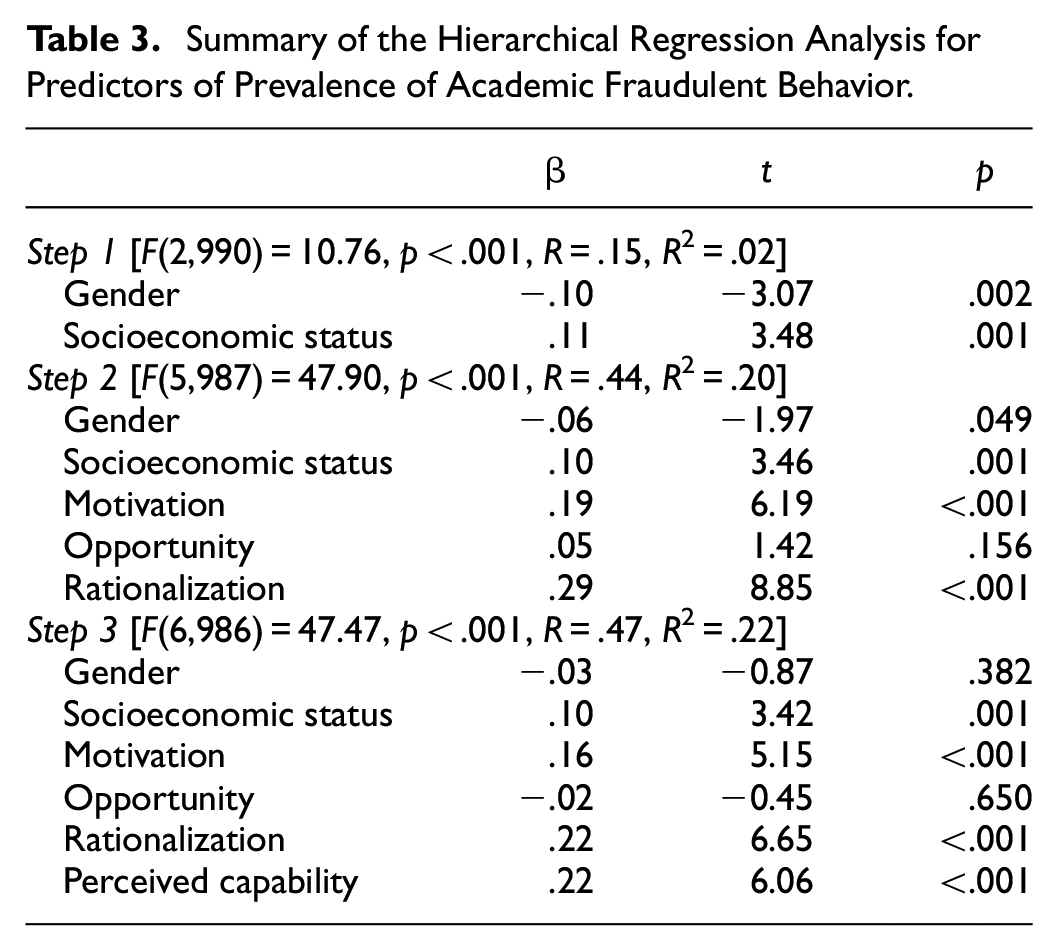
On step 1, participants’ gender and socioeconomic status were included. 3 Higher socioeconomic status predicted more frequent fraudulent behavior. Also, males showed higher levels of fraudulent behavior.
On step 2, the variables of the Fraud Triangle (motivation, opportunity, and rationalization) were included. Motivation and rationalization were significant positive predictors of prevalence of academic fraudulent behavior, even when controlling for the remaining variables (gender and socioeconomic status).
A third step was added to the hierarchical regression including the perceived capability variable and, as expected, it was a significant predictor of fraud in a positive association. Therefore, H2 was supported for all predictors with exception of opportunity.
A t-test on the difference between betas showed that students’ ability to rationalize as well as their motivation, and their perceived capability to commit fraud were the main predictors of prevalence of fraudulent behavior compared to socioeconomic status (all ts > 1.98, ps < .048). The differences between these three predictors were not significant (all ts < 1.65, ps > .093).
Relationship Between Prevalence and Severity
We expected the prevalence of fraudulent behavior to be negatively correlated with severity (H2). A partial correlation was conducted with gender, socioeconomic status, and GPA as covariates. As expected, the more students reported engaging in academic fraudulent behavior, the less severe they perceived such behaviors to be, r (544) = −.28, p < .001.
Predictors of Severity of Fraudulent Behavior
It was expected rationalization (but not motivation, opportunity, perceived capability) to negatively predict the severity of fraudulent behavior (H3). A hierarchical regression was conducted to test this hypothesis. Step 1 included the demographic variables, 4 Step 2 included the dimensions of the Fraud Triangle (motivation, rationalization and opportunity), and in Step 3 perceived capability was added to test the Fraud Diamond. The results are displayed in Table 4. Neither the demographic variables nor the dimensions of the Fraud Triangle were found to be significant predictors. Rationalization was the unique significant predictor and showed a negative association with severity of academic fraudulent behavior, supporting H3.
Summary of the Hierarchical Regression Analysis for Predictors of Severity of Academic Fraudulent Behavior.

Discussion
Research on academic fraudulent behavior has mainly focused on characterizing the phenomenon in terms of its prevalence. The prevalence at a graduate level is alarming and students are cheating even when they consider that it is wrong to do so (Jones, 2011; McCabe, 2009; Tenbrunsel et al., 2010). As such, we start the discussion section by analyzing prevalence and socio-demographic characteristics that may account for increasing prevalence of fraud in academic contexts. Next, following the Diamond Fraud theory, we explore psychological variables from which academic fraud can be explained. We analyze the extent to which each of the four dimensions of the Diamond Fraud theory predicts academic fraudulent behavior. We follow our discussion by extending the findings from previous research to examine the relationship between the prevalence of academic fraud and perceptions of severity.
Socio-Demographic Characteristics and the Prevalence of Academic Cheating
Our exploratory findings show that the prevalence of academic fraudulent behavior is higher among male students. This result is consistent with previous studies which found that male students were more prone to cheating than female students (McCabe & Treviño, 1997; Teixeira & Rocha, 2010). Drawing on research that has examined gender differences in whistleblowing in accounting (Brown et al., 2016), where women report misconduct more often than men, it may be that female students are more sensitive to ethical issues. The lower propensity of cheating among female students could be simply a result of their fear of being caught or it could be because they have a higher level of moral development than their male counterparts.
Similarly, our finding that students with higher GPAs reported lower levels of fraudulent behavior was also consistent with previous research (Gama et al., 2013; Teixeira & Rocha, 2010). Research has found that students with high academic achievement tend to have high levels of self-efficacy and conscientiousness. They are also more likely to use goal-directed learning (Schneider & Preckel, 2017). These factors indicate that students with high GPA scores, who invest in meaningful learning, are less likely to cheat.
Our research found that socioeconomic status positively predicted the prevalence of fraud behaviors. Indeed, students from higher socioeconomic backgrounds committed more fraud than students from lower socioeconomic backgrounds. This result contradicts other studies which have found that students with lower socioeconomic status are more likely to cheat (McCabe & Treviño, 1997; McCabe et al., 2001). It may be that students from higher socioeconomic groups experience greater pressure due to parental expectation to achieve academically (Tan, 2017) which, from the students’ point of view, may lead them to justify their dishonest behavior. Grades are an indicator of success for students in society (McCabe et al., 1999, 2001). When students feel that academic goals are not achievable through hard work and honest endeavor (Montgomerie & Birkhead, 2005), and they are not able to fulfill their own or others’ expectations, then misconduct may become a temptation.
Overall, our results highlight the differences in the prevalence of academic cheating between groups of students based on their characteristics. From a social identity perspective, normative behavior represents a way of generating positive distinctiveness and therefore, individuals are motivated to conform to norms that make the ingroup identity better than and different from an outgroup (Tajfel & Turner, 1986). Thus, it may be that students are conforming to possible group norms (i.e., gender, academic achievement, and socioeconomic status) around academic cheating.
Fraud Diamond Theory Related Variables and Academic Fraud
Partial support was found for H1. Motivation, rationalization, and perceived capability emerged as significant predictors of academic fraud. These variables remained significant even after controlling for differences in sociodemographic characteristics. However, opportunity was not found to be a significant predictor. The present research highlights that motivation, rationalization, and perceived capability are the most important factors in predicting students’ prevalence of fraudulent behavior. That is, the higher the motivation, rationalization and perceived capability, the more fraudulent behaviors were committed.
The results are in line with the literature. The prevalence of academic fraud amongst students with high GPA scores might result from external family pressure and internal pressures when they feel that they cannot achieve their academic goals (Abdullahi & Mansor, 2015; Singleton & Singleton, 2010; Shanahan et al., 2013). This fear of failing, results in misconduct becoming an option (Mih & Mih, 2016). Another source of external pressure is the pervasiveness of cheating in the academic environment amongst significant others (O’Rourke et al., 2010). Students are more likely to cheat when they witness other students benefiting from cheating behaviors, even knowing that such behaviors violate academic norms. Following Rettinger and Kramer (2009) it seems plausible that students with high GPA scores who wish to maintain a positive self-image engage in neutralization techniques rationalizing their behaviors even when they violate social norms. Our results also support Wolfe and Hermanson’s (2004) conclusion that even when motivation, opportunity, and rationalization are present, academic cheating is only likely to occur if students have self-efficacy beliefs regarding the skills necessary to commit fraud.
Prevalence of Academic Fraud and Perceptions of Its Severity
In support of H2, a negative correlation was found between the prevalence of academic fraud and students’ perceptions of the severity of cheating. As expected, students who reported that they committed fraud more frequently, the less severe they perceived their fraudulent behaviors to be. This result supports Scott’s (2017) argument that the repetition of a disruptive action can become normalized, reducing the sensitivity of the outcomes which will be perceived as less severe. In fact, students who commit episodic cheating might seek out other opportunities in the future and become habitual cheaters (Dorminey et al., 2012). In addition, Granitz and Loewy (2007) found a reduced sensitivity to rationalization among students who felt entitled to the benefits of their fraudulent behavior if they could outsmart the system.
The results fully supported H3 as rationalization emerged as a unique predictor of perceptions of severity. The study shows that the more students are able to find justifications for fraudulent behavior, the less severe they perceive those behaviors to be, regardless of their motivation, opportunity, perceived capability, and sociodemographic characteristics. In line with Haidt (2001) and Brown et al. (2016), we recognize that rationalization can be used as a post hoc justification of a moral decision. In this sense, it is a broader concept which encompasses (1) the perceived ease or difficulty of performing the behavior, (2) the perceptions of social incentives or normative beliefs about the acceptability of the behavior, (3) the assessment of the behavior determined by beliefs about the consequences of that behavior, and (4) the perceptions of the morality of that behavior. It may be that students’ moral evaluation of a transgression is associated with these four dimensions and that might justify their dishonest behavior through disengagement of moral norms (Bandura, 1990; Stone et al., 2009; Tenbrunsel et al., 2010). By rationalizing their unethical behavior, students are able to continue behaving dishonestly and cope with any discomfort. In addition, when students gradually increase their cheating they can keep a positive view of themselves while pursuing their instrumental educational goals (Ariely, 2012). This is consistent with the notion of ethical degradation that occurs slowly rather than in one abrupt shift, that is, the so-called slippery-slope effect, that impedes an individual from noticing their moral erosion (Gino & Bazerman, 2009).
Limitations and Future Directions
Our research focuses on academic dishonesty from an individual point of view based on self-report and perceptions of fraudulent behavior. Future studies should address academic fraud from a wider institutional and social identity perspective based on actual dishonest behavior. For example, it would be interesting to design experimental research that relates the role of the in-group opinion leader in a group of male students, lower GPA and high socioeconomic status with dishonest academic behavior, as we know that members of an ingroup tend to be more accepting of dishonest behavior from their leader compared to an outgroup leader (Abrams et al., 2013). Future research could also examine the importance of subjective norms as an explanation for the prevalence and severity of academic dishonest behavior. Nevertheless, this study clarifies the relationship between the prevalence and severity of academic fraudulent behavior. It not only finds that students who commit more fraud evaluate those behaviors as being less severe, but that students who justify their fraudulent behavior, also attribute less severity to those behaviors, extending the applications of the Fraud Diamond theory.
Implications for Higher Education Institutions
Our findings are particularly concerning for HEIs that are keen to fight fraudulent behavior. Students with high motivation, who are able to justify their behavior and to perceive a higher capability to commit fraud, are more likely to engage in fraudulent behaviors, regardless of their perceptions of opportunity. It suggests that HEIs need to be more creative and find new approaches and assessments to deal with fraud, as traditional mechanisms to prevent opportunities for fraud (e.g., fraud detection software, examination invigilation) may not be sufficient when considering individual and group differences in motivation, rationalization, and perceived capability.
As such, these results might be considered when universities are designing their programs to support academic integrity since their measures to control for academic fraud, such as examination invigilators or plagiarism detection software, appear to be ineffective. For example, rather than use institutional messages or HEI staff to warn against academic fraud, opinion leaders from the ingroup might help to develop an environment of academic honesty. Arguments for academic integrity from peers would be seen as less threatening (Hornsey & Esposo, 2009) and would be more likely to be accepted (Thürmer & McCrea, 2018), than arguments from HEI staff. Actively engaging students in the prevention of academic fraud is also likely to create an academic environment in which students do not feel that their academic cheating behaviors are legitimased. At the same time, HEI must define the standards expected from students and communicate their policies of zero tolerance regarding academic cheating.
Conclusion
HEIs need to take academic cheating seriously and appreciate that a vicious cycle develops from unethical behavior when it is perceived as being less severe. That is, if academic fraud is considered to be less severe it will become a common practice. Our results show that rationalization, motivation, and perceived capability are individual mechanisms that explain the prevalence of academic fraudulent behavior. However, only rationalization predicts students’ perceptions of the severity of those behaviors. Moreover, this study shows that the more the students cheat, the less severe they find this behavior to be, suggesting that students feel that cheating occasionally is not a big deal. The need to rationalize their fraudulent behavior (and to therefore perceive it as being less severe) emerges as a mechanism that allows students to maintain a positive image of themselves whilst benefiting from cheating (Ariely, 2012).
One limitation of our study is that the data is drawn from the students subjective self-reported experiences of their fraudulent behavior and may not accurately reflect objective prevalence of fraudulent behavior. Future research should address this limitation using objective measures, for example, as suggested by Simpson and Yu (2012) electronic records of online activity provide a valuable and objective means of detecting academic dishonesty.
Our study highlights that addressing academic fraud is not only a matter of implementing control mechanisms of face-to-face and virtual invigilation, as opportunity did not predict academic fraudulent behavior. Creating healthy university contexts where the academic community believes in honest endeavor and where programs of academic integrity include institutional, group, and individual level approaches are important. This emphasizes the need for ethical codes of conduct that provide cues concerning what is expected from students in the evaluation context and, simultaneously, increase the likelihood of action in the face of unethical behaviors. The sense of moral identity and self-control mechanisms will interact to reduce the propensity to cheat (Gino et al., 2011). Ultimately, this will reduce the attractiveness of unethical misconduct.
Footnotes
Declaration of Conflicting Interests
The author(s) declared no potential conflicts of interest with respect to the research, authorship, and/or publication of this article.
Funding
The author(s) disclosed receipt of the following financial support for the research, authorship, and/or publication of this article: Financial support from the Fundação para a Ciência e Tecnologia, I.P., through project UIDB/00731/2020 | DOI identifier 10.54499/UIDB/00731/2020 (https://doi.org/10.54499/UIDB/00731/2020) and UIDB/05380/2020 | DOI identifier 10.54499/UIDB/05380/2020 ( ) are gratefully acknowledged.
Ethical Approval
Approval by the Local Ethics Committee was not applicable. However, to carry out this study, all ethical principles and care were taken.
Informed Consent
Informed consent was a mandatory requirement for the participation in the study, and even after consent, participants could withdraw from the research at any time if they so wished.
PrePrint
http://dx.doi.org/10.2139/ssrn.4029217
Data Availability Statement
Data set might be made available upon request to the author of correspondence. The data collection process was carried out in accordance with the Ethical Charter of the Portuguese Society of Education Sciences (see http://www.spce.org.pt/regulacaoeticodeontologia.html) and the Code of Ethics and Conduct of Ethics and Conduct of the Portuguese Catholic University (). The data collection in this study did not imply risks for the participants, nor were any monetary contribution made for their participation. Confidentiality of data and voluntary participation were guaranteed in the application of the questionnaires.