



Abstract
The tendency to cheat is consubstantial to any kind of education and training process involving work and effort. The study was conducted on 194 participants, first- and second-year students from the bachelor and master’s programs from several engineering and humanities faculties from Brasov. The Academic Adjustment Questionnaire and the Academic Ethics Questionnaire (AEQ) were applied. The aim of the research was to highlight the internal structure of the two questionnaires and to investigate the associations between academic adjustment, academic dishonesty. Several demographic variables were taken into consideration. The results showed good construct validity and reliability for the scales and significant correlations between academic adjustment and academic dishonesty. Future research should examine to what extent AEQ is able to capture the impact of information technology on dishonest behavior or whether the matter requires a special approach or whether AEQ can support effective intervention programs to stop the phenomenon of academic dishonesty.
It is surprising that in nowadays Romania, a country relatively recently sticking out from under the iron curtain of communism, the number of studies on academic dishonesty (AD) is so small. The problem is not even considered to be one of major interest, despite regular scandals in the press about plagiarized PhD theses (Marinas, 2014), about private universities turned into factories of university diplomas or about professors from different faculties—some very honorable—which financially condition the success in exams. If almost everywhere in the world the concern for AD is major and growing, many of the former communist bloc countries seem not to be sufficiently aware that the connection to Western culture must start mainly from the ethical values (Ampuni et al., 2019; Coughlin, 2015). Recent studies conducted on Romanian students showed that the majority of students engaged in one or more acts of AD; however, they do not seem to have particularly higher rates of AD behaviors compared with students in other countries (Ives et al., 2017). Other studies showed that Romanian students reported higher levels of the need for more training to avoid plagiarism, which could be linked to the higher levels of perceived corruption in Romania or to the lower scores that Romanian students obtained for the individualism, as a characteristic of the cultural dimension of power distance (Mahmud et al., 2019). The lower level of individualism could also explain the general passivity’ among Romanian higher education students regarding academic integrity, Romanian students being reluctant to report other students who are involved in dishonest academic behavior because they consider that this is not their responsibility (Andrei et al., 2009).
As Colnerud and Rosander (2009) consider, AD is not a new phenomenon at all. The tendency to cheat is consubstantial to any kind of education and training process involving work and effort. The occurrence of AD is aimed at achieving educational targets with the economy of effort. So, laziness and the tendency of self-protection appear to be the first explanation of this phenomenon, but not the last. Eastman et al. (2008) consider that the decision to cheat is a conscious and rational one because students had to judge if the benefits of cheating outweigh the risks. Chapman et al. (2004) state that “the incidence of academic dishonesty has been increasing throughout the past few decades” (p. 236). However, more recent studies are not consistent and show divergent results. Although a recent study showed that the number of international students reported for academic integrity violations increased (Fass-Holmes, 2017), other studies found that the total cases of plagiarism raised over 7 years until 2016 but more severe cases of plagiarism dropped (Atkinson et al., 2016); a similar trend was highlighted by Curtis and Vardanega (2016) who talked about increased understanding and reduced occurrence of several forms of plagiarism.
The exponential growth in the quantity of information, coupled with unprecedented evolution in computer science and communications, improve AD, keeping pace with new developments (Karim et al., 2009). This makes it difficult to get to know and stop the phenomenon, which becomes even more harmful when manifest at higher educational levels (Jurdi et al., 2011). But being present at all educational levels, depending on which it acquires specific features, AD is difficult to identify and counteract. Thus, Jensen et al. (2001) consider that AD has become a widespread problem among high school and college students. They consider that cheating behavior is positively associated with cheating leniently and tolerance of deviation from norms and negatively related to self-restraint. Despite the importance of the phenomenon, its control is hampered by the difficulty of identifying and defining it. Högberg (2006) analyses AD as a conflict between youth culture and norms of the educational system.
Research determined that there is a disagreement between students and faculty regarding whether some behaviors constitute AD. Most students do not feel they understand institutional regulations about AD (Carnero et al., 2017; Childers & Bruton, 2016), they do not know to recognize plagiarism (Fenster, 2016), students tend to not consider self-plagiarism as a serious academic offense (Halupa & Breitenbach, 2016), or they do not understand plagiarism and AD (Haitch, 2016; Palmer et al., 2018). As stated by Colnerud and Rosander (2009), AD seems to have different connotations depending on the perspective from which it is addressed to—the education or the educator, the level of awareness and intentionality, the type of culture where it appears (Rawwas et al., 2004), the motivation involved or the academic evaluation type used—classical or electronic (Jurdi et al., 2012). In agreement with the theory of planned behavior (Ajzen, 1991), the mentioned authors elaborated a model of the determinants of AD in which dishonest academic attitudes mediate between causal agents (demographical variables—i.e., sex, age, psychosocial variables—i.e., religious feelings, self-efficacy, academic variables—i.e., motives to study, faculty of enrolment, strategies for learning and academic achievement, and situational variables—peers’ cheating behavior and peers request for help) and dishonest behaviors considering their effects (Jurdi et al., 2011; Schmelkin et al., 2008).
This article puts into equation AD and academic maladjustment, based on several premises. The first states that academic maladjustment is the response to pupils’ and students’ main form of stress which is school learning (Clinciu, 2013). The concept of academic maladjustment should be delimited from the concept of adjustment to college, which is a multidimensional construct. According to Baker and Siryk (1984), adjustment to college can be categorized into academic, social, personal-emotional adjustment, and institutional attachment. Therefore, academic adjustment is only one facet of adaptation to college and it can be defined as the appropriate response of students to the new learning environment. This is a staged, long-term process (Ng & De Guzman, 2017) that can be defined by directly relating the demands of the academic environment with the student resources: concordance expresses a good adaptation, discordance is a source of stress and maladaptation. More specifically, academic adjustment was found to be related to external outcomes of learning as overall grade point average, or utilization of counseling services for social support (Crede & Niehorster, 2012). Research evidence also suggests a positive association between student academic performance and retention, low adapted students being considered at risk of dropping out (Harvey et al., 2006; Hillman, 2005). As Yovita and Asih (2018) suggest unadapted students are more prone to develop academic stress, because they perceive that the academic-related pressure exceeds their coping abilities. However, academic stress can affect the subjective well-being and optimism of students. Attending university is a challenging experience for students, which sometimes leads to higher rates of underachievement, first years of university being the most critical for college adaptation because of the adjustment difficulties (Clinciu & Cazan, 2014). This premise does not deny at all the formative value of school and education but wishes to highlight its hidden side, less heeded, which is the stress it puts on students as a result of the effort to keep up with the demands of school. The second premise is that academic maladjustment involves both internal factors, emotional and cognitive ones, and external components, highlighted in pupils’ and students’ behavior (Clinciu & Cazan, 2014). The academic stress can be eliminated not only by effectively focusing on problems but also by postponing and delaying or—in an aggravated form—through fraud and deceit. The third assumption is that AD is a behavior that is learned and improved even within the education system, a phenomenon that is diversified according to educational levels, but that keeps pace with the technological developments and the zeitgeist (Karim et al., 2009). The last assumption is that controlling and approaching AD are not possible without in-depth knowledge of both context and foundation elements, both directly observable behaviors and internal ones—emotional and motivational—that support them.
The primary objective of this study is to identify the internal structure and the factors resulting from the newly created Academic Ethics Questionnaire (AEQ, Ives et al., 2017). Second, we wanted to highlight the construct validity and the psychometric qualities of the questionnaire by determining its internal consistency. In the third place, we wanted to highlight the interrelations between AEQ and the Academic Adjustment Questionnaire (AAQ, Clinciu, 2013), taking into account the possibility of adding to it an additional dimension called AD.
Method
Participants and Procedure
The investigated sample consists of 194 students from Transylvania University of Brasov, out of which 61.34% are students of Psychology and 38.66% from technical faculties of engineering. From the point of view of gender affiliation, the sample is not balanced, the males representing only 19.59% of the entire lot, compared with the female, strongly majoritarian (80.41%). As age, they range from 18 to 48 years old; the average is 22.77, with a standard deviation of 5.83, 75.3% of participants being under 22. The sample included participants from two academic training cycles, undergraduates, and graduates, 82% are students of undergraduate and 18% from the master’s programs.
To identify the problems of academic adjustment, a set of two questionnaires were administered in the first semester of the academic year 2015–2016, as a preamble of a class period. Given that AEQ investigates sensitive ethical issues, in order to reduce the tendency of facade and the effect of social desirability, the respondents’ anonymity was assured, the questionnaires being filled in voluntarily. However, to increase the level of motivation of the participants, those who took part in the research received credit for the course on the completion of the questionnaires. Also, the participants completed and signed an informed consent form, with the possibility of withdrawing from the research at any time. The duration of filling in the two instruments was no more than 30 min and there were no cases of withdrawal from the research.
Measures
AD behavior was measured through the AEQ (Ives et al., 2017). AEQ consists of 52 items organized into three sections. In addition to demographic data (age, gender affiliation), the first section includes additional information about the higher education institution they attend, year of study, specialization, Grade Point Average (GPA) (7 items). The second section of AEQ consists of 22 items, which aim to highlight the propensity for AD behavior. All items in this section have a unified answer format, which makes possible the summative scoring. Thus, the first category of responses concerns the general attitude as it pertains to the acceptability of behavior described, scored on a 7-point Likert-type scale. This category has totally unacceptable at the lowest pole and totally acceptable at the top. The second category of answers concerns how often that behavior has been observed in other colleagues, while the third category scores the frequency of that behavior in the respondent’s own behavior. Each category is scored on a 5-point Likert-type scale, with Never on the lowest pole and 10 or more times at the top. This gradation of responses from general acceptability of conduct to assessing its frequency of occurrence in others and then in himself creates both a funnel effect and the possibility to monitor whether the resulting structure of factor analysis of the entire section is common to the three categories of types of answers. The third section of AEQ consists of 23 items aiming to highlight the motivation for the involvement of AD behavior. The items are scored on a 5-point Likert-type scale, ranging from Not relevant to Extremely relevant. The items refer to motivations explaining the propensity for AD behavior, such as obtaining a better grade, the tendency not to disappoint, the lack of time needed to prepare for the exam, the irrelevant content of the subject, the exam or the way of teaching, the hyper-competitiveness, the fact that many others cheat, and so on.
The academic maladjustment was measured through the AAQ, which is the extension for university level of the School Inadaptability Questionnaire (Clinciu, 2014) designed for gymnasiums and secondary education cycles. Out of the 63 items of the original scale, there were detained by the factor analysis for AAQ only 24, 14 of which give expression to the Academic neuroticism factor and 10 to Academic Procrastination. Thus, there are taken into consideration two distinct manners of response to the stress induced by academic learning. The first is a predominantly internal response, consisting of anxiety, depression, self-depreciation, irritability, anger, hostility, and vulnerability. The second is predominantly external, behavioral, consisting of a tendency to delay or postpone current academic tasks. The two dimensions are interrelated at a medium level, hence the possibility of aggregating the scores of these scales into an integrating common dimension, which is academic maladjustment. The one-dimensionality of this construct was highlighted by an exploratory factor analysis. Cronbach’s alpha coefficient was high for all the subscales and also for the total scale .84 for Neuroticism, .77 for Procrastination, and .87 for the full scale (Clinciu & Cazan, 2014).
Results
For the 22 items of Section II of the AEQ questionnaire, responsible for the propensity toward AD, there were conducted four series of factor analysis by the Principal Components method, followed by the rotator Varimax method (Table 1). The first three series of analyses were aimed at studying the hypothesis of a common structure for the first three categories of answers to the items of the scale, that is, acceptability of dishonest behavior, frequency in colleagues, and frequency in himself. Since the factor structures identified were remarkably similar, there was the possibility that the entire internal structure of the scales to be evidenced by a factor analysis conducted on the sum of the scores from the three categories of answers. The conditions for applying this factor analysis are met: the discriminant is positive; Kaiser-Meyer-Olkin (KMO) index for the entire matrix of .87 is very good (Field, 2009), and for most variables, it is obviously greater than .85; Bartlett sphericity test is highly significant (χ2 = 2,243.16, df = 231, p <.001), indicating that the correlation matrix is sufficiently high; nonredundant residuals level (greater than .05) is below 50% (only 45%).
Communalities and Factors Loading From Component and Rotated Matrix Factors for the Academic Ethics Questionnaire, Section II—Academic Dishonesty.
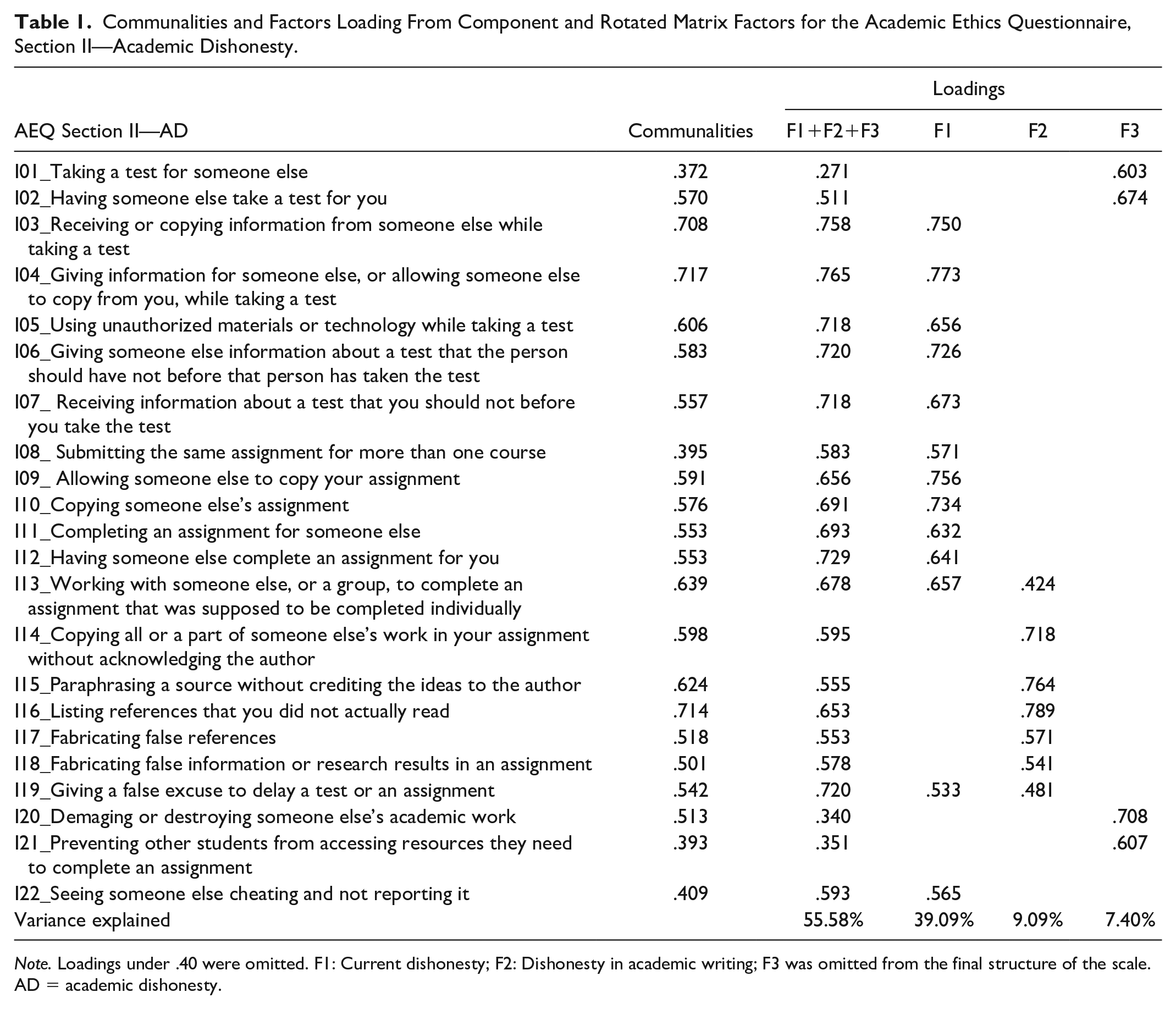
Note. Loadings under .40 were omitted. F1: Current dishonesty; F2: Dishonesty in academic writing; F3 was omitted from the final structure of the scale. AD = academic dishonesty.
The preliminary factor analysis indicated a three factors solution with eigen values greater than 1, covering 55.58% of the total variance. The scree-plot reveals a certain ambiguity, however, for retaining a solution in three, four, or five factors. The rotated Varimax method indicates the presence of three factors clearly defined, of 13, 5, and respectively 4 items. Because there is some overlap of the three factors emerging saturation, we conducted a parallel scale analysis, which showed very good values only for the first factor. The Cronbach’s alpha value is .92 for the first factor of .81 for the second one and only .61 for the third factor. Since the analysis indicates very good values of Skewness and Kurtosis only for the first two factors and non-normal ones for the third factor (2.58, respectively 8.16), we undertook a content analysis of the third factor. It includes extremely rare and atypical dishonest behavior for the population studied, such as impersonation in exams, blocking fellow students’ access to the resources necessary for carrying out academic tasks or damaging others’ academic work. This is why, eventually, we completely removed these factors from Section 2, AD being highlighted in this research only by the first two factors, totaling 18 items. The first of these consists of 13 items that refer to common dishonesty for tasks in courses, seminars and exams, whereas the second factor is composed of only 5 items related to Dishonesty involved in academic writing (plagiarism). The internal consistency of the common scale is very high, of .93, and also presents good Skewness and Kurtosis values which indicate normal distributions.
The second category of information on AD comes from the analysis of Section III of AEQ, which mainly refers to the intensity of motivation for dishonest academic behavior. Secondarily, we tried to identify, through an exploratory factor analysis, distinct motivational categories entering the structure of the motivational dimension (Table 2).
Communalities and Factor Loading From Component and Rotated Matrix Factors for the Academic Ethics Questionnaire, Section III—Motivation for Academic Dishonest .

Note. Loadings under .40 were omitted. F1 = results pressure, F2 = external pressures.
The results of this analysis indicate good construct validity regarding motivation for the dishonest academic behavior section, a scale that revealed the presence of two distinct sub-dimensions. Content analysis of the items highlights a first factor composed of 12 items identified as Results pressure. It is defined by the student’s high interest in performance and grades, in maintaining a scholarship or grant, in finding a good job, hypercompetitive behavior, and so on. The second factor, composed of 11 items, was labeled Contextual external pressure and refers to the low probability of being caught or penalized in cases of fraud, the pressure to comply exercised by the group, uninteresting course content, or the teacher’s dull teaching.
Another aim of this research was to investigate the interrelations between the study variables and to test the possibility of extending AAQ with an extra dimension. Table 3 summarizes these Pearson correlation coefficients showing the existence of a correlation between the two dimensions measured by AEQ, Academic dishonesty and Motivation for AD (r = .54). Motivation for AD correlates stronger than AD with the scales and subscales of the Academic Adjustment Questionnaire. Overall, the tendency to Procrastination is more statistically significantly associated with both scales and subscales of AEQ. Adding an additional scale for AD to the Academic Adjustment Questionnaire appears to be well supported by data drawn from the present research.
Correlations Between Study Variables.

p < .05. ** p < .01.
Table 4 highlights some interesting findings. Thus, Section II of AEQ aimed at AD does not produce any significant differences for several socio-demographic characteristics. This means that AD is a type of behavior with a high degree of generality, which does not depend on gender, age, level of education, or type of academic specialization. An almost similar situation is presented by the Academic Adjustment Questionnaire, which produces one major difference in Academic neuroticism, significantly higher for the female gender, this being in agreement with the theoretical premises of this factor (Eysenck & Eysenck, 1975) or other similar research (Gadzella & Carvalho, 2006).
Gender, Age, Academic Level, and Faculty Enrolment Differences for AAQ, AEQ and Their Sub-Dimensions.

Note. Only statistical significant differences were retained.
p < .01, ***p < .001.
What gives a certain dynamism to AEQ is the Motivation for AD, which has many connotations related to age, type of college, and university cycle. Thus, as expected, ages under 20 are more strongly subject to external pressures for compliance by committing dishonest behavior; students at master’s level feel significantly more subject to pressure related to outcomes; for the technical faculties, where the intellectual demands seem to be higher than in the humanities, both results pressure and external pressure for misbehavior are significantly higher, although they do not get to materialize in more AD compared with the faculties of Humanities. For all the differences presented in Table 4, the effect size (Cohen’s d, 1988) is medium to large, which reflects the high practical relevance of these differences.
One last problem addressed here is the correlation of the two instruments with academic achievement expressed through the overall average points of the preceding semester (Table 3). These correlations must be addressed cautiously, as only students from the second year and some master students could offer this information, but even in this case, it was not checked with the documents, but from memory and is therefore approximate. It can be noted that the AEQ scale and subscales produce no significant association with academic achievement expressed through grades, while the AAQ scale and subscales have in general point average a consistent element of validation against external criterion, especially for the Procrastination factor.
Discussion and Conclusion
This research has contributed to the expansion of measuring instruments in the field of AD practices. Broadly, this research has reached its goals in various proportions. The main aim of the study was to identify the internal structure and the resulting factors of the newly created AEQ. Although interrelated, the two distinct sections of AEQ produce distinct information, one on dishonest academic behavior, the other on the motivations that support this behavior. For the investigated sample, it appears that 4 of the 22 items of the “Academic dishonesty” section have limited utility. This happens because they aim at extreme behaviors, with a low probability to happen, which produce profoundly abnormal distributions of scores and that aggregate in a sub-scale with low internal consistency. The two subscales that result for the identification of Academic Dishonesty—Current dishonesty (manifested in courses, seminars, and examinations) and the one related to Academic Writing (plagiarism) rest on the dichotomy exam—plagiarism and it is consistent with other research data. Thus, Chapman et al. (2004) find two fundamental forms of cheating at exams and written assignments; Colnerud and Rosander (2009) distinguish between plagiarism and collusion or plagiarism and fabrication; Jurdi et al. (2012) between plagiarism and helping somebody else to cheat. The official Swedish taxonomy of AD (Colnerud & Rosander, 2009) includes three main categories: cheating, unauthorized collaboration, and plagiarism and fabrication. The unitary inclusion in the design of each item of three categories of answers, attitudinal, frequency of the incriminated fact in others, and frequency in himself recognize the mediating role of attitude (Ajzen, 1991) between internal and external factors of dishonest academic behavior. At the same time, the factorial structure of the three categories is similar, quasi-identical, which is an important argument for the internal consistency of the construct of AD.
Exactly as the “Academic dishonesty” section of AEQ, the Motivation for AD behavior produces an overall score, the sum of scores for the two subscale, all three with a very good internal consistency. Balanced as a number of items, the two subscales produce useful information about the two forms of motivation for Academic dishonesty, one related to results pressure and one especially to other external contextual elements of dishonesty. Motivational pressure resulting from the sum of the two subscales significantly correlated with AD behavior.
From the above data, AEQ has a good construct validity, coupled with high psychometric qualities. It remains the responsibility of the authors to answer a few questions in the future. Current research put the recrudescence of the phenomenon of AD on the account of unprecedented development of information technology (Chapman et al., 2004; Karim et al., 2009). The question is to what extent AEQ can capture the impact of information technology on dishonest behavior or whether the matter requires a special approach. In addition, future research will investigate the construct validity of the AEQ, through confirmatory factor analysis. The invariance of the measures will also be tested through a more heterogeneous sample in terms of gender, level of study, and age. The second issue is whether AEQ can support effective intervention programs to stop the phenomenon of AD. Obviously, the answer to this question requires further in-depth research. The last aspect is the extent to which the AAQ gives an adequate expression to the phenomenon of academic maladjustment. The fact that the AAQ dimensions correlate more strongly with the GPA compared with AEQ and the motivation for AD behavior is an important argument regarding the validity of this instrument. The contribution to the prediction of the academic performance of the Academic neuroticism dimension of AAQ seems to be significantly lower than the tendency toward Academic procrastination suggesting a possible more complex structure of the Academic neuroticism. This aspect needs further exploration in future research studies. However, the external (behavioral) components of maladjustment should not be limited to the tendency to postpone tasks through procrastination, but also to the tendency toward AD.
The use of surveys to identify the tendency to cheat and the frequency of AD behaviors could be a recommendation for faculties, the collected data being important resources to alleviate the temptation to cheat, or engage in future AD behaviors. This could lead to the creation of new policies which could prevent academic misconduct. Given the high associations found between AD and academic maladjustment, an important direction could be to highlight the attention paid to students’ personal characteristics associated with the tendency to cheat and to develop effective teaching practices to improve the students’ academic skills and their ability to cope with difficult academic tasks (e.g., knowledge about plagiarism, ability to delay gratification, time management skills, avoidance of procrastinating behavior; Baran & Jonason, 2020). The multiple academic pressures (peer, results and competition pressure, fear of failure, etc.) could explain the tendency of students to engage in dishonest behaviors, therefore, teachers should support students in understanding what AD and its consequences mean and teach them effective learning skills to answer appropriately to the academic pressure and to avoid maladjustment.
The overall conclusion of this study is that the measurement tools used converge toward an instrument that provides a more complete overview of academic maladjustment. As the previous study also showed, the main implication of the studies on AD is the need for higher education institutions to review their policies on AD (Eret & Ok, 2014), the existence of validated tools able to measure the multidimensionality of this concept being a strength (Mâță et al., 2020).
Footnotes
Declaration of Conflicting Interests
The author(s) declared no potential conflicts of interest with respect to the research, authorship, and/or publication of this article.
Funding
The author(s) received no financial support for the research and/or authorship of this article.
Ethics Statement
All ethical guidelines were followed as required for conducting human research. Written consent was obtained from the Committee of the Faculty of Psychology and Education Sciences, Transilvania University of Brasov number 39/ 2018.
