




Abstract
Dishonest academic behavior (DAB) by students in Chinese higher education institutions has become a significant concern. However, the related study of academic dishonesty in mainland China is very limited. This study fills this gap by examining the theory of planned behavior and its three extended versions, validating the effectiveness of predicting DAB among Chinese undergraduates, and testing 11 developed hypotheses. This study uses a quantitative research design, and responses are collected online from 525 undergraduate students from five disciplines in the second to fourth year at a public university in China. The results reveal the proposed models have good fitting indices and support 10 hypothetical relationships. These relationships demonstrate that attitudes, norms and control beliefs significantly impact intentions and justifications. Meanwhile, behavioral control, intentions, and justifications significantly influence DAB. Notably, this study found a direct and significant effect of MO on justifications. Therein, Model four best explains the variance in DAB and provides practical support for the expanded TPB models’ application in China.
Keywords
Introduction
Dishonest academic behaviors (DAB) were a worldwide problem encountered by academic institutions. It was present at every educational level, from primary schools to higher education institutions, and it is now a growing concern practically everywhere in the world (Clinciu et al., 2021; Murdock & Anderman, 2006). Chinese scholars (Wang & Xu, 2021) investigated contract cheating (students using third-party online resources to complete their coursework) by 447 students from four universities of different academic levels, and 71.14% of students admitted to plagiarizing and cheating. Wu et al. (2021) surveyed students at eight universities funded by the Hong Kong government and received 508 valid responses. About 42% of respondents admitted to plagiarizing during the semester before the survey, and 82% of the students admitted to participating in the identified dishonesty behaviors at least once. Studies claim dishonesty is a common problem in Chinese schools (Chen & Chou, 2017; Jian et al., 2020; Li, 2015; Ma et al., 2013; Shen & Hu, 2021; Xu, 2020; Yang, 2012b), but unfortunately, there was still a lack of related integrity studies on the factor-and-behavior relationship of the problem in institutions of higher learning. Because the majority of empirical studies concerning academic dishonesty have been performed in developed countries (Uzun & Kilis, 2020), some in Chinese cultural regions, but very little has been done on the mainland, let alone theory-driven research.
According to the Statista website, China’s number of higher education undergraduate institutions and students on campus is at the front of the worldwide list. According to the latest 2022 data on the official website of the Chinese Ministry of Education, there are 2,759 general higher education institutions in mainland China, including 1,270 undergraduate institutions with more than 19 million undergraduates and 3.3 million graduate students enrolled in university. In recent years, university graduates had to cope with involution (NeiJuan
Though some studies revealed that DAB was a severe problem in Chinese institutions of higher learning, the related studies on university students’ academic dishonesty in mainland China are limited (Liu & Alias, 2022; Ma et al., 2013; Wang & Xu, 2021). In particular, media coverage of plagiarism and cheating cases involving university students has risen significantly in recent years, inevitably impinging upon a university’s reputation and educator image (Finchilescu & Cooper, 2018; Tiong et al., 2018). The employing institutions were suspicious of college students’ professional and technical abilities and even doubted the validity of their qualifications (Walker, 1998). What’s worse, as individuals enter the workforce, DAB may extend to their professional lives (Rawwas et al., 2004), posing risks for organizational ethical violations and threatening their career success (Stone et al., 2009).
The most widely used theory on students’ unethical behavior was Ajzen’s (1985) Theory of Planned Behavior (TPB) (Scrimpshire et al., 2017; Stone et al., 2007), which was an expanded version of his earlier work with Fishbein on the Theory of Reasoned Action (TRA) (Fishbein & Ajzen, 1975). The crux of the TPB was that intentions to participate in a behavior precede actual engagement in the behavior. Attitudes toward the behavior, subjective norm, and perceived behavioral control influenced the intents engaged in actual behavior. According to Ajzen (1985), one of the TPB’s main advantages was that variables could be added to the model to increase its explanatory power. Moral beliefs and justification were proven that strengthen the explanatory power of the modified TPB model, but no studies have been found that include both two in the TPB model.
TPB seemed to be one of the most popular and influential basic psychological theories/frameworks to explain and predict a wide range of dishonest behavior in academics among students (Chudzicka-Czupała et al., 2016; Harding et al., 2007; Lonsdale, 2017; Meng et al., 2014). However, theory-driven research on academic dishonesty in China is also quite limited. The majority of the research discovered in the literature review was conducted in the United States (e.g., Beck & Ajzen, 1991; Camara et al., 2017; Cronan et al., 2018; Lonsdale, 2017; Scrimpshire et al., 2017; Stone et al., 2007, 2009, 2010; Yu et al., 2018), with few studies in the context of China mainland (Yang, 2012a; Zhang et al., 2018). Research has shown that TPB has a fairly strong explanatory power for dishonesty in American students, but it is less clear in China.
This study using TPB as the theoretical framework, adds moral and justification beliefs to extend to the conceptual models to test the developed hypotheses. Expect this empirical application to provide academic integrity guidance, suggestions to Chinese students, and more attention from Chinese researchers.
Therefore, the main objectives of this study are two-fold:
(1) To examine the efficacy of the (extended) TPB models in predicting/explaining dishonest academic behaviors among undergraduates from a public university in China.
(2) To verify the significant relationships between the constructs based on the collected data.
Literature Review
Different definitions and classifications of DAB were presented. Hendy and Montargot (2019) defined it as any deviant behaviors taking place during academic exercises and practices. Daumiller and Janke (2020) concluded that it could be conceptually separated from cheating (the specific, intentional breaking of rules) and deceiving (lying and omitting facts). Błachnio (2019) highlighted the purpose that engaging in dishonest behaviors at school or university was intended to result in a good grade or a passing examination. International Center for Academic Integrity (ICAI, 2022, https://academicintegrity.org/) included plagiarism, cheating, lying, and deception under the umbrella of AD. Chinese research Jian et al. (2020) showed exam scores and regular assignments were used to assess Chinese students’ academic performance. In conjunction with the actual Chinese educational assessment of students, cheating and plagiarism in exams and assignments is the most direct way of investigating Chinese students’ DAB.
Although there is no uniform agreement on the definition and assessment type of DAB, it was widely acknowledged that students who engage in DAB are still not optimistic. Wu et al. (2021) surveyed eight government-funded university students in Hong Kong and found that about 42% of respondents admitted to plagiarizing during the semester before the survey; 82% of the students who replied to the survey claimed to have participated in at least one of the given dishonesty behaviors. Salehi and Gholampour (2021) reported that almost 90% of the 310 students from three Iranian state universities admitted to cheating on their exams in various ways. And even among nursing students with high ethical requirements, 41% reported academic dishonesty, and 11% reported clinical dishonesty among 343 nursing students at a major university in central Israel (Maoz et al., 2022). Further, 81% of STEM students surveyed believe online learning during the epidemic increased cheating (Walsh et al., 2021). The ICAI website showed over 60% of students in higher education institutions engaged in dishonesty at least once during their studies (ICA, 2022, https://academicintegrity.org/resources/facts-and-statistics). DAB has remained a prevalent and severe issue in higher education institutions that should pay more attention pre- and post-pandemic.
Previous studies have attempted to look at factors such as personal characteristics (e.g., McCabe & Trevino, 1995; McCabe et al., 2006; Petrak & Bartolac, 2014; Salehi & Gholampour, 2021; Thomas, 2021) and situational factors (e.g., Douhou et al., 2012; Huynh et al., 2022; McCabe, 1999; McCabe & Treviño, 1997; Rettinger & Kramer, 2009; Stephens et al., 2021) as significant contributors to academic dishonesty. The academic community has a general knowledge of the impact factor of students engaging in DAB, which was caused by a variety of factors that are not fully understood (Ewing et al., 2017), especially less clear in China (Shen & Hu, 2021). To better understand the rationale underlying DAB, research guided by a theoretical model is essential, which can predict and explain students’ engagement in the specific DAB.
Theoretical Background to Predict and Explain Academic Dishonesty
In China, studies on academic dishonesty have been empirically driven, with demographic, individual, and situational factors used to explain academic dishonesty (Ma et al., 2013). However, theory-driven research explaining academic dishonesty in China was limited (Yang et al., 2021). The study related to academic integrity in connection to a theoretical framework might help people better comprehend the elements influencing students’ willingness to participate in dishonest behaviors (Sarwar et al., 2016).
Theory-driven research is necessary to understand the underlying rationale behavior, and one of the most promising theories is Ajzen’s (1991) TPB. Recent studies conducted in China based on TPB concluded that knowledge-seeking intention and supervisor support mediated and moderated the relationships among students’ academic attitudes, subjective norms, and their self-perceived academic performance (Khuram, Wang, & Khalid, 2021; Khuram, Wang, Khan, et al., 2021). Additionally, TPB did well at complex ethical or unethical human decision-making behaviors like academic integrity or academic dishonesty (Ajzen, 1991) and has shown promise in predicting academic dishonesty and offering one potential explanation (Stone et al., 2007). In the last decade, numerous studies have supported the practicality and effectiveness of (extended) TPB to evaluate the intentions and actions behind academic dishonesty (e.g., Chudzicka-Czupała et al., 2016; Cronan et al., 2018; Hamdani et al., 2022; Hendy & Montargot, 2019; Uzun & Kilis, 2020; Wang et al., 2022; Yang et al., 2021; Yu et al., 2018; Yusliza et al., 2022; Zhang et al., 2018).
Nevertheless, there is a gap in empirical research or valid theoretical guidance on predicting and explaining Chinese students’ DAB and a particular lack of research using TPB as a theoretical model.
Ajzen’s TPB and Components
Fishbein and Ajzen’s (1975) TRA proposed that attitudes toward the behavior and subjective norms influence an individual’s intention to perform it. Adding the third antecedent: perceived behavioral control, to form TPB, which suggested attitude, norm, and control beliefs all work independently to determine intention to act (or not act) on certain behaviors, and intention was the direct cause of behavior (Ajzen, 1985, 1991). Generally speaking, favorable attitudes toward academic dishonesty and supportive group norm result in strong intent to perform the behaviors of academic dishonesty, but perception of behavioral control (the perceived ease or difficulty of carrying out the dishonesty) may influence both levels of dishonesty and the intent-to-behavior relationship. For instance, a student may have a positive attitude toward exam cheating, and their peers may also cheat, but the level of examination monitoring may deter the student from engaging in that behavior.
Ajzen (1985) stated that one of the TPB’s main advantages was that variables could be added to the model to increase its explanatory power. With the encouragement of Ajzen, some scholars took the variables they think are critical into consideration in the TPB model to explain and predict academic dishonesty. For instance, spiritual intelligence; moral beliefs; Islamic religiosity; adjustment, prudence; justification, and perceived locus of control were all-inclusive TPB to predict academic dishonesty behaviors. Some studies revealed that moral obligation was a predictive variable of intention of DAB (e.g., Beck & Ajzen, 1991; Uzun & Kilis, 2020). Another variable, justification, was significantly related to intention (Rajah-Kanagasabai & Roberts, 2015; Yusliza et al., 2020). Moreover, it significantly moderated the perceived behavioral control-intention relationship (Yusliza et al., 2020) and was a mediator between three TPB predictors and behavior (Stone et al., 2009). Accordingly, combining the fact that Confucianism and socialist core values deeply influence Chinese undergraduate students, justification and moral obligation were added in sequence to TPB in this study to investigate their effects on intention and behavior. As a result, five TPB components: attitudes, norms, control, intentions, behaviors, and two newly added variables: moral obligation and justification, were reviewed in the following sections, respectively.
Hypothesis 1a: Attitude toward academic dishonesty significantly impacts intentions of academic dishonesty.
Hypothesis 1b: Attitude toward academic dishonesty significantly impacts justifications toward academic dishonesty.
The respondents of this study were Chinese university undergraduates, according to Chinese culture, there’s a lot of emphasis on collectivism and a one-child policy that China has implemented for several decades (Tsui & Ngo, 2016; Wu et al., 2021). The majority of respondents in this study were born between 1996 and 2002, when families had a one-child policy, and these children had no siblings and spent the most time with their peers and their parents. Moreover, Chinese educational management is uniform and collectivistic, and learning by copying is a common and legitimate practice (Wu et al., 2021). Therefore, it can be expected that the perception of peers’ dishonesty will strongly influence respondents’ intentions (Yang, 2012b). Consistent with that, we advance the following hypotheses:
Hypothesis 2a: Subjective norm significantly impacts intentions of academic dishonesty.
Hypothesis 2b: Subjective norm significantly impacts justifications toward academic dishonesty.
Hypothesis 3a: Perceived behavioral control significantly impacts intentions of academic dishonesty.
Hypothesis 3b: Perceived behavioral control significantly impacts justifications toward academic dishonesty.
Hypothesis 3c: Perceived behavioral control significantly impacts dishonest academic behaviors.
Hypothesis 4a: Moral obligation significantly impacts intentions of academic dishonesty.
Hypothesis 4b: Moral obligation significantly impacts justifications toward academic dishonesty.
Hypothesis 5: Intentions of academic dishonesty significantly impact dishonest academic behaviors.
Hypothesis 6: Justifications toward academic dishonesty significantly impact dishonest academic behaviors.
The Framework of the Research
According to the researcher’s knowledge, in a few empirical studies that investigated academic dishonesty among students in China, the assessment of DAB was usually only for examination cheating, (Cheung et al., 2016; Ma et al., 2013; Tsui & Ngo, 2016; Zhang et al., 2018), or paper plagiarism (Hu & Sun, 2017; Lei & Hu, 2015), few studies have included both or more other generally dishonest behaviors. Whereas previous studies have established that the assessment type of dishonesty plays a significant role in determining both the attitudes and frequency of dishonesty (Passow et al., 2006). Hence, the type of assessment affects respondents’ perceptions and willingness to report DAB. This study included three types of behaviors: cheating in examinations, unauthorized collaboration on assignments, and plagiarism simultaneously, the three most common means to evaluate the academic performance of Chinese undergraduates.
The main objective of this study is to put the TPB model as the theoretical framework to test undergraduates’ DAB at a Chinese public university and investigate the relationships between the components. The researcher relies on the modified and extended form of TPB as conceptual frameworks for students’ decision-making while formulating cheating intentions, justifications, and subsequent behavior. The researcher integrates empirical research related to academic integrity that used (revised) TPB models and added moral obligation and justification, in turn, to extend models and thus predict factors that influence students’ DAB. The hypotheses developed in this research give the needed framework to investigate the relationships between the predicted factors and DAB, in which ATAD, SN, PBC, and MO are exogenous variables, IAD, JAD, and DAB are the endogenous variables. Six series of direct hypotheses are developed in this research. Based on TPB (Model 1), the researcher proposes three extended models (Model 2–4) to validate the model fit and test the hypotheses.
Method
Sample
This study is carried out at a public university in Shaanxi province with nearly 20,000 undergraduate students enrolled. All eligible undergraduates in the second to fourth year and disciplines in business, engineering, information technology, education, and management are invited to complete the online questionnaire. Counselors in each program send invitations with survey links and informed consent to undergraduates via WeChat, QQ, and email groups. Finally, 525 responses are received, and the response rate is nearly 30%. About 49.7% of the samples are male students, and the rest are females. The main age segment of the participants is between 20 and 23 years old. The student’s years of study are second-year 51.4%, third-year 18.9%, fourth-year 29.7%, and all sample undergraduates have at least 1 year of study and exam experience in university. These students’ programs are business (7.2%) engineering (25.5%), information technology (31.4%), education (22.7%), and management (13.2%).
Measures
The construct-measurement items were adapted from published literature (McCabe, 2005; McCabe & Trevino, 1993; McCabe & Treviño, 1997; Stone et al., 2009) to make the items closer to the learning and examination experience of Chinese undergraduates. Four additional items were added to the existing 10 items further to supplement the measurement of Chinese undergraduates’ DAB. All items were measured on a five-point Likert-type scale.
The ATAD, PBC, and MO scales ranged from 1 (strongly disagree) to 5 (strongly agree). SN and DAB ranged from 1 (never) to 5 (always), assessing the frequency of various forms of academic dishonesty that respondents’ suspicions to peers and reported themselves, respectively. IAD and JAD were assessed, ranging from 1 (very unlikely) to 5 (very likely), assessing respondents’ likelihood of committing academic integrity violations.
The demographic factors included age, gender, study discipline, and year in the discipline. Each item with Chinese in the questionnaire helps students who are weak in English. Standard back translation procedures were performed to make sure the accuracy of the translation (Brislin, 1986). The questionnaire was pilot-tested on a smaller group of 80 students to ensure items were easily understood. No problems were detected, and the questionnaire was considered ready to be used in a real study involving one university.
Results
The present research aims to evaluate the modified versions of TPB models. More specifically, the study aims to understand the extent to which students’ attitudes, norms, behavioral control, moral obligations on justifications, intentions, and DAB to test the developed hypotheses.
Validating the Measurement Models: Confirmatory Factor Analysis (CFA) Model
After all necessary data screening had been completed, 525 responses were deemed valid and used in the analysis (Table 1). IBM-SPSS-AMOS 24.0 was used to estimate the model parameters with the maximum likelihood option. According to Awang et al. (2018), the Structural Equation Modeling (SEM) analysis involves first performing a Confirmatory Factor Analysis (CFA) which is a theory-driven technique that grants the validation of the measurement model of latent constructs. Therefore, CFA was the initial verification procedure to test the measurement model, which was also effective means to assess and validate the constructs of a study for validity and reliability. Table 2 below shows the CFA results of Standardized Factor Loadings (SFL), Composite Reliability (CR), and Average Variance Extracted (AVE) for each construct. Correlation coefficients for each subsection of the questionnaire are shown in Table 3.
Demographics of Respondents (N = 525).

SFL, CR, AVE of Items of the Academic Dishonesty Questionnaire.

Note. SFL = standardized factor loadings; CR = composite reliability; AVE = average variance extracted.
Correlations Between Variables.

Note. Squared root of AVE values are noted on the diagonal with bold.
Correlation is significant at .05 level. **Correlation is significant at the .01 level (two-tailed).
The CFA measurement models of the seven constructs revealed that all items’ SFL was more than .50, the CR ranging from .873 to .963, and all exceeded the acceptable value of .70 (Hair et al., 2016), indicating good internal consistency and convergent validity. AVE ranged between .542 and .767, which exceeded the minimum of .5 suggested by Fornell and Larcker (1981), which provided support for convergent validity. Additionally, all pairwise correlations between constructs (off-diagonal values) were lower than the squared root of AVE values (diagonal values), which illustrates strong evidence of discriminant validity (Hair et al., 2016).
The CFA result revealed that the collected data and proposed CFA measurement models were quite appropriate. The next step is to examine the fit indices of the four proposed structural models to verify this study’s research hypotheses.
Analyzing the Structural Model
The structural model’s assessment of model fit is required to ensure that the three categories of model fit indexes are achieved. The fitness indexes of concern are (1) absolute fit: Chi-Square and Root Square Error of Approximation (RMSEA); (2) incremental fit: Goodness of Fit Index (GFI), Normed Fit Index (NFI), Tucker-Lewis Index (TLI) and Comparative Fit Index (CFI); and (3) parsimonious fit: Chi-square/df. Four models were tested to identify the model that best explained behaviors of academic dishonesty among undergraduates at this university in China. Model fit statistics are presented in Table 4.
Fit Statistics for Model 1, Model 2, Model 3, and Model 4.

From the result of Table 4 that both absolutely, incremental and parsimonious model fit indices indicate a good fit of the four proposed models. Therefore, the four proposed structural models are utilized for further hypothesis testing.
Testing the Hypotheses
The following stage of the analysis is to perform the hypotheses testing through structural equation modeling by IBM-SPSS-AMOS 24.0 upon validating the constructs measurements by the current data set. The unstandardized estimates and the regression weight results of the structural model were considered for testing the research hypotheses of this study.
The unstandardized regression weights of four models for each of the path analyses of this study are revealed in Tables 5 to 8 to verify the significant relationships between the constructs and whether to support the hypotheses or not based on the data employed for the study. The standardized estimate results of the structural equation model for the proposed four models are shown in Figures 1 to 4.
Unstandardized Path Coefficients to Testing the Causal Effects of the Constructs for Model 1.

p < .001.
Unstandardized Path Coefficients to Testing the Causal Effects of the Constructs for Model 2.

p < .001.
Unstandardized Path Coefficients to Testing the Causal Effects of the Constructs for Model 3.

p < .001.
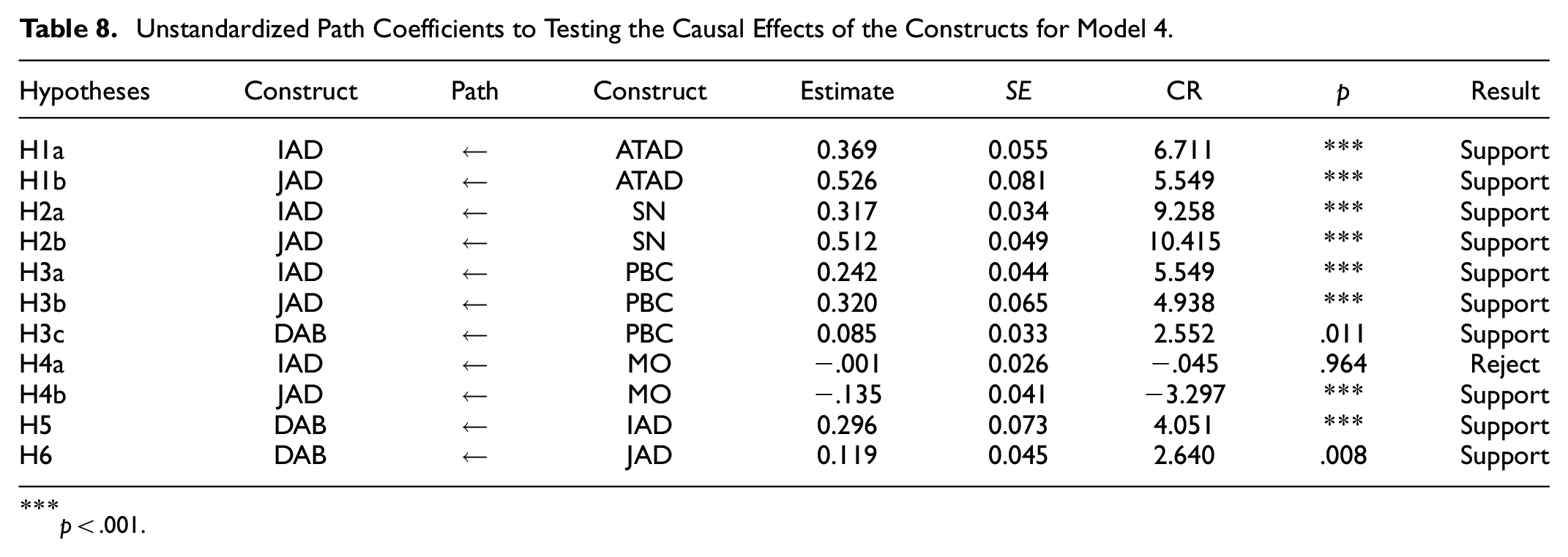
Unstandardized Path Coefficients to Testing the Causal Effects of the Constructs for Model 4.
p < .001.

Results of structural equation for Model 1.

Results of structural equation Model 2.

Results of structural equation Model 3.

Results of structural equation Model 4.
From Table 5, it was evident that all constructs significantly contribute to the endogenous constructs. In the proposed Model 1, each of the five pathways showed statistical significance (t-value > 1.96, p < .05). Therefore, the data collected from this Chinese public university in China supported the five related hypotheses. In which, ATAD (β = .33, p < .001), SN (β = .42, p < .001), and PBC (β = .27, p < .001) were significantly related to IAD and collectively explained 43.3% of variance. Furthermore, IAD (β = .55, p < .001) and PBC (β = .10, p < .05) were significantly related to DAB and together explained 35.7% of variance.
The proposed second model (Table 6) showed that ATAD, SN, and PBC have statistical significance (t-value > 1.96, p < .05) on IAD. However, MO was not significantly related to IAD, and hypothesis 4a was rejected. In addition, Model 2 (Figure 2) added direct paths from MO to IAD. Therein, ATAD (β = .33, p < .001), SN (β = .42, p < .001), and PBC (β = .27, p < .001) were significantly related to IAD and collectively explained 43.3% of variance. Furthermore, IAD (β = .55, p < .001) and PBC (β = .10, p < .05) were significantly related to DAB and together explained 35.7% of behaviors.
In the third model (Table 7), the researcher added the variable JAD on the basis of the first model. The result indicated that ATAD, SN, and PBC have statistical significance (t-value > 1.96, p < .05) on IAD as well as JAD. And simultaneously, JAD showed another significant direct antecedent to DAB. As a consequence, nine hypotheses were supported by the collected data at this Chinese university. Model 3 was tested and included direct paths from ATAS, SN, and PBC to JAD, IAD, and DAB but without MO. The results shown in Figure 3, ATAD (β = .33, p < .001), SN (β = .42, p < .001), and PBC (β = .26, p < .001) were significantly related to IAD and collectively explained 43.1% of variance. Meanwhile, ATAD (β = .25, p < .001), SN (β = .49, p < .001), and PBC (β = .16, p < .001) were significantly related to JAD and collectively accounted for 37.6% of variance. Additionally, IAD (β = .36, p < .001), JAD (β = .21, p < .05), and PBC (β = .11, p < .05) have significantly impact on DAB that together explained 36.9% of variance.
The variables of MO and JAD were simultaneously incorporated into the fourth model to try to find the best modified TPB models to explain the academic dishonesty of undergraduates at this Chinese university. Table 8 revealed that ATAD, SN, and PBC have statistical significance (t-value > 1.96, p < .05) on IAD and JAD. Nevertheless, MO was significant for JAD but not for IAD. The fourth model supported the earlier rejection of Hypothesis 4a in Model 2. In addition, PBC, IAD, and JAD were significant direct antecedents to DAB. The standardized structural equation of the fourth model is shown in Figure 4, in which ATAD (β = .33, p < .001), SN (β = .42, p < .001), and PBC (β = .27, p < .001) were significantly related to IAD and collectively explained 43.1% of variance. ATAD (β = .31, p < .001), SN (β = .45, p < .001), MO (β = −.16, p < .001), and PBC (β = .23, p < .001) were significantly related to JAD and collectively accounted 39.3% of variance. Additionally, IAD (β = .36, p < .001), JAD (β = .22, p < .05), and PBC (β = .11, p < .05) have significantly impact on DAB that together explained 36.9% of variance.
As hypothesized, the effect of ATAD, PBC, and SN have a significant impact on IAD and JAD. In turn, IAD, JAD, and PBC showed significant effects on DAB. However, MO was proved significant on JAD instead of IAD. Thus, of the 11 hypotheses we developed, only H4a was rejected by the data gathered at this Chinese university, and remain 10 hypotheses were all supported (see Tables 5–8).
Discussions
This study discovered that ATAD, SN, and PBC had significant impacts on intentions and justifications. And simultaneously, PBC, intentions, and justifications significantly influenced DAB. Notably, this study found evidence to support the statistically significant effect of MO on justifications, which is the first time to be verified. These findings indicated that the DAB of students at this Chinese university was significantly influenced, either directly or indirectly, by their peers, attitudes toward dishonesty, external circumstances, and ethical standards.
SN was the strongest predictive variable of intention to engage in academic dishonesty and justification for dishonest behaviors. This finding was in line with studies (Kam et al., 2018; Maloshonok & Shmeleva, 2019). A society characterized by a strong collectivist orientation can explain why the perceived views of social group members (subjective norm) were a determining factor in behavioral intentions to cheat among Chinese students (Chudzicka-Czupała et al., 2016; Wu et al., 2021; Yusliza et al., 2022).
MO was not an important variable in predicting intention, but it was significantly related to justification in Model 4. However, according to the researcher’s knowledge, no empirical study has been found on the relationship between moral beliefs and justification. Justifications for dishonesty among students may be minimized by highlighting the importance of ethical (moral) behaviors (Shalvi et al., 2015) and increasing the variance of explanation for justification.
PBC was found to be significantly related to intention to DAB. This result was consistent with findings from other studies (Camara et al., 2017; Cronan et al., 2018; Curtis et al., 2018; Kam et al., 2018; Stone et al., 2009; Yusliza et al., 2020). When students perceive that there is little institutional control, then perceived behavioral control is high, and the intention to dishonesty is high. Furthermore, PBC was a significant and direct predictor of DAB, consistent with the previous studies (e.g., Hendy & Montargot, 2019; Stone et al., 2009). In cultures where students are under great pressure to succeed, either through family or societal pressure to achieve lofty goals and standards on the one hand and lax rule enforcement in the institution, on the other hand, the intention to cheat is high (Grondona, 2000). Measures could be implemented to make it more difficult to engage in dishonest behavior or to raise awareness that this type of dishonest behavior is likely to be detected and will not be tolerated.
The results also showed that ATAD was significantly related to intention and justification of dishonesty which is consistent with studies (e.g., Camara et al., 2017; Chudzicka-Czupała et al., 2016; Kam et al., 2018; Uzun & Kilis, 2020). In some countries, academic cheating may not always be construed as a serious violation of norms, and students may not realize they violate ethical or moral imperatives (Chudzicka-Czupała et al., 2016). A student who observes other students getting away with academic dishonesty may also be inclined to dishonesty. Therefore, attitude is one of the most influential factors of intention/justification to perform the behavior of academic dishonesty.
Furthermore, justification accounted for the most variance of intentions on behaviors, highlighting the importance of justification in intent to engage in DAB, which is consistent with previous studies on the significant role of justification in dishonest behaviors (Rajah-Kanagasabai & Roberts, 2015; Stone et al., 2009). That is to say, students may agree to act unethically for a variety of excuses (justifications), which include internal and external reasons such as fear of failure, getting better scores, peer/family pressure, and so on. Therefore, it might be concluded that a significant predictor of dishonest behavior is the extent to which students justify offering dishonest assistance out of concern for themselves or other peers, consistent with Hermkens and Luca (2016).
Intention was the strongest direct antecedent for academic dishonesty in this study, which is consistent with most behavioral research (e.g., Ajzen, 1991; Beck & Ajzen, 1991; Yang, 2012b). Such that study often only measured intention rather than actual behavior when studying behavioral factors with the TPB (e.g., Cronan et al., 2018; Harding et al., 2007; Koc & Memduhoglu, 2020; Stone et al., 2007; Uzun & Kilis, 2020).
However, this study did not find a significant effect of MO on intentions, and the insignificant relationship may be because MO was a psychological (internal) factor, and measurement depended entirely on individual characteristics. Although these students have been influenced by Confucian culture from an early age, the teaching style of exam-oriented has to some extent, hindered the opportunity for students to learn ethics education systematically. Notedly, the significant relationship between MO and justification revealed a sense of guilt or obligation could impact the justifications consciously and rationally, leading to a decrease in the frequency of actual DAB. The limited number of articles that survey the relationship between MO and justification is an indication that there are chances for future research.
Additionally, other studies found that it exists a statistically significant relationship between justification to cheat and intention to cheat (Rajah-Kanagasabai & Roberts, 2015; Scrimpshire et al., 2017; Yusliza et al., 2020), which indicated that more justifications for participating in DAB, the more tendency to form the intentions to dishonesty. When justification for dishonesty prevails, there is a high tendency to dishonesty. In this study, we did not pay attention to the relationship between intention and justification. Therefore, within the scope of the current theoretical framework, we propose an alternative equation (shown in Figure 5) to test for future study.

Alternative model.
Furthermore, justifications contributed more variance to the explanation of DAB than intentions alone, from 35.7% to 36.9%. The inclusion of moral obligation from Model 3 to Model 4 explained an additional 1.7% variance in justifications. Therefore, Model 4, in our view, best explains the relationships between each variable.
Implications for Theory and Practice
Empirical studies on dishonest behaviors in higher learning institutions in China are relatively rare. This study uniquely contributes to the Chinese empirical surveys on academic integrity. We believe this is one of the largest surveys to investigate Chinese undergraduates’ attitudes, norms, control, intentions, and justifications. The findings help Chinese scholars, educators, and international readers better understand the Chinese undergraduates’ intentions and justifications behind plagiarizing and cheating on examinations and assignments.
Furthermore, the theoretical contribution provides additional support for the application of extended models of TPB that predict and explain academic dishonesty, as well as supplying evidence of the validity of mapping Chinese undergraduates’ ethical decision-making processes. Specifically, it is first put forward to include both a predictor (moral belief) and a potential mediator (justification) in models to predict violation of academic integrity. TPB has been widely used in analyzing academic dishonesty in the environmental context in developed countries for sustainable educational development. This study concluded that the extended TPB Model 4 offered the best explanations for DAB among undergraduates at this Chinese university. This study supported the extended TPB models in predicting Chinese undergraduates’ involvement in dishonest practices to create a climate of integrity and provide educators with a theoretically informed road map for developing effective moral interventions.
Limitations and Recommendations for Future Research
Some limitations have been identified, and caution is required in interpreting these results. First, the data discussed from one public university in China cannot be reflective of dishonest behaviors in all institutions of higher learning in China. Second, self-report measures may be subject to social desirability response bias, which may have resulted in the under-reporting of cheating behavior (Whitley, 1998). Another limitation is that the present survey relied on quantitative and cross-sectional research. Future studies should include a qualitative component to explore students’ cheating behavior in-depth. Additionally, the measured dimensions of academic dishonesty should also be more comprehensively, such as deceiving, which with cheating was loosely connected to the reasons underlying academic dishonesty (Daumiller & Janke, 2020). Future research should consider discussing the various types of dishonesty that arise in the new era. Particularly more forms of academic dishonesty caused by online and network technology should be taken into consideration in the post-pandemic period, paying more attention to the psychological mechanism of students who are dishonest in online exams and assignments. The researchers appeal to continue research and study in this area, as it continues to remain an area of concern for institutions of higher learning.
Conclusions
The current study evaluated four models intended to predict IAD, JAD, and DAB, using data collected from one Chinese public university. TPB and its three extended versions were compared to ascertain their predictive capacity. The fit indices revealed the proposed four models in this study were acceptable and reached a better fitting, and all four models received support from the data collected in the sample investigated. The last model that included MO and JAD explained the most variance in DAB. The strong predictive power in this study reiterates the robustness of (extended) TPB models in the behavior of academic dishonesty.
Moreover, the individual elements of models (ATAD, SN, PBC) significantly influenced IAD/JAD, MO had a statistical impact on JAD instead of IAD, and IAD, JAD, PBC directly predicted DAB. It indicated that academic integrity could be achieved by teaching ethics courses, encouraging peers to report violations, strengthening supervision and feedback on exams and assignments to help students develop positive moral attitudes and increasing internal and external barrier mechanisms for engaging in dishonesty to reduce students’ intentions and justifications for academic dishonesty and thus create an honest campus climate.
Footnotes
Acknowledgements
The authors would like to acknowledge the help given by administrative officers at the university in Shaanxi province and the Department of Postgraduate Studies of SEGi University, Malaysia, in the collection of data for this study.
Declaration of Conflicting Interests
The author(s) declared no potential conflicts of interest with respect to the research, authorship, and/or publication of this article.
Funding
The author(s) received no financial support for the research, authorship, and/or publication of this article.
Ethics Statement
The study was approved by human ethics committees by the university. Students’ participation occurred on a voluntary basis. Potential participants were informed about the research aims, and they were assured about the anonymity of their responses. The survey was distributed online, and students were given the website reference to access and complete the questionnaire.
