




Abstract
This study scrutinizes the effect of external and internal remittances on the outcomes of the labor market of Pakistan. The study uses data from PSLM – HIES 2018-2019. The labor participation analysis used the IV Probit model, while the labor supply analysis utilized the IV technique. The Multinomial Logit model with endogenous covariates is employed for the employment choice. The results reveal that an individual from a remittance-receiving household is less likely to participate in labor vis-à-vis an individual from a non-receiving household. The external and internal remittance inflow increases the labor supply for the labor-participating individual. In addition, more external remittances increase the likelihood of participation in self-employment than wage employment, which supports the positive effect of remittance inflow on labor supply. The higher internal remittances are associated with an increase in the likelihood of participation in farming. In short, our analysis supports the fact that the effect of external remittance is more pronounced on labor market outcomes than internal remittances. The study’s findings assist the labor economist in observing the obstacles in the labor force participation and policymaker to understand the entrepreneurial level and economic activities in the remittance-receiving households to turn the effect of remittance into a job creator.
Plain language summary
This study is related to the effect of external and internal remittances on the labor market outcomes. The labor market outcomes are related to the labor participation, labor supply, and employment choices. The empirical analysis confirms that remittances lower the likelihood to participate in the labor market, suggesting the disincentive effect (participating in nonmarket activities) among the non-participants. On the other hand, remittances expose the work effect because remittances increase the labor supply for the labor-participating individuals. Moreover, remittances raise the likelihood to participate in the self-employment which indicates the presence of entrepreneurial activities in the remittance-receiving households. The effect of external remittances are more propound on the labor market outcomes than the internal remittances. The implication of the study is related to the reallocation of labor. Remittances support self-employment status because external remittances soften the financial constraint. However, relevant stakeholders need to channel the remittance inflow into industry-based business start-ups to serve the effect of remittances as job creators. The higher level of remittances supports self-employment, which can increase the entrepreneurial activities in remittance-receiving households. Similarly, the higher level of remittances supports the higher labor supply, accelerating the “work effect” of remittances. For this purpose, steps need to undertake by the government to raise the level of remittances by exporting skilled labor. Moreover, technological advances in agriculture may result in higher productivity, increasing investment opportunities in agriculture because internal remittances support employment in the agriculture sector.
Keywords
Introduction
The labor diaspora of Pakistani workers continues due to a lack of economic opportunities, and it is even more widespread. The facts of the Bureau of Emigration and Overseas Employment (Bureau of Emigration & Overseas Employment, 2019) depict that annual labor exports of Pakistani workers surged from 113,781 in 1990 to 625,204 in 2019. At the same time, the total stock of Pakistani migrants outstretches to 3.39 million in 2017, which is 4.5% of the labor force and 1.7% of the population (Pakistan Migration Snapshot, 2019). Moreover, according to BOEOE, Pakistani migrants are even than 8.8 million as of December 2017. The surge in migrants also resulted in the rising flow of remittances from US$2 billion in 2001 to US$22 billion in 2019, which counted as 8% of Pakistan’s GDP (World Bank, 2019).
Remittance inflow is a significant source of foreign exchange in Pakistan. Remittance receipt to Pakistan is the highest source of foreign exchange, with a contribution of US$23.1 billion by comparing the US$22.5 billion contributions of export in 2020 (State Bank of Pakistan, Annual Report, 2020). Moreover, the share of remittances in total foreign exchange increased from 47% in 2019 to 48.5% in 2020. Pakistan is sixth on the list of top remittance-receiving countries globally, third in Asia, and second in South Asia (World Bank, 2020).
The benefit of labor migration to the source country emerges in several ways. For instance, remittance as a significant and stable foreign exchange source ensures the exchange rate’s stability by softening the pressure on the current account deficit. The stable exchange rate reduces financial and economic uncertainty and increases economic growth (Ratha, 2005). Remittances may also increase migrant-sending families’ consumption and saving, decreasing poverty and unemployment (Anyanwu & Erhijakpor, 2010). Remittance possesses a direct effect on the migrant household and an indirect trickle-down effect when utilized. For instance, at the household level, remittances support entrepreneurial activities (Lianos & Pseiridis, 2009) and act as job creators (Shair et al., 2023). Remittances support capital accumulation in developing nations, increase the capital-labor ratio (Barua et al., 2007), and increase labor productivity by reallocating resources to different employment opportunities (Mabrouk & Mekni, 2018).
Remittance is accredited as an essential source of capital inflow and creates incentives for low-income countries’ economic development. On the contrary, remittance inflows can be deleterious to developing countries through Dutch disease syndrome. Higher remittance inflow is a potential source of real exchange rate appreciation, which decreases the export, increases the import, and declines the domestic production and labor demand in the migrant-sending country (Amuedo-Dorantes & Pozo, 2004). The negative effect of remittances was also found by Airola (2008), who stated that remittance income is a significant and growing contributor to the country’s total output. This effect is offset due to a lower labor force participation rate in remittance-receiving households. Similarly, Barai (2012) found that remittances lower the labor supply and affect the efficiency of the labor market, which, in turn, decelerates economic growth. The present situation calls for a thorough investigation into the nexus of remittance on labor market outcomes in the country, which is among the top remittance-receiving country, such as Pakistan.
The inflow of remittances to Pakistan has surged over the last two decades, epically after 9/11. This terrorist attack scrutinized foreign Pakistani accounts, resulting in higher accumulated savings from Pakistani abroad (Kock & Sun, 2011). In Figure 1, at one glance, remittance increases from US$ 2 billion to US$ 20 billion, while another side depicts that the labor force participation rate decreased from 84% to 79% (World Bank, 2019). Since the advances in information technology in the last decade emerged, the importance of social remittances affects the behavior of non-migrant members. It implies tthat the labor market dynamics change in response to remittances because the labor force participation rate increased after 2011 (see Figure 1). It makes an intuition to examine the effect of remittances on labor market outcomes at the household level because decisions are taken at the household level.

Dynamics of annual external remittances and labor force participation rate.
However, despite its importance, little attention has been given to its empirical side. According to the best available information, the available set of studies in Pakistan related to remittances and labor supply is (Shair et al., 2023; Shair and Anwar, 2023; Kozel & Alderman, 1990). As much as we know, only one study is close to our study in Pakistan, Mughal and Makhlouf (2013), which utilized the Household Integrated Economic Survey (HIES) 2008. Hence, our study distinguishes itself from their study in serval notable aspects. This study is the first to examine the effect of internal and external remittance inflow on labor market outcomes in Pakistan. The uneven distribution of remittance inflow (see Figure A1) may affect labor market outcomes differently at different levels of remittances.
Moreover, since the launch of the Pakistan Social and Living Standard Measurement – Household Integrated Economic Survey (PSLM – HIES 2018-2019) in 2020, no study has reinvestigated the labor effect of remittances in Pakistan. Considering that there are prominent changes in the labor force participation rate (as depicted in Figure 1) and demographic dynamics of households in Pakistan from 2008 to 2019. This study, therefore, desired to scrutinize the effect of external and internal remittances on labor market outcomes. This project may help researchers and labor economists understand labor market outcomes in the presence of non-labor income (remittances) receipts and observe the obstacles to labor force participation. Moreover, analysis of preference toward different employment may support the policymaker to understand the entrepreneurial level and economic activities in the remittance-receiving households to turn the effect of remittance as a job creator.
Review of the Literature
Remittances and Labor Participation
The Neo-classical model of labor-leisure choice crystalizes that decision of an individual to participate in the market or non-market activities are subject to budget constraint they face. The budget constraint is determined by the labor and non-labor income of the individual (see: Becker, 1965, p. 459). The presence of non-labor income softens the budget constraint, decreasing the opportunity cost of leisure and increasing leisure consumption, given that leisure is a normal good (Borjas, 2013, pp. 31–33). The non-labor income is a positive function of the reservation wage of the individuals and, in turn, decreases their likelihood to enter or stay in the labor market (Killingsworth, 1983).
Remittance is a non-labor income for the non-migrant members of the household and is a positive function of reservation wage (Jadotte, 2009). Except for remittances, even the presence of a migrant in the household is associated with a lower likelihood of participating in the labor market (Rodriguez & Tiongson, 2001). Similarly, Bussolo and Medvedev (2008), Kim (2007), and Narazani (2009) empirically found that the likelihood of participating in the labor market is lower for individuals of households receiving remittances than the individuals of non-receiving households. It implies that remittances keep individuals out of the labor force because the share of remittances in household income is relatively higher, increasing reservation wage and keeping individuals out of the labor force (P. A. Acosta et al., 2009).
In the literature on migration and labor participation of non-migrant members, numerous studies (Hanson, 2007; Lokshin & Glinskaya, 2009; Rodriguez & Tiongson, 2001) found a negative association between the likelihood to participate in the labor for an individual of the remittance-receiving household. However, it was observed that in the absence of participation in the labor market, non-migrant members are more likely to engage in other household duties, childcare, participate in higher education, and family-contributing work in farming (Görlich et al., 2007). Interestingly, Cox-Edwards and Rodríguez-Oreggia (2009) found no evidence of any relationship between remittance receipts and the likelihood of labor force participation. The unaffected nature of remittance is justified as remittance inflow cannot create a surplus in the household’s total income. A household member’s migration process is associated with a significant expense, and remittances are used only to compensate for the expense associated with migration.
Contrary to the views above, the study of Nwokoye et al. (2020) found that remittance receipts increase the labor force in non-farm economic activities and decrease the labor force in farm economic activities. Thus, based on prior literature, remittances’ effect on labor participation is mixed. Consequently, to address this ambiguity and add the role of internal remittances, the following hypotheses are proposed;
Hypothesis A: Individuals of external remittance-receiving households are less likely to participate in the labor market.
Hypothesis B: Individuals of internal remittance-receiving households are less likely to participate in the labor market.
Hypothesis C: Higher external remittances reduce the likelihood of participating in the labor market.
Hypothesis D: Higher internal remittances reduce the likelihood of participating in the labor market.
Remittances and Labor Supply
The Neo-classical model of labor-leisure choice serves as a framework for analyzing the decision-making process of individuals concerning their labor supply. The literature has extensively documented the Neo-classical model of labor-leisure developed by Becker (1965). According to the theoretical framework, it is posited that an individual’s utility is contingent upon both “consumption” and “leisure” activities. The Cobb-Douglas utility function, as employed by Borjas (2013) and Schumann (2013), is typically expressed in its standard form. The utility function is influenced by “time” and “resource” constraints. The time constraint posits that to increase one’s leisure activities, an individual must correspondingly reduce his/her allocation of labor hours. The statement suggests a trade-off relationship between allocating time toward “labor” and ’leisure’ activities.
In contrast, resource constraint pertains to the limitations imposed on an individual’s “labor” and “non-labor” income. Non-labor income, also referred to as alternative sources of financial gain, encompasses various forms such as rental income, interest earnings, dividends, prizes, remittances, and lottery winnings. The impact of “labor income” on labor supply remains uncertain, although it is contingent upon the prevalence of either the income effect or the substitution effect resulting from wage changes. In contrast, it is worth noting that the existence of “non-labor income” has been found to have a positive relationship with leisure activities while conversely having a negative effect on labor supply, as highlighted by Borjas (2013).
Most studies on remittances and labor supply used household-level data, and their findings are mixed. For instance, Kim (2007), Airola (2008), and Shair et al. (2023) found a negative association between remittance inflow with the labor supply and support the “disincentive effect” of remittances. Conversely, Amuedo-Dorantes and Pozo (2004) and Jadotte (2009), and Mughal and Makhlouf (2013) found no evidence of the effect of remittances on the labor supply of non-migrant members. In the literature, only the study of Posso (2012) empirically found a positive association between remittances and labor supply. The positive effect of remittances on the labor supply of non-migrants turns up since non-migrant members have to work more to defray migration-related expenses. Additionally, remittances overcome the credit constraint and generate employment which requires a higher labor supply. The findings highlight that remittances’ effect on non-migrant members’ labor supply is mixed. Hence, to confirm the relationship and also examine the role of internal remittances, our hypotheses can be stated as follows:
Hypothesis E: Individuals of external remittance-receiving households are supplied less labor.
Hypothesis F: Individuals of internal remittance-receiving households are supplied less labor.
Hypothesis G: Higher external remittances reduce the labor supply of individuals.
Hypothesis H: Higher internal remittances reduce the labor supply of individuals.
Remittances and Occupational Choices
Within the realm of theoretical literature pertaining to occupational choices, an influential study conducted by Roy (1951) delves into the intricate process by which individuals make decisions regarding their chosen occupation from various available options. The model commences by considering a scenario involving two distinct categories of individuals contemplating a career in either hunting or fishing. This analysis assumes a context where there is uncertainty about to the quantity of goods, specifically rabbits or fish. The significance of skills cannot be overstated, as they play a pivotal role in various domains. Notably, a noteworthy association has been observed between skills and the technological resources that facilitate the application and enhancement of these skills.
Whether an individual chooses self-employment or wage-employment is contingent upon their “marginal ability,” as Blau (1985) highlighted, within the context of static analysis. According to Blau’s model, individuals aim to optimize their utility function while considering the constraint imposed by time and budget constraints. The decision to transition into self-employment is contingent upon comparing the marginal product of labor in self-employment and the prevailing wage rate. If the former surpasses the latter, the individual is inclined to become self-employed. Conversely, if the wage rate exceeds the marginal product of labor in self-employment, the individual is likelier to remain in traditional employment.
Within the context of dynamic analysis, an individual must conduct a comprehensive cost and benefit analysis when considering the decision to pursue self-employment. This analysis entails an evaluation of the anticipated net income derived from self-employment, juxtaposed against the associated opportunity cost. According to Borjas (1986), opportunity cost refers to the market wage rate an individual could earn if they engage in wage employment. Alternatively, if they decide not to participate in any employment, the opportunity cost would be the unemployment benefit they would receive. According to Hammarstedt (2004), whether an individual chooses to engage in self-employment or wage employment is contingent upon evaluating the present value of the future benefits and costs associated with each type of employment. The decision-making process regarding whether an individual chooses self-employment or wage-employment is influenced by various factors, including tax rates, discount rates, wages, unemployment rates, benefits, and start-up costs (see: Blanchflower & Oswald, 1998; Lianos & Pseiridis, 2009).
It is important to note that the scope of empirical literature pertaining to occupational choices extends beyond the dichotomy of self-employment and wage employment. The existing body of literature presents various views regarding the impact of migration on occupational preferences. These are: (1) migration of spouse shift preference toward non-employment (Cabegin, 2006); (2) shift the preference toward non-wage work (Binzel & Assaad, 2011); (3) migration of a household member relocates labor of non-migrant toward self-employed (Khan & Valatheeswaran, 2016). With the exception of migration, remittance inflow is positively associated with the likelihood of participation in family contributing workers (Dávalos et al., 2017); conversely, remittance inflow diverts preferences from unpaid wages to self-employed (Mendola & Carletto, 2012). Likewise, remittances shift an individual’s preference toward being self-employed rather than working in the private/public sector (Stanley, 2015). On the other hand, the study by P. Acosta (2020) did not find evidence on the receipt of remittances on participation in self-employment. Thus, based on existing literature on the effect of external remittances on employment choice, we can hypothesize that:
Hypothesis I: Individuals of external remittance-receiving households are more likely to participate in self-employment.
Hypothesis J: Higher external remittances increase the likelihood to participate in self-employment.
With the exception of external remittances, the presence of internal remittance receipts also affect the labor market outcomes. Dary and Ustarz (2020) studied the reallocation of labor in response to internal remittances and suggested that receipt of internal remittances increases the likelihood of participation in family employment more than self-employment. On the other hand, Mughal and Makhlouf (2013) found that the receipt of internal or external remittance receipts increases the likelihood of participation in self-employment and decreases the likelihood of participation in wage employment. The previous literature on the effect of internal remittance inflow is scant, which leads us to the following hypotheses:
Hypothesis K: Individuals of internal remittance-receiving households are more likely to participate in self-employment.
Hypothesis L: Higher internal remittances increase the likelihood of participating in self-employment.
Methodology and Empirical Strategy
Econometric Methodology
Labor Participation Model
In the sample, almost one-fifth of the individuals are not economically active and reported not participating in the labor market. We can find the non-participating members’ likelihood of participating in the labor market. For this purpose, we have to convert the dependant variable into a dummy dependant binary variable coded 1 for labor participation and zero otherwise. We model labor participation decisions as a function of remittances, demographics, individual traits, and household characteristics. However, due to endogeneity concerns, the casual effect of remittances on labor participation will be problematic. The potential reverse causality, unobserved heterogeneity, and omitted variable biased cause endogeneity in the variable. Similarly, unobserved characteristics of individuals and households can jointly affect the remittances and labor participation decisions. The potential endogeneity in remittances can be addressed using the instrumental variable (IV) strategy to estimate the labor participation decision in response to remittances. The system of equations we estimate is as follows:


Li is equal to one if an individual participates in the labor market and zero otherwise. In the equation
The choice of appropriate instruments plays a crucial role in determining the endogenous variable, as using valid and robust instruments is essential for obtaining consistent estimates. Within the scholarly discourse on remittances and their impact on labor market outcomes, it is widely recognized that employing individual and household-level instruments to study remittances is considered less preferred. According to Amuedo-Dorantes and Pozo (2004), regional-level instruments have a greater preference. The phenomenon of migration is influenced by various factors, commonly referred to as push and pull factors. These factors play a significant role in shaping the demand for remittances at the household level. The unemployment and poverty rates at the regional level were utilized as instrumental variables to capture the push factor. The utilization of the unemployment and poverty rates has been previously documented by Grigorian and Melkonyan (2011). Furthermore, the utilization of migration networks was employed as a pull factor for migration due to its ability to facilitate and streamline the migration process through established migration networks. The migration network has garnered significant attention and utilization within the academic community, as evidenced by its frequent references in scholarly works (P. Acosta, 2006; Woodruff & Zenteno, 2007).
It is important to note that each of the three regional variables exhibits an adequate amount of variance to offer meaningful results and carry out the statistical test. Each observation of the variable at the regional level is representative of 12 households in the urban area and 16 households in the rural area (see Table A1 for the definition and measurement of the instrument). We shall assess the exogeneity of the instrumented variable by utilizing Durbin's (1954) test, as well as the Wu-Hausman test, which was created by Wu (1974) and Hausman (1978). This will be done under the null hypothesis that the variables are exogenous. Sargan (1958) and Basmann (1960) test will conduct to determine whether or not the instruments are valid. In the test, statistically significant statistic suggests that the tested instruments are invalid. Moreover, the “instruments are weak” will test with the “estat firststage” command in Stata to test the strength of the instruments. Though Stata does not allow the post-estimation test for the IV Probit model, it is still possible to test the instruments by conducting the tests using the linear probability model or the Instrumental variable (IV) estimation setting. The Instrumental variable (IV) model will be discussed in the following paragraph.
Labor Supply Model
Upon establishing an individual’s likelihood to participate in the labor market, the subsequent step involves examining the impact of remittances on the labor supply of participating individuals. The labor supply model is a structural equation, primarily due to remittance endogeneity. Endogeneity in this context is characterized by a recursive nature rather than simultaneity. The utilization of the Instrumental variable (IV) regression model is deemed pertinent to derive estimates that are both unbiased and consistent. In the existing body of literature pertaining to remittances and labor supply, studies used the IV regression model are Stanley (2015), Sousa and García-Suaza (2018), and Shair et al. (2023a).
The equation for the labor supply will be as followed:

Here
The quantity of labor supplied is usually measured in terms of working hours, mostly weekly working hours (see Shair et al., 2023a). However, in the PSLM – HIES survey, the questions related to the working hour is not asked. Nevertheless, the monthly working days of the respondents are reported. The previous study by Mughal and Makhlouf (2013) used the number of working days as a proxy for labor supply. They considered the working day a continuous variable and applied the ordinary least square (OLS) model. The present investigation aims to assess the impact of remittances on labor supply by utilizing an instrumental variable (IV) model, which is known for its enhanced robustness compared to the ordinary least squares (OLS) model.
Employment Choice Model
Another objective of the study is to examine the preferences of individuals toward different employment statuses in response to remittances. For this purpose, we defined our dependent variable with more than two categories and applied the Multinomial logistic regression (MNLM) proposed by McFadden (1974). In the literature on remittances and employment choices, the multinomial logistic regression model was used by: Cabegin (2006), Lianos and Pseiridis (2009), and Görlich et al. (2007). The selection of the MNLM model over the Multinomial Probit model is motivated by the lack of support for endogenous covariates in the MProbit model within the STATA software. Researchers can estimate the Instrumental Variable (IV) MProbit model incorporating the Conditional Mixed Process (CMP) in the Stata software. However, it is important to note that this particular model is restricted to estimating odds ratios and does not support estimating marginal effects (Karymshakov et al., 2016).
The MNLM seems to be estimating simultaneously binary logits for all pairs of categories. For instance, a nominal outcome with the categories “F” for farming, “W” for wage-employment, and “S” for self-employment. Following the Long and Freese (2006), the model with the vector of independent variables for the estimation of three logits will be as follow:



Where coefficient
Data
The empirical analysis data utilized in this study has been obtained from the official website of the Pakistan Bureau of Statistics (PBS). We used Pakistan Social and Living Standard–Household Integrated Economic (PSLM – HIES 2018-2019) Survey. The current round of PSLM – HIES 2018-2019 merged both the PSLM and HIES surveys, whereas, before 2019, PBS conducted PSLM and HIES surveys separately. The current PSLM – HIES survey round covered 24,809 households from Punjab, Khyber Pakhtunkhwa, Sindh, Balochistan, and Federal Capital Territory. The sample design for the PSLM – HIES is the multi-stage stratified sampling design.
Regression Analysis
Remittances and Labor Participation
The marginal effects of the logit model in Table 1 suggest that individuals from remittance (internal or external) recipient households are less likely to participate in labor than the non-receiving households (see Model 1). The negative effect of remittances on labor participation is stronger for the individuals of external remittance-receiving households than those of internal remittance-receiving households. The internal remittance-receiving individual is 13%, and the external remittance-receiving individual is 18% less likelihood to participate in the labor market when compared with the likelihood of labor participation of the non-receiving individual (see Models 3 & 4). The likelihood of labor participation across the household categories can also be confirmed in Figure 2. The sample’s average monthly external remittances are 87% more than internal ones (see Table A2). Moreover, the monthly household income of external remittance-receiving households is 66% higher than internal remittance-receiving households and 47% higher than non-receiving households (see Figure A2). It follows that higher remittances and household income in external remittance-receiving households support the higher reservation wage level of the individuals of external remittance-receiving households and are less likely to participate in the labor market vis-à-vis other individuals.
Probit and IV Probit Regression on Effect of Remittances on Labor Participation.

Note.Robust standard errors in parentheses, ***p < .01, **p < .05, *p < .1. Model 1 is based on Equation 8 to test hypotheses A & B. It compares the labor market outcome of remittance-receiving individuals with non-receiving individuals. Model 2 & 3 is based on Equation 8 to test the hypotheses C & D which are related to the effect of remittance inflow on labor market outcome.
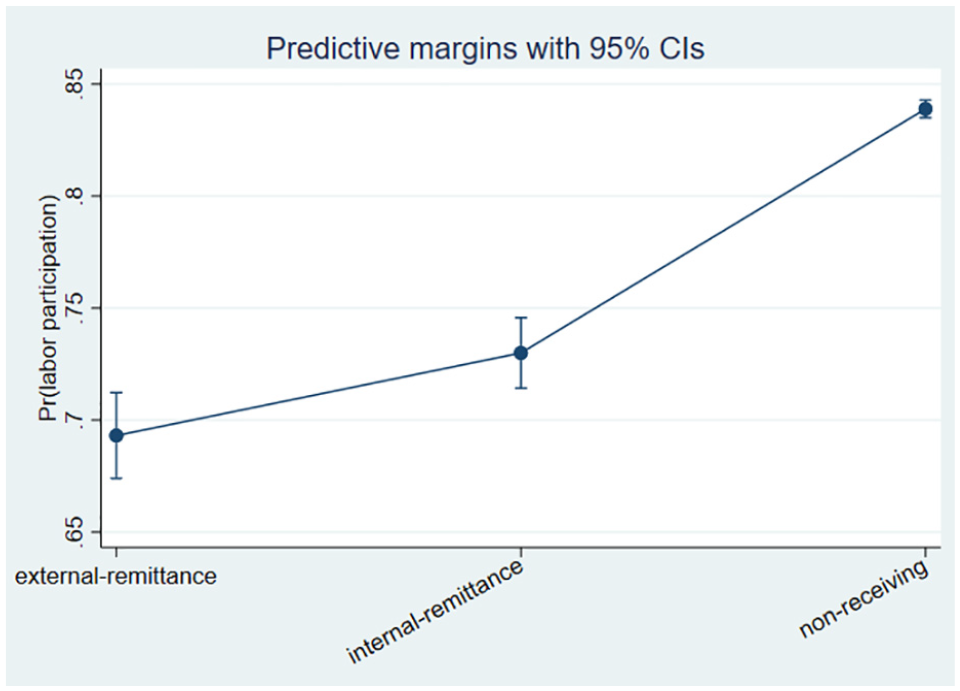
Predicted probability of labor participation across the household.
The negative effect of remittance implies that remittance amplifies the time span for the individual who is not participating in the labor force but to participates in non-market activities or child care. Remittance is a non-labor income, and the presence of non-labor income increases the reservation wage of the individuals, which in turn induces the individual to keep himself/herself out of the labor force. Moreover, it also depicts that remittances allow the household member to remain out of the labor force until he/she gets a flexible job as per his/her taste.
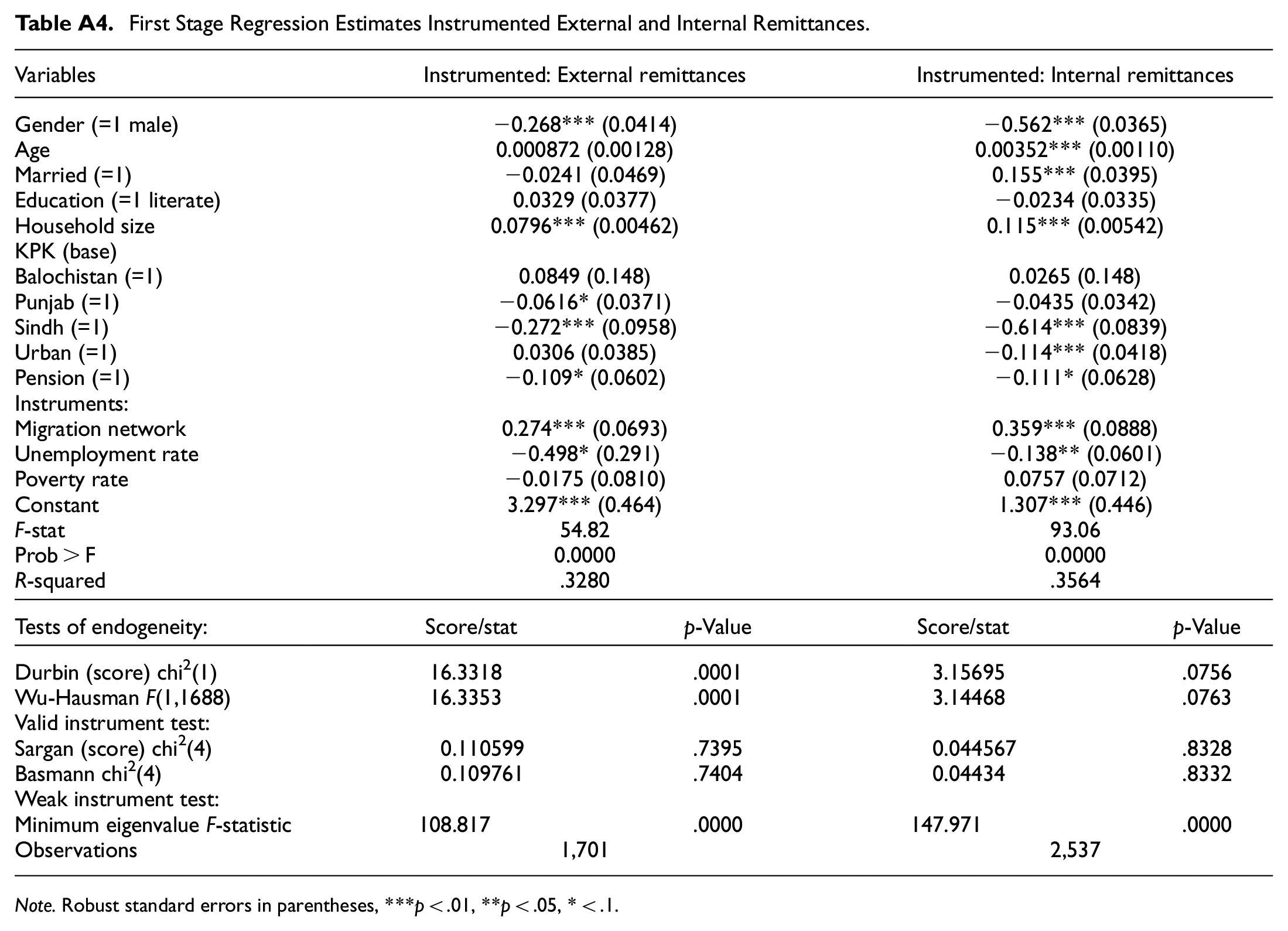
The differential effect of external and internal remittance inflow presented in last two columns (Models 2 & 3) of Table 1 after controlling for potential endogeneity of remittances. The estimates of the first stage are displayed in Table A4, alongside the pre- and post-estimation tests of endogeneity and instruments. The Durbin and Wu-Hausman tests have indicated the potential existence of endogeneity in the remittances under investigation. The Sargan and Basmann test results, which exhibit statistical insignificance, suggest that the instrumental variables under consideration can be considered valid. The observed statistically significant value of the weak instrument test suggests that the given instruments do not exhibit weakness. Moreover, the high value of R-square and statistically significant value of most of the coefficient of instruments also supports the reliability and validity of the instruments.
The study confirms the negative relationship between external and internal remittances and the predicted probability of participating in the labor market. However, it is important to note that when external remittances increase from 7.25 to 9.25 log points, then the likelihood of participating in labor decreases from 95 to 20 percentage points in response to external remittances and 55 to 15 percentage points in response to internal remittances (see Figure 3). The comparative impact of external remittances on the likelihood of labor participation surpasses that of internal remittances. The negative effect of remittances implies that a higher level of remittance inflow significantly softens the budget constraint in the household and induces the individuals of remittance-receiving households to keep himself/herself out of the labor market. Finally, remittances create “disincentive effects” and allow the non-migrant members to participate in “home production” in the absence of participating in the labor market.

Predicted probability of labor participation in response to external and internal remittance inflow.
Remittances and Labor Supply
To estimate the effect of remittance-receipt on individuals’ labor supply, we incorporate the dummy of external, and internal remittance receipts to compare the labor market outcome with the non-receipt individuals. In Table 2 (Model 1), the results suggest that the individuals of internal or external remittance-receiving household supplies have fewer working days than individuals of non-receiving households. However, the negative effect of external remittance receipts is stronger than internal ones. Remittance receipts allow the household members to supply fewer working days and monetary loss due to fewer working days can be compensated with the surplus in household income created by the remittances.
OLS and 2SLS Regression on Effects of Remittances on Labor Supply.

Note. Robust standard errors in parentheses, ***p < .01, **p < .05, *p < .1. Model 1 is based on Equation 10 respectively to test the hypotheses E & F. Model 2 & 3 is based on Equation 10 to test the hypothesis G & H.
The results on the effect of remittance inflow on labor supply are presented in Table 2 (Models 2 & 3). After addressing the potential endogeneity in the remittance inflow, we presented the estimates of the Instrumental variable approach. Although, individuals of remittance-receiving households supply less labor than non-remittance-receiving households. However, the effect of remittance inflow depicts differently. For instance, the coefficient of external remittance inflow depicts that an increase in external remittance is positively associated with labor supply (see Model 2). It implies that a higher level of external and internal remittance inflow may create a “work effect.” The higher amount of external remittances may help in financing the new business project or expanding the existing business, which in turn increases the labor supply of the individuals and an increase in labor supply is aimed to earn more from the business. The phenomenon of the “work effect” resulting from an increase in remittances was not observed in the context of internal remittances.
Remittances and Employment Choices
In this study, we used the multinomial logit (MNL) model to analyze the effect of remittances on preferences toward different employment statuses. We assume that an individual has to choose among three occupational options: self-employed, wage-employed, and farming. Here the dependent variable is coded as 1 for self-employed, 2 for wage-employed, and 3 for farming. We run only one multinomial logit regression to compare the likelihood of an individual to participating in distinct occupations across the household categories. We reported the marginal effects of each regression instead of the odds and relative risk ratios in Table 3.
Remittance-receipt and Employment Categories – Multinomial Logit Regression.

Note.Robust standard errors in parentheses, ***p < .01, **p < .05, * < .1. This table is based on Equation 12 to test the hypotheses I & K.
The aftermath of Table 3 depicts that labor-participating individuals from external remittance-receiving households are more likely to participate in self-employment and farming but less likely to participate in wage-employment than non-remittance-receiving (see Figure 4). In comparison, the positive effect of external remittance receipts on the choice of farming is stronger than self-employment. According to the findings presented in Table A3, it can be observed that a higher level of external remittances is in the household where non-migrant members are associated with the farming occupation than in other occupational categories. The choice of farming gives the following implication. First, farming is also a type of self-employment (see Table A3) in which one can work with flexible working hours. Second, the agriculture sectors of Pakistan possess the untapped potential for higher returns, and a higher level of external remittances may result in advanced technology adoption or even replacement of existing capital stock to absorb the expected returns. Third, agricultural income is exempted from the tax in Pakistan; in this context, the person living abroad realizes the importance of investing in tax exempted sector with his/her foreign experience. Consequently, the migrant will preferably suggest working in the agriculture sector.

Predicted probability for employment categories in non-remittance, external remittance, and internal remittance receipt individual.
The findings suggest that individuals from households receiving internal remittances exhibit a higher likelihood to participate in farming and self-employment activities while displaying a lower likelihood to participate in wage employment than those from households that do not receive remittances.
In order to estimate the differential effect of external remittance inflow on the choice of different occupational categories, we presented in Table 4. After controlling the potential endogeneity of remittances, the results of the multinomial logit model suggest that an increase in external remittance is associated with an increase in the likelihood of self-employment. The effect of external remittance inflow is insignificant for wage employment and farming. The differential effect of remittances suggests that when remittances increase from 7.25 log points to 9.25 log points, the likelihood to participate in self-employment increases from 7% to 20% (see Figure 5). The choice of self-employment in response to a higher level of external remittances gives the following intuition: First, external remittances overcome the credit constraint and allow the household member to commence the business, which can be financed from external remittances. Interestingly, we find strong evidence of higher household income and remittances in the external remittance-receiving households than in other households (see Figure A2). Second, the returns from self-employment are relatively higher than those from paid-employment (Kavuma et al., 2015). Third, self-employment status is relatively more flexible in the context of working hours than the wage employment, in which an individual has to supply the fixed working hour.
Remittance Inflow and Employment Categories – Multinomial Logit Regression.

Note. Robust standard errors in parentheses, ***p < .01, **p < .05, * < .1. This table is based on Equation 12 to test the hypotheses J & L.

Predicted probability for employment categories in response to internal and external remittance inflow.
The results of the multinomial logit model suggest that an increase in internal remittance is associated with an increase in the likelihood to participate in farming and self-employment and a decrease in the likelihood to participate in the wage-employment. The choice of farming in internal remittance-receiving households suggests that farming is a labor-intensive sector requiring a lower level of finance in expansion or commencement. For this purpose, internal remittances may finance the start-up cost and insist that non-migrant members invest in the agriculture sector due to higher returns associated with agricultural production.
Discussion and Conclusion
Discussion
This study aims to examine the effect of external and internal remittances on the labor market outcomes of individuals in Pakistan. The labor participation model estimates strong support to the hypotheses that individuals from external or internal remittance receipts households are less likely to participate in labor vis-à-vis individuals from non-migrant households. Moreover, higher external or internal remittance inflow reduces the likelihood to participate in the labor market. This finding aligns with the study of Kim (2007), Narazani (2009), Nwokoye et al. (2020). The negative impact associated with remittances pertains to the phenomenon wherein receiving such financial transfers enables individuals within a household not actively participating in the labor market to allocate their time and efforts toward nonmarket activities or home production. Furthermore, it is worth noting that remittances have been found to have a disincentive effect. This effect suggests that remittances may prolong inactive labor participation for those already jobless until they get a job based on their tastes and preferences.
The empirical results support to the hypothesis that labor-participating individuals from external or internal remittance-receiving households are supplied less labor than non-receiving households. However, higher external or internal remittance inflow increases the labor supply of labor-participating individuals, supporting the alternative hypotheses G and H. The present outcome is in contrast to the conclusions drawn from previous research conducted by Jadotte (2009), Shair et al.(2023a), and Murakami et al. (2021), wherein they identified a negative correlation between remittances and labor supply. The findings of this study are opposed to the research conducted by Mughal and Makhlouf (2013), which reported no significant association between remittances and labor supply. The observed positive relationship between remittances and labor supply aligns with the conclusions drawn by Posso (2012). The association between higher remittance levels and increased labor supply has been projected to indicate the presence of a work effect within households that receive remittances.
The results also indicate that individuals from remittance-receiving households are more likely to participate in self-employment and farming than wage employment. Likewise, higher external remittance inflow increases the likelihood to participate in self-employment. Whereas individuals of internal remittance-receiving households are more likely to participate in farming, higher internal remittance inflow is also associated with a higher likelihood to participate in farming and self-employment. In short, our analysis supports the fact that the effect of external remittance is more pronounced on labor market outcomes than internal remittances. The preference toward opting the self-employment within households that receive remittances aligns with the findings drawn by previous studies conducted by Mendola and Carletto (2012), Stanley (2015), and Khan and Valatheeswaran (2016).
Theoretical Implication
The findings of this study have significant implications for both theoretical and practical aspects. Concerning its theoretical contribution, this study confirms the usefulness of labor market outcome theories in explaining the influence of non-labor income. According to the reservation wage theory, it has been observed that non-labor income, including remittances, can impact the reservation wage of individuals who are left behind. This, in turn, influences their decision to stay away from participating in the labor market (Killingsworth, 1983). Remittance significantly influences the decision-making process of non-participating individuals, leading them to prioritize leisure (nonmarket activities) over work. The phenomenon of heightened consumption of leisure activities can be attributed to the fact that remittances, serving as a form of non-labor income, alleviate the budgetary constraints faced by individuals (Jadotte, 2009).
This study aims to build upon previous research conducted within the framework of the neoclassical model of labor-leisure choice. Specifically, it seeks to explore the relationship between remittances and labor supply. The positive relationship between remittances and the labor supply implies that as remittances increase, labor-participating individuals tend to allocate less time to leisure activities, as leisure is considered an inferior good (Borjas, 2013, p. 36). Remittances have the potential to stimulate significant capital investments. Remittances can alleviate the credit constraints experienced by households that do not have access to formal financial markets. This, in turn, can enable these households to accumulate assets and invest in various businesses such as land, tools, and new businesses (Aggarwal et al., 2006). Additionally, in accordance with the theory of occupational choice (Blanchflower & Oswald, 1998), the availability of higher remittances has been found to influence individuals’ decision to pursue self-employment as a means to finance the start-up costs of a new business or to support the growth of an existing one.
Practical Implication
A straightforward implication of the study is related to the reallocation of labor. Remittances support self-employment status because external remittances soften the financial constraint. However, relevant stakeholders need to channel the remittance inflow into industry-based business start-ups to serve the effect of remittances as job creators. The higher level of remittances supports self-employment, which can increase the entrepreneurial activities in remittance-receiving households. Similarly, the higher level of remittances supports the higher labor supply, accelerating the “work effect” of remittances. For this purpose, steps need to undertake by the government to raise the level of remittances by exporting skilled labor. Moreover, technological advances in agriculture may result in higher productivity, increasing investment opportunities in agriculture because internal remittances support employment in the agriculture sector. Finally, researchers need to evaluate the effect of remittance as labor market hassles due to lack of labor participation.
Limitations and Future Research Direction
The primary constraint encountered in this study pertains to the availability of the data set derived from the PSLM–HIES for the period spanning 2018 to 2019. Furthermore, it is essential to note that within the survey, as mentioned earlier, a significant limitation arises from the absence of various labor market variables such as experience, job training, and other fringe benefits. The potential limitation arises due to the inadequate definition of variables pertaining to various labor market variables. For instance, the labor supply is typically measured in terms of working hours rather than working days, while in the survey, working days were mentioned. Furthermore, the survey includes inquiries about the monthly remittance amounts, the name of the host country, and the preferred channel for receiving remittances. However, data regarding the characteristics of the migrants is not available.
Numerous potential avenues for future investigation exist. Investigating the non-linear impact of remittances on labor market outcomes presents an opportunity to uncover interesting facts regarding the specific threshold level at which remittances exert their influence. An additional investigation could be conducted to examine the impact of remittances on labor market outcomes at the household level rather than focusing solely on individual outcomes. For instance, the inquiry examines the average labor participation and labor supply of households. Finally, if data is available on the traits of migrants, scholars may incorporate the characteristics of migrants within the context of labor market outcomes for left-behind individuals.
Footnotes
Appendix
First Stage Regression Estimates Instrumented External and Internal Remittances.
| Variables | Instrumented: External remittances | Instrumented: Internal remittances | ||
|---|---|---|---|---|
| Gender (=1 male) | −0.268*** (0.0414) | −0.562*** (0.0365) | ||
| Age | 0.000872 (0.00128) | 0.00352*** (0.00110) | ||
| Married (=1) | −0.0241 (0.0469) | 0.155*** (0.0395) | ||
| Education (=1 literate) | 0.0329 (0.0377) | −0.0234 (0.0335) | ||
| Household size | 0.0796*** (0.00462) | 0.115*** (0.00542) | ||
| KPK (base) | ||||
| Balochistan (=1) | 0.0849 (0.148) | 0.0265 (0.148) | ||
| Punjab (=1) | −0.0616* (0.0371) | −0.0435 (0.0342) | ||
| Sindh (=1) | −0.272*** (0.0958) | −0.614*** (0.0839) | ||
| Urban (=1) | 0.0306 (0.0385) | −0.114*** (0.0418) | ||
| Pension (=1) | −0.109* (0.0602) | −0.111* (0.0628) | ||
| Instruments: | ||||
| Migration network | 0.274*** (0.0693) | 0.359*** (0.0888) | ||
| Unemployment rate | −0.498* (0.291) | −0.138** (0.0601) | ||
| Poverty rate | −0.0175 (0.0810) | 0.0757 (0.0712) | ||
| Constant | 3.297*** (0.464) | 1.307*** (0.446) | ||
| F-stat | 54.82 | 93.06 | ||
| Prob > F | 0.0000 | 0.0000 | ||
| R-squared | .3280 | .3564 | ||
| Tests of endogeneity: | Score/stat | p-Value | Score/stat | p-Value |
| Durbin (score) chi2(1) | 16.3318 | .0001 | 3.15695 | .0756 |
| Wu-Hausman F(1,1688) | 16.3353 | .0001 | 3.14468 | .0763 |
| Valid instrument test: | ||||
| Sargan (score) chi2(4) | 0.110599 | .7395 | 0.044567 | .8328 |
| Basmann chi2(4) | 0.109761 | .7404 | 0.04434 | .8332 |
| Weak instrument test: | ||||
| Minimum eigenvalue F-statistic | 108.817 | .0000 | 147.971 | .0000 |
| Observations | 1,701 | 2,537 | ||
Note. Robust standard errors in parentheses, ***p < .01, **p < .05, * < .1.
Acknowledgements
We extend our sincere gratitude to Ms. Farhat Rasul for her invaluable assistance in developing the econometric modeling. Her expertise and dedication were instrumental in enhancing the accuracy and effectiveness of our analytical frameworks.
Declaration of Conflicting Interests
The author(s) declared no potential conflicts of interest with respect to the research, authorship, and/or publication of this article.
Funding
The author(s) received no financial support for the research, authorship, and/or publication of this article.
