




Abstract
The COVID-19 pandemic has impacted on the ways in which academics engage in their work, with many unique demands, anxieties, and pressures placed on them. Adjustments to the work and home lives have been made as a result. I explored how Western Australian academics experienced working in higher education during the COVID-19 pandemic. 11 participants were interviewed, and data was analyzed using reflexive thematic analysis. Findings illustrated (1) how Western Australian academics initially reacted to the building COVID-19 concern, and its impacts on higher education, (2) the ways in which Western Australian academics responded to the daily changes, and (3) the lessons learned from the pandemic to assist academics moving forward. Overall, the findings of this study contribute to a growing body of literature on the impact of the COVID-19 pandemic on higher education and provide important insights into the experiences of Western Australian academics.
Introduction
The Coronavirus 2019 (COVID-19) pandemic has profoundly impacted many industries across the world, including the university sector. On the 1st of April 2020, many schools and higher education institutions were closed worldwide, with 185 countries reporting closure which impacted more than 1.5 billion, or 89.4%, of all enrolled learners (United Nations Educational, Scientific, and Cultural Organisation, 2020). Higher education institutions, such as universities, have had to manage the closing of campuses, as well as the rapid shifting of teaching and learning online, which have severely influenced the capacity for academics to engage in their research and teaching responsibilities (Tang, 2023). While the significant interruption of academic work has been noted (particularly by those who engage in practical work), teaching and learning has been severely disrupted due to the quarantining and social isolation measures undertaken by countries worldwide, as well as the adaption of online forms of pedagogy (Oranga & Matere, 2022). Academics worldwide rose to the challenge of working online and remotely, with most transitioning within as little as days to working via digital means. Intended to be provisional practices, the quick responses have had damaging impacts on higher education institutions’ primary operations of research and teaching (Watermeyer, Crick et al., 2021; Watermeyer, Shankar et al., 2021). While noting there were variations across contexts, the impacts include over half of scientific research projects possibly not being completed, as well as a reduction in enrollments and the associated financial effects, globally (Bender et al., 2022).
Compared to other countries worldwide, Australia fared better in relation to the pandemic spread, with 11,238,924 cases and 16, 679 deaths from COVID-19 to the date of submitting this article (World Health Organisation [WHO], 2023a), out of a total population of 26,263,229 (Australian Bureau of Statistics, 2022). This can be compared to 100,304,472 cases in the United States of America (USA) and 1,088,854 deaths (WHO, 2023a), out of a total population of 331,002,651 (Worldometer, 2023), as well as 24,243,393 cases in the United Kingdom (UK), with 202,157 deaths (WHO, 2023a), out of 67,886,011 total population (Worldometer, 2023). In Australia, the first case of COVID-19 was confirmed on the 25th of January 2020, and by March, many higher education institutions began implementing remote and online working (Moodie, 2020). The consensus across the Australian States and Territories regarding Australia’s comparative success during the pandemic is the zero-tolerance response to COVID-19, which has been evidenced by the extended border closures (e.g., Western Australia [WA]) and extended lockdowns (e.g., Melbourne; Berger & Reupert, 2020). Neighbors to Australia, such as New Zealand and Thailand, have shared this approach, which diverges Australia from the context and experience of the United Kingdom, mainland Europe, and the United States of America (Crabb & Toole, 2021).
The Australian Context
The higher education sector in Australia consists of 43 universities, where government funding is complicated, and as such, has endured substantial cuts in recent years (Norton & Cakitaki, 2016). As a sector, it has endured intervention and reform from the neoliberalist, marketised practices, aligned with other jurisdictions, such as the UK (Norton & Cakitaki, 2016). Such intervention and reform have perpetuated the economic and instrumentalist rationalization of universities as a breeding place of workplace talent, and operators of the knowledge economy (Apple, 2017; Davies & Bansel, 2007; Lakes & Carter, 2011). Neoliberalisation here refers to the existential crisis that has consumed higher education institutions, and the education sector more broadly, since the 1980s, and militarized their revolution from impartial public institutions to market players that mimic the corporate character and fundamentals of the market as entities of the private sector (Apple, 2017; Davies & Bansel, 2007; Lakes & Carter, 2011). Such widespread practices which are considered as a prestige economy of higher education that focuses on the procurement and exploitation of positional goods, have propagated labor-based changes in Australian universities (Apple, 2017; Davies & Bansel, 2007; Lakes & Carter, 2011). Alongside these concerns of governance within the academic sector is the questioning of how Australian higher education institutions justify and explain the salaries of vice-chancellors, which in 2019, averaged 1,000,000 dollars (Guthrie, 2022).
With most Australian universities being publicly funded and, consequently, publicly accountable, quasi market organizations, aim to convince others of their societal relevance and value to secure public support via an ethos of performance management that is consistently disciplinary and dogmatic, and thrives on an audit culture of surveillance that challenges academics’ autonomy (Welch, 2022). Consequentially, this has neglected the concerns of both the personal and professional wellbeing of academics, rather, the focus is on managerialist aspirations for outputs and competitive accountability (Apple, 2017; Davies & Bansel, 2007; Lakes & Carter, 2011). Trends have been observed surrounding the intensification, casualization, and precarity of work which have not been checked or evaluated, in conjunction with the increase of new managerialism (Apple, 2017; Davies & Bansel, 2007; Lakes & Carter, 2011). While the working conditions of academics have diminished at a rate equal to the weakening of the public authority of Australian universities, it is clear the damage of the neoliberal agenda for academia to academics’ well-being (particularly during the COVID-19 pandemic) has intensified with a similar carelessness and ease (Oranga & Matere, 2022). Considering this, the Australian higher education sector now finds itself in a precarious position, part public institution, part corporation, wedged between declining government expenditures and increasing institutional uncertainties within these quasi-market conditions (Norton & Cakitaki, 2016).
Before the COVID-19 pandemic, the higher education sector in Australia encountered substantial issues as it had become progressively more complicated, diverse, internationally reliant, and financially challenged, while also experiencing the distrust of the mainstream media (Welch, 2022). The COVID-19 pandemic has only perpetuated and intensified the vulnerability of the institution’s financial management, as well as additionally revealing the weakness of the dominant business model, as travel and societal restrictions have affected the practicability of service offerings, particularly for international students (Harman, 2005; Meiras, 2004). The expanding internationalization of the higher education sector, as well as the expansion of Australian degrees as a significant export, is far from a recent phenomenon (Harman, 2005; Meiras, 2004). Reflective of the Australian government, and university marketization methods to international students, in 2019, it was estimated that international education was worth A$40.4 billion, which makes it Australia’s fourth-largest export after iron ore, coal, and gas (Ross, 2020). While the statistics illustrated the impact of international education, paradoxically, the Australian federal government neglected to set up specific support for these students during the COVID-19 pandemic, with the Prime Minister advising international students to return to their home country if they could not fund their education (Nguyen & Balakrishnan, 2020). International students expressed feeling as if they were an unnecessary burden to Australia in response to this advice (Nguyen & Balakrishnan, 2020).
Concerns were further evidenced surrounding the Australian federal government’s broader neglect of the academic workforce during the COVID-19 pandemic, and discussions surrounding individual’s eligibility for JobKeeper (Blackmore, 2020). JobKeeper was an initiative developed to reduce the economic shock of COVID-19, with a $130 billion wage subsidy announced, but the thresholds for this scheme excluded most universities (Blackmore, 2020). While the government clarified a lower threshold to allow other organizations to benefit (such as charities), they then revised the conditions stating that JobKeeper did not apply to universities, and those who worked within the university sector (Blackmore, 2020). Many universities and academics provided evidence that they met the announced thresholds, but with the introducing of further changes to JobKeeper, it was evident that the Australian government was excluding academic staff from receiving financial support, despite there being an estimated 21,000 job losses across the higher education sector (Littleton & Stanford, 2021).
Living in the “Bubble”: Reflecting on the Western Australian Context
Reflecting on the outbreaks of COVID-19 across all Australian states and territories, WA has had the most contained, with the state accounting for only 11.35% of Australia’s total cases as of January 2023 (Government of Western Australia, 2023). Responses to COVID-19 implemented in March 2020 within the WA context included restricting (1) overseas travelers returning to Australia, and (2) being able to move between states, as well as reducing the size of social gatherings (WHO, 2023b). For the most part, at this time, this resulted in the broad containment of the transmission of COVID-19. This can be attributed to the unique geography of the state, which separates WA from other neighboring countries, as well as the capital city of Perth being 2,000 km from the nearest capital city (Oosthuizen et al., 2022). Such isolation allowed for the state and national borders to be shut easily and prevented the occurrence of a significant outbreak (which was anticipated based on the initial surge in cases from international travelers; Oosthuizen et al., 2022; N. Phillips, 2021). Further to this, the broad mass of land and smaller population (compared to other states) has reduced the population density of WA, which has most likely contributed to the consistently low transmission rates of COVID-19 in WA (Government of Western Australia, 2023). While there has been an intermittent implementation of restrictions to suppress outbreaks of COVID-19 in other Australian states, WA has been fortunate enough to avoid any lengthy lockdown periods (N. Phillips, 2021).
Despite the containing of the outbreak for the most part in WA, this did not mitigate the significant changes that consequentially occurred in the higher education sector, for example, changes in the delivery of teaching and learning, with the methods used dependent on the restrictions that were imposed in each jurisdiction (Nash & Churchill, 2020). In April 2020 within the WA context, the government shut its borders to both interstate and international travelers (Oosthuizen et al., 2022). While the closure of the borders remained throughout most of the year, higher education institutions had to revise their typical learning and teaching materials, activities, and assessment processes in a matter of weeks as a result of transferring everything online (Oranga & Matere, 2022).
Research Significance
The global impact of the COVID-19 pandemic has profoundly affected various sectors, including higher education, with abrupt closures, online teaching shifts, and research disruptions posing challenges for academics (Tang, 2023). My research aimed to focus on three core problems arising from these circumstances. Firstly, considering how the pandemic’s abrupt changes have disrupted academic work, considering the raised concerns of the quality of online teaching and research. Secondly, how the rapid transition to remote work could have threatened the academics’ well-being and work-life balance, which may have exacerbated existing mental health challenges. Lastly, considering the pandemic and how it has underscored the necessity for adaptable institutional strategies to support academics effectively. The study’s significance lies in its response to unprecedented challenges faced by academics, offering insights into how the pandemic has affected academic work, well-being, and institutional responses. The unique Western Australian context, marked by distinct funding structures and neoliberal influences, further magnifies the research’s importance. Existing gaps encompass limited contextual understanding within specific geographic and institutional contexts, the impact of the pandemic’s intersection with neoliberalism, and insufficient exploration of academic well-being during this time. My research aimed to bridge these gaps by investigating Western Australian academics’ experiences during the pandemic, ultimately contributing to a comprehensive understanding of challenges, institutional responses, and broader implications for higher education.
Such research exploring the experiences of Western Australian academics within the higher education landscape during the COVID-19 pandemic can offer multifaceted contributions to knowledge and practice. By providing a localized understanding of the impacts of the pandemic, my research can elucidate the unique challenges and responses within the region, to aid in future crisis management strategies. Insight into academics’ well-being can help shed light on the mental health ramifications of online work, and disrupted routines. Examination of institutional adaptations can highlight some of the effective approaches for navigating abrupt transitions to online teaching, research, and support for academics. Dissecting the interplay between the pre-existing neoliberal practices and pandemic disruptions can reveal the impacts on Western Australian academics. Additionally, offered strategies for work-life balance drawn from the research could provide practical guidance, and policy recommendations to inform discussions on supporting academic staff during crises. The current study also could assist in informing ongoing debates surrounding the future of online higher education and the transformation of the higher education context. Such analyses broaden perspectives and identify best practices to add to such exploration in different contexts, collectively underpinning the study’s potential to drive meaningful change in academia and policy domains.
As such, this article reports on the findings from
Following this literature review, the following sections of the article will detail my research approach, methodology, data collection procedures, and analysis techniques, culminating in a comprehensive exploration of the multifaceted experiences of Western Australian academics working in higher education during the COVID-19 pandemic, noted as a period of disruption and transformation. The Discussion section contextualizes and interprets the findings within the broader framework of higher education and the pandemic’s impact, offering insights and implications for the field.
Method
Research Design
The study adopted an exploratory, qualitative research design, with the data collected using semi-structured interviews conducted with Western Australian academics and analyzed via an inductive reflexive thematic analysis. Using this design allowed for the in-depth exploration of the participants’ experiences, and co-construction of themes developed between the researcher and the participants sentiments. The research was informed by a social constructionist epistemology, which allows for appropriate acknowledgment of the wide-ranging accounts of experiences depicted in the dataset and provides explanation as to how these experiences and associated impacts can be perceived differently both across participants, and by the other individuals referred to within participants’ stories (Burr, 1995; Phillips, 2023).
Researcher Positionality
I acknowledge that my positioning and experiences within Australian public higher education have informed how I approached and designed this research project. As such, it was crucial that I endeavored to maintain a reflexive position, and to locate myself within the research process. This was considered as an ongoing process. I identify as an Anglo-Australian, Cis-gender male, within the LGBTIQA+ identity, and an early-career academic in a teaching-research role. I recognize that my positionality represents some forms of diversity, however, replicates some of the most common identities in academia, those being, white, cis-gender, and male. As such, it was important to consider the particular privileges attached to my identities, to ensure that I attended to this influence and acknowledged my privilege in conducting this research. Throughout my research, I ensured to use a pragmatic approach to assist in dealing with these tensions and found engaging in reflexivity to be a core strategy to maintain rigor and authenticity within the findings. I acknowledge the importance of reflexive practice to explore, and be aware of, how my positioning may influence the research process, design decisions, and interpretation of findings.
Participants
Participants were academics who were currently employed by a Western Australian university, in a teaching, research, and/or service role, from any faculty. Additionally, the participants had to have been working in academia for a minimum of 1 year before the COVID-19 pandemic occurred, as well as having some form of engagement with students at their respective university through their role(s). The inclusion criteria were kept broad based on the exploratory nature of the study. In recruiting the participants, purposive and convenience sampling was employed, where the researcher’s judgment was used to determine the sample that would provide the most insight on the phenomenon being explored (Andrade, 2021). This sampling method is well suited to qualitative research due to its intentional and strategic selection of participants, which aligns with the goal of delving into phenomena, contexts, and experiences that are specific to the chosen population (Andrade, 2021). This can ensure that the collected data is meaningful, rich, and directly aligned with the study’s objectives. Flyers were placed on university campuses, targeting communal areas for staff, as well as emails being sent to academic professional connections, as forms of participant recruitment.
The sampling strategy and size was determined based on the principle of information power, where the more information that the sample held relevant to the research question, the smaller the required sample size (Malterud et al., 2016). Following Malterud et al. (2016), in this study, sufficient information power was achieved, dependent on the aim of the study (being very specific), the use of established theory, sample specificity (only academics from Western Australian higher education institutions), quality of dialog (evident in the fluency of the researchers during the interview, evidence of prompting and expanding on the dialog provided by participants, as well as the participants being experts on their experiences), and analysis strategy. In total, 11 participants took part in the study, with 81.8% identifying as female, and 18.2% as male. Participants ranged in age from 24 to 61 years (M = 41.55, SD = 9.8). The full range of demographic information collected is provided in Table 1.
Participant Demographic Information.
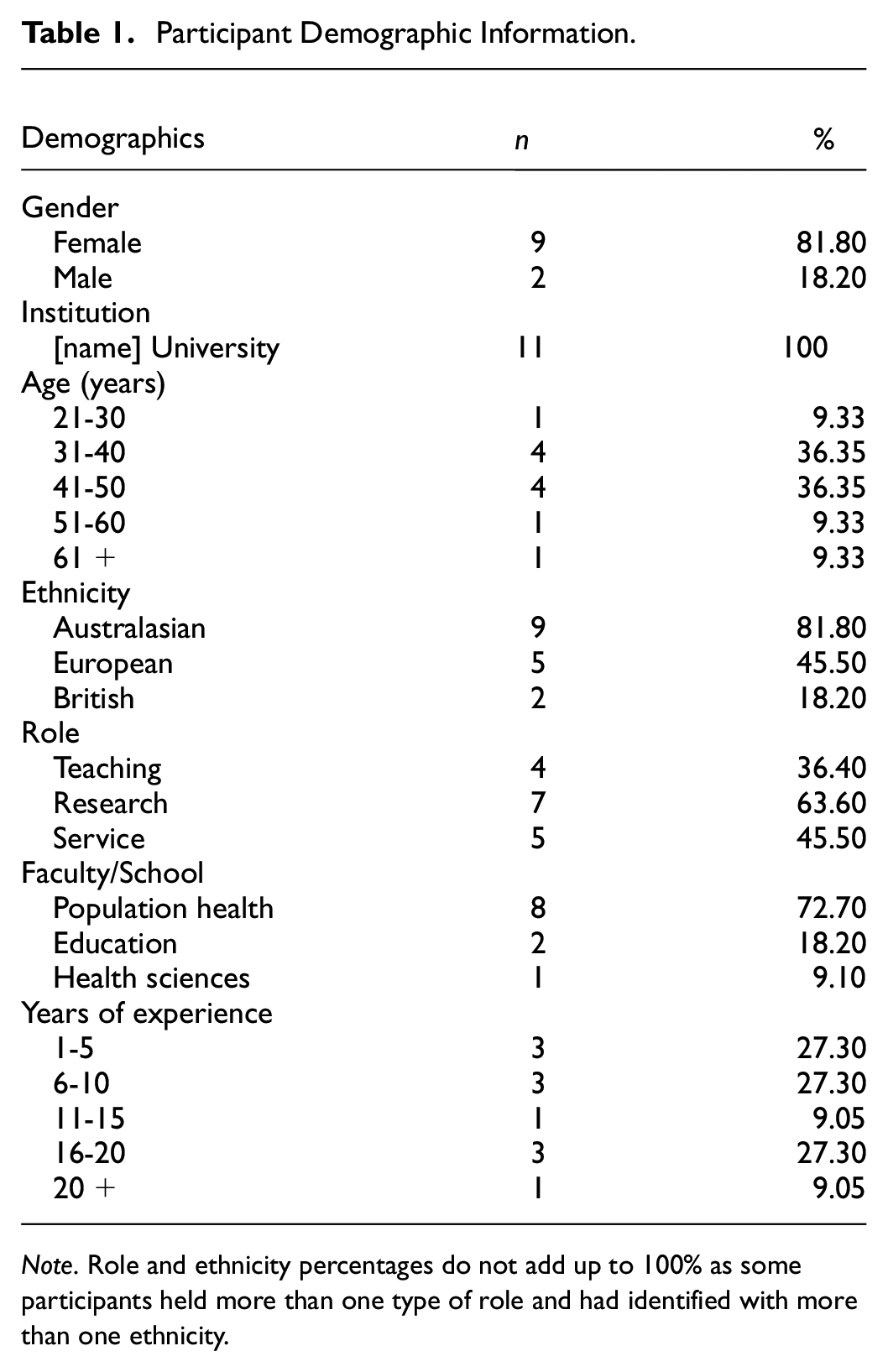
Note. Role and ethnicity percentages do not add up to 100% as some participants held more than one type of role and had identified with more than one ethnicity.
Materials
A semi-structured interview guide was constructed which provided broad topics and questions to cover throughout the interviews, whilst also allowing for opportunities to prompt and probe for further depth (Morrow, 2005; Ravenek & Rudman, 2013; Ryan et al., 2007). This was to allow for a more detailed exploration of the participants’ experiences. Using the semi-structured guide allowed for active engagement and communication with the participants, as well as providing opportunities for rapport building (Morrow, 2005; Ravenek & Rudman, 2013; Ryan et al., 2007). The semi-structured interview guide was developed in consultation with the research team, with the overarching purpose to allow for the exploring of Western Australian academics’ experiences in higher education during the COVID-19 pandemic. Thirteen interview questions were developed, with additional probing questions to explore content in further depth. Example questions included: “As an academic, what kind of challenges did you face in relation to your work during the COVID-19 pandemic?” and “What policies or guidelines were available to assist you as an academic during the pandemic?.” The guide allowed for an interview of 60 minutes in duration.
A demographic questionnaire was also developed to obtain data on the demographics of the participants to be reported in the final write-up. Data collected included age, gender, preferred pronouns, years of experience as an academic, current school/faculty, current institution, current job position, ethnicity, and the state they currently reside in. Participants were asked to complete the demographic questionnaire before the interview. Participants were also provided the option to return the form blank if they did not wish to provide this information. The demographic questionnaire responses were not linked to participants interview transcripts. All participants completed the demographic questionnaire.
Procedure
After receiving ethical approval from the Curtin University Human Research Ethics Committee (Approval Number HRE2022-0341), individuals were invited to participate through flyers circulated via email to those who were interested, recruitment emails sent after navigating staff directories, word-of-mouth through academic staff, and snowball sampling. Interested individuals were provided via email with a participant information sheet and consent form, which, in detail, outlined the focus of the study, the participants’ rights, and how the data collected would be used. My research group scheduled with the participants a mutually convenient time, location, and platform for the interview.
Informed consent was obtained from the participants verbally in the interview, and formally with the content form returned via email. Participants provided me with their completed demographic questionnaire. Participants were also informed that any information collected as a part of my research would remain confidential, and that their identity would be protected within the final write-up. Following informed consent, the interview commenced, and on average, most interviews were approximately 1 hour in duration, but ranged from 30 to 90 minutes in length. At the end of the interview, participants were provided with a verbal summary of their interview and asked if they wished to add any additional information to what had been shared.
The audio recordings were transcribed verbatim with the completion of each interview, where any identifying information was removed and replaced with either a pseudonym, or a placeholder (e.g., [participant’s name]). The transcripts were printed and analyzed via the paper/pen method, using reflexive thematic analysis (Braun & Clarke, 2006, 2019, 2021). Interviewing, transcription, and analysis were completed as an iterative process, where I moved through the phases repeatedly as I needed to, coming closer to the end process through continual engagement.
Data Analysis and Quality Procedures
An inductive, reflexive, thematic analysis was adopted, as outlined by Braun and Clarke (2006, 2019, 2021). Rather than being grounded in any pre-existing schema, framework, model, and/or theory, this analysis allowed for the description of the lived experiences of academics, as well as the factors which underpinned, influenced, and contextualized their experienced in academia during the COVID-19 pandemic. I became immersed in the data by listening to the audio recordings and engaging in transcription. Then, illustrative of both semantic and latent content, initial coding was inductively constructed and engaged in. Secondary coding followed, where the inductive organisation of codes into broad categories by collating data that was related occurred, which allowed for the development of unique themes. These themes were continually reviewed and revised, finalized, labeled, and defined, with the findings provided in the next section using in-depth descriptions and relevant quotes to capture their meaning.
To enhance the quality and trustworthiness of the study, multiple quality procedures were adopted. First, the semi-structured interview guide was inspected and then pilot tested before data collection to aid the quality procedure process, ensure it was appropriate for addressing the overarching research question, and to address any areas which could be revised in the interview questioning (Majid et al., 2017). Additionally, a reflexive journal was kept as a way of engaging in reflexivity, to continually reflect and process the interviews, as well as making note of, and keeping an audit trail, of any relevant information that informed the analysis (Morrow, 2005; Yardley, 2017). Finally, after all interviews had been collected and analyzed, participants were invited to “opt-in” to engage in member checking. This is where a summary was sent to the participants of the key collated messages of the research, to allow the participants to provide feedback on the fairness and accuracy of the interpretations and allow for the addition of additional reflections to the research (Locke & Velamuri, 1999).
Findings
Three overarching themes exploring Western Australian academics’ experiences working in higher education during the COVID-19 pandemic were constructed. Whilst each of the academics’ experiences were unique, there were also commonalities across experiences. These constructed understandings are presented in the following themes: (1) “Here We Go…”: The Building COVID-19 Concern, (2) “React and Adapt”: Responding to the COVID-19 Pandemic in Higher Education, and (3) “So, What Now?”: Lessons Learned from the COVID-19 Pandemic in Higher Education. These themes are displayed visually in a thematic map (see Figure 1) and are described in further detail below. Participant quotations are identified by participant numbers (e.g., [01] refers to a quote provided by Participant 1).

Thematic map depicting the themes constructed from Western Australian academics’ experiences in higher education during the COVID-19 pandemic.
“Here We Go…”: The Building COVID-19 Concern
For Western Australian academics, the initial reaction to the COVID-19 pandemic was multifaceted and complex. Participants suggested a growing concern about the pandemic, and how it may impact on their various roles and circumstances, stating that the initial experience was of interest, conceptualizing the experience of a pandemic as novel: “We had never had something like this [the pandemic] before, so I was interested in how it was gonna play out. Was it going to impact my work life? My home life? We just didn’t know” [04]. Participants noted while they were aware of the virus and its potential impact, the extent of the threat it posed to their daily lives (both work and home circumstances) was viewed as limited: “We [society] understood it was a virus, and it could be dangerous, but we hadn’t seen its impact yet, so we didn’t think it would affect us” [06]. As time progressed, participants acknowledged how the impact of the pandemic grew in severity, becoming highly challenging and disruptive to the daily operations of higher education:
I just started paying attention and as more information about it [the pandemic] came out, I just started to like, get a little bit concerned and just be like “ooh, what’s going to happen here” and how are we going to manage in academia. So, I was kind of aware, my awareness kind of increased over time and obviously when it happened, I was like okay, here we go. [01]
Challenges were then experienced in terms of the practicalities of teaching and research, the growing awareness of the systemic inequities in higher education, and society more broadly, as well as the significant emotional and psychological strain that began to be experienced: “…trying to figure out how to adapt your teaching, conduct your research, do we have the technology and resources available, alongside how it’s impacting on my health and well-being navigating the uncertainty” [09].
Participants had to navigate with a range of professional challenges, where they quickly adapted to the ever-changing public health restrictions and guidelines, which often resulted in sudden shifts to remote teaching and research:
All of a sudden, based on the restrictions, we [academics] were told we had to work from home, and we were isolated from everyone. We got told we had to shift our teaching to online, and no one knew how to manage their research projects yet. It was a shit show, basically. [05]
Academics were forced to develop new strategies and skills rapidly for teaching and communicating online, often with little support and adequate resources provided: “We [academics] were forced to find new ways to deliver in our multiple academic roles, with little support, and a lack of resources. Everyone was in the same boat, flailing about)…” [02]. Additionally, many research projects and funding were initially delayed, and eventually canceled, because of the pandemic: “I was told first that my research would need amending, to be COVID safe. Then, I was told it was too risky, and put on hold. After that, I was told I couldn’t conduct my research right now” [08]. Many of the participants acknowledged becoming aware of the impact of these issues on their students, as well as their colleagues, and in the initial stages of the pandemic, worked tirelessly to support and advocate for those most affected:
I saw it when communicating with my students, and my colleagues. People were stressed. They didn’t know how to react, how to respond. We were trying to navigate the uncertainty, while at the same time, work to assist those who needed it most. We were putting on a front, faking it until we made it. Our students thought we had it all together, but really, we didn’t. [11]
In addition to the professional challenges, academics faced significant psychological and emotional stress, particularly during the early months of the pandemic, where increasing levels of concern and anxiety were acknowledged. Some of the participants were concerned about contracting the virus, and how it may impact their health and well-being. Further, the increasing case numbers and mortality rates were a constant source of anxiety and fear, with concerns surrounding the safety and health of themselves and their loved ones noted: “While the rates remained fairly low in Western Australia, we saw the case numbers increase world-wide. We were protected in a sense, but it didn’t stop the anxiety and fear, like I was so scared” [11]. Additionally, the participants expressed concerns surrounding the impact, and long-term implications, of the pandemic, for their profession, higher education, and society more broadly: “We had no idea of how this virus would impact us. It wasn’t only at work, we had to consider the impacts on our home, our loved ones, our own well-being, society as a whole. It was overwhelming” [06]. As such, experiences of stress, anxiety, feeling overwhelmed, isolated, and disconnected were acknowledged by the participants on the building concerns of COVID-19, and the uncertainty that it brought: “I’ve never in my life felt so constantly anxious, stressed, isolated from my family, friends, and colleagues. I would just sit at home and cry because I was feeling all these emotions at once. It was too much” [03].
Within the early stages of the COVID-19 pandemic, participants acknowledged how it forced them to confront the systemic inequalities, both in higher education, and society more broadly. For example, many participants recognized how they, as well as other academics, and their students, lacked access to suitable resources and technology, which made the initial stages of the pandemic more difficult: “We were being told to make certain changes because of the pandemic, and to provide further support to our students, but we weren’t given the resources and time to do so. The students felt it too” [09]. Inequalities in access to resources and technology, funding constraints, and precarious working contracts and employment conditions were all suggested as pre-existing issues that were exacerbated by the presence of the pandemic. Further, participants acknowledged how in the initial stages of the pandemic, the existing disparities in access to healthcare, economic opportunities, and technology were also exacerbated, with an acknowledgment of how this impacted both their colleagues, and their students:
Some schools had better funding, resources, technology, compared to others. Some relied more on their sessionals than others. We were overworked, and underpaid, but these weren’t necessarily new issues. COVID just made the shit we go through more obvious. We saw it outside of academia as well. Individuals who had access to better healthcare, job opportunities, the latest technology, all groups with more money, and a level of privilege not afforded to those who were struggling. It impacted us, and it impacted our students. It was a societal thing. [01]
Overall, the initial stages of the COVID-19 pandemic were a period of uncertainty, stress, and intense disruption for participants. Many experienced professional challenges, personal health, and safety concerns, and acknowledged the wider societal impacts of the virus. Despite these challenges, participants acknowledged ways in which they developed novel, innovative methods of teaching, research, and administration, providing further support to their students and colleagues, and contributed to efforts that addressed the pandemic’s impact on society.
“React and Adapt:” Responding to the COVID-19 Pandemic in Higher Education
Many Western Australian academics responded to the COVID-19 pandemic in many ways, dependent on their role and the nature of their work. First, the participants identified how moving to remote means of learning was challenging, particularly those who were more attuned to face-to-face methods. Significant adjustments were made which included “…adapting to novel and new teaching methods” [04], “…mastering new technologies” [07], and “…finding ways to engage students” [08]. The primary challenge most discussed by participants was the adapting of their teaching methods to suit an online context, where it was acknowledged that the traditional lecture-style teaching was not as effective, and new ways to engage students were required. New technologies were adopted, including “Blackboard Collaborate” [01], which assisted in creating interactive learning experiences that could be delivered remotely, although participants did suggest adopting these systems came with its own set of issues: “I had to learn how to use these new online systems quickly…found out we were moving online at 10pm Monday, and I had an online class at 8am Tuesday. Talk about being on your toes!” [11]. Having to adopt new technologies and ways of doing meant that participants had to engage in additional training and support, which was often self-guided, and up to the academic to participate in: “You had all these websites and assistance manuals and guidelines, but it was all self-directed. It was the blind leading the blind” [08].
With the adopting of new method to engage students, participants admitted how finding new ways to build and maintain their relationships with students was difficult: “It was like talking to dead air. No student wanted to engage. We had to find new ways to get their attention” [03]. Novel ways to provide feedback, offer support, and build a sense of community, were suggested as important:
I would have weekly check-ins, so a time outside of the scheduled class time, where the students could come along, and talk about their days, show us their pets, what they’ve been cooking, what Netflix show were they watching, just little things to promote and foster communication and interaction. Community, my god it was really important. [04]
Despite these challenges, the participants could reflect on the experience of adapting to the pandemic, offering a positive reflection on how the remote nature of teaching allowed more flexibility, exploring of new teaching methods, and engaging with others in innovative ways. As such, the multifaceted experience here illustrates the challenge of adapting to the pandemic, but the opportunity to adapt and innovate in response to a rapidly changing environment:
I mean would I want to go through it again…no, but consider what we were able to do. It made us reflect on the nature of higher education and how we engage with our students. How we teach, how we provide feedback. It made me consider the nature of my work and my job, my responsibilities, trying to get some balance back in my life, and realising that if I take a little longer to get things done, it’s not the end of the world. We did well, with what we had, to make things as good as they could be. [07]
Not only did the participants have to adapt their teaching methods, but the conducting of research was altered due to the pandemic. This varied dependent on the nature of the research, and the extent to which it relied on face-to-face interactions, and/or travel. The pandemic significantly impacted many ongoing research projects, where participants made substantial adjustments to their research designs, methods of data collection, and plans for analysis:
I did a lot of my data collection during COVID, and I found myself having to amend my studies because I had to collect data online. I originally planned in my PhD to have some experiments, and some surveys, and an interview study. The experiment was nixed, the survey went online, and the interviews were virtual. The entire design of my study changed, thanks to the pandemic. [10]
One of the most substantial changes was that in adapting to consistently changing safety protocols, and restrictions on face-to-face interactions, which meant that academics had to find new and novel ways to recruit and interact with their participants remotely: “We used online interviews, online surveys, and other digital methods to collect data” [02]. For other participants, the lack of access to on-campus laboratories and equipment disrupted their research entirely: “I had to shut down my lab. There was just no way I could collect any data without having those face-to-face interactions” [06]. Changes in the way research was conducted also meant that funding priorities and sources were impacted. For example, participants acknowledged how many of their funding opportunities and research grants were either postponed, or canceled, due to the pandemic: “Having to tell my team that our funding had been taken away because of the pandemic. That was tough” [01]. Many of the participants found either their research areas being redirected into COVID-related research, or, having to find new sources of funding to support their work: “I was told my research area needed to focus more on COVID now because that’s where the funding was. It was nice knowing there was still funding, but I felt lost taking on a new area of research” [05]. Despite these challenges, the participants reflected on how the pandemic forced them into considering new and novel ways to conduct research, as well as collaborating with others across disciplines and institutions to develop new solutions to some of the pressing research issues that emerged. While flexibility and adjustment appeared paramount to the academic experience, ways of making meaningful contributions to their field was still a possibility for participants during the pandemic:
Yeah, we had to make a lot of changes to our research, but we were still able to make an impact. Seeing our research go from strength to strength and finding new people to work with to make a difference. It was nice to see things still moving forward. [11]
In addition to adapting their teaching and research practices during the COVID-19 pandemic, Western Australian academics found that supporting their students was also crucial in their response to the crisis. The pandemic created substantial emotional, financial, and logistical challenges for many students, with an increase in stress and anxiety noted. Participants acknowledged how they felt it was their responsibility, at least from the academic perspective, to provide further support and resources. Providing “…mental health resources” [02], “…access to counseling and assistance” [03], and “…checking in with the students regularly” [04] were just some of the ways that the participants supported their students. Additionally, providing students with the appropriate technology and resources to adapt to online learning (that was within their means) was noted, as well as providing additional support on how to engage and adapt while learning in an online environment:
We obviously couldn’t just give students laptops or tablets because we didn’t have the means to, but we provided them with access to programs that were needed for success within the course. I tried to post links to support mechanisms and create as many how-to videos as I could. I made myself more accessible, so the students felt they could come to me if needed. I felt as if I did everything I possibly could to make their experience worthwhile and manageable during the pandemic. [09]
Additionally, instructions, guidelines, and support were revised by participants to ensure they were personalized and provided in a manner that fostered a sense of community between staff and students: “I’d make little instructional videos to accompany the guidelines, which I probably wouldn’t have done pre-pandemic. I felt it added to the unit and the students could ‘see’ me conveying the information, and the students valued it” [05]. While supporting students required significant efforts from academic staff at a time where they too were navigating the uncertainty of the pandemic, it is clear from the participants sentiments that they helped to mitigate the impacts of COVID-19 on the students’ academic, and personal lives.
It is evident the COVID-19 pandemic had a significant impact on the way academics in Western Australia conducted research, delivered teaching, and provided support to their students. With the shift to remote learning, academics adapted to new technologies, as well as finding innovative ways to engage with their students. The lack of face-to-face interactions also affected research projects, with some participants needing to modify their research designs and methods of data collection. Many academics faced challenges in accessing laboratories and equipment, while some funding opportunities were postponed or canceled. Despite the challenges, participants reflected positively on their experiences, appreciating the opportunities to reflect on their work, consider new ways of conducting research, and make a meaningful impact in their field. Overall, academics in higher education responded to the COVID pandemic with creativity and flexibility, working to adapt their teaching, research, and service to meet the needs of their students and communities.
“So, What Now?:” Lessons Learned From the COVID-19 Pandemic in Higher Education
Part of the interviews focused on the Western Australian academics reflecting on the lessons learned from the COVID-19 pandemic, which were conceptualized into several thematic categories. First, when reviewing, reacting, evaluating, and adapting to the conditions, the participants reflected on how adaptability and flexibility was, and will continue to be, essential for managing academia post-pandemic. While the worst of the pandemic was suggested as “…behind us” [04, 06, 07], there was still the consequences of the changes made, as well as the uncertainty surrounding what is to come, that participants acknowledged: “We made a lot of changes, and we’re seeing the consequences of that now. We are better equipped to make changes if this happens again, but things will never be the same. We just never know what’s going to happen” [08]. Considering flexibility and adaptability in learning formats, technologies, and pedagogies moving forward, with a need for hybrid learning models, was suggested as important, to allow for the delivery of materials across multiple formats: “We have to continually reflect on what is best in terms of teaching our students. Online options are needed now. Combining face-to-face and online. Students want options, and we have to adapt” [02]. Additionally, the participants recognized the need for multi-, and inter-disciplinary research, and flexibility in collaborating with others to further address the issues that have arisen because of the pandemic:
Working with researchers in other fields, that’s now more important. If we are going to consider, for example, the impact of the COVID-19 pandemic, we can’t just consider things from a public health, epidemiological perspective. We would need a psychological perspective for mental health, and health promotion to consider best practice for moving forward. Like it just makes sense to collaborate [04].
Flexibility in the way that mentoring, and support, is provided for both staff and students, was also considered relevant, where new support systems and resources could be provided to help individuals cope with the ongoing impacts of the pandemic: “I’ve learned that we need to be continually asking our staff and students what they need. Not just with the pandemic, but beyond it. What can we do to help them?” [06]. More flexible working arrangements was a clear aspect reflected on during the pandemic, where further policies and practices were identified as needed to support the well-being of faculty and staff: “Having the flexibility in my working schedule, as well as being able to work from home when I need, that is so important” [05]. Finally, flexibility and adaptability in the way that safety protocols are developed, implemented, and reviewed was suggested. This was considered important based on the importance of teaching and research environments being safe and healthy, and that we cannot be complacent now that we are moving into the new normal: “I see everyone becoming complacent, coming to work sick, not sanitizing when needed, and we need to continue operating in a manner which allows for the safety and health of staff and students to be paramount” [11].
The critical role of technology was also reflected on, with participants suggesting that with the reliance on it during the pandemic, that it has become a normative component of the academic experience. The delivery of learning and teaching to students through virtual classrooms, learning management systems, and video conferencing platforms was noted as critical, and essential for those studying in face-to-face, and online formats: “We have so many systems we can use to provide our students with their learning materials, assessments, support. We can meet with them online. It’s all available, and all required” [10]. Additionally, this technology was suggested as crucial for remote collaboration, where research staff and broader faculty can work together, regardless of their physical location. This was considered important post-pandemic as collaborations become more global: “I can now communicate with my colleagues overseas without having to travel. That is so important, especially when we need to touch base to collaborate, but also, to check in with them” [07]. Further establishing the importance of technology during, and post-pandemic, was how many academic tasks could be performed remotely because of the rise in technology usage, which promoted the relevance of flexible working arrangements for all academic staff: “I didn’t realize just how much work I could do, while not being at work. It definitely has made me consider working a lot more from home now, which makes things a lot easier, especially with balancing multiple responsibilities” [05]. As such, it was considered important by the participants for academic staff to remain up to date on the latest technologies, to adapt their practices accordingly, to be able to meet the ever-changing needs of students, faculty, and researchers in a post-pandemic context.
Participants also considered how the pandemic forced them to reflect on the existing inequities in academia, where post-pandemic, they felt it was important to prioritize access and equity in academic experiences. First, the participants suggested how with the crucial role of technology noted, it is crucial for all staff and students to have equitable access to resources, regardless of their status and position: “How are you going to survive in academia if you don’t have access to technology? No matter who you are, we need to be providing these resources” [03]. Additionally, access to relevant funding for both research, and educational, opportunities was suggested, to ensure that staff and students can engage in professional development: “We always ask for more money, and we need it. Putting it toward development opportunities for staff and students would be worthwhile” [07]. Promoting access to mental health well-being resources and assistance, and the importance of education, were also considered, with participants expressing how prioritizing these aspects of health, safety, and education, will be considered paramount as we move into a post-pandemic world: “We have just come out of the most isolating time of our existence. We need to provide opportunities for support and recognizing that sometimes, we just need someone to listen” [11] and “Education is so paramount. Without it, how could we ever have moved through the pandemic?” [08]. Upon reflection, participants clearly acknowledged how equity and access were important in academia, both pre-, and post-pandemic, where the institutions can build and promote more equitable and inclusive systems that allow for all students and staff to thrive:
I think the pandemic really highlighted the inequalities that were already present in academia, but it also gave us an opportunity to reflect and make changes. It’s important that we create systems that are equitable and inclusive for all students and staff, regardless of their background or circumstances. We have a responsibility to ensure that everyone has the resources and support they need to thrive in academia, both now and in the future. [01]
Finally, the participants suggested how the COVID-19 pandemic bought significant challenges to higher education, where further reflections on safety and health were acknowledged. Participants discussed the requirement for working and learning environments to be safe, involving post-pandemic requirements that would still be considered useful, such as increased cleaning protocols, improved ventilation, and social distancing measures: “I’ve seen the removal of sanitization requirements on campus, which is ridiculous. I would feel safer knowing the classroom I’m in has been sanitized, the ventilation tested, and knowing students still need to socially distance” [04]. Additionally, some participants questioned the removal of vaccination and testing policies that ensured the safety of students and staff, but similarly, reflected on the importance of respecting one’s privacy and autonomy while ensuring safety, noted as a complex tension to navigate: “It would make me feel safer knowing everyone on campus has been vaccinated and tested, but also, how can you manage that? How do you survey that? You can’t, not without restricting one’s autonomy…” [07]. Further, policies for travel were discussed, with the relaxed nature of international travel restrictions, quarantine protocols, and testing requirements observed as a point of contention: “I am happy we are more relaxed regarding travel. Part of the academic world, and research, is traveling to promote your findings, so we need to be able to do that” [05] and “Restrictions have been lifted in Western Australia, but I’m really worried about what that means for our society. We might not see COVID cases rising as much, but I think we should still have some restrictions” [10].
This theme reflects the challenging, but transformative, experience for academics in higher education during the COVID-19 pandemic, and the important lessons learned surrounding flexibility, the critical role of technology, the need for collaboration, the significance of adaptability, the importance of equity and access, and the necessity of prioritizing health and safety. Participants acknowledged the importance of reflecting on these lessons to continue to shape the future of higher education, as they work to create more resilient and responsive institutions that can meet the challenges of an increasingly complex and unpredictable world.
Discussion
This study captured the experiences of Western Australian academics in higher education during the ever-changing and unpredictable COVID-19 pandemic. Reflexive thematic analysis allowed for the identification of three themes that described these experiences during the crisis: (1) navigating the complex and multifaceted initial concerns surrounding the impact of COVID-19 on higher education, (2) how Western Australian academics reacted and adapted to the constant changes as a result of the pandemics impact on higher education, and (3) the lessons learned by Western Australian academics on how to manage the impacts of the pandemic.
The findings of this study are consistent with the broader literature base on the impact of the pandemic on higher education. First, the findings illustrated how, for Western Australian academics, the initial changes to higher education during the pandemic were met with both increasing levels of stress, but curiosity and enthusiasm over what was to come. As such, the reactions were complex, with initial concerns about how it would impact their daily lives but a limited awareness of its potential threat. As the pandemic progressed, the participants acknowledged that it became increasingly challenging and disruptive to higher education operations. This is consistent with research findings documented by Bruggeman et al. (2022), Karatuna et al. (2022), and Singh and Chowdhury (2021), who extensively highlighted the arduous journey undertaken by academics as they maneuver through many professional hurdles, encompassing abrupt transitions to remote modes of teaching and research, necessitating a swift acclimatization to novel skills and strategies (often undertaken with minimal resources or support). In addition to evident professional challenges, participants in the study faced significant psychological and emotional stress, particularly during the early months of the pandemic, with increasing levels of concern and anxiety, another finding which has emerged within the existing literature (Brown et al., 2022; Bruggeman et al., 2022). The pandemic, acting as a catalyst, compelled academics to face the entrenched systemic inequalities that permeate both higher education and society at large. Among such inequalities is the palpable lack of access to resources and technology, which has been acknowledged previously as a pressing concern (Ewing & Cooper, 2021; Watson et al., 2022).
Second, Western Australian academics had to adapt to remote teaching and learning, which was challenging for those who were more accustomed to face-to-face methods. Participants made significant adjustments, including adapting to new teaching methods, mastering new technologies, and finding ways to engage students. Previous scholarly investigations have been consistent in outlining the pivotal role of adaptability and flexibility as key qualities requisite in effectively navigating the multifaceted challenges posed by the pandemic (e.g., Izumi et al., 2021; Leal Filho et al., 2022). Such studies are consistent with my findings which emphasize the need to swiftly recalibrate and readjust approaches and strategies as indispensable in the face of such unprecedented disruptions. This illuminates how the higher education landscape has been irrevocably transformed (Turner et al., 2023), prompting a fundamental reconsideration of traditional modes of instruction, research, and collaboration. Such practices advocate for a shift in how we consider the evolution of the setting, and academics readiness to embrace such change as the new norm (Watson et al., 2022), with educators, researchers, and institutions who are willing to adapt being better equipped to shift, innovate, and evolve to be more responsive and robust (Ewing & Cooper, 2021).
However, adapting to new methods and systems also came with their own set of issues, and academics had to engage in additional training and support, which was often self-guided. Participants also shared substantial adjustments to their research in terms of design, methods of data collection, and plans for analysis due to consistently changing safety protocols and restrictions on face-to-face interactions. For some academics, the lack of access to on-campus laboratories and equipment disrupted their research entirely. This is consistent with experiences within the literature base (Bender et al., 2022; Gray et al., 2023; Marinoni et al., 2023), encapsulating the broader sentiment within the academic community grappling with the same conundrum. Such sources collectively illuminate how the pandemic engendered seismic interruptions, echoing across laboratories and research hubs, and unveiling the fragility of the research ecosystem in the face of unseen disruptions (Ewing & Cooper, 2021; Gray et al., 2023).
Funding priorities and sources were also impacted, with many funding opportunities and research grants either postponed or canceled due to the pandemic. The usual cadence of funding priorities and sources experienced a recalibration, marked by a significant number of once-promising funding opportunities and research grants being compelled to pivot. Some academics found their research areas being redirected into COVID-related research, or they had to find new sources of funding to support their work. This financial upheaval catalyzed a dynamic reshuffling of researchers’ agendas and pursuits. Overall, findings were consistent with the broader literature base, suggesting that the pandemic has brought about long-lasting changes to higher education (e.g., Purcell & Lumbreras, 2021; Watermeyer, Crick et al., 2021; Watermeyer, Shankar et al., 2021), collectively reaffirming that the pandemic acted as an agent of lasting metamorphosis, leaving an indelible imprint on the academic landscape (M. J. Phillips & Dzidic, 2023). Despite the challenges, the participants reflected on how the pandemic forced them into considering new and novel ways to conduct research, as well as collaborating with others across disciplines and institutions to develop new solutions to some of the pressing research issues that emerged, which was viewed as a novel finding of this research.
Finally, the lessons learned by the participants during the pandemic were suggested, with the importance of adaptability and flexibility, multi-disciplinary research and collaboration, technology, and prioritizing access and equity in academic experiences noted. The participants emphasized the need for hybrid learning models, new support systems and resources for staff and students, flexible working arrangements, and safety protocols. The critical role of technology in delivering teaching and collaboration was noted, as was the need for equitable access to resources for all staff and students. This finding is in line with research on the importance of technology, as well as equitable access, in facilitating remote learning and research during the pandemic (e.g., Green et al., 2020; Roshid et al., 2022). Such areas have emerged as pivotal cornerstones in enabling the continuity of online learning and unearthing new avenues for research within the pandemic’s challenging landscape (Turner et al., 2023; Watson et al., 2022). This attests to the pervasive recognition that technology, when wielded inclusively, functions as a way of connecting academics and students, and researchers and resources (Djajadikerta et al., 2021; Ewing & Cooper, 2021; Gray et al., 2023; Turner et al., 2023). Additionally, my findings align with research showing that the pandemic has exacerbated existing inequalities in higher education and that targeted interventions are necessary to address these disparities (e.g., Angelico, 2020; Khan, 2021; Oranga & Matere, 2022). The pandemic has laid bare the inequities of higher education that persist, with the call for targeted interventions evident which emphasizes the critical necessity of equitable measures that counteract them directly (Djajadikerta et al., 2021; Gray et al., 2023; Turner et al., 2023).
Strengths, Limitations, and Future Research Directions
The sample for this research consisted of 11 academics who resided in Western Australia, and tensions emerged in how this was simultaneously considered a strength, and weakness, of the study. First, with the largely disparate COVID-19 experience in Western Australia, in comparison to other Australian states, and world-wide, this allowed for the participants to share their unique perspectives surrounding the focus of the research within this specific context. Limited literature has thus far addressed the experiences of Western Australian academics throughout the COVID-19 pandemic (and to a lesser extent Australian academics). As such, this provides perspectives which have not yet been sufficiently explored. Conversely, with the sample only located in Western Australia, this could be viewed as a limitation as it is a niche population. All participants were also employed by a single university, with the majority from a health-related discipline, as well as identifying as female, which could have resulted in a more homogenous sample. The intent was originally to broaden the sample, with recruitment targeting various states, higher education institutions, and disciplines across Western Australia, but interest only peaked at one university.
While this may impact the transferability of the findings to other similar contexts, I feel that the unique nature of the population, and the COVID response in this context, establishes the narrative of perspectives not yet covered or heard within the literature base. Unlike quantitative research, where the goal is to establish patterns that can be applied to a larger population, this qualitative research study focused on in-depth exploration and understanding of a specific context, set of experiences, and perspectives. As a result, the findings of my qualitative study are not intended to be statistically generalizable in the traditional sense. I have aimed for transferability, which means that while the findings may not be universally applicable, they can offer valuable insights and understanding that can be transferred to similar situations or contexts. The strength of qualitative research lies in its ability to uncover intricate details, capture diverse viewpoints, and shed light on the underlying complexities of a given phenomenon (Phillips, 2023). As such, when considering such implications of these research findings, it is important to recognize their value lying in the depth of provided insight, rather than their broad applicability. Such findings can assist in informing decision making, guiding further research, and offering nuanced perspectives that quantitative data may miss. As such, future research could focus more explicitly on other contexts in Australia and whether there are differences across States and Territories, where different experiences may have been had based on the different COVID responses of each jurisdiction. Additionally, many higher education institutions responded differently to the pandemic, which would be of use to qualitatively explore in such a comparison study.
Implications and Conclusion
While the ever-changing nature of the academic context may prepare academics well to cope with change, the impact of the COVID-19 pandemic on both teaching and research practices, as well as pastoral care, and the balancing of work/life responsibilities, was intense, which illuminates the need for higher education institutions to implement policies and practices which are flexible and adaptable. The initiatives implemented, and efforts of staff in rewriting curricula, re-organizing materials and timetables, and engaging in further support of students was important, yet it was observed that the neoliberal operation of universities continued to manifest, influencing how the institutions operated, and ultimately, the impact of this operation on academic staff (both positively and negatively). The findings illustrate how institutions should prioritize support for academic staff, increase the channels of communication within and between groups, as well as consider the overall needs of staff. Further, the shift in working conditions and modes has changed the way that we engage students, and work in academia. The impacts are clearly complex and differ in terms of impact across different academic staff; as such, rather than a one size fits all approach, the findings illustrate the need to balance the competing interests of all individuals in academia.
Overall, the findings of this study contribute to a growing body of literature on the impact of the COVID-19 pandemic on higher education and provide important insights into the experiences of Western Australian academics. Additionally, the need for ongoing support and resources to help academics adapt to new realities and continue their important work in research and teaching should be recognized. Institutions and funding agencies must recognize the impact of the pandemic on academic work and provide the necessary resources and support to ensure the continued success and well-being of academics in the years to come.
Footnotes
Acknowledgements
The author wishes to thank the efforts of Maya Katz, Izabela Sainoski, Dhisha Kara, Soffiah Abdul Kadir, and Esohe Staub, who conducted the research interviews with participants.
Author Contribution
The author wrote the article, contributed to the study conception and design, engaged in material preparation, data screening, quality checking, and analysis. All drafts of the manuscript were written by the author only who also finalized and approved this version of the manuscript being submitted for publication.
Declaration of Conflicting Interests
The author declared no potential conflicts of interest with respect to the research, authorship, and/or publication of this article.
Funding
The author received no financial support for the research, authorship, and/or publication of this article.
Ethics Approval
Ethical approval from the Curtin University Human Research Ethics Committee was obtained (Approval Number HRE2022-0341).
Consent to Participate
Informed consent was obtained from the participants verbally in the interview, and formally with the consent form returned via email.
Consent for Publication
Participants in providing informed consent agreed to the findings of the research being published in academic journals.

Code Availability
Not applicable.
Availability of Data and Material
Data from the research is not available, as it is qualitative research data, and while all efforts have been made to de-identify individuals and organizations, participants did not consent to the data being uploaded to external systems/organizations.