




Abstract
Indigenous African education grew out of the immediate environment, real or imaginary, where people had knowledge of the environment. Indigenous education inculcated a religious attitude that imbued courtesy, generosity, and honesty. At colonization, Africans were thought of as primitive although they had their own systems, contents, and methods of education. Colonialism signified the decline in the importance of indigenous knowledge systems (IKS). By shifting focus in the core curriculum from teaching/learning based on Western science to teaching/learning through IKS as a foundation for all education, it is anticipated that all forms of knowledge, ways of knowing, and world views be acknowledged as equally valid, adaptable, and complementary to one another in equally valuable ways. The uniqueness of indigenous people and their knowledge is inextricably connected to their lands, which are situated primarily at the social-ecological margins of human habitation such as tropical forests and desert margins. It is at these margins that the consequences of climate change manifest themselves in the following sectors: agriculture, pastoralism, fishing, hunting and gathering, and other subsistence activities, including access to water. Government policies in Zimbabwe often limit options and thus undermine indigenous peoples’ efforts to adapt. IKS is very important for community-based adaptation and mitigation actions in the agricultural sector for maintenance of resilience of social-ecological systems at a local level. This article, through interviews, document analysis, and personal observations, proposes that it is best for Zimbabwe to develop her own climate change curricula and modes of delivery that incorporates IKS.
Introduction
Climate variability and changes have serious consequences for peoples’ livelihoods; hence, any serious nation should give young people the chance to understand climate issues at a tender age (Makwara, 2013). Climate affects people’s lives in terms of career choices and consumer preferences. As the understanding of climate change improves, individuals will develop new understanding of indigenous knowledge in Ordinary Level (O-Level) Geography curriculum in Goromonzi District, Zimbabwe, with regard to the teaching of climate/weather studies by answering research questions posed below. Much of local traditional knowledge (LTK) practiced by communities has scientific basis, but unfortunately, this knowledge is not usually recorded (Agrawal, 1995; Nkomwa, Joshua, Ngongondo, Monjerezi, & Chipungu, 2014). Next generation learning is focused on the concept of “learner-centred teaching/learning” (Thrupp, 1998). The changing dynamics in education brought about by advances in information technology has shifted education focus from the traditional “teacher-centred teaching” (where previously, teachers focused on what they taught and how they taught it) to “learner-centred teaching” (where focus is now on what students are learning and how they acquire such knowledge through various relevant media). The emphasis of this process is for the students to learn through critical engagement of varied methods that shifts the role of teachers from providers of information to facilitators of student learning and knowledge transfer (Kurasha, 2015; Mararike, 1999). This applies especially to higher education learning because students mainly study at their own pace through what is now commonly known as “The Virtual University” or “Open & Distance ELearning” (ODeL). However, some authorities such as Kurasha (2015) argue that ODeL should shift to Lifelong Open and Flexible Learning (LLOFL). This basically means there is need to learn, unlearn, and relearn at one’s pace and from within the environment they survive in.
In Zimbabwe, secondary schooling stretches from Forms 1 to 6. On enrollment into Form 1, pupils are usually aged between 12 and 13. They are enrolled in private schools, mission schools, or government schools. Secondary school has three distinct levels:
Zimbabwe Junior Certificate (“ZJC”), which includes Forms I and II;
Ordinary (“O”) Level, which includes Forms III and IV; and
Advanced (“A”) Level, which includes Forms V and VI (often referred to as Lower 6 and Upper 6, respectively).
Core Curriculum for ZJC/“O” Level includes languages (English, Ndebele, Shona), sciences (biology, chemistry, core science, mathematics, physics), humanities (Bible knowledge, geography, history), and a practical subject (i.e., agriculture, fashion and fabrics, food and nutrition, metalwork, woodwork, and technical drawing). At “A” Level, most pupils do at least three subjects of their choice and geography is taken as either a science, art, or commercial subject depending on its combination with the other two subjects.
Statement of the Problem
Currently, there is limited or no incorporation of indigenous knowledge systems (IKS) in the geography curriculum in Zimbabwe. This is due to many constraints faced in the education sector in Zimbabwe. These include high failure rate in secondary schools, which is often below 30% at O-Level and low levels of comprehension of real issues, that is, education is exam-oriented, limited financial resources and skills, and poor infrastructure. Furthermore, there are weak linkages between the community and the school resulting in discord between what is taught in school and its relevance to the community. This is despite the fact that after Ordinary Level, one can get training in various fields such as nursing, teaching, and agriculture. Lack of incorporation of IKS results in pupils failing to comprehend pertinent issues necessary to understand fully the community they live in. The latter is worsened by deterioration of educational standards in the country.
Research Objective
The objective of this study was to identify how IKS could be incorporated in geography teaching/learning of weather and climate studies in Zimbabwe secondary schools?
Research Questions
To achieve the above objective, the following research questions were formulated:
Theoretical Framework: The Socio-Cultural Constructivist Epistemology
The study was qualitative and premised on the belief that in the classroom, there should be co-creation of knowledge between the teacher and the pupils (socio-cultural constructivist epistemology). The socio-cultural constructivist epistemology focus is based on how knowledge is built. Objective reality exists in the social constructionism domain; thus, it has inherent epistemological and not an ontological perspective (Burr, 2003; McKinley, 2015). Disagreements and confusion arise when this fundamental fact is misconstrued. Social constructionism emphasis is on interaction between people and how the language they use construct their reality (Bury, 1986). This, therefore, is the basis of enquiry. This is similar to the grounded theory but without much emphasis on language. Social constructionism that views society as existing both as objective and subjective reality is fully compatible with classical grounded theory (Berger & Luckmann, 1991). This is unlike the constructionist grounded theory that takes a relativist position. Simply put, the socio-cultural constructivist epistemology suggests that learning involves immersing oneself in one’s community through creating knowledge at various levels of expertise as a member. This thinking, therefore, posits that learning entails transformation of the individual and the social world. Society is seen as existing both as a subjective and as an objective reality reinforced through routinization and habitualization. Social constructionist framework lacks any ability to change things because there is nothing against which to judge the findings of research (Bury, 1986; McKinley, 2015). This results in political inertia because of the reluctance of social constructionist research to make any recommendations (Bury, 1986).
Toward a Definition of IKS
Local knowledge is viewed and conceptualized differently by people and therefore, it is known with various names such as, Traditional Ecological Knowledge (TEK), Indigenous People’s Knowledge (IPK), and even “folk knowledge” (Makwara, 2013; Mapara, 2009). Although local knowledge differs from Western science, it is quite pertinent to note that the two could be used together to complement the weaknesses of another (Shizha, 2011). IKS refers to “both the content and context of intricate knowledge systems i.e., it encompasses technology, social, economic and philosophical, learning and governance systems” (Tanyanyiwa & Chikwanha, 2011, p. 136). Indigenous Knowledge has become the accepted term based on association with a place. The knowledge is environmentally determined and therefore, may not be generalizable to different communities. The socio-economic, physical, and spiritual understandings inform the people’s survival strategies over a long period of time. For indigenous people, locally generated knowledge is the basis of decision-making on fundamental aspects of daily lives (United Nations Educational, Scientific and Cultural Organization [UNESCO], no date). IKS, as an alternative to Western science, is all encompassing as it also takes into consideration local handicrafts, and performing and visual arts, among others. It complements science by using local knowledge in farming, fishing, hunting expedition, forest resource use, atmospheric processes and phenomena, knowledge transmission systems, building and construction, medicine, pharmacology, commerce, and law as well as spirituality (Shizha, 2011; Snively & Corsiglia, 2001). Between 2005 and 2015, the Hyogo Framework for Action recognized “traditional and indigenous knowledge and cultural heritage” as one source of “knowledge, innovation and education to build a culture of safety and resilience at all levels” (United Nations International Strategy for Disaster Reduction [UNISDR], 2007, p. 4). Recently, the value of IKS has increased with increasing research on the topic. Shaw, Noralene, and Baumwoll (2008) state that there are four primary arguments for incorporating IKS in risk reduction policies. These include:
IKS is transferable to communities with the same cultural context;
Incorporating IKS in communities brings out the element of social capital by enhancement of participation;
IKS is locally based and therefore, provides critical information on a named community; and
A model for education on disaster mitigation measures can be created through IKS non-formal means of disseminating knowledge.
Method
Description of Goromonzi
The research was done in Goromonzi district, Mashonaland East Province, Zimbabwe. Mashonaland East is one of the 10 geo-political provinces of Zimbabwe and Goromonzi district is one of the nine districts in the Province; the others are Chikomba, Marondera, Mudzi, Murehwa, Mutoko, Seke, Uzumba-Maramba-Pfungwe, and Wedza. Goromonzi is located 32 kilometers south-east of Harare. It covers an area of 9,100 km2 with a population of 223,637 (ZimStast, 2012). Overall, 49.7% of the population is male and 50.3% female. The dominant group of people are mainly the Shona tribe. Goromonzi is in Natural Region II (average of 750-1,050 mm annual rainfall and average temperatures of 24°C) and encompasses communal lands, resettlement areas, and commercial farms. In recent years, rainfall has been erratic and unreliable. The major livelihood options include agriculture (main economic activity), mining, tourism, and urban development (Marongwe, 2008). Livestock production is mainly focused on beef, dairy, pig, and poultry. There are more than 20 secondary schools in Goromonzi (Figure 1).

Goromonzi district schools.
Goromonzi District as a Case Study Area
Goromonzi district was selected for research because it is a peri-urban area with limited urban, communal, and farm characteristics. In other words, there is triangulation of ideas because of the mix. It is located about 20 km to the north east of Harare, the capital city, making it easy for a self-funded study. The nearness of Goromonzi to Harare provided a better platform for accessing respondents. Proximity to the capital Harare also provides a better platform for the smallholder farmers to explore rural–urban connections to have access to new educational programs. The district enjoys and absorbs the effects of urban development as more than 50% of its area is included under Harare’s Master Plan.
Sample and Procedures
The research took about a month to complete, from September 1-29, 2017, September 1-15 at St. Peter Claver and September 16-30 at Pagejo Rarubi Secondary School. In the first instance, there was intensive reading of the O-Level Geography Syllabus pertaining to issues related to weather and climate as well as climate change which covers Forms 3 and 4 to get a feel of what pupils cover. Both schools implement the national 2248 Geography Ordinary Level Curriculum following Zimbabwe School Examination Council (ZIMSEC) Syllabus. The relevant textbooks to cover the syllabus were also pursued as well as the teacher’s scheme-cum-plans. This was done to see how teachers plan their work and the actual content that is imparted to pupils. Permission was sought from the Ministry of Primary and Secondary Education Head Office in Harare as well as the Goromonzi Education District Office located in Harare. Permission was also sought from School Heads.
Interviews and focus groups were carried out over a period of 1 month, that is, 2 weeks at each school. In the two schools, geography is taught in English, although teachers resorted to Shona should they feel that the pupils did not understand certain concepts. The first part at school involved class observation; this was done around 9 a.m. at each of the two schools. The time 9 a.m. was chosen because pupils were anticipated to be relatively fresh. This was followed by two in-depth interviews of individual geography teachers at each school. Six teachers and 20 students were interviewed, that is, 10 in Form 3 and another 10 in Form 4 at each of the two schools. The Heads of Department of Geography/Humanities and finally the Heads of the two schools were also interviewed (see Box 1). The last interview was held with the District Inspector and the Headman. Focus group discussions were held with 10 pupils in Form 3 and another group of 10 in Form 4 at the two schools. These pupils were randomly chosen. Ten is an easier number to manage.
Interview Guide for Students.

A structured questionnaire was used to collect information on how weather/climate studies are taught and the constraints being faced by teachers in using IKS in teaching/learning weather and climates studies. In addition, views and perceptions on IKS demographic data were captured. Pre-testing of the questionnaire was done on three randomly picked locals at the beginning of the data collection period. Results of the pilot test led to the revision of the original proposed plan. Focus group discussions were meant to come up with possible strategies to incorporate IKS in teaching/learning; a checklist was used to guide the participants in the discussions. Groups were assisted to track issues during discussions. The interviews were done at the schools. Visiting the interviewees was an opportunity to observe teaching/learning processes as well as a chance for ground truthing, which enhanced the study. Secondary data were obtained from archival documents, books, journals, reports, and government publications (Report of the Presidential Commission of Inquiry Into Education and Training Under the Chairmanship of Dr. C. T. Nziramasanga to His Excellency, the President, August 1999).
These questions were changed to suit a particular group of people, students, teachers, Heads of schools, the District Inspector, and Traditional Leadership but the gist of the question remained the same.
Data Analysis
Content analysis was used to analyze data. Qualitative data were coded into text segments by assigning labels and then aggregating similar codes into themes. The thematic analysis approach was used to analyze information from participants, key informants, and personal observations. Summaries were processed to make inferences. Data from key informant interviews and focus group discussions were also transcribed into interview notes. A stakeholder matrix was used to identify the actors and stakeholders and their roles.
Results and Discussion
Respondent Characteristics
All the pupils interviewed were between the ages of 14 and 17 years. These are normally the right ages in the Zimbabwean context for Forms 3s and 4s. The teachers’ age ranged from 28 to 36 years, which showed that they are experienced enough. In fact, the least experienced had taught for 5 years while the most experienced had taught for 13 years; hence, they were a source of a diversity of views in as far as IKS was concerned. All the teachers were qualified with degrees save for one. The District Inspector and the Chief were between 60 and 65 years.
Ordinary Level Geography Syllabus Weather and Climate Studies Section
Generally, the Ordinary Level (O- Level) syllabus, in its preamble, posits that each pupil should have skills of analysis and graphicacy. More specifically, the syllabus requires pupils “to acquire knowledge, skills and attitudes needed to understand current events and to make informed judgments on a variety of international issues that include economic, political, social, cultural and environmental” (ZIMSEC, 2017). This rationale involves the use of spatial information through maps, photographs, graphs, numerical forms, and other forms of illustration to understand the socio-economic environment in which they live in. The syllabus reminds pupils that the environment is the geographers’ laboratory and that people mainly rely on the environment for their livelihoods. As a result, anthropogenic activities have affected negatively on the environment in the form of various activities that include cloud seeding, dam construction, increased atmospheric carbon dioxide, acid rain, global warming, and tropical rainforest destruction. The section of weather and climate for the Ordinary Level Syllabus is shown in Box 2:
Weather and Climate Geography Ordinary Level Syllabus (O-Level).

Source. ZIMSEC (2017).
The syllabus section clearly shows that pupils should have a general aspect of climate change. However, some of the concepts that are in the syllabus, like frontal systems, are too abstract for the pupils; hence, it will be plausible if they start to relate this to their local environment, a task that could be done through IKS. Examination reports for the past 10 years indicate that answers provided by Zimbabwean pupils ranged from very poor to average. All the teachers and pupils interviewed argued that it is indeed a difficult section of the syllabus and some teachers argue it is difficult for them to interpret this part of the syllabus. However, if the local community could be involved in how they used to record the weather and in the interpretation of the weather systems, it could be a starting point for pupils’ understanding.
Teachers’ Views on the Incorporation of IKS in Geography Studies
On being asked why they do not utilize IKS in their teaching, the geography teachers argued they do not have much to experiment as they will be rushing to complete the syllabus and some of these facets are not in the official syllabus as well. However, they acknowledged that IKS has the potential to improve understanding of pupils’ knowledge on climate and kinds of weather studies. This is because IKS increases awareness of local culture and identity (Tatira, 2000). In addition, local environmental challenges have social, economic, political, moral, and cultural dimensions, which benefit from local perspectives (Ning, Adesina, & Osman, 2007). Geography, as a subject is rooted in the environment, that is, it is the laboratory where skills enhancement is developed. Some of these skills include observation, measurement, graphicacy, statistics, map reading and interpretation, and the understanding and analysis of geographical phenomenon which may include maps, pictures as well as the local landscape.
Generally, teachers are “gate-keepers” in schools. They process what is assumed “received wisdom” and how that knowledge is taught as prescribed in the national syllabus. In the process, LTK is often looked down upon but at the same time, Western science tends to be over glorified. Although the need for the creation is of paramount importance, teachers do not think outside the box and tend to keep on what they have learnt at college and/or university, hence, becoming rigid, conservative to new ideas as they continue to use knowledge produced a long time ago including their teaching notes. Instead, they should be co-creating this knowledge with students. Western science and indigenous knowledge should coexist in the same cultural and contextual constructs as they are equally important; both are shaped by the environment in which they exist. In the same sense, teachers should use locally relevant knowledge in their classes to make knowledge more meaningful. This enables students to move laterally and horizontally between Western science and traditional local knowledge. There is need to quiz the cultural dominance of Western science in the classroom, as well as the thought of science as the only form of knowledge. Teacher educators, curriculum developers, policy makers, and other interested stakeholders should be incorporated in the revision of the school curriculum so that it becomes socially and economically relevant in the teaching/learning of weather and climate through geography teaching.
Geographical Education for Disaster Management
Disaster education should include disaster vigilance, anticipation, and response information on forecasting, formulating for, and responding to hazards, and can be introduced in the curricula of universities as well as schools (UNISDR, 2009). LKS posits that adaptation and preparedness are imbedded in peoples’ way of life. The teaching of geography should incorporate the following principles if it is to be successful:
perceptions and understandings of climatic changes and related natural phenomena (e.g., prediction of storms based on observations of the sky, sea and wind);
enhancement of livelihood opportunities;
coping and adaptation strategies as well as mitigation schemes such as building houses on higher ground and the use of local materials; and
LTK which may include ritual and other related ceremonies.
Results from this study reveal the need for attitudinal change by all stakeholders toward IKS as well as transformational change of educational system and associated institutions. It should be clear that IKS is scientific, not superstitious, and is non-fatalistic, that is, Western science and IKS are complementary (Ninnes, 2000). In Zimbabwe, like in most African countries, the educational system and institutions are remnants and constructs of colonial education; hence, the need for hybridization of IKS and Western science as alluded to above. IKS should be multi-dimensional and multi-perspectival in climate and weather studies. All stakeholders in the education system, that is, civic organizations, universities, colleges of education, curriculum developers, teachers’ associations, community leaders and communities (the home is the starting point out of the school for learning), and teachers should be part of the key personnel in the creation of geography curriculum education that is relevant to the 21st-century’s economic, political, social, and cultural needs. Teachers need to be agents of change and they should be aware that English and other languages such as French and Spanish are not the only language of instruction for teaching geography; hence, they should desist from cognitive genocide by embracing new methodologies and pedagogies that incorporate IKS, for example. There are basic tenets such as season and months in the year and what they mean from a local perspective. The meaning of each month in the Shona culture is explained in Table 1. However, of all the pupils interviewed, no one could explain the meaning of each month both from the English and Shona perspectives. But from the Shona culture, each month has a meaning based on weather, for example, January is a month of beetles because of abundant rainfall during this month. There is a resemblance of explanation between the English and Shona culture for the month of January, for example. In English, January (Latin, Ianuarius) is a borrowed word. January in Latin means door (ianua); January opens new beginnings as the year commences. Janus means the god of openings and changes in mythology. The explanation for all the other months is as provided in Table 1:
Seasons and Months and How They Relate to Climate Change in Zimbabwe.
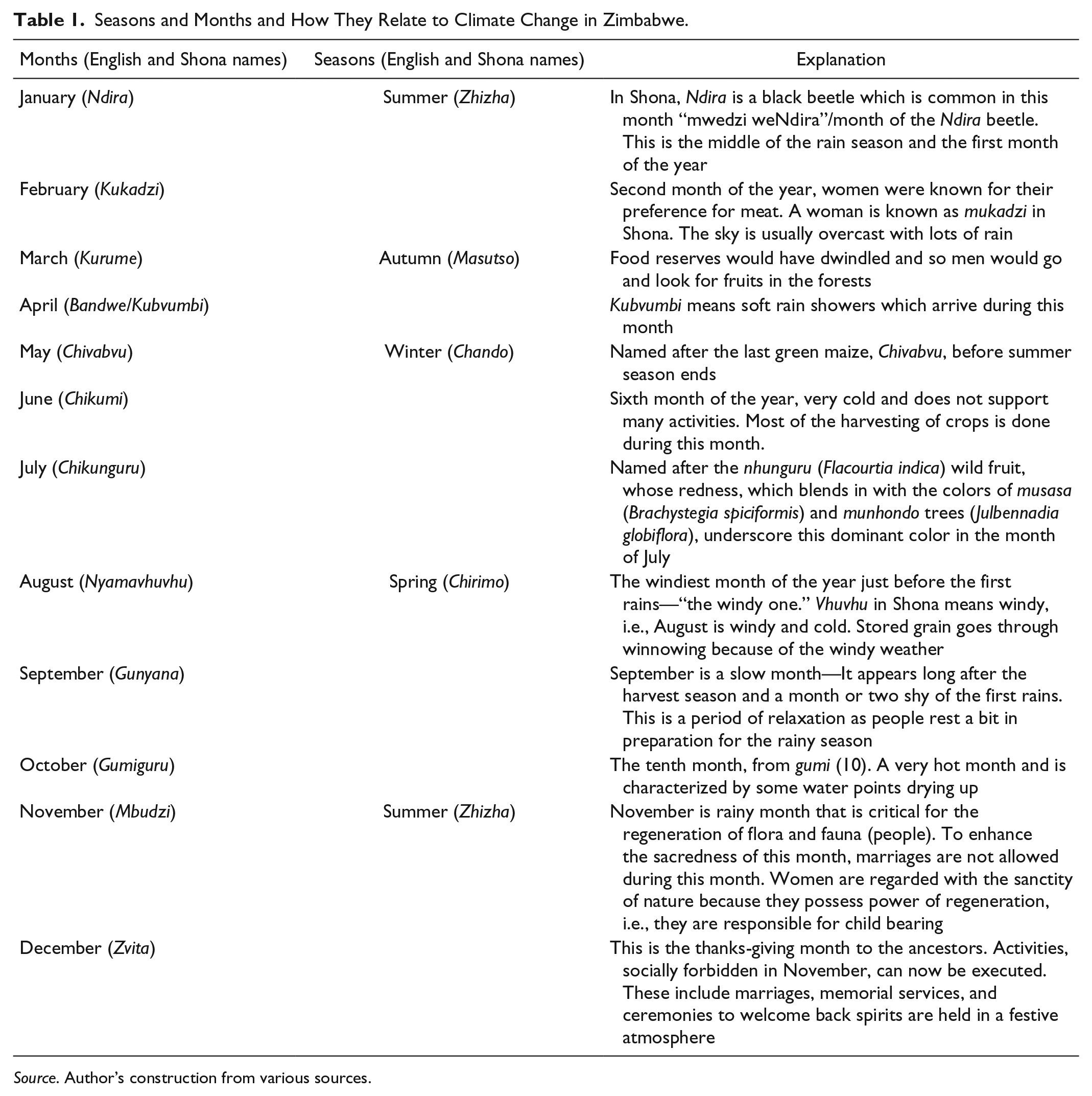
Source. Author’s construction from various sources.
Ways in Which IKS Could Enhance Understanding of Climate Change
The months of the year are very important because they add into seasons and years. The daily temperature shapes the rhythm of life, that is, the lived everyday experiences. This could be the starting point for pupils to understand how a calendar functions and thus identify the names of the months. The important days and how the year is arranged from January to December and begin over again is explained in class. Pupils can mention their favorite days and holidays in each month and pay particular attention to their birthdays and those of their kith and kin so that each pupil has events to relate to each month. All this could lead to pupils developing their own calendar.
After the development of the calendar, pupils may recognize seasons, as well as noticing a change in the weather and the related diverse activities that take place. The mention of seasons is done when teaching about months and how the seasons (summer, autumn, winter, and spring) happen during the same months every year. Actions of pupils in different seasons could be shown by pictures of pupils’ friends and family in action during the various months paying attention to the particular season and the month in which the picture falls. When reviewing the days of the week, there is a need to mention the month as well and try to associate certain events with certain months, for example, Valentine’s Day falls in February and Christmas in December. Months for the year and what happens during each month could be done in song because it does not feel like learning but funny. However, memorization is enhanced during season. The variation in months and seasons could then be related to climate variability and change, and how this could be understood from the locality through drama, poetry, rituals, role-play, songs, and speeches. Through this way, IKS is incorporated in the teaching/learning process.
IKS and the 1999 Presidential Commission of Inquiry Into Education and Training (CIET)
The 1999 Presidential CIEt also known as The Nziramasanga Commission of Inquiry was sanctioned by the then-President Mugabe to diagnose the problems that were affecting the education sector (Government of Zimbabwe, 1999). The last time a similar report was produced was in 1962. In some circles, the commission is also referred to as the Caiphas Nziramasanga Report named after the renowned educationist who chaired the commission. The findings of the report were lackadaisically implemented to date, hence, the frustration of educational stakeholders and Nziramasanga himself. The commission recommended that Grade 7 and Ordinary Level examinations should be dropped; they are not only costly but irrelevant for 21st-century education. Examination-driven curriculum in Zimbabwe does not impart knowledge to students; hence, schools are/were producing half-baked students.
Many socio-economic and political problems that Zimbabwe is facing today are related to limited knowledge that is key to growth and development. Generally, studies have shown that countries with higher skill levels and that use local language (IKS) are better equipped to face new challenges and master technological discoveries, in particular; this is important to countries such as, United States, United Kingdom, Germany (the largest economy in Europe), Japan, India, and China (Makwara, 2013). Zimbabwe has a reasonably well-educated human resource, which although qualified, remains scarce compared with the country’s developmental needs. Thus, in the process, sustainability is undermined, that is, skills to compete, innovate, and respond to complex economic, social, cultural, political, and environmental situations (Agrawal, 1995). A right education curriculum is, therefore, the basis for sustainable development.
The aim of geography is to teach valuable cognitive skills which can be applied outside the classroom. Observatory skills, judgment and analysis, memory and imagination help pupils with skills for weather reading and recording of which IKS can be incorporated. Fieldwork is particularly important (the landscape is the geographers’ laboratory and in most rural areas, locals know the resources that are prevalent or can be obtained from the landscape) with the joy of discovery on its being a motivating experience.
All stakeholders (from the student, the institution, and the employer perspectives) are important in curriculum reform ranging from national, regional, continental, and international levels. The role of UNESCO is very important at the international level. In this case, a paradigm shift becomes critical as the teacher becomes a co-learner although he or she does not necessarily relinquish his or her duty of directing learning (Rosenberg, 2000). In the same vein, students should, therefore, be recognized as information creators and gatherers; they are full of information of what happens within their environment. The teacher has to develop the knowledge and skills to enhance the teaching/learning process. All 10 teachers interviewed agree that the incorporation of IKS has the potential to empower the local community, through co-creation of knowledge, and acknowledging the role of every key stakeholder, the ability to make decisions based on local knowledge by cultivating local ownership of the knowledge produced, a precondition for sustainability. However, in Goromonzi, there seems to be lack of commitment by the local community and its willingness to get involved in the creation and documentation of IKS practices because the elderly who have vast IKS knowledge do not want to come to school to share some of this knowledge. There are things one cannot learn in books, one has to get to where it happens, and get involved—body, mind, and spirit, all put together. Universities, teacher training colleges, and secondary schools should validate IKS by documenting so as to demystify cultural practices, beliefs, mores, and norms; hence, the need to fuse educational institutions and communities in which they are collected, especially on climate change information because climate shapes the rhythm of life. With the continued reform in the school curriculum, it is anticipated that IKS will have its right place and become relevant.
Role of IKS in the Teaching/Learning of Geography
At both schools, teachers argued that IKS has various forms of knowledge ranging from local community’s traditional technology; social, economic, and philosophical learning grounded in spirituality skills, practices, and ways of being in nature. Teachers were not sure of what they should include or exclude. For IKS, focus should range from daily activities that range from farming to law, psychology, and mathematics. In the school curriculum, efforts to integrate IKS into formal schooling could be done through studying astronomy, weather and climate studies, agriculture, technology, and food and plant uses and relating these to community activities so that what is taught in schools becomes relevant. Change is hard, but necessary, transformation is necessary in Zimbabwe although the current reality in schools shows that it is painful, frightening, optimistic, and long overdue. In the same vein, it should be acknowledged that there are limitations if the world is seen from one perspective, that is, Western science. One way of seeing the world is through paying particular attention to the restoration of wisdom of elders to the education system. This can be done through the realization that a deeper and broader understanding of the world requires unlearning some assumptions. There is valuable and authentic wisdom in IKS because students’ questions and experiences are part of teaching/learning. Unfortunately, in Zimbabwe, the current situation is, The school and community are different things altogether, what one learns at school, is for the school, and what one learns at home is for the home.
IKS is viewed by Geography teachers as locally derived knowledge peculiar to a specific place. This kind of knowledge is generated and transferred from one generation to the other. As a result, such knowledge cannot be subjected to proof testing. Weather and climatological concepts are difficult to teach in Shona, the local language (teaching in the mother tongue is part of IKS). However, English is used in all teachers’ schemes of work and lesson plans as well as in students’ exercise books. It is unfortunate that in the Zimbabwean context, teachers are guided by a syllabus that is examination-oriented and therefore, does not clearly recognize IKS as a critical component in the teaching/learning process. Hence, there is very limited use of folk stories, riddles, music, and song in teaching/learning. In the same vein, most learning takes place indoors, with very limited, if any, contact with the external environment, for example, using old people to explain yesteryear climate. IKS plays a critical role in understanding climate change studies; however, the current O-Level Geography Syllabus does not have any components of IKS. This is an anomaly because to understand climate change, the local context should be understood. This is particularly important considering that 75% of Zimbabwe’s population lives in rural areas and it is in these areas where the majority of secondary schools are located, including early established mission schools, which produce excellent results at both O and A Levels.
At the two schools, the critical issue is centered on how pupils can be moved from passive involvement to active involvement in teaching/learning. The idea is to complement IKS with “scientific knowledge,” termed Western knowledge. Western knowledge was mainly developed as part of colonialism and capitalism (modernity) which is at odds with tradition. Westernization has tended to dominate and be accepted as the final destiny but in the process, this has created dichotomy between IKS and Western knowledge although IKS also carries the understanding of being universal.
Conclusion
Climate change is driving many changes in agriculture, manufacturing, health, and urbanization. Zimbabwe relies on climate-sensitive sectors such that extreme heat, drought, and arid conditions affect crop production and food security. This article has discussed the importance of IKS in understanding climate change in Africa and Zimbabwe. In particular, this is very important because Western science has dominated climate science research globally and may not always be adequate in interpreting climate change observations in Zimbabwe. Supported by other articles, the study argues that IKS complements Western empirical research in our bid to sustainably understand climate variability and change in Africa and eventually manage the environment. Thus, it is imperative that the teaching of climate change through IKS should begin with young children and teachers to understand the role of IKS in appreciating climate change and variability.
Policy Implications
To facilitate the integration of IKS in geography education and to increase understanding of climate change studies, the opportunities to meet these needs and benefits that would potentially ensue from these interventions include the following:
It is of utmost importance that all actors, government, national, provincial, district, ward, and local-level structures should work jointly toward this goal (co-creation of knowledge). In this respect, there is need for in-service for practicing teachers so that they catch up with the latest development in IKS as it relates to geography and education. Zimbabwe should immediately incorporate the findings of the Nziramasanga Commission so that education becomes more learner-centered. The case of bringing the school to the community and vice versa is critical in the teaching of IKS in schools. Generally, lack of knowledge is present on how the IKS has generally caused limited understanding of climate change studies in secondary schools in Goromonzi in particular and Zimbabwe in general.
It is vital to revamp the Ordinary Level Geography curriculum and the rejuvenation of the Curriculum Development Unit of Zimbabwe’s Ministry of Primary and Secondary Education to ensure that there is prioritization of action research. There is need to identify, document, and validate IKS best practices into both the primary and secondary school curriculum through inclusive, participatory, and multi-way learning. Zimbabwe’s Ministry of Primary and Secondary Education, in liaison with other stakeholders such as universities and research institutes, should redesign, repackage, and design educational materials to create awareness to all stakeholders on the benefits of IKS. This could be done through integrated school curriculum reform in a sustainable and appropriate legal framework.
There is need for community-based organizations to spearhead the development of knowledge that could increase community-based disaster risk management as well as resilience to ameliorate the effects of climate change. Geography educators should teach from a cultural context and ought to identify where learners originate from. Formal and informal curriculum influence the teaching/learning of geography concepts. Research, Development, Dissemination, and Adoption approach is important in the use of IKS as it gives feedback on learning that takes place within a geography classroom and in the countryside as espoused by the socio-cultural constructivist epistemology.
Footnotes
Acknowledgements
I would like to acknowledge Heads of Schools in Goromonzi who allowed me time to gain access to their premises and talk to their students and teachers. I would also like to acknowledge the District Inspector, Education and Traditional Leadership, and all those who contributed to this study. Thanks to Mrs. B. Mutambanengwe for her help in editing the document.
Declaration of Conflicting Interests
The author(s) declared no potential conflicts of interest with respect to the research, authorship, and/or publication of this article.
Funding
The author(s) received no financial support for the research, authorship, and/or publication of this article.
