




Abstract
This study aims to broaden the current knowledge on the effect of entrepreneurial commitment on entrepreneurial performance. Specifically, this study investigates how entrepreneurial commitment affects entrepreneurial performance through the mediation effect of family-work conflict, and the moderation effect of organization-family support. Using survey data collected from 246 China’s entrepreneurs, this study finds that entrepreneurial commitment affects entrepreneurial performance through family-work conflict/enhancement. In addition, organization-family support has a negatively moderating effect on the relationship of family-work conflict and entrepreneurial performance, and a positively moderating effect on the relationship of family-work enhancement and entrepreneurial performance. This study contributes theoretically to the literature on the relationship of entrepreneurial commitment and entrepreneurial performance through family-work conflict/enhancement, which can help entrepreneurs balance the entrepreneur and family identities.
Keywords
Introduction
Entrepreneurship requires the joint efforts of entrepreneurs, families and organizations. Only by balancing the relationship between these three can entrepreneurs achieve success. Entrepreneurial commitment (EC) is the entrepreneur’s belief and determination to entrepreneurial activities. It embodies the entrepreneur’s commitment and responsibility for entrepreneurial activities and motivates entrepreneurs to carry out entrepreneurial activities (Airba & Yldzhan, 2019; Tasnim et al., 2018). EC, as an important indicator of the confidence and responsibility of entrepreneurs to start a business, is a key factor that affects entrepreneurial performance (EP) and success (Nadhar et al., 2017; Szkudlarek et al., 2023; Tasnim & Singh, 2016). In recent years, most scholars have found a positive impact of EC on the EP of start-ups (Datta et al., 2020; Kong et al., 2018); EC is a decisive factor in the establishment of start-ups, which greatly affects EP. To improve the EP, startups must start from the source of EC. In the field of organizational research, Tasnim et al. (2014) pointed out that EC plays a promoting role in EP. Notably, the pathway through which EC affects EP remains obscure, necessitating further exploration of their interrelationship’s “black box.” What kind of influence does the mediation path of EC have on EP? There are relatively few related studies at present. This study further explores this problem.
The identity of entrepreneurs and family may lead to role conflicts, which can affect EP. Based on the perspectives of social identity theory (SIT) and role conflict theory (RCT), when an entrepreneur starts a business, the entrepreneur has both a job role and a family role. Entrepreneurs need to take different responsibilities for family and entrepreneurship. According to the role cognitive effect, the degree to which an individual understands his/her role determines how much time and effort they invest (Murnieks et al., 2019). Meanwhile, role expectation refers to the value expected by other people in a group from an individual (Clark et al., 2019; C. C. Huang, 2020). A role conflict occurs when one’s role cognition and role expectation deviate from each other. To this end, when entrepreneurs make EC, they should divide their limited resources between their family, which leads to family-work conflict (FWC) (Rhee et al., 2020). If the family does not recognize the entrepreneur’s identity, they will not only resist entrepreneurial behavior, but also put pressure on the entrepreneur, which will have a more negative impact (Wilson et al., 2018). However, if the family recognizes entrepreneur’s identity, they not only give the entrepreneur spiritual support and encouragement,but it may also help the entrepreneur solve some troubles and problems, which forms a family-work enhancement (FWE) (Nguyen & Sawang, 2016). Many studies have also confirmed a link between family and work (Heras et al., 2021; Masuda et al., 2019).
Currently, research on the relationship between FWC and EP has mostly been conducted in the organizational field. Different studies have drawn different conclusions on the relationship between FWC and EP, and in some studies, the relationship between FWC in both directions and EP is not entirely consistent among scholars. Most scholars believe that family interference in entrepreneurship has a negative impact on EP (Burch, 2020; Yasir et al., 2019; Zhang & Zhou, 2019). In the organizational field, the relationship between FWC and organizational commitment has been studied by many scholars, but research on the relationship between FWC and EC in the entrepreneurial field is relatively scarce. The study found that FWC was significantly positively correlated with organizational commitment (Cicek et al., 2016), while the correlation between FWC and organizational commitment was not significant (Tang & Wang, 2013). However, how FWC and FWE affect PE, and whether they have a mediation effect on the relationship of EC and EP. Existing research on the above issues is insufficient and requires further exploration and verification. This study aims to answer the questions and supplement the literature.
Through the review of previous relevant studies, we find that the academic circle has conducted rich research on the relationship between work-family balance, organizational commitment, and job performance in the field of organization, and has achieved certain research results. However, the research results are not completely consistent. Relatively speaking, there are very few scholars studying the relationship between FWC, EC and EP of entrepreneurs in an entrepreneurial environment. Even in the existing limited studies, some scholars have reached different conclusions, and the relationship and influencing mechanism among the three are not clear. Among the limited relevant studies in the field of entrepreneurship, the existing studies on FWC focus on investigating the current situation and handling strategies of FWC for entrepreneurs, and place emphasis on exploring FWC specifically among female entrepreneurs. Research on EC mainly focuses on theoretical research, with relatively limited empirical research available. Through literature review, it can be found that there is a relationship between these three variables. However, in the field of entrepreneurship, what exactly is the relationship between them? This is a subject worthy of further study. Therefore, starting with the EC of entrepreneurs, this study will investigate the relationship among EC, FWC, and EP through empirical study, with the objective of enhancing the research findings in the field of entrepreneurship.
Theory Analysis and Hypothesis Development
Social Identity Theory
Some scholars have adopted the resource theory to analyze how entrepreneurs allocate their resources when faced with pressures from their entrepreneurship and family roles. These resources can be divided into material resources (e.g., houses and cars), conditional resources (e.g., marital status and social qualifications), individual characteristic resources (e.g., optimism and self-efficacy), energy resources (e.g., time, energy and money), and individual and environmental factors (e.g., cultural background and individual value) (Crick & Crick, 2023; Ten Brummelhuis & Bakker, 2012). Each of these resources helps these entrepreneurs achieve their individual and organizational goals. Many studies have emphasized the relationship between stress and resources and pointed out that entrepreneurs either increase or decrease their entrepreneurial resources when faced with family conflict and pressure, which in turn affects their EP (Botelho & Chang, 2023). Some studies perceive family and entrepreneurship as two types of organizations with certain repulsive groups. To resolve the aforementioned conflicts, entrepreneurs need to redistribute their available resources (Szkudlarek et al., 2023). Researchers contend that entrepreneurs themselves have the potential to create resources. They actively coordinate their time and energy to fulfill their roles as entrepreneurs and their obligations to their family as well as to develop their reputation. Self-motivation stirs one’s thoughts and emotions and can boost his/her kinetic energy.
SIT is one of the most important theories for explaining the self-cognition and group cognition of entrepreneurial individuals. This theory also helps entrepreneurs understand their group attributes and, along with self-motivation, drives them to actively create and distribute resources. According to SIT, a social identity comprises three basic processes including classification, identification, and comparison. Individuals initially classify themselves into groups, identify their group attributes, and then gain recognition of their own values (Kovács & Horwitz, 2021). Tajfel (1978) defined individual identity as the characteristics that are specific to an individual. Meanwhile, social identity is a self-description on drawn by all members of a specific social category. The group identity and value of individuals can motivate them to make choices and stimulate their potential and value creation. In this way, social or group identity creates a favorable external environment from which individuals can obtain spiritual encouragement and resource inputs.
Family and entrepreneurship as two types of organizations (Cardella et al., 2020). When faced with FWC, entrepreneurs will reduce their investment in entrepreneurial activities, which affects EP. In order to balance FWC, entrepreneurs need to redistribute their available resources. We contend that entrepreneurs themselves have the potential to create resources. They actively coordinate their time and energy to fulfill their different roles. Due to the challenges and uncertainties involved in entrepreneurial activities, the commitment of entrepreneurs to entrepreneurship may be developed in three ways, namely, through allocating and balancing their resources. First, entrepreneur allocate limited resource and reduce EC, which reflects the relationship of EC and EP. Second, they stimulate their potential to create additional resources and reduce FWC, which reflect the effect of FWC and FWE. Third, they gain support and help from organizations, which reflects the effect of OFS. Therefore, this study aims to examine the relationship of EC and EP through FWC and FWE and explore the moderating effect of OFS.
This paper argues that the factors affecting EP mainly include three aspects: EC, FWC/FWE, and OFS. These three factors will directly or indirectly affect the management ability and entrepreneurial spirit of entrepreneurs, and then affect the EP. This paper argues that the higher the EC to the enterprise, it may reduce the commitment to the family, resulting in the reduction of time and emotional investment in the family, which will lead to FWC, and FWC will further consume the entrepreneur’s time, emotion, and ability, and then affect the EP (Szkudlarek et al., 2023). This is the common and typical problem of work-family incompatibility. In fact, in reality, many people because of FWC eventually lead to family breakdown, business failure, and other problems. Of course, there is also a case where the entrepreneur’s enthusiasm is recognized by the family, resulting in FWE, and the family gives the entrepreneur encouragement and help when the entrepreneur encounters problems or is depressed, helping the entrepreneur to achieve better performance. This article argues that the best way to balance work and family is to give recognition and support at the organizational level, which is better than the entrepreneur’s own expression. Receiving affirmation from the organization is more indicative of the organization’s recognition of the entrepreneur and the prospect of their career. In contrast, organizations often encourage entrepreneurs in two ways: one is to give entrepreneurs a higher salary and promotion opportunities, and the other is to give entrepreneurs or their families material support. Ultimately, EC may influence FWC/FWE and OFS may mediate this conflict, which in turn affects the EP. Therefore, the purpose of this paper has the following three aspects: First, to study the impact of entrepreneurs’ own EC on the performance of new ventures. Second, to analyze the relationship between FWC/FWE and EC and new venture performance from the perspective of work-family relationship. Third, the moderating effect of OFS is analyzed from the organizational level.
The Relationship of EC and EP
Entrepreneurs often face great pressure and risk because of the challenges and uncertainties involved in entrepreneurial activities (Gustavo, 2016). Entrepreneurs’ beliefs and decisions regarding these activities largely determine their input and duration of engagement in entrepreneurial activities. According to SIT, if entrepreneurs can clearly recognize their identity and value in the entrepreneurial community and acknowledge the importance of entrepreneurial activities, then they will invest much of their time, energy and emotions. Al-Mamary and Alshallaqi (2022) emphasize the robust correlation between entrepreneurial intention and increased autonomy, innovation, a spirit of adventure, and motivation. The innovation, autonomy, and motivation of entrepreneurs exhibit a significant positive correlation with EP (Y. Huang et al., 2022). By contrast, when these entrepreneurs are not highly aware of entrepreneurship or lack a sense of entrepreneurs’ identity, they will make fewer investments and eventually discontinue their involvement (Johnson et al., 2015). Thus, EC is an important indicator that affects EP. Entrepreneurial abilities without EC produce only minimal value for start-ups, and the level of EC affects EP (Rocha et al., 2012). Research has shown that entrepreneurs adopting new entrepreneurial models and methods can enhance their abilities and achieve enterprise development (Dana et al., 2022; Guo et al., 2022). Those entrepreneurs who lack EC tend to engage in short-term speculations. Entrepreneurs with high EC can bring about more positive results (Datta et al., 2020; Kong et al., 2018; Manev et al., 2015). Based on above arguments, this study proposes the following hypothesis.
H1: EC is positively related to EP.
The Mediating Role of FWC and FWE
From a psychological perspective, especially from the perspective of psychoanalysis, we can gain a deeper understanding of the internal psychological processes of entrepreneurs and provide more accurate interpretations of their behavior and decision-making (Metallo et al., 2021). According to SIT, when entrepreneurs recognize their entrepreneurial role and make EC, they tend to allocate much time and energy to entrepreneurial activities, thereby leading to FWC (Schjoedt, 2021; Tasnim et al., 2014). On the one hand, FWC forces entrepreneurs to equally divide their energy and time to balance their family and entrepreneurial identities. On the other hand, FWC imposes pressure and burden on the psychology and enthusiasm of entrepreneurs. FWC may trigger mental problems for entrepreneurs. Mental health issues are also important issues faced by many entrepreneurs in dealing with work, family, and organizational relationships. Some scholars have examined the impact of FWC on corporate performance (A. Li et al., 2017; Conte et al., 2019), but only a few have examined the effects of family and entrepreneurial conflict (Zhou et al., 2019). However, as the environment continues to change, entrepreneurs face more risk and pressure and they realize the need to invest more time and resources to entrepreneurial activities (Okhomina, 2010; Rokhman et al., 2023). This also imposes a huge burden for entrepreneurs (Casey & Kozan, 2012). Therefore, work-family conflict may negatively affect corporate performance. Based on the above arguments, this study proposes the following hypothesis.
H2: FWC has a negative mediating effect on the relationship of EC and EP.
Some scholars have highlighted a certain promoting relationship between work and family (Greenhaus & Powell, 2006). The happiness and joy brought by their families can stimulate positive outcomes for entrepreneurs (Wayne et al., 2007). FWE can transfer these positive effects to the job performance of entrepreneurs by reducing family pressure or gaining family support (Carlson et al., 2011; Rastogi & Chaudhary, 2018). According to SIT, by understanding the identities and roles of entrepreneurs, families can also understand their hardships, give them encouragement and even help them secure additional resources (Carlson et al., 2019; Ten Brummelhuis & Bakker, 2012; Werbel & Danes, 2010). Therefore, the family identity of entrepreneurs can promote entrepreneurial activities to a certain extent. The responsibility of family can also motivate entrepreneurs to be more eager for entrepreneurial success. Based on the above arguments, this study proposes the following hypothesis.
H3: FWE has a positive mediating effect on the relationship of EC and EP.
The Moderating Role of OFS
Family-support organization perceive refers to a series of measures that are provided to employees by the organization at work and are conducive to promoting family-work balance (Haar, 2004). Family-support organization perception is a two-dimensional concept, including work-based family support organization perception and family-based family support organization perception. More and more companies provide employees with family care benefits, aiming to reduce employees’ work-family conflict. Although scholars of work-family conflict and organizational support have been studying for many years, there have been relatively few studies on the relationship between organizational family support and work-family conflict. The mechanism models of social support for some outcome variables in an organization can be mainly categorized into main effect and moderating effect models (Mauno & Ruokolainen., 2017; Wayne et al., 2006). Allen et al. (2003) pointed out that there is a significant and strong correlation between organizational family support and FWC. Thompson and Prottas (2006) have shown that there is a negative correlation between organizational support and FWC. Organization can truly help employees reduce the conflict between work and family and improve corporate performance, scholars and management should pay more attention to employees’ sense of organization and family. However, whether these family care benefits can truly reduce employees’ FWC requires further exploration and research. We believe that when the organization’s family support is high, the negative impact of FWC on EP is alleviated. And when the organization family support is low, the impact of FWC on EP may be greater. Based on the above arguments, this study proposes the following hypothesis.
H4: OFS has a moderating effect on the relationship of FWC and EP.
When family to work generates gains, employees can engage in work happily. At this time, if families receive more care and assistance from organizations, such as welfare and housing, it will further promote FWE (Holliday et al., 2013; Wayne et al., 2013). Employees can not only obtain support for promoting family life from the organization, but also obtain support for work from the family. Scholars should pay more attention to the positive effect on the FWE. When OFS is higher, FWE play a stronger role in promoting company performance. When the sense of organizational family support is low, the role of FWE in promoting company performance is weak. Yucel et al. (2023) supervisor support has a moderator role between work-family conflict and work engagement and has a moderated mediation role at the model in which work-family conflict is independent, turnover intention is dependent and work engagement is a mediator variable. Based on the above arguments, this study proposes the following hypothesis.
H5: OFS has a moderating effect on the relationship of FWE and EP.
Figure 1 outlines the model proposed in the study. FWC and FWE are proposed as the mediator to link EC and EP. OFS are proposed as the moderator to adjust the relationship of FWC, FWE, and EP.

Proposed model.
Methodology
Measurement
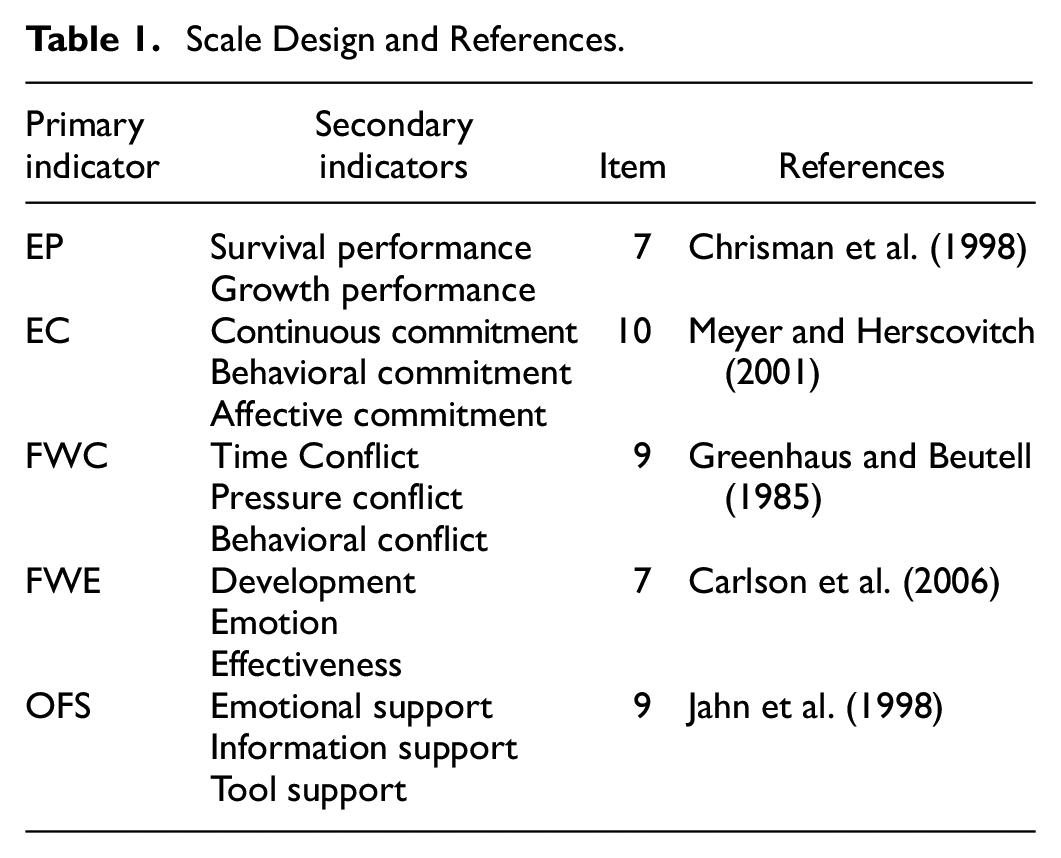
EP was assessed with 7 items. The scale contains two indicators including survival performance and growth performance (Chrisman et al., 1998). The scale was measured based on a 5-point response scale, with responses that could be ranked from 1 to 5 (1 = “very dissatisfied,” 5 = “very agreeable”). The Cronbach’s alpha for scale is .881 in the sample of entrepreneurs.
EC was assessed with 10 items. The scale contains three indicators including continuous commitment, behavioral commitment and affective commitment (Meyer & Herscovitch, 2001). The scale was measured based on a 5-point response scale, with responses that could be ranked from 1 to 5 (1 = “very dissatisfied,” 3 = “neutral,” 5 = “very agreeable”). The Cronbach’s alpha for scale is .895 in the sample of entrepreneurs.
To measure the FWC and FWE, these scales have been used in other studies (Carlson et al., 2006; Greenhaus & Beutell, 1985). The scale of FWC contains three indicators including pressure conflict, behavioral conflict and behavioral conflict. The scale of FWE contains three indicators including pressure conflict, behavioral conflict and behavioral conflict. Both variables were measured on a 5-point Likert type response scale, with responses that could be ranked from 1 to 5 (1 = “very dissatisfied,” 3 = “neutral,” 5 = “very agreeable”). The Cronbach’s alpha for scale is .887 for the scale of FWC and .884 for the scale of FWE in the sample of entrepreneurs.
OFS was assessed with 9 items (Jahn, 1998). The scale contains three indicators including emotional support, information support and tool support. The scale was measured based on a 5-point response scale which asks the entrepreneurs to rank the degree to which they agreed with the statement listed. The responses could be ranged from 1 to 5 (1 = “very dissatisfied,” 3 = “neutral,” 5 = “very agreeable”). The Cronbach’s alpha for scale is .913 for the scale in the sample of entrepreneurs.
To rule out alternative explanations and to test the stated hypotheses, the present study included the individual-level control variables, such as gender, age, education and marital status. Venture-level control variables were also included, such as the year of establishment, number of employees and venture times. Table 1 presents the specific conditions of the scale.
Scale Design and References.
Pilot Study
The sample of the study was the New Ventures that contained firms in a wide range of different development stages, and diverse entrepreneurial activity. Given the questions all selected scales were developed in English, but the target population was Chinese. In order to ensure the accuracy of the scale expression, we invited two doctoral students and a teacher with strong English ability to participate in translation and correction. The translation and back-translation procedure were strictly conducted to ensure translation equivalence. In order to test the validity of the scale, this study conducted a pre-survey in the entrepreneurship Park of Anhui and Fujian Province, China. A sample of 40 entrepreneurs was collected for the pilot study. Results show that the reliability and validity of each dimension reached the effective standard. And the item setting of the measurement scale is reasonable, so formal investigation can be conducted.
Data Collection
The survey objects of this research are entrepreneurs who are engaged in entrepreneurial activities, whose entrepreneurial years are within 8 years. This research has been strongly supported by teachers from Chuzhou University, Xiamen University, Fuzhou University, Nanchang University and other alumni associations, Anhui and Fujian local chambers of commerce, and other organizations. There are two forms of sample collection. A convenience sampling method was carried out by research team members via a field survey. One is to issue questionnaires to entrepreneurs through social relationship introductions and recommendations such as alumni to conduct surveys. The other is to visit and investigate entrepreneurs in major entrepreneurship parks in Fujian and Anhui provinces by teachers and teams. Before the questionnaires were sent out, the target respondents were informed that the questionnaires did not involve important privacies of them and were completely anonymous. In addition, they were told that the collected data is strictly confidential and used only for academic research. Out of 500 questionnaires, data collectors received a total of 436. After excluding unqualified questionnaires, a total of 246 valid questionnaires were returned, with an 43.92% valid response rate.
Data Analysis
According to the research of Podsakoff et al. (2003), Harman’s single-factor test and common factor analysis were formed to detect the threat of common method variance. According to the recommendations of Gerbing and Anderson’s (1988), a two-step method is used to test the reliability and validity of the model. Firstly, the reliability and validity of each measurement were examined based on the KMO value and Cronbach’s alpha value in the method of exploratory factor analysis and reliability testing. Secondly, the fit indices of confirmatory factor analysis including CFI and RMSEA, were used to further test the reliability and validity of the model.
Hierarchical regression analysis was performed to examine the hypotheses. The regression analyses were conducted as a three-step process. In the first step, control variables were entered and followed by the independent variables. In the second step, the mediators of FWC and FWE were entered. In the last step, OFS was used as a moderator to examine the moderating effect. Moreover, bias-corrected bootstrapping tests were used to examine mediation analysis (Preacher & Hayes, 2008). Based on the study, the independent variables can be measured by subtracting the mean for the entire sample from the individual scores. The above analysis was accomplished using SPSS 26.0 and AMOS 24.0.
Results
Sample Profiles
The sample data mainly comes from Fujian, Guangdong, Zhejiang, Anhui, and other places, and the industries involved are mainly manufacturing, financial, wholesale and retail industries. The majority of the total sample is male (65%), the age range is mainly between 26 and 35 years old (52.4%), the educational background is basically a bachelor degree (50.4%), and there are more married groups (59.8%). Table 2 presents the information of these respondents.
Analysis Results of Sample Basic Conditions (N = 246).

Reliability and Validity Test
Table 3 presents the reliability and validity of the scale as measured via exploratory factor analysis and reliability analysis. The KMO values of each dimension exceed 0.8, the significance level of the Bartlett test is below 0.05 and Cronbach’s alpha values of each dimension exceed .8. This highlights the good reliability and validity of the proposed measurement scale. A confirmatory factor analysis was also performed to validate the fitness of the overall model CMIN/DF = 1.534, CFI = 9.38, TLI = 0.932, IFI = 0.939, NFI = 0.843, RMSEA = 0.047, AIC = 898.242. Except NFI value is less than 0.9, all other values are greater than 0.9, and the path coefficients are greater than 0.5.
Results of Reliability and Validity Test.

Correlation Analysis
Table 4 presents the results of the correlation analysis. These results highlight significant positive correlation among EC, FWE, OFS, and EP, and a significant negative correlation among FWC, EC, and EP. In other words, EC has a certain impact on EP. FWC and FWE are related to both EC and EP. A regression analysis was then conducted to further explore these relationships.
Means, Standards, and Correlations.

p < .05. **p < .01.
Main Effect
Table 5 presents the regression results where models 1.1 to 1.2, 1.5 to 1.7 are regression on EP, model 1.3 are regression on FWC and model 1.4 are regression on FWE. Model 1.1 shows that the relationships between gender, age, education, number, year employee, and EP. Model 1.2 shows that EC is significantly positively associated with EP (β = .530, p < .01), which posits that EC to entrepreneurial activities will affect EP in such activities to a certain extent. However, the pathway of this effect requires further study. Therefore, H1 is empirically supported. Model 1.3 shows that EC is significantly negatively associated with FWC (β = −.376, p < .01), which posits that EC will negative affect EP. Model 1.4 shows that EC is significantly positively associated with FWE (β = .369, p < .01), which posits that EC to entrepreneurial activities will positive affect FWE.
Results of the Main Effect Analysis.

p < .1. **p < .05. ***p < .01.
Meanwhile, model 1.5 shows that FWE is significantly positively associated with EP (β = .359, p < .01), thereby suggesting that when a family acknowledges the entrepreneurial identity of entrepreneurs, the latter receives additional resources and incentives, thereby improving their EP. Model 1.6 shows that FWC is significantly negatively associated with EP (β = −.395, p < .01), thereby suggesting that families do not recognize the entrepreneurial identity of entrepreneurs. Therefore, entrepreneurs should balance their time between their families and their entrepreneurial activities as well as redistribute their resources. Due to the lack of time and revenue to create such resources, these entrepreneurs may also face a shortage of available resources, resulting in a decline in EP. Model 1.7 shows the relationship of EC and EP was significant and positive (β = .383, p < .01), the relationship of FWC and EP was significant and negative (β = −.212, p < .01) and the relationship of FWE and EP was significant and positive (β = .182, p < .01).
Mediating Effect of FWC and FWE
To determine the mediating effect of FWC and FWE on EC and EP, this study adopts the bootstrap sampling method and model 4 to select the non-parametric percentile of bias correction. The sample size and confidence level were set to 5,000 iterations and 95% bias-corrected confidence intervals (Preacher & Hayes, 2008). Table 6 presents the results of the mediating effects of FWC and FEW. After adding the intermediary variable, the coefficients of EC, FWC and FWE to EP decrease to β = .3869 (p < .01), β = −.1997 (p < .01), and β = .1716 (p < .05), respectively. The direct effect is 0.3869 (p < .01), and given that [LLCI, ULCL] = [0.2629, 0.5109] does not contain 0, the direct effect is deemed significant. Meanwhile, the total indirect effect of the mediator variable is 0.1469, and given that [LLCI, ULCL] = [0.0754, 0.2283] does not contain 0, the mediation variable shows a significant indirect effect. The indirect effect of FWC is 0.1469, and given that [LLCI, ULCL] = [0.0333,0.1395] does not contain 0, the mediating effect of FWC is significant and H2 is supported. The indirect effect of FWE to EP is 0.0677, and given that [LLCI, ULCL] = [0.0219, 0.1277] does not include 0, the mediating effect of FWE is supported along with H3. The difference between the mediation effects of FWC and FWE is 0.0115. The overall effect of EC to EP is 0.5337, and given that [LLCI, ULCL] = [0.0754, 0.2283] does not include 0, the overall mediating effect of FWE and FWC is significant. In summary, FWC has complementary effects on EC and EP, whereas FWE plays a complementary role in the relationship between EC and EP. Therefore, H2 and H3 is empirically supported.
Mediating Effects of FWC and FEW.

Note. R-sq = .5947, F = 14.3496, p = .0000.
p < .01.
Table 7 presents the results of the mediation analysis. The sample was divided into several groups to further rank FWC and FWE. Those samples with an FWC value of greater than the mean were placed in the high conflict group (with an assignment value of 1), whereas those with an FWC value below the mean were placed in the low conflict group (with an assignment value of 2). In addition, those samples with FWE values of less than or above the mean were placed in low and high enhancement groups, respectively, with assignment values of 1 and 2. The high conflict and low enhancement groups represent the worst case, whereas the low conflict and high enhancement groups represent the best case. The product of FWC and FWE was used as a mediating variable to determine their effects on the relationship between EC and EP.
Results of the Mediation Analysis.

Note. R-sq = 0.3340, F = 9.0000, p = .0000. LLCI = lower limit confidence interval; ULCI = upper limit confidence interval.
p < .1. **p < .05. ***p < .01.
Table 8 present the types of family-work relationship. As shown in Tables 3 and 4, the indirect effect of EC is 0.0891, and given that [LLCI, ULCL] = [0.0337, 0.1609] does not contain 0, FWE × FWC has a significant and positively promoting effect on EC and EP. A higher FWC and lower FWE correspond to a smaller impact of EC on EP. By contrast, a lower FWC and higher FWE corresponds to a greater impact.
Characteristics of Different Types of Family-Work Relationships.

The family-work relationship with high conflict and low enhancement is characterized by low EC and EP. This relationship has medium-level OFS, whilst its overall effectiveness of family-work is negative, thereby indicating that family has a negative effect on entrepreneurial activities. Meanwhile, the family-work relationship with low conflict and enhancement is characterized by moderate EC and EP. This relationship has moderate-level OFS and reveals that the overall role of family in work is unclear and requires further analysis. The family-work relationship with high conflict and enhancement is characterized by medium commitment and performance. This relationship has high-level OFS and a relatively high efficiency of family-work, thereby suggesting that family has an important role in promoting work. The family-work relationship with low conflict and high enhancement is characterized by high commitment, performance, OFS and overall efficiency of family-work.
The Moderating Role of OFS
Table 9 and Figure 2 present the result of the moderating effects of OFS on the relationship between FWC and EP. Figure 3 presents the analysis results of the relationship between all variables. Model 2.1 is the moderating effects of OFS. FWC is significantly negatively associated with EP (β = .361, p < .01). Meanwhile, OFS is significantly positively associated with EP (β = .193). Given that [LLCI, ULCL] = [0.0656, 0.3205] does not contains 0, indicating that the coefficient is significant. The interaction terms between FWC and OFS is insignificantly negatively associated with EP (β = .114, p < .01). Given that [LLCI, ULCL] = [−0.2600, 0.0316] contains 0, indicating that the moderating effects of OFS on the relationship between FWC and EP is insignificant. Therefore, H4 is not empirically supported.
Moderating Effects of OFS.

p < .05. ***p < .01.

Moderating effect of OFS.

Analysis results of the relationship between all variables.
Model 2.2 is the moderating effects of OFS on the relationship between FWE and EP. FWE is significantly positively associated with EP (β = .311, p < .01). OFS is insignificantly positively associated with EP (β = .192). Given that [LLCI, ULCL] = [−0.0388, 0.2311] contains 0, indicating that the coefficient is insignificant. The interaction terms between FWE and OFS is insignificantly positively associated with EP is 0.175, and [LLCI, ULCL] = [0.0198, 0.3308] does not contain 0, indicating that OFS has a significant and positive moderating effect on the relationship between FWE and EP. Therefore, H5 is empirically supported.
Discussion
Findings
From the perspective of SIT, this study explores the relationship between EC and EP and analyzes the mediation effect of FWC/FWE, and the moderation effect of OFS. The following conclusions are obtained from the analysis:
(1) EC positively affects EP. Entrepreneurs who show greater commitment to entrepreneurship also invest more resources and energy, which will positively influence their EP. This result not only conforms to both logic and theory, but also validates the findings of previous studies on EC and EP (Salisu et al., 2017; Simon et al., 2002). According to SIT, entrepreneurs focus on the attributes of entrepreneurship group when they identify themselves as entrepreneurs and affirm their entrepreneurship status through their EP in order to gain respect from others, thereby leading to a cognitive spiral. To develop group identity, these entrepreneurs create and invest additional resources, stimulate their potential and practice cognitive creativity.
(2) FWC negatively influences EP. When their identity is not acknowledged by their families, entrepreneurs need to balance two identities (i.e., family and entrepreneur identities) and reallocate the resources they invest to their families and entrepreneurship activities. Entrepreneurs need some time to compensate for the negative impact of entrepreneurship on their families. FWC also plays a complementary intermediary role in the relationship between EC and EP.
(3) FWE positively affects EP. When their identity is acknowledged by their families, entrepreneurs receive increased incentives that drive them to invest more of their resources in their entrepreneurship activities, thereby leading to improved enterprise performance. This argument supports the findings of a previous study (Yang et al., 2018). FWE also shows a complementary mediating effect on the relationship between EC and EP. The overall mediating effect between FWE and FWC is positive and greater than that among FEW, EC, and EP.
(4) OFS has a moderating effect. OFS can motivate a family to care for and help entrepreneurs, thereby easing conflicts between these parties. Consequently, entrepreneurs can invest more energy and time in their work. OFS also positively regulates the relationship between FWE and EP but it has no significant effect on the relationship between FWC and EP.
Theoretical Contribution
Theoretical contributions to the body of knowledge from this study can be drawn in several respects. First, the antecedents of EP are expanded by the addition of EC based on SIT. This extension enables researchers to understand the predictors of EP from EC. The findings of this study indicate that EC is positively related to EP, which respond to the study of Datta et al. (2020). They find EC has positive effect on individual behavior and performance. Compared with Datta et al. (2020) study, which only paid attention to entrepreneurial responsiveness, this study paid close attention to how EC affects EP. This study adopts the suggestion Kong et al.’s (2018) study, which apple to improve the entrepreneur framework from the perspective of EC. He found entrepreneurial long-term commitment significantly affects entrepreneurs’ individual behaviors. Our research considerably answers the question about how EC affects EP and also helps to evaluate the values of EC in China.
In addition, existing studies find employees’ organizational commitment has a positive effect on organizational performance (Cao et al., 2020; Hadian Nasab & Afshari, 2019; Wang et al., 2020). This study examines the relationship between EC and EP in entrepreneurship. Compared with Cao et al.’s (2020) study, which only focus on the affective organizational commitment positively affected job performance, this study paid attention to EC including affective commitment, behavioral commitment and continuous commitment, which broaden the knowledge on the consequences of EC.
Second, existing studies examined the negatively relationship between FWC and EP by the mediating effect of EC (C. Li et al., 2013). However, McDowell et al.’s (2019) study indicated that EC may impact job satisfaction and performance through the mediating effect of FWC. The findings of this study examine that FWC has a negative mediating effect on the relationship between EC and EP. Meanwhile, this study also explores the mediating effect of FWE on the relationship between EC and EP. This study not only considerably answer the arguments of Conte et al. (2019) about the negative impact of FWC, but also responds to the arguments of Rastogi and Chaudhary (2018) about the positive impact of FWE. These findings advances our understanding of how or why EC produce effects on EP, which contributes to how EC affect EP by the addition of FWC and FWE based on role conflict theory.
Third, this study examines the moderating role of OFS in the relationships among FWC, FWE and EP. The findings of this study indicate that OFS has a significantly positive moderating role in the effect of FWE on EP. This shows that when FWE has a positive effect on EP, OFS can further strengthen this positive effect, which is consistent with Mauno and Ruokolainen (2017). However, the findings of this study also indicate that OFS has an insignificantly negative moderating role in the effect of FWC on EP. This shows that when FWC has a negative effect on EP, OFS cannot alleviate this positive effect. The results considerably respond to the argument of Hill et al. (2016), which paid attention with the effects of family-supportive supervision and family-supportive organization perceptions on individual outcomes.
In a word, when FWE plays a positive role, OFS plays a catalytic role. But when FWC plays a negative role, the catalyst stops working. The finding of this study is very interesting and valuable, which can better help understand the relationship among organizations, families and entrepreneurship, and has direct practical significance for entrepreneurs in dealing with the relationship among them. Meanwhile, the findings of this study contribute theoretically to the EC literature by further developing its linkages with FWC, FWE, and OFS.
Practical Implication
The study provides important implications and recommendations for entrepreneurs
The research proves that EC have a positive promoting effect on EP. Entrepreneurs engage in entrepreneurship activities and join entrepreneurship teams. Their commitment to their profession affects their investment of resources in entrepreneurship activities. As one continues to engage in entrepreneurial activities, their EC initially increases, then decreases and eventually stabilizes. This trend reflects the fluctuations in the psychological behavior of entrepreneurs. Meanwhile, the impact of EC on FWC decreases before increasing, but the opposite is observed for the effect of FWE. Therefore, entrepreneurs should not only examine the changes in their psychological behavior throughout their entrepreneurship activities but also adjust their investment of resources as necessary while simultaneously taking family identity into account, addressing FWC and increasing FWE. Based on the above research results, we can obtain some practical implication. During a critical period of entrepreneurship for entrepreneurs, especially in the face of deteriorating market conditions, such as the intensification of market fluctuations due to the pandemic, entrepreneurs need to mentally adjust and prepare in advance. Entrepreneurs should not only understand their psychological changes in the process of entrepreneurship and adjust their resources for entrepreneurship activities, but also take into account family identity, reduce family conflicts and enhance family enhancements.
The study provides important implications and recommendations for entrepreneurs families
It is found that FWC has an inhibiting effect on EP, whereas FWE exerts a significant positive effect. Family plays an important role in enhancing EP. On the one hand, the investment of entrepreneurs in entrepreneurial activities will reduce their family investment, increase the risks being faced by their families and reduce the quality of life of their families. On the other hand, entrepreneurs need the support and help of their families, and their success will bring great wealth and happiness to their families. Based on the research results, we have gained some practical implication. When entrepreneurs make EC, they need to balance the relationship between work and family, minimize FWC as much as possible, and improve FWE. The family can be a powerful resource provider or spiritual supporter for entrepreneurs, or it can be a burden for entrepreneurs to fully devote themselves to their work. At the same time, as their families, they need to understand and support the work of entrepreneurs, and provide them with as much help as possible. During the epidemic, many industries were impacted, and entrepreneurs faced great pressure and challenges. There are news reports that many entrepreneurs suffer from depression or choose to commit suicide. Therefore, families need to actively understand and identify changes in entrepreneurial status, and provide timely encouragement and assistance to entrepreneurs.
The study provides important implications and recommendations for entrepreneurs entrepreneurial organizations
It is found that OFS has a positive promoting effect on EP. A higher OFS corresponds to greater benefits that a family can receive from an entrepreneurial organization. In this case, OFS can increase a family’s acceptance of entrepreneurial identity, promote FWE or reduce FWC and further affect the investment of entrepreneurs in their entrepreneurial activities. Therefore, entrepreneurial organizations can alleviate the conflicts and contradictions between families and entrepreneurs. The middle stage of entrepreneurial activities is the most agonizing moment for entrepreneurs. If the entrepreneurial organization can help and provide more benefits to the family at this time, alleviate the conflict between family identity and entrepreneur identity, it will help entrepreneurs get through difficult times and be more conducive to the support of the family toward entrepreneurial activities and the commitment of entrepreneurs toward entrepreneurial activities, improving EP.
Currently, the precise policies and funding provided for entrepreneurs are the main factors contributing to the success of entrepreneurial businesses. However, entrepreneurs with strong entrepreneurial abilities and a desire to start their own ventures may fail to withstand the impact of the entrepreneurial wave due to lack of support. On the other hand, those entrepreneurs with lower willingness may obtain high-quality entrepreneurial resources but end up wasting them due to lower entrepreneurial motivation and commitment. This article provides corresponding screening criteria for entrepreneurship support departments to select entrepreneurs with high willingness. To sum up, only by balancing the relationship between the entrepreneur, the family and the organization can the entrepreneur achieve success.
Limitations and Future Research Directions
This study investigates how EC affects EP through the mediation effect of FWC/FWE, and the moderation effect of OFS. However, because of the difficulty of obtaining the sample, the sample of this paper focuses on the start-ups within 8 years. The sample coverage of the region and industry is limited. Although the sample shows certain representativeness, some limitations can still be observed. Firstly, employing a non-random sampling method, such as convenience sampling, relies on the subjective judgments of data collectors, potentially leading to selection bias and compromising the representativeness of the sample. Moreover, since all survey data was gathered solely within China during July and August 2021, the generalizability of the findings might be limited. Hence, it is highly recommended that further explore the differences in the impact of FWC in different industries, regions and enterprise life cycle. In addition, FWC is a relatively complex concept. Given that this study mainly focuses on the impact of EC on EP, the mediator variable examines the FWC yet does not examine the WFC. The WFC may also affect EP. However, such effect is not the focus of this study. The relationship between entrepreneurial identity and family identity is mutually reinforcing and cannot be easily examined via closed-loop research. It has great research value for the relationship among entrepreneurs, entrepreneurial team, entrepreneurial organization and other group. Future authors and team members will also continue to study the impact of EC and FWC/FWE on entrepreneurial activities.
Footnotes
Acknowledgements
We would like to thank the reviewers for their beneficial suggestions that helped improve this paper.
Author Contributions
Conceptualization, methodology, software, validation, J.W. and X.W; formal analysis, investigation, resources, data curation, writing-original draft preparation, X.W; writing-review and editing, visualization, supervision, and project administration, J.W. All authors have read and agreed to the published version of the manuscript. Both authors contributed to the article and approved the submitted version.
Declaration of Conflicting Interests
The author(s) declared no potential conflicts of interest with respect to the research, authorship, and/or publication of this article.
Funding
The author(s) disclosed receipt of the following financial support for the research, authorship, and/or publication of this article: This research was supported by Social Science Innovation and Development Research Project of Anhui Province, China (Grant No: 2023CX065), and Humanities and Social Sciences Research Project in Anhui Province, China (Grant No: 2022AH051062), and Chuzhou Social Science Association Applied Countermeasures Project, China (Grant No: B2023014).

Data Availability Statement
All relevant data are within the paper.