




Abstract
After more than four decades of China’s reform and opening up, many family businesses in China are welcoming the peak of trans-generational inheritance. Therefore, more research is needed to help the second-generation successors avoid the potential negative effect of trans-generational conflicts and keep and maintain the sustainable development of their family businesses. To fill these gaps in the literature, this paper explores the impact of trans-generational conflicts on trans-generational entrepreneurial performance and investigates the moderating role of first-generation entrepreneurs’ business and social networks. Based on a survey data captured from the 221 matched responses from founder and second-generation successors dyads in China, we found that both cognitive and process conflicts have negative effects on trans-generational entrepreneurial performance, and process conflict has a greater negative impact than cognitive conflict. Furthermore, we found that the first-generation entrepreneurs’ business and social networks independently alleviate the negative impact of cognitive conflict on trans-generational entrepreneurial performance. By examining the three-way inaction effect, we also found that the negative effect of process conflict on trans-generational entrepreneurial performance is alleviated. Theoretical and managerial implications are also provided.
Keywords
Introduction
Since 1979, with the policy of opening up and the advent of reform in China, a large number of outstanding family businesses have emerged, which have had a profound impact on the Chinese economy. Price water house Coopers pointed out that family businesses in China account for 85.4% of private enterprises, absorbing 65% of the employed population and contributing about two-thirds of the GDP growth rate (Li & Peng, 2021). After more than four decades of China’s reform and opening up, many family businesses in China are welcoming the peak of trans-generational inheritance (Zhu et al., 2021). As an unavoidable problem in family businesses, trans-generational inheritance is a very complex and continuous process (Dyck et al., 2002; Tatoglu et al., 2008). Multiple factors can affect this process from the perspectives of individuals, relationships, and organizations (Handler, 1991), but it is not simply a shift event. After second-generation successors inherit an enterprise, they are usually eager to find new strategic directions, create new products and services, or adopt new models for the enterprise by building on the foundation of their parents to seize new market opportunities and realize the trans-generational growth of the enterprise (Luo et al., 2022). Therefore, it is imperative to answer the question: How can trans-generational firms avoid trans-generational conflicts to keep and maintain the sustainable development of their family businesses?
Whereas scholars have investigated organizational conflict for more than a few decades (Jehn, 1995; Jehn & Mannix, 2001; Simons & Peterson, 2000), only recently have scholars begun adopting this important concept into trans-generational family enterprises to assess their effect on firm performance (Li, 2021; Xian et al., 2021). Moreover, previous studies have shown inconsistent patterns regarding the organizational conflict-performance relationship. For example, some scholars believe that it has a negative impact (Kehrli & Sopp, 2006), whereas others believe that it has a positive impact (Amason & Sapienza, 1997; Li, 2021). Due to the increasing trend in the number of cases of trans-generational inheritance for family businesses every year, more and more recent research is needed to explore the effect of trans-generational conflicts in Chinese family businesses. If such trans-generational conflicts may have a negative effect on the firm performance, understanding of how to alleviate the negative impact of trans-generational conflict is important from both theoretical and practical perspectives.
To fill these gaps in the literature, this paper explores the impact of trans-generational conflicts on trans-generational entrepreneurial performance. Consistent with the organizational conflict literature, we define intergenerational conflict as perceived incompatibilities or discrepant views held by older and younger generations among family members in the family business (Jehn, 1995; Kubíček & Machek, 2020). Also, following the pioneering work contributes to knowledge about conflict in family firms (Kellermanns & Eddleston, 2007), we also focused on those two important trans-generational conflicts, such as cognitive conflict (conflict about goals and strategies) and process conflict (conflict about strategy implementation), to investigate the impact of both of those two trans-generational conflicts on performance. Based on a survey data captured from the 221 matched responses from founder and second-generation successors dyads in China, we found that both cognitive and process conflicts have negative effects on trans-generational entrepreneurial performance, and process conflict has a greater negative impact than cognitive conflict.
In order to help the second-generation successors alleviate the negative impact of trans-generational conflict, they may utilize the network resources created and maintained by the founders. As such, we examined the moderating effect of the contractual business network and family social network formed to exacerbate the particularity and complexity of trans-generational entrepreneurship. In particular, the business network of first-generation entrepreneurs provides market support for trans-generational entrepreneurship, whereas the social network of first-generation entrepreneurs provides more non-economic emotional support (Berrone et al., 2012). We found that the first-generation entrepreneurs’ business and social networks independently alleviate the negative impact of cognitive conflict on trans-generational entrepreneurial performance but aggravate the negative impact of process conflict on trans-generational entrepreneurial performance. By examining the three-way inaction effect, we also found that the negative effect of process conflict on trans-generational entrepreneurial performance is alleviated.
Our findings have the following theoretical and practical implications. First, the existing empirical findings on the relationship between trans-generational conflict and firm are controversial (Caputo et al., 2019; Kellermanns & Eddleston, 2007). Therefore, this study is a valuable supplement to the existing research on trans-generational conflict. Second, we also extended the classical network theory (Berrone et al., 2012) and provide more alternative solutions to alleviate those negative effect. The introduction of two heterogeneous network relationships—first-generation entrepreneurs’ business and social networks—as moderating variables further expands the network embedding theory in the study of the trans-generational inheritance of family businesses. Third, the two network embeddings have a three-dimensional moderating effect on the relationship between trans-generational conflict and trans-generational entrepreneurial performance, which is an interpretation of the overlapping effects of the two network embeddings on trans-generational entrepreneurship from a contingency perspective. Rather than focusing on the individual moderating effect, this study highlights a new and in-depth exploration space for future research. The findings would serve as a reference for family businesses to dominate the relationship between business and social networks and smoothly promote trans-generational inheritance in the trade-off game.
Literature Review and Hypotheses Development
Literature Review
Trans-Generational Entrepreneurship Theory and Trans-Generational Conflict
The research perspective of trans-generational entrepreneurship gradually emerged at the beginning of this century (Heck et al., 2008), and the theoretical basis is immature (Habbershon et al., 2010; Heck et al., 2008; Nordqvist & Zellweger, 2010). Trans-generational entrepreneurship is a process in which a family applies and develops entrepreneurial spirits, family resources, and capabilities in future entrepreneurship activities to create new social and financial values (Habbershon et al., 2010; Nordqvist & Zellweger, 2010) and is a key factor for the sustainable development of family business (Li et al., 2020). This process often involves several generations (Habbershon et al., 2010; Nordqvist & Zellweger, 2010). The successor of the new generation applies the resources of the previous generation to new business opportunities through new ideas and innovation to achieve the success of trans-generational entrepreneurship (Yakubu et al., 2022; Yi et al., 2023). According to the trans-generational entrepreneurship research (Zellweger et al., 2012), the impact factors of trans-generational entrepreneurship include, such as entrepreneurial orientation (Basco et al., 2019), family-specific assets (Lee, 2006), and business process differences between different generations (Jehn & Mannix, 2001). There are often large differences and conflicts in the entrepreneurial orientation between first- and second-generation entrepreneurs of family enterprises (Caputo et al., 2019), which leads to turbulence in the trans-generational inheritance of family businesses. Family-specific assets are an important basis for trans-generational entrepreneurship (Zellweger et al., 2012), which will bring support and assistance in the operation of family businesses, but disharmonious family relations may also bring obstacles (Lee, 2006). Family relations are unique assets that are difficult to replicate (Habbershon & Williams, 1999). The differences between the two generations in the business process may lead to conflicts in personnel management, financial management, market operation, and other aspects of an enterprise. Trans-generational entrepreneurship has been broadly investigated through a considerable number of qualitative studies (Au et al., 2013; Clinton et al., 2018). However, there is still a major need to empirically test family firms.
Until Jehn (1995) divided organizational conflicts into three types—cognitive, process, and relational, previous research on trans-generational conflict in family businesses focused on conflicts among family members. According to Jehn (1995), Kellermanns and Eddleston (2004) divided the conflict between family members into task conflict, relationship conflict, and process conflict. They believed that a relationship conflict between family members will not only have a devastating impact on the performance of a family business but even inhibit the beneficial effects of task and process conflicts on performance. Kellermanns and Eddleston (2007) pointed out that cognitive conflict is the conflict caused by the cognitive difference between task purpose and the strategic goal of an organization; process conflict is the conflict in an organization on how to allocate resources used to complete tasks and how to allocate individual responsibilities, and relational conflict is filled with negative emotions, such as resentment and hostility. P. S. Davis and Harveston (2001) divided the trans-generational conflicts in family business inheritance into substantive and emotional conflicts. The divergence of issues, including the nature and importance of task goals, and critical decisions, such as task completion procedures and appropriate action choices, are consistent with Kellermanns and Eddleston (2007). Relational conflict is related to negative emotions and emotional components, such as dissatisfaction, frustration, and annoyance (Jehn, 1997b). The academic community has generally reached a consensus that relational conflict is harmful to family businesses (Eddleston & Kellermanns, 2007; Jehn, 1997b; Jehn & Mannix, 2001; Kellermanns & Eddleston, 2007).
In Chinese family businesses, cognitive and process conflicts have a more direct impact on trans-generational entrepreneurship. First, two generations are prone to cognitive differences because of differences in growth background, educational background, and management experience, resulting in differences in business ideas and directions (Caputo et al., 2019; Yang et al., 2022). Second, the first generation focuses on the success of the enterprise in the early stage and their own entrepreneurial experience (Yang et al., 2022). However, second-generation successors are keen on transformation and innovation in the later stages (Mehrotra et al., 2013). Process conflicts also arise in entrepreneurship. Cognitive conflict at the ideological level and process conflict at the behavioral level have a direct and substantive impact on family businesses. However, scholars do not agree on the impact of these two conflicts. Some scholars have demonstrated that cognitive conflict hurts enterprises (Kellermanns & Eddleston, 2007), but some case studies have proposed that cognitive conflict can bring benefits to teamwork (Caputo et al., 2019; Kellermanns & Eddleston, 2007). Process conflicts refer to responsibilities and tasks that are assigned to various individuals within a company (Caputo et al., 2019). The impact of process conflict is inconsistent (Jehn & Mannix, 2001). Some scholars think it will improve productivity and team performance (Jehn, 1997a; Jehn & Bendersky, 2003), while others think that it will harm the interests of enterprises if the conflict is excessive (Kellermanns & Eddleston, 2004).
Network Embedding
Granovetter (1985) put forward the theory of “social embedding” and argued that the behavior of actors is affected by social relations. Social embedding promotes trust and interaction between relevant participants and ensures the smooth progress of transactions (Hansen, 1995). Many scholars have researched the transaction cost of enterprises (Uzzi, 1996), resource acquisition (Stam et al., 2014), and enterprise performance (Rowley et al., 2000) from the perspective of network embedding, affirming its important influence on the development of enterprises. Some scholars have long believed that first-generation entrepreneurs’ network relationship is of great significance to the success of the successor of a family business. Whether a family business can be successfully inherited requires special attention to the network relationship of the successor. A family business’s creation, survival, and business activities are deeply embedded in social relationships. In reality, the successors are more likely to take over the network resources left by first-generation entrepreneurs and build business across generations based on the foundation laid by the entrepreneurs. The network resources of first-generation entrepreneurs can provide much convenience for their successors in identifying entrepreneurial opportunities (Rejeb-Khachlouf et al., 2011), remove obstacles to entrepreneurship, and balance the imbalances in the entrepreneurial process. First-generation entrepreneurs’ network relationships are mainly divided into social and business networks. First-generation entrepreneurs’ social networks mainly refer to their relationship with relatives, friends, and old employees, and first-generation entrepreneurs’ business network mainly refers to the relationship between business partnerships, such as customers and suppliers (Aldrich & Dubini, 1991; Fernández-Pérez et al., 2014). First-generation entrepreneurs’ network not only helps them acquire resources and capital in the operation of a family business but also serves as emotional support. A strong sense of responsibility, loyalty, high commitment, and reciprocity among family or pan-family members cannot be ignored (Berrone et al., 2010), and members with “altruism” work together to achieve a shared and collective dream. The business network relationship of first-generation entrepreneurs can help the successors obtain important entrepreneurial information and key resource support in a trusting environment and obtain new related businesses not complementary to the family business. However, members of business networks are bystanders in the process of family business inheritance. They are concerned about their “self-interest” and will not easily tie the development of a family business to their interests, and the goal is more short term than long term.
First-generation entrepreneurs’ social and business networks are two types of heterogeneous network relationships with different influences. Although there are many types of research on the impact of these two network relationships on corporate performance in academia, only a few studies have introduced them into the research on the impact of trans-generational conflict on trans-generational entrepreneurship and explored the role of these two network relationships in trans-generational conflict management. In summary, although there have been some studies on the trans-generational conflict and entrepreneurship of family businesses, there are still some deficiencies in the existing studies, which are embodied in the following two aspects. First, what impact will trans-generational conflict, especially the two substantive conflicts (cognitive and process conflicts), have on the trans-generational entrepreneurship of family businesses? Is there any difference in the mechanism of its influence? Second, the trans-generational entrepreneurship of a family business is a very complex process involving many factors at different levels, such as the family, society, and business of the two generations. In the process of trans-generational entrepreneurship, interpersonal interaction is a dynamic evolutionary process that is multi-party interactive, especially in trans-generational inheritance. Therefore, how the successor can successfully undertake the relationship resources of the entrepreneurs needs to be further explored.
Hypotheses Development
Trans-Generational Conflict and Trans-Generational Entrepreneurial Performance
From the perspective of enterprise governance, in family businesses, people often resist change (Eddleston & Kellermanns, 2007; Lohe & Calabrò, 2017). Based on the trans-generational entrepreneurship theory and existing scholars’ views on trans-generational conflict, two types of substantial conflicts arise among generations during a trans-generational transmission process. On the one hand, cognitive conflict is about operation philosophy and direction, which is a nonspecific, delayed reaction at the ideological level (Caputo et al., 2019; Jehn, 1997b). On the other hand, process conflict, which is a conflict in the distribution of power and responsibilities, is a specific, immediate reaction in the business operation process (Caputo et al., 2019; Jehn & Mannix, 2001). Both conflicts have a direct negative impact on the trans-generational entrepreneurial behavior of family-owned businesses.
In China, the differences in habits, economic background, and education between the two generations lead to an ideology split, resulting in divergent perceptions of the operation philosophy and entrepreneurial ideas, affecting trans-generational entrepreneurial performance (Au et al., 2013). First, the difference in their economic background leads to divergence in the choice of the industrial direction of the two generations. First-generation entrepreneurs are rooted in the real economy under the influence of the traditional economy, whereas second-generation successors growing up in the information economy have innovative values and cutting-edge management concepts (Carney et al., 2019) and usually prefer to choose emerging industries and pursue rapid growth. The divergence in the choice of industrial direction does not make family business resources efficiently coordinated and reduces trans-generational entrepreneurial performance. Second, differences in life background lead to differences in the risk preferences of the two generations. Most first-generation entrepreneurs of family businesses in China have gone through a challenging entrepreneurial journey. After success, they are usually risk-averse, that is, they operate conservatively with lower risks and pay less attention to industries outside their industry (Yang et al., 2022), focusing more on the industrial scope where they have already established a firm foothold. After the reform and opening-up, the complex and rapidly developing social environment in China has shaped second-generation successors with a strong sense of rebellion and self-promoting personality traits, so they have had a higher risk preference (Papadakis & Bourantas, 1998). Differences in risk preferences lead to divergent business philosophies between the two generations, slowing down the speed and marketization of new products and projects and reducing trans-generational entrepreneurial performance. Third, differences in educational attainment lead to divergent cultural values between the two generations (Wang et al., 2023; Yang et al., 2022), thereby deepening divergent business philosophies and reducing trans-generational entrepreneurial performance. Most first-generation entrepreneurs of Chinese family businesses come from a “grassroots” background, whereas most second-generation successors have received higher education, resulting in a severe gap between the two generations in terms of cultural values. Second-generation successors are more willing to choose new industries and are eager to diversify and innovate their companies (Meyer et al., 2009). This further exacerbates the divergence in business philosophy between the two generations, thereby reducing the efficiency of resource allocation in family businesses and affecting the product or service development and promotion process.
In summary, the business philosophy of first-generation entrepreneurs has a special imprint of their times (Kish-Gephart & Campbell, 2015), so it is not easy for them to understand the business philosophy of second-generation successors. Therefore, the two generations are more likely to disagree on the future direction of the family business (Wong et al., 2018), thereby affecting the choice of trans-generational entrepreneurial direction and hindering the realization of trans-generational entrepreneurial performance. Based on this, this paper proposes the following hypothesis:
H1a Cognitive conflict has a negative relationship to trans-generational entrepreneurial performance.
In the process of trans-generational transmission, first-generation entrepreneurs are concerned about the lack of authority and the inexperience of the second-generation successors and tend to give some support (Woodfield & Husted, 2017). However, the differences in knowledge and experience between the two generations can frequently lead to process conflicts in resource allocation, task assignment, organizational structure, and other implementation activities (Jehn & Mannix, 2001; Yang et al., 2022), which hinders the trans-generational entrepreneurial process. First, due to their knowledge blindness, first-generation entrepreneurs often consider it too radical to undertake trans-generational entrepreneurial projects in new fields or models. Due to paternalism, first-generation entrepreneurs provide various so-called “guidance” and “help” in the trans-generational entrepreneurial process (Erben & Güneşer, 2008), which not only requires second-generation successors to spend more time and energy on explaining and communicating with first-generation entrepreneurs but also delays the project. Furthermore, it tends to trigger negative emotions that affect the enthusiasm for the trans-generational entrepreneurial process (Cardon & Kirk, 2015). Second, first-generation entrepreneurs have a strong will to dominate due to their long-term leadership experience (Brown et al., 2005; Koenig, 2000). Thus, process conflicts can easily lead to a lack of confidence in “empowerment” and interfere with the trans-generational entrepreneurial process. The desire of second-generation successors to change and innovate, as well as their many seemingly “rebellious” behavior, can also lead to an attachment to power by their fathers (Davis et al., 1997), delaying the process of decentralization. This results in a lack of authority of second-generation successors, which makes it difficult for the entrepreneurial project to proceed smoothly, thus negatively affecting the achievement of trans-generational entrepreneurial performance. Third, in terms of staffing, the older employees of family businesses trust and follow first-generation entrepreneurs. When second-generation successors succeed in the trans-generational venture, it is difficult to break some of the original dominant rules in the organization. The older employees of family businesses may not respond positively to the trans-generational entrepreneurship of successors either because of their loyalty to the original authority or their inertia (Gilbert, 2005). Therefore, this paper proposes the following hypothesis:
H1b Process conflict has a negative relationship to trans-generational entrepreneurial performance.
Unlike process conflict, cognitive conflict is a collision between two generations that stays at the level of ideas, which does not immediately impact the relevant interests of the firm (Dalpiaz et al., 2014). On the one hand, cognitive conflict stimulates both generations to spend more time profoundly analyzing and reflecting on the mechanisms of conflict. As first-generation entrepreneurs’ and second-generation successors’ co-governance time grows, continuous communication between the two generations will continue to mitigate the conflict between traditional and modern ideas (Yang et al., 2022). However, process conflicts generally occur in the process of firm-specific resource allocation and task execution, and they tend to erupt immediately and visually with more violent conflicts. On the other hand, process conflict involving specific matters, such as resource allocation, task assignment, and organizational structure, takes a more concrete form in the enterprise and has a more direct impact. If trans-generational relationships are cordial, choices between the two generations can lead to a “war” between a company and its stakeholders, which is not conducive to a supportive environment (Yu et al., 2019). The tense and fragmented management environment makes employees receive contradictory instructions when performing tasks, and the task execution process is constantly interrupted, which is not conducive to the establishment of the legitimacy and authority of second-generation successors. Therefore, this paper proposes the following hypothesis:
H1c Compared with cognitive conflict, process conflict has a greater negative relationship to trans-generational entrepreneurial performance.
The Moderating Role of First-Generation Entrepreneurs’ Business Network
Based on the network embedding theory, the network relationships in which first-generation entrepreneurs are embedded can provide a firm’s necessary internal and external support. Business network embedding promotes mutual trust, information sharing, and problem-solving among stakeholders (McEvily & Marcus, 2005) and ensures smooth transactions (Hillman et al., 2009). Stable business network relationships constructed by first-generation entrepreneurs over the years can provide more business support and an economic foundation for trans-generational entrepreneurship (Li & Zhou, 2010) and mitigate the negative impact of cognitive conflict on trans-generational entrepreneurial performance.
First, the more profound the first-generation entrepreneurs’ business network embedding and the more frequent information communication between them, the more they can bridge the logical gap in business thinking between the two generations, reduce cognitive differences, and reduce the negative impact of cognitive conflict. Second, in repetitive and continuous cooperation with business network members, entrepreneurs help each other overcome difficulties together and build a deep foundation of cooperation. The entrepreneurs in the network try easing the cognitive conflict between them. Third, most of the business network members of first-generation entrepreneurs are in the same industry and have homogeneous organizational structures and interests (Dai et al., 2011). Moreover, the sharing and exchange of information and knowledge technology are more based on the original industry (Xi et al., 2017), thus having high interdependence and homogeneity of problems encountered. To maintain the stable development of common business interests, they take the initiative to mediate the cognitive conflict between the two generations and moderate the negative effects of the conflicts. Therefore, this paper proposes the following hypothesis:
H2a First-generation entrepreneurs’ business network embedding strengthens the relationship between cognitive conflict and trans-generational entrepreneurial performance.
Unlike cognitive conflict, process conflict directly affects first-generation entrepreneurs’ original resource and benefit distribution system. It also disrupts the original business equilibrium and prompts the members of the business network of first-generation entrepreneurs to hinder the trans-generational entrepreneurial behavior of family businesses to maintain their interests (Guo & Miller, 2010). Then, the negative impact of process conflict on trans-generational entrepreneurial performance exacerbates. On the one hand, due to organizational inertia, business network members tend to resist the new challenges posed by strategic changes and innovative practices in family businesses and are reluctant to cooperate with the process and system reforms of second-generation successors. This leads to a “struggle” between them when second-generation successors start working with incumbent managers and taking over some of their duties (Au et al., 2013). Instead, the business network resources become redundant, overlapping, and closed (Jack, 2005), constraining innovation (Uzzi, 1996) and hindering the trans-generational entrepreneurial process.
On the other hand, when business network members face new challenges of trans-generational process transformation, they usually seek help from first-generation entrepreneurs. The latter directly intervene or even stop the process of trans-generational entrepreneurship. Inappropriate intervention may also lead to new trans-generational conflicts (Qiu & Freel, 2020), thus reducing trans-generational entrepreneurial performance. Additionally, embedding first-generation entrepreneurs’ business networks promotes trust among the relevant stakeholders of the entrepreneurs (Li et al., 2020). To a certain extent, entrepreneurs will share their resources with others based on previous relationships. The continuous pressure caused by obstructing first-generation entrepreneurs and business partners can significantly increase the difficulty of trans-generational entrepreneurship and discourage it among second-generation successors. The deeper the embedding of the first-generation entrepreneurs’ business network, the more the negative impact of process conflict exacerbates. Therefore, this paper proposes the following hypothesis:
H2b First-generation entrepreneurs’ business network embedding weakens the relationship between process conflict and trans-generational entrepreneurial performance.
Moderating Role of First-Generation Entrepreneurs’ Social Network
The family is a very complex social institution (Carr & Hmieleski, 2015), and family members have mutual obligations to each other in society, providing a relatively safe environment for each other (Burt et al., 2021). Under the influence of clan culture, family networks have a unique advantage in the marketplace or serve as social capital. Family businesses often deviate from economic values to pursue non-economic values, such as emotional values, family cultural values, and family control (Bird & Zellweger, 2018), and the embedding of social network relationships affects the creation, survival, and operation of family businesses (Dou & Li, 2013).
First-generation entrepreneurs’ social network shares the same three characteristics of mutual trust, information communication, and problem-solving (McEvily & Marcus, 2005), providing emotional support for both generations and mitigating the negative effects of cognitive conflict on trans-generational entrepreneurial performance. The trust base of family members generates more emotional identity and empathy, providing emotional support (Caputo et al., 2019) for both generations as trusted individuals and creating space for both parties to think rationally and adequately. This relationship mitigates the cognitive conflict between the two generations and its negative impact on trans-generational entrepreneurship (Alderson, 2015). Second, family network members who rely on relationships and emotional ties to provide natural legitimacy connections are involved and frequently interact in business operations or the personal growth of both generations. They can determine the root cause of the difference in perceptions between the two generations and actively, proactively, and effectively try reducing the cognitive conflict between the two generations to mitigate its negative impact on trans-generational entrepreneurship (Alderson, 2015). Third, family network members do not put financial interests first, instead, having solid preferences for family heritage, emotional attachment, and reputation (Berrone et al., 2010). They work together to resolve conflicts to safeguard the spiritual and emotional wealth of the family, which helps resolve the cognitive conflict between the two generations to mitigate the negative impact of cognitive conflict on trans-generational entrepreneurship. Therefore, this paper proposes the following hypothesis:
H3a First-generation entrepreneurs’ social network embedding strengthens the relationship between cognitive conflict and trans-generational entrepreneurial performance.
Concrete and immediate process conflicts motivate social network members to make substantial changes or sacrifices. Family network members who have become accustomed to the family’s wealth and reputational status are reluctant to take the risk of uncertainty associated with new changes, which can exacerbate the negative effects of process conflict. First, as a critical feature of family businesses, family members’ involvement is one of the primary sources of conflict (De Massis et al., 2015). In the trans-generational entrepreneurship process, second-generation successors implement new systems and models in the firm, which requires breaking some of the original dominant rules, but old employees may not respond positively due to organizational inertia. The reluctance of family employees with dual identities may negatively impact the firm, which affects trans-generational entrepreneurship. Second, second-generation successors often pursue rapid growth in economic value to demonstrate competence and establish authority, which often conflicts with the emotional value pursuits of family members. To maintain the family’s spiritual and emotional wealth, family members seek help from first-generation entrepreneurs, which may interfere with or even override many decisions of second-generation successors because of family pressure. Finally, the large hierarchy of family members also triggers process conflicts (Sonfield & Lussier, 2004). Most formal contracts among family members do not strictly follow market norms but are informal contractual relationships influenced by traditional thinking such as parental authority (Claro et al., 2003). More irrational demands in the power distribution process hinder objective power distribution among second-generation successors, affect the standardization of further institutional implementation, and exacerbate the negative impact of process conflict on trans-generational entrepreneurial performance. Therefore, this paper proposes the following hypothesis:
H3b First-generation entrepreneurs’ social network embedding weakens the relationship between process conflict and trans-generational entrepreneurial performance.
The Three-Way Moderating Role of First-Generation Entrepreneurs’ Business and Social Networks
As mentioned above, when faced with cognitive conflict at the ideological level, first-generation entrepreneurs’ business and social network relationships are willing to alleviate the cognitive conflict between the two generations, thereby mitigating its negative impact on trans-generational entrepreneurial performance (Sharma & Chua, 2013). However, the overlapping effects of the two heterogeneous network relationships are variable. Specifically, the tendency of the economic interests of the members of the first-generation entrepreneurs’ business network prompts them to focus on the maximization of the economic value of their enterprises by resolving the cognitive conflict between the two generations. Moreover, the tendency of the family emotional wealth of first-generation entrepreneurs’ social network members helps resolve the cognitive conflict between the two generations, enabling them to focus on the inheritance of family spirit, the maintenance of family emotions, and the sublimation of family relationships (Berrone et al., 2012). At this time, the two generations receive two conflicting cognitive indoctrination; they will not only avoid directly absorbing this idea but also are prone to more economic and emotional concerns, resulting in more business philosophy anxiety. It will not only make it difficult for first-generation entrepreneurs to give accurate and timely guidance to trans-generation entrepreneurship but also second-generation successors will have more complex ideological struggles and thinking under the guidance of multiple channels, resulting in the lack of timely direction for trans-generation entrepreneurship. Indecisive decision-making delays the process of trans-generational entrepreneurship and aggravates the negative impact of cognitive conflict on trans-generational entrepreneurial performance. Therefore, this paper proposes the following hypothesis:
H4a First-generation entrepreneurs’ business and social networks have a negative three-way moderating effect on the relationship between cognitive conflict and trans-generational entrepreneurial performance.
When process conflicts at the execution level occur, if first-generation entrepreneurs’ business and social networks are involved in the trans-generational entrepreneurial process of a family business, they will propose completely different and even contradictory “asylum” requests to the first-generation entrepreneurs due to their differentiated value orientations. The “asylum” requests will make it difficult for first-generation entrepreneurs to decide on how to intervene in the system and process the transformation of second-generation successors, thereby delaying or giving up the intervention and finally promoting the smooth progress of the trans-generational entrepreneurial process. First, under informal procedures that are based on emotional factors, trans-generational strategic changes often shake a series of processes and systems, such as business transactions and job division. The deeper the level of embedding in the social network of first-generation entrepreneurs, the more restrictive the establishment of new business contractual relationships. Second, family members tend to internalize family business resources, solve the employment problem of relatives (Schulze et al., 2003), and pursue the social–emotional wealth of the family. “Family grouping” may damage the interests of business cooperation (Gómez-Mejía et al., 2007; Li et al., 2020) and lead to market doubts about enterprises and investors’ concerns about the family hollowing out interests. Finally, new systems and models implemented by second-generation successors often pose new requirements and challenges to the members of first-generation entrepreneurs’ businesses and social networks and even directly affect the vested interests of all parties. When these two heterogeneous network members put pressure on the two generations of the family business simultaneously, due to the differences and conflicts between the demands from the two sides, it would not only prompt second-generation successors to strengthen their determination to reform but also help first-generation entrepreneurs to understand the necessity of trans-generational change with specific conflict facts, thereby alleviating the negative effect of process conflict on trans-generational entrepreneurial performance. Therefore, this paper proposes the following hypothesis:
H4b First-generation entrepreneurs’ business and social networks have a positive three-way moderating effect on the relationship between process conflict and trans-generational entrepreneurial performance.
Based on the above analysis, the theoretical framework of this study is depicted in Figure 1.

Theoretical framework.
Methodology
Sample and Procedures
In order to test our hypotheses, we selected Quanzhou City, located in Fujian Province in China as the research context. Quanzhou’s private sector is one of the most important in China. In 2022, Quanzhou City became yet another Chinese city with a GDP exceeding 1 trillion yuan ($167 billion), registering a GDP of 1.21 trillion yuan that year. Meanwhile, its GDP has ranked first in Fujian Province for two decades, while its other major economic indicators, such as GDP growth and industrial output, have consistently been some of the highest in the country, as published by the National Bureau of Census. It is a suitable setting; because in Quanzhou, it’s expected that people want to start their own businesses. Backed by tradition, the first generation of entrepreneurs started their businesses from scratch around the early 1980s. After more than four decades of China’s reform and opening-up, many of Quanzhou’s family businesses are being handed over to second-generation entrepreneurs, most of whom have overseas study or working experience. So, all firms included in this research experienced such a trans-generational process, which emphasized as a decent research and unique context for our research.
Our data collection procedure was guided by Roy et al.’s (2001) recommendation. First, sponsored by the United Front Work Department of the Quanzhou Municipal Party Committee and the Quanzhou Enterprise Management Association, we contacted three family enterprises with the “father-child co-governance” period and conducted in-depth interviews with both of those two generations of entrepreneurs to verify our research model. Second, we selected 50 qualified sample enterprises to conduct a pre-test on the preliminary questionnaire by combining online and offline methods, such as telephone, online video, and on-site survey; invited them to evaluate the content of the questionnaire; and made appropriate modifications according to the suggestions to ensure the accuracy and effectiveness of the questionnaire. Finally, we randomly selected 500 family enterprises in the period of “father-child co-governance” from the list provided by the Quanzhou Municipal Party Committee and the Quanzhou Enterprise Management Association. To be eligible for the study, the respondents should be the second generation of those enterprises who have already entered top management teams or boards of directors of enterprises. The sample encompassed a diverse range of industries, including manufacturing, information technology (IT), Finance/real estate, and others. First of all, we either spoke directly to the current CEO of each firm or emailed them soliciting their voluntary participation and also explained the survey objectives. Then, to ensure the accuracy of each variable measurement and effectively avoid the common method deviation of questionnaire measurement, we divided the questionnaire into two parts. For the moderated variable (first-generation entrepreneurs’ business and social networks) and control variables, we relied on responses from the founders, while the independent variable (cognitive conflict and process conflict) and trans-generational entrepreneurial performance, and control variables were based on the responses from the second-generation successors of the sampled companies. For each participant company, separate questionnaires with cover letters explaining the purpose of our study, and two separate self-administered online surveys were conducted via Sojump, an online survey platform in China were used to collect data.
Out of our initial sampling frame of 500 firms, we ended up with 310 matched observations from founder and second-generation successors dyads (89 were excluded because of a mass of information missing on key items). Finally, 221 valid matched questionnaires were used to test our hypotheses, resulting in a response rate of 44.2%. We detail the sample demographics in Table 1.
Results of Descriptive Analysis (N = 221).

Measures
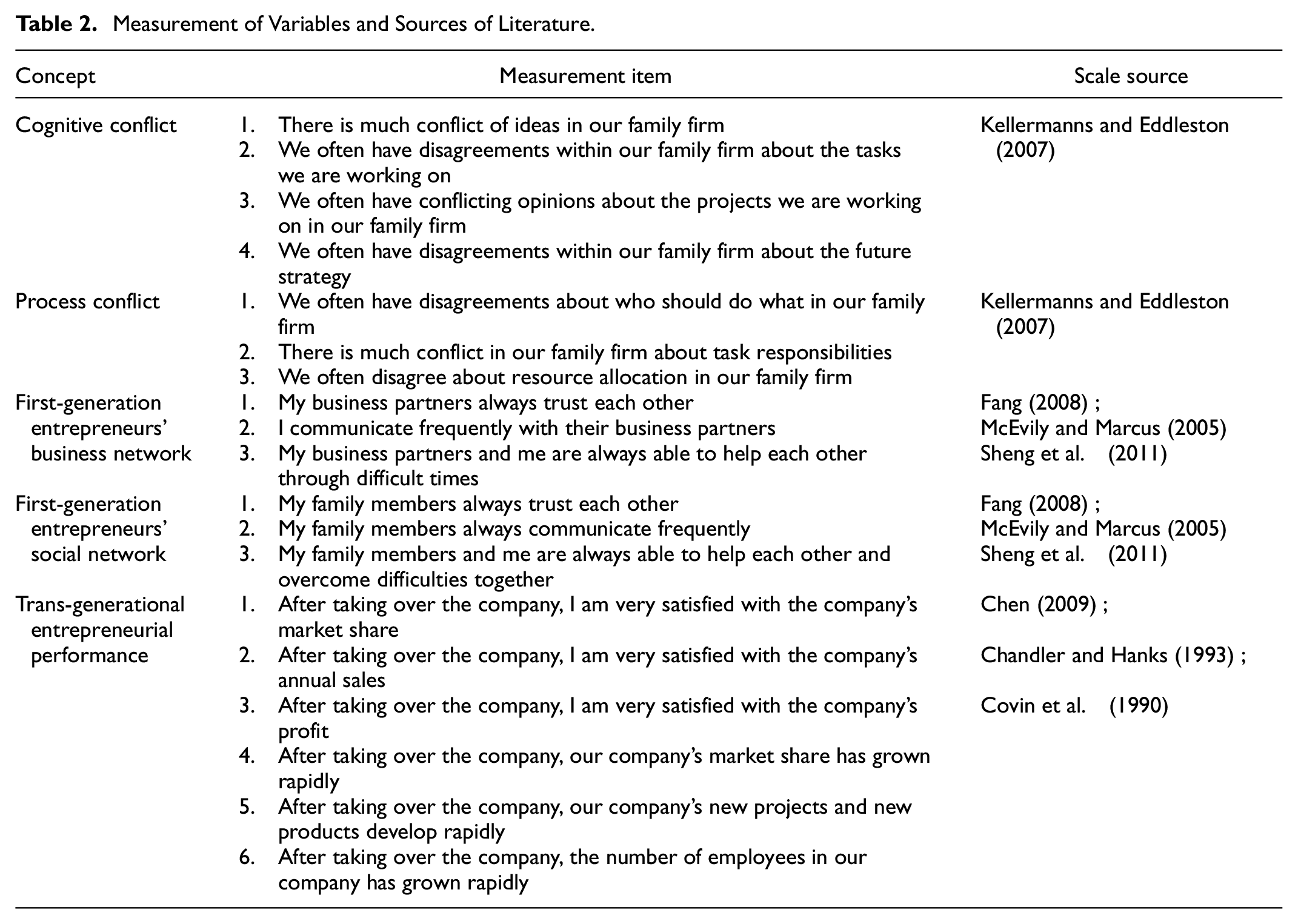
The scales applied in this study are adopted from previous research published in top-tier journals, which are translated and adapted to the content and purpose of this study (Table 2). All items are measured on a seven-point Likert scale (1 = strongly disagree and 7 = strongly agree). The second-generation successors were required to state the extent to which the description matches their objective conditions. The last part of the questionnaire included basic information about the manager and the enterprise. In addition, the size of the family business (number of employees), industry type, years of inheritance, age, gender and education level of the second-generation successors are used as control variables.
Measurement of Variables and Sources of Literature.
Reliability and Validity of the Measurement of the Variables
Reliability Analysis
SPSS26.0 was used to test the reliability of two independent variables (cognitive and process conflicts), two moderating variables (the first-generation entrepreneurs’ business and social networks), and one dependent variable (trans-generational entrepreneurial performance). The result of the reliability test revealed that the CITC value of each operation variable is higher than 0.50, and Cronbach’s α value of the corresponding secondary nominal variable is higher than .80, indicating that the internal consistency of each operation variable is good (Table 3).
Results of Cronbach Alpha, Composite Reliability, Average Variance Extracted (AVE).

Validity Analysis
An exploratory factor analysis was first performed using SPSS26.0 to determine the suitability of the data for factor analysis. Principal component analysis was employed to extract factors, and orthogonal rotation with Varimax was applied. The extracted factors along with their eigenvalues are presented in Table 4. This indicates that the content validity of the measurement scale is good.
Exploratory Factor Analysis Results.

To verify the discriminant validity among the variables, Amos 25.0 was used to perform the confirmatory factor analysis of each variable (Figure 2). The combination reliability (CR) and average extraction variance (AVE) of each variable were calculated according to the standardized factor load. The results reveal that the CR of each variable is higher than 0.80, and the AVE is higher than 0.50 (Table 3). Additionally, the square root of each variable’s AVE is higher than its correlation coefficient’s absolute value with other variables (Table 5). Thus, the variables have strong discriminant validity and convergent validity. Moreover, we derive the fitting index of the five-factor model (χ2/df = 1.31; CFI = 0.98; TLI = 0.98; RMSEA = 0.04), which fully reveals the fitting degree of the model, and the data are good.

Model of confirmatory factor analysis.
Means, Standard Deviations, and Correlation Coefficients of Variables.

Note. The bold number on the diagonal is the square root of AVE, and the correlation coefficient of each variable below the diagonal (n = 221; ***p < .01.
Hypotheses Testing
The hypotheses were tested using SPSS 26.0’s Hierarchical Regression Modeling method (Table 6). The results reveal that after controlling the enterprise size, industry type, age, and education level of the second-generation successors, both cognitive and process conflicts have significant negative effects on trans-generational entrepreneurial performance (Table 6, M2). Among them, the impact coefficient β of cognitive conflict is −0.14 (p < .05), and that of process conflict is −0.22 (p < .01). The T value of the two coefficients is 2.76 (p < .01). This indicates that there is a significant difference between the two influence coefficients. Thus, H1a, H1b, and H1c are supported.
Results of Hierarchical Regression.

Note. n = 221.
p < 0.01. **p < .05. *p < .1.
Next, we test the moderating effect of the first-generation entrepreneurs’ business network on the two conflicts and trans-generational entrepreneurial performance. Following previous studies (Baron et al., 1986; James & Brett, 1984), we add two interactive items (“cognitive conflict * first-generation entrepreneurs’ business network” and “process conflict * first-generation entrepreneurs’ business network”) to M3 in Table 6 and re-examine the hierarchical regression analysis. To guarantee the stability of the research results and reduce the problem of multicollinearity among the variables, we calculate the interactive terms between the independent and moderating variables after centralizing the data of the independent and moderating variables. The results of M3 indicate that there is a positive moderating effect of the first-generation entrepreneurs’ business network on the relationship between cognitive conflict and trans-generational entrepreneurial performance (the interaction coefficient β = .13, p < .10). Moreover, there is a negative moderating effect on the relationship between process conflict and trans-generational entrepreneurial performance (interaction coefficient β = −.12, p < .10), supporting H2a and H2b. Similarly, we re-examine the hierarchical regression analysis by adding two interactive items (“cognitive conflict * first-generation entrepreneurs’ social network” and “process conflict * first-generation entrepreneurs’ social network”) to M4 in Table 6. The results of M4 reveal a positive moderating effect of the first-generation entrepreneurs’ social network on the relationship between cognitive conflict and trans-generational entrepreneurial performance (interaction coefficient β = .16, p < .01). Moreover, there is a negative moderating effect on the relationship between process conflict and trans-generational entrepreneurial performance (interaction coefficient β = −.11, p < .10), supporting H3a and H3b.
Next, the three-dimensional moderating effect is examined. We add two three-dimensional interactions (“cognitive conflict * first-generation entrepreneurs’ business network * first-generation entrepreneurs’ social network” and “process conflict * first-generation entrepreneurs’ business network * first-generation entrepreneurs’ social network”) to M5 in Table 6 and re-run the hierarchical regression analysis. As presented in M5, the first-generation entrepreneurs’ business and social networks have a negative three-dimensional moderating effect on the relationship between cognitive conflict and trans-generational entrepreneurial performance (interaction coefficient β = −.19, p < .01). However, there is a positive three-dimensional moderating effect on the relationship between process conflict and trans-generational entrepreneurial performance (interaction coefficient β = .14, p < .05), supporting H4a and H4b.
General Discussions
Conclusions
Focusing on the context of family business inheritance and the theories of trans-generational entrepreneurship and network embedding, this paper explores the impact of trans-generational conflicts on trans-generational entrepreneurial performance and investigates the moderating role of first-generation entrepreneurs’ business and social networks. Based on a survey data captured from the 221 matched responses from founder and second-generation successors dyads in China, this study finds that (1) cognitive and process conflicts have negative effects on trans-generational entrepreneurial performance, but the impact of process conflict is greater because it is often more immediate and specific than cognitive conflict, which focuses on ideology. (2) First-generation entrepreneurs’ business and social networks independently alleviate the negative impact of cognitive conflict on trans-generational entrepreneurial performance but enhance the negative impact of process conflict on trans-generational entrepreneurial performance. This conclusion is consistent with the existing literature (Alderson, 2015; Caputo et al., 2019; X. Li et al., 2020). Our research refines their role in different conflicts. (3) These two networks synthetically have a negative three-dimensional interactive effect on the relationship between cognitive conflict and trans-generational entrepreneurial performance. However, they synthetically have a positive three-dimensional interactive effect on the relationship between process conflicts and trans-generational entrepreneurial performance.
Theoretical Contribution
The current study makes the following three theoretical contributions to the literature. First, many previous studies in the field of trans-generational conflict focused on the impact on firm performance, and the findings are controversial (Caputo et al., 2019; Kellermanns & Eddleston, 2007). Existing empirical studies have paid less attention to research on trans-generational entrepreneurial performance and are less involved in comparing the impact of the two conflicts. This study finds that the different growth backgrounds of the two generations lead to differences in their business philosophy and action methods, which hinders the realization of trans-generational entrepreneurial performance. It also reveals that process conflict with more specific and immediate performance has a greater negative impact on trans-generational entrepreneurial performance. This is a valuable complement to existing research on trans-generational conflict.
Second, this study introduces two heterogeneous network relationships—the business network outside the family and the social network inside the family—as moderator variables to analyze their impact on trans-generational conflict and entrepreneurship. The results reveal that when faced with cognitive conflict that does not affect substantive interests, both first-generation entrepreneurs’ business and social networks hope to complete the trans-generational inheritance successfully and are willing to alleviate the negative impact of cognitive conflict on trans-generational entrepreneurial performance. However, when facing process conflicts involving substantial changes or sacrifice, due to organizational inertia, first-generation entrepreneurs’ business and social networks may seek the private shelter of their business network or put pressure on second-generation successors. This dramatically increases the difficulty of trans-generation entrepreneurship and affects trans-generational entrepreneurial performance. This study further extends the network embedding theory in studying the trans-generational inheritance of family businesses.
Third, this study deserves special attention because the two network embeddings have a negative three-dimensional moderating effect on the relationship between cognitive conflict and trans-generational entrepreneurial performance. However, they have a positive three-dimensional moderating effect on the relationship between process conflict and trans-generational entrepreneurial performance. The interests and demands of business and social network members are not the same or even conflict, and their comprehensive impacts vary. When faced with cognitive conflict, these two heterogeneous networks will theoretically guide and persuade the two generations according to their own value needs, which is more likely to cause business anxiety among the two generations. However, it is impossible to decisively determine the trans-generational entrepreneurial direction, thereby delaying the process of trans-generational entrepreneurship. When facing process conflicts, embedding two heterogeneous networks makes contradictory demands on trans-generational entrepreneurship. It mitigates the negative impact of process conflict on trans-generational entrepreneurial performance. This is a further interpretation of the overlapping effect of the two network embeddings on trans-generational entrepreneurship from the perspective of contingency, which is different from the independent moderating effect and reveals a new and in-depth discussion area for future research.
Practical Implication
This study also has the following valuable implications in the practical field of how family enterprises manage cognitive and process conflicts, and how to balance the interests of all parties in the game. First, both generations of entrepreneurs should recognize the negative impact of cognitive and process conflicts. Particularly, in the actual operation of the trans-generational strategic change, first-generation entrepreneurs should not intervene too much. First-generation entrepreneurs should give legal authority to second-generation successors through formal authorization to help them “start up” as soon as possible. Second, the business and social network of the first generation is an important bridge for ideological communication between the two generations of entrepreneurs. When there is conflict in the two generations’ strategic direction or ideas, they can use the members of these two networks to persuade and mediate at the ideological and cognitive levels. However, the artificial obstacles set by the members of these two networks in the trans-generation strategic transformation cannot be ignored. The resistance of these “old forces” to the new transformation of enterprises should be eliminated as far as possible. This resistance will aggravate the process conflict of trans-generational inheritance. Third, first-generation entrepreneurs’ business and social networks are two heterogeneous networks, and they have different interests and concerns on trans-generation inheritance. Therefore, they have overlapping effects in opposite directions. The two generations should jointly focus on controlling the relationship between all parties, strengthening communication and trust, and supporting each other. In particular, they should pay attention to the trade-off and game with these two networks to prevent them from intensifying the conflict between two generations for different purposes and constantly realize the trans-generational entrepreneurial goal of the family business in the game of trade-offs. Last but not least, other stakeholders also should play a correct role in regulating intergenerational conflicts within the family enterprise. As for shareholders, transparent information exchange and negotiation platforms between generations should be strengthened to avoid causing more conflict in regular business activities. Family businesses are an important engine of China’s economic growth. Currently, family businesses in China are at the peak of intergenerational inheritance. The government can reduce cognitive conflicts between two generations of entrepreneurs through various forms such as discussions and training. It can also encourage family businesses to introduce professional management teams and assist two generations in establishing a scientific business management system.
Limitations and Directions for Future Research
This study has certain limitations. First, there are many types of trans-generational conflicts. This paper only explores the impact of cognitive and process conflicts. The impact of other types of trans-generational conflicts is also worth studying. Second, there is a problem with the universality of the data. The object of this study is limited to the area of Quanzhou City, thereby affecting the universality of the research conclusions. Additionally, the main variables, trans-generational conflicts, and network relationships cannot be measured from secondary databases and can only be measured through questionnaires. The cross-sectional nature of the data is evident. In the future, the same sample data can be collected in multiple periods, and a longitudinal comparative study can be used. Alternatively, future study also can use objective records (e.g., company archival data) to measure firm performance. Other methods can be used to observe the evolution of trans-generational conflict and its impact on trans-generational entrepreneurship.
Footnotes
Acknowledgements
The authors would like to thank Dr. Hangjun Xu at Union University for his invaluable assistance with this research. The authors are also grateful to the editors and the reviewers for their helpful comments.
Declaration of Conflicting Interests
The author(s) declared no potential conflicts of interest with respect to the research, authorship, and/or publication of this article.
Funding
The author(s) disclosed receipt of the following financial support for the research, authorship, and/or publication of this article: This work was supported by the National Social Science Fund Project (21BGL073).
Ethics Statement
Because our study is non-interventional (the survey), the ethical committee of Huaqiao University has granted us the exemption of ethical approval. Informed consent has been obtained from all participants involved in this study. In the research process, all participants were informed that participation was voluntary and assured that their responses would be used only for academic research and kept strictly confidential. Participants could withdraw from the study at any time without penalization. All the responses were anonymous, which helped to protect the privacy of participants. The research reported in the manuscript respects strictly the Declaration of Helsinki Ethical Principles.

Data Available Statement
The datasets generated during and/or analyzed during the current study are available from the corresponding author on reasonable request.