




Abstract
Digital commerce is being raised to a new level by the growing Metaverse cosmos. Business tycoons are attempting to establish a presence in the metaverse, highlighting its possibilities for e-marketing, virtual commerce, banking, and social engagement. As a result, many well-known organizations and companies are entering into the metaverse. The elements affecting customers’ behaviors in the metaverse, however, are not well understood. Our proposed study model was theoretically underpinned by the Stimulus Organism Response (S-O-R) concept. We proposed two stimuli factors (technological and spatial) and two factors of organismic experience (telepresence and flow experience) to account for consumers’ metaverse shopping intentions. With the help of structural equation modeling, we examined the data from 317 respondents. According to the findings, telepresence is significantly influenced favorably by interaction and vividness. Consumers’ flow experiences which eventually improve their intent to shop in the metaverse are significantly influenced by perceived similarity and competence. This study is one of the few that added to the body of knowledge on the metaverse while providing useful advice for tech firms and other businesses, in general, to take advantage of the metaverse’s prospects.
Introduction
The metaverse is a new digital universe that has emerged as a result of the rapid growth of virtual reality (VR) and augmented reality (AR) technologies (Zhao et al., 2022). Users of the metaverse can interact with virtual objects and other users in simulated reality through immersive experiences. The metaverse provides a virtual world with limitless economic opportunities from virtual music festivals to NFT-based businesses (Luo et al., 2021). It successfully addresses the typical problems with online shopping, such as a lack of product details and the inability to physically handle things (Hollensen et al., 2022). Therefore, tech firms are keen to make use of the metaverse’s possibilities, which will help the online environment. The metaverse overcomes the drawbacks of conventional web-based e-commerce by enhancing user operability and engagement (Baker et al., 2019). Its immersive and interactive features foster a strong sense of involvement known as flow. Companies may provide consumers with a wholly immersive shopping experience in the metaverse by utilizing 3D virtual storefronts and lifelike avatars (Batat, 2021; Xu et al., 2022).
Lately in the metaverse, big brands like Zara, Adidas, and Gucci now offer people to buy virtual clothes for their avatars and deliver products to their homes (Han et al., 2022). Unlike traditional internet buying, which requires hours of searching, reading reviews, and enduring advertisements, purchasing in the metaverse offers the best of both worlds. Customers can inspect items as if they were physically present, touch them, and interact with them without having to disturb themselves by going to a physical store (Sivasankar, 2022). The metaverse has the potential to seamlessly integrate users’ lives by providing immersive experiences (Hollensen et al., 2022; Kon & Hyekyung, 2022). The consumers’ behavior depends on emotions and perceptions, that create a sense of telepresence and flow in the metaverse (Kshetri, 2022). Telepresence is a sense of one’s presence and flow experience, which is a state of total immersion and absorption in a virtual environment (Jafar et al., 2023). However, the antecedents of telepresence and flow experience and their potential impacts on the use of immersive technologies have not been yet explored in the metaverse context. Therefore, one aspect that remains integral to this exploration is the understanding of how telepresence and flow experience influence consumers’ shopping behavior in the metaverse. Earlier studies mainly assessed client perceptions of virtual reality and human-computer interactions (Janssen et al., 2019; Kon & Hyekyung, 2022).
This research paper aims to inspect the interplay between telepresence, flow experience, and consumers’ shopping behavior and purchase decision-making processes in the metaverse. By examining how these factors shape consumers’ interactions with virtual stores, products, and services. To achieve these objectives, this research paper established a conceptual framework based on stimulus-organism-response (S-O-R; Mehrabian & Russell, 1974), consumer flow (Koufaris, 2002), and social interaction theories (Ettis, 2017; Hsiao & Tang, 2021). The model addresses two factors of environmental stimuli named “technological factors and spatial factors.” The technological factors are “interactivity and vividness,” and environmental factors are “perceived expertise and similarities.” Similarly, organismic factors are “telepresence and flow experience,” which ultimately influence the intentions to make purchase decisions in the metaverse stores. This study model comprehensively investigates factors that can influence consumers’ behaviors to purchase in the metaverse stores. The findings have significant managerial ramifications for people and businesses hoping to encourage consumers to use the metaverse.
The current study is organized as follows: Section “Conceptual Background and Hypotheses Development” offers the literature assessment and hypotheses development. Section “Methods” presents the research methods and analyses; section “Data Analysis and Results” describes the results and analysis; In the end, section “Discussion” describes the research findings, implications, limitations, and future research avenues. In addition, appendix A provides list of acronyms used in this study.
Conceptual Background and Hypotheses Development
The S-O-R Framework in the Context of Metaverse
This study adheres to the stimulus-organism-response (SOR) framework proposed by Mehrabian and Russell (1974). In this theory, the stimulus denotes the antecedent events to an act. Whereas the organism acts as a kind of conduit between the stimuli and human behaviors (Hsiao & Tang, 2021). The S-O-R model used in this research determines how the environment influences humans. It examines how technology and interpersonal interaction interact. The term “organism” alludes to a person’s feelings, ideas, and experiences. Pandita et al. (2021) define the organism as people’s mental evaluation of their online consumer experience as a flow experience. The response is the action as a result of stimuli and organisms such as making a purchase plan or intention to trade online (Baker et al., 2019; Yang et al., 2022). For two reasons, the comprehensive and integrated S-O-R paradigm is ideal for such investigations: First, the S-O-R framework has been extensively employed in earlier customer behavior studies (Ettis, 2017; Ja et al., 2020; Song et al., 2021). For example, Zhang et al. (2014), used the S-O-R paradigm to examine the impact of technological stimuli on customers’ simulated experiences and ensuing online purchasing plans.
Second, the S-O-R framework establishes a precise and formal framework for examining the effect of social interaction variables as environmental stimuli on an individual’s simulated experiences (flow) and, ultimately, online purchase intention (Jafar & Ahmad, 2023; Riegger et al., 2022). According to the current study technology and the virtual environment itself are two key factors that influence people’s behavior and opinion while using metaverse. These elements can affect a person’s telepresence (the sensation of being practically present) and flow (the state of being immersed in what they are doing). This study conceptualized the telepresence and flow experience as a result of the technological and spatial traits of metaverse platforms. In addition, it offers two types of stimulation variables that are in line with Sheridan’s notion of presence (Sheridan & Kelly, 2010; Steuer, 1992), Consequently, technology stimuli in our research include interactivity and vividness, whereas interpersonal interactions involve perceived expertise and similarities (Sanglin et al., 2020). This in turn can affect whether they want to buy things online.
Environmental Stimuli (S)
According to Steuer (1992) vividness and interactivity are two variables of VR experience that contribute to telepresence and flow experience. These two aspects are significant technological factors that might influence virtual experiences (Whang et al., 2021). The virtual world’s designers or developers normally produce or change the technological environmental stimuli, whereas the avatars’ interactions inside the virtual world determine the spatial environmental stimuli. The avatar’s engagement with other avatars in the metaverse is stimulated by technological stimuli such as virtual objects and surroundings found within the metaverse (Tu, 2022). In virtual settings, users can interact with other users and virtual objects in their surroundings through their avatars (Animesh et al., 2011). The avatar develops a feeling of self-awareness, enabling participants to do the same through engaging in vicarious experiences and benefiting from them (Reinhard et al., 2020).
Interactivity (INT)
The degree to which users may interact with virtual objects and change the perspective or content of a mediated environment in real time is defined as interactivity (Steuer, 1992). Consumers’ interactions with virtual goods might be facilitated or hindered by technical aspects in an immersive virtual world that change their virtual experiences (Lombart et al., 2019). The avatars’ actions serve as a channel for their communication with the metaverse (Cowan & Ketron, 2019). A medium’s degree of interaction is determined by its technological foundation, which includes elements like response time, the degree to which users can influence virtual environments, and the techniques used to track user behavior in the metaverse. Interactivity in online shopping channels has been found to boost the emotional response of retailers’ attitudes (Lee et al., 2010), shopping participation (Poushneh, 2018), purchase intention (C. Liu et al., 2020), and satisfaction (Dash et al., 2021). The brain adapts to the virtual world environment because of self-control in the virtual environment provided by interactivity, and the avatar becomes an extended version of the consumer’s external reality (C.-L. Liu, 2014). Such fascinating participation in metaverse exchanges and explorations lowers self-consciousness, makes the virtual experience more enjoyable, and improves flow (Takahashi et al., 2017). Thus, this study postulated that:
Vividness (VDN)
Steuer (1992) defined vividness as “the degree to which mediated environments can communicate information to users’ senses.” More detailed information is vividly transmitted when the quality of the material such as description or visibility improves (Leeuwis et al., 2021). In the same way, high-definition television (HDTV) produces higher-resolution images than as compared to standard-definition television, thus having comparatively more sensory depth. When users interact within a VR environment, the breadth and depth of information allow them to feel sensory, spatial, and social immersion (Hwan et al., 2021). Rich media tools like animation, video, and audio can be regarded as tools that enhance the richness of the experience with a company, thus increasing vividness. When it comes to online sites, a vivid website must contain sensory-rich information that appeals to numerous senses. Because vividness is supposed to influence people’s perceptions of telepresence, any effort to boost vividness on a website should cultivate telepresence (Jang et al., 2019). In the context of online marketing, a visually appealing or highly vivid website attracts more customers for a longer period in an e-commerce environment (Kowalczuk et al., 2021). According to Minwoo et al. (2020), vividness affects consumers’ views and behavioral intentions toward stores and their products. Consumer sentiments toward virtual product experiences in advertising are favorably impacted by vividness (Yim et al., 2017). These results suggest that participants can converse and receive information more effectively when their vividness is high, which eventually enhances telepresence (Houn & JeanA, 2009).
Interpersonal Interactions Stimuli (S)
The face-to-face sharing of thoughts, ideas, sentiments, and emotions among different individuals is referred to as interpersonal communication (Hajli, 2015). If people connect with a website or platform frequently it will increase interpersonal attraction (Xiang et al., 2016). Therefore, in the metaverse context, we incorporated two interpersonal interaction dimensions that is, perceived similarity and perceived expertise. Perceived similarity refers to a consumer’s perceptions of a product’s flavor, preference, and liking (Grigoryan, 2020). According to Fischer and Reuber (2011), when online shoppers possess the knowledge and experience to suggest products to others, it is termed as their expertise. Numerous academics have found a connection between flow experience and purchase intention when using the S-O-R model. For instance, Animesh et al. (2011), investigated how flow, telepresence, and social presence mediate the effects of technological and spatial elements on buying behavior. Gao and Bai (2014) used flow as a mediator to examine how website atmospheric cues affected customers’ purchase behavior and experience. For instance, according to Baker et al. (2019), flow is comprised of expertise, similarities, and curiosity. We describe flow as a momentarily unconscious state in which a person actively enjoys, completely concentrates on, and controls their shopping activity in a metaverse store.
Perceived Expertise (PE)
Perceived expertise is delineated as a person’s level of knowledge in that discipline. The competence of a group’s source is critical for information acceptance and when people are socially influenced they are more likely to agree with an expert’s opinion (Spake & Megehee, 2010). Members with greater experience in the field of online shopping provide advice to newcomers (Wu et al., 2018). Asymmetric information and cost will be reduced as a result of members’ valuable and relevant messages, resulting in delightful encounters (Woong & Sumeet, 2009). Additionally, customers are more inclined to engage if given pertinent and useful information. Customers frequently lose self-control and enter a flow state during a vigorous virtual engagement (Donghee, 2019; Gao & Bai, 2014). As a result, we posit that group members’ PE in the social retailing setting will generate a flow experience. So, we proposed the hypothesis as follows,
Perceived Similarity (PS)
In this study, perceived similarity refers to consumers of e-commerce sites’ self-perceived behavioral similarities (e.g., preferences and choices). People gravitate toward individuals who are akin to them (Hain et al., 2022; Murnieks et al., 2011). Customers adore interactions and create positive sentiments since they feel similar to other members (Ou & Verhoef, 2017). Social connections are the primary source of flow experience (Hefu et al., 2016). A sense of flow is consequently produced by social interaction which increases enjoyment and makes virtual experiences more enticing (Ettis, 2017). Customers will choose to concentrate on the experience and eventually enter the state of flow if they value the experience (Gao & Bai, 2014). According to the present study, shoppers who see commonalities with users of e-commerce platforms are expected to reach the state of flow. Hence, we proposed as follows:
Metaverse Organismic Experience (O)
The S-O-R framework suggests that the experiences of an organism enhance the impact of environmental stimuli on its behavior. Furthermore, organismic experiences are thought to mediate the impact of technical and spatial environmental cues on customers’ intention to shop (Animesh et al., 2011; Hefu et al., 2016; Sanglin et al., 2020). We focused on two types of virtual experiences: telepresence and consumer flow experience. The spatial and technological environmental stimuli are employed in the model because they are more responsive and have the potential to impact the socioemotional reasons for purchasing products in the metaverse.
Telepresence (TLP)
Telepresence is defined as “the degree to which one feels present in a “virtual space” rather than in one’s actual physical surroundings” (Steuer, 1992). The level of telepresence is examined by how well a certain media technology can mimic how people interact with their surroundings through their senses (Shih, 1998). Users’ perceptions in virtual reality are shaped by the vivid information that surrounds them and produces an interesting overall experience (Algharabat et al., 2018; Shin & Han, 2017). Sanglin et al. (2020) examined the impact of audio-visual cues on consumer reactions to virtual products since they have a strong connection with telepresence. According to Xi et al. (2022), those who are accustomed to telepresence will be less sensitive to the differences between real-world and metaverse environments. It will lead to a higher level of virtual environment pleasure and a perception of embodiment as a second reality. These customers enter the virtual world and interact with others using avatars, just as they would in reality. Furthermore, participants buy virtual goods to improve and create their avatars’ identities in the virtual world because they see their avatars as an extension or mirror of themselves (Jafar et al., 2023; Koles & Nagy, 2012). Therefore, we propose:
Consumers’Flow Experience
According to Donghee (2019), customers who experience flow when shopping online are more inclined to make impulsive purchases. When individuals experience flow they become fully absorbed in the stimuli (Hefu et al., 2016). User involvement in computer-mediated environments creates a sense of concentration and causes a flow experience (Balakrishnan & Dwivedi, 2021; Barker, 2016; Koufaris, 2002). Several studies have utilized the S-O-R model to inspect the relationship between consumers’ flow experience and shopping intentions. Animesh et al. (2011) investigated how flow, telepresence, and social presence moderate the impact of technical and geographical factors on purchase intentions. According to Ettis (2017), flow is a multidimensional construct, made up of control, attention, and interest. Flow is a captivating experience that affects customer conduct in online buying and social networking games (Daehwan & Yong, 2019). Similarly, Zhang et al. (2014) described that customers who feel a sense of enjoyment and satisfaction during browsing or virtual commerce activities have positive purchase intentions. Consumers’ behavioral intentions such as the chance of purchasing from a website are influenced by flow experience (Chen & Lin, 2022; Whang et al., 2021). When using online shopping websites and making purchases to improve their online reputation, people who have fascinating experiences are more likely to be fully engaged (Animesh et al., 2011). Therefore, consumers are more inclined to shop on virtual or metaverse platforms if they have a good time while doing so on social media websites. We’ve guessed about something as a result of this.
Shopping Behavior in Metaverse as Response (R)
According to this study framework, the stimulus is technological and societal aspects, the organism is metaverse experience, and the reaction is metaverse shopping intention. Social media tools are used in social commerce to efficiently engage customers and facilitate social connections (Fischer & Reuber, 2011; Uhm et al., 2022). According to Shen et al. (2010), customers are receptive to a range of advantageous interaction factors and effects, including perceived similarity, familiarity, engagement, and locus of control, which boost their behavioral intentions. Consumers’ attitudes about objects are influenced by the different levels of cognitive processing they engage in their buying activities and these feelings influence their action (Argyriou & Melewar, 2011). Increases in product knowledge influence consumer attitudes that influence the growth of consumers’ intents to act whether positive or negative on the products (Kim et al., 2020). According to a study, technologically and socially enhanced events increase users’ telepresence, flow experience, and purchase intentions. As a result, our suggested method of investigation is consistent with earlier studies that apply the S-O-R model and take into account intention to buy as a response variable. The conceptual model of this study is shown in Figure 1.

Conceptual model.
Methods
Measures Development
The theoretical model was validated using a novel method of data collecting that involved a unique questionnaire. The measurement items in the questionnaire were custom-created to fit the requirements of this investigation after being adapted from previously published research. To make sure the questionnaire was valid and effective, a focus group discussion was held with professors and postdoc fellows from our university. The questionnaire for this study is divided into two components. The first section asks about the respondent’s general demographics, including gender, age, education level, and how frequently they use the metaverse. The seven constructs that were used in this study are covered by questions in the second section. Five measurement items for TLP were adapted form Daehwan & Yong (2019). These items were designed from the conceptual definition of telepresence by Steuer (1992). Likewise, three items for shopping intentions were adapted from Sanglin et al. (2020). Similarly, perceived expertise and similarities were evaluated using items from Shen et al. (2010) respectively. Zhang et al. (2014) study provided the basis for flow items. interactivity and vividness were modified from the study Daehwan and Yong (2019). The measurement items are presented in Supplemental Appendix B. The Likert scale of 1 (strongly disagree) to 5 (strongly agree) was used to score the measurement items.
Sample Design and Data Collection
We employed a survey approach that is frequently used to examine social commerce behaviors to evaluate the association between constructs and variables (Zhang et al., 2014). We gathered information from online metaverse groups, notably from the Telegram channel for the metaverse community (https://t.me/metaverse_blockchain). The metaverse community group has thousands of daily active users who publish blogs, communicate, seek help, and share new ideas with other metaverse community members. Furthermore, the model we employed in our study is comprehensive and incorporates characteristics of social interaction that are difficult to quantify using other methods. For the current study, we believe that conducting a survey is the most suitable technique (Zhang et al., 2014). We briefed the study respondents before starting the questionnaire. We asked them some simple questions, for example, do you frequently visit metaverse platforms (Sandbox, Roblox, and Decentraland, etc.)? or do you have experience with metaverse shopping malls or metaverse stores (i.e., H&M, ZARA, Adidas, and Gucci)? With the support of registered members of telegram channels, the online questionnaire was provided to potential users via email. For the final data analysis, 317 valid responses were obtained. The demographic characteristics of responders are indicated in Table 1.
Respondents’ Descriptive Statistics.

Data Analysis and Results
Partial Least Squares Structural Equation Modelling (PLS-SEM) was applied in the present study. It is a useful procedure in handling cases where multifaceted mediation theories are studied with a wide range of gauge numbers and associations (Hair et al., 2017). PLS-SEM has been widely used as a crucial tool in social science research, acting as a reliable substitute for conventional statistical methods like multiple regression and path analysis (e.g., Jafar et al., 2019; Sanglin et al., 2020). It is an approach that can be applied to perform both measurement and structural model analyses. Due to its dominance over alternative structural equation modeling techniques, PLS-SEM has been steadfastly proven to be a better option for this kind of study (Evermann & Tate, 2016). It permits the integration of insightful and determinative measurement theories. Therefore, PLS becomes a preferred statistical package for the critical analysis and management of formative constructs (Hair et al., 2017). The analysis was carried out using the data analysis tool, SmartPLS 3.2.9 software.
Common-Method Bias (CMB)
Given that data is collected simultaneously from a single source, the problem of common method bias could undermine the validity of the research. Harman’s single-factor test was used to investigate prevalent technique bias in our study. Finally, the research revealed that all of the items may be divided into five categories, with the first component accounting for only 14.67% of the variance. Additionally, it was determined that all of the indicators’ variance inflation factor (VIF) values fell below 2.550, which is consistent with the results shown in Table 2. The ideal VIF values, as recommended Hair et al. (2017), should be less than 3.3. This proves that the model does not have any common biases. On the other hand, if the VIF is greater than 3.3, it may indicate that the model contains common method bias (CMB). As a result, these findings strongly imply that bias was not a major issue in this particular study.
Measurement Model (Convergent Validity, Reliability, Discriminant Validity, and Multicollinearity).

Demographic Information
Table 1 illustrates the demographic and personal information received from research participants. Accordingly, 56% of respondents were men and 44% were females. The majority of the respondents are youth because the age group with the highest proportion 55% includes 18 to 30 years old. Furthermore, 53% of respondents hold a bachelor’s degree, 29% hold a postgraduate degree, 14% of individuals have a high school certificate and 9% have at least a middle-level education. The statistics revealed that respondents had a good educational background. The research sample was diversified, with participants possessing from a variety of metaverse platforms. All the participants have strong knowledge and experience of the metaverse, as 97% of respondents actively use and metaverse and 45% of users spend more than 12 h weekly in the metaverse. SPSS Statistics was used to analyze the demographic data recorded in Table 1.
Evaluation of the Measurement Model
The robustness of the measurement model is tested by quantifying the internal consistency, discriminant, and convergent validity of the reflective constructs. The internal consistency (reliability) is determined precisely by reviewing the values of Cronbach’s alpha (CA), and composite reliability (CR). According to Sarstedt et al. (2020), it is crucial for CA and CR values to exceed .7 and for the AVE value to be greater than 0.5. Table 2 shows that the current study’s CA values, which are comfortably above the suggested threshold of .7, range from .779 to .858. Similar to that, the study’s CR values, which range from 0.871 to 0.899, are higher than the industry norm of 0.7. These results show a high construct reliability. Additionally, Table 2’s AVE values, which range from 0.640 to 0.745, are above the advised level.
The Discriminant Validity Assessment
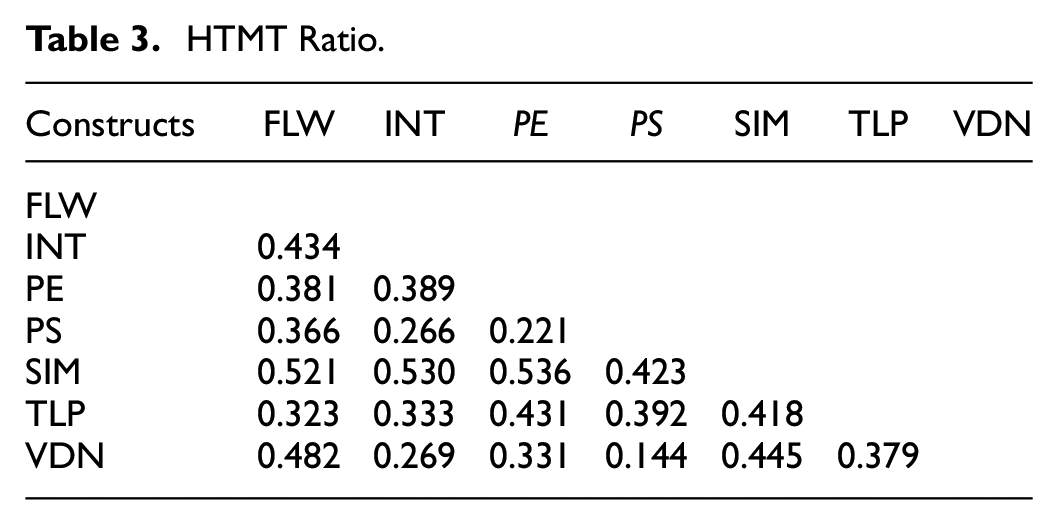
In contrast to the conventional Fornell-Larcker criterion approach, a Heterotrait-Monotrait (HTMT) correlation ratio is a more recent method for assessing discriminant validity in SEM (Henseler et al., 2015). The HTMT cutoff value must be significantly less than 1 or less than 0.90. According to Table 3, the highest HTMT value we discovered during our research was 0.536. This number falls below the suggested cutoff point of 0.90. However, we came to the conclusion that all measures indicated construct validity after taking into account discriminant validity and evidence of nomological validity, as shown in Table 3.
HTMT Ratio.
Evaluation of the Structural Model
In our study model, all constructs show desirable properties. As depicted in Table 2, the VIF value for the shopping intentions construct ranges from 1.428 to 2.550, which confirms that our data does not have any multicollinearity issue. Hence, we continue to assess the structural model. A structural model specifies the association along with latent variables. The path coefficients and described variances of the structural model are shown in Figure 2. The data analysis employed the demographic factors as checks on the metaverse shoppers’ inclinations to purchase. All of the control variables were not statistically significant (p > .05). As shown in Figure 2, interactivity had positive effects on both the telepresence (β = .111, t = 2.167, p < .05) and consumer flow experience (β = .217, t = 4.331, p < .05) respectively. Similarly, VDN also has a positive and significant effect on both the telepresence (β = .211, t = 4.047, p < .05) and flow experience (β = .293, t = 6.526, p < .05). Hence, hypotheses H1a, H1b, H2a, and H2b were accepted. Meanwhile, perceived expertise had positive influences on the telepresence (β = .224, t = 4.381, p < .05) and flow experience (β = .132, t = 2.592, p < .05) and perceived similarities impacts on telepresence (β = .249, t = 5.239, p < .05) and flow experience (β = .208, t = 4.389, p < .05). Hence, hypotheses H3a, H3b, H4a, and H4b were also accepted. Similarly, telepresence (β = .250, t = 4.858, p < .05) and consumers’ flow experience (β = .368, t = 7.775, p < .05) had positive and significant relationships with shopping intentions in the metaverse respectively. So, hypotheses H5 and H6 were supported. These results showed that the antecedent (exogenous) factors accounted for 48% and 43%, respectively, of the variance in flow. About 52% of the variation in shopping intentions in the metaverse was overall explained by the structural model.

Structural model’s path coefficients.
Mediating Effect
In order to evaluate the mediation effects of telepresence and flow, we used the bias-corrected technique at a 97.5% confidence level (Prebensen & Xie, 2017). If the bias-corrected method’s generated confidence intervals do not include zero, it suggests that indirect effects are mediating the relationship. When the confidence intervals for the direct and indirect effects do not coincide with zero, there is a partially mediated effect. A full mediation effect, on the other hand, is seen when the indirect impact’s confidence interval does not include zero while the direct effect’s confidence interval does. Unexpected findings show that while the confidence interval for the direct effect includes 0, the confidence interval for the indirect effect excludes it. As a result, telepresence and flow serve as substantial mediators between shopping intentions in the metaverse except for interactivity. Moreover, the R2 values indicate that the model has sufficient analytical ability. Table 4 shows the results of both direct and indirect effects.
PLS Bootstrapping Results.

Note. n.s: Unsupported.
p < .05, **p < .01, ***p < .001 (two-tail test).
Discussion
Based on the S
Theoretical Implications
Our research contributes significantly to the existing body of knowledge. First, this research extends the present literature by examining and justifying a model that integrates technical and interpersonal stimuli (S) to produce the metaverse organismic flow experience (O) which ultimately enhances the consumers’ shopping intentions in the metaverse (R). This study is one of the earliest attempts to examine the impact of expertise and similarities on participants’ sense of presence and engagement in the metaverse. Furthermore, we embark on an exploration of how technological elements, such as vividness and interactivity, sculpt the tapestry of engagement and presence in the metaverse. Second, telepresence’s important function in influencing consumers’ decision to shop in the metaverse was successfully described by this study. We discovered that consumers can feel similar to they are at a physical mall when using technology elements in the metaverse shopping mall that have high levels of telepresence. Third, this research adds to our understanding of how crucial interpersonal interaction elements are in virtual retail. The current study adds to Shen et al. (2010) findings by proving that interpersonal interaction elements influence shoppers’ shopping intentions in the metaverse via flow and telepresence experience. Last, we uncovered the mediating effect of users’“organismic experience” regarding how technological and social factors affect users’ purchase intention. Users’ organismic experience (i.e., telepresence and flow), which takes into account people’s fundamental psychological needs and the internal motivations for their thoughts and behaviors, frequently influences the way stimulus elements affect customers’ purchase intentions (Zhao et al., 2020). The findings of this study show that organismic experience, prompted by telepresence and flow, resulted in the user’s intention to make a metaverse purchase.
Practical Implications
The outcomes of this study have significant ramifications for platform companies, investors and developers who work in the metaverse. They have a significant interest in solving the puzzles around customers’online purchasing intents. An important contribution is the useful advice provided to designers on integrating interfaces with current goods. Additionally, it has been demonstrated that these interactions in the metaverse improve customers’ opinions of telepresence, which ultimately results in more favorable responses from consumers as a whole. Similar to Suh and Chang (2006), another suggestion for metaverse originators is to create and adjust the user interface in a way that enhances the feeling of being present and interacting with others. Additionally, our research prompts managers to completely appreciate how flow experience is built in metaverse retail. Practitioners should focus on enhancing interpersonal attraction on metaverse purchasing platforms and paying special attention to expertise, similarities, and interactivities because social attraction factors have a substantial impact on consumer flow and telepresence. Additionally, our research prompts managers to completely appreciate how flow experience is built in metaverse retail. Practitioners should focus on enhancing interpersonal attraction on metaverse purchasing platforms and paying special attention to expertise, similarities, and interactivities because social attraction factors have a substantial impact on consumer flow and telepresence. Managers can improve telepresence through more bright and dynamic platforms to improve consumer perceptions within metaverse purchasing environments. This suggests that businesses should prioritize these elements and plan strategies to improve interfaces for fostering higher degrees of telepresence rather than dispersing their efforts across all marketing variables. This study proved that telepresence and consumers’ flow experience significantly enhance the consumers’ shopping intentions in the metaverse.
Conclusion
In conclusion, the Metaverse is quickly changing the environment of digital trade and offering fascinating potential for companies in a range of industries, including e-marketing, virtual trade, banking, and social interaction. Understanding the elements impacting consumer behavior within the Metaverse is essential as large businesses enter this developing market. Key components have been illuminated by this study, which is based on the Stimulus-Organism-Response (S-O-R) idea. While telepresence and the flow experience are crucial organismic elements influencing consumers’ inclinations to shop in the Metaverse, technological and spatial inputs also play a significant influence. The study’s findings offer insightful advice for IT companies and companies wishing to make use of the Metaverse’s enormous potential. This study adds to the corpus of knowledge on this revolutionary digital space and emphasizes the value of embracing the Metaverse’s potential.
Limitations and Future Research Avenue
There are some important restrictions on the current investigation. We collected information from groups on platforms like Telegram and Second Life, where most respondents primarily used the metaverse for gaming rather than for purchasing. Future studies should concentrate on the direct customers of stores like H&M, ZARA, Adidas, and Gucci that are located in the metaverse. There are also several exciting directions for future study. Future research should focus on metaverse telepresence and methods for augmenting it as a starting point for this investigation. Researchers could look into the impact of interactivity and vividness on metaverse telepresence, as well as their relative relevance. Because these characteristics were not directly explored in the current study, a study like this could provide more practical guidance for metaverse creators. More research might be done to look into the effects of sensory components on vividness, and eventually telepresence. Additionally, the survey sample may be biased due to self-selection since the respondents’ participation was voluntary. Future studies should include a bigger and more representative sample. We advise using a triangulation methodology in future studies that syndicate observation in-depth interviews and self-report data.
Supplemental Material
sj-docx-1-sgo-10.1177_21582440241261256 – Supplemental material for Metaverse in Human Behavior: The Role of Telepresence and Flow Experience on Consumers’ Shopping Behavior in the Metaverse
Supplemental material, sj-docx-1-sgo-10.1177_21582440241261256 for Metaverse in Human Behavior: The Role of Telepresence and Flow Experience on Consumers’ Shopping Behavior in the Metaverse by Rana Muhammad Sohail Jafar, Wasim Ahmad and Yi Chen in SAGE Open
Footnotes
Declaration of Conflicting Interests
The author(s) declared no potential conflicts of interest with respect to the research, authorship, and/or publication of this article.
Funding
The author(s) received no financial support for the research, authorship, and/or publication of this article.

Data Availability Statement
Data will be provided on request.
Supplemental Material
Supplemental material for this article is available online.
References
Supplementary Material
Please find the following supplemental material available below.
For Open Access articles published under a Creative Commons License, all supplemental material carries the same license as the article it is associated with.
For non-Open Access articles published, all supplemental material carries a non-exclusive license, and permission requests for re-use of supplemental material or any part of supplemental material shall be sent directly to the copyright owner as specified in the copyright notice associated with the article.
