




Abstract
The secure base phenomenon was ascribed to changes in exploration observed during Ainsworth’s Strange Situation Procedure (SSP), related to the quality of the attachment relationship. However, infant temperament was not taken into consideration. The current study aims to replicate Ainsworth’s findings regarding infant exploration and attachment quality during the SSP and extend the findings by examining the role of infant temperament. One hundred thirty-two mother-infant dyads participated in the SSP when infants were 12 months old. Video recordings were coded for attachment quality and for duration of locomotion, duration of engagement with toys, and quality of engagement with toys. Temperamental activity level and fear were assessed with the Infant Behavior Questionnaire. Results showed that—irrespective of infant temperament—infants with insecure-resistant attachment relationships engaged less with toys compared to infants with secure or insecure avoidant relationships, and these differences were amplified during separation from the mother. Duration of engagement with toys was thus a robust indicator of attachment-related infant exploratory behavior. Duration of locomotion increased in response to separation from the mother and decreased after reunion. This likely reflects a mix of exploratory and proximity seeking behavior, and was more affected by controlling for temperamental fear. For quality of engagement with toys, no associations with attachment and temperament were found. During the SSP, the manifestation of the secure base phenomenon depended on the combination of the type of exploratory behaviors and the quality of the attachment relationship, but also on infant temperament.
Plain Language Summary
In this study we examined how infants explore a new situation with their mothers present or absent, because a classic study (Ainsworth et al., 1978) did not take into account that infants’ temperament might play a role. Videos of 132 12-months-old infants and their mothers were coded on attachment relationship quality, moving through the room and playing with toys. Infant temperament was reported by the mothers. Results showed that duration of playing with toys decreased when mother left the room and increased when mother came back; this pattern depended on the attachment relationship but not on temperament, replicating results of the classic study. Moving through the room increased when mother left the room and decreased when mother came back, which was not associated with attachment but rather with temperament. These results can only be applied to situations during which mothers leaves the room and returns after a short moment. Altogether it indicates that the exploration of the infant during the presence or absence of the mother depended on the type of exploration, attachment relationship quality and for some behaviors also on infant temperament. Future studies should consider including both children’s temperament and the attachment relationship quality when studying children’s exploration.
According to attachment theory (Bowlby, 1969/1982), infants’ exploration of their surroundings is modulated by the presence or absence of their attachment figures. This so-called “secure base phenomenon” can be observed in exploration of objects (e.g., playing with toys), spatial exploration, and visual exploration (Ainsworth et al., 1978). For years, there has been a debate about the extent to which children’s responses to the whereabouts of their attachment figures reflect the history of their interactions or rather reflect infants’ temperament (Goldsmith & Alansky, 1987; Vaughn & Bost, 1999), yet the role of temperament with respect to the secure base phenomenon remains unknown. This study revisits the link between infants’ exploratory behavior during presence and absence of their mother and the quality of the attachment relationship, adding the possible role of infant temperament.
Ainsworth and colleagues (Ainsworth et al., 1978; Ainsworth & Wittig, 1969) developed the Strange Situation Procedure (SSP) at first to experimentally demonstrate the universality of the secure base phenomenon. Only after discovering striking individual differences in infants’ responses to their mother, the SSP became a tool for measuring individual differences in the quality of attachment relationships. In video-recordings of the SSP, infant-caregiver interactions can be observed in reaction to the manipulation of the presence of the parent, and an unknown research confederate, the so-called “stranger.” Throughout the procedure, the infant can play with the provided toys and is free to explore the room. Based on the changes in exploratory and attachment behavior in reaction to the caregiver and stranger leaving and returning, individual differences in the quality of infant-caregiver attachment relationships have been detected and linked to observed interactions with the parent-child relationship in the home situation.
Ainsworth et al. (1978) proposed that the quality of the attachment relationship between infant and caregiver can be described as either secure, insecure-avoidant, or insecure-resistant. Infants with a secure attachment relationship showed positive behaviors toward their caregiver, explored in presence of the caregiver and in absence of stress, and sought contact with their caregiver when upset. Infants with an insecure-avoidant attachment relationship showed avoidance of interaction with the caregiver during the SSP, notably during reunion. Infants with an insecure-resistant attachment relationship showed little exploration and ambivalent behavior, that is strong proximity seeking and contact maintaining with angry or passive resistance (Ainsworth et al., 1978). Regarding exploration behaviors, Ainsworth et al. found that exploratory locomotion and manipulation of objects was most frequent when mothers were present, and least when infants were briefly separated from their mothers. Furthermore, infants with insecure-avoidant attachment relationships showed most exploration, and infants with insecure-resistant attachment relationships least (Ainsworth et al., 1978). Whereas Ainsworth et al. focused on infant exploratory behavior during the SSP, later research has shown links between attachment quality and infant exploration throughout childhood (Grossmann et al., 2008). In addition, the importance of a secure base from which infants can explore was illustrated by a study that showed a strong association between the quality of maternal secure base behaviors and mother-infant attachment quality (Woodhouse et al., 2020). This suggests that infant exploratory behaviors are key aspects of attachment security that are worth unraveling.
Both exploratory locomotion and manipulation of objects/toys are aspects of infant exploration, of which exploratory manipulation of objects manifests itself earlier in development. By the age of 12 months, infants manifest individual differences in quantity and quality of engagement with toys (Caruso, 1993; Lobo et al., 2014). The importance of the quality of exploratory behavior in play for children’s development is reflected by for example the positive association between variability in types of exploration and problem-solving skills (Caruso, 1993), and later in development by the association between the quality of pretend play and cognitive self-regulation (e.g., behaviors related to learning such as controlling of planning, attention, and motivation; Slot et al., 2017). In addition, infant exploratory behavior is linked to parent-child interaction: increases in infant spatial exploration coincided with increases in mother-infant interaction as infants develop crawling (Thurman & Corbetta, 2017). Variation in parent-initiated object-related interaction was positively related to infant object exploration (Koterba & Iverson, 2009). Additionally, exploratory behavior mediated the relationship between the quality of the child-caregiver attachment relationship at 36 months and cognitive skills in first grade (O’Connor & McCartney, 2007). Thus, studying individual differences in both the quantity and quality of infant exploration of objects could provide additional insights in the way the parent-child relationship is associated with infant exploration.
In addition to infant exploratory behavior being linked to the interaction with the caregiver, exploratory behavior could also reflect innate temperamental characteristics. Exploratory behavior has been related to individual differences in temperament, in particular reactivity to environmental stimuli, including novel or stressful situations (Rothbart, 2012). The secure base phenomenon describes that infants explore most intensively when they perceive their attachment figure to be available and responsive (Ainsworth et al., 1978). Yet, infants who have high rates of fear might experience higher levels of stress in new situations which might inhibit exploratory behaviors. Frazier-Wood and Saudino (2017) showed that infant motor activity observed in a lab situation was reduced for infants with higher rates of social fear. In addition, temperamental activity level, which refers to gross motor activity such as moving limbs and locomotion and indicates a child’s predisposition to be physically active in different situations, might also determine the locomotive behavior, next to attachment quality and fear. Infants with high activity levels might show more spatial exploration (locomotion) and engagement with toys than infants with lower activity levels, which might contribute to the amount of exploratory behaviors in an independent way.
Moreover, attachment quality and infant temperament are found to be weakly to moderately associated (Groh et al., 2017b). The debate about the association between temperament and attachment quality (e.g., Goldsmith & Alansky, 1987; Vaughn & Bost, 1999; Vaughn et al., 2008) focused on overall associations between temperamental subscales and attachment classifications/security, but also has raised the issue of the developmental significance of attachment quality and temperament in parent-child interaction (Vaughn et al., 2008). A still open question is whether temperament and attachment quality may jointly explain regulation of exploratory behavior in relation to stress.
The aims of our study are to examine (a) to what extent changes in infant locomotion and engagement with toys across episodes of separation from and reunion with their mothers are associated with mother-infant attachment quality, and (b) whether the associations of locomotion and engagement with toys with attachment quality are independent of temperamental activity level and fear. Like Ainsworth et al. (1978), the present study focuses on the quantity of locomotion and engagement with toys (i.e., the duration). In addition, the quality of engagement with toys is examined. We hypothesize that infants spend most time on locomotion and engagement with toys as a form of exploration during pre-separation and that infants spend least time engaging in these behaviors during separation from their caregiver. We also hypothesize that infants with insecure-avoidant attachment relationships show quantitatively the most of such exploratory behavior, and infants with insecure-resistant relationships the least (Ainsworth et al., 1978). Furthermore, a higher quality of engagement with toys was expected in the presence of the mother pre-separation, and for infants with secure attachment relationships compared to infants with insecure attachment relationships. In addition, we hypothesize that the associations between changes in locomotion and engagement with toys with attachment quality are partly explained by individual differences in infant temperament (both fear and activity level). Attachment quality was tested using three attachment categories, to be consistent with Ainsworth et al. (1978). Sensitivity analyses were added to test the robustness of the associations against variation in the operationalization of attachment quality, by also including the additional fourth category of disorganized attachment (Main & Solomon, 1986).
Method
Participants
This study included 132 women who participated in the larger longitudinal Generations2 study of the Vrije Universiteit Amsterdam. Generations2 follows first-time mothers and their first-born children. The general aim of the study is to examine the transition to parenthood, how parenting and the parent-child relationship develops, and how this is linked to the social-emotional, cognitive, and motor development of the children. In total, about 2,000 women who were pregnant with their first child were recruited for the study via the project website, midwifery practices in the Amsterdam area, and a pregnancy fair. The women filled in questionnaires at three occasions during pregnancy and at five occasions after the child was born up to the age of 6 to 7 years old. A subsample of about 400 women participated in more intensive assessments (e.g., interviews, observations, and physiological measurements) during home and lab visits.
The current study included observational and questionnaire data collected during a lab visit when children were about 12 months old. For this study, micro coding of infant locomotion and engagement with toys was performed for 132 mother-infant dyads who completed the lab visit. A power analysis (Faul et al., 2007, 2009) showed that 132 dyads were sufficient to detect small to medium effect sizes with a power of at least 0.80. The 132 mothers were on average 30.56 years old (SD = 5.52, range: 18.64–42.66), and the infants (of whom 69 girls) were on average 12.85 months old (SD = 0.78, range: 11.66–17.22). Thirty-eight percent of the mothers were married, 48% cohabiting but not married to their partner, 7% were in a relationship without living together, and 7% were single. The majority did not have a migration background, indicated by 78% of the mothers of whom both of their parents were born in the Netherlands. At first data-collection during pregnancy, 26% of the mothers had finished university, 36% university of applied sciences, 19% vocational education, 13% secondary school, and 3% primary school. The family income was low (less than €23.900) for 12% of the mothers, average (between €23.900 and €42.900) for 15% of the mothers, and high for the remaining 43% of the mothers (between €42.900 and €69.700 for 22% of the mothers, and more than €69.700 for 21% of the mothers) (income categories derived from Statistics Netherlands, 2022). For 31% of the mothers, data on family income was missing. The mothers selected for micro coding of observations (n = 132) did not statistically differ from the non-selected mothers (n = 179) on education, marital status, and family income, nor regarding the gender of the infant. The two groups differed in both maternal and infant age. The infants in the non-selected group (M = 13.24, SD = 1.37) were statistically older than the selected infants (M = 12.85, SD = 0.78), t[291.61] = 3.21, p = .001, d = .35. Further, non-selected mothers were younger (M = 28.70, SD = 5.84) than the selected mothers (M = 30.56, SD = 5.52), t[303] = −2.80, p = .005, d = .33.
Procedure
When infants were about 12 months old, mothers were invited to visit the lab for the SSP, following standard procedures (Ainsworth et al., 1978). The lab was equipped with see-through mirrors, three cameras, two chairs, and eight different toys on the ground. The SSP consists of eight episodes, during which the presence of the mother and researcher in the room changes across episodes (Table 1). In addition, the mothers of the infants filled in questionnaires at home before or after the visit.
Episodes of the Strange Situation Procedure (SSP; Ainsworth et al., 1978).

All mothers and legal guardians of the children provided informed consent before participating in the longitudinal study. All mothers knew participation was voluntary and they could stop anytime. The Generations2 research protocol was approved by the Medical-Ethical Review Committee of the Vrije Universiteit Medical Center in October 2008 (NL24319.029.08).
Measures
Quality of Attachment Relationship
The quality of the infant-mother attachment relationship was coded based on video-observations of the SSP, using both the three original categories by Ainsworth et al. (1978): secure, insecure-avoidant or insecure-resistant, and a four-way categorization including the disorganized classification (Main & Solomon, 1986). This later added fourth category was based on disorganized and/or disoriented attachment behavior during reunion with the caregiver, such as sudden termination of movements/actions, fear on reunion, hesitation, confusion, and contradictions in proximity seeking and avoidance behaviors (Main & Solomon, 1986). Quality of attachment relationship based on SSP is found to be moderately stable over time (Opie et al., 2021). The video-observations were coded by five trained coders, who did not code motor activity and were blind for the coding of infant motor behavior. Coder agreement on infant-caregiver attachment classification of the reliability subset of 15 videos ranged from κ = .62 to κ = .91, which is a substantial to almost perfect level of agreement (Landis & Koch, 1977).
Infant Motor Behaviors
We developed a real-time coding paradigm to label infant locomotive behavior and interaction with toys during the SSP using Noldus The Observer XT 10.5 (Supplemental Appendix 1), enabling to label the duration of the episodes and of infant locomotion and engagement with toys, and to specify the types of locomotive and interactive behaviors. The videos were labelled by seven trained and reliable coders, who did not code attachment quality and were blind for attachment classifications. The coders practiced labeling by completing four videos of the collected data, of which feedback was discussed after completion of each video. This practice phase was followed by the coding of a fifth video for which coder agreement was substantial (Landis & Koch, 1977), ranging from κ = .70 to κ = .75.
The current study focused on the duration of locomotion, duration of engagement with toys, and the quality of engagement with toys in total, and for each episode separately. The brief first episode typically only contained final instructions and was therefore excluded. The duration of locomotion was measured by the percentage of time an infant spent displacing through the room by crawling, walking, shuffling, or creeping. The duration of engagement with toys was assessed as the percentage of time an infant spent physically interacting with toys (e.g., holding, banging, throwing, or manually exploring). The quality of engagement with toys was defined as the proportion of explorative play versus stereotypical play. Explorative play included both advanced manual exploration and functional play (e.g., putting a block in a shape sorter). Stereotypical play was based on rhythmical stereotypies, a term used to describe (in)voluntary typical movements that are observed in infants as part of early motor development (Kahrs et al., 2012; Thelen, 1981). In this study, stereotypical play implied typical and/or rhythmical playing behaviors that are part of early infant development, and included banging, throwing, and mouthing (e.g., rattling a toy). Quality of engagement with toys was calculated by dividing the amount of explorative play by the sum of the amount of stereotypical play and explorative play. For example, in the second episode an infant engaged in advanced explorative play twelve times and engaged in stereotypical play five times. The quality of engagement with toys for that episode would be 12 / (5 + 12) = 0.71. For analyses concerning comparisons between episodes, data of the quality of engagement with toys were excluded for infants who did not play for a minimum of 5 s during each episode, leading to the exclusion of 58 infants for those analyses. The proportion of advanced explorative play versus stereotypical play is thought of as being less informative when an infant scarcely engaged in any type of playing behavior during that episode (e.g., when an infant stopped playing 2 s after the mother left the room and the episode of separation started). For analyses concerning the overall quality of engagement with toys (all episodes combined), all available data were included.
Twenty percent of the video-observations (n = 26) were labeled by a second coder. Interrater reliability was high for duration of locomotion (ICC ranging from .92–.98 per episode) and duration of engagement with toys (ICC = .81–1.00) and sufficient for quality of engagement with toys (ICC = .70–.87).
Infant Temperament
Mother-reported infant temperament was measured using the adjusted Dutch version of the Infant Behavior Questionnaire (IBQ; Rothbart, 1981). The questionnaire consists of 94 items with a 7-point Likert-scale, ranging from never to always, with an additional option for situations not applicable/not experienced. Mean item scores were computed for the subscales, insofar no more than three items of the subscale were reported as not applicable/not experienced. Based on the secure base phenomenon (Ainsworth et al., 1978; Bowlby, 1969/1982) the two temperamental subscales of activity level and fear were included in analyses as indicators of individual differences in infant temperament that are hypothesized to be related to exploratory behaviors. For the four other subscales (distress to limitations, duration of orienting, smiling and laughter, and soothability) exploratory analyses were conducted and reported in the Supplemental Appendix. Activity level (17 items) refers to the level of gross motor movements and includes moving limbs and locomotion (Cronbach’s alpha = .80). Fear (16 items), also labeled as distress and extended latency to approach intense or novel stimuli, refers to the distress experienced or inhibited approach of novel stimuli such as unfamiliar persons, objects, or situations (Cronbach’s alpha = .72).
Analyses
All analyses were conducted using SPSS version 26. We first performed preliminary analyses to check the data on outliers, missings, and normality of distributions. Two extreme outliers (interquartile range 3 or higher) were found for infants’ age (age > 16 months), and data of these infants were excluded from further analyses. Square root transformations were performed on the positively skewed data of duration of locomotion before conducting further analyses. If significant associations were found between infant age and infant motor behaviors, age was controlled for in further analyses. Correlations were computed among the three motor behavior variables and the two subscales of infant temperament.
Repeated measures analyses of (co)variance (AN(C)OVA) were conducted to test the hypotheses. First, it was tested whether infant motor behaviors differed across episodes and whether these (changes in) infant motor behaviors were related to attachment quality. Second, it was tested to what extent (changes in) infant motor behaviors were associated with attachment classification and infant temperament. Sensitivity analyses were carried out to test whether results were similar when performing analyses with the four rather than three-way classification of attachment.
Results
Descriptives
Descriptives of infant locomotion and engagement with toys and temperament variables are shown in Table 2 for the total sample, and for each of the three attachment categories separately in Table 3. Infants with insecure-avoidant attachment relationships showed the highest total durations of locomotion and engagement with toys, whereas infants with insecure-resistant relationships showed lowest. In addition, infants with insecure-avoidant attachment relationships had lower levels of temperamental fear than infants with secure or insecure-resistant attachment relationships. Differences between attachment categories for total quality of engagement with toys and temperamental activity level were not statistically significant. Descriptives of duration of locomotion and engagement with toys, and for quality of engagement with toys (total sample and by attachment categories) for each episode of the SSP separately can be found in Supplemental Appendix 2.1.
Descriptives of Infant Locomotion, Engagement with Toys, and Temperament.

Five infants scored zero on duration of locomotion, because they did not display any locomotive behaviors during the SSP.
Means and Standards Deviations for the Three Attachment Categories Separately.

Note. Duration of locomotion and duration of engagement with toys are the mean percentages of the total duration of the SSP (Episodes 2–8).
p < .01; ***p < .001.
The distribution of attachment categories was comparable to the global distributions of attachment categories in a large meta-analysis (Madigan et al., 2023), and the distributions of a large Dutch cohort study (Tharner et al., 2012). Chi-square Goodness of Fit tests showed that the distribution of attachment categories of our study significantly differed from expectations based on global data by Madigan et al. (2023), χ2 (3, N = 130) = 11.12, p = .011, yet did not significantly differed from the Dutch cohort-study by Tharner et al. (2012), χ2 (3, N = 130) = 3.24, p = .356.
Correlations among locomotion, engagement with toys and temperamental activity level and fear are provided in Supplemental Appendix 2.2. Duration of locomotion was negatively associated with the quality of engagement with toys, r(130) = −.42, p < .001, indicating that infants who spent more time moving around the room showed lower quality of engagement with toys. The other associations were not statistically significant. Further, infants’ age was positively associated with quality of engagement with toys, r(130) = .18, p = .040, which indicates that older infants showed higher quality of engagement with toys. Therefore, infants’ age was included as a covariate in analyses that involved the quality of engagement with toys. The quality of engagement with toys was also positively associated with temperamental fear, r(129) = .24, p = .007, indicating that infants with higher rates of fear showed higher quality of engagement with toys.
Associations Between Attachment Quality and Locomotion and Engagement with Toys
The repeated measures ANOVA for duration of locomotion showed a statistically significant and large main effect of episode, and a medium-sized main effect of attachment classification (Table 4). The interaction effect between attachment classification and episode was not statistically significant. Locomotion increased in all attachment groups up to the second separation with the mother (episode 6) and decreased again thereafter (Figure 1A). Bonferroni-corrected post-hoc analyses for each attachment category separately revealed that infants with insecure-avoidant attachment relationships showed significantly longer duration of locomotion across episodes, compared to infants with insecure-resistant relationships.
Repeated Measures Analysis of (Co)Variance on Infant Motor Behaviors and Attachment Classification.


Estimated group means for infant locomotion and engagement with toys during each SSP episode. This figure demonstrates estimated means for duration of locomotion: (A), duration of engagement with toys (B), and quality of engagement with toys (C) across episodes, for each attachment category separately. During Episodes 4, 6, and 7, infants were separated from their mother.
For duration of engagement with toys, a significant small-to-medium sized interaction effect between attachment classification and episode was found, next to statistically significant and large main effects of both episode and attachment classification (Table 4). Infants with insecure-resistant attachment relationships spent less time engaged with toys compared to infants with insecure-avoidant and secure attachment relationships. The difference between attachment categories increased during the first and second separation from the mother (Figure 1B). Post-hoc analyses showed that for infants with a secure attachment relationship, duration of engagement with toys decreased in response to separation during episode 4 (F[1, 64] = 6.00, p < .05, η2 = .09), and episode 6 (F[1, 64] = 25.92, p < .001, η2 = .29). For infants with an insecure-resistant attachment relationship, results were similar (Episode 4: F[1, 37] = 8.90, p < .01, η2 = .19; Episode 6: F[1, 37] = 16.41, p < .001, η2 = .31), but for infants with an insecure-avoidant attachment relationship results only showed a decrease during the separation of episode 4, F[1, 22] = 4.42, p < .05, η2 = .17.
For the quality of engagement with toys, no statistically significant main or interaction effects of attachment classification or episode were found (Table 4; Figure 1C).
The Role of Infant’s Temperament
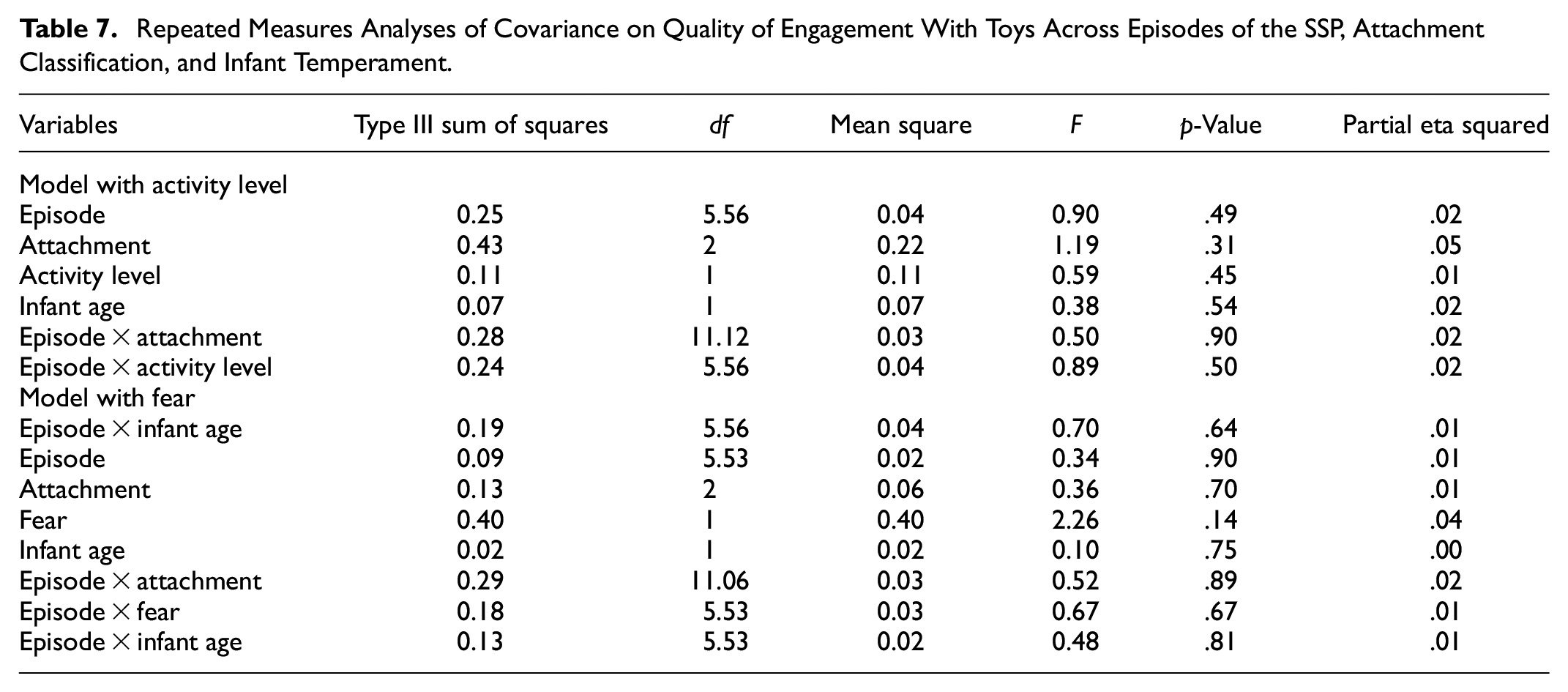
To assess whether the associations between attachment classification and infant locomotion and engagement with toys changed when controlling for infant temperament, analyses were conducted with attachment classification and either temperamental fear or activity level entered as predictors in the model. For duration of locomotion (Table 5), the main effects of episode and attachment classification were no longer statistically significant when including temperamental fear. When including activity level, only the main effect of attachment classification remained statistically significant, with a small-to-medium effect size. For duration of engagement with toys (Table 6), when including activity level or fear, the small-to-medium interaction effect between attachment classification and episode remained statistically significant. For quality of engagement with toys (Table 7), results of the main effects and interaction effects were unchanged, yet the associations between quality of engagement with toys and infant age and temperamental fear were no longer statistically significant when including both into one model.
Repeated Measures Analyses of Variance on Duration of Locomotion Across Episodes of the SSP, Attachment Classification, and Infant Temperament.

Repeated Measures Analyses of Variance on Duration of Engagement With Toys Across Episodes of the SSP, Attachment Classification, and Infant Temperament.

Repeated Measures Analyses of Covariance on Quality of Engagement With Toys Across Episodes of the SSP, Attachment Classification, and Infant Temperament.
Results of repeated measures analyses of variance with the four additional temperamental subscales included as predictors in the model (Supplemental Appendix 3.1–3.3), showed a significant main effect of soothability on duration of engagement with toys (Supplemental Appendix 3.2), and a significant interaction effect of duration of orienting across episodes on the quality of engagement with toys (Supplemental Appendix 3.3). Infants with high scores on soothability showed longer durations of engagement with toys, and infants with high scores on duration of orienting showed lower quality of engagement with toys at the first episode of the SSP, but not in the subsequent episodes.
Sensitivity Analyses
Sensitivity analyses were performed to examine whether attachment-related results were robust for the three- versus four-way classification. Descriptives are displayed in Table 8. For 32 of the 130 mother-infant dyads, the attachment relationship was now categorized as disorganized, while based on the three-way classification it was insecure-avoidant (n = 2), secure (n = 13), or insecure-resistant (n = 17). Results of repeated measures AN(C)OVAs with the four-way.
Means and Standard Deviations of Infant Locomotion and Engagement With Toys for Four and Three Attachment Categories.

Attachment classification can be found in Supplemental Appendix 4.1, and of the four-way attachment classification and temperament combined in Supplemental Appendix 4.2. In contrast to results for the three-way classification, there was a significant interaction effect between episode and the four-way attachment classification on duration of locomotion. For duration of engagement with toys, the interaction between episode and attachment classification that was found for the three-way classification, was no longer statistically significant for the four-way classification, yet it was significant when controlling for fear or activity level. The quality of engagement with toys again showed no significant main or interaction effects, regardless of controlling for infant temperament.
Discussion
This study partially replicated and extended findings reported by Ainsworth et al. (1978) in that individual differences in attachment quality are associated with duration of locomotion and engagement with toys observed during the SSP, bolstering the theoretical link between infant exploratory behavior and the whereabouts of attachment figures based on the secure base phenomenon. The link between attachment quality and engagement with toys was not explained by maternal perceptions of infants’ temperament. Associations between attachment quality and duration of locomotion in response to separation and reunion were less robust. Infants with insecure-avoidant attachment relationships showed most locomotive behavior across episodes of the SSP, yet the association did not remain statistically significant after controlling for temperamental fear. Attachment quality and infant temperament were not significantly associated with changes in quality of engagement with toys during the SSP.
The attachment quality of the mother-infant dyads was unequally distributed across attachment categories, with most dyads’ relationships categorized as secure. Comparison with a large Dutch sample (Tharner et al., 2012) and a large global meta-analysis (Madigan et al., 2023) showed that the distribution of attachment categories of our study differed somewhat from the global distribution, but did not differ from the other Dutch sample. While our own sample and that of Tharner et al. may suggest overrepresentation of resistant attachment compared to the global distribution, the meta-analysis by Madigan et al. also showed that differences in distributions of attachment categories across world regions were very limited. Therefore, we are cautious not to overinterpret the difference with the global distribution.
The pattern of duration of engagement with toys across episodes (Figure 1B) was congruent with expectations and prior research based on the secure base phenomenon (Ainsworth et al., 1978): infants showed most exploration in presence of the caregiver when stress was low before separation from the caregiver, and least exploration in absence of the caregiver, when the exploratory system is thought to be suppressed. Furthermore, infants with insecure-resistant attachment relationships showed less engagement with toys from the start of the SSP compared to infants with secure or insecure-avoidant relationships, and these differences were amplified throughout the procedure, particularly during separation from the mother. Based on Ainsworth et al. (1978), an increase in exploration, hence in engagement with toys, was expected during the first reunion for all attachment categories. Our results did not show these expected increases in engagement with toys during this episode. Because studies using the SSP typically determine attachment quality based on infant behavior during the two reunion episodes (e.g., Prince et al., 2021), the inconsistency could not be compared with other studies. Altogether, duration of engagement with toys appears to be a robust indicator of attachment-related infant exploratory behavior during the SSP.
Duration of locomotion increased in response to separation from the mother and decreased after reunion, but this pattern was not dependent on attachment quality. This suggests that, more so than engagement with toys, infant locomotion during the SSP serves other functions than exploration. The large increase in locomotion during the first separation could reflect proximity seeking behavior and be part of the attachment behavioral system rather than the exploratory behavioral system (Ainsworth et al., 1978). Although the interaction between attachment and episode was not statistically significant, the pattern of change in locomotion between attachment categories showed a particular increase for the infants with insecure-avoidant attachment classification during the last episode after reunion with the mother. This might suggest that their locomotion reflects the avoidance of the mother by displacing through the room. In a recent study by Prince et al. (2021), proximity seeking and avoidance of mothers and infants during the two reunion episodes of the SSP were analyzed. During reunion, moving to and from one another was associated with ratings of attachment behaviors. In the current study, main effects of episode and attachment quality on locomotion weakened when temperamental fear was included in the model. Yet, sensitivity analyses showed that when including the disorganized attachment category, the interaction between episode and attachment classification was significantly associated with locomotion, irrespective of infant temperament. Contrary to expectations based on Frazier-Wood and Saudino (2017), who found a negative association between infant social fear and motor activity in lab situations, no main effect of temperamental fear on duration of locomotion was found. However, the infants studied by Frazier-Wood and Saudino were older, and the presence of the caregiver during the assessments was not reported, which could explain these results. Altogether, including both temperament and the additional disorganized category somewhat altered the pattern of associations between duration of locomotion and attachment quality compared to Ainsworth et al.’s original findings.
While quantitative aspects of infant engagement with toys showed clear patterns of change in response to separation and reunion that were linked to attachment quality, no such results were found for qualitative aspects of engagement with toys. Based on the secure base phenomenon (Ainsworth et al., 1978), it was expected that when infants are exploring, the quality of exploration changes in absence and presence of the caregiver. The present null findings might indicate that the index for the quality of engagement with toys (the proportion of exploratory vs. stereotypical playing behavior) is not sensitive to the stress induced by the separation from the mother. Alternatively, the manipulation of the presence of the mother throughout the SSP might evoke strong emotional responses leading to toy disengagement rather than qualitatively changing play, as reflected in our finding of decreases in duration of engagement with toys during separation. Unexpectedly, infants with higher rates of temperamental fear showed higher quality of engagement with toys. Infants with higher rates of fear might focus more on engaging with toys as a coping strategy for dealing with the anxiety of the novel situation. In a review, Liu and Bell (2020) explained that children with a fearful temperament and high inhibitory control showed more attentional avoidance of threat. For this study this could indicate that for infants with high levels of fear, the advanced manual exploration of toys was a manifestation of inhibitory control and attentional bias away from the threat of the novel situation and stranger.
Several limitations of this study should be acknowledged. First, the age range of the included infants was 11 to 15 months. It is possible that variation in attained motor milestones influenced the results, yet motor milestones were not assessed. Prior research (Thurman & Corbetta, 2017) showed that exploration evolves particularly when infants learn crawling, which most infants have developed prior to 12 months. Given their age, all infants were assumed to have acquired at least some form of self-locomotion, which was confirmed by the observation that the large majority (96%) of infants showed some form of self-locomotion during the SSP. In addition, age was not significantly associated with duration of engagement with toys or locomotion. However, age was significantly associated with quality of engagement with toys. Hence, these results were controlled for age, limiting the possibility of a confounding influence of attained motor skills required to manipulate toys.
A second limitation of this study concerns the assessment of the quality of engagement with toys. By examining frequencies only, no information about the duration of specific types and qualities of engagement with toys are available. In future research, by focusing on the duration of each type of engagement with toys, more data could be included, leading to more power, and additional information about individual differences in the quality of exploration of objects during the SSP, and possible associations with attachment quality and infant temperament.
Third, the study measured infant locomotion and engagement with toys and attachment quality during the SSP, a paradigm developed to elicit attachment behaviors and suppress exploration behaviors. This enabled us to replicate and extend findings from Ainsworth et al. (1978) with regard to how exploratory behaviors might change in response to stress induced by separation of the caregiver. However, this comes with the disadvantage that findings can only be generalized to settings in daily life involving separation from and reunion with the caregiver, or other settings in which attachment-related exploratory behavior of infants may be relevant.
Fourth, infant temperament was mother-reported. Both infant temperament and mother-infant attachment quality could be affected by confounding maternal factors. Other measures of infant temperament, for example based on observed infant behavior (e.g., Lab TAB; Goldsmith & Rothbart, 1996; Planalp et al., 2017), might reflect actual infant temperament better. This might result in different conclusions regarding how infant temperament affects associations between infant exploration and mother-infant attachment quality.
Finally, the current study is cross-sectional and cannot be generalized to other ages or to developmental outcomes later in childhood. Throughout development, child locomotion and play could be associated with attachment quality and child temperament differentially. Future longitudinal research that includes links between exploration, attachment quality, and temperament could contribute to our understanding of the extent to which attachment-related exploratory behavior, above and beyond attachment quality and temperament, could predict developmental outcomes such as self-regulation and associated socio-emotional, cognitive, and motor outcomes.
Conclusion and Future Directions
This study shows that 40 years later, findings by Ainsworth et al. (1978) regarding infant exploration during the SSP still hold, albeit partially. The shifting balance between exploration and attachment behavior in response to the presence and absence of a secure base figure, is expressed in duration of engagement with toys, and was found unaffected by infant temperament. Yet for duration of locomotion the findings are less clear and suggest reflecting a mix of exploratory and proximity seeking behaviors rather than a clear indication of attachment-related exploratory behavior. Furthermore, findings regarding locomotion and attachment quality were more strongly affected by infant temperament.
Implications of this study are that it extends the attachment theoretical framework on child development by examining infant temperament and attachment-related exploratory behaviors in relation to attachment quality. Prior research found that early exploration is related to language development (Hellendoorn et al., 2015) and spatial memory (Oudgenoeg-Paz et al., 2014) during childhood, and that attachment quality is important for socio-emotional development (Groh et al., 2017a). When predicting such child developmental outcomes across childhood, an integrative approach could provide a more comprehensive view on how heritable child characteristics, such as temperament, in addition to aspects of the parent-child relationship, shape developmental pathways across childhood.
Supplemental Material
sj-docx-1-sgo-10.1177_21582440241260567 – Supplemental material for Infant Exploratory Behaviors During the Strange Situation Procedure: Links With Attachment Quality and Temperament
Supplemental material, sj-docx-1-sgo-10.1177_21582440241260567 for Infant Exploratory Behaviors During the Strange Situation Procedure: Links With Attachment Quality and Temperament by Lianne van Setten, Annick Ledebt, Mirjam Oosterman, Carlo Schuengel and Marleen H. M. de Moor in SAGE Open
Footnotes
Acknowledgements
We thank all mothers and infants for participating in our study, Nienke van der Ploeg for helping with the development of the behavioral coding instructions and starting up data collection, and all students and colleagues who helped with collecting and coding data.
Declaration of Conflicting Interests
The author(s) declared no potential conflicts of interest with respect to the research, authorship, and/or publication of this article.
Funding
The author(s) disclosed receipt of the following financial support for the research, authorship, and/or publication of this article: This research was supported by grants from Netherlands Organization for Scientific Research (NWO[400-09-123], the foundation Stichting tot Steun Nederland, and the Faculty of Behavioural and Movement Sciences of the Vrije Universiteit Amsterdam.

Data Availability Statement
Supplemental Material
Supplemental material for this article is available online.
References
Supplementary Material
Please find the following supplemental material available below.
For Open Access articles published under a Creative Commons License, all supplemental material carries the same license as the article it is associated with.
For non-Open Access articles published, all supplemental material carries a non-exclusive license, and permission requests for re-use of supplemental material or any part of supplemental material shall be sent directly to the copyright owner as specified in the copyright notice associated with the article.
