



Abstract
Social networks are radically changing the marketing landscape, offering new ways to connect with others, which can be used to maintain and build new consumer brand relationships. The conceptual domain of the connection between consumers and brands has expanded from general attitudinal tendencies to closer relationships, giving rise to brand addiction. With Nike and HUAWEI as the focus brands in two sub-studies, the formation mechanism model of brand addiction under social network influence is constructed. The results of the two studies in this paper (study 1 and study 2) confirm that social network influence positively stimulates brand attachment and brand attachment has a positive effect on brand addiction. Furthermore, both studies propose that brand attachment mediates the effects of social network influence on brand addiction. Study 1 shows that brand attachment plays a full mediating role, and social network influence indirectly impacts brand addiction through brand attachment; Study 2 finds that brand attachment plays a partial mediating role, and social network influence not only indirectly promotes brand addiction through brand attachment, but also directly influences brand addiction. The study provides valuable insights for brand marketers on how to identify social network influence and strengthen relationships with consumers.
Introduction
With the development of social networks, the way individuals interact with others has changed significantly, and marketers are becoming aware of its close connection to customers and desire to establish lasting and mutually beneficial relationships with customers (Morgan-Thomas et al., 2020). Unlike the static websites of the Web 1.0 era, social network platforms in the context of the Web 2.0 era have established brand community hubs that gather users who contribute to news feeds and become more interactive (C. L. Wang, 2021), which has largely transformed the relationship between consumers and brands (Kim & Drumwright, 2016), even making them more active in creating brand stories and enhancing their consumer-based brand equity (Arya et al., 2022). Research shows that marketing activities conducted by enterprises through social networks play a vital role in consumer engagement and brand loyalty (Aljuhmani et al., 2023; Ibrahim & Aljarah, 2024), helping to build and strengthen consumer-brand relationships (Hennig-Thurau et al., 2010; Li et al., 2020; Touni et al., 2020). These social network platforms provide brands with strategic space to interact directly with consumers and help create personalized relationships. With the popularity of social networks, the marketing landscape is undergoing a fundamental transformation (Shanahan et al., 2019; Wallace et al., 2021). Social networks have become a key factor in successful marketing communications, not only to maintain existing consumer-brand relationships but also to create new brand relationships through innovative interactive methods.
In this context, brand managers need a greater sense of urgency to integrate these emerging media, and marketing plans need to be based on social networking strategies, which are an important way for companies to build and maintain brand relationships with consumers. Research has shown that the success of modern marketing practices depends on building and facilitating sustainable consumer-brand relationships (Tanveer et al., 2021), and the concept of this relationship has expanded from attitudinal tendencies (e.g., brand commitment) to closer brand connections (such as brand attachment and brand love; Hemsley-Brown, 2023; Rahman et al., 2021), and the latest brand addiction (Francioni et al., 2021; Ghorbanzadeh, 2024; Mrad et al., 2020), which represents the most intimate form of a relationship with the brand (Mrad et al., 2020).
As an important channel for timely consumer-brand interaction, social networks have profoundly influenced consumer behavior and strengthened brand relationships (Hamzah et al., 2021; Kujur & Singh, 2020). However, despite the key role played by social networks in building consumer-brand relationships, there is still a lack of systematic research on their role in cultivating brand addiction and the studies exploring a transition in consumer-brand emotions are limited (Ghorbanzadeh, 2024). Brand addiction, that is, consumers’ strong emotional dependence on brands, has been proven to be crucial to lasting competitiveness. Therefore, exploring how social networks affect consumers’ brand addiction behavior not only helps brands better understand user needs, but also provides a new research perspective for the academic community to reveal the formation mechanism of brand addiction. Given the research gap, this study aims to establish an integrated theoretical framework to examine how social networks influence the formation of consumer brand addiction, and its findings enhance our understanding of consumer behavior related to brand addiction within the context of social networks. These results can be of great assistance to brand managers in establishing and strengthening consumer-brand relationships.
Literature Review
Social Network Influence
The rapid popularity of social networks such as Facebook and Twitter has deepened consumers’ perceptions of self-concept in the digital world, and social networks give consumers more communication opportunities and promote brands’ understanding of consumers (Barreda et al., 2020; Ruane & Wallace, 2015). Consumers are increasingly using social networks partly because of their role as communication media, and their internal motivation for using social networks is to provide opportunities for identity expressiveness (Bailey et al., 2020; Wilcox & Stephen, 2013). Social network influence is defined as the role of social networking sites in providing knowledge, communication, interaction, and identity creation. Social networking sites are popular because they provide users with a large number of communication features and individuals can connect with others instantly and access various contents easily (Pang & Ruan, 2023). There are about 3.535 billion users of various SNSs in the world (Li et al., 2020). They utilize social networks to boost their self-esteem (Ameen et al., 2022) and improve their well-being by using SNSs actively (Meier et al., 2020; Verduyn et al., 2022).
Online social networks have accelerated the process of the paradigm shift in human interaction, enriched people’s entertainment lives, and inadvertently changed the way brands engage with consumers (Dabbous & Barakat, 2020). Research results consistently point to marketing activities conducted by companies through social networking sites, which are crucial for maintaining and enhancing consumer-brand relationships (Hennig-Thurau, 2010; Labrecque, 2014; Li et al., 2020). The rise of social network influence via digital social platforms has been aimed at promoting efficient and valuable communication (Raza et al., 2023). Their results revealed that the higher the influence of social networks, the stronger the relationship between opinion leadership and the customers’ behavioral manifestations toward the brand. Santini et al. (2020) found that some social network users are more susceptible to the visual portrayal of content created by other consumers, including their ideas, the way they express them, and their sense of style. And their identity expression through social networks is expected to strengthen consumer-brand relationships even further (Labrecque, 2014).
Consumer Brand Relationships
Brand theory and practice have undergone a great turn, and the new focus is on the consumer-brand relationship as the main axis and focus. Compared with previous themes such as brand image or brand positioning, the main perspective of brand thought has shifted from the brand itself to the consumer-brand relationship, and the consumer-brand relationship has become a new ideological height. The consumer-brand relationship refers to an emotional connection established between a brand and its consumers (Nawaz et al., 2020). Fournier’s (1998) viewpoint is that “the relationship between a consumer and a brand is similar to connections among people, in that both follow a continuum of the intensity of the relationship from non-intense emotions to moderate emotions, friendly emotions, to the culmination of an addictive obsession.”Fournier’s (1998) research has played a crucial role in the development of the theory of consumer-brand relationships. Fournier believes that the relationship theory can be applied to the field of branding, and brands and consumers will spontaneously form mutually dependent relationships. Brands are not passive participants in the process of forming such a relationship, but active participants and active contributing partners in the relationship body. Fournier further integrated interpersonal relationship theory into the research on consumer-brand relationships, and pointed out that the relationships between brands and consumers and interpersonal relationships have many types (Alvarez et al., 2023).
Research has found that consumer-brand relationships cover multiple types, including trust, emotional connection, addiction, etc. (Alvarez et al., 2023). These dimensions influence each other and constitute consumers’ overall perception of the brand. From the perspective of consumer-brand relationships, consumers’ attitudes toward brands are similar to those toward interpersonal relationships. Through continuous positive interactions, they gradually build trust and emotional attachment (Hayes & King, 2014; Pentina et al., 2023). Such interactions not only enhance the appeal of the brand, but also make the connection between consumers and brands closer (Foster et al., 2022). With the rapid growth of different types of brand relationships, the emergence of brand addiction and the exploration of previously unstudied categories are key factors driving the rapid development of the consumer-brand relationship field (Alvarez et al., 2023).
Brand Attachment
Consumer brand relationships are a continuum, each type of consumer-brand relationship is increasing step by step. The central relationship between brands and consumers is based on brand attachment (Alvarez & Fournier, 2016; Li et al., 2020; Shimul, 2022), which refers to “the strength of the bond connecting the brand with the self” (C. W. Park et al., 2010). The so-called brand attachment is an emotional bond between the individual and the brand based on cognition and the psychological bond that connects the two. It covers cognition, emotion and motion, and is a close two-way dependence relationship established from the emotional level. One of the foundational aspects of conceptualizing brand attachment is that of self-relevance. The relationship is closer when the brand helps to present the consumer’s self (Shimul & Phau, 2023; Swani & Labrecque, 2020). Based on this, it can be found that the consistency of brand image or personality and self-concept will have an impact on brand attachment (Shimul & Phau, 2022; Wu et al., 2024). According to Malär (2011), brand attachment can be enhanced when brand personality is highly consistent with an individual’s true self. Furthermore, Japutra et al. (2014) directly examined the factors that consumers perceive as influencing brand attachment, such as trust, quality, experience, and self-congruity. On this basis, Rabbanee et al. (2020) pointed out many studies exploring different self-congruity orientations in the offline environment. And they considered the role of social networks and explored the effects of multiple self-concordant directions on brand attachment. Elhajjar et al. (2022) found that brands were not just a product in the minds of consumers, but also a symbol of emotion and identity, and consumers’ attachment to brands and emotional investment had a positive impact on brand addiction.
Brand Addiction
Addiction in the context of consumer-brand relationships was mentioned by Fajer and Schouten (1995). In order to understand the concept of brand addiction more clearly, Fournier (1998) drew on interpersonal relationship theory and proposed that brand addiction was gradually from surface effects to simple affection, friendly feelings, passionate love, and finally to addiction and obsession. Building on the research of Fournier, Veloutsou and Moutinho (2009) described the brand relationship as a continuum. By observing the consistent phenomenon in brand communities, Xue and Wang (2009) further argued that brand addiction was due to the increasing marginal utility that consumers obtain from brands, and this expectation can make consumers more inclined to consume those brands. Subsequently, scholars examined the negative effects of brand addiction (Fournier & Alvarez, 2013; Junaid et al., 2022), considering it as an extremely strong connection. With the deepening of the relationship, consumers may lose themselves (Fournier & Alvarez, 2013). In this context, the addictive relationship becomes highly compulsive and destructive, which can easily trigger adverse behaviors among consumers, such as compulsive buying. Different from the former view, Mrad and Cui (2017) considered the positive effects of brand addiction. Through in-depth analysis of the differences between brand addiction and other forms of consumer-brand relationships, they pointed out that brand addiction, as a psychological state of individual consumers, reflects consumers’ positive emotions and satisfaction with their favorite brands, and their continuous desire to own the brands’ products/services. It is not limited to emotional attributes, but also includes significant cognitive and behavioral attributes (Cui et al., 2018). Referring to the definition of brand addiction by Cui et al. (2018), this paper believes that brand addiction refers to “consumers’ psychological and behavioral focus on a specific brand, driven by the desire to own the brand’s products, and containing positive emotions and satisfaction.”
Some scholars have conducted research on the influencing factors of brand addiction (Le, 2020). Mrad and Cui (2017) pointed out that brand trust helps to promote the emergence of brand addiction. In addition, on this basis, the author further found brand attachment is positively related to brand addiction. After establishing a close relationship with a brand, consumers develop a strong emotional attachment and obedience to the brand. Mrad et al. (2020) explored the main motivations and results of brand addiction in the context of luxury and fast fashion brands. Considering the impact of brand characteristics on brand addiction, Francioni et al. (2021) highlighted the positive impact of brand characteristics such as self-expressiveness, and authenticity on brand addiction. On this basis, Bai et al. (2021) considered the role of self and others to reveal the formation process of consumer brand addiction in the light of the social identity theory. Also, some other brand emotional attitudes such as brand attachment and brand passion also have a significant positive impact on brand addiction (Elhajjar et al., 2022).
The above literature has explored brand addiction from the aspects of psychology and behavior, but it often analyzes the influence of brand addiction from the perspective of brand characteristics or focuses on the effect of individual behavior, without considering the impact of online social networks, and rarely investigates the formation process of brand addiction. Given the widespread use of online social networks, this study examines the impact of social networks on the formation of consumers’ brand addiction. It takes into account the current trend of online social networks, and considers various factors that influence the formation of brand addiction and their interrelationships. The results can assist scholars in better comprehending the mechanism of consumer brand addiction formation and assist businesses in leveraging social networks to improve consumer-brand relationships.
Research Hypothesis
The Relationship Between Social Network Influence and Brand Attachment
The rapid development of social networks has become a part of daily life. Facebook, Twitter, My Space, and others have greatly expanded and changed the nature of social interaction. Users can immerse themselves in the social network environment 24 hr a day and reveal their identity to others through the use of an ever-expanding set of symbolic tools. Social networking sites are web-based, where individuals can create public or semi-public profiles without exceeding the system limits, and create lists of other users who share connections with them, as well as view their connection lists and connections established with others within the system (Boyd & Ellison, 2007). Enterprises seek to leverage in various ways to provide value to customers, and networks enable connections between members of virtual communities according to mutual interests (Sweet et al., 2020). As a result, social networks—online “places” where individuals gather to share ideas—have grown rapidly (Sweet et al., 2020). Social networks include social network websites (such as Twitter, Weibo, Facebook, etc.), but also brand websites (such as Amazon, LinkedIn, etc.), and enterprise sites (such as Apple, Oracle, etc.), all of which are trying to integrate social elements into their online portfolio.
The popularity of social networks is in part due to their position as communication spaces, as well as their ability to display extended selves (Belk, 2013) and authentic selves (Bailey et al., 2020). In addition to common social interaction (Dennis et al., 2010; Xu et al., 2021), members can enhance their self-expression and presentation with the help of online projects (Choi & Burnham, 2021; Wilcox & Stephen, 2013). Such virtual objects can exist outside of the consumers’ physical reality, and when the favorite brand can enhance self-awareness (Belk, 2013), a strong connection will be established between consumers and brands (Choi & Burnham, 2021). For example, if consumers like a specific brand, that brand is pushed to appear on their Facebook page. Therefore, we believe that the greater the impact of online social networks on consumers, the stronger the consumer’s attachment to the brand will be.
The Relationship Between Brand Attachment and Brand Addiction
Brand attachment reflects a strong connection between brands and consumers (Kleine et al., 1995), brand attachment refers to a strong cognitive and emotional perception in consumers’ psychology, that is, self-closeness to the brand (C. W. Park et al., 2006). In social networks, consumers establish self-identity by describing themselves and connecting with others (Wilcox & Stephen, 2013). Consumers invest resources directly or indirectly in the relationship with the brand, hoping that doing so will maintain and enhance the relationship with the brand. That is, when the brand has instrumental value and consumers’ feelings about the brand become increasingly salient, the attachment becomes stronger. When brands become part of everyday life, brand attachment becomes stronger.
Brand attachment is a key variable in the development of consumer-brand relationships, especially in social networks (Jain et al., 2018). Brand addiction, as a psychological state, involves consumers’ emotional attachment to a specific brand, driven by the compulsive impulse to get happiness. On this basis, scholars discovered that brand attachment had positive effect on brand addiction (Elhajjar et al., 2022). When consumers establish a close relationship with the brand, they develop a strong emotional attachment and loyalty to the brand. When the brand’s position becomes an extension of the individual’s self-extension, such brand feeling can occasionally reach unfathomable levels of addiction (Starcevic & Aboujaoude, 2017). Based on the above research results, it is found that brand attachment is a pre-factor creating brand addiction, with the gradual deepening of emotional attachment, consumer brand relationship progresses to the stage of brand addiction.
The Relationship Between Social Network Influence and Brand Addiction
Social network influence involves two aspects: vicarious innovativeness and identity expressiveness. Vicarious innovativeness is described as actively searching for information about new or unfamiliar products. And identity expressiveness is defined as “the behavior that can be interpreted by oneself in the self-construction of identity and by others in the social construction of identity” (Pagani et al., 2011). Individuals take advantage of SNS to show their identities and values, and to interact with others (Ceglarek & Ward, 2016; Wilcox & Stephen, 2013). On social networking sites, consumers often carefully craft their image by managing others’ impressions of them through words, images, and media (Doster, 2013). Social network platforms change the way brands connect with consumers by establishing personalized and direct relationships (Aboulnasr et al., 2022; H. Park & Kim, 2014). They proposed that the uniqueness of branded social networking sites amplified the propensity of consumers to respond socially to media, as it enabled consumers to establish personalized relationships and interact with brands in real-time (H. Park & Kim, 2014). Furthermore, online social network platforms provide an instant communication context for users to communicate with others who share the same passion and love and is likely to provoke more intense emotional responses, culminating in addictive behavior (Ho et al., 2017).
Ho et al. (2017) explored the relationships between social network use and addiction in the light of planned behavior theory, they believe that a crucial benefit of social networks is to allow consumers to present themselves (Seidman, 2013) and socialize (Palalic et al., 2021), and consumers are drawn to social networks to obtain a sense of self-identity (E. W. J. Lee et al., 2017). Social networking provides an additional instant communication environment that allows consumers to express their identity (Wilcox & Stephen, 2013), and individuals are able to interact in real-time with characters from other virtual communities and share information with each other (Boyd & Ellison, 2007), which may trigger stronger emotional reactions (Francioni et al., 2021). Based on this, we hypothesize that social network influence has a facilitating effect on consumers’ brand addiction.
In summary, the theoretical model proposed for this study is shown in Figure 1.

Research framework.
Study 1
Research Method
This study used the anonymous questionnaire survey method. All potential participants would see a brief description at the beginning of the questionnaire, clearly stating the research purpose, anonymity guarantee (data is only for statistical analysis), and the participation reward (cash reward can be obtained upon completion of the questionnaire). Participants need to answer whether they agree to participate (the “Yes/No” option) before proceeding. If they select “Yes,” they will continue to answer. If they select “No,” it will be automatically submitted, and the process will be terminated. Verbal informed consents were obtained from all subjects in this study. All questionnaires of this study were approved by the university, and all studies were carried out in accordance with relevant guidelines and regulations. The research design ensures: (1) Privacy protection (no collection of identification information such as name); (2) Autonomy (participants can close the page at any time to exit); (3) Risk minimization (sensitive issues are excluded through pre-tests in the questionnaire), and its social value (providing empirical evidence for brand marketers to identify the influence of social networks and strengthen the relationships between brands and consumers) is much higher than the slight time burden that may be caused.
Study 1 mainly analyzes the formation process of brand addiction under the influence of social networks based on student groups. As is well known, Nike, the 17th best brand in the world, is deeply loved and trusted by young sports enthusiasts (Interbrand, 2018), and is always seen in a group environment like social networks (Kozinets, 2017). In addition, Sina Weibo is currently the most popular social networking site in China, with 361 million monthly active users, according to data. Therefore, for the student samples, the first study focuses on the brand Nike, and chooses Sina Weibo as the data source to analyze the formation process of consumers’ brand addiction under the influence of social networks.
This investigation starts with the following scenario:
Let’s say you’re browsing Weibo one day. When you’re browsing online, you’ve noticed that there’s news about Nike footwear on your Weibo, and you’re interested in learning more about the company’s different products. You click on this link to enter Nike’s official Weibo page, where they can see various shoe posts released by the company, giving them great visual impact. And the logo of Nike that appeared in the scene was designed to establish a connection between the respondent and the brand.
Next, the respondents answered some questions reflecting social network influence (vicarious innovativeness and identity expressiveness), brand attachment, brand addiction, and questions related to the basic information of the subjects.
Measurement and Distribution
The measurement items of social network influence are from Ruane and Wallace (2015) and Pagani et al. (2011). The measurement of brand attachment adopts the six items of Malär et al. (2011), which is consistent with the measurement of brand attachment used by Thomson et al. (2005) in previous research on consumer behavior. The measurement items of brand addiction come from the item scale developed by Mrad and Cui (2017), all of which are measured by the Likert five-point scale.
Data for study 1 were collected by conducting a survey of students at the university. This study was distributed to 330 students, and 292 completed questionnaires were received, by setting reverse items, 61 unqualified questionnaires were deleted. The final 231 data were used for further analysis. Participants in our study included 67 men and 164 women. Aged between 17 and 26 years (M = 20.71; SD = 1.10). The majority (62.8%) of respondents’ monthly expenditure is 1,501 to 3,000 yuan, monthly expenditure of the respondents (11.3%) is less than 1,500 yuan, 20.3% of the respondents spend 3,001 to 4,500 yuan monthly, 3.9% of the respondents spend 3,001 to 4,500 yuan monthly and 1.7% of the respondents spend over 6,000 yuan.
Model Verification
The study tests the reliability and validity of the results of the measurement scale items. In this study, SPSS 21.0 was used to test the reliability level of each variable, the Cronbach’s α coefficients of social network influence, brand attachment and brand addiction are .820, .900, and .878, the Cronbach’s α of all variables are greater than .8, this indicates that each variable has high reliability and high internal consistency. Through exploratory factor analysis, the item with low factor loading (BA1) was deleted. Before verifying the path relationship of the structural model, the convergence and discriminant validity of the measurement model were tested. The study evaluates the convergent validity of the construct by testing the factor loading of the measurement items, using AMOS 21.0 (Hair et al., 2010). The results show that all items are loaded on their respective latent constructs (the minimum factor loading is 0.559), as shown in Table 1.
Descriptive Statistics and Convergent Validity of Measurement Model (Study 1).

The CR values of social network influence, brand attachment and brand addiction are 0.717, 0.906, and 0.881, indicating that the scale items used have high internal consistency. The AVE of all constructs is higher than the squared correlation between them (as shown in Table 2), the convergent validity and discriminant validity of measurement model are supported (Hair et al., 2010). This paper further tests the discriminant validity to test the discriminant validity among social network influence, brand attachment and brand addiction, as shown in Table 3, the goodness of fit of the three-factor model is better than that of other factor models.
Correlation Coefficients, CR and AVE Values of Each Variable (Study 1).
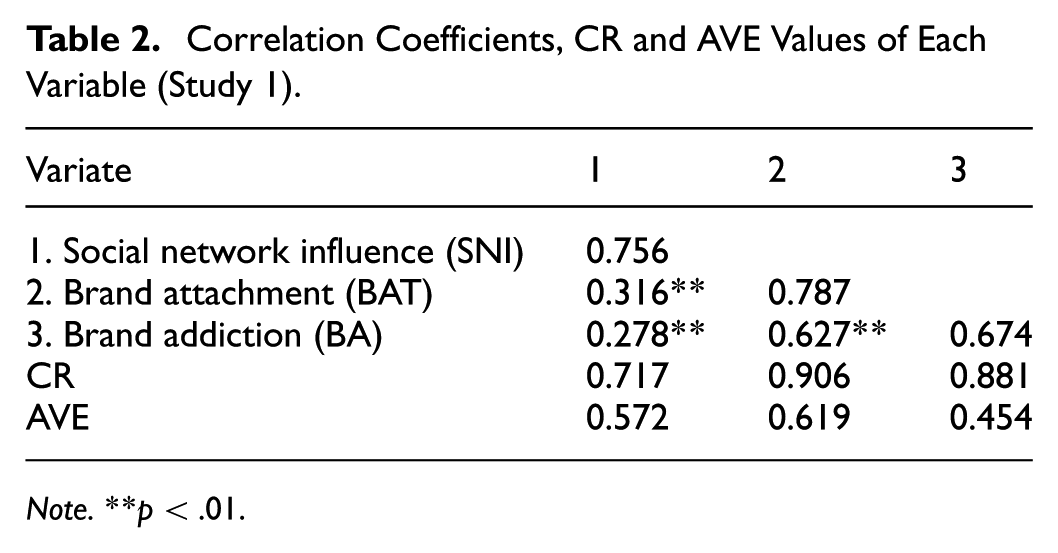
Note.**p < .01.
Model Comparison Results.

Note. SNI = social network influence; BAT = brand attachment; BA = brand addiction.
To minimize the potential impact of the common approach, the study followed the approach of Podsakoff et al. (2003) and employed various procedural and statistical remedies. First of all, under the procedural remedies, the purpose of the questionnaire was introduced at the head of the questionnaire, and the respondents were promised to complete questionnaires anonymously, and they could answer honestly as required, in addition, the logo of the focal brand (Nike) is used as a clue in the questionnaire. Second, a pre-validated scale was used to measure these structures. To prevent participants from guessing the study’s outcomes when completing the questionnaire, the items in the questionnaire were presented in different orders for each variable.
This study involves two steps to reduce the influence of common method variance. First, according to Roy and Rabbanee (2015), we conducted Harman single factor test to examine whether all measurement items have a dominant factor in the investigation load. The explained percentage of variance of the first common factor is 30.01%, which is less than 40%, and this suggests that no single factor can explain most of the variance. Therefore, it can be regarded as no common method bias. Secondly, the influence of common method deviation is judged by comparing the goodness of fit index of the two models. From the discrimination validity table, it can be found that compared with the three-factor model, △
Research Results
AMOS 21.0 was used to test the hypothesis, and the fitting indexes of the structural model were good (
Model Results (Study 1).

Note. ***p < .001. **p < .01.
It can be seen from Table 4 that social network influence (β = .360; p < .01) and brand attachment (β = .646; p < .001) were significantly correlated with brand addiction, while social network influence (β = .107; p = .126) and brand addiction were not significant. The results show that social network influence is positively related to brand attachment; Brand attachment can promote brand addiction, so Hypothesis 1 and Hypothesis 2 are supported, while Hypothesis 3 is not valid.
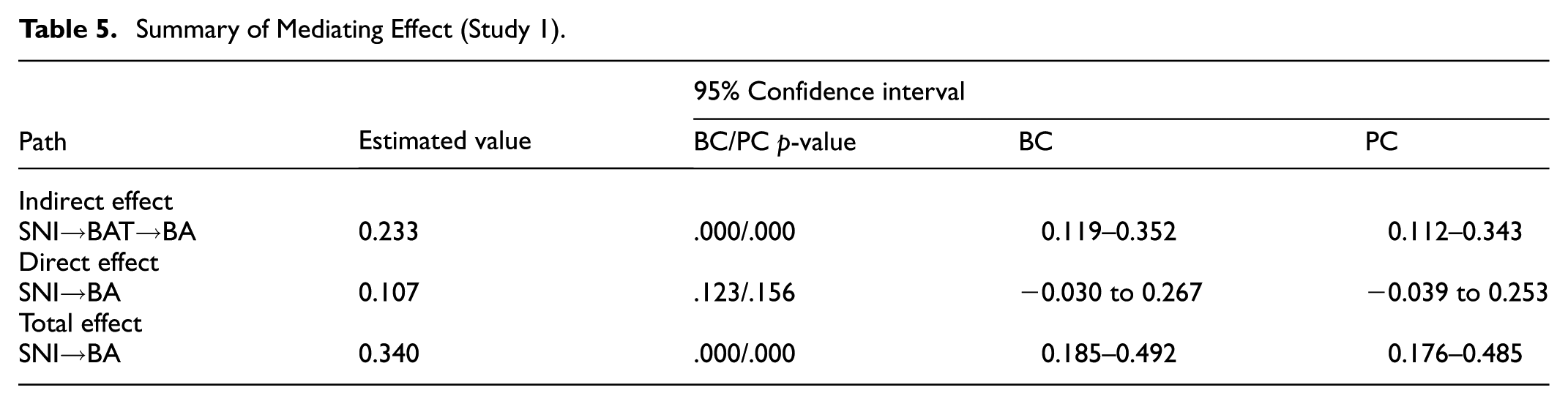
Secondly, we study the mediating effect of brand attachment between social network influence and brand addiction. A bootstrap analysis was performed in AMOS 21.0 with 5,000 samples and 95% confidence intervals. The indirect effect is 0.233, the 95% confidence interval of BC/PC does not include 0, and p < .001 (Table 5), indicating that brand attachment plays a significant mediating role in the effects of social network influence on brand addiction; Furthermore, the direct effect of social network influence on brand addiction is 0.107, the 95% confidence interval of BC/PC includes 0, and the direct effect is not significant if the p-value is greater than 0.05; Above all, brand attachment completely mediates the association between social network influence and brand addiction.
Summary of Mediating Effect (Study 1).
Study 2
Study 2 investigates the formation mechanism of brand addiction under the influence of social networks based on social groups. The World Brand Lab has released its 2020 Asian consumer “National Brand” loyalty survey. The results show that among the top 10 favorite brands of Chinese people, Huawei firmly ranks first, beating several other brands, and Huawei has become the most favorite brand of Chinese users. Therefore, based on the social sample, the focal brand of the study is Huawei, an iconic name in the category of electronic products.
Participants in the Study 2 were non-students between the ages of 25 and 55 and had to have a Weibo account. According to survey data, 482 questionnaires were received in Study 2; A total of 364 valid questionnaires were obtained by deleting unqualified questionnaires through reverse items. Participants in our study included 137 men and 227 women. Aged between 25 and 55 years. The majority (50.3%) of respondents’ monthly expenditure is over 6,000 yuan, monthly expenditure of the respondents (3.3%) is less than 1500 yuan, 9.3% of the respondents spend 3,001 to 4,500 yuan monthly, 17.0% of the respondents spend 3,001 to 4,500 yuan monthly and 20.1% of the respondents spend 4,501 to 6,000 yuan monthly. Table 6 presents the demographic information of the final sample. And the research method and measurement items were similar to those of study 1. The Weibo scenario in Study 2 is based on the brand Huawei. The reliability and validity tests are similar to those of study 1, so we will not repeat them here.
Demographic Information of Respondents (Study 2).

As can be seen from Table 7, social network influence (β = .509; p < .001) had a significant effect on brand attachment, and brand attachment (β = .716; p < .001) had a significant impact on brand addiction, and social network influence (β = .252; p < .001) was positively related to brand addiction. All three hypotheses in Study 2 are supported.
Model Results (Study 2).

Note. ***p < .001.
Then we analyze the mediating role of brand attachment between social network influence and brand addiction in study 2, using AMOS 21.0. The results are shown in Table 8. The indirect effect is 0.364, and the 95% confidence interval of BC/PC does not include 0, and p < .001, indicating that brand attachment plays a significant mediating role in the relationship between social network influence and brand addiction. Furthermore, the direct effect of social network influence on brand addiction was 0.252, and the 95% confidence interval of BC/PC did not include 0, and p < .001, indicating that the direct effect was significant. This support for mediating influence of brand attachment on the relationship between social network influence and brand addiction.
Summary of Mediating Effect (Study 2).

General Discussion
Discussion of Results
The findings from both studies (study 1 and study 2) indicated that social network influence was positively related to brand attachment, indicating support for Hypothesis 1. We discovered that consumers who utilize social networks more often were more likely to feel attached to the brand. This finding supports P. Wang et al. (2023) contention that social networks play an important role in modern society by providing an interactive platform that helps people establish and maintain emotional attachment.
The results of the two studies also verified that brand attachment was positively related to brand addiction in the online environment, consistent with Hypothesis 2. The finding is in accordance with prior studies of Elhajjar et al. (2022). The online environment motivated consumers with high brand attachment to spend time and resources. Interacting with brands through social networks deepened the relationship between consumers and brands, reaching the stage of brand addiction. The findings support the argument of Basu and Sondhi (2020), verifying brand addiction as a higher-order structure in the relationship between consumers and brands, and believing that brand addiction can achieve long-term economic benefits.
We tested Hypothesis 3 and discovered differences in the relationship between social network influence and brand addiction between the two studies: while Study 1 found no significant direct impact, Study 2 identified a significant direct effect of social network influence on brand addiction. Study 1 focused on the Nike brand, and the hypothesis of the direct effect of social network influence on brand addiction (Hypothesis 3) was not supported. However, further mediation analysis revealed that brand attachment fully mediated this relationship. Specifically, social network influence indirectly drives brand addiction behavior by stimulating consumers’ emotional attachment to the brand, such as a sense of belonging and identity. This result can be explained by Nike’s brand characteristics: as a globally mature sports brand, Nike has long shaped sports culture symbols and self actualization symbols through social networks (such as user stories, inspirational advertisements), and its consumption behavior is highly embedded in consumers’ self-concept and social identity expression (Belk, 2013). Its content strategy focuses more on emotional resonance rather than immediate behavioral stimulation. After consumers come into contact with such content on social networks, they need to go through a process of cognitive emotional internalization (Hollebeek et al., 2014), which first forms an emotional attachment to the brand, and then gradually develops into addictive behavior. Therefore, the effect of social network influence is completely mediated by the psychological mechanism of brand attachment, resulting in an insignificant direct path. In contrast, for brands with strong functional attributes (such as Huawei in Study 2), their core values are based on technical efficiency and pragmatic logic. Their social network discussions are often accompanied by rational content such as technical parameter comparisons and product performance verifications, resulting in a dual path. On one hand, technological reputation is transformed into brand attachment through cognitive trust; On the other hand, high-frequency discussions on technological updates and user feedback on social networks can directly create technology anxiety (such as worrying about being outdated) or functional dependence (such as ecological binding), thereby bypassing emotional intermediaries and forming brand addiction (such as continuous machine replacement and accessory hoarding). This enables social network influence to affect brand addiction simultaneously through both direct and indirect paths.
This study revealed that the path of the influence of social networks on brand addicton was affected by brand category attributes. This lends further support to the argument of prior studies that individuals’ emotions toward brands are influenced by brand categories (Joshi & Garg, 2021; Malär et al., 2021; Pina & Dias, 2021). The core values of symbolic brands (such as Nike) are rooted in consumer identity construction and social symbolic meaning. Their social network dissemination often triggers emotional resonance by shaping self-projection (such as sportsmanship, trendy identity), which prompts consumers to form a self-brand connection at the psychological level. Only when social network influence is successfully internalized as part of an individual’s identity (i.e., forming brand attachment) will consumers enter an addictive state. The core values of functional brands (such as HUAWEI) are based on technical performance and practical solutions, and their social network dissemination often directly affects consumers’ cognitive evaluation through product feature display, technical reputation, or group recommendations. This enables social network information to directly reinforce addictive behavior through rational pathways (such as comparing technical parameters, user empirical feedback), while also indirectly promoting brand addiction through the emotional bonding mechanism. Symbolic value and functional value are not binary oppositions, but in digital social scenarios, the former relies more on emotional internalization processes, while the latter allows rational stimuli to directly affect brand addiction due to the quantifiable communicability of technological discourse.
Furthermore, two studies showed that brand attachment mediated the effects of social network influence on brand addiction. The importance of the mediating role of brand attachment has attracted the attention of many researchers (Hemsley-Brown, 2023; Rabbanee et al., 2020). Study 1 showed that brand attachment played a full mediating role, and social network influence indirectly impacted brand addiction through brand attachment; Study 2 found that brand attachment played a partial mediating role, and social network influence not only indirectly promoted brand addiction through brand attachment, but also directly influenced brand addiction. In today’s social networking environment, the importance of brand attachment can’t be underestimated, and the core connection between brands and consumers is built on this attachment (M. W. Li et al., 2020; Shimul, 2022). The knowledge of brand attachment provides an effective tool for understanding businesses and helps to gain a deeper understanding of the mechanistic model and achieve higher profitability (Hemsley-Brown, 2023).
Theoretical Implications
First, this study supplements research on the effect of social network influence on brand attachment. Our analysis indicates a strong link between social network influence and consumers’ brand attachment. This study contributes to the study of the impact of social network influence on the development of consumer-brand relationships. Our research supports the view of Ruane and Wallace (2015) and supports the importance of the “social network influence,” which is considered an antecedent factor during the consumer-brand relationship development.
Second, this study validates the impact of brand attachment on brand addiction in the online social network environment. We found that brand attachment was positively related to brand addiction in the online environment. Moreover, our findings provide evidence supporting Fournier’s (1998) viewpoints that the connection between consumers and brands is a continuum, ranging from attachment (such as affection and connection among other emotions) to obsession or addiction (such as biased partner perception, preoccupation with the brand, devaluation of alternatives, etc).
In addition, the study also contributes to consumer-brand relationship literature by clarifying that brand attachment positively mediates the relationship between social network influence and brand addiction. Another contribution of our study comes from illuminating the underlying process of how the mediating effects work in our model. Social networks may have both direct and indirect effects on consumer brand addiction through brand attachment, which further emphasizes the importance of incorporating brand attachment into research on social network influence and consumer brand addiction.
Finally, this paper contributes to the theory of social network influence, and the findings of the two studies provide important explanations for how social network influences consumers’ brand addiction and respond to the appeal of Mrad and Cui (2017) and Bai et al. (2021) by investigating the formation of brand addiction in the comprehensive framework of consumer-brand relationship, and reveal the process of consumers’ brand addiction formation under the environment of social network.
Implications for Management
This study aims to explore the process of brand addiction formation under the influence of social networks. Our study indicates that social networks can be used to strengthen consumer brand relationships. This research may provide some inspiration for brand marketers, especially those who want to use online social networks to strengthen consumer-brand relationships. Managers need to incorporate social media into their marketing strategies to encourage user engagement and to continuously accumulate and enrich consumer-generated content, for example, by providing a forum that caters to consumer behavioral tendencies where consumers can express their identity and fulfill their desire for self-expansion. Enterprises can also build brand communities through social networks and give consumers the opportunity to belong to a community, where consumers can share and build connections through brands.
In this study, brand attachment positively mediated the relationships between social network influence and brand addiction. This implies that brand managers need to pay attention to the importance of brand attachment in the social network environment and use these psychological motivations to systematically increase consumers’ emotional attachment to their brands and build unique and lasting relationships with them. This also means that brand managers who use social networks to promote their brands need to build closer relationships with their target customers based on images, social ties and identities on digital platforms. In addition, managers should invest in building emotional connections with social media brands. For example, they can design some brand awareness campaigns or foster a sense of personal interaction between consumers and brands through well-designed information cues that enhance the perception of one-to-one interaction, enabling a closer and more sustainable relationship between brands and consumers.
Additionally, companies should adopt differentiated strategies based on different brand categories to effectively enhance consumer-brand relationships when conducting brand marketing on social networks. Lifestyle brands (such as Nike) focus on emotional connections and use emotion-driven stories and user-generated content to build close relationships with consumers. Technology brands stimulate consumers’ curiosity and expectations by demonstrating product innovation and technological advantages, using live broadcasts and other means to cultivate their continued attention and desire to buy, thereby strengthening their sense of dependence on the brand.
Furthermore, our research adds to managers’ understanding of brand addiction. Through social network effects, consumers contribute to the improvement of consumer-brand connections. Brand managers need to assume corporate social responsibility and should do something to assist consumers in maintaining strong brand relationships at a healthy level. It is undeniable that the digital revolution has indeed significantly increased people’s online time, and companies should make full use of the various resources available to facilitate consumers to better leverage the value of the Web. For instance, social media sites can offer applications with commercialized strategies to help consumers spend less time managing specific sites. Companies can also adopt new web technologies to continuously monitor the emotional state of their customers for highly interactive and personalized communication with them. Brand addicts can get faster reactions and satisfying answers, alleviating the anxiety and irritability that may arise from changes in their favorite brands.
Limitations and Future Research
There are still some shortcomings in this study that need to be refined in the future. Firstly, our study was conducted in China, which limits the impact of cultural differences on our model. Future research needs to delve into different countries, and systematically understand their cultural differences. Secondly, this study focused on the consumer-favored brands Nike and Huawei, examining respondents’ expected behavior on Weibo. Both brands are iconic, highly trusted by consumers, and frequently featured on social network platforms. However, future research should expand the scope to include a wider range of brands. Third, considering the mediating effect of brand attachment, our study explores brand addiction in the integrated framework of consumer-brand relationship, and other factors (such as compulsive buying, etc.) need to be considered to deeply understand brand addiction.
Conclusion
These studies investigate a theoretical framework comprised of social network influence as the independent variable and brand attachment as the mediating variable, to explore the impact on brand addiction. The results of two studies reveal that the greater the influence of online social networks on consumers, the stronger the consumer’s attachment to the brand will be. Brand attachment is a precursor to brand addiction. As emotional attachment gradually deepens, the consumer-brand relationship progresses to the stage of brand addiction. Moreover, brand attachment plays a significant mediating role in the relationship between social network influence and brand addiction. And the relationship between social network influence and brand addiction is influenced by brand category attributes.
Footnotes
Acknowledgements
Yue Yin: Conceptualization, Methodology, Writing—Original Draft Preparation. Yuxiang Gao: Resources, Data curation, Writing—Review & Editing. Sheng Wei: Methodology, Formal Analysis and Investigation.

Ethical Considerations
In this study, we designed a consumer behavior survey that primarily collects information on respondents’ consumption habits and preferences. This data is considered routine market research data. Based on the nature of the study and the type of data collected, Harbin University of Commerce believed that the research did not involve any sensitive ethical issues, and determined that ethical approval was not necessary.
Consent to Participate
This study used the anonymous questionnaire survey method. All potential participants would see a brief description at the beginning of the questionnaire, clearly stating the research purpose, anonymity guarantee (data is only for statistical analysis), and the participation reward (cash reward can be obtained upon completion of the questionnaire). Participants need to answer whether they agree to participate (the “Yes/No” option) before proceeding. If they select “Yes,” they will continue to answer. If they select “No,” it will be automatically submitted, and the process will be terminated. Verbal informed consents were obtained from all subjects in this study. All questionnaires of this study were approved by Harbin University of Commerce, and all studies were carried out in accordance with relevant guidelines and regulations.
Funding
The authors disclosed receipt of the following financial support for the research, authorship, and/or publication of this article: This research is supported by the Harbin University of Commerce Teacher Innovation Support Program Project [22GLC283] and the National Social Science Fund of China [22BJY157].
Declaration of Conflicting Interests
The authors declared no potential conflicts of interest with respect to the research, authorship, and/or publication of this article.
Data Availability Statement
The data of the research is available from the corresponding author upon reasonable request.