




Abstract
The Achievement Goal Theory has been commonly used in the literature and the relation between the goal orientation construct and aspects of athletes’ personality and well-being is an important element to be considered in the sports field. The objectives of this study were: (i) to confirm the reliability, factorial invariance and existence of latent mean differences of the Goal Orientations in Exercise Scale (GOES) in an Ecuadorian sample across sex; (ii) to identify the existence of subgroups of Ecuadorian students with different profiles of goal orientations to exercise; and iii) to determine the differences in resilience and life satisfaction among these profiles. A total of 597 Ecuadorian students from the Sports Sciences degree participated in this study. Confirmatory factorial analysis supported the two-dimensional (ego-task) GOES structure. The GOES has an adequate reliability and structural invariance across sex. Significant latent mean differences on the ego orientation subscale were found across sex but not in the task one. Cluster analysis identified three task-ego orientation profiles: (1) moderately high on task and low on ego; (2) low on task and slightly high on ego; (3) high in both task and ego orientation. Post hoc comparisons showed statistical differences in resilience between the three profiles and in life satisfaction between the profile 3 and profiles 1 and 2. The current study allows the possibility of using the GOES as an invariant and reliable scale in Ecuadorian sample and initiates the use of goal orientation profiles and their relationship with resilience and life satisfaction in the sports field.
Introduction
Currently, the Achievement Goals Theory (Nicholls, 1984, 1989) is, together with the Self-Determination Theory (Deci & Ryan, 1985; Ryan & Deci, 2000), one of the most widely studied motivational theories in the sport field. Nicholls (1984, 1989) established the existence of two groups of orientations (i.e., task orientation and ego orientation) in reflecting the criteria by which individuals evaluate their own competence and thus define their success or failure. Those athletes with task orientation seem to perceive their competence in self-comparative terms (i.e., competence judgments are with themselves), whereas those with ego orientation base their competence judgments on comparison with third parties, such as peers or rivals (Duda, 2013; Roberts, 2012a). Thus, whereas task-oriented athletes develop adaptive behavioral strategies (e.g., training harder, choosing more challenging tasks, etc.), ego-orientation fosters maladaptive behaviors (e.g., higher levels of anxiety, lower persistence in the face of demanding challenges, etc.), as previously discussed (Duda, 2012, 2013).
The evaluation of success (or failure) under the Achievement Goal Theory paradigm has received a great deal of attention in the literature, both from the perspective of physical education (Roberts, 2012a, 2012b; Treasure, 2012; Treasure & Roberts, 1995), and more recently in physical activity and exercise (Duda, 2013; Kilpatrick et al., 2003; Petherick & Markland, 2008). In this sense and based on the Task and Ego Orientation in Sport Questionnaire [TEOSQ] (Duda & Nicholls, 1992), Kilpatrick et al. (2003) developed the Goal Orientations in Exercise Scale [GOES] as an instrument to assess the degree of motivational orientation (i.e., task orientation or ego orientation) in exercise and physical activity. This instrument has been shown to have adequate psychometric properties and high internal consistency (Cronbach’s alpha coefficients between .73 and .90) across diverse populations (Kilpatrick et al., 2003; Lochbaum et al., 2007; Wahl et al., 2019).
In another vein, resilience is a dynamic process related to an individual’s social flexibility (Rutter, 1985), and its relevance for personal health and well-being has been widely verified (Prince-Embury, 2013). Although it is a construct of complex interpretation (Kaplan, 1999; Windle et al., 2011), most definitions of resilience include two basic elements: adversity and positive adaptation (Fletcher & Sarkar, 2013). High levels of resilience facilitate active, efficient, and effective management of emotional skills (Feder et al., 2009) and a better ability to adapt and recover in the face of adversity (Burns & Anstey, 2010; Windle et al., 2011). Thus, individuals with high degrees of resilience are able to optimize available resources (their own and those of the environment) and achieve better psychological well-being (Arrogante et al., 2015).
Although many scales have been developed to measure resilience, the most widely used instrument is the one developed by Connor & Davidson (2003): The Connor-Davidson Resilience Scale [CD-RISC]. This instrument was designed with 25 items and demonstrated good psychometric properties and internal consistency in a wide variety of populations (Connor & Davidson, 2003). Among others, it was translated into Spanish, maintaining its psychometric properties in populations such as the elderly (Serrano-Parra et al., 2012) or those with chronic stress (Crespo et al., 2014).
However, for operational reasons, shorter adaptations were designed, such as the 2-item CD-RISC2 (Vaishnavi et al., 2007) or the 10-item CD-RISC10 (Campbell-Sills & Stein, 2007). Specifically, the latter (i.e., CD-RISC10) has also been translated into Spanish and validated in, for instance, general population (García-León et al., 2019; Pulido-Martos et al., 2020), young adults (Gras et al., 2019; Notario-Pacheco et al., 2011), chronically ill patients (Riveros-Munévar et al., 2016) or individuals with fibromyalgia (Notario-Pacheco et al., 2014). Therefore, it seems that the shortened 10-item version (i.e., CD-RISC10) is a valid, adequate, efficient and particularly useful instrument, since (Gras et al., 2019; Notario-Pacheco et al., 2011): (i) it maintains its psychometric properties and internal consistency; (ii) it requires less time to be completed and can thus be combined with other instruments; and (iii) it does not require excessively large sample sizes.
Finally, another construct intrinsically related to health and psychological well-being is life satisfaction, defined as the subjective evaluation that individuals make of their own life, comparing it with self-established and self-imposed standards (Pavot et al., 1991; Shin & Johnson, 1978). Therefore, life satisfaction—understood as a facet of subjective well-being—is a totally subjective judgment and not an externally imposed criterion, since it is the person who self-evaluates the overall quality of their life in relation to the standards that they consider adequate (Diener, 1984; Diener et al., 1985, 2018). The most widely used instrument to assess this construct has been the Satisfaction with Life Scale [SWLS] developed by Diener et al. (1985), which has been administered and validated in different populations and cultures (Diener et al., 1985; Pavot & Diener, 1993; Pavot et al., 1991), including the Spanish context (Atienza et al., 2003, 2000).
Cluster method as a person-centered statistical technique for obtaining profiles has clearly demonstrated its advantages over traditional methods (e.g., mean or median methods) because it generates more homogeneous and differentiated groups (Garcia et al., 2015; Sanmartín et al., 2018). However, knowledge about profiles of goal orientation toward exercise (i.e., ego-task) is limited. Although it is true that some works have analyzed goal orientation profiles toward exercise, it has been from a motivational and/or sport activity enjoyment perspective, and always with instruments other than GOES (Agans et al., 2018; Gardner et al., 2016; Gaudreau & Braaten, 2016; Jaakkola et al., 2015; John et al., 2010; Lindwall et al., 2016; Lochbaum et al., 2020). Since it has been shown that ego-task orientations have different cognitive and motivational implications, their impact in combination (i.e., their interaction) might be different from their effect when examined independently (Fox et al., 1994).
Thus, and to the best of our knowledge, there is no work that has analyzed the different profiles of goal orientation toward exercise (i.e., ego-task) and their relationship with resilience and life satisfaction. Nevertheless, there are several ideas that suggest the importance of studying this hitherto unknown relationship. On the one hand, the way of coping with sport failures is closely related to the type of behavioral strategy (i.e., adaptive or maladaptive) used by the athlete (Duda, 2012, 2013; Roberts, 2012a). We consider that this could have implications for the subject’s resilience and, therefore, for his or her satisfaction with life. On the other hand, other factors similar to resilience and life satisfaction, such as anxiety (Tomczak et al., 2022; White & Zellner, 1996) or mental toughness (Jackman et al., 2016; Kuan & Roy, 2007), have been widely related to goal orientation in sport. Due to the relationship that has been found between these concepts (e.g., anxiety, mental toughness) and resilience (Cowden et al., 2016) or life satisfaction (Gerber et al., 2013), it is probably relevant to study them specifically in a primary study.
In addition, there is no adaptation study of the GOES in the Ecuadorian population. It has been validated in the Spanish population (in practitioners of physical-sports activities), but the authors suggested further research in other cultures or populations (Moreno-Murcia & González-Cutre, 2006; Moreno-Murcia et al., 2006, 2007). Therefore, the aim of the present study was threefold: first, to confirm the reliability and analyze the factorial invariance and the latent mean differences across sex of the GOES in an Ecuadorian sample of Sports Sciences students; second, to identify the existence of subgroups of Ecuadorian students with different profiles of goal orientation to exercise; and third, to determine the differences in resilience and life satisfaction scores among the identified profiles.
Based on the available evidence, it was hypothesized that: (i) the GOES scores would be valid, reliable and invariant across sex in this sample, with the ego-task two-dimensional model (Kilpatrick et al., 2003); (ii) different goal orientation profiles to exercise will be identified through cluster analysis (Agans et al., 2018; Gardner et al., 2016; Gaudreau & Braaten, 2016; Jaakkola et al., 2015; John et al., 2010; Lindwall et al., 2016; Lochbaum et al., 2020); and iii) statistically significant differences in resilience (Ramírez-Granizo et al., 2020; Torres-Cruz & Ruiz-Badillo, 2012) and life satisfaction (Cabras & Mondo, 2018; Gutiérrez et al., 2017; Poulsen et al., 2006; Usán-Supervía et al., 2020) would exist among the identified profiles.
Materials and Methods
Participants
The initial sample of the study, obtained through convenience sampling, was formed by 624 Ecuadorian students enrolled in a university degree in Sports Sciences in Ecuadorian Universities of Pichincha province. After informing about the possibility of participating in the current piece of research, a 3.7% of the sample decided to not participate and four multivariate atypical values were detected and excluded using the Mahalanobis distance (Field, 2018). Consequently, our final sample was reduced to 597 students (Meanage = 22.05, SDage = 3.03). The 63.2% of the families of the sample proceeded from urban area, the 31.6% from suburban area and the 5.2% from rural areas. Table 1 shows the distribution of the participants across sex and semester of study. Finally, the Chi-square test according to sex and semester of study indicated that there was no substantial departure from the expected distribution (χ2 = 4.78, df = 7, p = .69).
Sex and Semester of Study Distribution of the Participants in Numbers (Percentages).

Instruments
Goal Orientation in Exercise Scale [GOES] (Kilpatrick et al., 2003; Moreno-Murcia et al., 2006): This is a revised version of Duda’s (1989)Task and Ego Orientation in Sport Questionnaire [TEOSQ] and a translated version into Spanish. The GOES is composed of two subscales of five items each: a subscale for task-focused goal orientation (e.g., I learn a new skill by trying hard) and another subscale for ego-focused goal orientation (e.g., others cannot do as well as me). The 10 items that make up the scale ask the participant to indicate on a 5-point Likert scale (1 = strongly disagree; 5 = strongly agree) under which goal orientation they feel most successful in sport. High scores on each of the subscales indicate higher levels of task-focused goal orientation and ego-focused goal orientation, respectively. On the other hand, low scores on each of the subscales indicate lower levels of task-focused goal orientation and ego-focused goal orientation, respectively. The scale showed adequate internal consistency values in its original study as measured through Cronbach’s alpha (Task = .79, Ego = .90).
The Spanish version of the 10-item Connor-Davidson Resilience Scale [CD-RISC] (Notario-Pacheco et al., 2011): This is the translated and validated version of the 10-item CD-RISC (Campbell-Sills & Stein, 2007). This scale presents a single dimension composed of 10 items to measure resilience through a five-point Likert scale (0 = never; 4 = almost always). All responses are added at the end and high scores indicate higher levels of resilience, whereas low scores indicate lower levels of resilience. The internal consistency of the scale in the current study was adequate with a Cronbach’s alpha of .83 and Omega index of .85.
The Spanish version of the Satisfaction With Life Scale [SWLS] (Atienza et al., 2003, 2000): This is the Spanish version of the SWLS (Diener et al., 1985) and is composed of five items to quantify individuals’ assessment of life satisfaction. These items are answered on a 5-point Likert scale (1 = totally disagree; 5 = totally agree) and high scores in the scale indicate higher levels of satisfaction with life, whereas low scores are associated with lower levels of the mentioned construct. The internal consistency of the scale in the present study was adequate with a Cronbach’s alpha of .74 and Omega index of .76.
It is important to mention that the language of the three scales was revised by two Ecuadorian researchers (with recognize prestige in the field) and two Ecuadorian professionals of Physical Activity and Sport Sciences (with an average professional experience of more than 5 years in their field) who verified that all the words of the items were adequate for Ecuadorian Spanish.
Procedures
To obtain participation in the study, the indications of the Ethical Committee of the University of Alicante and the Declaration of Helsinki were always followed. Therefore, the scales were completed in virtual format and the fulfillment was voluntarily, anonymously and without receiving financial compensation in 25-minute sessions inside the classroom (5–10 min for the GOES, 5 to 10 min for the CD-RISC and 2 to 5 min for the SWLS). In addition, during the questionnaire administration sessions a member of the research group was present to explain the procedure and assist during the completion of the scales.
Statistical Analysis
To analyze the internal structure of the GOES, four confirmatory factor analyses (CFAs) were performed: a model without factors, a model with one factor, a model with two uncorrelated factors and a model with two correlated factors, following the structure proposed by Kilpatrick et al. (2003). Because the Mardia coefficient was 29.22, the data did not show multivariate normality being greater than 5 (Bentler, 1995) and the Robust Maximum Likelihood (RML) and the Satorra-Bentler χ2 scaled (S-Bχ2) were used. To decide which structure best fitted the data, the following model fit indices were taken into account, according to Brown (2015), Hu and Bentler (1999), and Kline (2015): Robust Root Mean Square Error of Approximation (R-RMSEA): with values below .05 indicating excellent fit and below .08 acceptable; Standardized Root Mean Square Residual (SRMR): values below .08 as acceptable; Robust Comparative Fit Index (R-CFI) and Tucker Lewis Index (TLI): values above .90 as acceptable and above .95 good fit. Once the structure with the best fit was identified, the reliability of the instrument was calculated through the Cronbach’s alpha internal consistency value and the Omega index.
Subsequently, multigroup confirmatory factor analyses (MCFAs) were performed to verify the factorial invariance according to sex of the GOES structure with the best goodness-of-fit indices. It is a way of verifying that participants interpret the same latent factor in the same way irrespective of their gender (Byrne, 2008b). Given that the Mardia coefficient remained high, the robust fit indices discussed above and the S-Bχ2 continued to be used to check the fit of the models to the data. Regarding the study of factorial invariance, the hierarchical stepwise method of Byrne (2008a, 2008b) was followed: base model free of restrictions (Model 1), model 1 with restrictions on the factor loadings (Model 2; metric invariance), model 2 with restrictions on the intercepts of the variables (Model 3; scalar or strong invariance), model 3 with restrictions on the variances of the errors (Model 4; strict invariance) and model 3 with restrictions on the variances and covariances of the factors (Model 5; structural invariance). The following criteria were used to confirm the invariance of the nested models: ΔR-CFI > −.01, ΔR-RMSEA > −.015 and p of ΔS-Bχ2 > .05 (Byrne, 2008b; Chen, 2007; Cheung & Rensvold, 2001). At the time when the invariance of the GOES as a function of sex was confirmed, the relevant analyses were performed to test the latent mean difference. Therefore, the male group was set to zero and compared to the female group. The Critical Ratio (CR), which is obtained by parameter estimate and divided by its standard error, was used to test for statistically significant differences with values above 1.96 and below −1.96 (Byrne, 2013; Tsaousis & Kazi, 2013). In turn, Cohen’s d was used to know the size of the differences in case of confirming their significance (Fritz et al., 2012).
Then, Person’s product-moment coefficients of correlation were performed between the two subscales of the GOES and between each of the subscales and the CD-RISC and the SWL to investigate the relationship between the variables of the study.
Finally, to identify goal orientation profiles as a function of the two components of the GOES, the non-hierarchical method of quick cluster analysis (K-means) was used. Consequently, the GOES scores were standardized and the following criteria were used to classify z-scores as high or low: above .05 (high), between .05 and −.05 (moderate) and below −.05 (low), following the works of Cumming and Duda (2012), Inglés et al. (2016), and Nordin-Bates et al. (2011). The distribution of the profiles through the method employed was chosen considering maximizing intergroup differences and conforming to the scientific literature. Then, to analyze the existence of significant differences between the identified profiles in terms of resilience and life satisfaction scores, a multivariate analysis of variance (MANOVA) was used. In this sense, eta squared (η2) was used to determine the magnitude of the effect and the Bonferroni post hoc method was used to identify between which profiles significant differences were identified. The magnitude of the identified differences was also determined with eta squared (Cohen, 1988): between .01 and .058 (small), between .059 and .137 (moderate) and above .138 (large), and Cohen’s d (1988): between 0.20 and 0.49 (small), between 0.50 and 0.79 (moderate) and above 0.80 (large).
SPSS version 22 and EQS version 6.1 were the statistical packages used to carry out the aforementioned analyses.
Results
Confirmatory Factor Analysis and Reliability
The results of the CFAs performed to test the optimal structure of the GOES are shown in Table 2. As it can be seen, the null Model and the 1-factor Model did not meet the fit indices to be considered as adequate structures. Both the 2-factor Model and the correlated 2-factor Model met adequate fit index values (R-RMSEA and SRMR < .08; R-CFI and TLI > .90). Given that both models obtained similar fit indices, the 2-factor correlated Model was chosen as the model that showed the best fit, since it complies with the goodness-of-fit indices and presents the lowest values of χ2 and S-Bχ2.
Goodness-of-Fit Indices of the Proposed Models for the GOES.

The factor loadings of the correlated 2-factor model were: .70 (Item 1), .47 (Item 2), .73 (Item 3), .71 (Item 4), .74 (Item 5), .61 (Item 6), .62 (Item 7), .78 (Item 8), .60 (Item 9) and .82 (Item 10). On the other hand, the internal consistency coefficients (Cronbach’s alpha) were .81 for the task orientation subscale and .82 for the ego orientation subscale. Regarding the Omega indexes, the task orientation subscale was .81 and the ego orientation subscale was .83.
Factorial Invariance and Latent Mean Difference Across Sex for the GOES
As it can be seen in Table 3, both the male and female models and the models used to test for sex invariance obtained adequate fit indices (TLI and R-CFI > .90; R-RMSEA and SRMR < .08). On the other hand, differences when comparing the nested models with the reference models were nonsignificant in all cases (ΔR-CFI > −.01, ΔR-RMSEA > −.015 and p for the ΔS-Bχ2 > .05). In this sense, metric, scalar, strict and structural invariance were confirmed. Therefore, the correlated 2-factor structure of the GOES confirmed measurement and structure invariance as a function of sex in Ecuadorian sample.
Goodness-of-Fit Indices of the 2-Factor Correlated Model of the GOES Across Sex.
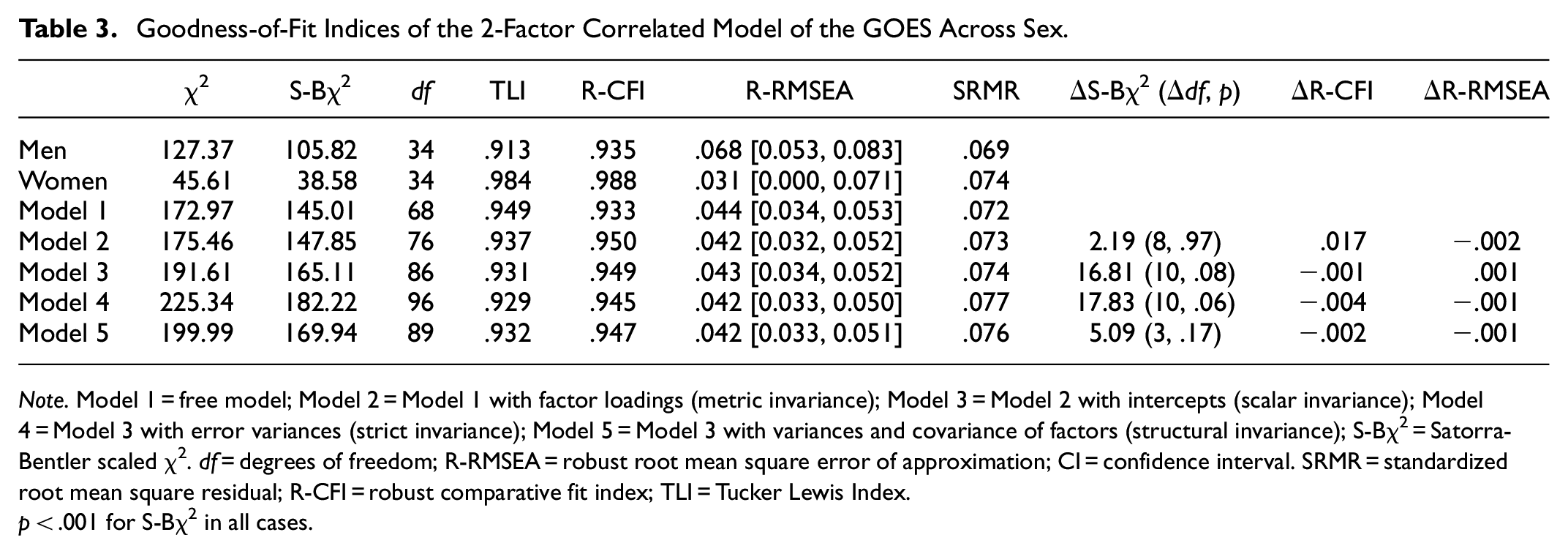
Note. Model 1 = free model; Model 2 = Model 1 with factor loadings (metric invariance); Model 3 = Model 2 with intercepts (scalar invariance); Model 4 = Model 3 with error variances (strict invariance); Model 5 = Model 3 with variances and covariance of factors (structural invariance); S-Bχ2 = Satorra-Bentler scaled χ2. df = degrees of freedom; R-RMSEA = robust root mean square error of approximation; CI = confidence interval. SRMR = standardized root mean square residual; R-CFI = robust comparative fit index; TLI = Tucker Lewis Index.
p < .001 for S-Bχ2 in all cases.
Once the factorial invariance of the GOES was confirmed, Table 4 shows the results of the analyses to test the difference in latent means according to sex. The model used to analyze these differences obtained adequate fit indices (S-Bχ2 = 167.41, df = 84,
Latent Means Differences Across Sex in the GOES.
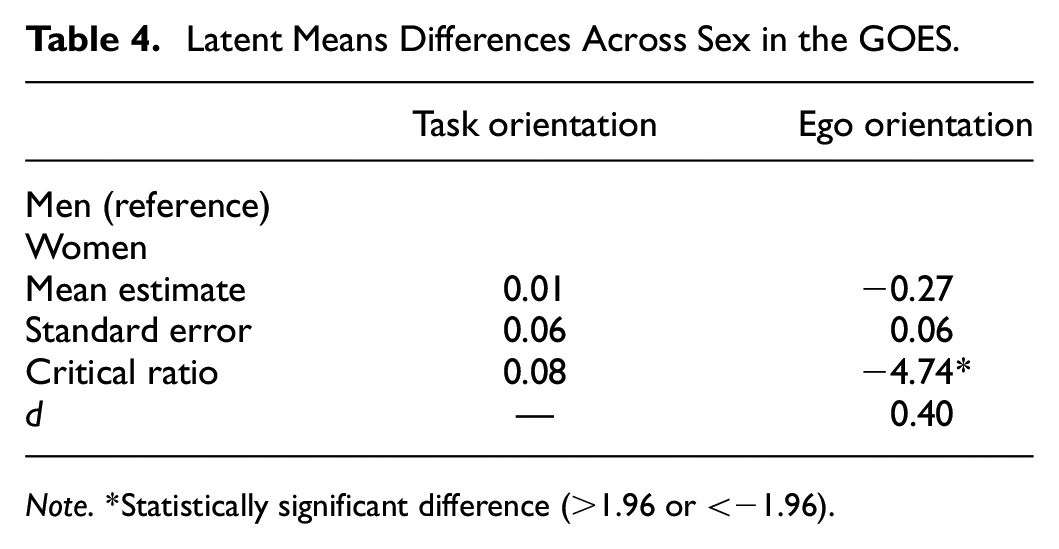
Note. *Statistically significant difference (>1.96 or <−1.96).
R-CFI = .948, TLI = .932, R-RMSEA = .041, CI = [0.032, 0.050] and SRMR = .75) and by setting the men’s group to zero, women scored significantly lower scores than men on the ego orientation subscale with a small effect size (d between 0.20 and 0.49). Regarding the task orientation subscale, there were no statistically significant differences.
Correlations Between the GOES, CD-RISC, and SWL
Regarding to the results of the Person’s product-moment coefficients of correlation, it is important to mention that the correlation between task-focused goal orientation and ego-focused goal orientation was not significant (p = .33) and was of .04. The relation between task-focused goal orientation and CD-RISC and SWL was significant in both cases (p ≤ .01) and was .41 and .22, respectively. With regard to the relation between ego-focused goal orientation and CD-RISC and SWL, both relation were significant (p ≤ .01) and they were .21 and .21, respectively.
Identification of Goal Orientation Profiles
As it can be seen in Figure 1, three task-ego orientation profiles were obtained according to the method explained above. The first profile (n = 192; 32.16%) was characterized by moderately high scores on task orientation and low scores on ego orientation (M-Hi-Ta/Lo-E). The second profile (n = 132; 22.11%) was characterized by low scores on task orientation and slightly high scores on ego orientation (Lo-Ta/S-Hi-E). Finally, the third profile (n = 273; 45.73%) presented high scores in both task orientation and ego orientation (Hi-Ta/Hi-E).
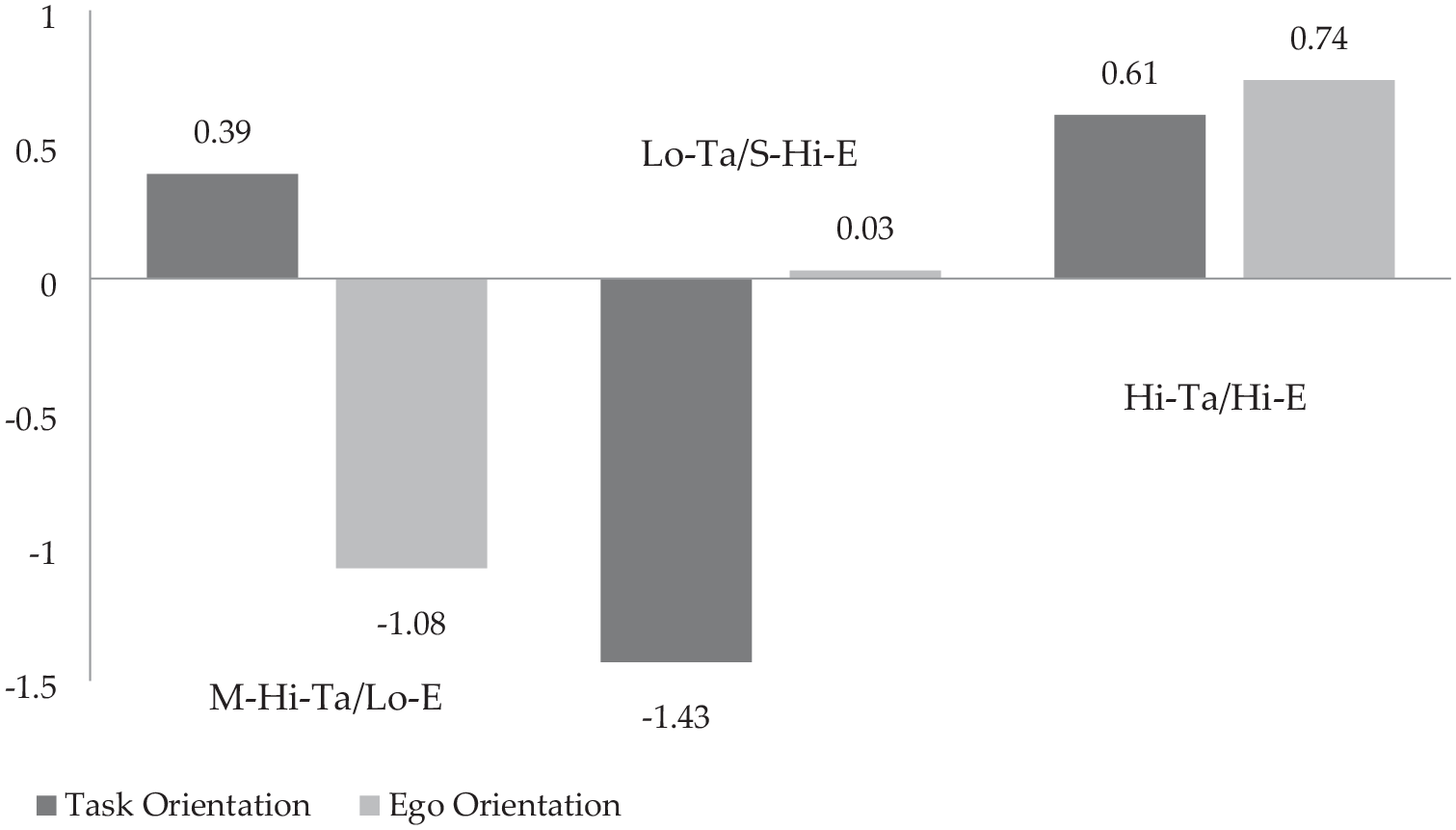
Graphic representation of the three-goal orientation profiles through cluster analysis.
Intergroup Differences in Goal Orientation Profiles in Resilience and Life Satisfaction
To test for statistically significant differences between the three-goal orientation profiles in resilience and life satisfaction scores, a MANOVA was conducted. This statistical analysis indicated that statistically significant differences were found in both variables (Wilks’ Lambda = .843, F(4,594) = 26.36; p < .001,
Means and Standard Deviations Obtained by the Three-Goal Orientation Profiles for the Resilience and Life Satisfaction Dimension.

Note. Profile M-Hi-Ta/Lo-E = moderately high scores in task orientation and low scores in ego orientation; Profile Lo-Ta/S-Hi-E = low scores in task orientation and slightly high scores in ego orientation; Profile Hi-Ta/Hi-E = high scores in both task and ego orientation.
After examining the post hoc comparisons, it could be seen that in the resilience variable, statistical differences were obtained between the three profiles. On the one hand, profile Hi-Ta/Hi-E scored significantly higher in resilience than profile M-Hi-Ta/Lo-E with a small effect size (d = 0.49; d = 0.48 for men; d = 0.49 for women) and significantly higher than profile Lo-Ta/S-Hi-E with a large effect size (d = 1.04; d = 1.06 for men; d = 0.95 for women). On the other hand, profile M-Hi-Ta/Lo-E scored significantly higher than profile Lo-Ta/S-Hi-E with a moderate effect size (d = 0.52; d = 0.51 for men; d = 0.57 for women). Regarding the life satisfaction variable, profile Hi-Ta/Hi-E scored significantly higher than profile M-Hi-Ta/Lo-E (d = 0.35; d = 0.33 for men; d = 0.49 for women) and Lo-Ta/S-Hi-E (d = 0.35; d = 0.34 for men; d = 0.49 for women), with a small effect size for both cases. There were no statistically significant differences between profile M-Hi-Ta/Lo-E and profile Lo-Ta/S-Hi-E in life satisfaction scores.
Discussion
The first objective of this study was to confirm the reliability of the scores of the GOES in an Ecuadorian sample of Sports Sciences students. To the best of our knowledge, there is no study that has analyzed the adaptation of this scale in this sample, much less through factorial invariance analysis. As expected according to the initial hypotheses, the two-dimensional model originally proposed by Kilpatrick et al. (2003) has been replicated for the first time in this sample, in which adequate levels of reliability were reported for the task and ego subscales, with coefficients of .79 and .90, respectively. More recent works such as Lochbaum et al. (2007) or Wahl et al. (2019) reported adequate reliability values for both subscales with Cronbach’s alpha coefficients above .70.
This instrument has been translated and applied in several languages, such as Portuguese (Cid et al., 2012) or Spanish (Moreno-Murcia & González-Cutre, 2006; Moreno-Murcia et al., 2006, 2007). On the one hand, Cid et al. (2012) found 61% of total variance explained and adequate internal consistency (Cronbach’s alpha coefficients of .71 and .91 for the task and ego subscales, respectively), although their confirmatory analysis showed an inadequate fit to the model (S-Bχ2 = 154.59; df = 34; p < .001; S-Bχ2/df = 4.55; SRMR = .06; TLI = .87; CFI = .90; RMSEA = .10; 90% CI RMSEA = [0.09, 0.12]). Therefore, the authors suggested caution in its use and more research in this regard. On the other hand, Moreno-Murcia and González-Cutre (2006) and Moreno-Murcia et al. (2006, 2007), with a Spanish translation in samples of Spanish practitioners of physical-sports activities, also found a total explained variance of 58% to 61% and adequate internal consistency (Cronbach’s alpha coefficients of between .71 and .80 and between .80 and .87 for the task and ego subscales, respectively). However, these authors also suggested further research in this regard, especially in different cultures or populations.
Along the same lines, our results also indicate adequate reliability and internal consistency values for both factors (α = .81 and α = .82 for the task and ego subscales, respectively). Given all that has been mentioned in relation to reliability and internal consistency, we can confirm that the results of this study are in full harmony with the original validation (Kilpatrick et al., 2003) and the adaptations made to Portuguese (Cid et al., 2012) and Spanish (Moreno-Murcia & González-Cutre, 2006; Moreno-Murcia et al., 2006, 2007).
On the other hand, and as a novelty to the previous literature, this paper presents the first evidence that the GOES is invariant across sex in an Ecuadorian sample of Sports Sciences students. In addition, and after the confirmation of the invariant structure of the instrument and its robustness, to the best of our knowledge this is the first study that analyzes the differences in latent means of the GOES across sex. In this sense, although no significant differences were found in the task orientation factor, there were significant differences in the ego orientation factor, in which it was observed that women scored significantly lower than men in this subscale, as previously described (Duda, 1989; Li et al., 1996). This seems to support the idea that there are some distinctions in how men and women are likely to construct their level of competence and process their experiences of success and failure. Therefore, even male and female do not differ in levels of task orientation, women probably value the context of physical exercise in a more cooperative way with others (e.g., doing one’s best, trying to focus on the group rather than on oneself), as opposed to a more competitive idea (e.g., being better than others, wanting to win at all costs), associated in this case with men.
The second objective of the current study was to identify the existence of subgroups of Ecuadorian students with different profiles of goal orientation to exercise. Thus, the existence of three profiles was determined: profile (1) moderately high scores in task orientation and low scores in ego orientation (M-Hi-Ta/Lo-E); profile (2) low scores in task orientation and slightly high scores in ego orientation (Lo-Ta/S-Hi-E); and profile (3) high scores in both task orientation and ego orientation (Hi-Ta/Hi-E). There is a lack of literature in this regard, as no previous work could be found that has analyzed the existence of different profiles of goal orientation to exercise as a function of the GOES. It can be found that some authors have suggested that future lines of research should focus on the study of profiles through cluster analysis (Moreno-Murcia et al., 2007), so the results of the present manuscript are pioneering in this aspect.
The third (and last) objective was to relate the identified profiles to resilience and life satisfaction scores. Thus, significant differences were found between the three profiles in resilience and life satisfaction scores, with profiles Hi-Ta/Hi-E and Lo-Ta/S-Hi-E having the highest and lowest scores, respectively, on both variables. In addition, significant differences were found in the resilience variable among the three profiles, with a large effect size between profiles Hi-Ta/Hi-E and Lo-Ta/S-Hi-E. In parallel, significant differences were found in the life satisfaction variable between profile Hi-Ta/Hi-E and profiles M-Hi-Ta/Lo-E and Lo-Ta/S-Hi-E, with a small effect size. These results could be justified from a motivational point of view in which task orientation has an essential effect. In this sense, high task orientations tend to be positively associated with the three basic psychological needs (Clancy et al., 2017), which could favor the control of emotions and the optimization of motivation to adequately manage the stressful situations of physical exercise and/or sports practice (Fletcher & Sarkar, 2012). Similarly, it has also been shown that optimal levels of motivation are necessary to withstand stress and competitive pressure (Standage et al., 2012), which is possibly closely related to resilience after all. Thus, the ability to control and efficiently manage this emotional fluctuation could be positively influencing the subject’s resilience and life satisfaction, and possibly also becoming an ideal scenario for its correct development.
No previous work analyzing the relationship of ego- and/or task-oriented profiles based on the GOES with resilience and life satisfaction has been found, which supports the novelty of current results. Nevertheless, in the following these results will be compared with those that have analyzed the relationship of ego- and/or task-oriented profiles with resilience or life satisfaction independently.
Resilience as a factor related to goal orientation toward exercise is still somewhat unknown, and the most similar recent theoretical models are in the field of sport and competitive performance (Fletcher & Sarkar, 2012; Galli & Vealey, 2008), and in this sense, the few existing works have reported direct relationships between resilience and task orientation (Arnold et al., 2017; Morgan et al., 2019; Secades et al., 2016; Tudor & Ridpath, 2018). On the other hand, in the educational and/or clinical setting, it has also been possible to see how task orientation is directly related to resilience in Mexican high school students (Torres-Cruz & Ruiz-Badillo, 2012). Similarly, Ramírez-Granizo et al. (2020) recently concluded that the motivational climate favoring task orientation in fifth and sixth grade children was also directly related to resilience.
Thus, although our results are hardly comparable with previous literature, they are along the same lines. Profiles M-Hi-Ta/Lo-E and Hi-Ta/Hi-E, which showed the highest levels of task orientation, also showed the highest levels of resilience. Likewise, profile Lo-Ta/S-Hi-E, which had slightly high levels of ego orientation and low levels of task orientation, showed the lowest resilience scores. Profile Hi-Ta/Hi-E showed the highest levels of resilience, despite scoring high in both task orientation and ego orientation, probably due to the type of sample analyzed. Given that they were Sports Sciences students, who are used to regularly practice some kind of competitive sport, this result is probably due, for example, to the strong need of the athlete to sometimes pay more attention to the result than to the learning of new skills. This has also been previously reported by Reyes-Bossio (2009), who suggested that the presence of both orientations is essential for the correct adaptation and adequate confrontation to the situations of sport competition.
On the other hand, the relationship of goal orientation toward exercise and life satisfaction in the identified profiles followed a similar trend to that shown for resilience. Those profiles with high scores in task orientation have shown the highest scores in life satisfaction (i.e., profiles M-Hi-Ta/Lo-E and Hi-Ta/Hi-E), whereas profile Lo-Ta/S-Hi-E, which showed the lowest scores in task orientation, obtained the lowest scores in life satisfaction. Similarly as with resilience, profile Hi-Ta/Hi-E scored the highest on life satisfaction, even though it scored high on both task orientation and ego orientation.
These results are in the same direction as previous research in this regard, which reports, albeit without the use of profile analyses, that task orientation correlates directly and significantly with life satisfaction (Cabras & Mondo, 2018; Gutiérrez et al., 2017; Poulsen et al., 2006; Usán-Supervía et al., 2020). Poulsen et al. (2006) found that task-oriented goal adoption was directly related to life satisfaction in Australian children aged 10 to 13 years. Cabras and Mondo (2018), in a sample of Italian first-year university students, also reported that task-oriented strategies significantly influenced higher life satisfaction. Similarly, the studies of Gutiérrez et al. (2017) and Usán-Supervía et al. (2020) revealed highly significant relationships between these two variables in Spanish students in high school and baccalaureate.
The main strengths of this work lie in the novelty of the results presented, since most of them are pioneers in this field. Both the factorial invariance analysis and the use of profiles in the relational analyses with resilience and life satisfaction are, undoubtedly, the gaps that this work intends to fill in the frontier of current scientific knowledge on the subject. However, this also implies a limitation, due to the lack of studies analyzing similar aspects with which to compare the results. It is suggested that future research lines could be focused in other age groups (Primary School or High School students) and in other Spanish speaking countries to be able of comparing the results of the current study with other cultures and other age groups. Besides, it is another limitation to have only considered an undergraduate sample, so it is suggested that future research lines could be focused in other age groups (Primary School or High School students) and in other Spanish speaking countries to be able of comparing the results of the current study with other cultures and other age groups. Moreover, the analyses that has been used in the current study have been correlational. Consequently, we have found a limitation regarding the causality of our results, so future studies could analyze through longitudinal studies the change of goal orientation scores over time and analyzing the causal relationship between goal orientation scores and resilience and life satisfaction scores through structural equation modelling approaches.
In conclusion, this work provides a new adaptation of the GOES in an Ecuadorian sample of Sports Sciences students. It also presents the first piece of evidence about the invariance of this scale across sex in this sample, as well as the first analysis of latent mean differences between both sexes. In addition, the existence of three profiles of goal orientation toward exercise was identified, which have been related for the first time to resilience and life satisfaction. Thus, those profiles with high scores in task orientation showed the highest scores in resilience and life satisfaction, and vice versa. Consequently, the students, researchers and professionals of the sports field can consider these findings and applying them in their chore.
Footnotes
Declaration of Conflicting Interests
The author(s) declared no potential conflicts of interest with respect to the research, authorship, and/or publication of this article.
Funding
The author(s) received no financial support for the research, authorship, and/or publication of this article.

Data Availability Statement
To our regret, these data are part of a larger research project that has yet to be published and cannot yet be made public.